A team of candidates led by former Woodlands Wellington manager R Vengadalasam also wants to institute a system of promotion and relegation in Singapore’s local football leagues.
Source link
Singapore football election hopefuls propose all-local S.League
F1 back-markers hope to make their mark

These are the Formula One drivers who would hardly dream of a podium finish, let alone a race victory. Usually starting from the back of the grid, they often have to endure the ignominy of being lapped by the race leaders on the track.
For the drivers who sit at the tail-end of the driver standings, it is all about being optimistic and taking baby steps as they look to move up the grid and go forward in their budding racing careers.
And one such example is Renault’s Jolyon Palmer. The rookie driver said: “It’s all about making the best out of what I can. I’m not struggling for motivation.
“If you want to make it in racing, you’ve to have a huge amount of determination. For me, there were many times when I felt I wasn’t going to make it into F1.
“But you got to keep pushing, got to keep showing your best and opportunities will just arrive.”
328753
Photo GalleryF1 drivers arrive for Singapore Grand Prix 2016
-

<!–
-

<!–
-

<!–
-

<!–
-

<!–
-

<!–
-

<!–
-

<!–
-

<!–
-

<!–
-

<!–
-

<!–
-

<!–
-

<!–
-

<!–
-

<!–
-

<!–
-

<!–
-

<!–
-

<!–
-

<!–
-

<!–
-

<!–
-

<!–
-

<!–
-

<!–
-

<!–
-

<!–
The Briton was a reserve driver last season with Lotus, and was handed a promotion to a full-time seat this season.
When Renault took over Lotus last December, however, they switched from a Mercedes engine to a Renault one late on, which puts the car “a year behind” in terms of development. “It’s been difficult, I must admit, because we haven’t really had the car to be fighting up the field,” the son of former F1 driver Jonathan said.
“It’s not easy but I’ve learnt a lot and I’m improving in every race. I put pressure on myself to move forward. My first goal was to drive an F1 car, then to race one – both I’ve done. Now, it’s to get some points, a podium, win a race and the championship.”
Before tonight’s Singapore Airlines Singapore Grand Prix, Palmer is ranked 20th in the driver standings without any points on board.
He said: “Of course I want to be higher but it’s just how it is. If you take a look at the driver standings, apart from the top, it’s not very representative of the drivers’ quality.
“You have to take it one by one, especially in my current situation where I’m struggling at the back with Renault. It takes a long time and each step is important.”
F1 Singapore Grand Prix 2016
Click on thumbnail to view photos. Source:
Singapore GP










Before F1, Palmer raced in the GP2 Series and was also an F2 driver but F1 has taken him to another level. He said: “The higher up you go, the more pressure and work it is. F1 requires a lot of thinking and if you miss a beat on the circuit, it’s very difficult to make up ground but you enjoy it as well because you love what you do.”
Ultimately, the aim for rookies and back-markers is longevity – being picked up by better teams and spending the best part of their racing careers at the elite level.
Said Palmer: “I hope I do last long in the sport. I want to still be here in 10 years’ time because that means I’ve done a good job.
“I’d probably have had some podiums, won some races and maybe even a championship – I’ll be doing something right.”

This article was first published on September 18, 2016.
Get a copy of The Straits Times or go to straitstimes.com for more stories.
Image:

Publication Date:
Sunday, September 18, 2016 – 18:00
Keywords:
Send to mobile app:
Source:
Story Type:
Others
'I didn't know a blind person could bowl'
The Rio Paralympics 2016, which ends today, shines a spotlight on elite athletes with disabilities, igniting a fresh wave of celebration of the determination and grace of these sportspeople.
Yip Pin Xiu clinches Singapore’s second gold medal at Paralympics
Click on thumbnail to view photos. Source:
AFP, Reuters, The Straits Times, MCCY, Singapore Sports Council








.jpg)
































Outside of a competitive arena, there are also many opportunities for people with disabilities to take part in sports for recreation.
The Singapore Disability Sports Council, for example, offers a range of sports suited to different disabilities. These include badminton, wheelchair racing, cerebral palsy football, equestrian sport, handcycling, sailing, swimming, shooting and goalball, where blind or partially sighted players wear eye shades for parity and score goals with a ball containing bells.
Ms Judy Wee, senior manager at Muscular Dystrophy Association Singapore, says it has seen more people taking up its sports programmes which are suitable for people with severe disabilities. These sports are powerchair football, played using motorised wheelchairs, and boccia, a ball game that can be played by wheelchair-users with motor-skill impairments.
Boccia can be played by individuals, in pairs or in teams of three. Players throw or roll coloured balls as close as possible to a white target ball or “jack”. The individual or team with the most balls near the jack wins.
Despite the range of disability sports available, not many people are aware of them, says Dr Marissa Medjeral-Mills, executive director of the Disabled People’s Association. “The Paralympics help in increasing awareness, but a lot of people don’t know that those with disabilities can be sporty. People also don’t know how to include them in sports,” she says.
In general, she says, there are ways to modify sports to make them more inclusive, such as using hand gestures instead of whistles so deaf people can participate in football matches.
Besides benefits for health and mental well-being, sports allows people with disabilities to socialise, as some of them may be isolated at home or not working, she says.
While barriers to entry still exist, such as expensive, specialised transportation to accommodate wheelchair users, stakeholders are also encouraging people with disabilities to take up sports.
The Singapore Disability Sports Council conducts monthly awareness programmes and adapted sports activities as rehabilitation for people with disabilities.
There are considerations when organising sports activities for people with disabilities. People with severe disabilities may not be able to take part in games with those who are higher-functioning physically, in case they get injured, notes Ms Wee.
But people do not necessarily have to play to participate. Even being a spectator can do wonders in making people with disabilities feel included, she adds.
RETURNING TO A TEENAGE PASTIME
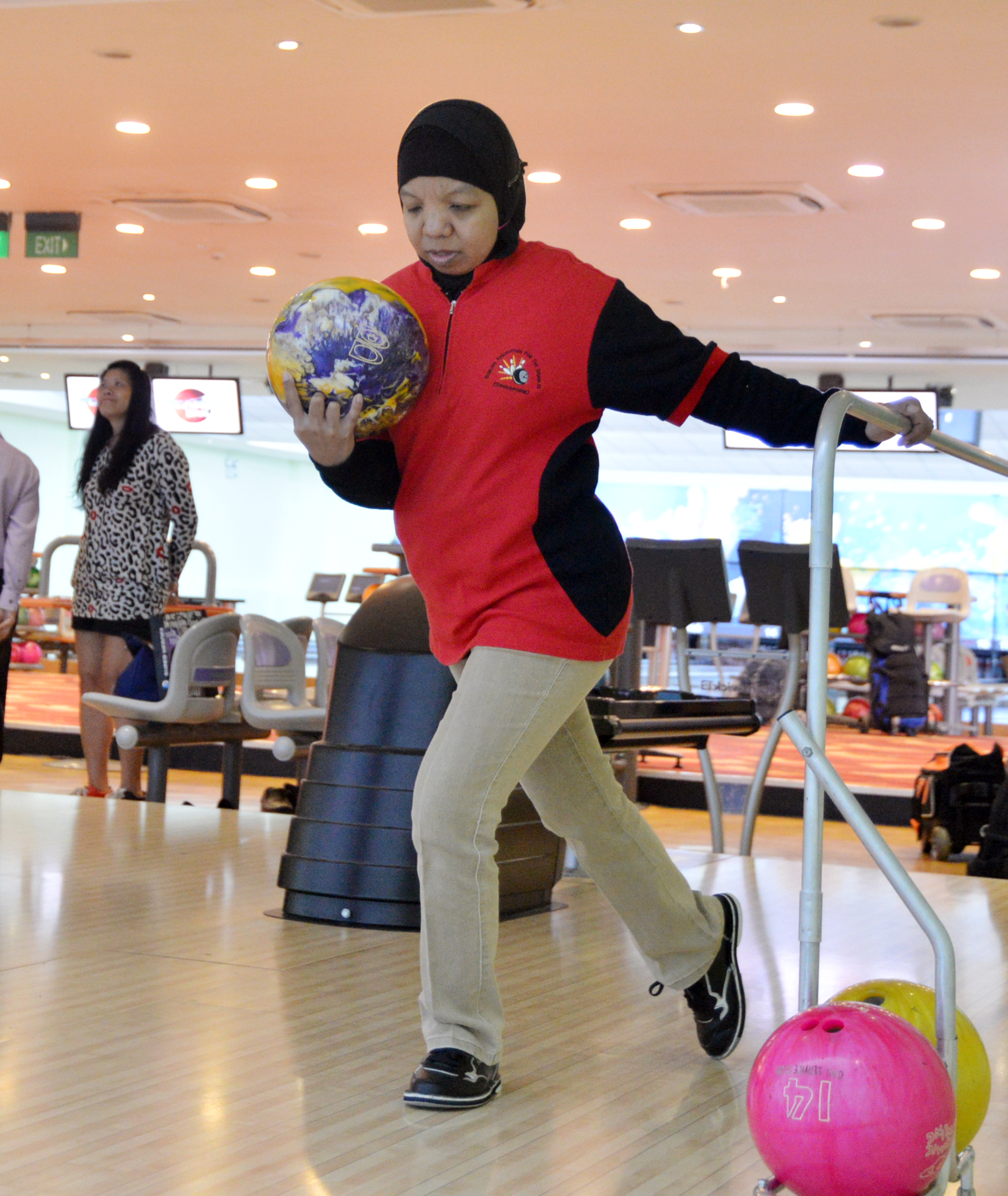
After she became blind, Ms Siti Rossaliza Rosli (pictured), 36, returned to a sport she picked up in her teens: bowling.
She often bowled with her cousins when she was in secondary school because the sport was relaxing enough for her heart condition.
As a child, she was diagnosed with mitral stenosis, which is characterised by a narrowed heart valve. This made her tire easily and she was exempted from physical education in school. She underwent heart surgery in adulthood to correct the condition.
In 2010, at age 29, she received another medical blow – she was diagnosed with glaucoma, a disease that damages the optic nerve and usually affects older people.
Like many sufferers who had no early symptoms, she thought she was simply myopic until she saw a doctor when she had blurred vision. She was almost blind in her right eye by the time she was diagnosed in 2010.
She had to leave her job as a kindergarten teacher and, over the subsequent three years, she lost all of her sight, despite having surgery to try to save her left eye.
There was no family history of the disease, apart from her late grandfather, who had glaucoma in his 70s but did not go blind. Her father, 65, works in a mosque and her mother, 58, is a housewife.
She recalls feeling frustrated during the two years after her diagnosis and rarely going out.
In 2013, her uncle mentioned he had seen an advertisement of a blind athlete bowling in pitch darkness.
It sparked in her a new fascination with an old pastime.
“I didn’t know a blind person could bowl,” she says. She did some research and discovered the Bowling Association for the Disabled (Singapore), signing up for lessons to learn to bowl as a blind person.
She initially found it “very tough”, throwing a lot of gutter balls before she mastered the skill, such as using a guide rail, which is a frame set up at the edge of a lane to help blind bowlers orientate themselves.
These days, Ms Liza, who works as a call agent at a telemarketing firm, and her husband, Mr Nazarudin Abd Razak, 38, go bowling once a week. They have no children.
Mr Nazarudin, a freelance masseur who is partially sighted, is an athlete, representing Singapore in goalball at the ASEAN Para Games held here last year.
Ms Liza says bowling has enlarged their circle of friends and the activity has given her more energy. “I want to stay healthy. Bowling is one thing I know I can do.”
BEING DEAF NO HINDRANCE
Deaf since the age of three after a high fever, Mr Jimmy Chan has always led a sporty lifestyle.
The 45-year-old runs marathons, works out at the gym and goes rock- climbing.
He also trains both able-bodied and disabled people in sports such as strength training and dragon- boating at social enterprise Society Staples.
Among the challenges he took up was participating in an Operation Raleigh expedition in Siberia in his early 20s, which involved trekking and helping with scientific research.
“If I just focused on one sport, I wouldn’t be satisfied. I want to try many types of sport. Persons with disabilities can achieve in sports, the same as normal people,” he says.
The senior process designer in the oil and gas industry is married to a 37-year-old teacher. They have two daughters aged 13 and five.
As a pupil at a school for the deaf, he looked forward to physical education lessons and playing football with his friends. He also took up badminton and table tennis.
When he became deaf, he had to learn sign language based on English. His parents, who were school- bus drivers, spoke only Mandarin.
They eventually picked up basic words in English, but it was an uphill journey made easier only when his two sisters – one older, the other younger – gradually picked up simple sign language during their childhood.
Sometimes, communication with coaches can be fraught. He once left a running club because the coach refused to slow his speech so that Mr Chan could lip-read instructions.
At other times, communication challenges are not immediately apparent as his disability is not visible. For example, since his 20s, he has been rock-climbing, where safety depends on the skill of belaying, a partnered technique where another person is attached to the climber by rope.
Belaying usually depends on clear verbal communication. Because Mr Chan often cannot speak clearly, he has to work closely with his belayer, for instance, by prearranging hand signals to ensure a safe climb.
He has enrolled his daughters for rock-climbing lessons as he believes the sport tests one’s determination. He says: “I want my children to follow in my footsteps and aim to achieve in sports as well as studies.”
PLAYING TENNIS AND BASKETBALL IN A WHEELCHAIR
When Mr Palanisamy Avaday was in his late teens, a stranger stopped him in the street and asked if he wanted to take up sports.
Mr Palanisamy, 65, contracted polio at the age of seven and was using a caliper, a support for his polio-affected right leg, at the time. For longer distances, he used a wheelchair.
He replied: “What can a disabled person do?”
The stranger turned out to be the late Abdul Wahid Baba, a pioneer wheelchair-using Paralympian in Singapore who co-founded the Society for Aid to the Paralysed, now known as SPD, an organisation that serves people with disabilities.
Mr Abdul Wahid persuaded the teen to try playing wheelchair basketball with a team he had gathered.
Mr Palanisamy found the training, which included lifting weights, tiring. But he stuck with it and eventually felt motivated to take part in other disability sports such as archery and athletics.
From the late 1970s, he represented Singapore in competitions such as the Far East and South Pacific Games for the Disabled. He won several medals, including a gold for wheelchair tennis at an international tennis tournament in the 1990s.
The senior project executive at Bizlink, a non-profit organisation that offers employment assistance and training for people with disabilities, left competitive sport about 10 years ago, but feels it is important to stay healthy.
He does sit-ups and lifts dumbbells daily and watches his diet, avoiding high-cholesterol and oily food. Married to a 62-year-old telemarketer, he has two daughters who are in their 30s.
He has been trying to recruit younger people with disabilities to play basketball with the Wheelchair Basketball Association (Singapore), of which he is a committee member.
One young person told him that since he was already disabled, he did not want to be further disadvantaged by injuries from playing basketball.
“But there are rules and regulations,” Mr Palanisamy says. “It’s not dangerous, it’s a very exciting sport.”
This article was first published on September 18, 2016.
Get a copy of The Straits Times or go to straitstimes.com for more stories.
Image:

Publication Date:
Sunday, September 18, 2016 – 18:00
Keywords:
Send to mobile app:
Source:
Story Type:
Others
iPhone 7 'seller' scams a dozen of more than $10,000
SINGAPORE – About a dozen people who paid deposits for brand new iPhone 7 sets have been left empty handed, Shin Min Daily News reported.
One victim, who is in his 30s, said that he saw a listing for a 128GB iPhone 7Plus in jet black on online marketplace Carousell for $1,480 on Monday (Sept 12).
The events planning manager, who did not wish to be named, told Shin Min that the seller claimed to know an employee in a telco, and can get his hands on the smartphone, which is in high demand worldwide.
He bargained with the seller, and agreed to buy the phone at $1,460. The seller then asked for a $200 deposit, claiming that he needed it to secure the phone.
The seller even sent him a photo of his identity card and driver’s licence to secure his trust.
Later, the victim read reports that the jet black model of the phone was not available in Singapore and questioned the seller about it.
iPhone 7 launch in Asia
Click on thumbnail to view photos. Source:
AsiaOne, Reuters, The Straits Times, AFP





























They arranged to meet at Bugis Junction at 3pm on Friday to make the transaction, but the seller could not be contacted from Friday morning onwards.
The victim made a police report on Friday evening. He also found other victims who had left messages for the seller online.
He told Shin Min there are 15 people who suspect they have been cheated. Most paid deposits of $200 to $400, two paid more than $1,000, and one victim about $4,600.
Police said that investigations are ongoing.
A quick check of Carousell revealed dozens of iPhone 7 listed for sale, as well as requests to buy the device.
Apple Holds Press Event To Introduce New iPhone
Click on thumbnail to view photos. Source:
Reuters, AFP
























This article was first published on Sept 17, 2016.
Get a copy of The Straits Times or go to straitstimes.com for more stories.
Image:

Publication Date:
Sunday, September 18, 2016 – 16:49
Keywords:
Send to mobile app:
Source:
Story Type:
Others
Joanne Peh and Qi Yuwu 'working hard' to conceive second child

Actress Joanne Peh is making her return to local drama serials after taking a break for two years.
At a lensing ceremony last Wednesday (Sept 14) for upcoming TV series Dream Coder, she shared how her daughter, ‘Little Qi’, is just learning to walk at 13 months. She also revealed that the couple are working hard to conceive again, despite being in a long-distance marriage, My Paper reported.
Husband Qi Yuwu, who is based in Beijing, flew to Singapore on Sept 9 to celebrate their two-year wedding anniversary with a candle-light dinner. Peh shared that they made use of the romantic opportunity to hopefully give their daughter a little brother or sister.
But with the spread of Zika in Singapore recently, are they worried? “We have taken precautions are are more careful,” said Peh.
Joanne Peh gives birth to daughter nicknamed “Baby Qi”
Click on thumbnail to view photos. Source:
The New Paper, MM2 Entertainment, Joanne Peh & Qi Yuwu, The Straits Times

































No tech for Little Qi
Although she’s a proponent of all things digital, but for now, Peh does not allow her daughter to touch her mobile phone, the computer or even watch TV.
“I know we can’t deny that technology plays an important role in our society, but we’ll wait till she is older and knows self discipline before allowing her to use the computer,” said Peh.
And no iPads for her either.
Peh added that when her daughter was outside for dinner and saw a boy playing with a tablet, she was curious and went over to press the touchscreen.
But the couple believe that at her age, personal interaction is most important.
candicec@sph.com.sg
Image:

Publication Date:
Sunday, September 18, 2016 – 16:14
Keywords:
Send to mobile app:
Source:
Rotator Image:

Story Type:
Others
Man who stared Death in the face
The sun is about to set, casting a golden glow on the rugged landscape of the Gobi Desert. I am standing at the foot of the Khan Bayanzurkh mountain in Sainshand in the province of Dornogovi in Mongolia, and looking at the summit with dread.
The locals call it Wishes Mountain. The spirit of a Gobi lord is believed to live at the top, and if you walk three times around the ovoo – sacred stones placed in a heap to serve as an altar – and toss vodka and other offerings, whatever you wish for apparently will come true.
To get to the peak, standing at 1,070m, I would have to navigate a pathway with a gazillion steps, a prospect my tired body does not relish. I have been up since 6am, and spent about seven hours travelling nearly 500km from Ulaanbaatar to Sainshand; my butt is sore from sharing the backseat of an SUV with two other people.
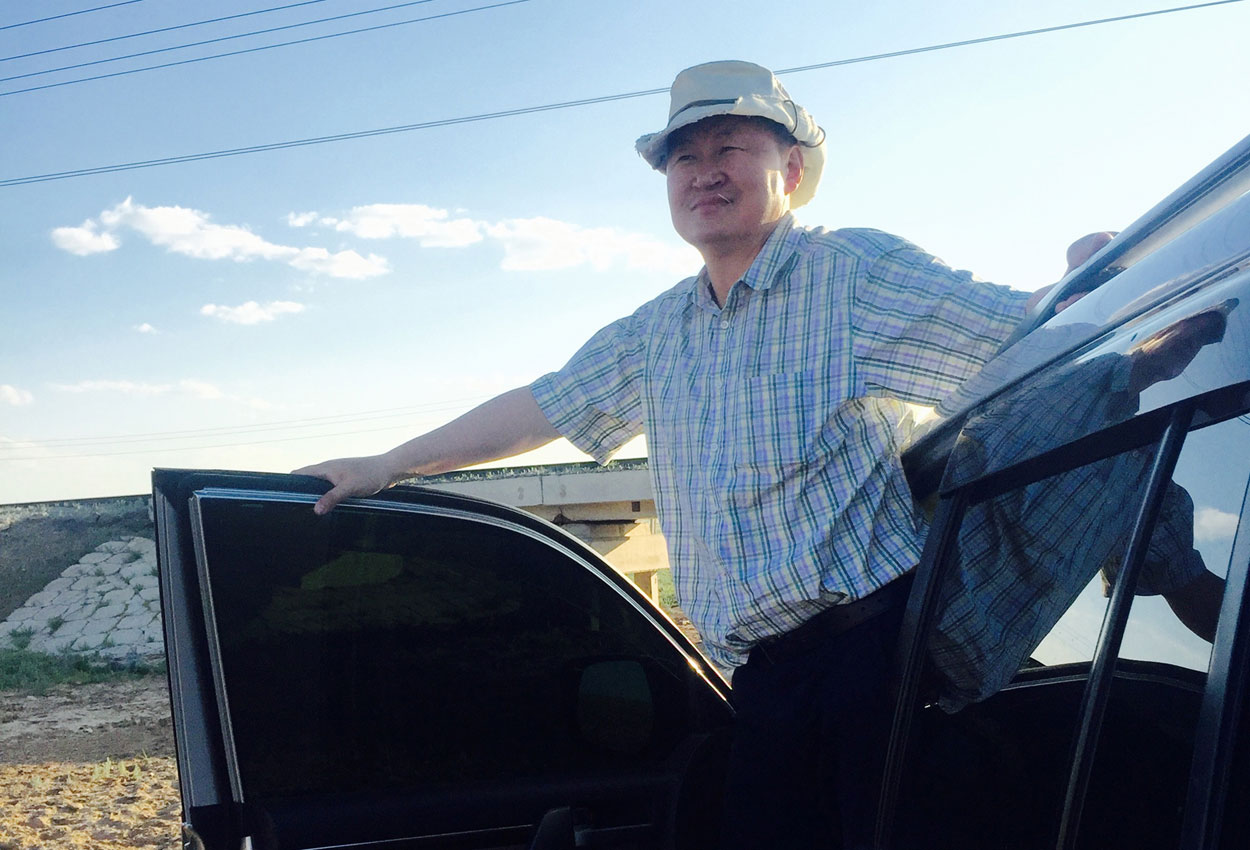
Unfortunately, Mr Damdindorj Puntsagdorj – or Damdin, as we know him – is already making his way up the mountain with nary a pause. His energy beggars belief, especially as he has spent more than seven hours behind the wheel, at times steering the SUV through intestine-jolting terrain.
Then again, what is scaling a puny mountain for a man who, just two years ago, was in a vegetative state, vacillating between life and death for nine months?
He is the reason I am in Mongolia with four of my Singaporean friends. We wanted to see the man who stared Death in the face and came back with a tale of hope, kindness and resilience.
It all started on Jan 5, 2014, when Damdin, 52, arrived in Singapore with his wife Otgo, 51, son Nagy, 29, and daughter Anu, 15, for a family vacation.
That night after dinner, the former deputy director of the Research Institute of Animal Husbandry in Mongolia grappled with a massive migraine. His face turned ghostly white and he started vomiting.
Because they were staying in a hotel in the Bugis area, his son took him to Raffles Hospital, where he collapsed. A CT scan revealed that he had an aneurysm which resulted in a bleeding stroke.
Another stroke hit two months later. He went into a coma twice, and was in a vegetative state during the six months he spent at Singapore General Hospital and Tan Tock Seng Hospital.
A strapping Mongolian who tipped the scales at 110kg before this, he lost more than 40kg during this period.
According to his family, he also once stopped breathing and had 10 operations to, among other things, secure the aneurysm, manage brain infection and treat cerebrospinal fluid build-up.
Dr Nicole Keong was one of the doctors who treated him in Singapore.
“He was critically ill for most of his stay here and his medical management was complex,” says the neurosurgeon at the National Neuroscience Institute.
The odds for such patients, she adds, are not good. Up to a third may die or suffer severe damage to the brain or multiple organ systems.
Damdin spent another three months in a vegetative state after he flew home to Mongolia. His family, meanwhile, was put through the wringer financially, emotionally and psychologically.
Because he did not have travel insurance, Damdin’s hospital bills quickly became a six-figure nightmare.
By the second week of his stay in hospital, Otgo and Nagy were reduced to sleeping on newspapers on the floor next to Damdin’s bed in hospital.
Their savings quickly ran out. Otgo had to sell jewellery, clothes and, later, even land to keep her husband alive.
The family also had a crash course in humanity, and saw its faces both ugly and beautiful.
Friends whom they trusted deserted them; relatives whom they thought they could rely on turned their backs on them.
Nagy – then a foreign relations manager in a Mongolian investment holding company – lost his job. His employers said they sympathised with his situation but could not allow him to stay away from work for such a long time.
“I was so depressed; I even thought of killing myself,” he says.
Fortunately there were silver linings.
Through a medical social worker, my friend Josie – whose family runs a budget hotel – came to know of their plight.
Josie and family not only gave Otgo and Nagy a free room for several months, they also gave the Puntsagdorjs a lot of emotional support.
Otgo says there were also other angels in Singapore who rallied around them.
One Mongolian woman living in Singapore told Otgo never to give up until the last minute.
“There was another Mongolian family with two little girls. One of them drew a picture of my husband, out of hospital, and looking healthy. The little girl’s drawing gave me a lot of strength,” she says.
Kind Singaporeans offered comforting words, and sometimes bought them meals. A Singapore property developer – who has an office in Ulaanbaatar – later offered Nagy a job as a marketing executive.
Otgo says: “We found priceless friendships in the most unlikely places.”
On June 18, 2014, Damdin – still unconscious – flew home to Ulaanbaatar; he was on a hospital bed and was accompanied on the flight by a nurse.
Nagy says: “The doctor told us my dad might be in a vegetative state for a long time or he might recover. The future was unknown. We had to leave because the longer we stayed, the higher the hospital bill would soar.”
Upon arrival in Ulaanbaatar, Damdin was admitted to a Mongolian hospital and discharged 10 days later. Doctors told his wife there was nothing they could do.
Otgo, a former paediatrician, recalls: “They said he might stay like this forever so he would need lifelong support and care from family members. I couldn’t give up, I had to stay strong.”
An agnostic, she sought help and comfort from Catholic nuns and even a Mongolian shaman.
Every day, she would talk to Damdin as she massaged him.
“I told him he was too young to go to the sky; I told him the children still needed him,” she says
One day in mid-September 2014, Damdin’s eyes suddenly opened.
“He just started crying, big tears rolling down his cheeks,” Otgo recalls.
But he could not recognise his loved ones.
Fortunately, his memory slowly came back as did his mobility, although his balance was wonky and he often fell in the first few weeks.
Over the next few months, Otgo forced her husband to read from newspapers and then grilled him on what he had just read.
“I’d send him out to the shops and make him run errands and I’d follow behind to see if he got lost or forgot to do what he was supposed to do,” says Otgo, who updated those who had helped her each time Damdin had a breakthrough.
In February last year, she whatsapp’d Josie the following update in fractured English: “Now my husband feeling good. Don’t worry and you are all come together to Mongolia. I always talk about you for my husband and he knows all your names.”
That is what has brought us – Josie, me and three other people whose paths crossed with this family’s in Singapore – to Mongolia 18 months later.
It is a unique trip in more ways than one. Mongolia is a harsh but stunningly beautiful land, one where the clouds tell stories and the vastness sings.
But more than just an expedition to see the new and the wondrous, the trip is a reminder that friendship, empathy and humanity can really add colour and meaning to our time on earth.
The worst is over for Damdin, Otgo, Nagy and Anu, but they still have worries. They have a mountain of debts which will take them years to settle but they are intent on paying back every cent.
Damdin – who hopes to go back to work soon – feels bad that he has put his family through so much.
“It is a lesson and the cost has been high. But I’m proud my family and I went through these challenges and survived. We are now stronger.”
Strong he definitely is; he reaches the ovoo a good 10 minutes before I do.
I do not know what he will wish for. But when I get to the summit of Wishes Mountain and toss milk and rice into the desert air, I will ask for strength, and friends and family who will always be there for me.
This article was first published on September 18, 2016.
Get a copy of The Straits Times or go to straitstimes.com for more stories.
Image:
Publication Date:
Sunday, September 18, 2016 – 16:02
Send to mobile app:
Source:
Story Type:
Others
Death toll in Pakistan suicide bombing rises to 36

PESHAWAR, Pakistan – The death toll from a Taliban suicide bomb attack on a mosque in northwest tribal Pakistan has risen to 36, including eight children, officials said on Sunday.
The Friday attack targeted a mosque in the Mohmand tribal district bordering Afghanistan where the army has been fighting against Taliban militants.
“We have now compiled a list of victims of the blast which includes 36 dead and 27 injured. At least eight children below the age of 10 years are among the dead” Naveed Akbar, deputy chief of the Mohmand tribal district administration, told AFP.
“Many children were hit in the blast because they were praying in the last rows in the mosque where the bomber struck,” Akbar said.
The bomber came in as Friday prayers were in progress and blew himself up in the main hall. A curfew has been imposed in the area since the bombing.
Taliban faction Jamaat-ul-Ahrar (JuA) claimed responsibility for the attack, saying it was carried out to avenge the deaths of 13 of its members and arrests of others by a local vigilante force in 2009.
Since 2007 the government has encouraged vigilante forces comprising tribesmen – locally known as peace committees – to defend their villages against the Taliban.
Pakistan’s deadliest ever attack occurred in Peshawar in December 2014, when Taliban militants stormed a school killing more than 150 people, mostly children.
The army launched an operation in June 2014 in a bid to wipe out militant bases in the northwestern tribal areas and so bring an end to the bloody insurgency that has cost thousands of civilian lives since 2004.
Last year, the country recorded its lowest number of killings since 2007, when the Pakistani Taliban was formed.
Image:

Publication Date:
Sunday, September 18, 2016 – 15:24
Keywords:
Send to mobile app:
Source:
Story Type:
Others
Rain washes out final day of Australia-Slovakia tie

SYDNEY – Rain washed out the dead reverse singles matches on the final day of Australia’s Davis Cup World Group play-off with Slovakia in Sydney on Sunday.
Australia clinched their place in the 2017 World Group after taking an unassailable 3-0 lead when they won Saturday’s doubles.
Nick Kyrgios and Bernard Tomic put Australia in command with straight-set victories in Friday’s singles before Sam Groth and John Peers won the doubles.
Australia, captained by Lleyton Hewitt, will play in the World Group for a fourth consecutive year in 2017.
“We feel quietly confident no matter who we come up against, whether it’s home or away,” Hewitt said of the imminent draw.
“If we can have our two main guys with one (Kyrgios) pushing close to the top 10, the other (Tomic) 15 to 20, it’s certainly a pretty strong team on paper.” Australia are second only to the United States on the all-time list of Davis Cup champions, having won the title 28 times.
Image:

Publication Date:
Sunday, September 18, 2016 – 15:04
Keywords:
Send to mobile app:
Source:
Story Type:
Others
More apps for lonely adults who want to find friends
Meetup.com is too slow. Tinder comes with too much negative baggage.
Enter a clutch of friendshipseeking and community-building apps – Sup, Lunch Kaki, Wander and Motivatormob – for bored or lonely young adults not looking for romantic entanglements.
Ms Jen Wei Qing, the 35-year-old co-founder of Sup, says: “We’re used to everything being on demand so there is no reason why friendships could not be more portable as well. Because the app recommends events to you and connects you to the right people to go with, it acts very much like an Uber for friendship.”
No matter the hundreds of friends millennials might have on their social media platforms, they probably interact regularly only with the same close handful of people – frequenting the same places with the same people and talking about the same things a few too many times.
For many young adults who have grown up on the immediacy of social connection on platforms such as Twitter and Facebook, this real- world friendship gap can be disconcerting.
No surprises then that friendship has become the newest area to go mobile.
Free from the slower response time of traditional community portals such as Meetup.com and the many negative stereotypes that plague dating apps such as Tinder, this new generation of social apps is catered to efficiently connecting like-minded people – no matter one’s age, gender or relationship status (although the founders acknowledge that users may go from being platonic friends to romantic partners).
In Singapore, there are at least three such apps that have recently launched.
For Ms Jen, the irony of being unable to translate digital connections into real-life interaction spurred her to launch Sup – which she calls “Tinder for social life” – with her Harvard University schoolmate in January this year.
Sup – short for “What’s up” – helps to connect users to friends who are nearby and available immediately for an activity.
The app makes these connections by mining relevant information such as geographical location, interests and mutual connections from users’ Facebook profile and contact list and running it through a proprietary algorithm.
Over time, the algorithm learns from user behaviours so suggestions become more relevant the more you use the app.
The response time to a user’s activity request? Typically within 30 minutes, says Ms Jen.
This immediacy of connection is also a huge selling point of local social networking app Lunch Kaki, designed to help people connect and socialise over lunch.
Founded by Mr Melvin Tan, 35, the app launched in November 2014 and currently has more than 20,000 registered users who are mainly working in professional fields such as finance and engineering.
For the ex-stockbroker, the idea came about during a period when he was unemployed for seven months.
“During that time, I realised that it would be helpful to have a way to meet new people and casually network with people in my industry,” he says. “Plus, my wife who worked in the city would also mention how she did not like to dine alone, which made me realise there was potential for an app like Lunch Kaki.”
This desire to connect like- minded individuals for platonic friendship is why he says he has made the conscious effort to not market the app as one that promotes romance.
“Dating apps are an easy way to quickly meet people, but users come with their own set of expectations and the apps exclude people who are in committed relationships but might just be looking to widen their social circle.”
People using Lunch Kaki filter their lunch requests by location, interests, industry, gender and age and can use the last-minute-eats function to find a lunch buddy within 10 minutes.
For Ms Hazel Kweh, 31, who started using Lunch Kaki at the end of last year, the efficiency and ease of using the app is a big draw.
“As I work from home, the app gives me a chance to connect with other working professionals in entrepreneurship who I would not have had a chance to meet otherwise,” says the singleton, who runs an e-commerce start-up.
“I use it up to three times a week and have met lots of interesting people – many of whom are married and in relationships – who are just looking to make new friends. In fact, many of these people have become friends.”
The chance to interact with strangers who share similar interests is also what draws more users to friendship apps.
Ms Huang Xuemin, 29, used women’s-only app Hey! Vina while on her maiden solo trip to Sydney last year and connected with a fellow music lover over brunch.
She says of the experience: “The app isn’t available in Singapore yet, but many of my friends in Australia recommended it to me as a way to meet locals. Because it’s only for women, I found it really safe. In the end, I made a good friend whom I am still in touch with today.”
Similarly, local community- building apps such as Wander and Motivatormob capitalise on commonalities between strangers to help people turn digital connections into offline friendships.
Wander, which launched this week, allows users to set up group chats and discuss anything from their favourite brunch spots to PokemonGo.
Local app Motivatormob, which is looking to launch by January, focuses on the social aspect of fitness. Its users can find and join workout groups across the island based on filters such as geographical area, time and type of activity. Both free activities and paid activities will be available on the free app.
Its co-founder Tom Bennett, 40, a Singapore permanent resident, says: “We found that people often feel more motivated and connected when they are part of a community. So even though our app is focused on fitness, it is also very much about strangers translating online connections to real relationships in the offline world.”
HI THERE, STRANGER
Technology entrepreneur Krystal Choo believes that people are lonely and the social space is broken.
So last month, she started building Wander to connect strangers with common ground.
The app – which launched this week – operates like a group messenger for strangers, allowing people to start discussions and build communities with others who have shared interests. It is for the fostering of platonic friendships.
Ms Choo, 28, says: “These days people type more than they talk, but they are either broadcasting information in a bid for validation or are stuck in silos and connecting only with a small handful of close friends and co-workers.”
Originally intended for singles, it has become a friendship-focused portal open to anyone, as long as you want to connect over an area of interest.
Once users have logged in with their Facebook or e-mail accounts, they can choose to join a conversation that falls under various existing topics.
If they cannot find what they are looking for, they can set up their own topics of interest or filter using keywords to find profiles similar to theirs.
“It allows people to stick to using their phones, which is what they are comfortable with, but affords them immediacy in replies and a chance to expand and connect to social circles that might not be available to them daily,” says Ms Choo, who is single.
She hopes that the chance the app offers to have genuine conversations with like-minded people will draw users.
“Everyone still treasures the sense of identity and belonging they feel when they are in the midst of a community. No matter how many digital likes we get, friendship and human connection will always be key.”
JAPANESE FINDS HIS KAKIS
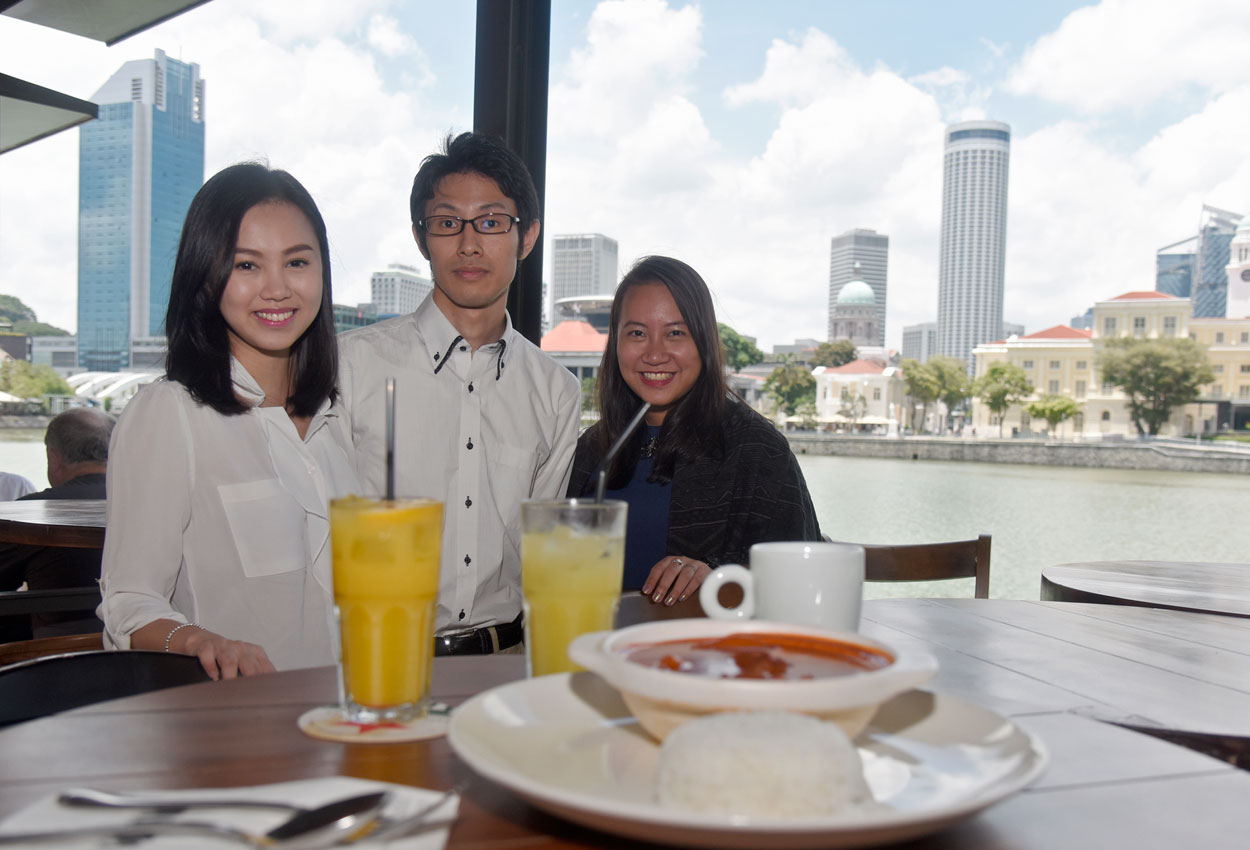
For Mr Allan Tanekura, managing director of a Japanese event ticketing company, meeting Singaporeans has been a tricky prospect.
The Japanese citizen, who is the only staff of the Singapore branch of his company, does not have any colleagues to rely on to introduce him to new people.
Working in Raffles Place, he finds it hard to strike up conversations with strangers, most of whom are either in a rush to get back to the office or are already dining with friends of their own.
Since June this year, he has been able to count on Lunch Kaki to help him out on the friendship front. The app – which he uses two to three times a month – has helped him meet nearly 10 new people so far, many of whom he gets together with regularly.
The 31-year-old, who is married, says: “Since I moved to Singapore six years ago, I’ve found it quite hard to make new friends. Also, because I am married, I don’t want to use dating apps to try and meet new people, so Lunch Kaki was a happy medium.”
Using the app has even indirectly benefited his business. A friend he met through the app introduced Mr Tanekura to his partner, who became his client.
He says of his Lunch Kaki experience: “It’s been a great way to not only meet new people, but also to exchange ideas with like-minded business people. Plus, because so many people on the app work in the city, there’s a high chance that I can meet someone new regularly and at my convenience. It’s a win-win situation.”
This article was first published on September 18, 2016.
Get a copy of The Straits Times or go to straitstimes.com for more stories.
Image:
Category:
Publication Date:
Sunday, September 18, 2016 – 16:00
Keywords:
Send to mobile app:
Source:
Story Type:
Others
Swipe right for friendship – More apps for lonely adults who want to find friends
Meetup.com is too slow. Tinder comes with too much negative baggage.
Enter a clutch of friendshipseeking and community-building apps – Sup, Lunch Kaki, Wander and Motivatormob – for bored or lonely young adults not looking for romantic entanglements.
Ms Jen Wei Qing, the 35-year-old co-founder of Sup, says: “We’re used to everything being on demand so there is no reason why friendships could not be more portable as well. Because the app recommends events to you and connects you to the right people to go with, it acts very much like an Uber for friendship.”
No matter the hundreds of friends millennials might have on their social media platforms, they probably interact regularly only with the same close handful of people – frequenting the same places with the same people and talking about the same things a few too many times.
For many young adults who have grown up on the immediacy of social connection on platforms such as Twitter and Facebook, this real- world friendship gap can be disconcerting.
No surprises then that friendship has become the newest area to go mobile.
Free from the slower response time of traditional community portals such as Meetup.com and the many negative stereotypes that plague dating apps such as Tinder, this new generation of social apps is catered to efficiently connecting like-minded people – no matter one’s age, gender or relationship status (although the founders acknowledge that users may go from being platonic friends to romantic partners).
In Singapore, there are at least three such apps that have recently launched.
For Ms Jen, the irony of being unable to translate digital connections into real-life interaction spurred her to launch Sup – which she calls “Tinder for social life” – with her Harvard University schoolmate in January this year.
Sup – short for “What’s up” – helps to connect users to friends who are nearby and available immediately for an activity.
The app makes these connections by mining relevant information such as geographical location, interests and mutual connections from users’ Facebook profile and contact list and running it through a proprietary algorithm.
Over time, the algorithm learns from user behaviours so suggestions become more relevant the more you use the app.
The response time to a user’s activity request? Typically within 30 minutes, says Ms Jen.
This immediacy of connection is also a huge selling point of local social networking app Lunch Kaki, designed to help people connect and socialise over lunch.
Founded by Mr Melvin Tan, 35, the app launched in November 2014 and currently has more than 20,000 registered users who are mainly working in professional fields such as finance and engineering.
For the ex-stockbroker, the idea came about during a period when he was unemployed for seven months.
“During that time, I realised that it would be helpful to have a way to meet new people and casually network with people in my industry,” he says. “Plus, my wife who worked in the city would also mention how she did not like to dine alone, which made me realise there was potential for an app like Lunch Kaki.”
This desire to connect like- minded individuals for platonic friendship is why he says he has made the conscious effort to not market the app as one that promotes romance.
“Dating apps are an easy way to quickly meet people, but users come with their own set of expectations and the apps exclude people who are in committed relationships but might just be looking to widen their social circle.”
People using Lunch Kaki filter their lunch requests by location, interests, industry, gender and age and can use the last-minute-eats function to find a lunch buddy within 10 minutes.
For Ms Hazel Kweh, 31, who started using Lunch Kaki at the end of last year, the efficiency and ease of using the app is a big draw.
“As I work from home, the app gives me a chance to connect with other working professionals in entrepreneurship who I would not have had a chance to meet otherwise,” says the singleton, who runs an e-commerce start-up.
“I use it up to three times a week and have met lots of interesting people – many of whom are married and in relationships – who are just looking to make new friends. In fact, many of these people have become friends.”
The chance to interact with strangers who share similar interests is also what draws more users to friendship apps.
Ms Huang Xuemin, 29, used women’s-only app Hey! Vina while on her maiden solo trip to Sydney last year and connected with a fellow music lover over brunch.
She says of the experience: “The app isn’t available in Singapore yet, but many of my friends in Australia recommended it to me as a way to meet locals. Because it’s only for women, I found it really safe. In the end, I made a good friend whom I am still in touch with today.”
Similarly, local community- building apps such as Wander and Motivatormob capitalise on commonalities between strangers to help people turn digital connections into offline friendships.
Wander, which launched this week, allows users to set up group chats and discuss anything from their favourite brunch spots to PokemonGo.
Local app Motivatormob, which is looking to launch by January, focuses on the social aspect of fitness. Its users can find and join workout groups across the island based on filters such as geographical area, time and type of activity. Both free activities and paid activities will be available on the free app.
Its co-founder Tom Bennett, 40, a Singapore permanent resident, says: “We found that people often feel more motivated and connected when they are part of a community. So even though our app is focused on fitness, it is also very much about strangers translating online connections to real relationships in the offline world.”
HI THERE, STRANGER
Technology entrepreneur Krystal Choo believes that people are lonely and the social space is broken.
So last month, she started building Wander to connect strangers with common ground.
The app – which launched this week – operates like a group messenger for strangers, allowing people to start discussions and build communities with others who have shared interests. It is for the fostering of platonic friendships.
Ms Choo, 28, says: “These days people type more than they talk, but they are either broadcasting information in a bid for validation or are stuck in silos and connecting only with a small handful of close friends and co-workers.”
Originally intended for singles, it has become a friendship-focused portal open to anyone, as long as you want to connect over an area of interest.
Once users have logged in with their Facebook or e-mail accounts, they can choose to join a conversation that falls under various existing topics.
If they cannot find what they are looking for, they can set up their own topics of interest or filter using keywords to find profiles similar to theirs.
“It allows people to stick to using their phones, which is what they are comfortable with, but affords them immediacy in replies and a chance to expand and connect to social circles that might not be available to them daily,” says Ms Choo, who is single.
She hopes that the chance the app offers to have genuine conversations with like-minded people will draw users.
“Everyone still treasures the sense of identity and belonging they feel when they are in the midst of a community. No matter how many digital likes we get, friendship and human connection will always be key.”
JAPANESE FINDS HIS KAKIS
For Mr Allan Tanekura, managing director of a Japanese event ticketing company, meeting Singaporeans has been a tricky prospect.
The Japanese citizen, who is the only staff of the Singapore branch of his company, does not have any colleagues to rely on to introduce him to new people.
Working in Raffles Place, he finds it hard to strike up conversations with strangers, most of whom are either in a rush to get back to the office or are already dining with friends of their own.
Since June this year, he has been able to count on Lunch Kaki to help him out on the friendship front. The app – which he uses two to three times a month – has helped him meet nearly 10 new people so far, many of whom he gets together with regularly.
The 31-year-old, who is married, says: “Since I moved to Singapore six years ago, I’ve found it quite hard to make new friends. Also, because I am married, I don’t want to use dating apps to try and meet new people, so Lunch Kaki was a happy medium.”
Using the app has even indirectly benefited his business. A friend he met through the app introduced Mr Tanekura to his partner, who became his client.
He says of his Lunch Kaki experience: “It’s been a great way to not only meet new people, but also to exchange ideas with like-minded business people. Plus, because so many people on the app work in the city, there’s a high chance that I can meet someone new regularly and at my convenience. It’s a win-win situation.”
This article was first published on September 18, 2016.
Get a copy of The Straits Times or go to straitstimes.com for more stories.
Image:
Category:
Publication Date:
Sunday, September 18, 2016 – 16:00
Keywords:
Send to mobile app:
Source:
Story Type:
Others


