Home Blog Page 291

Grab to bar passengers from front seat under new COVID-19 measures

SINGAPORE: Passengers will no longer be allowed to ride in the front seat beside the driver, Grab announced on Tuesday (Jun 2), as part of a new suite of measures to minimise the spread of COVID-19.

The measures, called GrabProtect, will be progressively rolled out in Singapore from the end of June, the ride-hailing company said in a media release.

Drivers, delivery personnel and passengers are now required to fill out an online health and hygiene declaration form on the Grab app before they can start driving, delivering orders or booking a ride.

After completing the declaration, drivers and delivery personnel will also be prompted to take a selfie of themselves wearing a face mask. They are currently only required to make daily health declarations.

“The COVID-19 pandemic has created greater awareness of safety and hygiene across all industries,” said Russell Cohen, regional head of operations at Grab.

“Safety has always been a core value at Grab and with programmes like GrabProtect, we are setting a higher bar for hygiene standards in ride-hailing.

“Together with our driver partners, we can help enforce new hygiene habits even before the ride starts.”

Both Grab passengers and drivers will be allowed to cancel a booking if either party shows up without a mask by selecting “driver/passenger did not wear a mask” as the cancellation reason. They can also cancel rides if either party appears unwell.

The penalty for cancellations for these two reasons will be waived, Grab said.

READ: Masks to be worn as default, face shields allowed only for certain settings and groups like children aged 12 and below

READ: COVID-19: What the law says about having to wear a mask when outside your home

It added that it has updated its app to allow users to provide feedback after every interaction, such as whether drivers or customers practised good personal hygiene or took precautionary measures such as contactless delivery.

“Grab will take the necessary actions, including the suspension of driver-partners’ and passengers’ ride-hailing accounts, to protect the safety and well-being of its users,” it said.
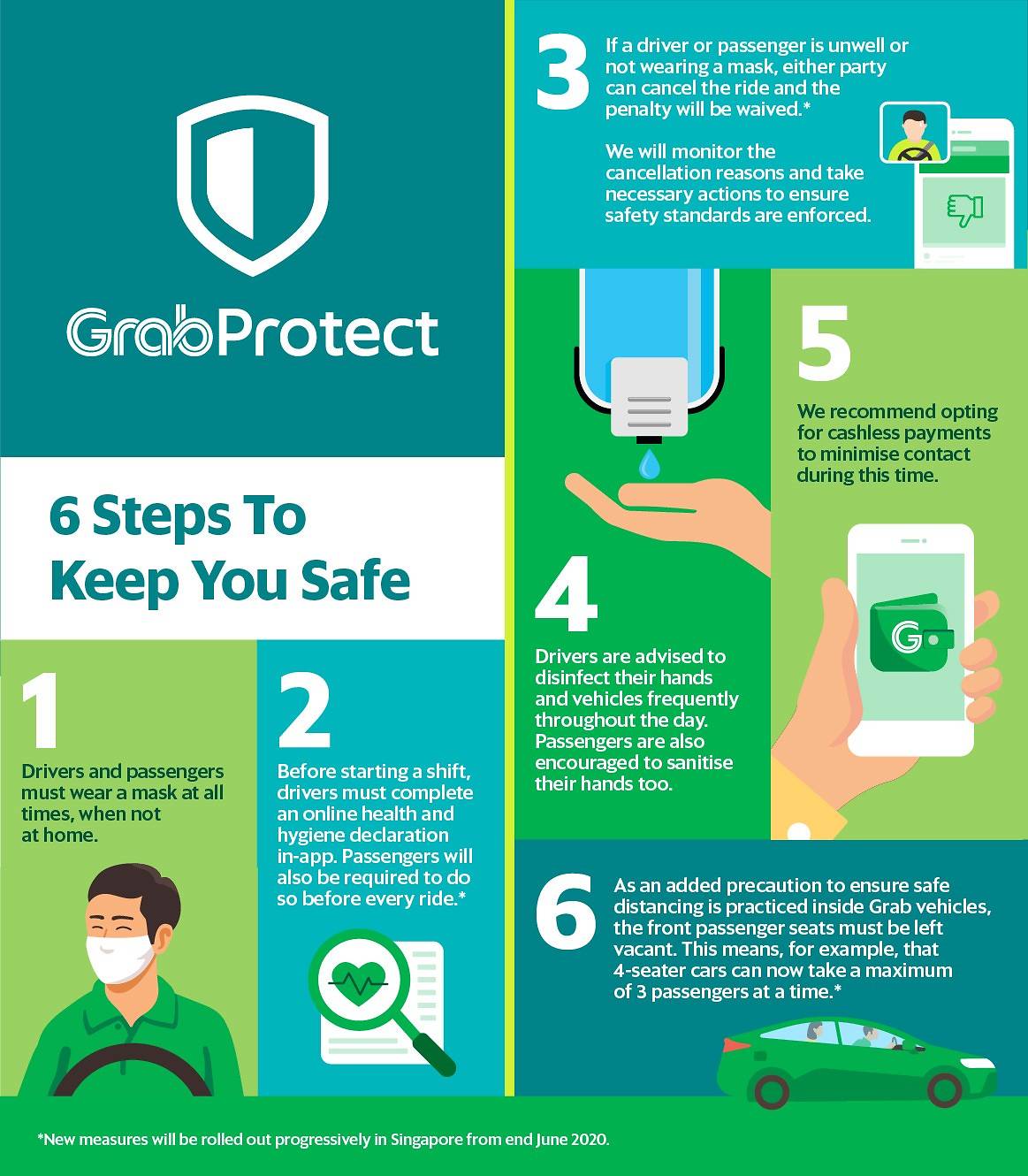
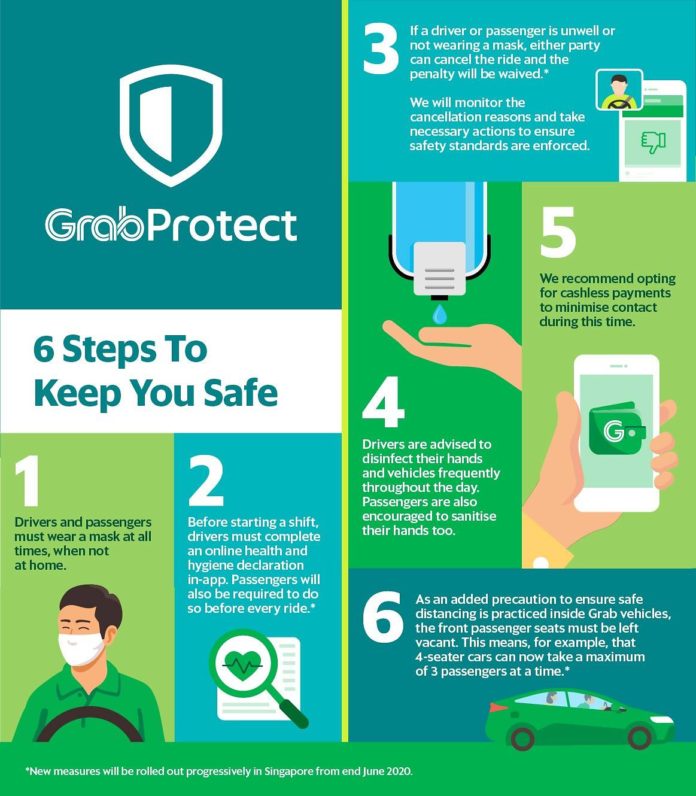
GrabProtect infographic

GrabProtect will be rolled out progressively in Singapore from end-June 2020. (Infographic: Grab)

Grab’s new measures came as Singapore entered the first phase of the post-circuit breaker period on Tuesday with some businesses being allowed to reopen and students returning to school.

According to a recent Grab survey of its users in Southeast Asia, wearing masks, providing hand sanitisers in vehicles and disinfecting car surfaces before every ride are the three most important preventative measures against COVID-19.

Grab said it will be exploring partnerships with manufacturers and suppliers to make it easy and affordable for drivers and deliverer personnel to buy hygiene products at discounted rates.

“Grab will continue to evaluate its measures and policies, and adapt as the situation evolves,” the company said.

“Our users can expect more information on these measures through in-app updates over the next few weeks.”

BOOKMARK THIS: Our comprehensive coverage of the coronavirus outbreak and its developments

Download our app or subscribe to our Telegram channel for the latest updates on the coronavirus outbreak: https://cna.asia/telegram

Source link

Trains and roads more crowded after Singapore exits circuit breaker

SINGAPORE: With more people returning to work or school following the end of the COVID-19 “circuit breaker”, trains and roads were noticeably busier on Tuesday (Jun 2).

During the morning peak hour, more commuters were seen at MRT stations such as Raffles Place, Tanjong Pagar, Bishan and Paya Lebar, compared to Monday when the circuit breaker was still in place.

There was also morning congestion along certain stretches of the Central Expressway heading into the city. 

It was visibly busier in the central business district as well, as workers returned to their offices.

Just a day before, only a small number of people were seen at Raffles Place, mainly security officers, frontline bank employees and a handful of food delivery riders.

Raffles Place June 1 2020

A virtually deserted Raffles Place on Jun 1, 2020 – the last day of Singapore’s circuit breaker period aimed at stopping the spread of COVID-19. (Photo: Marcus Ramos) 

Raffles Place phase 1 post-CB

Workers at Raffles Place on Jun 2, 2020, the first day after Singapore’s circuit breaker period. (Photo: Marcus Ramos)

Some said returning to the office felt like an unfamiliar experience after more than two months of working from home. 

“When I came into the office, I couldn’t remember my password,” said one employee at Raffles Place who only wanted to be known as Leo. 

The 38-year-old, who works in commodities trading, said he had been asked to go into the office later, at about 9.30am, to avoid crowds on public transport. 

He told CNA that his work often involves “important documents” that have to be handled in person, adding that the company had discussed new working arrangements for post-circuit breaker.

This involves split teams alternating between working from home and going into the office on alternate weeks.

READ: MOE to review how to ‘blend’ classroom and digital online learning as schools reopen after COVID-19 circuit breaker

READ: Singapore to exit circuit breaker on Jun 1, visiting of parents, places of worship allowed with restrictions

While the arrangement could be disruptive, Leo said he accepts that it is necessary in order to keep to safe distancing measures.

Singapore is reopening its economy in phases, after a fall in the number of COVID-19 cases in the community.

In Phase 1, businesses that operate in settings with lower transmission risks are allowed to open. These include most offices and manufacturing firms.

Raffles Place - phase 1 circuit breaker

Office workers at Raffles Place during lunch hour on Jun 2, 2020, the first day after the end of the circuit breaker. (Photo: Jeremy Long)

However, authorities said telecommuting must be used to the “maximum extent”.

“Those who have been working from home so far should continue to do so, and employees should go to the office only where demonstrably necessary,” the Ministry of Health (MOH) and Ministry of Trade and Industry (MTI) said earlier in May.

READ: COVID-19: Phase 2 of post-circuit breaker reopening could begin before end-June, says Lawrence Wong

This is why crowds in the CBD have not returned to levels seen before the coronavirus hit.

Graphic artist Shah Ismail said his employers have chosen to continue allowing staff members to work from home until further notice. 

“In our line of work, it’s fairly easy to work from home,” said the 38-year-old. 

He was out on Tueday to meet clients – his first such meeting in more than two months.

“It felt like my first day at work,” he added. 

Raffles Place MRT Jun 1 2020

Raffles Place MRT station on Jun 1, 2020 – the last day of the circuit breaker period. (Photo: Marcus Ramos)

Raffles Place MRT June 2 2020

Commuters at Raffles Place MRT station on Jun 2 2020, the first day of phase one of Singapore’s post-circuit breaker period. (Photo: Marcus Ramos)

Trains, too, were not as crowded as they were before the circuit breaker was imposed on Apr 7.

“I got a seat without anyone sitting next to me,” Mr Shah said, noting that this was even though the stickers reminding commuters to practice safe distancing had been removed from alternate seats.

Bishan MRT Jun 1 2020

Commuters at the Bishan MRT station on Jun 1 2020. (Photo: Marcus Ramos)

Bishan MRT June 2 2020

More commuters could be seen at the Bishan MRT station on Jun 2, 2020. (Photo: Marcus Ramos)

READ: Singapore’s circuit breaker and beyond: Timeline of the COVID-19 reality

Now that the circuit breaker is over, the Land Transport Authority (LTA) said it will increase the frequency of trains and buses. Train operating hours will also return to normal.

“As Singapore enters Phase 1 of its safe reopening on Jun 2, more people will return to work and school. We will increase the capacity of the trains and buses to the maximum,” said LTA in response to media queries.

READ: Travelling or telecommuting – how COVID-19 could affect public transport costs in Singapore

LTA added that safe distancing stickers – which had been placed on train seats and boarding queues at bus interchanges during the circuit breaker – would be removed from most places in the public transport network due to the expected difficulty in maintaining physical distancing between commuters. 

Certain bus services where demand is expected to be low – such as night bus services and those heading to attractions such as East Coast Park, the zoo and Resorts World Sentosa – will remain suspended, LTA said. 

Source link

Working from home? You can get tax deductions for electricity and phone expenses next year

[ad_1]

Since early April, working from home has become a new norm for most working adults in Singapore.

With many employees glued to their laptops at home as they hold Zoom meetings and WhatsApp discussions, one worry that has surfaced is higher electricity and phone bills.

Good news — you can get tax deductions for expenses incurred while working from home.

A spokesperson from Inland Revenue Authority of Singapore (IRAS) recently told The Business Times: “Tax deduction against employment income is allowable for expenses incurred wholly and exclusively in the production of employment income.”

These include additional electricity and phone bills incurred when employees are required to work from home (that are not reimbursed by the employer and not capital or private in nature.).

[ad_2]

Source link

7 linked to Robertson Quay incident charged with offences under Covid-19 regulations

[ad_1]

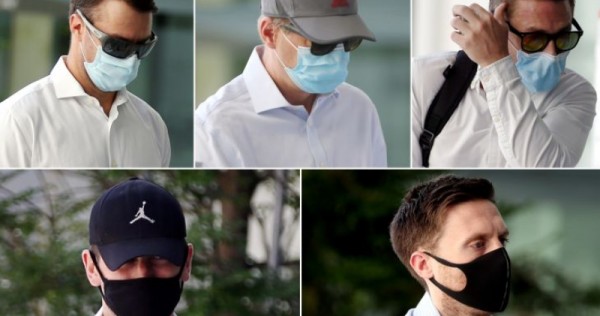
Six men and one woman, aged between 30 and 52, were charged with offences under the Covid-19 (Temporary Measures) Act today (June 2).

They were accused of flouting circuit breaker measures after groups of people were seen gathering at various places in Robertson Quay area on May 16. 

Four of the men – Neil Gordon Buchan, 30; James Titus Bett, 33; Joseph William Poynter, 35; and Perry Schott Blair, 37 — are Britons.

Another man, Michael Czerny, 45, is Austrian, while Jeffrey George Brown, 52 and the only woman, Bao Nguyen Brown, 40, are Americans.

The four Britons are accused of meeting one another “for a social purpose” near Italian restaurant Rosso Vino, while the other three were said to have met near Tap @ Robertson Quay.

[ad_2]

Source link

MOE to review how to ‘blend’ classroom and digital online learning as schools reopen after COVID-19 circuit breaker

SINGAPORE: The Ministry of Education (MOE) will review how to “blend” classroom learning and digital online learning to “harness the best of both worlds”, said Education Minister Ong Ye Kung on Tuesday (Jun 2). 

With schools reopening on Tuesday after the end of Singapore’s “circuit breaker” on Monday, Mr Ong noted that a month of full home-based learning has “taught us a lot”.

“We totally understand home-based learning and digital online learning cannot substitute classroom learning. But having forced ourselves to do this for a whole month, we also learned how to do it better, and that there are certain strengths in online learning that actually, classroom learning does not have,” he told reporters during a visit to Xingnan Primary School. 

Students can engage in self-directed learning outside the classroom, said Mr Ong, describing this as a “strength of digital learning”. 

“Moving forward, there is a big review happening in MOE to see how we can better plan to blend the two. Not too far into the future, I think we want to do this quite soon, (we want to) blend the two so that we can harness the best of both worlds in a modern education system,” the minister said.

Because schools entered full home-based learning “at such a short notice”, there are still “many areas for improvement”, Mr Ong added.

The resilient response from teachers, parents and students was “extremely encouraging”, he said.

xingnan primary 1

Students at Xingnan Primary School observing safe distancing measures. (Photo: Tan Si Hui) 

LEARNING FROM SOUTH KOREA

Responding to questions about South Korea imposing limits on school attendance due to a spike in COVID-19 cases after schools there reopened on May 20, Mr Ong said that this was “unfortunate”. 

“We have been monitoring what other countries do. In the case of South Korea, unfortunately, when they opened, they extended to bars and clubs and many of the entertainment outlets and this resulted in certain big clusters being triggered off,” he said. 

Singapore is reopening in three phases after exiting the circuit breaker on Monday.

Adding that the clusters in South Korea were “a good reminder” to open up “step by step”, Mr Ong noted that many Singaporeans think Phase 1 of the reopening is “a bit tight”. 

“We are erring on the side of being more careful, learning from South Korea,” the minister said.

Schools and “most other places” in Singapore are “big enough” to accommodate safe distancing measures, he added. 

“Safe distancing is only breached only when people congregate during certain places at a certain time … so it’s a lot about the processes about this that we will slowly, in the next few weeks, inculcate in the students,” Mr Ong said.

xingnan primary 2

Xingnan Primary School students observing safe distancing measures in the canteen. (Photo: Tan Si Hui) 

PALPABLE SENSE OF ENTHUSIASM’ IN STUDENTS RETURNING

With students in Primary 4 to 6 and Secondary 1, 2, 4 and 5 returning to school on Tuesday, Mr Ong said the return has been “orderly” and “very calm”, and that there was “a palpable sense of enthusiasm” among teachers and students who came back to schools.

READ: COVID-19: Graduating primary, secondary students to attend school on weekdays after circuit breaker ends; others to rotate weekly

“There are bound to be many teething problems,” Mr Ong said, adding that students are getting used to the safe distancing measures.

Some parents remain apprehensive about schools reopening, said Mr Ong, adding that he has received requests from parents to open schools only a month or two later.

“Very practical considerations” were taken on board before the decision was made for schools to reopen, he said.

“Many parents are going back to work, and schools and work come hand in hand. You have to provide a safe environment in school so that parents can go to work with a peace of mind, leave their kids here to study,” the minister said.

With the end of the circuit breaker, more people will want to go out, and it is better for students to go to school to study in a safe environment instead of letting them go out into the community, he added. 

xingnan 3

Xingnan Primary School students observing safe distancing measures during recess. (Photo: Tan Si Hui) 

Noting that Singapore saw no new community cases on Monday, Mr Ong stressed that the number of COVID-19 infections is likely to rise in Phase 1. 

“So if we are not comfortable opening up now when we have zero, very low daily infections, what more later? You will end up having the possibility of very prolonged school closure and that impact will be quite significant,” he said.

PSLE AND NATIONAL EXAMS

As for concerns from parents about the Primary School Leaving Examination (PSLE) and other national examinations that graduating cohorts will take, Mr Ong noted that some topics have been removed from this year’s exams.

As part of the gradual easing of circuit breaker measures, schools were allowed to reopen for students in small groups for face-to-face lessons from May 19.

Priority was given to graduating cohorts and those who needed additional support or school facilities for coursework and practical sessions during the May school holidays.

“I think the load and the pressure on children, students will be less this year. And then as to whether you find the paper is going to be harder this year or harder next year, people always speculate,” he said. 

“Just try your best. And ultimately, PSLE is still just the first gateway of a very long learning and education journey.” 

Urging students not to be “too hard” on themselves, he added: “You still have a long journey ahead of you and discover your passion, to learn to grow and to be a better person. Don’t let one exam in an exceptional time think that it will determine your future.” 

BOOKMARK THIS: Our comprehensive coverage of the coronavirus outbreak and its developments

Download our app or subscribe to our Telegram channel for the latest updates on the coronavirus outbreak: https://cna.asia/telegram
Source link

Excitement, nerves as Singapore starts phased reopening from coronavirus circuit breaker

[ad_1]

Heidi Tan, 13, is excited. The Secondary One student is eager to see her classmates after an eight-week hiatus that began when Singapore imposed its so called circuit breaker early in April to control the spread of the coronavirus.

“She’s looking forward to seeing friends in person and going back to teasing her classmates,” her mother, Michelle Tan, said.

This partial lockdown was relaxed on Tuesday as Singapore took its first steps to reopen, with pupils back in the classroom and 75 per cent of the economy resuming. Only graduating pupils can attend school every day, however.

Others like Tan will rotate weekly between the classroom and continuing with home-based learning.

Dental clinics, chiropractors and air conditioning servicing were among the businesses allowed to operate again.

Public transport also began running more frequently – during off-peak periods, trains arrive every five minutes compared to 10 minutes for the past few weeks. And the green and orange stickers plastered over alternate train and bus seats to enforce social distancing have been removed.

[ad_2]

Source link

Hit hard by CB, Korean NTU student revitalises father's hawker business

[ad_1]

With dining outside not allowed during the circuit breaker (and in Phase 1 of Singapore’s reopening), many F&B owners found themselves struggling to stay afloat, including a humble Korean food stall located in Marsiling.

That was until the stall owner’s daughter Chela Suh took business into her own hands.

After finding out about Hawkers United – Dabao 2020, a hawker-for-hawker initiative that connects F&B owners to customers through Facebook for free, Suh decided to advertise her dad’s stall through the group on May 15.

[ad_2]

Source link

'Keeping the kampung spirit alive': Sheng Siong staff tries to quietly slip $200 for family's wake

[ad_1]

A death in the family is always tragic and things could get even more distressing if grieving family members get named and shamed on social media for holding wakes that apparently flout safe-distancing rules. 

Fortunately, there’s none of that antagonism here. Quite the opposite really, according to a Facebook post by Caleb Low, whose family was unexpectedly graced by the philanthropic efforts of Sheng Siong Supermarket. 

In his post on June 1, Low shared a recent encounter that one of his relatives experienced during the wake for his wife’s grandmother. The relative had noticed that a stranger tried to discreetly slip $200 into the collection box at the wake.

When asked, the stranger was said to have admitted that he was just a Sheng Siong employee carrying out the instructions of the management. 

[ad_2]

Source link

Now Singaporeans can get married in Sentosa on Animal Crossing: New Horizons

[ad_1]

Remember when Sentosa became a virtual hangout for Singaporeans on Animal Crossing: New Horizons back in May?

Yeah, it turns out locals have been getting married there too. Given the current sitch preventing many lovebirds from officiating their vows, doing it virtually might not be such a bad idea after all.

This was definitely the case for Varian and Ruoyi. The pair, who were partners from their polytechnic days, was supposed to originally hold their wedding on May 30.

While they still had to postpone their actual wedding, the duo still made the effort to celebrate what would’ve been their special day by making their marriage “official” on the Sentosa Crossing virtual event.

[ad_2]

Source link

7 people charged over Robertson Quay gatherings during COVID-19 circuit breaker

SINGAPORE: Six men and one woman were charged in court on Tuesday (Jun 2) with breaking a COVID-19 regulation by meeting each other near Robertson Quay during the “circuit breaker” period when social gatherings were prohibited.

The seven are: Neil Gordon Buchan, a 30-year-old British national; Perry Scott Blair, a 37-year-old British citizen; Bao Nguyen Brown, a 40-year-old American; Jeffrey George Brown, a 52-year-old American; Michael Czerny, a 45-year-old Austrian national; James Titus Beatt, a 33-year-old British national and Joseph William Poynter, a 35-year-old British citizen.

They are each charged with one count of breaching Regulation 6 of the COVID-19 regulations by meeting each other without reasonable excuse between 6pm and 6.44pm on May 16, either at Rosso Vino at 15 Merbau Road or TAP@Robertson Quay, a short walk away.

READ:  Singapore’s circuit breaker and beyond: Timeline of the COVID-19 reality

Czerny and the Browns are accused of meeting at the TAP@Robertson Quay bar for chatting and drinks, while Beatt, Poynter, Buchan and Blair are accused of meeting each other to chat and drink at Rosso Vino.

The Browns and Czerny are represented by Mirza Namazie, while Shashi Nathan is defending Beatt and Buchan. Lawyer Christopher Bridges is representing Poynter and Blair.

Brown Jeffrey George

Jeffrey George Brown was one of seven people charged on Jun 2, 2020 over gatherings at Robertson Quay during the “circuit breaker” period. (Photo: Hanidah Amin) 

Neil Gordon Buchan

Neil Gordon Buchan was one of seven people charged on Jun 2, 2020 over gatherings at Robertson Quay during the “circuit breaker” period. (Photo: Hanidah Amin) 

The case was adjourned to Jun 16, and S$3,000 bail was offered to each of them. Lawyer Shashi Nathan said that his client’s charge was an Urban Redevelopment Authority one and that usually no bail is required.

However, Deputy Public Prosecutor Timotheus Koh said the prosecution would be asking for bail because of the “complexion” of the case.

Mr Namazie said Bao Nguyen Brown is not a flight risk and has a son in school here. She has also been in Singapore for 14 years and is on an employment pass.

However, Mr Koh said she is a foreigner and pressed for bail. He did so for the rest of the accused.

Poynter Joseph William

Joseph William Poynter  was one of seven people charged on Jun 2, 2020 over gatherings at Robertson Quay during the “circuit breaker” period. (Photo: Hanidah Amin)

Perry Scott Blair

Perry Scott Blair was one of seven people charged on Jun 2, 2020 over gatherings at Robertson Quay during the “circuit breaker” period. (Photo: Hanidah Amin) 

The court heard that Czerny is a permanent resident and has two children in school here.

No indications were made on whether any of the accused would plead guilty or claim trial.

The incident drew attention when Facebook user Lectress Pat posted photos of the alleged gatherings at Robertson Quay on May 16.

The post, which questioned enforcement levels in the heartlands versus those in other areas such as Robertson Quay, has since been shared more than 2,000 times.

A day after this, the Urban Redevelopment Authority issued a written direction to some restaurants in the area selling takeaway alcohol to cease doing so. 

READ: COVID-19: Robertson Quay restaurants ordered to stop selling takeaway alcohol to prevent gatherings

This had contributed to gatherings around the premises, said Ministry for the Environment and Water Resources Masagos Zulkifli. Two days after the incident, he said the police had traced a number of those who gathered in the area and added that the “non-Singaporeans” were currently under police investigations.

On May 30, Mr Masagos announced that the seven would be charged for breaching safe-distancing measures at Robertson Quay on May 16.

“We take such breaches very seriously and will not hesitate to take action,” he said.

James Titus Beatt

James Titus Beatt was one of seven people charged on Jun 2, 2020 over gatherings at Robertson Quay during the “circuit breaker” period. (Photo: Hanidah Amin) 

The Ministry of Manpower had said in a statement on Monday that foreigners working in Singapore on work passes “must abide by our laws”.

“Regardless of pass types, those who are convicted (of) offences risk having their work passes revoked, in addition to an employment ban,” said a spokesperson. 

He added that the ministry has “consistently revoked the work passes of persons convicted of criminal offences or for making false declarations in work pass applications”.

These include holders of work permits, S Pass and Employment Passes, with more than 100 Employment Pass holders having their work passes revoked in the last three years.

MOM said that circuit-breaker measures are strictly enforced, with “Singaporeans and foreigners alike” penalised for flouting the rules in widely publicised cases.
 
“Work pass holders are reminded to take these rules seriously, for their own protection and the safety of the community at large,” said the spokesperson.

For each charge of flouting COVID-19 regulations, the accused can be jailed for up to six months, fined up to S$10,000, or both. 

BOOKMARK THIS: Our comprehensive coverage of the coronavirus outbreak and its developments

Download our app or subscribe to our Telegram channel for the latest updates on the coronavirus outbreak: https://cna.asia/telegram
Source link