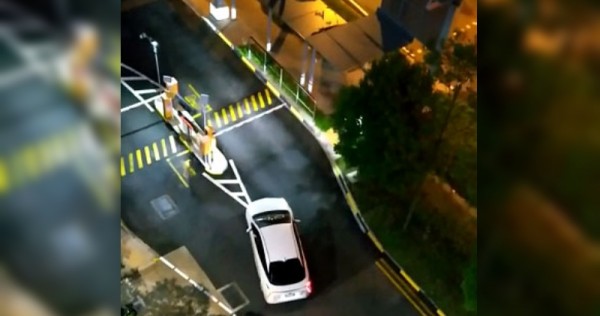
A white Prius was about to leave a carpark, before it slowly backed away from the electronic gantry, made a turn to the walkway on the right and made a hasty exit.
The driver got away… or did he?
His bold escape (from parking fees) was filmed by someone who had a clear view of the area.
A video clip of the incident was subsequently shared on SG Road Vigilante this morning (June 3), with no indication where it had taken place.
03June2020
Desperate things people do when they cannot afford to pay ERP Parking. 🤦🏻♂️
SINGAPORE: The number of dengue cases this year could surpass 2013’s figure of 22,170, unless urgent action community action is taken, the National Environment Agency (NEA) warned on Wednesday (Jun 3).
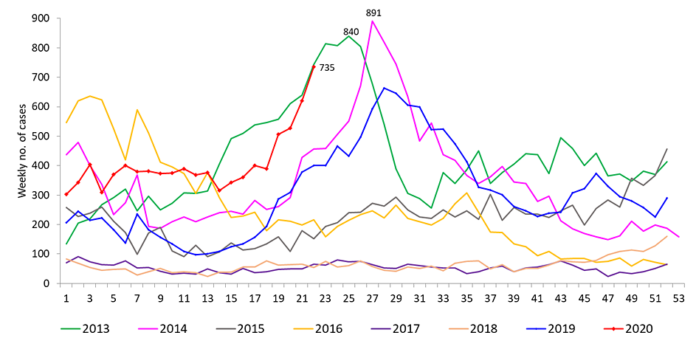
As of Tuesday, there have been 9,261 reported dengue cases this year, the highest in the same period since 2013, which saw the largest outbreak in Singapore’s recent history, said the agency.
As it stands, the number of weekly dengue cases is expected to exceed the historical high of 891.
There were 735 dengue cases last week, up from the 300 to 400 weekly cases from January to April.
“Singapore has not seen such a high weekly number of dengue cases since the peak years in 2013 and 2014,” said NEA.
“The number of dengue cases this year is expected to exceed the 15,998 cases reported in 2019, and may even surpass the 22,170 cases reported in 2013.”
Annual trend of dengue cases from 2013 to 2020. (Infographic: National Environment Agency)
Twelve people, between the ages of 56 and 80, have died as a result of dengue so far this year. Ten of the 12 had worked or lived in active dengue cluster areas.
“Urgent collective community effort is needed to drastically reduce mosquito breeding habitats and slow down the rise in the number of dengue cases,” said NEA.
COVID-19 A FACTOR BEHIND INCREASE
The agency said the spike in dengue cases can be attributed to several factors, one of which is the increase in Dengue virus serotype 3 (DENV-3) since the beginning of this year.
DENV-3 is a less common strain of dengue that was last seen in a dominant position in Singapore about 30 years ago, meaning there is low immunity in the population and rapid disease transmission.
Singapore is also entering the traditional dengue peak season, when warmer weather facilitates the faster multiplication of the Aedes mosquito and the dengue virus, increasing the chances of dengue transmission. NEA said it has detected more areas with high Aedes mosquito populations.
The COVID-19 outbreak in Singapore and the resulting “circuit breaker” has also exacerbated the dengue situation, said NEA, with the dengue spike in early May coinciding with the circuit breaker measures.
The Aedes mosquito, the main vector of dengue, mainly dwells in indoor spaces and usually bites during the day.
“With a shift in human concentration from offices to homes, more people staying at home during the day also means more blood meals for the female Aedes aegypti mosquitoes, especially in residential areas where the mosquito population is also high,” said NEA.
“Together with the availability of breeding habitats for the mosquitoes, this produced even more mosquitoes. This has likely exacerbated the situation, leading to the sharp rise in the number of dengue infections in the past four weeks.”
From January to May, NEA conducted about 341,000 inspections for mosquito breeding across Singapore and uncovered about 7,800 breeding habitats.
NEA dengue inspection officer checking for mosquito breeding at the roof top of residential premises. (Photo: National Environment Agency)
NEA said it has observed a five-fold increase of Aedes mosquito larva detected in homes and common corridors in residential areas during the two-month circuit breaker period compared to the two months prior.
The agency urged homeowners to cooperate with NEA officers in allowing them home access to facilitate checks and indoor misting.
“As we continue to manage the COVID-19 situation, we need to be mindful that dengue is another serious public health threat that Singapore faces,” said NEA director-general of public health Chew Ming Fai.
“During our inspections, we continue to find mosquito breeding in common habitats, such as flower pot plates and domestic containers. Lack of care or diligence in maintaining one’s premises or home could easily lead to mosquito breeding, putting the whole community at risk.”
CONSTRUCTION SITES INSPECTED
NEA has continued to step up preventive surveillance of construction sites, which have been closed during the circuit breaker period.
Before the start of the circuit breaker, construction site operators were instructed to maintain a minimum workforce to perform housekeeping and facilitate pest control services within the sites.
NEA dengue inspection officer checking for mosquito breeding at a construction site after a rainy day. (Photo: National Environment Agency)
Despite this, NEA observed a two-fold increase in Aedes mosquito larvae at construction sites during the circuit breaker period. So far, 82 per cent of construction sites have been inspected since the start of the circuit breaker, it said.
From January to May, 52 summonses and two stop work orders were issued to construction sites.
Two contractors will also be charged in court for repeat offences, the agency added.
“NEA will continue with our inspection and enforcement efforts, and we will not hesitate to take action against anyone found to have created conditions favourable for the propagation or harbouring of vectors,” said Mr Chew.
“All of us must do our part in our collective fight against dengue.”
Information on the dengue situation can be found on the NEA website, the Stop Dengue Now Facebook page and the myENV app.
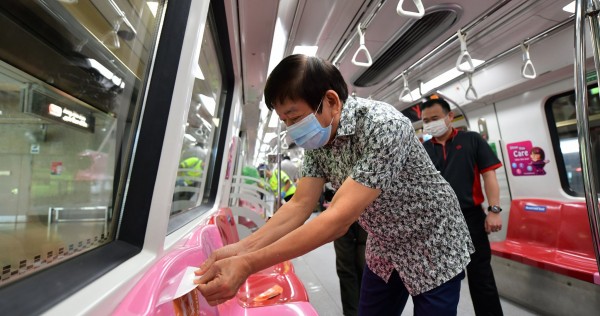
If you’ve been on a bus or MRT in the past couple of days, you may have noticed something strange — the safe distancing stickers that have become familiar fixtures to most of us are no more.
The stickers were removed from June 1 as “physical distancing will be difficult once the crowds return”, Transport Minister Khaw Boon Wan mentioned in a Facebook post.
The move was in line with amendments to the Covid-19 (Temporary Measures) Act 2020, which stated that individuals are required to keep a safe distance of one metre from each other, except when in a motor vehicle or on public transport.
This means that commuters will not be penalised or fined if they are not able to stay a metre apart from one another.
SINGAPORE: A man left a dog he had adopted in a filthy cage placed in a room littered with dog excrement. It was discovered malnourished and near death.
For animal abuse, Malaysian Chan Kean Yap, 30, was fined S$4,000 on Wednesday (Jun 3). He was also banned from owning pets for a year.
Chan pleaded guilty to one charge under the Animals and Birds Act of failing to ensure that his pet, an English Bulldog, had adequate and suitable food and water.
A second charge of keeping the dog at a fish farm without a licence was taken into consideration.
The court heard that Chan, who is also a Singapore permanent resident, adopted the male dog in 2017 and kept it at Dreamfish, a fish farm where he worked.
In May 2019, the lease of the farm expired and Chan stopped working there.
Two months later, a National Parks Board (NParks) officer inspected Dreamfish at 221 Neo Tiew Crescent when he heard an animal whining.
He found a malnourished brown and white English Bulldog kept in a cage in a room. The floor was littered with dog faeces and urine, said the prosecutor.
The abused dog in the office where it was kept. (Photo: NParks)
Chan was contacted and confirmed that the dog was his. The officer told him that the dog was in bad condition and needed immediate attention, before reporting the matter to the Animal & Veterinary Service.
Chan later surrendered the dog to NParks.
An examination found that the dog scored one out of nine in a body condition scale, the lowest next to death. Its ribs, spine and bones were prominent from a distance, with no discernible body fat and with obvious loss of muscle mass, likely due to severely inadequate feeding or underlying chronic illness.
“If not for the discovery by the inspecting officer, the said dog might have died as a result if it was left untreated at the premises,” said the prosecutor.
The dog has since been rehomed, and has recovered to a satisfactory condition.
The recovered dog in September 2019. (Photos: NParks)
The prosecutor pressed for a “high fine” to deter like-minded offenders.
Chan said he has left the fish farm and cannot find a stable job. He added that he has children to support and his wife’s job is currently affected so it’s “quite a hard time for me”.
He apologised and said he hoped for leniency.
For not giving the dog adequate food and water, Chan could have been jailed for up to a year, fined up to S$10,000, or both.
With no money, no phone and not a clue where to go, things seemed rather dire for Mandy Chan, a jogger who lost her way, until she met her benefactor at Fort Canning MRT station.
Hearing about her situation, a station staff took out $2 from his own wallet and handed it over to her so she could buy a train ticket home.
Touched by the unexpected act of kindness, Chan took to Facebook on Sunday (May 31), titling the experience as “$2 of Humanity”.
Today’s First: $2 of Humanity
After having a crazy feast last night at home for a birthday, I decided to go for a 10km…
SINGAPORE: Landlords will have to dig into their pockets to provide small- and medium-sized enterprise (SME) tenants with more rental relief under amendments to COVID-19 regulations set to be introduced in Parliament on Friday (Jun 5).
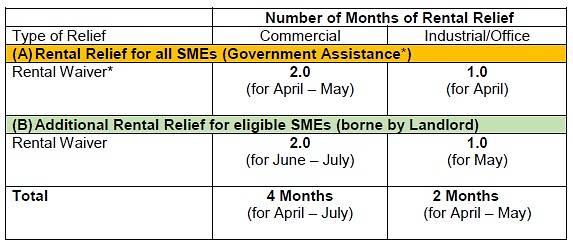
As long as the leases or licences were in force on Apr 1, commercial property owners must waive the base rent for two months – June and July – for SME tenants that have seen “significant” revenue declines due to the pandemic. Landlords of industrial and office properties will be required to grant eligible tenants with a one-month base rent waiver for May.
Base rent excludes the variable rent based on a tenant’s gross turnover, as well as maintenance fee and other service charges.
These rental waivers to be borne by landlords will come on top of already-announced rent support from the Government, the Ministry of Law (MinLaw) said on Wednesday (Jun 3) as it laid out its proposed amendments to the COVID-19 (Temporary Measures) Act.
Altogether, the proposed framework mandates a “co-sharing of rental obligations” that will provide SME tenants at commercial properties with four months’ worth of rental relief, while those at industrial and office properties get two months.
Other proposed amendments include allowing SME tenants to repay rental arrears through instalments and the introduction of a cap on late payment interest or charges for specific contracts.
The wide-ranging Act, which was passed in Parliament on Apr 7 and took effect on Apr 20, grants those who cannot fulfil contractual obligations amid the virus outbreak with temporary relief for six months.
But businesses, especially SMEs, continue to face financial concerns and uncertainties from the COVID-19 pandemic.
This required a “substantive intervention” by the Government, said Law and Home Affairs Minister K Shanmugam at a media briefing on Tuesday ahead of the announcement.
“In early April, we intervened through the COVID-19 (Temporary Measures) Act, to give time for companies to pay their rental. This time round, it’s an even more substantive intervention. It gives rental waiver for SMEs.”
The relief measures will help nearly 260,000 SMEs employing more than 2 million people to cope with the impact of the “circuit breaker” and a slow recovery ahead as Singapore reopens in a phased approach, he added.
“TRYING TO STRIKE A BALANCE”
SMEs eligible for the landlords’ rental waivers are defined as those with annual turnover of no more than S$100 million in 2019.
They also have to fulfil two other criteria – having seen a 35 per cent or more drop in average monthly revenue from April to May on a year-on-year basis, and have entered into the tenancy before Mar 25 this year.
Landlords can apply for an assessment of this eligibility “within a specific time” and the case will be examined by an assessor. More details will be announced at a later date.
If landlords have passed on tax rebates and any direct monetary assistance to tenants from February, this can be used to offset the required rental waivers.
Landlords that are unable to provide tenants with the additional rental waivers may seek an assessment on “grounds of financial hardship”.
This may apply to smaller landlords who only own one property and have rent as a substantial part of their income, said Mr Shanmugam. He added that the Government will set out the criteria and landlords that qualify will only have to provide half of the waivers.
Apart from having landlords step up to provide rent relief, the amendment Bill will also require property owners to pass on the Government-granted tax rebates and the new S$2 billion cash grant to their SME tenants in the form of base-rent waivers.
The latter, announced as part of the latest Fortitude Budget, gives tenants at eligible commercial properties cash grants amounting to about 0.8 month’s worth of rent. Those in qualifying industrial and office properties will receive 0.64 month’s worth of rent.
Combined with the property tax rebates, total government support will offset about two months of rent for tenants at commercial properties, and about one month for those at industrial and office properties.
To ensure the Government’s support reaches its intended beneficiaries, MinLaw said the Bill will make it mandatory for tenants of commercial properties to get a two-month waiver of their base rent covering April and May, as long as leases were in force on Apr 1. Similarly, those in the industrial and office properties will have their base rent waived for one month in April.
Altogether, SME tenants in commercial properties should get rental relief totalling up to four months starting from April to July, while others at the industrial and office properties will receive two months’ worth of rental help covering April and May.
These rental waivers also apply to eligible SMEs who are sub-tenants and licensees, MinLaw said, adding that its framework aims to set “a baseline position for the handling of tenants’ rental obligations”.
(Table from the Ministry of Law)
“We are trying to strike a balance,” said Mr Shanmugam, noting that landlords and tenants have to do their parts.
“Together, with a bit of sharing of the pain, we hope that as many as possible can pull through.”
REPAY ARREARS IN INSTALMENTS
The proposed amendments set to be tabled will also allow SMEs to pay a “specified portion” of rental arrears that are accumulated from Feb 1 until Oct 19 via instalments.
Tenants will first have to serve notice on their landlords before being able to repay the arrears in equal instalments over an extended period of up to nine months or the remaining term of their tenancy agreements, whichever is shorter.
The first instalment must be paid no later than Nov 1 this year. The interest payable on such arrears will be capped at 3 per cent per annum.
If a tenant fails to make payment or terminates the lease, the repayment scheme will be cancelled. This means that the landlord will be entitled to an immediate payment of all arrears, or be allowed to take steps as specified in the contract, the ministry said.
OTHER TEMPORARY RELIEF
The COVID-19 outbreak has also made it difficult for tenants to vacate their premises at the end of their leases, the ministry said, citing feedback. In some instances, tenants have had to face penalties such as paying double rent.
Another proposed amendment to the COVID-19 laws will look to provide such tenants with some relief.
“This relief will apply where, due to COVID-19, the tenant is unable to vacate a non-residential property after the end of the lease or licence and before the expiry of the prescribed period i.e. before Oct 19, 2020,” MinLaw said in its press release.
After meeting these conditions and serving a notification for relief on the landlord, tenants will not be liable for failing to vacate the property.
Arrears also continue to be accrued and are subject to late payment interest and charges, despite the Act providing businesses and individuals with a temporary moratorium until Oct 19.
As such, the Bill will also propose a cap on these late payment interest or charges for arrears that arise due to COVID-19 under specific contracts.
Creditors will also not be allowed to terminate these contracts due to late payments during the prescribed period until Oct 19.
The ministry said various stakeholders were consulted for the amendments, including representatives from industries such as retail and food and beverage, as well as legal, accountancy and property development professionals.
The amendments, if passed, will kick in at the end of July and tenants eligible for rental relief will be “notified in due course”, the ministry said.
Veteran track and field coach Loh Siang Piow was on Wednesday (June 3) found guilty of two charges of molesting a teenage athlete under his charge in 2013.
The trial, which began more than three years ago and was in its 30th day in the State Courts, ended with District Judge Marvin Bay delivering his judgment.
Loh, 75, better known in the sports fraternity as Loh Chan Pew, was charged with using criminal force on the female athlete when she was 18 by rubbing her genitals on two occasions while massaging the back of her thighs.
Both incidents were said to have happened at the old Tampines Stadium on two Sundays between January and March 17 in 2013.
Loh, a former vice-president of Singapore Athletics, which governs the sport in Singapore, stood trial for his alleged deeds against one of his two accusers, with three more charges involving another accuser, who was 16 then, stood down.
The two accusers cannot be named because of a court order.
Loh, a former national sprinter who groomed many national athletes as a coach, was previously deputy superintendent of prisons.
He will return to court on June 26 for sentencing.
SINGAPORE: Authorities have arrested two Singaporean men and three foreign women for alleged involvement in duty-unpaid cigarettes and drug activities.
A joint operation on Saturday (May 30) by the Central Narcotics Bureau (CNB) and Singapore Customs at two locations uncovered drugs and more than a thousand cartons of contraband cigarettes.
In a news release on Wednesday, the two agencies said officers found 900 cartons of duty-unpaid cigarettes wrapped in brown bags in the rear compartment of a Singapore-registered van parked in a Jalan Sayang residence.
Duty-unpaid cigarettes found in van. (Photo: Singapore Customs)
Further checks revealed another 147 cartons and eight packets of duty-unpaid cigarettes in one of the bedrooms.
Duty-unpaid cigarettes uncovered in residential unit at Jalan Sayang. (Photo: Singapore Customs)
Investigations show that the 47-year-old Singaporean man who was residing there had purchased the contraband cigarettes from an unknown man to be resold. The driver of the van, a 36-year-old man, made the delivery.
Officers later uncovered another 65 cartons of duty-unpaid cigarettes in a follow-up search at the driver’s residence.
The total duty and Goods and Services Tax (GST) amounted to about S$95,030 and S$7,690 respectively.
Officers also found about 19g of Ice, 3g of vegetable matter suspected to contain new psychoactive substances, a small amount of ketamine, 36 ecstasy tablets and various drug paraphernalia in the Jalan Sayang apartment. The van and cash amounting to S$52,510 were also seized.
Investigations are ongoing.
If found guilty under the Customs Act and the GST Act, offenders can be fined up to 40 times the amount of duty and GST evaded, jailed for up to six years, or both. Vehicles used in the commission of such offences and proceeds of sales of duty-unpaid cigarettes are also liable to be forfeited.
The trafficking, manufacture, import, export, possession or consumption of controlled drugs also constitute an offence under the Misuse of Drugs Act.
“CNB and Singapore Customs will continue to clamp down on illegal activities and those found engaging in such activities will be dealt with in accordance with the law,” the authorities said.
The Ministry of Health has preliminarily confirmed an additional 569 cases of Covid-19 infection in Singapore on Wednesday (June 3), majority of whom are Work Permit holders residing in foreign worker dormitories.
There are seven community cases – one Singaporean/Permanent Resident, and six Work Pass holders.
More details will be released tonight.
For the latest updates on the coronavirus, visit here.
Young hawkers are a rare sight these days, especially since the pandemic wreaked havoc on all local F&B establishments big and small.
Delonix Tan, a third-generation hawker selling fishball noodles, is not giving up that easily. The passion to continue plying his trade despite multiple setbacks is keeping him afloat in current circumstances, with the hopes that his reopened stall at Amoy Street Food Centre can survive.
In a post on the Hawkers United Facebook group page, Tan shared how his dream to set up his own hawker stall was nearly dashed thanks to the coronavirus outbreak, which prompted enhanced social distancing measures to kick in.
“Growing up helping my dad in the wet market, I have always been passionate about the hawker trade,” he wrote.