SINGAPORE: Singaporeans will receive cash from Jun 18 as part of the the Care and Support Package, first announced in February to help with household expenses.
Those eligible will receive cash payments of S$300 or S$600 via PayNow on Jun 18, the Ministry of Finance (MOF) said in a press release on Thursday (Jun 4).
Citizens who do not have PayNow linked to their NRIC by Jun 11 but have previously provided their bank account details for receiving Government payouts will receive the cash on Jun 25 via direct bank crediting, with the rest receiving the payments via cheque between Jun 30 and Jul 9.
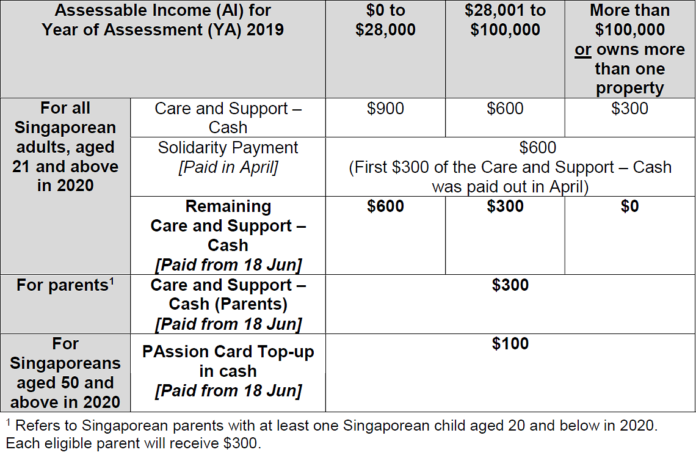
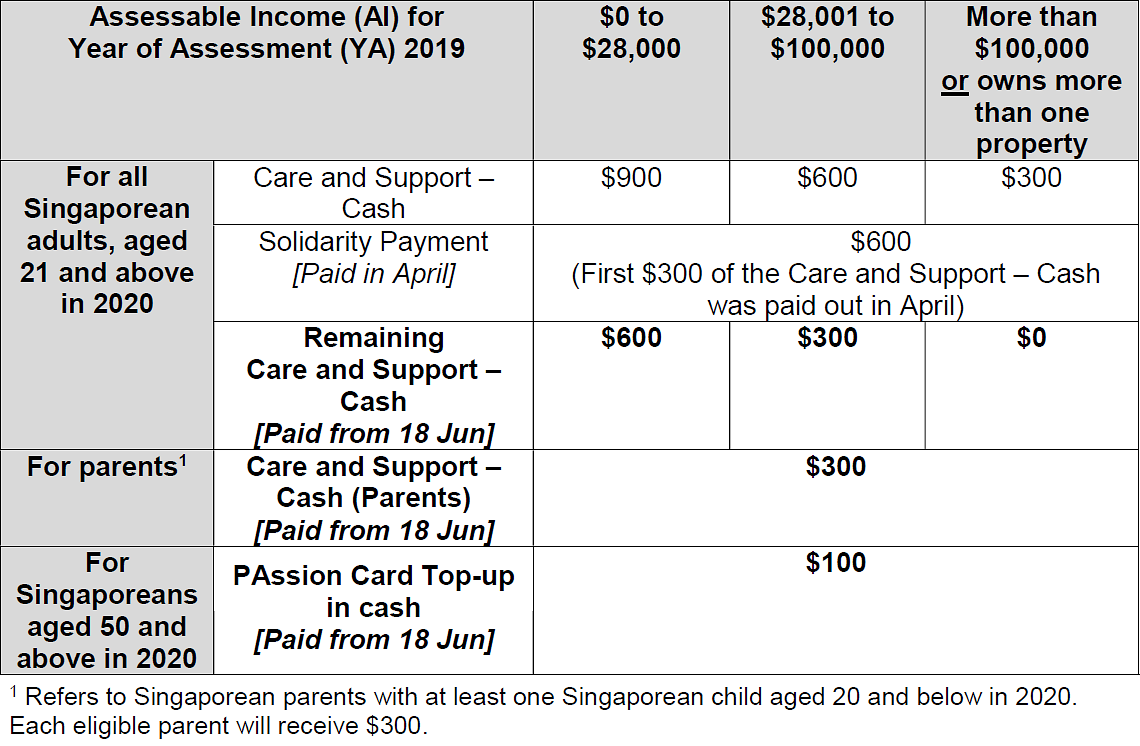
(Graphic: MOF)
In addition, parents with at least one Singaporean child aged 20 and below in 2020 will each receive an extra S$300.
Singaporeans aged 50 and above in 2020 will each receive an extra S$100 cash, in place of the earlier announced PAssion Card top-up.
“As part of the Unity and Resilience Budgets, the Care and Support Package helps provide more assurance and support to over 2.8 million Singaporeans who may be concerned about household expenses during this period of economic uncertainty,” said MOF.
In February, Finance Minister Heng Swee Keat announced the package, noting that many families are facing greater pressures due to the economic slowdown and the uncertainties of the COVID-19 outbreak.
In total, eligible Singaporeans will receive S$900, S$600 or S$300 this year depending on their assessable income for 2019. In April, S$300 was paid as part of the S$600 Solidarity Payment.
In a Facebook post on Thursday, Mr Heng said that he hoped the move would alleviate expenditure concerns of families.
Mr Heng, who is also Deputy Prime Minister, said that those who wish to donate their cash payouts can do so at Giving.sg, as some have done with their Solidarity Payments.
On Thursday afternoon, Parliament will debate the Fortitude Budget, a new S$33 billion Budget focused on providing jobs and helping to tide workers and businesses through the “difficult period” of COVID-19.
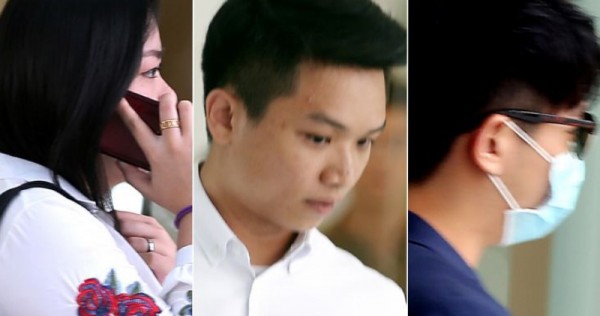
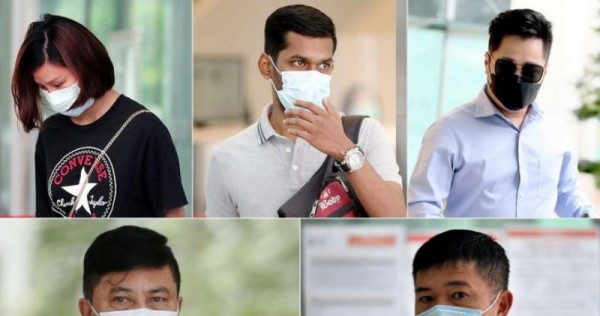
The trio who assaulted a plainclothes policeman on duty at a St James Power Station club in 2017 were each sentenced to 10 months’ jail on Wednesday (June 3).
One of them, Lim Yang Horng, 25, was also fined $2,500 for verbally abusing the officer, Sergeant Tan You Chuen, with vulgar language.
Lim and the other two – Coretta Leong Yin Teng, 26, and Marcus Goh Jun Fong, 25 – were convicted in April after a trial.
The trio were at the Envy Dance Club in the morning of Nov 12, 2017, when the police were alerted to a fight that had broken out on the dance floor.
Sgt Tan and his colleagues arrived at the scene at around 4am.
The policeman testified earlier in court that he asked the trio about the fight and told them to leave the club immediately if they were not involved in the brawl.
He said that he heard somebody utter an expletive directed at the police as he was walking away.
When he turned around to ask the group about what had been said, Lim responded by hurling vulgar words at him.
Lim then threw a punch at Sgt Tan, and a scuffle ensued between the two men.
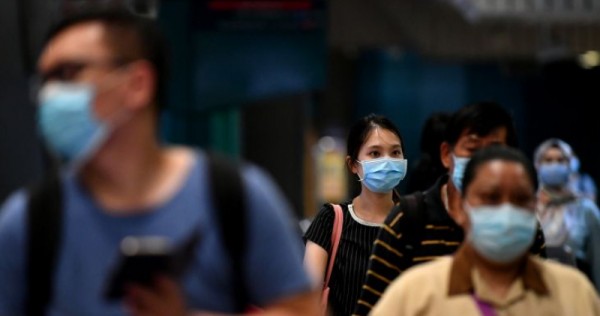
With six out of the seven new community cases announced yesterday being asymptomatic, it is clear there are hidden reservoirs of Covid-19 infections in the community, experts said, as Singapore enters the third day of its reopening this morning.
The circuit breaker is a success, but the country now needs to go to the next level and beat the virus completely, and one way is to work from home whenever possible and put up with the inconveniences of not being able to have face-to-face interactions, said Associate Professor Josip Car, director of the Centre for Population Health Sciences at Nanyang Technological University’s Lee Kong Chian School of Medicine.
When working from home is not possible, precautionary measures such as safe distancing and faysal testing masks should be followed, he added.
People also need to be reminded constantly that the outbreak is ongoing and that is a reason Singapore’s reopening is taking place in phases, said Professor Teo Yik Ying, dean of the National University of Singapore’s Saw Swee Hock School of Public Health.
Digital hijackers are taking over computers to mine for cryptocurrency, with cyber-security firm Kaspersky saying that Singapore has had a spike in cryptojacking attempts in the first three months of 2020.
The Russia-based firm said it blocked more than 11,700 cryptojacking attempts on devices in Singapore between January and March this year – a more than threefold increase from the same period last year when there were about 2,900 attempts.
In a recently published report, Kaspersky said the spike is the highest percentage increase in South-east Asia.
Hijackers target Singapore because of its IT infrastructure and fast Internet speed, which offers a healthy supply of bandwidth for cyber criminals to take advantage of, said Mr Yeo Siang Tiong, general manager for South-east Asia at Kaspersky.
“Cryptojacking, or malicious mining, is the unauthorised use of someone else’s device to mine cryptocurrency.
SINGAPORE – Three workplaces were forced to stop operations for failing to implement adequate safe management measures, including instructing employees to return to the office instead of allowing them to work from home, said the Ministry of Manpower (MOM) on Wednesday (June 3) evening.
A total of 14 composition fines were also issued to employers for breaching various safe management measures in the two days following the end of the circuit breaker period on Monday.
As of 5pm on Wednesday, the ministry had inspected over 200 workplaces in islandwide enforcement operations, it said in a Facebook post.
Mr Silas Sng, divisional director of the occupational safety and health division at the MOM, said: “It is understandable that some employers may be eager to bring their employees back to work in the office after two months of circuit breaker. However, we would like to remind employees that working from home must remain the default working arrangement for employees who are able to do so.”
SINGAPORE: When Daviest Ong turned up unannounced at the door of his family’s flat in Whampoa last week, his reunion with his parents and elder sister was a teary affair peppered with hugs.
The 24-year-old was finally home after 68 days in isolation with COVID-19.
On Friday (May 30), he tested negative for the illness, after a total of 22 uncomfortable swab tests. With that test result, he was able to take the first steps out of his home for more than two months – a single-bed ward in Gleneagles Hospital.
“When I went down to the lobby, and smelt the fresh air, it felt very good, because I couldn’t even pop my head out when I was in the ward,” he told CNA in a phone interview.
“When I found out I was going to be discharged, that was the happiest day of my life.”
Being discharged has allowed him to enjoy the small pleasures he had missed during his isolation, such as having a meal with his family or being able to step outside whenever he wants to.
“It’s the simple stuff that count, the things that I was deprived of,” he said.
By the time he was discharged, Daviest had not seen his family for eight months. Before he fell ill and had to be warded, he had been studying at Newcastle University in the United Kingdom.
HANGING ONTO HOPES OF A NEGATIVE TEST
Daviest’s life in hospital centred around the four days he had to wait after each swab test, hoping each time for a result that would allow him to go home.
“It was very demoralising to keep taking the test. Every time, you go through the pain hoping for a negative result,” he said.
“It gets very tiring.”
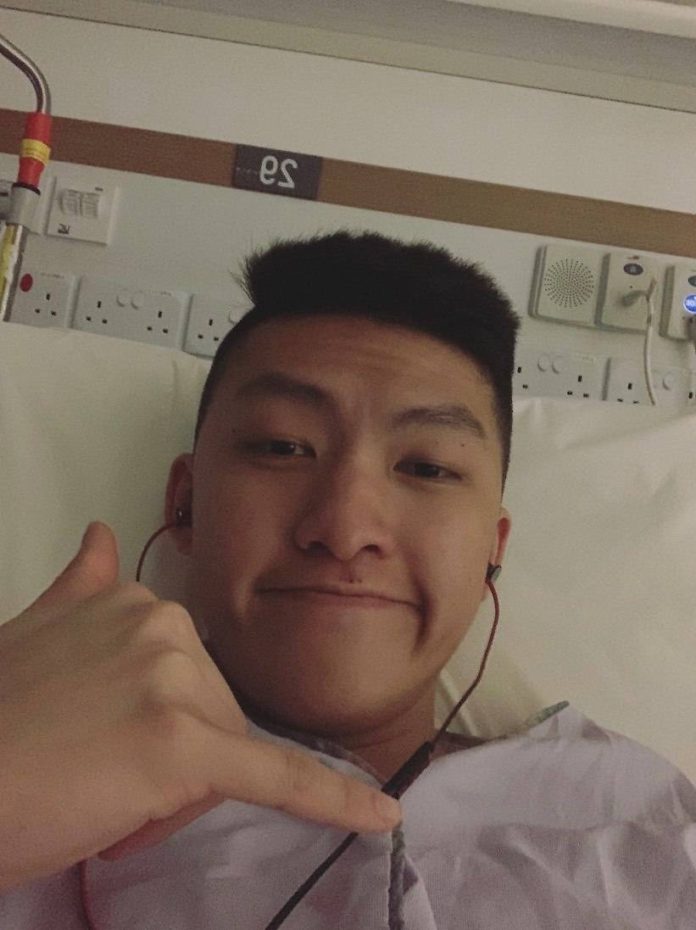
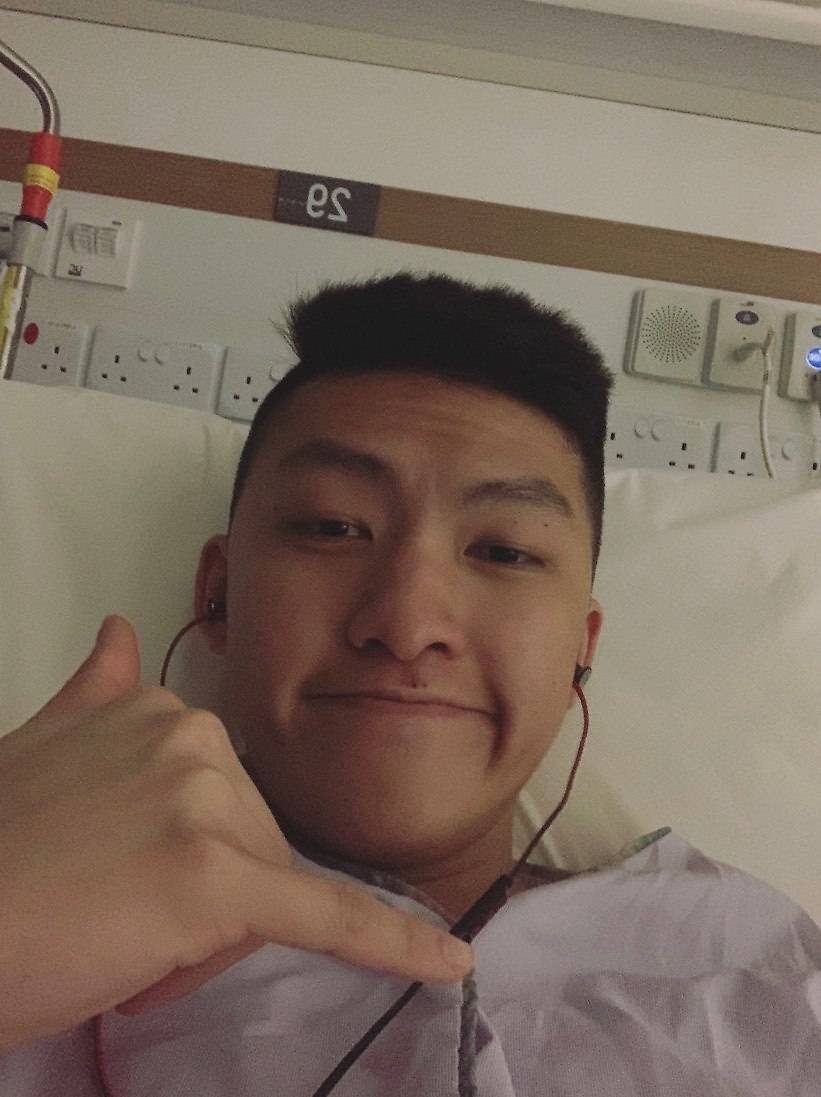
Daviest Ong was warded in hospital for more than two months after being diagnosed with COVID-19. (Photo: Daviest Ong)
In the first two weeks of the illness, Daviest suffered from the common symptoms that come with COVID-19 – nausea, shortness of breath, dry cough and the inability to taste or smell.
While the sickness was unpleasant, at least it felt like he was in hospital for a reason. But as time wore on and his symptoms improved, the days in isolation became more of a challenge.
“It got very claustrophobic. I felt trapped and alone, and I didn’t know what to expect,” he said.
CREATING A LIFE AS NORMAL AS POSSIBLE
One way of dealing with the emotional strain was through exercise.
“I tried to recreate life outside (on the) inside. I had to do it for my sanity,” he said. Studying was also a welcome distraction, as he continued to have examinations.
His loneliness was only staved off each time a nurse came in, but that did little to satiate his need for social interaction.
Daviest kept in touch with friends who were going through a similar experience, and took some solace that there were others who could share in and empathise with his misery.
He was also thankful because, as he saw it, he was not in the worst possible situation. Other patients he knew were struggling much more than he was.
His stay may have been made worse by the realisation he might have only himself to blame for his predicament.
A NIGHT OF ABANDON
While there is no way for him to confirm how he got the illness, his best guess is a rare night out of partying in the United Kingdom. That was when he threw caution to the wind.
There was no washing of hands, plenty of face-touching and cup-sharing, and touching of tables and chairs, as he and his friends celebrated at a club after their victory in a regional school competition for table tennis.
“I let my guard down, I agreed to go for the party,” Daviest said.
The Daviest that night was a far cry from the one he had been for about a month. He had been going to school and grocery shopping with not just a mask, but gloves on too.
Life was still going as per normal in the city – there were no government-mandated precautions to take, school was still on and COVID-19 seemed a distant reality. Yet, with stories from Singapore bringing home the urgency to protect against the disease, he took the precautions, at the risk of sticking out like a sore thumb.
“Even at the grocery store, I would only touch things I needed. I’d discard the gloves after that in a box outside my house,” he said.
Daviest Ong outside Newcastle University, where he read his degree in marketing and management (Photo: Daviest Ong)
While studying at the library, he would regularly make for the toilet with an urgent need to wash his hands. Hand sanitisers became a new accessory.
He took strict precautions, except for that night.
“If I got the infection that night, I regret going for the party. I could have avoided it,” he said.
THE POSSIBILITY OF COVID-19
Shortly after, the Singapore Government appealed for students overseas to return, and Daviest did on Mar 20, along with three friends.
It was when he was back and on a Stay-Home Notice (SHN) that he realised something could be wrong. Two of his table tennis team mates, who had attended the party with him, called to say they had been infected.
He had a fever that at times hovered close to 40 degrees Celsius. He sought medical help, and shortly afterwards found out that he also had the infection.
“When we were at the party, my friends showed no signs. We were very relaxed,” he said.
Daviest Ong with his family during Chinese New Year two years ago. (Photo: Daviest Ong)
Daviest had taken additional precautions even during his SHN. Instead of returning to live with his family, he received a kind offer from his aunt to stay at her place, while she went and stayed with her mother.
“I didn’t expect to get the virus, but I didn’t want to take chances,” he said.
He also took extra care on the flight home. “My friend wanted to drink out of my cup, but I told him no,” he said. He realised how important hygiene is in preventing the transmission of the disease, he said.
Life has somewhat returned to normal for Daviest, and the only faint sign that he went through an illness for more than two months is his slight lack of smell. But still, he continues to heal from the experience.
“This whole journey has been very difficult. It’s not been just a physical battle, but a psychological battle,” he said.
SINGAPORE: Trust. Over decades, airlines have earned the trust of travellers to bring them safely to their destination. Amid the COVID-19 crisis, the question of trust now extends to personal health.
Surveys tell us people are eager to get back to exploring the world, reconnecting with friends and family and vising business partners to seal the next big deal. But you won’t do that unless you feel safe while traveling.
Over the past few weeks all stakeholders in aviation – airlines, airports, manufacturers, governments and medical experts – have been working together to develop a plan for safe travel even as the challenges of COVID-19 remain.
There is no silver bullet. Until a vaccine is found, there is nothing that is failsafe. But layers of measures — each reducing risk at each stage of the journey — can have the cumulative effect of reducing risk a lot.
UNWELL PEOPLE SHOULD NOT TRAVEL
The measures to protect your safety begin at the airport. The first thing we want to do is ensure that unwell people don’t fly.
We will continue to communicate that it is the personal responsibility of everyone to stay home when you have a fever. And passengers will have their temperature checked at the airport as an extra measure.
To keep numbers manageable, only passengers (and their care givers if required) will be allowed into the airport.
Masks will become a feature of travel. Evidence tells us COVID-19 can be spread by people who show no signs of the disease. Wearing a mask helps to prevent the spread of the virus by people who don’t know that they are sick.
You will see airline staff wearing them. And you will be asked to as well — from the time you arrive at the airport until you reach your destination.
REDUCING CONTACT WILL BE KEY
The next layer is speed and reduced contact. That means having passengers arrive at the airport ready to fly using online check-in and a home printed bag tag where possible. If not, then we should see automated processes with kiosks for check-in and self-service boarding.
Self-service check-in counters throughout Changi Airport with Sanrio-themed decor. (Photo: Elizabeth Khor)
That’s not all. Airline staff will most likely have plexi-glass barriers.
There will be more deep cleaning everywhere but particularly for high-touch areas such as kiosks and security trays. And we are working on more efficient ways to queue and other measures so that safe distances can be maintained.
Our surveys show the biggest concern is the person seated next to you. That is totally understandable.
In fact, many expect that the “middle seat” needs to be kept empty so we can extend social distancing on board. That won’t generate the distance suggested by health officials for physical distancing — which is usually 1 or 2m.
So we are following the advice for situations where physical distancing is not possible, which is to wear a mask. And on top of that we are adding other layers of protection.
We are rethinking boarding and disembarking to get people seated or off the aircraft more efficiently. We are simplifying service to minimise the interaction with crew. And we will ensure that people don’t congregate around the washrooms.
BARRIERS TO THE SPREAD OF THE VIRUS IN THE AIRCRAFT
People should also be aware of some other barriers to the spread of the virus. Everybody generally faces forward and doesn’t move around that much. And the seatback is a barrier for respiratory droplets jumping rows.
There are some very important design features including the air flow in the aircraft. It flows from the ceiling to the floor so there is not much air movement backwards and forwards which can help reduce the spread.
SATS aircraft interior cleaning team members disinfect a Singapore Airlines Airbus A350. (Photo: Jeremy Long)
You might not realise that air is exchanged 20 to 30 times an hour with fresh air from outside the aircraft. That’s about 10 times more frequently than most modern office buildings.
For the air that is recycled, it goes through High Efficiency Particulate Air filters—the same ones that are used in hospital operating theatres.
I wish that I could say with absolute certainty that there is no risk of catching COVID-19 in the cabin. There is risk in every interaction we have with other people — when shopping, working, dining or flying. What I can say though, is that we haven’t seen that risk manifest in many cases of onboard transmission.
The main example is a flight from the UK to Vietnam in early March that saw one symptomatic passenger potentially passing the virus to several others.
But there are also published studies of two recent flights between Asia and North America with known symptomatic passengers where no transmission was detected despite extensive contact tracing.
So the risk of onboard transmission appears to be low. And the measures that we have put in place will reduce it further.
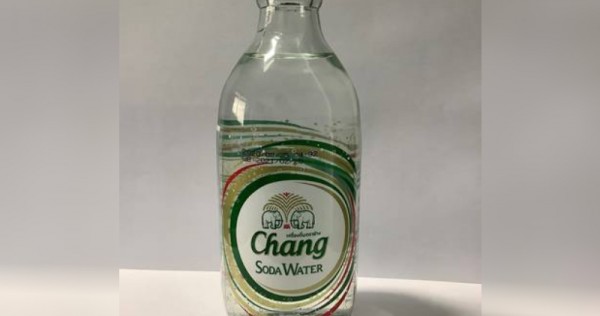
The Singapore Food Agency (SFA) has issued a recall for Chang Soda Water after bromate was detected in samples of the product.
SFA said in a statement on Tuesday (June 2) that under the Singapore Food Regulations, food products, including bottled water, are not allowed to contain any incidental constituents such as bromate.
Incidental constituents in food include extraneous substances, toxic substances and toxins.
The consumption of excessive levels of bromate in food or drinks for a prolonged period of time could result in gastrointestinal symptoms such as nausea, vomiting and abdominal pain.
SFA has directed the importer, Yen Investments, to recall the products. The recall is ongoing.
The affected bottles of Chang Soda Water are products of Thailand in 325 ml bottles and have a best before date of Feb 25, 2021.
SFA said: “Consumers who have purchased the implicated product should not consume it.
A sex worker breached safe distancing measures and allowed a regular customer to enter her home during the circuit breaker period.
Chinese national Cheng Fengzhao, 38, is a work permit holder and was supposed to be employed as a waitress at an eatery whose name was not revealed in court documents, but she failed to turn up for work.
She was fined $7,000 after pleading guilty to an offence under the Covid-19 (Temporary Measures) Act on Wednesday (June 3).
Instead of working as a waitress, Cheng paid a monthly fee to some unknown individuals to help her advertise sexual services on different websites.
She also lived at a condominium apartment in Jalan Kemaman near Balestier Road and paid rent to an unknown man every 10 days. She was charged $100 a day, the court heard.
When the police conducted a raid there at around 3pm on May 5, officers spotted Cheng’s regular customer, a 51-year-old man, entering her unit.
The man, whose name was not revealed in court documents, was stepping out about an hour later when the police identified themselves.
Anything posted on the internet stays on the internet — a tough lesson for a group of former Raffles Institution (RI) students who took a problematic photo four years ago.
And it has returned to haunt them today in a particularly sensitive climate for issues on race and civil injustice.
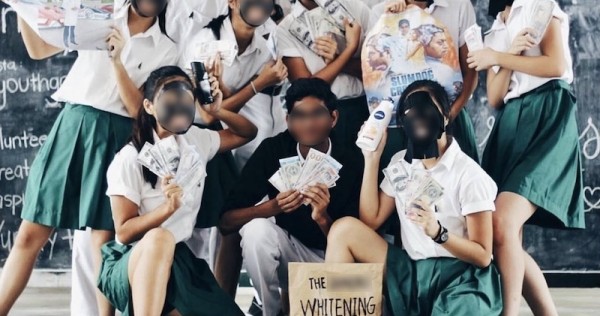
The former RI student who posted the picture on his Instagram account in April 2016 now regrets what he and his friends did together with an Indian friend. The photo — found and reposted on Twitter today (June 3) by someone outside the group — has since been taken down from his page.
In the photo, a student of Indian ethnicity is posing in front of a paper bag that’s labelled with his name and the words “whitening kit”. Posing around him are his schoolmates, all of them smiling with black beauty face masks on, akin to black face.