Singapore has started churning out ventilators to meet the global shortage as Covid-19 cases worldwide surged past the 13 million mark.
Home-grown medical device company Advanced MedTech, which is wholly owned by Singapore’s Temasek, has received emergency approval from the Health Sciences Authority for its Alpha ventilator.
Even before emergency approval was received yesterday, it had already received inquiries and advance orders from countries like India and Indonesia.
It expects to ramp up production to about 200 a month before the end of the year, and eventually to 1,000 a month if it also receives non-emergency approval, which will allow the device to be used outside of an emergency.
Mr Abel Ang, the company’s group chief executive, is confident the ventilator will meet international standards. The company has already filed for approval with the Food and Drug Administration (FDA) of the United States.
He said the Alpha ventilator is the world’s first telehealth ventilator and ideally suited for treating patients with infectious diseases.
Meet Caleb Lin and Terra Chua, the husband-and-wife co-founders of Miniature Stories, which sells collectible miniature figurines of SAF soldiers in different uniforms as well as retro kacang puteh man, samsui woman, and street barber figurines in the heritage collection.
“The long-term plan for Miniature Stories has always been to capture Singapore’s culture and heritage as a whole,” says Terra. “Of course, National Service is a very big part of many Singaporeans’ lives.”
Plenty of research and discussions with sculptors and manufacturers precede the prototyping phase. Caleb and Terra then have to decide what colours to use for each figurine before they finally head to production.
The solid metal alloy figurines are hand-painted and sold primarily at their online store, miniature-stories.com, but they can also be found in selected retail locations islandwide.
The consideration that has been raised for voters during this General Elections 2020 is whether the elected representatives can run a town council (well).
For the roughly 80 per cent of people in Singapore who live in HDB flats, town councils and the Service & Conservancy Charges (S&CC) they charge each month is a reality of life.
But for those who never stopped to wonder what town councils are, who sets S&CC fees, how the collected money is spent, and what happens if you stop paying, then read on as we explain town councils and the S&CC they collect.
What are town councils?
Established by the Town Councils Act in 1988, Town Councils are autonomous legal entities chaired by elected Members of Parliament (MPs) of the constituencies that the town is composed of.
Today, there are 16 Town Councils which are responsible for controlling, managing, maintaining and improving common HDB residential areas and commercial properties within their respective towns, including linkways, precinct pavilions, fitness corners/playgrounds, gardens, lifts, corridors and void decks.
Singaporean blogger and social media influencer Wendy Cheng – better known by her online handle Xiaxue – is no stranger to controversy thanks to her political incorrectness and unpopular opinions on social issues and race.
But the 36-year-old is now under intense fire for accusing female Singaporean politician Raeesah Khan in an Instagram story of stirring up racist sentiments, while finding herself the subject of police reports and petitions for allegedly racist and seditious social media posts.
The post about Khan, which came in the lead-up to Singapore’s recent general election, angered the online community, many of whom took to social media to express their disdain for Cheng and her provocative posts.
Police are also investigating two reports made against Khan for the social media posts in which she “allegedly commented that Singapore law enforcement authorities discriminated against citizens, and that compared to other groups, rich Chinese and white people were treated differently under the law”.
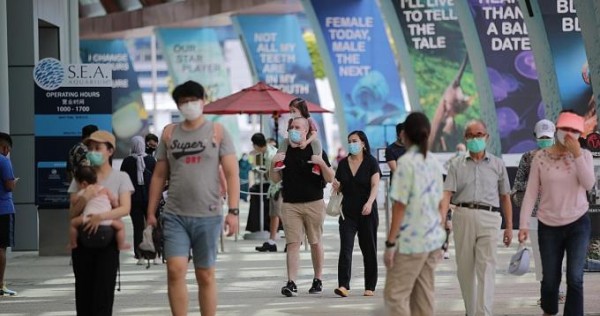
As the number of Covid-19 community cases rises during phase two of the economy reopening, people should be wary but not paranoid, say health experts.
What is important is for the community to keep their guard up and continue practising good habits such as keeping a safe distance from other people, limiting social activities to small groups, and wearing a mask when outdoors, they said.
The Ministry of Health said yesterday that overall, the number of new cases in the community has increased from an average of 12 cases per day in the week before to an average of 14 per day in the past week.
The number of unlinked community cases has also gone up from an average of six per day in the week before to an average of eight per day in the past week.
Yesterday, cinemas became the latest to resume business with safe management measures in place, following the reopening of food outlets for dine-in service and attractions such as wildlife parks.
Infectious disease expert Leong Hoe Nam told The New Paper: “The reopening of attractions will draw in cases, and no country has been able to avoid subsequent ‘waves’ of the disease after reopening.”
SINGAPORE: In Singapore’s 2020 General Election (GE), while voters returned the People’s Action Party (PAP) candidates in 83 out of 93 seats in Parliament, it is the opposition Workers’ Party (WP) that stole the show.
Going into the election in the midst of the COVID-19 pandemic, WP held out the spectre of a PAP “clean sweep” unless voters could beat the instinctive “flight to safety” of choosing a tried and tested team. Instead, WP reminded them of the reasons why “balance” in voices and power was needed in Parliament.
The surprise was that WP was able to extend its influence from six seats to 10 by wresting a second group representation constituency (GRC) – Sengkang – in addition to WP holding Aljunied GRC and the single seat of Hougang where it was the incumbent party.
The popular vote share for WP where it contested swung by 10.7 percentage points from its GE2015 result to reach a creditable 50.5 per cent in the seats it contested.
Recognising this development, Prime Minister Lee Hsien Loong announced that WP secretary-general Pritam Singh would be invited to take up a newly created post in Singapore – the Leader of the Opposition – which in a different Westminster two-party system assumes he would head a shadow government.
Since that may be too great an ambition for WP at the moment, the post more plausibly allows Mr Singh to play the diplomatic role of meeting visiting foreign dignitaries who wish to recognise the political opposition and understand more comprehensively how democracy works in Singapore, as is the practice in countries like the United Kingdom and Australia.
Support for that modest, seductively sensible approach of “balance” came at the expense of a PAP Sengkang team of four men that included three office-holders in favour of four young politicians featuring an even mix of genders – three professionals and one civic activist. They secured 52.13 per cent of the vote in a straight fight against the PAP.
The WP Sengkang team epitomises the way the party has refreshed its ranks in its transition between former secretary-general Low Thia Khiang and Mr Singh. Mr Low, in explaining his decision not to contest in GE2020 said he was gratified there were now younger members who could appeal to people like themselves.
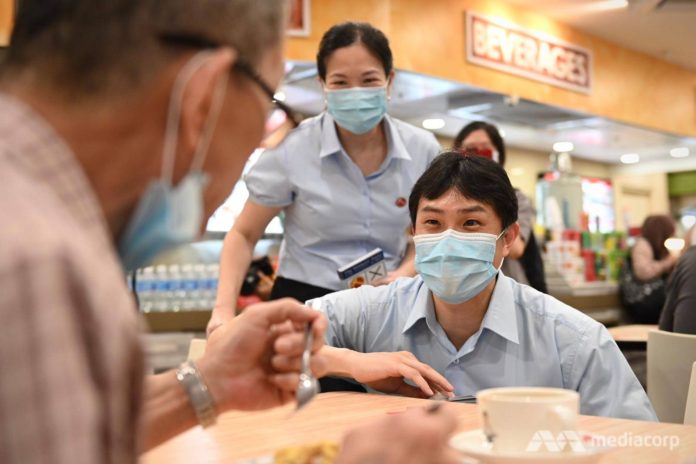
The Workers’ Party (WP) candidates for Sengkang GRC, He Ting Ru and Jamus Lim, interacting with residents during a walkabout at Rivervale Plaza on Jul 7, 2020. (Photo: Marcus Mark Ramos)
ASKING HARD QUESTIONS
There were three other factors apart from demographics that might account for a revival of WP’s fortunes in GE2020. The first is it made good on its promise to provide an alternative voice in Parliament.
Post-GE2015, WP’s six duly-elected MPs, and three NCMPs not only engaged in robust debates with the PAP frontbench on policies but emphasised in this election’s party broadcasts they had voted against bills and constitutional amendments when they felt they had to.
Think of their November 2016 opposition to the changes to the elected presidency system and May 2019 opposition to the Prevention of Online Falsehoods and Manipulation Act.
These did not just provide public profile to the MPs but demonstrated how seriously they were prepared to “deny the PAP a blank cheque”, another key message of its campaign.
The WP also campaigned like other opposition candidates did, to deny the PAP a supermajority or 62 seats so that it would not be able to push through constitutional changes in the House.
This was an ambition that Mr Singh had set out at WP’s annual members’ forum in January 2019. He said it was a goal that would make “any government sensitive to the pulse of the people and their welfare, allowing any ruling party to govern without gridlock while promoting the political openness that so many of us yearn for in Singapore.”
In essence, they had set up a record of “asking tough questions of the government”, in Mr Singh’s words, to convince voters the WP could play such a role.
THE SOCIAL MEDIA FACTOR
Second, even if this had not been an election held in the midst of a pandemic where mass meetings were disallowed, greater mastery of social media would be critical for a successful campaign. In this regard, WP seemed to have its ducks in a row for impactful communication.
The constraints to in-person mass meetings were more than overcome through its Hammer Show and Instagram stories. These were tailored to younger voters, who in past post-election surveys by the Institute of Policy Studies, was the segment more inclined to support the notion of political contestation, turn to the internet for election material and act as swing voters.
While other parties also had their online outreach, to win at the game, candidates have to be personable and authentic.
In its communications strategy, the Sengkang team was empowered to stamp its own mark to convey how they were “insiders” in the constituency. They said they were like their residents – people with young families. They discussed the amenities that residents wished for. This was not a cookie-cutter approach to engagement. They came across as relatable.
Even more critically, Mr Singh provided a masterclass in crisis communications when he was quick to allow the WP candidate in Sengkang, Raeesah Khan, to respond to a brewing controversy over her remarks about alleged unfair treatment of public authorities in two social media posts in 2018 and May this year.
Mr Singh acknowledged concerns head-on and said his party would deal with it after the election, a line that matched the PAP’s in the “trial by Internet” of the potential candidate it had to withdraw, Ivan Lim.
He also said his party did not expect its members to sanitise their past to be on its ticket. This message of “taking people as they come”, of not expecting perfection and backing up one’s candidate quickly, would have appealed to voters.
His composure and responsible leadership was noted online. On the other hand, the PAP may have suffered a backlash for what happened to Ms Khan even if it is unclear if it was directly linked to surfacing her posts.
GOOD LOCAL GOVERNANCE
Third, WP signalled it accepted that voters do have the right to expect good local governance from it.
In his Nomination Day speech, Mr Singh apologised for falling short in the past and promised to do better. The idea of restitution, of setting things right and humility, is again reinforced and a good motivator for support among ordinary citizens.
Importantly, against the backdrop of an appeal to the High Court ruling on the civil case brought against the Aljunied – Hougang Town Council (AHTC) team of leaders for the dereliction of their fiduciary duties, Mr Singh highlighted in a Constituency Political Broadcast on Jul 2 that AHTC’s financial statements had been given a clean and unqualified opinion in 2019 and the Ministry of National Development had also placed Aljunied GRC in a satisfactory green banding for corporate governance.
Pritam Singh from the Workers’ Party speaking during a Party Political Broadcast on Jul 2, 2020.
This would have set some voters’ minds at ease about supporting the team. The WP was able to hold Aljunied GRC with a 9 percentage point rise in support vis-à-vis its GE2015 score.
The outcome has been a positive one for Singapore. It signals elections here are not just contestable but provide balance, discipline and the need for accountability upon the dominant PAP and opposition parties in Parliament.
This is in an age of rage where publics in democracies around the world feel they lack effective channels to voice their dissent.
Some may argue the first-past-the-post-system does not do justice to the fact that 61.24 per cent support for the PAP translated to it taking 90 per cent of the seats in Parliament, but we can be assured that in GE2020, this vital function of parliamentary elections has taken Singapore into the green banding of democratic health.
Dr Gillian Koh is Deputy Director (Research) and Senior Research Fellow in the Governance and Economy Department at the Institute of Policy Studies, National University of Singapore.
SINGAPORE: Now that the General Election is over, it is time for Singapore to refocus on the big challenge of creating jobs to tide citizens over a pandemic and double down on digitalisation for the long term.
Much has been said about the concerns people have about livelihoods, with suggestions to safeguard and improve the prospects of jobs for Singaporeans.
Yet disruption is not new to Singapore. History has witnessed how Singapore has upskilled its workforce through computerisation and automation in the 1980s.
Singapore businesses and workers are no strangers to the need to adapt to new technological changes.
Now, Digital Ambassador Corps have been deployed to help small businesses and senior citizens learn and apply technology.
With every change comes hesitance, even resistance. In the push for a Smart Nation, this resistance may come from a fear of the unknown. Reports of artificial Intelligence (AI) and digital technologies cannibalising jobs do not help either.
However, Singapore is in a unique situation. With a small and ageing workforce, Singapore has to tap on AI and automation to preserve its competitive advantage over other economies.
A COUNTRY INCREASINGLY POWERED BY MORE ARTIFICIAL INTELLIGENCE
Digital technologies and AI (including machine learning, computer vision and natural language processing) can boost efficiencies, performance and productivity in various ways.
It is these advanced technologies that help e-commerce retailers like Lazada sell more by analysing massive amount of data, learning customer preferences and providing targeted products to be displayed online for the customers.
In engineering and aviation, AI has been used to increase the performance of gas turbine engines, such as finding an optimal way to increase thrust and decrease fuel consumptions.
In the long term, the savings on fuel could be passed to the passengers. Such performance improvements cannot usually be attained using traditional models.
SilkAir, Singapore Airlines and Scoot planes sit on the tarmac at Changi Airport in Singapore. (Photo: Reuters/Edgar Su)
In logistics in Singapore and around the world, AI has also been utilised to predict traffic patterns and route conditions. For companies like Grab, the use of AI has enabled drivers to complete as many jobs as possible in the shortest amount of time.
Grab also uses natural language processing methods to address customer feedback and enable users to find the services they need with greater ease.
AI is also extensively used in the development of autonomous vehicles like the National University of Singapore (NUS) autonomous shuttle at its Kent Ridge campus.
In healthcare, AI has been employed to optimise hospital management and processes like managing a large number of patient beds in the case of Tan Tock Seng Hospital. Predictive analytics can help optimise hospital bed assignment decisions by predicting when patients will be discharged to make more beds available.
AI will be an integral part of Singapore’s healthcare system to help doctors make better decisions and design early intervention programmes and improved care pathways for patients using predictive modelling.
One application of machine learning is “precision medicine” where AI can help predict what treatment protocols are most feasible and with higher success rate on a patient based on various patient characteristics and the treatment context.
Another example is robotic surgery (like the da Vinci Surgical System used in Gleneagles Hospital Singapore) which can help surgeons improve their ability to perform precise and minimally invasive incisions and surgeries. Important decisions are still made by human surgeons.
In educational applications and tools, AI has helped the development of skills and testing systems and allows the adjustment of learning based on differentiating students’ needs in Institutes of Higher Learning in Singapore.
Students can thus enjoy more customised testing and learning tailored to the specific needs and ability level of each student.
In areas where AI and digital technologies improve businesses significantly, the nature of jobs has changed.
(Photo: Unsplash/Stefan Stefancik)
Certain jobs like routine clerical work may be reduced while the employment rates for professionals and those in the service sectors have increased. Understanding what tasks AI is suited or not suited for will be a business priority for firms. Singapore’s learning, retraining and upskilling efforts must take full advantage of the AI era.
Prior research has shown AI is suited to perform tasks that provide clear feedback with definable goals and metrics. AI is also efficient at recognising associations based on empirical and statistical data.
AI can help improve traffic volume and flow in metropolitan areas like Singapore, New York or London using pre-defined performance and congestion measures at the system level by analysing large amounts of traffic data.
On the other hand, AI is not so good at unstructured tasks and reasoning, especially based on background information that is previously unknown to the computer.
This is why AI (or machine learning) can be used to spot irregular heartbeat from scans and detect diseases from medical imaging, but it cannot explain as well as doctors how and why one is diagnosed with a certain disease.
In other words, the interpretation of the causes and severity of these diseases and their linkages to other diseases are much more difficult for AI to ascertain. AI also does not perform well when the tasks to be learned change quickly.
Humans do much better at interpreting data and drawing inferences even when the tasks evolve over time.
YOUR JOB MAY REMAIN BUT SOME TASKS COULD BE OUTSOURCED TO AI
In light of the above understanding, how we should we adjust, retrain or upskill the valuable human resource we have in Singapore to prepare for the new paradigm involving AI and digital technologies?
We understand that most jobs have many interrelated tasks. People say the jobs AI could likely replace include telemarketing, receptionists, computer support specialists (think chatbots used by banks like OCBC) and market research analysts.
(Photo: Unsplash/Kate Sade)
However, it doesn’t mean these jobs will disappear entirely. AI is weak on relatively unstructured, creative tasks and those involving emotional intelligence.
The focus of the training or upskilling of such roles should be on these areas. Upskilling courses can cover developing strategies in branding, designing and marketing.
Use AI to gather your data, but use humans to develop business and innovation strategies and design marketing campaigns based on understanding those data.
People and leadership skills will continue to be important, yet another area that AI currently does not fill the void. The expertise in asking interesting questions and looking for new and innovative solutions, which is required in researchers or entrepreneurs, will also be deemed more valuable.
The age of AI and digital technologies is already here. It is clear they can and probably should be applied to different industries and have the potential to significantly improve productivity.
In the process, they will transform our work and lives. While some jobs may be replaced, many other job and career opportunities will be created.
Singapore has the infrastructure, talents and resources to take advantage of the benefits brought about by the AI revolution.
With national emphasis on innovation and Industry 4.0, as well as additional resources and upskilling opportunities, this could yet be another pivotal point for Singapore to create and deliver value in a competitive global arena.
Dr Kenneth G Huang is an Associate Professor with the Department of Strategy & Policy at National University of Singapore (NUS) Business School and the Department of Industrial Systems Engineering & Management at NUS. The opinions expressed are those of the writer and do not represent the views and opinions of NUS.
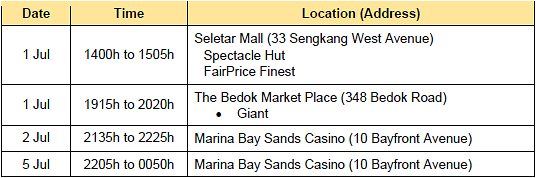
SINGAPORE: Four new locations have been added to the list of places visited by COVID-19 cases in the community during their infectious period, the Ministry of Health (MOH) said on Tuesday (Jul 14).
The locations include Marina Bay Sands Casino on two different dates, as well as Seletar Mall.
Those identified as close contacts of confirmed COVID-19 cases would have been notified by MOH, said the ministry.
It added that people who have been at these locations during the specified timings should monitor their health closely for 14 days from their date of visit.
“They should see a doctor promptly if they develop symptoms of acute respiratory infection (such as cough, sore throat and runny nose), as well as fever and loss of taste or smell, and inform the doctor of their exposure history,” said MOH.
“There is no need to avoid places where confirmed cases of COVID-19 have been.”
The National Environment Agency will also engage the management of affected premises to provide guidance on cleaning and disinfection.
SINGAPORE – Singapore has developed a blockchain-based payments network that could enable faster and cheaper international settlements, authorities said on Monday, adding that the next step was a commercial rollout.
The final phase of the years-long ‘Project Ubin’ saw the Monetary Authority of Singapore team up with state investor Temasek and J.P. Morgan to develop the prototype multi-currency payments network.
“An international settlement network, modelled after this payments network prototype, could enable faster and cheaper transactions than conventional cross-border payments channels,” MAS and Temasek said in a joint statement.
They said that commercial applications of the prototype include cross-border payments in multiple currencies, foreign currency exchange, and settlement of foreign currency denominated securities as well as other use cases.
Blockchain, a digital ledger of transactions, leapt to prominence as the technology that underpins the first digital currency, bitcoin. It has since attracted global attention because it can be used to track, record and transfer assets across all industries.
Charles Yeo’s time in the spotlight may be over, now that the general election’s done and dusted, but the 30-year-old Reform Party member still has fans rooting for him.
The criminal defence lawyer saw unexpected support from Ho Ching herself on Saturday (July 11). The wife of Prime Minister Lee Hsien Loong urged folks not to ridicule Yeo for his noble attempt to deliver his party’s campaign message in Mandarin during a political broadcast that saw him becoming the subject of several memes. Memes that Ho doesn’t want people to circulate.
Another surprise fan of the young politician? The chief of homegrown gaming hardware brand Razer, Tan Min-Liang, who wants to send over some sweet gear to Yeo. But it was an offer that the RP member has politely turned down out of his political credo.
.jpg "20200714_Army_Insta-2.jpg")