Home Blog Page 179

Singapore to mark 55th birthday amid ‘challenging year’: First look at ‘scaled-down’ NDP2020

0

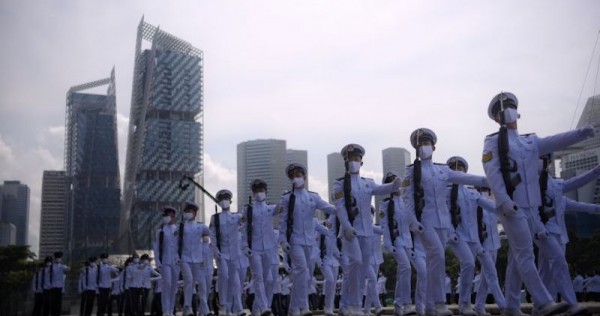
SINGAPORE: Singapore marks 55 years of independence in 2020 – a challenging year for the small nation as it continues to fight the global COVID-19 pandemic. On Sunday (Jul 26), a demonstration was held at the Padang previewing this year’s National Day Parade (NDP), a smaller affair focused on safety and dedicated to frontline workers. 

The parade segment of the event – themed “Together a stronger Singapore” – will comprise the state colours, guard-of-honour contingents formed by the Singapore Army, Republic of Singapore Navy (RSN), Republic of Singapore Air Force (RSAF) and Singapore Police Force (SPF), as well as a combined band from SPF and the Singapore Armed Forces.

For the first time, the presidential gun salute will be conducted at the Padang together with the marching contingents on parade. 

READ: ‘It means a lot to people with disabilities’: Meet the special needs artists who designed NDP Singapore Together Packs

NDP2020 Padang preview (9)

The March Past during the Parade and Ceremony demonstration, Jul 26, 2020. (Photo: Marcus Mark Ramos)

NDP2020 Padang preview (4)

This year’s parade is themed “Together a stronger Singapore”. (Photo: Marcus Mark Ramos)

NDP2020 Padang preview (3)

This year’s National Day Parade will also include the State Flag Flypast by the RSAF’s CH-475D Chinook helicopter, escorted by two AH-64D Apache helicopters. (Photo: Marcus Mark Ramos)

Traditional parade favourites will feature in this year’s NDP, including the state flag flypast by the RSAF’s CH-475D Chinook helicopter, escorted by two AH-64D Apache helicopters. 

Singaporeans can look forward to six F-15SG fighter planes flying in a delta formation to perform a “roar of unity” across the Padang, before overflying Singapore as a tribute to frontline fighters and essential workers. 

READ: NDP 2020 music video features Singaporeans who joined fight against COVID-19; theme song performed by Nathan Hartono

NDP2020 Padang preview

State Flag Flypast by the RSAF’s CH-47SD Chinook Helicopter, escorted by two AH-64D Apache helicopters. (Photo: Marcus Mark Ramos)

NDP2020 Padang preview (2)

F-15SG fighter aircraft flying in delta formation to perform a Roar of Unity across the Padang. (Photo: Marcus Mark Ramos)

Highlights of the parade include the “nationwide anthem moment” and a salute to frontline and essential workers. 

During the former, President Halimah Yacob – together with the parade – will lead the singing of the national anthem as the state flag is raised at the Padang. At the same time, flag-raising ceremonies will take place across Singapore in a bid to bring Singaporeans together in a collective moment of unity. 

READ: NDP 2020 to have morning and evening shows; shows to be scaled down in line with COVID-19 precautions

NDP2020 Padang preview (11)

Minister for Defence Dr Ng Eng Hen speaks to members of the media, Jul 26, 2020. (Photo: Marcus Mark Ramos)

Defence Minister Ng Eng Hen, who witnessed the demonstration at the Padang, spoke about the precautions taken for this year’s parade to stem the spread of COVID-19. 

“It will be a scaled-down parade,” said Dr Ng, with just four guard-of-honour contingents. 

The spectators will be made up of “representatives of society” and “instead of tens of thousands, we will have about 150 members”, he said.

READ: NDP a uniquely Singapore phenomenon, a commentary

NDP2020 Padang preview (1)

This year’s National Day Parade will be a smaller affair focused on safety and dedicated to frontline workers. (Photo: Marcus Mark Ramos)

NDP2020 Padang preview (5)

A simulated President’s Inspection during the Parade and Ceremony demonstration, Jul 26, 2020. (Photo: Marcus Mark Ramos)

NDP2020 Padang preview (7)

For the first time, the Presidential Gun salute will be conducted at the Padang together with the marching contingents on parade. (Photo: Marcus Mark Ramos)

“The contingents have been exercising very strict discipline, in terms of ‘cohorting’ and ensuring that they themselves are well. I think that so far so good, they have kept themselves free from infection, but we are always monitoring.”

Each contingent will have 36 participants, half of what it was in previous years, and they are all required to wear a mask throughout the ceremony.  

“It was a little bit challenging at the beginning because it is a little harder to breathe,” said Parade Regimental Sergeant Major (RSM) Master Warrant Officer David Ling.

READ: SAF soldiers ‘rose to the occasion’ in fight against COVID-19: Ng Eng Hen

NDP2020 Padang Preview commander Nicholas Ong

Parade commander LTC Nicholas Ong and RSM Master Warrant Officer David Ling, Jul 26, 2020. (Photo: Marcus Mark Ramos)

NDP2020 Padang preview (8)

Parade Commander LTC Nicholas Ong. (Photo: Marcus Mark Ramos)

“However, we planned a progressive training programme whereby we acclimatised them to the heat, the humidity and the difficulty in breathing. We allowed them to adjust and regulate their breathing before we moved on to proper training,” he said. 

He said that safety is “paramount” and that it is his responsibility in his role to plan and execute a parade that is “safe for all participants”. 

“We require our participants to take their temperature twice a day. We also ensure that all participants adhere to safety distancing,” he added.

READ: Nathan Hartono, Taufik Batisah in special concert to celebrate Singapore’s 55th birthday

NDP2020 Padang preview (10)

Minister for Defence Dr Ng Eng Hen was present at the Padang to witness the demonstration. (Photo: Marcus Mark Ramos)

Parade Commander LTC Nicholas Ong talked about how NDP 2020 will be a dedication to the frontline workers. 

“We want to take this opportunity to pay our respects and gratitude to our unsung heroes, who have been working tirelessly (since) our nation was hit by the challenges caused by the COVID-19 pandemic,” he said.

“I think as all Singaporeans know, it’s a very challenging year because of COVID-19,” said Dr Ng.

“But we have to stand together and send a very strong message as Singaporeans that no matter what comes, rain or shine, virus or no virus, that our resolve to celebrate our national day as one nation, our resolve to overcome our difficulties … that’s what National Day means. That’s what it has meant ever since our independence 55 years ago.”
Source link

NDP 2020 scaled down to around 150 parade spectators and 300 participants

0

[ad_1]

Instead of the tens of thousands of spectators of past years, this year’s National Day Parade (NDP) will have just around 150 spectators who are “representatives of society”, Defence Minister Ng Eng Hen said on Sunday (July 26).

NDP2020 will be broken into two segments, with a morning parade and ceremony held at the Padang, the site of Singapore’s first NDP in 1966, and an evening show at the Star Performing Arts Centre.

There will be around 50 representatives of the Government, including ministers, watching the morning parade and around 100 members of the public as spectators.

Those watching the parade will be seated in three sections of around 50 people each, to prevent intermingling.
State flag flypast above flats along Sengkang East Way during National Day Parade Rehearsal on July 26, 2020. PHOTO: The Straits Times / Lim YaohuiParticipant numbers have also been dropped to about 300 this year for both events combined. This is down from the usual 5,000 to 6,000 people.

[ad_2]

Source link

'We are in absolute unity': Vivian Balakrishnan on support for Heng Swee Keat's leadership

0

[ad_1]

The fourth-generation leadership team is in “complete unity” behind Deputy Prime Minister Heng Swee Keat’s leadership, said Foreign Minister Vivian Balakrishnan on Sunday.

Asked about the implications of the new Cabinet line-up, which was announced by Prime Minister Lee Hsien Loong on Saturday (Jul 25), Dr Balakrishnan reiterated PM Lee’s points that the reshuffle “reflects the need for continuity, the need for rotation, and the need for renewal”.

“And if you look carefully at the composition, and, in fact, at the moves that the Prime Minister has made, it reflects all these three priorities,” he added.

Dr Balakrishnan, who has said that he is part of the fourth-generation leadership team, also said the 4G team backs the leadership of Deputy Prime Minister Heng Swee Keat, who is expected to take over as PM when PM Lee Hsien Loong steps down. On Saturday, it was announced that Mr Heng is taking on an additional appointment as Coordinating Minister for Economic Policies.

[ad_2]

Source link

PM Lee Hsien Loong's crisis Cabinet a mix of continuity and change

0

[ad_1]

Prime Minister Lee Hsien Loong announced his new Cabinet yesterday, which sought to strike a balance between continuity provided by his senior colleagues, exposure for younger ministers and leadership renewal, as Singapore navigates its worst crisis since independence.

The new line-up will see six of the 15 ministries having a change in ministers. Seven of the PAP’s new faces have also been appointed political office-holders, with the oldest among them — Dr Tan See Leng, 55 — made a full minister.

Most older ministers — including Senior Ministers Teo Chee Hean and Tharman Shanmugaratnam — will stay on to provide continuity amid the coronavirus pandemic.

Deputy Prime Minister Heng Swee Keat’s role overseeing the nation’s economy has been cemented. Apart from continuing as Finance Minister, he will take on an additional role as Coordinating Minister for Economic Policies.

This formalises the role Mr Heng was playing in the last term, said PM Lee. Mr Heng chairs the Future Economy Council as well as the National Research Foundation.

[ad_2]

Source link

Singapore-Malaysia travel arrangements for permit holders, business travellers finalised

0

[ad_1]

Singapore and Malaysia have finalised arrangements for long-term pass holders and travellers on essential or official business to cross the border — applications for which will kick off on Aug 10, Foreign Minister Vivian Balakrishnan announced on Sunday (Jul 26).

Operational details for the reciprocal green lane and periodic commuting arrangement will be published in the next few days.

Meanwhile, the two countries have also agreed to develop a proposal for daily commuters crossing the border for work.

This will take into account the required health protocols and available medical resources in both countries to ensure the safety of citizens of both sides.

“Give us a couple of weeks to monitor the figures both in Malaysia in particular Johor and in Singapore, and as we gain greater confidence that the control of the pandemic is well-executed in both places, we can then begin the discussions for how we can allow daily commuting,” said Dr Balakrishnan.

[ad_2]

Source link

Making of a Chinese agent: Dickson Yeo, the Singaporean spy

0

[ad_1]

Dickson Yeo spent almost five years working at the behest of Chinese intelligence operatives to obtain valuable information from the United States.

He was recruited when, as a PhD student in the Lee Kuan Yew School of Public Policy, he went on a trip to Beijing to give a presentation on Southeast Asia politics, court documents showed.

After the presentation, he was approached and recruited by individuals who said they represented China-based think-tanks and offered him money in exchange for political reports and information.

Yeo came to understand that at least four of them were Chinese intelligence operatives, one of whom eventually asked him to sign a contract with China’s People’s Liberation Army.

Although Yeo refused to sign the contract, he continued to work for the Chinese operatives.

They told him that they wanted non-public information which they called “scuttlebutt”, a slang term for rumours and gossip.

Their assignments focused on Southeast Asia at first, but over time, shifted to focus on the US.

Over the next few years, Yeo met his Chinese handlers as many as 25 times in various locations across China.

[ad_2]

Source link

More than nose jobs and facelifts: The plastic surgeon who saves body parts

0

SINGAPORE: Dr Pek Chong Han has performed surgery on bacteria-infested feet and cancer-ridden tongues. But few of his patients, on introduction, are aware of why they must see him.

The mention of plastic surgery brings to mind procedures like breast augmentation and eye lifts. So he has to take a few moments to explain: Yes, he is a plastic surgeon. No, he is not here just to beautify them.

“It’s about making you recover faster … or recover what you’ve lost to whatever disease,” said the 36-year-old, who has been with Khoo Teck Puat Hospital (KTPH) for three years.

While he does some cosmetic procedures, most of his work at the government hospital is reconstructive surgery. That means literally patching “holes” and restoring function to defective body parts.

Most of plastic surgeon Pek Chong Han's work at Khoo Teck Puat Hospital is reconstructive surgery.

Dr Pek Chong Han.

In fact, the full name of the speciality is Plastic, Reconstructive and Aesthetic Surgery. The term “plastic”, he explained, comes from the Greek word plastikos, which means to be moulded or formed, rather than the “synthetic material”.

Where there is a hole, he is there to patch it up — whether it is a trauma case such as a facial laceration from a road accident, a severe foot wound aggravated by diabetes, or a deep burn.

Some holes are created by other surgeons, for instance after a big cancerous tumour is removed, and are later referred to the plastic surgery team, which currently comprises six doctors.

So Dr Pek could be working with neurosurgeons on the scalp, orthopaedic surgeons on the lower limbs and general surgeons for anything in between. The list is bound only by the human anatomy.

That means he must be well acquainted with diseases in every body part and understand how to reconstruct those areas, he said. “We approach the same problem, (just) from a different angle.”

Quite apart from the glitz and glamour of cosmetic surgery, this of the work of its lesser known twin in the field of plastic surgery.

TO SPEAK AND SWALLOW AGAIN

One of the best parts of the job, said Dr Pek, is being in the “special ops force” behind these multi-disciplinary surgeries. It usually entails a discussion with the primary surgeon to come up with a “reconstructive plan”.

“When the army has something that they … can’t do, they’d call (us), and then (we’d) come in and do something on top of what they can do, to help resolve that issue,” he said.

“We get to learn from others, and we also can help each other along the way.”

The Khoo Teck Puat Hospital team at work during an abdominoplasty, commonly known as a tummy tuck.

The team at work during an abdominoplasty, commonly known as a tummy tuck.

In the case of 46-year-old Ben (not his real name), having stage two cancer meant a 3.5-centimetre tumour on his tongue needed removing. That was the entire left side down to the floor of his mouth.

Armed with this information, Dr Pek determined how big a flap was needed from the donor body part, Ben’s left arm.

A flap differs from the more commonly known skin graft, which is a thin sheet of skin. A flap comprises skin, soft tissue and its accompanying blood vessels and nerves, which can restore the bulk of the tongue, with sensation and movement.

The work did not stop, however, with surgery last year. For many weeks, hair from the flap continued growing on Ben’s tongue and needed trimming during each follow-up consultation.

“(The skin) is alive, and therefore the cells are active and … the hair’s also growing,” said Dr Pek. “It took us almost 20 or 30 minutes just to (trim) all the hair inside (each time).”

KTPH plastic surgeon Pek Chong Han removing hair from Ben's tongue, six months after surgery.

Removing hair from Ben’s tongue, six months after surgery.

But with time, as the flap is constantly in contact with saliva, the cells undergo a “transformation”, or “metaplasia”, to mimic the mouth environment.

Ben also had speech therapy for a few months as therapists helped him to “maintain his airway to facilitate breathing” and relearn how to use his new tongue.

“It’s like going back to when you were young, like a baby,” said Ben, who could not chew, swallow and talk properly for “two to three months” post-surgery.

Six months after the operation, when CNA Insider met him, the flap was pinker in colour, and barely any hair was present. “It’s much closer to the final result now,” Dr Pek said while examining Ben’s tongue.

Ben's tongue pictured a few months apart. The one on the right was taken six months after surgery.

Ben’s tongue pictured a few months apart. The one on the right was taken six months after surgery. (Photo: Khoo Teck Puat Hospital)

ALMOST LOSING A FOOT

For another patient, 33-year-old Kelvin Seah, plastic surgery meant being able to walk and play sports again, after flesh-eating bacteria attacked a significant portion of his left foot.

He was on holiday in Iceland when his foot began to swell. He had a cut on a toe then and suspects he caught the bacteria while at the iconic Blue Lagoon geothermal spa.

On returning home, he went into KTPH, where he had four operations in total. The first two involved his orthopaedic surgeon removing as much bacteria-infested flesh as possible. The third, for good measure, was to clear him of any bacteria.

By then, his tendons, bones and muscles lay exposed. Portions of his foot also lacked blood supply, which would not have supported a skin graft.

Kelvin Seah's foot after surgery at KTPH, with his tendons, bones and muscles exposed.

Kelvin Seah’s foot after surgery. (Photo: Khoo Teck Puat Hospital)

“The wound needs to be able to ‘receive’ a skin graft, much like applying wallpaper on a wall that’s been prepared,” said Dr Pek, who used a flap instead.

“This flap allows him to wiggle his toes nicely; he can move his ankles nicely. It gives him good contour, and it’s more resilient.”

But the flap, which had more fat cells as it was transplanted from the left thigh, also needed to adapt to the foot post-surgery.

As Seah had put on weight while recovering, the thigh flap grew disproportionately bigger than his foot. Liposuction had to be done to thin down the flap so that he could wear shoes of the same size again.

Kelvin Seah's foot before liposuction (left) and after — done to thin down the flap on his foot.

Seah’s foot before liposuction (left) and after. (Photo: Khoo Teck Puat Hospital)

Two years after his surgery, he not only can walk, but also play sports such as basketball and badminton. Rock climbing, however, is one thing he cannot really do, as he cannot grip well with his toes, he said.

“That’s fine, I don’t do it much,” he added. “The most important thing is to resume my original lifestyle.”

RECONSTRUCTION VS COSMETIC

Whether one’s surgery is reconstructive or cosmetic is important in determining if its cost is covered under Medisave.

The distinction lies in whether the patient’s pre-existing condition is medical, said Dr Pek. There is, for the most part, “guidance” from the Health Ministry and the plastic surgery specialist board on what is medical or cosmetic in nature, he added.

“It isn’t black and white; it’s a little bit grey,” he said. “As a doctor, you’d have to determine what symptoms (the patients) have. Or is it just purely about their appearance?”

Plastic surgeon Pek Chong Han has been with Khoo Teck Puat Hospital for three years.

Dr Pek.

For example, if a patient asks for a “crooked” nose to be fixed but he does not see it as such, he would have to say no.

“As long as we’re trying to improve someone’s symptoms or function, then that, in general, should fall under some kind of medical indication,” he said.

That was the case for Vanessa (not her real name), who had an abdominoplasty, commonly known as a tummy tuck.

She had undergone bariatric surgery in 2015 — to make her stomach smaller — and the weight loss resulted in excess skin, which impaired her “hygiene around the groin area”. It also impeded exercise.

KTPH plastic surgeon Pek Chong Han making pre-op markings before an abdominoplasty.

Dr Pek making pre-op markings before the abdominoplasty.

“Imagine you have a large waist pouch with a 1.5-litre or 2-litre Coke bottle in there and try to go for a run. It’s a very difficult task,” said Dr Pek.

The skin was unlikely to normalise on its own, he added, as it had been “expanded for many, many years”.

“There were tyres appearing on my stomach, so it wasn’t a good thought,” Vanessa described. “It was impacting my self-esteem.”

So last year, on the advice of the bariatric team, she opted for the tummy tuck, which involved cutting off the excess skin, shifting back the abdominal muscles that had splayed and repositioning her belly button.

“Health wise, I do believe … there’ll be no more hygiene issues, skin reactions and all those things,” she told CNA Insider post-surgery.

“I’m already looking forward to now going back to my exercise regime. It’s up to the individual to maintain it, so I’m not just relying on this surgery.”

KTPH plastic surgeon Pek Chong Han shifting the belly button during an abdominoplasty.

Shifting the belly button during the abdominoplasty.

Following such surgeries, Dr Pek would review the scars to make sure that they heal well and that the patient is “happy with not just the physical appearance, but functional appearance”.

That includes finding out if the patient can move properly or experiences any pain when exercising.

‘A MEANINGFUL LAST STEP’

In a week, Dr Pek does about five surgeries. Even during the COVID-19 “circuit breaker”, when non-essential surgeries were postponed, he had many emergency cases. The most rewarding cases, however, are not necessarily the most challenging ones.

“Some of these patients, when you restore them to normality, they’re so grateful to you,” he said.

Kelvin Seah, 33, is all smiles now, but his foot infection two years ago was a serious one.

Kelvin Seah is all smiles now, but his foot infection two years ago was a serious one.

Before surgery, it is not uncommon for patients to experience anxiety, since they are facing a major bodily change, he noted. But the satisfaction comes when they “see how far they’ve (come)” and “gain confidence to return to society”.

“They come in with a severe problem … and usually when they come to the plastic surgery team, we’re the last part of the treatment plan. So we help to round off their journey on a high note,” he said.

“They can go back to functioning. To me, that’s a very meaningful last step.”

With all this in mind, he hopes that impressions of plastic surgery can move beyond what is “commonly sensationalised” in the mass media as merely aesthetic surgery. He hopes to bring more awareness in favour of breast reconstruction in particular.

“Singapore … actually has one of the lowest breast reconstruction rates,” he said.

He has seen how mastectomy, the surgical removal of one or both breasts, is “a scarring surgery not only for the body but also for the mind”.

“Patients sometimes do suffer from depression … because of a loss of a body part,” he said. “We hope to give patients more knowledge and the power of optionality in terms of what they want to do after breast cancer treatment.”

As for the money he could earn — never mind the glitz and glamour — if he were an aesthetic surgeon in private practice, he said: “To put it plainly, if I really want to earn money, there are better ways than being a doctor.”

Source link

Need a holiday but can’t travel? How to get away while staying in Singapore

0

SINGAPORE: Seagulls flew overhead as we gazed at a sea view dotted with kelongs and a mangrove island – this was Singapore but not as I know it.

Speeding in a half-cabin cruiser, our small group of four were on a boat tour that took us around the northeastern coast of Singapore, cruising by Pulau Ubin and Pulau Tekong, with a stop at a kelong, or fish farm, partly converted to a floating restaurant.

Along the way Mr Robin Loh of Let’s Go Tours told us stories about how the coast and northern islands have changed, fed us titbits about fish farming and explained seafaring terms.

The long-time fishing enthusiast, who has been boating in Singapore waters for two decades, came up with this tour for Singapore residents who want to explore a side of Singapore they may not have seen before.

While his company’s bike tours cover cultural and historical sites as well as major attractions, he did not think these would appeal to most Singapore residents.

“It really takes a lot more to attract the locals. That’s why we are putting on our thinking cap and coming up with experiences like this where local residents may not get to do on an everyday basis,” he said.

READ: S$45 million tourism campaign launched urging locals to explore Singapore

It’s an example of how tourism businesses have had to adapt to a plunge in visitor arrivals to Singapore, which has gone from the fifth-most visited city in the world to admitting just 880 people in May.

For outbound travel, the government’s advisory not to travel out of the country is unlikely to change in the near future even as essential business travel resumes gradually and green lanes for travel are established.

“This will not apply to mass tourism travel. That I think will not happen any time soon,” National Development Minister Lawrence Wong said on Jul 17. 

On Wednesday (Jul 22), the Singapore Tourism Board (STB) launched a S$45 million campaign to encourage locals to take a “Singapoliday” or staycation, and support tourism and lifestyle businesses here.

According to a United Nations estimate, Singaporeans spent S$34 billion travelling overseas in 2018 alone, and  STB hopes that some of Singaporeans’ overseas spending can be channeled to domestic consumption despite the uncertain economic times. 

But living on a small city-state with no hinterland, it can be hard to imagine where one can “get away from it all”. Besides booking a staycation at a hotel, are there corners of Singapore one can explore?

ISLAND-HOPPING LIFE

Island hopping and taking a day trip to Singapore’s outer islands is one way to escape the bustle of city life, said Ms Jane Lim, VP of global markets at Tripadvisor.

Mr Alvin Lee, who co-owns yacht charter Sip & Sail, used to hold parties at sea for large groups or corporate events on his catamaran Kingdom, but with safe distancing measures limiting groups to five people per boat, they now take families and small groups out for a day out in the sun and sea.

Bookings have also switched from being concentrated on weekends to being spread out across the week as people’s routines have changed, and the company has tweaked its rates and operations to adapt, he said.

“In our concrete jungle home, it’s a rare opportunity to enjoy the sun, sea and beach away from the crowds and get away from it all – at least for a few hours,” said Mr Lee.

Mr Lars Lund Rasmussen of Epic Ocean yacht charter said that many families and groups book their boat to visit Lazarus Island for kayaking, water activities and time on the beach, but with small groups, it is also easy to tailor itineraries to more obscure islands or special occasions.

Epic Ocean in water 1

Yacht charter Epic Ocean takes guests out to sea, typically to Lazarus Island to Singapore’s south. (Photo: Epic Ocean) 

His wife Aemy Lim, who runs the operation with Mr Rasmussen, told CNA that they had a family who wanted to show their children Lazarus Island and St John’s Island, and tell them about the history of the islands; they’ve also taken guests to circle Pulau Jong – one of the few Singapore islands that remains untouched.

“We arrange a lot of surprises, when they bring (their friends or family) over, it’s a birthday or wedding anniversary … they can have a barbecue or a romantic dinner out in nature,” she said.

STAYCATIONS WITH MORE

Staycations at a hotel are another way to book a quick getaway – and without the hassle of dealing with an unfamiliar environment, currency or transport system.

“The desire to have a staycation is usually higher for couples who live separately with their respective families, groups of friends who usually travel together, or families who don’t have a swimming pool near their homes and wish to enjoy one at a hotel,” said Ms Zelia Leong, co-founder of trip planning company Anywhr. 

“Some people also wish to replicate that travel experience, such as checking into a hotel or taking a plane. That is why in Taiwan, you can now board a plane to ‘nowhere’ and just sit in a stationary plane for a meal.”

READ: Check in but never leave: Taiwan offers fake flights for travel-starved tourists

READ: Singapore hotels look to woo staycationers with promotions, COVID-19 safety measures

With the recent opening for staycations, hotels here have been aggressively pushing out packages for locals that combine tours, discounts and spa or adventure experiences.

Mr Loh of Let’s Go Tours has adapted his award-winning bike tour for guests of Raffles Hotel. His history trails led by “Tan Ah Huat”, a fictional immigrant to Singapore at the turn of the 20th century, catered mostly to tourists before restrictions on arrivals were imposed in late March.  

“This is a trail where we will cover the early days of 1900s all the way up to present, to show the contrast then and now, but in line with Raffles Hotel’s history,” he said.

Let's Go Tours bike tour

Let’s Go Tour has adapted its history tour Trails of Tan Ah Huat for Raffles Hotel. (Photo: Marcus Mark Ramos)

With the restrictions in Phase 2, tours are also limited to no more than two hours for five people or fewer, and operators are turning to new niches.

Hoping to tap on nationalistic sentiments ahead of National Day, Monster Day Tours is organising SG55 special edition tours. The company is working with hotels, such as Lyf Funan, to offer these tours to staycation patrons, and it is also running a “behind-the-scenes” tour of Changi Airport and Jewel.

“We will tell you the insider stories about Changi and Jewel, which you may not know about even if you go to these areas often, and we’re also bundling the tour together with a set of gift cards,” he said.

“We’re not really looking to make money, It’s more like a long-term plan. We know if we want to recover we need our guides back on the ground.”

READ: Retrenchments in tourism industry are ‘inevitable’ without resumption of mass market travel: Chan Chun Sing

As part of the push to get locals to explore Singapore, merchant associations will be working with the Society of Tourist Guides to develop heartland tours slated for September, STB has said. There will also be guidebooks via a Jalan Jalan: Your Good Hoods Guide initiative, to promote local neighbourhoods’ food, shopping, entertainment and arts destinations.

WORKSHOPS ARE NOT WORK

Workshops are another great way to “escape” your routine at home, said Ms Leong. 

“It allows you to bond with each other, try something new, and even bring a souvenir home,” she said. “We usually recommend workshops like terrarium making, concrete/cement workshops where you can make anything from lamps to coasters, and pottery – which are suitable for families, couples, and seniors.”

Ms Lynette Foo, director of cooking school Palate Sensations, said that they have seen more people interested in classes on advanced culinary techniques, and which require more time and effort to complete – such as an eight-session Chef In Training programme. 

Palate Sensations cooking class

An instructor demonstrates at a Palate Sensations cooking class. (Photo: Gaya Chandramohan)

“Surprisingly, in times of crisis or distress, people tend to invest in themselves instead of spending their money on material items,” she told CNA.

“Technique-based classes are more important to them than aesthetic Instagrammable classes such as character macarons. They’d rather learn how to make sausages or how to improve their knife skills because they know this will stand them in good stead in the future.”

Ms Leong, whose company specialises in designing personalised itineraries, said that there are many hidden gems in Singapore, some of which she had recommended to overseas travellers who asked them to design their holidays in Singapore.

One suggestion: A tea making and appreciation workshop at family-run Yixing Xuan Teahouse along Tanjong Pagar, which Ms Leong said was “unique and under-rated”.

Yixing Xuan Teahouse 1

A tea making and appreciation workshop at Yixing Xuan Teahouse. (Photo: Gaya Chandramohan)

The teahouse, which has been in the area since 1989, would run workshops for corporate groups and tourists, but now holds virtual workshops, as well as more intimate sessions for smaller groups to savour and learn more about the art of tea making. 

“You can also stroll along the shophouses along Duxton and spend an entire day in that neighbourhood,” Ms Leong suggested.

Those who live in tiny Singapore can take this time to discover lesser-known places, by learning from other people who have different experiences and interests.

“What many of our travellers want out of a holiday is to have new discoveries and unique experiences. You can also do that in your own country by searching for activities beyond your usual circle and social network, trying dining establishments you have never been before (and different cuisines), and most importantly to have an open mind,” she said.

Source link

Commentary: The sandwiched generation, with kids and seniors, is staying home most days too in Phase 2

0

SINGAPORE: I read recent news about large crowds and gatherings at the beach with a mixture of disdain and worry.

Don’t get me wrong, I’ve visited the beach once in Phase 2.

However, it was a weekday morning for breakfast with my husband, while the kids were in school. The beach area was quiet and while the nearby restaurants had some patrons, it was far from the level of crowding East Coast Park and Sentosa experienced last weekend.

Why so cautious, you ask?

It’s not just because I have young kids, three of them under 12. I also live with my elderly godmother who has a compromised immune system.

Everything we choose to do as a family cannot escape the caregiver filters that I’ve donned since early last year, when she was too frail to go on living on her own.

READ: Commentary: Perhaps now, stay-home mums will get the credit they deserve

READ: Commentary: The wrangling over rest days foreign domestic workers and their employers face in Phase 2

When the daily number of new community cases in Singapore shot to the twenties in early July, alarm bells went off.

We simply cannot bear the risk of one of us bringing the virus home and infecting her. With a complex medical history that includes hypertension, the chances of her surviving the infection are far slimmer than a normal person’s.

GOING BEYOND ‘NOT BREAKING RULES’

Many Singaporeans too have said they still stay home most days despite Singapore lifting circuit breaker since June.

A woman wearing a protective face masks crosses a street, amid the coronavirus disease (COVID-19) o

FILE PHOTO: A woman wearing a protective face masks crosses a street, amid the coronavirus disease (COVID-19) outbreak in Singapore May 15, 2020. REUTERS/Edgar Su

Since Phase 2 began, I’ve started carpooling with a neighbour whose children attend the same school as my eldest daughter.

Their mother and I discussed options and took great pains to make the most meticulous plans, such as who sends them in the morning, and who does pickup, plus etiquette in the car. She too has an elderly parent in her home, so we agreed we would all don our masks during car rides.

During the one-week term break, we haven’t made any outings to the beach, zoo, trampoline park or indoor playground.

However, we did make it up to the kids with swimming at our condo pool when few other residents are around, a picnic at the Botanic Gardens, a home-based movie night with everyone piled onto our bed, and some snack treats. Not forgetting a baking playdate with said neighbour.

Precaution has been our new normal. That means shrinking our social circle to the bare minimum. 

Although house visiting is allowed in Phase 2, we’ve only brought the kids to their godparents’ house twice, compared to visiting friends every other week pre-coronavirus.

READ: Commentary: Immobility during COVID-19 and its effects on our sleep, physical activity and well-being

READ: Commentary: The next tech crash is around the corner thanks to COVID-19

The power of technology has unleashed the ability to speak to friends and family over a variety of video conferencing apps – and they arrived not a moment too soon in a world grappling with a deadly coronavirus pandemic.

This has also meant the kids continue to do some of their enrichment activities, such as coding and violin, via Zoom.

There are moments when we worry about the kids not getting enough socialising and play. Then again we tend to underestimate how adaptive kids can be and perhaps they in turn learn to take less for granted now.  

You might think this heavy handed, even draconian, but with news the WHO acknowledged that the novel coronavirus can spread through droplets floating in the air, I’m not keen on playing Russian roulette.

It’s not a crime to head out. Most people out and about are not actively breaking the rule of fives or the rule of masks. But for families in similar situations, we have to make up our own set of stricter rules.

Singapore Phase 2 Orchard Road

Orchard Road on Jun 19, the first day of Phase 2 of Singapore’s reopening. (Photo: Jeremy Long)

Visit a crowded and air-conditioned place? We’ll pass. If we really have to, then we’d try to keep the trip short and leave the kids at home.

If it’s an open and well-ventilated space with ample play opportunities for kids? Plus no crowds? Give me that slice of heaven already.

MANAGING CABIN FEVER

I get it, cabin fever can also kill (or maybe numb) our senses. Even my godmother complains of boredom every few days and asks to go out for a meal.

So recently, after her hospital checkup that was long overdue, we chanced upon a Japanese restaurant that had just opened for the day.

Since there was no one around, we took that opportunity to dine in and order a couple of her favourite dishes. It was the first proper meal that we’ve had outside since February.

READ: Commentary: Is COVID-19 the final straw that breaks the Orchard Road camel’s back?
READ: Commentary: The COVID-19 crisis has put luxury brands in a fix

Thankfully, she attends daycare for a couple of days every week, and this helps to give structure to her days.

Every two to three weeks, we also try to arrange for visitors to come by, but it’s mostly the same one or two close friends of hers or family members.

Singapore has actually come a long way since the dreaded circuit breaker.

I remember those tiresome weeks vividly. The kids were at home all day, but that wasn’t the toughest thing for me; it was more my godmother losing a sense of routine without her usual day care arrangement.

With little to do apart from reading the papers or watching the news, the days and nights would merge into one senseless mess. At times, she even found it hard to get a good night’s rest.

We’re lucky my husband and I have steady incomes. But another circuit breaker could put more businesses, jobs and livelihoods at risk and affect loved ones already concerned with whether they’re next to get the boot.

LISTEN: Retrenchment: What is fair compensation, clear communication and empathy in letting people go?

Robinson road empty

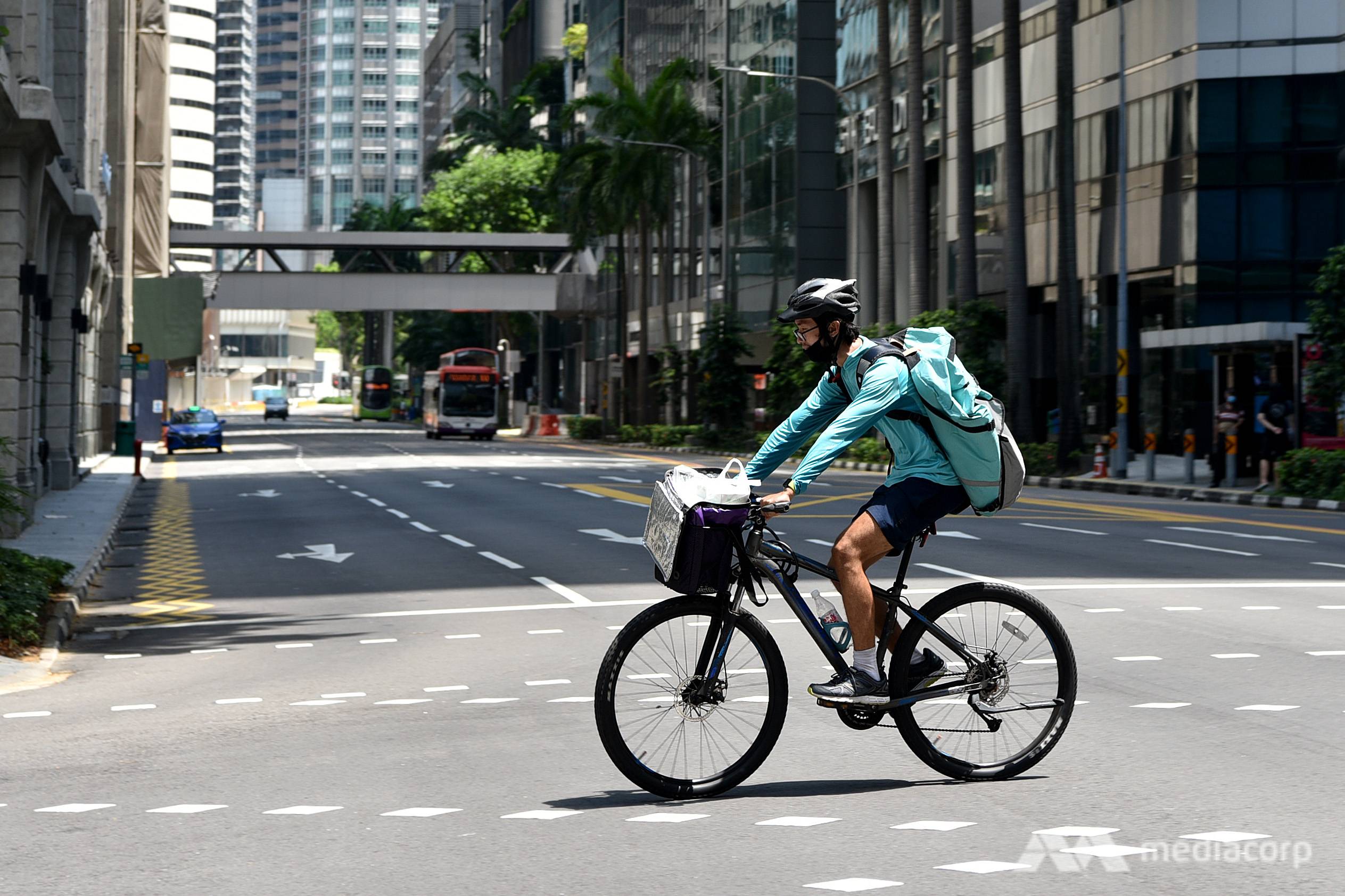
A Deliveroo rider cycles across an almost deserted Robinson Road, in the Central Business District, which usually sees heavy traffic during the day (Photo: Jeremy Long)

READ: Commentary: More bold measures needed to protect against the job losses heading Singapore’s way

My hope is that Singapore will continue to move forward in this battle against COVID-19, and not be forced to backtrack, but this will require all of us to play our part.

SILVER LININGS IN EVERY SITUATION

Like everyone else, I yearn for days of relative freedom once again.

But I will think twice before diving headlong into the crowds at malls, parks, or beaches over the weekends.

It may sound like a sacrifice, but the situation has its upsides too.

With fewer activities on our schedule, we have more family playtime, less rushing around, and our level of spending has also gone down.

It has also taught me empathy. Whatever hardship I thought I was going through is nowhere near the level of an elderly person whose sense of mobility, independence, and even identity has been stolen by COVID-19.

Hopefully in doing our part to minimise crowding and infection rates, we create a safer environment for the very young and very old to emerge from their shells, and for caregivers to breathe just a little easier.

READ: Commentary: Does long-term WFH mean goodbye to makeup?

BOOKMARK THIS: Our comprehensive coverage of the coronavirus outbreak and its developments

Download our app or subscribe to our Telegram channel for the latest updates on the coronavirus outbreak: https://cna.asia/telegram

June Yong is a mother of three, an educational therapist and owner of Mama Wear Papa Shirt, a blog that discusses parenting and education in Singapore.

Source link

Ramada Singapore at Zhongshan Park, minimart in Geylang among new locations visited by COVID-19 cases while infectious

0

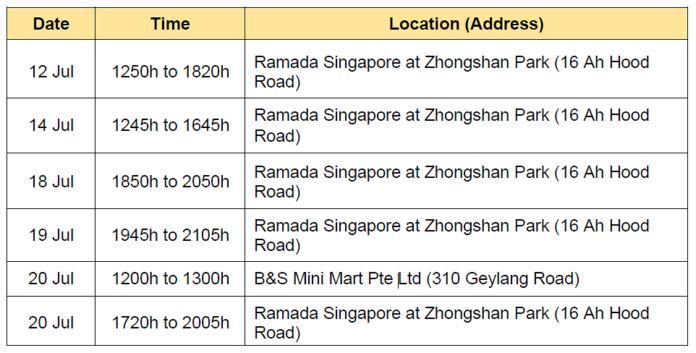
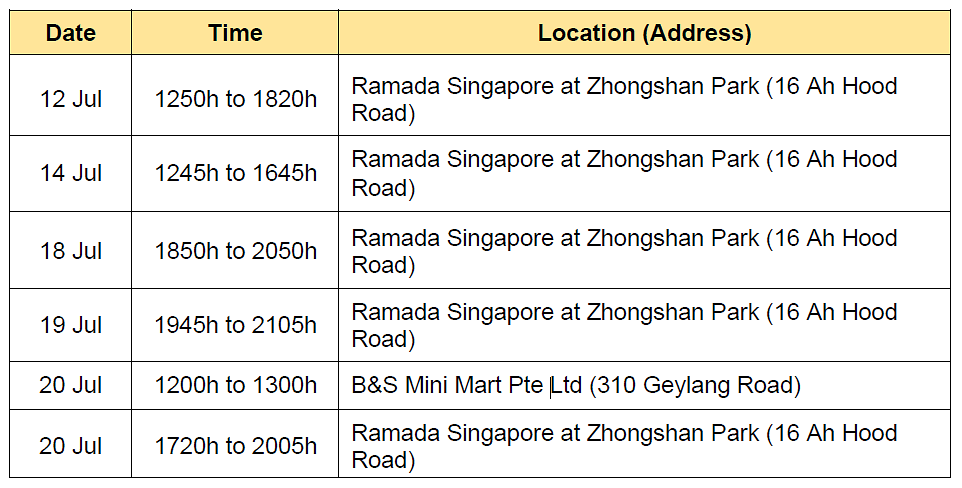
SINGAPORE: Ramada Singapore at Zhongshan Park and a minimart in Geylang were among the new locations added on Saturday (Jul 25) to the list of places visited by COVID-19 cases in the community during their infectious period.

Ramada Singapore at Zhongshan Park, a hotel located at 16 Ah Hood Road, and B&S Mini Mart at 310 Geylang Road were the two new locations added, the Ministry of Health (MOH) said.

Ramada Singapore appeared on the list five times – on Jul 12, Jul 14, Jul 18, Jul 19 and Jul 20.

UPDATED MAP: All the places that COVID-19 community cases visited while they were infectious 

The new locations are as follows:

MOH COVID-19 locations Jul 25

Those identified as close contacts of confirmed COVID-19 cases would have been notified by MOH, said the ministry.

It added that people who were at these locations during the specified timings should monitor their health closely for 14 days from their date of visit.

“They should see a doctor promptly if they develop symptoms of acute respiratory infection (such as cough, sore throat and runny nose), as well as fever and loss of taste or smell, and inform the doctor of their exposure history,” said MOH.

“There is no need to avoid places where confirmed cases of COVID-19 have been.”

The National Environment Agency will also engage the management of affected premises to provide guidance on cleaning and disinfection.

Singapore reported 513 new COVID-19 infections on Saturday, bringing the total number of cases in the country to 49,888.

Of the new cases, two cases were in the community, both work pass holders.

There are also six imported cases who had been placed on stay-home notice upon their arrival in Singapore. 

The remaining new cases are work permit holders residing in foreign worker dormitories.

BOOKMARK THIS: Our comprehensive coverage of the coronavirus outbreak and its developments

Download our app or subscribe to our Telegram channel for the latest updates on the coronavirus outbreak: https://cna.asia/telegram

Source link