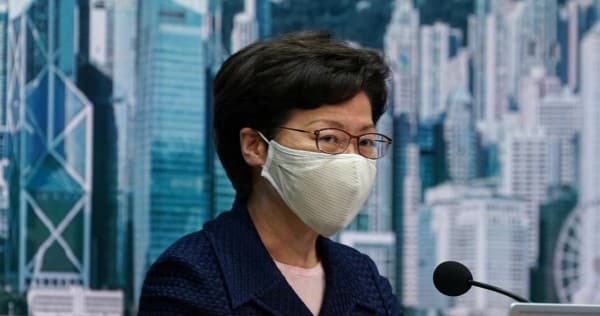
HONG KONG (REUTERS) – The Hong Kong government’s decision to postpone an election for the city’s legislature by a year, by invoking emergency legislation after a spike in coronavirus cases, may be unlawful, the city’s bar association said.
Hong Kong’s leader Carrie Lam on Friday (July 31) postponed the election for the Legislative Council, or Legco, citing public health dangers in the Chinese-ruled city, but said there were political considerations.
The poll would have been the former British colony’s first official vote since Beijing imposed a sweeping security law to tackle what China broadly defines as secession, subversion, terrorism and collusion with foreign forces, with punishment of up to life in prison.
Electoral rules in Hong Kong only allow votes to be postponed for 14 days, but colonial-era laws give the government broad powers in case of threats to public safety.
As the coronavirus ravages economies, forces countries into lockdowns and empties supermarket shelves, millions of people across Asia have been forced to put their former lifestyles on hold.
But amid all the destruction, one pastime has just kept on growing: Gardening.
In the half a year since the virus first came to public attention, urban farming has boomed in popularity, as green-fingered Asians spot an opportunity to while away those lockdown hours while cutting living costs and putting food on the table.
Among those whose fingers are turning green are Bollywood celebrities who, locked down in their homes away from the red carpet, have picked up their shovels and trowels and tried their hand at growing fruit and vegetables, often involving their young children.
Actor Twinkle Khanna shared a post about growing Ceylon spinach, while fitness guru Shilpa Shetty Kundra showed off her fresh harvest of brinjals and chillies.
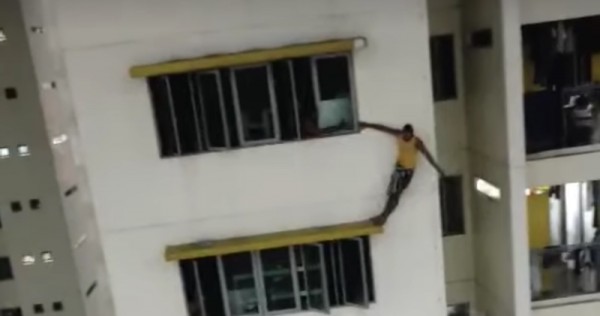
A series of suspenseful video clips surfaced online last week, depicting a migrant worker at a dormitory in Kaki Bukit standing on the window ledge outside an 8th-floor apartment, seemingly in an attempt to kill himself.
The incident, which took place on July 31 at The Leo at 23 Kaki Bukit Road 3 after midnight, saw the man perched precariously on a narrow ledge as the entire neighbourhood erupted in exclamations.
Initially, a lone flatmate tried to coax the man back into the apartment and attempted to hold onto him. After some time, the rest of the occupants woke up and joined in the rescue attempt.
Eventually, the group managed to grip onto the man’s hand and collectively pulled him to safety.
All travellers entering Singapore who are serving their stay-home notice (SHN) outside of dedicated facilities will soon have to wear an electronic monitoring device.
From Aug 10, 11.59pm, such travellers will have to wear the device throughout the 14-day stay-home period.
They include citizens, permanent residents, long-term pass holders, work pass holders and their dependants. Children aged 12 and below are exempted.
The stay-home rule was extended to all incoming travellers from March 21. Travellers serve the notice either at their home or at dedicated facilities, and are tested for Covid-19 at designated community testing facilities before the end of the stay-home period.
In a joint statement on Monday (Aug 3), the Immigration and Checkpoints Authority (ICA) and the ministries of Manpower and Education (MOM) said the devices will allow them to monitor those serving the SHN more effectively as travel restrictions are progressively lifted.
The devices are a change from the combination of text messages, voice and video calls and house visits the authorities have been using to make sure the rules are observed.
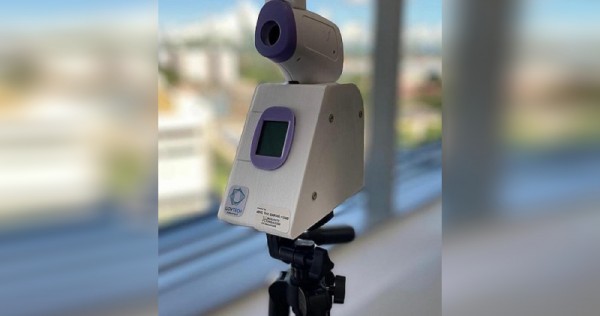
To help Singapore in its fight against Covid-19, the Government Technology Agency (GovTech) designed an improved contactless temperature scanner far cheaper than the original version.
It then mass produced 340 machines in about two weeks so that they could be rolled out to eldercare facilities.
These facilities needed to conduct temperature taking as a precautionary measure, especially as the country reopened .
Mr Steven Teo, GovTech’s assistant director of sensors and Internet of Things, told The New Paper it had received feedback that the original model, which was produced in March, was bulky and difficult to transport.
The Agency for Integrated Care had also approached GovTech to improve the design and make the scanner cheaper.
Mr Teo said: “We had to brainstorm for about a week on how to improve the design, followed by two weeks of tearing apart the thermometer and then reverse engineering it.”
For example, the team figured out a way to switch the temperature display to the front of the scanner and managed to do away with components such as the video camera.
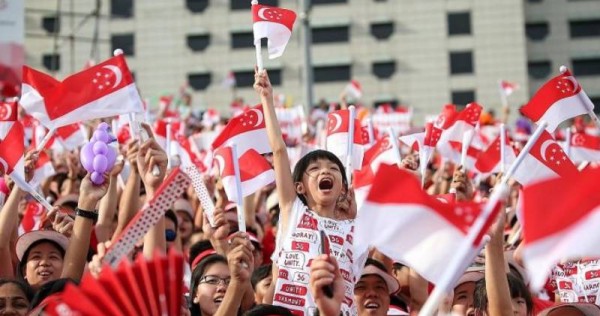
SINGAPORE – For the first time, Singaporeans will be able to see from their homes the state flag fly-past during this year’s National Day Parade (NDP).
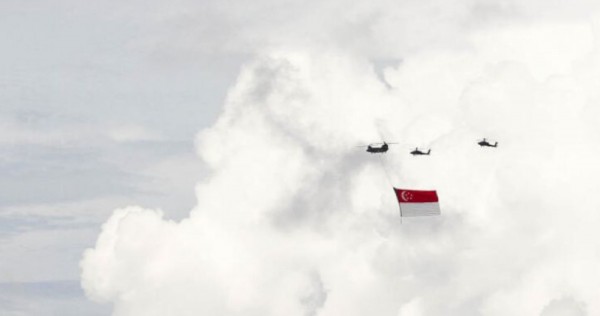
Two Chinook helicopters, each carrying the Singapore flag 1,000ft in the air, will fly across the country on two separate routes in the east and the west of the island.
Each helicopter will be accompanied by two Apache helicopters during this segment titled Fly Our Flag.
The east route will take the flag – measuring 30m by 20m – past housing estates such as Bedok, Pasir Ris and Punggol, while the helicopters on the west route will fly past residences in places such as Jurong East, Choa Chu Kang and Ang Mo Kio.
Both routes will begin at the south of Singapore and end at Sembawang Air Base at the north. They are slated to start at 10.30am and will each take 55 minutes.
In previous years, the fly-past took place at a single location where the NDP was held, such as the floating platform at Marina Bay, and lasted only ten minutes.
With the focus on celebrating the nation’s 55th birthday at home, this year’s NDP will be split into morning and evening portions.
Every August 9, Singaporeans across the world band together to commemorate the anniversary of our nation’s independence, and one event that happens every year without fail is the National Day Parade (NDP).
But given everything that’s going on this year (like the coronavirus pandemic), we’ll be celebrating our country’s 55th birthday a little bit differently. And the parade is not spared.
This year’s parade will see a significant reduction in the number of participants, for everyone’s safety, of course. Various parade segments have also moved to the heartlands and will be streamed live on television and internet platforms.
There is, however, a silver lining. For the first time ever, residents will be able to catch the state flag flypast, jet aerial display and mobile column in real life from the comfort of their homes as they are slated to take place at various locations around the island.
While NDP 2020 is certain to be a familiar, yet definitively different experience, for me, I am looking forward to seeing this year’s performances at night, especially the story and song segments.
TOKYO: This month marks 75 years since the end of World War Two in the Pacific.
Japan invaded and occupied parts of Asia before and during the war in the name of its emperor, Hirohito, and aligned itself with Germany and Italy in 1940 to become one of the so-called Axis powers.
Here are some key events of World War Two in the Pacific:
Dec. 7, 1941: Japanese forces attack Pearl Harbor with torpedo planes, bombers and fighter planes, pounding the US fleet moored there in the hope of destroying US military power in the Pacific. Around 2,300 Americans die and 1,200 are injured, 21 vessels sunk or damaged and hundreds of aircraft destroyed.
The United States declares war the following day and three days later, Germany declares war on the United States.
Shortly before the Pearl Harbor attack, Japanese troops land on the east coast of west Malaya, and capture large swathes of territory in their push southward to Singapore.
Jan. 15, 1942: Five weeks after the attack on Pearl Harbour, a Japanese land column, moving from Thailand, strikes across the frontier into present-day southern Myanmar. British forces fight back but Japan’s superior jungle tactics see Myanmar fall at the end of May.
Feb. 15, 1942: Lieutenant General Arthur Percival, commander of the British Commonwealth forces, surrenders to Japanese Lieutenant-General Tomoyuki Yamashita in Singapore after a swift, humiliating battle. Singapore is then occupied by the Japanese until 1945.
April 1942: US and Filipino prisoners of war are forced to march about 100km under brutal conditions after the three-month Battle of Bataan in the Philippines. Many died from physical abuse, dysentery and other diseases.
Death marches also occurred in Sandakan on Borneo island. Both were later judged as war crimes.
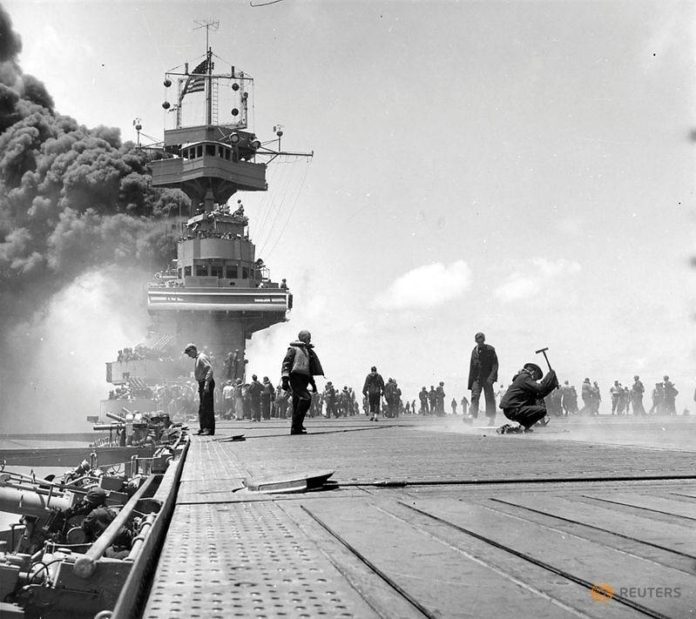
FILE PHOTO: The USS Yorktown, shortly after being hit by three Japanese bombs during the World War Two’s Battle of Midway, Jun 4, 1942. (Photo: US Navy/Handout via REUTERS/File Photo)
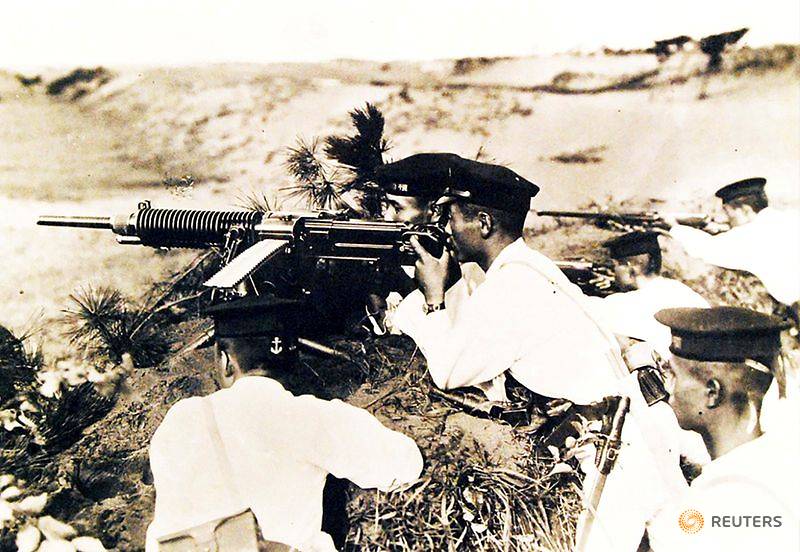
Aug. 1942: In the Pacific, Japanese and US troops fight from island to island. Guadalcanal, in the Solomon Islands in the Pacific Ocean, was the scene of six months of fighting. Along with the Battle of Midway, this was one of the first major offensives and decisive victories for the Allies in the Pacific.
FILE PHOTO: Japanese soldiers wearing white uniforms and dress caps pose behind a heavy machine gun in an undated photo captured by US Marines during World War Two’s Battle of Guadalcanal in the Solomon Islands in February 1943. (Photo: US Navy/Handout via REUTERS/File Photo)
Oct. 1944: On the verge of losing the Philippines to US forces, Japan conducts its first kamikaze attack off the island of Leyte, deliberately crashing planes into Allied targets. Roughly 4,000 kamikaze pilots died and 34 US ships were sunk as a result of the attacks in the last few months of the war.
Feb. 1945: More than 30,000 US Marines battle 21,000 Japanese on the island of Iwo Jima, the first native Japanese soil to be invaded during the Allied advance. Nearly all the Japanese defenders died in the 36-day battle, along with nearly 7,000 US Marines.
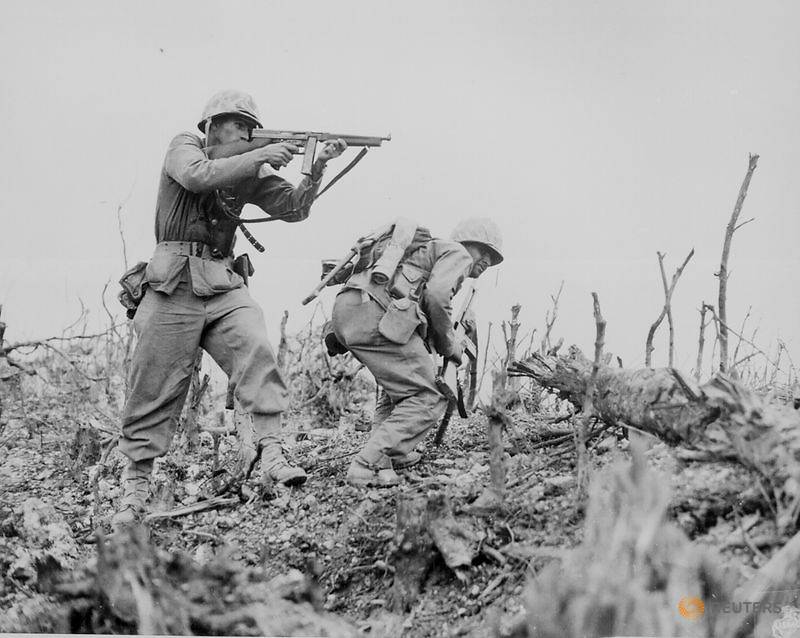
FILE PHOTO: Marines of the 1st Marine Division near Wana Ridge during World War Two’s Battle of Okinawa, May 18, 1945. (Photo: US National Archives/Handout via REUTERS/File Photo)
Aug. 6, 1945: The US B-29 Superfortress Enola Gay carrying 12 crew members drops an atomic bomb nicknamed “Little Boy” on Hiroshima in Japan’s main island of Honshu.
The death toll from the blast was estimated at about 140,000 people by the end of the year, out of a total of 350,000 who lived there at the time. Three days later, the United States drops an atomic bomb nicknamed “Fat Man” on Nagasaki.
Aug. 15, 1945: Emperor Hirohito announces Japan’s decision to surrender in his first speech broadcast by radio, bringing World War Two to an end.
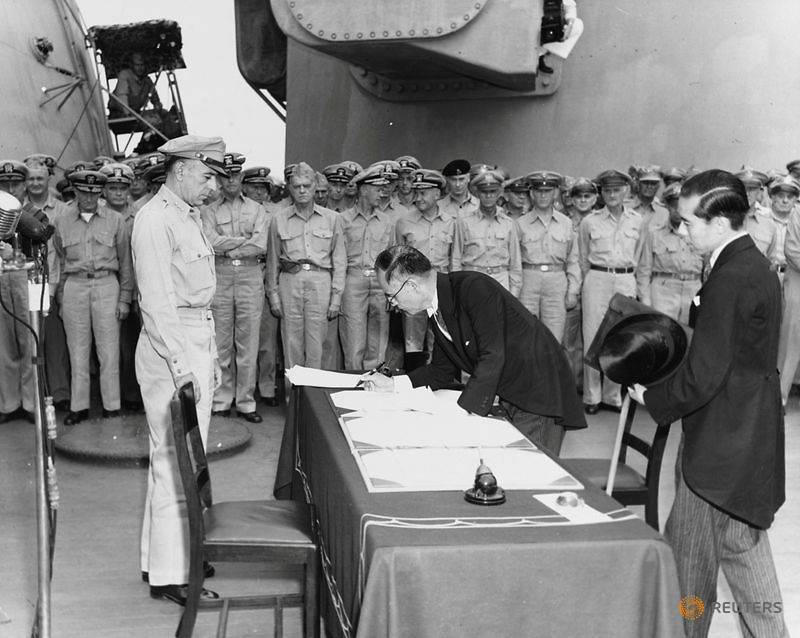
Sept. 2, 1945: A Japanese delegation headed by Foreign Minister Mamoru Shigemitsu board the battleship USS Missouri to sign the surrender document, along with US General Douglas MacArthur as Supreme Allied Commander.
FILE PHOTO: Japan’s Foreign Minister Mamoru Shigemitsu signs the Instrument of Surrender onboard the US Navy battleship USS Missouri in Tokyo Bay. (Photo: Reuters)
SINGAPORE – Two sisters were content to let “sleeping dogs lie” after they discovered that their brother had used funds from the family business for his own family’s expenses.
However, they decided to bring the matter to light after his son, on his behalf, decided to sue them and their late mother’s estate over debts owed by the business to a bank.
The High Court eventually dismissed the lawsuit against Ms Lee Gin Hong and Ms Lee Gim Moi, holding that their brother, Mr Lee Ker Min, ought to account for the money that he had withdrawn for his personal use.
According to the judgment dated July 30, Mr Lee’s father – Mr Lee Kim Eng – started Lee Huat Company as a sole proprietorship in 1958.
The business, which is a retailer for motorcycles, motor scooters and related accessories as well as a workshop, operates at a shophouse in Upper Bukit Timah Road.
In 1975, Mr Lee Ker Min was appointed a partner in the business. His mother, Madam Ng Ang Chum, was also registered as a partner after the elder Mr Lee died about six years later.
SINGAPORE: Could sunlight offer the key to unlocking Singapore’s sustainable future?
Advancements in solar energy technologies and declining prices promise to unleash the power of the sun for a country with growing energy needs.
Many countries, including Singapore, have risen to the existential challenge of climate change and have committed to stabilise, or even reduce their carbon emissions.
By 2050, this small country aspires to halve emissions from its peak, with a longer-term view to achieve net-zero emissions as soon as viable in the second half of the century.
Tapping on clean energy can help to move the needle, especially since electric power generation accounts for 39 per cent of Singapore’s emissions.
Last year, an ambitious goal was unveiled for Singapore to install at least 2 gigawatt-peak (GWp) of solar photovoltaic (PV) power by 2030 – more than six times the currently installed capacity.
In an accelerated deployment scenario, the Solar Energy Research Institute of Singapore (SERIS) expects solar power to contribute 28 per cent of Singapore’s peak power demand during mid-day by 2030, and 43 per cent by 2050.
This raises an interesting question: What might an increasingly solar-powered Singapore look like?
A view of public housing blocks, with solar panels affixed to the roof of some blocks, in Singapore on Jun 27, 2019. (File photo: Reuters/Kevin Lam)
Today, most of the solar PV panels in Singapore are on rooftops and are largely out-of-sight. That could change going forward as scientists and engineers explore more innovative deployment options to make the best use of Singapore’s limited space.
EXPECT SOLAR PANELS TO BE MORE VISIBLE IN THE URBAN ENVIRONMENT
In the future, we can expect solar power to become more visible in the public eye.
For one, harnessing vertical spaces for solar PV installations will become increasingly important as buildings stretch ever skywards in Singapore.
Engineers have found a way to supplement conventional façades with ones that can generate electricity. For instance, the new PSA terminal at Tuas features building-integrated photovoltaics – vertically-mounted solar PV panels that form the building’s facade cladding.
In the future, we can also expect individual solar PV panels to better mimic the appearance of conventional building materials like glass, brick, or concrete, and generate power at the same time.
This will allow architects to better incorporate solar PV into a building’s design, and will serve as an important enabler of zero-energy buildings, super-low-energy buildings and positive-energy buildings.
To overcome space constraints, developers in Singapore are deploying solar PV panels over water bodies. Over the next few months, avid joggers will see floating PV systems progressively being rolled out at Bedok and Lower Seletar Reservoirs.
Next year, a large 60 megawatt-peak (MWp) floating solar PV system will also be completed at Tengeh Reservoir. This vast system is forty times bigger than those deployed at Bedok and Lower Seletar Reservoirs.
Motorists driving into Singapore from Malaysia across the Second Link Bridge might be able to catch a glimpse of it as they exit the Tuas Checkpoint.
Future floating solar PV power plants will generate clean electricity and could also be combined with other industrial uses such as fish farming, desalination or “green” hydrogen generation.
PUB and the EDB launched a 1MWp test-bed at Tengeh Reservoir in 2016. (Photo: Wee Teck Hian/TODAY)
Solar PV technologies are incredibly versatile and can be integrated in many ways into the urban environment. Lightweight solar PV panels can be readily installed on pedestrian linkways and bus shelters to generate electricity from otherwise passive surfaces.
Solar PV panels can also be configured as noise barriers that help alleviate noise pollution emanating from motorways and MRT traffic, while generating clean electricity. These solar noise barriers have proven to be useful in many places and are currently being tested in Singapore. If successful, commuters could soon see them on their way to work.
Movable solar PV systems can be deployed in pockets of temporarily vacant spaces to better their use. Indeed, there are projects that aim to do just that.
Under a JTC programme, a semi-mobile PV system has been deployed on Jurong Island, and another will soon be constructed at Changi Business Park. These generate clean solar electricity, which is then made available to consumers.
When the land is needed by the authorities for development, the solar PV panels and supporting equipment can be quickly packed up and relocated.
As the cost of solar electricity continues its downward trend, solar PV has become an increasingly attractive form of energy generation technology.
For systems built on larger buildings in Singapore with flat and unobstructed roofs, the so-called “levelised cost of electricity” (LCOE) for solar electricity is now less than 8 cents per kilowatt-hour. This compares well to the wholesale electricity price, which also hovers around 8 cents per kilowatt-hour (prior to the slowdown of economic activities in Q2 2020).
However, solar PV alone cannot power Singapore. Solar PV panels cannot generate electricity at night, and the availability of sunlight during the day also fluctuates due to frequent changes in cloud cover.
File photo of a power station in Singapore. (Photo: Jeremy Long)
For Singapore to accommodate a large share of solar power in the coming decades, its variability will be one key challenge to overcome.
When solar generation dips, other parts of the power grid must compensate to ensure that the supply of electricity remains stable.
A resilient electricity grid, in which solar power plays a greater role, will require providers to build new capabilities to ensure a stable supply of energy, including solar power forecasting, and energy storage systems.
Ultimately, sustainability is the key consideration that guides Singapore’s drive towards greater adoption of solar energy. Hence, the deployment of solar power will not happen at the expense of greenery, green spaces and Singapore’s biodiversity. Where possible, future solar PV installations will be co-located with greenery to the benefit of both.
There will also be an emphasis on ensuring that solar PV panels and ancillary components are of high quality, and will be properly recycled once they reach their technical end-of-life.
Similarly, it is also paramount to manage the inherent power degradation of solar PV panels caused by the high ultraviolet index and humidity of Singapore’s tropical climate. If not, systems may fail prematurely and subsequently be discarded.
Ideally, we would set up a circular economy around the use of solar energy to minimise waste and the unnecessary use of new resources.
There are long-term plans ahead that will see solar energy play a bigger role for this small country.
FILE PHOTO: An employee makes a final inspection on panels during a tour of an REC solar panel manufacturing plant in Singapore, May 5, 2017. REUTERS/Edgar Su/File Photo
For one, solar energy forms one of the announced “four switches” that will transform Singapore’s energy supply over the next 50 years. It will be instrumental in helping the country meet its commitments under the United Nations Framework Convention on Climate Change.
A growing number of companies in Singapore – from multinational firms like Google to home-grown ones like DBS – have committed to using 100 per cent renewable energy to power their operations. We have to build enough solar capacity to satiate this demand.
The growth of Singapore’s solar energy industry will demand a new generation of professional workers with a diverse set of skills.
We can expect new high value-added jobs in research, manufacturing, engineering and construction that support the solar energy industry and related functions in the power sector, which should be good news for our post-COVID economy.
Tan Congyi is the Head of the Urban Solar Group at the Solar Energy Research Institute of Singapore (SERIS) at the National University of Singapore (NUS).