By now, you might have been tickled (or horrified) by a video making its rounds on local social media: 16 prominent Singaporean political figures seemingly singing in unison to a Japanese pop ballad from a video game series.
Yes, it’s pretty freaky. That’s because the clip is made using deepfake technology, which video producer Adrian Chan carried out by using machine learning and artificial intelligence to manipulate the politicians’ portraits.
SINGAPORE – Singapore’s recession was deeper than first thought in the second quarter due to coronavirus lockdown measures, and the government said the trade-reliant economy’s path to recovery remained uncertain due to the pandemic.
Gross domestic product (GDP) fell 13.2 per cent year-on-year in the second quarter, revised government data showed on Tuesday, versus the 12.6 per cent drop seen in advance estimates.
The economy fell 42.9 per cent from the previous three months on an annualised and seasonally adjusted basis, compared with the government’s initial estimate of a 41.2 per cent contraction.
The data matched analyst expectations.
The government said it now expects full-year GDP to contract between 5 per cent and 7 per cent versus its previous forecast for a 4 per cent to 7 per cent decline. The country is still facing the biggest downturn in its history.
SINGAPORE – Singapore’s Temasek Holdings is terminating its $4 billion conditional offer for conglomerate Keppel Corp by invoking a material adverse change (MAC) clause following the company’s poor financial results.
Keppel’s large second-quarter loss that breached a threshold in the state investor’s offer to buy control of the company had raised the risk Temasek would abandon the deal.
“The offeror has decided that it will invoke the MAC pre-condition, and accordingly, is announcing today that the partial offer will not proceed,” a Temasek subsidiary said in a Singapore bourse statement on Monday, a public holiday.
Its decision is still likely to surprise markets as expectations had mounted Temasek would lead much-needed consolidation in the rig-building sector after taking majority control of Keppel.
The domestic rig-building sector has been battered by a long period of low oil prices exacerbated by the coronavirus crisis.
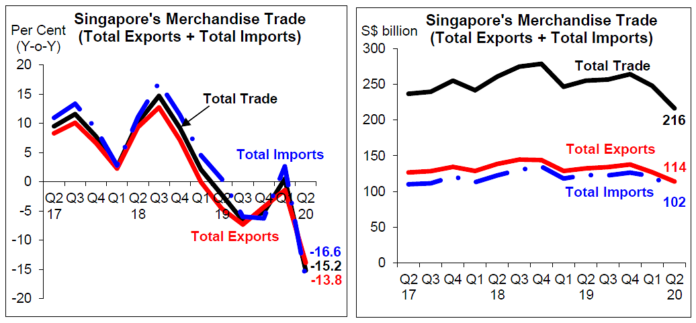
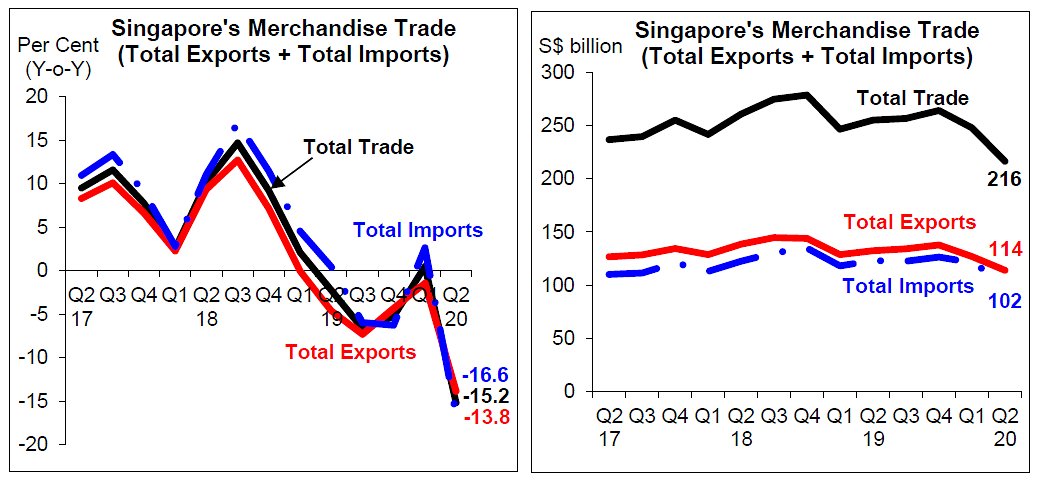
SINGAPORE: Total merchandise trade in Singapore declined by 15.2 per cent in the second quarter of 2020, following a slight growth of 0.5 per cent in the previous quarter.
Official data by Enterprise Singapore also showed on Tuesday (Aug 11) that non-oil trade declined by 3.3 per cent, after the previous quarter’s 4.4 per cent increase.
Oil trade fell sharply in the second quarter, by 61.9 percent, compared to the 15.9% drop in the first quarter.
(Graphic: Enterprise Singapore)
On a quarter-on-quarter seasonally adjusted basis, total merchandise trade decreased by 14.3 per cent in Q2 2020, after the previous quarter’s 0.1 per cent growth. Non-oil trade declined by 7.7 per cent, while oil trade contracted by 50.6 per cent.
On a year-on-year basis, non-oil exports (NOX), which include both non-oil domestic exports (NODX) and non-oil re-exports (NORX), decreased y-o-y by 1.7 per cent in the second quarter of 2020, after the preceding quarter’s 3.8 per cent growth. On a quarter-on-quarter seasonally adjusted basis, NOX declined by 6.7 per cent, after the 2.3 per cent increase in the previous quarter.
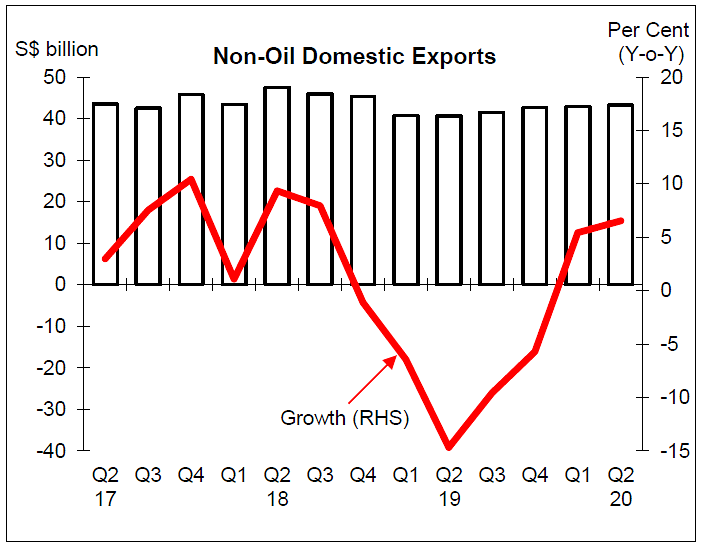
NODX saw a year-on-year growth of 6.5 per cent, following a 5.4 per cent rise in the previous quarter.
(Graphic: Enterprise Singapore)
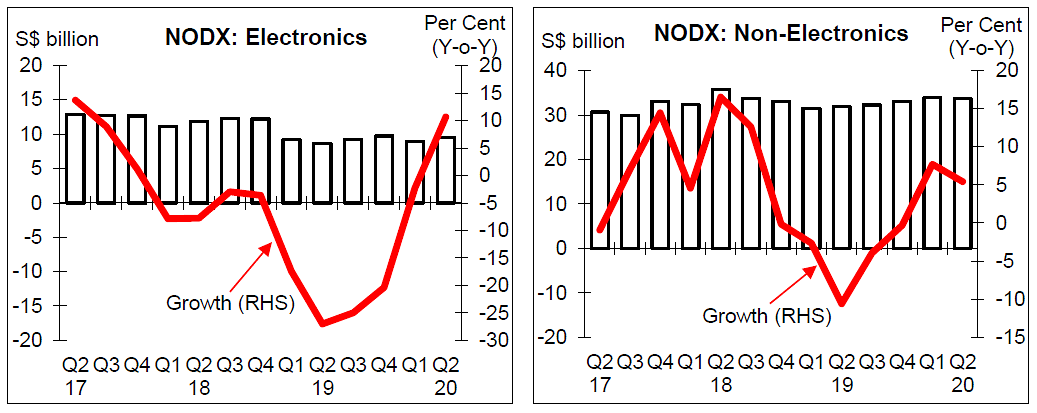
Growth in NODX was largely due to non-electronics, said Enterprise Singapore.
Domestic exports of non-electronic products grew by 5.4 per cent over the year, following an increase of 7.7 per cent in the previous quarter. The largest contributors to the growth were non-monetary gold (+132.7 per cent), pharmaceuticals (+41.3 per cent) and specialised machinery (+28.1 per cent).
Domestic exports of electronic products grew by 10.6 per cent, after a 2.3 per cent decline in the previous quarter. The largest contributors to the growth were ICs (+20 per cent), disk media products (+46.7 per cent) and telecommunications equipment (+9.9 per cent).
(Graphic: Enterprise Singapore)
On a quarter-on-quarter seasonally adjusted basis, NODX declined by 2.4 per cent, after the 7.3 per cent growth in the previous quarter, as the decrease in non-electronic NODX outweighed the increase in electronics. Electronic domestic exports grew on a quarter-on-quarter seasonally adjusted basis by 2.8 per cent, following the previous quarter’s 9.1 per cent rise. Non-electronic NODX declined by 3.9 per cent, after the 6.9 per cent increase in the previous quarter.
The trade agency reported that NODX to all top markets grew as a whole in the second quarter – however, exports to China, Hong Kong, Indonesia, Malaysia and Thailand declined. The biggest contributors to the NODX growth were the US (+56.0 per cent), Japan (+75.8 per cent) and South Korea (+44.1 per cent).
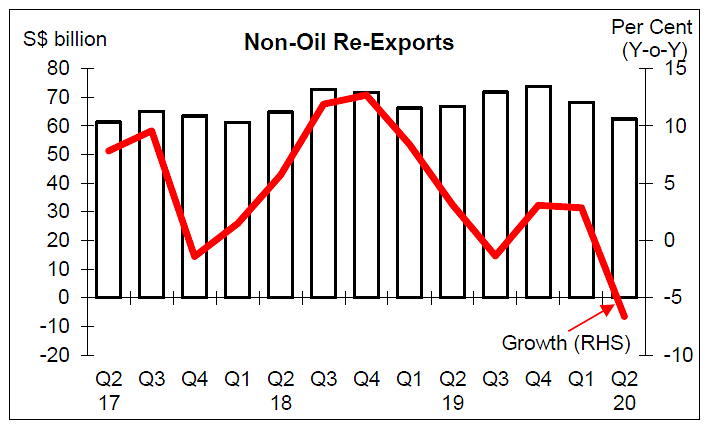
NORX declined by 6.6 per cent, following a 2.8 per cent growth in the previous quarter. This is due to to lower shipment of non-electronics, while electronic re-exports grew.
(Graphic: Enterprise Singapore)
Electronic NORX rose by 7.4 per cent, after the 2.8 per cent growth in the previous quarter. This is due to higher re-exports of ICs (+8.8 per cent), diodes & transistors (+29.1 per cent) and parts of PCs (+5.6 per cent).
Non-electronic NORX contracted by 19 per cent, after the previous quarter’s 0.6 per cent decline. The decrease in non-electronic NORX was due to lower re-exports of piston engines (-81.0 per cent), aircraft parts (-39.4 per cent) and precious stones & pearls (-74.2 per cent).
On a quarter-on-quarter seasonally adjusted basis, NORX declined by 9.5 per cent in Q2 2020, except Hong Kong, the EU 27 and Taiwan. The biggest contributors to the NORX decrease in 2Q 2020 were Malaysia (-16.1 per cent), the US (-10.8 per cent) and Indonesia (-8.1 per cent).
NORX to the top markets as a whole declined in Q2 2020, except Hong Kong, the EU 27 and Taiwan. The biggest contributors to the NORX decrease were Malaysia (-16.1 per cent), the US (-10.8 per cent) and Indonesia (-8.1 per cent).
Total services trade contracted by 22 per cent, reaching S$107 billion in the second quarter of 2020, with the contraction of both services exports (-20.3 per cent) and imports (-24.1 per cent). This follows a 3.2 per cent decline in the previous quarter.
OIL TRADE
Oil trade contracted by 61.9 per cent amid lower oil prices than a year ago, following the 15.9 per cent decline in the previous quarter.
On a year-on-year basis, oil domestic exports contracted by 67.7 per cent in Q2 2020 amid lower oil prices than a year ago, following the 28.9 per cent decline in the previous quarter.
In volume terms, oil domestic exports declined by 36.2 per cent, following the 13.9 per cent decrease in the previous quarter.
On a quarter-on-quarter seasonally adjusted basis, oil domestic exports contracted by 48.5 per cent, following the 26.8 per cent decline in the previous quarter.
On a year-on-year basis, oil re-exports contracted by 27.5 per cent, after the 63.8 per cent expansion in the first quarter.
In volume terms, oil re-exports rose by 44.6 per cent, following the 103.2 per cent expansion in the first quarter.
On a quarter-on-quarter seasonally adjusted basis, oil re-exports declined by 23.2 per cent, after the previous quarter’s 1.5 per cent increase.
FORECASTS ADJUSTED UPWARDS
Forecasts have been adjusted upwards for both total merchandise trade (-10 per cent to -8 per cent) and NODX (3 per cent to 5 per cent), amid better-than-expected performance for specific products such as non-monetary gold, pharmaceuticals and electronics.
Although the global economic outlook remains uncertain, global trade is unlikely to reach the worst-case scenario of a 32 per cent contraction earlier projected by the World Trade Organization in April 2020, said Enterprise Singapore.
It said this is due to rapid government responses tempering the sharp fall in the first half of 2020.
The growth of NODX in Q2 2020 was better than expected, said Enterprise Singapore, amid favourable sector-specific export and output trends. Besides non-monetary gold and pharmaceuticals, electronic domestic exports also grew, after declines in previous quarters.
Due to improved oil prices and upgraded oil forecasts, the 2020 growth projection is adjusted upwards to -10.0 per cent to -8.0 per cent for total trade and 3.0 per cent to 5.0 per cent for NODX.
Hiring a confinement nanny from Malaysia typically sets one back $3,000 to $3,500 a month.
But this is set to increase as cross-border travel between Singapore and Malaysia starts again.
Applications for cross-border travel arrangements started yesterday and it takes place under two schemes: the reciprocal green lane for travellers on shorter visits, and the longer-term periodic commuting arrangement (PCA).
The hiring of nannies will be through the PCA scheme and costs incurred will amount to approximately $2,000, which includes Covid-19 tests and accommodation for the nannies who have to remain under a mandatory 14-day stay-home notice at hotels or dedicated facilities before starting work.
Employers of confinement nannies are responsible for their food and lodging, and will now also have to bear the extra cost, although a spokesman from the Ministry of Manpower told The New Paper: “Employers may reach a mutual agreement with their employment agencies on cost-sharing.”
SINGAPORE: As someone who loves good tailoring and is rarely seen without a blazer, I’m probably not representative of the majority of the population.
But since beginning working from home several months ago, one thing I really miss is getting up in the morning and putting on my formal workday garb.
Dressing for work — even if you’re not going out to an office — has a potent psychological effect. It puts you in get-up-and-go mode.
Writers, adept at working from home, have adopted this technique since time immemorial. American novelist John Cheever, for instance, had a ritual of dressing each morning in full suit and tie, before spending the day writing alone in his basement workspace.
While not quite following Cheever’s example, I do habitually put on a button-up shirt and make a point of wearing a blazer or suit jacket while conducting video-call interviews. But it seems that I’m in the minority.
“My customers overwhelmingly tell me they’re dressing very casually at home,” says Singapore’s foremost bespoke tailor, Kevin Seah.
“They’re getting up in the morning and putting on shorts, a T-shirt or polo shirt. Maybe a shirt, if they have an important Zoom call.”
This relaxed approach is somewhat surprising, given that Seah’s customers are men for whom dressing well is a pleasure, never a chore.
A CHANCE TO DRESS UP AGAIN – LIKE THE TWENTIES
This growing trend of dressing down since the coronavirus confined us to our homes is probably more accurately described as a relentless global onslaught.
The man who created the blueprint for the power suit with his endlessly influential tailoring for the character Gordon Gekko in 1987 film, Wall Street, is Alan Flusser. He has since dressed most of Manhattan’s corporate, financial and political elite.
Gordon Gekko was played by Michael Douglas in Oliver Stone’s Wall Street films. (Photo: AFP/LOIC VENANCE)
Yet when asked whether his customers have been wearing fancy smoking jackets, cravats and velvet slippers around the house during quarantine, or an old college tee, track pants and Adidas slides, he replies: “Definitely the latter.”
Flusser explains: “Most of my New York customers are living out at their holiday homes in the Hamptons, and are not planning to come back (to the city) anytime soon … People are saying to me, ‘I haven’t put on a pair of trousers in four months. I’ve been living in a T-shirt.’ Even if you wanted to put on a sports coat, where would you wear it? The restaurants and bars are all closed. Where would you go?”
Here in Singapore, where bars and restaurants are gradually reopening with safe distancing measures in place, male clotheshorses are tapping on a desire to dress up and step out among some segments.
“For this sort of gentleman, it’s a real delight to put on a beautifully tailored jacket and go for a nice meal,” says Seah. “After months stuck at home in casual clothing, they can’t wait to dress up again.”
Our current situation is often described as an unprecedented crisis, but that isn’t quite so. The circumstances surrounding the Spanish Flu that ravaged civilisation a century ago parallel those we’re facing today.
Then, as now, amidst a global health disaster, businesses and economies faltered, people were confined to their homes and wore masks when they ventured out.
When the flu eventually cleared, what followed was a decade of celebration, expressed not only in the way people lived, but how they dressed.
The Roaring Twenties saw men re-embrace peacockery with a gusto not seen since the late 18th century, when George “Beau” Brummell killed off the vogue for colourful, foppish attire and brought a new shades-of-grey sobriety to men’s style.
In the 1920s, despite the United States’ prohibition of alcohol, sobriety was by no means the order of the day. Men possessed of the wherewithal — such as F Scott Fitzgerald’s fictional Jazz Age bootlegger tycoon, Jay Gatsby — dressed intoxicatingly in silk shirts, vibrant tailoring, two-tone shoes and glitzy gem-studded accessories.
Jean-Paul Gaultier has used fur in his collections before, such as this fur and leather coat in 1996. (Photo: AFP/GERARD JULIEN)
Women, decked in fur coats and fringe wraps, bold Art Deco dresses and brilliant strings of pearls, sashayed around with beaded purses and feather headbands in glorious evening parties.
Will we see a similar period of flashy style prevail, once a vaccine is developed and we’re fully liberated from the clutches of COVID-19 quarantine?
Leading British tailor Timothy Everest feels this may be the case for a segment of the population, at least.
“Hopefully we’ll see a bit more colour and pattern, people might want to be a little more flamboyant in a way,” he suggests. Many, though, will swing the other direction.
“When jobs are difficult to find, people do become more conservative in the way they dress. The Japanese say when times are tough, they dress British, because it’s conservative, and when times are buoyant, they wear Italian style,” which is more exuberant, Everest says.
That’s the great difference between the 1920s and 2020s — we are experiencing a drastic economic downturn, whereas Gatsby’s day was a boom-time. An ongoing depression will inevitably breed drab dressing.
“The way someone dresses depends upon their mood,” Seah says. “People are feeling down at the moment, so they’re dressing down.”
Though he has a vested interest in the continued popularity of tailoring, leading New York clothier Alan Flusser believes men will emerge from this crisis wearing more casual clothing than ever before.
“The only ineluctable, constant trend in fashion is the casualisation of dress. It’s been going on uninterrupted for a long, long time,” he says.
“It’s a very seductive proposition for a man, the opportunity to work or do anything, really, in something more comfortable. And once you spend enough time in clothes that are simply about comfort, action, movement, the genie is out of the bottle. It’s hard for people to go back.”
THE SHIFT AWAY FROM CASUAL WEAR
Even before COVID-19 made work-from-home the default, we had already seen financial institutions such as Goldman Sachs introducing a casual wear-friendly dress code.
COVID-19 has forced many companies to adopt flexible and remote working arrangements. (Photo: Unsplash/Priscilla Du Preez)
We used to see young guys in banking who talk to about “the suit” they need, whereas they require to need several, Everest told me.
Now, forced to work from home, even lawyers are becoming less particular, insofar as dress standards go.
A friend, who’s a partner at the Singapore office of a leading international law firm, describes how things have changed within his previously super-formal profession. “We’re still settling upon the precise standards for Zoom meetings,” he notes.
“But suits are rarely if ever seen, beards are bushier and ties are optional at best.” What’s worn on one’s lower half is purely a matter of personal preference.
I’m not at all ashamed to admit that, in the series of Instagram Live interviews I’ve conducted over the past three months, despite maintaining an immaculately tailored appearance up top, I’ve worn Bermuda shorts every time. It’s comfortable, practical — and invisible.
In most pre-COVID workplaces, long pants were a given, a must. Working from home, that’s no longer the case.
Plenty of people are losing their shirts (in both financial and sartorial senses) because of this crisis. It appears many of us may lose our trousers as well.
Download our app or subscribe to our Telegram channel for the latest updates on the coronavirus outbreak: https://cna.asia/telegram
Christian Barker is a journalist and editor with two decades’ experience writing about men’s style and luxury for publications including The Rake, Forbes Asia, Robb Report, GQ and Esquire.
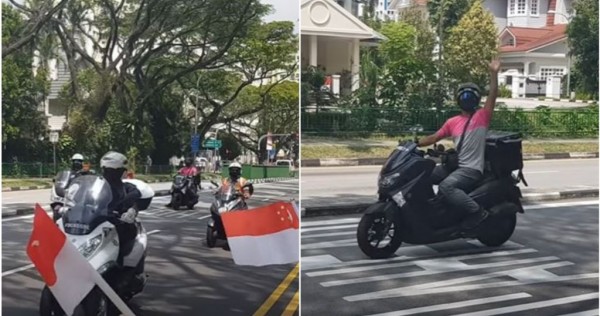
When he found himself at the tail-end of a National Day mobile column in Woodlands Avenue 3 on Sunday (Aug 9), Foodpanda delivery rider Abdul Rahman waved at residents and received a loud cheer.
What many may not know is that it was one of the best birthday gifts he ever received, the 29-year-old told The Straits Times on Monday.
His birthday was on Aug 8, a day he spent working as usual before his wife surprised him with a cake when he returned home for lunch at 1pm.
“We had a quick celebration and ate lunch together, and I was off to work again at 3pm.”
Mr Rahman, who has two sons aged 2 and 4 years old, has been a delivery rider for about a year.
He was an auxiliary police officer for a few years but had left the profession because he did not want to continue working night shifts.
He now works up to nine hours a day, six days a week, to provide for his family who lives in a three-room Housing Board flat in Woodlands.
His wife, 31, works in the engineering sector.
“Food delivery is not an easy job. We have to travel through rain and heat, and deal with traffic also. I would say it is a high-risk occupation.
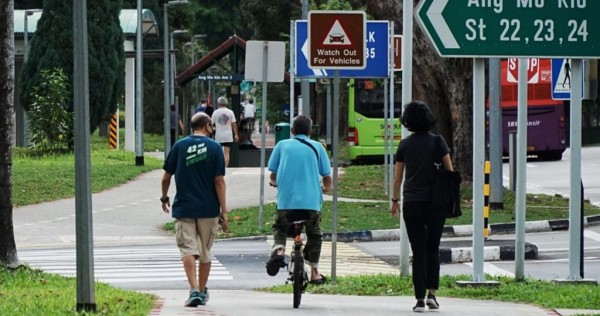
Pedestrians will not be policed based on how they walk under the new pedestrian code of conduct.
Senior Parliamentary Secretary for Transport Baey Yam Keng told The Straits Times last Friday (Aug 7) that the code was meant to raise awareness and build a gracious culture.
“The purpose of the code of conduct for pedestrians is not deterrence; we do not intend to police how people walk,” he said.
“The Highway Code, similarly, sets out certain norms to guide pedestrians on safe behaviour, such as how to cross roads safely.”
He was commenting on the issue after the introduction of the code drew controversy. Some pedestrians have expressed worries the code will water down their rights on footpaths while others insist the onus should be on cyclists and users of personal mobility devices to ride safely.
Mr Baey said focus group sessions held by the Active Mobility Advisory Panel (AMAP) in the last two years had found that it was common to spot pedestrians and device users “glued to their phones and unaware of their surroundings”.
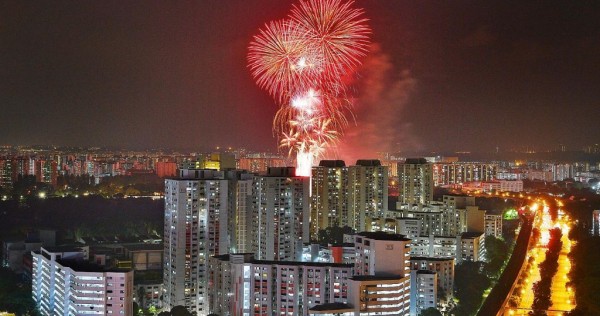
Scattered across the island, Singaporeans gathered in pockets of joy despite the Covid-19 pandemic to celebrate their 55th National Day, their first socially distanced one.
The reduced festivities meant the spectacles of yesteryear were out of the question. Yesterday morning, a small audience that included many front-line workers bore witness to a sober ceremony with just four marching contingents. Smoke from a 21-gun presidential salute filled the otherwise empty Padang.
But the thought of the virus did not stop Singaporeans from taking to the streets en masse – but masked – to wave at the tanks, police vehicles and ambulances rumbling past.
They set up camp as early as 8am on the Marina Barrage to catch the first maritime sail-past in 20 years. They peered out of windows and caught their breath as F-15 fighter jets roared past, flying in a tight arrowhead formation.
Wearing matching “I Heart SG” shirts, Ms Fatema Begum, 36, and her family watched a Chinook helicopter fly the State flag over the Barrage.