The Housing and Development Board (HDB) announced the launch of more than 7,000 BTO flats across eight locations in Singapore on Wednesday (Aug 12).
The new plots are located in Ang Mo Kio, Bishan, Choa Chu Kang, Geylang, Pasir Ris, Tampines, Tengah and Woodlands. Among the bunch however, there appears to be one standout development that has gotten the most interest from netizens.
Chairs were thrown, tables were flipped and bottles were smashed as a violent brawl broke out at a coffee shop along Hougang Avenue 8 last Sunday night (Aug 9).
Four men and a woman, aged between 52 and 65, were arrested for their suspected involvement in the case of affray on Tuesday (Aug 11), police confirmed.
A video of the physical altercation was uploaded onto Facebook the same day they were arrested.
HaizzzzPosted by Lim Peh on Monday, August 10, 2020
In the clip, two men were captured trading blows with each other before a woman in red wedged herself between them and threw a chair.
SINGAPORE: A series of unpopular changes to bus services in the Bukit Panjang area, which were to come into effect on Sunday (Aug 16), will now be delayed by two weeks while mitigation measures are being introduced.
The changes will now be introduced on Aug 30 to allow bus operators more time to implement the new measures, which include the provision of a direct bus service to the city, said Senior Minister of State for Transport Chee Hong Tat on Thursday (Aug 13).
This comes after it was announced earlier this month that services 700 and 700A would cease operations, while service 171 would loop at Bukit Panjang MRT station instead of travelling to the Marina Centre bus terminal.
From Aug 30, bus service 171 will loop at Bukit Panjang MRT station instead of travelling to the Marina Centre bus terminal. (Photo: Land Transport Guru website/boy_you_want_bus)
The Land Transport Authority (LTA) had said that the changes were made in light of sharp declines in ridership for the services following the opening of the second phase of the Downtown MRT line in 2017, as well as a need to “exercise prudence” in the use of public funds, given the millions subsidising the running of the bus services.
Newly-elected Bukit Panjang MP Liang Eng Hwa had said at the time that he was disappointed with the “drastic changes” and that he felt bus route planners had given “no regard” to how the changes would impact residents’ lives.
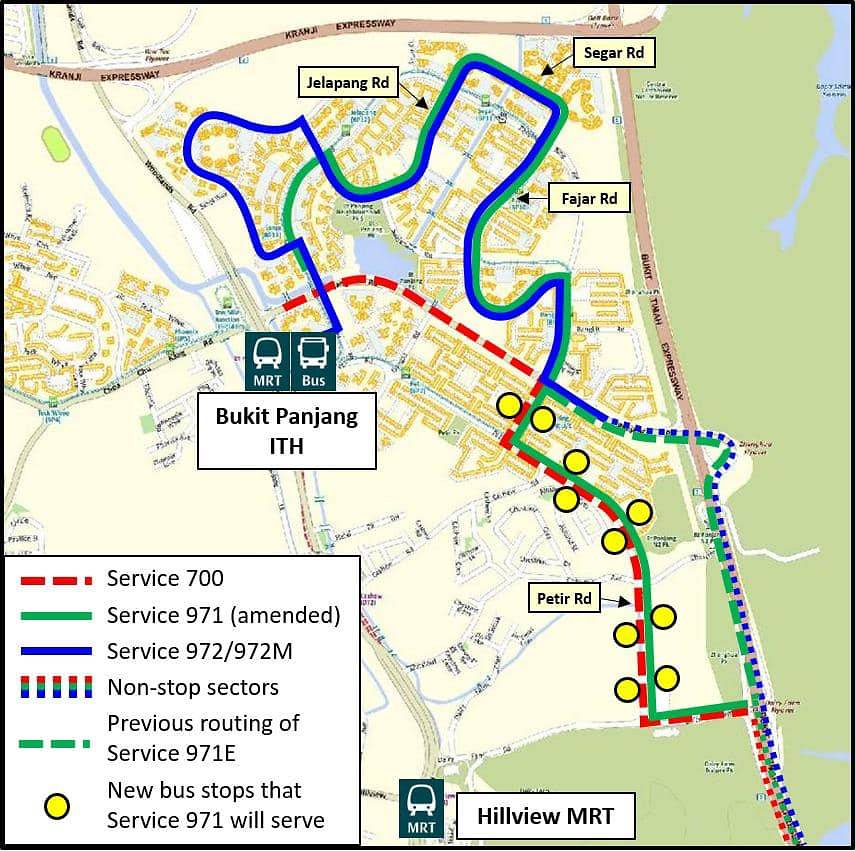
Service 971E, currently a peak-hour express service that bypasses certain bus stops, will be converted to a trunk service, 971, that calls at more stops, said Mr Chee in a Facebook post.
The service will now ply Petir Road before entering the Bukit Timah Expressway to give residents a direct bus connection to town during peak hours, he added.
The operating hours for service 971 will also be extended, running from 6.30am to 8.30am in the morning and from 6.05pm to 7.35pm in the evening.
The service currently runs from 7.10am to 7.50am in the morning and 6.05pm to 6.30pm in the evening.
(Graphic: Facebook/Edward Chia Bing Hui)
“Existing Service 971E commuters will experience an increase in travel times, but their fares will drop by up to 60 cents per trip as they no longer need to pay express fares. They can also alight at more bus stops along the way,” said Mr Chee.
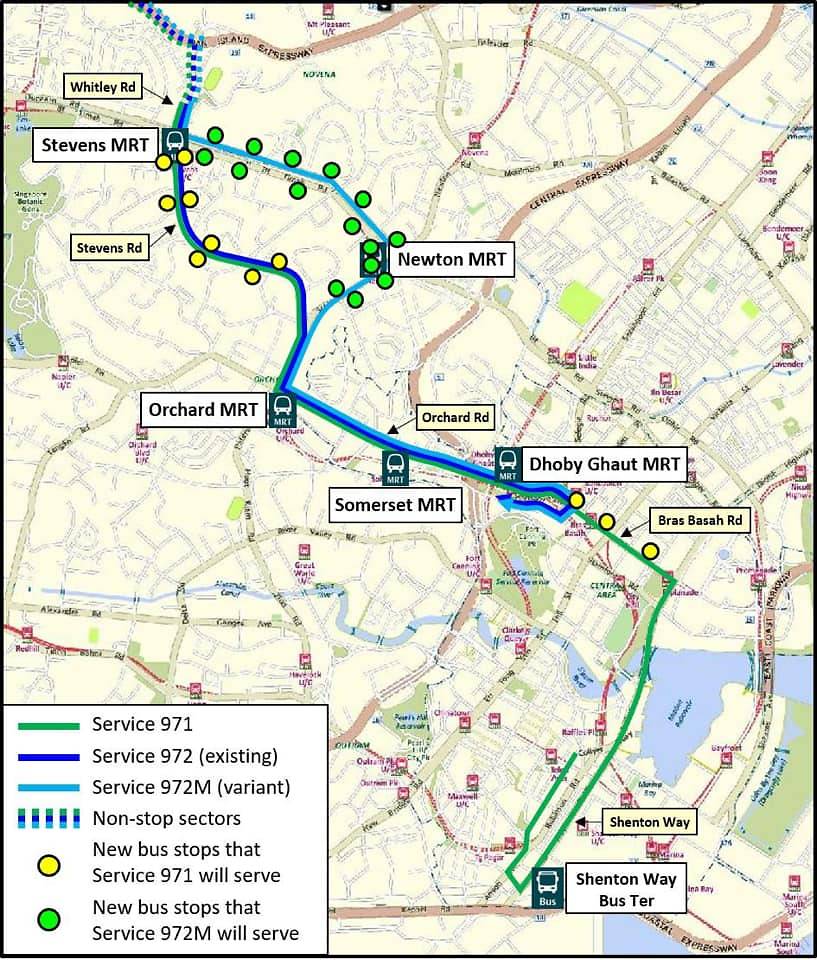
The route for service 972 – which would have been changed to serve commuters at Bukit Timah and Dunearn Road as well as those living near Newton MRT and Scotts Road – will also no longer be amended in view of residents’ feedback, he added.
“Instead, we will introduce a modified Service 972M by redirecting a portion of the existing Service 972 buses to ply along Dunearn Road and Scotts Road. This allows commuters at Dunearn and Bukit Timah Road to retain connectivity to Scotts Road and Newton MRT,” he stated.
(Graphic: Facebook/Edward Chia Bing Hui)
Mr Chee added that additional peak hour trips for services 972 and 972M would be introduced where necessary to reduce waiting time and crowding for commuters.
Bukit Panjang commuters can take either service 972 or 972M to town, he said, noting also the option of service 971 during peak hours.
“While this arrangement increases the headway between bus arrivals for both Services 972 and 972M, commuters can use the bus service app to plan your journeys and minimise waiting time at the bus stops,” he said, adding that he sought commuters’ understanding that some give and take is needed in such situations, to “cater to different groups of commuters while ensuring prudent use of public funds”.
“Lastly, LTA will increase the frequency of Service 973 during peak hours to enhance the connection to Hillview MRT,” said Mr Chee. “We will monitor the situation after two months and assess if further adjustments are needed.”
LTA will increase the frequency of Service 973 during peak hours to enhance the connection to Hillview MRT. (Photo: Land Transport Guru website/boy_you_want_bus)
Mr Chee said that the mitigation measures come after discussions with Mr Liang, Holland-Bukit Timah GRC MP Edward Chia as well as grassroots leaders.
In a post on Facebook, Mr Liang said he was glad that they had arrived at solutions based on commuters’ feedback.
“It has not been easy to find that balance, but our foremost consideration is to minimise the inconveniences and impact to residents, especially to the peak hour commuters,” he said, thanking Mr Chee for his personal involvement in coming to a “better solution”.
“We understand that that some residents will still be affected by these new changes and we hope to seek your understanding and patience,” said Mr Chia on his Facebook page.
“MOT (Ministry of Transport) and LTA have assured us that they are open to continual communication with us and will closely monitor the waiting times and crowdedness of the buses,” he added.
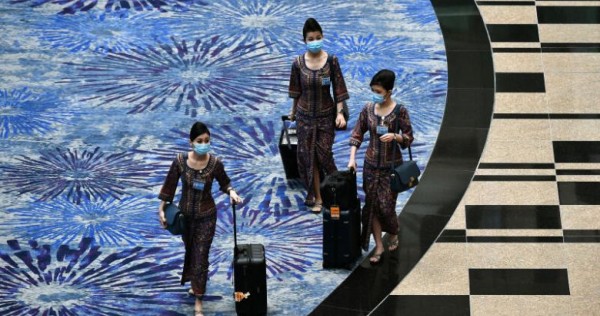
SINGAPORE – National carrier Singapore Airlines (SIA) is offering its cabin crew early release or retirement as it continues efforts to cut costs amid the Covid-19 pandemic.
It told The Straits Times on Wednesday (Aug 12) that the voluntary retirement scheme was introduced in view of the impact of Covid-19 “as well as a slower projected recovery trajectory in international air travel”.
Cabin crew members who successfully apply for the scheme will get payouts and benefits. They will have until end-August to apply. Trainee crew will not be eligible, said SIA.
The outcome of the applications will be made known by mid-September.
“Each application will be considered on its merits, and SIA will also take into account operational requirements in the review of applications,” said a spokesman.
“We continue to work closely with our unions on the way forward where staff measures are concerned. We will announce any additional measures, if necessary, at the appropriate time.”
The SIA Group, which comprises SIA, budget arm Scoot and regional arm SilkAir, has about 11,000 cabin crew in total.
While many of us were playing games like FF VII Remake or Doom Eternal while staying home this past year, one geek decided he wanted to use that time to make his own game.
So he learned some game development skills from YouTube and created Gloom and Doom, an indie game about being stuck in life.
What he ended up with is a quirky visual novel about an ancient ghost named Gloom and a young girl named Wynona who is destined to destroy the world.
According to the self-described “game dev noob” Drew Pan, the story is based on his experiences during university. He didn’t know what he wanted to do with his life, his friend was stuck in a lousy job, and another friend couldn’t get out of a toxic relationship. “I sort of combined all of that into a horror concept with a wraith as the protagonist,” he explained.
SINGAPORE: Eight men were arrested for smuggling 3,490 cartons of contraband cigarettes into Singapore on a tugboat, said the Singapore Police Force on Thursday (Aug 13).
The men, Indonesian nationals aged between 24 and 53, were detained during an operation conducted by the Police Coast Guard and the Immigration and Checkpoints Authority (ICA) at the Western Anchorage on Tuesday.
Officers from the Police Coast Guard Anti-Smuggling Team conducted an enforcement operation on board this Singapore-registered tugboat at the Western Anchorage on Aug 11, 2020, and found 3,490 cartons of duty-unpaid cigarettes onboard. (Photo: Singapore Police Force)
“During the enforcement operation targeting illegal activities in Singapore waters, a total of 3,490 cartons of duty-unpaid cigarettes were discovered inside the tugboat,” the police said in a news release.
The cigarettes were seized as case exhibits, the police said, adding that the duty evaded amounted to S$433,430 while the Goods and Services Tax (GST) was S$33,020.
Investigations by Singapore Customs are ongoing.
The total duty and Goods and Services Tax (GST) evaded amounted to about $433,430 and $33,020 respectively. (Photo: Singapore Police Force)
Involvement of any form in smuggling duty-unpaid cigarettes – such as buying, selling or storing – is a serious offence under the Customs Act and the GST Act, the police said.
Offenders can be fined up to 40 times the amount of duty and GST evaded, jailed for up to six years, or both.
SINGAPORE – A number of projects in the mega build-to-order (BTO) sales exercise on Wednesday (Aug 12) may take up to five years to complete due to safety measures introduced at construction sites to curb Covid-19.
The Housing Board said home buyers keen on the 1,785-unit UrbanVille @ Woodlands project, a five-minute walk from Woodlands MRT station, will have to wait the longest, at around 62 months.
The project is slated to be completed in the second quarter of 2026.
The 1,070-unit Costa Grove in Pasir Ris will take between 56 and 58 months, with an estimated completion date in the fourth quarter of 2025.
The 472 BTO flats in Bishan and 1,044 flats in Parc Residences @ Tengah have an estimated waiting time of between 52 and 54 months, to be ready around the second or third quarter of 2025.
On Wednesday, National Development Minister Desmond Lee acknowledged in a Facebook post that some of the projects have a “longer than normal” completion timeline, which may be of concern to buyers.
A 35-year-old man was taken injured to hospital after he was hit by a glass bottle falling from height on Tuesday evening.
The high-rise killer litter incident happened at Block 227A Sumang Lane in Punggol.
The police said they were alerted at about 6.30pm to a case of rash act causing hurt, and the victim was taken to Changi General Hospital.
Police investigations are ongoing.
The New Paper understands that the man, who was at the foot of the block, was struck on the head by a beer bottle inside a plastic bag, which also contained some tissue paper and a receipt.
Chinese language newspaper Shin Min Daily News, quoting an eyewitness, reported that the victim was chatting with a group of friends when the bottle hit him on the head, which started bleeding.
KNOCKED ON DOORS
The wound was about 4cm long, and someone called for an ambulance immediately. The extent of his injury is not known.
When TNP spoke to several residents at the 17-storey block yesterday afternoon, most of them were not aware of the incident and had not noticed or heard anything suspicious.
JOHOR: “I have been working in Singapore for 17 years, but now I cannot go in … selling durian is the only way I can earn money for now.” A man selling the fruit in a carpark in Gelang Patah told me.
“We used to work in Singapore as cleaners. But now we have to wait until the border opens for us. So we sell what we can at the traffic lights. It’s a new idea – I’ve seen people do this in other countries on YouTube – people are always thirsty in the car,” another man who sold drinks at a traffic junction in Johor Bahru mentioned in the course of my field work.
Times are tough for Malaysian workers who used to work in Singapore but have returned to Johor since the Movement Control Order (MCO) was imposed.
But things may be looking up for stranded professionals cut off from their traditional sources of employment across the Johor Strait.
In less than a week, travel between Singapore and Malaysia will restart for business and official purposes under the Reciprocal Green Lane arrangement.
There are measures in place to control the risk of COVID-19 spread. Visitors must still take swab tests before departure and upon arrival and stick to a controlled itinerary for 14 days for example.
Unfortunately, this arrangement does not apply to the 100,000 Malaysian workers who previously commuted daily into Singapore and headed home across the Causeway after.
Some may consider the Periodic Commuting Arrangement, which allows Singapore and Malaysia citizens or Permanent Residents (PRs) who hold long-term immigration passes for business purposes in the other country to enter that country for work and return for home leave every 90 days.
But with additional costs and responsibilities imposed on employers to ensure employees comply with regulations, some firms and Malaysian workers in Singapore are hesitant, given this uncertain economic climate.
THE DAILY COMMUTER FROM MAALYSIA
Singaporeans might think of Malaysian workers as part of the foreign workforce pool yet the Malaysian worker in Singapore is hardly distinguishable from a Singaporean.
Commuters leave the Woodlands Causeway across to Singapore from Johor, hours before Malaysia imposes a lockdown on travel due to the COVID-19 outbreak, in Singapore on Mar 17, 2020. (Reuters/Edgar Su)
Malaysians have found jobs and niches in all levels of employment. Many have married Singaporeans and made Singapore home. About a million Malaysians live in Singapore, as PRs, work pass holders and more.
Of those who make the daily commute, most work in blue-collar jobs; in factories, F&B, sales and services, as well as hairdressers, cleaners, technicians, mechanics, electricians, plumbers and builders – to name a few.
Working from home is rarely an option for this labour force who work with their hands, while staying in Singapore for an extended period adds costs to a limited income.
This group have been affected the most by coronavirus-induced border closures, with most left in limbo on either side of the Causeway, dealing with employment uncertainty.
A daily commuter’s journey usually begins before dawn, with the morning trip into Singapore usually by bus or motorbike taking anywhere between one-and-a-half to three hours depending on where a commuter lives, the day of the week, traffic conditions and sheer luck.
The return trip often stretches well into the night. As someone who used to make that daily expedition, it is a long and exhausting journey. Most get used to it after a while, but it leaves little time to be at home with family.
Malaysians commute because of the Singapore dollar value. An income multiplied by three is a big draw, and has enabled many who take up the challenge to inch into the middle income bracket, buy houses and cars and comfortably support their families.
For others, working in Singapore offers unrivalled opportunities – international networks, broader horizons, efficient working conditions and positive additions to a CV. Many cite the lack of available employment with competitive remuneration in Malaysia.
The Causeway at around 7am as dawn breaks on Mar 18, 2020. (Photo: Try Sutrisno Foo)
For a worker with a secondary school education earning RM750 (S$245) as a cleaner in Malaysia, it makes more sense to take up that role in Singapore, which can fetch multiple times more – a huge difference if saving for a wedding, starting a new family or supporting elderly parents.
STRANDED IN SINGAPORE
When the borders closed in March, all this screeched to a halt. For the first time ever, the busiest border crossing in the world fell eerily silent.
On the day before they shut the border, commuters (myself included) scrambled to grab belongings and either find accommodation in Singapore to hunker down for what we initially thought might be a two-week closure, or make arrangements to return to Malaysia.
Firms like SBS Transit, NTUC Fairprice and more, as well as charities and Singapore households opened up places for Malaysians who decided to stay. Employers were provided S$50 a night for each worker to aid with accommodation costs.
But some who opted to remain in Singapore found themselves out of work as Singapore buckled down for its circuit breaker.
Reports of Malaysians stranded and sleeping on the streets also emerged, along with stories of those unable to return home during family tragedies.
Thankfully, Malaysia began to allow up to 400 stranded citizens to return per day in April. Those able to do so had to walk across the bridges connecting the two nations, given that other transportation options had ceased, and spend time in government quarantine centres.
COPING WITH UNEMPLOYMENT IN JOHOR
With movement restriction orders in place and national economies almost slowed to a halt, commuters who returned to Malaysia struggled to make ends meet.
But when push comes to shove, Malaysians will find new ways to eke out a living.
Interviews with those who sold fruit from their cars or snacks and drinks at traffic lights around Johor Bahru mentioned they worked in Singapore for many years, but had to now find alternatives to feed their families. Several became food delivery riders.
A Malaysian worker at Jalan Tampoi in Johor Bahru. (Photo: Serina Rahman)
Malaysian employers have been reluctant to hire those who used to work in Singapore. They expected them to quit when the borders reopen. Job hunters also confessed this is a likely scenario.
As the weeks turned into months, home businesses and food trucks mushroomed as many resigned themselves to the realisation that they may not be able to return to Singapore until 2021.
Many who had rented accommodation in Johor Bahru to commute into Singapore pre-coronavirus gave these up to return to their hometowns and villages once interstate travel was permitted.
Some who have seen the despair of those unable to return to Malaysia after the passing of a partner, child or parent readjusted their expectations and standards of living – opting to be close to family.
LIVING WITH THE COVID-19 SITUATION
The mental health impacts of separation, forced unemployment and the total change in lifestyle of those who used to commute for work need to be looked into. Malaysia’s National Fire and Rescue Department has reported that the attempted suicide rates they attended to spiked since the MCO was imposed.
They expect actual numbers to be far higher. They cite financial distress as a key reason why people attempted suicide.
The full economic blowback will be clearer once Malaysian banks lift debt moratoriums in September. The Johor state government reported in April that more than 15,000 employees in Johor were retrenched or faced salary cuts over the MCO period.
This is a small percentage of the more than 60,000 nationwide who lost jobs, which Malaysia’s Human Resource Minister M Saravanan highlighted in end-July, but it is unclear if this second set of figures include returning workers from Singapore and those relying on home-based micro-businesses.
Targeted assistance under the Malaysian government’s economic recovery plans and stimulus packages Penjana and Prihatin plans are not accessible to Malaysian workers who have only worked in Singapore and do not contribute to Malaysia’s Employment Provident Fund.
FILE PHOTO: Commuters wait for a transport to leave the Woodlands Causeway across to Singapore from Johor, hours before Malaysia imposes a lockdown on travel due to the coronavirus outbreak March 17, 2020. REUTERS/Edgar Su
Plans to revive rural economies and agricultural-based employment may be less relevant to this group.
Even though we are divided by national borders, Singapore and Malaysia remain very much closely intertwined – culturally, socially and economically.
Leaders from both sides know this. Johor’s Chief Minister Hasni Mohammad welcomed the move to allow Malaysians to commute from Johor Bahru to Singapore for work in June when it was first announced, adding this would not only provide relief for workers but would also help to boost the economy in both countries.
While borders are slated to reopen, we are a long way from old norms that reinforced this complex interdependency between Singapore and Malaysia.
Until a way can be found for daily commuters to travel safely between the nations, both countries will have to work out a way to cope with the economic impact to Singapore firms and those dedicated Malaysian workers looking for a job.
SINGAPORE: Ships passing through Singapore ports occasionally carry ammonium nitrate, said the Maritime and Port Authority of Singapore (MPA) on Wednesday (Aug 12) as it outlined how the explosive chemical is regulated for safety.
Vessels carrying ammonium nitrate have to inform port authorities of their cargo before arrival. They will only be able to unload or store the material when approval is given, MPA said in response to queries from CNA.
“MPA carries out inspections on-board vessels to ensure that regulations are being complied with,” it added.
The dangers of ammonium nitrate have been in the spotlight since Aug 4 when 2,750 tonnes of the chemical set off a massive explosion in Beirut’s port area. More than 170 people were killed, 6,500 injured and 300,000 left homeless.
An aerial view of parts of the devastated Beirut port taken on Aug 7 shows the crater caused by the colossal explosion three days earlier of a huge pile of ammonium nitrate that had languished for years in a port warehouse. (Photo: AFP)
Reports said the ammonium nitrate arrived in Beirut in 2013 aboard a cargo ship that had experienced technical problems. The ship was inspected, banned from leaving and the chemical was unloaded.
Many questions remain as to why a huge shipment of the chemical was allowed to be left at a port warehouse for so long, but Lebanon Prime Minister Hassan Diab blamed the blast on unsafe storage.
The warehouse had reportedly caught fire from maintenance work done on Aug 4.
According to United Nations trade data, Singapore imported at least 1,665 tonnes of ammonium nitrate in 2019, from countries like Germany, Malaysia and Thailand.
“As a major transhipment hub, there are vessels in Singapore port that carry ammonium nitrate from time to time,” MPA said.
Ammonium nitrate is a crystal-like white solid commonly used to make agricultural fertiliser. It can also be mixed with fuel oils to create an explosive used in mining and construction.
But the chemical, usually transported by sea, has more nefarious uses. Militants have in the past used it to make bombs. In 2001, there was a plot to hit targets in Singapore using truck bombs rigged with ammonium nitrate.
SHIPS CARRYING AMMONIUM NITRATE ARE INSPECTED
In Singapore, ammonium nitrate is classified as a Dangerous Good. This means all vessels transporting it here must comply with the International Maritime Dangerous Goods Code.
The code covers matters like proper labelling and stowage segregation, MPA said. An MPA port marine circular issued in January 2019 indicated that ammonium nitrate on board ships must be packed in containers.
MPA said that an owner, agent or master of arriving ships carrying dangerous goods or intending to load them in the port must submit a Dangerous Goods Notification not less than 12 hours before the vessel’s arrival or loading.
This notification can be submitted through online maritime portals like Portnet, JP-Online or Marinet, it said.
“Until permission from the Port Master has been obtained, no loading or unloading of such cargo from the vessel should take place,” it added.
“Similarly, approval from terminal operators needs to be obtained for the temporary storage of dangerous goods within the terminal.”
Apart from MPA inspections on board vessels, the authority said the Singapore Police Force (SPF) and Singapore Civil Defence Force also conduct safety management audits and inspections at storage premises in port terminals.
HANDLERS OF AMMONIUM NITRATE MUST NOT HAVE CRIMINAL RECORD
The police also regulate the local import and export of ammonium nitrate as an explosive precursor under the Arms and Explosives Act.
Those who wish to manufacture, store, deal in, possess, import or export ammonium nitrate require a licence under Arms and Explosives Act, the police told CNA.
Licence applicants who wish to manufacture, store, deal in or possess the chemical must be a Singaporean or permanent resident, as well as a business stakeholder registered with the Accounting and Corporate Regulatory Authority.
Those who will directly handle the chemical must not have a criminal record, and they need to have relevant experience and knowledge in the handling of explosive precursors.
Applicants are also required to submit training records and certifications for staff handling the chemical, safety and security plans for its handling, transportation and storage, as well as a write-up on the actual processes where the chemical is used.
STRICT CCTV RULES FOR STORAGE PREMISES
When it comes to storing ammonium nitrate, SPF said licensees are only permitted to keep a prescribed quantity as approved in their licence.
They should also comply with the chemical’s Safety Data Sheet, which is provided by manufacturers to ensure the safe use and handling of hazardous chemicals under a global standard.
This is on top of a set of security measures for storage premises, including installing closed-circuit television cameras (CCTV) that cover entrances and exits leading to and from the premises as well as the actual storage area inside.
According to an SPF document on licensing conditions, the CCTVs must be switched on and record in colour at all times, capture the faces of those who enter and exit, and store recordings for at least 30 days.
Licensees must ensure that ammonium nitrate which has expired and is unsafe for storage is immediately removed and disposed. SPF provides a list of three suitable disposal companies.
A chemistry professor quoted by the BBC said ammonium nitrate that lies around for a long time begins to decay, absorb moisture and become a large rock. This makes it more dangerous as any reaction with fire will be more intense.
ADEQUATE VENTILATION, FIRE SAFETY MEASURES A MUST
The police said they could impose additional conditions depending on the type and quantity of explosive precursor that will be stored.
“The police also take into consideration the suitability of premises in storing the proposed type and quantity of explosive precursors safely and securely,” SPF added.
“Licensees are required to implement security measures such as those to track the inventory of explosive precursors and control access to their storage premises at all times.”
A Lebanese youth wrapped in the national flag looks at the damaged grain silos at Beirut’s port, where a huge chemical explosion devastated large swathes of the capital. (Photo: AFP)
Storage premises should also be well-ventilated and away from flammable or combustible substances, the police said, adding that licensees must have “robust” fire safety measures in place to mitigate the effects of any incident.
“The police perform regular inspections to ensure compliance, and will not hesitate to impose regulatory sanctions against errant licensees,” they added.