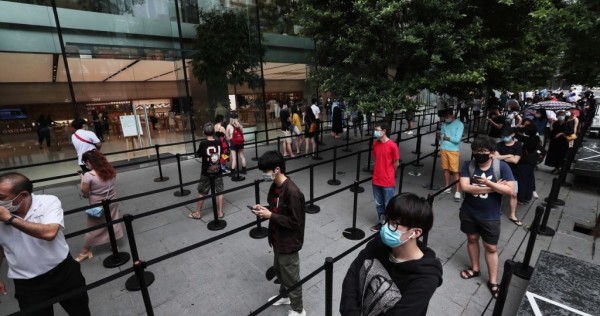
SINGAPORE – A hotpot restaurant has been ordered to suspend operations for 10 days and fined $2,000 for failing to comply with safe distancing measures, the Singapore Tourism Board (STB) said on Saturday (Aug 15).
Hai Xian Lao, which is located on the fourth level of Shaw House in Orchard Road, allowed customers to consume alcohol on its premises after 10.30pm and did not maintain a distance of 1m between groups of customers.
The restaurant also failed to ensure that group sizes did not exceed five persons.
STB said its enforcement officers noticed a group of more than 20 people leaving the restaurant on Friday night, and further checks revealed that the group had been seated in a locked private room within the restaurant.
Restaurant employees were also found to be uncooperative and at times aggressive towards the STB officers, attempting to block entry into the restaurant and private room.
“STB takes a serious view of non-compliance for safety distancing measures by both businesses and members of the public,” said STB director for retail and dining Ranita Sundramoorthy.
SINGAPORE – Valencia president Anil Murthy has told the Spanish La Liga’s club’s supporters that it needs to be “responsible” as it braces for the “serious” impact of Covid-19 on football.
In an open letter to them on the club’s website, the 47-year-old Singaporean, a former diplomat, sought to explain the realities facing the club on two fronts: the summer market in signing players and plans to build a new stadium.
He also launched a staunch defence of the club’s financial stewardship under Peter Lim, following protests from a section of vocal Los Che fans who have accused the Singaporean billionaire of “negligently managing the club” and “deteriorating the value of the team”.
NEED FOR FINANCIAL PRUDENCE
Murthy highlighted that the club is in better financial shape now than in the recent past – it racked up debts of up to €547 million (S$888 million) in June 2009 – and has been able to start financing the debts from 2017, when previously it had not done so since 2009.
He noted that when Lim became the majority shareholder in 2014, “there was a total of €48 million in player salaries unpaid, and no cash in the bank”.
With seven in 10 Singaporeans saying the Covid-19 outbreak has lasted longer than they anticipated, people are becoming weary of the rules to limit the spread of the virus, according to a Sunday Times survey of 1,000 people.
These rules include a ban on gatherings of more than five, and the need to mask up when outside.
It is natural for coronavirus fatigue to set in, according to experts such as Professor Teo Yik Ying, dean of the National University of Singapore’s (NUS) Saw Swee Hock School of Public Health.
“Wearing a mask every time we step out of the house is really not normal behaviour for us,” he said, but the experts also agree that the authorities need to manage this to ensure Singapore’s collective guard against the virus is not let down.
SINGAPORE: As the coronavirus pandemic rages on, the 23,715 Singaporeans enrolled in universities overseas are wringing their hands.
Will they be allowed back on campus? Or will they have to stay home and grapple with online lessons, which may take place in topsy-turvy time zones?
Some may be left hanging with mixed messages from on high. On Jul 6, the US Immigration and Customs Enforcement (ICE) announced that all non-resident students in American colleges enrolled only in online classes will have to leave the country, or face deportation.
But following lawsuits brought by Harvard University and the Massachusetts Institute of Technology (MIT), the decision was reversed within a week.
It is unlikely that other countries, particularly those popular with Singaporean students, will impose sweeping restrictions like those that America did.
Many universities in popular study aboard destinations such as Australia and the UK are dependent on income from overseas students. In 2018, international onshore student revenue accounted for more than a quarter of all universities’ revenue in Australia.
With COVID-19 forcing countries to close their borders, what do the prospects for Singaporeans keen to pursue an overseas education look like?
EDUCATIONAL DISRUPTION
It’s an understatement to say there won’t be a return to normal campus life at the start of the new semester.
Bikes are seen outside Cambridge University, as the spread of COVID-19 continues. (FILE PHOTO: REUTERS/Andrew Couldridge)
Prestigious universities from Cambridge to Harvard will deliver all lectures online for the academic year of 2020 to 2021. Singaporean students, regardless of if they’re overseas or at home, will in all likelihood have to attend virtual classes this fall.
The shift to virtual classes rightly prioritises the health of students but could result in some learning loss. The educators we work with have observed how online classes reduces interactivity with their students, making it challenging to personalise lessons based on real-time feedback.
Moving overseas to study can be a traumatic experience. My former colleague, a Singaporean who recently embarked on her post-graduate studies in the Netherlands, struggled with loneliness during her first few months of the programme.
Despite having travelled extensively, she found it trying to adjust to a new culture with few friendly faces to count on.
Students who began their overseas education at the start of this year – before lockdowns were enforced – may not have had the time or opportunity to build up a strong social network. They may feel isolated in a foreign country, and struggle to remain motivated and committed to their studies.
Even more worrying than a sense of isolation is the rise of racism targeting those who appear East Asian.
During the early stages of the outbreak in February, Jonathan Mok, a Singaporean student at University College London, was the unfortunate victim of a coronavirus-related racist attack.
Since then, I’ve seen on social media anecdotes from friends and acquaintances of racist abuse, largely verbal, in foreign countries. Fortunately, most cases were not as violent as Mr Mok’s, but nonetheless caused great distress to the victims and their loved ones.
A university student wears her mortar hat following her graduation ceremony from the School of Commerce at the University of Sydney in Australia, Apr 22, 2016. (File photo: Reuters/Jason Reed)
Unfortunately, with increasingly nationalist rhetoric from certain world leaders, it is unlikely we’ll see an end to such antagonism soon.
Recent or soon-to-be graduates who intend to work in their host country may have their plans thrown into disarray.
Mr Gavin Ng, a Singaporean PhD candidate at the University of Illinois, had received a job offer in April as a data scientist with Uber.
However, that offer was rescinded just a month later. The ride sharing behemoth is struggling to keep afloat, having laid off a quarter of its workforce globally in May due to the impact of COVID-19 lockdowns.
With the pandemic likely to cause the worst recession since the Great Depression, most countries would be focused on channelling any available employment opportunities to citizens.
ONLINE DEGREES A SUBSTITUTE FOR OVERSEAS EDUCATION?
As institutions worldwide shift towards online learning, many will question the value of enrolling in a university overseas.
But online learning in tertiary institutions is not a new trend by any measure. Over the past decade, platforms like EdX and Coursera have offered MOOCs – massive open online courses – designed by universities and companies such as MIT and Microsoft.
In some cases, students can earn certifications that are stackable for a degree. EdX has a MicroBachelors programme that provides students with accreditation from established universities like New York University and Arizona State University.
These programmes are significantly more affordable than traditional degree programmes, and allow students to complete the course at their own pace, making them particularly popular with mature learners juggling work and family.
(Photo: Unsplash/Charles Deluvio)
Yet MOOCs have not been seen by most as a substitute for a campus-based education, particularly in a premier institutions. In a post-COVID world, Singaporeans considering an overseas education will likely be more discerning about where they apply to.
The cost of an overseas university education is still significantly higher than one at a local university. An average three-year undergraduate programme at the latter costs around S$25,000, compared to £10,000 (S$18,000) and upwards per year at a UK university.
So if students are going to fork out much more for an overseas education – especially if what they’re getting in return is mostly virtual lectures and seminars – they are going to want the biggest bang for their buck.
With the increased proliferation of online learning spurred by COVID-19, a campus-based overseas higher education will only remain attractive at elite institutions.
Beyond providing their students with quality education, the allure of pedigree schools have more to do with their non-academic perks.
Higher education is a stratified sector, where the name of the institution is often as valuable as the knowledge gained. Marketing can only do so much – the perceived worth of institutions is often built over long periods of time, even centuries.
If pay is any reflection, then employers buy into the brand names of schools too.
From 2015 onwards, the US Bureau of Economic Analysis has consistently reported Ivy League graduates landing the highest starting salary compared to their non-Ivy League peers. Their median starting salary was 55 per cent more than that of US private university graduates in 2019.
A university student graduation. (Photo: Reuters/Brian Snyder)
The other draw of top schools is the opportunity to work closely with world-renowned academics. This will still be possible in an online learning environment, though the lack of face-to-face interaction will dilute the experience and its value.
The best ideas are often the result of heated debates between great minds, and despite the advancements in technology, it’s hard to fully capture the nuances of human interaction online.
Singaporeans also pursue an overseas education to master their craft. Olympic gold-medallist Joseph Schooling, for instance, chose to enrol at the University of Texas at Austin to train with a former coach of the US Olympic swimming team.
Musicians and artists would also want to study abroad for the same reasons.
When international students can return to campus remains a huge question mark. Many countries are only beginning to lift lockdowns, while some states such as Victoria, Australia are forced to re-enter lockdowns due to sudden spikes in infections.
Countries are also more likely to focus on reopening schools before they turn their attention to universities.
But the allure of an overseas university education will likely persist. Once the prerogative of wealthy families and brilliant scholars; an overseas university education is now more accessible to Singapore’s growing middle class.
In the longer term, as COVID-19 begins to recede or a vaccine is developed, an overseas education, particularly at top schools, will remain the dream for ambitious Singaporeans.
Vignesh Naidu is Director, Operations at The HEAD Foundation.
SINGAPORE: COVID-19 is often thought of as a historic disruption to businesses, but a more accurate characterisation of this pandemic is its role in accelerating trends already underway to separate the goat from the sheep.
Nowhere is this clearer than in retail. Prior to the coronavirus reaching our shores, longstanding department store titans like Metro and Isetan already had plans to wind up outlets in Centrepoint and Westgate respectively.
We are likely to see these great dames of shopping scale down their physical footprint and reconfigure their business model, moving towards an omni-channel strategy. Robinsons and Marks & Spencer, which already have their own websites, now have more virtual storefronts after tie-ups with e-commerce platform Lazada in April.
These follow international trends where consumer spending has been slow to recover despite economies reopening post-lockdown. Retail giants H&M, Zara and Esprit have shuttered stores worldwide.
The latest victim in Singapore is homegrown sport chain Sportslink, which filed for liquidation and put its flagship stores in Queensway Shopping Centre up for sale in July.
But unlike Real Estate Investment Trusts (REIT) malls flushed with investor cash, strata malls like Queensway Shopping Centre suffer more acutely with the closure of an anchor tenant. These tend to create negative spill-overs to other shops in the mall, many of which are in the same trade and bank on the big boys to pull in crowds.
Queensway Shopping Centre (Photo: Darius Boey)
The good news is retailers in Queensway Shopping Centre and other strata malls, made up of mainly small and medium enterprises (SMEs), have received temporarily reprieve via four-month rental reliefs provided for under the COVID-19 (Temporary Measures) Act passed in Parliament in June.
But with this rental waive having ended in July, the writing may be on the wall. The rising island-wide retail space vacancy rate of 8.0 per cent and 9.6 per cent in the first and second quarters of 2020 respectively may just be the tip of the iceberg.
While retailers in strata shops that own their spaces may not be as financially stressed as rent-paying tenants, they face greater headwinds keeping their businesses going. Many are in traditional trades, like tailoring, F&B, Chinese medicine, while others, particularly the huge concentrations of family businesses, face certain death with the next generation unkeen to take over.
Competition from REIT malls able to dish out deep discounts has intensified. The relentless march of e-commerce is also not letting up, with the circuit breaker likely to see consumers utilise online shopping for the purchase of regular, essential items including groceries and food delivery.
Retail in general will also come under huge pressure given the poor macroeconomic picture. The circuit breaker has hurt the economy gravely and placed retail under great strain after a two-month closure, where revenues fell to near-zero, but stores continue to incur manpower, storage and other operating costs.
Although the Singapore’s economy has made strides in the transition towards a new normal and expected to have bottomed out, retail will see a winnowing given a dwindling pie.
Research on consumer expectations by our colleague NUS Assistant Professor Qin Yu suggests individual consumer confidence to spend has been dampened. Consumers will continue tightening their belts amidst this gloomy outlook until a COVID-19 vaccine is found and the virus can be permanently contained.
People were seen wearing masks at Orchard Road, Singapore on Feb 3. (Photo: Gaya Chandramohan)
An optimistic outlook remains elusive. With a 2020 contraction of 5 to 7 per cent forecasted, the Singapore’s economy has seen its worst quarterly performance on record from April to June shrinking 13.2 per cent year-on-year.
Travel restrictions have also killed the flow of international business travellers and tourist spending, impacting strata malls in the prime shopping belt and places of interest to visitors reliant on foreign dollars, like People’s Park Complex in Chinatown, Mustafa and Orchard Towers.
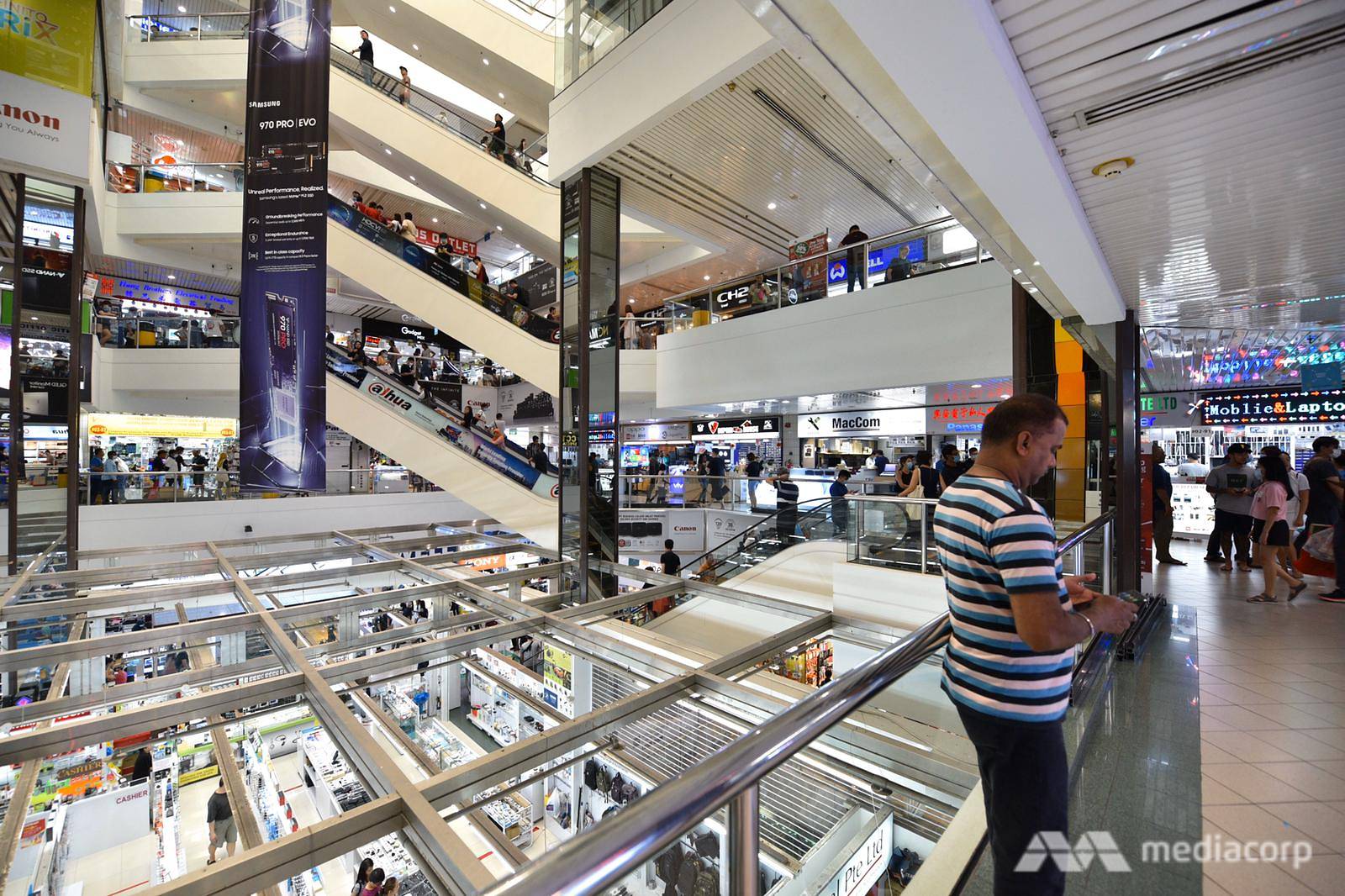
Shops in Sim Lim Square selling computer accessories, televisions and IT equipment have seen revenues plummet by 40 to 50 per cent, with owners attributing the drop to a lack of tourists and foreign workers who make up 40 per cent of clientele. Facing greater financial pressures, 11 shops there have been put on sale this past month.
THE CHALLENGE OF COLLECTIVE ACTION IN STRATA MALLS
Strata-titled malls may do less well than REIT malls in weathering this historic upending of retail.
Part of this weakness stems from the fragmented ownership structure of strata malls that hampers collective action needed to undertake bold moves to rejuvenate and adopt new shopping concepts.
Strata mall units are individually sold to different owners, who lease them out to small tenants, and are motivated to maximise fixed rents from sub-divided units with little sharing of business risks and upsides.
Screengrab from Google Street View of Golden Mile Tower.
In contrast, revenue models for REIT malls, and those owned by a single company, which already have deeper pockets, tend to adopt a percentage rent model that incentivises efforts to draw crowds and generate footfalls and tie their fortunes to their tenants’ – an advantage in a time of COVID-19.
CapitaLand, the largest landlords of retail malls in Singapore, for example, offered additional support schemes on top of government mandated landlord rental rebates, including a one-month security deposit release, a more generous rental relief package and bulk purchases of sanitisation services and thermal scanners.
Single-owner and REIT malls have a strict tenant selection procedure to bring in a mix of complimentary tenants, whereas strata malls face challenges in attracting large anchor tenants with pulling power, which requires the amalgamation of contiguous, individual units.
Sub-divided owners also have less of an incentive to turn down undesirable tenants that may fetch a lofty rent but come with negative externalities.
Orchard Towers used to be a bustling mall filled with clothing, jewellery and even had a cinema and a supermarket in the 1970s.
Yet the atmosphere has changed drastically after businesses like massage parlours and nightclubs moved in, attracting a less-than-family-friendly group of patrons. These days, people no longer associate Orchard Towers with shopping for fashion and jewellery, and many original businesses have moved out.
Ironically, although the fragmented ownership structure grants owners more discretion to lease out spaces to their preferred tenants, strata malls tend to be stagnant in their tenant mix, and reliant on specific destination-driven consumers, for example clusters of shops selling sportswear in Queensway Shopping Centre.
Yet being located near similar shops may breed healthy competition as businesses keep up with trends. Sim Lim Square moved from selling TV consoles, printers, cameras and IT accessories to laptops and smartphones with the IT boom in the 2000s.
Beauty World Centre too is seeing a slight change in their tenant mix, as old trades like tailoring and optometry fade and shops pivot to cater to the Korean community, selling Korean food, fashion and dancing academies, which has seen green shoots in attracting younger shoppers.
CHALLENGES IN MANAGING AND MAINTAINING MALLS
The management and maintenance of strata malls get less attention, where they come under a management council comprising subsidiary proprietors who serve on a voluntary basis and lack professional expertise in mall management.
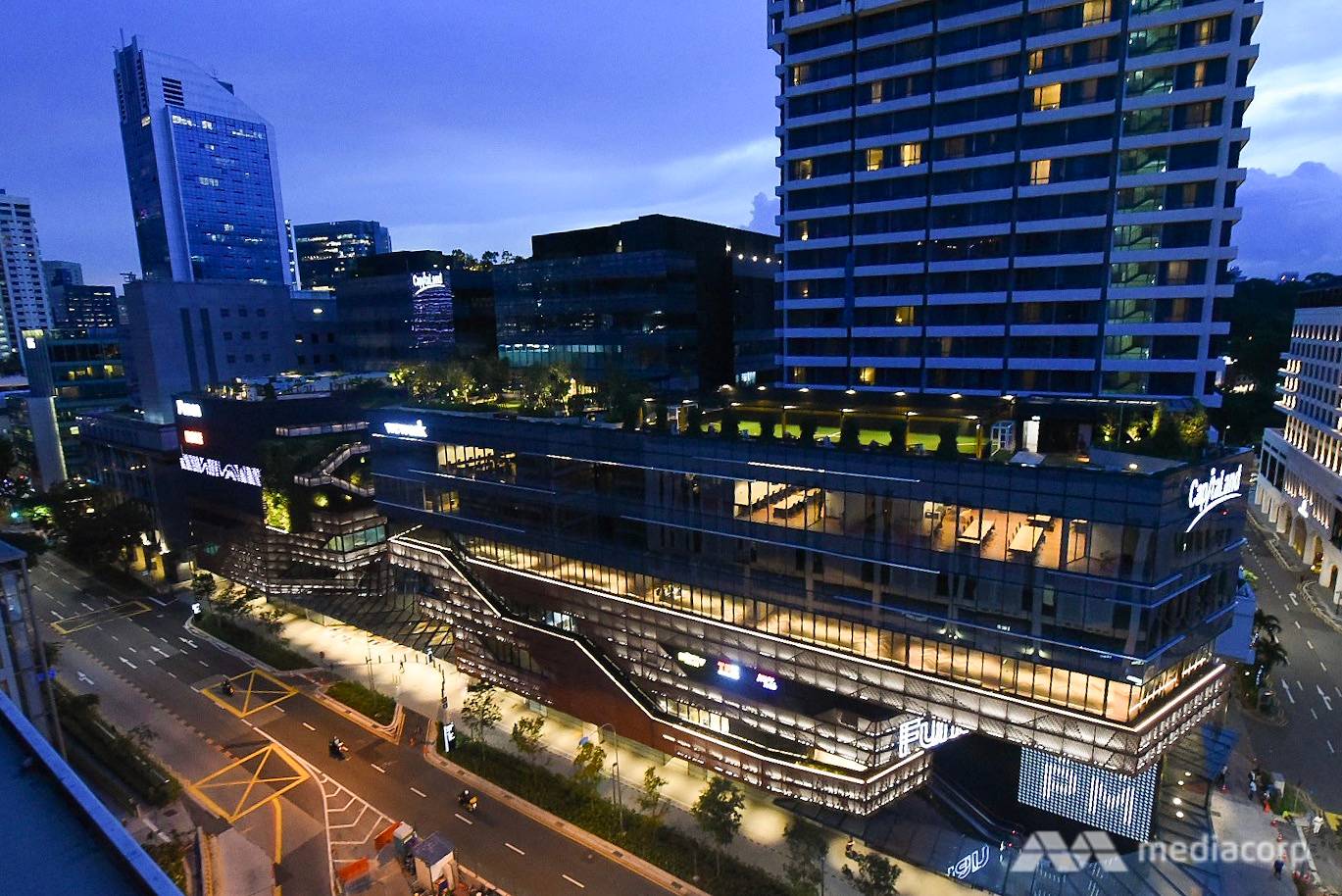
Aerial view of Funan by night. (Photo: Gaya Chandramohan)
The result is short-termism.
With limited budgets where each individual owner has vested interests in keeping sinking fund contributions low, strata malls only have enough muscle to organise piecemeal mall promotions and advertising activities, after routine maintenance, repair works and cyclical upgrading works have been accounted for.
These are a fraction of the major asset enhancement initiatives carried out in REIT malls. The upgrading project at Suntec City Mall and Suntec International Convention and Exhibition Centre in 2011 cost S$410 million in 2011, nearly the price tag of S$500 million Queensway Shopping Centre demanded in an en bloc sale.
Many older strata malls, long overdue for a makeover, struggle to compete with newer malls in better locations when accumulated sinking funds cannot cover major refurbishment works.
The sinking funds in strata malls are used only to cover repair works for common properties, such as water-proofing and the maintenance of public toilets.
Sportslink used to pay S$1.56 per square foot per month for maintenance fees, inclusive of the goods and services tax. Meanwhile, major works, like the one Tampines Mall undertook which involved enhancing the mall façade and replacement of the flooring at the external walkway for a more inviting look cost S$8.2 million in 2018. This translates to S$23.02 per square foot.
REIT malls can undertake such projects without consensus from the majority of owners. REIT managers also have less qualms tearing down old buildings for redevelopment.
CapitaLand Mall Trust had redeveloped the former Funan IT Mall at the cost of S$560 million in 2016 to keep its niche trade mix in electronics and technology while integrating a lifestyle component to attract younger shoppers.
The mall reopened in June 2019 with a 95 per cent occupancy rate for their retail sector and projected a return of investment of 6.5 per cent in 2016.
The newly revamped Funan stands in contrast to Peninsula Shopping Centre, a strata mall just right at the corner of the street which has largely stayed the same since 1974 when it first opened. It faces difficulties staying competitive, judging from the huge difference in foot traffic between the two despite their proximity.
The same can be said of strata mall Lucky Plaza, located in a prime spot on Orchard Road. It pales in comparison to next-door Paragon Mall owned and managed by SPH REIT, which spent S$82 million on a makeover and expansion in 2008.
The fact is REIT and single-owner retail malls are usually managed by a professional management team actively involved in developing distinct mall positioning strategies, planning promotional events, and conducting advertising campaigns, with their pay structure tied to the performance of the mall.
Shops at Sim Lim Square remained open for business on Apr 4, 2020. (Photo: Jeremy Long)
The other trouble is most strata malls are not connected to transport hubs and MRT stations. That’s a challenge when a study conducted by the Ministry of Trade and Industry in 2014, show better location and asset enhancement works can allow malls to command higher rents.
It’s no wonder some, like Sim Lim Square, Queensway Shopping Centre and Golden Mile Complex, have resorted to putting themselves up for collective sales yet have failed to attract potential buyers.
WHAT STRATA MALLS CAN DO
History has shown, however, that subdivided unit owners in strata malls can put aside individual interests to take decisions in the collective interest of the mall, including amalgamating contiguous space to snag strong anchor tenants.
Owners and tenants in the King Albert Park Residences Mall have managed to attract entertainment and lifestyle firm EagleWings Group, founded by famed Eagle Eye centre medical director Dr Julian Theng, which set up a cinema, retail shops, healthcare and eateries there.
Initiatives that improve the mall’s physical layouts and functionality to create refreshing shopping concepts and experiences can enhance their asset value.
Our advice for strata mall owners is to use this COVID-19 pandemic to break out of their current model to focus on the long term by injecting new life into their shopping centres.
They must look beyond maintaining the bare functionality of mall spaces and shift their focus to the business side of their role. They must think about their visitor segment targets to work out anchor tenants and store mix. They should peg their performance to mall foot traffic, store capture rates and store sales conversions.
They should help stores develop relevant marketing strategies. Some retail operators that own substantial space and have major share values in strata malls, like Fairprice Finest in Thomson Plaza and Bukit Timah Plaza, are motivated to work and organise collective action with other smaller retailers to run promotional and marketing campaigns.
Others like Lucky Plaza allow tenants to utilise atrium spaces to hold events or organise book fairs to gain more footfall.
However, in malls like Queensway Shopping Centre where the floor layout is cramped and the atrium is not designed for regular promotional events, tenants will rely on regulars for sales, and strata mall owners should help them develop online strategies. Even Soccer store Weston Corp at Queensway Shopping Centre has started embracing e-commerce to boost sales.
Strata mall owners could also take a leaf from CapitaLand, which launched two e-commerce platforms, eCapitaMall and Capita3Eats, to extend marketing reach for their tenants to more than 1 million CapitaStar members in Singapore, or leverage existing e-commerce and social media platforms and aid older tenants with onboarding.
Bulk sales, cross-selling and joint marketing could be undertaken by tenants on digital platforms. These benefits could be realised by tapping on the Government’s Digital Resilience Bonus, which provides up to S$10,000 in subsidies for qualifying digital solutions.
An ambitious goal might be for strata mall owners to band together in a trade and merchant association. They may be able to tap on government schemes under the Local Enterprise and Association Development umbrella administered by Enterprise Singapore.
Download our app or subscribe to our Telegram channel for the latest updates on the coronavirus outbreak: https://cna.asia/telegram
Professor Sing Tien Foo is Director at the Institute of Real Estate and Urban Studies (IREUS) and Head of Department of Real Estate, National University of Singapore. Lau Li Min is Research Assistant at the same institute. The views and opinions expressed herein are those of the authors and do not represent the views and opinions of the National University of Singapore or any of its subsidiaries or affiliates.
SINGAPORE: Reverend Eileen Harrop has never courted fame, she said. But in a strange twist of fate, she has gone global, after being pictured giving Communion to her congregants with a pair of long chopsticks.
Appearing on several major UK media outlets – including Sky News, the British Broadcasting Corporation (BBC) and the tabloid Daily Mail – and some further afield, Singapore-born Mrs Harrop is “baffled” by her newfound fame.
“I still don’t understand it. That’s the honest truth,” she told CNA on Thursday (Aug 13) in a video call all the way from County Durham, where she serves at St Mary’s in Gainford and St Andrew’s in Winston.
“I don’t understand it. But I think, if it’s something that takes people’s mind away from the fear of living in a pandemic, where it’s going to be scary and completely threatening and hopeless, if it can give people some inkling that there could be hope and interesting things and we’re going to be okay … then I’m very glad.”
In fact, when she first conceived of using chopsticks, she was only trying to work within the constraints of safe distancing in the UK, where people have to keep a distance of more than a metre from each other, but with advice to stick to two metres if possible.
“I’m about five-foot tall, and my arms aren’t very long,” said Mrs Harrop. “If people come forward to receive Communion … they stretch out their arms, and it’s still not long enough for the 2m distance,” she said.
While some other churches started using tongs, Mrs Harrop felt that those available to her – sugar tongs about 15cm long – were still too short. That was when she thought of using ‘lo hei’ chopsticks, which are about 46cm in length, she said.
Such chopsticks are longer than normal and are used by groups of people to toss the ingredients in a raw fish salad to celebrate Chinese New Year.
And she thought the meaning was “very appropriate” for Communion in a Christian context too, as the Chinese use the chopsticks for “special communion”, where family and friends come together and “lay aside any differences” and be there “in good spirit”.
Once she suggested the idea to her team members at the church, they were immediately onboard, she said.
Mrs Harrop giving Communion in her parish of St Andrew’s in Winston. (Photo: Eileen Harrop)
“They did not hesitate. They thought – why not? It brings confidence to our congregation. It is the first time they’re coming back to church services after being locked down for four months,” she said.
On Mar 23, UK Prime Minister Boris Johnson announced a nationwide lockdown in a bid to stem the overwhelming numbers of coronavirus cases in the UK.
So with the support of her bishop, Mrs Harrop tried using chopsticks with her parishioners, who she found were very “assured” with what she had planned for them.
‘I DIDN’T EXPECT IT TO BE CARRIED SO WIDELY’
It was initially meant to be a “local story”, said Mrs Harrop on the media interest in her unusual approach to Communion. “I didn’t expect it to be carried so widely.”
It all started when she first opened the church for a school service, after churches were allowed to resume in the UK. A local reporter came in to cover the service, where the congregation prays for students entering secondary school.
“When I told this news reporter – our local news reporter – I said, our next service is a Holy Communion on Sunday, and I’m going to pilot using chopsticks, he was very interested … He actually ran it in a local, very local way in our own area, and it had such a good reception,” she said.
The spread ended up being a huge photograph covering about a quarter of a page. While she expected regional interest, she never imagined that it would end up hitting the headlines in places as far as Poland and India, she said.
Mrs Harrop wasn’t even aware that she was on the news until one resident in the community sent her a Facebook message telling her that she was on BBC news. And since then, it has been a “complete, continuous” line of people getting in touch with her to tell that they have seen her on the news.
The local Facebook page has been buzzing about this too, she said, which has “just lifted people’s spirits”. And members of her family around the world – from Australia, New Zealand, Canada and Hong Kong – have also got in touch with her after seeing her hit the headlines.
For someone living in a “sleepy rural area” used to a regular schedule of prayer and counselling, Mrs Harrop was initially “a bit concerned” about her sudden fame. She has only slightly over 3,000 people living in both her parishes, with nearly 100 people attending her services.
“I had to think about it and (I) thought, well, if it’s of help, if it encourages people, if it gives people a little bit of positive cheer, then that’s a good thing,” she said.
The reverend, who is still a Singapore citizen, also saw this in the spirit of representing her home country, which she said has always “hit above its size”.
“I think if I could testify to what a Singaporean spirit can contribute, to ourselves as Singaporeans, and to anybody else who would be encouraged, I’m very pleased. I’m very glad to be able to do that.”
A TEACHER, A CONSULTANT AND NOW A PRIEST
Mrs Harrop – whose maiden name is Eileen Chew – started her career as a teacher, teaching in Anglo-Chinese School (ACS).
Mrs Harrop started her career with the Church of England in 2010, after a varied career in teaching and consulting. (Photo: Eileen Harrop)
She married her English husband, also an educator, who she met during her undergraduate years in the UK. They settled in Singapore from 1989 to 1996.
Before leaving Singapore, she had already switched careers twice. She left the teaching service to work with hospitals in the private sector, before being headhunted by a private company to be an organisation change consultant for quality management for multinational conglomerates (MNCs).
She returned to the UK with her husband in 1996, when he needed to finish his PhD at Bristol University. They settled in Oxfordshire, where she continued her work with MNCs, until 2004.
“At the time, things were happening in that village, and then in a group of parishes there. And the bishop said to me, I think Eileen, you should think about going into the church.
“I thought he was being polite, because I had done some things to help the church … But God was calling me, and somehow I knew that my life was going to change,” she said.
It took many years to reconcile herself with joining the church, but she finally took the plunge in 2010, where she did a two-year Bachelor of Theology in Ministry at Cambridge University.
She was ordained as a priest in 2013, and since then, she has served several congregations, including her current one in County Durham.
While there aren’t many Chinese priests in the UK – and Mrs Harrop is the first Southeast Asian woman to serve as an ordained minister in the country – Mrs Harrop feels “very blessed”.
“The congregation of people in my parishes and my communities, they know who I am. They know I come from an Eastern background. I even had – about two years ago – a fundraising meal, (where) we celebrated Chinese New Year, and I did ‘lo hei’ as part of the fundraising celebration.
SINGAPORE: A hotpot restaurant in Shaw House has been suspended for 10 days and fined S$2,000 for failing to comply with safe management measures, including allowing 20 people to gather in a locked private room.
Hai Xian Lao restaurant, located at the fourth level of Shaw House at 350 Orchard Road, had allowed customers to consume alcohol on its premises after 10.30pm and did not maintain a distance of 1m between groups of customers, said the Singapore Tourism Board (STB) on Saturday (Aug 15).
The restaurant had also failed to ensure that group sizes did not exceed five persons.
STB said that its enforcement officers saw a group of more than 20 people leaving the restaurant on Friday night. Further checks revealed the group had been seated in a locked private room within the restaurant.
Staff at the restaurant were “uncooperative, and at times aggressive” towards the enforcement officers, added STB, and had tried to block them from entering the restaurant and the private room.
Enforcement officers from the Singapore Tourism Board conducted a check at Hai Xian Lao restaurant on Aug 14, 2020. (Photo: Singapore Tourism Board)
“STB takes a serious view of non-compliance for safety management measures by both businesses and members of the public,” said Ranita Sundramoorthy, director for retail and dining at STB.
“While we encourage people to go out and enjoy what our local businesses have to offer, we strongly urge them to do so in a safe and socially responsible manner, so as to minimise the risk of further COVID-19 tranmissions within the community.”
Before the Covid-19 pandemic closed the door on international tourism, Singaporean travel entrepreneur Scott Tay journeyed to some of the world’s most remote places.
Conducting small-group tours, he spent time with Tsaatan reindeer herders in Mongolia’s frozen hinterlands, roamed the Gobi Desert on camelback and journeyed with Kazakh eagle hunters.
Now confined to Singapore thanks to global travel restrictions, the adrenaline junkie has found a different adventure, closer to home.
Tay has taken to organising outdoor cookouts by the sea in a secret location in eastern Singapore, where he whips up meals for friends using a mix of modern techniques and bushcraft.
When all restrictions are eased, he plans to offer these cookout experiences to paying customers.
He has also taken to exploring remote paths and secret underground tunnels in the wildest corners of the tropical city state, in the hope of inspiring fellow Singaporeans to follow his lead.
“Many people might think differently, but to me, the [lockdown] was one of the best moments of my life,” says Tay, 28, founder of travel agency Beyond Expeditions Singapore.
Businesses are realistic about the fact that Covid-19 financial support measures have to come to an end, but they are still hoping some key help will continue in the short term.
Mr Sim Gim Guan, executive director of the Singapore National Employers Federation, wants to see the Jobs Support Scheme (JSS), which provides wage subsidies for local employees, extended beyond this month.
“The Government should taper off the JSS gradually in tandem with the likely slow recovery of the economy, while providing targeted support for severely affected industries,” he said.
Dr Kevin Cheong, chairman of the Association of Singapore Attractions, said the rate at which the JSS is tapered off should be determined through an “equitable formula” that takes into account the maximum business capacity of an establishment amid Covid-19 curbs.
For instance, most tourist attractions that have been allowed to reopen are currently restricted to no more than 25 per cent of their operating capacity at any one time, so they should get more subsidies than those not facing such limits.
SINGAPORE – It is possible to get Covid-19 from contaminated imported chilled or frozen food, but the risk is very low, said experts.
The coronavirus that causes Covid-19 remains viable for at least three weeks at 4 deg C, said Professor Dale Fisher, a senior consultant in the division of infectious diseases at the National University Hospital.
He recently concluded a study that involved putting the Sars-CoV-2 virus on prawn, salmon and pork, and testing its viability after three weeks – an ample time frame for such food to be exported and sold, Prof Fisher said.
Transmission through imported food has become a hot topic following the re-emergence of Covid-19 in New Zealand after 102 days with no cases, leading to a 12-day a lockdown of the city of Auckland.
Four of the people infected work at a refrigerator storage facility, raising the possibility that they may have contracted the disease from the imported food before spreading it to others.
China recently reported finding the virus on frozen chicken wings from Brazil, where the pandemic is raging, and on the outer packaging of frozen prawns from Ecuador.