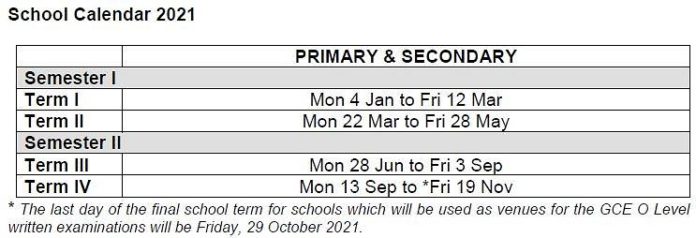
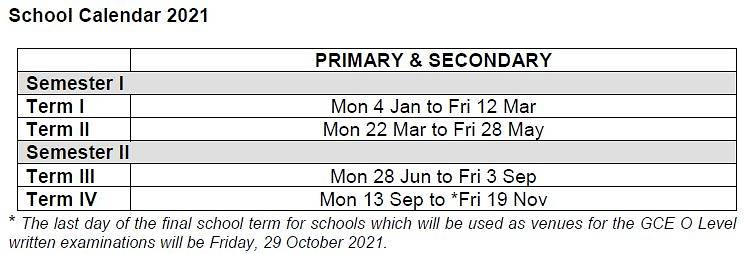
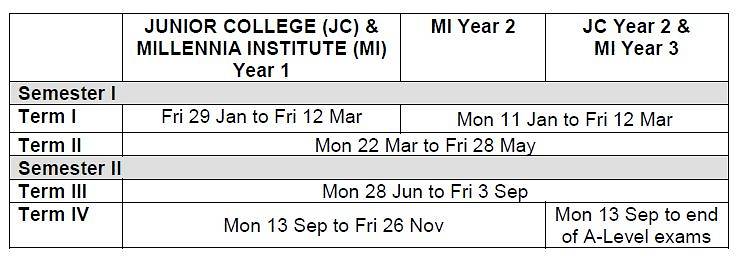
SINGAPORE: The 2021 school year for all primary and secondary schools will start on Monday, Jan 4, and end on Friday, Nov 19, the Ministry of Education (MOE) announced on Monday (Aug 17).
Students entering junior colleges and at the Millenia Institute will start on Friday, Jan 29, while the rest of the students will start earlier on Monday, Jan 11.
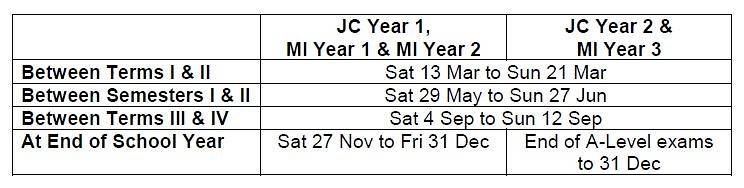
The school vacation periods are as follows:
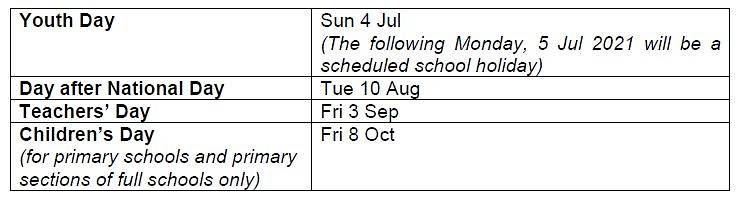
There will also be three scheduled school holidays in 2021:
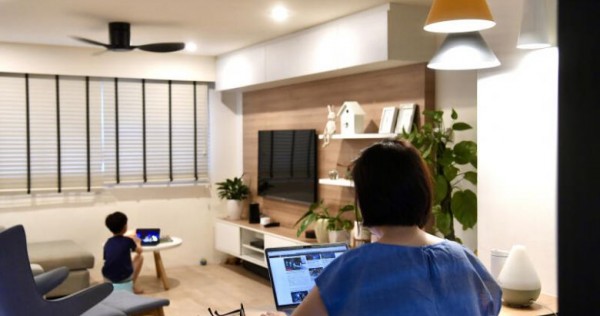
Singaporeans have learnt over time to better adjust to working from home, as new survey data shows that overall productivity among employees gradually increased from April to June.
According to a survey by employee engagement platform EngageRocket that had 20,000 respondents from 127 companies across various sectors, about 23 per cent said in June that they were more productive working from home than when they worked in the office before the coronavirus outbreak.
This number was up from the 15 per cent in April, when the circuit breaker period had just begun and employees were starting to work from home.
Mr Leong Chee Tung, co-founder and chief executive of EngageRocket, said: “Productivity levels increased between the start of the circuit breaker and phase two, reflecting the way leaders (of companies) are successfully responding to this crisis.”
She was four months pregnant with her third child when she found out she had stage three breast cancer.
It was in 2017 when the 26-year-old housewife, who wanted to be known only as Madam Nadiya, felt soreness in her breast and went to see a doctor, who recommended she go for a biopsy.
Three days after the biopsy, the doctor told her she had breast cancer.
Now 29, she told The New Paper: “I was actually quite calm (over the diagnosis) as I had done my research and also knew that my family had a history of cancer.”
Acting on medical advice, Madam Nadiya proceeded with a mastectomy to remove the affected breast.
Two weeks later, she gave birth prematurely at six months to a baby boy via a Caesarean section.
About two weeks after giving birth, she went for 16 chemotherapy sessions, which made her irritable and easily tired.
Madam Nadiya, who has three sons aged 12, five and three, is featured in a Breast Cancer Foundation (BCF) paper titled Take Charge Of Your Breast Health – Journeys Of Young Women With Breast Cancer In Singapore.
SINGAPORE: A fear of the uncontrollable spread of the COVID-19 virus compelled governments around the world to lock down cities and close national borders.
Ever–diminishing consumer demand led to a near collapse of industrial production and a complete shutdown of service industries. As the crisis triggered massive layoffs, unemployment reached double digits.
At the early signs of trouble, stock markets plummeted. Major indices such as S&P500, Japan’s Nikkei Index, and Singapore’s Straits Times Index started dropping on Feb 19 and lost approximately 30 per cent of their value in a month.
As the pandemic spread, most major economies faced unprecedented recessions. According to the OECD Economic Outlook, the world is headed for an almost 13 per cent decline in global gross domestic product (GDP) in the first half of 2020.
Closer to home, Singapore’s GDP fell by 41.2 per cent in the second quarter of 2020, while the government projected as much as a 7 per cent decline of annual GDP.
As the global situation looks extremely bleak, observers wonder if there is a silver lining.
CREATIVE DESTRUCTION
Austrian Economist Joseph Schumpeter argued that economic growth relies on daring entrepreneurs, evolving institutions and innovative technologies. Without daring entrepreneurship and innovation almost all businesses fail.
Moreover, major crises reveal true survivors – businesses resilient enough to weather the most challenging conditions. It is often in such extreme circumstances and the excessive volatilities, that we witness creative destruction.
Coronavirus-linked lockdowns and movement curbs have hammered the global economy. (Photo: AFP/Daniel CASTELLANO)
Creative destruction is based on the principle that the existing system needs to be challenged so that innovative products or services can replace the outdated ones.
Effectively, the existing equilibrium gets disrupted, market dynamic changes, and routine practices get transformed.
Typically, innovative solutions spring to life.
As innovative technologies replace existing technologies, the resources are more efficiently reallocated by the market, thus allowing economies to grow.
This economic progress is chaotic and often unpleasant and thus the moniker “creative destruction.”
Indeed, we witnessed creative destructions in action many times before.
DOTCOM BUBBLE
When the dotcom bubble burst 20 years ago, the Nasdaq index plummeted by almost 80 per cent. Moreover, a majority of dotcom companies quickly ran out of cash and went bankrupt. Unsurprisingly, doomsayers predicted the end of the internet era.
Even though the dotcom era witnessed a glut of bankrupt companies, massive layoffs, and a wipe-outs of market values, some of the capital was invested in a very high throughput backbone for the internet.
That initial infrastructure has enabled the development of companies that have changed the business models of modern era.
Moreover, the existing equilibrium got disrupted, market dynamic changed, and routine practices got transformed.
Finally, crisis revealed true survivors. Indeed, companies that had survived the dotcom bubble and had a spectacular growth include Amazon and Google – some of the largest companies in the world.
COVID–19 PANDEMIC
Similarly, the global COVID–19 pandemic triggered plunges in market indices, widespread bankruptcies, and worldwide recession.
Apple, Google and Amazon logos. (Photos: REUTERS/Mark Makela, Mike Blake,Carlo Allegri)
Yet, the destruction often creates space for innovative players and thus this COVID–19 crisis may provide the impetus to creative destruction.
The question becomes, “What will be destroyed and what will replace it?” Some industries such as airlines and tourism are very difficult to forecast. Yet, the theory of creative destruction implies a complete shake-up and major innovations in these industries.
It is easier to predict industries such as e-commerce.
Since the invention of the internet, the online sector has been consistently chipping away the market share from brick-and-mortar stores.
According to the US Commerce Department, online sales beat general merchandise stores for the first time in February last year.
According to eMarketer, US e-commerce sales are estimated at approximately US$700 billion in 2020 – 14.5 per cent of total US retail sales – compared to slightly above US$600 billion in 2019. The e-commerce share of total retail sales is estimated to reach 15.5 per cent in 2022.
Unsurprisingly, Amazon’s stock price soared by 66 per cent and eBay’s rose by 55 per cent since the beginning of the year.
Closer to home, the internet economy in six largest Southeast Asian markets with a population of 570 million surpassed US$100 billion last year, according to the 2019 e-Conomy Southeast Asia report.
While the internet economy in most countries was growing at 20 per cent to 30 per cent, Indonesia and Vietnam grew at over 40 per cent a year.
FILE PHOTO: The eBay logo is pictured on a phone screen in this photo illustration in New York, U.S., July 23, 2019. REUTERS/Brendan McDermid/Illustration/File Photo
By mobile internet usage, four Southeast Asian countries rank in the top 10 in the world. Driven by a high mobile internet penetration rate, young consumers, and an increase in disposable income,
Southeast Asia’s online sector is expected to hit US$300 billion by 2025, while e-commerce sector was projected to be worth US$150 billion by 2025.
The study reported US$600 billion in online payments last year, while gross transactions were projected to exceed US$1 trillion by 2025.
Indeed, online purchasing soared due to worldwide lockdowns and people’s inability to do the shopping in brick-and-mortar shops.
In fact, according to Accenture, the COVID-19 crisis caused a shift in Singapore consumers’ behaviour and thus spurred Singapore’s digital economy to earn additional US$500 million annually, while some businesses saw up to three times their normal growth.
The logo of e-commerce firm Shopee is seen on its regional headquarters in Singapore. (Photo: Shopee)
The COVID-19 pandemic will provide further impetus for the growth in digital payments. Bain & Company projected digital payments to account for 67 per cent of total transaction values in 2025 – up 10 percentage points from their pre-COVID-19 prediction.
The COVID–19 pandemic has caused loss of human lives and destroyed jobs, but there is a silver lining to the crisis.
The ensuing creative destruction will likely spur innovation, as innovative technologies will replace existing technologies and thus resources will be more efficiently reallocated by the market.
Emir Hrnjic is an adjunct assistant professor at National University of Singapore (NUS) Business School and a co-founder of Block’N’White Consulting. The opinions expressed are those of the writer and do not represent the views and opinions of NUS.
SINGAPORE: In May, Nicholas (not his real name), 27, received an email from the food and beverage (F&B) company where he was employed as a quality control officer. It was during the circuit breaker measures which saw many businesses stop operations, and he and his colleagues had gone on no-pay leave.
The email from the human resources department said the firm was closing down, and he was retrenched with immediate effect.
“The CEO did not even leave a word via WhatsApp,” said Nicholas. “Naturally, many outlet staff were quite upset, as they were already on no-pay leave, and were waiting for the circuit breaker to end so that they could resume working.”
As Nicholas had worked with the company for only one and a half years, he did not receive any benefits, which were granted only to those who had worked two years or longer.
Similarly, Daniel (not his real name), 26, lost his job earlier this year.
In mid-January, he had successfully completed a six-month probation period as an accounts manager at an online travel agency. But barely a few weeks later, in early February, he was called into his manager’s office.
“We all just thought (my manager) wanted to brief us on something important regarding work … none of us were suspecting anything at all,” said Daniel.
Instead, he was told that the company was “undergoing some restructuring”, and that he and several colleagues would be retrenched on the day itself. He would be paid during a one-month gardening leave, but no other benefits were offered.
“My mind just went blank and I could feel the tears almost coming out from my eyes,” he said.
Amid the current economic slump brought on by the COVID-19 pandemic, the experiences of workers like Daniel and Nicholas are not unique: Across different sectors, particularly those worst hit by the crisis, many workers are being let go abruptly and for some, in a seemingly insensitive manner.
Nevertheless, employers spoken to stressed that they had retrenched workers as a last resort, and had used unconventional methods due to the safe management measures in place.
An owner of an events company who had laid off five of his workers in early June said that he had to conduct the exercise over video-conferencing due to the restrictions under Phase One of the post-circuit breaker period.
“I was very transparent … I told them that our revenue dropped by 90 to 95 per cent.
“When I had to tell them we had to (let workers go), it was quite heartbreaking … some of the staff had been with us five, six years,” said the owner, who is in his 30s.
As COVID-19 continues to wreak havoc on economies around the world, including Singapore’s, unemployment and retrenchments on the island continued to rise in the second quarter of this year, especially in sectors hard-hit by the pandemic, such as aviation, hospitality, and F&B.
Retrenchments rose by 108 per cent to 6,700 between April and June, compared with 3,220 in the first three months of the year, according to advance estimates from the Ministry of Manpower (MOM) in July.
In his National Day Message on Aug 9, Prime Minister Lee Hsien Loong said that with business closures, retrenchments and unemployment will likely go up in the coming months.
Prime Minister Lee Hsien Loong delivering his National Day message. (Photo: MCI)
However, he added that the Government is actively helping people find new jobs and acquire new skills, and that “employers, too, must make every effort to keep their workers, and not drop them at the first sign of trouble”.
On Monday, Deputy Prime Minister Heng Swee Keat is slated to make a ministerial statement to provide details on how the Government will continue to support workers and businesses.
Writing on Facebook earlier this week, Mr Heng gave the assurance that the Government will continue to provide targeted support to sectors that are hardest hit, including helping them “pivot to new opportunities” in growth areas.
He added: “But we are not able to sustain the same level of support indefinitely. As more sectors re-open gradually, we will have to evolve and taper the support provided.”
The MOM’s advance estimates for the second quarter of this year showed that both manufacturing and services sectors registered a sharp increase in retrenchments.
While manufacturing saw an increase from 720 retrenchments in the first quarter to 1,600 in the second, services saw a corresponding increase from 2,360 to 4,600.
The services sector includes industries such as retail, F&B, hotels, transport services, and recreation.
While there was relatively little news of major retrenchment exercises in Singapore in the first few months of the pandemic, the end of the circuit breaker period saw several companies – mostly from the badly impacted services sector – making headlines with their layoff announcements.
In June, ride-sharing firm Grab and edutainment centre KidZania Singapore announced that they would be retrenching staff here.
In July, Resorts World Sentosa and professional networking site LinkedIn were reported to have axed staff. This was followed by firms in the aerospace sector such as Pratt & Whitney and its majority-owned unit Eagle Services Asia laying off hundreds of their staff.
While more layoffs could be expected, especially from the hard-hit industries, the number may be lower than what some experts had earlier expected.
Retrenchments rose by 108 per cent to 6,700 between April and June, compared with 3,220 in the first three months of the year, according to advance estimates from the Ministry of Manpower (MOM) in July. (Photo: Ili Nadhirah Mansor/TODAY)
DBS Bank senior economist Irvin Seah, who forecasted in April that there might be 45,600 retrenchments by the end of the year, said that the retrenchments figures are likely to be mitigated by the Government’s job support measures.
They include the Job Support Scheme (JSS), which has helped to subsidise wages, thus enabling companies to retain their workers despite challenging business conditions.
But Mr Seah said it is hard to come up with an exact figure now “as the entire crisis is still continuing”.
Agreeing, OCBC bank economist Selena Ling – who had also predicted four months ago that retrenchments this year could hit 65,000 – said that aside from support such as the JSS, there have also been other “soft” measures in place that could help reduce layoffs, though it would be difficult to estimate a figure.
“There has also been a lot of moral suasion (by the authorities) that if companies really do need to lay off (workers), they should protect the Singaporean core,” she said.
Mr Seah said that the JSS’ mitigating effects will be felt differently across different industries.
He said that the scheme had helped to save jobs in the F&B and retail sectors, which were the most badly hit during the circuit breaker period. These sectors had seen a modest recovery since June when the restrictions were lifted.
“(But) there are industries where the impact of the pandemic is longer lasting, such as the hospitality and aviation industries,” he said. “In those industries, the effectiveness of the JSS is limited by its duration.”
Under the JSS, which is scheduled to cease this month barring any extension, the Government will co-fund between 25 per cent and 75 per cent of the first S$4,600 of an employee’s gross monthly wages, with three main payouts in April, July and October.
“We should extend the JSS, but take a more targeted approach where the extension is only for certain industries that are worst hit,” Mr Seah said.
Ms Ling noted: “After August, the question is if the businesses foresee that the demand is not going to pick up significantly … Then you may get many who will throw in the towel.”
“I think (retrenchments) are likely to increase and whether we get a surge depends on whether policymakers extend or enhance some of the current policy support,” she said.
If the measures are extended, the retrenchment numbers for the year “may be a bit lower” than her initial prediction of 65,000, she added.
The Asian Financial Crisis in 1997 and 1998 saw around 30,000 retrenchments, while the Global Financial Crisis in 2008 and 2009 claimed around 40,000 jobs.
In the first two quarters of this year, there have already been almost 10,000 retrenchments.
Even as retrenchment figures rise, the official numbers may still not capture the full picture since they do not include firms with fewer than 25 employees or affected workers in the gig economy, economists said.
According to MOM’s Labour Force Reports, in 2016, there were 200,100 residents who were “own account” workers.
In 2019, this had grown to 211,000, making up 8.8 per cent of the country’s labour force. Among this group, more than 80 per cent did gigs or contract work as their primary job.
However, the pandemic has dealt a fresh blow to the gig economy, said the economists. Many gig workers such as freelance performers, artists, tour guides, and private-hire drivers, have seen a drastic drop in their incomes or job opportunities drying up.
The end of the circuit breaker period saw several companies – mostly from the badly impacted services sector – making headlines with their layoff announcements. (Photo: Ili Nadhirah Mansor/TODAY)
One private-hire driver, who identified himself only as Mr Ang, said that he had seen his income drop by 60 per cent from the pre-pandemic days.
He now earns about S$1,500 a month, working 12 hours daily. He is also relying on the Self-Employed Person Income Relief Scheme, where eligible self-employed workers will receive three quarterly cash payouts totalling S$9,000. He has also applied for financial support to pay for his daughter’s polytechnic fees.
“This is the only way I have in earning the little I can,” said the 56-year-old, who became a private-hire driver after he was retrenched from a manufacturing firm two years ago.
Maybank Kim Eng economist Chua Hak Bin noted that some gig economy workers, however, could still thrive during this time, such as those working in food delivery and those who can bring their expertise online, such as tuition teachers.
A DEEPER AND WIDER RECESSION
The expectation that retrenchments are likely to increase stems from the severe depth of the current recession, which is set to be longer than the ones which Singapore experienced during the Asian Financial Crisis and the Global Financial Crisis.
The Ministry of Trade and Industry (MTI) on Aug 11 said that the Singapore economy shrunk 13.2 per cent in the second quarter of the year compared with the same period last year, as the country enters its worst recession since independence.
From an initial projection that the GDP will shrink between 4 and 7 per cent, MTI downgraded its forecast to a contraction of between 5 and 7 per cent this year.
Mr Seah said: “We think that growth will only return back to positive levels from the second quarter of next year.”
He added: “Real GDP (gross domestic product) will only return to pre-COVID levels earliest by end of next year.”
This means the current economic crisis is expected to last 24 months, said Mr Seah. In comparison, the Asian Financial Crisis and the Global Financial Crisis both lasted about 18 to 19 months.
With such a long-drawn battle ahead, Dr Chua said the authorities may even have to think twice about saving some companies that may not see demand return in the next few years.
“Sectors that are hard hit such as airlines and hospitality and recreation may take three to four years to return to pre-pandemic levels.
“I don’t think it’s wise (for the authorities) to keep extending the lifelines, so we will see more companies cutting jobs,” he said.
The impact of the current recession will be deeper and wider than previous downturns, the economists reiterated.
The expectation that retrenchments are likely to increase stems from the severe depth of the current recession, which is set to be longer than the ones which Singapore experienced during the Asian Financial Crisis and the Global Financial Crisis. (Phoot: Ili Nadhirah Mansor/TODAY)
For one, the crisis has impacted all corners of the globe, not only pushing down demand, but also affecting global supply chains, with lockdowns and travel restrictions imposed by countries around the world.
“(COVID-19) really stress-tests your entire economy in terms of its self-sufficiency in critical components,” said Ms Ling. “When the (global) supply chains break down, even if you have the demand, you won’t have the supply.”
This is unlike the Global Financial Crisis, which started in the United States’ financial sector and whose ripple effects were felt in Singapore. It is also different from the severe acute respiratory syndrome (Sars) crisis in 2003, which was largely contained within Asia.
“For this pandemic, we are all at the heart of it,” said Dr Chua.
The severity of the crisis also means that sectors which are seeing a temporary rebound – after Singapore and other countries reopened their economies – are by no means immune to layoffs.
For instance, the recent increase in demand in retail, F&B and entertainment sectors may not last if the economy continues to dive further, and people begin to tighten their belts again.
“If employment prospects continue to deteriorate, then it will have a second-order impact on domestic consumption and henceforth segments such as the F&B and retail sector,” said Mr Seah.
He noted that any sector that depends on discretionary spending could see more retrenchments in the coming months. They include entertainment and recreational services, as well as industries dealing with big-ticket items such as cars and real estate.
“People will think twice about making such purchases,” he added.
While the overall outlook remains bleak, economists have identified several industries that would be safe amid the pandemic. These are the biomedical and pharmaceutical industries that have seen an increase in demand in healthcare supplies, the e-commerce industry which has benefitted from safe-distancing measures, and some segments of the tech industry, as more people take their businesses and everyday activities online.
However, other industries will need to grow and adapt to the uncertainties ahead rather than wait for government support, the economists cautioned.
“Ultimately … it is the survival of the fittest, and the fittest are the ones who are able to adapt and grow,” Mr Seah said.
THE PAIN OF LOSING ONE’S JOB
Apart from Daniel and Nicholas, we spoke to five others who have lost their jobs due to the pandemic. Most of them declined to be named.
One of them, a former Pratt & Whitney worker, said the pain of getting the axe is a familiar one, as he had been retrenched five years ago from an oil and gas company.
As one of the over 400 workers retrenched on Aug 3, he said that while he understands that it was due to the pandemic, the news was “still quite painful”.
The 49-year-old, who has three sons aged between 12 and 24, said he had his family foremost in mind when he received the news.
Responding to queries from TODAY, an MOM spokesperson reiterated that employers should do their part to ensure retrenchment is carried out “sensitively, and with dignity and compassion”. (Photo: Ili Nadhirah Mansor/TODAY)
“It’s every unemployed guy’s concern – putting food for the family on the table, but there’s nothing much we can do for now but just hope, keep looking and searching for employment,” he said.
He had been with the aerospace company for five years. Luckily, his wife works in an e-commerce firm which is an industry that is currently doing well, he said.
Nevertheless, he will be searching for jobs in the burgeoning pharmaceutical industry but may become a private-hire driver if he is unsuccessful.
Another former worker at Pratt & Whitney, who was a continuous improvement lead with the firm, said that the entire retrenchment process was done in a respectable manner and the retrenchment benefits were generous.
He said that the employees gathered at the lobby, where the general manager informed them of the company’s losses. They were then split into separate smaller groups, each led by one human resource staff, who briefed the employees on why they were retrenched and what support they would receive.
“When they briefed us, they were very sensitive about what was happening,” the 33-year-old said. “We got one month of payout for every year of service, and they even went down to two decimal points.”
Though he was retrenched on the day he was notified, he received one extra month of pay in lieu of notice, which meant that his retrenchment benefits totalled eight months’ pay, as he had been with the company for seven years.
He added that representatives from the Employment and Employability Institute (e2i) were present during the exercise to recommend alternative employment possibilities, and his manager also stayed up late to write a letter of recommendation.
NOT ALL RETRENCHMENTS WELL HANDLED
Unlike the former Pratt & Whitney employees, others who were interviewed felt that their companies could have done better with the retrenchment process.
A former project lead at a game development company, who wished to be known only as Mr Wong, said that he was notified of his retrenchment at the end of May, just four days before the exercise.
The 37-year-old received the news over a chat service that his company used as a communication channel as he was working from home. He said that he did not get any benefits although he had worked at the company for nine and a half years.
“More than four days’ actual notice would’ve helped, although I don’t know the full story behind this so I can’t judge,” said Mr Wong.
For Nicholas, who was retrenched from his F&B company over email, he said that the company did not lay off workers in this manner before the pandemic.
“There was a proper notification of retrenchment and an off-boarding process. However, due to COVID-19, everyone was either working from home or on no-pay leave,” he said.
“What could have been done was to send emails and WhatsApp messages to everyone, especially the outlet staff, who did not have company email addresses.”
On the part of the employers, they said the retrenchment process has become less personal due to the COVID-19 restrictions, coupled with the growing number of retrenchment exercises which they have had to carry out.
An employer who oversees the retrenchment process at a multinational electronics firm said that human resource staff members will read out the bad news to employees via video conference while they are working from home.
From there, the employees will have a few hours to pack up any company equipment they have with them, and a courier service will be hired to pick these up from their homes.
“In the past, the retrenched employee will get to go to the office, and someone will be there to talk to them face to face … Normally the manager will propose new openings to them,” he said.
“But in this situation, no, because everyone is running out of opportunities.”
POST-CIRCUIT BREAKER, RETRENCHED WORKERS SHOULD BE INFORMED IN-PERSON: MOM
Responding to queries, an MOM spokesperson reiterated that employers should do their part to ensure retrenchment is carried out “sensitively, and with dignity and compassion”.
“This includes the manner in which affected employees are notified and the type of support they receive thereafter,” the spokesperson said.
While the employer may contractually terminate an employee with salary-in-lieu of notice, employers are encouraged to give more notice to employees during retrenchments.
There should also be few instances where employers would need to engage security officers to escort an employee out of the work premises. “Such practices are insensitive and unwarranted,” said the spokesperson.
While the news of retrenchment had to be delivered remotely to employees during the circuit breaker, the spokesperson said that after the circuit breaker, “such news should be delivered in person, with appropriate safe distancing measures in place”.
Employers should also help affected employees look for alternative jobs. They can tap resources provided by agencies such as Workforce Singapore and e2i.
Even as retrenchment figures rise, the official numbers may still not capture the full picture since they do not include firms with fewer than 25 employees or affected workers in the gig economy, economists told TODAY. (Photo: Ili Nadhirah Mansor/TODAY)
The MOM spokesperson reiterated that employers should adhere to the Tripartite Advisory on Managing Excess Manpower and Responsible Retrenchment, which had been updated in March to provide clearer guidance on cost-saving measures and to encourage the training and upskilling of employees.
“It is imperative that employers act responsibly when taking actions that would affect an employee’s livelihood,” the spokesperson said.
“Employers who are assessed to be irresponsible or unfair in their employment practices, whether in cost-saving measures or conduct of retrenchment, may be denied future Government support or have their work pass privileges suspended.”
Singapore National Employers Federation executive director Sim Gim Guan stressed that regardless of the limitations brought about by COVID-19, retrenchments should still be the last resort.
Urging employers to conduct retrenchment exercises in a “responsible and sensitive manner”, Mr Sim said that for instance, employers should explain to affected employees the business situation faced by the company. They should also outline how the retrenchment exercise will be carried out, and specify the assistance being offered to those affected.
“(Employers) should consider its impact on both employees who are being retrenched, and those who will remain,” said Mr Sim. “This is important to manage staff morale and retain other employees.”
SUPPORT FROM UNIONS
In response to queries, National Trades Union Congress (NTUC) deputy secretary-general Cham Hui Fong pointed out that while union members in non-unionised companies can also seek help from NTUC, the advantages of being in a unionised company are “more significant”.
“The union is recognised and empowered to represent workers on employment and workplace issues, to negotiate with the companies on all industrial matters including retrenchment and retrenchment benefits,” she said.
Leaders of the unions representing workers in badly affected sectors said their unions are working with the unionised companies to minimise retrenchments and their impact on employees.
Singapore Industrial and Services Employees Union (SISEU) president Sazali Zainal said that his union will be working with unionised aerospace firms “to take necessary actions to reduce costs and save jobs, while keeping a longer-term view in terms of manpower needs”.
Mr Tan Hock Soon, general secretary of the Food, Drinks & Allied Workers Union (FDAWU), said that it is “staying closely in touch with our unionised companies to explore other cost-cutting measures before resorting to retrenchments which should only be considered as the last resort”.
For the manufacturing sector, Mr Melvin Yong, the executive secretary of the United Workers of Electronics and Electrical Industries (UWEEI), said that the union has been “working with our management partners to support companies in their hiring and training needs”.
“Additionally, for union members whose income may have dropped, for example due to a reduction in overtime earnings, UWEEI is also reaching out to assist them through the NTUC Care Fund (COVID-19), which provides eligible members cash relief of up to S$300,” said Mr Yong, who is also a Member of Parliament for Radin Mas.
Ms Cham said that should layoffs be inevitable, the unions will ensure that the selection criteria for retrenchment is fair, and they will work with companies to go through the list of retrenched workers to safeguard the Singaporean core.
The unions will also work with e2i and NTUC’s Job Security Council to plan for job placements for the retrenched workers, she added.
“While we hope to be able to resolve issues at the company and union level, we are prepared to take actions against the companies if the need arises,” Ms Cham added.
This could come in the form of industrial action, or to escalate the matter to MOM or the Industrial Arbitration Court.
Almost all the retrenched workers interviewed have yet to find full-time employment, with some working part-time to get by.
After being retrenched from a corporate role at a hotel in June, Alyssa (not her real name) has been applying “aggressively” for jobs.
The 29-year-old has gone for 10 interviews so far but has yet to be offered a job. She has applied for roles in the technology and healthcare sectors, but feels like she is “just applying for jobs which I think I am qualified to do, with no real sense of direction”.
She is currently working part-time in sales planning at a small local trading company earning S$120 a week – some 90 per cent lower than what she was earning from her previous job.
“I don’t think S$120 a week is enough to get by, (but) I have savings to fall back on,” she said.
Daniel, who was retrenched from the online travel agency, has also been working part time at security firm Certis since February, where he helps to call persons under quarantine to check on their details.
He clocks in four 12-hour days a week, fetching about 80 to 90 per cent of his previous salary.
However, he knows that the role is not permanent and is looking for full-time employment.
“As long as it’s something that I think I can do and have the experience they are looking for, I just apply,” he said.
While most of the retrenched workers interviewed started looking for jobs only after they received the pink slip, Frederick (not his real name), a senior technician from the aerospace industry, said that he began looking for alternative employment as early as March, before he was eventually retrenched in July.
Seeing the writing on the wall for his industry, he applied for various companies outside of the aerospace sector, such as in the biomedical and semiconductor fields.
In July, the 34-year-old secured a job at a local infocomm technology firm as an associate engineer, matching his previous salary.
“One of the reasons I looked for a job so early is because I don’t want to place my bets on finding a job while living on the money from the retrenchment package,” said Frederick, who has a two-year-old son.
LOOKING FOR A FRESH START? HERE’S SOME HELP:
For workers who have been retrenched, there are several government grants and initiatives to help tide them over this period and find jobs.
Grants and funds
Under the COVID-19 Support Grant, those who have experienced involuntary job loss or involuntary no-pay leave for at least three consecutive months can receive a cash grant of up to S$800 for up to three months.
There is also the Courage Fund that lower-income households with a gross monthly income of less than or equal to S$6,200, or gross monthly per capita income of less than S$2,000, can tap on. This grants them a one-time lump sum of up to S$1,000.
These are targeted at professionals, managers, executives and technicians (PMETs), to undergo skills conversion to move to occupations or sectors that have good prospects and opportunities for progression.
There are two modes available for retrenched workers:
— Place-and train, where PMETs are hired by a participating employer before undergoing training to take on a new job role.
— Attach-and-train, where PMETs are provided with training and work attachments prior to job placement through industry partners in growth sectors.
Helps workers build up industry-relevant experiences through traineeships so that they can work towards permanent jobs. Mid-career jobseekers can apply for more than 13,000 company attachments.
Attachments under this programme will be between four and nine months, with participants receiving a monthly training allowance of between S$1,400 and S$3,000, of which 80 per cent will be funded by the Government.
SINGAPORE: The Google Pixel 4A has finally arrived, adding another strong entry to a crowded mid-range smartphone market.
Mid-range smartphones have been the stars of COVID-19 pandemic, experiencing a 178 per cent boost in searches during this period – especially the iPhone SE and Oppo 3.
This is unsurprising as consumers have been more sensitive to prices.
Over the past months, countries all over the world have witnessed a weaker labour market, with more losing jobs, receiving pay cuts or seeing slower growth if at all in disposable incomes. There has also been a general decline in consumer confidence.
These trends have impacted smartphones. We’re stretching the lifespan of our current models or opting for cheaper alternatives even when we replace them.
According to tech research firm Counterpoint Research, the global mobile market plunged 15.5 per cent in the first quarter of 2020, in what was the industry’s biggest year-on-year quarterly fall.
THAT GOLDEN AGE OF SMARTPHONE INNOVATION
The golden age in smartphone development is over. Once progressing at the same breakneck pace as its sales, smartphone innovation has reached a plateau with an overall slowdown in innovation across most aspects of performance and design.
Just six years ago, if you bought a new iPhone 6S versus an entry-level smartphone, you were buying a markedly different machine compared to an entry-level smartphone. The iPhone was jam-packed with features like 3D Touch, the most outstanding camera at that time, an improved touch ID, a faster processor, and a super sleek design.
But today, if you compare the latest premium phone with a “good-enough” alternative, that expected improvement in performance is much harder to spot.
Google Pixel 4a (Photo: Joyee Koo)
Thanks to e-commerce platforms and price-comparison sites, we have all this information at our finger tips and can make a considered decision even after being wowed by seeing the latest iPhone at an Apple store.
Perhaps there’s also fewer of us to market to. After all, mobile penetration has reached over 154 per cent in Singapore according to the Department of Statistics, meaning a lot of us have two to three phones each.
Still, that number is likely to inch upwards. With greater need for remote communication, video-conferencing and the surge ahead of the gig economy, many Singaporean who didn’t use to have a smartphone will finally take the plunge. This segment tends to start with an entry model too.
LOYALTY MAKES SMARTPHONE PURCHASES STICKY
While iPhones have been the mainstay for most smartphone users over the past decade, the iPhone retention rate has come down by 15.2 percent compared with 2018. According to a survey by PC Magazine in 2018, users have moved from iOS to Android mainly because of better pricing.
The average selling price for iPhones is US$760 (S$1,043) in 2020. Even the cheapest model, the iPhone SE, costs US$474. In comparison, an average Android device only costs about half of that, with an average selling price estimated to be at US$258 in 2019.
In contrast, a Google Pixel 4A costs US$364, one third cheaper than its Apple equivalent.
But would people really switch to a Google phone? For customers of limited means looking at a downgrade, there are plenty of other players having a much stronger mindshare, like the Samsung Galaxy A51 or Mi Note 10.
The fact is when it comes to brand loyalty, Apple and Samsung are in a league of their own.
A woman tries out a Samsung Electronic’s Galaxy A50 at a Samsung store in Seoul, South Korea, November 14, 2019. November 14, 2019. REUTERS/Kim Hong-Ji/Files
Apple remains the market leader in Singapore with a market share of approximately 33.6 per cent, a 4 percentage points decrease from last year. Four out of five best-selling models in the premium segment were From Apple.
But coming second and third are strong competitors Samsung and Huawei going after all price segments.
Years of hard work and billions of marketing dollars have paid off for them.
With a combined customer loyalty rate of 69 per cent, Apple and Samsung command more than twice the consumer allegiance attained by other players, according to a multinational survey by IHS Markit.
With this competitive bulwark built by Apple and Samsung, Google has long struggled to get consumers to notice its Pixel phone.
Google suffers from intense competition and had to battle over a few percentage points of market share. It’s not a recognised smartphone manufacturer in the way Apple and Samsung are.
In this context, the Pixel 4a clearly target consumers who are not committed to their phone brands.
HOW GOOGLE COMPARES TO OTHER BRANDS
However, even for those who don’t’ need the bells and whistles but just a good-enough phone at affordable price, it’s also hard to make a case for Pixel 4A unless you compare it with other lesser known brands.
FILE PHOTO: People experience Apple’s iPhone XS and iPhone XS Max during a media tour at an Apple office in Shanghai, China September 21, 2018. REUTERS/Aly Song/File Photo
Still, with the bigger Chinese manufactures like Shenzhen-based OnePlus coming in with flagship smartphone features at a mid-range price, the Pixel 4A doesn’t really match up on specifications.
For instance, the OnePlus Nord looks and behaves almost like any of the Chinese brands’ flagship models, but sells for less than half the price.
With the typical specs you’d expect from an average Android phone, Pixel 4A may not provide the best price–performance ratio in the eyes of many.
One factor that has played to Google’s interest, however, is the stewing US-China trade war. The restrictions placed on Huawei’s access to the Android operating system have casted a long shadow over its latest launches in the international market.
Though there have been discussions about simple workarounds, inevitable user complexities and security concerns make a quick-fix elusive.
As mainstream users outside China are still not yet ready for a Chinese phone, this could be a window of opportunities for competing brands like Samsung and Google.
The 5G era is coming, which is a significant milestone that could help convince many consumers to finally upgrade their smartphones.
Google has announced that there will be a Pixel 4A (5G) modestly priced at about US$499 “in the coming months”, which could be worth the wait.
Chong Guan is Associate Professor and Deputy Director at the Office of Graduate Studies, Singapore University of Social Sciences.
SINGAPORE: As part of their breathing apparatus proficiency test, Singapore Civil Defence Force (SCDF) officer cadets must wear 22kg of bunker gear and climb an “endless ladder” for a certain distance within three minutes.
More than a minute on that vertical treadmill and the cadets start breathing heavily through their bulky oxygen masks. The audible gasps quicken as a distance and time counter at the top of the machine ticks on. An instructor standing behind looks out for cadets who could be overexerting.
A cadet who passes out might eventually be given extended medical leave, affecting his training schedule and output. But the SCDF is looking to change this by introducing a smart watch that can measure a cadet’s heart rate, improving training safety and efficiency.
With the smart watch, instructors monitor cadets’ heart rate using a tablet on top of the usual visual cues, allowing them to intervene quicker when they see signs of overexertion. These cadets can then be sent for rehabilitation earlier, reducing any potential downtime.
An instructor will monitor officers’ heart rate as they do strenuous exercises. (Photo: Jeremy Long)
“What we envision to achieve is to reduce the occurrence and severity of training-related injuries and get them into the optimal training zones,” said Major (Maj) Hasan Kuddoos, acting head of the responder performance centre at SCDF’s Civil Defence Academy, at a media event on Wednesday (Aug 12).
In operational settings, the smart watch can automatically assign officers to different incidents based on their proficiencies, and provide a summary of the incident on their way there. At the scene, the watch sends officers’ locations to a digital map in real time. Those who get into a spot of trouble can use the watch to send “man-down” alerts.
The purpose-built smart watch was in July rolled out to about 50 cadets in the 22nd rota commander course. In 2021, the SCDF will distribute 700 smart watches for all trainees and pilot it for frontline operations at a new smart fire station in Punggol.
The SCDF expects all emergency responders, including firefighters, paramedics and hazardous material specialists, to be equipped with a smart watch by 2022.
In the bigger picture, the SCDF aims to use the smart watch to collect officers’ physiological data, like maximum heart rates, to determine the optimal training intensity and tweak standards for different exercises and tests.
The Home Team Science and Technology Agency (HTX) is conducting a long-term study to assess an SCDF officer’s training load based on the collected data. The data could also help design progressive training with personal targets.
“Everybody can challenge themselves,” Maj Hasan added. “The fit become fitter, and the fitter become fittest. And not formulating just one standard exercise regime for everyone.”
Beyond measuring heart rate, the smart watch can broadcast voice and text messages to disseminate instructions, and use GPS technology to show cadets’ location. The latter helps during outdoor exercises with obstructed views.
Trainee can get instructions through the smart watch. (Photo: Jeremy Long)
During real-life operations, commanders at the scene of a fire, for instance, can instantly know which officers are in the burning building, check their vital signs and see where they are. This was previously done through manual counting and over the radio.
The watch’s “man-down” function enables personnel to send a distress call to nearby colleagues with the hit of a button. This is useful when an officer feels giddy and is about to collapse.
Mr Ying Meng Fai, acting director of human factors and simulation centre of expertise at HTX, said the smart watch reduces the mental workload on commanders and allows them to focus on more pressing tasks.
“You don’t need to keep on tracking the person. It will all be factored into the system,” he said.
Moving forward, the SCDF hopes to improve the watch so it can record more types of physiological data, like blood oxygen, hydration and sleeping patterns. Right now, officer cadets take off the watches and charge them while sleeping.
“(More data) will give us a better prediction of the fitness and recovery profile of each individual,” Maj Hasan said.
The “man-down” function could be improved by tying it with a motion sensor in the watch, he added. This would trigger automatic alerts when an officer does not move for five to 10 seconds.
SCDF officer cadet trainee Shin Won Tae, part of the pioneer batch to receive the watch, said he now knows when to push harder and ease off during strenuous exercises, like the individual physical proficiency test, to achieve better results.
“I think training is done more effectively so that everybody can last throughout the whole course, instead of having unnecessary (drop-out) cases,” the 27-year-old said.
SMART FIRE STATION
The smart watch will play a key role at the SCDF’s first smart fire station in Punggol, slated to be ready in 2021. The watch will be hooked up to an SCDF database containing officers’ skills and biometrics.
This means personnel can use the watch to register attendance and calculate meal allowance, as well as access certain locations at the station without a key or card.
The watch also has the ability to assign an officer to a specific incident based on his or her proficiencies. Officers will get a message telling them where to go.
SCDF officer cadets putting on bunking gear before a test. (Photo: Jeremy Long)
On the way there, they will get a summary of the incident. This allows officers to plan early and mentally ready themselves for what is to come.
The fire station will also have smart glasses that paramedics can put on when attending to medical emergencies. The glasses will send real-time footage to doctors in hospitals who can advise them on managing the incident. The glasses are still at the prototype stage.
NEW PERFORMANCE LAB
Also in the pipeline is a new performance lab at the Civil Defence Academy on Jalan Bahar to improve first responders’ performance and capabilities.
The Emergency Responders’ Fitness Conditioning and Enhancement Lab, co-developed with HTX, is expected to be commissioned in 2021. The three-storey building will contain a simulator, environmental chamber as well as cognitive and fitness facilities.
The lab will become a central point for collection and analysis of physiological data, simulating conditions during real-world operations, and rehabilitation or corrective training.
For instance, the lab has a 360-degree virtual simulation dome with moving treadmills for strength conditioning, motion acclimatisation and rehabilitation.
The breathing apparatus proficiency test will be moved a new performance lab. (Photo: Jeremy Long)
“We can use it with our full PPE (personal protective equipment) to see how officers walk, how we can correct it and maybe compare different PPEs,” Maj Hasan said.
An environmental chamber can simulate training in different temperatures and humidity, crucial for officers who will be deployed in search and rescue missions abroad.
The breathing apparatus proficiency test will eventually be moved to the chamber so it can be conducted in a setting that replicates the local climate.
“The results that we get here don’t only stay at the training institution, it will be brought up into operational responses that we will be deploying in the future phases,” Maj Hasan added.
With a huge amount of data expected to be collected and stored, SCDF said it has implemented “strict controls and protocols” on the use of the smart watches to safeguard the use, collection and storage of the recorded data.
These measures adhere to data security standards adopted by Government agencies, it added, noting that the data will be encrypted for added security.
“For example, only authorised personnel will be allowed to handle the collection, storage and use of the data,” it stated.
“Any officer who misuses the smart watches or the data collected will be dealt with severely.”
SCDF deputy commissioner of future technology and public safety Teong How Hwa said leveraging smart technology is a “key thrust” of its transformation plan.
The initiatives will enable the force to “optimise our personnel’s performance and safety, to deliver our mission of protecting and saving lives and property more effectively in this digital age”, he said.
SINGAPORE: Several new locations including Newton Food Centre and three malls were added to a list of public places visited by COVID-19 cases in the community during their infectious period, the Ministry of Health (MOH) said on Sunday (Aug 16).
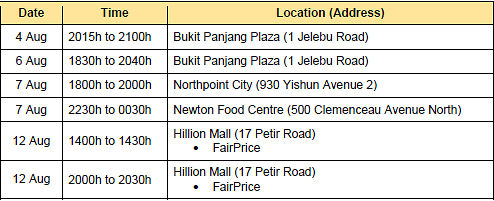
Newton Food Centre was visited between 10.30pm Aug 7 and 12.30am the next day, according to MOH.
Bukit Panjang Plaza, Northpoint City and Hillion Mall were also added to the list.
Bukit Panjang Plaza was visited on two occasions on Aug 4 and Aug 6, while the FairPrice outlet at Hillion Mall was also visited twice on Aug 12.
People who were identified as close contacts of confirmed cases would already have been notified by the ministry. As a precautionary measure, people who were at these locations during the specified timings should monitor their health closely for 14 days from their date of visit, MOH said.
“They should see a doctor promptly if they develop symptoms of acute respiratory infection (such as cough, sore throat and runny nose), as well as fever and loss of taste or smell, and inform the doctor of their exposure history,” said MOH.
“There is no need to avoid places where confirmed cases of COVID-19 have been.”
The National Environment Agency will engage the management of affected premises to provide guidance on cleaning and disinfection.
Singapore on Sunday reported 86 new cases of COVID-19, among them two community infections.
One community case, a 47-year-old Malaysian national, is a technician who on Aug 9 boarded a vessel linked to multiple COVID-19 infections to carry out essential repair and maintenance work.
The man was placed on quarantine when some crew members were confirmed to have COVID-19, and swabbed even though he is asymptomatic.
Another community case is a 48-year-old Singaporean who is linked to a previously confirmed case.
There were also six new imported cases who had travelled from India, Indonesia, the Philippines and Russia.
SINGAPORE: Eight people have been arrested on suspicion of fraudulently registering prepaid SIM cards, which may be used by criminals for anonymous communications on illicit activities, the Singapore Police Force (SPF) said in news release on Sunday (Aug 16).
Seven men and one woman aged between 19 and 55 were arrested after the police conducted simultaneous raids on 16 mobile phone shops in Ang Mo Kio, Changi, City Hall, Little India, Orchard, Ubi and Woodlands on Sunday.
The eight people were arrested for their “suspected involvement in fraudulently registering prepaid SIM cards using the particulars of unsuspecting customers or foreigners who have not entered Singapore”, said the police.
Another 13 people – nine men and four women aged between 24 and 60 – are assisting with investigations.
21 people are under investigation for fraudulently registering prepaid SIM cards after a police operation on Aug 16, 2020. (Photo: SPF)
Investigations showed that the mobile phone retailers had abused the computer systems holding registration information for prepaid SIM cards.
“They would then pre-register SIM cards using particulars of others and sell them to customers who wish to remain anonymous,” SPF said.
Criminals exploit such fraudulently registered prepaid SIM cards as an anonymous channel of communications for unlicensed moneylending, scams and vice, among other illicit activities, said the police.
“For example, scam syndicates have been found to perpetuate their criminal activities by using such prepaid SIM cards to contact victims and amongst themselves to evade possible detection,” SPF added.
21 people are under investigation for fraudulently registering prepaid SIM cards after a police operation on Aug 16, 2020. (Photo: SPF)
Items seized during the operation included computer terminal devices, desktops, laptops, printers, mobile phones, invoices, photocopied passports, SIM cards and relevant documents, the police said.
Investigations are ongoing. If found guilty of unauthorised modification of computer material, those arrested could be fined up to S$10,000, jailed for up to three years, or both.
“The police will spare no effort to clamp down on such errant handphone shop dealers who may be indirectly facilitating illegal activities,” said SPF.
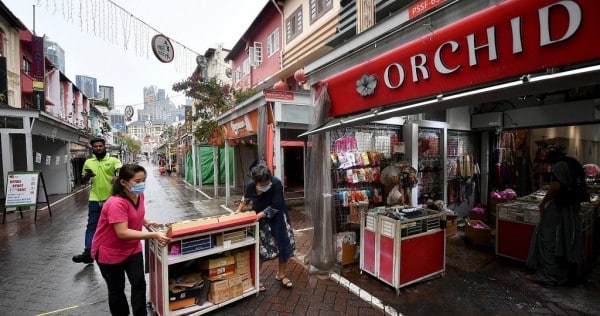
More than 20 tourist souvenir shops in Singapore, several of which have been in operation for decades, have closed for good – casualties of Covid-19 travel restrictions here and around the world.
With no end to the pandemic in sight, other shops are seeing this as their inevitable end as well in the months to come, The Sunday Times has found.
On bad days, some gift stores in popular tourist spots such as Chinatown and Bugis Street do not see even a single customer.
Mr Joe Chen, founder of the Singapore Souvenir Centre, one of the bigger players with 10 outlets under different brands, said there could well be a situation where tourism speciality shops all but disappear when travel eventually resumes.
“It would be a pity. After all, we too help to market Singapore to tourists,” noted Mr Chen, 29, who believes that 90 per cent of souvenir shops will fold within the next six months if more help does not come in soon.
The pandemic has decimated the tourism industry, with air travel crippled by border closures.