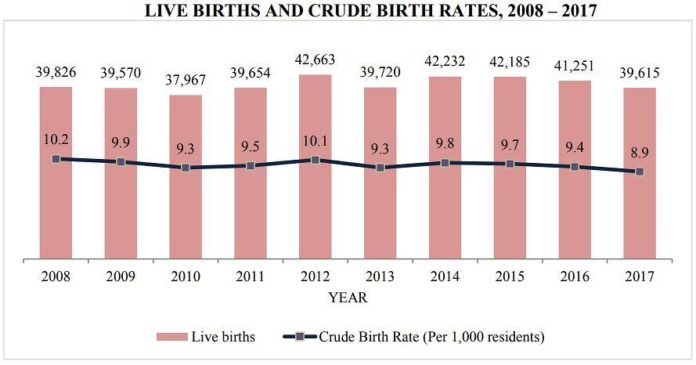
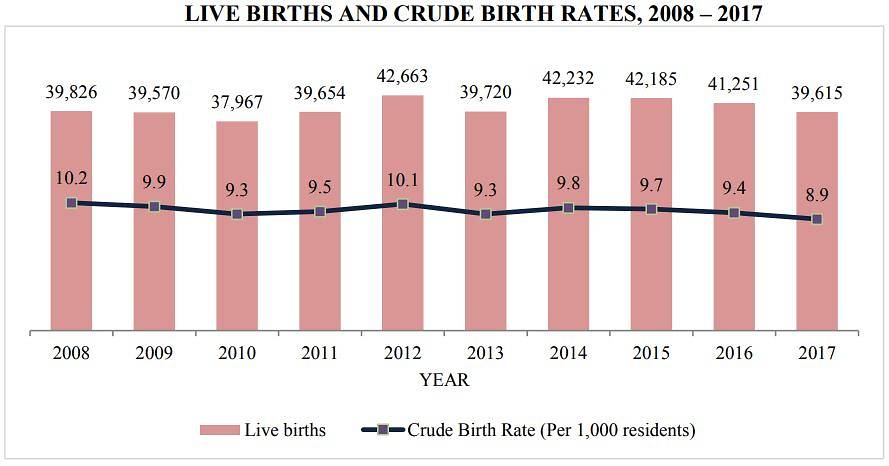
SINGAPORE: The number of births in Singapore fell to 39,615 in 2017 – a 4 per cent decrease from the previous year when 41,251 births were recorded, according to statistics released by the Immigration and Checkpoints Authority (ICA) in June.
Data from the Department of Statistics also showed that this was the lowest number of births since 2010 when 37,967 births were recorded.
Within this eight-year period, the highest number of births was recorded in 2012, the year of the dragon, with 42,663 births.
Birth and death numbers in Singapore since 2008. (Source: ICA)
While there was a fall in the number of births, there were more deaths recorded in 2017.
According to ICA, there were 20,905 deaths last year. This is 4.4 per cent more than what was recorded in 2016.
The majority of the deaths were recorded in hospitals and 17,192 deceased persons in 2017 were aged 60 or older.
ICA added that the two most common causes of death in Singapore were malignant neoplasms or cancerous tumours, and heart and hypertensive diseases.
These diseases accounted for 52.8 per cent, or more than half, of the recorded deaths in Singapore last year.
SINGAPORE: What if a collision at sea spills 500 tonnes of benzene into the waters off Singapore?
A chemical spill on such a scale in the East Johor Strait is one of the scenarios Singapore and Malaysia authorities were preparing for in a joint exercise conducted on Thursday (Jul 12).
Vapour suppression being carried out by a Marine Department of Malaysia vessel. (Photo: Vanessa Lim)
Seven vessels and 50 officers from Maritime and Port Authority of Singapore (MPA) and the National Environment Agency (NEA) were deployed to support the exercise. They were joined by the Marine Department of Malaysia (MDM).
During the simulation, officers had to react quickly after a chemical tanker and a product tanker collided off Pulau Ubin, spilling about 500 tonnes of benzene, a colourless and highly flammable liquid, into the sea.
The exercise also simulated how authorities would respond if residents and farmers nearby were affected by a gasoline-like odour due to the spill, said authorities in a joint news release on Thursday.
Benzene is carcinogenic and inhaling it in large quantities may cause dizziness, headaches and eye, skin and respiratory tract irritation, the release said.
Under the joint emergency response plan, the MPA will work with MDM, their Malaysian counterpart, to monitor and coordinate the clean-up at sea.
A joint chemical spill exercise was conducted by Singapore and Malaysia authorities to test their joint emergency response plan. (Photo: Vanessa Lim)
NEA is to work with the Johor Department of Environment to monitor the air and water quality and coordinate clean-up efforts at affected shore areas.
During the exercise, the two sides demonstrated clean-up operations, vapour suppression activities as well as environmental monitoring.
Singapore Civil Defence Force (SCDF) officers also evacuated “injured” crew members from the chemical tanker. This was followed by a decontamination procedure on board the SCDF firefighting vessel.
“As chemical or oil spills are transboundary in nature, it is important that we conduct regular bilateral exercises with our immediate neighbours to strengthen regional and multi-agency response capabilities,” said MPA’s chief executive Andrew Tan.
Launched in 2014, the biennial exercise is part of the bilateral cooperation programme under the Malaysia-Singapore Joint Committee on the Environment.
Speaking to reporters during a joint press conference with South Korean President Moon Jae-in, Prime Minister Lee Hsien Loong also said he appreciates South Korean President Moon Jae-in’s personal efforts to encourage dialogue with the North.
South Korea’s President Moon Jae-in and Prime Minister Lee Hsien Loong. (Photo: TODAY / Jason Quah)
(Updated: )
Bookmark
SINGAPORE: Singapore believes that “constructive dialogue” is necessary to achieve peace and stability in the Korean Peninsula, Prime Minister Lee Hsien Loong said on Thursday (Jul 12), on the sidelines of South Korean President Moon Jae-in’s state visit to Singapore.
Speaking to reporters at a joint press conference, Mr Lee said that Singapore is happy to have hosted the recent summit between North Korea and the United States, and wished South Korea and all other parties involved success.
“It is a long road ahead, with many more challenges to come,” he said. “But I hope the Singapore meeting has set things moving in the right direction.”
Mr Lee noted that he appreciates the South Korean government’s initiatives, including Mr Moon’s personal efforts in encouraging dialogue with the North.
He added that Singapore will continue to work with South Korea and the international community to achieve lasting peace and stability and the complete denuclearisation of the Korean Peninsula.
SINGAPORE HAS STRONG, EXPANDING ECONOMIC TIES WITH SOUTH KOREA
Mr Lee added that Singapore’s economic ties with South Korea are “strong and expanding”, with overall trade reaching S$45 billion in 2017.
He said both parties discussed ways to step up economic cooperation, and expressed the hope that progress could be made on existing areas of cooperation like trade. For example, he hoped that the next implementation review of the Korea-Singapore Free Trade Agreement (KSFTA) can be held soon.
“It will show the international community that our countries are committed to free and open trade,” he said.
During the visit, Mr Lee and Mr Moon also witnessed the signing of six Memoranda of Understanding covering the environment, free trade, smart grids, the fourth industrial revolution, small and medium enterprises, and investments.
“These agreements build upon our existing cooperation and trade mechanisms, but also our complementary strengths,” he said.
“We also welcome Korean companies to take advantage of Singapore to expand into the ASEAN region.”
Mr Lee added that both leaders discussed South Korea’s relations with ASEAN, and said he was glad that South Korea is increasing its engagement with the region.
Possibilities for growing relations between ASEAN and South Korea could include upgrading the ASEAN-ROK (Republic of Korea) Free Trade Area and concluding an ASEAN-Korea Air Services agreement, he said.
Mr Moon’s visit to Singapore is his first as president, and the first state visit by a South Korea president to Singapore in 15 years.
He was given an official welcome by President Halimah Yacob at the Istana on Thursday morning and will be attending a state banquet in his honour.
SINGAPORE: South Korean President Moon Jae-in received an official welcome by President Halimah Yacob at the Istana as he began his state visit to Singapore on Thursday (Jul 12).
Mr Moon, who was welcomed by a guard of honour, also had an audience with Mdm Halimah and met Prime Minister Lee Hsien Loong.
He will also be hosted to a lunch.
South Korean President Moon Jae-In at the Istana on Thursday (Jul 12). (Photo: Jeremy Long)
Mr Moon is in Singapore on a three-day state visit until Friday, according to a Ministry of Foreign Affairs (MFA) press statement.
He is here at the invitation of Mdm Halimah.
During the visit, Mr Moon and Mr Lee will witness the exchange of several Memoranda of Understanding to boost cooperation in the areas of trade, environment, small and medium enterprises and start-ups.
President Halimah Yacob hosted South Korean President Moon Jae-In at the Istana on Thursday (Jul 12). (Photo: Jeremy Long)
Mdm Halimah will also host a state banquet in honour of Mr Moon.
On Friday, Mr Moon will deliver the 42nd Singapore Lecture titled, “ROK and ASEAN: Partners for Achieving Peace and Co-prosperity in East Asia”.
It will be moderated by Deputy Prime Minister and Coordinating Minister for National Security Teo Chee Hean, MFA said.
Earlier this month, South Korea’s Blue House reported that Mr Moon will give a speech on his vision and policies for permanent peace on the Korean Peninsula as well as cooperation with Asian countries in the region.
Mr Moon’s trip comes on the back of the historic meeting last month between North Korean leader Kim Jong Un and US President Donald Trump which Singapore hosted.
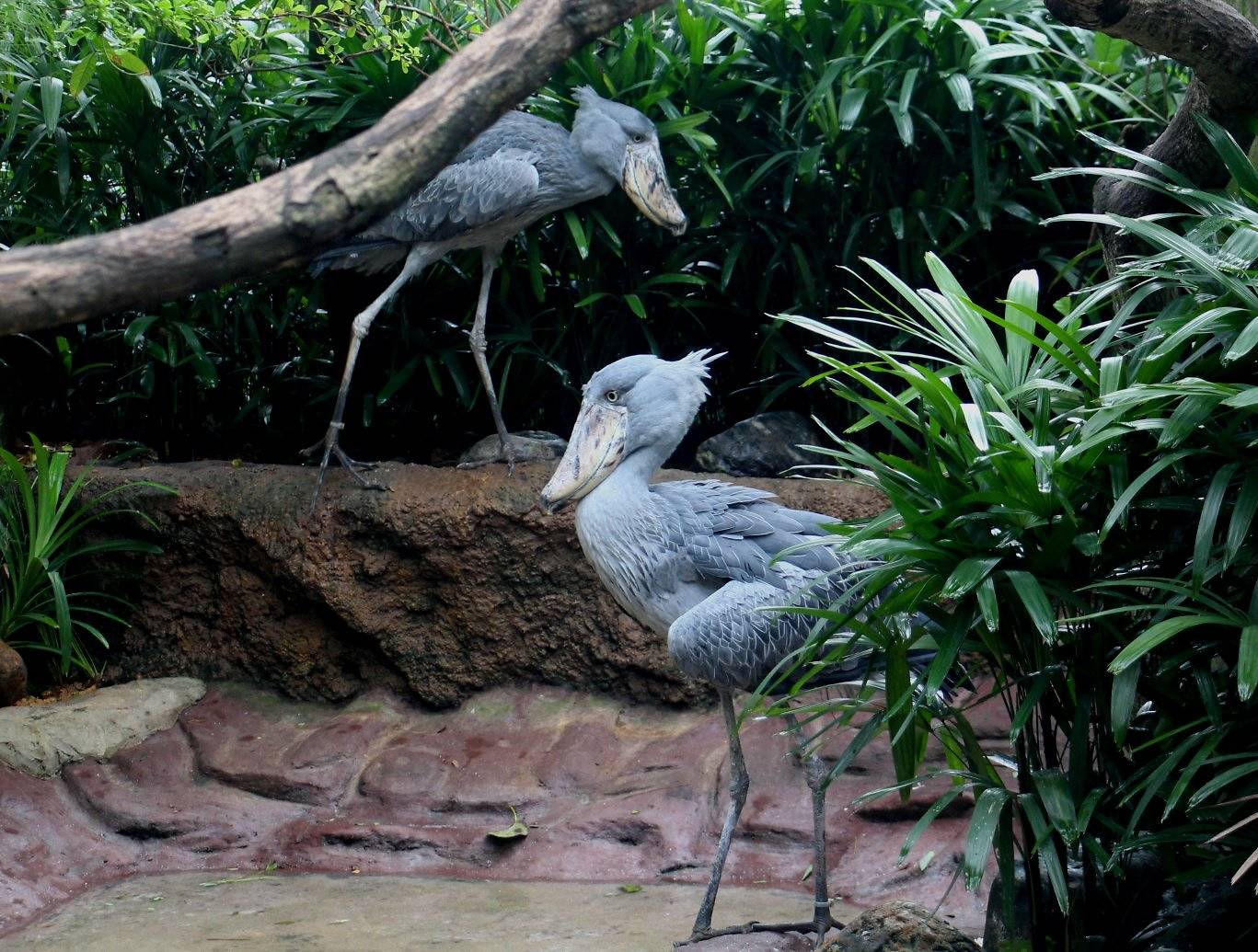
SINGAPORE: Good news for bird lovers in Singapore – the Jurong Bird Park has acquired a pair of rare Shoebill birds for the park’s Wetlands exhibit.
The birds’ arrival will make the Jurong Bird Park the only zoological institution in Southeast Asia where visitors will be able to view the species, Wildlife Reserves Singapore (WRS) – which runs the park – said in a press release on Thursday (Jul 12).
Flown over from Qatar in June, the 11-year-old male and 17-year-old female will join other critically endangered wetland birds in the park.
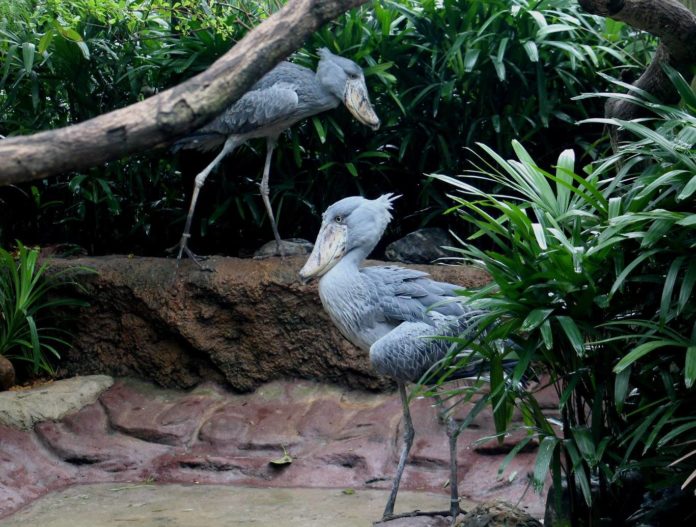
The 11-year-old male and 17-year-old female will join other critically endangered wetland birds in the park. (Photo: Wildlife Reserves Singapore)
Native to tropical East Africa, the Shoebills, also known as Balaeniceps rex, are classified as Vulnerable on the International Union for the Conservation of Nature’s Red List of Threatened Species. They face threats such as habitat loss and the illegal wildlife trade.
There are only 30 Shoebills under human care in the world, and an estimated 5,000 to 8,000 birds remaining in the wild, according to WRS.
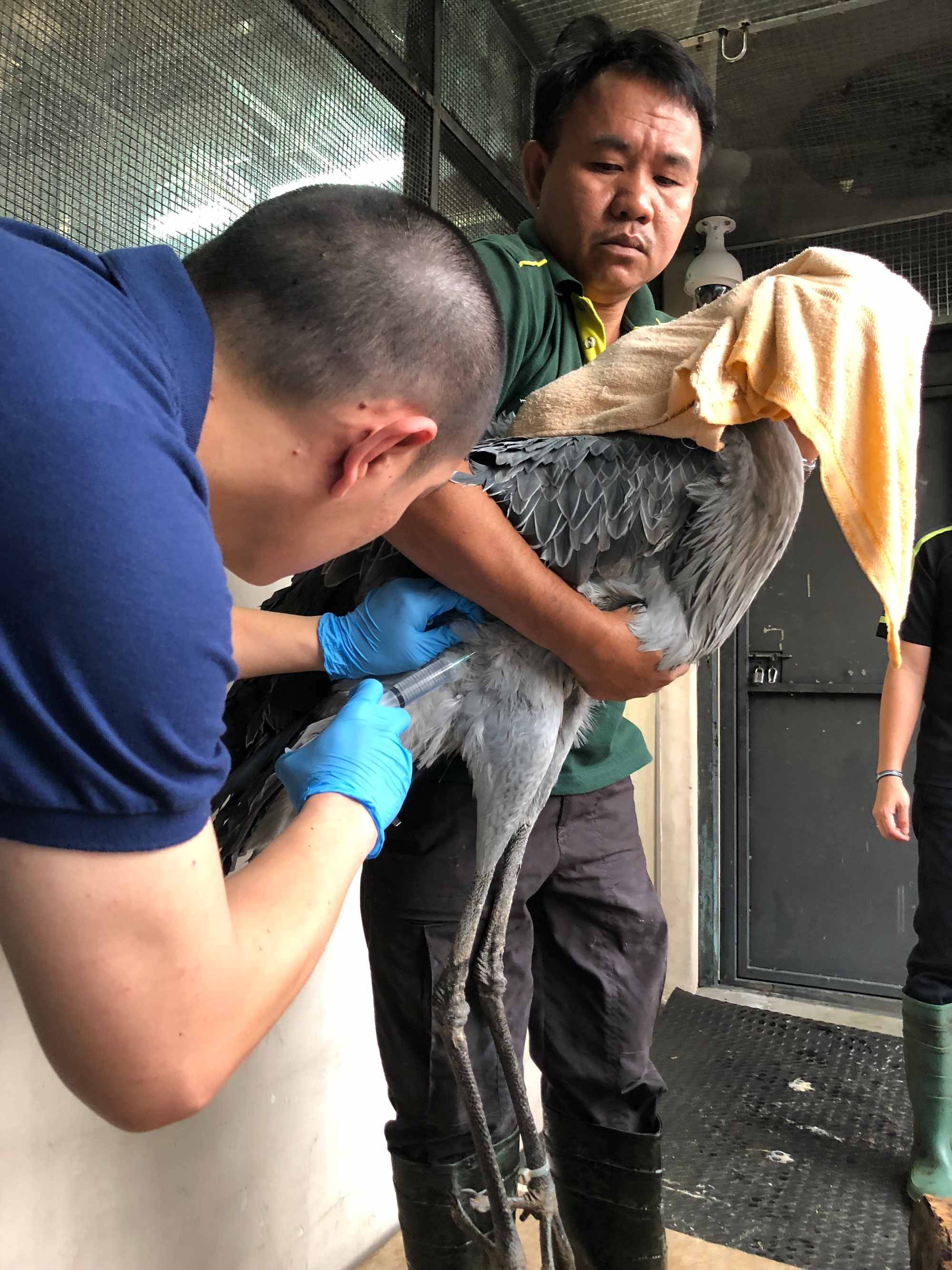
Jurong Bird Park’s assistant director of the veterinary department Dr Xie Shangzhe administers fluids to one of the Shoebills for additional hydration, assisted by deputy head keeper Razali Mohamad Habidin. (Photo: Wildlife Reserves Singapore)
The birds – which can live for up to 35 years in the wild – are named for their large shoe-shaped bills, which are more than 20cm long and have a sharp hook at the end for killing prey.
Though their diet consists primarily of fish, Shoebills also consume amphibians, snakes, rodents and even baby crocodiles.
Though their diet consists primarily of fish, Shoebills also consume amphibians, snakes, rodents and even baby crocodiles. (Photo: Wildlife Reserves Singapore)
Jurong Bird Park first displayed Shoebills in 1995, and its last specimen died in 2015.
WRS said the park hopes to breed the pair although it is rare under human care.
“With only two recorded cases of successful breeding under human care reported, Jurong Bird Park hopes to breed the pair and help to better understand the biology of this amazing species,” it said.
BRUSSELS: The ratification process for the free trade agreement between Singapore and the European Union is now in its final stages, in what Trade and Industry Minister Chan Chun Sing described as a “critical juncture” for Singapore to convince the EU officials on the strategic and economic benefits the deal will bring.
Mr Chan was speaking at the sidelines of his meetings with key EU officials and representatives during his visit to Brussels on Wednesday (11 July).
These officials include Austrian Federal Minister for Digital and Economic Affairs Dr Margarete Schramböck, EU Trade Commissioner Ms Cecilia Malmström and EUSFTA Rapporteur Mr David Martin, among others.
Trade and Industry Minister Chan Chun Sing meets Member of Parliament and EUSFTA Rapporteur David Martin (left), who has been in charge of drafting and presenting reports on the trade agreement to the European Parliament.
During the meetings, Mr Chan reaffirmed Singapore’s interest in the expeditious ratification of the EUSFTA and held discussions about the latest developments on trade policy.
The aim is for the agreement to come into force by next year before the European Commission’s mandate ends.
Mr Chan said the conclusion of the agreement is crucial, especially against the backdrop of the trade conflict between the US and China, which Mr Chan described as a spat that could “significantly impact” Singapore’s open economy.
“In the current climate of protectionism and unilateralism, it is in our common interest to send a strong and powerful statement to the rest of the world that we have like-minded partners that continue to believe in the free, open and rule-based multilateral system,” he said.
The US on Wednesday threatened to impose tariffs on US$200 billion in Chinese imports, with Beijing vowing countermeasures in retaliation. This would be the third round of tariffs on Chinese goods imposed by the Trump administration and comes shortly after US tariffs on US$34 billion worth of Chinese goods kicked in last Friday.
Mr Chan also said the EU-Singapore pact will act as a pathfinder for other Asian countries.
“Many of the ASEAN and Asian countries will be looking at Singapore and the EU and say that if Singapore and EU can do it, then there’s always hope for the rest of the countries to have similar agreements with the EU to benefit their economies and people,” he said.
But if the free trade agreement does not come about, Mr Chan said these countries may lose confidence and question the EU’s commitment to the ASEAN region.
SINGAPORE: A bold suggestion came late last month from newly appointed Malaysian Defence Minister Mohamad Sabu.
One of the first few Cabinet Ministers to be appointed after Pakatan Harapan’s electrifying election victory, he had proposed for both countries to work together to strengthen security cooperation in the eastern Singapore Strait near Pedra Branca and Middle Rocks, which serves as an entry point to the busy Singapore Strait that links major economies in the Middle East and East Asia.
This idea was well received by Defence Minister Ng Eng Hen who remarked that “even joint patrols with our agencies and their agencies, I completely agree with that”.
These remarks from both defence establishments came on the heels of controversial comments from Malaysian Prime Minister Dr Mahathir Mohamed about reviewing the price of water Malaysia sells to Singapore.
But the idea of joint patrols in the area isn’t a new suggestion.
BACK TO 2003
Back in January 2003, then Malaysian Foreign Minister Syed Hamid Albar proposed having joint patrols with Singapore off Pedra Branca as the challenges of operating in these narrow straits became clear to both sides.
Syed Hamid’s suggestion came in the wake of the collision between a Republic of Singapore Navy patrol vessel and a cargo ship about 1.8 km off the island.
“To me, it is good when both parties carry out monitoring … each other’s presence is made known so that there will not be any accident,” the top Malaysian diplomat stressed back then, pointing out that waters off the rocky outcrop accommodate a busy international shipping lane. He had added:
I think it’s better for us to cooperate with each other and understand each other’s presence without the intention of getting engaged in aggression or physical contact.
A view of the Causeway. (Photo: AFP)
Belying these comments were the testy nature of relations between both countries that year.
Both countries were in the midst of negotiating an agreement to refer the dispute over Pedra Branca to the International Court of Justice.
Negotiations on a package of issues including water, the Causeway Bridge and airspace had just crumbled. Exchanges in the media were heated and acrimonious.
Yet cooperation between the two navies continued apace. Both sides proceeded that year with the annual exercise Malapura, a flagship annual joint training exercise between the Republic of Singapore Navy and the Royal Malaysian Navy, involving warships, fighter jets and maritime patrol aircraft.
History tells us that we shouldn’t gloss over the value of sustained, institutionalised military-to-military linkages even in times of political turbulence. Around the world, such linkages often become casualties with downturns in political relations.
Yet it’s precisely in times of tension that militaries ought to maintain those links as a way to promote confidence-building and crisis management.
Even as cooperation between air and land forces may be disrupted, maritime forces, especially navies, are key in promoting interstate relations. Navies serve as their countries’ ambassadors and can help to ensure that political tensions between countries do not translate to blows on the ground in undelimited waters.
This set of bilateral naval links have continued to grow over the decades, and the common security challenges both sides share have led Malaysia and Singapore to work closely together within the rubric of the Malacca Straits Patrols, inaugurated in 2006, with Indonesia and Thailand for example.
A Malacca Straits Patrol exercise held in 2016. (Photo: MINDEF)
BUILDING ON INTEROPERABILITY BETWEEN THE TWO NAVIES
Cooperation also brings professional value to both navies. Exercise Malapura has evolved over the years, with its scope becoming more complex – moving from shipboard tactical procedures of individual vessels to broader operational matters involving planning at group level.
Both navies have also explored developing common operating procedures and naval techniques, jointly tackled topical issues such as rules of engagement, and expanded forces involved to include air force and maritime security elements.
The idea of broadening naval cooperation to operations elsewhere was mooted in 2011 when then Malaysian Defence Minister Dr Ahmad Zahid Hamidi suggested the two navies cooperate to protect shipping security in the Gulf of Aden, since both forces were already contributing to counter-piracy operations there.
“We are inviting the Singapore Navy to be involved in our operations as it will be part of an international team and not just representing its own country … This is apt as Malaysia and Singapore will be jointly protecting the merchant ships from Southeast Asian countries against piracy,” he remarked.
Suspected pirates keep their hands in the air as directed by a patrol from the guided-missile cruiser USS Vella Gulf, in the Gulf of Aden. (File photo: AFP/Jason Zalasky)
PERSISTENT SECURITY THREATS
It is a worthwhile idea to expand maritime security cooperation, especially between the two navies, beyond the Malacca Strait to include the eastern Strait of Singapore, around Pedra Branca and Middle Rocks.
In recent years, threats to shipping in the eastern waterways can come from a variety of causes including accidents, piracy and potentially maritime terrorism. Given how much of world trade and energy passes through these waters, cooperation in the area between both sides may go some way to ensure these sea lanes remain safe and secured for international shipping.
For example, in October 2016, two individuals were apprehended by Malaysian authorities in waters off Middle Rocks after conducting unauthorised diving activities there.
Incidents of men overboard and boats sinking in the vicinity over these two years underscore the utility of both sides cooperating in search-and-rescue operations.
The collision between the American destroyer USS John McCain and an oil tanker near Pedra Branca also illustrates the importance of communications and coordination of movement in those waters.
A temporary patch welded to the area damaged by a collision aboard USS John McCain pictured at Changi Naval Base in Singapore Sep 21, 2017. (Photo: Mass Communication Specialist 1st Class Micah Blechner/US Navy Handout via Reuters)
Pushing for closer maritime security cooperation around Pedra Branca and Middle Rocks would be clearly mutually beneficial for both Malaysia and Singapore.
Joint patrols to respond to abrupt contingencies in the area would allow both countries to free up resources and allocate them to other locations. In particular, Kuala Lumpur could assign more maritime security assets to eastern Sabah and the Sulu Sea where piracy incidents have risen in recent years.
But one also should not forget the role of civilian maritime agencies in this potential setup which include the Malaysian Marine Operations Force and Singapore Police Coast Guard, agencies who tackle transnational crime including smuggling.
If both countries decide to ride on the present momentum, Malaysia and Singapore authorities could consider how best to bring together their maritime forces, both military and civilian. A first step may be to commence a joint feasibility study on a slate of maritime security operations in waters around Pedra Branca and Middle Rocks.
It may be prudent to start small, focusing on search-and-rescue and joint action against transnational crime and counter-terrorism in those waterways.
A more ambitious idea is for exercise Malapura, which has traditionally been conducted in the Malacca Strait, to extend to waters near Pedra Branca and Middle Rocks, and expand into a multi-agency activity involving the two countries’ civilian and maritime law enforcement bodies.
When Singapore as chair of ASEAN this year is advancing confidence-building measures like the Code of Unplanned Encounters at Sea and both countries are already signatories, such an expansion may be practical because it sensitises other agencies to real-word maritime security operations.
The road ahead is full of potential. Both countries should seize on this new momentum and build on the strong cooperation between their maritime forces that has been cultivated over the years.
Collin Koh is research fellow at the Maritime Security Programme, S Rajaratnam School of International Studies based at Nanyang Technological University, Singapore.
SINGAPORE: Singapore’s national water agency has devised a road map that will progressively see artificial intelligence, big data and smart work redesign being rolled out over the next five years to improve its operations and water management.
PUB announced on Wednesday (Jul 11) that the road map will help to achieve smarter water quality management and work process.
“Business as usual is not sustainable,” said Mr Michael Toh, PUB’s chief information officer.
“Not adopting new technology exposes us to inefficiencies and risk, and can render us obsolete or unable to adapt to technological disruptions,” he added.
SMART WATER QUALITY MONITORING
As part of its smart road map, the water agency is exploring two pieces of innovation for remote water quality management.
The Remote Micro-Invertebrate Detector allows PUB to perform automated microscopic imaging on water samples and identify micro-invertebrates. (Photo: Vanessa Lim)
The first is an autonomous boat that can navigate itself through choppy waters to collect samples. First piloted at Pandan reservoir in November 2017, the boat’s effectiveness in monitoring water quality is currently being evaluated.
PUB is also developing a device that can perform automated microscopic imaging of water samples and identify micro-invertebrates – small organisms found in raw water.
This will help to improve the existing process, which requires a trained biologist to manually count the number of micro-invertebrates in a sample. This process could take up to two hours per sample.
CNA LIFESTYLE EXPERIENCES: Meet one of Singapore’s most respected artists at the opening of his latest special exhibition. Details below. Follow our CNA LIFESTYLE page on Facebook for more exclusive events.
SINGAPORE: At the ripe old age of 98, Singapore’s oldest living artist just can’t stop thinking about art.
As we settled down for a chat at his home in Telok Kurau, Lim Tze Peng confessed that he hadn’t gotten a good night’s sleep.
“I woke up at 4am thinking about how to paint better,” he shared in Mandarin, with a gentle chuckle.
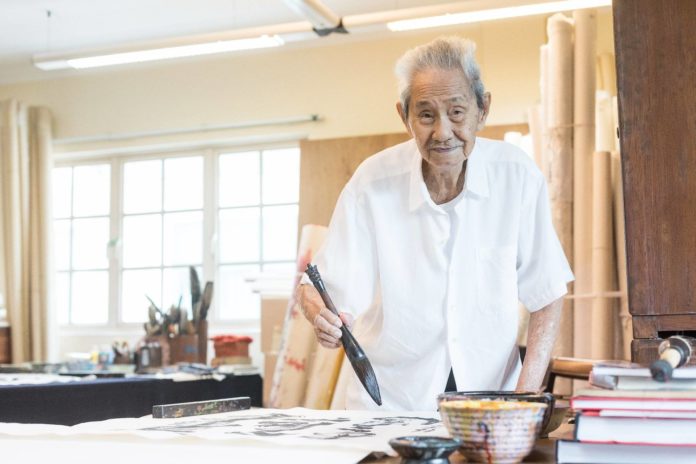
Lim Tze Peng is still creating art at the age of 98. (Photo: Ode To Art Gallery)
“When I think too much about painting or writing calligraphy, I can’t sleep well. Even when I’m sitting here, I’m thinking of it. When I lie down on my bed, I’m thinking of it!”
Talk about dedication. After decades of creating some of the most familiar and iconic Chinese ink paintings of the Singapore River and Chinatown (and breaking auction records and snagging a Cultural Medallion award along the way), we half-expected to find Mr Lim just chilling out at home with his grandchildren, resting on his laurels during his twilight years.
SINGAPORE’S VERY IMPORTANT CHINESE INK ARTIST
But amazingly, he’s still at it. One of the coolest senior artists we’ve ever met, Mr Lim may have stopped painting full-time, but he still does a bit of calligraphy as a form of exercise at his second-floor artist studio, which is crammed with old paintings and scrolls.
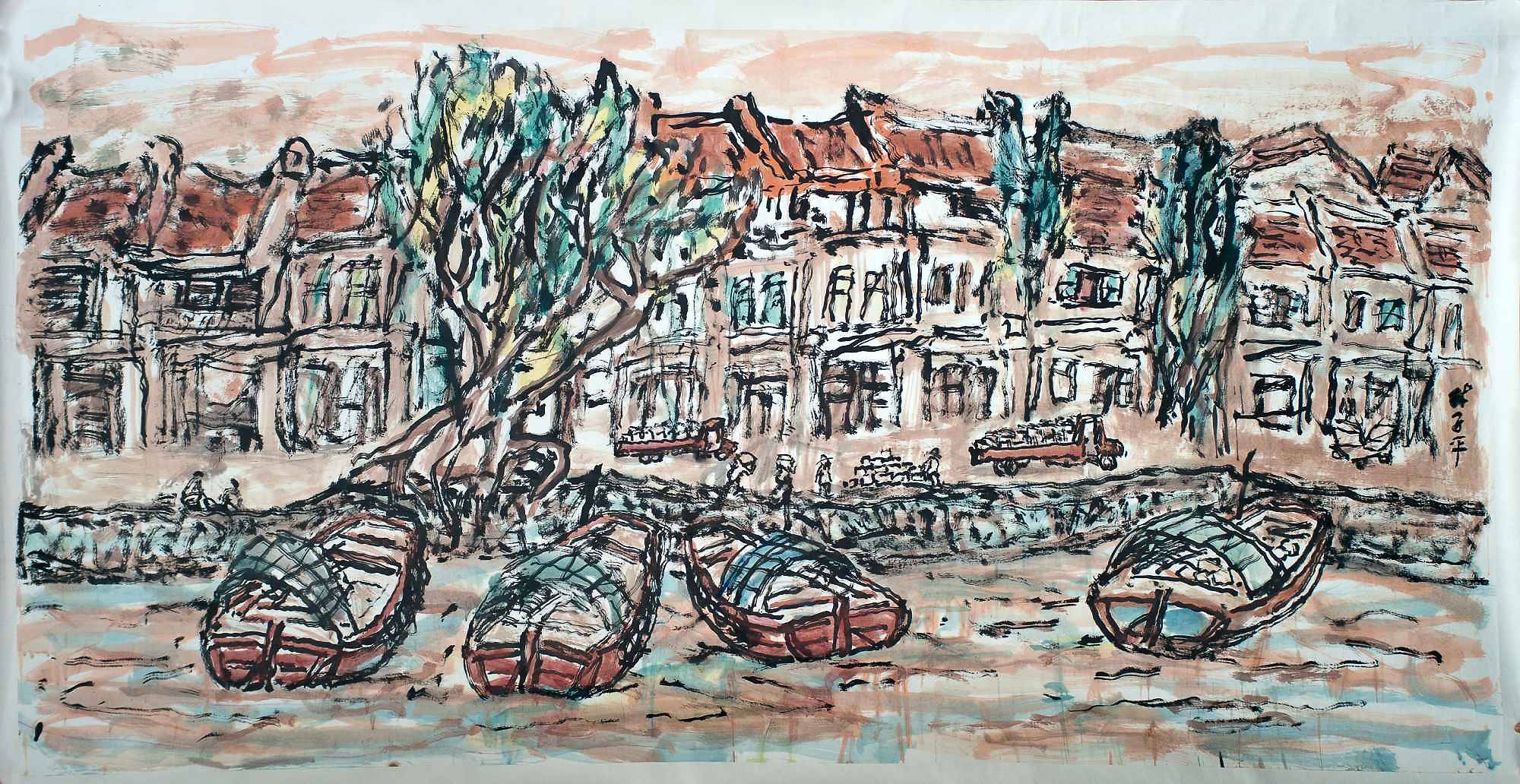
Lim Tze Peng’s Singapore River (Four Boats). (Photo: Ode To Art Gallery)
And while he mostly just stays at home these days, he’ll soon be stepping out for his latest solo exhibition in two years.
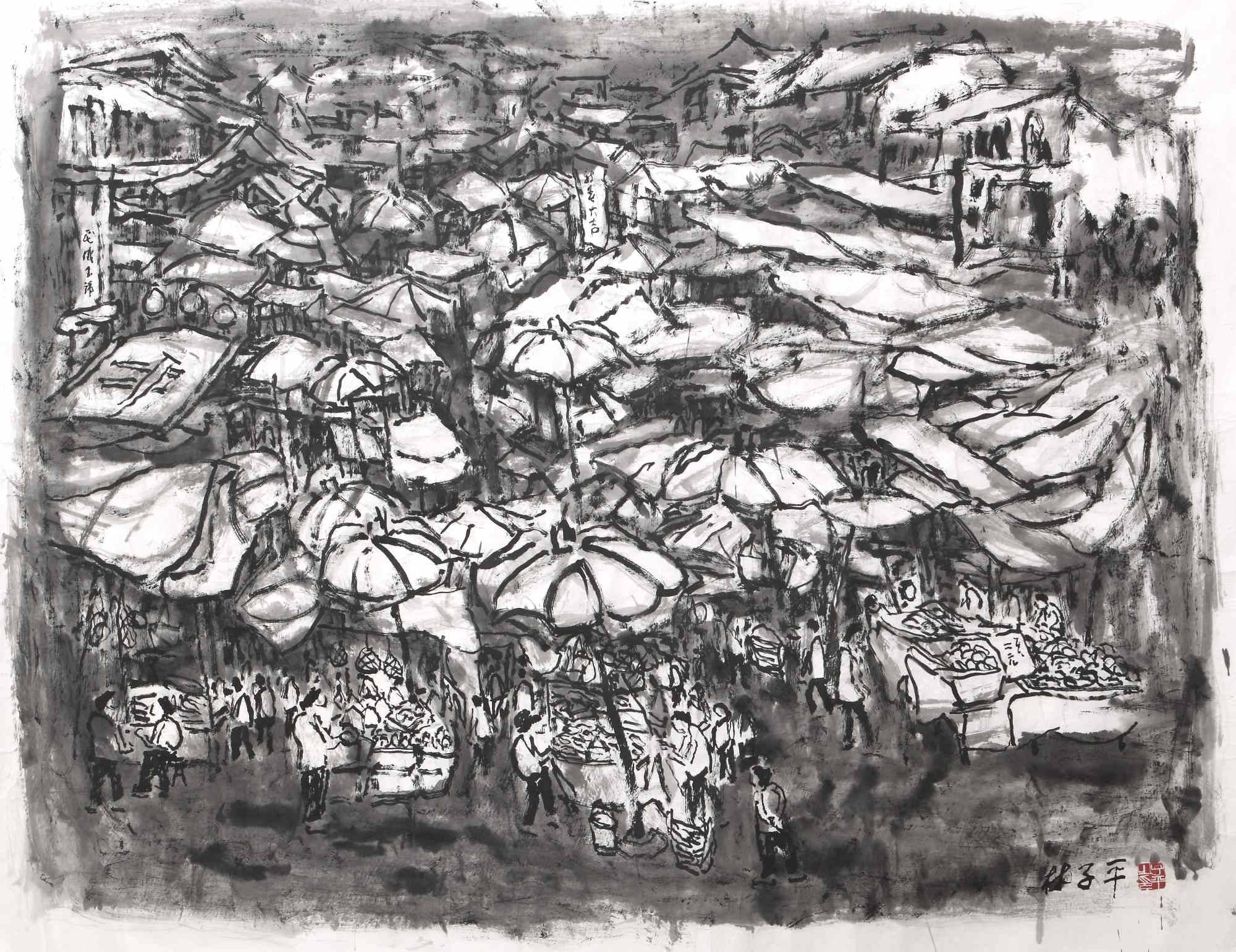
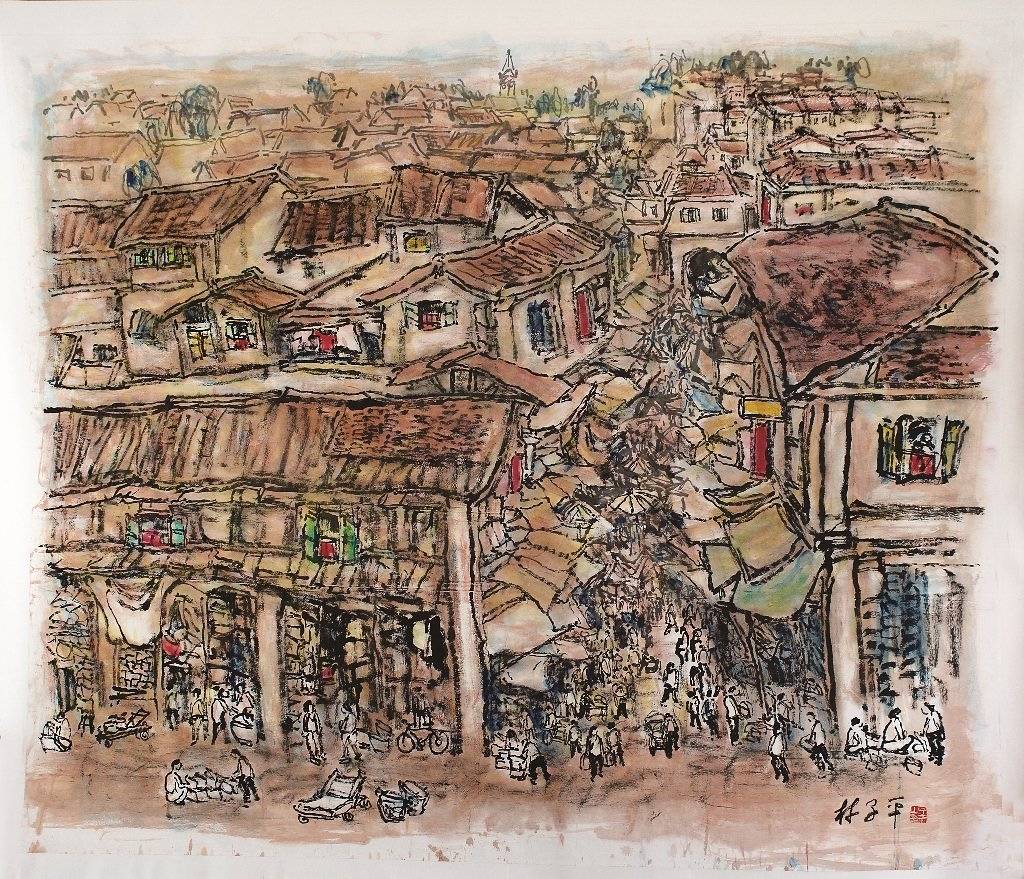
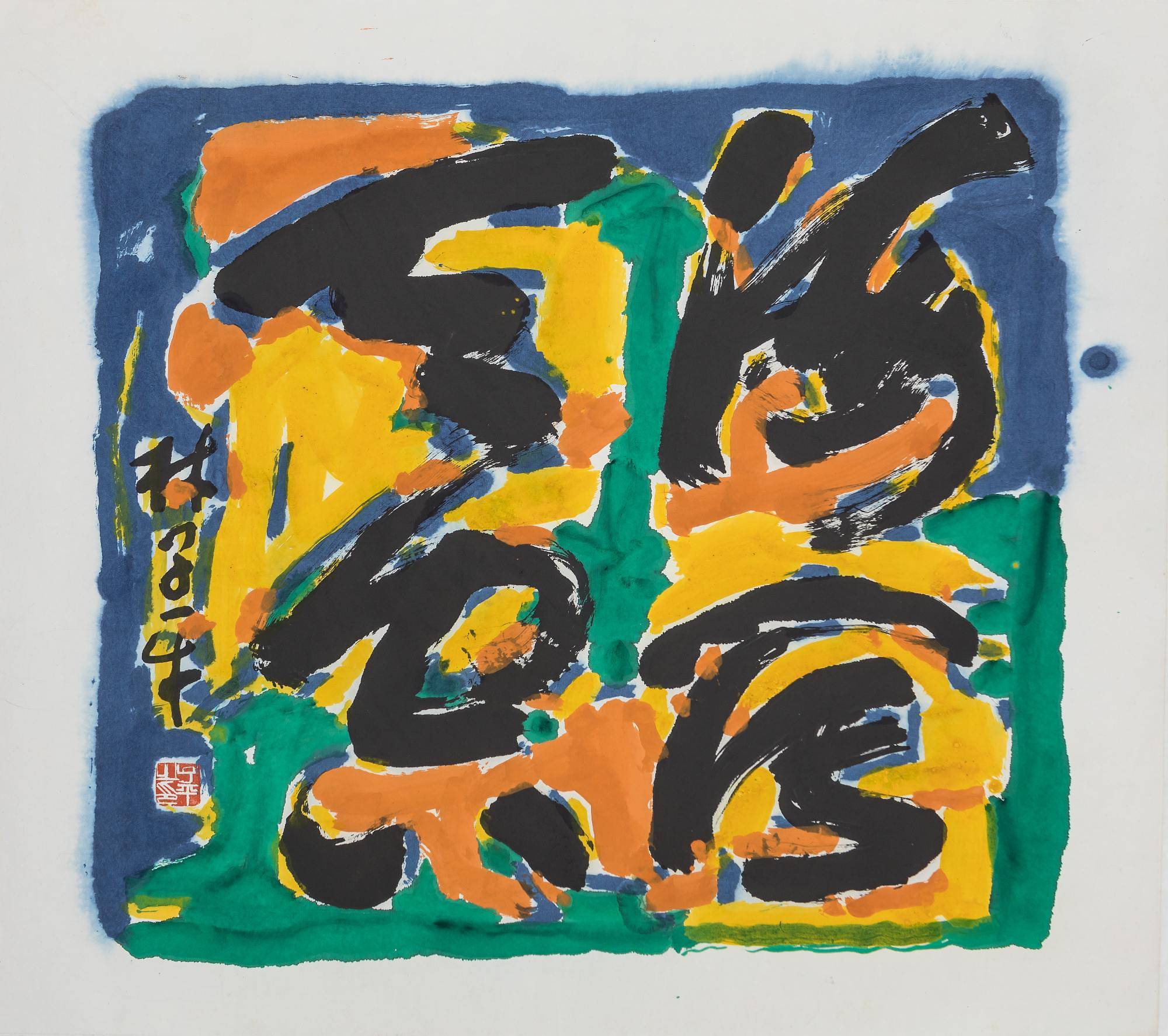
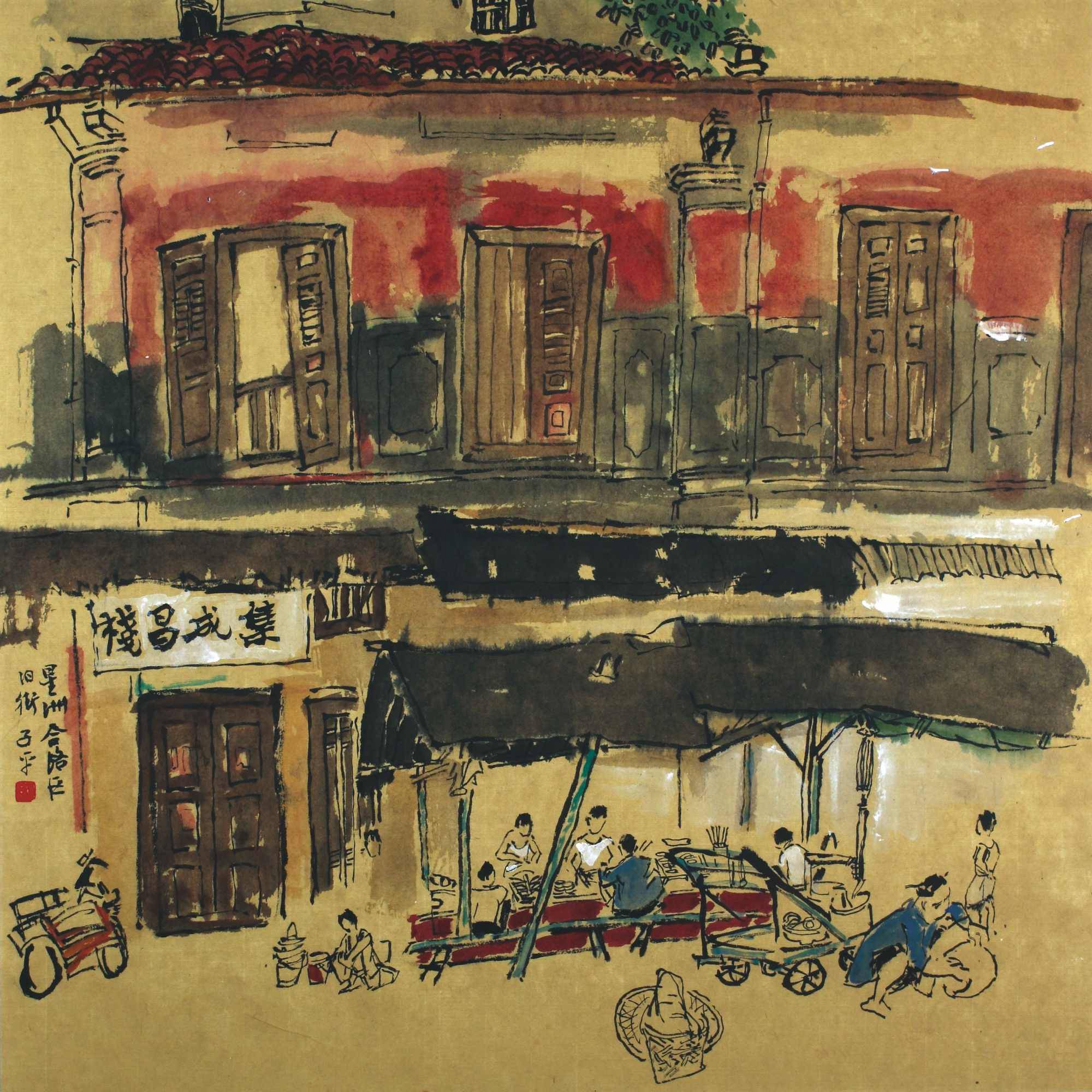
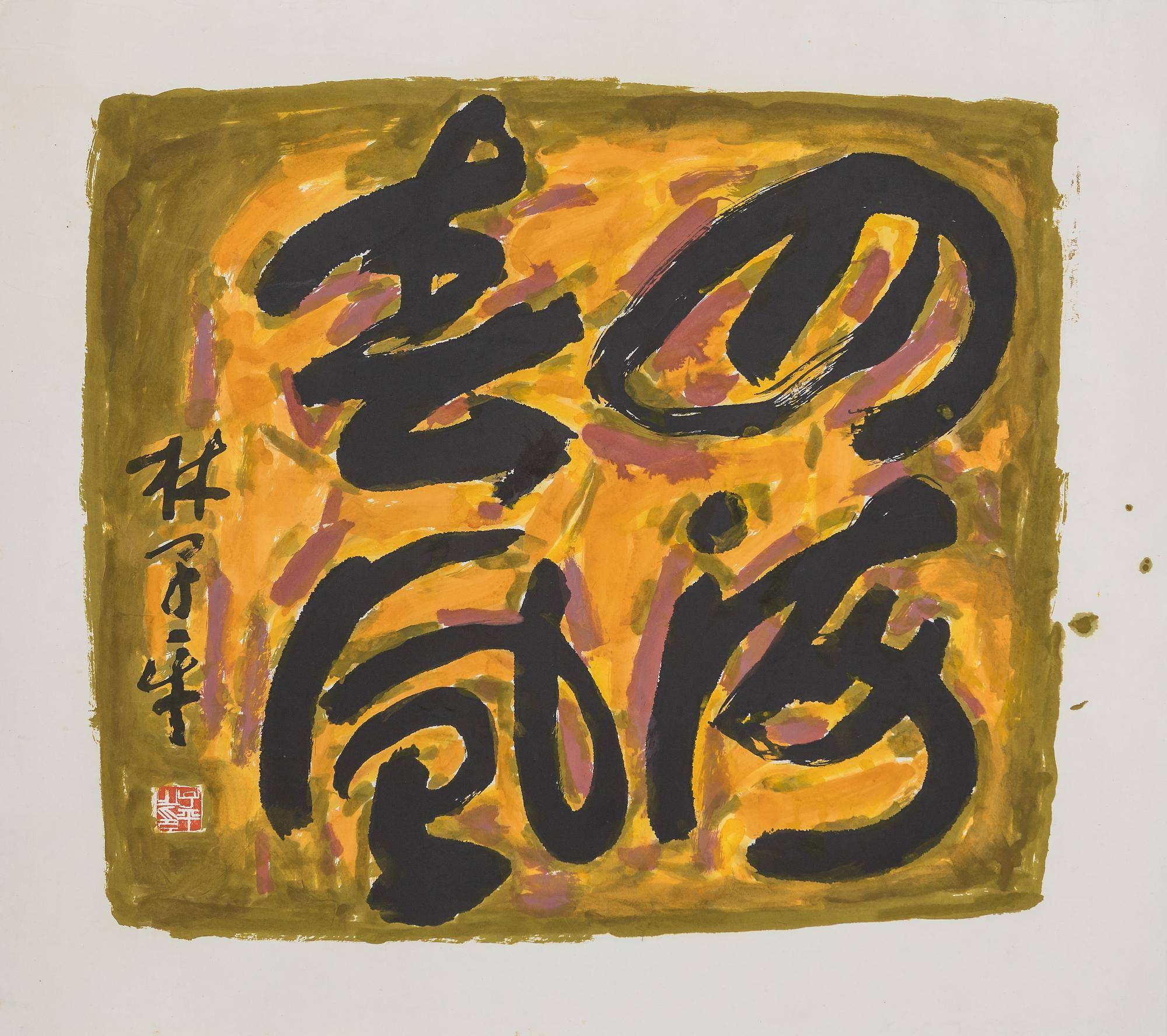
Later this month, Ode To Art Gallery is presenting Portrait Of The Heart, a retrospective of Mr Lim’s artworks through the years. It will comprise over 80 pieces that span his entire practice, from his Singapore River and street scenes to his Tree series and even experimental calligraphy works. And they’re not all old pieces – he’s even throwing in a few recent ones, too.
While Mr Lim admits to feeling “a bit of pressure” with the exhibition, he’s also looking forward to it.
Lim Tze Peng’s Market. (Photo: Ode To Art Gallery)
“I feel delighted that someone is organising the show, and people want to come and enjoy my work,” he said.
For gallery owner Jazz Chong, holding the exhibition was a no-brainer. “He’s a very important Chinese ink artist in Singapore; the oldest and probably the most prominent Singaporean artist alive. Because he has had so many years of practice, you see the evolution of his works.”
FROM PASIR RIS KAMPONGS TO THE SINGAPORE RIVER
And, in a way, of Singapore, too. Born in 1921 to parents who were pig and chicken farmers in Pasir Ris, the eldest of seven children recalled learning how to paint in his twenties, with the local villages in the area one of his favourite subjects.
Lim Tze Peng’s Bustling Streets Of Chinatown. (Photo: Ode To Art Gallery)
“Near our place – we lived in an attap house – there were a lot of Malay kampongs and I used to go there to do drawings. I did a few hundred pieces,” he said.
But Mr Lim didn’t become a full-time artist until much later – he spent the first half of his life as a primary school teacher, while occasionally joining other artists, such as the seminal Ten Men Group, in trips to other places in the region.
Upon his retirement in the late 1970s, Mr Lim switched gears. Around this time, Pasir Ris had also started to lose its kampong vibe thanks to development, and he shifted his attention to the subject matter he would really become famous for – the Singapore River and Chinatown.
Lim Tze Peng’s Bark. (Photo: Ode To Art Gallery)
“I have a lot of good memories of the Singapore River – it was a unique part of Singapore at that point in time,” Mr Lim recalled.
“And it wasn’t just me who painted there. There would be hundreds of artists, there would be tourists taking photos, the big bumboats. There was so much activity. It wasn’t so clean as it is now, but it wasn’t very smelly because of the low and high tides,” he quipped.
Lim Tze Peng’s Boundless. (Photo: Ode To Art Gallery)
Mr Lim also has vivid memories of the street scenes in Chinatown. “The clothes hanging outside the shophouses were like flags – a lot of colours and very beautiful. On the streets, you’d see hawkers on one end selling fish, duck and fruit. On the other, you’d see the Samsui women, bent over as they were walking or working. It was the perfect subject matter.”
‘I SEE, I PAINT. I THINK, I PAINT.’
While these artworks had made Mr Lim famous, he went on to do others – experimenting with calligraphy in the 1990s and 2000s. “I always felt the need to come up with new expressions, new things,” he explained. “When I was younger, I used to go out – I see, I paint. As I’ve become older and can’t go out anymore, I think, then I paint.”
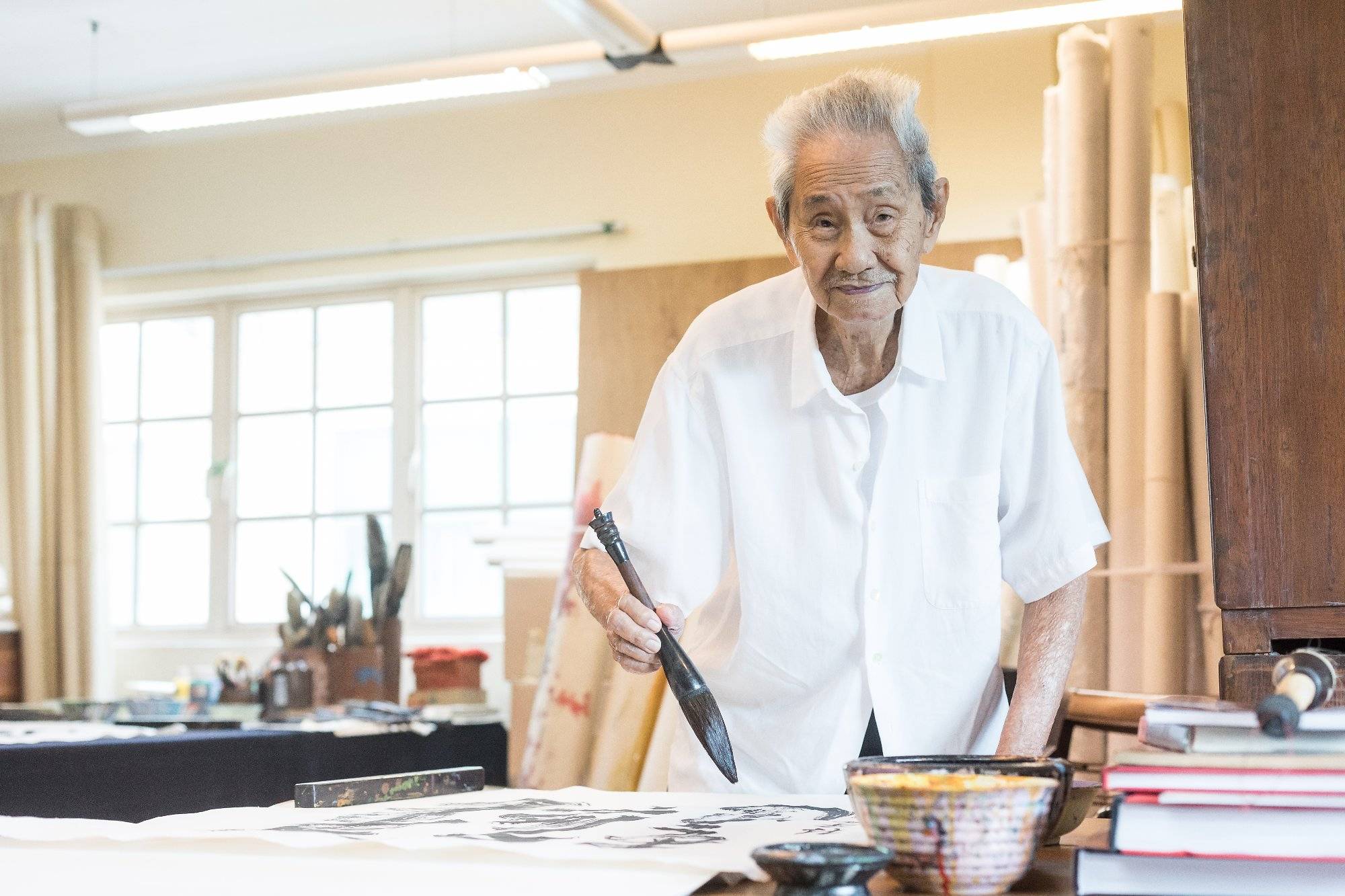
Lim Tze Peng working on one of his big artworks. (Photo: Ode To Art Gallery)
His personal drive to innovate would eventually reap even bigger rewards. In 2003, he received the prestigious Cultural Medallion, the highest accolade for any artist in Singapore. A few years ago, he also received the Meritorious Service Award.
Mr Lim’s artworks have also been a hit in the art market. In 2012, one of his Chinese ink paintings of a Singapore River scene sold for S$101,800 at a Christie’s auction in Hong Kong – a record then for a living Singaporean artist.
And while you might think Mr Lim’s works aren’t quite popular among younger art lovers weaned on cool contemporary art, you’d be surprised to find out that his works continue to resonate with a new generation.
Lim Tze Peng’s Old Singapore Scene. (Photo: Ode To Art Gallery)
“A lot of those who collect him are actually quite young,” said Ode To Art’s Ms Chong, who says that prices for Mr Lim’s works range between S$10,000 to half a million for his big pieces.
“There are those in their early 30s, who’re looking for something for their new homes, who are starting to say they want to be more connected to their roots, and they feel they can relate to his art, whether it’s calligraphy or old Singapore scenes; the aesthetic side or the nostalgic side,” she said.
At just two years short of the century mark, and having made so many innovations in his practice and being lauded for it, most people would probably think it’s time for Mr Lim to take a step back and just enjoy the moment.
Lim Tze Peng’s Ubiquitous Spring. (Photo: Ode To Art Gallery)
But Singapore’s oldest living artist has other plans. Mr Lim shared that he recently did a seal carving, which said, in Chinese, “treasure your remaining years”.
“Although I’m close to 100 years old, I want to make the best use of my time. I want to think more and innovate more,” he said.
Hopefully, not at the expense of a good night’s sleep.
Lim Tze Peng’s solo exhibit Portrait Of The Heart runs from Jul 26 to Aug 12 at Ode To Art Gallery, Raffles City Shopping Centre.
TERMS & CONDITIONS
This contest is organised by Mediacorp Pte Ltd (“Mediacorp”). This contest is valid from 14 July to 21 July 2018, and is open to all residents of Singapore who are above 21 years old except for employees of Mediacorp, its related companies and their immediate family members. By participating in this contest, the participant agrees to be bound by the official rules, regulations and decisions of Mediacorp.
20 winners will each win a pair of invites to attend this event.
By participating in this contest, the participant agrees to participate in any form of publicity for this contest. Mediacorp reserves the right to disqualify any winner(s) in the event that the winner(s) refuses or fails to participate in such publicity for this contest.
The invite is non-transferable or exchangeable for cash, credit, goods or services. Mediacorp reserves the right to replace the invite with other invitations of similar value without giving prior notice.
The decisions of Mediacorp on all matters relating to this contest are final, conclusive and binding and no appeals or correspondence will be entertained.
Mediacorp reserves the right to reject any entry for any reason.
Personal Data
By participating in this contest, participants agree that their personal data may be used by Mediacorp and the Mediacorp group of companies (collectively “Mediacorp”) to send them marketing and advertising materials in relation to goods and services of Mediacorp and its business partners, and for research and analysis. If you have any questions relating to Mediacorp’s collection, use and disclosure of your personal data, please contact Mediacorp’s Data Protection Officer at dpo@mediacorp.com.sg.
Contest Conditions
The tickets are not redeemable for cash, credit or any other items with Ode to Art and Mediacorp.
Others
Mediacorp reserves the right to change, amend or add to these terms and conditions without prior notice. Mediacorp further reserves the right, without any liability on its part whatsoever, to cancel, postpone, or in any other way terminate this contest at any time without prior notice.
No obligation will be incurred by Mediacorp or its sponsors by reason of participation in this contest or by reason of anything done or omitted to be done by the participants as a result of or on account of this contest. Mediacorp shall not be liable or responsible for any and all losses, damages, costs and/or expenses (of any nature whatsoever) suffered by any participant arising from any failure or refusal, for whatever reason, to deliver or transfer, whether by Mediacorp or its sponsors, the prize or make good on any promise or offer to the participants.
Each participant expressly acknowledges and agrees that Mediacorp shall not be liable to any of the participant(s) for any injury, loss or damage whatsoever or howsoever caused arising directly or indirectly in connection with this contest or the prize, including any loss, damage or injury.
These terms and conditions and this contest shall be governed by and construed in accordance with Singapore laws.
SINGAPORE: More than 2,000 reports of unauthorised short-term stays in residential units were received by the Urban Redevelopment Authority (URA) between 2015 to 2017, Minister for National Development Lawrence Wong said in Parliament on Wednesday (11 Jul).
Of these, 1,808 were in private homes and 390 in Housing and Development Board (HDB) flats.
Mr Wong was responding to questions in Parliament on short-term home rentals by Members of Parliament Alex Yam, Melvin Yong and Lee Bee Wah.
Currently, the minimum rental period for private homes and HDB flats in Singapore are three and six months respectively, meaning short-term lettings on platforms like Airbnb are prohibited.
Enforcement notices will be issued for all these cases, said Mr Wong.
“A good majority of them will then stop, and immediately comply with the enforcement notice, but should there be cases that continue or there are egregious cases, then indeed, URA will work with AGC (Attorney-General’s Chambers) on prosecution,” he added.
Composite photo taken on Feb 27, 2018 shows real estate agents Yao Songliang (left) and Terence Tan En Wei (right) leaving the State Court in Singapore. The two Singaporeans pleaded guilty to unauthorised short-term lending by letting out apartments on Airbnb. (Photo: Roslan RAHMAN/AFP)
SUPPORT FOR PROPOSED REGULATIONS
Following public feedback on a proposed regulatory framework for short-term letting, the URA will be further studying responses, before deciding how to take this issue forward, said Mr Wong. The public consultation exercise was conducted between Apr 16 to May 31 this year.
“Many respondents supported the need for regulations on STA, given that STA can cause negative externalities to other residents,” Mr Wong said. “Key concerns raised include safety, security and privacy, as well as abuse of common property. Many also supported regulating STA platform operators, for example, through a licensing framework.”
One of the proposals suggested in the framework was for the management corporation to obtain an 80 per cent consent from owners within a strata-titled residential development before STA can be permitted in any residential unit.
“There was mixed response to this proposal,” said Mr Wong. “Some respondents felt that an 80 per cent threshold would be unfair to the minority who do not support STA, but have to accept the presence of STA guests in their developments.
“On the other hand, there were others who felt that an 80 per cent threshold was too high, and that it would be difficult to obtain sufficient votes in support of STA among home-owners.”
The URA has also considered the impact of STAs on Singapore’s hospitality industry, said Mr Wong, who added that the proposed regulatory framework includes controls similar to those imposed on the hospitality industry.
These include requirements for STA hosts to collect and record the personal details of guests and to comply with fire safety regulations, as well as a proposal for platform operators to be licensed.
“The intent is to provide a more level playing field in the STA sector and the hospitality industry,” Mr Wong added.
“Our approach to this has to be one that’s based on fair competition. It’s not possible to say let’s block any new entrants into the hospitality sector simply on the basis that the existing incumbents have put in investments.”