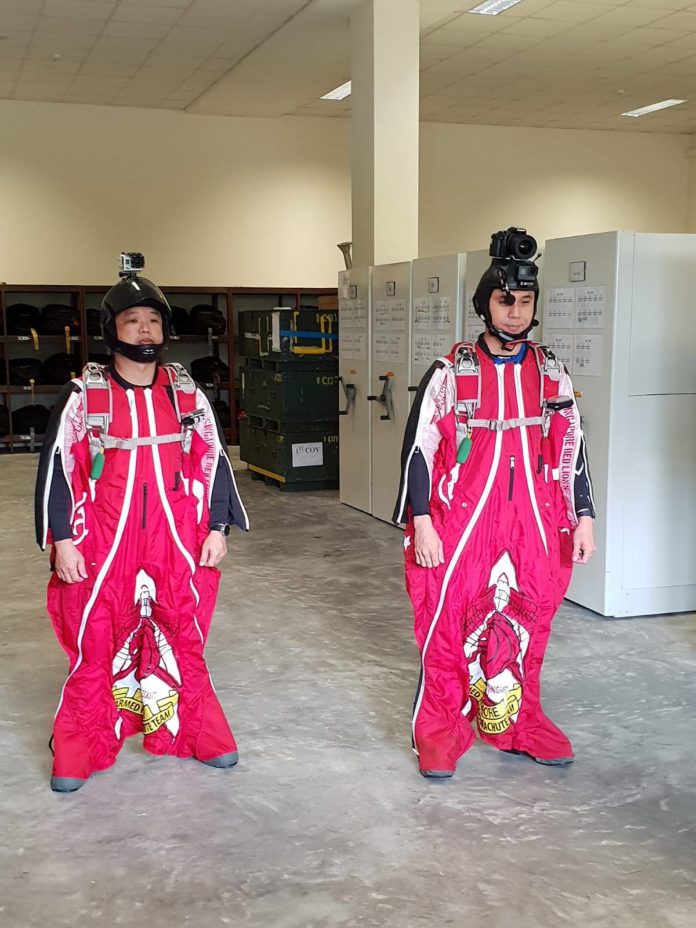
SINGAPORE: The perennial crowd favourite Red Lions will perform a wingsuit jump for the first time at the National Day Parade (NDP) this year, from a record height of 3,800 metres, it was announced on Saturday (Jul 14).
The Singapore Army’s parachute display team will also be executing the free fall segment with the Republic of Singapore Navy’s naval combat divers – another NDP first.
The 10 Red Lions had to undergo a special two-week wingsuit training programme in the US to prepare for the performance, which will see them “flying” from a helicopter in Sentosa placed more than 750m higher than before.
The Red Lions will jump from above Sentosa, reaching speeds of up to 200km/hr and gliding to the floating platform to land, instead of jumping from above the floating platform. (Photo: Ahmad Khan)
They will then glide at a speed of up to 200km/hr towards the Marina Bay floating platform before experiencing a minute-long free fall, which is double the time taken for their normal jumps.
“We’ve been doing (the free fall segment) for many years, so we’ve been looking … how we can improve in the show and how we can even excite the crowd even more,” said First Warrant Officer (1WO) Ivan Low, team leader of the Red Lions for this year’s NDP.
“We decided to stretch the benchmark a bit higher so we can have a better show for the audiences. We have the challenge of bringing the whole group right to the middle of the show area. The responsibility is a lot, but we have practised more than enough for this show,” he added.
While this is happening, the eight-member Naval Diving Unit (NDU) will free fall more than 1,800 metres towards the water from a Super Puma helicopter – an operational capability that it utilises for actual operations.
“The showcase gives an insight to the maritime operations conducted by the divers when they need to enter an area of operation that is not easily or quickly accessible by other means,” the NDP organising committee said in a press release. “During actual operations, an accompanying sea boat is also first deployed from the air into water, serving as a platform for the divers to move off quickly for their mission.”
In their debut NDP free fall performance, the divers will deploy their parachutes at about 1,200 metres in the air before descending to a designated drop zone in the waters around the floating platform.
Naval combat divers are equipped with waterproof gear weighing up to 50kg, including dive fins and an HK416 assault rifle. Operational load such as fins catch additional wind due to their increased surface area. (Photo: Ahmad Khan)
“We have to do a lot of competency training to make sure we are able to fall stable and fall as a team,” said Master Warrant Officer Eric Tay, who is the team lead of the NDU’s free fall water jump.
Landing in the water means the divers have to battle water currents on top of the wind changes from all directions. They also have to do more than carry a parachute on their descent. They have to wear tactical vests, and carry an assault rifle and dive fins, all amounting to about 50kg.
“When you are at a free fall, approximately at a speed of 120km/hr and with the big flap behind your legs, it catches a lot of wind,” he said. “That is the difficulty we face apart from the equipment that we wear that change the aerodynamics.”
SINGAPORE: A pilot programme that encourages the public to pay-it-forward by paying for the meals of needy residents in Pasir Ris was launched by NTUC Foodfare on Saturday (Jul 14).
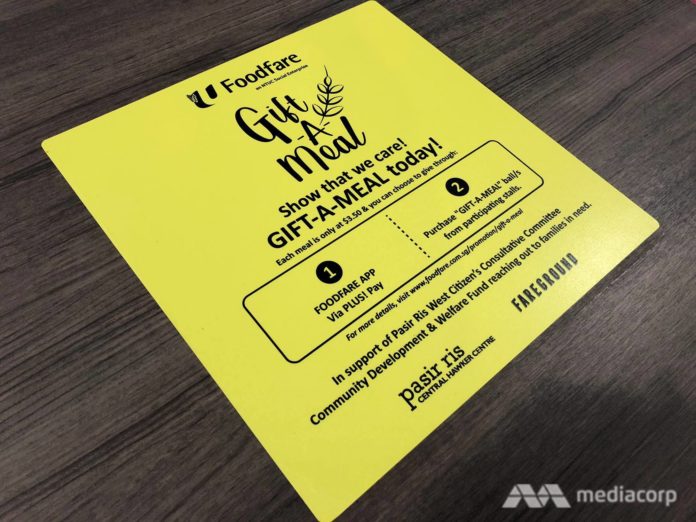
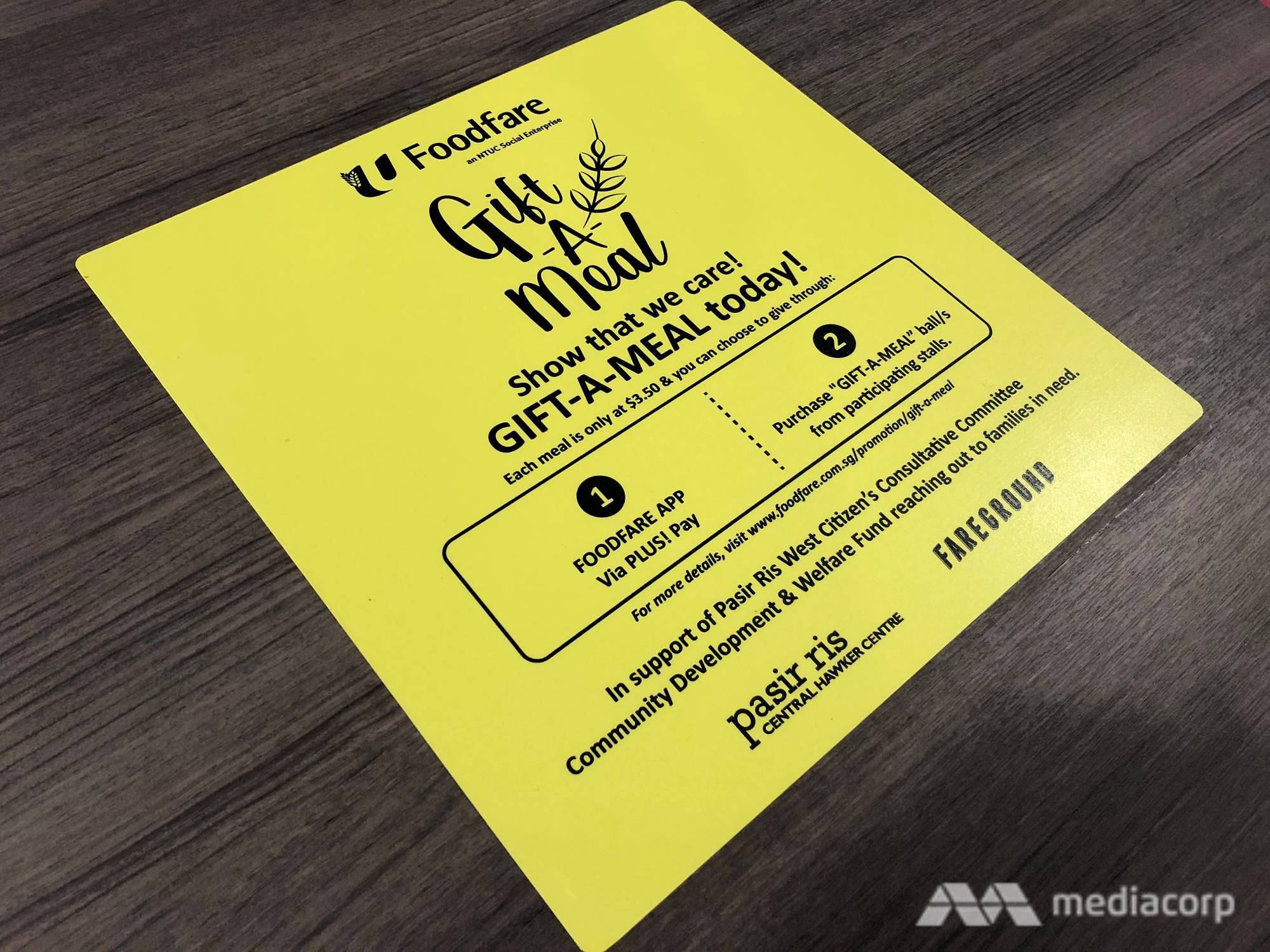
Through the Gift-A-Meal programme, the public will be able to make donations at Pasir Ris Central Hawker Centre in the form of meals at S$3.50 each. This can be done through the NTUC Foodfare mobile app or through the hawkers.
Funds raised by the programme will be administered by the Community Development & Welfare Fund, which will identify families in need. According to NTUC Foodfare, some 30 families are expected to benefit from the pilot.
The Gift-A-Meal programme was launched at Pasir Ris Central Hawker Centre on Saturday (Jul 14). (Photo: Vanessa Lim)
The programme was launched during the official opening of the Pasir Ris Central Hawker Centre on Saturday (Jul 14), which started operations in January.
The hawker centre has 20 food stalls selling local hawker dishes on the first floor, and 22 stalls offering modern cuisine on the top floor.
To keep healthy meals affordable, each stall offers at least two budget meals priced from S$2.80.
NTUC secretary-general Ng Chee Meng said NTUC enterprises like Foodfare play a key role in helping to regulate the cost of essential everyday items.
“As the cost of living rises in Singapore, many Singaporeans are concerned about having to cope with basic necessities,” he said.
“We take this role seriously and will work hard to ensure that we continue to enable Singaporeans to live better and more meaningful lives.”
The Gift-A-Meal programme was launched at Pasir Ris Central Hawker Centre on Saturday (Jul 14). (Photo: Vanessa Lim)
While the programme aims to benefit needy residents, stall vendors Channel NewsAsia spoke to said they hoped it would help to bring more business too.
Since the hawker centre started operations in January, four stalls have closed down.
“Some people still don’t know that our store at the hawker centre is open, so maybe that’s why they aren’t really coming here,” said Mr Lai Yi Sue, who runs a vegetarian food stall.
Some stall vendors cited the location and lack of public awareness as reasons for the closures.
“We don’t get office crowd because it’s a residential area, so it’s quite quiet during the day. Business is usually a bit better at night or on weekends,” said Mr Jason Yeo, who runs a fruit juice stall at the centre.
“The hawker centre is quite central but it’s not that near to the MRT station, so it may be a bit inconvenient for some,” said one stall vendor, who declined to be named.
SINGAPORE: We are living through the fourth industrial revolution.
The first was the Agrarian Revolution which happened about 10,000 years ago. Humans stopped foraging for food for survival. They learned to grow food and domesticated animals. Food production improved and human settlements grew in size, leading to the emergence of villages, towns and cities.
The second revolution, called the Industrial Revolution, began in the 18th century and accelerated in the 19th and 20th centuries. It was powered by the invention of the steam engine, electricity and mass production.
The third revolution began in the 1960s, with the invention of the computer, semi-conductors, personal computers and the internet. That is the world we have been living in.
The fourth revolution began at the turn of the 21st century. It builds on the third industrial revolution as it is also being driven by technology and digitalisation. New technology and innovation have given rise to companies which disrupt the status quo, for example, Airbnb, Grab and Alibaba.
The world is being transformed by robots, artificial intelligence, the Internet of things, big data, smart cities, block chain, the sharing economy, 3D printing, autonomous vehicles, nanotechnology and financial technology.
The fourth industrial revolution is remarkable for its speed and breadth. It is affecting every sphere of human activity.
Singapore must therefore prepare its young people with the knowledge, skills and mindset to take advantage of the new opportunities. This is why the Government has emphasised what is called STEM – meaning science, technology, engineering and mathematics.
This is not wrong but it does not tell the whole story. Many founders of new and innovative companies are not graduates of STEM. Founder and CEO of Razer, Tan Min-Liang, for example, is not a graduate of STEM but law. He is our youngest self-made billionaire.
File photo of Razer CEO Tan Min-Liang. (Photo: AFP/Roslan Rahman)
CASE FOR HOLISTIC EDUCATION
What the world needs is to educate our young people both in the sciences and the humanities. We need technologists who understand the humanities and humanists who understand technology.
When Steve Jobs, who attended but dropped out of a small liberal arts college, was asked what was the most important course he took in college, he said it was a course on calligraphy. His knowledge of calligraphy enabled him to design a keyboard for the Macintosh computer, which distinguishes it from its competitors.
When unveiling a new edition of iPad, Steve Jobs said:
It is in Apple’s DNA that technology is married with liberal arts, married with the humanities, that yield us the results that make our hearts sing.
Mark Zuckerberg was a psychology major at Harvard but he also dropped out of college. Mark has said that:
Facebook is as much about psychology and sociology as it is about technology.
I think I have made my point. What is changing the world is not technology alone but innovators and entrepreneurs who have been able to marry technology with design, psychology and sociology.
Facebook’s CEO Mark Zuckerberg is seen at the VivaTech (Viva Technology) trade fair in Paris on May 24. (Photo: AFP/GERARD JULIEN)
WHY STUDY HISTORY?
When parents ask me what their children should study if they aspire to join our foreign service, I tell them that it doesn’t really matter but I hope some of our diplomats would have studied history.
Ignorance of history can get you into trouble and the knowledge of history can empower you.
A Singapore developer had secured a site in Hanoi for development and was confronted by protesting Vietnamese veterans when the developer had wanted to demolish the prison standing on it.
The prison had been built by the French. During the long colonial rule, many Vietnamese freedom fighters had been imprisoned there, and some were tortured and killed.
To these Vietnamese veterans, the prison was sacred territory. In the end, a compromise was arrived at and a section of the prison has been preserved and turned into a museum.
As Chairman at the National Heritage Board for nine years, one of my initiatives was to put up markers to honour great men and women who had visited Singapore during their lifetimes.
The first marker was to honour the great Polish-British writer, Joseph Conrad. A British merchant Seaman before becoming a writer, Singapore was his base as he worked on ships which sailed between Singapore and the Indonesian archipelago and the island of Borneo.
The success of this first marker encouraged me to put up markers to honour Ho Chi Minh, Jose Rizal, Deng Xiaoping and Jawaharlal Nehru. Our gestures have touched the hearts of the leaders and people of their countries.
In diplomacy, I have learned that, as human beings, we think with both our heads and our hearts.
WHY STUDY LITERATURE?
One of the subjects I studied for my O-levels in 1955 was Literature. 63 years later, I consider the study of Literature one of the best investments I have made.
Through Literature, I acquired a love of books and the joy of reading. Reading is an educational, joyful and liberating experience. You are transported from your circumstances, no matter how difficult and challenging, to another world, another time and another civilisation.
Reading is the key that unlocks the door to the treasury of the world. At the inaugural Book Summit, held in Washington, I was moved by the testimonies of several famous American writers who said that reading had saved their lives.
Reading literature helps you to think, write and speak clearly. Clarity of thought and expression is a virtue which should be cultivated.
Reading literature gives one a better understanding of human nature and the complexity of the human condition. It makes one less judgmental and more sympathetic. Literature complements non-fiction in helping us to understand another country and its people.
In the case of Singapore, we should encourage our students, whether they are studying literature or not, to read the works of our poets, playwrights and authors.
I am an admirer of our poets, Edwin Thumboo, Lee Tzu Pheng and Leong Liew Geok. My favourite playwrights are Kuo Pao Kun, Robert Yeo, Haresh Sharma and Alfian Sa’at. I recommend the short stories and novels of Goh Poh Seng, Lim Chor Pee, Catherine Lim, Suchen Christine Lim, Philip Jeyaretnam, Simon Tay and Meira Chand.
Playwright Haresh Sharma. (Photo: Mediacorp)
CASE FOR THE HUMANITIES
The fourth industrial revolution has not made the study of the humanities irrelevant. We should study the humanities because it will help us to think analytically, to write clearly and to speak persuasively.
Apart from acquiring domain knowledge in the law, my legal education taught me how to think analytically and how to communicate my thoughts coherently, clearly and persuasively, both orally and in writing.
Norman Augustine, the former CEO of Lockheed Martin, when asked what was the most important qualification for advancement in his company, said that it was the ability to express one’s thought clearly in writing.
Amazon boss Jeff Bezos requires his senior executives to submit written memoranda for their meetings. If proposing a new product or strategy, the memo must take the form of a press release. It must use simple, jargon-free language so that a lay person can understand it.
My good friend, Professor Lily Kong, the President-elect of SMU, has written that:
It is in studying the humanities that we learn about humanity, or what it means to be human, in all its beauty and all its foibles.
“Through literature and history, we see, for example, the martyrdom of self-sacrificing leaders as much as we see the viciousness of ambition. We gain insights into what it means to have a kindred spirit but also a cruel enemy. We witness the tenderness of human love, the pain of loss and the joy of reunion.”
“In an age of hyper-technology, all the more reason why we need the humanities – to remind us of the glory and frailty of humanity, to retell the meaning of being human … Where robots can dispense medicines, and chatbots replace human conversations, the jobs that will withstand the fourth industrial revolution are precisely the ones that require an understanding of human nature and a reliance on human empathy.”
Professor Lily Kong will begin her term as president of SMU on Jan 1, 2019. (Photo: SMU)
What we should aspire for is holistic education. We want our humanists to understand technology and our technologists to understand the humanities. An education in the humanities train us to think, write and speak clearly.
As long as we are human beings, the humanities will always be at the heart of civilisation.
Professor Tommy Koh is Ambassador-at-Large at the Ministry of Foreign Affairs, Chairman of the Centre for International Law of NUS, and Special Adviser to the Institute of Policy Studies. This commentary is an abridged version of Professor Tommy Koh’s piece in IPS Commons. Read the original here.
SINGAPORE: “It’s something that we can safely predict won’t be a fad,” Mr Alvin Wong, partner of Singaporean DIY sushi chain Maki-San said on Friday (Jul 13), ahead of the business’ first major step outside Singapore.
It’s opening its first outlet overseas in Osaka on Saturday, with plans to expand to Tokyo in 2019.
With interest from Russia, England, Indonesia, Philippines and more, Maki-San’s decision to venture into Japan – a market saturated with sushi chains – may turn heads.
Mr Wong and his partner, Mr Omar Marks, who co-founded the food chain, have been set on Japan ever since Maki-San’s new franchise owner, Mr Yamamoto Masayoshi, approached them. Mr Wong said it “felt like we managed to sell ice to the Eskimos”.
Mr Masayoshi said: “I was looking for unique concepts to bring to Japan when I came across this brand. Most sushi in Japan uses very traditional ingredients.” Maki-San stood out for using “special ingredients from around the world, not just typical Japanese ingredients”.
Left to right: Mr Alvin Wong. Mr Omar Marks, Mr Yamamoto Masayoshi (Maki-San Osaka project director) and Mr Hitoshi Yokota (Osaka franchise owner).
Maki-San has three defining features: untraditional ingredients, make-it-yourself sushi and loud, colourful marketing with an affinity for social media.
In its brightly coloured stores, customers make their own rolls from ingredients including spicy chicken jerky and tempura mushrooms, and sit on pastel stools. The chain has enjoyed marked success with its concept, especially with a younger crowd, with 18 stores in Singapore.
In most sushi restaurants in Japan, Mr Wong said, “everything is already pre-configured, you already know what to expect.” Maki-San is where “consumers have the chance to customise their sushi to reflect their taste buds”. He is convinced that “it’s quite a safe bet.”
But he is not dismissing the risks. “It’s always a different market. Things that register with customers here may not register there,” Mr Wong said.
To cater to the Japanese palette, Maki-San tweaked their menu and recipes. The menu at its Osaka outlet will have a menu that is about 80 per cent similar to the Singapore version. Following taste tests in Osaka, the company has developed a better sense of Japanese customers’ taste profiles, notably including an aversion to salted egg yolk and chimichurri.
Sushi chain Maki-San has become characterised by its bright, colourful packaging. (Photo: Alvin Wong)
Recipes for staple items will differ between countries too. The Japanese outlet’s sweet plum sauce, tartar sauce, and yuzu sesame sauce have been tweaked to reflect the differences in consumers’ taste profiles. The sweet plum sauce, for example, is sourer in Osaka.
“We’ve seen other shops that have gone through the fad-ish period. A couple months after they open, sales dip quite a bit.” Maki-San has avoided the trap in Singapore so far. Mr Wong believes the company has shown the concept has a lasting appeal.
He said, “We look at ourselves as a brand that’s here to stay.”
SINGAPORE: She was threatened at knifepoint in her own flat by her husband, after a quarrel that escalated. Even police intervention could not guarantee her safety if she remained.
Madam Tamilvaannii already had obtained a Personal Protection Order against her abusive husband – it allowed the couple to live in the same home but separate rooms. Still, officers responding to her call advised her to leave for her own good.
“What if he stabs me to death after the police leave?” she thought to herself.
So in the middle of the night, she and her 18-year-old daughter Vinothinnii found themselves on the streets.
That was when Mdm Vaannii saw the true value of being a homeowner in a new light: It wasn’t just a roof over her head, or a place to decorate as she liked.
It was about having a haven where nobody could turf her or her children out. Said the 46-year-old:
I felt the pain of (having to leave). I saw that I must have my own home.
But it was to take eight years of anxiety as a single mother, and the unexpected boon of a second chance, before she found that security for her children, with assistance from the Housing and Development Board (HDB).
SO NEAR, YET SO FAR
The night she was chased out, Mdm Vaannii sought shelter with relatives. And so began a “very, very tough” transition from a full-time housewife to a sole breadwinner.
When her divorce was granted in 2011, her son went with her ex-husband, while she gained custody of her two daughters. To make ends meet, she started working two shifts as a healthcare assistant.
Mdm Vaannii found herself having to single-handedly raise her two daughters, Vinothinnii and Visalini.
In urgent need of housing, she rented a four-room flat on the open market for about S$2,200 a month – a steep price given their financial situation. It was a decision she made “in a rush”, because her daughters were in schools near the flat in Bukit Panjang.
And, she thought, it would only be for a short while because they had something better to look forward to: She had applied successfully for a new flat under a 2012 Sale of Balance Flats exercise.
But then, she was dealt another blow by her ex-husband: He refused to declare that he would not buy a subsidised flat within three years of their divorce.
At the time, only one party of a divorced couple could buy or own a subsidised flat within those first three years. The policy has since been lifted as of March 6, 2018, to help divorcees with children through an “already difficult period of transition”. But back then, her ex-husband’s intransigence dashed her hopes.
Her daughters’ entreaties on her behalf could not move him, and her application had to be cancelled. “If anything happens to me, where are they going to go?” fretted the “very disappointed” and “lost” mother.
FROM FOUR-ROOM TO TWO-ROOM FLAT
After over a year of renting, her savings were running low, even with her 40-per-cent share of the proceeds from the sale of the matrimonial four-room flat in 2012.
That and her S$900 monthly salary as a patient care assistant in a polyclinic would not cover both the rent and her daughters’ education, as well as their living expenses, for long.
So in May 2012, the family applied for a public rental flat from HDB. While the policy then generally debarred people from applying within 30 months of selling their HDB flat, the housing authority looks at applicants’ needs and options on a case-by-case basis.
In Mdm Vaannii’s case, she was assessed to be financially unable to buy a flat and without other options – and so the requirement was waived. They were allocated a rental flat in December.
Living in a rental flat felt like being in limbo, but they made it as much a home as possible.
Her elder daughter, Ms Vinothinnii, who is now 26, recalls the day she first saw their current two-room rental flat in Clementi. It was a reality check after staying in a four-room flat with her own bedroom.
We walked in, and I just sat in a corner, with my hands on my head.
“How small it was. How were we going to live here?” she thought.
She remembers that they cried as they packed their belongings, such as photo albums and soft toys, for storage in a warehouse. For Mdm Vaannii, having to put away items of sentimental value, chiefly two boxes of saris, was the most painful part of the move.
“All of the saris have meaning,” she said. “Most of them my father bought for me.”
Much of their belongings, including cherished photo albums and saris, had to be stowed in a storage facility.
Still, though they felt as if they were in limbo over the next five years, they made do with the temporary home they had.
And in early 2016, it seemed like things might look up when Ms Vinothinnii began working full-time as an operations manager, and could help with the bills.
The snag: Their monthly rental, which was pegged to household income, was adjusted from S$275 to S$495 after she was a year into her job.
The trouble was that a chunk of her pay of S$2,500 a month was going to her part-time studies at the Singapore Institute of Management. The rent increase wasn’t something they could afford.
Ms Vinothinnii even considered splitting up the family and moving to a relative’s home, in the hopes the rent would remain as it was.
But the idea and the uncertainty of their situation affected her mother so much, that she decided it was time to try again to own their own home, and apply for a flat jointly with her mum.
“I always wanted a house under her own name,” she said.
A FRESH START, AND HAPPINESS
The turning point in the family’s search for a permanent home came not quite in the way they had expected.
While they were submitting a Sale of Balance Flats application in November 2016, an HDB officer suggested to Mdm Vaannii that she apply for a flat under the newly-minted Fresh Start Housing Scheme.
The scheme is aimed at families with children below the age of 16, who are living in public rental flats and have owned subsidised housing previously. It provides them with a chance to own a home again – specifically, two-room flats with flexible leases ranging between 45 and 65 years, which are more affordable than standard two-room flats with 99-year leases.
It was a significant opportunity for the family because of their tight financial situation. The flat would also come with a grant of up to S$35,000.
And so, in December, Mdm Vaannii applied for the scheme with her two daughters, one of whom – Ms Visalini – was 15 at the time.
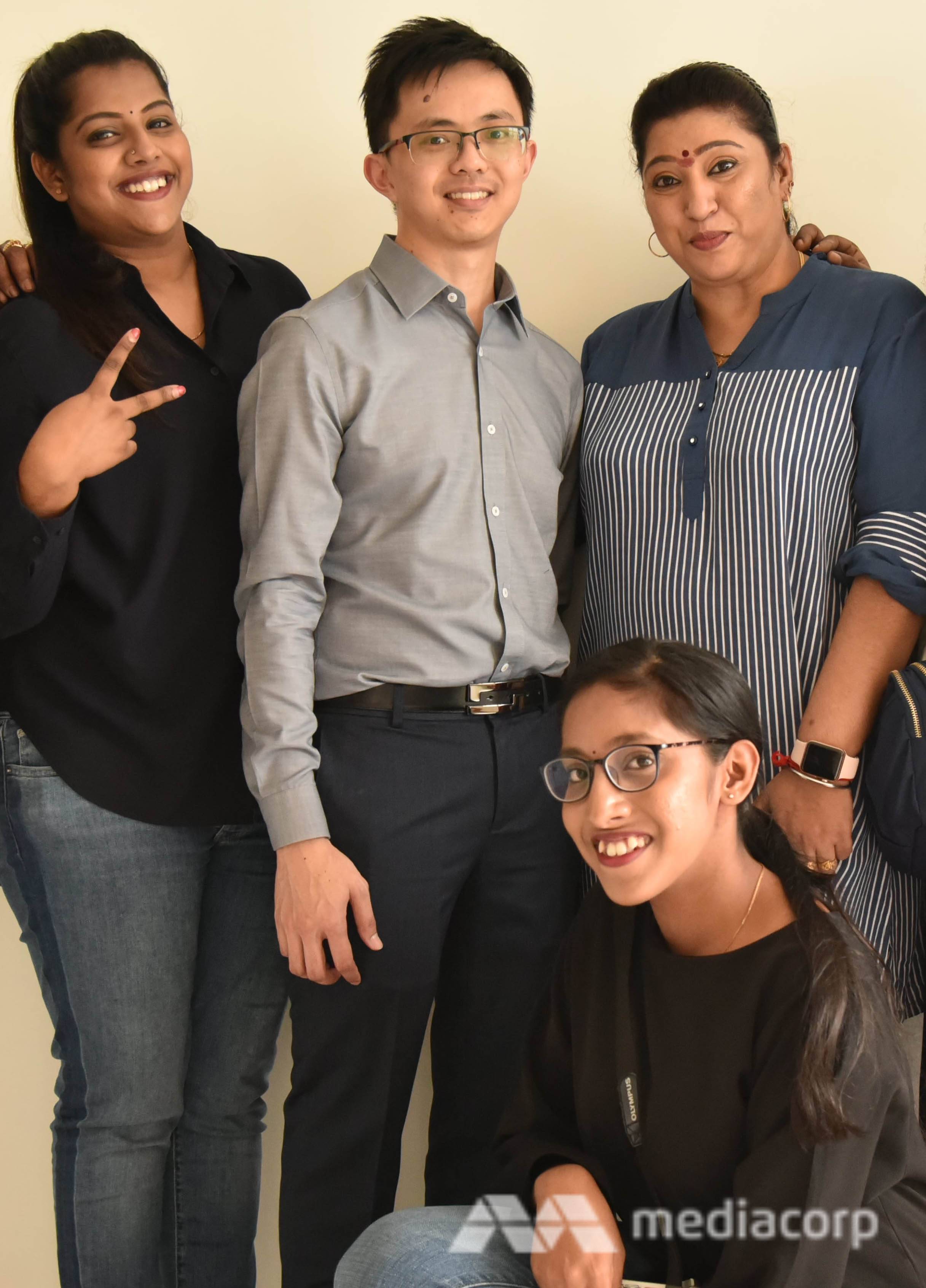
Vinothinnii and Visalini.
Within a month, the family received a letter from the HDB: Their Sale of Balance Flats application was unsuccessful because their balloted queue position was beyond the available flat supply. But the Fresh Start application went through.
Three months later, they received the official letter of approval. Mdm Vaannii could proceed to apply for a flat – and be a homeowner again. Said her elder daughter: “When she got accepted under Fresh Start, she was the happiest woman.”
HELP TO MAKE A DREAM COME TRUE
But she had lived with uncertainty for so long that, even amid her joy, Mdm Vaannii could not quite shake off the feeling of disbelief. Not even when they were choosing their two-room flat.
I kept asking, ‘Are you sure I’m choosing my flat? Am I really going to buy a flat?’
Fresh Start applicants must meet a set of criteria to “ensure that they’re committed and ready for homeownership”, according to the HDB. They must, for example, qualify for a Letter of Social Assessment from the Ministry of Social and Family Development (MSF), which would assess their family stability, ability to manage their finances, and the children’s regularity of school attendance.
Mdm Vaannii made the cut. Hers is one of 70 families who have found a home under the scheme so far.
And for her to make the most of this “dream come true”, HDB and MSF officers were on hand to offer assistance. As she put it, “From nowhere, someone popped up and said, ‘Hey, I’m here to help.’”
For example, HDB senior estate manager Johnson Lim helped her to work out her housing budget, which consisted mainly of her Central Provident Fund (CPF) savings, an HDB concessionary loan (subject to credit assessment), and the Fresh Start Housing Grant, where of which S$20,000 would be credited to her CPF account upfront.
“One of the key aspects of this scheme is financial sustainability,” Mr Lim said. “What I try to do is understand the applicants’ situation and come up with a housing plan according to their circumstances.”
The family with Johnson Lim, one of the officers who helped them through the process.
The flat cost Mdm Vaannii about S$133,000, after incorporating a reduced resale levy of S$16,700 based on the 60-year lease period. And she opted for a flat with all the finishes, which will help her save on renovation costs.
As they waited for the day they could finally move in, her family were hardly able to contain themselves. They went for drives in her brother-in-law’s van to see their new block in Bukit Batok take shape.
“Every week, without fail,” said Ms Vinothinnii with a smile. “They have to see whether the house is okay, if the construction is okay. They even inspected the car parks.”
HOME SWEET HOME, FINALLY
When it came time to collect her new set of keys, Mdm Vaannii was visibly nervous – but above all, deeply moved. As were her daughters. Ms Vinothinnii burst into tears as she walked down the corridor to their flat.
“Tears of joy,” she managed to say. “The struggle has finally paid off.”
With her family cheering behind her, Mdm Vaannii opened the door of her new home. Bare as it was, excited squeals filled every corner as the family flooded into the flat.
Taking a moment for herself, Mdm Vaannii stood by the window to admire the greenery outside. “I’m starting anew – after a very long time, having our own home,” she said, teary-eyed.
I’m so happy. No words to talk.
A teary Mdm Vaannii savours the view from her new flat for the first time.
In fact, this will be their home for at least 20 years, the minimum occupation period under the Fresh Start scheme. Ms Visalini, now 17, is looking forward to holding family gatherings here, while her older sister is chewing over renovation ideas.
Their mother is planning on doing one thing first: Moving her saris out of the warehouse for good. “There’s a storeroom (here), so we can put a cupboard in there,” she said. “I’ll hang the saris. Only the saris.”
In the place she can finally call her own home, sweet home.
SINGAPORE: The scrapping of unwanted oBikes is underway, with some bicycles in the process of being dismantled and broken down.
When Channel NewsAsia visited the Enviro-Hub Holdings compound in Tuas on Friday (Jul 13), a large heap of oBikes was spotted piled up at the back of the property.
There were also oBikes lining the side of a warehouse.
A spokeswoman from Cimelia Resource Recovery, a subsidiary of Enviro-Hub Group, said in a WhatsApp message that the space is leased to a company called Sing Metal Industry, which is recycling oBikes.
An on-site supervisor of Sing Metal, who declined to be named, said that close to 1,000 bicycles were sent to the compound on Monday (Jul 9) by a “trucking company”. Sing Metal purchased these bicycles and aims to take them apart within a month.
The broken up bikes will then be mixed with other metals, before being sold to be melted down. Channel NewsAsia understands that oBikes have also been transported to other companies.
These oBikes will be scrapped over the course of the month. (Photo: Matthew Mohan)
oBike shuttered operations last month, citing difficulties in meeting new requirements put in place by the Land Transport Authority (LTA) to tackle indiscriminate parking.
The bike-sharing operator was instructed by LTA to work with its liquidator to remove bicycles from public spaces by Jul 4.
Since then, customers have tried to get back their deposits, which add up to S$6.3 million in total. Liquidators have said affected customers should submit online applications.
There are an estimated 1,000 oBikes which will be scrapped at this compound. (Photo: Matthew Mohan)
These complaints come a day after the provisional liquidators of oBike Asia – which had earlier announced it is exiting the market from Jun 25 – said affected consumers should submit their claim together with relevant supporting documents through an online portal www.obikedepositholders.com “as soon as possible”.
The website has a link re-directing people to a Google Docs form that, among other things, is requesting user details such as oBike account name, mobile number and email account used to register with the company, member ID as well as initial deposit amount.
Screengrab of the online form for users to apply for a refund from oBike.
Additionally, it also requested data such as one’s NRIC or identification number, name on NRIC, telephone bill used to register one’s oBike account, student certification and postal address.
The amount of information needed to kickstart the refund process with the bike-sharing company has irked some users.
One of them is Mr Aloysius Low, who told Channel NewsAsia: “I think it’s deplorable that consumers will need to give up a lot of personal information in order to get back what they had, in good faith, placed with oBike.
“Why does the liquidator require credit card statements, IC numbers, phone bills or even student verification? Shouldn’t there be a process to refund it automatically through the app already?”
He also went on to question whether the form submission is secure and if there are safeguards in place to protect the information given.
The online form also caused some to question its authenticity.
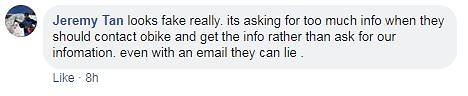
One Facebook user, Jeremy Tan, posted a comment on the social media platform saying the form “looks fake really”.
“Its (sic) asking for too much info when they should contact obike and get the info rather than asking for our information,” he wrote.
Another Facebook user, Sarah, simply wrote: “Is this even real!?” in response to Mr Low’s initial Facebook post on the matter.
Channel NewsAsia has reached out to FTI Consulting to comment on these issues, as well as an update on the refund process.
The bike-sharing company on Jul 5 announced it has appointed Mr Joshua James Taylor and Mr Yit Chee Wah of FTI Consulting as its provisional liquidators, who is working with the Land Transport Authority of Singapore (LTA) to collect oBike’s bicycles.
The company’s founding investor and chairman Shi Yi told Channel NewsAsia last Tuesday that the total deposits it owed to customers amounted to US$4.6 million (S$6.3 million).
TOKYO has dethroned Hong Kong as the most expensive city in Asia for overseas workers, according to a survey released last month.
The ECA International Cost of Living Ranking data showed that within the space of 12 months, Hong Kong fell from the second most expensive place on the planet for expatriates to 11th – largely because of a depreciating Hong Kong dollar.
“Although the price of goods has continued to rise in Hong Kong in the past 12 months, the Hong Kong dollar has weakened over the same period of time” said Lee Quane, Regional Director – Asia at ECA International.
“This has meant that Hong Kong has fallen behind Tokyo, Seoul and Shanghai in the rankings”.
Tokyo is now the least affordable city in Asia for expats, and the seventh most expensive city worldwide.
“It is only the yen’s relative strength against the US dollar that has seen the Japanese capital has become the most expensive place in Asia for foreigners to live and work at Hong Kong’s expense,” Quane said.
“It has been a similar theme in Seoul, which is also now above Hong Kong in the rankings, despite remaining in eighth place globally.”
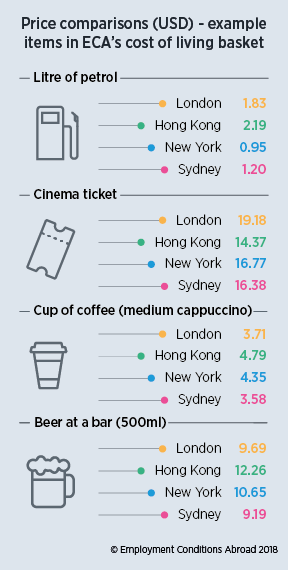
ECA’s ranking considers the cost of commonly purchased items, including a litre of petrol, a cinema ticket, a cup of coffee, and a beer at a bar.
Shifting exchange rates had largely been responsible for movements in the ranking since 2017, said the company.
“Rates of price increases throughout most of the major locations in Asia researched has been quite low,” Quane said.
“Currency movements, on the other hand have been quite volatile with several emerging market currencies strengthening against the US dollar in the last year.”
Like Hong Kong, the Taiwanese cities of Taipei and Kaohsiung saw a fall in the cost of living, dropping out of the top 30 and 40 most expensive places, respectively.
Mainland Chinese cities, however, moved up the rankings, with Shanghai overtaking Hong Kong into 10th spot overall. “The stronger yuan pushed all locations up in our rankings,” explained Quane.
Singapore moved up the rankings from 24th place to now being listed at 20th most expensive in the world.
SINGAPORE: Two men who helped former City Harvest Church leader Chew Eng Han in his attempt to escape Singapore by boat were sentenced to jail on Friday (Jul 13).
Tan Poh Teck, 53, was the boatman piloting the motorised sampan in Chew’s escape bid on Feb 21, a day before Chew was to start his jail term for his role in the City Harvest saga. He was sentenced to 27 weeks’ jail.
Tan Kim Ho, a 42-year-old Malaysian man also known as Rayson, made arrangements for Chew to leave Singapore for Malaysia by boat. He was sentenced to a jail term of six months.
The boatman was arrested on Feb 21 along with the former City Harvest fund manager when the Police Coast Guard intercepted the sampan following a tip-off, while Malaysian authorities handed Rayson over to the Singapore police in April.
On Friday, Tan Poh Teck pleaded guilty to one charge of abetting Chew, 58, to leave Singapore from Pulau Ubin’s jetty, which is not an authorised place of departure or embarkation.
He had intended to take Chew to the north-east part of Pulau Ubin, where Chew would take another boat to Malaysia.
District Judge Ng Peng Hong agreed with the prosecution’s request for a sentence higher than the minimum six months for Tan, as he has also been charged with abetting two other people to leave Singapore by boat.
Rayson also pleaded guilty to a single charge of abetting Chew in his bid to leave Singapore illegally, by making arrangements for the boat.
Chew began serving his jail term of three years and four months for criminal breach of trust and falsification of accounts on Mar 1.
Of the six City Harvest leaders who were convicted of misusing church funds, Chew was the last to begin serving his sentence. He had asked for multiple deferments, including asking to defer his sentence until after Chinese New Year.
After his attempt to flee, Chew was given two additional charges: One of trying to leave Singapore illegally and another of attempting to intentionally defeat the course of justice by trying to leave the country a day before he was to serve his sentence.
He is scheduled to attend a pre-trial conference for the new charges on Jul 19.
PARIS: Singapore’s Defence Minister Ng Eng Hen on Thursday (Jul 12) hailed the “strong and growing ties” between France and Singapore, as the two countries celebrated the 20th anniversary of the Republic of Singapore Air Force (RSAF)’s presence at Cazaux Air Base.
Speaking at the air base in France, Dr Ng highlighted the long history of defence cooperation between both countries.
“The RSAF’s presence in Cazaux is a physical testament to the strong and growing ties between our two countries,” he said. “It is developed on a shared foundation of ideals and values for both our countries built on liberty, equality and fraternity.”
“Twenty years on, I think we can say that the people of Cazaux and the RSAF families here are no longer strangers,” he added.
“They know each other, they trust each other. Their warm relationship reflects the ties between our two countries.”
About an hour away from the city of Bordeaux, the air base at Cazaux is where the RSAF’s 150 Squadron has been based for the past 20 years.
The squadron operates the M-346 Advanced Jet Trainer aircraft which closely mimics the flight performance of modern-day fighters like the F15.
To mark the occasion, Dr Ng also unveiled the 20th anniversary tail flash on an M-346 aircraft, along with the French Secretary of State to the Minister for the Armed Forces Genevieve Darrieussecq.
Said Dr Ng: “From the offer of the Cazaux Air Base to facilitating the upgrading of the RSAF’s flying training system with the M-346 Advanced Jet Trainers, our French hosts have remained steadfast in their support through the years.
“And with your support, we look forward to many more years of cooperation and training in France.”
The RSAF’s presence in Cazaux is made possible under a technical arrangement which allows Singapore to deploy its fighters to French air bases for training.
In 2011, the RSAF’s arrangement with France was extended to 2035.
With air space 32 times the size of Singapore, Cazaux Air Base offers RSAF pilots with sprawling skies to hone their flying and combat skills.
Minister for Defence Ng Eng Hen (far right) and French Secretary of State to the Minister for the Armed Forces Geneviève Darrieussecq (far left) witnessing the unveiling of a commemorative plaque for the 20th anniversary celebrations of the Republic of Singapore Air Force’s Cazaux detachment. (Photo: MINDEF)
“WE ADAPTED VERY WELL”
Since 1998, more than 190 Singaporean pilots have been trained at the base.
One of these is Captain Yeap Wei Jiun, the Officer Commanding of the 150 Squadron, who has been based at Cazaux Air Base for two-and-a-half years.
“Despite the language differences, we adapted very well,” he said. “The Singaporean community here form a tight network with one another, so we get together over the weekends, like for example (for the) World Cup, we go to each others’ houses to view the World Cup together.”
Dignitaries at Cazaux were also given a sneak preview of the flypast which they will be doing.
The combined flypast between the RSAF’s M-346 Advanced Jet Trainer aircraft (far right) and two of the French Air Force’s Alpha Jets at the 20th anniversary celebrations of the RSAF’s Cazaux detachment. (Photo: MINDEF)
Speaking to reporters later, Dr Ng said Singapore’s collaboration with France is very deep, even beyond the Cazaux detachment.
“We cooperate on a number of advanced projects, in terms of defence technology, especially where the strengths of the French, the defence ministry as well as their defence companies, as well as in areas like cybersecurity,” he said.
“So I would say it’s multi-faceted. It’s been a very rich, very productive relationship and I think it’s because we share perspectives on both of our countries of liberty, equality, fraternity, as well as shared values about the world that we live in.”
Also as part of the celebrations, items from Singapore and France were placed inside a time capsule, which will only be opened 20 years later.