SINGAPORE: Members of the local footballing fraternity have warned that Benjamin Davis’ development could be disrupted by two years of National Service, following news that his application to defer his NS has been rejected.
The 17-year-old midfielder has signed a two-year contract with Fulham, the newly promoted Premier League (EPL) club announced on its website on Friday (Jul 13). Benjamin, the first Singaporean to ink a professional contract with a top-tier English club, turns 18 in November.
Former Hougang United coach Philippe Aw told Channel NewsAsia that if Benjamin has to juggle serving NS and playing football, his growth as a footballer will be hampered.
“It is guaranteed that his development will be curtailed for sure,” said Aw.
“It’s not easy to serve NS and play football. A young player who trains in Singapore versus a young player who trains in Fulham – it’s a big, big difference. The environment here is not positive enough, not challenging enough for a young player to develop faster.”
A former Singapore international who declined to be named agreed with Aw.
“This responsibility has always been a hindrance to the development of Singaporean footballers,” he said.
The experience of playing abroad is a crucial one for a young player, said Albirex Niigata midfielder Adam Swandi, who spent almost two years at the academy of French club FC Metz.
“It helped me to mature as a player, that was the vital age for me to change from an aspiring player to a professional player,” stressed Adam.
He returned home for the 2015 Southeast Asian Games and later served his NS, and said he understands the rationale in having to do so.
“Of course as a footballer, you won’t want to waste the two years which could be an important period, but NS is a part (of life) which you cannot escape and there are some positives that you can take away from it,” he said.
“There are so many benefits of being a Singaporean – this is part and parcel of life, you have to go through it.”
In MINDEF’s statement, the ministry said that very few applications have been approved over the years and for sports, deferments are granted to those who represent Singapore in international competitions like the Olympic Games and are potential medal winners for the nation.
Only three have met this criteria in the last 15 years – swimmers Joseph Schooling and Quah Zheng Wen, as well as sailor Maximilian Soh.
But Aw believes that the criteria for deferment should also take into account the level of football at which Davis could soon be playing.
“It is a gold medal in football – to play football in the top five leagues in the world,” quipped Aw.”There’s never been a Singaporean who has done this.”
FILE PHOTO: World Cup – Group F – South Korea vs Germany – Kazan Arena, Kazan, Russia – June 27, 2018 South Korea’s Son Heung-min celebrates after the match REUTERS/Dylan Martinez/File Photo
Former national coach Vincent Subramaniam, however, disagrees that Benjamin’s development could be severely affected.
“The hampering (to his footballing growth) is minimal,” he said. “There’s definitely a possibility that he can continue to train. Talent doesn’t go away, it stays with you.”
He pointed to the example of South Korean star Son Heung-Min, who could still have to serve mandatory military service despite being one of the biggest Asian stars in Europe.
“That kind of sacrifice is one that has to be made for the country,” insisted Subramaniam, who had several full-time NSmen under his care when he was coach of Singapore Armed Forces FC from 1996 to 1998.
“Ben could find that it might be best to serve NS as early as possible, get it out of the way and then he can pursue his career in football.
“That would be the best option for him, because if he has to serve at the peak of his career, that would be even worse.”
SINGAPORE: Issues related to jobs, education and housing were among the concerns raised by Jurong residents who met Manpower Minister Josephine Teo, Education Minister Ong Ye Kung and National Development Minister Lawrence Wong on Sunday morning (15 July).
The three ministers were on a Ministerial Community Visit, the first time three ministers have conducted it together. It is typically conducted by one minister.
Speaking to the media, Mr Ong said this will be the new format going forward as the ministers were able to attend to residents’ concerns more effectively as a team.
Manpower Minister Josephine Teo said these sessions could help political office holders connect better with real issues on the ground. (Photo: Deborah Wong)
“So as we were walking just now, you can see residents with children going to school, they will come and talk to me about their school work, tuition, about applying for polytechnics.
“Those who are looking for work, they will talk to Minister Josephine Teo, and those facing issues with HDB they will talk to Minister Lawrence Wong,” Mr Ong explained.
“So I think it’s useful. By walking together, the three of us can exchange notes, which will give us a more holistic understanding of the issues that residents face.”
Mr Ong, who is in charge of coordinating ministerial community visits for this term of government, said the leaders are studying the possibility of involving more ministers, as well as intensifying the visits to ensure greater outreach efforts.
The ministers were hosted by Mr Ang Wei Neng, grassroots adviser to Jurong GRC.
During the visit, the ministers had breakfast with residents at coffee shops and interacted with stall holders in the dry market near Blocks 494 and 497 at Jurong West Street 41.
They also visited the homes of senior citizens in Block 499 where they were introduced to the newly launched Red Cross Home Monitoring System – which allows vulnerable residents to call for help more effectively.
Education Minister Ong Ye Kung and National Development Minister Lawrence Wong interacting with stall holders in the dry market near Blocks 494 and 497 at Jurong West Street 41. (Photo: Deborah Wong)
The visit concluded with a dialogue led by Mrs Teo, who spoke with invited residents about the future of work.
“On the part of those about to join the workforce, they wanted to know how their skills could be relevant for their entire work lives,” she told the media.
“For those who are slightly older, they wanted to know how they could remain in employment and how they can be treated fairly by their employers.
“At the same time we had a number of business owners in the audience. They, of course, were concerned with whether they can transform quickly enough, to keep pace with the changes and, most importantly. how they can continue to be attractive to job seekers.”
Mrs Teo added that these sessions could help political office holders connect better with real issues on the ground.
“It helps us think about our policies, where to prioritise and also what kinds of interventions are needed in order to help people make progress,” she said.
SINGAPORE: Conscientious businesses and early adopters such as Plain Vanilla, KFC, Deliveroo, Millennium Hotels and IKEA in reducing single-use plastic waste, should be applauded for their courage and leadership, and responsible consumers should shift their business accordingly.
But the scale of our consumerism – leading to more plastic than fishes in our oceans in 2050, and microplastics from disintegrating plastic waste contaminating our water, food chain and us – demands a similarly robust response.
Addressing our plastics problem requires tackling it at its root – the use of plastics, in particular single-use plastic. If we do not want to be nourishing our families with plasticised food and water, or have more sea animals die because we “need” straws to drink, then minimising plastic usage seems logical.
Merely attempting to recycle, amidst this avalanche, is as effective as stopping sea level surges with a wine glass.
Complementing plastic use reduction is circular economy design – worth the investment in producing thoughtful, well-made products that stand the test of time, and potentially a sector of opportunity for Singapore going forward.
China’s decision to stop being the world’s rubbish dump, resulting in our plastic “recycling” simply getting burnt and taking up limited landfill space, should provide further impetus.
Plastic can be essential, in limited and specific situations, such as medical purposes and assisted living for the physically challenged. But the bulk of the 9 billion tonnes of plastic ever created do not stem from essentials.
Rampant and indiscriminate plastic usage does not only injure or kill sea creatures; microplastics taint breast milk with which we nourish babies, and even donor organs. Allowing this to continue could mean plastics rather than AI transforming humans in the future.
At current rates of dumping, there could be more plastic trash than fish in the world’s oceans by 2050 if nothing is done. (Photo: AFP/Noel CELIS)
IRRESPONSIBLE BUSINESSES MAY BE RESPONSIBLE
The challenge may be more fundamental – do businesses have the right to force society to bear their negative externalities?
Would plastics companies guarantee that microplastics from their products are safe for human or animal consumption?
Privatising profits and socialising costs is a surefire way of escalating the tragedy of the commons.
Encouraging corporate irresponsibility, ensures that the rest of us – government, civil society and responsible businesses – have to invest time and other resources to help corporate babies clean up their own mess. Obviously, this is not sustainable.
There are innovative ways to collect and even liquefy plastic waste, but should society bear this cost?
Beyond plastics, Obike is just one of the more public and recent examples of the pain that corporate irresponsibility could cause.
KFC’s move in particular, seems to have prompted significant attention. Its scale and the siren call of fast food in general, means an estimated “reduction of 17.8 metric tons of single-use plastics in a year”.
McDonald’s in contrast, has not extended its UK civil action to replace plastic straws with paper ones to Singapore. If businesses cannot regulate themselves, it may prompt regulatory action ala the EU.
Birds of Paradise gelato boutique uses paper cups too, (Photo: Vivian Claire Liew)
For an advanced nation aware of climate change’s impact, why do we still allow caviar environmental standards to muddle through?
HOMEGROWN COMPANIES RISE TO THE CHALLENGE
Forward-thinking small enterprises such as homegrown Plain Vanilla Bakery are taking responsibility – and even more holistically. Without a huge public relations budget, it is serendipitous that their green policies came up in my newsfeed.
They chose not merely to forego plastic straws completely, but bottled water sales too.
Combined with a decent discount to encourage you to bring your own bag and reduce takeaway waste, they might be seen to have taken on some financial risk – though it is likely to be more than offset in the medium and long term by increased customer goodwill and business.
What heartens me at least as much is its food waste reduction programme, including importantly, redistribution of unsold food to those in need in Singapore.
The current war on plastic may have stemmed from the injuries or deaths of sea creatures, but the way to move the needle is for the public to understand their skin in the game.
US journal Science notes that 8 million tonnes of plastic are dumped into the earth’s water system per year, with toxic particles ingested by fish and up the food chain.
The Great Pacific Garbage Patch, the largest accumulation of ocean plastic in the world, is only the size of France because the rest have disintegrated. Microplastics taint our food and water; which good parent wants to feed their children with plastic-laced food?
Screengrab of a video posted on Facebook shows British diver Rich Horner swimming among plastic rubbish in the waters off the Indonesian resort island of Bali. (Photo: Facebook/Rich Horner)
The rising accrual of microplastics and toxins in our bodies should concern policymakers responsible for the well-being of citizens, particularly given Singapore’s imperatives of health, fertility and productivity.
We have other major national priorities that demand mental bandwidth, design thinking and other resources, so I hesitate to recommend an all-out strategy to tackle plastic given our hierarchy of needs. Moreover, the largest part of oceanic plastic waste – fishing nets – does not stem from Singapore. But here are a select few recommendations for thought.
MAKE CLEAN DRINKING WATER AVAILABLE EVERYWHERE
The most important actions our Government can take to mitigate the health risks is a focus on water distillation instead of filtration, as distilled water is free of microplastics.
If micro-filtration to remove microplastics can be deployed at lower costs, that could be a less disruptive and more desirable way of achieving mass microplastic-free water.
Another significant move we should take is to enhance and accelerate plans to have water dispensers publicly available, with at least one in each building, including MRT stations, bus interchanges and malls.
While that is targeted at reducing the need for sugary drinks, the presence of water dispensers reduces the need for the purchase of bottled water, and makes it sensible to carry one’s own.
(File photo: AFP/Justin Sullivan)
A Whole-of-Government approach might also see Singaporeans use an app that pinpoints the locations of water dispensers, giving the public assurance of access to drinking water everywhere – a bonus as temperatures soar and keeping hydrated becomes a health imperative.
To encourage Singaporeans to be environmentally conscious, the same app could highlight F&B outlets that have abolished single-use plastic completely.
A challenge is how to compensate current drinks sellers – be it in malls or in hawker centres. Rental rebates commensurate with bottled water sales, and helping them pivot to healthy drinks by enlisting the help of universities or social impact enthusiasts through hackathons for instance may be some ways.
More available fresh juices free of artificial sugar, are likely in Singapore’s health interests and also help raise the profit margins of entrepreneurs versus bottled water.
Protecting our culinary heritage in hawker centres, would seem to dovetail with serving food in actual plates and utensils, rather than plastic ones, which is not known to be heat-stable. Many of us have been concerned with cafes and restaurants serving food in plastic disposables even for dining in.
If this is because of staff costs involved in washing utensils, why not invest in a dishwasher with bulk purchase deals, so that we can have clean utensils that are cheaper in the longer run economically and environmentally?
Plastic bubble tea cups and straws. (Photo: Wikimedia Commons)
TACKLE SCOURGE OF PLASTIC USE
There is much that can be done to tackle the scourge of plastic use in our part of the world.
Five Asian countries – China, Indonesia, the Philippines, Vietnam and Thailand – account for 60 per cent of plastic waste leaking into the ocean, according to Ocean Conservancy and the McKinsey Centre for Business and Environment.
Singapore could leverage its ASEAN Chairmanship – in its Year of Climate Action – on evaluating and building the case for the minimising of plastics for our greater good, beyond plastic to climate action overall, and beyond the plastic sector to the entire corporate sector.
Vivian Claire Liew is founding CEO of social enterprise PhilanthropyWorks and a Young Global Leader of the World Economic Forum.
SINGAPORE: Singaporean footballer Benjamin Davis’ application to defer his national service (NS) enlistment was rejected by the Ministry of Defence (MINDEF).
In a statement on Sunday (Jul 15), MINDEF confirmed that Davis’ application was not approved as he “does not meet the criteria for long-term deferment from Full-time NS”.
“As all male Singaporeans liable for Full-time NS put aside personal pursuits to dutifully enlist and serve their NS, it would not be fair to approve applications for deferment for individuals to pursue their own careers and development.
“Very few applications have been approved over the years and based on criteria which are made known to the public.In sports, deferments are granted only to those who represent Singapore in international competitions like the Olympic Games and are potential medal winners for Singapore. In the last 15 years, only three have met this criteria,” MINDEF said.
MINDEF added that the decision was made in consultation with the Ministry of Culture, Community and Youth and was communicated to Davis and his parents on Jun 11.
“Mr Davis was also notified that he is due for enlistment and must dutifully serve NS along with others in his cohort,” the statement said.
It was earlier reported that Davis had signed the first professional deal of his career with newly promoted English Premier League (EPL) club Fulham FC.
He is the first Singaporean to sign a professional contract with a top-tier English club.
Ben Davis, together with his father Harvey, signing a two-year scholarship with English side Fulham. (Photo: Fulham FC)
Speaking to Channel NewsAsia earlier, Davis’ father Harvey Davis said they were informed by the Football Association of Singapore that it will help to put in appeal to MINDEF and that they were working on the appeal.
“As the father of Ben, I really hope that common sense can prevail so that Ben can be given the opportunity to not just pursue his dream of playing in the EPL, but also the dream of every young Singaporean footballer and to make Singapore proud by being the first Singaporean to play in the EPL,” said Davis’ father.
When Davis had learned about the deal he told Channel NewsAsia that the deal was “fantastic news for Singapore football”.
“It shows that Singapore can produce footballers who can play at the highest level in the UK,” the 17-year-old added.
“Ben has been trained here in Singapore and shows to all Singaporeans that you can be coached in Singapore and achieve the highest level for a 17-year-old on the international stage,” added the senior Davis, echoing his son’s sentiments.
“If Ben is not deferred then the message is clear and simple; that there is no chance or opportunity for team sportsmen to compete on the World stage. What message does this send to our children and young Singaporeans who dream of playing professional football in Europe and the EPL or any other team sport,” he added.
Harvey Davis also said that the authorities had been informed of his son’s professional contract with Fulham as well, noting that his son would eventually serve his NS.
“We have been completely transparent with the authorities who were immediately informed of his scholarship contract back in 2016 and his professional contract back in May this year.
“We fully understand the importance of serving your country and my older son has already served and so will Ben as will my younger boy.”
Drawing comparisons between his son and Olympic swimmer Joseph Schooling, Harvey also commented on Schooling’s deferment.
“If Joseph had not been given the deferment and opportunity he would never have won the Olympics.”
SINGAPORE: Singaporean footballer Benjamin Davis’ application to defer his national service (NS) enlistment was rejected by the Ministry of Defence (MINDEF).
In a statement on Sunday (Jul 15), MINDEF confirmed that Davis’ application was not approved as he “does not meet the criteria for long-term deferment from Full-time NS”.
“As all male Singaporeans liable for Full-time NS put aside personal pursuits to dutifully enlist and serve their NS, it would not be fair to approve applications for deferment for individuals to pursue their own careers and development.
“Very few applications have been approved over the years and based on criteria which are made known to the public.In sports, deferments are granted only to those who represent Singapore in international competitions like the Olympic Games and are potential medal winners for Singapore. In the last 15 years, only three have met this criteria,” MINDEF said.
MINDEF added that the decision was made in consultation with the Ministry of Culture, Community and Youth and was communicated to Davis and his parents on Jun 11.
“Mr Davis was also notified that he is due for enlistment and must dutifully serve NS along with others in his cohort,” the statement said.
It was earlier reported that Davis had signed the first professional deal of his career with newly promoted English Premier League (EPL) club Fulham FC.
He is the first Singaporean to sign a professional contract with a top-tier English club.
Ben Davis, together with his father Harvey, signing a two-year scholarship with English side Fulham. (Photo: Fulham FC)
Speaking to Channel NewsAsia earlier, Davis’ father Harvey Davis said they were informed by the Football Association of Singapore that it will help to put in appeal to MINDEF and that they were working on the appeal.
“As the father of Ben, I really hope that common sense can prevail so that Ben can be given the opportunity to not just pursue his dream of playing in the EPL, but also the dream of every young Singaporean footballer and to make Singapore proud by being the first Singaporean to play in the EPL,” said Davis’ father.
When Davis had learned about the deal he told Channel NewsAsia that the deal was “fantastic news for Singapore football”.
“It shows that Singapore can produce footballers who can play at the highest level in the UK,” the 17-year-old added.
“Ben has been trained here in Singapore and shows to all Singaporeans that you can be coached in Singapore and achieve the highest level for a 17-year-old on the international stage,” added the senior Davis, echoing his son’s sentiments.
“If Ben is not deferred then the message is clear and simple; that there is no chance or opportunity for team sportsmen to compete on the World stage. What message does this send to our children and young Singaporeans who dream of playing professional football in Europe and the EPL or any other team sport,” he added.
Harvey Davis also said that the authorities had been informed of his son’s professional contract with Fulham as well, noting that his son would eventually serve his NS.
“We have been completely transparent with the authorities who were immediately informed of his scholarship contract back in 2016 and his professional contract back in May this year.
“We fully understand the importance of serving your country and my older son has already served and so will Ben as will my younger boy.”
Drawing comparisons between his son and Olympic swimmer Joseph Schooling, Harvey also commented on Schooling’s deferment.
“If Joseph had not been given the deferment and opportunity he would never have won the Olympics.”
PARIS: The European Union (EU) and ASEAN have agreed to restart the process of establishing a Free Trade Agreement (FTA) between them, said Singapore Prime Minister Lee Hsien Loong on Saturday (Jul 14).
And as the ASEAN coordinator for ASEAN-EU relations after this August, he said that Singapore hopes to establish a framework to identify areas with potential to work out deals.
Mr Lee was speaking to the media after attending France’s National Day Parade in Paris, where he was the guest of honour – the first Singaporean leader to receive the distinction.
On the Jul 14 every year, France holds a military parade in Paris to commemorate the storming of the Bastille prison in Paris in 1789, and the beginning of the French Revolution.
And every year, France invites a country to participate in its National Day Parade.
Last year, President Emmanuel Macron invited US President Donald Trump, who now wants to hold a similar parade in the United States.
Japanese Prime Minister Shinzo Abe was also invited this year, but he had to pull out due to natural disasters in his country.
In a symbolic gesture of strong bilateral ties, jets from the Singapore and French air forces soared over Paris in a combined flypast.
Troops from Singapore and Japan also marched alongside more than 4000 members of the French armed forces and other participants.
Pionniers de la Legion Etrangere march during the annual Bastille Day military parade on the Champs-Elysees avenue in Paris on Jul 14, 2018. (Photo: AFP/Feferberg)
Speaking to the media after the parade, Mr Lee said the bilateral cooperation between Singapore and France is very good.
And he elaborated on the France-Singapore Road Map for Deepening Cooperation in Digital Innovation, Internet Governance and Cybersecurity which was issued on Friday.
“Their last presidential election they got hacked by some black operators and they had a very effective counter operation which neutralised and prevented it from interfering with their domestic political process,” said Mr Lee.
“We are also developing our own cybersecurity because we are talking about having a smart nation and having all our systems go online and in the cloud.
“You must have your defences up, otherwise you are naked, so it’s an area where we can both work together and the cybersecurity roadmap spells out how we can further this cooperation, and it reflects the intent on both sides to do a lot more together on this issue.”
Mr Lee also said that the EU and ASEAN have agreed to restart the process of establishing a free trade agreement between the two blocs.
The EU and ASEAN launched talks towards a pact in 2007 but abandoned the process two years later, with the EU opting instead to conduct bilateral negotiations with individual states.
“As coordinator we hope to be able to establish a framework to identify where are the areas where we have the potential to work out deals,” said Mr Lee.
“Working out the deals will probably take longer than the end of this year, almost certainly. But if we can identify what the shape of the deal can be like, where the major opportunities are, our trade-offs are, then I hope we will have better successes there.”
Turning to the wave of populism sweeping the world, and also the uncertainty over the US administration’s policies under President Donald Trump, Mr Lee said it means that Singapore will have to work with like-minded partners around the world who agree that the multilateral system is important, and that there is a need to work within an international framework of rules.
He added, “One of the things we hope for is that the European countries are able to manage their social and political tensions, so they do not end up with radical governments. And then they can play a role internationally. Otherwise, the governments may be likeminded with you but if they can’t hold their own domestically, I think they will not be on a strong platform.”
With France playing in the finals of the World Cup on Sunday against Croatia, Mr Lee also said he had wished his host well.
France has deployed 110,000 members of the security forces across the country for the back-to-back celebrations of its National Day and a hoped-for victory in the World Cup final.
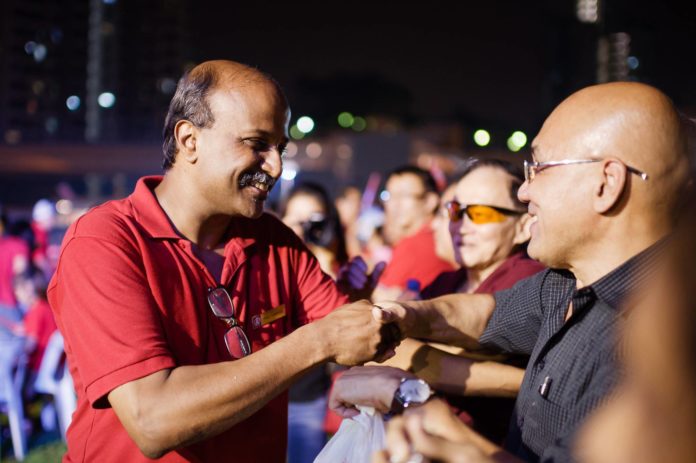
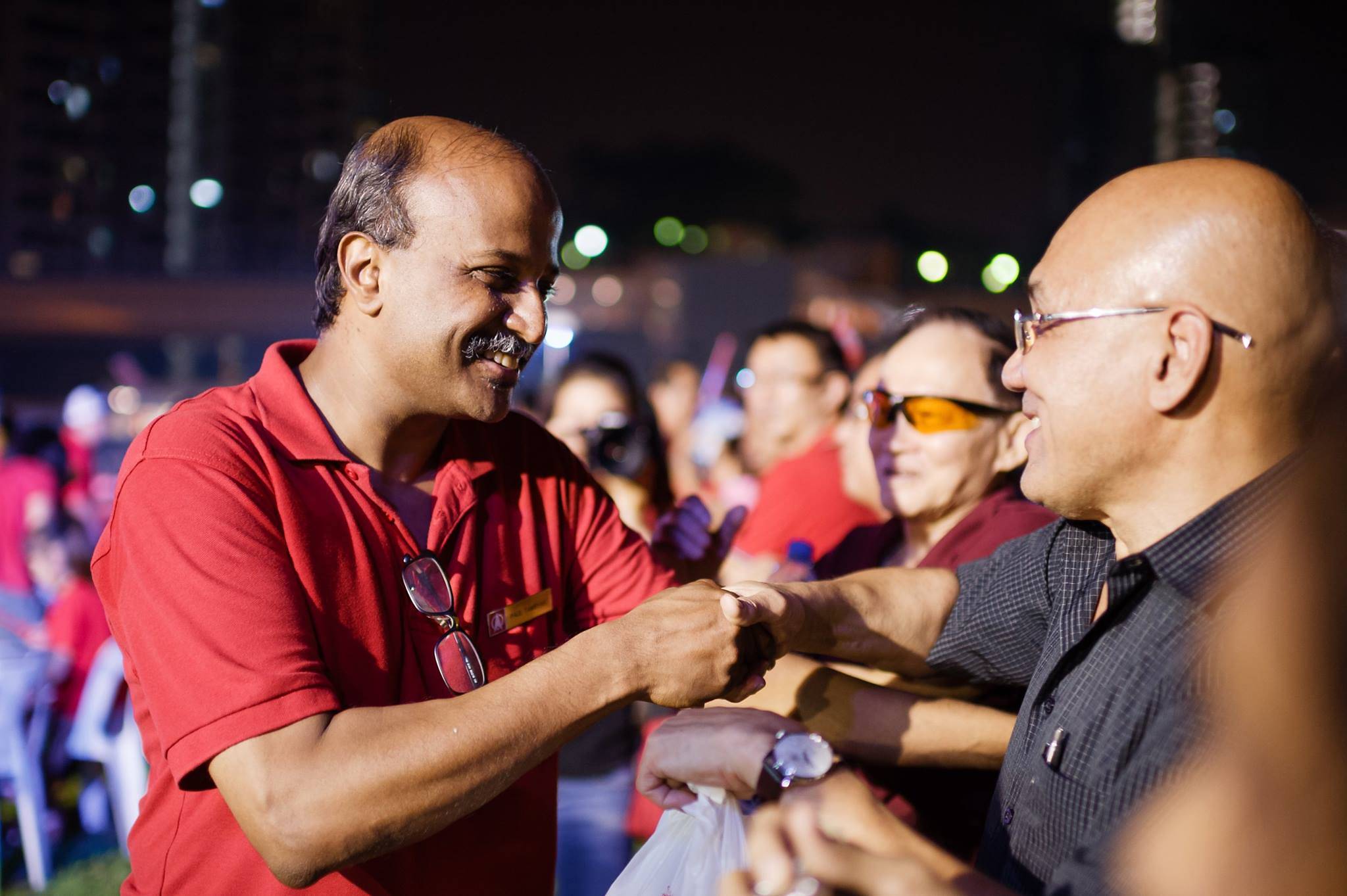
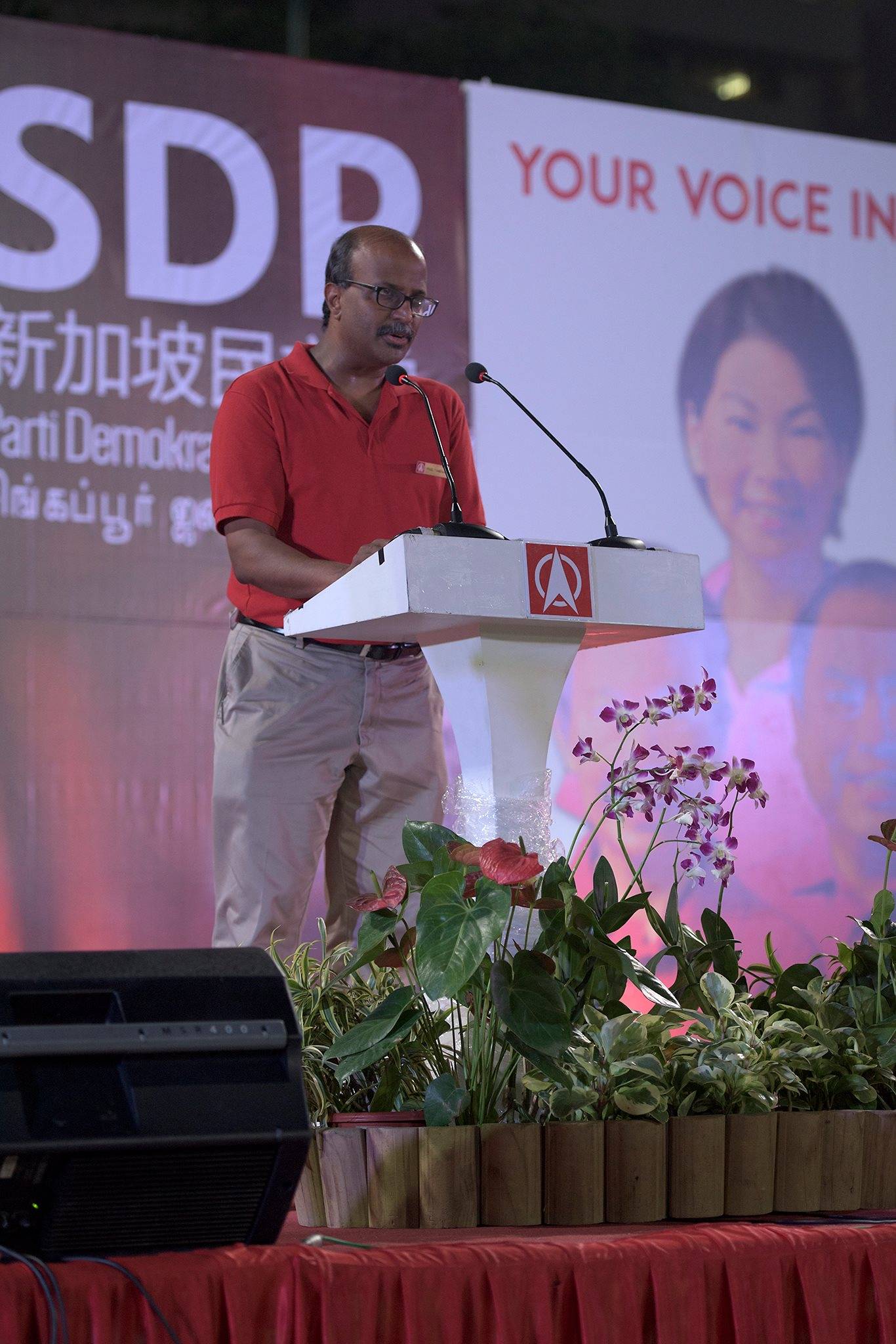
SINGAPORE: Paul Tambyah exudes a good-natured amiability befitting any good doctor and teacher.
But the Professor of Medicine at the National University of Singapore and Senior Consultant at the Division of Infectious Diseases at National University Hospital dutifully reminds me that he is here in a completely different capacity.
“I have to get the disclaimer out of the way. Everything I say here is my personal opinion and has nothing to do with the university or hospital,” he says with a smile.
For good measure, I ascertain that his “personal opinion” encompasses his opinions as Chairman of the opposition Singapore Democratic Party (SDP), a post he was elected to in September last year.
“Of course,” he says with a grin.
At first glance, one may not detect the impassioned politician and activist that Dr Tambyah embodies. This facet of his personality emerges gradually as we talk about the state of Singapore’s politics, democracy and various policies.
But through it all, while critical of the PAP Government, Dr Tambyah maintains his affable demeanour and gives credit where credit is due.
For instance, while he feels that MediShield Life is inadequate in terms of making healthcare affordable to the masses, he acknowledges that it is “a huge advance in that it took in people with pre-existing conditions”.
Before we discuss his political career though, he tells me what attracted him to medicine. It was the “combined influences” of his parents. His father was a doctor and his mother, Leaena Tambyah, is a well-known advocate who was partly responsible for starting Singapore’s first school for students with multiple disabilities.
CIVIL SOCIETY ACTIVISM – “THREE STEPS FORWARD, TWO STEPS BACK”
In a way, it was his profession as an infectious diseases specialist that led to his activism and later, his political awakening.
“Worldwide, one of the most common infectious diseases is HIV, the virus which causes AIDS. It’s a disease which is associated with a lot of stigma and discrimination.”
He became involved in an advocacy group, Action for AIDS Singapore.
“They are activists who take steps to reduce stigma and discrimination. I saw that people in Singapore can make a difference if they feel strongly about something and if they can gather the evidence and the data, eventually the Government will change.”
His involvement in civil society intensified and later he became one of the founding members of human rights advocacy group MARUAH.
“But one of the things I realised is that there are limits to what civil society can do. Civil society can give feedback but ultimately, all the levers are still with the Government. If you really want to effect change, in fact, former prime minister Goh Chok Tong said that you have to join a political party.”
Dr Tambyah doesn’t entirely agree with this argument even though he has accepted “that’s the way it is in Singapore”.
Paul Tambyah contested in Holland-Bukit Timah GRC in GE 2015. (Photo: Facebook / Singapore Democratic Party)
He compares civil society here to that in other developed countries where activists play a more significant role.
“There are fewer restrictions on civil society and civil society actually is encouraged. They often get grants from the government for various projects. There is a give-and-take with the government.
“You win some, you lose some, but you are treated with mutual respect and I think that is perhaps slightly lacking in civil society today in its interactions with the Government.”
He describes progress as being “three steps forward, two steps back”.
For example, MARUAH was gazetted as a political association and that, according to him, “severely limited” their ability to work with other civil societies or organisations outside of Singapore. They were also not allowed to accept foreign funding.
“MARUAH was set up for the Association of Southeast Asian Nations (ASEAN) human rights mechanism. But if they wanted to hold an event and invite human rights activists from the Philippines, they’d have to apply for permits. These are just barriers which make it difficult to move forward towards an ASEAN human rights mechanism.”
He also points to more restrictions on Hong Lim Park’s Speakers’ Corner in terms of “having to check IDs, to make sure we don’t have foreigners attending events”.
I ask him if he can see it from the authorities’ standpoint that there is a case for putting in place measures to guard against foreign interference.
“Definitely. You don’t want foreign interference and I think the worst thing is covert foreign funding. But when you are talking about something like ASEAN where there is, by its very nature, a collaborative effort amongst countries, I think that there has to be a place for transparent, well-documented foreign funding, if necessary, on a case-by-case basis and I think the blanket ban forces people to jump through hoops.”
“SPEAKING UP SHOULD BE CONSIDERED NATURAL … NOT AN ACT OF BRAVERY”
Dr Tambyah started getting involved in SDP activities in 2010. While he spoke at SDP rallies during the 2011 General Election (GE), his first GE as a political candidate was in 2015. He was part of the SDP team contesting Holland-Bukit Timah Group Representation Constituency (GRC). One of the main areas in which he wanted to effect change was healthcare financing.
“I was looking for a party with a very clear-cut ideology and the SDP is very much left-of-centre. It was in line with my own personal views on basic human rights, like housing, healthcare and basic education.”
I ask why he didn’t consider the Workers’ Party (WP), which had a presence in Parliament then.
“The WP haven’t published the same number of policy papers. I’m pretty sure they share very much the same views as we do on many of these issues but the SDP seemed to be willing to go out there and be heard.”
He admits his friends and family were worried that joining an opposition party would put his career in jeopardy.
“Lots of well-meaning people said to me, “Oh, you have to be careful”.
He recalls how after he gave a speech at an SDP rally in 2011, he went to Mount Elizabeth Hospital to visit a friend and people asked him if he was there to buy a clinic.
“They thought my days in the university were numbered and I think that when I got my promotion in 2013 to full professor with tenure, everybody was pretty shocked.”
He says while he, too, was worried initially, he “was tremendously reassured by the senior leadership of the university”.
“I think there are elements within the university who strongly feel that there is a need to speak up about issues which are important, as long as you do it in a responsible and rational way.
“The university has changed; I think it’s a lot more open but also social media has come into play. And you’ve seen what happened with Cherian George when he was denied tenure (at Nanyang Technological University, NTU). He had a voice and he was able to talk about it and I don’t think that NTU came out very well from that whole incident.”
“Speaking up should be considered natural for citizens of a democracy, and not an act of bravery,” says Paul Tambyah. (Photo: Facebook / Singapore Democratic Party)
But I wonder if he would have gone ahead and joined an opposition party if it meant losing his job.
“First of all, I don’t think that anyone should lose their jobs or have their careers put in jeopardy for speaking up or championing an alternative narrative in a democratic society. At this stage in my career, I am fortunate to have options that many Singaporeans may not have. I am now an internationally well-known academic clinician who could possibly work in private medical healthcare in Singapore or in academic medicine overseas. But to reiterate, speaking up should be considered natural for citizens of a democracy, and not an act of bravery.”
THE PROBLEM WITH SELF-CENSORSHIP
While his own experience has been positive, he says it is still very hard for the SDP to attract candidates because of fears that involvement in an opposition party would jeopardise their livelihoods.
“We’ve had individuals within the SDP who are very talented, very capable. There’s actually an individual who was very active in the SDP and she said that she was told by people in her organisation that they are grassroots leaders and they don’t think it’s appropriate for her to be involved in an opposition party.
“I said, ‘That’s ridiculous. You should complain.’ But she said that they are the senior management so who can she complain to? You will get good people who have courage of their convictions but it is very hard to move people from the centre because they are just too afraid for their bread-and-butter.”
When I put it to him that this is possibly a function of self-inflicted fear, rather than people reacting to Government directives to discourage involvement in opposition politics, he agrees, but points out that “self-censorship is so much more effective than actual censorship”.
“Even though the Government doesn’t sack people because they are involved in opposition politics, there’s often that perception about that.”
He illustrates the power of perception with another example.
“You don’t have to lock people up. All you have to do is make them think that you are going to lock them up or think of somebody who was locked up 10 years ago or 15 years ago and when they censor themselves, it’s much more effective.”
Considering that he agrees this could be partly a manifestation of self-censorship rather than the ruling party issuing directives to organisations to discriminate against opposition party members, I ask him whether he thinks there’s anything the PAP can really do about it.
“The PAP Government is amongst the best in the world at running campaigns. All they need to do is run a campaign to say, join the opposition and your career in the civil service will take off. I mean that’s an extreme example but they could say, the civil service is independent. We’ve got people from the Workers’ Party. We’ve got people from the SDP. Feel free to speak up. Singapore is a diverse place which encourages views from all ends of the political spectrum.
“We could have little mascots and we could have bumper stickers and posters on buses and it’ll be tremendously effective.”
For a moment, I think he’s being facetious, but when he raises the suggestion again later in the interview, it dawns on me that he is serious.
He does feel certain actions by the authorities continue to fuel a climate of self-censorship. He cites as an example, the 2017 arrest of activist and artist Seelan Palay for presenting a performance art piece in tribute to political detainee Chia Thye Poh outside Parliament House.
POLITICS AND PARANOIA
The climate of “walking on eggshells”, as he describes it, is exacerbated by how the Government handles parliamentary debates.
He describes how he thinks the ruling party can better engage the opposition.
“Every time the Workers’ Party asks a question in Parliament, the Government could turn around and respond the way I might to a student who asks a question, and say, ‘Oh, that’s a really good question’, and start to deal with it.
“Instead, they turn around and they chide them. If you don’t have all the information and you ask a question, then you’re slammed and you’re asked to apologise like Sylvia Lim was asked to – that puts a certain amount of fear into individuals.”
He is referring to WP chairman Sylvia Lim being asked to apologise to the House earlier this year for alleging that the Government had floated “test balloons” before announcing an impending Goods and Services Tax hike.
Paul Tambyah goes On The Record with Bharati Jagdish.
I put it to him that most ruling parties would consider it a natural instinct to defend their policies and make a point of it if they feel the other parties are trying to cast aspersions on their intentions.
“But still, there has to be some degree of balance because otherwise it’s going to backfire. The whole Sylvia Lim example, I think it won Sylvia a lot of sympathy points – the fact that people are trying to make her apologise for asking an honest question. You can say that the question is a stupid question, you can try to criticise her for that, but trying to make her apologise for asking a question seems to be a little bit like shooting yourself in the foot because it makes you come across like a bully.
“In a parliamentary democracy, if somebody asks you a question, you can make them look small or really silly, but to treat every question as an attack on your own personal integrity, to me, that’s bordering a little bit on paranoia.”
CAN THE SDP CONVINCE VOTERS?
We move on to talking about why the SDP has not made any headway in winning parliamentary seats, not even in the 2011 election.
“You must remember, we were going from a state where the party was almost non-existent. It was the subject of several lawsuits. It was on the verge of bankruptcy and to get over 30 per cent of the vote, I think, was a pretty significant achievement.”
I wonder why the party’s baggage didn’t discourage him from joining it.
“The fact that they persevered despite all of the slings and arrows that had been flung against them, that was very impressive because that shows a certain kind of courage of your convictions.”
But he feels that media coverage favouring the ruling party has worked against them.
“In 2015, on Cooling-off Day, the front-page headline on The Straits Times was Mr Khaw Boon Wan saying you may not get a PAP government. There were these WhatsApp messages going around with fake bookie odds. No one has ever owned up to propagating trying to scare people into thinking that the PAP would lose the 2015 election despite all indicators pointing in the opposite direction.”
He also cites the difficulties the party faces in holding community events as securing venues run by town councils and the People’s Association is challenging.
He puts this down partly to the “self-censorship” phenomenon we discussed earlier.
“But I’m an optimist. I don’t think that this self-censorship is going to be able to continue forever and if social media develops and as people become more open, then I think the PAP will realise that they need to come down on these people who are second-guessing them and tell them ‘Hey, loosen up. We are not going to give you a phone call and tell you to not allow them. Let them have their event in some basketball court’.”
But the PAP’s ability to mobilise state resources in other ways is “very, very difficult to try to go up against”, he says.
“During my first clinic session after the election, a patient of mine who I’ve been treating for many years wheeled himself into the room in his motorised wheelchair and he said, ‘Doc, you guys ran a good campaign. Too bad you all lost.’ I said, ‘Thank you. By the way, where do you live?’ Then he said, ‘We live in Yuhua, but you know, (Minister) Grace Fu gave us this wheelchair.’ Then I said, ‘She didn’t give you the wheelchair. This is paid for by your taxes’.
“He said, ‘No, no no, she came to my house with an entourage of people, with her photographers and she gave me the wheelchair’.”
Even though Dr Tambyah says he reiterated that ‘it’s your money that went into this wheelchair’, his patient ‘refused to accept’ it.
“This was a guy I’d been looking after for 10 years. He knew me. We got on with each other very well. But at the same time, he felt indebted to the ruling party politician because she was able to, in his mind, provide him with mobility.”
However, I put it to him that if the PAP Government lets Singaporeans down, and if the opposition manages to come up with better policies, they could get the votes regardless of the PAP’s party machinery.
Considering the way Singaporeans have voted in the last two elections, I suggest to him that Singaporeans don’t see the point of an opposition party or don’t consider the opposition parties, including the SDP, as being worthy of a vote or as being able to govern.
But he reiterates that the various hurdles prevent the SDP from truly convincing voters of the party’s merits, even thought they “have really dedicated volunteers, and for Single Member Constituencies (SMCs) they can cover almost every household at least twice”.
“The administrative constraints, the media constraints and the self-censorship issues affect people. Even social media is constrained by the licensing issue and the various actions that have been taken against individuals for crossing the poorly defined Out of Bounds or OB markers. This deprives Singaporean voters of essential information we need to allow us to cast a ballot for the people most able and willing to take care of our interests and well-being.”
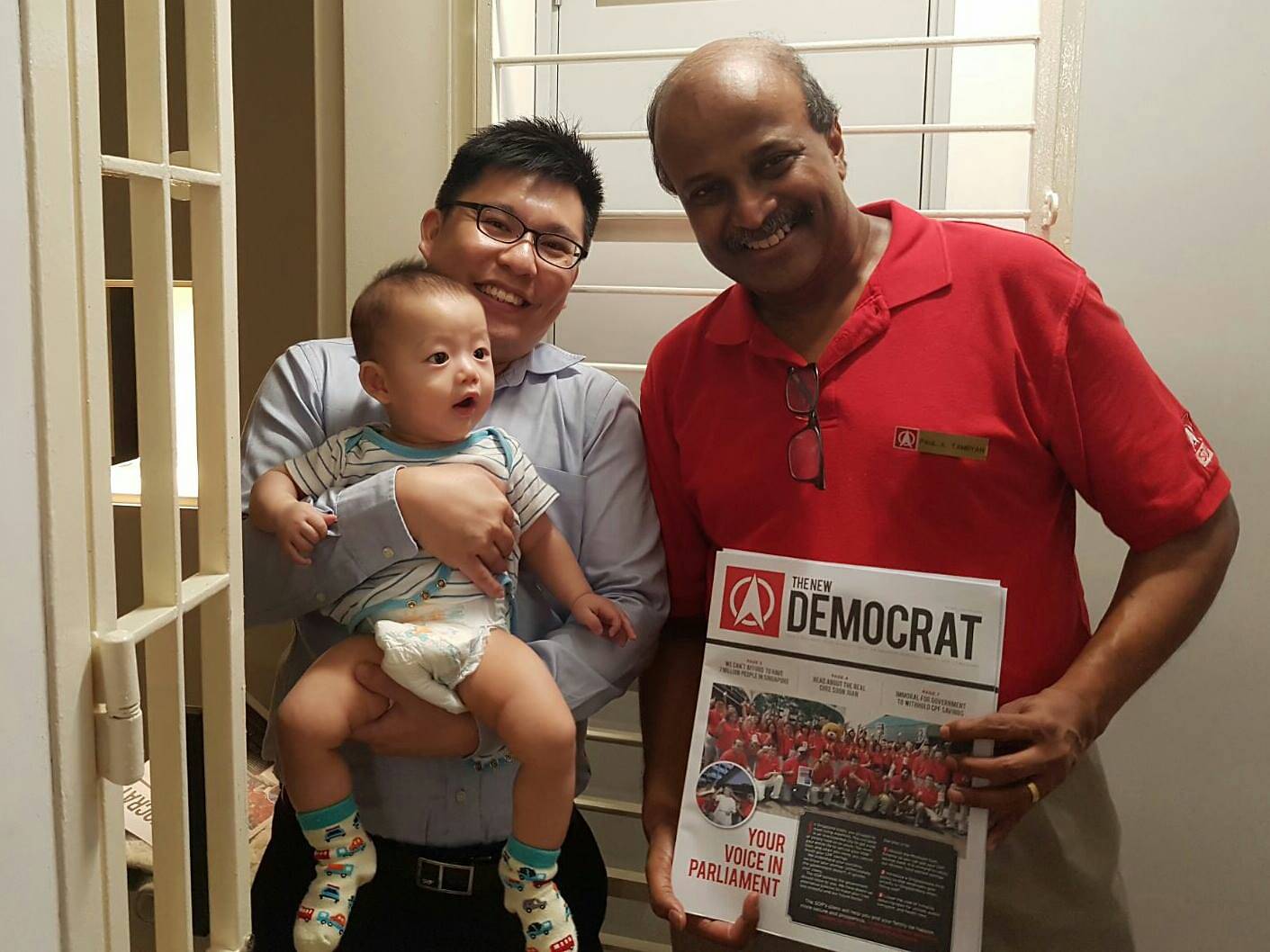
Paul Tambyah meeting residents on a house-to-house visit. (Photo: Facebook / Paul Tambyah)
Some analysts have said this could help opposition parties who generally have fewer resources to put together large teams, but Dr Tambyah is “cynical” about this.
“You can design three-member GRCs very strategically. You could arrange it such that these three-member GRCs are all in constituencies that you could win.”
He says what he would like to see instead is “an independent Election Commission” that could ensure that “electoral boundaries will be drawn up with all the parties and civil society and all the individuals involved”.
At this point, the Election Commission is under the Prime Minister’s Office.
He also suggests “a return to all single-member constituencies”.
“Before the GRCs came up, Singapore has always had a multi-racial parliament. We’ve always had members of parliament from the Malay and Indian communities, and the proportion of people from the minority communities actually was highest in the earliest years when we were all single-member constituencies. So, I don’t buy the argument that GRCs are essential for racial representation.”
I point out a survey that showed when it comes to deciding who should hold the nation’s highest positions, Singaporeans prefer it be someone of the same race as they are.
“But obviously that was not borne out by the facts. Like in the Bukit Batok by-election, Mr Murali Pillai won handily against SDP Secretary-General, Dr Chee Soon Juan. It was the first by-election the PAP has won since 1992 and it was quite obvious that there was somebody from a minority race who was able to win. I think those surveys have to be taken with a pinch of salt.”
HEALTHCARE AND HOUSING
Aside from the politics though, the policies matter.
From the very beginning of his political life, Dr Tambyah has been campaigning for a better healthcare financing system.
He still feels that MediShield Life, for instance, needs to be improved. Most notably, the high deductibles concern him.
“Healthcare is a right, not charity”, he says and cites research that showed the state of healthcare financing in the early days of Singapore.
“In 1960, the World Health Organization sent a delegation to Singapore in Malaya to study the healthcare system. Our health minister at that time was Ahmad Ibrahim and he pointed out that Singapore had a pretty decent healthcare system in 1960. The unique thing about it was that it was all free at the point of care. They introduced the S$1 charge at the Outpatient Dispensaries (OPDs) and I think it was a S$5 charge for the inpatients.”
That was how, he says, Singapore’s healthcare system operated right up till the mid-80s.
“In 1983, when we had the blue paper on Singapore healthcare, Singapore had an infant mortality rate that was lower than the UK and the US. So we had really good health outcomes with very cheap healthcare and that I think shows that it’s achievable. If you wanted to pay a bit more to stay in some private hospital, you could but basically, you should not have to worry about getting your cancer treated or your bypass done because it could be done for a really cheap price if the government was the sole proprietor.”
Dr Paul Tambyah has been campaigning for a better healthcare financing system.
He feels that the privatisation of healthcare was a “mistake”, but wouldn’t an entirely state-run system run the risk of being inefficient?
He acknowledges this and suggests instead a national universal health insurance system where the government takes over administering insurance, but not the provision of services.
“The government is the financier but not the provider. This is what happens in Australia and France. Also Germany to a certain extent.”
His vision includes basic healthcare with minimal deductibles and co-payments.
When I raise the risk of overconsumption under such a system, he says it may not be a direct effect of enhanced insurance.
“There is no direct evidence that significant numbers of patients are going out of their way to subject themselves to unnecessary surgeries or treatments just because these are paid for by insurance riders or free. Most people do not like to see the doctor or subject themselves to chemotherapy or injections or to take bitter medicines.”
He says that cases of overconsumption that we are seeing today could be due to other reasons.
“There is an asymmetry of information. Most people have a very limited knowledge of medicine or medical procedures and depend on their healthcare providers for the information that they need to make decisions about what procedures and treatments are best to deal with their ailments.
“Healthcare costs have risen in Singapore for many reasons including, primarily, the commercialisation of healthcare which has led to the need to provide returns to shareholders who own major healthcare providers. This leads to incentives which distort the market by rewarding overconsumption of resources.”
For example, he says some patients do certain tests and procedures as inpatients to “claim insurance benefits” and thus maximise profits for the owners of the healthcare infrastructure, rather than as outpatients which would have been cheaper.
“The doctor becomes an employee who has to answer to the shareholder while at the same time, maintain an ethical practice towards his patients. So it’s a huge challenge.”
He also points out that the medico-legal environment in Singapore and elsewhere may encourage doctors to potentially over-investigate patients for fear of litigation or being accused of negligence.
“A well-run, evidence-based national health insurance scheme similar to what is proposed in the SDP Healthcare Plan would avoid the problem of overconsumption by restricting benefits to those procedures which are proven and supported by solid scientific evidence,” he says.
To finance Singapore’s future needs such as healthcare, naturally, more funds will be required. I ask him how best he thinks these can be generated.
“In Singapore currently, you don’t have pay estate duty, you don’t have to pay capital gains tax, you don’t have to pay tax on dividends, you don’t have to pay tax on fixed deposits interests.”
He thinks it’s time Singaporeans do.
But might this make Singapore less competitive as a wealth management hub?
“I don’t think so because I think we have the skillset, individuals with the talents, the infrastructure, so if we just went back to some kind of a more equitable, a progressive taxation system, I don’t think that we’ll undersell ourselves. These are people who are just parking their money here. If they paid a little price, I don’t think they would feel it that badly.”
Among the other policy issues that concern him is housing.
“Somewhere along the way, public housing lost its focus. Instead of becoming a basic human right to have a roof over your head, with the asset enhancement policy, it became a tool for multiplying your wealth or a vehicle for speculation.”
He calls it a “misguided” approach to public housing.
When I remark that many Singaporeans have, in fact, benefited from this, he says it’s just a “short-term gain”.
“If you’ve got more money, then you should invest in private property.”
He also points to how the Ministry of National Development has recently highlighted the limits of HDB leases.
“I think the Government is going to deal with it. They’re probably going to extend the lease. It’s too much of a political time bomb.”
Paul Tambyah with SDP Secretary-General, Chee Soon Juan. (Photo: Ryan Smith)
THE FUTURE OF SINGAPORE’S OPPOSITION
As we progress to talking about the future of the opposition in Singapore, something that he says is “on the cards” is an opposition alliance.
The SDP recently invited members of all the other political parties to a forum where it became apparent to him that their ideologies could be aligned.
“We recognise that we probably have more in common than actually what separates us. Most of us are in favour of transparency, accountability, more social justice.
“Dr Tan Cheng Bock was invited and he was going to come for our event but something happened at home, so he couldn’t make it but he sent three of the senior members of his team and they were there. So we think that a figure like him, who has been in Parliament, who has run election campaigns successfully, could be a catalyst to bring people together.”
When asked what role Dr Tan could formally play, Dr Tambyah doesn’t seem certain.
“I don’t know what he’s going to do but all he needs to do, if he decides to form his own political party, is to draw all the other parties to form a coalition. There are many different possibilities as to what he could do.”
This and the idea of an alliance is “an ongoing conversation”, he says.
I wonder how his party plans to convince voters of its merits in the next election considering the PAP’s performance in the last election and the new policies it has introduced since 2011.
“There have been schemes such as the Silver Support Scheme and the MediShield Life which are baby steps towards a national old-age pension and a comprehensive national health insurance policy respectively. However, both are limited severely in terms of the quantum provided (up to a maximum of $250 a month) for the Silver Support Scheme or the high deductibles for MediShield Life.”
He also raises other issues that Singaporeans seem concerned about.
“Prices were raised across the board for water and electricity. We in the SDP consider healthcare, affordable housing and equitable quality education as basic human rights which should be guaranteed to everyone not dispensed as charity or traded as commodities. The one-party system is a dinosaur which is overdue for extinction in Singapore.”
His ideal vision of a democracy is one that includes many political parties.
“I think what’s important is that there will be a free discussion of ideas, a thinking-through of plans of what’s good for Singapore.”
I ask him what he thinks of suggestions from some quarters that Singapore doesn’t need a multi-party system in order for good governance to be the order of the day.
“I think history tells us otherwise. What’s happened in Mexico, Taiwan and Malaysia is that single-party rule cannot survive for too long because it becomes fossilised. No matter how good you are, you just become fossilised and that’s just the order of things because you need people to keep you on your toes.
“You need to have time spent in opposition. Like in Japan, the Liberal Democratic Party was in opposition for a short period of time and then they came back and they came back better. So I think this is something that is inevitably going to happen.”
SINGAPORE: For nearly 35 years, Mr Sim Kah Lim’s world has been the walls of his ward at the Institute of Mental Health (IMH).
Outside, changes have swept the landscape, old buildings falling and new ones rising – skylines and shorelines of a 21st-century nation transformed.
But in his mind’s eye – and in his bold-stroked acrylic and watercolour paintings – Mr Sim’s homeland is one where bumboats still crowd the Singapore River, ferrying goods and passengers; and where Chinatown’s open-air markets thrive and its five-foot ways are bustling with locals, not tourists.
They are pictures, frozen in time and memory, from early childhood when his father used to take him to these places.
“My father brought me outdoors (for) painting. I saw the Singapore River and all the artists,” the 50-year-old said, words spilling out without pause in a torrent of English and Mandarin, sometimes incoherent and muddied, like the river of his paintings during monsoon season.
It’s through his art that he finds order, focus and clarity in expressing himself.
Along the IMH corridors are hung some of his paintings. We counted 15 on our short tour, and there were more, including renditions of the old Woodbridge Hospital off Yio Chu Kang Road where he used to live.
More of his artworks are stuffed into cupboards in two rooms – and he bashfully takes them out one by one to show us, such as one of a Chinese dragon and another of a tiger.
His sister Cindy Sim later lets on that he paints these predators when he is feeling angry or moody.
AS A CHILD, LEARNING FROM THE MASTERS
Her brother was four when he started doodling and painting.
“He was really good,” Ms Sim recalled. “He could draw a very precise animal.
For me, drawing a cat is like two balls, two ears and a tail. For him, he could draw the whole cat.
Recognising his potential, his father took him to the Singapore River and Kampong Glam to paint and learn from the artists who used to congregate there.
Those veterans were generous in sharing their knowledge of stroke techniques, different mediums and colours. The young Kah Lim was even under the tutelage of renowned local artists Ong Kim Seng and the late Ong Chye Cho.
“There were a few artists who thought his painting was very nice so that’s why they advised him,” said Ms Sim. “He didn’t go through any other proper training.”
Mr Sim’s painting of bumboats on the Singapore River of old.
Their father had also wanted to dissuade his son, the eldest of three, from drawing too many pictures of Chinese deities, as he thought that “drawing scenery and buildings was more meaningful”, added Ms Sim.
Those childhood visits became the strongest and happiest memories of her brother’s life. “He enjoyed those days. That’s why he could remember those days better. Ever since then, he has kept drawing those (landscapes),” she said.
He also does still life (while CNA Insider was with him at IMH, he painted the garden); tackles portraits, and paints from photographs.
His flair for painting was rewarded at a young age when he won cash prizes at a couple of art competitions, and he seemed destined to be a professional artist.
(Photo courtesy: Cindy Sim)
WARDED AS A TEEN
When he was 14, however, his behaviour started to change. He started talking to himself, refused to leave the house and wanted only to paint. He was diagnosed with schizophrenia.
Then when he was 17, he fell from their sixth-storey flat but miraculously survived. “I don’t know why, but I believe he felt sad on that particular day, and he just looked down and fell,” said Ms Sim.
He was subsequently warded long-term at the mental hospital. His family were at a loss for what to do, but he seemed to adapt well.
“At the old IMH children’s unit, he was doing quite okay and was quite happy there because every day he was drawing,” said his sister.
(Photo courtesy: Cindy Sim)
Long-stay patients are classified as those who have been warded for more than a year, where all possible discharge options have been explored and failed. And Mr Sim is now one of the longest-staying residential patients at IMH.
Over the years, his art has been a record of sorts of his emotions.
“When he was in a bad shape, he drew more of the (Chinese) gods,” said his sister, adding that he would paint landscapes when he is in a good mood.
When asked why he liked to paint, he went off at a tangent once and broke into a National Day song.
But another time, he said with a smile:
My work is my expression … It’s my dreaming world. It’s my dream to create the picture.
When he paints or draws, he is focused. He constantly shifts the easel to adjust to changes in the lighting.
Holding a pencil loosely, he makes broad strokes on the canvas, with seemingly little purpose to the untrained eye, but the result is an impressive sketch of IMH with its garden in the foreground.
BIG-HEARTED, PROLIFIC ARTIST
While some may think him a little odd, most people are more fascinated by his artwork. “Because he just draws, he doesn’t disturb anybody,” said Ms Sim, who thinks her brother has faced “not so much” stigma.
But he is generous to a fault, which got him into trouble before.
He’s so generous he could take anything from our home to give to anybody, since young.
His sister added that whenever she visits him with food, he would share it with other patients. He has a hearty appetite, and often requests for local fare such as char kway teow and roti prata.
On special occasions, like Chinese New Year and Mother’s Day, Ms Sim – who moved near to IMH so as to visit him more regularly – brings him home, as their mother has difficulty walking and their father is still working.
“He brings all his paintings, and puts (them) all over the place. And he can remember all his paintings,” she said. “He’d say, “Where’s my pigeon?’ Then I’d say, ‘Oh, upstairs. I’ll go and take it.’”
Chinatown of old, in Mr Sim’s paintings.
He is such a prolific artist that he has paintings stored in a warehouse, and his sister doubles as his curator, framing those works she deems worthy. Her home and office are also scattered with his art.
Some of his pieces are displayed in the offices of other healthcare institutions like the National University Hospital. He also sold two paintings to non-profit organisation BizLink for its range of These Abled People greeting cards.
And now, some of his works have been selected for the Healing Touch, Green Finger exhibition, organised by T-Touch – Temasek’s staff-driven volunteer initiative – IMH and the Singapore Anglican Community Services to highlight the importance of mental health.
(Photo courtesy: Temasek)
Ms Sim is grateful for this chance to showcase his paintings, as he has been requesting for his own exhibition for some time.
“He keeps asking me to keep all his art pieces before they disappear, so that when he gets an art exhibition, he (can) show them. Of course, he also wants to sell his paintings,” she said.
BECOMING AN OBSESSION
Mr Sim said he also likes “singing, swimming, table tennis, badminton”. But he has a tireless commitment to painting, to the point of it becoming an obsession.
And that is cause for concern, said IMH occupational therapist Lee Shu Hui, who works with schizophrenia patients on social skills such as interacting with others and behaving in a group setting.
When she was first introduced to him, it was in a room full of his paintings, and there was not much space for them to move about.
While painting is his strength and should be encouraged, his goals all revolve around painting, and “it shouldn’t be the only part of his life”.
“We’re also looking at other aspects of his life: Whether or not he can take care of himself … whether he can overcome some of the conflicts he faces in the ward itself,” said Ms Lee.
Mr Sim with IMH therapist Lee Shu Hui.
While painting helps to calm Mr Sim down, he gets frustrated at those times he does not get to paint. And this is not helping his condition.
“We have to have a balance; we need to be able to pace ourselves also. Therefore we have to set structures for him,” added Ms Lee.
We can have that allowance (for painting). But we can’t do that every day.
Mr Sim recognises Ms Lee’s point, even though he has told her before: “I can paint without food – I can don’t eat; I can don’t sleep.”
When he spoke to CNA Insider, he said: “Must rest. I every time continue to paint, never take a deep breath – cannot.”
Kampong Glam in the 1980s, as painted by Mr Sim.
His sister still dreams of reintegrating him into society, and even hopes that he can sell his paintings and help their parents buy a bigger home.
There is always hope. But as with all IMH patients, it is a matter of assessing their mental condition, whether they are ready and whether such a move is beneficial for them.
Said Ms Lee: “If we’re able to find that support in the community, and they’re able to manage, of course we’re more than happy to help them reintegrate.”
SINGAPORE: Singaporean footballer Benjamin Davis’ application to defer his national service (NS) enlistment was rejected by the Ministry of Defence (MINDEF).
In a statement early on Sunday (Jul 15), MINDEF confirmed that Davis’ application was rejected on the grounds that Davis was neither a potential medal winner nor does he represent Singapore in international competitions.
“As all male Singaporeans liable for Full-time NS put aside personal pursuits to dutifully enlist and serve their NS, it would not be fair to approve applications for deferment for individuals to pursue their own careers and development,” MINDEF said.
“In sports, deferments are granted only to those who represent Singapore in international competitions like the Olympic Games and are potential medal winners for Singapore. In the last 15 years, only three have met this criteria.
“Benjamin James Davis’ application for deferment was not approved as he does not meet the criteria for long-term deferment from Full-time NS.”
It was earlier reported that Davis had signed the first professional deal of his career with newly promoted English Premier League (EPL) club Fulham FC.
He is the first Singaporean to sign a professional contract with a top-tier English club.
Ben Davis, together with his father Harvey, signing a two-year scholarship with English side Fulham. (Photo: Fulham FC)
Speaking to Channel NewsAsia, Davis’ father Harvey Davis clarified that the Football Association of Singapore will help to put forth an appeal to MINDEF.
“As the father of Ben, I really hope that common sense can prevail so that Ben can be given the opportunity to not just pursue his dream of playing in the EPL, but also the dream of every young Singaporean footballer and to make Singapore proud by being the first Singaporean to play in the EPL,” said Davis’ father.
When Davis had learned about the deal he told Channel NewsAsia that the deal was “fantastic news for Singapore football”.
“It shows that Singapore can produce footballers who can play at the highest level in the UK,” the 17-year-old added.
“Ben has been trained here in Singapore and shows to all Singaporeans that you can be coached in Singapore and achieve the highest level for a 17-year-old on the international stage,” added the senior Davis, echoing his son’s sentiments.
Harvey Davis also said that the authorities had been informed of his son’s professional contract with Fulham as well, noting that his son would eventually serve his NS.
“We have been completely transparent with the authorities who were immediately informed of his scholarship contract back in 2016 and his professional contract back in May this year.
“We fully understand the importance of serving your country and my older son has already served and so will Ben as will my younger boy.”
Notably, as Davis’ mother is from Thailand, and his father from the UK, he currently has the option to represent these two countries for football as well.
Drawing comparisons between his son and Olympic swimmer Joseph Schooling, Harvey also commented on Schooling’s deferment.
“If Joseph had not been given the deferment and opportunity he would never have won the Olympics.”
SINGAPORE: Scripts from the once popular television series Friday Background were among more than 400 items donated by members of the public to the National Archives of Singapore (NAS) on Saturday (Jul 14), as part of a donation drive calling for historical materials related to the city’s past.
The scripts for the 1980s current affairs programme were donated by a former producer, who worked for the Singapore Broadcasting Corporation – the predecessor of Mediacorp – for almost a decade.
Other historical treasures also surfaced during the one-day drive, including never-seen-before footage of 1950s Singapore filmed by a young British soldier stationed in country from 1952 to 1956.
His great grand-nephew Nigel Sumner, who has lived in Singapore for the past seven years, came across it by chance when he visited the now 87-year-old in London.
The contents page of a Radio Singapore script. (Photo: Wendy Wong)
“It was a casual conversation. I actually had no idea he’d been in Singapore. We were talking about my experience living in Singapore and he mentioned he’d shot some film while he was there,” said Mr Sumner, 42.
“For me it’s really interesting to see the locations I can still identify as part of Singapore , like Boat Quay and Beach Road, and to see how they’ve changed over time,” the creative director said.
“I’d really like to see something done with it – I was trying to think of something interesting I could do with it. I take a lot of photos on my phone and they stay there and nothing really happens to them. So I thought if (NAS) was able to do this for some good, hopefully there can be a way it can be utilised,” he added.
In conjunction with its 50th anniversary, the NAS hopes to receive historical materials preceding 1970, such as photographs of old landmarks and organisations that have since ceased operations, as well as copies of broadcasted events – in particular the first television broadcast on Feb 15,1963 and the 1969 National Day Rally Speech, which are believed to have been lost in a fire in the 1960s.
“We know Singapore has undergone major urban development since the late 1960s,” said Ms Noor Fadilah Yusof, assistant director of records management at NAS. “The city landscape changed during this period.
“We want to collect photos before the 1970s, mainly to help Singaporeans rediscover the sites and scenes that are gone or lost after the major urban development.”
“These are the untold stories that we should be keeping or retaining for current or future generations,” she said.
The donated items were assessed on the spot and will undergo a full assessment, with suitable materials to be added to the national collection for future research, publication and exhibition purposes.
More than 100,000 items are donated by the public annually, according to the NAS.