SINGAPORE: Thirty-three people have been arrested in several estates during a 10-day joint enforcement operation led by the Singapore Police Force, said the police in a news release on Monday (Aug 6).
The suspects, aged between 20 and 56, were arrested for various offences that include illegal gambling and vice.
The joint operation, which included the Central Narcotics Bureau (CNB) and the Singapore Civil Defence Force (SCDF), was conducted at Anchorvale, Ang Mo Kio, Braddell Heights, Fernvale, Jalan Kayu, Rivervale, Sembawang and Yishun.
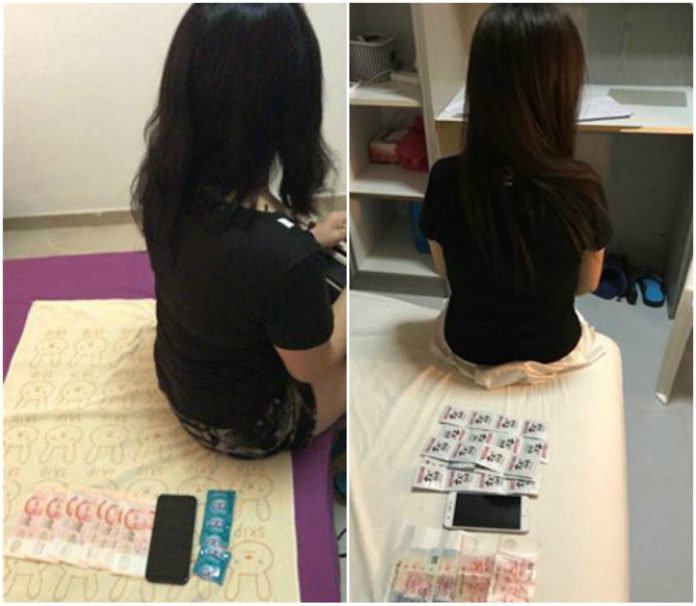
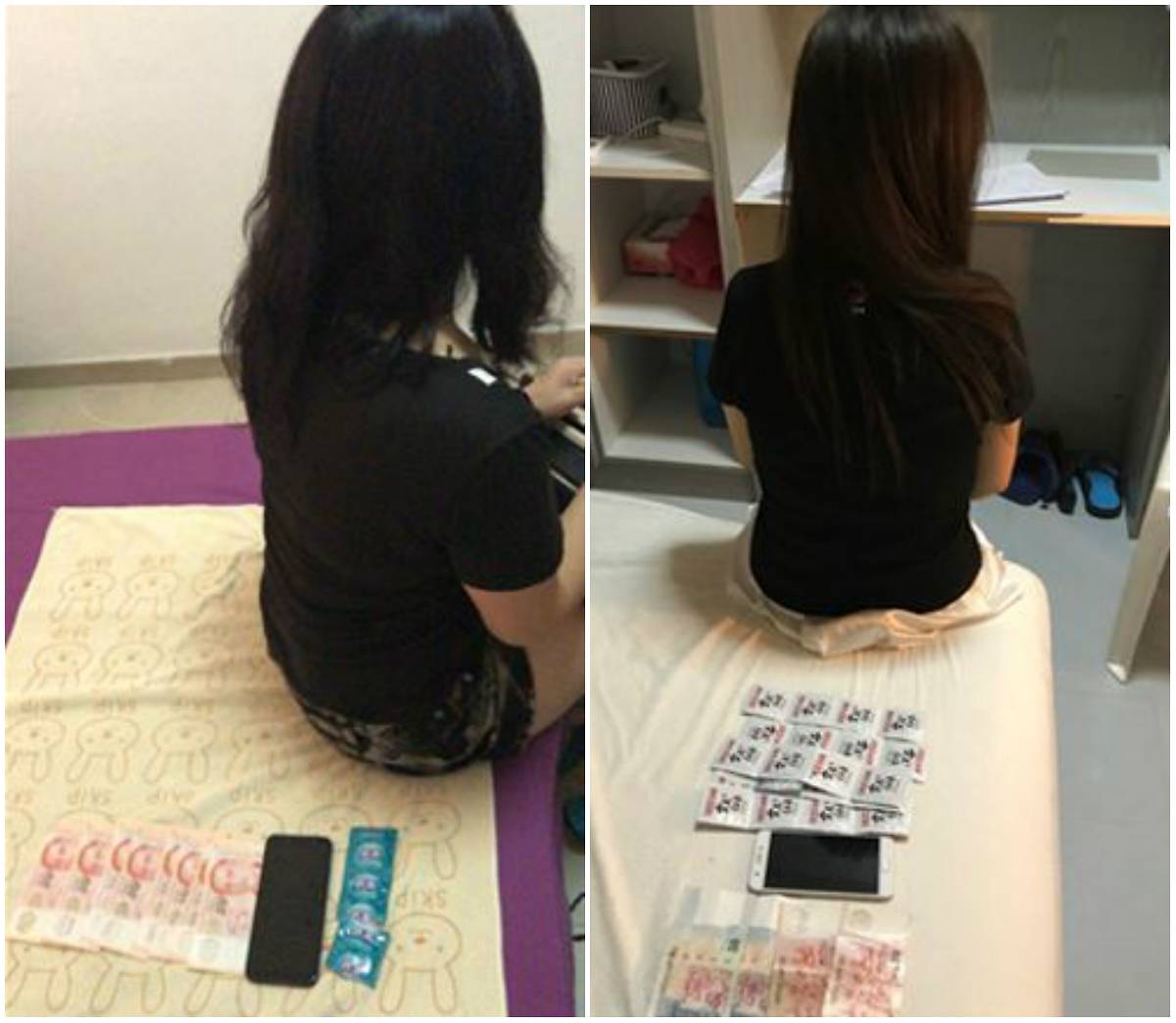
In Yishun and Sembawang, nine women were arrested in two residential units for allegedly advertising sexual services online.
Also arrested were a 37-year-old woman for offences under the Employment Act, and a 35-year-old man believed to be involved in managing the two residential units.
Four mobile phones and S$890 in cash were also seized, the police said.
Ten women, aged between 26 and 45, were arrested after investigations found they were advertising sexual services online. (Photo: Singapore Police Force)
In Braddell Heights estate, three men were arrested for allegedly operating a gambling den in a private residential unit. Ten other men were arrested on suspicion of illegal gambling.
In another raid, six men and a woman were arrested for suspected drug-related offences. Five packets of substances believed to be controlled drugs and some drug paraphernalia were also seized, said the police.
Investigations are ongoing.
The police reminded landlords and hotel owners to ensure that tenants do not carry out vice or other illegal activities on their premises.
SINGAPORE: The Singapore Armed Forces (SAF) will be implementing several measures to fine-tune its management of heat injuries.
These would include preventive and early detection, providing effective cooling for those with heat injury as well as the rapid evacuation of such cases, as recommended by an external panel looking at its heat injury management processes.
The Ministry of Defence (MINDEF) had in May commissioned an external review panel – which includes medical professionals from Singapore General Hospital, Changi General Hospital and Khoo Teck Puat Hospital – on heat injury management to examine the SAF’s heat injury policies and processes.
In its report that was presented to Defence Minister Ng Eng Hen on Jul 23, the panel found that the SAF’s heat injury measures were “generally sound and aligned with prevalent industry and foreign military practices”. The army’s Training Safety Regulations (TSR) on hot weather operations were broadly similar to regulations by advanced army forces like those in the US, UK and NATO, it added.
The organisation last did a major review of its heat injury prevention measures in 2013 to address a rising trend of heat injuries, and “succeeded in reversing the trend”, the panel observed.
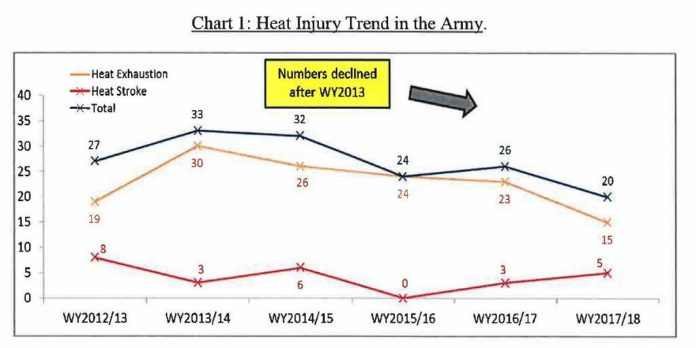
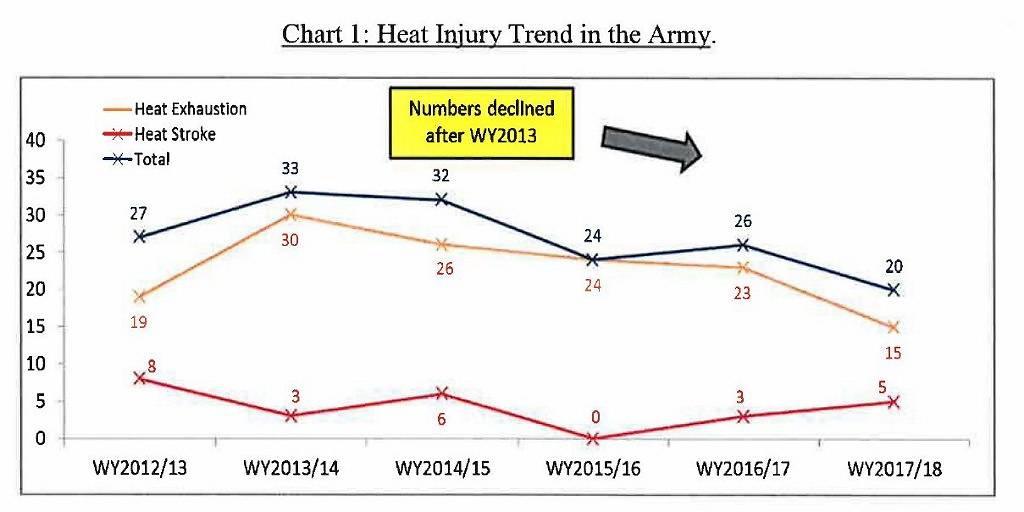
In its report, the total number of heat injuries declined from 27 in 2012/2013 to 20 in 2017/2018. However, heat stroke cases – while dropping from eight to five in the same period – saw a rise from zero cases in 2015/2016 to five in 2017/2018.
The number of heat injuries in the Singapore Armed Forces has dropped overall, but the cases of heat stroke have increased from 2015/2016 to 2017/2018. (Graph: MINDEF)
SAF, the panel said, has put in place a broad range of heat injury measures and invested “substantial resources” to prevent and treat heat injuries such as in research studies, improved load-bearing vests and uniforms, specialised cooling equipment and a responsive casualty evacuation system.
The training provided to SAF medical officers and medics are “in line with national requirements”, it added.
Colonel Tong Yi Chuen, head of Army Safety Inspectorate, said in a media briefing that from its investigations of the number of heat stroke and heat exhaustion cases over the past few years, it has found that the “causal factor for most of these cases is highly motivated soldiers”.
That said, the five-strong panel made several observations and recommendations that it bundled under three key themes:
Finetuning the SAF’s heat injury prevention measures
Ensuring early recognition and evacuation of heat injury cases
Providing effective cooling to heat injury casualties
ENHANCING PREVENTIVE MEASURES
On the point about SAF’s heat injury prevention measures, the panel was informed that the US Army and Australian Defence Force, for one, has implemented a cooling measure known as Arm Immersion Cooling System (AICS) for soldiers training in hot conditions to immerse their arms in cool water of a recommended 10 degrees Celsius during rest breaks.
SAF, too, has promoted this measure as a best practice and used selectively during strenuous training in units like the Basic Military Training Centre (BMTC), Specialist Cadet School and Officer Cadet School, the panel noted, and recommended for this to be implemented across the whole SAF.
On its part, SAF said AICS has been found to be effective in cooling body core temperature as water removes heat more effectively than air.
As such, it will be implementing AICS across the army in phases from this month, starting with BMTC. This will be mandatory for all fast marches and route marches spanning 12km and more, although SAF will continue to evaluate its use for other activities like the Standard Obstacle Course (SOC).
COL Tong also said as part of SAF’s internal reviews in the past three years, the other heat prevention measures included the introduction of the Heat Stress Monitor in 2015 to allow commanders to monitor atmospheric temperature. He also pointed to the hybrid uniform for army combat units that better help dissipates heat.
REDUCING BARRIERS FOR SELF REPORTING
The SAF will also be strengthening the open reporting system by more actively encouraging soldiers to report safety concerns using the Army service hotline. COL Tong said this would include emphasising to commanders about the hotline and getting them to encourage soldiers under their charge to use it where necessary.
Besides phoning in their concerns, soldiers can also report via WhatsApp, Telegram or Viber, he added.
He said the hotline was established since 2011, and it receives an average of 50 calls every year. Some of the calls were to inform of safety hazards while others were made by concerned parents, COL Tong added.
Commander of Army Training Doctrine Command (TRADOC) Brigadier-General Kenneth Liow also stressed in the same briefing that every report made will be investigated.
This was an area highlighted by the external panel, which said in its report that many soldiers may be reluctant to opt out of training for a variety of reasons, including individual volition, peer pressure or desire to avoid weekend make-up training.
“The panel’s view is supported by the army’s finding that many heat injury cases arose as a result of over-zealous soldiers pushing themselves beyond their limits,” it said in the report.
“The army would need to address the barriers that are discouraging soldiers from self-reporting if they are feeling unwell.”
It also recommended to expand the army’s list of risk factors that may predispose someone to heat injuries, which currently stands at 16. The additional factors, gleaned from foreign military guidelines, include: Inexperienced soldiers, alcohol intake, use of supplements and salt depletion.
Chief Army Medical Officer Colonel (Dr) Edward Lo explained that while its current list of risk factors is comprehensive, the external panel’s recommendation showed that they did not want to leave any stone unturned.
PROVIDING MORE EFFECTIVE COOLING EQUIPMENT
The external panel noted that Body Cooling Units (BCUs) are currently used in 30 SAF medical centres and are the main equipment used for treating heat injury casualties. They are also used in three hospitals: Singapore General Hospital, Changi General Hospital and Ng Teng Fong General Hospital.
However, while BCUs have served SAF well, the panel said research suggests newer and more effective cooling methods are available in the market. One such option is the EMCOOLS Flex.Pad, which is a portable cooling system “superior to the BCU”.
SAF, in turn, has accepted the recommendation and said it will replace the current use of six ice packs to this purpose-built cooling pad as its on-site cooling measure when there are suspected heat injuries.
It said these pads cool 15 times faster than ice and 58 times faster than water, while in a study done by the SAF and DSO National Laboratories, the pads demonstrated a cooling rate of 0.12 degrees Celsius per minute, which is about four times faster than the 0.03 degrees Celsius per minute by ice packs.
These pads will be implemented across SAF from August, starting with BMTC in Pulau Tekong.
During a demonstration of cooling pads, Major (Dr) Teo Rui Ming said BMTC will be the first recipients as it has the “highest risk of heat injuries”.
The pads are not new though, as it is used in overseas training and by the Emergency Ambulance Services, MINDEF said.
SINGAPORE: Runners at this year’s Standard Chartered Singapore Marathon (SCSM) can get a medal featuring the iconic Merlion, which organisers Ironman unveiled on Monday (Aug 6).
The gold-plated medal, the first in the race’s history, is also 20 per cent bigger than last year’s medal. The new design is meant to commemorate the race’s prominence in Singapore’s sporting calender, SCSM said.
However, it is only available for runners who complete the 42.195km full marathon. More than 14,000 participants are expected to receive the new medal, according to SCSM.
The new gold-plated finisher medal that features the iconic Merlion. (Photo: SCSM)
This year’s SCSM, the 17th edition, will run from Dec 8 to Dec 9. The new two-day format will cater to more than 50,000 runners across six different categories.
The 5km category will be reintroduced at this year’s edition. Participants looking for an entry-level distance but full-marathon experience are encouraged to join this category.
The main events, the half-marathon and full-marathon, are held on Dec 9. This year’s race will take on a new route covering many of Singapore’s historical landmarks.
The runs will kick off at the F1 Pit Building and end at The Float at Marina Bay.
Children up to 12 years old can take part in the revamped Kids Dash at Universal Studios Singapore.
The Ekiden category, where groups of five take turns to run 42.195km, will also be held on Dec 9.
Seasoned runners can choose to take up the Double-Up Challenge, providing them access to either the 5km or 10km category on Dec 8 before participating in either the half-marathon or full-marathon on Dec 9.
Participants in the challenge will be rewarded with a special Double-Up Challenge medal on top of their individual categories medals.
Registration for all categories is currently open, and costs S$60 for the 5km race, up to S$110 for the 42.195km race.
Speaking in Parliament on Monday (Aug 6), the Senior Minister of State for the Environment and Water Resources said that doing so would likely elicit a negative reaction.
Senior Minister of State for the Environment and Water Resources Amy Khor speaking in Parliament on Monday (Aug 6).
(Updated: )
Bookmark
SINGAPORE: The Government has no plans to amend legislation and extend anti-littering laws to private estates such as condominiums, Senior Minister of State for the Environment and Water Resources Amy Khor said in Parliament on Monday (Aug 6).
Responding to a question from MP for Holland-Bukit Timah GRC Liang Eng Hwa, Dr Khor said that doing so would likely elicit a negative reaction, such as the laws being intrusive.
Mr Liang had asked whether the National Environment Agency (NEA) could extend the deployment of surveillance cameras beyond HDB estates to high-rise private estates to carry out enforcement against high-rise littering.
Dr Khor explained that the prohibition against littering under the Environmental Public Health Act applies only to publicly accessible places. Private estates such as Executive Condominiums (ECs) and private strata-titled condominiums are not regarded as such a place in law, as access to these places are restricted. This means, she said, that NEA is in turn unable to carry out enforcement against littering incidents carried out in these estates.
However, she noted that when approached by a condominium’s management committee for assistance in the area of high-rise littering, NEA explores ways to collaborate with them to educate and advise residents against doing so.
She added that many condominiums already have by-laws that prohibit littering within their estates. “If all else fails, the management committee can apply to the courts to enforce these by-laws against errant residents,” she said. “While the process may be challenging, MCSTs can nonetheless turn to these options if all other means at reaching out to the errant resident fails, including even community mediation.”
Ultimately, Dr Khor stressed that home owners in private estates have the autonomy to govern and manage the shared private spaces in a responsible manner.
“For this to happen, residents should come together to encourage and influence acceptable social behaviour in their communities,” she said.
SINGAPORE: Ragging, a ritual or tradition, that one goes through in order to join or gain acceptance in an in-group, is often meant to be an embarrassing process for the victim, and is common in close-knit groups such as military organisations, sports teams and fraternities around the world.
Some claim that the process of ragging can produce cohesiveness and membership loyalty, and may end with the inclusion and initiation of the victim into the group. Most feel a sense of liking and loyalty thereafter, and so are likely to accept practices.
Ragging experiences are “justified” since members see it as a rite of passage for newcomers. And with the mindset of “I had to do it, so you have to as well” instilled in group members, many support and perpetuate the practice of such rituals despite bans and stringent controls.
Participants may not see ragging as causing harm, especially if participants in a rite of passage had survived it and came out closer than ever.
These practices are, however, dangerous.
Students who have difficulties transitioning into university can end up feeling victimised or even depressed from ragging rituals as part of orientation activities they have little choice but to take part in.
Ragging can also be violent, and in rare cases, might even lead to death.
In 2013, a student of a fraternity in the City University of New York died from head injuries as a result of extreme ragging rituals. He had to carry a weighed-down backpack through a gauntlet of fraternity members across a yard of ice, blindfolded, and was tackled repeatedly, according to news reports.
Last week, five Singapore Civil Defence Force officers were charged over the death of Corporal Kok Yuen Chin, who had drowned during a ragging incident. Corporal Kok’s death has incited discussions about ragging practices and bullying in the workplace, and how future incidences can be prevented.
Tuas View fire station, where Corporal Kok Yuen Chin was found unconscious at the bottom of a pump well. (Photo: Nevin Jacob)
INTENTIONAL OR HARMLESS PRANK?
While they do share certain key characteristics, ragging and bullying are not the same. Ragging aims to induce liking of the group and results in inclusivity and cohesiveness. Harm is never a goal, but a sometimes unseen by-product. Bullies, on the other hand, carry out their actions with the intention to harm and isolate the victim from the group.
Ragging rituals are often only carried out once on a single victim, while bullying is an ongoing process of harassing.
In most cases, perpetrators of ragging function in an organised team with a practical goal, while workplace bullies work alone or as a clique that has no functional value in terms of workplace contributions.
Workplace bullying and harassment cover a wider scope that includes passive-aggressiveness and threats that include the withholding of promotions, even though both ragging and bullying include verbal and physical abuse and seemingly harmless pranks that can turn ugly.
Contrary to popular beliefs, workplace bullies do not target their victims out of low self-esteem, nor are their targets necessarily loners of the team.
Most bullies often act out due to their inability to manage and react to stress or problems adequately and handle their experiences in a positive manner. Only a minority possess antisocial tendencies that result in destructive behaviours toward others and the company.
Victims are usually performers or popular members of the team – the perfect target for bullies to channel their stress.
Workplace bullying behaviours are generally difficult to spot, but their effects are extremely visible. If a performer shows a sudden drop in performance or change in attitude, that might be a sign they are being bullied.
Abrupt changes in team behaviours and dynamics must also be watched closely. These are alarming especially when someone new joins the team.
Employees work inside an office in San Francisco, California January 7, 2014. (Photo: REUTERS/Stephen Lam)
HARMFUL ACTIONS NOT TOLERABLE
While public attention has been focused on stamping out ragging, it is just as important to focus our efforts on identifying and addressing workplace bullying. While certain bullies cannot be deterred in the same way that ragging can, most of them can be changed.
The first step is to go beyond stating that bullying will not be tolerated. Laying out the details of what will not be accepted helps to guide a better understanding of the behaviours that constitute bullying, as certain bullies are unaware that their actions are considered bullying.
Second, never ignore claims and complaints, but investigate them with a clear and transparent process that all employees have been informed of.
Last, members of an organisation can help create a bully-free environment by stepping in or reporting whenever an incident occurs.
While ragging should never be condoned, it shouldn’t mean that we shy away from initiation practices altogether. When done right under adequate management, initiation rituals have been shown to increase team unity and performance. They are still beneficial in militaristic or sports settings given the nature of these groups.
Initiation rituals should always be carried out with an atmosphere of mutual respect, or include certain bonding elements.
Having meals together, or outdoor team-building activities, are some examples that do not infringe on the dignity of participants. Likewise, these practices can also be used to increase workplace bonding and cooperation, which can reduce the likelihood of workplace bullying.
The key takeaway is that any kind of practice that results in harm, both physical and psychological, should be explicitly prohibited.
Joel Yang is a clinical psychologist with Mind what Matters Psychological Consultancy. He regularly treats individuals who have difficulties managing work relationships and environments.
SINGAPORE: Law and Home Affairs Minister K Shanmugam was among a group of Singaporeans who felt the effects of the magnitude 7.0 earthquake that hit Lombok on Sunday (Aug 5) evening.
Mr Shanmugam, who is attending a security conference in Mataram, Lombok, said he and the Singapore delegation are safe.
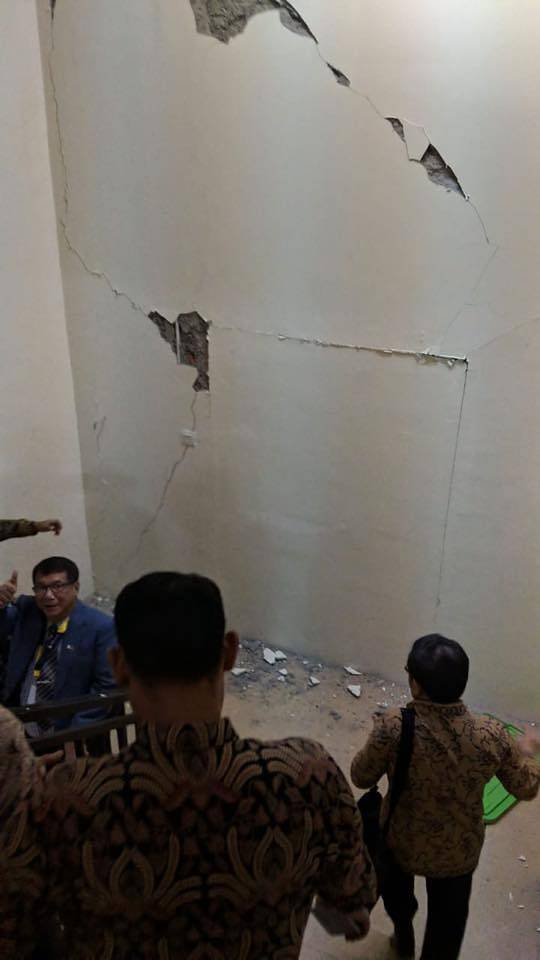
“I was in my room, 10th floor, working on my laptop. Suddenly the room shook violently, walls cracked, it was quite impossible to stand up. Heard screams,” said Mr Shanmugam in a Facebook post on Sunday evening.
He added that he made his way down a staircase while the building was shaking, noting that the power had gone out, and that there were many cracks and fallen doors.
The damage seen in a building after an earthquake struck Lombok. (Photo: K Shanmugam/Facebook)
“Delegation thankfully safe though there I was told that there were casualties amongst other guests,” he said.
Hospital staff treat patients outside a hospital after a major earthquake rocked Indonesia’s Lombok island, in Mataram on Aug 5, 2018. (Photo: AFP / RITA SISWATI)
The quake occurred at a depth of 15 km, the Indonesian Meteorological Agency said.
The quake also prompted a tsunami warning, but this was later lifted.
Residents in Lombok’s main city Mataram described a strong jolt that sent people scrambling out of buildings.
“Everyone immediately ran out of their homes, everyone is panicking,” Iman, a local resident in Mataram, told AFP.
Mr Shanmugam urged Singaporeans affected by the earthquake to contact the Singapore Embassy in Jakarta.
“Hoping that there are no serious injuries and that everyone will be ok,” he said.
The National Environment Agency (NEA) said in an advisory that there were no reports of tremors in Singapore.
“Regional Tsunami Warning Centres have forecast that a local tsunami may be generated near the epicentre, but Singapore is unlikely to be affected,” said NEA.
It triggered landslides that briefly trapped trekkers on popular mountain hiking routes.
Indonesia, one of the most disaster-prone nations on earth, straddles the so-called Pacific “Ring of Fire”, where tectonic plates collide and many of the world’s volcanic eruptions and earthquakes occur.
In 2004 a tsunami triggered by a magnitude 9.3 undersea earthquake off the coast of Sumatra in western Indonesia killed 220,000 people in countries around the Indian Ocean, including 168,000 in Indonesia.
SINGAPORE: The sun was blazing down on Camp Christine, where schoolgirls were using sticks and twine to make racks for their bags, shoes and for drying their towels.
In one corner of the grounds, one group in pink were laughing, waving to the Boy Scouts at the campsite next door, and chatting about their most recent camping trip to Switzerland.
“We kept getting scolded,” Yvette Cheak said, gesturing at Anna Tham next to her. “We had such a good time.”
“We were the clowns,” Petrina Giam chimed in. “We brought the house down.”
Their laughter echoed through the grounds. Their conversation, filled with a yearning for adventure – their next camping trip is to Melbourne – sounded typical of young women. But, in fact, these lively ladies were approaching their 70s and into their 80s.
Mrs Tham and Mrs Giam at Camp Christine.
They have known each other for more than 50 years, and their friendship has remained the same, even now as proud grandmothers.
They are former Girl Guides who belong to the Trefoil Guild, the adult branch (25 and above) of the Guiding movement. And their bonds remain strong because of what they have cultivated since they first met: Teamwork.
“It’s teamwork in action. It’s not just talking about it,” said Mrs Cheak, 68. “This is really where you see how the girls team up together and then go for it.”
Around them, the schoolgirls are part of an evolving organisation. And this sisterhood of old friends have also moved with the times. More importantly, they are passing on a rich legacy, not least of friendship.
Girl Guides working together to build clothes lines in camp.
O CAPTAIN! MY CAPTAIN!
Mrs Cheak and Mrs Giam, 69, were 16 and 17 years old respectively when they became Ranger Guides after completing their O Levels and leaving their respective Guiding companies in the Singapore Chinese Girls’ School.
That was when they met Mrs Tham, their captain. “She was a very fierce captain,” Mrs Giam recalled, looking at her with a playful smile.
Added Mrs Cheak: “We were always full of respect. There’s no question about it. But at the same time, we were scared because she had this aura – very stern, very disciplined and very clever.”
Mrs Tham also has an air of wisdom that now comes from her 84 years of age. Sitting composedly and wearing blue eye shadow, the captain’s demeanour soon gave way, however, to her mischievous streak.
“I liked to bring them to cemeteries,” she said with a hearty laugh.
It was enough to set Mrs Giam off on an animated retelling of those moments: “As you can imagine, we stumbled over tombstones, and we were like, ‘Sorry, sorry, sorry.’”
After pitching many tents and starting many campfires together, the bonds they formed melted the ice queen. “And then they bullied me,” Mrs Tham said with a chuckle.
At times, their Girl Guide adventures were much more harrowing than cemetery capers. Recalling one such experience in the late 1960s, when Singapore had many more farms, Mrs Tham said:
Somebody went trekking around the farms, and the farmers came out with a gun.
Their farm explorations were otherwise less dangerous, however, and those memories are a reminder to them of how Guiding has changed, with a smaller range of outdoor opportunities nowadays.
On the other hand, Guiding is now offered as a co-curricular activity (CCA) in more schools – more than 55 per cent of primary and secondary schools – than it was back then.
Mrs Tham remembered that she had joined an open company at the headquarters, meant for girls from different schools. That was in 1949.
Mrs Tham (far left) during her Guiding days in 1949.
“It was a choice we made, not that we were put into the CCA,” she said. “And because it was a choice we made, we really put ourselves into the movement.”
Until today, her fellow Guides are proud of how well she has done throughout the years. “She ran Singapore’s first Land Rangers company,” said Mrs Cheak. “Today, she’s (still) our captain – she’s known to us as captain.”
GUIDES AT WORK AND AT HOME
Although they had joined the Guiding movement for a taste of adventure, it gave them much more eventually, including in their careers. As they became mothers and grandmothers too, the values from their early Guiding days never left them either.
A photo of a young Yvette on the bass drum (second from right).
“It helped a lot during my time as principal,” said Mrs Tham, an ex-principal of Methodist Girls’ School, as she recalled the day when a pupil had sustained a deep cut on her leg after falling on a glass panel.
“It was bleeding very badly. And everyone was so panicky. I said, ‘Lie down, calm down.’ So I went there, managed to stop the bleeding, called for the ambulance and then went back (to the office).”
Mrs Cheak, a former regional head of compliance at a French bank who still acts as an adviser to the Association of Banks in Singapore, agreed that Guiding was good preparation for her career.
“Because of my role (in compliance), I have to be very careful, very calm,” she said. And nothing gave her more confidence that she could manage in her job than her Guiding experience.
Juggling everyday life with their roles as Guides, however, was not easy.
Mrs Wah Teng Siew, 82, the chief commissioner of Girl Guides Singapore from 1984 to 1989, recalled her hectic schedule then, having had to travel multiple times for regional conferences.
While she was in office, Singapore also worked to bring in the organisation’s world conference. “I think I ran out of leave,” the former radiographer said wryly – a sentiment shared by the other three Guides, who are also good friends with her.
Mrs Wah Teng Siew.
They were so involved in the Guiding community that their families would miss their presence at home. “My son would complain, ‘Mummy, when you’re not home, we only eat canned food,’” Mrs Cheak said with a chuckle.
Perhaps inevitably, however, their families have also carried on a strong tradition from them.
“My second daughter is a President’s Guide (award winner),” beamed Mrs Tham, whose other daughter was also a Guide while her son was a Scout. “And both granddaughters got the chief commissioner’s award.”
There was no disguising the women’s sense of pride as they talked about their children and grandchildren who followed in their footsteps.
“We left it to them. But then they’d see pictures (of us), and ask, ‘Who’s this? What’s this uniform?’ And this was when I’d tell them a little bit. Then they made their decisions,” said Mrs Cheak.
All three of her sons became Scouts, and two of them were awarded the President’s Scout Award.
SPENDING TIME WITH THE BOYS
Another topic of lively chatter among these ladies – but prompting more gales of laughter and playfully raised eyebrows – was boys, or rather, Boy Scouts.
“We were always with the Scouts who taught us how to make gadgets,” said Mrs Cheak, who then gestured at Mrs Giam. “That’s how she met her boyfriend.”
“Boyfriends,” Mrs Giam interjected.
Banter aside, the Girl Guides and Boy Scouts, in Singapore and elsewhere, have a long shared history.
It started in London in 1909, at the first Boy Scout Rally, which a handful of determined girls gatecrashed to request Robert Baden-Powell – the founder of the Scouts – to have “something for the girls”.
And even now, these four friends collaborate with the senior Scouts.
“When the Scouts have training, they’d invite our Guides to go, like for campfire training,” said Mrs Cheak. “Then the Guides who are free and our trainers who can manage will join them.”
One of the most recent get-togethers was on July 14, when the senior Scouts organised a walk in Kampong Lorong Buangkok, Singapore’s last kampung.
It was pouring, but that did not dampen the seniors’ spirits as they sang that famous nursery rhyme for the rain to go away.
These joint activities span the gamut from camping to purely social meet-ups, said 49-year-old Malcolm Tan, a “lawyer by profession, scout by choice”.
“We arrange to have Chinese New Year gatherings, Christmas gatherings and … from time to time, we have hikes and all that,” said the Scout Guild assistant secretary.
The Singapore Scout Guild was established in 1996, while the Trefoil Guild here was founded in 1973 and has more than 100 members, with the oldest active member now 89 years old.
DEVELOPING GIRLS IN DIFFERENT WAYS
One of the lasting legacies that Trefoil Guild members have left to newer generations of Guides has been Camp Christine, located at Jalan Bahtera and opened in 1988 after “fierce fundraising”, noted Mrs Wah.
With the changing times, however, there are also Guiding initiatives being rolled out that she and her friends would never have had.
Take, for example, the Surf Smart Badge, which equips girls to be vigilant and responsible online citizens who can protect themselves and their rights on the Internet.
The four ladies agree that “everything is Google” now, but see hands-on training as crucial too.
And they may no longer be as active in the Guiding movement as they once were, but this is where they continue to support its activities and help to develop girls in different ways.
They volunteer to be testers, for example, in the President’s Guide Award Camp. “We’re like resources they can call on to help because we’re all retired or semi-retired,” said Mrs Cheak.
“The thing we can do as alumni is try to close that gap in experience – the character building, the values, the community, the communication, the leadership.”
To some of the young Guides, however, because the camp was something for which they had been preparing “for a very long time”, they expected it to be “nerve-wracking” – until they got to know their testers.
“I was quite scared of them at first because they were testing us, but they’re actually very nice, like the one who tested me (Mrs Tham),” said 15-year-old Alexa Yeo.
“She gave me a lot of interesting advice and on things I hadn’t come across in school. She taught me a completely different and new kind of lashing.”
The Raffles Girls’ School student may well be starting a journey like the one her charming testers embarked on all those years ago.
“When I came to secondary school, I didn’t expect to join the Guides either, but over the years, it has become a family to me,” she said.
The primary goals and values the Guiding movement inculcates remain the same, and ultimately, it is supposed to be fun – and a close sisterhood.
“Guiding is supposed to be a game …” said Mrs Tham, “… And we’re still playing the game,” continued Mrs Wah, completing the sentence.
“The passion never dies …” added Mrs Cheak, “… And we want to give back,” went Mrs Giam, without hesitation.
Once a Guide, always a Guide – it is a core value these four are familiar with, and they are holding to it together.
SINGAPORE: “人在江湖,身不由己”. This is a commonly used mandarin expression which states that as one steps out into the world, one cannot expect to live as one wishes to.
Some may choose, heroically, to pay the price of living by their lofty ideals, but this statement justifies the need to set those ideals aside.
What happens if one’s personal values and beliefs or ideal vision of society differ vastly from what is playing out in society? How can one live with that? How can the gaps be narrowed?
The findings from a survey series called the National Values Assessment conducted by a Singapore business consulting firm, aAdvantage and a British group, the Barrett Values Centre, provide a quick indicator of first, the gap between Singaporeans’ avowed personal values and their perception of society today, and second, the gap between that perception and their ideal model of it.
The findings are based on the views of 2,000 Singaporeans drawn using quota samples collected in 2012, 2015, and March to May 2018.
Answers by respondents to the 2018 National Values Assessment.
POSITIVE PERSONAL VALUES
First, the good news. The surveys indicate that, in defining themselves, Singaporeans consistently place great value on being caring, compassionate, family-oriented, responsible and fair.
In defining their model society, Singaporeans say they espouse ideals of respect, and care for the elderly, the disadvantaged, the future generation and the environment across all three surveys.
Affordable housing, effective healthcare and this year’s additions of educational opportunities and dependable public services, were among the other top ten descriptors of what respondents also want in their ideal society.
A family walking in Singapore. (Photo: Gaya Chandramohan)
Why is this good news? These suggest that issues of social inclusion and support are important to us.
Such concerns were present across the board. Concern for seniors was among the top three values chosen across all age segments including the youngest, aged 15 to 30. Affordable housing was also among the top three values cited by respondents of all housing backgrounds, including those living in private apartments and landed property.
GAP BETWEEN PERSONAL IDEALS AND REALITY
Now, to the bad news – whether there is coherence between personal ideals, Singaporeans’ notions of their model society, and the reality they find themselves in, and why.
The main values, attitudes and behaviours respondents said define their reality over the three surveys were selfish competitiveness (kiasu), the fear of failure (kiasi), self-centredness, materialism and a blaming culture.
None of the top ten values on this list coincided with those that described personal values over the years.
But who makes up society? Clearly, many of us are compromising on our ideal set of values when we step out of our homes every morning.
Crowds of people along Orchard Road. (Photo: TODAY)
GAP BETWEEN IDEAL SOCIETY AND REALITY
There was at least some resemblance between the top ten values and needs cited to describe current society with that of the ideal society – care for the elderly, effective healthcare and educational opportunities.
But the survey indicates that many of these needs are under-served today. How do we know?
The survey compares the number of mentions made to the values respondents chose in describing current society and ideal society. The largest difference in the 2015 and 2018 surveys were in the areas of affordable housing, care for the elderly, the disadvantaged and the environment, as well as in the manifestation of virtues like compassion, respect and integrity.
What are the choices we must make and the cost we must bear to transform society into one that mirrors our declared personal values and ideals more closely? Let us explore how we can grapple with that in a few of those areas.
CHOICES AND COST TO CLOSING THE GAPS
First, on affordable housing, in recent years, the Government has introduced cooling measures to tame the demand for property and raise the supply of new public housing units.
The rationale is to ensure prices do not outstrip the economic performance of the country and that buyers are not over-leveraged in their property loans in an uncertain financial market. These measures keep housing affordable.
In recent years, Singapore Government introduced cooling measures to tame the demand for property (File photo: TODAY)
This is done at a cost to sellers of property. Within the “buy low, sell high” dictum where everyone wants to win in the property lottery of land-scarce Singapore, politically, this policy stance is controversial among segments of citizens and certain interest groups.
Hence, the conundrum of governance – the calculus of what is good at the personal level can be different at the societal one. What is fair and inclusive policy for one group seems draconian and stifling for another.
Second, on care for the elderly, we want senior family members to enjoy dignified and supported golden years. However, for most, it is simply too costly to achieve this on an individual household basis.
On the other hand, we can all manage it better when we pool our resources as individuals, communities and employers by paying taxes, by becoming contributors to national social risk-pooling schemes like Medishield Life and the proposed CareShield Life, or by building and running shared, community facilities in the heart of our neighbourhoods.
Again, individual, private solutions will lead to different outcomes from collective ones.
Deciding who will carry which burden, who should benefit more are the choices we have to make for a welfare outcome that is superior all round. Reframing issues like these – from transactions to acts of solidarity will help us achieve that.
An elderly man in Singapore (File Photo: Francine Lim)
Third, on nurturing compassion, care and respect, it is difficult to find an antidote to the corrosive selfish competitiveness that arise from widespread systems that appraise workplace performance or academic achievements on a bell curve.
Active citizens wait for highly-regulated public agencies to provide permission and funding for local community projects at the cost of a diminished sense of ownership, authenticity and innovation. The balance between accountability and empowerment between state and people has to be part of the difficult conversation about developing the livelier civic space we want.
We need to nourish the collective and community far more if we are to live up to our nobler ideals that the survey series suggests are in us.
Narratives like “no one owes you a living”, “don’t be weak or someone will take advantage of you”, “the small guy always gets swallowed up”, and “the good guy never wins” need similarly powerful counterpoints to allow notions of the common good to flourish.
National Day will be a good time to discuss how we can become a society we will always be proud of.
Answers by respondents to the 2018 National Values Assessment.
Dr Gillian Koh is Deputy Director (Research) at the Institute of Policy Studies, National University of Singapore. The National Values Assessment 2018 survey referred to in the essay was conducted by aAdvantage Consulting Group Pte Ltd (Singapore) and Barrett Values Centre (United Kingdom).
SINGAPORE: Ms Michelle Lee, the co-founder of online-only retailer Trippy Travelers, stumbled into the world of e-commerce by accident.
A sense of wanderlust and desire to share the spoils of their trips with others led Ms Lee and her boyfriend to start a modest online business selling travel essentials, customisable world maps and other knick knacks.
The 27-year-old architectural designer left her job to co-found Trippy Travelers and started selling on e-commerce platform Lazada in early 2016, despite having next to no knowledge of doing business, and online at that.
From selling a handful of products, her online business grew. She now offers more than 100 products, including her own brand of Travel Bandits journals. And Ms Lee attributed the success to tools Lazada recently added for sellers to better reach customers and make sales.
Trippy Travelers co-founder Michelle Lee, formerly an architectural designer, has managed to grow her online business despite not having prior e-commerce knowledge. (Photo: Lazada)
She pointed to a feature called Seller Picks introduced just “two to three weeks ago”. This allows online retailers like her, to pick up to three of their products to be more easily discovered by people – or “boosted”, as she described it.
“This feature helped increased sales by five to eight times the usual traffic, the entrepreneur told Channel NewsAsia in a recent interview, although she did not provide the baseline figure for comparison.
She also has a positive view on the Business Advisor dashboard introduced in January this year.
Ms Lee said: “With Business Advisor, you’re able to see which product is selling, which isn’t, and which are the ones that may not be competitively priced. It also shows which product was added to a consumer’s checkout cart, but not purchased in the end, and gives us the opportunity to either cut prices or give discount coupons – and these are then conveyed to customers through push app notifications.
“This helps us to make better business decisions … and tweak according to customers’ needs,” she added.
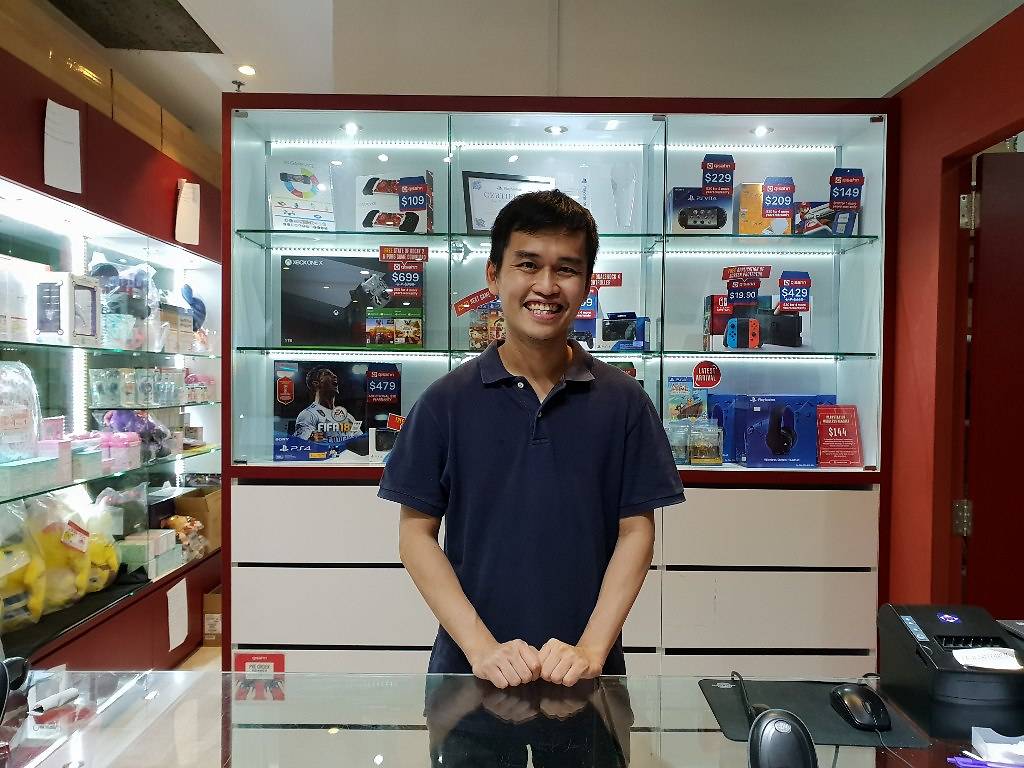
Another online retailer, Mr Soon Qishan who runs video game shop Qisahn.com, also lauded the tools that Lazada has been introducing to help businesses like his be more visible.
Mr Soon Qishan, who runs the video game shop Qisahn.com, recognises the advantages of partnering Lazada to sell his products and services. (Photo: Lazada)
Competition is fierce in the market space he operates in – selling video game consoles and other services – as he is a reseller, and there are many others like him in the market.
For him, it’s about finding a competitive edge, however small, to entice customers to buy from him rather than rival offerings. So, the ability to “decorate” his online presence on Lazada and flag to people that he is based in Singapore and has a brick-and-mortar shop here in case they need to physically inspect their purchase is an advantage Mr Soon readily mentioned.
“I do this to try and be a bit better (than overseas sellers),” Mr Soon told Channel NewsAsia, adding he is “happy to know” there are customers out there who still have a buy-from-Singapore mentality.
The 32-year-old’s business has also benefited from joint campaigns with Lazada. He cited a recent campaign that resulted in “a huge spike in sales for three days” and raked in S$178,000 during that period, which he said was 25 times more than normal days.
That said, Mr Soon acknowledged that not all campaigns are as successful. He also said not all the tools Lazada is touting is new, like letting buyers and sellers chat using instant messaging, which has been available for a long time on his website.
ONLINE RETAIL MATCHMAKER
These tools for sellers were introduced after the e-commerce platform spent the past year understanding their needs and pain points, explained Mr Alexis Lanternier, CEO of Lazada Singapore.
During a media lunch on Wednesday (Aug 1), Mr Lanternier shared that the goal for the company is to become “more and more like a matchmaker” to bring the right merchant to meet the consumer’s needs.
Beyond the tools already mentioned, the executive pointed to its Treasure Ball system that allows retailers to flag up to three products at a reduced price to Lazada to sell under its Flash Sales category, which is designed to be highly visible and accessible on its mobile app or Web portal. These products are made available at the reduced price for six hours, after which a new selection of products will be hawked online, he explained.
“Through these sales, our algorithm learns to better match buyers with appropriate products,” Mr Lanternier explained, adding that it would give more exposure to retailers as shoppers tend to go on and browse the “shop” providing the item they were interested in initially.
“WE ARE GOING TO CRUSH” THE COMPETITION
It also announced on Wednesday it will remove the commission charge for Singapore sellers. It had previously charged sellers between 1 per cent and 7 per cent per sale, depending on the category of products.
“Completely doing away with commission charges will help lower the cost of doing business on the platform and create new opportunities for local merchants to venture into the e-commerce space,” the company said in its press release.
In contrast, competitors like Sea’s Shopee, for instance, has imposed a transaction fee of 1 per cent for sellers based in Singapore from Aug 1. Shopee, whose parent company is backed by Tencent, said then that the move highlights the shift in focus from merely growing the platform to building a more sustainable e-commerce ecosystem for users in the long run.
Singapore-based Giosis, which operates rival platform Qoo10, has also girded itself for competition after bolstering its war chest from the sale of its Japanese assets to eBay for an undisclosed amount, with reports pegging the deal at between US$573 million and US$700 million.
The more cynical would view Lazada’s moves as a grab for market share and, once a clear market leadership has been established, additional fees and fewer promotions may be introduced to sellers and consumers. It’s a phenomenon that some argue is currently being seen in the local ride-hailing scene after Grab’s merger with rival Uber.
Lazada Singapore CEO Alexis Lanternier is bullish about the e-commerce platform’s future prospects. (Photo: Lazada)
Mr Lanternier acknowledged the point but said its acquisition by Chinese Internet behemoth Alibaba meant that such fears can and should be allayed. Alibaba announced in March this year it will invest an additional US$2 billion in Lazada, bringing the total investment to US$4 billion, and installed chairwoman Lucy Peng as its CEO too.
He said sellers on Taobao, for instance, have not had to pay sales commission for years now and, given the scale of Alibaba’s e-commerce business, they can afford not to charge commission.
“We aren’t too concerned about what the competition is doing, because we are going to crush them,” Mr Lanternier said.