SINGAPORE: A woman who failed to provide a safe working environment for her two maids and employed them as a scaffolder and maintenance worker illegally was fined S$46,000 in total on Wednesday (Aug 8).
Willow Phua Brest, 46, pleaded guilty to four charges of breaching work permit conditions and a charge of illegal employment on Tuesday. Five other similar charges were taken into consideration during sentencing.
All the offences took place in October last year, said the Ministry of Manpower in a news release.
Phua had permitted her maids to clean the windows’ exterior at the two-storey bungalow at Cluny Park on four occasions.
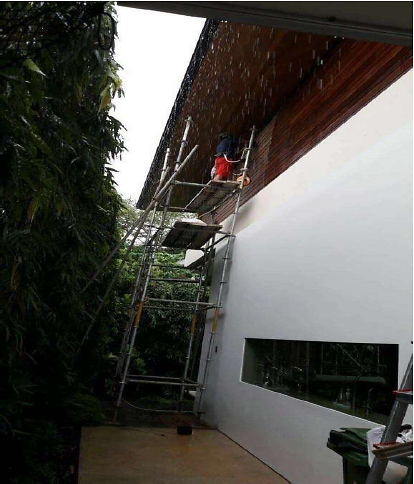
The maids had to stand on a 7m-tall L-shaped scaffold that was erected outside the bungalow’s main building to reach the windows, which did not have grilles installed.
MOM said that such acts should have been undertaken by service providers instead, and that Phua had endangered the maids’ life by permitting them to carrying out those acts.
Phua also failed to provide a safe working environment for the maids and did not take necessary measures to ensure their safety, the ministry added.
The L-shaped scaffold that the maids had to climb to clean the windows exterior. (Photo: MOM)
The maids, who had been employed to carry out household chores, were also told to erect a scaffold and carry out maintenance work at the back wall of the bungalow without valid work permits in the same month.
One of the maids had raised concerns that it was dangerous to climb onto the scaffold to work as it did not have proper guard rails to prevent falls, but Phua persuaded her to carry out the tasks, said MOM.
The maids carried out maintenance works dangerously on the bungalow’s back wall by standing on a make-shift scaffold erected by one of the maid. (Photo: MOM)
Both maids have since been stopped from working for Phua by MOM. One of the maid has been placed under the temporary job scheme and works for a new employer, while the other has returned home.
MOM director of well-being Ms Jeanette Har said that the case was “egregious”.
“Lives and limbs are at stake here … The risks are real and obvious but the employer was oblivious to them,” she said.
Phua could have been fined up to S$10,000 and jailed 12 months for each charge of failing to ensure the work safety of domestic workers can be fined up to S$10,000 and jailed up to 12 months for each charge.
For illegal employment, Phua could have be fined up to S$30,000 and jailed up to 12 months. Offenders will be barred from hiring domestic workers in future as well.
From perennial favourites like the Red Lions and fireworks, to strings of giant balloons, here’s our pick of what to look out for at National Day Parade 2018.
Revellers take photos of the Red Lions as they descend from the sky at the 2018 National Day Parade preview. (Photo: Gaya Chandramohan)
(Updated: )
Bookmark
SINGAPORE: Got hold of those coveted National Day Parade tickets? Or are you planning to catch the parade on TV or online with your friends and family?
As Singapore’s 53rd birthday rolls round, here’s our pick of the five highlights to look out for – and remember – at NDP 2018.
1. NAVY DIVERS AND RED LIONS
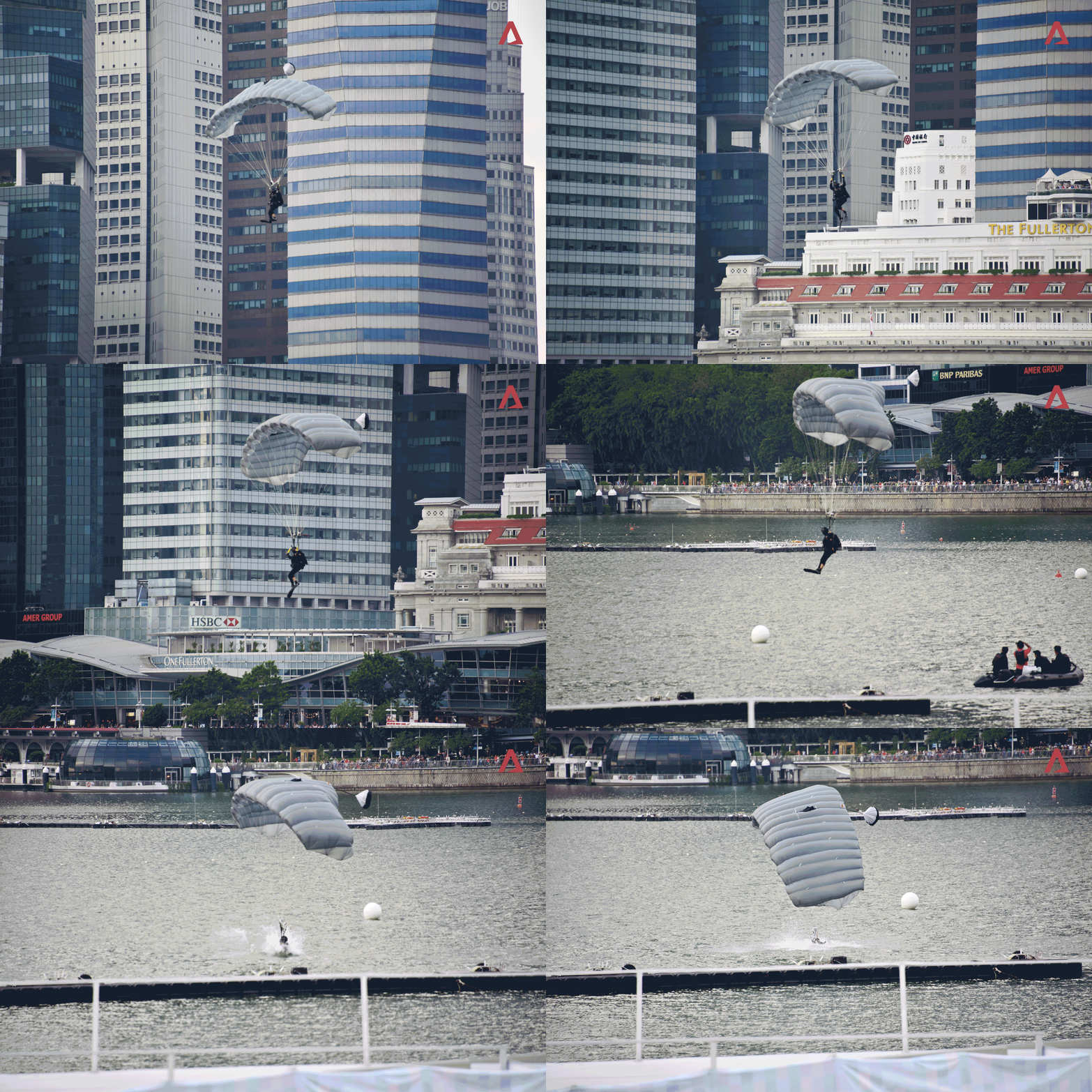
A Navy Diving Unit member free-falls into the water from more than 1,800 metres in the sky. (Photos: Gaya Chandramohan)
First, look out for the eight-member Naval Diving Unit (NDU) as they free-fall more than 1,800 metres from a Super Puma helicopter into the water.
The move is one used in actual operations and will give an insight to the maritime operations conducted by divers when they need to enter an area that isn’t easily or quickly accessible by other means.
After that, the perennial crowd favourite, the Red Lions, will perform a wingsuit jump from a record height of 3,800 metres – more than 750m higher than their previous performances.
A Red Lion begins his descent after a wingsuit jump from a record height of 3,800 metres. (Photo: Gaya Chandramohan)
They will jump from a C-130 plane above Sentosa and glide towards the Marina Bay floating platform at speeds of up to 200kmh before a minute-long free fall.
2. RSAF AERIAL SEGMENT
RSAF helicopters demonstrate an aerial flypast. (Photo: Jeremy Long)
Keep looking up – this year’s NDP will feature an “enhanced” aerial segment, involving as many as 21 Republic of Singapore Air Force (RSAF) aircraft. The planes will fly in formation towards the floating platform before fighter jets execute aerial aerobatics over the Marina Bay skies.
3. 20KG BALLOON GARLANDS
The balloon garlands featured in this year’s National Day Parade show segment. (Video: Gaya Chandramohan)
Look out for these 18m-high balloon garlands in the second act of the show segment.
The 12 massive garlands will transfix you as they sway and twinkle against the evening sky – but perhaps less obvious is the sheer strength and stamina it takes to handle the balloons.
It’s been likened to pulling with a 20kg weight while sprinting, and performers have to resist the upward pull of the balloons even when they’re standing still.
Our reporter Lianne Chia gave it a go:
4. SAILING DOWN MEMORY LANE
Part of the 18-vessel water procession that will sail around Marina Bay during NDP.
Also in the second act of the show is an 18-vessel water procession that will sail around Marina Bay. In a nod to Singapore’s heritage, some of the floats have been modelled after iconic playgrounds of yesteryear. Which ones do you recognise?
5. BOOM BOOM POW
Fireworks light up the sky at the preview of the 2018 National Day Parade. (Photo: Gaya Chandramohan)
And what is a National Day Parade without the grand finale, lighting up the sky across the Marina Bay? The fireworks start at about 8pm and will be visible from all around the bay.
Here are some of our picks for the best vantage point:
With Aug 9 just around the corner, you might be thinking of ways to catch the fireworks display near the Marina Bay Floating Platform. Elizabeth Neo looks at the prime spots to get a good view for free or for a fee.
Didn’t get tickets – or couldn’t make it back home to Singapore this year? Don’t worry, you can catch the parade ‘live’ on our website, Twitter or Facebook on Aug 9 from 5.30pm Singapore time.
SINGAPORE: If you were born in 1965, it’s hard to forget how old you are – especially on Aug 9 every year.
That’s the case for Gurmit Singh, Chen Liping and Rayson Tan, who happen to be the same age as Singapore.
And just as Singapore has matured and developed over her 53 years of independence, these celebs can also look back and say they have come a long way – and are definitely not stopping here.
This National Day, they tell us their hopes and dreams for the future and for Singapore.
GURMIT SINGH
Gurmit Singh at a rehearsal for the National Day Parade 2018. (Photo: Facebook/Gurmit Singh)
This year marks Gurmit’s 20th year as one of the hosts for the National Day Parade, a true testament to the actor and comedian’s enduring popularity. While he’s working the crowd at the Marina Bay Floating Platform, the fans who grew up watching him on TV can also appreciate his contributions to the local entertainment scene.
“The difference between Singapore and myself is that every year, Singapore gets better and more developed and more high tech, whereas I am going the other way,” Gurmit joked. “But seriously, some people see getting older as a bad thing, but I see age as just a number. I’m still enjoying the same way of life as I did back in my 30s and 40s – going to the gym, meeting friends and being active. I think the fact that I have a five-year-old helps as well! I can’t lie back and say, “I’m going to be a grandfather soon.'”
If he could go back in time to advise his younger self, he would say: “Save more, invest more and don’t be an idiot and spend so much,” he quipped. “It was only after I met my wife that I picked up the habit of saving. If I knew then what I know now, I’d always put some serious money aside, as opposed to, ‘Oh, I’ve got money now, I’d better buy the latest laptop or phone.’ That will never end.”
For the future, “I think the first thing I want to wish for the nation and myself is good health. Increasingly, that’s my priority. If I’m doing too much at the expense of my health, then I have to take a look and say, ‘Maybe I shouldn’t do this.’ I think it’s the same for Singapore,” he said.
“We have progressed so fast that it’s incredible. But I also want Singapore to take note, as a people and as a government, of where our roots are, and be able to keep that alive. One way of doing that, I think, is to keep the architecture. There are landmarks that I sometimes feel have been torn down for the sake of progress – I’m still very sore about the old National Library. I know that the government has taken steps to earmark some buildings as national heritage, and I think that’s the right way to go.”
CHEN LIPING
Chen Liping. (Photo: Jeremy Long)
At 53, Chen Liping asserts, she’s far from done learning. “No matter how old you are, you have to keep learning without ceasing. That’s true for me even when I’ve been in the industry for so long,” she said. “Every show, every phase of life, offers something to learn from, experience or overcome.”
Those are weighty words coming from somebody who has been acting for 33 years and counting, and is still remembered for her iconic roles such as that of a teacher in 1989’s Good Morning, Sir!.
But on the subject of school, if there’s anything she could go back and do again, she said, she would put a little more effort into her studies.
“I think back to when I was a student. I loved outdoor activities and exercising,” she said. “Sometimes I think to myself, ‘Why didn’t I work a little harder? It wasn’t that I was lazy; I just liked sports, so I didn’t focus wholeheartedly on my studies. I went to a Chinese school, but then I switched to an English school, so now, my language skills are neither here nor there. I really admire people who can write and speak well. Many people say academics aren’t that important, but I think that when you’re young, you should put more effort into studying.”
Still, her love of outdoor activities laid foundations for active roles in sports dramas such as 1990’s volleyball-themed The Winning Team.
Chen Liping (second from left) with co-stars in 1990’s The Winning Team. (Photo: iWeekly)
Having found her career niche early on, Chen’s love for acting hasn’t abated at midlife. “It’s been so many years, but the passion is still there. I love thinking about how to craft each and every one of my roles, obtain inspiration from the scripts and deliver my best,” said the actress, who currently stars in the drama Say Cheese, airing weekdays at 9pm on Mediacorp TV Channel 8.
At 53, growth is still on her mind. “Things are always moving forward and changing, especially in television and with social media. We have to be able to keep up. No one knows about the future. We will all grow together. In Singapore, everything is very well established. How to maintain that is another question. I think that’s the challenge. It’s that way with people and also with the country.”
RAYSON TAN
Rayson Tan. (Photo: Jeremy Long)
“Singapore is a green and growing garden city. I think I’m the same – not that I’ve lived to 53 and refuse to admit that I’ve aged, but that my mindset is still 30-something. That keeps me energetic,” said actor Rayson Tan, who happens to be married to Chen and also stars in Say Cheese.
“I think I’m like Singapore in that aspect – having a young mindset and continuing to grow and learn. Once a person ceases to grow, they start to age.”
At this period in his life, “I have more confidence in myself,” he said. And “I’m learning now to be slow to speak, slow to get angry and quick to listen.”
Also, “I’ve learnt to live in the moment. If I could go back in time, I would tell myself to enjoy the process. I used to be very much focused on achievements and outcomes, and I neglected the process.”
His wish for Singapore’s future is a very practical one. “I really hope Singaporeans will have more babies,” he stated matter-of-factly. “If we’re lacking in population, we lack the chance to groom our own talent, and we’ll have to absorb talent from outside. For the sake of our country, we should have more babies. I mean that sincerely.
“From the time of our birth, every step we take moves us closer to the grave. During this process, we take things for granted. But we have to pass the baton to the next generation, and we need this group of people to be ready.”
SINGAPORE: Anything red, white and emblazoned with the Merlion is pretty much de rigueur every Aug 9. But sometimes the National Day merchandise on hand can be a tad heavy-handed and, dare we say, too literal for those of us who don’t want to look like a tourist in our own home.
Which is why we’ve rounded up a list of limited-edition National Day merchandise we reckon is just about quirky, tongue-in-cheek and socially conscious enough for patriotic Singaporeans who aren’t dressed to wave tiny flags at the parade.
There are recycled lamppost banners, social commentary T-shirts, and even a shoe rack that pays homage to the humble HDB block.
Happy 53rd birthday, Singapore!
RECYCLED NATIONAL DAY LAMPPOST BANNERS
These reversible tote bags (S$28) are made out of recycled National Day lamp post banners and flags. (Photo: The LampPost Project)
All sales from these T-shirts and bags made out of recycled National Day lamp post banners and flags benefit the Singapore Association for Mental Health. (Photo: The LampPost Project)
The LampPost Project is back this National Day after last year’s resounding success, where 500 tote bags were sold out in just 2 days.
The initiative gives thousands of lamppost banners and flags produced for our National Day celebrations a new lease of life by turning them into T-shirts (S$28) and reversible tote bags (S$28).
All sales benefit the Singapore Association for Mental Health (SAMH) – an organisation that helps persons with mental illness reintegrate into society.
Each LampPost product is individually cut and stitched from the recycled banners with no alteration made to the original design. The totes are sewn by beneficiaries at SAMH.
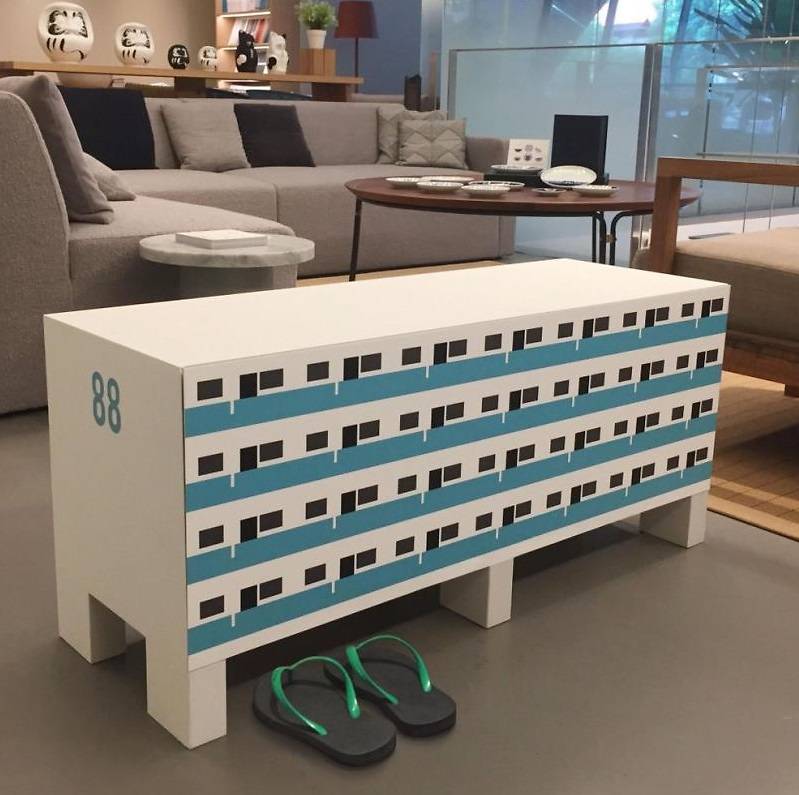
Online design store Degree pays homage to a Singapore icon this National Day with a HDB block-inspired shoe rack (S$290).
Influenced by the colourful Rochor flats, designers Joel Chin, Elmy Thong and Neil Johnson crafted the 100cm by 35cm by 45cm show rack that was “designed to have a distinct Singapore flavour”.
The shoe rack is made-to-order and comes in blue, orange and red. Each order can be customised to include a block and unit number and comes complete with a pack of decorative Singapore flag stickers.
Starbucks’ new line of Singapore-themed merchandise ranges from cold cups and tumblers to vintage-style enamel cups. (Photo: Starbucks Singapore)
(From L-R) Starbucks’ Merlion Cold Cup with a local icons dome lid (S$29.90) and the Merlion Tumbler with a water-filled dome at the base (S$29.90). (Photo: Starbucks Singapore)
Yes, even Starbucks is on board this patriotic train with a line of Singapore-themed merchandise like vintage-style enamel cups (S$19.90) and a Merlion emblazoned tumbler (S$29.90).
Toast to Singapore in a cold cup with a dome lid filled with local icons like the instantly recognisable Dragon Playground, the Singapore Flyer, HDB flats and, of course, the Merlion, priced at S$29.90.
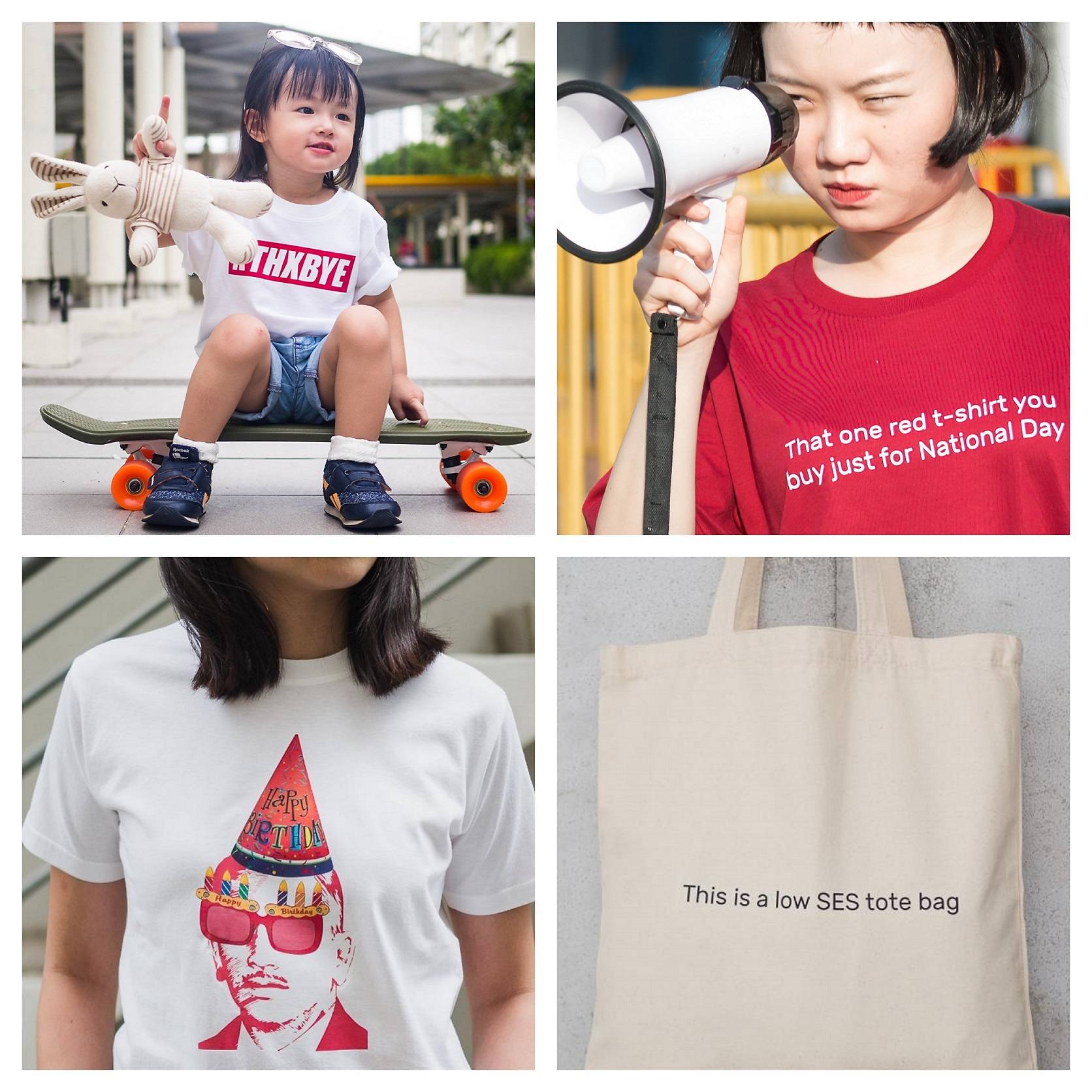
SGAG’s cheeky National Day swag range from S$18 for a tote bag to S$22 for a kid t-shirt and S$25 for an adult t-shirt. (Photos: SGAG)
Is your red T-shirt ready for this year’s NDP viewing party? Local humourist website SGAG is offering the only festive red shirt you’ll ever need, literally.
The rest of their National Day swag includes a host of tongue-firmly-in-cheek tote bags and satirical T-shirts.
WITHIN the span of less than a year, both Singapore and Malaysia made history in the political arena with women appointed at vital governmental positions for the first time.
In Singapore, Halimah Yacob was elected the President of Singapore while Dr. Wan Azizah Wan Ismail was officially made the first women deputy prime minister in Malaysia. This major milestone for women wasn’t just for the two countries but for Southeast Asia as well, where only 30 women per-every 100 men are in leadership positions.
This is especially vital for e-commerce, which in recent years received much limelight when giants such as Google and Temasek predicted that the internet economy is slated to be worth more than US$8.2 billion in Malaysia and US$5.4 billion in Singapore by year 2025.
The bright future of e-commerce was further lit up when Amazon entered Singapore mid-2017 and Alibaba establishing the first Digital Free Trade Zone (DFTZ) outside of China in Malaysia.
While there is no lack of technology and investment in e-commerce, it is paramount that consumers of different demographics are represented in the top levels of its managerial team in order to fully realize the full potential of the industry.
But as we looked into the private sector of e-commerce, we noticed there was a lack of women leaders in top e-commerce companies from both Singapore and Malaysia.
More men than women at the highest management levels
To derive our findings, we analyzed more than 600 employees in managerial positions from Singapore and Malaysia’s top 15 most visited e-commerce platforms of Q2 2018.
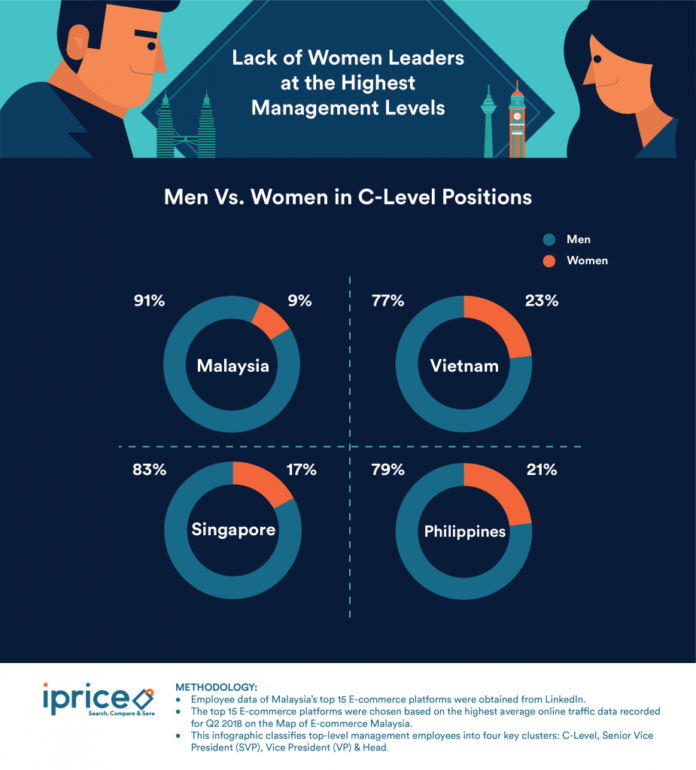
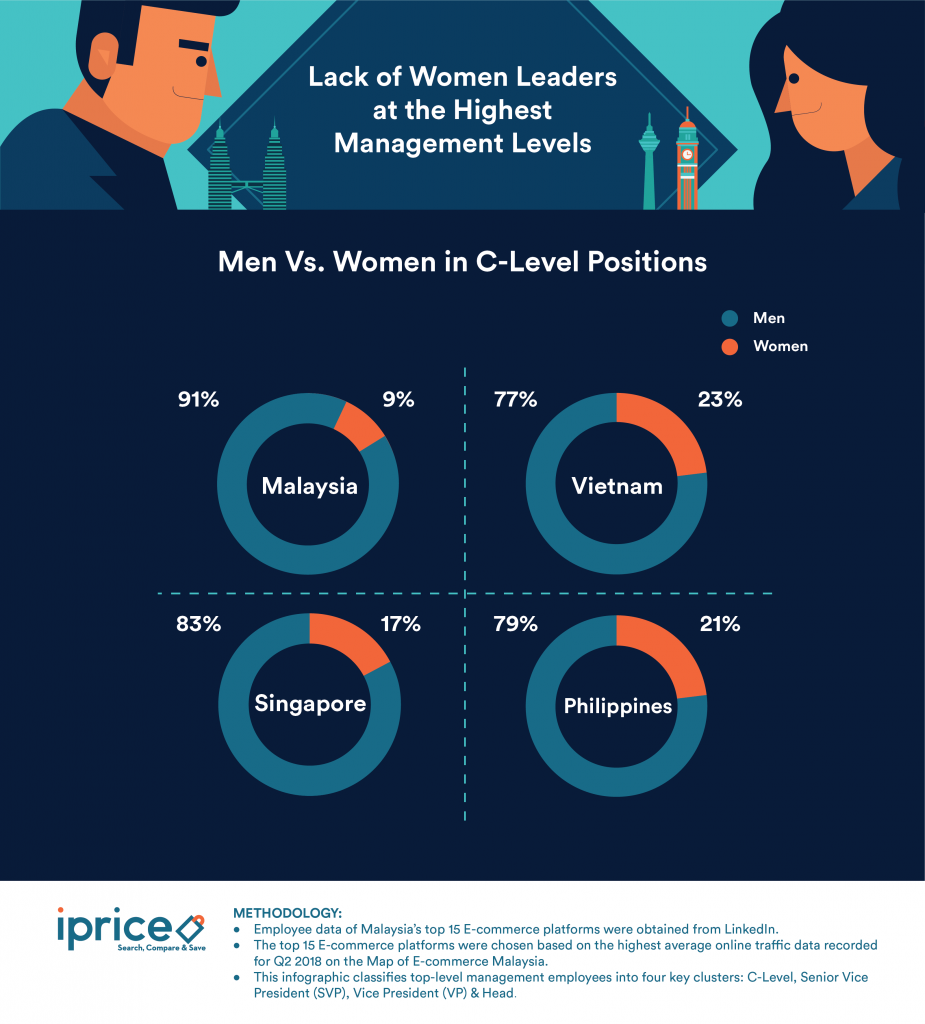
We found that there were more men than women at the highest management levels. Only 17 percent of women in Singapore and 9 percent of women in Malaysia were in C-level positions. What was more interesting was that there were more women in C-level positions in Vietnam at 23 percent and Philippines at 21 percent.
Malaysia has the least number of women in C-level positions. Source: iPrice Group
More so, women currently hold a big share of Malaysia’s demographic today. The Malaysian Communications and Multimedia Commission highlighted that 57 percent of online shoppers today are women. A similar percentage is seen in Singapore as well.
This makes it paramount that women’s views should be represented at vital decision-making stages of e-commerce platforms. People crafting technology have the power to influence how it works and it requires the minds of various demographics to maximise its effectiveness to all consumers.
Hence, gender diversity is important for the people who make and use technology.
Much can be learned from the Philippines, who has consistently performed as one of the most gender-equal workplaces in the world. The Philippines took the helm in Southeast Asia with the highest number of women in leadership, technical and professional roles as seen in the Global Gender Gap Index.
The Philippines fared well in the political empowerment of women, specifically on women handling managerial and executive positions and labour force participation.
The rationale for these findings is in the general upward mobility of women in the Philippines, which makes its talent pool robust.
For instance, the country’s legislature, Magna Carta of Women Act in 2009, promotes gender equality in government by mandating quotas for the proportion of women in government jobs. The same legislature has encouraged the private sector to follow the trend.
A blockage at the career pipeline
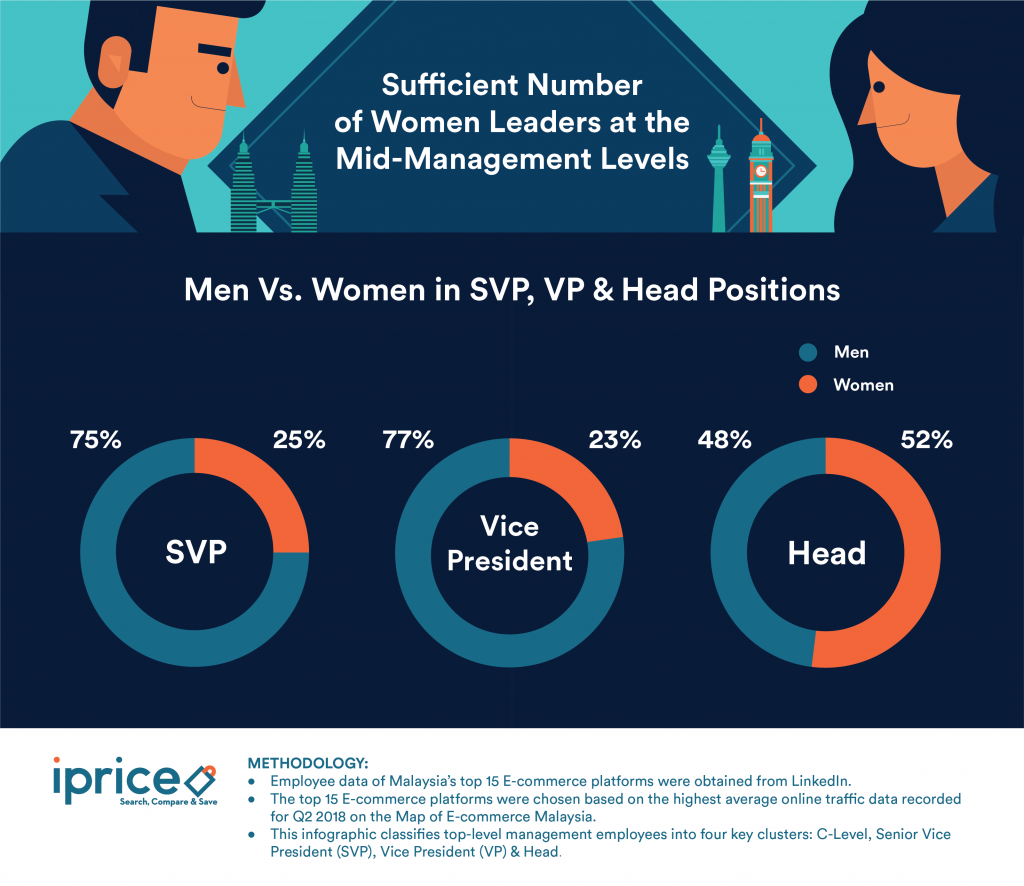
As we looked at the lower management levels, we noticed there was no lack of women in the workforce. In Malaysia’s top e-commerce platforms, 25 percent of women held senior vice president (SVP) positions, 23 percent held vice president (VP) positions and 48 percent held Head career levels.
In Singapore, 20 percent of women held SVP positions, 38 percent held VP positions and 45 percent held Head career levels.
Women are well represented at mid-management levels, but very few carried on to reach the highest management levels.
There was no lack of women in the workforce when looking at the lower management levels. Source: iPrice Group
In Malaysia, Deputy Women, Family and Community Development Minister Hannah Yeoh stated that the number of women taking up tertiary education courses is increasing. But this is not reflected in higher level positions at the workplace.
To reduce the disparity of women on these levels, Yeoh stated that there is a need to empower the rights of women and to recognise the importance of their roles.
The deputy minister went on to state that the private sector should emulate the government’s announcement to open childcare centers in every office in 2019.
This is relevant to the private sector in Singapore as well. Citibank Technology Infrastructure Director Meggy Chung said more work needs to be done to bridge the gender gap. This is particularly true for women holding leadership positions in technology, given that such roles are predominately male-dominated.
Chung, who is also the chairman of Women in Tech@SG said:
“We hope to educate and more importantly, make a positive influence on our next generations, such as students of polytechnics and universities, on their career choices with a view to encourage them to join the technology field.”
SINGAPORE: Durex has recalled several batches of one of its condoms in Singapore after they failed to pass shelf-life durability tests, the condom manufacturer said on its website.
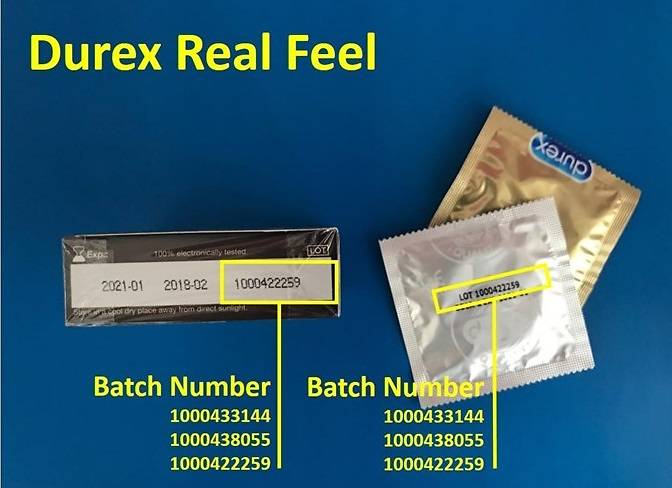
The recall, initiated on Aug 1, involves three batches of non-latex Real Feel condoms with the batch numbers 1000433144, 1000438055 and 1000422259.
The numbers are shown on the bottom of the pack and on the foil wrapping of individual condoms, Durex said.
(Photo: Durex website)
“We recently found that a limited number of non-latex Real Feel condoms made earlier this year are not passing our stringent shelf-life durability tests,” Durex said in the notice, adding that it decided to recall the affected batches after working with regulatory authorities.
There is no immediate safety concern for consumers and only the three batches listed are affected, it added.
Customers who have purchased condoms with the batch numbers listed can get a refund by mailing them to Durex at this address: Durex Real Feel, 1 Sophia Road #04-14 Peace Centre, Singapore 228149.
They should include their full name, phone number, bank and bank account number to receive the refund in their bank accounts within 14 days, Durex said.
Full refunds on the original packs will be given for all unused condoms returned, even if customers have already used some of the condoms from the pack, it added.
The same batches of condoms have also been recalled in Malaysia.
Durex also recently recalled some batches of its Real Feel condoms in the United Kingdom and Ireland due to concerns they may burst towards the end of their shelf life.
SINGAPORE: A buzz was set off in Singapore’s usually dull political scene, when seven opposition parties announced plans last weekend to form a coalition, and extended an invite to former presidential candidate Tan Cheng Bock to lead them.
Buoyed by the stunning political developments across the Causeway, which saw the Barisan Nasional (BN) government toppled after an uninterrupted 61-year rule, some members of the proposed alliance are setting their sights high.
“Our alliance must strive to form the next Government in the upcoming General Election (GE),” said former National Solidarity Party (NSP) chief Lim Tean, who is seeking to form a new party. Singapore’s next GE must be held by 2021.
Writing on Facebook, Mr Lim added:
The winds of change are here and they have buffeted the world for the past two years… Those who try to suggest that what happened in the West and now Malaysia cannot possibly happen in Singapore are myopic and in denial.
But not everyone is convinced. Rather than providing voters with a real choice of an alternative government and a force to be reckoned with at the next GE, the proposed coalition is a last-ditch effort by parties and personalities who have been bit-part players to avoid political oblivion, said some analysts interviewed.
People’s Power Party (PPP) chief Goh Meng Seng was more circumspect about what the opposition parties were trying to achieve with the alliance. Citing the poor showing by the smaller opposition parties in the Republic’s last GE in 2015, Mr Goh said: “We’re at rock-bottom. When we come to that stage, nothing could be worse (than) to try… a new approach to get a different result. If we don’t change, the results won’t change.”
The seven parties involved are the Singapore Democratic Party (SDP), NSP, PPP, Democratic Progressive Party, Reform Party (RP), Singaporeans First, and Mr Lim’s as-yet-unregistered party People’s Voice.
Former NSP secretary-general Lim Tean. (Photo: Kane Cunico)
The Workers’ Party (WP) and the Singapore People’s Party (SPP), two of the most successful opposition parties in Singapore, are not part of the effort.
At this stage, many questions remain unanswered. For instance, RP chairman Andy Zhu said it is unclear if the component parties will have to fold should the alliance come to pass, or if the coalition’s leaders have to resign from their current party posts while their old parties remain.
The idea of the smaller opposition parties forming a new coalition and having Dr Tan as a leader was mooted two Saturdays ago during a working lunch chaired by SDP secretary-general Chee Soon Juan at his party’s premises.
The meeting was held three weeks after the SDP brought in Malaysian politician Chua Tian Chang to speak about the opposition coalition Pakatan Harapan’s (PH) historic victory in the Malaysian election. Mr Chua is vice-president of Parti Keadilan Rakyat, one of PH’s component parties.
THE MALAYSIAN GE EFFECT
The opposition leaders behind the proposed alliance have made clear that the Malaysian GE results had given them the impetus, and the belief that they can achieve a similar feat.
In the aftermath of the May 9 polls, many speculated whether Singapore could follow suit, as opposition supporters in the country hailed PH’s victory as a sign of things to come.
Subsequent comments by Malaysian Prime Minister Mahathir Mohamad — who returned to power after a 15-year hiatus by leading the PH alliance to victory — further fuelled such sentiments.
Malaysian prime minister Mahathir Mohamad celebrates with other leaders of his Pakatan Harapan coalition during a press conference following the 14th general elections in Kuala Lumpur on early May 10, 2018. (Photo: AFP/Manan Vatsyayana)
Weeks after the Malaysian polls, Dr Mahathir told the Financial Times that PH’s win would have a spillover effect on Singapore. “I think the people of Singapore, like the people in Malaysia, must be tired of having the same government, the same party since independence,” he said.
However, some political observers and analysts have pointed out that the conditions in Malaysia and Singapore are vastly different.
Banyan Tree executive chairman Ho Kwon Ping, for example, said last month that it would be a “foolish mistake” to think the People’s Action Party (PAP) will suffer the same fate as BN, even though there are “unnervingly close parallels” between the neighbouring countries.
A “huge and critical difference” is the “egregiously blatant” corruption of the previous Malaysian government, said Mr Ho who was speaking at an OCBC Bank forum.
Singapore and its people would be “drawing the wrong lessons if we look at Malaysia and think that the fall of the PAP is imminent for whatever reasons that are happening across the Causeway”, he reiterated.
“It is not the absence of full democratic institutions, it is not the absence of full human rights, or the putting down of dissent, nor the presence of paternalistic governance which brings down a government, or has brought down the Malaysian government,” he said.
It is the unbridled, egregiously blatant and massively enormous corruption of the Najib (Malaysia’s former premier) government which brought him down.
Several political analysts noted that getting Dr Tan to lead the proposed coalition was straight out of the PH playbook. But the circumstances in Singapore could not be more different.
Dr Tan, 78, has said that he is open to the idea of leading the coalition but stopped short of agreeing to take up the offer.
Former presidential candidate Tan Cheng Bock at a press conference in 2011. (File photo: TODAY)
Several opposition party leaders involved in the proposed coalition said they were pinning their hopes on Dr Tan to take charge — from shaping the form in which the coalition will take to attracting more qualified candidates into its ranks.
Dr Tan, a medical doctor, was formerly a long-serving PAP Member of Parliament (MP), winning six consecutive elections — garnering at least 70 per cent of the vote each time — in the Ayer Rajah single member constituency between 1980 and 2001.
He stepped down as an MP in 2006, and resigned from the PAP in 2011 to run in the Presidential Election (PE). He received almost 34.9 per cent of the vote in the four-cornered fight, losing to Dr Tony Tan by a razor-thin margin of about 0.3 percentage point.
Despite his popularity among Singaporeans and political credentials, any comparison of Dr Tan to Dr Mahathir, 93, is far-fetched, analysts said.
The veteran Malaysian politician had been the country’s longest-serving prime minister before taking up the reins again, while Dr Tan had only been an MP, they added.
The PH alliance is also highly mature, compared with the “much less organised” coalition being proposed here, said Nanyang Technological University (NTU) political scientist Woo Jun Jie.
Retired political science professor Hussin Mutalib said there had been mass disenchantment across the Causeway leading to the polls, with major issues dogging the previous BN government, such as the financial scandal involving state fund 1Malaysia Development Berhad.
“The Malaysian setting that led to PH’s victory is far different from Singapore,” he reiterated.
Never mind that the opposition leaders banking on any Malaysian GE effect could be setting themselves up for disappointment, they have their work cut out should the proposed coalition come to pass, the analysts said.
Malaysian ministers attend first cabinet meeting since the Pakatan Harapan coalition won the 14th general election.(Photo: Facebook/Selangor Chief Minister Azmin Ali)
The leaders will have to set aside their differences and party aspirations to forge a common vision and identity. They must also go beyond stirring dissatisfaction against the ruling PAP and chart clear and effective policies to convince voters.
Building a pipeline of credible politicians will also be key to ensuring the group’s long-term viability, analysts added.
Party leaders interviewed were acutely aware of the challenges that lie before them.
This is not the first time that opposition parties have mooted a formal alliance. The most recent attempt saw the formation of the Singapore Democratic Alliance (SDA) by opposition figurehead Chiam See Tong in 2001.
The SDA started out with four component parties: SPP (which was led by Mr Chiam), NSP, the Singapore Justice Party and the Singapore Malay National Organization (PKMS).
Before long, cracks appeared. NSP withdrew from the alliance in 2007. Four years later, Mr Chiam and the SPP followed suit — just three months before the 2011 GE. The SDA floundered at the polls that year, where it was the worst-performing opposition party.
For the latest effort to bear fruit, some opposition leaders acknowledged the need to not only put aside their egos but also agree on a common manifesto and identity to mount an effective electoral battle.
PUTTING ASIDE EGOS, STRONG PERSONALITIES
The egos of party leaders are the main obstacle, said Mr Zhu. “It is easy to come together, but it is difficult to put aside some of their leadership egos and ‘why do I have to listen to you’ and everything,” he added.
Mr Zhu, however, struck an optimistic note, saying that the grouping comprises seasoned politicians who have been in the arena for a long time. “We believe that we know what we’re doing and who we’re dealing with,” he said.
Assistant Professor Woo, who is from the NTU’s public policy and global affairs programme, noted the presence of “strong-willed leaders” such as RP secretary-general Kenneth Jeyaretnam and Singaporeans First chief Tan Jee Say.
Singaporeans First chief Tan Jee Say seen here with other party members during a walkabout at Tiong Bahru market on Aug 1, 2015. (Photo: TODAY/Raj Nadarajan)
Writing on Facebook a day after the parties proposed that he lead them, Dr Tan said some politicians from the seven parties may need to stand down and “serve from the backroom if it is for the good of the country”.
Dr Gillian Koh, deputy director (research) at the Institute of Policy Studies, said it was not that promising to start talks with “terms and conditions dictated”, where parties are told certain personalities may have to step aside.
“If you’re saying you want to build a coalition that is inclusive, then you might want to start off by laying on the table what are some things that (all) agree with,” she said.
Still, Prof Hussin said party veterans should agree to give way to younger and qualified members to be fielded in elections.
Mr Goh from the PPP, however, disagreed that egos would get in the way.
“If we are all egomaniacs, we won’t be sitting on the same table … All the leaders have their differences in their ideologies, policy-wise and how things should be done, but I do not think they are so egoistic as to say they can do it all by themselves,” he said.
We understand that we cannot do it alone and we need to unite and depend on each other for our future success.
Mr Goh, for one, said he has no qualms taking a backseat. “The back-end is as important as the front … I do not see anything bad about that,” he said.
COMMON VISION, IDENTITY VITAL
While the nitty-gritty of the proposed coalition is still to be ironed out, analysts and politicians said that uniting behind a single vision and identity will be key to achieving any success.
The parties need to agree on a “conscientious” pooling of resources and a united electoral strategy, said Singapore Management University (SMU) law lecturer Eugene Tan.
Mr Spencer Ng, secretary-general of the NSP, said working towards the same goal was the “fundamental cornerstone” if the parties were to fight more effectively at the ballot box.
The National Solidarity Party on a walkabout in Yishun on Sep 2, 2015. (Photo: Sarah Yang)
A common vision, said Asst Prof Woo, is also important so that the coalition can transcend the personality politics that has thus far characterised the country’s opposition landscape.
“The lack of a common vision will only damage the coalition’s credibility to potential voters,” he added.
Singaporeans First secretary-general Tan Jee Say said that the seven parties have met to discuss several issues such as the cost of living, minimum wage and foreign worker inflows.
He also acknowledged that the parties will have to reach a “compromise” and adopt a “give-and-take spirit” to form a successful coalition. As long as the parties agree on the core issues to tackle, peripheral differences “will not matter as much”, he said.
Mr Goh said the parties concur on many issues, including the need to cut ministerial salaries and to stem increases in the Goods and Services Tax — which is set to rise from 7 per cent to 9 per cent between 2021 and 2025.
“Fundamentally, we feel that the PAP should not be in power anymore,” said Mr Goh, claiming that the PAP government is not running the country as well as it used to be.
Political analyst Felix Tan, an associate lecturer with SIM Global Education, said the proposed coalition must go beyond just being “against the ruling party”. Clear policies and directions will be key to convincing voters, especially as the extent of change the coalition can effect is still in question, he said.
More than a common vision, the parties will have to forge a shared identity, analysts said.
Party identities will be diminished in the process, said Asst Prof Woo.
Party leaders said that this was not a huge concern and they will work towards adopting a common logo and banner under which they will contest elections. Said NSP’s Mr Ng:
If the coalition really comes into existence, it’s only natural that we will contest under one party and one logo.
A clear agenda and arrangement under which the coalition speaks and campaigns as one will also help it to draw candidates, said Mr Tan from Singaporeans First.
People at a Bukit Batok by-election rally by the Singapore Democratic Party (Photo: Xabryna Kek)
TALENT CRUNCH
The proposed coalition also needs to focus on creating a steady pipeline of talent to ensure it stays relevant and viable for the long haul, said analysts.
Political parties, including PAP, face a perennial challenge of getting suitable candidates to step forward. Among the opposition parties, WP has the strongest brand name and would be the natural choice for those aspiring to join the opposition, analysts noted.
Asst Prof Woo said that parties in the proposed alliance are presently unequal in their ability to attract and retain talent.
RP, for example, has had little success, with members coming and going in quick succession. By contrast, SDP has fared better, he added.
Indeed, most of the parties face a dearth of talent, said SIM’s Dr Tan, and have not demonstrated the tenacity to seek out new blood or keep existing members.
SMU’s Assoc Prof Tan said the parties have a long way to go in making a compelling case on why any budding politician should opt for them.
One reason the smaller parties face this difficulty is that they tend to go into “political hibernation” after elections.
Agreeing, Dr Bilveer Singh, a political scientist with NUS, said the parties should raise their visibility to woo talent. They cannot just be “fly-by-night” parties, but ought to capitalise on social media to scout potential candidates — an area in which they are lagging behind right now.
Notwithstanding the concerns over talent, some opposition leaders remained sanguine.
Mr Tan from Singaporeans First said the discussions sparked by the proposed coalition could inspire those who are ready to step forward. “With every election, there will always be new people coming up, people who are older, and ready for a change,” he added.
PPP’s Mr Goh said parties of the proposed alliance were not short on talent, with banking and finance professionals and former top civil servants in their ranks, for instance.
People’s Power Party (PPP) chief Goh Meng Seng (left) and Syafarin Sarif speaking to a resident at Lot 1 in Choa Chu Kang, Aug 2, 2015. (Photo: Raj Nadarajan/TODAY)
The parties are also looking to Dr Tan Cheng Bock to serve as a draw for prospective candidates.
“Having the leadership of Dr Tan Cheng Bock, I hope more talented Singaporeans are willing enough to step out of their comfort zones to really fight for what is right and beneficial for the country,” said NSP’s Mr Ng.
When approached, Dr Tan declined to be interviewed.
IMPACT OF MAJOR PARTIES’ ABSENCE
Despite the optimism of the opposition leaders involved, the effort to form a new coalition is hamstrung from the start by the absence of WP and SPP.
Both parties were invited to the working lunch where the idea was mooted, but did not attend.
SPP chairman Lina Chiam said that her party is focusing its efforts on intensive ground engagement to gauge and understand the sentiments of Singaporeans. Responding to media queries, the WP had maintained that its focus was on building itself up to better serve Singaporeans.
WP’s aversion towards working with other opposition parties is well known, with former WP chief Low Thia Khiang making it clear previously that having all opposition parties band together as one political force was an “unworkable concept”.
Mr Low stepped down as party chief earlier this year to make way for new blood. But its stance towards opposition unity is unlikely to change under new secretary-general Pritam Singh, experts have said.
The absence of WP — which is the only opposition party with a presence in Parliament — would lower the proposed coalition’s chances of success, analysts said.
Asst Prof Woo pointed out that it would, however, not have made sense for the WP to participate. Its political values and ideologies differ from those of key coalition members, such as the SDP.
SIM’s Dr Tan reiterated that the WP and the SPP have established identities and manifestos, and are clear about who and what they stand for. Joining the coalition would diminish their influence, he said.
Nonetheless, Prof Hussin said the alliance could still receive considerable support without the two main opposition parties if its leadership is united and credible, and its programmes are seen as relevant and timely.
Assoc Prof Tan from SMU felt that the non-involvement of WP and SPP will not matter much as long as the opposition parties avoid being mired in three-cornered fights, which will split the opposition vote.
Still, some opposition members are holding out hope that both parties could come on board.
Worker’s Party chief Low Thia Khiang WP had made it clear previously that having all opposition parties band together as one political force was an “unworkable concept” (Photo: Xabryna Kek)
Mr Goh said discussions with WP and SPP are ongoing via various channels.
While he believes it would be best if the WP decides to step in, he noted that “maybe we should let them be” as the party already has a presence in Parliament.
“It’s not easy to win seats from the PAP, but whether they can hold on to them … that’s their problem.”
Opposition figure Ravi Philemon, a former SPP candidate, said that while some parties may be non-committal now, it is hard to tell how things will pan out come election time.
“The opposition parties always have a roundtable discussion just before the election is announced and constituencies are drawn up. We may see a coalition (coming together) at that time,” he added.
‘IF WE DON’T CHANGE, THE RESULTS WON’T CHANGE’
With the proposed coalition beset with great challenges and what seems to be a Herculean task ahead, few people outside the opposition circles are convinced that it would take off.
SIM’s Dr Tan reiterated that for several parties in the proposed coalition, “their popularity and influence in domestic politics are waning completely”.
“So their relevance is … called into question in the first place. Coming together will, perhaps, allow them to be in the minds of Singaporeans,” he added.
Call it what one will, but PPP’s Mr Goh — who has had his fair share of electoral setbacks — said the effort to come together stemmed from the realisation among the smaller opposition parties that they can no longer go it alone.
“If we continue to do things (as we did) in the past, we will not get different results,” he said. “The fact is that our fortunes and destinies are linked … We cannot do without each other.”
He added: “If you don’t try, you won’t know”. “It cannot be worse than the status quo.”
In a crowded and fragmented opposition landscape, Assoc Prof Tan said the stakes are high for some of the parties involved. The proposed coalition could be their last throw of the dice.
“The parties may have no alternative as they have been marginal players in the last and previous GEs. If they don’t make headway, then the next GE might see them consigned to political irrelevance,” he said.
An obsession with what others ate, bought or experienced and posted on social media might be unhealthy, says one University of Technology Sydney lecturer.
A survey found that when young adults engage in social media, creating and sharing content about products they consumed, it can trigger social comparisons. (Photo: Unsplash/Eaters Collective)
(Updated: )
Bookmark
SYDNEY: Posting images on social media when we buy new clothes, eat out or purchase the latest gadget may seem harmless enough. But this consumption-oriented sharing may be undermining both our bank balance and our mental well-being.
Research has found that this sort of social media engagement is linked in some people to greater anxiety, lower self-esteem and an increased likelihood of excessive spending.
Around 40 per cent of the world’s population uses social media, with young people spending the greatest amount of time online. So understanding the influence of social media on health and well-being is critical to reducing potential harm.
We surveyed 900 Singaporean university students aged 17 to 24 about their social media activities, to explore whether sharing product information had an influence on well-being.
On platforms like Facebook and Instagram everyone looks happy: Enjoying holidays, going to fancy restaurants, buying luxury goods and clothes. We were curious to understand whether this glossy portrayal has a psychological impact on social media users.
Previous research has looked at the impact of time spent on social media, but our research specifically examined the link between consumer-based content – such as posts about products or shopping experiences – and well-being.
Our survey was conducted face to face at several college campuses. Participants voluntarily reported their behaviours related to social media usage, peer comparison, well-being and spending levels.
This data allowed us to assess the impact of participants’ sharing of consumption-related content on well-being, while controlling for demographics and media usage habits.
Silhouettes of mobile users are seen next to a screen projection of Instagram logo in this picture illustration taken March 28, 2018. (File Photo: REUTERS/Dado Ruvic)
Findings suggest that when young adults engage in social media, creating and sharing content about products, it can trigger a social comparison process.
In the end, this hurts their psychological well-being, lowering their self-esteem and increasing anxiety levels.
Feelings of inferiority, low self-esteem and anxiety in some cases led to uncontrollable spending sprees – seemingly in an effort to close the gap between the students’ own lives and what they see in their news feeds.
While Singaporean culture has a strong focus on material life and peer comparison, the results are also applicable to social media users around the world, particularly young people.
Of particular concern is the link between consumption-oriented sharing and risky spending behaviour, including higher credit card debt. Just sharing general experiences does not seem to have the same impact.
HEALTHY PARENTAL RELATIONSHIPS HELP CURB THE PROBLEM
Negative impacts were more common in students who felt that materialistic possessions and financial success are “very important”. But those who said they had a good relationship with their parents were less affected.
Students who told us that they have a close, healthy relationship with their parents, using self-rated measures of attachment, support and warmth, did not suffer the same feelings of inferiority. Nor did they succumb to the behaviour that this can trigger.
A family walking in Singapore. (Photo: Gaya Chandramohan)
The research has implications for government policy and awareness programmes for young people. We are keen to conduct more of such research, to better understand ways to help young people develop self-regulation and resilience.
The study also has ramifications for marketers because of what it says about the potentially negative impact of marketing products through social media “influencers” – people like beauty and fashion bloggers with large social media followings who are given free products or paid to endorse brands online.
Hillbun Ho is senior lecturer in marketing discipline group at the University of Technology Sydney. A version of this commentary first appeared on The Conversation.
Back in Singapore, the Law and Home Affairs Minister offered his condolences to the Indonesian people after an earthquake on Lombok.
Law and Home Affairs Minister K Shanmugam speaks to the media after returning to Singapore from quake-hit Lombok.
SINGAPORE: Law and Home Affairs Minister K Shanmugam returned to Singapore safely from earthquake-struck Lombok island on Monday afternoon (Aug 6).
He was at the worst-hit region of Mataram for a security conference when the Indonesian island was hit by a 6.9-magnitude earthquake.
Speaking to local media, Mr Shanmugam said: “It’s a tragedy for the Indonesian people, and the people of Lombok … and I think our thoughts and prayers are with them.”
The powerful quake has killed more than 90 people and wounded hundreds, with thousands of buildings left damaged.
Mr Shanmugam said this was his first experience with an earthquake and the hotel they were in “shook very violently”.
“It went through my mind should we just crawl under something but I wasn’t sure the building was going to hold up, and I thought, (let’s) take a chance and leave,” he said, adding that no one in the Singapore delegation was hurt.
On his Facebook page, he shared pictures showing damage and people fleeing.
The power went out and they began evacuating once the building stopped shaking, he said.
“A lot of debris, a lot of doors blown out, ceilings fallen through, people screaming, walking down,” he said, describing the scene as they evacuated.
He and his team tried to go to another hotel, but people were also fleeing from there. They then decided to go to the airport.
“There were several other security ministers – Australia, New Zealand, Myanmar’s National Security Advisor, Brunei’s minister and others had all left (the hotel),” he said.
Eventually, they spent the night at a one-storey police post near the Lombok International Airport.
“MFA’s e-registration shows that there are about 40-odd Singaporeans, MFA is trying to contact all of them,” said Mr Shanmugam.
“There are four officers at the airport trying to help Singaporeans. Some Singaporeans had reached out to me on Facebook after my post, MFA is also reaching out to them.”
In a separate Facebook post, the Ministry of Foreign Affairs said it has set up a counter at Lombok International Airport to provide consular assistance to Singaporeans affected by the recent earthquake in Lombok.