SINGAPORE: A collective gasp rose from the audience as the 36 performers ran out on stage, the long strands of balloons they held swaying gracefully in the air.
Instrumental music played as they ran around the stage using the giant balloons to create beautiful shapes and formations, the bright lights affixed to 12 garlands – each 18m in height – twinkling in the evening sky. As two of the three performers carrying the garland slowly released it in unison, audience members – made up mostly of Primary 5 students – screamed in excitement.
The students in attendance were enjoying a preview of this year’s National Day Parade (NDP), and the giant balloon garlands featured in the second act of the show segment were an obvious hit with them. But far less obvious was the sheer amount of hard work, strength and stamina required to create and execute this visual spectacle.
WORSE THAN A 2.4KM RUN
Garland performer Ronnie Lai is a self-professed natural on stage. The 22-year-old, who is waiting to enter university, has been in the drama club since he was a child, and studied theatre when he was in junior college.
Performing on stage and hearing the audience cheer, he says, always gives him an adrenaline rush. But this time round, it’s better.
“Doing it for my country’s birthday is extra meaningful,” he said. “And when the audience saw the balloons and got so excited, it felt really nice, like my hard work, sweat and tears was all worth it.”
NDP performer Ronnie Lai enjoys being on stage. (Photo: Gaya Chandramohan)
Indeed, being a balloon garland performer is a strenuous task.
With a 10m wire attached, each garland stretches out for close to 30 metres. The balloons themselves are the size of car tyres.
If this does not already make the garlands difficult to manoeuvre, the performers also have to contend with the weight of a 4kg battery pack and the drag from the helium-filled balloons when they run. It is like pulling a 20kg weight, the organisers said. Even when they are standing still they have to resist the upward pull of the balloons.
To make things even more exhausting, jogging slowly from position to position will not cut it. Performers, it turns out, have to sprint – while bearing the weight of the garlands.
“They look deceptively light, but they’re quite a beast to manoeuvre and manage on stage,” said Joshua Chia, a company commander from the 3rd Singapore Division and the person in charge of the balloon garland performers.
“It’s like non-stop running”, added Ronnie. “We always say it’s worse than a 2.4km run.”
Each balloon is about the size of a car tyre. (Photo: Gaya Chandramohan)
GETTING IN SHAPE…AND OUT OF EACH OTHER’S WAY
Getting in shape was, therefore, a key part of the training the team of performers had to go through. Since April they have been training together about 2 to 3 times a week, running around a parade square and making sure they could meet the timing required of them.
“A basic level of physical fitness is definitely a key factor, in order to achieve the graceful, effortless look,” explained Joshua. “Throughout the act, there’s a lot of precision needed in achieving symmetry across the stage, as well as timeliness in arriving in positions.”
“There is just so much to coordinate,” he added. “Just trying to do a simple forward run that involves 6 people having to run in a synchronised manner…even without the balloons, it was tough.”
“The pace and spacing has to be precise, aesthetically pleasing, and correct so we don’t collide with one another and the garlands don’t get tangled up.”
Performers at this year’s NDP holding balloon garlands. (Photo: Gaya Chandramohan)
This, said Ronnie, turned out to be the main challenge.
“We had to run together, in step and in cadence,” he said. “Even things like perfecting a circle is very important, so we don’t look lopsided, and we’re evenly spaced out on stage.”
As Ronnie easily strapped on the battery pack and deftly looped the long garland wire around his arm, it is clear that he knows what he is doing. But he admitted that it was not always like this.
“When we first saw the balloons, we got a shock at first,” he recalled, grinning. “It was like, wow, they’re huge!”
It was tiring at first, he added. But after multiple rounds of practice, the balloons became easier to handle. Little tricks and techniques he picked up along the way also came in useful.
“You could say we learnt from our mistakes,” he said, as he held on to the balloons and ran around the stage without having to catch his breath. “For example, things like tightening the strap of the battery packs so it fits snugly on us, or knowing which hand to use to hold the wire…there are so many little things to take note of.”
Working together with his friends, he added, was also of vital importance.
“It’s one thing for you to remember your own steps, and remember where you’re supposed to go, but we also need to know where everyone else’s markings are,” he said. “So a lot of teamwork is required.”
Performers on stage after the NDP preview show. (Photo: Gaya Chandramohan)
But with the cheers of thousands of audience members ringing in their ears, it is clear that the team’s hard work has paid off – even if the real show has yet to come.
“Watching them on stage with the beautiful garlands made me shed a tear,” admitted Joshua. “They were performing for their friends, family and parents.”
“And I’m proud to say that they gave them a spectacle that they would definitely be proud of.”
SINGAPORE: Dr Woffles Wu’s name often sparks vivid imagery of people undergoing nose jobs, face lifts, botox treatments and a whole range of aesthetic procedures. Indeed, it has become synonymous with plastic surgery, not just in Singapore, but around the world.
After all, the prominent Singaporean plastic surgeon invented a procedure named the Woffles Lift that is being used by surgeons everywhere. It’s a non-surgical procedure for face lifts which involves injecting self-retaining threads into the face and out through the scalp, eliminating the need for stitches and cutting recovery time from several weeks to just several days.
But Dr Wu is more than a plastic surgeon as he has proven over the years.
For instance, the flamboyant doctor who often used to be seen wearing garish multi-hued shirts, also co-produced a film- Singapore Dreaming – in 2006.
“It’s just to have a full life and to experience different things,” he says.
The 58-year old arrives for our interview in a nondescript white short-sleeved shirt, clearly mellower than the last time I met him. It’s “a function of age”, he says.
Throughout our conversation about his recently released memoir, Life in Plastic, and other issues, it’s clear that he has spent time processing pivotal events in his life including some painful ones.
From the challenges of his growing-up years, his relationship with his parents and his career challenges to the traffic offence that propelled him into the public eye for all the wrong reasons in 2010 – he speaks of these now with a calmness that reflects a comfortable acceptance.
THE TRAFFIC OFFENCE SAGA – “I ACCEPT IT WAS WRONG”
While his memoir covers many of these events, one that is missing is the saga of how he got an elderly employee to take the rap for two speeding offences in 2005 and 2006.
The case only came to light in 2010. He was fined S$1,000 for it and in 2014, the Singapore Medical Council (SMC) suspended him from practice for four months, saying that with his “wrongful act”, he had “tarnished the good name of his profession”.
The case sparked public discussions over whether he was let off too easily and it was even raised in Parliament in the context of the equitability of the legal system.
I first ask Dr Wu why he left the incident, which he describes as harrowing, out of his memoir.
“The whole saga and why it’s not in the book, is because it’s just too long and convoluted. It would have consumed the book,” he says.
However, since I’ve asked, he agrees to discuss it with me and reveals information that he says was left out of news reports at the time.
“First of all, the elderly employee was my godfather. He was very close to my family and he was helping out in the clinic. He was my employee in that respect because I gave him a salary. But it’s not as if I abused my position and went to this elderly guy and said ‘Hey, you got to take the rap for me’. It wasn’t anything like that at all.”
However, regardless of their relationship, why did he decide to get someone else to take responsibility for the speeding offences?
“I’ll make one disclaimer first. I accept that it was wrong and I shouldn’t have done it but in those days, a lot of people were doing it. It was just a traffic fine and putting a name on the traffic fine. I thought it was as trivial as jaywalking or one of those other things.
“I guess it was just ego. I had a completely clean record but there was this fine, and my godfather who was sitting with me as we were having lunch one day said ‘Well, you can put my name for this’. So I said, ‘Oh okay, that’s a good idea’. We were still going to pay the fine anyway. I didn’t think anyone was hard put by it and we just forgot about the incident.”
“IT WAS LIKE A HONG KONG DRAMA”
He suspects what brought it to the attention of the authorities a few years later were the actions of one his former employees, who he says was stealing from his practice.
He confronted her but she denied wrongdoing. Eventually he fired her and reported her to the police.
She was sent to jail but not before she “vowed vengeance”, he says.
“She said to me, ‘I will one day see you in jail as well’. It was like a Hong Kong drama being unfolded before my eyes.”
She had witnessed the conversation between Dr Wu and his godfather about the traffic offence, he adds.
“She had written a couple of complaints to various agencies saying I had abused her and I had to write back lengthy letters saying that she has stolen money from us and she is currently under investigation, that she is currently in jail, and that these are fictitious complaints. So they were all thrown by the wayside but finally she went to the Corrupt Practices Investigation Bureau and she alleged that I had bribed this elderly employee.”
Dr Wu was subsequently investigated.
“It’s not fun being investigated by them. It’s exactly like what you see in the movies with little cell with a glass window and you’re sitting on the chair and somebody is interrogating you and your godfather is in the other room and you’re only allowed to look at each other briefly.
“It was quite harrowing but the good thing is, they discovered that there was no wrongdoing of that nature. No money had changed hands, but I readily admitted to the putting his name on the traffic offence, which I shouldn’t have done.”
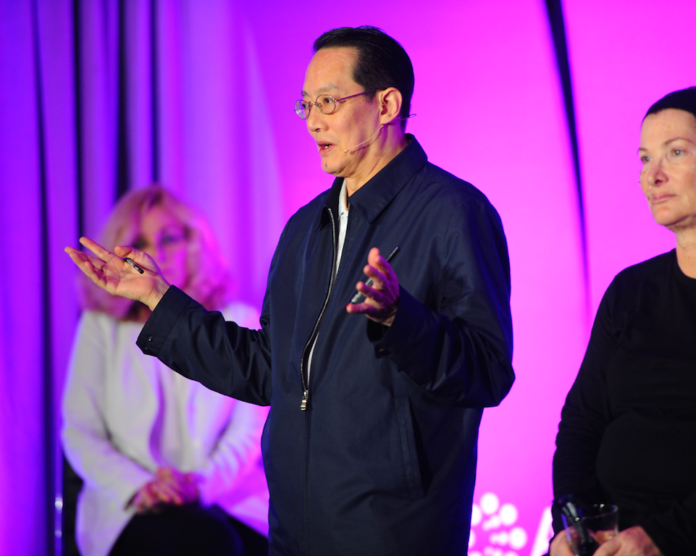
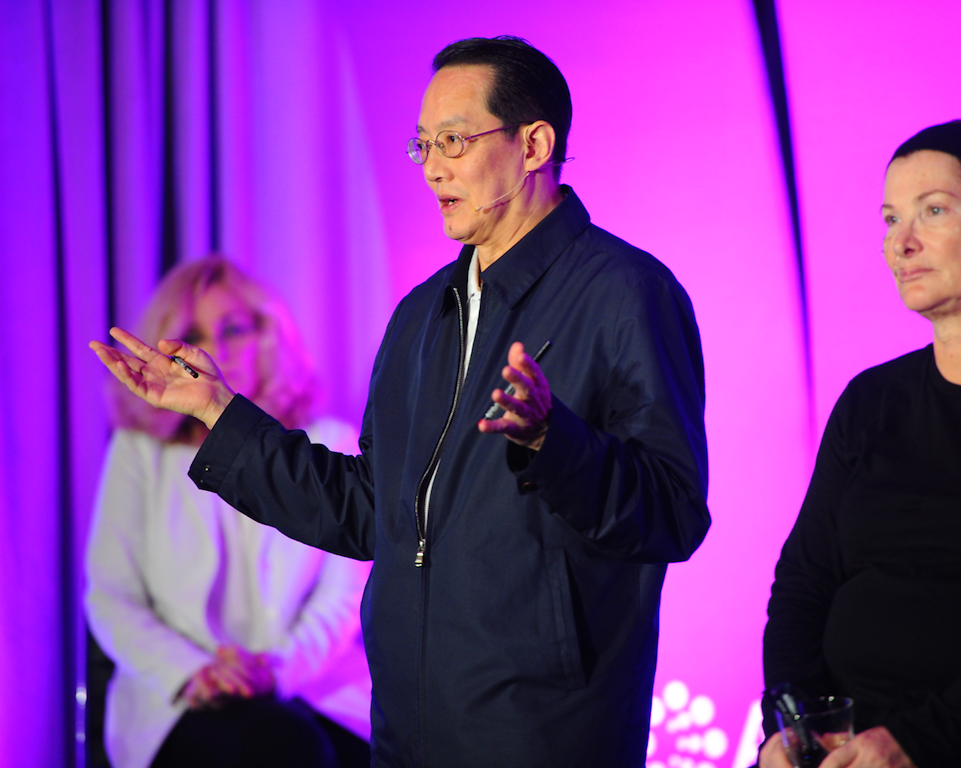
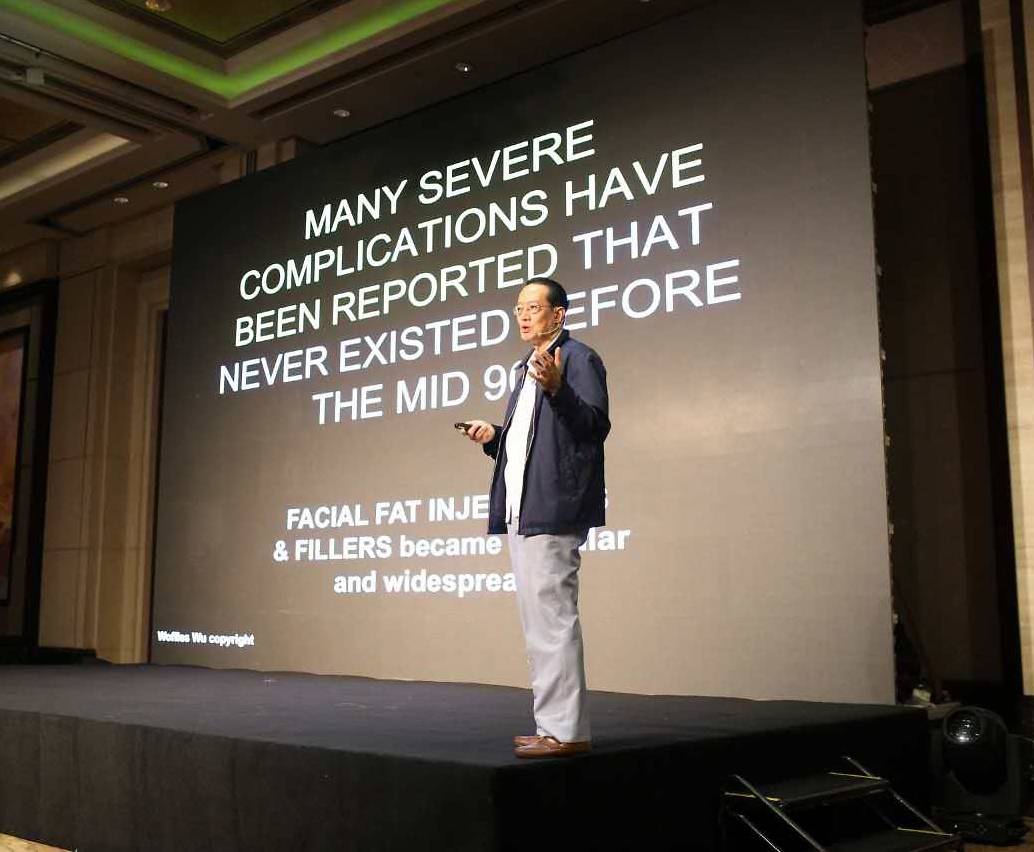
Dr Woffles Wu on a lecture tour in the US. (Photo: Woffles Wu)
LET OFF TOO LIGHTLY?
Then came the public scrutiny.
Was the S$1,000 fine commensurate to his offence, people asked?
Was he being let off lightly because he was rich or because of his relationship with people in high places?
The Attorney-General’s Chambers had to issue a statement explaining its decision to charge Dr Wu under a section of the Road Traffic Act rather than under the Penal Code, which provides for stiffer penalties.
Among the reasons for this was that Dr Wu could not have been charged under a section in the Penal Code for intentionally perverting the course of justice because he had committed his offence in 2006, before that particular section was enacted in 2008.
Also, as there was no major accident or injury, it was considered appropriate to proceed under the Road Traffic Act and in general, fines or short custodial sentences are imposed for wilfully providing false information.
The case was also discussed in Parliament. In response to questions, Law Minister Shanmugam cited six cases between 2004 and 2007, to show that the final result of Dr Wu’s case was consistent with the verdict of the Court in those instances – where no jail term was imposed.
“A lot of people ploughed into it because it suddenly became fodder for the internet and people didn’t realise that the fine I was given was three times more than what it should’ve been for that period,” says Dr Wu.
“All they could see was that ‘Hey, he only got a fine and some other people went to jail’. They were not comparing apples with apples because the people who went to jail over traffic offences were also people who had bribed other people to take the rap for them. So there was an exchange of money, which there wasn’t in this case.”
He stayed away from the internet during that period because reading such reports was just “too distressing”.
Then came the SMC’s decision to suspend him for four months.
The SMC had said that he was unremorseful. I ask him why he came across that way.
“I didn’t even bother to put up a fight because I’d accepted it. What I did was wrong. They asked me why I did it and I said honestly that I didn’t think it was a serious thing at that time. I had seen other senior people doing it. Even some senior doctors have done it and we just thought it was a trivial thing.”
This explanation was construed as reflecting a lack of remorse.
Dr Wu however says he was merely explaining why he had done it without meaning to justify his wrongdoing.
I ask him why he never appealed the decision.
“It was something that was said to me during that process, that the public was outraged by my behaviour and justice had to be seen to be done. So I thought, okay, these are my peers, these are my seniors and if they say that this is not up to their moral yardstick, I accept that and I just wanted to be as quiet as possible.”
ACCEPT IT AND MOVE ON
During his four-month suspension, he says he concentrated on getting back to his life.
“I like playing squash and the World Squash Championship Masters was coming up, so I was training for it and I just put medicine out of my mind for a while. I was also doing a little bit of teaching. People who wanted to learn about plastic surgery would come to me and I would give them lectures.”
I wonder if he reflected on his actions and what had happened as a result.
“Of course, I have reflected. I knew it was a silly thing to do but I never thought a traffic offence would derail my career to such a great extent. You either accept it and move on or you dig a hole and jump inside and cry. I’m not about to do that because my philosophy in life is you only got one life, you’re not coming back, you better live it while you can.
“This incident also forced me to re-examine my relationship with people around me, who I value most. It drove home the point that your family is always there for you. The children and my wife are the beautiful things in my life.”
When I ask if the incident affected his business, he says it’s hard to tell as the industry was going through other changes at the time as well.
“That, together with unfavourable economic conditions at the time and the fact that people were becoming more budget-conscious and beginning to fly out of Singapore to do surgeries either in Bangkok or Malaysia, or Batam could have been the causes of the decline I saw in my business. Then there was this Korean wave of doctors coming into Singapore and setting up clinics, consulting with patients and then taking all the patients back to Korea to operate.
“I think all of us noticed a huge downturn in our practices and whether or not this incident contributed significantly to it, I can’t really evaluate in an honest fashion.”
But clearly, Dr Wu’s life encompasses much more than his traffic offence.
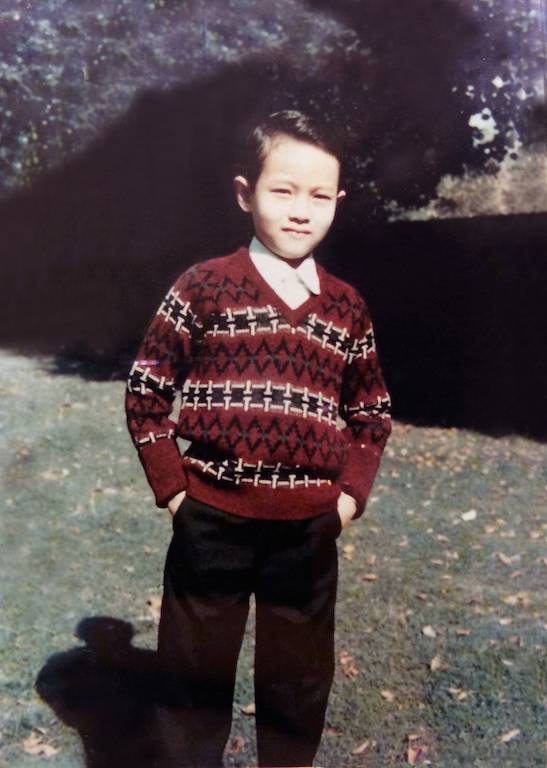
A young Woffles Wu in London. (Photo: Woffles Wu)
LIFE IN LONDON
We talk about the other facets of his life that he has shared in his book.
He writes a great deal about how his upbringing has shaped who he is today.
One pivotal moment was when at the age of 4, he left for London with his mother after his parents’ divorce.
She went there to pursue a law degree.
Life in London for them was not what many Singaporeans typically picture, he says.
“They think I was privileged or going to a boarding school. But it wasn’t like that for us. The two of us struggled for six years, in a foreign land, moving from one room to another room.
“It was a function of how much money we had. It was all being paid for by my grandfather who’s a policeman and you can imagine policeman didn’t earn that much in those days, so we just really had to get by on the cheapest available housing which was a room.”
He recalls the living conditions with almost a sense of nostalgia.
“The way it worked in England in the 1960s was if you were renting a room, there’s no toilet with it. The toilet was outside on the landing. There was also no heating unless you put a coin into the machine. So there’s a little meter. You can see the meter ticking and you put in a couple of pennies and the heater comes on for a short while. In the cold of winter, you put a couple of pennies in, and when you’ve run out of pennies, you’ve just got to stay cold.”
His mother was determined to complete her studies in spite of the financial difficulties.
“I think my grandfather also really wanted her to continue her legal studies because he knew that she would be good at it and she was good at it.”
He says it was challenging but sometimes “fun”.
“When you’re living through it, it’s not as bad. There are moments. When you’re trying to get a bath and you finally do get a bath, even though it’s in a public toilet, it’s still a bath and you’re still quite thankful for it. I guess that helped to hone the kind of resilience that I hope I’ve displayed through my life.
“Maybe I’ve got a nomad in me, but we would pack everything up and move to a new place and it was always kind of exciting for me to see whether this new place was better than the old place, making new friends in the neighbourhood and going to a new school.”
However, the racism and xenophobia he experienced were not so pleasant.
Some of the people he encountered asked if Singaporeans lived in trees with the monkeys and whether his parents wore leaves for clothes.
His London experience also contributed to the unusual name Woffles sticking with him throughout his life.
Prior to that, his mother who “had a thing for cute little names” had nicknamed him that, after a rabbit from the novel The Magic Faraway Tree by Enid Blyton.
In school in London, nobody could pronounce his Chinese name, Tze Liang. So he told them to go with his nickname.
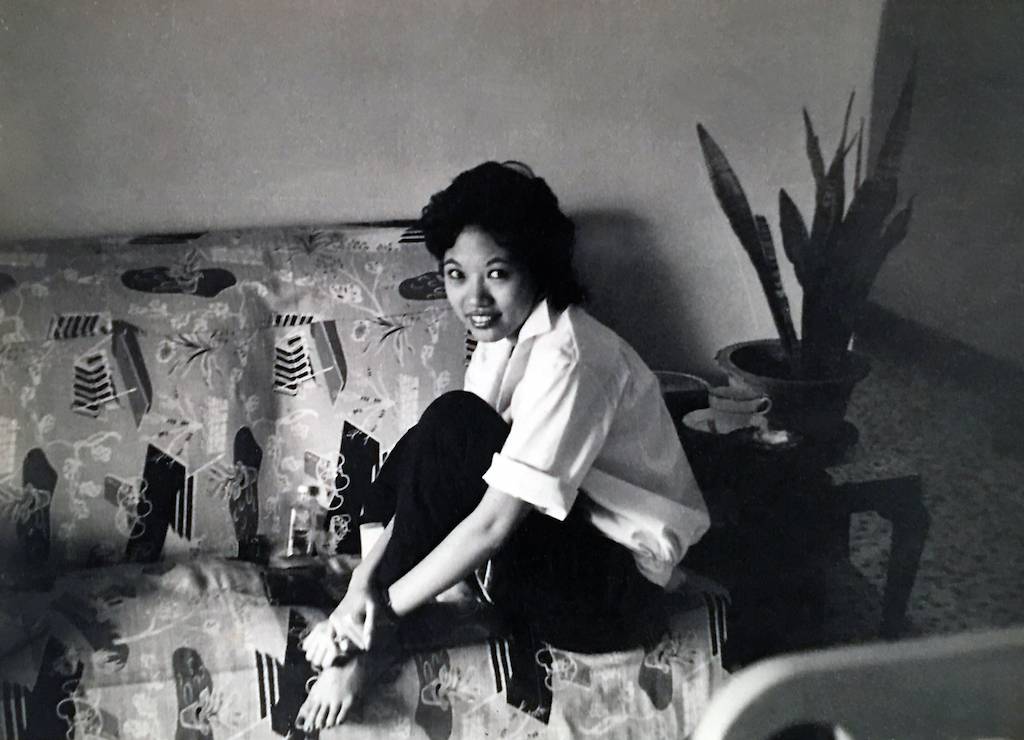
Dr Woffles Wu’s mother, Ong Beng Khim in 1958. (Photo: Woffles Wu)
HIS RELATIONSHIP WITH HIS PARENTS
Much of his childhood was spent hoping his parents would get back together.
“For a brief period when we came back to Singapore and had been visited by my father a couple of times, I used to see that they got on pretty well. They could still laugh at each other and they could still crack jokes with each other so I was hoping that maybe they would rekindle something. But it didn’t happen.”
His father would visit, but every time he left, it was “heartbreaking”, says Dr Wu.
While he longed for life with a father, some things about his dad bothered him.
“One of the main problems with my father and our relationship at that time was that whenever he spoke to me, or called me on the phone or even came down to visit us in our house in Singapore, he was always drunk. If you’ve ever experienced trying to have a conversation with somebody who’s really off his rocker, it’s very frustrating.”
He assures me that his father, who was an airline pilot at the time, was not an alcoholic, but merely enjoyed drinking while he was off-duty.
His father remarried and had more children with his second wife. When he died, he left an equal share of his estate to Dr Wu, something that made him realise that his father indeed thought of him as one his children even though they had been largely apart.
One of his enduring regrets is judging his father too harshly.
“Now as an adult and being married, I realise the difficulty of maintaining a relationship with one person over many, many years. I can begin the understand how different my parents were as personalities. My mother probably had one set of expectations which he couldn’t fulfil and he probably had another image of her.”
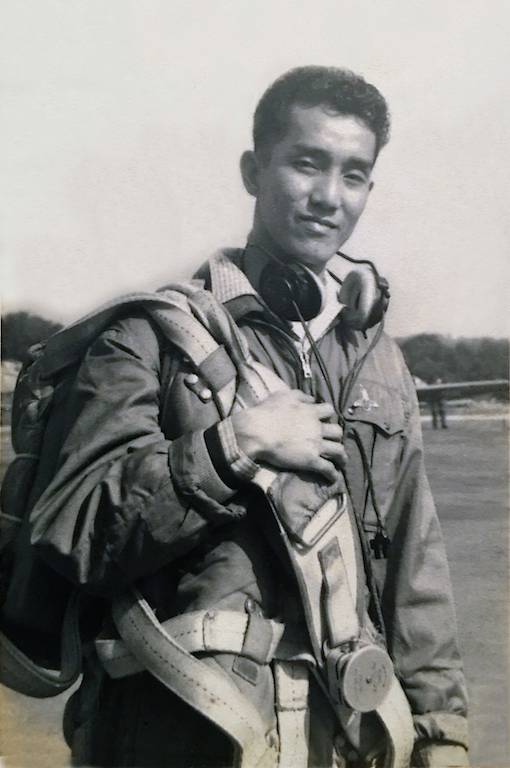
Dr Woffles Wu’s dad, Captain Wu Teh Hua in Hamble College, UK in 1957. (Photo: Woffles Wu)
WHY PLASTIC SURGERY?
Aside from family, naturally, his medical career is a vital part of his story.
Many of his aunts and uncles were doctors and their influence attracted him to the profession, however plastic surgery stood out for him for very specific reasons.
“I’m naturally a creative person and in my life, I love art and I paint as well. I realised that I had to come back to the creative aspect. I knew I didn’t want to be just sitting there, make a diagnosis and give medicine, then wait for it to work. I wanted to do something with my hands. So it meant something surgical and since I have a natural eye for beauty, it just became second nature to me.”
Like many plastic surgeons, he started off in reconstructive surgery.
“That’s a huge branch and all of us trained as reconstructive surgeons. Whether we treat burns or treat cancers, breast cancers, cleft lips, all of these fall under plastic surgery. If you’re restoring a patient to normality, you have to do it with an aesthetic eye. But this is where you learn all your skills.”
He acknowledges of course that aesthetic surgery – “making somebody who’s already normal, look better for whatever reason, either to look younger or to physically look better” – is a different ball game.
When I put it to him that plastic surgeons are merely capitalising on people’s insecurities, he says he sees it differently.
“We are all, to a certain extent, insecure about something in ourselves. What have we turned to in the past to address this? Make-up, hairstyle, fashion. So now, you have the ability through medical science, to change certain features in your face, to give you that self-confidence that you were looking for and I think that makes a huge difference in peoples’ lives.
“We have to understand that looks aren’t important to everybody. But they are important to certain people. We have to be understanding of different peoples needs and we can’t use one yardstick for everybody.”
However, he does draw a line in certain cases.
“People with body dysmorphic disorder obviously need psychological help. I don’t do surgery or cosmetic procedure on everybody who walks in my door. Some people have a lack of self-confidence when actually there’s no reason to because their face looks perfectly all right If I feel that this is not going to benefit you aesthetically, or if the risk of getting there is too high, I will dissuade you from doing it.”
He also encourages moving away from subscribing to specific ideals of beauty.
“Many people used to think that there is an ideal face for everybody in the world and one of the movements that I’ve been a part of in the last 15 to 20 years has been to tell people that we are all beautiful in our own way and we shouldn’t be judged by just strictly a Caucasian standards.
“I try to keep my beauty parameters within each ethnic group. So if you look at the Chinese or you look at the Indians, there are really, really gorgeous Chinese, Indian and Malay faces and then there are the others which look a little flatter or a little broader or not so attractive and I try to move people up the aesthetic scale for that ethnicity. I’m not into making an Asian look like a Caucasian. I think that’s going over the limit.”
As a doctor, he has had a few lawsuits brought against him by patients in the last few years.
He puts it down to unrealistic expectations in spite of the fact that he goes through “a full list of complications” and even shows patients “pictures of complications”.
“If somebody is doing a breast reduction, I will show them a picture of a breast where somebody’s nipple has died or where the wound has split open and I’ll tell them that this is a potential complication that you could encounter. Do you still want to go ahead with the surgery? And then you begin to determine how firm they are in their minds about having a certain procedure.
“Some think that a plastic surgeon is a god-like person who can just wave a magic wand and they will look exactly the way they want. However, plastic surgery is a science and it’s a surgical science which means that no two individuals are going to heal in the same way, no two individuals will have swelling in the same way. Everybody looks a little different.”
In 2014, a patient sued him for negligence, claiming she was persuaded to undergo facial treatment that resulted in pain, suffering and complications.
“What transpired was that she had been to see other doctors previously and she had these creams from them. She was applying them inappropriately with the creams that we had given her. So she basically burnt her face. It went to court and was thrown out.”
But such news, he admits, has affected business.
“This is where being positive about your life helps you to cope with these things. At one point of my career, I had probably 30 or 40 patients in my clinic every day. Now there are far fewer patients. But I don’t allow it to bother me. I look at it as a blessing because it now means I have more time to do other things in my life, especially being with family, or doing the things that I love like playing squash. So I’m not hung up about sitting in the clinic.”
He himself has not undergone any major aesthetic procedures and has no intentions to in the near future.
“I’ve had a little bit of botox to my forehead because I have a very wrinkly forehead but that’s about the only thing I’ve done. I do maybe a skin freshening once a year. I’m a very happy-go-lucky kind of person. So I wanted a countenance that goes with that.
“As you age, things happen to you, and you can absolutely accept it gracefully. I play a lot of sports. I think sports helps the overall rejuvenation of the body. But sometimes, if you’re developing pigmentation for example, if you’re getting a big black spot on your face which just kind of makes you look not optimal, then there’s no harm in doing a bit of a laser or a bit of IPL just to get rid of it.”
Aside from the art and the science, he has concerns about the business of plastic surgery.
As more go overseas for more affordable aesthetic procedures, he feels more needs to be done to level the playing field for doctors operating in Singapore.
“Currently, aesthetic doctors in Singapore are not even allowed to put a before and after photograph on our website. It’s considered ethically wrong and when we asked why, the SMC said it’s laudatory. How is patient education illustrated by a photograph of a person without double eyelids and then another of what they look like with double eyelids, laudatory? It is just educating the public as to what they can expect. Patients or potential patients are only going to click on a website that has pictures and since everywhere else in this region doctors are allowed to freely advertise before and after pictures, patients end up going to these doctors.”
He admits however that doing such procedures in Singapore is definitely more expensive than in other countries.
“But I think the overall standard of aesthetic surgery here is very high. I mean it’s comparable to some of the best cities in America or in London, Paris. I don’t think we lose out to many other people.”
Dr Woffles Wu giving a lecture in Shanghai. (Photo: Woffles Wu)
RETURNING TO HIS ROOTS
He hopes to soon return to his roots doing reconstructive and corrective surgery.
He recently got a license to practice in China and is looking into doing pro bono work there.
“Treating reconstructive patients and treating patients who are not necessarily coming to you just to look even better. That gives me a sense of satisfaction and in recent years as I’ve gone back to China more often to do these operations that I used to do before, it’s brought back that feeling of satisfaction, gratitude and reminded me why I went into medicine in the first place. It’s given me a modicum of satisfaction that is missing when you’re just treating cosmetic patients.”
Writing his book has also reignited a love for the arts.
He is working on two film projects for which he is writing screenplays. One is about an elderly lorry driver who loses his wife and as a result, his will to live. His friends introduce him to a woman from China and hence begins an exploration of stereotypes in modern Singapore society.
The other film is about an obsessive toy collector.
Both projects have been in making for many years. He says they were put on hold because the problems he faced over the traffic offence saga wrecked his peace of mind for several years. Today, it seems he is determined to put that behind him.
“I try to live life as fully as I can now and I know we have setbacks. We’ve got speed bumps along the way. We have to drive over or navigate them. The traffic incident was one. There will be many more. If you’re going to dwell on them and just be morose and mope about things, it doesn’t help things very much so I try to be very positive, even in the face of adversities.”
SINGAPORE: Singapore has conveyed its concerns to both the US and China about the rising trade tensions between the two powers, Foreign Affairs Minister Vivian Balakrishnan said on Saturday (Aug 4).
Speaking to reporters during a press conference at the conclusion of a series of meetings between members of the Association of Southeast Asian Nations (ASEAN) and external powers, Dr Balakrishnan explained that any trade war or unilateral sanctions will have a “disproportionate impact” on Singapore.
Singapore has good relations with both the US and China, he said, and has “courteously and directly” expressed its position to both of them, he said, in response to questions from reporters.
“Obviously, we don’t control the agenda of their decisions, but for what it is worth, we conveyed our concerns.”
Dr Balakrishnan’s comments come amid escalating trade tensions between the US and China. In early July, the US imposed 25 per cent tariffs on US$34 billion (S$46 billion) of Chinese goods, prompting retaliatory tariffs on an equivalent volume of US exports to China.
US State Secretary Mike Pompeo (left) met with Singapore’s Foreign Minister Vivian Balakrishnan to sign a memorandum of understanding on the sidelines of the 51st ASEAN Ministerial Meeting. (Photo: Joseph Nair / POOL / AFP)
China’s Foreign Minister Wang Yi (left) stands with Singapore’s Minister for Foreign Affairs Vivian Balakrishnan during a bilateral meeting at the 51st ASEAN Ministerial Meeting. (Photo: AFP)
Dr Balakrishnan explained that Singapore believes in a multilateral, rules-based system, and noted that “in an ideal world”, everyone resolves their differences on trade through the World Trade Organisation (WTO), or at least in a WTO-compliant fashion.
“It’s not exactly identical to what the US or China may want, but Singapore gets to state what we believe in, because we say the same thing to both sides, they know that we are being transparent and honest, and we are not playing games,” he said.
He added that this position is “entirely consistent” with that of the ASEAN regional bloc.
NEED FOR ASEAN TO “DOUBLE DOWN” ON MULTILATERAL TRADE SYSTEMS
During the press conference, Dr Balakrishnan noted that ASEAN acknowledges the escalating trade tensions around the world, and stressed that ASEAN has to “double down” on a multilateral trading system and work with other like-minded partners.
To that end, he said he is glad that there is agreement to redouble efforts to settle the Regional Comprehensive Economic Partnership (RCEP) by the end of the year. The RCEP is a 16-nation pact poised to become the world’s largest free-trade agreement. It would bring together the 10 ASEAN member states plus China, India, Japan, South Korea, Australia and New Zealand.
“It doesn’t mean that negotiations are over or that there are no sticky issues, but at least the political will…the acknowledgement that this is something which we need to settle, and all the more so, given the state of the world and the anxiety over trade wars,” he said.
In response to a further question on what these “sticky issues” are, Dr Balakrishnan pointed out that the “one missing element” is that China and India do not currently have a bilateral free trade agreement.
“If they agree to the RCEP, in effect they are setting the stage to liberalise the trade of goods and services between India and China,” he said. “Now, dealing with two mega continental-sized economies, I think it is entirely reasonable to have to be very, very careful, given the size, that disparity, that diversity.”
“There is good reason for them to very carefully calculate what they are agreeing to,” he added.
“SMOOTHEST, MOST CONSTRUCTIVE MEETINGS SO FAR”
During the press conference, Dr Balakrishnan described the meetings this week as the “smoothest, least contentious and most constructive, positive meetings so far.”
“The tone was far more constructive, far more positive this year,” he said. “But at the same time, it allowed all the issues to be discussed very openly.” He added that the superpowers present “did not pull any punches”, but it nevertheless took place in a “safe, constructive and comfortable forum”.
This, he said, illustrates the importance of ASEAN.
Frank discussions, he added, also took place during the meetings, for example on the topic of the Korean Peninsula. Describing the discussions on this issue as “very candid” and “brutally frank”, Dr Balakrishnan noted that the US, North Korea and South Korea have “major issues” that they need to resolve.
But nevertheless, he said, people acknowledged that there has been some progress, and the Jun 12 Singapore Summit did “change the tone of the conversation”.
Dr Balakrishnan also described ASEAN and China’s arrival at a single draft negotiating text on the South China Sea code of conduct as a “significant milestone”.
He added that the single draft made a “big difference” to the tone of the discussion on the topic this time, as compared to previous ASEAN meetings.
NO INTENTION OF ALLOWING ASEAN TO BECOME PROXY STATES
In response to a question from the media on whether ASEAN is at risk of becoming an arena for big power rivalry to play out, Dr Balakrishnan noted that the question alludes to whether there will be a resumption of the old Cold War, and whether ASEAN would end up being proxy states entangled in the “diplomatic, strategic and defence entanglements” of the superpowers.
“We have no intention of allowing that to happen,” he said. “And hence, we have ASEAN.”
“Hence we will be united, we will be relevant, we will maintain centrality and we will continue to convene these regional and extra-regional platforms,” he said.
He added that all the superpowers were represented, and were able to express their demands, anxieties and hopes “quite frankly” during the closed-door sessions.
“Rather than looking at this as a competitive situation where we all just become proxies, our concept of being united, central, open and inclusive, and welcoming trade and investments with all parties is in fact precisely the right response,” he said. “And this is what we have communicated unequivocally to all our external partners including the superpowers.”
“I think they appreciate our position,” he added. “No one has said they would rather have a disunited ASEAN, or that ASEAN breaks up into rival blocs.”
“In the case of Singapore, precisely because we are so small, I think our role as an honest broker has been appreciated, and has allowed us to be relevant beyond our geographical boundaries.”
Dr Balakrishnan also revealed to reporters that an agreement has been reached to conclude negotiations on the ASEAN-European Union comprehensive Air Transport Agreement by the end of the year. Negotiations for an ASEAN-European Union Free Trade Agreement will also be negotiated.
A Chairman’s Statement outlining the discussions and outcomes of the various meetings was also released on Saturday.
SINGAPORE: Train services between Tai Seng and Mountbatten on the Circle Line resumed about 30 minutes after train operator SMRT announced that they were temporarily suspended in both directions because of a “signalling fault” on Saturday evening (Aug 4).
In a tweet posted at 6.52pm, SMRT said that train services along the stretch were available again but that additional travel time was expected between Stadium and Bartley.
It added that free regular bus services were still available between the Stadium and Bartley stations.
[CCL Update]: Trains service is available between Tai Seng and Mountbatten. Additional travel time between Stadium and Bartley is expected. Free regular bus services are still available between Stadium and Bartley.
The additional travel time expected was five minutes between Stadium and Bartley, according to an update a few minutes later.
[CCL Update]: Train service resume between Tai Seng and Mountbatten. Additional 5 minutes travelling time between Stadium and Bartley is expected. Free regular bus services are still available between Stadium and Bartley.
In a subsequent update at 7.13pm, SMRT said the free regular bus services were available until 7.30pm.
[CCL Update]: Train service has resumed between Tai Seng and Mountbatten. Free regular bus service will be available between Stadium and Bartley till 1930hrs.
SMRT first announced at about 6.20pm that train services were unavailable between Tai Seng and MacPherson.
Crowds at a bus stop at Bartley after train services along a stretch of the Circle Line were suspended. (Photo: Nigel Tan)
“We apologise for the inconvenience,” the train operator wrote.
[CCL]: Due to signalling fault, there is no Train Service between Tai Seng to MacPherson on both bounds. Free regular bus services are available. We apologise for the inconvenience.
It extended the stretch affected to Mountbatten station in a later tweet at 6.35pm.
[CCL]: Due to signalling fault, there is no train Service between Taiseng to Mountbatten on both bounds. Free regular bus services are available between Bartley and Stadium.
The fault appeared to have started around 5.55pm, an announcement at MacPherson station had asked commuters to “look for alternative routes”.
One commuter, Aung Than, said he was on a train along the line at about 6pm when it stopped at Paya Lebar. At about 6.30pm, staff manually opened the door and let those on board out of the train, he said.
JAKARTA: A US diplomat handed over a letter for North Korean leader Kim Jong Un from US President Donald Trump to North Korea’s foreign minister at a meeting Singapore on Saturday (Aug 4), a US State Department spokeswoman said.
Sung Kim, the US ambassador to the Philippines, who has played a prominent role in US talks with North Korea, handed the letter to Ri Yong Ho on the sidelines of a regional meeting, State Department spokeswoman Heather Nauert said.
She said the letter was a response to one from Kim Jong Un to Trump.
In Singapore, US Secretary of State Mike Pompeo and Ri shook hands and exchanged words and smiles at a Southeast Asian security forum, but had no formal meeting, Nauert said. Nauert said Pompeo told Ri: “We should meet again soon.”
U.S. Secretary of State Mike Pompeo shakes hands with North Korea’s Foreign Minister Ri Yong Ho as South Korea’s Foreign Minister Kang Kyung-wha looks on at the Asean Regional Forum Retreat Session in Singapore August 4, 2018. REUTERS/Edgar Su
She said Ri replied: “I agree, there are many productive conversations to be had.”
SINGAPORE: A new defence team, the In-Situ Reaction Team (IRT), will join this year’s National Day Parade to patrol on foot in indoor areas around the Marina Bay Area, especially around areas with high foot traffic.
The IRTs will join ground patrol forces such as the Ground Response Forces, Emergency Response Teams and specialist forces from the Special Operations Command and Gurkha Contingent to protect the area around this year’s parade.
“This is the first time the In-situ Reaction Team from the Protective Security Command is deployed for the National Day Parade. They will be deployed at shopping malls in and around the Marina Bay area and will perform high-visibility patrol to deter any terrorist attack,” said deputy superintendent (DSP) Ong Ruo Cheng on Saturday (Aug 4).
The teams are made up of full-time national servicemen who are specially selected, trained and armed appropriately to deal with any public security incidents, she added.
An In-Situ Reaction Team led by Inspector Tan Kim Chuan patrolling Esplanade Mall. (Photo: Fann Sim)
While they will be performing the same patrolling duties as the fast-response unit Emergency Response Teams (ERTs) this National Day, the IRTs are trained to respond to issues in central Singapore such as Orchard and Marina Bay Area.
Inspector Tan Kim Chuan, who is in charge of the IRTs at NDP, said the patrols are similar to their day-to-day work but require additional communication with other teams due to the large scale of the parade.
“We are trained to deal with scenarios such as armed attacks or … knife attacks. So if such a scenario happens at NDP, IRT officers will be able to respond,” said Insp Tan.
“We focus on public security incidents whereby we are in-situ, (which) means that we are positioned at the location. So our response will be much faster,” he said.
They will be part of more than 5,600 personnel from the Singapore Armed Forces (SAF), Singapore Police Force (SPF), Singapore Civil Defence Force (SCDF) and volunteers from Heartware Network involved in managing the security and safety of those involved in and attending this year’s National Day Parade.
In addition, 500 medical personnel from the SAF Medical Corps, SCDF and the Ministry of Health will be deployed to provide primary health care and manage emergency evacuation situations.
The Battalion Casualty Station (BCS) can provide emergency treatment for intermediate to severe injuries before the casualty can be conveyed to the hospital. (Photo: Fann Sim)
Their deployment is supported by three Battalion Casualty Stations (BCS) which are equipped to respond to “intermediate” or severe injuries.
Casualties who do not have an immediate life-threatening condition but require medical attention to prevent their condition from deteriorating will be classified as having intermediate injuries. Those with a life-threatening condition will be classified as having severe injuries.
Each BCS, stationed outside the F1 Pit Building, can treat two victims with severe injuries and four victims with intermediate injuries at a time before they are evacuated to hospitals.
Casualties with light injuries can be treated at a larger area next to the BCS.
“Our BCS are equipped to handle up to advanced trauma life support, so they can manage all kinds of casualty including any airway, circulation, breathing compromise. Any bombs or gunshot wounds,” said ME4 Melissa Lim.
Various check stations will also be set up in and around The Float @ Marina Bay, where the parade will take place.
Metal detector checks and x-ray screenings will be conducted on visitors to The Float @ Marina Bay. Containers with liquid of more than 100ml will be subjected to enhanced checks.
Unauthorised vehicles will not be allowed to enter The Float @ Marina Bay. To prevent unauthorised vehicles from forcefully entering the venue, concrete blocks have been installed around the area.
As a Special Event Area, unmanned aircraft such as drones are not allowed to be brought into the area. Anyone found flying drones may be arrested and fined for up to $20,000 or imprisonment for up to 12 months, or both.
SINGAPORE: A fire has broken out at a shophouse in Chinatown, eyewitnesses reported on Saturday (Aug 4).
Thick smoke spewed out of what appeared to be a coffeeshop at the junction of Neil Road and Keong Saik Road, photos sent to Channel NewsAsia show.
Fire breaks out at Neil Road on Saturday (Aug 4). (Photo: Carlos Monforte)
Firefighters and several Singapore Civil Defence Force (SCDF) vehicles were seen in the area and a witness told Channel NewsAsia that there was also an ambulance in the area.
This is a developing story.
This story came from a reader tip-off. If you would like to send in photos or videos of something newsworthy, WhatsApp our Mediacorp news hotline at +65 8218 8281 or message us on Facebook.
SINGAPORE: Mention the phrase “healthy hawker food” to a typical Singaporean on the street, and images of sterile bowls of bland noodles with awkward lettuce leaves may conjure to mind.
Indeed, in our society, the word “healthy” has grown to become synonymous with “bland-tasting” over the years.
With chronic lifestyle diseases such as diabetes and heart diseases on the rise, and a well-documented role of diet in the prevention and management of these conditions, how then can we work towards changing deep-rooted mindsets and setting Singaporeans on the path towards a healthier lifestyle?
An obvious choice of strategy that comes to mind is to start by altering the environment where Singaporeans frequent, which are the hawker centres, due to their relative affordability and accessibility.
However, as public healthcare workers may have quickly come to learn, working with hawkers to effect changes is not an easy task.
Having spent years of serving up and perfecting traditional dishes, the hawkers take pride in their recipes, which have garnered a strong customer base over the years. As hawkers struggle to find their footing in the face of increasing rental and food prices, charting into unfamiliar grounds of serving up healthy hawker food may also inevitably be assigned a lower priority.
Meanwhile, Singapore, with its diverse and culturally rich dishes to offer, has gained its reputation as a food paradise. Singaporeans are known to flock to stalls where queues are among the longest, placing emphasis on the taste and authenticity of local food.
Hence, there is the sentiment that hawker centres should be left to their own devices, as healthier changes in the hawker centres may be “killing the hawker vibe”. After all, are there not already healthy eating places such as salad bars, which serves the purpose for those seeking healthier choices?
There are also the feelings of familiarity and comfort associated with consuming the traditional favourites, along with pleasant memories of enjoying these together with family or friends, which are difficult to detach.
Health Promotion Board officer Tan Meiying on her rounds at Tiong Bahru Food Centre. (Photo: Lianne Chia)
BUT WAIT, LET’S LOOK AT HEALTH SURVEYS
However, with the 2010 National Nutrition Survey showing a majority of Singaporeans consuming hawker food, with 60 per cent having it for lunch or dinner at least four times each week, there is pertinent need to improve food choices in hawker centres.
Similarly, according to the Food Forward Trends Report in 2014 by Weber Shandwick, 81 per cent of Singaporeans surveyed said they opt for hawker food most often when they eat out.
One solution to improve the diet of Singaporeans without rocking the boat would be to provide healthier alternatives at hawker centres, without phasing out traditional hawker favourites.
As it is the thing we do day-to-day that makes a difference, if we are able to select healthier choices most of the time, we would not have to eliminate these traditional favourites completely.
Stickers at this Teochew kueh hawker stall indicate that he sells kueh made from wholegrain flour. (Photo: Health Promotion Board)
HUGE CHALLENGE TO CONVINCE SINGAPOREANS, NOT JUST HAWKERS
Despite the challenges abound, it is encouraging to see the Health Promotion Board staff reaching new grounds in the hawker centres, moving towards their target of getting 40 per cent of hawker stalls to offer at least one healthier dish by 2019. However, the colossal challenge remains to convince key stakeholders to embrace the change, which are Singaporeans themselves.
With many Singaporeans already accustomed to the taste of rich hawker dishes, changing habits and taste preferences is not an easy feat. However, the good news is that given time, habits and taste buds can change.
If Singaporeans are willing to step out of their comfort zone and try out the healthier hawker options, they may discover for themselves that they are just as capable of being tasty, wholesome and filling. They are also likely to develop a palate for healthier dishes over time, and learn to find a balance between the occasional treat foods.
By offering consumers options, hawkers can create a platform for them to switch to healthier options when they are ready, such as by offering both brown and white rice options. As consumer demand grows, hawkers would also have greater incentives to offer healthier options.
As the saying goes, “If not me, who? If not now, when?” If we can step forward to make a commitment towards improving our health, we can all work towards building a healthy environment for both our loved ones and ourselves.
Ng Zi Ling Jolyn Johal is senior dietitian at the National University Hospital.
SINGAPORE: With three snips of his cutter, 83-year-old Ronald Cheong removes a good feather from an otherwise tattered shuttlecock.
During his heyday in the 1950s, the former national shuttler would have only needed three swings of his racquet to send his opponent scrambling on the court.
“Although they played slowly, the judgment and accuracy was there,” Mr Cheong told Channel NewsAsia at a noisy void deck in Sengkang, insisting that badminton was played more tactically those days.
“You can be very good friends off the court, but on the court you are his enemy. The weapon given to you is the racquet, and the bullets are the shuttles. So you have to make sure that he gets into problems with the shuttle.”
For Mr Cheong, even the most torn-up bullets have a use. With his frail fingers he stores the feather in a clear, plastic box. It will be used to refurbish other shuttlecocks.
The man has been recycling shuttlecocks for more than 60 years, since he left the national team to become a coach. He started doing it because he wanted to reuse them for his students to practise with.
At his age, Mr Cheong hardly plays. But that hasn’t stopped him from pursuing his side hobby. It is a way for him to get more young people to play the game he loves so much.
Mr Cheong sometimes gives the refurbished shuttles to tuition centres, often under the guise of getting students to go outside. “Your students only sit down and study,” he would say. “Why not you take this, get racquets and play?”
But his real aim is far more ambitious. “I hope that there will be a time when we have our own Singaporean to be a world beater,” he said.
CUTTER, PLIER AND GLUE
For decades Mr Cheong has been waiting for this to happen, although according to him, no one has come close to Wong Peng Soon, the three-time Thomas Cup and four-time All England Open winner.
It is a big dream, but one that starts small – with a short LRT ride from his Sengkang block to the interchange, then a much longer bus ride from there to Bedok.
About twice a week, Mr Cheong commutes to a sports hall in Bedok to gather old shuttlecocks. He’s lived and played there for many years, so the regulars know him very well. He gets their used shuttlecocks without asking. He picks up what’s left behind too.
In a good week, Mr Cheong can get about two dozen shuttlecocks. “I take everything,” he said. “What you can use, you use. The ones you can’t, you throw.”
Back at the void deck under his block, Mr Cheong spends his mornings getting to work.
He lays out the used shuttlecocks on a piece of newspaper, picks out the decent-looking ones and cuts out the damaged feathers. Then, he uses pliers and glue to insert new feathers from his stash, before leaving the shuttles in the sun to dry.
It sounds straightforward, but Mr Cheong must ensure the new quills have the same thickness as the rest. If not, he uses a penknife to carve off the excess. The entire process can take around 20 minutes per shuttlecock.
Mr Cheong inserting a new feather into a used shuttlecock. (Photo: Aqil Haziq Mahmud)
But not all the shuttles can be saved. With heavy hitting so common in the sport today, they typically come with more than half of their 17 feathers broken, he lamented. Out of 24 shuttles, he might only salvage five.
While it is short change for what seems like a painstaking process, Mr Cheong keeps going. Besides the children, he gives the shuttles to fellow seniors who play for leisure too.
Mr Cheong using pliers to position the feather. (Photo: Aqil Haziq Mahmud)
These refurbished shuttles also work just as well as the new ones, he suggested, something his playing partners have confirmed.
“Some of them want to pay for it,” he said. “I said, forget it.” But they insisted, and so he lets them go for S$12 a dozen. “I don’t want to say that I am making something out of it,” he continued. “The passion is to build better badminton players in the young.”
REACHING THE TOP, ALMOST
As a young boy, Mr Cheong was crazy about badminton.
The Peranakan Chinese grew up in Joo Chiat, in a house flanked on each side by an outdoor badminton court. At age 7, he picked up the sport and was soon playing almost every day, “from early morning till evening”.
He sparred feverishly with his cousin, a competitive player who was sponsored by a racquet company. After it rained, Mr Cheong would quickly wipe the courts with gunny sacks. Night time? No problem. His father had fixed lights on the court.
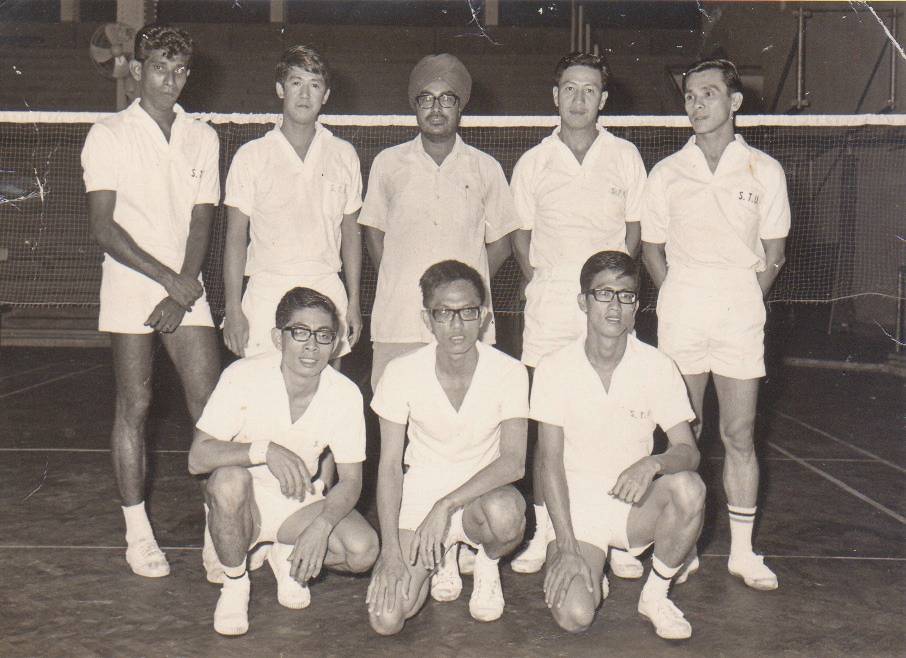
Growing up, Mr Cheong played with his cousin Cheong Cheng Swee (squatting, extreme left), another former national shuttler. (Photo: Alvin Oon)
It had become an obsession, and naturally, his dad wasn’t too happy, demanding his son hit the books instead.
“If he makes a noise, you just stand there and listen,” Mr Cheong said, chuckling and pointing to his right ear, then left. “It goes in here, comes out there. He walks away nicely, I just forget about it, and continue what I am doing.”
Continued he did, until he developed a flair for the sport, even without formal coaching. “Nobody taught me,” he said. “Nobody told me this stroke is wrong – I learnt it myself.”
Mr Cheong lived on Jalan Koon Seng, in the Peranakan neighbourhood of Joo Chiat. (Photo: Facebook/VisitSingapore)
Mr Cheong even played through the war, especially as he didn’t need to venture far to do so. Since his father was a village leader at the time, the Japanese didn’t bother them either.
After the war ended, Mr Cheong started playing in junior then senior tournaments for the Anglo-Chinese School team, beating opponents older than him. By 17, he had been scouted for the national team.
It was then that he thought he could eke out a living from badminton. “I felt that this sport was a very free and easy game,” he said.
But his meteoric rise stalled as quickly as it started.
During tournaments, Mr Cheong kept finding himself on the reserves. For some reason, his coach always seemed to favour two to three other singles players. Still, he remained hopeful that his team would win titles and produce the next Wong Peng Soon.
It never happened. “The players chosen did not shine,” he said. “I could have made it, but at that time there was no spirit in me to go further, because when you are put on reserve so many occasions, you just get frustrated.”
Mr Cheong left the squad in his 20s, but he has no regrets. “I think I have done my best playing and now it’s time to give back in any form,” he said.
DRIFTING APART
If there’s one thing that Mr Cheong has left to offer, it’s the sheer amount of knowledge he has about badminton.
Similar to how he picked up the sport on his own, nobody taught him how to refurbish the shuttlecocks. “I only looked at it and saw that it could be done,” he said. “It’s my own knowledge that came with the experience of playing.”
As Mr Cheong explained how a broken shuttlecock would flutter in the wind, he couldn’t resist diving deeper. He elaborated on serve techniques, dished out numbers on weight and tension, and rattled off names of pre-independence national players.
Like how he picked up badminton on his own, Mr Cheong taught himself how to fix the shuttles. (Photo: Gaya Chandramohan)
It wasn’t a surprise then that he went down the coaching route.
For a number of years Mr Cheong trained kids under a couple of national badminton programmes, and he enjoyed it. The money wasn’t as good as it is now, but he said this was secondary. “I hoped to pass it on to future generations who are interested in the game,” he reiterated.
But Mr Cheong would soon discover it would be difficult to sustain that passion.
His dad, discovering that he had too much free time, asked him to get a proper job. He found work in a shipping firm, then a telecommunications company, but still managed to coach on Sundays.
Then, Mr Cheong got a letter inviting him to interview for a better-paying job working for the Government. He passed the interviews, and it was too good to turn down.
“I still played during my free time, but I was consumed by work,” he said, adding that he had three round-the-clock shifts to cover. “I should have played more and got more people to play the game, but during work it was very hard to find time.”
ILLNESS AND BROKEN TIES
While he retired from the civil service aged 62, the setbacks didn’t stop.
During a medical check-up, doctors diagnosed Mr Cheong’s wife with advanced stage ovarian cancer. To pay for her medical bills, he used up all his savings and sold his Bedok flat. “It was a huge sum of money,” he said, his trademark chirpy and playful tone gone. “I didn’t want to owe people money.”
For the next four-and-a-half years, Mr Cheong looked after his wife every day. “I tried within my means,” he said, even seeking alternative medicine on top of the chemo and radiotherapy. She eventually died in 2006.
Mr Cheong usually does his work at this void deck in Sengkang. (Photo: Gaya Chandramohan)
Mr Cheong was all alone. He said he hasn’t heard from his son and daughter, both living overseas, in a very long time either.
“To talk about my children is also very hard,” he said quietly. When asked if he’d like for them to reach out, he replied: “I hope that they will do it. But they have not done so for 40 over years.”
Nevertheless, Mr Cheong said he’s grateful that a family who used to live in the same Joo Chiat area took him in after his wife died. He’s been living with them ever since.
“I have a family who provides everything for me, I don’t have to ask more,” he said. “They are my godchildren.”
HOPES AND DREAMS
Mr Cheong might have gone through quite a bit, but his love for badminton never faltered.
Since he retired, he has started playing more regularly again. For the past three months, he’s been playing once a week with some friends in Choa Chu Kang, but only if they’re able to book a court.
Mr Cheong said he’s unhappy with the current booking system. There should be a few hours in the evening reserved for seniors, he suggested.
However, he’s not playing as much now because he wants to refurbish more shuttlecocks. After a Facebook post on him went viral, he’s had a huge jump in orders. But he needs a lot more used shuttles to meet the demand.
“I did not really expect people to want to try or play with it,” he said. “For all those who asked for it, I will do my best.”
Mr Cheong reaching out for a return. (Photo: Aqil Haziq Mahmud)
Back in the heartlands, Mr Cheong does his best to execute a smash in a friendly rally with a neighbour.
Then he stretches his wiry frame and hits a few wayward shots, laughing and joking with his opponent. But his determination to return the shuttlecock, evidence of his competitive streak from days long gone, is still present.
Mr Cheong having a laugh as he prepares to serve. (Photo: Gaya Chandramohan)
It might be easier to believe he’s 83 when he sits alone at the table each morning, fiddling with his tools and shuttles. He said people walking by sometimes stop to say things like: “Wow, you are clever ah.”
“They will say it in some language which I don’t understand, but know,” he added, referring to Hokkien or Mandarin, languages he doesn’t speak because he is a Baba.
“I appreciate that, but I hope they will tell people around the area that somebody is doing this and get their children and grandchildren to play the sport.
“And that’s how a small population can get a few top-level players.”
SINGAPORE: A breakthrough was reached on Thursday (Aug 2).
Following the adoption of a draft framework on the Code of Conduct on the South China Sea last August, barely a year later, China and the ten Southeast Asian countries of ASEAN agreed this week on a single draft document that will serve as a “living document and the basis of future code of conduct negotiations”.
Describing this new development as “yet another milestone”, Singapore Foreign Minister Vivian Balakrishnan said that the parties arrived at the first draft during talks held a couple of months back in Changsha, China. Besides this single draft text, the 11 foreign ministers also agreed on the key modalities for future rounds of negotiations.
This is certainly a noteworthy development. But it is necessary to look past the fist pumps and delve into the realities.
Of course, the apparent rapid progress since August last year – from adoption of the draft framework to commencement of negotiations in March this year and then agreement of a single draft text this month – gives the impression of all things going well so far.
But is this really so?
REALITIES IN THE SOUTH CHINA SEA ‘GROUND ZERO’
True, there has been no more reported incidents of major aerial and maritime standoffs registered since August last year. But it does not mean the concerned parties have truly stopped whatever they have been doing, short of building new artificial islands.
Against the backdrop of regular wargames of varying force size in the South China Sea, Beijing has upped the ante where it comes to boosting its military presence in the area – deploying long-range missiles to the Spratly Islands, landing strategic bombers in the Paracel Islands, and testing electronic jammers in the disputed waters over the past year.
Such developments were unprecedented.
China has reportedly installed missiles on Subi Reef and other outposts in the disputed Spratly Islands. (AFP/TED ALJIBE)
And it was precisely because such actions ran counter to Chinese President Xi Jinping’s 2015 Rose Garden pledge to refrain from militarising the South China Sea, that the Chinese Navy was disinvited from the multilateral Rim of the Pacific exercise in Hawaii this year.
Chinese officials howled protest at this move, at the same time emphasising that non-participation in RIMPAC is a small price to pay for safeguarding the country’s sovereign rights and interests in the South China Sea.
The disinvite may have been a major loss of face for Beijing.
Yet, already beleaguered by the trade row with the United States, and international “debt trap” controversies surrounding Chinese overseas investments couched under the Belt and Road Initiative, it is not entirely unimaginable to think that the Chinese Government needs a foreign policy win – something that can help mollify the bad press it has received to date.
Not to forget that with the island-building work complete and fortifications mostly in place, all Beijing has to do is to further consolidate its gains in the South China Sea. So it finds itself now in a much stronger position to encourage progress, instead of foot-dragging, on the issue.
Meanwhile, it is not difficult to see that ASEAN has every incentive to push for the single draft text. With the ongoing militarisation in the disputed waters and potential escalation in the future, the urgency felt by the bloc to make continued progress on the Code of Conduct is real.
ASEAN Foreign Ministers’ Meeting in Singapore
ASEAN too has to ensure its relevance. Progress on the Code of Conduct is key, indispensable, and almost like a “litmus test”.
It’s no surprise different ASEAN countries took different national positions as they work towards the draft text. Vietnam offered the strongest opposition to Beijing’s activities whereas there was little sign of serious resistance from other ASEAN member states.
The Philippines, which oversaw the promulgation of the draft framework last August in its earlier capacity as ASEAN chair, certainly has a significant role to play.
Taking over from Singapore after Thursday’s meeting to now serve as the bloc’s coordinator of ASEAN-China relations, Manila has every reason to facilitate this outcome if one notes recent developments on the South China Sea confronting President Rodrigo Duterte, who faces enormous pressure to do something on this front.
A recent Social Weather Station survey last month showed that four out of five Filipinos rejected the Duterte administration’s inaction on the issue, and 87 per cent of Filipinos polled wanted the government to regain control of the disputed waters.
Amidst public doubts over the lack of transparency on the Filipino government’s relations with China, Manila even had to clarify that there were no “secret deals” reached with Beijing on the South China Sea dispute.
NO ROOM FOR COMPLACENCY
That said, ASEAN countries would have likely agreed to reach a single draft text for the code to help ease subsequent negotiations. In any case, they can reserve their positions.
The devil still lies in the details – the wordings, language and tone that determine the texture of the eventual mechanism that all 11 countries deem fit to agree on. So the prospect of an eventual promulgation of this Code of Conduct is uncertain at best.
File photo of ASEAN flag and flags of ASEAN member countries. (AFP/Romeo Gacad)
Until the code is agreed upon, we can foresee that short of provoking major incidents in the disputed waters, the various claimants – not least China – will continue business-as-usual with their current set of activities, which could still be after all couched under the ambiguous and debatable notion of “defensive preparations”.
The likelihood of a maritime or aerial incident in the future also cannot be discounted, notwithstanding this latest progress on the Code of Conduct.
Any miscalculation on the ground in such a contingency may potentially result in escalatory actions that may have dire consequences – possibly to the point of even derailing negotiations on the code.
As such, while observers may expend time ruminating over the details of the code, in the interim it is necessary for countries to get on with existing confidence-building measures – for example the inaugural ASEAN-China maritime exercise, the table-top phase of which is being held this week in Singapore and the field training phase is slated for later this year.
This activity will be based on the Code for Unplanned Encounters at Sea (CUES), adopted at the Western Pacific Naval Symposium in 2014 in Qingdao.
CUES in particular will remain a significant bulwark against close-proximity encounters between opposing forces which will still continue to operate in the South China Sea.
While talks on the Code of Conduct persist, it is essential to not only implement CUES but also push for an expanded participation, especially among regional countries including those who are not signatories to this naval mechanism.
Whether the Code of Conduct materialises eventually, CUES in more holistic forms – extended to the aerial and underwater dimensions, and involving maritime law enforcement agencies – will become ever more critical in guaranteeing peace and stability in the South China Sea, and securing understanding among forces on the ground in avoiding conflict.
Koh Swee Lean Collin is research fellow with the Maritime Security Programme, at the S Rajaratnam School of International Studies, based in Nanyang Technological University, Singapore.