SINGAPORE: Team Singapore athletes may not have a fixed set of medal targets for the 2018 Asian Games, but their goal nonetheless will be to improve on their previous performances, said Chef de Mission Lee Wung Yew on Tuesday (Aug 14).
He added that he looks forward to “a lot of personal bests” from the athletes.
“Everybody has their KPIs (Key Performance Indicators), but we try to limit the kind of stress that they will go through, so why count the chickens before they hatch? (We will) let their actions speak for themselves,” Mr Lee told reporters before leaving for Jakarta where the Games will kick off on Saturday.
“What’s important is for them to go there, do their best and see what happens. We want them to better their (previous) performances, and we look forward to a lot of personal bests from our athletes.”
Minister for Culture, Community and Youth Grace Fu had said last month that there are no “specific” targets for the contingent, and Mr Lee added that this will take some pressure off the athletes.
“I believe there will be less pressure – the spotlight is not on them, they don’t have to see their names in the media – how many golds they are going to get,” said Mr Lee, a former national shooter who represented Singapore six times at the Asian Games and thrice at the Olympic Games.
The contingent of 265 athletes across 21 sports is Singapore’s largest at an Asian Games.
At the 2014 edition in Incheon, Team Singapore’s 223-strong contingent clinched five golds, six silvers and 14 bronze medals.
Mr Lee Wung Yew (second from right) represented Singapore at three Olympic Games as a shooter. (Photo: Matthew Mohan)
There are expectations for athletes to deliver in swimming, sailing and bowling, having won medals in these sports in past Asian Games, said Mr Lee.
“We are seeing more and more of our athletes making their way to (perform at) world levels,” he added. “These are things that are looking good for us.”
ALL GEARED UP
Singapore’s Asian Games contingent will also have to come to grips with the environment in Indonesia, with lingering pollution concerns due to haze from forest fires.
Traffic congestion in Indonesia’s sprawling capital of 10 million also consistently ranks among the world’s worst, although Games organisers have been trying to mitigate the issue with measures such as dedicated lanes.
To prepare them for the journey, Team Singapore’s athletes will get a travel essential kit, which comes complete with a 3M mask, hand sanitizer, ear plugs and a neck pillow, among other things.
“There were spikes in the haze situation so these masks are a precautionary measure,” explained Mr Lee. “In the event that it (the air quality) hits certain levels, athletes can use these things depending on their level of tolerance.”
External factors aside, Mr Lee believes that the athletes are ready to compete and are happy with the guidance some of the senior athletes have provided to their less experienced counterparts.
“They have been doing their part,” he said. “I see them performing the big brother and big sister roles – this is encouraging as it helps the younger athletes settle down and I want more of the veterans to take up these kinds of roles.”
SINGAPORE: A total of 18 personal mobility devices (PMDs) and two power-assisted bicycles (PABs) were seized from errant retailers by the Land Transport Authority (LTA) in an islandwide “sting operation”.
The operation was held from Jul 17 to Aug 2 on 18 retailers of PMDs and PABs, said LTA in a news release on Tuesday (Aug 14).
LTA added that among the retailers, five were found either displaying or advertising non-compliant devices.
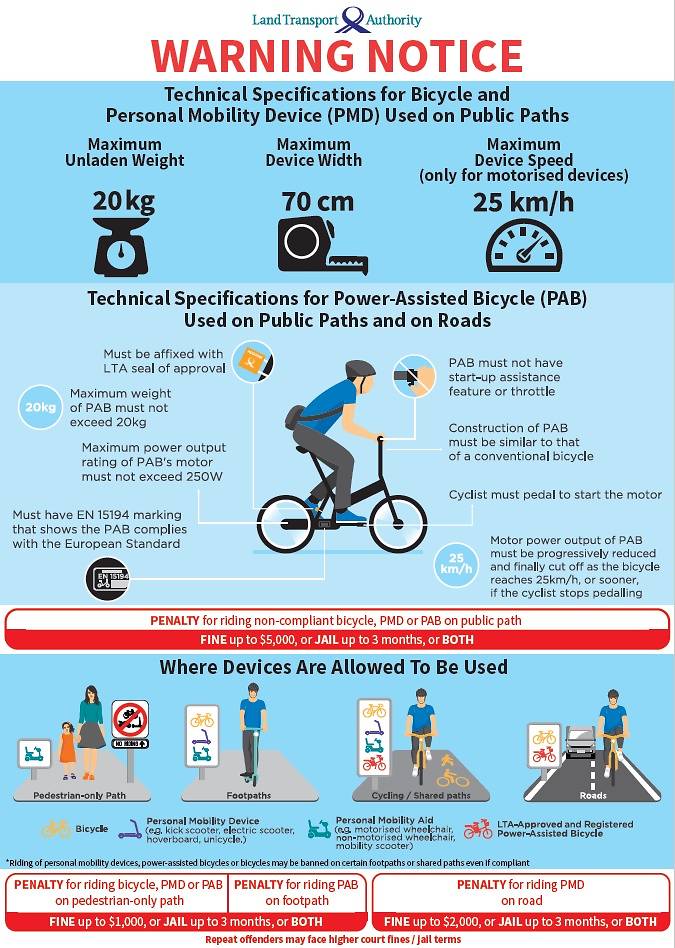
Non-compliant PMDs are devices that exceed 20kg in unladen weight, 70cm in width, and 25km/h in device speed if motorised.
Meanwhile, non-compliant PABs, also known as e-bikes, are devices that do not fulfil the PAB technical requirements such as those exceeding 250W of power output rating or having start-up assistance throttle.
An impounded overweight PMD weighing 49.74kg. (Photo: Land Transport Authority)
Under the Active Mobility Act (AMA) and the Road Traffic Act (RTA), only devices that comply with prescribed criteria can be used on public paths and roads, said LTA.
First-time offenders can be fined up to S$1,000 and/or jailed up to three months.
LTA added that it was also an offence for retailers to sell non-compliant devices or modify a customer’s device to a non-compliant state for use on public paths or roads.
Those found guilty can be fined up to $5,000 and/or jailed up to three months.
Five retailers were also caught for not displaying LTA’s prescribed warning notice, said the authority.
“Retailers of PMDs and PABs are required to display warning notices on their premises stating, among other things, the technical criteria for different devices and where they are allowed to be used,” added LTA.
Those found guilty of failing to display these notices can be fined up to S$1,000 and/or jailed up to three months.
“Enforcement blitzes against errant retailers will help to tackle the issue of non-compliant devices upstream,” said LTA, adding that it will continue to actively enforce against such retailers.
“Members of the public are also advised to exercise caution and ensure they only purchase compliant devices if they wish to use the devices on public paths or roads.”
SINGAPORE: Michael Chiang may be best known for penning Beauty World and Army Daze. But there’s more to the 62-year-old playwright than beloved stage classics about National Service hijinks and nostalgic Singapore.
Back in 1992, Chiang came up with a bittersweet comedy about three transsexuals who are befriended by a talk show host eager to get them to guest in his show.
Private Parts’ director Beatrice Chia-Richmond and playwright Michael Chiang. (Photo: Michael Chiang Playthings)
Private Parts was unlike anything that had been staged in Singapore at that point – and while it may not ring a bell among millennials the way his two big hits do, it was a groundbreaking, critically acclaimed piece that was eventually staged a handful of times.
After its sold-out debut at the Singapore Festival of Arts in 1992, a Mandarin version starring Edmund Chen and the late comedian Hua Liang was staged two years later. Its last professional staging was back in 2004 at the Esplanade.
Chua Enlai posing with his Private Parts counterpart Mirabella. (Photo: Michael Chiang Playthings)
This November, it will be restaged yet again. Directed by Beatrice Chia-Richmond – who will be the first woman to helm the play – it will star Chua Enlai, Zee Wong, Shane Mardjuki and Jason Godfrey.
The gender-themed play is close to Chiang’s heart – in fact, it’s the one he’s proudest of.
“It may not be as well known as, say Army Daze, which has been translated into a movie and is a lot more recognisable and ‘mass’, but I feel this is my strongest work in terms of writing,” he told CNA Lifestyle.
Jason Godfrey as Warren Lee in Private Parts. (Photo: Michael Chiang Playthings)
For this version of Private Parts – which officially kicks off his new theatre company, Michael Chiang Playthings – the playwright pointed out that they’ll be going back to the original script instead of updating it, which is what he usually does to older scripts.
“Beatrice and I thought it would be more meaningful to have it set in the 1990s, mainly because the scene has changed quite a lot,” he explained.
“There’s more awareness of the trans community now. It’s less of a mystery and you can easily find out about it online or in TV shows. I wanted to retain that mystique of a world we weren’t privy to. I felt it’s more important to remind people of a more innocent time – in a more ironic way. Back then, people were not as exposed, and how (audiences) reacted to the characters was really very fresh.”
Zee Wong at Edward in Private Parts. (Photo: Michael Chiang Playthings)
He added: “Back then, we didn’t have Ru Paul’s Drag Race or Caitlyn Jenner – it wasn’t part of the social fabric and pop culture we’re now exposed to.”
As if to underscore the difference between then and now, Chiang actually reached out to Professor Tommy Koh for his thoughts on Private Parts.
Back in 1992, Koh was the Chairperson of both the National Arts Council and the Censorship Review Committee – and had been asked by the media about his thoughts on the then-new production.
Shane Mardjuki as Lavinia in Private Parts. (Photo: Michael Chiang Playthings)
In the recent Private Parts press release, Koh was quoted as saying the play “helped to bring about a paradigm change in Singapore theatre” and that “the culture of tolerance and acceptance of diversity has grown stronger… Singapore has become more liberal and more open to new ideas and alternative views.”
Does Chiang think younger Singaporeans, who are probably only familiar with his big hits, will be surprised to discover he had written a play about transsexuals?
“I hope not,” he quipped. “I think there’s still quite a lot of my trademark style in there. It’s still a recognisably Singaporean story. I’ve always wanted to make sure the characters are always the people that audiences care for and it’s one of those shows where people remember the characters very well.”
AFTER a government-issued stamp depicting a family with three children was released last week, speculation has been rife that China may finally be putting an end to its infamous attempts at population control.
Suffering a booming population and diminishing resources in the 70s, the communist party implemented the one-child policy that proved incredibly effective in lowering birth rates. It was so effective, in fact, that the country is now facing the opposite problem of a rapidly aging population and a shrinking workforce.
They’re now trying to back-peddle and are considering cash handouts and tax breaks to couples willing to procreate.
China is far from the only government that’s wormed its way into people’s bedrooms. Whether they’re trying to stop it or encourage it, governments across the world have found ways to make your business, their business.
Here are some of the most extreme, effective, and just downright weird attempts at population control.
China
Let’s start with probably the most famous example of population control – China.
The communist party’s overzealous enforcement of its one-child policy has been a point of contention for many human rights groups since its inception in 1979.
The stringent policing of the policy saw women subjected to regular gynaecological examinations, forced abortions, and in some instances, surgical sterilisation.
Family’s are also fined if they violate the policy. While rich couples are able to bear the cost, poor couples suffer.
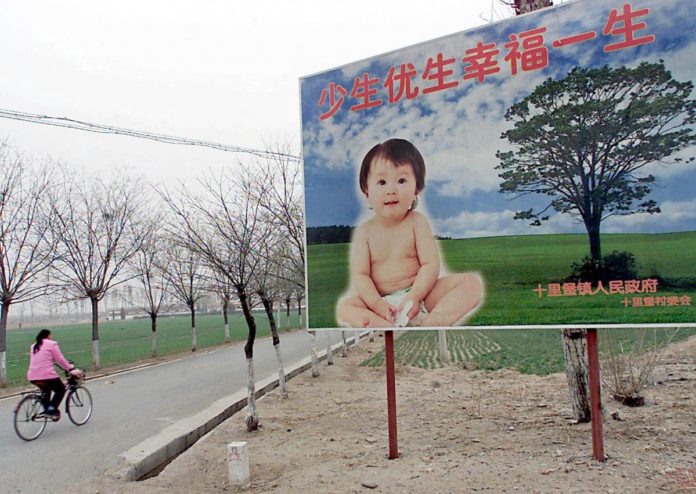
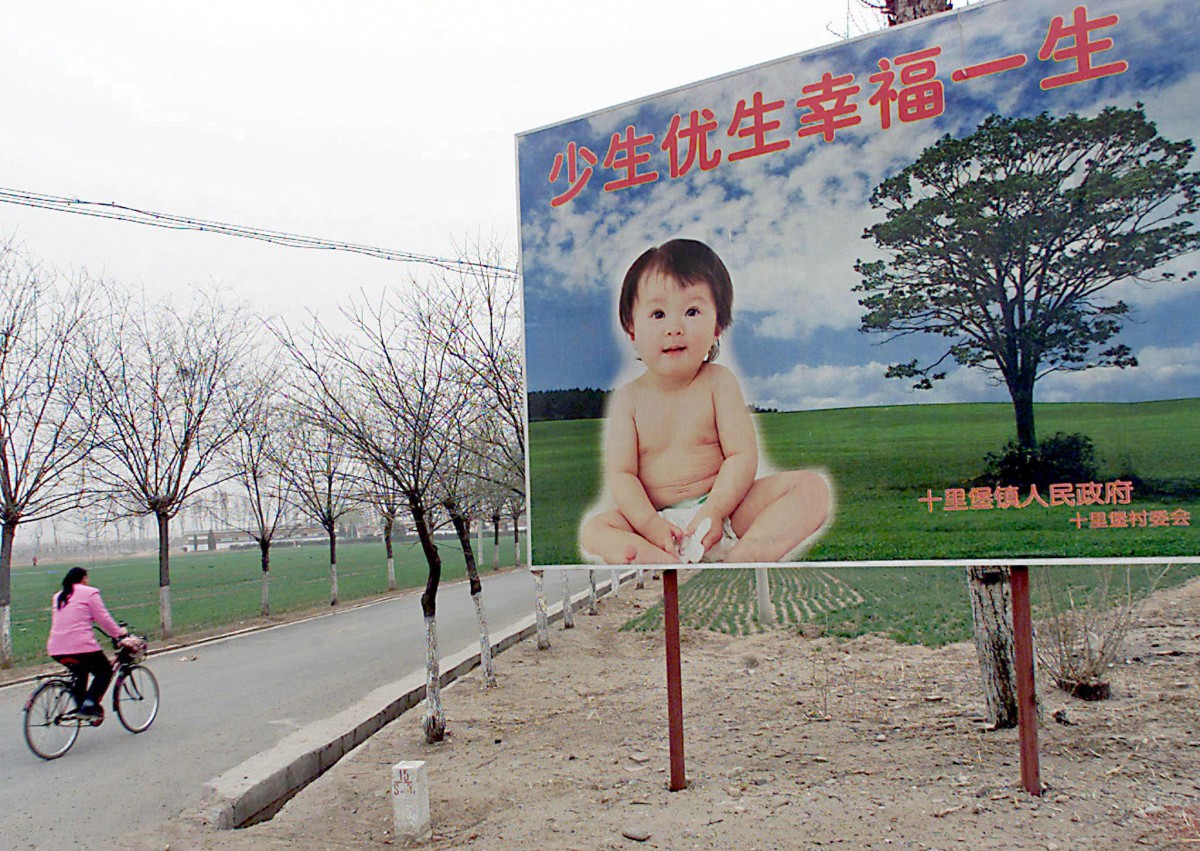
A woman cycles past a billboard encouraging couples to have only one child, along a road leading to a village in the suburb of the Chinese capital Beijing. 25 March 2001. Source: AFP/Goh Chai Hin
In 2014, Wang Guangrong, a 37-year-old father of four, killed himself after he was told his children could not enrol in the local public primary school unless he paid heavy fines of RMB22,500 (US$3,275) for violating the policies.
The communist party eased the restrictions in 2015 when it allowed couples to have two children – but no more.
It now looks like the scheme might be scrapped completely as China hopes to address social and economic problems created by the strict family-planning policies. A shrinking working-age population could threaten its economic development and a huge gender imbalance has made it hard for many men to get married.
India
India is experiencing similar problems to those China went through during the 70s and 80s. Its population is booming, and the sheer size poses looming pressures on resources and presents an enormous challenge for the government to expand schooling and other services for the growing young population.
Population control has largely been left to state governments to decide on the policies. While some states have reacted with coercion, forbidding parents with more than two children from holding local office or disqualifying government workers from certain benefits if they have larger families, other states have done little.
Maharashtra state offers newlyweds a cash grant of 5,000 rupees (US$72) to wait two years to have their first child.
The little Southeast Asian city-state wins the award for the weirdest approach to baby making.
Rather than trying to curtail population growth, Singapore is trying to encourage it.
With one of the lowest birth rates in the world at just 1.2 births per woman, the total fertility rate has been below replacement levels for over 40 years. And the government has been trying some unusual methods to pick up the pace.
In 2012, they teamed up with Mentos mints to release a song urging people to do their national duty and get down on national day.
Some of the lyrics include: “It’s national night and I want a baby, boo. I know you want it, so does the SDU (Social Development Unit). I ain’t merlion baby, this is national duty. Let me SMS the details of our late night dooty… call. Singapore’s population, it needs some increasing. So forget waving flags, August 9th we be freaking.”
The country has also placed a limit on the number of small one-bedroom apartments available for rent to encourage people to live together and, presumably, procreate.
Family planning policies of the 60s and 70s were so effective in slowing population growth that South Korea now has one of the lowest birth rates in the world.
Last year it recorded its lowest ever fertility rate at just 1.05 births per woman. To keep its population level stable, the country needs a fertility rate of 2.1 births per woman.
It is now the fastest aging developed economy in the world with over-65s outnumbering young people. In December, the country recorded more deaths than births for the first time ever.
In an attempt to restore the balance, the government has poured US$70 billion into incentivising child birth over the last decade.
Expectant couples are given 500,000 won bonuses (US$440) to help cover prenatal expenses. For the child’s first year, parents get monthly cash allowances of up to 200,000 won (US$176) – an amount that increases with each subsequent child.
They also set up a universal free childcare policy in 2013 to reduce the financial burden of having a child.
Other perks include subsidised fertility treatments, housing assistance and even free parking and dinner discounts.
AFTER gaining custody of a US$250 million superyacht, the Malaysian government is looking to claim a private jet that is also purportedly owned by a financier at the centre of the country’s state fund scandal.
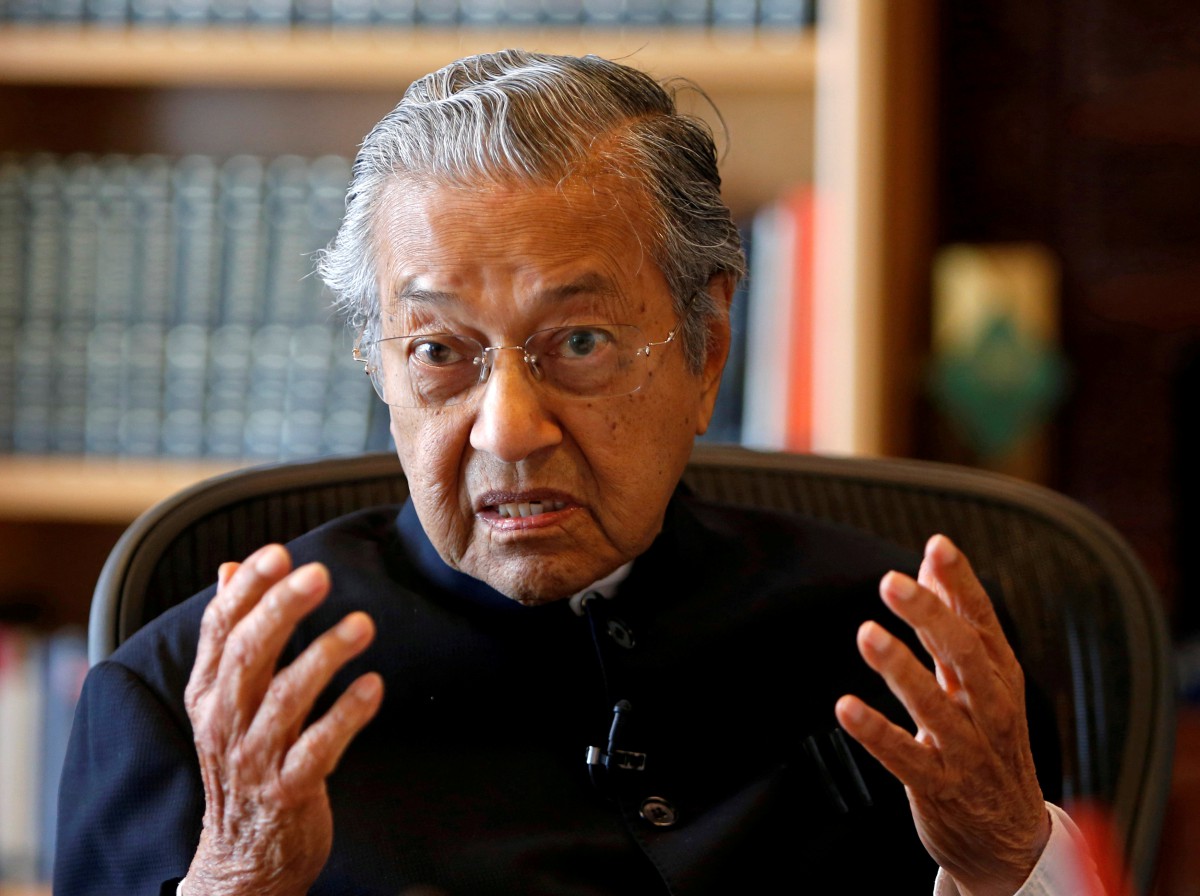
Prime Minister Dr Mahathir Mohamad said the government is making arrangements with Singaporean authorities to repatriate a US$35 million Bombardier Global 5000 said to be owned by fugitive businessman Low Taek Jho, the New Straits Times reported.
The prime minister said this in a press conference where reporters asked whether he believed the plane was bought with money allegedly stolen from the 1Malaysia Development Berhad (1MDB) state fund.
“Yes… I think so. (So) we have to bring it back,” Dr Mahathir told reporters after attending an exhibition held to celebrate his legacy at a university near Kuala Lumpur, the country’s capital.
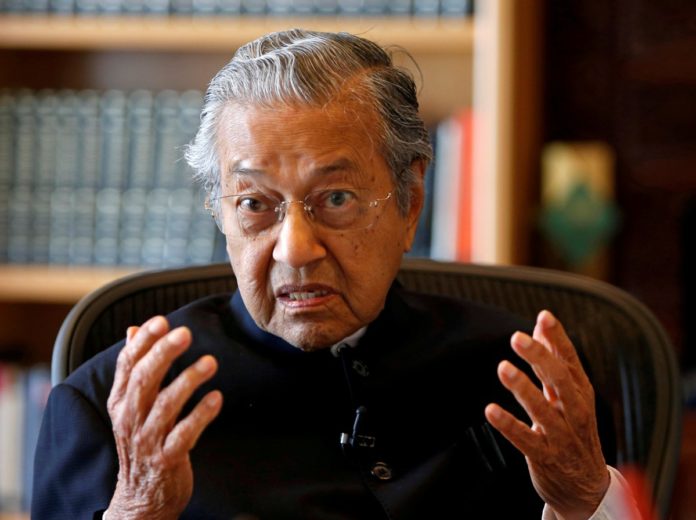
FILE PHOTO: Former Malaysian prime minister Mahathir Mohamad speaks during an interview with Reuters in Putrajaya, Malaysia, March 30, 2017. Source: Reuters
Last year, Singaporean authorities seized the private jet which is believed to be part of an estimated US$1 billion in assets bought using 1MDB funds.
1MDB, set up by Dr Mahathir’s predecessor Najib Razak in 2009, is at the centre of money-laundering probes in at least six countries, including the United States, Switzerland and Singapore.
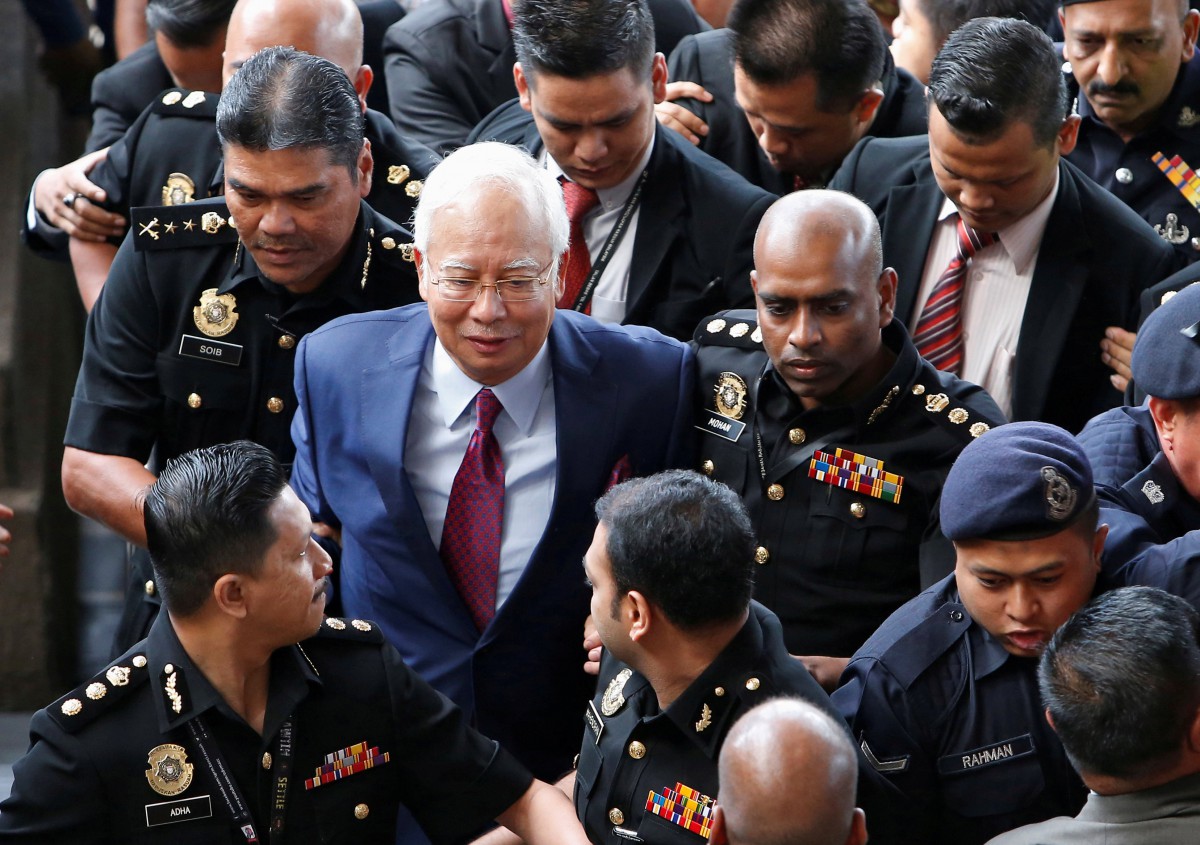
Najib, who fresh from losing the election in May, has claimed trial to a slew of graft charges related to 1MDB. He has denied any wrongdoing on the case.
Former Malaysian prime minister Najib Razak arrives in court in Kuala Lumpur, Malaysia July 4, 2018. Source: Reuters
The US Department of Justice has listed a total of US$4.5 billion that was allegedly misappropriated from 1MDB by high-level officials of the fund and their associates.
In August last year, the DOJ sought to seize more than US$1.7 billion in assets allegedly bought with stolen 1MDB funds after opening a criminal case on the matter.
“We are trying to get back all the money that has been stolen from us. We know who has it but we don’t know where they are,” Dr Mahathir said, as quoted by The Star.
“And the need for us to access the money depends on us proving that it is our money.”
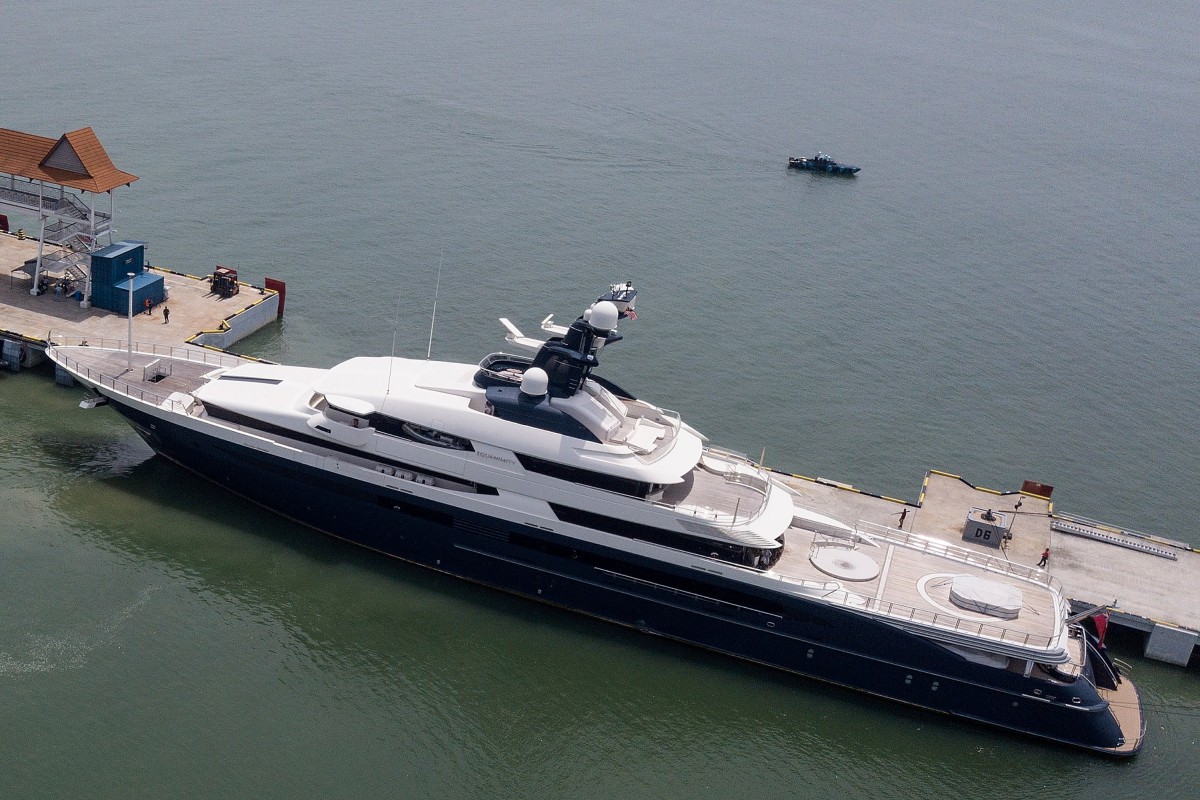
The Cayman-island flagged superyacht named the Equanimity arrived at a Malaysian port in Pulau Indah early last week after it was handed over by Indonesian authorities who seized the vessel earlier this year.
Equanimity, the 300-foot (90-metre) luxury yacht worth 250 million USD that belonged to Jho Low, a flamboyant international financier who allegedly played a central role in the 1MDB controversy that has engulfed former prime minister Najib Razak, arrives in Port Klang outside of Kuala Lumpur on August 7, 2018. Source: AFP
After visiting the extravagant yacht on Saturday, Dr Mahathir said the vessel will be sold to the highest bidder to recover the stolen 1MDB money.
“It’s super luxurious. I have been on yachts before but nothing like this. Everything is superb, and bought with stolen money, by crooks. We’ll get the crooks,” Dr Mahathir said.
In a statement issued by a spokesperson, Low later accused the prime minister of “hijacking” legal proceedings of countries like the US which has been in a custody battle over the vessel with the Indonesian authorities.
According to MalaysiaKini, Low’s spokesperson said Dr Mahathir was “putting words into the mouth of the DOJ” in relation to its agreement to grant Malaysia custody to the asset.
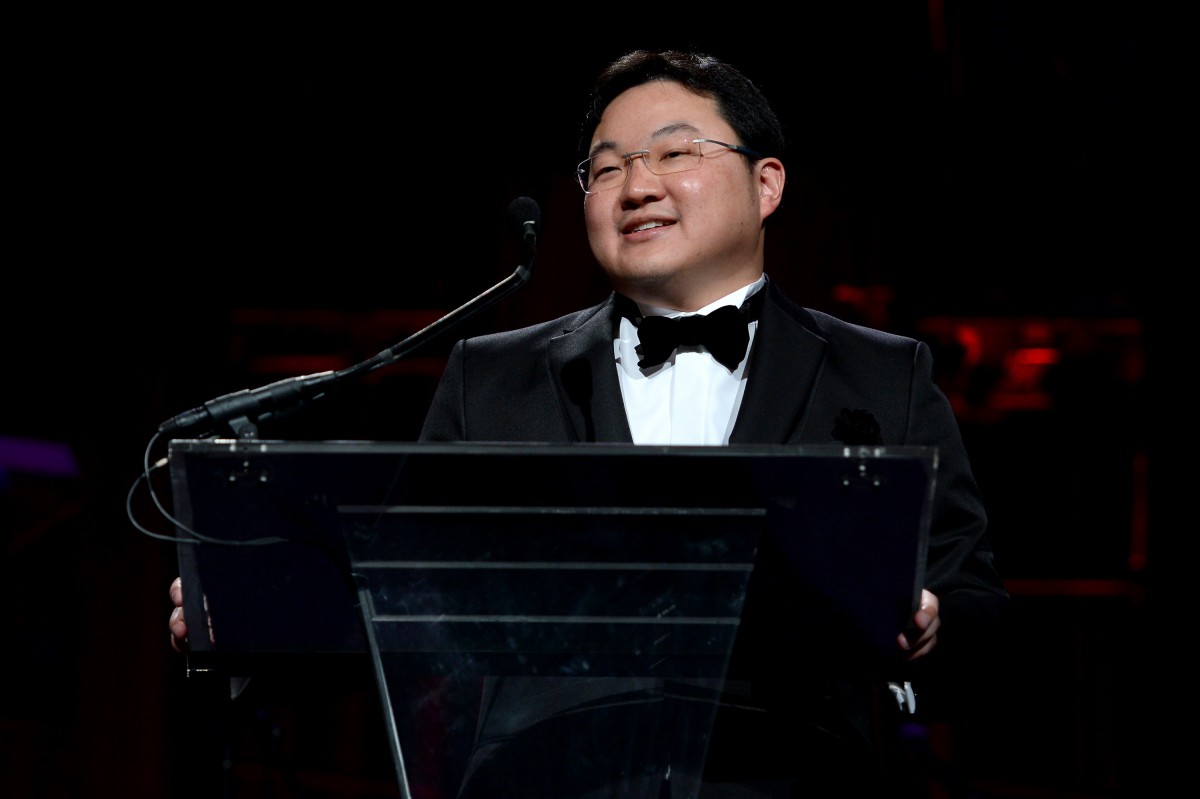
Jho Low speaks onstage during Angel Ball 2014 hosted by Gabrielle’s Angel Foundation at Cipriani Wall Street on October 20, 2014 in New York City. Source: Dimitrios Kambouris / Getty Images via AFP
“These repeated misstatements by Malaysia are embarrassing the US, which has stressed it has no involvement in the illegal seizure of the vessel and will update the US court on Aug 17.”
Low’s spokesperson also claimed the US’ bid to seize the ship was unlawful.
“The US hasn’t proven anything. The truth is this: the US filed unproven allegations in a civil forfeiture complaint more than a year ago – then halted the proceedings before any party had any meaningful chance to respond,” Low’s spokesperson said.
SINGAPORE: Chef Chen Siyuan, 31, counts watching films by American director Wes Anderson and listening to indie music by artists such as Norwegian duo Kings of Convenience as his hobbies. His taste in film and music has led some of his friends to call him a “hipster”.
But he demurs at the tag. “You don’t really want to be labelled, that’s the irony (of a hipster) I guess,” added Mr Chen.
The rise of “hipster” culture in Singapore is unmistakable, with the term becoming a part of Singaporeans’ daily lexicon.
From artisan cafes, yoga studios to fashion boutiques, the imported youth subculture seems to have found its spiritual home here, so much so that it has not been bogged down by its negative connotations. In fact, for some, being a hipster has become a status symbol, experts say.
The rise of hipster enclaves in Singapore and the disamenities generated by them were in the spotlight recently. Last month, the Urban Redevelopment Authority (URA) rezoned parts of the Tiong Bahru estate, following feedback from affected residents.
Local news also reported about the unhappiness of some residents – especially the elderly – with the noise and the crowds, particularly during weekends, at other hipster enclaves in Housing and Development Board (HDB) estates including those at Everton Park and Jalan Besar.
But what is the hipster culture? And why has it flourished here?
Its roots have been traced by some experts to the United States in the late 1990s in Brooklyn, New York and Silver Lake, Los Angeles, said National University of Singapore sociologist Joshua Kurz.
Those cities were extremely violent then, and the authorities introduced various measures to bring down the crime rate. But these efforts were deemed to have sterilised the cities and stripped the neighbourhoods of their street culture, leading to a pushback among youth to reclaim these spaces, said Dr Kurz.
The carpark spaces along Eng Wat Street at the Tiong Bahru estate are usually taken up on weekends. (Photo: Amir Yusof)
“Hipsters came as a response … resurrecting the old, finding the new before anybody else does and turning it into the next hot, new cultural thing,” he explained.
Later, businesses in the US started to market their products to this group of youths including stores selling vinyl records and brands such as lifestyle retailer Urban Outfitters and clothing brand American Apparel.
Experts broadly define it as a movement of individuals looking for originality, to be different and not conform to mainstream interests and lifestyles.
“It refers to a millennial generation searching for authentic alternative lifestyles which they believe comes from a seemingly more innocent past before the internet and mass manufacturing,” said Assistant Professor Liew Kai Khiun of Nanyang Technological University’s Wee Kim Wee School of Communication and Information.
It is unclear when the hipster culture first appeared in Singapore, but experts including Dr Kurz narrowed it down to some time around the 2000s.
Part of the problem in determining the birth of the subculture here is the reluctance of people to identify themselves as part of a hipster culture – a paradoxical characteristic of hipsters anywhere in the world. Dr Kurz said:
Unlike another subculture like the punks, where those who identify themselves as one readily call themselves one, hipsters hate such label.
(Photo: Unsplash/Joanna Nix)
Some aspects of the hipster culture are also contradictory, said Mr Sherman Tan, a PhD candidate at the Australian National University and visiting research scholar at the National University of Singapore (NUS).
Mr Tan co-authored a study in 2014 titled The Rise of “Hipster” Culture in Singapore: Spatial Transformation in Tiong Bahru.
Noting that the unwillingness of hipsters to define themselves as such “gives us a clue to what being hipster is about”, Mr Tan pointed out that some say hipsters have a peculiar aesthetic style – a look that is relaxed and unbothered.
While this suggests that they are unbothered by social standing, it contradicts how the subculture is seen as a way for middle-class youths to distinguish themselves from their peers, Mr Tan pointed out.
In Singapore, people tend to put the label on others and rarely on themselves, he added.
“That’s where you start hearing, ‘Eh, don’t be so hipster la’ among Singaporeans,” he said. “But there is an unacknowledged desire for difference and uniqueness (among hipsters), and it’s not a uniquely Singapore trend.”
In the Singapore context, it is the clamour for a sense of identity among a large middle class, which has been around for some time, in a densely-populated city, said Mr Tan.
When old buildings gave way to new ones, Singaporeans also became anxious about its built heritage, and looked to preserve the aesthetics of the past – a common trait of hipster culture.
The experts said the hipster culture could have been driven by the droves of Singaporeans returning home after studying overseas in the late 90s and early 2000s, and were drawn to businesses that seemed to cater to the hipster lifestyle.
For example, after Forty Hands cafe set up its first outlet along Yong Siak Street in 2010, other indie stores such as book store BooksActually set up shop in the vicinity. Haji Lane soon became a hipster spot around 2013, with a string of indie fashion boutiques drawing a strong following among youths.
WHO’S A HIPSTER?
“Trendy”, “different”, “cool”, “pretentious”, and “vintage” – these are some of the words which Singaporeans interviewed associate with the hipster culture.
Most agreed that hipsters here are people who try to be different from the crowd, and are often seen as trendy or fashionable. They like to visit artisanal cafes, and areas such as Tiong Bahru, Haji Lane, Holland Village and Everton Park.
Kampong Glam’s Haji Lane (Photo: Mayo Martin)
When it comes to hipster fashion, floral-print shirts, vintage outfits, rolled-up skinny jeans and canvas totes spring to mind.
Mr Amir Mohamed, 19, is one of the few hipsters who accept the label – though not all of it.
“I do what I like so I’m pretty much a hipster in that sense … (most) Singaporeans probably think they want to get a degree and get a good job. But for me, I don’t want to be under someone, I want to be my own boss, I want to be in a position where I can say, ‘oh this is what I want and I can do it,” he said.
His taste in music is also what sets him apart as a hipster, added the aspiring musician who listens to a wide range of music, from jazz to hip-hop.
However, he said he does not identify with hipsters when it comes to fashion and food choices.
“I don’t really follow hipster trends like drinking at (cafes), I really love my teh-tarik,” he said.
Undergraduates Shermaine Lim, 19, and Sonia Lee, 20, admitted that they might have a hipster’s preference in their choice of literature, favouring local authors and poetry as opposed to more mainstream authors. But they quipped that it is too expensive to maintain a hipster lifestyle, which would include food such as avocado toasts.
Ms Lee noted that some youths may adopt a hipster lifestyle to get more “likes” on social media.
However, Ms Cheryl Chong, who is in business development, felt that the hipster culture has become commercialised today. It used to reflect a person’s hobby and interests but now, it seems to be about businesses such as cafes, fashion boutiques, bookshops and music stores, said the 32-year-old.
A BYWORD FOR CONSUMERISM
With the dominance of international brands and shopping malls in Singapore, there will inevitably be a small group of consumers who reject these and search instead for local stores and less popular items, said Dr Kurz.
And “hipster” shops here say they are merely catering to this demand.
Apparel retailer Nana and Bird at Tiong Bahru. (Photo: Amir Yusof)
Barbershop Mr Moustache, located at Everton Park, for instance, exudes a hipster vibe by pairing its take on classic hairstyling and shaving services for men with a vintage-styled interior, such as retro-looking barber chairs.
Co-founder Victor Tan said his business is considered hipster because it tries to reinvent the traditional craft.
“I’m not a hipster, I’m too old for this … but my barber shop is, and so are the (style of) hair cuts,” said Mr Tan, who declined to reveal his age.
“Singaporeans are quite conservative, so I’m happy that at least, there are people who are willing to try our (style) of haircuts,” he added.
Since 2006, fashion boutique Saladshop, located in Haji Lane, has been bringing in a selection of women’s wear different from what can be found at shopping malls. About one or two years later, people started to use the term “hipster” to describe such concept stores, said Saladshop owner Eileen Teo, 40.
While her idea of hipsters are creative individuals who make bold selections, she admitted the term has since become too generic. The word may not reflect the level seriousness or professionalism shown by those who work hard to select and bring in items for a certain concept store or style, she added.
The hipster fever has engulfed even the traditional hawker centres: For example, the newly-opened Pasir Ris Central Hawker Centre has been marketed as the first to offer both traditional and hipster cuisines at affordable prices.
Mr Mohammed Rafi, 35, co-owner of Burgernomics at the hawker centre, said he does not really like the “hipster” label. However, the marketing strategy has managed to draw a younger crowd, which is the burger stall’s target audience.
“It’s just like graffiti … if you give someone a space to do graffiti, the essence of it is no longer there,” he said of the “hipster” label. He added:
It’s an ‘in’ term to use, but it has also been used too much that it has become, a very – for the lack of a better word – ‘obiang’ (Hokkien word for out of fashion) term to use.
The new Pasir Ris Central Hawker Centre will offer both traditional hawker fare and modern “hipster” cuisine. (Photo: NTUC Foodfare)
Coffee joint Forty Hands is seen by many to have contributed to Tiong Bahru’s evolution into a hipster enclave, after its success ushered in several more indie stores in the area.
While the rush of trendy businesses has revived the once-sleepy estate, it has also been criticised for gentrification.
Director of Forty Hands cafe Harry Grover, 37, said his target audience was not the hipster crowd but he is “more than willing to take (their) money”.
The idea for a cafe came from wanting to “do something cool and original”, after he realised that Singapore had the market for a “third wave of coffee” after coffee chains like Starbucks, he said.
The so-called “third wave of coffee” is a movement to emphasise an appreciation of high-quality coffee, the production process, and alternative preparation methods, among other things.
“We wanted a proper business that services hundreds of customers, that built its name on merit, not just because it is located in a hipster neighbourhood,” he said.
He added that while the hipster crowd is part of his clientele, he is not too concerned even if the subculture disappears further down the road.
EVER EVOLVING
While the hipster culture has flourished in Singapore over the last two decades, it is not clear how it could evolve, the experts said.
Reiterating that some Singaporeans have taken to the hipster culture to differentiate themselves socially and find a sense of identity, Mr Tan, the visiting research scholar at NUS, noted the presence of a dominant and affluent middle class in the Republic, who have the means to pursue such a lifestyle.
For some in Singapore, a hipster lifestyle is in fact something to aspire to, notwithstanding the reluctance to embrace the label. In contrast, the term carries negative connotations in the US, where it is often used in a derogatory manner and associated with “middle-class trust fund youths”, said Mr Tan.
“It’s in everyday Singapore conversations, where you turn to your friend and say, ‘wah that’s so hipster’. And it doesn’t really connote bad or good, it just very simply describes the visual styling of something and the aesthetics of it,” he added.
(Photo: AFP/Behrouz Mehri)
Dr Kurz noted that Singapore is one of the few places where media portrayal of “hipsters” has not been too negative.
He also pointed out that unlike in some other countries, hipsterism here is not so much about being anti-establishment, but more about aesthetics, fashion and trends. It also revolves around cafes given Singapore’s food culture, he added.
Another factor underpinning its rise in the Republic is the younger generation’s anxiety with the country’s rapidly changing landscape, said NTU’s Asst Prof Liew.
Colonial shophouses and early public estates are seen to be “more rustic, quaint, distinct and therefore cool”, he noted. It is no coincidence that images of these places are frequently put up by hipsters on social media platforms such as Instagram and Pinterest, he added.
Asst Prof Liew concedes that he used to think hipster cafes and retailers were gentrifying some of the HDB heartlands and conservation districts including Tiong Bahru.
His perception changed when he realised that some of these shops actually add to the local culture and environment. “Better an independent hipster design shop by enterprising youths than another faceless branch of some big brands,” he pointed out.
Still, Dr Kurz said some experts have argued that the hipster culture could be unwittingly threatened by businesses seeking to cash in on it – even as others see this as an evolution of the culture.
“It’s been made into a brand identity. As soon as (stores) like Urban Outfitters, American Apparel and many other kinds of businesses started specifically catering this group of people, you can argue that what made the culture specific and interesting has died,” he said.
Customers visit Urban Outfitters store in Manhattan, New York, U.S., August 15, 2016. (File Photo: REUTERS/Eduardo Munoz)
In Singapore, where hipster culture is sometimes manifested in physical spaces, its fate in the coming years could also hinge on practical considerations and government policies, Dr Kurz said.
Referring to the Tiong Bahru rezoning exercise, he noted that this would have an impact on youths living or setting up business in the area.
“Changing the zoning laws could fundamentally disrupt this neighbourhood (and the subcultures),” he added.
Nevertheless, for Mr Tan, the fundamental ideal of the hipster movement – resistance to modernity – will never go away.
It stretches as far back as after the French Revolution in the 18th century. Over the ensuing centuries, such resistance has come in the form of religion or spirituality, he said.
On the malleability and durability of the hipster culture, he added:
People still have this idea that hipsterism is relatively new or it’s really an innovative trend. But it isn’t … hipsterism is really the latest reincarnation of a resistance to the modern mainstream.
SINGAPORE: The closure of car parks at Holland Village to make way for a new mixed-use development has been pushed back to minimise inconvenience to the public and disruption to businesses in the area, Far East Organisation has said.
The open-air car park will be kept open until the end of October while the two-storey car park will remain open until August next year, Mr Marc Boey, the director of planning and acquisitions at Far East Organisation said in a statement on Monday (Aug 13). He was also speaking on behalf of joint venture developers Sekisui House and Sino Group.
The closing dates of the car parks may be adjusted as the planning for the development progresses, Mr Boey added.
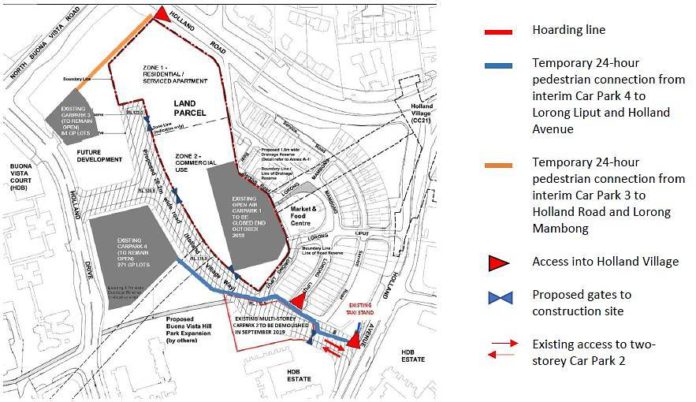
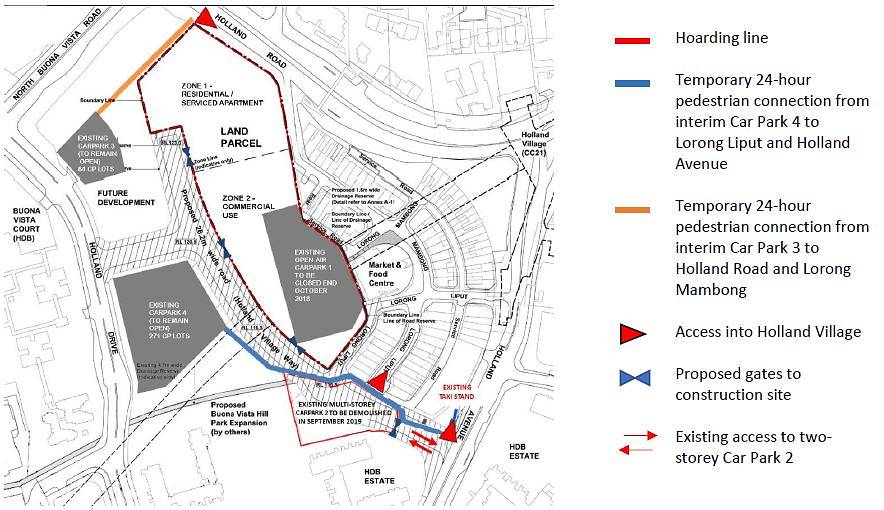
Two temporary pedestrian connections will also be constructed to link Holland Village to two interim car parks, with 350 lots, at Holland Drive, he said.
Both existing car parks at Holland Village offer a total of 405 lots. It was earlier reported that the car parks would be closed from Monday, the same day the developer took possession of the site.
Stirling Land Holdings, a consortium led by Far East Organisation, was awarded the tender for a 99-year-old leasehold land parcel at Holland Road in May.
Information boards and directional signs will be put up when the car parks are due to close to inform the public of the changes in traffic circulation plans for the area, according to a flyer distributed at Holland Village which was seen by Channel NewsAsia.
The two-storey carpark is expected to be demolished in September next year.
Details of a mixed-use development project at Holland Village Way. (Graphic: Commons Residential)
The new development will include a new basement car park that will provide 486 car lots and 56 motorcycle lots, according to the flyer. Its projected completion date is in 2025.
“We are committed to keeping the existing car parks open for as long as possible before construction work commences,” Mr Boey said.
“We also remain keenly sensitive to the needs of the existing community. Hence, we are working hard to minimise any potential disruptions to the existing businesses and community at Holland Village.”
The Housing and Development Board (HDB) had earlier distributed notices from Aug 1 informing motorists of the closure of the open-air car park.
HDB also highlighted alternative parking spots, namely the car parks opposite Blocks 18 and 21 Holland Drive, and at Block 5A Holland Close and Block 10A Holland Drive.
SINGAPORE: A total of 326 Haj pilgrims – the largest group this year – departed for Jeddah, Saudi Arabia on Monday afternoon (Aug 13), said the Islamic Religious Council of Singapore (MUIS) in a press release.
This year, Saudi Arabian authorities gave Singapore an additional 100 places for Haj pilgrims, on top of the official quota of 800.
Singaporean pilgrims reciting prayers before boarding the flight to Jeddah. (Photo: MCI)
The pilgrims departed from Changi Airport’s Terminal 2 and Terminal 3 via Scoot Airways and Saudi Arabian Airlines.
Minister-in-charge of Muslim Affairs, Mr Masagos Zulkifli was at Terminal 3 to send 232 pilgrims off, along with Senior Parliamentary Secretary for Home Affairs and for Health Amrin Amin. Mr Amrin also sent off 94 pilgrims at Terminal 2.
Minister-in-charge of Muslim Affairs Masagos Zulkifli mingling with Haj pilgrims at Changi Airport on Monday (Aug 13). (Photo: MCI)
Also present at the airport were MUIS’ chief executive Abdul Razak Hassan Maricar and ambassador of the Royal Embassy of Saudi Arabia in Singapore Saad Saleh Alsaleh.
A 22-member delegation from the Singapore Pilgrims’ Affairs Office will be accompanying and providing medical and welfare services to Singaporean pilgrims, said MUIS.
BBR, La Dame de Pic and yi are among the new dining concepts that will be available once the hotel, which is undergoing renovation, opens its doors in 2019.
Raffles Hotel Singapore is set to reopen in 2019. (Photo: Raffles Hotel Singapore)
(Updated: )
Bookmark
SINGAPORE: The local culinary scene gets another star-studded boost as Raffles Hotel announced on Monday (Aug 13) its new restaurant line-up, including those by celebrity chefs Alain Ducasse, Anne-Sophie Pic and Jereme Leung.
Raffles Hotel Singapore welcomes new restaurants by celebrity chefs Alain Ducasse, Anne-Sophie Pic and Jereme Leung. (Photo: Raffles Hotel Singapore, Wikipedia)
BBR by Alain Ducasse will be the acclaimed French chef’s first Mediterranean sharing and grill concept, and will be located at the hotel’s 122-year-old Bar & Billiard Room.
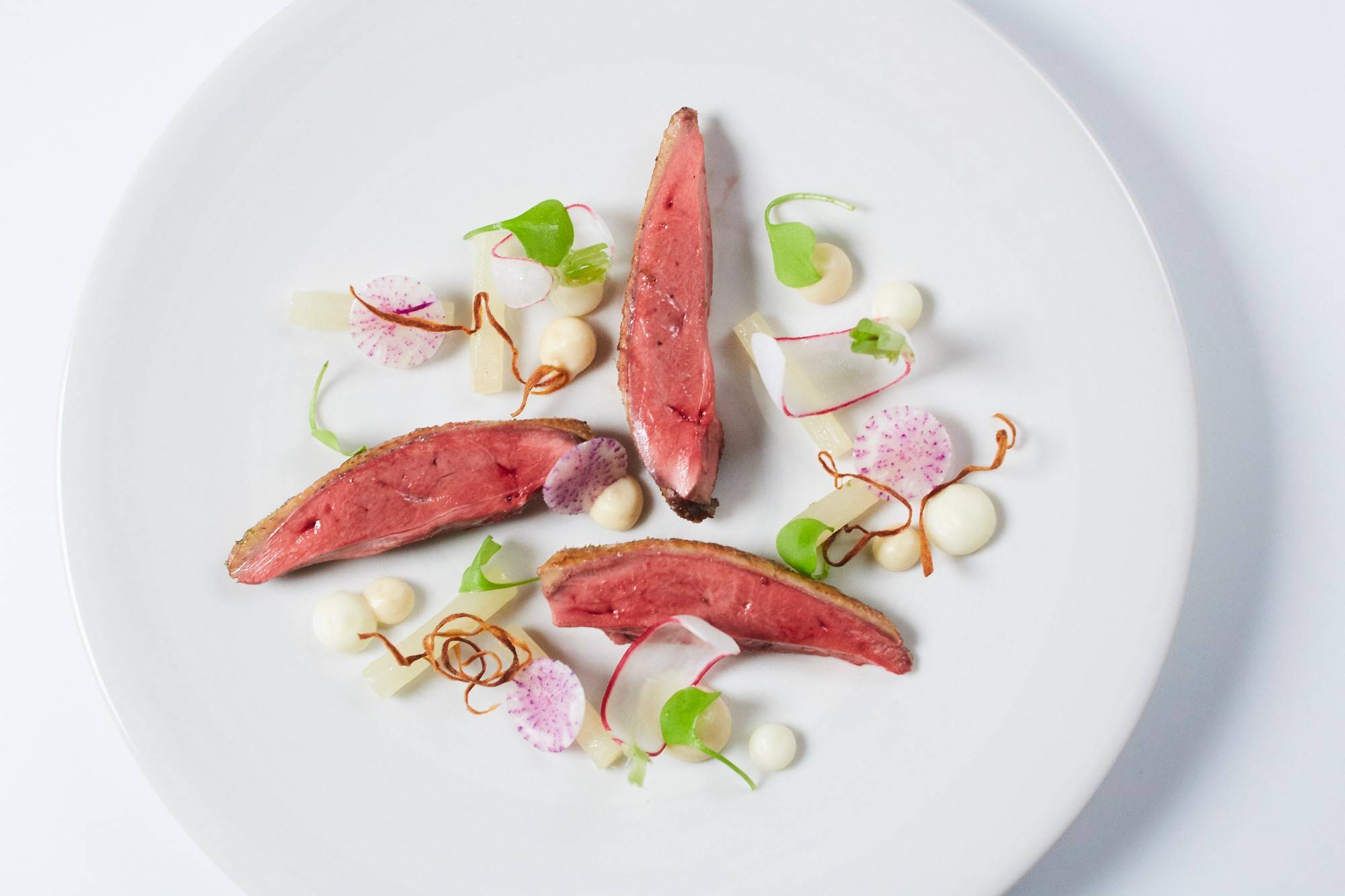
Meanwhile, fellow French chef Pic will be making her Asian debut with La Dame de Pic. Located in the hotel’s dining room in the main building, it will feature one of the world’s top female chef’s culinary signatures that takes the cue from her birthplace in the Rhone Valley.
Anne-Sophie Pic, France’s only female chef with three Michelin stars, makes her Asian debut with La Dame de Pic. (Photo: Raffles Hotel Singapore)
Singaporean master chef Jereme Leung returns with his contemporary Chinese restaurant yi, which will be at the newly restored Raffles Arcade and will feature Cantonese classics as well as adaptations of ancient Chinese delicacies.
“Continuing with our tradition and commitment of the highest level of friendly, engaging and anticipatory service, we are more than excited to introduce concepts with partner chefs, who have a reputation of operating successful venues around the world, while at the same time, creating culinary experiences that are new and distinct to Singapore,” said Christian Westbeld, General Manager, Raffles Hotel Singapore, in a media release.
BBR by Alain Ducasse will be the acclaimed French chef’s first Mediterranean sharing and grill concept. (Photo: Raffles Hotel Singapore)
The 131-year-old hotel, which is currently undergoing restoration, is set to open during the first quarter of 2019.
Aside from the three restaurants, another new dining concept will be Butcher’s Block, which will showcase high-end single sourced meats.
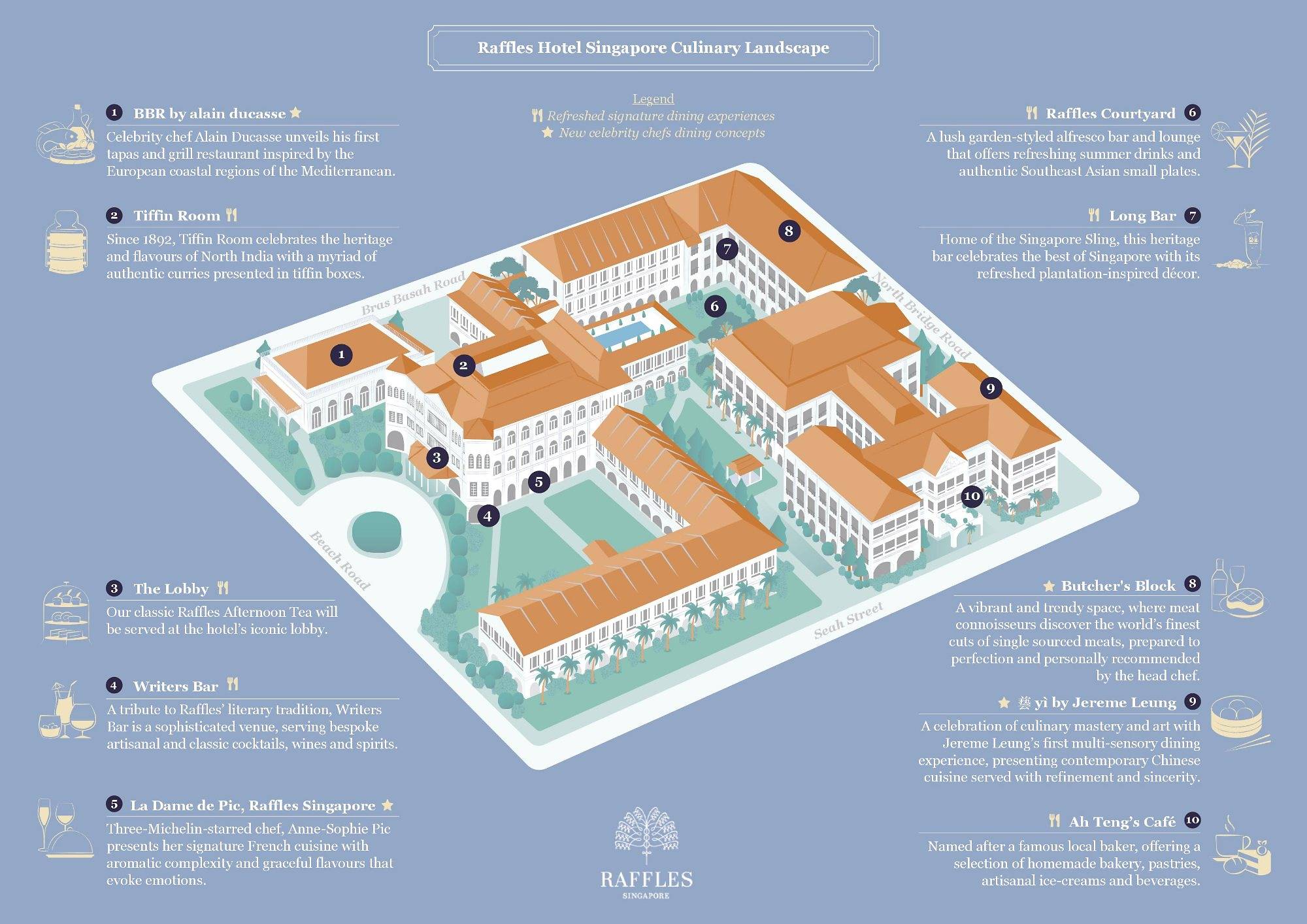
Six other bars and restaurants will be making its return at Raffles Hotel, including the North Indian dining spot Tiffin Room; heritage bar Long Bar, with its iconic Singapore Sling cocktail; The Lobby; Writers Bar; Raffles Courtyard; and the newly renamed Ah Teng’s Cafe.
Where to eat at the Raffles Hotel Singapore. (Photo: Raffles Hotel Singapore)
“I could not dream of a better location than the landmark Raffles Hotel Singapore to bring the Ducasse restaurant experience for the first time to Singapore,” said Ducasse in the media release. A giant in the international culinary world, the 61-year-old chef has 21 Michelin stars to his name and around 20 restaurants in seven countries, including his famous spots at London’s Dorchester, Paris’ Palaza Athenee and Monaco’s l’Hotel de Paris.
The 49-year-old Pic, who is best known as France’s only female chef with three Michelin stars, said: “Making our debut in Asia at Raffles Hotel Singapore is a very natural choice for me. Like Raffles, the Pic family’s culinary heritage spans more than a century.”
Finally, 46-year-old Leung’s yi marks a return to Singapore, where he had spent his early years working.
“While I have lived abroad for most of my career, the formative years which I spent working in Singapore and Hong Kong were so important to defining my approach and style of cooking. Opening yì by Jereme Leung at Raffles Hotel Singapore is an honour and I am excited to be able to work with some of the best minds in the Singapore industry and present my personal take on Chinese cuisine,” said the chef, who is also known for being a judge on MasterChef China and for hosting TV food shows in China.