Follies: National Theatre Live (screening)
Saturday, September 29, 2018 at 3:30 PM
Saturday, September 29, 2018 at 3:30 PM
Esplanade – Theatres on the Bay
1 Esplanade Drive, Singapore, 038981 Singapore
The group will hold a one-night-only concert here as part of a new tour to celebrate their 15th anniversary.

Il Divo will be performing in Singapore in October as part of their 15th anniversary tour.
Follow our CNA LIFESTYLE page on Facebook for more trending stories and videos
SINGAPORE: Pop-opera group Il Divo will be returning to Singapore on Oct 13 this year.
The multi-platinum group last held a concert here in 2016 and this time around, they will be performing at the Star Theatre as part of the new Timeless Tour to celebrate their 15th anniversary.
One of the most popular classical music crossover groups, Il Divo – comprising the Spanish Carlos Marin, the Swiss tenor Urs Buhler, the Frenchman Sebastien Izambard and the American tenor David Miller – is known for their operatic takes on songs from different genres.
Since debuting in 2003, they have performed before the likes of former US president Barack Obama and the Queen of England, as well as drawing crowds to their concerts.
With hit songs such as Regresa a mi (Unbreak My Heart), The Time Of Our Lives, Si voy a perderte (Don’t Wanna Lose You)” and I Believe In You (Je crois en toi), the group has sold 30 million albums worldwide.
They have also collected numerous gold and platinum music awards in over 33 countries, and was the first classical crossover group to have an album debut at the top of Billboard’s Top 200 chart.
Il Divo’s Timeless Tour will take them to Asia, South Africa, Australia, Latin America and the United States. For their Singapore concert, fans can expect a mix of pop classics as well as new songs from their latest album, such as a Spanish version of Adele’s hit Hello, titled Hola.
Ticket sales start on Aug 18 from Sistic, with prices ranging from S$98 to S$278.
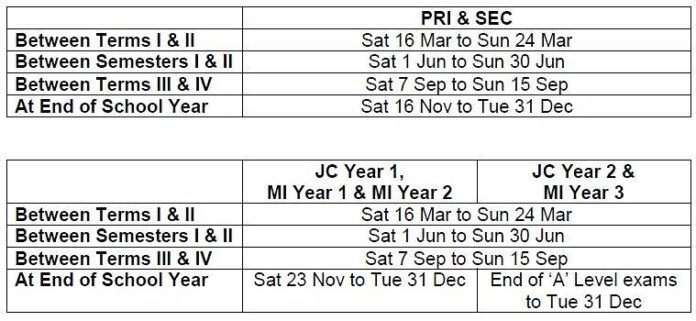
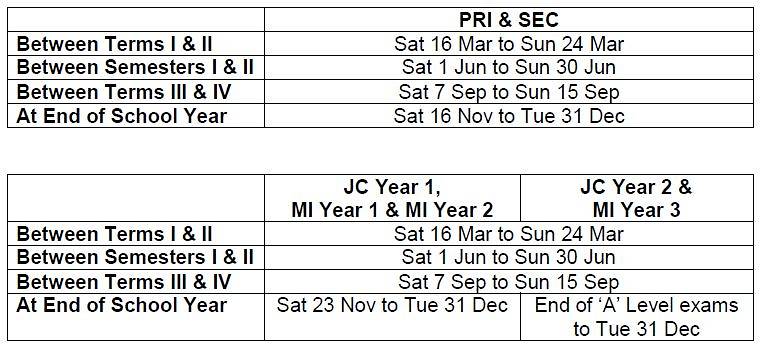
SINGAPORE: The 2019 school year for all primary and secondary schools under the Ministry of Education (MOE) will start on Wednesday, Jan 2 and end on Friday, Nov 15, the ministry announced on Wednesday (Aug 15).
Students in their first year at junior colleges and at the Millennia Institute will start on Friday, Feb 1, while the rest of the students will start school on Monday, Jan 7.
The four vacation periods next year are as follows:
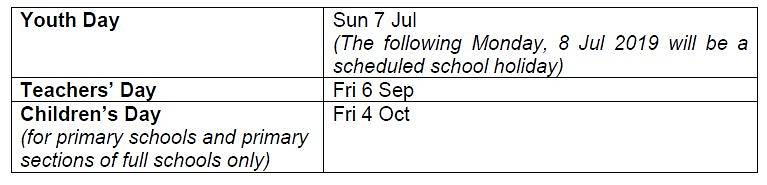
In addition, there will be three scheduled school holidays in 2019:
SINGAPORE: She came from China 18 years ago, eagerly looking forward to the bliss of married life, and could not be more excited when awarded her Singapore citizenship a short while later.
Then times got tough. With her husband’s salary not being “high enough”, and to support her three children, she decided to stop being a housewife, and turned to a job she was familiar with, having once done it in China.
To her family, Coco (not her real name), 43, has been the boss of her own small, one-woman massage parlour for five years. What they don’t know is that “since day one”, she has been offering extra sexual services along with back rubs and foot kneads.
“I’m doing it for my husband and children, just using different methods to make money,” she said in Mandarin. “For now we are happy and everything is alright. But if the police catch me, it’ll surely lead to divorce.”
Of late, Coco has had more to fear. New laws against unlicensed massage joints were passed in November last year under the Massage Establishment Act (MEA) and came into force in March. Under the toughened laws, offending operators face up to S$10,000 in fines – 10 times the previous penalty – or two years in jail.
These efforts represent an attempt to clean up what appears to be an ongoing issue in Singapore. Most recently available figures show the number of illegal massage parlours increasing by 40 per cent from 2013 to 2016. Of the 300-odd errant operators identified in 2016, 40 per cent were engaged in vice-related offences.
While debating the bill in Parliament last year, Second Minister for Home Affairs Mrs Josephine Teo gave further context to the new legislation, stating the previous S$1,000 penalty as “grossly insufficient” compared to the profits that unlicensed establishments can make “especially by engaging in vice activities”.
The Singapore Police Force (SPF) told Channel NewsAsia that due to operational considerations it could not comment on the number of raids conducted since the implementation of the new MEA. But it promised to “continue to take strong enforcement actions against unlicensed massage establishments, as well as errant licensed massage establishments”.
This year, the police have taken to issuing a monthly average of around 4 announcements of arrests stemming from raids on such establishments, compared to the second half of 2017, when there was one or fewer such announcements per month on average.
Vanessa Ho, who heads local sex worker rights group Project X, said that just by walking the ground, she had observed an increase in the number of targeted raids on massage parlours.
Singapore police conducting enforcement operations at a massage parlour in Little India, in April 2017 (Photo: Singapore Police Force)
“THEY DON’T BUG US” – OR DO THEY?
In the Jalan Besar and Beach Road areas, which have been the subject of repeated police raids, residents have expressed concern to their Member of Parliament (MP) Ms Denise Phua over a perceived increase in the number of massage parlours and related vice activities.
Ms Phua said she had conveyed such feedback to the police.
“My residents welcome police efforts to clamp down unlicensed operators and vice activities in their neighbourhoods, for the sake of their loved ones,” she added.
It is the police’s duty, she said, “to ensure a safe and secure living environment for residents and other businesses”.
Her fellow MP Heng Chee How, whose ward includes nearby Lavender Street, faces similar issues.
“On behalf of the residents of Whampoa ward, we have maintained a clear and consistent position with the police – that we support strict enforcement against all illegal and vice activities in our area,” he said.
Along Lavender Street, which is in Mr Heng’s ward, there are at least four recently-shuttered massage establishments. With signage still intact, they stand directly in front of the Bendemeer Light estate.
A resident of four years there, Teresa, 38, has seen plenty of skimpily-dressed women openly walking around and hanging their clothes out to dry. “It’s obvious that something’s up, but they don’t bug us,” she said.
One of her neighbours, a woman who declined to be named, said: “I just stay away from that area. Then you won’t notice anything.”
For more than 20 years now, Mr and Mrs Ong have run an auto accessories shop directly opposite the stretch of massage parlours. “Last time, it was 10 shops in a row,” said Mr Ong. “They come and go, but the scantily clad women are always around.”
On nearby Cavan Road, raided by police just last month, a lone massage establishment can be found – and seemingly closed for good, with its interior left in disarray as seen through the glass door. Neighbouring businesses said it appeared to be operated independently by a woman from China, who did not interact much save for the occasional hello and good-bye.
“It’s quiet around here, the only thing is she liked to hang underwear outside,” said Gary Tan, owner of the next-door wine shop. “But it’s alright – as we Singaporeans like to say, don’t come and disturb can already.”
A row of massage establishments along Foch Road, which was the target of a recent raid by police (Photo: Justin Ong)
CLAMPDOWN “COMPLETELY USELESS”?
Meanwhile Coco, whose parlour has previously been raided, said the new laws are “too strict”.
“It’s not like we want to do bad things. I don’t feel like I’m doing anything wrong. Inside our shops, we’re not affecting anyone, not harming anyone – so why do you have to jail people?” she asked. “They are being unreasonable. Just issue everyone licenses. If during checks they’re really found to have done wrong, then take away the license and they’ll stop.”
But while ongoing attempts to shut down the illegal businesses are creating nervousness among their owners, eradicating the problem once and for all may be a challenge.
Ho explained that with each raid, foreign workers lacking proper documentation will be deported and blacklisted from coming back. “But new batches of women enter the country to take their place,” Ho said. “The cycle continues. Agents and pimps benefit the most because they earn new batches of agent fees.
“Clients can also be said to ‘benefit’ as after the women are arrested, new women show up to take their place. And the clients return for more.”
She added: “With the MEA, current efforts may succeed in eradicating most sex work from massage parlours. But what’s next? Where will they be displaced to? And for how long more can we play this cat and mouse game?”
Coco agreed. “Close down one, and they’ll just open more and more parlours somewhere else,” she declared.
“Whether from Thailand, Vietnam or elsewhere, there will always be supply. All these operations are completely useless. You can’t finish catching them all.”
A room in a massage parlour raided by the police last year (Photo: SPF)
“WE JUST WANT A RICE BOWL”
Local massage parlour owner Sonia (also not her real name), 55, blamed the stiffer laws on these foreigners. “That’s why at my place, all the girls are Singaporean, and we all just want a rice bowl,” she added. “If we don’t do this, somebody’s mother, sister or daughter will be in this line anyway.”
A single mother, Sonia turned to the massage industry 20 years ago. “I needed cash then for my son who got cancer,” she said. “Now, all he knows is that mum has a shop.”
She said that her employees offer “basic” sexual services of their own accord. “It’s their own arrangement with the customers. We owners don’t force the girls to do anything,” said Sonia. “They want the money. My girls, some of them have old mothers, or up to four kids who’re schooling, and they need to pay fees.”
Coco, too, said she did not want “to keep doing this.”
“I hope to stop in three years. But for now, I need the money,” she added.
Sonia said her masseuses receive a base monthly pay of S$500, and could get up to S$50 for a sexual service. Each of them gets one to two customers a night. The parlour is open daily.
“I’ve had my girls’ husbands come to my shop, asking them what the hell are they doing, then of course they get separated,” she said.
“But if you ask my girls to go find another job, they’ll go be cleaners and they won’t earn enough.”
SINGAPORE: John is doing a six-month internship at a global biomedical company. As an undergraduate pursuing a science degree, he expects to gain relevant hands-on experience to supplement what he learnt back in university.
This would include checking for possible harmful interactions among different drugs patients take, getting practice in record-keeping duties, and helping patients secure the claims they deserve through liaising with insurance companies.
If he is fortunate, he might even learn to administer some medications and perform basic tests, like taking a patient’s blood pressure.
But alas, he will continue to reminisce about such hopes and dreams, as he continues with his assigned tasks this morning – wrapping presents for the company’s guests of honour for next week’s event.
MINDLESS WORK
John is not the first and won’t be the last intern to be doing such mindless work. Buying coffee, queuing up to place the latest World Cup bets for his boss or stuffing Chinese New Year cards into envelopes. It doesn’t matter if one is a 3rd lower and 1st upper, because these tasks don’t discriminate.
These menial duties might not cross the line into misconduct or abuse but they are nonetheless meaningless and do not contribute to the professional development of interns like John.
As an employer responsible for hiring and overseeing interns in the past, I can understand why such things happen.
No, there wasn’t any inappropriate conduct on my part nor did I become a violent slapping machine when the interns at our company irked me. But many of our interns spent their final week decorating our office Christmas tree, a job their diplomas in HR didn’t equip them with skills for or require from them.
Employees work inside an office in San Francisco, California January 7, 2014. (Photo: REUTERS/Stephen Lam)
Why did I do that? From a resource allocation perspective, it actually makes perfect sense. You wouldn’t otherwise get your top salesperson to spend time hanging up ornaments.
The challenge for most company leaders is to strike a balance. Even for non-interns, employees often get tasked (read: Arrowed) to take on responsibilities not mentioned anywhere in the job description. Dinner and dance committee anyone?
But from a big picture perspective, these tasks probably take up at most 3 per cent of a year’s worth of work time. The same quantum should be acceptable for an intern.
The problem arises when an intern starts to spend more time getting coffee for others instead of putting their academic theories to practice – unless you are a barrister intern.
BE ALERT
I believe much of whether an internships are likely to be useful depends on the duration of the internship and if you noticed, the reputation or size of the company. With so much public relations at stake, a giant like DBS bank, for instance, will never allow such bad press.
Conversely, the ones covered in the news for questionable internship practices could easily close down, reopen and their neighbours would barely notice.
Internships has undergone extension over recent years – under programmes between educational institutes of higher learning and the industry, like the Skillsfuture Enhanced Internships, which integrate internships as part of the core curriculum.
The aim is to equip students with a longer stint of real-world experience in the hope that it would make them better prepared for the jobs they will take on when they enter the workforce.
A worker walks past Raffles Place MRT.
With a longer period of commitment, I believe employers will also have more runway to train up and make more productive use of their interns. And that includes a good induction programme so they can operate solo instead of being hand-held every single minute.
Interns on the other hand also have to be vigilant and be on the lookout for signs of possible abuse. Just like how we are educated to ignore private calls claiming to be your missing DHL parcel and requesting for your credit card details to send this back to you, schools too need to sharpen their students’ common sense.
Hiring managers should also be screened and interviewed thoroughly by the schools and interns to ensure a good fit. The same level of due diligence should apply vis-a-vis securing full-time employment.
If all that is logistically impossible, go with big company names as a safeguard.
GET SOMETHING OUT OF IT
From my decade of experience in recruitment and career coaching, having a meaningful, impactful internship is very important in giving individuals a competitive edge.
If you have industry-relevant internship experience, it will help you stand out from the crowd of coursemates who will be leaving school with the same certificate.
Grades may help but a demonstrated ability to do the job is more important to employers. Like what Alibaba founder Jack Ma said, companies aim to hire the right talent, not the best one with the finest paper credentials.
Alibaba executive chairman Jack Ma, attends the annual meeting of the World Economic Forum (WEF) in Davos, Switzerland, January 18, 2017. (Photo: REUTERS/Ruben Sprich)
If you are already stuck in a lousy internship, my heart goes out to you but it isn’t the end of the world.
After all, internships are about buffering yourself with practical skills to supplement your formal education and you should strive to see where else in the company you can add value.
You can also score experience points by temping or putting yourself up for gigs on freelancer platforms. And it doesn’t even have to be paid.
A jobseeker I know was making a transition from engineering to data analytics. While his old classmates and peers looking for a similar career switch were waiting around for employment calls to come, he volunteered for a free internship with an IT company and did six months of pro bono work.
It may not seem much but his practical experience aided him in passing the assessment test of another company when they were on the lookout for a data engineer trainee. Today, he is gainfully employed while cobwebs are forming over his former classmates.
LEARN HOW TO DEAL WITH CHALLENGES
At the end of the day, whether the internship goes well or turns bad, it is really okay.
Real life in the working world is going to be just like that – with unexpected twists and unforeseen work demands – and the earlier you get used to it and figure out how best to deal with these challenges, the better.
Just ensure you reflect and learn from it. Many people learnt and grew to become better despite lousy bosses or horrible parents. You can also learn from a bad internship.
Adrian Tan is the co-founder of The Resource Group, a boutique HR consulting agency that specialises in HR and grant consultancy for SMEs. He is the recipient of the SHRI HR Entrepreneur of the Year in 2013 and writes regularly about HR on adriantan.com.sg.
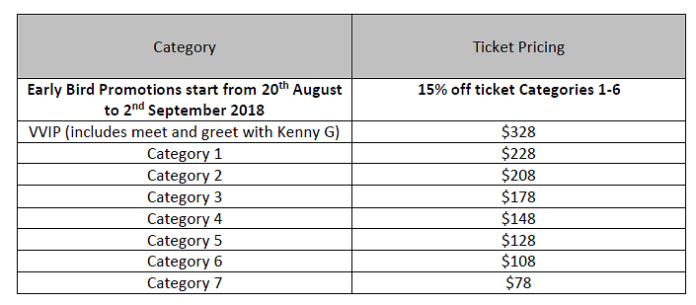
SINGAPORE: Acclaimed saxophonist Kenny G will be performing in Singapore on Nov 8 this year.
The Grammy award-winning musician will hold a solo concert at The Star Theatre for one night only – about three years after the instrumental music star was last in Singapore in 2015.
The show will feature his album The Brazilian Nights, according to promoter CK Star Entertainment.
“I cannot wait to meet all my loyal fans in Singapore to give them a taste of what a romantic and exotic night in Brazil is like, through my music,” said the musician.
“It will be such a great reunion. I hope to be able to share my love for bossa nova with all my fans in Singapore.”
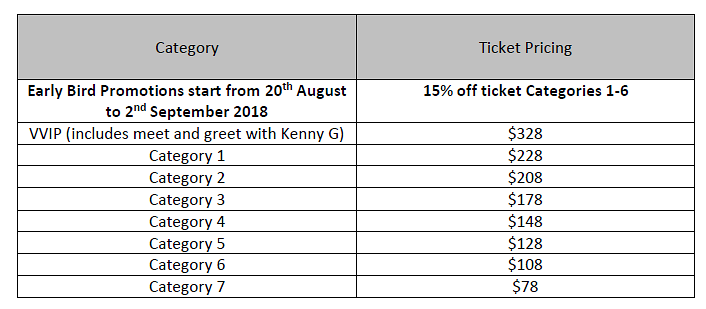
Ticket sales start on Aug 20, with early bird promotions ranging in price from S$78 to S$328.
TOKYO: Japanese discount retailer Don Quijote was once the industry’s enfant terrible, overturning standard retail practices with its cluttered and chaotic stores that sell everything from faux leopard-skin rugs to designer watches.
These days, however, Donki – as it popularly known – is more of a role model, defying Japan’s weak retail environment to last week report its 29th year of unbroken sales and profit growth.
With sales projected to hit 1 trillion yen (US$9 billion) this year, Donki is joining the top ranks of Japan’s heavyweight retail market, among the likes of Aeon Co Ltd, Uniqlo parent Fast Retailing Co Ltd and convenience store operator Seven & i Holdings Co Ltd.
Shoppers browse products at Japanese discount retailer Don Quijote’s store in Tokyo. (Photo: Reuters/Kim Kyung-hoon)
The company says its success lies in its ability to amuse customers, who have tired of the efficient yet predictable shopping experiences at other Japanese stores.
“Our biggest rival is not Amazon or Aeon, but customers’ losing interest,” Mitsuo Takahashi, Don Quijote’s chief financial officer, told Reuters in an interview.
After struggling to find sites in some areas to fuel its sustained expansion, Donki has tied up with FamilyMart Uny Holdings to convert its struggling big box stores, delivering a rapid turnaround at the first six outlets to try the new format.
And on Monday (Aug 13), the discounter said it would be interested in buying Walmart Inc’s Seiyu supermarket unit, reflecting its increasingly ubiquitous presence on Japan’s shopping streets, where it has replaced stores struggling in the new economy.
Shoppers browse products at Japanese discount retailer Don Quijote’s store in Tokyo. (Photo: Reuters/Kim Kyung-hoon)
As Amazon grows rapidly in Japan, Donki aims to increase the fun of visiting stores by making its app more interactive – with points to collect and discounts to find – in a doubling down on its store-focused approach.
“If Amazon is like downloading music, we are like a concert venue. Both are needed,” Donki Chief Executive Koji Ohara said on Monday.
THAT’S ENTERTAINMENT
Shoppers at Donki are welcomed by tanks of exotic fish before they enter a maze-like warren piled high with goods ranging from face-massaging gadgets to oversized bags of potato chips.
What feels like a pell-mell approach is actually a finely honed company strategy, the result of decades of experimentation in each store.
First-time customers often come away bewildered and humming the store’s unending earworm of a theme song, but return for more, drawn back by a constantly changing array of goods.
A shopper browses products at Don Quijote in Tokyo. (Photo: Reuters/Kim Kyung-hoon)
Many of the products Donki sells are cast off from other retailers, a result of the Japanese penchant for a huge variety of seasonal, limited edition and experimental products, from cans of beer splashed with cherry blossom patterns to yogurt-flavored water.
Stocking decisions are left to store staff, and financial incentives help motivate them to source and display wares effectively. The approach is a far cry from how head offices micromanage the operations of many large Japanese retailers.
With every store catering to local tastes, “you cannot create a strategy that will be effective against all of their stores,” Jefferies analyst Michael Jon Allen said of Donki’s rivals.
RIDING FORTH
Donki also has a growing range of store formats, including smaller Picasso stores, giant Mega Don Quijote and even a Platinum Don Quijote selling high-end products.
Looking to expand but faced with a shortage of suitable suburban locations, Donki last year took a 40 per cent stake in the merchandise store unit of FamilyMart Uny Holdings.
A Don Quijote store in Tokyo. (Photo: Reuters/Kim Kyung-hoon)
It’s an unlikely marriage of disparate corporate cultures. But so far it seems successful: the companies’ first six Donki-style stores have almost doubled sales in the five months to July, with a further 20 stores to be converted in 2019.
That is helping push Donki toward its target of 500 stores by 2020, from 420 stores currently. Uny has almost 200 locations.
The purchase of part or all of Walmart’s Seiyu chain would mark a dramatic acceleration of that expansion. Walmart says it has not made a decision to sell Seiyu.
DON DON DONKI
Donki’s newest frontier is overseas, with two “Don Don Donki” stores opened in Singapore in the last year and another due to open in Bangkok this year.
Founder Takao Yasuda, who moved to Singapore after retiring three years ago, drove the expansion there after finding Japanese products too costly. Prices are as much as 50 per cent lower than rivals, said Takahashi, the CFO.
The Singapore stores are stocked mainly with food and drink, leveraging Japan’s culinary reputation. Donki’s “yaki-imo” or baked sweet potato is its best-selling product.
Products are displayed at a Don Quijote Holding store in Tokyo. (Photo: Reuters/Kim Kyung-hoon)
Singapore-based Euromonitor analyst Chayadi Karim said Don Quijote has tweaked its strategy in Singapore, where shoppers are unburdened by a deflationary mindset and “are willing to pay that premium for Japanese products.”
Southeast Asian expansion, with several new stores opening annually, along with 28 outlets in Hawaii and California, are building Donki’s food retailing expertise.
Concerns about overly rapid expansion weighed on the company’s shares this year, and like all Japanese retailers, it faces headwinds from the country’s aging population and growing affection for online retailers.
But for now, its ability to make money seems to be resilient.
In the most recent quarter Donki’s gross margin – a key measure of profitability – climbed 0.4 per cent on a year earlier to 26.6 per cent.