Home Blog Page 969

Commentary: Crazy Rich Asians, a single story cannot a complete narrative make

0

SINGAPORE: The highly anticipated movie Crazy Rich Asians opens on Wednesday (Aug 22).

From the moment trailers of the movie began circulating online several months ago, it became clear that there were high expectations of director Jon M Chu’s screen adaptation of Singapore-born author Kevin Kwan’s bestselling novel about the lives of ultra-rich Chinese families in Singapore.

Many have lauded it for being the first major Hollywood studio movie in 25 years to feature an all-Asian cast and believe it could herald a sea change in terms of how Hollywood deals with diversity.

However, many have also censured it for not being an accurate representation of Singapore society. In fact, there are fears it might even fuel more pernicious caricatures and stereotypes of what Singapore, Singaporeans  and Asians are about.

In this respect, indeed Crazy Rich Asians could be more damaging than helpful.

However, let’s face it. The movie does not purport to be an accurate or holistic representation of Singapore society.

It is, pure and simple, a romantic comedy about Crazy Rich Asians and generally, comedic films play off caricatures.

Considering this, should we really have such high expectations and repeatedly condemn the movie for not meeting them?

Seeing caricatures and stereotypes of one’s society is naturally frustrating, and this wouldn’t be the first time that Singapore is misrepresented in the movies or on television.

We often rightfully worry about how the world will see us if these depictions are all they are exposed to.

But if we took a step back, we might see that the solutions to this are not completely out of reach.

READ: Singapore takes over Hollywood as Crazy Rich Asians premieres

singapore cast hollywood premiere crazy rich asians

The Singaporean actors of Crazy Rich Asians, including Pierre Png, Fiona Xie, Selena Tan and Koh Chieng Mun, with their cast mates at the Hollywood premiere of the film. (Photo: Instagram.com/iampierrepng)

WHY REPRESENTATION IS IMPORTANT

Popular culture and the arts can help us understand ourselves, our societies and facilitate such understanding for societies elsewhere.

Singaporean filmmaker Kelvin Tong, in a recent On the Record interview, discussed how seeing Singapore on film in Jack Neo’s Money No Enough several years ago moved him immensely.

Not only did I see Singapore on the big screen, I heard Singapore on the big screen. There’s a certain satisfaction to that.

Asian stories need to be told, but stopping at a single story could have injurious effects on not just others’ views of us, but our own views of the places and communities we live in.

While the onus is partly on individuals to seek out diverse stories for consumption, there is clearly a need to create these stories in the first place.

READ: Crazy Rich Asians: The biggest misconceptions about Asians according to the cast

READ: Not Singaporean enough? Are we expecting too much from Crazy Rich Asians? A commentary

A SINGLE STORY CANNOT BE AN ANTIDOTE

Most movies aren’t fully representative of the societies they portray.

For instance, we don’t expect a single Hollywood movie set in the US to represent every facet of American society.

What America has going for it is a variety and volume of work. Each work portrays a different facet of society. It is this variety, seen as a whole, that has the potential of reflecting a more authentic picture.

Instead of desiring any one story to be an antidote for Asian and Singaporean stereotypes, we need to think about how to encourage more Asian and Singaporean work that can collectively represent our societies more holistically on the local and global stage.

Singapore skyline (1)

A view of the Singapore skyline. (File photo: Reuters)

TELL AND RECOGNISE DIVERSE STORIES BY DIVERSE PEOPLE

It’s about who tells the stories, how they are told and also how often they are told.

Other artists I’ve spoken with recently in On the Record interviews have expressed as much.

Award-winning Singaporean filmmaker, K Rajagopal expressed his frustration at a dearth of stories about racial minority groups on the big screen and on stage.

“There were local plays with minority characters but I think they were caricatures. There was no identity, no proper representation. I’m Indian and I’m Singaporean but when I looked around, there was nothing about my community or where I came from, what I’m familiar with, the language, or the people.”

His solution was to create his own work. He was also quick to explain that he has no expectations of others to do so.

“If a Chinese writer feels that they want to write about their own experience and that does not include a non-Chinese person, you can’t force them to create work for the purpose of being inclusive. You have to stand up and create your own work.”

READ: On the Record: K Rajagopal, award-winning Singaporean filmmaker

K Rajagopal_1

Award-winning filmmaker K Rajagopal. (Photo: Singapore International Film Festival)

TOWARDS A MORE COMPLETE NARRATIVE

Actor and filmmaker, Glen Goei who is also Co-Artistic Director of one of Singapore’s leading professional theatre companies, Wild Rice, echoed this sentiment during our interview.

He has had his own battles with international film agents who subscribe to Asian stereotypes. His movie, Blue Mansion was ignored by them simply because it featured Chinese Singaporeans speaking English.

“They are not used to Chinese people speaking English. It’s a stereotype which has been perpetuated over the years. They couldn’t imagine Singaporeans speaking good English.”

But instead of cowing to pressure, he went ahead and kept in English. For him, the film was a powerful representation of the world he grew up in.

“I wasn’t going to make the film in Mandarin because that’s not the world I grew up in. That’s not the world I live in.”

READ: Racism, ignorance and the cost of living: Glen Goei goes On the Record about what ails the arts in Singapore

Glen Goei_1

Glen Goei started off as an actor and is now Co-Artistic Director of one of Singapore’s leading professional theatre companies, Wild Rice. (Photo: Wild Rice)

This proves another point.

Singapore, like any other place in the world, is not a monolith.

Each of our experiences in this country is distinct.

Goei grew up in an English-speaking environment. You might have grown up in a largely Hokkien-speaking or Malay-speaking Singapore.

Goei’s Blue Mansion is simply representative of one facet of Singapore and he acknowledges it.

Let’s also acknowledge that a movie like Crazy Rich Asians is not and cannot be a definitive depiction of what and who we are.

We can censure such depictions, but criticism alone provides few solutions.

We must take it upon ourselves to tell more stories. To ensure that these stories are heard, we also have to believe enough in ourselves to create and support a variety of work that demands local and global attention to form a more complete narrative of who we are.

Bharati Jagdish is the host of Channel NewsAsia’s On The Record, a weekly interview with thought leaders across Singapore, and The Pulse, Channel NewsAsia’s weekly podcast that discusses the hottest issues of the week.

Source link

From food court to IPO: Koufu fires up appetite for expansion

0

SINGAPORE: It was part of a target set for Koufu’s 20th anniversary in 2022 but as founder-CEO Pang Lim began ticking items off his checklist, having the company listed on a stock exchange no longer seemed like a distant dream. 

Last month, the home-grown firm best known for its food court business, made its debut on the mainboard of the Singapore Exchange. 

Speaking to Channel NewsAsia at the first Koufu food court started in 2002, Mr Pang described the move to go public as a “turning point” for him and the company. 

“This is very meaningful for me,” the 63-year-old said in Mandarin. “I see it as a sum-up of my three decades in the food and beverage (F&B) industry and an affirmation of everything we did so far.”

“I had plans to take the company to the next phase during the 20th anniversary. Before that, I laid out some targets and luckily enough, we achieved them last year.”

This includes meeting a profit target set for the firm’s 20th year and exceeding it by more than 20 per cent, according to Mr Pang.

Koufu also renewed the lease for its premium food court brand at Marina Bay Sands, and secured approval to rent an industrial property in Woodlands. The latter will be home to a 20,000 square metre integrated facility that Koufu is betting on to fire up growth.

The success of Kimly – the first publicly-listed traditional coffee shop operator in Singapore – also had some effect, Mr Pang replied candidly when asked.

A favourite among market analysts, Kimly shares have risen more than 30 per cent above its initial public offering (IPO) price since debuting on the Catalist board last March.

“I don’t deny that I was somewhat influenced by them,” the entrepreneur said. “A favourable performance for F&B businesses in the stock market did set me thinking.” 

MORE THAN JUST A FOOD COURT CHAIN

Koufu, a name that has since become synonymous with food courts, started 16 years ago after Mr Pang sold his coffee shop chain Aik Hua and decided to cash in on the growing demand for air-conditioned food courts in the heartlands.

From the first location in Toa Payoh Central, it has since expanded to 47 food courts in Singapore catering to different market segments, such as the premium Rasapura Masters and Halal-focused Fork & Spoon. Koufu also runs a food court in Macau.

Its outlet and mall management business also includes a chain of 14 coffee shops, Jurong West Hawker Centre and Punggol Plaza.

Under its F&B retail business, which makes up slightly more than half of the group revenue, Koufu owns 81 F&B stalls, five F&B kiosks like bubble tea brand R&B Tea, as well as 14 restaurants.

Altogether, Koufu whipped up a net profit of S$26.8 million and revenue of S$216.7 million last year.

Its shares have thus far moved up from its IPO price of S$0.63 – a performance that Mr Pang said has put him more at ease.

He admitted that he felt “disappointed” when the stock finished flat on its debut.

“I even asked why it turned out this way but they told me not to worry or be bothered by this. The company is fundamentally sound and all I have to do is to focus on what I need to do.”

Describing the listing as a “brand new start”, Mr Pang said the company will look to deepen its corporate management and is hungry for bigger growth.

It has been actively filling up new senior management roles, with one already being tasked to oversee the building of the integrated facility due to be completed in 2020.

This seven-storey building, which is allocated about S$30 million of IPO proceeds, will house a central kitchen and dishwashing facility, as well as a research and development centre among other things.

Mr Pang highlighted this as the project that he is most looking forward to.

For one, a bigger central kitchen will help to boost productivity and operational efficiency. Koufu is also eyeing potential collaboration with other food manufacturers to produce semi-finished or finished food products for third-party businesses.

“It will be a modernised central kitchen with new technology systems, as well as one that fosters cooperation,” explained Mr Pang.

“For example, we can bring in other companies to make products that can be sold to other businesses, apart from being supplied to our own food courts and coffee shops. We’ve been a business-to-consumer (B2C) company but we can start having a business-to-business (B2B) model too.”

The new facility is also set to give Koufu another modern update to its operations, following the roll-out of smart tray return robots and mobile ordering apps at its F&B locations.

Even as it remains in a traditional industry, Mr Pang stressed that the business has to move with the times. He declined, however, to reveal the amount spent on technology-driven initiatives thus far.

“You may not be able to reap the benefits now but that doesn’t mean that it is something we can ignore.”

Meanwhile, overseas expansion is also on Koufu’s plate. Mr Pang said talks are underway to launch brands, such as R&B Tea and Elemen, in markets including China, Malaysia and Australia.

It remains more cautious, however, when it comes to exporting its food courts overseas. This boils down to the huge costs involved and the fact that food courts are still a foreign concept beyond Singapore.

When Koufu first set up shop in Macau’s Sands Cotai Central in 2012, it battled with a host of challenges from finding suitable vendors to having a menu that would appeal to the local taste buds.

“We went in with the Singapore model but did not know how to make adjustments,” said Mr Pang. “We had to endure a few challenging years before turning around the situation in what was a money-losing business.”

“We will not rule out food courts (in our overseas plans) but we will be very careful because of the huge investment needed.”

Koufu's first food court in 2002

Mr Pang Lim seen at the first Koufu food court in Toa Payoh Central in 2002. (Photo courtesy of Mr Pang Lim)

“I’M NOT DONE GROWING KOUFU YET” 

When asked how he would build up investor confidence and assuage some concerns from analysts about the company wading into unfamiliar territory with capital-intensive projects, Mr Pang stressed that these plans are key in ensuring Koufu grows sustainably.

“Being in a traditional industry, it hasn’t been an easy journey for us to develop to where we are,” he said. “With our new business plans underway, we will continue to evolve. Though I can’t predict the scale, I believe we will become a sustainable enterprise.”

The chief executive also revealed that he had turned down a buyer keen on acquiring Koufu last year.

“If we have a plan for the company that can bring about sustainable growth, why should I sell it?” he said, though he declined to reveal details about the buyer and the offer. “I’m not done growing Koufu yet.”

This emphasis on growth and adapting to changes has been a constant theme in Mr Pang’s life.

Before becoming a hawker and starting Aik Hua, he spent more than 10 years as a vendor at the now-defunct Sungei Road flea market.

“I started when I was 13. Sungei Road was where I grew up … Over the years, I’ve sold everything from watches, toys, fruits to chicken rice.”

While the memories as a street vendor – even if it involved being on constant lookout for the police as he did not have a license for a couple of years – never fail to bring a smile to Mr Pang’s face, they were borne out of unhappy circumstances.

Mr Pang’s father passed away when he was 13. His mother’s pay as a labourer at a wood manufacturing factory was never enough for the family of eight.

“We were poor and no work means no food on the table,” he recounted. “I was the second child but the eldest son. After a few months at secondary school, I told my mother I want to start working.”

He found work as the assistant of a street hawker at Sungei Road.

“I was running around making deliveries every day so I knew everyone. Maybe I was young so all of them treated me well.

“During my breaks, I’ll pop by the stalls to chat with different people or just observe how people bargained or made a deal. I learnt a lot.”

The hustle and bustle of a thriving, maze-like flea market could have been intimidating for others his age but not for Mr Pang.

“I wouldn’t think of it as tough … In fact, without the experiences there, I wouldn’t be who I am today.”

When asked about his recipe to success, the entrepreneur said his only guiding principle is to never stop learning.

For what he lacked in paper qualifications, he made up for it through his voracious appetite for reading.

The Fifth Discipline published in 1990 by management guru Peter Sanges is one of Mr Pang’s favourite books.

“It changed the perception of learning by talking about how people needed to be proactive and learn continuously so as to achieve results. He also mentioned how there’s a need to change your mental models and reflect on the presumptions that influence your actions.

“And that’s what I think is important: Whatever you do, be brave to make changes and never give up on learning something new.”

Source link

Knock knock, WoOoO’s there? The Hungry Ghost Festival chatbot

0

SINGAPORE: Singapore’s new mascot for intangible heritage is invisible – Mr WoOoO, a ghostly chatbot, is set to help Singaporeans understand Hungry Ghost Festival traditions, the Ministry of Culture, Community and Youth (MCCY) said on Thursday (Aug 16).

Souls of the dead are believed to roam among the living during the month-long festival, which falls in the seventh month of the lunar calendar. This year, it started on Aug 11.

“Mr Woo (full name: Mr WoOoO) (is) in town on his yearly trip in search of good food, exciting concerts and intriguing ceremonies,” MCCY said in its press release. 

Singapore’s first chatbot for the festival already has a profile on Facebook. Mr Woo is available on Facebook Messenger until Sep 9, the ministry said.

“Mr Woo is friendly, learned and loves char kway teow. He is also brimming with information on the festival’s origins and practices, having built up his store of knowledge by consulting religious leaders from Buddhist and Taoist faiths,” MCCY said.

Mr Woo will guide users to his favourite haunts, like Buddhist or Taoist temples and getai performances, according to MCCY.

It will also prompt users to participate in a daily quiz about the festival and use memes, GIFs and emojis to engage them.

Hungry Ghost Festival chatbot

Source link

In pictures: Interactive Night Light installations at the Singapore Night Festival 2018

0

Ride a bicycle and send sparks flying, or enter a dark alley to see graffiti come to life – here’s what to expect over the first weekend of the annual event that takes place when the sun goes down.

Night Festival 2018 - Odyssey 01

Odyssey features a projection mapping installation on the facade of the Singapore Art Museum that takes visitors on a journey through time and space. (Photo: Jeremy Long)

Follow our CNA LIFESTYLE page on Facebook for more trending stories and videos 

SINGAPORE: This year’s Singapore Night Festival kicks off this weekend with the interactive Night Lights installations.

From Aug 17 to 25, visitors can begin wandering around the Bras Basah.Bugis Precinct after the sun goes down, with those smartphones ready to snap away. There are 14 works and exhibitions spread around the different areas. Here’s a glimpse of what you can expect.

Night Festival 2018 - Aquatic Dream

Aquatic Dream features glowing and harmonious installations at the National Museum of Singapore Lawn. (Photo: Jeremy Long)

Immerse yourself in a dream-like “forest below the sea” with Lekker Design and Auditoire’s Aquatic Dream installations at the National Museum of Singapore Lawn.

Night Festival 2018 - Ember Rain

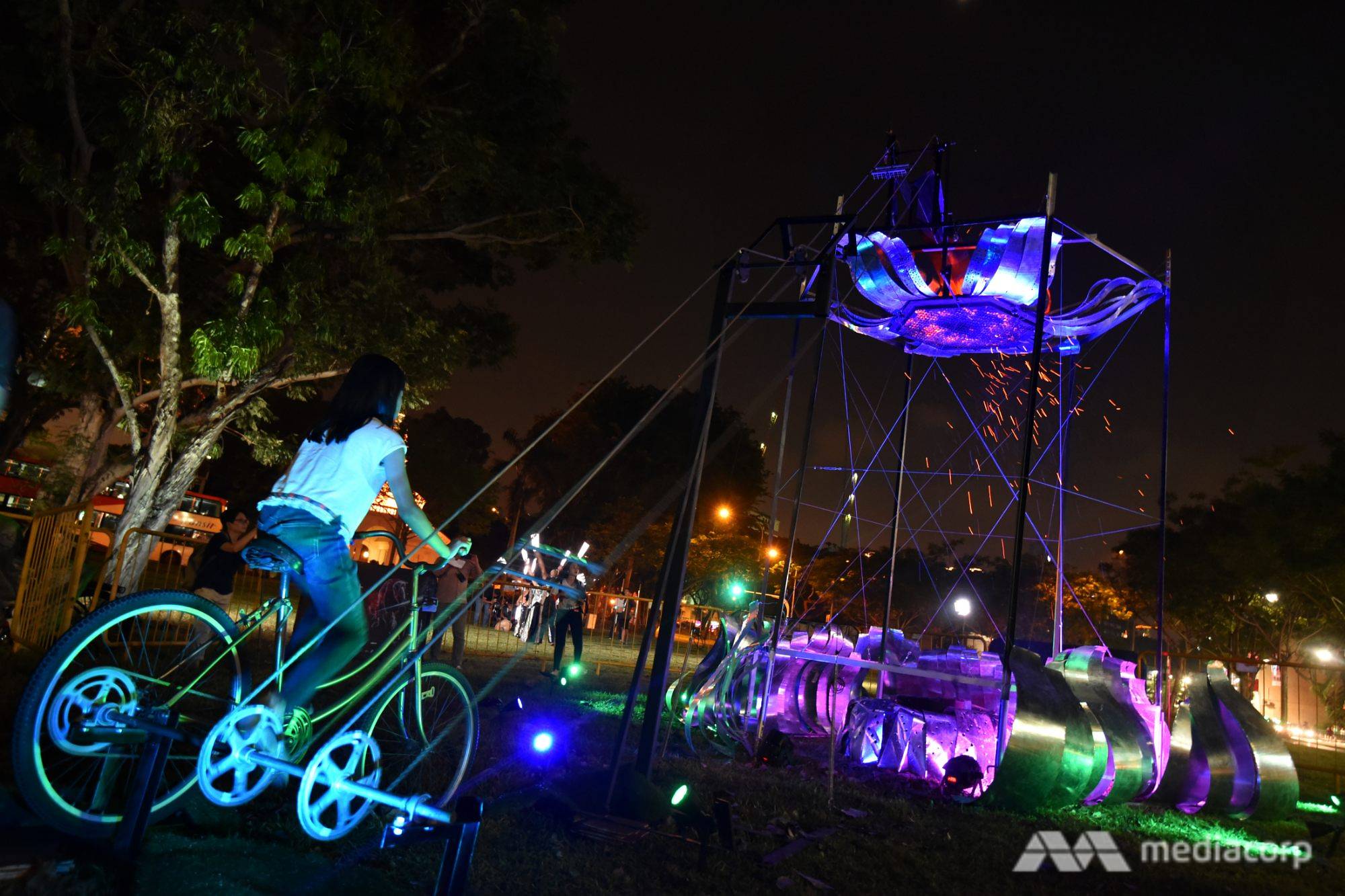
Visitors can interact with this installation, titled Ember Rain, by pedaling a bicycle attached to it to create a downpour of sparkling embers. (Photo: Jeremy Long)

Want to see sparks fly? Work up a sweat and hop on this bike, as part of local group Starlight Alchemy’s Ember Rain work at the Cathay Green.

Night Festival 2018 - World of WearableArt 01

A visitor takes photos at the World of WearableArt exhibition, which features eight garments from the international design competition, showcased at Atrium of the National Design Centre. (Photo: Jeremy Long)

Night Festival 2018 - World of WearableArt 02

World of Wearable Art exhibition at the National Design Centre. (Photo: Jeremy Long)

Drop by the National Design Centre for an exhibition on “wearable art”. Ingenious or outrageous fashion? You decide.

READ: Lady Gaga, Nicki Minaj designer featured at Singapore Night Festival

Night Festival 2018 - Odyssey 02

Odyssey features a projection mapping installation onto the facade of the Singapore Art Museum. (Photo: Jeremy Long)

The Singapore Art Museum’s main building might be closed for renovation, but its facade has always been a regular backdrop for light projections, such as Arnaud Pottier and Thimothee Mironneau’s Odyssey.

Night Festival 2018 - Pulse

Pulse at the Armenian Church is an interactive installation where visitors immerse themselves in colourful projections using sound and voice. (Photo: Jeremy Long)

Over at the Armenian Church grounds is Pulse, a “playful, tactile playground” that looks at digital interpretations of the urban landscape.

Night Festival 2018 - Orbit 02

At the installation Orbit, visitors can use their phone’s light to reveal patterns on the works. (Photo: Jeremy Long)

Night Festival 2018 - Orbit 01

A visitor spinning the installation. Orbit offers an experience inspired by the solar system and space. Visitors can immerse themselves with the installation at Dhoby Ghaut Green, by using a light source to bring out the retroreflective material that creates different patterns. (Photo: Jeremy Long)

At Dhoby Ghaut Green, feel like you’re exploring the solar system in this installation by LiteWerz and 3M titled Orbit.

Night Festival 2018 - Graffiti Alive 01

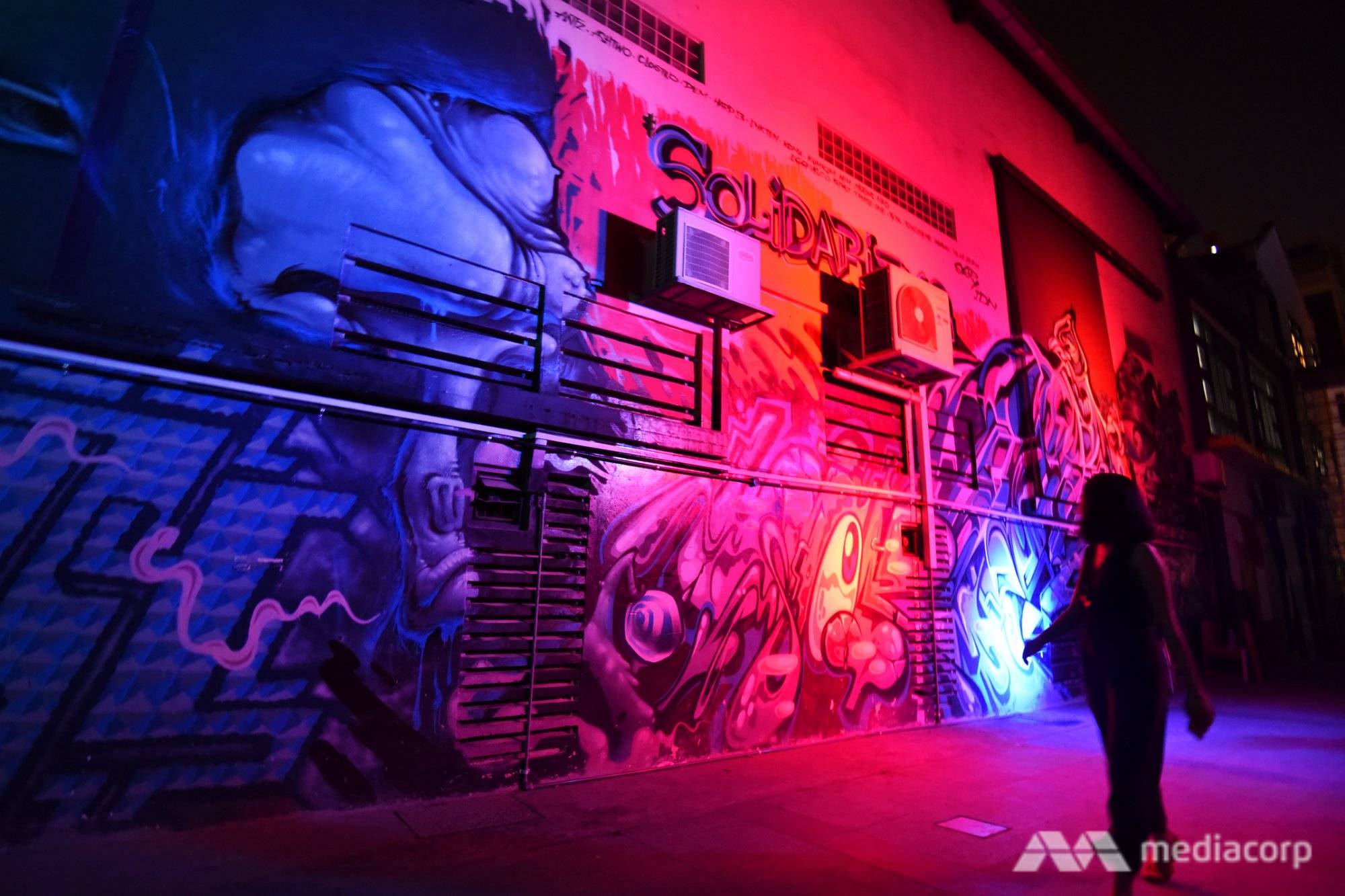
Graffiti Alive illuminates artworks with RGB spotlights and integrated motion sensors along the alley off Armenian Street. (Photo: Jeremy Long)

Night Festival 2018 - Graffiti Alive 02

Graffiti Alive illuminates artworks with RGB spotlights and integrated motion sensors along the alley off Armenian Street. (Photo: Jeremy Long)

The action at Armenian Street moves into the alley with Arup Singapore’s Graffiti Alive, where graffiti, well, comes alive with a little help from technology.

For more information on this year’s Singapore Night Festival, visit http://nightfestival.sg

Source link

Future leaders must serve with dedication and humility: President Halimah

0

SINGAPORE: As future leaders, President’s Scholars have the responsibility to lead fellow Singaporeans in introducing innovative solutions and implementing practical policies to tackle tomorrow’s challenges, President Halimah Yacob said as she presented the scholarship to five recipients at the Istana on Thursday (Aug 16) evening .

“To do this, you must remain closely connected to the ground, and serve with dedication and humility. The Public Service can only succeed if it is built on trust; trust that public officers will uphold Singapore’s best interests,” she said.

“We must serve with empathy, and put the needs of others before ourselves,” she added.

The President’s scholarship is the highest accolade to be given to an undergraduate, and is typically awarded to students with a strong ethos for public service.

It is awarded in addition to another public sector scholarship, such as the Singapore Armed Forces (SAF) Scholarship, Singapore Police Force (SPF) Scholarship and the Public Service Commission (PSC) Scholarship.

This year’s recipients are SPF scholars Inspector Alden Tan and Inspector Stefan Liew, SAF scholar Officer Cadet Sharmaine Koh and PSC scholars Penny Shi and Tan Xin Hwee.

RESILIENCE AND EMPATHY

For 19-year-old Sharmaine Koh, growing up in an extended family of boys saw many of their conversations inevitably revolve around the army.

And since she couldn’t beat them, she joined them.

Her uncle, for example, was in the armor unit, a vocation that she will be joining when she returns from her studies at Yale University.

“I thought to myself, ‘if I feel that defending the country was very important … if not me to defend, then who else?’” she said.

Sharmaine Koh notes, greeting card

Sharmaine Koh is among 22 female recipients awarded scholarships from the Singapore Armed Forces and Defence Ministry.

The officer cadet is among 22 female recipients awarded scholarships by the Singapore Armed Forces and Defence Ministry this year – a number that MINDEF said has doubled from a decade ago.

Sharmaine will study history and politics at Yale, two subjects she believes will help inform her decisions as a strategist and leader in the army.

“A lot of things – like our geopolitical realities, why Singapore makes policy the way it does – is very much informed by our historical experiences. (History and politics) also shapes the national psyche, so I felt that (those subjects) will be able to help me formulate more appropriate and meaningful policies.”

Sharmaine’s degree of choice is a surprising one, considering her less-than-stellar history grade at Hwa Chong Institution. But regular coaching sessions by her history teacher helped her understand how the subject is applicable to the present, and she gradually excelled in it.

Tan Xin Hwee

Tan Xin Hwee will be pursuing a degree in philosophy and Ppychology at Oxford University.

FINDING THE CONNECTION

Meanwhile, 19-year-old Tan Xin Hwee, who is from Raffles Institution, feels a need to connect with the characters in her life.

The Public Service Commission scholar, who will be pursuing a degree in philosophy and psychology at Oxford University, has stepped into the shoes of a wide spectrum of characters over her seven years in theatre.

“The process of crafting theatre is essentially an exercise in empathy. When you borrow these notes you learn in theatre, you’ll see that people around you have very varied needs. They have different experiences from you, but still have needs that are very important,” Xin Hwee said.

“In public service, when you’re crafting policies, there’s a very human aspect to it. You really need to understand the people you are trying to help, otherwise you will be addressing needs that don’t exist, and you’re going to spend a lot of resources on things that people don’t actually need.”

Philosophy and psychology are subjects that she believes will help her reach out to the public more effectively.

“Many times, policies are created with the intention of helping people on the ground. But the benefit may not be always so apparent to them. I hope to value-add by applying an overarching perspective and critical thinking skills to dissect policies and address needs more accurately,” she said.

Xin Hwee eventually hopes to contribute to the education and social services sector.

Source link

Giant to remove mystery box machines after police declare them ‘a form of public lottery’

0

SINGAPORE: Supermarket chain Giant will remove mystery box vending machines from its Tampines and IMM outlets after police issued an advisory on Thursday (Aug 16) calling them “a form of public lottery”, and therefore operating them without a licence is an offence.

“The current mystery box machines located at Giant are operated by third-party vendors,” a spokesperson for the supermarket chain told Channel NewsAsia in response to media queries.

“We understand the vendors have been notified by the authorities and Giant has arranged to remove these machines from store premises by today.”

These machines, part of Giant’s VendMart cluster of vending machines that offer a diverse range of items like toys and lifestyle products, will for S$10 dispense a surprise item of a higher value, including the supermarket’s vouchers, household appliances and an iPhone 8.

Mystery box machine

A Takara Box machine and the items it offers. 

Over the past few years, a growing number of these mystery box machines have popped up across the island. One example is Takara Box, which offers customers the chance of getting gaming consoles, laptops and luxury handbags for just S$5.

Takara Box vending machines can be found in at least 15 locations in Singapore, including shopping malls like Plaza Singapura, The Star Vista and Tampines 1.

But the police said merchants that operate vending machines which “dispense random mystery prizes upon receipt of cash payments” in public places are breaking the law.

“As this is a form of public lottery, it is an offence under Section 5(a) of the Common Gaming Houses Act,” it said.

“Existing merchants operating such vending machines are advised to cease these operations. Police will take enforcement actions against merchants who continue to contravene the law.”

Those found guilty may be fined between S$20,000 and S$200,000, and jailed for up to five years, the police added.

Takara Box did not respond to queries on its Facebook page or calls to a number it provided on the page.

However, it said in a Facebook post on Wednesday that it is “upgrading” its service and will return “soon” with a new concept, without elaborating. It is unclear if this is in response to the police advisory.

Channel NewsAsia has reached out to AsiaMalls and CapitaLand, which operate a number of shopping malls with Takara Box machines, and Golden Village, which also has the machines in two of its cinemas, for comment.

Criminal lawyer Sunil Sudheesan told Channel NewsAsia establishments might be unaware that such machines run afoul of the law. As these machines involve an element of chance, he explained, they are considered public lottery.

Those who patronise the machines can also be caught and prosecuted, Mr Sudheesan said, referring to Section 8 of the Common Gaming Houses Act.

Nevertheless, criminal lawyer Luke Lee said the police should not enforce it if the machine deals in stakes that are not high.

He said: “It may technically be a crime, but who does it harm?”

Mr Sudheesan said while the machines should be regulated, “licences should be given out upon application so that this can be monitored”.

However, Channel NewsAsia understands the police will not issue permits for such machines as it is an offence to operate them.

Source link

Asia’s best food experiences, according to Lonely Planet

0

LONELY PLANET has published a global list of 500 food experiences – the Ultimate Eatlist.

Just the pictures alone will whet your appetite and stir up hunger pangs.

The pages revealed some of the culinary recommendations from experts including world-renowned chefs like Elena Arzak, joint head chef of three Michelin starred restaurant Arzak; Eric Ripert, French chef, author, and television personality; television chef Andrew Zimmern; and BBC MasterChef judge Monica Galetti.

SEE ALSO: Malaysia vs Singapore: Who has better food?

It ranks 500 incredible food experiences around the world including the lesser-known mouthwatering morsels only known to a region or a country’s residents.

“When we travel, the food we eat tells a story, unlocking social customs and revealing ancient traditions, all while offering us a chance to connect with the locals in an organic way,” Lonely Planet wrote.

eaty-1

If you have a love affair with food, you’ll love to eat your way through Asia. Source: Shutterstock

“The inextricable link between food and travel is so fascinating (not to mention, delicious!) that we set our community of bloggers, writers and staff the task of trawling the planet for epic foodie adventures.”

Asian delicacies have come out on top, from meticulously-crafted sushi in Tokyo to Korean rice mixed with colourful and crisp vegetables in a hot stone bowl.

Find out what are some of the ultimate eats that Asia has to offer, according to Lonely Planet.

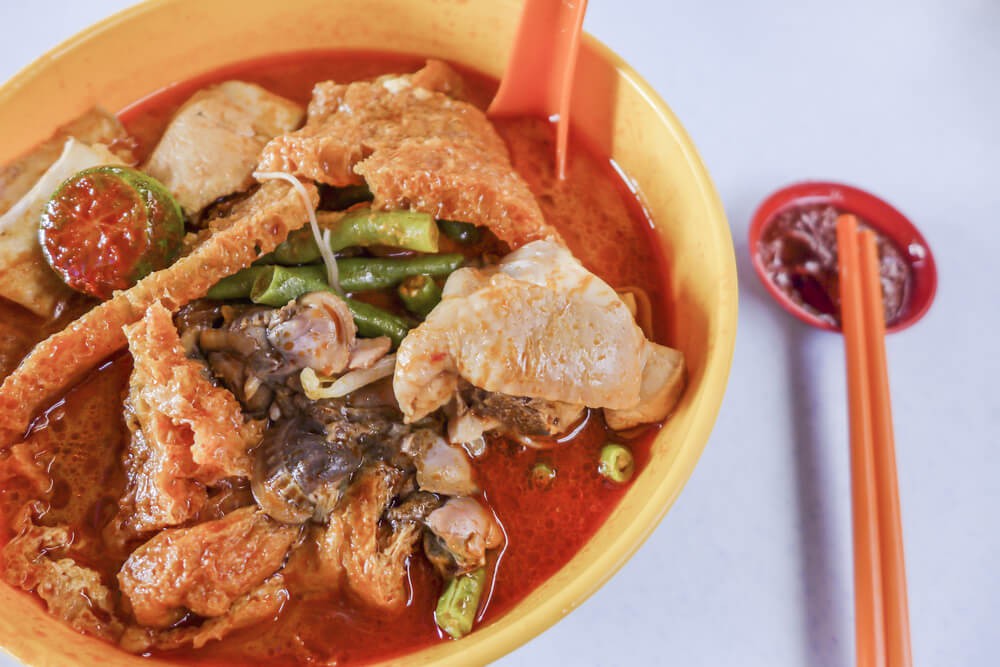
#2 Kuala Lumpur, Malaysia: Curry laksa

eaty-2

Red, fiery, creamy – all the elements that make Malaysia’s curry laksa such a world-celebrated dish. Source: Shutterstock

Rich and cream curry laksa is one of the signature dishes of the Malaysian Chinese community and particularly popular on the island of Penang and Kuala Lumpur city.

Eating it is a sweat-inducing process, but you will definitely love its flavourful fiery-red and orange curry soup combined with noodles, shredded chicken, shrimp, cockles, tofu puffs, bean sprouts, topped with a fresh chilli and mint, and if you’d like, a squeeze of lime.

Tucked in the shadows of Kuala Lumpur’s towering skyscrapers is Madras Lane, just off Petaling Street, where you will find more than a handful of curry laksa stalls.

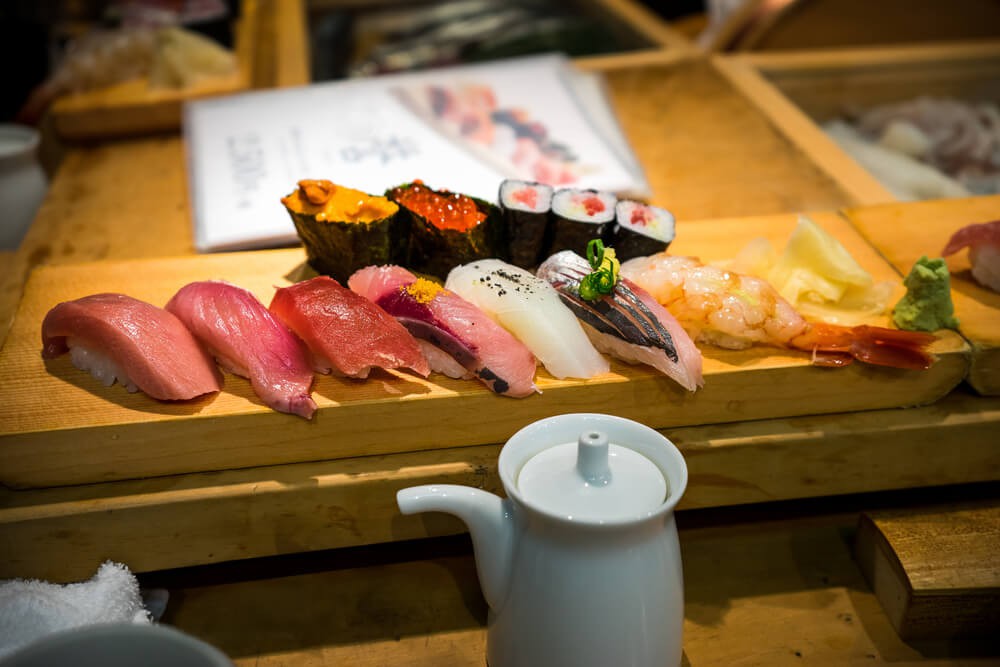
#3 Tokyo, Japan: Sushi

eaty-3

Who doesn’t love a good sushi meal? Source: Shutterstock

No traveller can leave Japan without at least having a bite of sushi.

It is a Japanese dish made of specially prepared vinegared medium-grain white rice and a variety of ingredients such as seafood and vegetables and served with pickled ginger, wasabi, and soy sauce.

When in Tokyo, be sure to visit Sukiyabashi Jiro, Sushi Saito, Manten Sushi Marunouchi, or Juzo Sushi as these joints will dish up a life-changing experience for your palate.

#5 Bangkok, Thailand: Som tum

eaty-4

The som tum is salad done right. Nutritious, full of texture, sweet, sour and spicy all in one. Source: Shutterstock

In Thailand, green papaya salad is called som tum – som means sour and tum refers to the pounding sound of the large pestle used to crush ingredients.

SEE ALSO: Thailand crowned the friendliest country in Asia for vegetarians

This amazing salad with all sorts of flavours – sour, salty, sweet, and fiery – rolled in one can be eaten on its own as a snack, with marinated grilled beef and chicken, and even with a side of warm rice, whatever your taste buds desire.

You can get this off the street vendors all over Bangkok, such as Jay So, or from Somtam Nua restaurant at the Siam Center on Siam Square.

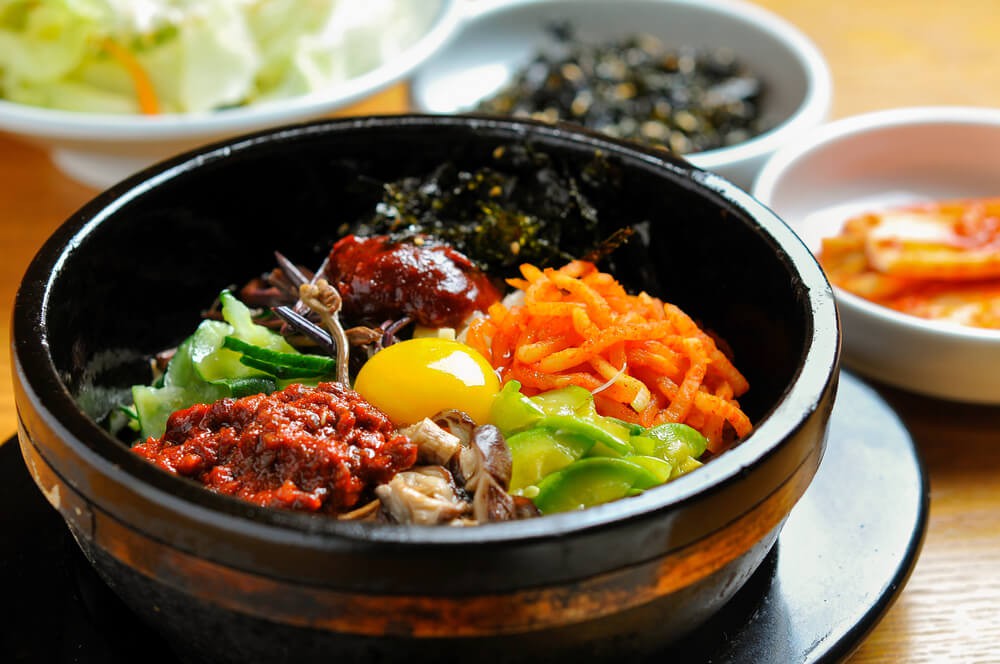
#8 Seoul, South Korea: Bibimbap

eaty-5

Korea’s famed bibimbap is a feast for both the eyes and that growling tummy. Source: Shutterstock

Often hailed as the healthy meal, popular Korean meal in a bowl bibimbap literally means mixed rice.

Traditionally, it is served in a hot stone bowl, consisting of warm fluffy white rice, sauteed and seasoned vegetables (julienned cucumber, radish, mushrooms, bellflower roots, spinach, soybean sprouts, zucchini), an egg, chilli pepper paste, and fermented soybean paste.

For visual appeal, the vegetables are often placed so adjacent colours complement each other then stirred together thoroughly before eating, perfect for any season.

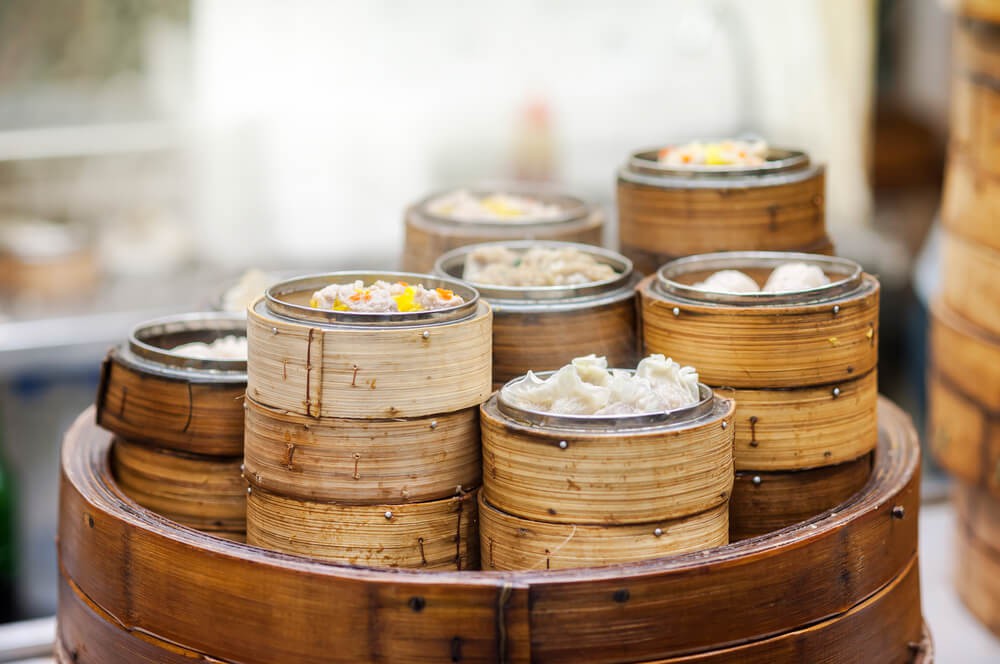
#9 Hong Kong: Dim sum

eaty-6

Dim sum is… gosh, just typing this caption is making us hungry. Source: Shutterstock

Fact: Nowhere else in the world does dim sum like Hong Kong, not even its neighbouring Asian countries.

Dim sum (known as yum cha, which means “with tea” to the locals) is a popular brunch activity and destination whereby locals and foreigners alike stop for tea and snacks.

Duddell’s and Fook Lam Moon serve their trademark styles of Chinese cuisine prepared as small bite-sized portions of food, such as dumplings and buns, in small hot steamer baskets or on small plates.

#17 Singapore: Chilli crab

eaty-7

It’s no curry laksa but hey, we do love a good platter of Singaporean-style chilli crabs so kudos to the island-state! Source: Shutterstock

This is one dish that Singaporeans can truly and proudly call their own – chilli crab.

SEE ALSO: Why are Malaysia and Singapore fighting over a burger?

Said to be invented by Madam Cher Yam Tian in the 1950s, chilli crab consists of fresh mud crabs stir-fried in a semi-thick, sweet and savoury tomato and (not very spicy) chilli-based sauce.

Thinking of putting your tolerance for spicy crabs to the test? Head on over to Red House Seafood, Jumbo Seafood, or Majestic Bay on the island city-state.

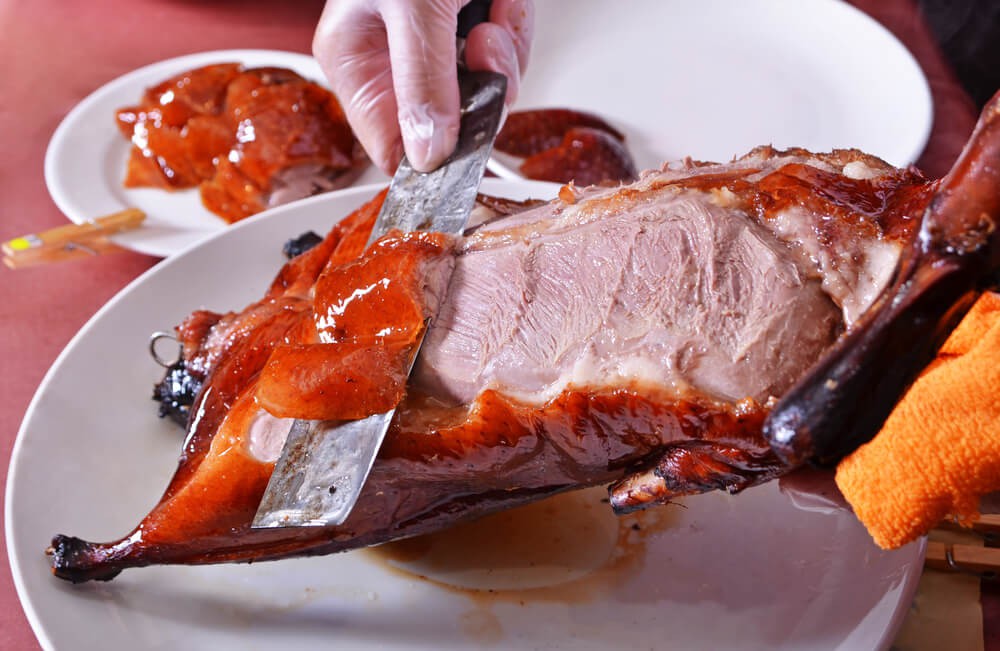
#19 Beijing, China: Peking duck

eaty-8

Just look at the shine on that crispy skin. Source: Shutterstock

Originating from the Chinese capital city of Beijing since the imperial era, Peking duck was one of the main dishes on imperial court menus and is now a highly sought after dish.

Ducks are bred specially for the dish and are slaughtered after 65 days then seasoned before being roasted in a closed or hung oven.

Peking duck is characterized by its thin, crisp skin (mostly skin and little meat) that is eaten with spring onion, cucumber, and sweet bean sauce with pancakes.

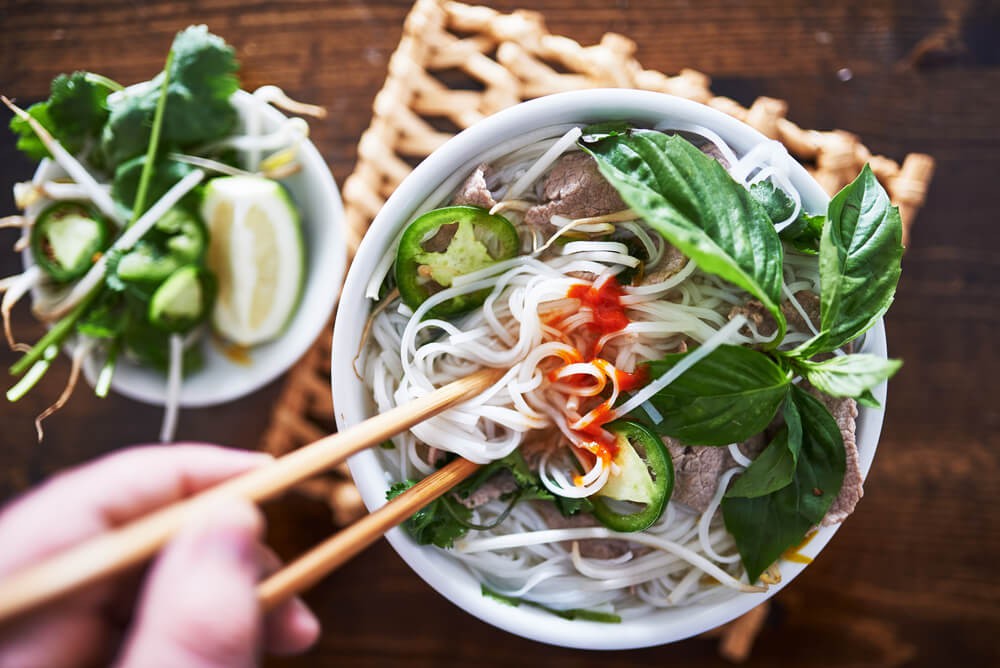
#20 Hau River, Vietnam: Pho

eaty-9

Trust us, slurping down a bowl of this on a cold, rainy day is pho-king pho-ntastic. Source: Shutterstock

Famed for being a popular street food in Vietnam, pho originated in the early 20th century in northern Vietnam and shared with the rest of the world through Vietnam War refugees.

It is a Vietnamese noodle soup consisting of broth, banh pho rice noodles, fragrant herbs, and either beef or chicken meat.

However, don’t expect to find the same flavors in Ho Chi Minh City or Hanoi, as their styles of pho differ by noodle width, the sweetness of broth, and their choice of herbs.

Going to Asia sometime soon?

Be sure to check out the rest of the Ultimate Eatlist then let your taste buds and stomach guide you through the region.

This article first appeared on our sister website Travel Wire Asia.

Source link

Commentary: Saving too little, starting too late, do we have enough for retirement?

0

SINGAPORE: John Ng, aged 40, plans to retire at 65 with S$3,000 monthly to spend in real terms. He hopes to enjoy such an income in his old age for 20 years.

By the time he retires, he must set aside a retirement sum of almost S$1.15 million, assuming a long-term inflation rate of 3 per cent. 

What can John do now?

CPF LIFE, INSURANCE TERM POLICIES PROVIDE OPTIONS

John is a member of the CPF LIFE scheme, which is a compulsory annuity plan that pays out lifelong income. He is confident he can meet the full retirement sum of S$181,000 when he retires. 

Depending on CPF Board’s pending projections, that probably provides a lifelong guaranteed monthly payout of slightly over S$1,500. But this is still short of his ideal S$3,000.

To reach a payout of S$3,000 a month, John must invest S$10,100 a year assuming an annualised return of 8 per cent. If he had started his retirement investment five years earlier, he would have only needed to invest S$6,510 annually with the same annualised returns.

But if the annualised returns is only 6 per cent, then he has to invest slightly more than S$13,600 every year to achieve his retirement financial goal.

Another option for John is a retirement income plan which insurance companies offer but these usually do not provide lifelong income. Although they come with lower risks, they may also have lower returns compared to other investment options.

A third option would be the Supplement Retirement Scheme, which provides an account that allows for investment gains to accumulate tax-free and tax relief for contributions to the account.

STARTING TOO LATE

John’s example highlights the arduous challenges most people must confront as we plan for our retirement.

singapore dollar currency at a money changer

File picture of Singapore currency. (Photo: AFP/Roslan Rahman)

READ: Save for retirement? But we hate making financial decisions

A 2014 survey by DBS Bank showed that many Singaporeans aged 18 to 29 are saving late and not enough.

73 per cent of respondents polled said they plan to retire between 55 and 65, yet 85 per cent also expect to live on retirement income of S$3,500 per month.

The same survey also found that while providing for retirement is a priority for 76 per cent of respondents, only 49 per cent have a financial plan.

When so many of us put off planning for our retirement, we give ourselves a shorter runway to grow our retirement fund. Most of us only think about retirement after 40.

Surveys have also shown most Singapore workers have only their CPF savings to depend on for their retirement. Yet, as we have seen from John’s case, the payout from the CPF LIFE scheme may not be sufficient to meet your retirement income needs, unless you are prepared to review your lifestyle. 

To overcome these issues, one option is to invest more aggressively. But this is a risky move if we start too late, as it gives little time to regroup our portfolios and recoup losses, if the investment tide turns.

The best time to begin retirement planning is when you get your first salary. But few individuals do that because retirement planning is not a priority – funding a home, paying for the kids’ education or going away on holiday might be more acute financial imperatives for many of us.

Yet many of us recognise that we ignore our retirement needs at our own peril. A survey done in 2015, found that two thirds of surveyed retirees wished they have started their retirement plans earlier.

ARE YOU SAVING TOO LITTLE?

Even after we start planning, most of us may save too little. Attitudes to retirement study by BlackRock found more than half are still unsure how much they truly require for their retirement.

Without the necessary knowledge and tools, they will either guess or apply heuristics, such as using current expenses to estimate their retirement needs.

accounting budget calculator

Are we saving too little, and starting too late? (Photo: Pixabay/stevepb)

But any sum estimated is likely to be insufficient, as they negate external factors, such as the impact of inflation. In 20 years, today’s S$100 would only be worth S$54, assuming an annual 3 per cent inflation.

John may have assumed that he only needs S$720,000 (S$3,000 monthly x 20 years) for his retirement. But in real terms with inflation, it means he actually needs to set aside an additional S$430,000.

Many also tend to be overly optimistic about their physical and mental well-being, and overlook making provisions for additional medical expenses incurred in old age.

START NOW, BE BOLD

It is better to start earlier but it’s never too late to begin. We can all take the first step by adopting a mindset change and make retirement planning one of our top priorities necessary to ensure we retire comfortably, instead of seeing it as something we do only after our other financial obligations have been squared away.

I often tell people that we need to apply the Law of the Farm when thinking about retirement adequacy. Like the planting of trees and harvesting of apples, investment needs time to grow. 

The earlier we begin, the more we might have for retirement. Time is investment’s best friend, as compound returns over time will grow your investment many folds.       

Some level of discipline can introduce greater consciousness and thoughtfulness into how much we set aside for our retirement. Perhaps think of having different bank accounts. 

One blunt but systematic way is to funnel your income into different bank accounts for savings, expenses, investment, children education funds, retirement funds, and so forth.

Apples

Like the planting of trees and harvesting of apples, investment needs time to grow, says financial advisor Patrick Chang. (Photo: Pixabay/Couleur)

​​​​​​​

Each account then has a clear purpose and specific objectives. You also must not withdraw from other accounts, if one has been depleted. Applying some system discipline can help us all manage our finances more effectively. 

Even the most financially savvy of us can benefit from seeking independent and professional financial advice, to better understand our current financial position, our future financial needs and the best options that provide payouts at critical junctures in our lives.

The mapping of a comprehensive financial road map, and pinpointing with finer precision of how much we need after retirement, with regular reviews of that amount, can help us gain control over our retirement finances.

FOREST, NOT TREES

Retirement is an important phase of our lives often overlooked for several decades because of a lack of an urgency to plan. Immediate needs, such as building one’s career and grooming children, take centre-stage but it need not be a zero-sum game.

Let’s not miss the forest for the trees. We can all start today to plant the seeds for the fruits we need in our old age.

Patrick Chang is senior consultant at Financial Alliance, an independent financial advisory firm.

Source link

Boxing: Singaporean Muhamad Ridhwan to fight for IBO world title, sets sights on the big leagues

0

SINGAPORE: In slightly more than a month, Singapore’s top boxer Muhamad Ridhwan will embark on a rite of passage the likes of Filipino Manny Pacquiao and Briton Anthony Joshua have taken and passed.

These two boxers have gone on to become household names in the sport. Now it is Ridhwan’s turn for a shot at glory.

Ridhwan, 30, will take on Namibian former world champion Paulus Ambunda, 38, at the Marina Bay Sands on Sep 29 for the International Boxing Organisation (IBO) super bantamweight (up to 55kg) world title.

READ: Singaporean Muhamad Ridhwan extends unbeaten streak to win IBO international title

But there’s more than just a world title at stake. The IBO is considered the biggest organisation outside the sport’s four major bodies: the World Boxing Association, International Boxing Federation, World Boxing Council and World Boxing Organisation (WBO).

Pacquiao and Joshua won the IBO super lightweight and heavyweight world titles respectively before achieving greater heights, and Ridhwan acknowledged the significance of a victory next month.

“Our goal is to get bigger fights, tougher fights, whether locally or internationally,” he told reporters at a media event on Wednesday (Aug 15).

“Maybe one day one of the big boys will call and say Scott, I want to fight one of your guys, Ridhwan,” he added, referring to his manager and promoter Scott O’Farrell. “And that’s the fight that we will want.”

However Ridhwan, who earned his title shot after beating Filipino Jeson Umbal for the IBO intercontinental featherweight title in April, said he is not getting carried away. 

Ambunda is a formidable opponent who knows what it takes to win an IBO world title, having clinched the super bantamweight world title in August 2015 before losing it almost a year later.

“We are not undermining our opponent so we are still focused on this fight,” Ridhwan added.

TRASH TALK

Still, there was no love lost between the fighters as they upped the ante ahead of their high-stakes bout.

“Scott, why are you making me punch an old man?” Ridhwan asked, teasing Ambunda about his age.

“As a boxer, he’s done. He’s going to retire after this fight, he is going to thank me after that for helping him make a decision. 

“In terms of his boxing, he hits good but he’s nothing great. He’s slow because going forward, he’s a walking punching bag.”

muhamad ridhwan paulus ambunda face off

Ridhwan (left) and Ambunda face off for the cameras after trading barbs. (Photo: Aqil Haziq Mahmud)

Ambunda, who’s also a former WBO world bantamweight champion and Olympic quarter-finalist, didn’t back down.

“I’m not yet old, I’m fresh and young. He’s my boy, and I’m his father. I will be his teacher on the 29th,” he said.

“Ridhwan is a great boxer, up-and-coming, but he’s still got a lot of mistakes in him. I have to teach him how to respect an elder in the ring.

“The fans of Ridhwan will break down in tears because they will see him counting stars.”

PREPARATIONS AND ASPIRATIONS

On a more serious note, Ridhwan said his team will prepare for the fight by flying in a pair of sparring partners who are also world title contenders.

His gameplan? Launching an offensive when Ambunda slows down and going for the knockout. “I don’t want Paulus to make excuses (after a potential defeat),” Ridhwan said.

Ridhwan doesn’t want to make excuses for his career either, telling Channel NewsAsia afterwards that he wants to be “the best professional boxer Singapore has ever seen”.

Within the next five years, he said his target is to win a title from one of the big four boxing organisations.

“I don’t know if there will be a step up in weight, but I will definitely want to get one of those titles and bring it to Singapore,” he said. “With careful planning, hard work and dedication, I think we can reach that.”

IBO super bantamweight world title

The IBO super bantamweight world title belt. (Photo: Aqil Haziq Mahmud)

O’Farrell said winning an IBO world title is the perfect launch pad into the big leagues, noting that the best boxers have usually held IBO world titles.

“It’s the only world title that has integrity,” he explained, pointing out that the organisation aligns itself with BoxRec, one of the most recognised record-keeping systems in world boxing.

“BoxRec is a computerised system that tells you where a fighter is based on his fights and skill level and everything across all divisions. So, it’s kind of an unbiased view.”

READ: Muhamad Ridhwan ‘The Chosen Wan’ wins Singapore’s first UBO world title

To that end, O’Farrell said Ridhwan, who boasts an undefeated 11-0 record, has what it takes to reach the pinnacle of boxing.

“I’ve seen boxers before and this guy has every single bit,” he said. “You can see how strong he looks, you can see how sharp he looks. He’s also getting mentally ready, his game now is not all about physical and cardio, it’s very calculated.”

muhamad ridhwan paulus ambunda scott o'farrell

Ridhwan’s manager and promoter Scott O’Farrell (far right) has a lot of faith in his fighter. (Photo: Aqil Haziq Mahmud)

If Ridhwan wins his fight next month, O’Farrell said the plan is to defend the title and unify it with other major world titles.

“The long-term vision is to see Ridhwan as a four-time world champion with four different belts,” he added. “And then we’re gonna step him up through (weight) divisions.”

For Ridhwan, a three-time Southeast Asian Games bronze medallist, one of his biggest goals is to “unite the whole of Singapore through boxing”.

“It will be amazing to see the whole arena packed with a lot of Singaporeans,” he added. “Maybe they can bring back the Kallang Wave, but in a boxing arena.”

Source link