SINGAPORE: The Government is planning a new scheme which will allow more HDB households to benefit from redevelopment before the 99-year leases on their flats expire, Prime Minister Lee Hsien Loong announced on Sunday (Aug 19).
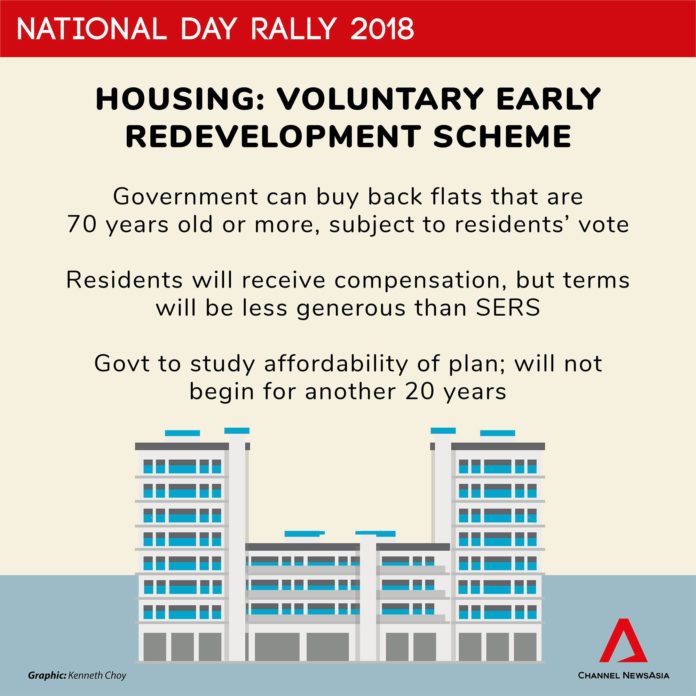
The Voluntary Early Redevelopment Scheme (VERS) is part of a “long-term plan” to allow the Government to progressively redevelop precincts, Mr Lee said in his National Day Rally speech. It will take place when the flats reach about 70 years of age, he added.
Mr Lee said that the Government will compensate residents whose flats are taken back early, and will also help them get another flat to live in, just as they would if their leases had run out.
But the terms will be less generous than that of the Selective En-Bloc Redevelopment Scheme (SERS), as there will be “less financial upside”.
Hence, he said, the scheme will be voluntary, and residents would have to vote for VERS, just like they currently do for the Home Improvement Programme (HIP).
“If the residents vote yes, we will proceed,” he explained. “The Government will buy back the whole precinct, all the flats and redevelop it, and residents can use their proceeds to help pay for another flat.”
“If the residents vote no, then they can continue to live in their flats until their leases run out.”
However, Mr Lee said that the Government will need time to work out the details of the scheme, such as how to select the precincts, pace the redevelopments out and the specific terms of the Government’s offer. He added that they also need to study how to afford VERS for the long term.
Hence, the scheme will not start for another 20 years, although planning for it will begin now, he said.
NEED FOR REDEVELOPMENT TO BE STAGGERED
In explaining the rationale for the new scheme, Mr Lee said that the Government has good reason to take back more flats, and redevelop them as they grow older, before their 99-year leases are up. He added that when HDB towns grow older and the leases in the estates are nearing expiry, it is necessary to also redevelop the towns.
The Government, he said, wants to do this in an orderly way.
He explained that HDB often built in a “tremendous rush” in the early years due to the housing shortage, and several older HDB estates, such as Marine Parade, Ang Mo Kio and Bedok, were built within short periods.
“If we do not plan ahead, 99 years later, all the leases in such towns will expire around the same time, and all the flats will be returned to the state in a few years,” he said.
“We will have to find new homes for a lot of people at once, and HDB will have to tear down and rebuild all the old flats in a hurry, just like when we first built Marine Parade, Ang Mo Kio and Bedok,” he added.
“I don’t think this is a good idea”, he said. “The towns will become construction sites all over again, with cranes all over the place.”
Hence, Mr Lee said old towns should be redeveloped progressively, over 20 to 30 years, rather than within 4-5 years.
“And that means starting from when the oldest flats reach about 70 years old onwards,” he said.
“So some flats, you redevelop when they get to 70 years old, some 75, some 80, and you stretch it out over 20-30 years, and progressively, do things in a measured and considered way.”
SERS LIMITED TO ABOUT 5 PER CENT OF FLATS
In his speech, Mr Lee pointed out that SERS is a very good scheme for estate rejuvenation. But he noted it is a “very limited scheme”, and HDB estimates that only about 5 per cent of flats are suitable for SERS.
The issue of the lease expiry of older HDB flats has been in the spotlight recently, following a blog post last year by National Development Minister Lawrence Wong. He had said that SERS is, as its name implies, done on a selective basis, and said that home owners should not automatically assume that all old HDB flats would be eligible for it.
More recently, amid concerns about the impact of lease expiry on HDB resale prices, Mr Wong said in Parliament that there is still value in older HDB flats that can be unlocked for retirement.
Mr Lee said that there will be a few more SERS projects to come, but many projects with high redevelopment potential have already been done.
He explained that SERS is meant for selected HDB blocks or precincts which have high development value that can be unlocked. Tanglin Halt, which is being redeveloped through SERS, is one such example.
But it was not built optimally, and the precincts, he said, were not always well laid out: There are low-rise flats, large surface car parks, many empty spaces and odd leftover areas.
He said that in cases such as Tanglin Halt, it makes economic sense for the Government to take back the flats early and redevelop the site.
“Because there is a lot of value unlocked, we share this value with residents through generous compensation,” he said. “And with generous compensation, we can make the acquisition compulsory.”
SINGAPORE: The Community Health Assist Scheme (CHAS) will soon cover Singaporeans with chronic conditions, regardless of their income, Prime Minister Lee Hsien Loong revealed in his National Day Rally speech on Sunday (Aug 19).
The Ministry of Health (MOH) will reveal more details at a later stage, Mr Lee said, adding that the benefits will be tiered according to income.
“We want all Singaporeans to have access to affordable, high quality healthcare,” he added. “No one should be denied medical care because they cannot afford it.”
And as Singapore’s population ages, Mr Lee said more people will have chronic conditions like diabetes or high blood pressure.
Asthma, dementia, osteoporosis and Parkinson’s disease are some examples of chronic conditions listed by the MOH. There are a total of 20 conditions under the Chronic Disease Management Programme.
At last year’s National Day Rally, Mr Lee stressed the importance of tackling diabetes in the country, highlighting that one in nine Singaporeans has the disease.
“But we can continue to live a full life if we manage these conditions – by taking good care of ourselves, eating healthily, taking our medications regularly and following up with our family doctor,” he said.
“I think all of us will appreciate a little bit of help with the regular medical bills for such chronic conditions.”
Currently, CHAS offers Singaporeans from lower- to middle-income households as well as those from the Pioneer Generation subsidies for their medical and dental care at participating clinics.
And the scheme, which was introduced in 2012, has worked well, Mr Lee said. Jalan Besar Member of Parliament Lily Neo, who is also a general practitioner, has been seeing more elderly patients since then, he added.
“She said that our old folks are very resilient and generally put off seeing the doctor until they cannot tahan (stand it) anymore,” he added. “But because of CHAS, they now come to her earlier, because now, she can treat them before their conditions worsen.”
Mr Lee also gave an update on the new polyclinics that will be built islandwide.
Sembawang, Eunos, Kallang and Bukit Panjang will have new polyclinics by 2020, he revealed, while Nee Soon Central and Tampines North will get them by 2023.
“We will make sure we have affordable, accessible, high quality primary care all over Singapore,” he said.
Ang Mo Kio Polyclinic’s new site is located at 21 Ang Mo Kio Central 2. (Photo: Edvarcl Heng)
Mr Lee opened the new Ang Mo Kio Polyclinic in June, noting that it is “bigger and better, with more and improved services”.
“In fact, Ang Mo Kio Polyclinic has become so popular that the staff told me they are getting ‘medical tourists’,” he said. “Not from overseas, but they come from Yishun, and even Bedok and Jurong.”
Added Mr Lee: “All of you are very welcome in Ang Mo Kio, but actually you don’t have worry, because we are building more polyclinics across Singapore.”
SINGAPORE: With Singaporeans still feeling the squeeze from rising cost of living, the Government will do its part to help alleviate these worries, said Prime Minister Lee Hsien Loong on Sunday (Aug 19).
“People still feel cost of living pressures,” he said in his Chinese speech at the National Day Rally, where he highlighted four contributing factors to the worries about living costs despite Singapore seeing steady economic growth, low unemployment and higher wages.
“They sense that they have to spend more and that their earnings never seem to be quite enough.”
Mr Lee said the Government is looking at housing, education and healthcare costs “very closely” given that these major expenditure items are the top concerns among Singaporeans, especially young families and the sandwiched generation.
“We will make sure that HDB housing, healthcare and education are affordable so Singaporeans do not have to worry about them.”
Meanwhile, price increases and an improved standard of living have also pushed up living costs.
Measures are in place to allay worries related to the rise in water and electricity prices, but Mr Lee said Singaporeans also have a responsibility to “look after (their) own wallets” amid lifestyle changes.
PRICE INCREASES
The rise in prices of goods and services here can be attributed to inflation, which has been “relatively modest” according to statistics, said Mr Lee.
Singapore has also done better than most developed countries in terms of overall wage gains though this has not occurred across the board.
“I know that not everyone’s wages grew,” said Mr Lee. “For some, their wages have stagnated. Others worry about losing their jobs because of economic restructuring. Some have lost their jobs but they are the minority fortunately.”
There are also retirees who no longer have incomes and are worried about their savings running out, he added.
“Therefore, for these Singaporeans, when prices increase … they feel as if ‘their wallets have shrunk’.”
Mr Lee said the Government has tried to keep inflation low and prices stable, but it cannot completely prevent prices from increasing.
Mr Lee said the Government has put off the increase “for as long as (it) could” but it had to do it in the end given significant increases to the cost of producing clean water over the years, as well as the need to build more NEWater factories and desalination plants.
“Water will always be a precious resource for us, a strategic and security issue, as well as a sensitive foreign policy matter,” he said in his speech delivered at the Institute of Technical Education College Central in Ang Mo Kio.
(AFP/Fred Tanneau)
Moving on to the recent increase in electricity prices, Mr Lee said electricity tariffs today are actually lower compared to 2008 as he showed a chart that plotted the fluctuations of tariffs over the past 10 years.
According to that chart, the electricity tariff stood at 25.07 cents per kilowatt hour (kWh) in the third quarter of 2008. Since then, it has gone up and down over the years and is now at 23.65 cents per kWh.
“Unfortunately, we all remember vividly when the electricity tariff goes up but when the tariff comes down, we forget quickly.”
With Singapore importing almost all of its energy, it cannot control electricity tariffs that track changes in global oil prices, said Mr Lee.
On why the Government does not fix electricity tariffs, the prime minister explained that doing so will involve costly subsidies as Singapore is not an oil producing country.
“This is not financially sustainable in the long run,” he said.
In addition, having such a policy will mean that those who consume more electricity will receive more subsidies.
With the well-to-do more likely to have higher consumption, subsiding the cost of electricity by fixing a low tariff is not the best way to help low-income families, Mr Lee said.
The more effective way is to give direct subsidies to low-to-middle income families for their utilities bills, such as the U-Save rebates for all households living in HDB flats.
“I hope people will understand that we have adopted the best approach to lessen the burden of Singaporeans,” he added.
HIGHER SPENDING WITH LIFESTYLE CHANGES
Lifestyle changes alongside economic growth and technological progress have also contributed to higher cost of living, said Mr Lee.
Items that were once considered luxury items or did not exist before, such as air conditioners and smartphones, have now become daily necessities. People are also eating out more, while enjoying more entertainment and leisure options, he said.
“Our standard of living have gone up. That is a good thing because it means that our lives have improved.
“However to sustain this higher quality of life, people are spending more than before and that can put pressure on them,” said Mr Lee.
Handphones, for one, have completely changed lifestyles and how people communicate.
With households doing away with landlines and every family member using a handphone, telecommunication bills have increased, with some low-income families having bills as much as S$300.
This accounts for more than 10 per cent of their household incomes, said Mr Lee.
This compared to how telecommunications bill was about S$8 a month or S$100 a year in the 1990s, he added.
Mr Lee also touched on how many young parents are concerned about the cost of infant milk formula in Singapore.
For that, the Government has since set up a task force led by Senior Minister of State of Trade and Industry Koh Poh Koon.
The task force has attempted to tackle the issue in various ways, such as simplifying import processes, as well as bringing in more brands and parallel imports.
Public hospitals have also begun offering more affordable brands, with private hospitals also coming on board.
The Government has also indicated clearly that it will tighten regulations for the labelling of infant formula and put a stop to misleading advertising.
Amid these initiatives, Mr Lee said the average price of formula milk has dropped.
“Through these efforts, there are now more reasonably priced options for consumers to choose from,” he said.
“More importantly, young parents are better informed. They are now able to make better choices, based on their needs and budget.”
Lastly, Mr Lee turned to how fewer families cook at home these days and are eating out more, given that it is more convenient especially for dual-income families.
While this lifestyle change in completely understandable, he said it pushes up the cost of living.
The Government will help Singaporeans manage the cost of eating out by building more hawker centres. Seven new centres have been built in the last few years and 13 more are on the way, he said.
“Stalls in the new hawker centres are required to provide affordable food choices. Almost every stall will offer at least one economical meal option, priced at S$3 or less.
“In other words when we tender out the hawker centres, we do not assess bids just on their tender price alone but also whether the operators can offer affordable options,” said Mr Lee.
But while the Government will do its part to alleviate concerns that people have about cost of living, Mr Lee said that Singaporeans also have a responsibility to look after their own wallets.
“Each of us has a responsibility to ‘look after our own wallets’ – save water, save electricity, and at the same time, shop around for the best prices and be a smart consumer,” he said.
SINGAPORE: Hawker culture will be nominated by Singapore for a possible listing on the UNESCO Representative List of the Intangible Cultural Heritage of Humanity, Prime Minister Lee Hsien Loong announced on Sunday (Aug 19) in his National Day Rally speech.
The list, which was developed in 2008, is made up of intangible cultural heritage elements from different countries that showcase the diversity of such things from around the world. This is with the aim of increasing their visibility and raising awareness about their importance so they can be safeguarded.
Speaking at the Institute of Technical Education College Central at Ang Mo Kio, PM Lee described hawker culture as a “cultural institution” that is a unique part of Singapore’s heritage and identity.
“Hawker centres are our community dining rooms,” said Mr Lee in the Chinese section of his speech, noting how Singaporeans of all races, faiths and income groups are able to eat together in hawker centres.
Highlighting how hawker food remains the biggest draw for Singaporeans overseas and is the “best cure for homesickness”, he added: “Our hawker centres and hawker food resonate with many Singaporeans.”
Mr Lee said that Singaporeans approached during various consultations have expressed “widespread support” for the nomination.
“The UNESCO inscription will help to safeguard and promote this unique culture for future generations. It will also let the rest of the world know about our local food and multicultural heritage.”
Echoing that, Minister for Culture, Community and Youth Grace Fu said in a statement that hawker culture is an integral part of Singaporeans’ lives and is a reflection of the country’s multicultural heritage.
“Hawker culture is not just about the food. It is also about our hawker centres, being social and community spaces for people from all walks of life. It is also about our hawker food heritage, and the people behind the food – our hawkers.
“I am very happy that there is widespread public support for it to be nominated to UNESCO,” she said.
Ms Fu said in March that Singapore is looking at the possible listing, and stressed that the chosen element has to be one that resonates with all Singaporeans and reflects its multicultural heritage.
The nomination will be spearheaded by the Federation of Merchants’ Associations, Singapore (FMAS), the National Environment Agency (NEA) as well as the National Heritage Board (NHB). The nomination documents will be submitted in March 2019, with the results expected in end 2020, said a joint press releases from the three organisations.
If successful, hawker culture will be Singapore’s first entry on the UNESCO list, joining the likes of batik from Indonesia, yoga in India as well as Malaysian Mak Yong theatre.
A plate of Char Kuay Teow (fried noodles) is collected by a customer at a hawker centre in Singapore. (Photo: REUTERS/Edgar Su)
WIDESPREAD POPULARITY
The selection of hawker culture was made after a series of public engagement efforts and focus group discussions earlier this year. Across these sessions, hawker culture was consistently highlighted as an intangible cultural heritage that best represents Singapore’s multicultural identity, said the release.
Three important characteristics of hawker culture were particularly highlighted in the focus group discussions – hawkers as dedicated masters of a trade, accessible hawker centres and hawker centres as a reflection of Singapore’s multi-culture heritage, the release added.
These findings were similar to studies conducted in the past. For instance, a 2016 NEA study found that close to 85 per cent of respondents felt that hawker centres play an important role in community bonding. The same study also revealed that 9 in 10 respondents felt hawker centres are an integral part of Singapore’s identity.
“Hawker centres and hawker food have grown to become an integral part of the Singaporean identity, and is a reflection of our multi-cultural society,” said NHB chief executive officer Ms Chang Hwee Nee. “Just as how our hawker centres bring people together through our shared love for food, I believe this nomination will help bond Singaporeans through the celebration of our living heritage, and make us feel even prouder to be Singaporean.
“Through the bid, we hope to put Singapore’s hawker culture on the world stage, thus increasing recognition of its importance, and ensuring its sustainability for the future.”
National Environment Agency (NEA) CEO Mr Ronnie Tay described hawker centres as “important communal spaces where people gather, interact and forge community bonds”.
“Recognising the key role that hawker centres play in the daily lives of Singaporeans, NEA will continue to work with all stakeholders to sustain the hawker trade and ensure that our hawker centres remain a popular and well-loved dining location amongst all Singaporeans,” Mr Tay added.
From now till end 2020, Singaporeans can pledge their support for hawker centres, hawkers and hawker food via www.oursgheritage.sg. There are also plans in October this year for public outreach initiatives such as a three-month travelling exhibition for Singaporeans to learn about hawker culture and support the nomination.
The exhibition will be held at more than 10 locations island-wide, including Our Tampines Hub, Kampung Admiralty Hawker Centre and Yuhua Village Market, as well as selected libraries and shopping malls.
“Singapore’s nomination of hawker culture reflects the prized position that our hawker culture occupies in the hearts of Singaporeans,” said FMAS president Mr Yeo Hiang Meng. “We hope that more Singaporeans will actively pledge their support for our hawker culture. This will strengthen our bid and support its successful inscription on UNESCO’s Representative List.”
HAPPY FOR THE RECOGNITION
Hawkers have welcomed the nomination, explaining that it provides much-needed recognition for their craft.
“I fully support the nomination,” said Mr Tan Kim Leng, who sells prawn noodles at Tiong Bahru market. “I’m very happy, as it will showcase this special aspect of Singapore to the world and I feel very supported …This allows us to be recognized for our hard work.”
Mr Loh Teck Seng, 62, sells soya Bean milk at Tiong Bahru Market. (Photo: Matthew Mohan)
Others added that they are pleased that hawker culture can be showcased on a global stage.
Mr Alan Tan, who took over HarriAnns, his family’s Nonya Kueh and Teochew-style Glutinous rice business in 2013, said that the nomination is something for hawkers to be proud of.
He said: “I really think that with this nomination, hawkers can give themselves a pat on the back and say that ‘Hey, we’ve done it, we are proud of it’ and hawker centres can be put on the world’s culinary map.”
“It’s a good thing and can raise our profile,” added Mr Low Teck Seng, a second generation hawker who owns a stall selling soya bean milk at Tiong Bahru market. Mr Low took up the trade from his father, who started out as an itinerant hawker on Seng Poh Road.
“We feel very honoured by the nomination. Hopefully, those from outside Singapore can patronize our businesses as a result and business can get even better.”
He hopes that it will also encourage more young people to become hawkers. “My children are undecided on whether they will be taking over,” said Mr Low, who has a 28-year-old son and a 30-year-old daughter.
SINGAPORE: The Government will work with community stakeholders to make Geylang Serai more culturally distinctive, Prime Minister Lee Hsien Loong said, as he revealed plans to make the place “even more vibrant and special”.
In his Malay speech at the National Day Rally on Sunday (Aug 19), Mr Lee said “we can do more to make Geylang Serai a culturally distinctive precinct, stretching from the Tanjong Katong Complex to Kampong Ubi CC”.
“WGS (Wisma Geylang Serai) can use the open field and car park next door for activities,” he added, referring to the new Malay-Muslim social, cultural and heritage hub beside the iconic Geylang Serai market.
“We can beautify and coordinate night lighting, and turn the junction in front of WGS into a landmark to create a distinctive feel and sense of arrival.”
South East District Mayor Maliki Osman, who is also Senior Minister of State for Defence and Foreign Affairs, will lead the project and work with local merchants, Government agencies and MESRA, the People’s Association’s Malay Activity Executive Committees Council.
“He will also engage the Malay community and other Singaporeans to solicit ideas and make recommendations to the Government,” Mr Lee said. “I am sure that the next time I visit, Geylang Serai will be even more vibrant and special.”
“WGS will be a centre for Malay activities, an icon that the community can be proud of,” he added.
It will officially open in January 2019.
Wisma Geylang Serai will be a centre for Malay activities.
The WGS will also host a joint-office for the Islamic Religious Council of Singapore (MUIS) and self-help group Mendaki, which Mr Lee described as a first step towards having Malay-Muslim organisations (MMO) work together and improve their services for the community.
This new partnership, called M3, involves MUIS, Mendaki and MESRA combining their resources and volunteers and collaborating with the Government and other MMOs, Mr Lee said.
“By doing so, they can make even more headway in tackling the challenges the community faces,” he explained.
“These challenges include getting more young children to attend pre-school, empowering and mentoring youth, and supporting those who are left behind because of drugs or social problems.”
In addition, the WGS will host a one-stop service centre jointly run by seven MMOs, including the Association of Muslim Professionals, Creative Malay Arts and Culture and Tabung Amal Aidilfitri, which collects donations and distributes them to the needy during Ramadan.
This centre will serve multiple needs of the community and help improve the lives of residents, the Ministry of Communications and Information said in a statement on Sunday.
“There is also opportunity for better collaboration on social assistance programmes and synergy to build better programmes for the community,” it added.
Mr Lee called M3 a “positive development” that will need the community’s support to succeed.
“Individually, each (organisation) continues to make major contributions to the community’s progress by looking after their cultural, religious, educational and social needs,” he said.
“I hope more Malays will contribute to the community through M3, whether you are new volunteers or activists already in the mosques and various Malay-Muslim organisations.”
SINGAPORE: Prime Minister Lee Hsien Loong will speak on the cost of living, housing, medical costs, as well as water and electricity prices at the National Day Rally on Sunday evening (Aug 19).
These are the issues which “are on people’s minds”, Mr Lee had said in a Facebook post.
We’ll bring you the latest from the National Day Rally here. Please refresh for updates:
6.40pm: Key issues in last year’s National Day Rally
In his 2017 speech, Mr Lee spoke about upgrading pre-schools, fighting diabetes and building a Smart Nation.
6.24pm: Mr Lee’s team posts a photo of him arriving ahead of the National Day Rally
6.15pm:National Day Rally 2018 to begin at 6.45pm
PM Lee will begin his address to the nation at 6.45pm, speaking first in Malay followed by the Mandarin speech.
He will deliver his English speech at 8.15pm, at the Institute of Technical Education (ITE) College Central campus in Ang Mo Kio.
The Institute of Technical Education (ITE) College Central at Ang Mo Kio. (Photo: Jeremy Long)
SINGAPORE: According to a survey of 809 teenage boys that AWARE published last year, nine in 10 teenage boys reported facing pressures to be “manly” through experiences of harassment, bullying, teasing, social exclusion, and psychological and physical violence.
The most common forms of such pressure are being told to “man-up” and to “take it like a man”.
Many of us accept that this pressure which boys and men so regularly face is one way gender inequality manifests.
Yet when we actually talk about gender equality, many mention visions of greater female representation on boards and in government, or something basic, like women’s rights to education and work.
In thinkpieces and social discourse, gender equality is often framed as a responsibility that is largely in the hands of women and girls – that women ought to be more “outspoken” or “assertive” to get that promotion at work or muscle their way up the career ladder.
Gender equality is often framed as a responsibility of women, and that they ought to be more outspoken or assertive to climb the career ladder (Image: Rafa Estrada)
It too easily becomes a conversation about women’s “shortcomings”, and how women should behave, participate and contribute to right this deeply-entrenched imbalance.
Where are the men in this picture? It’s clear that men also have a stake in gender equality.
Indeed men may have a greater responsibility to work towards it, as a group with collectively more power, influence and capital than women. But striving for equality won’t just improve society’s treatment of women and girls: Men, too, benefit.
CHALLENGE GENDER ROLES EARLY
A society that prioritises gender equality would start teaching boys and girls about the harms of gender roles early.
In Singapore, this can be done through implementing mandatory gender equality and comprehensive sexuality education in the school curriculum, which encourages young men and women to strive for more healthy and equal relationships.
If Singapore had such a curriculum in place, we probably would hear fewer stories about the gender stereotyping and sexist beliefs that young people are often subject to or reinforce – some examples in recent years include officially-distributed pamphlets telling young people about “female doublespeak”, and university orientation games that make light of sexual violence and gender-based violence.
These unhealthy messages would have less room to grow if young people are taught values of gender equality, respect and diversity, the same way they are taught racial and religious harmony in school.
MEN ARE ALSO AFFECTED
Boys and men are directly affected by narrow ideas about gender. Through the survey cited above, we found that 54 per cent of respondents have hit, punched, shoved or spat on another boy, while 74 per cent have experienced some form of physical violence.
“If (the bullied) said how they felt when someone insulted them, (the bullies) would say to “take it like a man” and “stop being such a girl”, one respondent said. Some reported how boys seen to be “weak” or “girly” were even sexually abused.
Two boys at a playground. (Photo: Unsplash/Hisu lee)
The harms of pressures to conform seem fairly obvious. Everyone should be free to behave in ways that feel comfortable without the threat of violence. By reforming traditional ideas about gender, we can start to move away from real or implied threats of violence, and leave more than just overt gender-based violence behind.
After all, gender inequality doesn’t only lead to violence – it restricts individual expression, contributes to economic inequality, and limits men and women’s role in their households and communities, among others.
CAREGIVING SHOULD NOT BE ONLY A WOMAN’S RESPONSIBILITY
Let’s take the issue of caregiving in the family – a big part of many people’s lives in Singapore, especially with our ageing population. Myths about how women are more naturally nurturing and caring than men seem to shape our national policies.
For instance, mothers receive 16 weeks of maternity leave, while fathers receive only two weeks of paternity leave. Fathers are allowed to share maternity leave, though only up to four weeks.
Might this be the reason for why women assume a heavier caregiving burden?
According to Ministry of Social and Family Development’s survey of informal family caregivers of older adults, 60 per cent of caregivers were women.
The message is unfortunately loud and clear – childcare and eldercare remain primarily “women’s issues”. We see this translate into women’s inability to fully participate in the labour force, which result in their financial stability and livelihoods suffering.
According to Ministry of Social and Family Development’s survey of informal family caregivers of older adults, 60 per cent of caregivers were women.(Photo: Reuters)
78 per cent of prime-age working women who were out of the labour force two years ago in a survey by the Ministry of Manpower cited “family responsibilities” as their main reason for not working, compared to 9.6 per cent of men.
This ripples into old age: Women have 11 per cent less CPF savings in old age than men do, an analysis by the Central Provident Fund found last year.
What would Singapore look like if men were equal contributors to care and household labour? We would see greater economic growth, with women returning to the labour force after being freed up from unpaid care responsibilities that otherwise would fall entirely on them.
Dual-income households generally fare better in an expensive city like Singapore, so the pressure for men to be sole income earners is likely to lessen. In parallel, we would hopefully see national institutions improve at a greater pace to support this progress.
A couple preparing dinner in the kitchen. (Photo: Unsplash/Soroush Karimi)
We already see a thirst for flexibility and more family-friendly policies in workplaces. There is a slow but growing normalisation of flexi-work arrangements among more progressive companies.
Employers are recognising their staff as more than just workers, but as individuals with care, domestic and personal responsibilities and needs as well. Employment policies that support family life and promote gender equality would enable all workers, including men, to better juggle work and care.
It’s no wonder, then, that there are higher rates of retention and greater job satisfaction when employees feel like their contributions are supported and valued, beyond their office doors.
So it’s not just women who would benefit from initiatives like paid caregiving leave or equalised parental leave. Many fathers are starting to be more active parents, and healthy workplace allowances are encouraging egalitarian family structures, rather than one that is determined by gender.
After all, the underlying assumption that men are simply not interested in playing a bigger role in their children’s lives, or caring for their own family members, is unfair to men.
DON’T TAKE TOO LONG
It sounds like an all-around win, for men and women to strive towards gender equality. So what’s taking us so long to get there?
For gender equality to truly be achieved, much has to change. Individual attitudes and beliefs about gender need to be reformed, of course, but this would do little unless there are also accommodations made in our workplaces, educational institutions and communities.
(Photo: AFP/Toshifumi Kitamura)
Our laws and policies need to also address gender-based barriers – for instance, by increasing paid paternity leave to encourage equal caregiving.
Gender equality is not a pipe dream. But for it to be a reality, men need to recognise how gender inequality creates unfair, narrow and even toxic versions of themselves and their roles in society; and they need to see it equally as their responsibility, too.
And then they, as allies working alongside women, need to act.
SINGAPORE: It brought us services such as UberX, UberPool and UberPet. For millions of commuters worldwide, Uber has changed the face of transport, allowing people to find rides with an ease previously unheard of.
From a start-up in 2009, it has grown into one of the world’s most valuable private technology companies, valued at some US$62 billion (S$85 billion) today.
The behemoth made its foray into Southeast Asia with a launch in Singapore in 2013, followed by tiny start-up Grab later that year.
Five years later, however, the San Francisco-based firm conceded defeat and said goodbye to the region – its assets, offices and drivers now under the control of its rival.
Two became one, after Grab dethroned Uber.
The story of how a Singapore-based champion outgunned this ride-hailing giant is told in the new season of Inside the Storm – a series about how major companies are run, the high-pressure decisions and risks they take, and how they adapt in times of crisis.
A DISRUPTIVE, IRREVERENT COMPANY
Uber started out in San Francisco as UberCab, a limousine service that could be ordered via text or a tap of a button on one’s phone. It was an immediate hit.
Back then, there were numerous complaints about how expensive taxis were in the United States and how difficult it was to get them, said Assistant Professor Yang Nan of the National University of Singapore (NUS) Business School’s strategy and policy department.
Uber was a great alternative, as its location-based app made hiring an on-demand driver easy. “It was so successful because the industry there was ripe for disruption,” said Dr Yang.
The then CEO, Mr Travis Kalanick, set the culture for the company, with “this idea of a disruptive, irreverent company that wanted to break all the rules”, said former BBC correspondent Mark Worthington, now the managing director (Singapore) of Klareco Communications.
“It was probably that energy and originality that led to Uber’s very early and very rapid success.”
Between 2011 and 2014, Uber’s value jumped from US$60 million to US$17 billion as it expanded into 100 cities across North America, Europe, India, China, and Southeast Asia.
In 2012, Mr Vidit Agrawal became Uber’s first employee in Asia, at a time when few had heard of the brand in this region.
“When I told my parents I was going to join Uber, they were like, ‘Are you going to become a taxi operator?’” said Mr Agrawal, who started out as an operations manager in the company.
Uber’s expansion strategy of “go in, think later” involved scaling up rapidly and getting as many users and subscribers as it could.
The company did not, however, actively seek out and work with regulators, pointed out Nanyang Business School Adjunct Associate Professor Zafar Momin.
“That worked pretty well in the US”, but when Uber got to some markets in Europe and Asia, it “encountered a few difficulties”, he said. “One is that the regulatory framework wasn’t as kind or welcoming.”
NOT LOCAL ENOUGH
In addition, Uber lost its monopoly as copycat apps cropped up and competition heated up in all of its markets, such as Lyft and Gett in the US and Didi Chuxing in China.
In Southeast Asia, Grab had grand ambitions: To provide safe and convenient taxi services in Malaysia and the rest of the region.
Its co-founder Tan Hooi Ling recalled how, growing up in Malaysia, she constantly tried to convince her parents to let her take a taxi, as they were concerned she could be robbed or raped.
Grab co-founder Tan Hooi Ling (right).
“Because of certain bad apples in the system, the entire industry got a tremendously bad reputation. So we were trying to solve this from a holistic perspective,” she said.
The company carved out a niche for itself, focusing on local needs and cultures. A local understanding of the market is something that cannot be underestimated, said Mr Lim Kell Jay, the head of Grab Singapore.
“Every city is different, even within the same country,” he said. “So you need to understand all those nuances to serve your customers better.”
For example, recognising that many Southeast Asian cities had monstrous traffic jams, the firm unveiled GrabBike – motorcycle taxis that can weave in and out of traffic – in Vietnam, Indonesia and Thailand in 2014 and 2015.
While Uber cars were stuck in traffic, Grab cruised ahead in the market with their bikes. Uber eventually caught on – 17 months too late. That “hyper-local approach” was important, which a global company “sometimes takes for granted”, said Ms Tan.
While Uber was designed for the global market, it did try to localise, said Mr Agrawal. But competitors like Grab and Go-Jek “had people (and) engineering teams on the ground, and their decision-making could’ve been a lot faster than ours”.
In under three years, Grab had expanded into 21 Southeast Asian cities. And by 2016, it had become a major competitor to Uber.
The latter also failed to understand that cash was king in Southeast Asia, accepting only credit cards for two years in some parts of the region before introducing cash payments, and it cost the firm dear.
Mr Lim noted: “We started out with cash, and that helped us tremendously in competing with the other players.”
DISTRACTED BY SCANDALS
Despite its efforts, Uber was falling behind in foreign markets. And it was being dogged by scandals – taxi companies have protested its presence in their cities, and it was banned in Delhi after one of its drivers raped a woman.
One of the many protests by taxi drivers against Uber.
Last year, when US President Donald Trump enforced the refugee ban, taxi companies joined American protesters at New York’s John F Kennedy International Airport in a show of solidarity, by refusing to pick up passengers.
But Uber continued operating and profited from the strike, a politically-laden decision that sparked the #DeleteUber campaign.
Barely a month later, the company was found using a software called Greyball, which barred certain individuals, including law enforcement officers, from using its service.
Around the same time, a video of Mr Kalanick berating an Uber driver went viral; and former Uber engineer Susan Fowler published a blog post accusing the firm of fostering a misogynistic corporate culture.
Video footage of Mr Travis Kalanick’s tiff with the driver.
An investigation report made 47 recommendations as to how to change its culture, and 20 employees were fired owing to a separate harassment probe.
Associate Professor Chu Junhong, from the NUS Business School’s department of marketing, said: “(There were) lots of PR crises. It really damaged the company’s public image.”
The issues of political alignment, profiteering, sexual harassment and the conduct of the CEO himself made last year a terrible one for Uber, noted Mr Worthington.
“When you’re hit by all of these in a short period of a few months, unless you do something very drastic, there’s always going to be a danger that what people are questioning isn’t the individual incident but the company as a whole.”
Grab, on the other hand, had an advantage over Uber when it came to staying out of trouble. It was “seen as friendlier – as, in some ways, more in tune with the needs of their customers”, he added.
With Uber spending resources putting out fires in the US, it left its other markets vulnerable. Mr Agrawal admitted: “It did affect the focus, and it also gave an opportunity to our competitors – Ola in India, to Grab.
“They weren’t leading the market, but they could easily focus on these markets. They doubled down on their initiatives and led a lot of the markets.”
PRICE WAR
In China, Uber’s grand plans to defeat homegrown company Didi Chuxing ended with its exit in 2016 and billions lost.
“Didi could concentrate all its resources in the Chinese market to compete with Uber, but Uber couldn’t concentrate all its resources in the Chinese market because Uber had so many markets to take care of,” said Dr Chu.
Its departure from China galvanised its Southeast Asian competitors. Said Mr Lim: “We started thinking, ‘Hey, a homegrown local company is able to overcome a global giant.’ And that’s when the belief started.”
Last year, Uber and Grab launched a price war. The end goal was presumably for one to force the other out of the market.
Dr Momin said: “It’s like having a fuse burning at both ends. And that’s a way to burn up cash very quickly, which is what happened for both companies.”
In March this year, Uber decided to exit Southeast Asia, with its competitor acquiring its operations and assets in eight countries, including Indonesia, Malaysia and Singapore, in exchange for a 27.5 percent stake in Grab.
Said Ms Tan: “It was a big milestone for us because it was a reinforcement (of our belief) that we were doing the right things and that the crazy journey we had started was worth it.”
Dr Momin does not see it as a failure on Uber’s part, however, but rather as the company trimming its portfolio to focus on a few countries, instead of “trying to fight a battle on so many fronts”.
“So in some ways it’s a smart move on the part of Uber,” he said. “It’s even good because it gets a stake in Grab, which now has a high valuation.”
While Grab is now a household name in Southeast Asia, its long-term profitability is questionable, as with that of Uber and Didi.
“If you take other disruptive companies like Amazon, they’d also lost money for a long time, but eventually they did start turning positive profits,” Dr Momin added.
“But Uber hasn’t turned positive profits; neither has Grab, and I don’t think Didi has either.”
For now, Grab can enjoy being the victor of a David and Goliath battle, whose outcome few would have predicted five years ago.
“We don’t take that good fortune lightly,” said Ms Tan. “We take it as a very significant responsibility because we’ve been fortunate to be able to do what we get to do now.”
Grab “did a very good job” of catching up with Uber, acknowledged Dr Yang.
“How it successfully operated here … catered for the local demand, understood the local market and designed products to fit the local demands – you have to give it credit.”
The new season of Inside the Storm tells the stories of the high-pressure decisions and risks taken by some of the world’s biggest brands: Uber, Apple, Haier, Japan Airlines and Starbucks. Watch the series here. Or catch episodes on Channel NewsAsia every Wednesday at 8pm.
SINGAPORE: Recently, there has been much discussion on how to help the vulnerable, particularly those living in public rental flats.
Many have offered their views on what it means to have a home in Singapore and how we can help lower-income families put a better roof over their heads. It is heartening to see that there is no lack of passionate champions for the vulnerable.
As a former staff of the Housing and Development Board, I have been following these discussions keenly. I am intrigued by one suggestion that we should build bigger public rental flats, and create a larger subsidised public rental housing programme catering to a higher share of the population.
It is not difficult to build more and bigger rental flats. The more fundamental issue is this – what is the best way of allocating the limited quantum of housing subsidies within the Government’s budget?
Some countries prefer to allocate the subsidies in favour of rental. For example, in Hong Kong, about 29 per cent of the population live in subsidised public rental housing, with more renting from the open market.
There is little prospect of young couples owning a decently sized home when they are ready for marriage, something we have almost taken for granted in Singapore.
We have opted for a different approach to housing here, right from the early days of nation building. It is one that emphasises homeownership as a key pillar of our social compact. Today, more than 90 per cent of residents in Singapore own their homes, with about 80 per cent of Singaporeans living in HDB flats.
Even among the less well-off in our society – 83 per cent of the bottom 10 per cent of households in terms of income own a home, and this figure stands at 87 per cent for the bottom 20 per cent of households.
The success of our public housing story is well documented and remains a model many nations aspire to. If we had weighed our subsidies towards rental, the housing outcomes for Singapore would have been quite different.
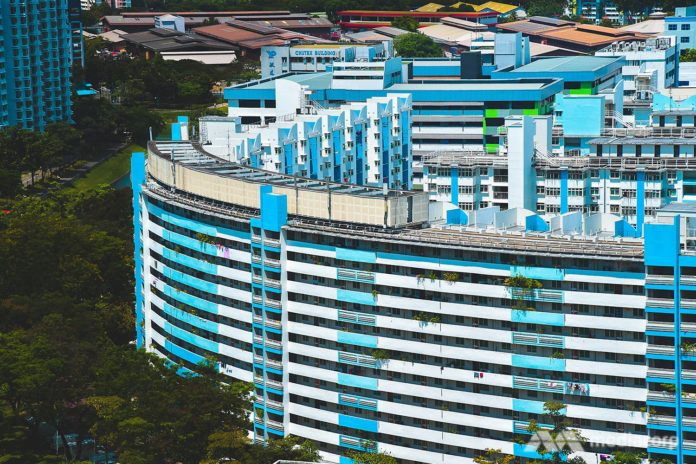
The longest curved HDB block in Singapore. (Photo: Gaya Chandramohan)
In fact, HDB used to offer 3-room rental flats. This was discontinued in 1982.
At that time, many existing tenants preferred to buy their own three-room flats, as it made more financial sense for them to do so, given the highly subsidised pricing for such new flats. They could also use their CPF savings to pay for it, instead of paying rent in cash, and they got to own the flat at the end of the day.
Since then, the Government has continued to enhance subsidies for home ownership. Housing subsidies are more generous and also designed to be progressive and fair. Grants such as the Additional CPF Housing Grant (AHG) and Special CPF Housing Grant (SHG) are means tested, with lower-income families receiving larger grants.
Effectively, low-income families buying new HDB flats can receive up to S$80,000 in grants, on top of the already subsidised flat price. Eligible families buying HDB resale flats can also receive up to S$120,000 in grants.
There are also specific schemes to help rental tenants achieve homeownership, including giving them priority in the ballot for new flats, and additional grants under the Fresh Start Housing Scheme.
A block of flats in Singapore. (Photo: Marcus Mark Ramos)
MANY STILL ASPIRE TO OWN THEIR OWN HOME
My sense is that most rental households today continue to aspire to have their own homes. In the last five years, about 3,700 households living in subsidised rental flats have moved on to homeownership.
Last year we saw a record high of almost 1,000 of such households moving on to own their homes. This upward trend is a positive development.
I expect many of them are first-timer households, who would qualify for significant housing grants, are typically younger and can take a larger loan due to the longer tenure.
But even among the second-timer households who live in public rental flats, the desire for homeownership is strong, looking at the positive response towards the Fresh Start Housing Scheme.
WE NEED AN INTEGRATED APPROACH TO HELP VULNERABLE FAMILIES
However, each family has their own journey, and we cannot rush them into buying a home if they are not ready. Some may need more time to work on stabilising their finances and family circumstances before buying a flat, and we should respect that and support them to become ready.
The discussion so far has shown that housing the vulnerable is complex because it is not just about bricks and mortar – the cement of homes is the stability of family relationships. When these break down, while housing support is important, social support is also crucial.
A family walking in Singapore. (Photo: Gaya Chandramohan)
We have seen differing philosophies and approaches among social work practitioners on how to provide such support. I would like to suggest a few areas to focus on.
First, we should consider how to better integrate the various modes of social assistance, and intensify the handholding and support we provide to families in rental flats. Such an operating model has shown some positive results in Project 4650, where tenants of two Interim Rental Housing blocks in Bedok South were offered intensive assistance in their homeownership journey.
Families in public rental often face multiple challenges – financial difficulties, unemployment, family conflict and so on. Currently, they have to approach different agencies for help with each challenge, and each agency may not have a complete picture of the family.
Guiding rental tenants towards owning their homes thus requires extensive coordination between the Government and voluntary groups to better understand the challenges tenants face. The various parties have to jointly build a comprehensive view of each family’s situation.
They should also agree on a shared approach to help the family so that the various forms of assistance provided complement one another and holistically tackle their challenges.
The Social Service Office in Punggol. (Photo: Wendy Wong)
In this regard, I welcome the recent announcement by the Ministry of Social and Family Development to set up social service hubs in and around rental housing precincts.
Mindset changes are also needed to ensure the success of these social service hubs. Instead of operating in silos, frontline staff supporting our rental families must be empowered to take an integrated approach, putting families, not organisations, at the centre of their work.
Second, there is scope to improve the physical environment in public rental blocks. The newer HDB rental blocks, with better ventilation, natural lighting along the corridor and larger, elder-friendly toilets, do have better designs and are much more liveable compared to older rental blocks. I have seen examples of both. So we should expedite the replacement and renewal of older rental blocks with new and better designed ones.
Third, we can do more to integrate rental and sold units within the same block or precinct. HDB has started building mixed blocks which contain both rental and homeownership flats.
But it is disappointing to see negative reactions to this announcement. Some people were concerned that the rental flats would devalue the neighbouring homeownership flats; others made disparaging remarks about the habits of rental tenants.
A resident watching television in his rental flat. (Photo: Linette Lim)
HELP MUST COME FROM ALL OF US
This brings me to my final suggestion, which is that helping others is not only the job of Government agencies. It is up to all of us to provide mutual support and care for fellow Singaporeans.
We can step forward with our skills. Retired teachers have volunteered to tutor children at the Homework Cafe in Project 4650.
We can also offer our time and energy. The Cassia Resettlement Team helped elderly rental tenants move from their old flats to their new ones in Cassia Crescent, and continue to befriend them and help them with their daily needs.
These examples show that ordinary citizens can come together to make extraordinary difference in helping others.
I have great respect for the social work practitioners, public service officers, and volunteers who already give their effort and understanding to others in need. More of us can and should do the same.
Chionh Chye Khye is a fellow at the Centre for Liveable Cities and was Deputy CEO (Building and Development) of the Housing and Development Board from 1998 to 2002.
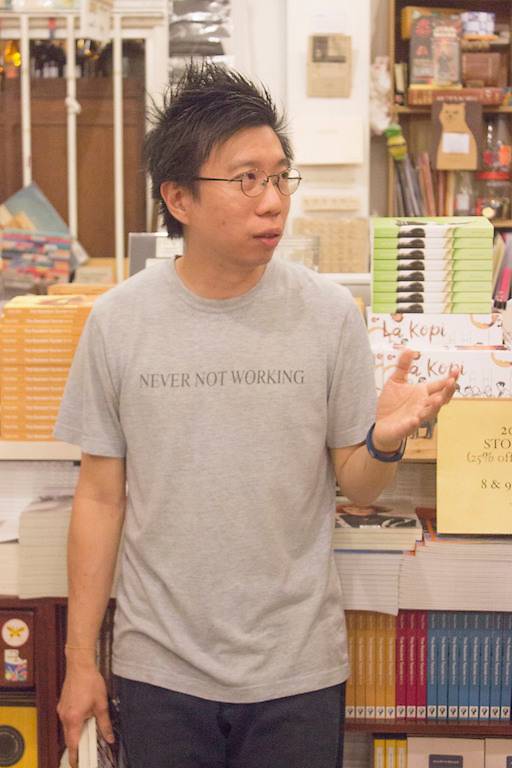
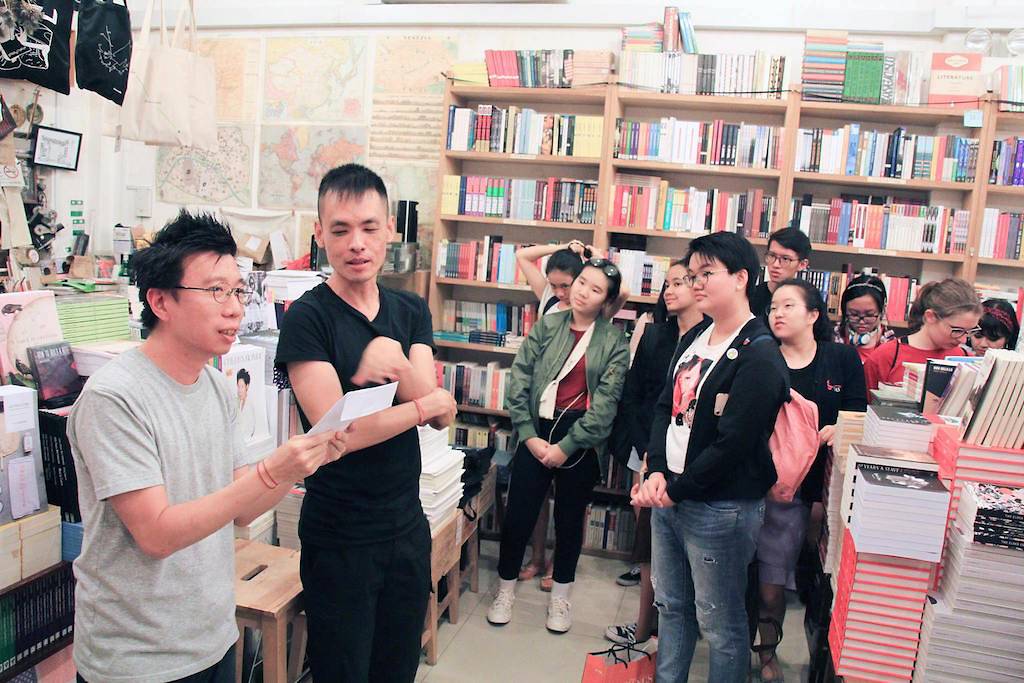
SINGAPORE: Kenny Leck looks nothing like a conventional businessman but in his field he is considered a formidable force. In an era where many major bookstores have closed down, his independent bookstore BooksActually has survived and is going strong after 13 years.
When I arrive there, he is behind a stack of books next to the cashier. He wears a nondescript T-shirt and glasses. The only thing that is easily visible from afar is his spiky black hair.
It’s a weekday and only a handful of people are browsing the rows of books that stretch from floor to ceiling at BooksActually at Yong Siak Street in Tiong Bahru.
We move into a backroom to talk. The 40-year-old answers questions with aplomb, but it feels as if I’m speaking with someone who is more a booklover than a businessman.
However, to survive in this business, you “necessarily have to be both”, he concedes.
The business turned a modest profit of S$80,000 last year. For a single bookstore, “that’s actually quite ok”, he says. To a great extent, the figure is modest because he has been pumping more money into boosting the bookstore’s publishing arm, Math Paper Press, through which he often publishes local work that may not always make money, but that he considers important to “put out there”.
“When someone sends you a manuscript, whether it’s fiction, non-fiction, or a children’s book, they are trying to tell a story. Especially if it is a Singaporean who has submitted the manuscript to you, they’re trying to tell you a particular narrative of their own. And that narrative is as important as us winning an Olympic gold medal. Because that’s part of who we are, that’s part of our history.”
Investing in publishing has slowed down his progress towards buying a permanent retail property for the bookstore.
While he and his co-founder have been making the business work entirely on their own dime so far, they recently started a fundraising effort to rope in investors to help them do this.
“It’s more sustainable than paying rent and we hope we can do this through this crowdfunding effort.”
Over the last 13 years, they have moved three times, each time due to an increase in rent but for the last seven years, they’ve managed to establish some stability in Tiong Bahru.
The current rent is about S$10,000 a month but he’s not complaining.
“If you’re a good business owner, regardless of what the rent is, low or high, (if) you know that the location works for you and the numbers are proving right, you’ll just stay. So for now, it’s fine. But in the future, we don’t know what’s going to happen and who wants to be a sucker to any landlord who’s going to increase your rent by 50 to a 100 per cent?”
While he bemoans high rents, he doesn’t believe, as some businessmen do, that the authorities should intervene to control them.
“That’s just how the free market economy works. If you expect the landlords to reduce rent or if you ask the Government to intervene to reduce retail rents, you’re just being lazy and asking to be spoon-fed. We have to remember that it’s not free money. Rental subsidies will have to come from taxpayers.
“Business people should just accept this is the way it is, crunch your numbers well and do more to make your business successful. That’s what we have been trying to do. But if the price is too high, then you have to move. That’s just how the economy is. But we also want to explore other options such as having our own property.”
I remark that his public fundraising effort for this could be construed as “asking to be spoon-fed”.
He disagrees.
“We are aware that nobody owes us a living. It’s your private money. If you decide to help or invest, then do it. If you decide not to help, it’s fine too,” he says decisively.
We talk more about the numbers and his strategy to convince people to help later but to understand Mr Leck’s motivations it’s necessary to take a step back.
Kenny Leck, owner of BooksActually has also started a publishing arm, Math Paper Press.
WOULD HE AMOUNT TO NOTHING?
He came from a low-income family. His father was a taxi-driver and his mother a housewife. They both recognised the importance of reading.
“My mum was a typical parent who read a lot of self-help books about parenting. While she encouraged me to spend a lot of time in the library, she was also never stingy when it came to buying books for me.”
He attributes his desire to own books instead of simply borrowing them from the library, to a “covetous” instinct that he believes many book lovers possess.
“My mother would never say no. She would crunch her own numbers and figure out how she can transfer money from her household expenses to buy me books. I remember in school when there was an opportunity to buy several sets of encyclopedias, she bought them for me on a three-year instalment plan.”
He dropped out of an accountancy and taxation diploma course in a local polytechnic just two semesters before graduation and went to work at Borders before co-founding BooksActually in 2005.
He picked the polytechnic course for a very specific reason.
“My dad fell very ill when I was 17 so the family needed me to come up with a solid income after National Service (NS). I chose all the business-related courses, and I ended up with Accounting and Taxation. It was a very clear route. If you’re there, after NS you can just go on to do your accounting papers, and eventually you can become a chartered accountant which pays really well.”
But things changed. His father became better and landed a well-paying job at a church. This helped seal his decision to turn his back on school to pursue his dreams.
His polytechnic course manager at the time actually told him he would amount to nothing. His memories of this are still very vivid.
“I remember this person, but I understand why she said it. It was the context of that time. I think many people didn’t believe that you could succeed without paper qualifications. I was actually doing well in school. I was probably one of the top 10 students and I enjoyed studying things like taxation. But I also knew it’s not something I wanted to do for the rest of my life.”
His parents seemed to understand his decision.
“I told my dad I wanted to quit, and broke down the number of years that would be saved if I were to quit immediately, and he told me to go ahead. That’s what my parents have given to me. Since I was a kid, they’ve always trusted me to make my own mistakes, and to own them to make decisions, whether good or bad.”
BOOKSTORES HAVE ONLY THEMSELVES TO BLAME
Working at major bookstores such as Borders and Tower Books taught him what not to do.
He has said in previous interviews that the mistake many of these stores made was to sell non-book merchandise such as stationery, movie posters, gadgets and even snacks.
He admits now that he was guilty of this too, albeit to a much more limited extent today.
“Booksellers are guilty. All of us are guilty. There were phases of this bookstore when we brought in non-book products because they brought in the money. As we went on, we realised that we are a bookstore, so why are we selling all these things? If we’re a bookstore, let’s work harder at selling books.”
His focus is on displaying and marketing the books well and to that end, he sets up pop-up stores around the island. He believes that consumers should not be blamed for losing interest in reading or in physical books.
“The bookstores that haven’t made it have only themselves to blame. I’m in the business so I know. Sometimes, they receive stock and they don’t display it. They’ll leave it somewhere in a box. Three months later, they’ll tell you that the books don’t sell. So who is to blame? Is it the consumer, or is it the bookstore manager that managed the outlet? Or is it the top not managing the business well enough to ensure that when the books come in, they get processed and displayed?
“And not just displayed in terms of shoving it in, but making a nice visual display, and doing enough marketing and branding.”
“The bookstores that haven’t made it have only themselves to blame. Sometimes, they receive stock and they don’t display it. They’ll leave it somewhere in a box. Three months later, they’ll tell you that the books don’t sell,” says Kenny Leck of BooksActually. (Photo: Facebook / BooksActually)
FEAR AND ANXIETY
He set up his first bookstore in Telok Ayer Street with less than S$25,000.
“We borrowed $20,000 from my co-founder’s mom. We had maybe S$1,000 in our bank accounts. I borrowed S$700 from my dad. I remember because my dad had to take the loan from a fellow church member, and I had to pay it back within the month, so the number was very clear-cut.
“We picked up quite a bit of contractor skills. We actually made our display tables from discarded wood mounted on Ikea shelving units. We did quite a fair bit of painting ourselves. A lot of our marketing materials were made in-house. The do-it-yourself philosophy became more pronounced as the years went by. The current wooden wine crates that you see in the bookstore today were all mounted and put together by us. We sourced the wine crates, planned the layout, and then fitted it into the walls.”
When they first started out, there would be days when there would be no sales whatsoever.
He remembers the fear and anxiety he felt then.
“I think for any retailer, bookstore or otherwise, that’s the scariest thing that could ever happen. I remember that happening a few times in that first year. One day I fell ill, so I decided to take a break. The second day, I was actually feeling okay, but I was feeling so demoralised that I decided to stay at home another day. Then another. On the fourth morning, I woke up and I decided I shouldn’t do that, no matter if there are sales or not. I should just suck it up, open it up because you never know what’s going to happen.”
He calls that period a turning point.
“If I was serious about running the business and if there’s zero sales, it means that I’ve do something about it whether it is organising an event, doing more marketing, doing more branding, get people in and get the sales.”
He was to face even more challenges later though.
He sold a 3-room HDB flat that his mother left him when she died and with the S$200,000 he made from it, he set up a second bookstore at Club Street which failed.
“I miscalculated. The space there was huge and we had to buy stocks from scratch. We had to buy a lot to fill up that huge space that we had. And the money burned faster than you could ever think.”
They had to close it eventually, but thankfully have managed to continue sustaining at least one store till today.
WHY INVEST IN A BOOKSTORE?
I ask how his fundraising efforts to purchase a commercial retail property for the bookstore are going.
The BooksActually Shophouse Fund has only made S$20,000 to date. They’ll need much more for a downpayment.
“An ideal location in Jalan Besar where it’s got a good vibe and slightly, but not totally gentrified, in total, will set us back about S$5 million. For a not-so-ideal location, but a location that we still like, it’ll be about S$2 million.”
He is considering the Balestier area.
I ask him what his proposition to donors is. Why should people contribute to this fund?
“I guess it’s about possibilities. Over time, we have connected with a lot of people, formed relationships and we have discovered simple things. For example, just two months ago, a customer who used to visit us at our previous location came back from the UK after completing her studies and she told us that she’s so happy to see us still around, because now she can show her kid what the bookstore meant to her when she was still studying in Singapore.”
I remark that it all sounds merely sentimental. What’s the business rationale?
“There’s no business rationale. There’s only that very intangible part of it. Everybody’s always asking where are our roots? Where is our commonality in this country, right? If they like to ask that but they tell you that actually we have no roots in this country because everything is changing so fast and places are disappearing, they are obviously not looking hard enough or not investing in it.
“Maybe someone down the road that you might be married to, or your kid might end up being a writer, might end up being a musician, might end up being an artist who we end up supporting. When you invest in us, it comes back around to you.”
But it seems as if he hasn’t managed to convince many people with that argument.
He ascribes the dismal contributions to a lack of publicity for the fundraising efforts and intends to ramp them up progressively.
A book launch at BooksActually. (Photo: Facebook / BooksActually)
STANDING FOR SOMETHING
But he reveals that “quite a handful” of private investors have actually offered to contribute, but once they realised what he stood for, they retreated.
“Bookstores tend to have a certain amount of character, and the character here is derived heavily from me – the person running it. For example, I am against discrimination and injustice, so a few years ago when the National Library Board pulled some books from their shelves because they highlighted different types of families including same-sex parents, we took a stand. We went to Amazon and bought all the 300-odd copies of And Tango Makes Three left in stock and sold them at our bookstore.
“We stand up against anything that discriminates against another person but some of our potential investors with deep pockets are of a certain social standing, and they are not comfortable aligning themselves with such causes.”
He clearly would rather reject the money than relinquish his ideals.
For now, he concedes that his modest profits will not get them far in terms of acquiring property, but he is determined to soldier on.
His ultimate goal is to have one large bookstore modeled after The Strand Bookstore in New York City.
In other respects, he is happy to continue living humbly.
“I currently only draw an allowance that covers food and transport, and I rent an apartment near the bookstore which doubles up as our publishing office, and storage area for our book stocks, plus bookstore supplies.
“I don’t take any holidays. For the first nine years of the bookstore’s existence, I did not travel because that was an unnecessary expense. When I had the chance to go to Bangkok after being invited to be a speaker in 2015 for the Bangkok Literary Festival they paid for all my expenses.”
Considering that at this time, he can’t afford to expand or buy his own retail property, clearly the bookselling business, on the scale he does it, has its limitations.
I ask if wealth is even a goal of his.
“I want to achieve wealth but I want to achieve wealth that enables me or the bookstore to help those who need it most because I’ve experienced what it’s like to grow up in a low-income family. I’ve seen how my folks struggled to make ends meet and not deprive their two kids of basic material comforts.
“The lowest point was when my father fell ill, nearly died, and with the loss of the sole-breadwinner in the family, we were suddenly at a loss. I was 17 that year doing my ‘O’ levels. We were either very, very lucky or blessed or both. His major hospital bills were close to 80 per cent subsidised by the government based on our income level, and for the rest, our church stepped in. That kind of support meant that my mother could ease her way into a job.”
Experiencing this “lack of wealth” has put him on a path to be as self-sufficient as possible but it has also ingrained in him a deep belief that any wealth gained must be used to help another person in need.
In his business, he classifies budding writers as “those in need”.
Through the publishing arm, Math Paper Press, he goes out of his way to help them in spite of the fact that some of the work lacks quality.
“There’s definitely a quality deficit. Over the years, it has of course improved by leaps and bounds, especially in the last decade. But we’re always going to have a quality deficit because there’s not enough being pushed out. How are you going to reach higher standards when you only have three or four serious publishers, compared to a city like London where they have many more. They also have a longer history than us.
“But we already have some really good work too that gets ignored because sometimes local publishers don’t push it hard enough. We have to do a better job.”
In the meantime, he sees it as his responsibility to give all writers a “good debut”.
He contributes to society in other ways by sponsoring books for community reading programmes for children from low-income families. Recently, he also contributed several thousand dollars to helping pay rent for a shelter for transgender individuals.
Kenny Leck is regularly seen at book fairs and events, a necessary part of his bookstore’s outreach efforts. (Photo: Facebook / BooksActually)
STAYING RELEVANT
As we turn to talking business again, he concedes that in some quarters it’s believed that physical books will become passé no matter how well they are marketed.
“I think the covetous side of book lovers – the fact that we are tactile beings – will ensure there’ll be a market for books. But I also know that there are questions about how environmentally-friendly all this is.”
I point out that e-books have a carbon footprint too, but ask him to justify why he continues his business in spite of his concerns.
He thinks the trade-offs are worth it.
“With books, we push knowledge and insight. All of us have been impacted by one or a handful of books. I think that’s where the value is. You are consuming resources, but we are producing books for pushing conversations, for keeping narratives, for pushing the envelope. Using paper to produce a book is much more valuable than using the same resources to produce a memo-pad.”
Some suggest that in a country with very good public libraries, buying books may in fact be wasteful too.
But he insists that book lovers’ covetous instincts that he alluded to earlier can make bookselling a viable business long into the future.
In fact, he welcomes competition.
“If we want to become a nation of readers, you need to have more bookstores. People today would rather open a cupcake shop than a bookshop, but they don’t know how to crunch numbers. They’ll always tell you that there’s a great number of people who will eat cupcakes, but soon many of these businesses will fold. I believe if they crunch the numbers right and did the right marketing and publicity, they’ll see bookselling can be viable.”
Competition, he believes, will also keep him and his team from becoming complacent.
His advice to budding business owners is simple.
“Don’t go in with the mindset of trying it for just two to three years and falling back on something else you’re more familiar with. If you go in with that mindset, you’re setting yourself up for an easy failure. If you’re faced with a life-and-death situation, you will think of more ways to stay alive, right? In business it’s the same thing, if you are presented with one problem, there can be multiple solutions. But if you go in with that mindset, you won’t even be able to see these solutions. You’ll just give up.”
While running a sustainable business is clearly important to him, when asked what impact he’d like to ultimately make in the industry, his answer has very little to do with monetary concerns.
“I always say the best way to die is to be just sitting in a chair reading a book, and to suddenly just expire. But throughout my life, I remember the individuals who’ve left a huge mark on me, whether teachers, parents or friends. I think that’s the most valuable thing. In your toughest times, you look back and know that those individuals have propped you up, put you on their shoulders so you can walk better. Hopefully, I can be that support for others in my personal and business life.”