Home Blog Page 966

Kitchen Stories: When the head chef is a 27-year-old girl boss

0

Follow our CNA LIFESTYLE page on Facebook for more dining stories and videos

SINGAPORE: One imagines that chefs go through phases of passionate devotion to one food at a time, entering into whirlwind romances with dish after pretty young dish. But Sujatha Asokan has demonstrated a steadfast loyalty to one particular dish all her life, and that’s assam laksa – a special dish that holds particular significance for this young chef.

The 27-year-old heads the kitchen at The Garage, an establishment consisting of modern European bistro Botanico and casual cafe The Bee’s Knees, located in a heritage building in the Botanic Gardens. Ever since she took over the reins a year ago, the daughter of a Chinese mother and an Indian father has introduced the piquant Asian flavours she grew up with into her menus.

Kitchen stories female head chef sujatha asokan Botanico iberico char siew

Iberico Char Siew. (Photo: Botanico)

Dining at Botanico, for instance, you might opt for the “Curry” Lamb Neck slow-cooked for 24 hours and served with Vadouvan-spiced king oyster mushrooms (S$32); or the Iberico Char Siew accompanied by carrot noodles, carrot puree and honey pork jus (S$34). And for dessert, you’d have a tough time choosing between the Lemongrass Panna Cotta topped with ginger ice cream (S$10), and the Jalapeno Ice Cream with charred Sarawak pineapple, dehydrated bacon financier and micro coriander.

Kitchen stories female head chef sujatha asokan Botanico jalapeno ice cream

Jalapeno Ice Cream. (Photo: Botanico)

A KITCHEN FULL OF AUNTS

But Sujatha herself, or Su, as she prefers to be known, never has any trouble deciding what to order when she hangs out at her favourite haunt – a Penang eatery in the Geylang area. It is always assam laksa.

“I’m a very boring person,” she declared. “If I like something, I go back there and I keep ordering that thing.”

Her singlemindedness probably has a lot to do with the fact that her earliest kitchen memory, which is also her most significant, revolves around the sour, spicy noodle dish.

The die was cast at the age of six. As a child, she would travel regularly with her parents and older brother to visit her mother’s family in Kedah, Malaysia. There, her four aunts would fill the kitchen with sights, sounds, smells and bustle.

“At first, I would just watch, not really understanding what was happening. But gradually, the smells and everything made me curious about what was going on in there. I saw that when they all cooked together, it brought the family together,” Su recounted.

“They made all the usual dishes in Chinese home cooking, but the dish that really caught my attention was assam laksa. The smell would fill the whole place,” she recalled. “I used to find the final product too spicy – although it was very shiok – so they would tease me and say, ‘Your father is Indian. Why can’t you take spicy food?’ Then, they would lower the spice level for me.”

As time went on, she was allowed to help make the dish. And after this piqued her interest in cooking, she also began to “kaypoh” around her paternal grandmother’s kitchen in Singapore. “She’s Indian, so she made things like curry and raita. I grew closer to her by going to see what was happening in her kitchen and trying to help her.”

Kitchen stories female head chef sujatha asokan Botanico Seabass Ceviche

Seabass Ceviche. (Photo: Botanico)

At Botanico, Su’s heartfelt tribute to the dish that started it all is the Seabass Ceviche, which is her interpretation of assam laksa. Here, diced local seabass is dressed with lemon and lime juice, housemade chilli jam, extra virgin olive oil, finely diced jalapeno, shallots, coriander and mint. It’s piled around glass noodles dressed in tamarind laksa sauce: A blend of belachan, candlenuts, dried chilli, galangal, ginger flower, shallots, turmeric, laksa leaves, lemongrass, tamarind skins and tamarind pulp. Topping it all off is a little quenelle of housemade shrimp paste ice cream, which subtly melts its richness into the cold, fresh mix.

STANDING UP TO THE HEAT

Having female culinary mentors during her formative years likely provides essential inspiration for this young leader as she holds her own in an industry that is largely male dominated.

“I’m probably very lucky. In all the kitchens I’ve been in, there has never been any worry about what I can or cannot do,” said Su, who began her gastronomic career at the age of 19 at Stellar at 1-Altitude, then did stints at Pollen and Esquina. She added, with a smile: “It’s also because I’m a giant, maybe. I’m big enough to lift things and man the grill.” And, at 1.8m tall, “I think I’m big enough to scare people”.

Kitchen stories female head chef sujatha asokan 2

Chef Sujatha Asokan. (Photo: Chee Yan)

That said, she certainly doesn’t believe that it’s all about size, much less about gender.

“My female colleagues are usually put into the cold kitchen, or dessert and pastry because ladies are known to have very soft, gentle hands, and wanting to advance to lifting heavy pots and the hot grill presents challenges,” she said. That’s not so in her kitchen. “I have a girl who’s very small. She’s on the grill now, in Botanico, and she’s enjoying it.”

That’s because Su believes in supporting people in the pursuit of their passions. “I think the most important things are support, encouragement and positive vibes,” she said. “I always put myself in their shoes… If you have a heart for what you do, they will feel it.”

Although she does run a tight ship when it comes to discipline and will chew people out if they have a bad attitude, she’s also the first one up for a prank.

“The one I pull most often is wrapping the tap in cling film,” she giggled, slightly sheepishly. “When you are busy, the first thing you want to do is wash your hands – but, whoosh! You can try that – it’s so annoying. I also cling wrap their olive oil bottles or call out a long list of fake orders towards the end of service.

“One of the worst pranks, which I regret the most, was when we put fish sauce into a potato foam and then sprayed it onto someone. The whole place smelled so bad after that.”
Kitchen stories female head chef sujatha asokan Botanico

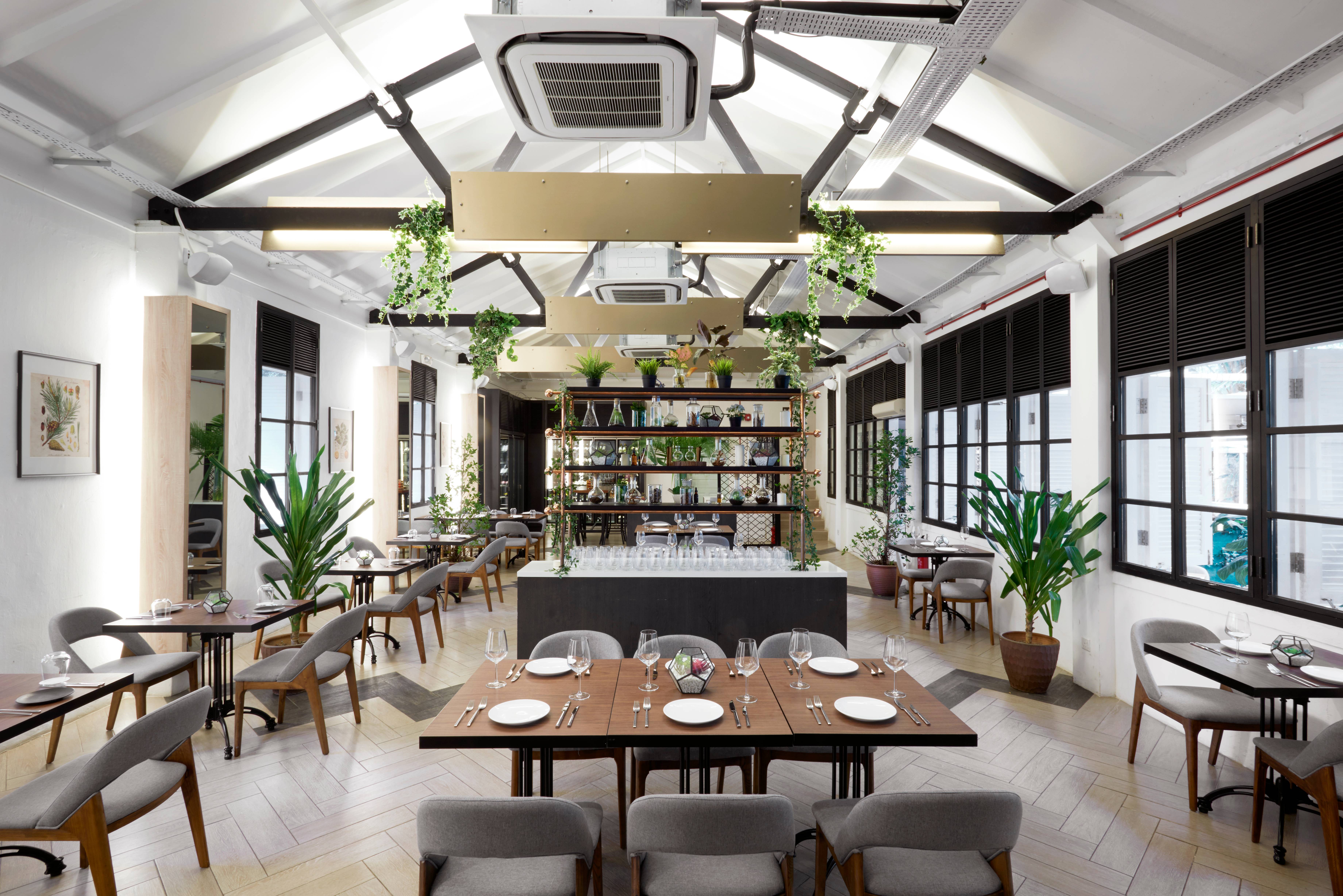
Botanico is housed in a 1920’s Art Deco conservation building. (Photo: Botanico)

Lest you think she’s abusing her authority, it seems it’s all some form of kitchen camaraderie. “They also play pranks on me. They cling wrap my helmet. I think we’re using too much cling wrap in this kitchen,” she quipped, adding, “I ride a motorcycle. My parents were worried at first, but they know they cannot control me.”

When all’s said and done – and the fish sauce has been cleaned up – her team, she said, is “very supportive and very passionate, especially the younger ones”.

“I’m very lucky to have them. It’s stressful and tiring, but I believe in keeping things alive in the kitchen.”

After all, the kitchen has always been the place that breathes life into her, ever since she was a six-year-old in her aunts’ kitchen.

“When I get stressed with all the computers and meetings, I just run back into the kitchen and say, ‘Is there anything for me to do? Come, let me help you.’ That’s very comforting and relaxing, somehow.”

The Garage, 50 Cluny Park Road. http://www.thegarage.sg
Source link

Why this Singapore film’s historic win at one of the world’s most important festivals matters

0

Follow our CNA LIFESTYLE page on Facebook for more trending stories and videos 

SINGAPORE: With the ongoing Crazy Rich Asians global hype, excitement and expectation, it is all too easy to miss another historic milestone in Singapore cinema: Homegrown filmmaker Yeo Siew Hua’s A Land Imagined is the first film from Singapore to win the prestigious Golden Leopard at the Locarno Film Festival in Switzerland.

On Aug 11, Yeo’s Mandarin thriller about the disappearance of a migrant Chinese construction worker at a Singapore land reclamation site took home the grand prize for Best Film at the 71st edition of one of the world’s most respected film festivals. 

The Golden Leopard top prize is worth 90,000 Swiss francs (S$120,000).

Singaporean grand prize Best Film 71st Locarno Film Festival

A Land Imagined lead actress Luna Kwok and director Yeo Siew Hua at the 71st Locarno Film Festival. (Alexandra Wey / Keystone via AP)

The film also clinched the first prize at the festival’s Junior Jury Awards, plus a Special Mention from the Ecumenical Jury (for “sensitising the viewer to religious, people-related, and social values”). In addition, independent critics presented A Land Imagined’s lead actress, Luna Kwok, with the Boccalino d’Oro Prize for Best Actress.

Yeo told CNA Lifestyle that his mind “just went completely blank” when he first heard that he had won. After all, there were heavyweights in the competition, including well-received features by filmmakers Hong Sang-soo, Radu Muntean and Kent Jones.

“After the initial shock, I was overwhelmed at the thought that people really cared about a film like ours, and that all our hard work is finally being recognised,” he shared. “I was just really, really touched.”

“It signals to me that times have changed and maybe the world is now ready to hear our stories,” said Yeo, who wanted this film to showcase the people he felt he needed to represent in Singapore.

THE SIGNIFICANCE OF THE WIN

Winning at Locarno is a massive achievement for the avant-garde auteur. The first edition was held in 1946, making it the first international film festival to take place after World War II.

And while Locarno may be not as famously familiar as fellow festivals such as Cannes or Venice, it has made a name for itself in the international film community by serving as a hotbed for innovative, art house films, with entries that embrace new forms or ideas about cinema.

Roberto Rossellini’s 1945 Italian classic Rome, Open City and 2006 Best Foreign Language Film Oscar winner The Lives of Others by Florian Henckel von Donnersmarck are examples of such edgy filmmaking that have won big at Locarno.

NO LOVE FOR HOMEGROWN FILMS?

Reactions among the Singapore film community have been effusive, signalling the importance of this win for the local industry. Fellow filmmaker Tan Pin Pin celebrated Yeo’s win on Facebook, writing: “The grand prize, not sure if the powers that be understand how big this is!”

Which lead us back to the perennial question: Must Singaporean filmmakers first win awards abroad before getting recognised in one’s own home country?

“It seems to be the case,” said Yeo. “But cinema culture here in Singapore is at a very young stage. It’s maybe hard to understand the appreciation and relevance without setting it within a larger context.”

“That said, I think all cinema made with sincerity is unique and deserving of its own way of spectatorship. It is important that a piece of work is appreciated by the local viewer it addresses, and having recognition from the international community helps to give it a certain perspective that might be lacking otherwise,” he continued.

FORMING RIPPLES

Ultimately for Yeo, the greatest reward for winning at Locarno is to know “that what we have achieved here is something that will form ripples and have larger implications on cinema from this part of the world”.

“I am heartened to hear some filmmaker friends from Singapore and the region who felt that my winning the grand prize in a top festival is a sign that a larger international audience is now interested in hearing our stories and feel encouraged to make their own films,” he said.

So, exactly how important is a win like this for Singapore film?

“I hope it is important,” said Yeo. “We can’t just always celebrate our thriving economy. I think it’s time people look our way and see the dedication and sophistication in our arts. But before that can happen, we need to be able to embrace our own and care for the health of our arts here.”

And the chance to do so will be when A Land Imagined gets a theatrical release in Singapore. It will “definitely” be screened locally, according to Yeo, with exact release dates still being discussed.

“It shouldn’t be for too long now,” he shared. “It’s a film dedicated to this land, made for my audience here, and I hope it starts a conversation – not elsewhere but here”.

Source link

More Singaporeans visit food delivery websites than supermarkets: Survey

0

More locals are eating out, ordering food deliveries and shopping online for meal kits, according to the latest Nielsen Out-of-Home Dining Survey.

Casual dining Singaporeans eating out Nielsen survey

(Photo: Unsplash/rawpixels)

Follow our CNA LIFESTYLE page on Facebook for more dining stories and videos 

SINGAPORE: Eating out is no longer just for special occasions; it has become a way of life for Singaporeans, according to the latest Nielsen Out-of-Home Dining Survey. 

According to the report, which included 202 respondents in Singapore in August, one in four people (24 per cent in 2018 compared to 19 per cent in 2015, when the last survey was held) eat out daily. More than half (55 per cent in 2018 vs 51 per cent in 2015) do so on a weekly basis.

Of the three meals, dinner (72 per cent in 2018 vs 78 per cent in 2015) is the most popular one to be eaten outside, followed by lunch (66 per cent in 2018 vs 58 per cent in 2015) and breakfast (15 per cent in 2018 vs 13 per cent in 2015).

It’s not just dishes that more Singaporeans are buying online; pre-portioned meal kits that help you prepare home-cooked meals are also more popular here than elsewhere in the world. 

Compared to the global average of 33 per cent, 44 per cent of Singaporeans have visited restaurant delivery websites or meal-kit-delivery services online.

Convenience and healthfulness were the main factors that shaped the respondents’ choices when it came to places they have visited in the past six months. Casual dining outlets (81 per cent) came up tops, followed by fast food restaurants (76 per cent) and cafes (64 per cent). 

Cafes appear to be growing in popularity among Singaporeans who dine out as there is an 18 per cent increase from 2015’s results.

Source link

Roads around Marina Centre to be closed for F1 Singapore Grand Prix

0

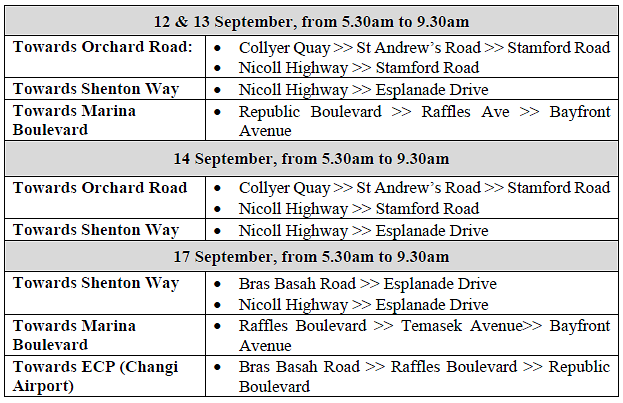
SINGAPORE: Roads around the Marina Centre area will be closed next month for seven days for the 2018 Formula 1 Singapore Airlines Grand Prix, the Land Transport Authority (LTA) said on Tuesday (Aug 21) in its news release.

The closure from Sep 12, at 12.01am, is to facilitate for the set up of race infrastructure, the release said adding that all roads will be fully accessible by Sep 18, at 5.30am.

This year, more roads will progressively reopen earlier to facilitate better traffic access, said LTA. 

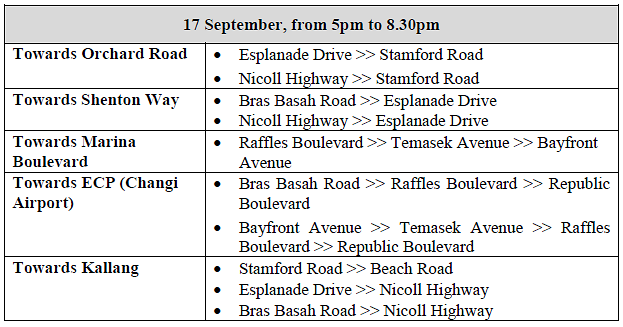
During this period, road corridors will be open at selected hours: 

F1 Road Closures 1

Roads open during traffic peak hours. (Table: LTA) 

F1 Road Closures 2

Roads open during traffic peak hours. (Table: LTA) 

Those driving, except for buses and vehicles with W, X, Y plates, can access the Marina Centre via a single lane along Raffles Boulevard via Nicoll Highway at the following times: 

  • Sep 12 to Sep 14, 10am to 5pm, and 10pm to 6am
  • Sep 15 to Sep 16, midnight to 1pm
  • Sep 17, midnight to 6am, 10am to 5pm, 10pm to 6am

Taxis will be able to use the single-lane access at all times, except for race days, added LTA. 

Motorists will also be able to enter the Marina Centre area via Temasek Bolevard from Rochor Road (after exiting ECP) throughout the day. 

Traffic wardens will be on site to direct traffic and assist the public, while directional signs will also be put up in the area. 

Car parks at malls including Suntec City, Millenia Singapore and Marina Square will remain open as well. 

MRT TRAIN SERVICES EXTENDED 

The operating hours of MRT train services will be extended on race days, Sep 14 to Sep 15, and selected feeder buses will also be extended to match the last train services. 

On Sep 14 and Sep 15, train services will be available at City Hall station until 12.30am. 

On Sep 16, train services at the station will continue until 12.45am. 

Meanwhile, free shuttle buses between Lavender station and Gate 1 of the race venue will be available. 

Source link

Commentary: Ragging is everywhere but organisations can set boundaries

0

SINGAPORE: A young man died on May 13 while engaged in an unofficial ritual to mark his graduation as a trained national serviceman.

It is difficult to make sense of what transpired, because the activity is clearly unauthorised and there are existing laws that discourage such activities. Furthermore, how could this have happened in an organisational setting imbued with noble life-saving principles and practices?

This incident can best be understood under the umbrella term of ragging. The activities engaged in can also be described as harassment and bullying.

While the mood was celebratory, to mark the happy occasion of his graduation, it was marred by the unauthorised ritual that unfortunately has become sewed into the cultural embroidery of the organisation.

A GLOBAL PHENOMENA

A review of the literature reflects that such induction rites of passage are a global phenomena, especially prevalent in schools, colleges, universities, sporting fraternities, and in the uniformed services.

In a 2017 book titled Emerging Ritual in Secular Societies, scholar Matthieu Smyth refers to the humiliating ragging rituals inflicted upon young pupils in boarding schools in the UK.

Sports psychologist Jennifer Waldron in her book chapter on hazing in sport published in 2016 in the International Handbook of Sport Psychology wrote of how initiation rituals can be degrading, humiliating, and even brutal. These rites of passage have evolved in modern sport in the United States and Canada.

Similar phenomena exist across the world, referred to as bizutage in French, mopokaste in Finnish, novatada in Spanish, ragging in India, and praxe in Portuguese. Across the continents (Brazil, India, Sri Lanka), there are research investigations documenting the prevalence of ragging in medical and dental colleges and universities, in law and business schools.  

File photo of students taking their seats for the diploma ceremony at Harvard University in Cambrid

A university student graduation. (Photo: REUTERS/Brian Snyder)

In a 2008 study, psychiatrist Jorge Srabstein found that between 1950 to 2007, there were 250 reported cases in English-language newspapers from around the world linked to bullying, hazing or ragging. 

He wrote that the majority of the reports of bullying related deaths (62.3 per cent) originated in Europe, and most of them (93 per cent) occurred in the UK. This could also be attributed to the accuracy of reporting such deaths in different countries.  

SECRECY, SELF-PERPETUATING

These rites are undertaken under a cloak of secrecy as it is understood that they are not condoned by officials. The perpetrators are usually “seniors” who had previously undergone similar treatment.

The practices or rituals or “ragging” may be conducted with or without any intended malice but this would hinge on the personalities of those doing the initiation, and the perceived shortfalls, upstart or fearful personalities of those being initiated.

Once they “pass” the initiation, the new entrant is often received warmly into the group. Sometimes those who conducted the rigorous initiation, especially in tertiary institutions, will permit those who “graduated” from the initiation to rag them in turn for a permitted period of time – as a mark of goodwill.

The activity is self-perpetuating – as a “mindless” cultural norm, passed on from one institutional generation to the next. The simplistic exhortation is “this is the way it is done here” and that “these are the rules and you must follow them”.

READ: Address ragging but remember to also tackle workplace bullying, a commentary.

The execution of such a practice provides a sense of power and control to the perpetrators, and renders a sense of victimisation and powerlessness among those subjected to the ragging. Research across countries reflects a predominance of negative impact on the latter such as depression, anxiety, even suicidal acts.

stress or depression file photo

A woman bows her head in pain. (Photo: Unsplash/Volkan Olmez)

​​​​​​​

RECOURSE TO LEGISLATION

Those subject to ragging can find solace in the rule of law. 

In Singapore, the Protection from Harassment Act spells out scenarios which would render punishable by law any person who intentionally causes harassment, alarm or distress.

It also covers communications or behaviour that is threatening, abusive or insulting, and would definitively cover the context of ragging, hazing and bullying.

Similar legislation exists in the US, and Australia and other developed countries, spelling out acts that people should be protected against. However, the existence of such legislation by itself has not curtailed acts of bullying and harassment.

MORE CAN BE DONE TO PROTECT AND PREVENT

It may not be possible to eliminate ragging entirely but perhaps organisations could spell out clearly what the boundaries are where such informal “initiation” rites are known to exist.

Organisations can give clear notices and reminders of what is permitted and what is not. In this, damaging acts to life and limb and denigration that attacks the self-respect of the new entrant must be ruled out. 

To fill the perceived vacuum of a more broadly inclusive and meaningful rite of passage for new entrants, it befits organisations to invest in a more broadly engaging and involving ceremonious rite of passage where seniors formally welcome new enlistees into the group. 

This would serve the purpose of recognising the immediate “seniors” whose role are now as guides and mentors to the new entrants.

Study by psychologists Glenn Walters and Dorothy Espelage recently published on School Psychology Quarterly, discussed how the construct of “psychological inertia” serves to maintain bullying behaviour. 

Actions are carried out without examination of reasons or rationale. Cognitive impulsivity (including acting or behaving based on impulsive or automatic thinking rather than deliberated deep thinking) perpetrates the acts of bullying.

This suggests that managing ragging would require some level of education and changes in mindsets. That, beyond religious beliefs, there is a need to inculcate morality, kindness, and other ethical values and attitudes necessary for healthy social existence in our present digital age.

Dr Elizabeth Nair is a health and organisational psychologist, and a registered trauma counsellor. She is CEO and Principal Psychologist of Work & Health Psychologists, Singapore.

Source link

Owners of old HDB flats now know ‘there is some future’: Experts on new housing schemes

0

SINGAPORE: The new housing schemes announced by Prime Minister Lee Hsien Loong on Sunday (Aug 19) could see older flats retain their value for a longer period of time and become viable alternatives for prospective buyers, said analysts.

In his National Day Rally speech, Mr Lee said that the Home Improvement Programme (HIP) will be expanded to cover more Housing and Development Board (HDB) flats, to include those that were built up to 1997.

In addition, every HDB flat can expect to be upgraded twice during their 99-year lease, under the new HIP II scheme. The second round of upgrading will take place when the flats are about 60 to 70 years old.

This will create greater assurance for people who may want to buy older flats, said PropNex Realty’s key executive officer Lim Yong Hock.

“It gives people a little bit more confidence to buy the older flats, especially those who intend to buy and live there till they die,” said Mr Lim. “They know that even if they were to buy an older flat, five to 10 years down the road, HDB will still do the home improvements.”

“But there will still be other considerations – these could be location for example, the renovation (costs), and last but most importantly, the price,” he added.

READ: NDR 2018 – Expanded home improvement scheme to spruce up another 230,000 HDB flats

However, for older flats to be attractive to buyers, there needs to be some changes to the Central Provision Fund (CPF) Withdrawal Limit, Mr Lim noted.

Currently, if the remaining lease of a property is less than 60 years, there are restrictions on how much CPF money can be used to buy it.

A home owner can use CPF money if his age plus the number of years left on the lease is at least 80 years – but subject to restrictions.

However, if the remaining lease is less than 30 years, CPF cannot be used at all.

“Younger buyers may not be able to use up to the full (amount of CPF),” said Mr Lim. “So this becomes a constraint, unless there are more changes and adjustments, then you may be able to see more younger buyers purchasing older flats.”

ADDRESSING THE 99-YEAR LEASE WORRY UNDER VERS

Another housing scheme that was announced by Mr Lee is the Voluntary Early Redevelopment Scheme (VERS). The Government will buy back older flats before the 99-year leases run out and compensate residents whose flats are taken back early.

Residents, who have to vote for VERS, can then use the proceeds to buy a new flat.

READ: NDR 2018 – Scheme planned to redevelop more old HDB flats before leases end

The scheme could ease concerns about the value of older flats.

“A lot of owners were afraid that when the tail end of the lease comes, nobody will buy the flat from them and they would be forced to return the flats and end up with nothing,” said Mr Chris Koh, director of property firm Chris Koh International.

“At least now, owners who have old flats know that there is some future … You have options now instead of staying in your flat till the end.”

Old HDB flats in Singapore

HDB flats in Singapore. (File photo: Marcus Mark Ramos)

There remains the question of how much home owners would get in return if they choose to go for VERS. PM Lee had already said that the terms will be less generous than that of the Selective En-Bloc Redevelopment Scheme (SERS), as there will be “less financial upside”.

“People are going to decline if they feel that the pricing isn’t attractive enough or they feel that if they accepted the price, they don’t have the financial ability to find another place,” explained Singapore University of Social Sciences (SUSS) Associate Professor of Economics Walter Theseira.

“There’s always this issue whether people feel they can find an appropriate replacement.”

READ: New VERS scheme could bring about ‘acrimony’ among residents, warns Alex Yam

Still, Ms Karen Chan, who lives in a 48-year-old three-room flat at Stirling Road with her parents, hopes there will be rehousing benefits similar to SERS, when VERS kicks in.

“I am quite surprised because I thought there would be no chance for us to be part of these schemes,” Ms Chan said. “I believe for the older generation – it would be good for them to have different options.”

NO IMMEDIATE IMPACT ON RESALE MARKET

VERS will only start in about 20 years, when some flats reach 70 years old.

Similarly, HIP II will be implemented in about 10 years’ time, which is why property analysts said the schemes are unlikely to have any immediate impact on the HDB resale market for now.

“If VERS or HIP happened on Jan 1 next year – such a timeline can excite the people,” said PropNex’s Mr Lim. “Too long a time to wait means that there are too many uncertainties in the market.”

For Mdm Anbrijt Thakarsingh, who lives in a 43-year-old flat in Bukit Merah, she is already certain that she does not intend to sell her flat to the Government. She wants to pass it on to her children instead.

“What happens at the end of the 99-year lease is up to them,” she said. “I’m happy to stay for as long as we are around … no matter how much money is being offered.”

Source link

Fewer vehicular-related workplace fatalities in first half of 2018; falls top cause of major injuries

0

SINGAPORE: There were fewer fatalities in the workplace related to vehicular incidents in the first half of the year, but falls remain a top cause for major injuries, according to official figures released on Monday (Aug 20). 

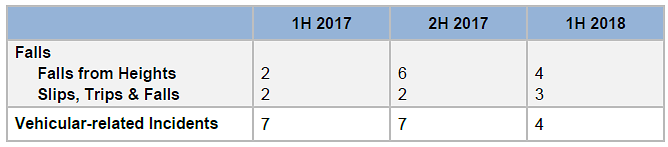
Vehicle-related fatalities – the top cause of workplace fatalities annually since 2013 – fell to four in the first half of 2018, the Ministry of Manpower (MOM) and the Workplace Safety and Health (WSH) Institute said in a press release. 

In both the first half and second half of last year, seven fatalities were recorded from vehicle-related incidents. 

Falls remain a concern however, causing seven fatalities in the first half of this year. More than half of these fatalities occurred in construction, said MOM and WSH Institute. 

There were eight fatalities from falls in the second half of last year and four in the first half of 2017.

Leading causes of fatalities

Leading causes of fatal injuries in the first half of 2018. (Table: WSH Institute, MOM) 

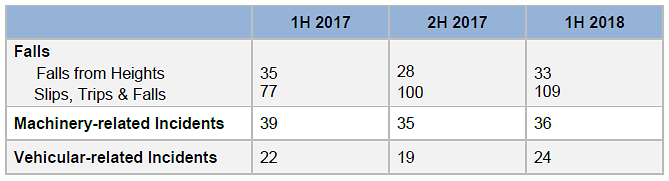
Falls were also the top cause of major injuries in the first half of 2018, with 142 cases. 

This was an increase from the 128 cases in the second half of 2017 and 112 cases in the first half of last year. 

Machinery-related incidents remained stable with 36 cases in the first half of this year, MOM and WSH Institute said. 

Leading causes of major injuries mom, wsh

Leading causes of major injuries in the first half of 2018. (Table: WSH Institute, MOM) 

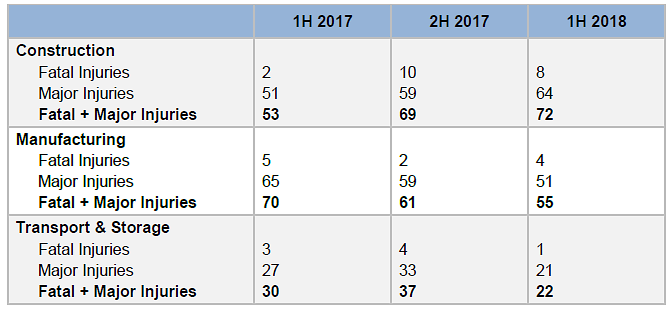
There were 20 workplace fatalities in the first half of 2018, which is slightly higher than the 19 cases in the same period last year. 

Most of these cases – 8 fatalities – were in the construction sector, followed by the manufacturing sector. 

Industry injuries

Fatal and major injuries in construction, manufacturing and transport and storage. (Table: WSH Institute, MOM) 

Compared with the first and second halves of last year, including non-fatal cases, there were fewer workplace injuries, dangerous occurrences and occupational diseases in the first half of 2018. 

Source link

Why Singapore’s Hsien Loong broke down last Sunday

0

SINGAPORE Prime Minister Lee Hsien Loong’s usually stoic demeanour cracked on Sunday as he addressed the city-state during its annual National Day Rally.

The trigger? It happened as Lee unveiled the “Merdeka Generation Package”, a special medical assistance initiative for those born in the 1950s (baby boomers) or those in the “Merdeka generation”. Merdeka means “independence” in English.

As he discussed the initiative, Lee detailed the struggles Singaporeans faced during the fight for independence and their efforts towards nation-building when the country was finally liberated. He broke down into tears as he touched on the challenges faces by the Merdeka Generation who saw their parents, the pioneer generation, toil for the country.

“There are 500,000 (Singaporeans) from the Merdeka Generation and I’m proud to be one of them,” Lee said during the televised speech.

“Having lived through the battles and upheavals of the Merdeka struggle and seen how their parents have scraped and slogged for them… they understood instinctively what was at stake.”

SEE ALSO: Singapore’s elderly suicides peak as population ages 

Singapore gained independence from Malaysia on Aug 9, 1965, but the bid that paved way for the wealthy city-state began the decade before when the country’s People’s Action Party set up a government.

Lee said this generation, who are mostly in their sixties, had accepted hardships, made sacrifices, answered the call of duty, and worked with their leaders to build a better future.

“The men were among the earliest batches called up for national service… many, especially the girls didn’t complete their education. They came out to work early to support their family and younger siblings.

2018-08-09T112928Z_212962729_RC1FA0AAED80_RTRMADP_3_SINGAPORE-NATIONALDAY

Singapore’s Prime Minister Lee Hsien Loong arrives for the National Day parade along Marina Bay in Singapore August 9, 2018. Source: Reuters

“Some joined the workforce amid uncertainty in the economy and unemployment and when the British forces withdrew from Singapore, all started working when wages were still low.”

The prime minister said together with the pioneer generation, the Merdeka Generation contributed to building Singapore and “making its independence a success”.

SEE ALSO: Singapore is now delivering medicine with drones 

However, Lee noted that the Merdeka Generation were better off than their preceding generation before as they benefitted from a decade of economic growth and had more access to education.

“The Merdeka generation earned more over their lifetimes and accumulated more CPF (Central Provident Fund) savings because, in the eighties, wages increased sharply.”

With the generation’s contribution in mind, Lee said the Merdeka Generation Package would help meet their healthcare expenses, but the benefits would not be as large as those received by the pioneer generation who had “much less advantage” compared to their children.

Lee did not mention a timeline for the plan but said the details of the package would be revealed next year.

Source link

Asian Games swimming: No medal but Singapore youngsters impress on opening day

0

JAKARTA: Team Singapore finished the opening day of the swimming competition at the 2018 Asian Games without a medal but many of its young talents put up impressive displays at the Gelaro Bung Karno (GBK) Aquatic Centre in Jakarta on Sunday night (Aug 19). 

The women’s 4x100m freestyle team just missed out on a medal after finishing fourth in the final behind teams from China, Japan and Hong Kong. 

However, the quartet of Quah Ting Wen, Quah Jing Wen, Cherlyn Yeoh and Christie Chue clocked 3:44.21s to break the national record for the event by 0.17s. 

Jing Wen and Christie, both 18, and 17-year-old Cherlyn were all competing at the Asian Games for the first time.

Singapore women relay swimmer

Team Singapore in action on lane 6 at the 4x100m freestyle relay. (Photo: Amir Yusof) 

The previous national record of 3:44.38 were held by the Quah sisters, Amanda Lim and Natasha Ong from the 2017 SEA Games in Kuala Lumpur. 

Veteran swimmers Ting Wen, 26, and Lim, 25, were part of the quartet who clocked 3:52.63s in the previous edition of the Games in Incheon.

Speaking to the media after the race, Jing Wen said: “We weren’t really thinking about the record. We just wanted to do our best.” 

Her elder sister Ting Wen lauded the performance of her younger teammates, acknowledging that “it’s getting competitive at home”. 

“I’m saying this as one of the seniors as it pushes us. (Youngsters being competitive) helps us not to become too comfortable, not be too complacent. It reminds us of why we actually want to be here,” said Ting Wen. 

Singapore women swimmers

Team Singapore’s women 4x100m freestyle relay final squad. (Photo: Amir Yusof) 

“Everyone is pushing one another and actually trying to help each other get better,” she added. 

Meanwhile, another Team Singapore debutant Gan Ching Hwee also broke the national record for the women’s 1,500m freestyle on Sunday. 

Gan clocked 16:39.70s to finish fifth out of seven competitors in the final. The 15-year-old’s timing was also her personal best. 

The previous national record of 16:41.49s was set by Lynette Lim in 2009. 

Source link

National Day Rally 2018: The 8 things you need to know

0

SINGAPORE: Prime Minister Lee Hsien Loong unveiled plans to upgrade and redevelop Singapore’s public housing, and measures to help Singaporeans manage healthcare costs in the National Day Rally on Sunday evening (Aug 19).

In addition to addressing the cost of living, Mr Lee devoted a large part of his speech to housing concerns and revealed two major schemes to renew Housing and Development Board (HDB) flats.

He also announced major changes to healthcare financing: A new healthcare subsidy package for Singaporeans born in the 1950s and the expansion of the Community Health Assist Scheme (CHAS).

Here are 8 key takeaways from the rally:

1. VOLUNTARY EARLY REDEVELOPMENT SCHEME

Addressing Singaporeans’ concerns about the 99-year leases of HDB flats running out in a few decades’ time, Mr Lee announced a new scheme to redevelop HDB flats, that will be implemented in about 20 years’ time.

The Government plans to start redeveloping older housing estates and will begin doing so when the flats are about 70 years old, Mr Lee said. 

This will be done progressively over a period of 20 to 30 years so that old towns can be rejuvenated in an “orderly way”.

Under the Voluntary Early Redevelopment Scheme (VERS), residents in a precinct will have to vote to allow authorities to take back the flats. Those who do so will receive compensation, but this will be less generous than under the Selective En Bloc Redevelopment Scheme (SERS).

Mr Lee also explained at length the reasons why HDB flat leases should not extend beyond 99 years.

READ: Scheme planned to redevelop HDB flats before leases end

2. HOME IMPROVEMENT PROGRAMME

Old HDB flats in Singapore

A block of flats in Singapore. (Photo: Marcus Mark Ramos)

More HDB flats will be upgraded as the Government expands the Home Improvement Programme (HIP) to homes built from 1987 to 1997. The programme originally covered flats built in the years up to 1986.

Another 230,000 flats will benefit, including in estates like Pasir Ris, Yishun, Tampines and Jurong, Mr Lee said.

HDB will also be upgrading older flats a second time at around the 60- to 70-year mark under a HIP II scheme, which will start in 10 years’ time.

READ: Expanded home improvement scheme to spruce up another 230,000 HDB flats

3. MERDEKA GENERATION PACKAGE

Elderly in Singapore File

(File photo: Xabryna Kek)

The Government will work out a Merdeka Generation Package which will help Singaporeans born in the 1950s with healthcare costs.

The package will cover outpatient subsidies, Medisave top-ups, MediShield Life premium subsidies and payouts for long-term care for about 500,000 Singaporeans.

The benefits will not be as extensive as those for the pioneer generation, who benefitted from the Pioneer Generation Package launched four years ago, Mr Lee said.

The Merdeka package will help to relieve some of the healthcare worries of Singaporeans now in their 60s, he added.

READ: PM Lee announces ‘Merdeka Generation’ healthcare package for Singaporeans born in ’50s

4. MORE HEALTHCARE BENEFITS

Medical subsidy programme CHAS will be extended to all Singaporeans with chronic conditions regardless of income, Mr Lee announced. However, the benefits will continue to be tiered according to income.

The scheme currently provides subsidies to those in the pioneer generation, lower- and middle-income households for outpatient medical and dental care.

The Ministry of Health will announce details of the changes later.

READ: CHAS subsidies to be extended to Singaporeans with chronic conditions

5. MORE POLYCLINICS

Geylang Polyclinic

(File photo)

More polyclinics will be built in Sembawang, Eunos, Kallang and Bukit Panjang by 2020; and in Tampines North and Nee Soon Central by 2023.

“Some of these are to upgrade and improve existing ones, but we will make sure that there are affordable, accessible, high-quality primary healthcare services all over Singapore,” Mr Lee promised.

6. GEYLANG SERAI

Wisma Geylang Serai

Wisma Geylang Serai will be a centre for Malay activities.

Senior Minister of State for Defence and Foreign Affairs Maliki Osman has been appointed to lead a project to make Geylang Serai a culturally distinctive precinct.

This includes the area stretching from the Tanjong Katong Complex to Kampong Ubi Community Centre.

Dr Maliki will engage the Malay community and other Singaporeans to solicit ideas and make recommendations to the Government, Mr Lee said in his Malay speech.

READ: Geylang Serai to be made ‘culturally distinctive’

7. COST OF LIVING

The Government will ensure that the major costs of living – HDB housing, healthcare and education are affordable, Mr Lee said in his Mandarin speech.

It is also helping to manage the cost of living by building more hawker centres.

He pointed out that lifestyle changes, such as the prevalence of smartphones, eating out and a higher quality of life in general have contributed to cost of living pressures.

“While the Government will do its part to alleviate people’s cost of living concerns, each of us also has a responsibility to ‘look after our own wallets’ – save water, save electricity and at the same time, shop around for the best prices and be a smart consumer,” he said.

READ: Government will do its part to alleviate concerns about cost of living

8. HAWKER CULTURE

Singapore will nominate the island’s hawker culture for the United Nations Educational, Scientific and Cultural Organization’s (UNESCO) list of intangible cultural heritage.

Mr Lee called hawker centres Singaporeans’ “community dining rooms” and hawker food their “best cure for homesickness” in his address.

“The UNESCO inscription will help to safeguard and promote this unique culture for future generations,” he said.

READ: Singapore to nominate hawker culture as UNESCO intangible cultural heritage

Source link