SINGAPORE: Sentosa will waive island admission fees for all Singapore residents during the September school holidays, Sentosa Development Corporation said on Friday (Aug 24).
Visitors driving into Sentosa in Singapore-registered vehicles, as well as those who enter via the Sentosa Express trains, will gain free admission between Sep 1 and Sep 16, the news release said.
Sentosa will also continue to offer its existing free modes of entry for those who walk or take SBS Transit’s bus service 123 to the island.
The waiver of island admission fees is part of efforts by Sentosa to celebrate the school holidays. The island will also be hosting Southeast Asia’s largest sand festival, Sentosa Sandsation: Marvel Edition, during the school holidays.
A sand sculptor working on a sand sculpture of Thor. (Photo: Sentosa Development Corporation)
Spanning almost 3,000 sq m at Siloso Beach, the exhibition will feature 15 larger-than-life sand sculptures of popular Marvel super heroes such as Iron Man, Thor and Captain America.
SINGAPORE: They stand side by side in the restaurant’s kitchen, hands moving nimbly as they piped batter into baking moulds. The pair is hard at work preparing the restaurant’s signature madeleines, communicating occasionally using sign language, or by writing in Chinese on a paper pad.
“Don’t be nervous,” pastry chef Mandy Pan writes at one point. Her mentee, 62-year-old Tay Lee Keng, responds with a smile and a thumbs up.
Mdm Tay is deaf, and runs the bakery stall at Dignity Kitchen, a social enterprise and hawker training school for disabled and disadvantaged people. The skilled baker, who counts treats like muffins, pineapple tarts and large cookies as part of her repertoire, has to rely on visual cues such a timer so she can check when her pastries are ready to be taken out of the oven.
She is, nonetheless, passionate about baking. And her passion has brought her on a new adventure: She has just embarked on a training stint in the kitchens of db Bistro, one of Marina Bay Sands’ award-winning restaurants.
Her skills will be put to the test on Friday (Aug 24) evening, where she will work together with her mentor, Chef Pan, in a food truck, preparing and serving food to members of the public.
RAISING AWARENESS
The stint is part of the integrated resort’s annual Sands for Singapore Charity Festival. Three Dignity Kitchen beneficiaries, Mdm Tay and stroke patients Roger Chong and Lau Liang Peng, were each attached to a Marina Bay Sands restaurant for three days to hone their skills and learn from a chef mentor, before they head out to work in the food trucks till Sunday (Aug 26).
Proceeds from the sale will go to charity.
Chef Mandy Pan guiding Mdm Tay as she pipes the batter into baking moulds for the restaurant’s signature madeleines. (Photo: Hanidah Amin)
The stint brings many benefits, explained Dignity Kitchen’s founder Koh Seng Choon. For one, the trainees are able to pick up new skills and experience that will stand them in good stead as they prepare for placements in food and beverage establishments outside of Dignity Kitchen.
“Hawker culture in Singapore is single-cuisine,” he said. “But in a restaurant like that, it’s multi-cuisine, and the environment is also completely different compared to a hawker centre.”
Mdm Tay, in particular, hopes to learn to bake other items such as focaccia bread, brioche and fruit tarts.
“I can improve my baking skills when I go back from here,” she said through a sign language interpreter. “It prepares me with skills that outside bakeries need.”
Beyond this, Mr Koh also hopes that the opportunity will help raise awareness about the employability of people like Mdm Tay among companies. Dignity Kitchen, he explained, also helps to secure jobs for its beneficiaries, and he hopes that restaurants and other establishments can give them a chance.
“There’s a shortage of people in the F&B industry, and I have the kind of people that they want,” he said. “So I hope that in this programme, we can show employers that they can work.”
BAKING IS A “UNIVERSAL LANGUAGE”
But were there any teething or communication issues at the start of the training?
While Chef Pan, who is an executive pastry chef at db Bistro, admitted that she was a little worried about communicating with Mdm Tay at the start, it turned out that her fears were unfounded.
“I was thinking back, and I realised that I’ve had similar experiences before,” she said, laughing.
“When I was working in New York City, the guys in my team were either French or Mexican … and I couldn’t speak either.”
“So it really isn’t much different.”
As Chef Pan demonstrated how she instructed Mdm Tay using hand gestures, she pointed out that it was, very simply, “a different way of showing someone how to do things.”
“It’s not like we’re singing, where we have to learn through our voice,” she said. “Baking is special, because we learn through observation.”
“Your skills with your hands and your eyes are very important.”
Describing Mdm Tay as a quick study and “full of energy”, she also had nothing but good things to say about her.
“When she first came in, she had a big smile on her face and you can tell she’s really happy to be here,” she said. “She’s trained in a hawker setting and we’re a celebrity chef restaurant, so the processes are slightly different.
“But quite honestly, cooking and baking is a universal language, and if you can do it there, you can do it here.”
It was just a few hours into the training stint, but it was clear that the pair have already built a rapport.
Baking some chocolate chip cookies in the restaurant’s kitchen. (Photo: Hanidah Amin)
“Chef Mandy is very kind, knowledgeable and ready to share,” said Mdm Tay, as Chef Pan put an arm around her and gave her a thumbs-up sign.
Later, as the two posed for a photograph and signed the words “thank you” to each other, Mr Koh admitted to being very encouraged by what he has observed so far. He explained that while businesses – and bosses – are often more than happy to employ people with disabilities, getting coworkers to accept them can sometimes be a challenge.
“I’m very chuffed about this whole thing,” he said. “I was so happy at how Chef Mandy and her colleagues treated Mdm Tay, and how well they could work together.”
“Maybe it’s a positive sign that people are now more receptive to people with disabilities,” he added.
“Because they can work. All they need is the platform and opportunity for them to do so.”
SINGAPORE: A new facility launched by the Agency for Science, Technology and Research (A*STAR) on Thursday (Aug 23), is set to provide manufacturing companies greater access to technology to grow their business.
The new Model Factory at the Advanced Remanufacturing and Technology Centre (ARTC) located at Clean Tech Loop – spanning 15,000 sq ft – lets companies test more than 10 types of advanced manufacturing technologies.
They include virtual labs and simulation equipment for firms to test new production lines and improve resource planning even before implementing them.
The first of the two model factories was launched at Singapore Institute of Manufacturing Technology (SIMTech) in October last year and is primarily aimed at companies on their first mile of technology adoption.
Different from the one at SIMTech, the model factory at ARTC is targeted at companies in more advanced stages of technology adoption, with a more comprehensive suite of solutions.
Firms can also tap on ARTC’s pool of engineers and researchers to come up with solutions for their business.
Other types of technologies on offer include robotics and the Internet of Things (IoT).
Speaking at the launch, Senior Minister of State for Trade and Industry Koh Poh Koon said he hopes the facility will help support homegrown companies, especially the small- and medium-sized ones, to innovate, grow and scale up.
This is to ensure that the manufacturing sector is able to reap the benefits of digital technologies, Dr Koh added.
“Under the Research, Innovation and Enterprise 2020 (RIE2020) plan, the government has committed S$3.2 billion from 2016 to 2020, to develop research and technological capabilities in the Advanced Manufacturing and Engineering (AME) domain.
“Disruptive technologies such as additive manufacturing, robotics … are ushering a new era of manufacturing … these technologies will fundamentally change the way businesses operate, produce and interact with their customers and supply chain, leading to enhanced business models,” he said.
Local metal and machine servicing firm Abrasive Engineering, which is one of the first to come on board the initiative, said the facility has helped with the test-bedding of a new type of digital process to monitor machine health.
The company is now in the process of integrating the technology in its machines, and expects to increase its sales by 20 per cent this year, revealed Mr Tan Ser Hean, Abrasive Engineering’s managing director.
Just hours after those exploits, Singapore’s golden boy was back in the pool at 9am local time, racing in the heats for the 50m butterfly event. If his body was fatigued, it did not show as he stormed off the blocks to finish as the fastest overall qualifier, clocking 23.84s.
Schooling’s national teammate Teong Tzen Wei clocked 24.28s to finish ninth, just one place off a final spot.
On his own performance in the heats, Schooling said: “It was okay. It’s always hard to get up in the morning especially after a very very very long few days but the most important thing is booking a spot in the final which I’m looking forward to. It’ll be fun.”
Schooling said he had a “rough” night, heading to bed only at 1am and had to wake up at around 6am to prepare for the heats.
“It’s a shitty turn around but that’s what you gotta do sometimes. It’s a normal scenario at this kind of meet. I had a massage, a shower, and took a lot of caffeine last night.
“I had four cups of coffee in the evening so it was hard to go to bed, but it’s okay, the whole point of prelims was to make finals and that’s what I did so it’s alright,” he added.
However, in spite of all the challenges, Schooling stressed that he has prepared himself for these kind of situations.
“It has been a long few days so of course I feel tired but it just means you got to grind through it. We train day in and day out to replicate scenarios like this and you gotta be a man and step it up and not complain. I’m not complaining at all. I’m excited for tonight and we’ll see what happens.”
“It’s not very hard to switch on mentally, I’ve been in this position several times. That’s when experience comes into play,” he added.
Joseph Schooling claps after the Singapore national anthem Majulah Singapura is played for the first time at the 2018 Asian Games. (Photo: Sport Singapore)
If Schooling gets a podium finish in the 50m butterfly, he will have bagged his fourth medal at the 2018 Asian Games and surpass his medal tally at the previous Games in 2014.
Schooling won silver in the 50m butterfly in 2014, after finishing behind China’s Shi Yang by 0.24s.
On his prospects for gold medal this time round, Schooling said: “I don’t like thinking ahead. There are fast people in the heats racing tonight so I’m just trying to focus on myself.”
China’s Wang Peng and Kazakhstan’ Adilbek Mussin will be his closest rivals when they line up for the final at around 6pm local time (7pm Singapore time) on Wednesday evening. Wang, who was second overall in the heats, clocked 23.89s while Mussin recorded 23.91s.
“I’ve been feeling good this meet so I’m trying to finish my last individual event strong,” he added.
MAKING FUN of politicians has long had a home in the media landscape of liberal Western democracies.
Monty Python, The Daily Show, Charlie Hebdo — each lampoons those in power for comedic effect, but also to drive home criticism of government policy.
Political satire has also had its place in Southeast Asia, but many of those sticking it to their leaders through cutting comedic commentary often lack the space to do so. The strongman politics dominating the region, from Hun Sen in Cambodia to the Philippines’ Rodrigo Duterte, is making satire a difficult pastime.
It’s telling that some of the most outspoken critics of Cambodia’s authoritarian Prime Minister Hun Sen are operating online, and from abroad. Since 2011, Hun Sen’s Eye has sought to satirise Hun Sen and his cronies via Twitter, Facebook (before the account was closed) and a Tumblr account.
In a rare email interview, the owner of the accounts noted that anonymity afforded a level of protection not granted to critics operating inside the country.
“A lot of government critics use the grey area of interpretation as protection against retribution (though that didn’t work very well for Kem Ley),” the owner said, referring to the government critic who was shot dead in Phnom Penh in 2016.
“Kem Ley’s fables are a perfect example of Cambodians’ capacity to express allusion and irony. And Kem Ley’s murder is a perfect example of why they should keep it to themselves.
“Since I’m an eyeball, I have to opportunity to be a bit more pointed. The governance of Cambodia just happens to be ridiculous, in the saddest way.”
Because the output is in English and primarily on Twitter, which reaches a small number of people in Cambodia, the Eye has a limited impact inside the country, explained a Cambodian journalist who asked to remain anonymous in order to speak freely in Cambodia’s increasing restrictive media environment.
Hun Sen’s Eye has almost 10,000 followers, which puts it among the top Twitter users in Cambodia.
“Its funny, but I don’t think many Cambodians get it; its in English, but also very different humour to people here,” the journalist says. “Dirty comedy, violent things are funny here.”
“It’s very dangerous to make fun of our leader,” he adds. “You can say Donald Trump is a dickhead or has a small penis, but you can’t say Hun Sen is stupid, as his image is that of being the smartest man in the country.”
Part of a meme created by the satirist behind “Hun Sen’s Eye”. Image by the artist. Source: Splice
Facing the consequences
In Malaysia, “punk rocking graphic artist/activist” Fahmi Reza’s satirical art landed him in legal trouble.
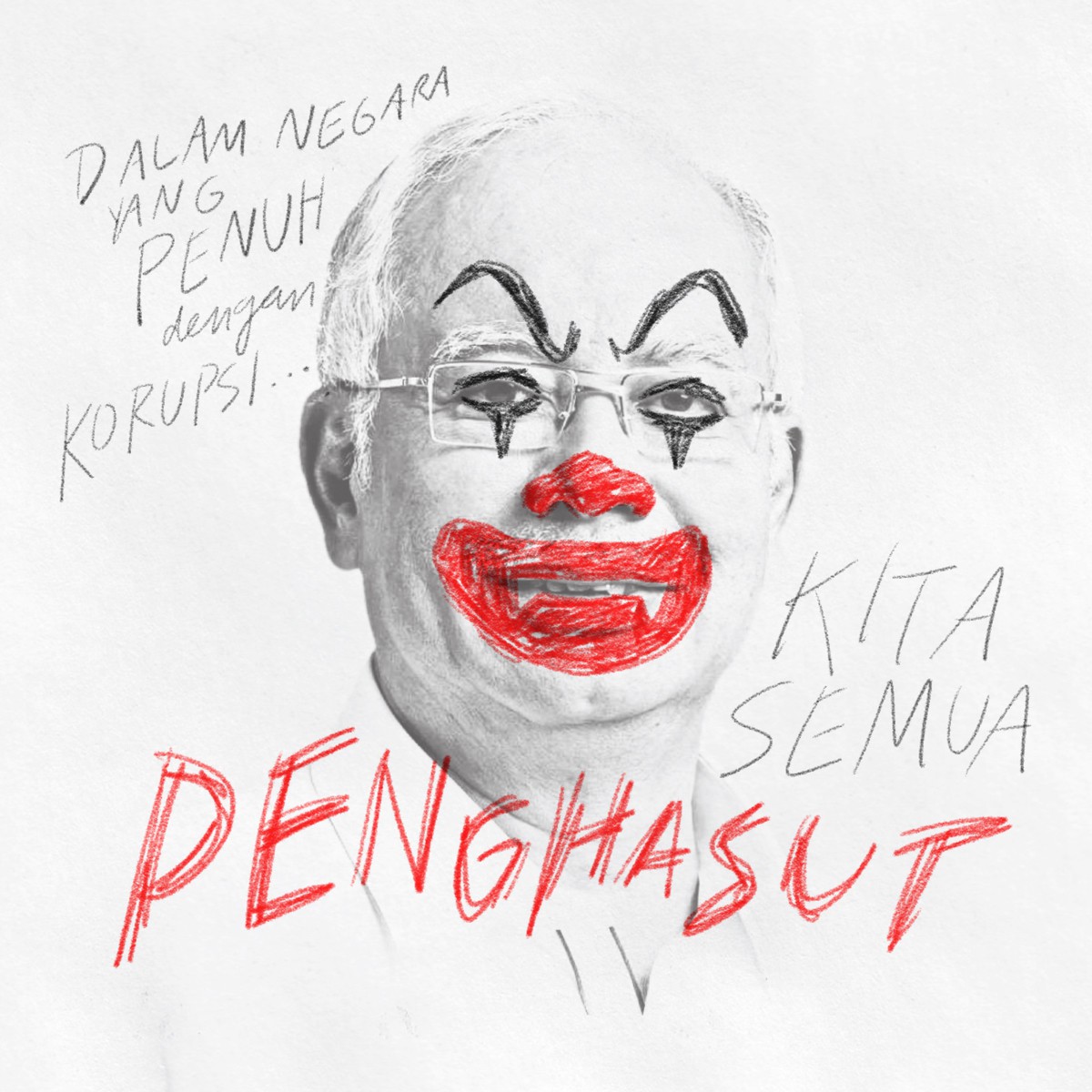
Arrested in June 2016 for drawing and sharing an image of then-Prime Minister Najib Razak as a clown, he is currently on bail but faces up to a year in jail and a US$12,000 fine. He is unapologetic about the work he does, seeing it as part of a struggle for social change.
“I think the political climate under Najib was a climate of self-censorship. The persecution of political cartoonists like Zunar [since dropped] and design activists like me created a culture of fear, and a chilling effect on satirists, activists and everyday citizens,” he explains.
“Satire has traditionally been used as a weapon by the powerless against the powerful… I see the work that I do as continuing this revolutionary tradition of graphic dissent and visual disobedience.”
Fahmi Reza was arrested and hauled to court for his widely-shared depiction of Najib Razak in clown face. Source: Splice
Elsewhere in Asia, social media is reshaping the way satire is produced, how it is distributed, and how governments strive to contain it.
Hong Zhang, associate professor of East Asian Studies at Maine’s Colby College, says that government monitoring in China has pushed the sharing of political satire to become more sophisticated.
Images with embedded text, for example, are used to bypass the filters on the popular Wechat platform.
“Most of the messages in more recent years are more subdued and indirect, perhaps due to the concern that overt and sharp political satire may get people in the Wechat group into trouble,” she says.
Despite China’s onerous media controls, satirical messages still draw upon the same kinds of themes you would see elsewhere in the world.
“Obvious ones are the call for political reform, democracy, making fun of the current leader and its policy, [but] any topic can all of a sudden become off limits if the Party-State arbitrarily things so,” she says.
The social effect
Sanjay Rajoura, one of the team members behind the satirical Indian TV show Aisi Taisi Democracy, sees social media as having both positive and negative elements for sharing their blend of stand-up comedy, song and biting political satire.
Targets include Prime Minister Narendra Modi’s BJP party, as well as leading political and business figures in India.
“Things have become both easier because times like these give you a lot to speak about, you are more relevant,” he says, “[and] tougher because… authorities have more control.
“But, at the same time, it is also a chance to refine your craft so much that it is able to bypass the authoritarian scrutiny. And that’s how fine satire comes into being.”
For Malaysia’s Fahmi Reza the risks have brought about reward, with his arrest garnering widespread public attention.
“The investigations, the arrests, the court charges and the travel ban that they’ve placed on me only added fuel to the fire, amplifying the popularity and prestige of the clown image as a protest symbol even more,” he says.
“The whole experience taught me that satire and humour is effective because it breaks the fear barrier. It taught me that political satire can agitate and mobilise people towards political action.”
JAKARTA: Singapore Olympic champion swimmer Joseph Schooling swam a total of three races at the 2018 Asian Games on Wednesday (Aug 22) – featuring in the heats and finals for the 100m butterfly as well as the 4x100m freestyle final.
That’s three different warm ups and cool downs, and 300m of pulsating sprint racing at the Gelora Bung Karno aquatic centre in Jakarta – all within a span of 12 hours.
He looked understandably drained when he spoke to reporters at the end of it all, talking about how his preparation bore fruit and if the effort was finally able to silence his relentless critics.
But when a journalist asked whether he was feeling pressure for the 50m butterfly event on Thursday morning, his eyes lit up.
“Pressure? No, I’ll enjoy it. I swam two 100s today (in the final) so that’s (three) 100s. Two more 50s is nothing in my mind so that’s ok. I’m very excited, I’ll probably sleep a lot easier tonight,” he said.
Since his historic Olympic win in Rio de Janiero in 2016, Schooling’s career – by his own admission – has not been smooth sailing. At the FINA World Championships in 2017, Schooling had to settle for bronze in the 100m butterfly final, and could only watch as United States’ Caeleb Dressel stole the limelight.
“I’ve been up and down over the last two years but its always a cycle right? You cant always be in tip-top performance. What’s important is if you’re not feeling at your best, step up, grind it through and … try to win the race. That’s what defines a champion,” said Schooling.
When asked if he feels he is now back to his best, Schooling respectfully declined to make that admission. His time for the 100m fly in Jakarta was after all 0.65s off his personal best, set in Rio in 2016.
Joseph Schooling blazed the competition in the 100m butterfly final at the 2018 Asian Games. (Photo: Sport Singapore)
“I’m heading in the right direction. I’ve had a lot of things to get used to … and since turning pro it’s been a little different, but I’m definitely going in the right direction,” he said.
“My support staff is amazing, I’m starting to feel more and more comfortable so I envision the next two years, getting better and better heading into (South) Korea and Tokyo,” he said.
As far as the 100m butterfly is concerned, next on his agenda is the 2019 World Aquatics Championships in South Korea, and more importantly, to defend his Olympic title at Tokyo 2020.
“(The Asian Games gold) is just another stepping stone … you build one at each meet until you finally get to the Olympics. This is one of the building years to get to do what I want to do in Tokyo.
“And so are things going according to plan? Yes I’d say so. I’m happy with where I’m at. I’m definitely in a lot better shape than I was last year, hopefully I can keep building on that,” he said.
Schooling was criticised by certain quarters for his dip in form since 2016, and his win in Jakarta could go some way in proving them wrong.
But for Schooling, it is about how he channels it to boost his performance.
“I think criticism is good, like if everyone’s on your side praising you then it might get to your head. But I think this is a great check and balance for me, (I’ve) always proven my critics wrong. It’s gives me more motivation to go to practice to race harder so I can prove people wrong,” he said.
In the lead up to Tokyo, Schooling said he is eyeing to compete in the US professional swim circuits, the Mare Nostrum and even feature in meets around Europe.
Joseph Schooling claps after the Singapore national anthem Majulah Singapura is played for the first time at the 2018 Asian Games. (Photo: Sport Singapore)
“Now after I’m done with school, finally, it’ll be nice to go out to Europe and swim in some meets. I’ll come back for the FINA World Cup in Singapore and take it meet by meet and see what happens.”
But for now, Schooling is just focused on two more days of racing in Jakarta.
Next on his plate is the 50m butterfly, an event he bagged silver in the last Asian Games in Incheon. But Schooling is looking to better that, and clinch his second gold for the Games in Indonesia.
“It’s one of my goals … to give everyone the chance to hear our national anthem. So having done that, I feel very proud and very happy. Mission accomplished for today. But I still have two more days of racing. (The 50m butterfly) is a big event which I’m excited about,” he said.
Schooling won 3 medals in the previous edition of the Asian Games in Incheon – a gold, a silver and a bronze. He has already bagged three medals in Jakarta – a gold in the 100m butterfly, and two bronzes – in the 4x100m and 4x200m freestyle relay events.
With the 50m butterfly and the 4x100m relay medley events still on the cards, Schooling looks set to surpass his medal count from two years ago.
Get the widest coverage of the 18th Asian Games (Aug 18 – Sep 2) from Jakarta and Palembang, Indonesia on Mediacorp. Go to toggle.sg/AsianGames2018 for details.
SINGAPORE: Eleven babies who were given the recalled Dumex Mamil Gold milk formula at KK Women’s and Children’s Hospital (KKH) are “reported to be well”, the hospital said on Thursday (Aug 23).
Responding to Channel NewsAsia’s queries, the chairman of the hospital’s medical board said KKH has contacted 11 of the 13 caregivers whose infants were given the milk and that it is still trying to contact the remaining two caregivers.
“KKH is closely monitoring the situation. As of now, all of the 11 children are reported to be well. Our team of medical specialists is on standby to provide care and support where necessary,” said Associate Professor Ng Kee Chong.
He said the hospital has removed all tins of the implicated batch of products, and has since stopped using this brand of milk powder.
“Our top priority is the health of the babies. Should they have symptoms such as fever, poor feeding or lethargy, or if the infant feels unwell, parents and caregivers should immediately consult a doctor,” Assoc Prof Ng added.
On Monday, the Agri-Food and Veterinary Authority of Singapore announced that a batch of Dumex Mamil Gold infant milk formula – Step 1 (850g) was recalled after the Cronobacter sakazakii bacteria was found in samples of the product.
Cronobacter infections are generally rare, but they can be fatal to newborns as they may cause meningitis or sepsis.
The affected batch, which was made in Malaysia, has an expiry date of Sep 11, 2019. The batch number is 09117R1.
AVA ordered the recall of a batch of Dumex Mamil Gold infant milk formula – Step 1 (850g) after Cronobacter sakazakii bacteria was detected in samples. (Photo: AVA)
The Health Ministry said on Tuesday that the milk had been used at KKH and the National University Hospital (NUH).
The ministry also said that babies who might have been given the affected milk were those below six months old, and who were admitted to the two hospitals between Aug 1 and Aug 20.
It added that it had not received reports of its young patients experiencing any symptoms related to the recalled milk formula so far. Like KKH, it has removed the affected products from its hospital.
KEVIN KWAN may have brought Hollywood glamour to Singapore for his novel-turned-blockbuster hit “Crazy Rich Asians” but the island state’s government won’t be rolling out the red carpet should he return there one day.
This is because the 67-year-old author, although celebrated abroad, is a wanted man back home.
Singapore’s Ministry of Defence (Mindef) said Kwan, who moved to the US when he was 11, skipped National Service (NS) decades ago and as he remains a Singaporean citizen, faces a three-year jail term and a US$7,300 fine for the offence, Straits Times reported.
“Mr Kevin Kwan failed to register for NS in 1990, despite notices and letters sent to his overseas address,” the ministry said on Tuesday.
“He also stayed overseas without a valid exit permit. Mr Kwan is therefore wanted for defaulting on his NS obligations.”
Kwan was recently thrown into the international spotlight following the release of the movie adaptation of his bestseller, which details the opulent lifestyles of Singapore’s super-rich.
The move that was released in the United States last week premiered in Singapore on Tuesday, and has been hailed as a watershed for Asian representation in Hollywood due to its all-Asian cast, according to the AFP.
Kwan, also credited as an executive producer of the film, attended the US premiere but was conspicuously missing from Tuesday’s red carpet event at Capitol Theatre.
Author Kevin Kwan (R) and cast members Henry Golding and Constance Wu pose at the premiere for “Crazy Rich Asians” in Los Angeles, California, U.S., August 7, 2018. Source: Reuters
For decades, Singapore has set a two-year mandatory requirement for its male citizens to undergo NS where they could serve either in the military, police or civil defence force.
Although Kwan tried to renounce his citizenship in 1994, the government rejected his application for failure to fulfil his NS obligation.
Set against the backdrop of Singapore, the plot of “Crazy Rich Asians” revolves around American-born Chinese economics professor Rachel Chu, played by Constance Wu, who meets her boyfriend’s (Henry Golding) wealthy and tradition-bound family of Chinese descent.
The movie is the first Hollywood film centred around an all-Asian cast in 25 years with the last being the 1993 film Joy Luck Club directed by Wayne Wang.
Despite praises in the US, the movie has been the subject of wide criticism in Singapore and around the region for its ethnocentrism in merely focussing on ethnic-Chinese characters.
SINGAPORE: A succession of major “cyber” events in Asia have reinforced the need for companies to take a proactive and realistic approach to cyber resilience.
In recent weeks we have seen the much publicised SingHealth Data breach, the ransomware attack on Chinese shipping giant Cosco, and the crippling of Taiwanese semiconductor manufacturer TSMC by a virus.
Most organisations are conscious of the significant malicious cyber traffic seen in Asia, but often discount the risks and wonder:
Why would anyone attack me?
Most don’t consider the broader context in which these attacks occur and the collateral damage that is common.
It has been suggested that the target of the SingHealth attack was Prime Minister Lee Hsien Loong’s medical data, but hackers are not known to differentiate when extracting other sensitive information, hence the exfiltration of data pertaining to 1.5 million SingHealth patients.
If the attack was state-sponsored then it serves as a useful reminder that exposure to cyber risk does not exist in a vacuum. Geopolitical tension has been the driver behind some of the more significant attacks in recent memory.
That organisations may be collateral damage should not be discounted. In the case of TSMC, which was shut down by a latent variant of the WannaCry malware, the impact of non-targeted attacks is evident. The most significant cyber losses of 2017 belonged to those companies caught in the web of WannaCry and NotPetya ransomware.
A logo of Taiwan Semiconductor Manufacturing Co (TSMC) is seen at its headquarters in Hsinchu, Taiwan October 5, 2017. (File Photo: REUTERS/Eason Lam)
WE NEED AN ‘ASSUME BREACH’ MENTALITY
Acceptance of such risks is critical, but there’s no turning back from the reliance on data, automation and connectivity that gave rise to the risk. Indeed, organisations which have fallen victim to cyber losses have turned to technology to mitigate the damage.
Integrated transport and logistics company, Maersk, and Cosco used a combination of social media and personal email accounts to keep their businesses running – not the most secure measures, but business continuity is often paramount. SingHealth communicated with affected parties by SMS.
But there is one way to get ahead of the curve. Public comments from government officials in Singapore suggest an acceptance that while every effort must be taken to secure data, attacks will be ongoing and breaches are inevitable.
Indeed, there is a growing acceptance that cyber risk is an unavoidable cost of doing business – a necessary consequence of the benefits derived from technology. This was also clear in Prime Minister Lee Hsien Loong’s Facebook statement where he says:
We cannot go back to paper records and files. We have to go forward, to build a secure and smart nation.
The logical extension of this acceptance is a shift towards an “assume breach” mentality for organisations, an approach to cybersecurity that recognises the inevitability of some degree of intrusion, and emphasises incident response and protection of critical assets once the perimeter is compromised.
RED-TEAMING STRENGTHENS SYSTEMS
But this approach depends on a willingness among the broader public to forgive organisations which have been successfully attacked, as well as to be far more critical of those who have mishandled communications or failed to act prudently after a breach has occurred.
Adopting this mentality does not mean that organisations sacrifice cybersecurity measures because it will educate how those measures are deployed.
Sophisticated organisations will often engage ethical hackers for “red-team testing” – launching attacks on their systems to detect vulnerabilities. Good red teams have an incredibly high penetration rate, but this is only part of the story.
Prime Minister Lee Hsien Loong speaking at the opening ceremony of the 51st ASEAN Foreign Ministers’ Meeting (AMM) and related meetings.
Once breach is assumed, the more important questions emerge – can attackers move within our systems to access sensitive data? Are internal access controls appropriate? How quickly did our own security team detect the intrusion?
Similarly, organisations which adopt an “assume breach” mentality are more likely to have an incident response plan which has been tested and can be readily deployed in a crisis.
A RESPONSE PLAN NEEDED
In underwriting an organisation, cyber insurers will want to see that an incident response plan is in place, but the best risks will have a plan that is regularly tested and updated. Table-top simulations of cyber events can help senior management understand the pressures and responsibilities of handling a crisis and aid companies to identify gaps in incident response and business continuity plans.
These exercises also focus on communication with clients, employees, commercial partners and regulators.
But quick and clear communication with stakeholders in the wake of a cyber event is not common for businesses in other parts of Asia, particularly as most jurisdictions do not feature mandatory breach notification laws, in stark contrast to the experience in Singapore (where mandatory breach notification amendments to the Personal Data Protection Act are pending), the US, Europe and Australia.
That is expected to change in the coming years, but companies are also recognising that controlling the message can be best practice.
Perceptions of honesty and transparency are two key drivers of successful recovery from a reputation event, according to the 2018 Reputation Risk in the Cyber Age study released by Pentland Analytics and Aon.
Both SingHealth and TSMC communicated with the media quickly and may have avoided reputational damage that may arise from speculation and unanswered questions.
Ultimately, companies that are confident with the efforts they have made to bolster cyber resilience and have prepared for these events with an assume breach mentality will be much better placed to face the media, clients and their shareholders.
Andrew Mahony is regional director of Financial Services and Professions at leading professional services and risk management firm Aon Asia.