Home Blog Page 963

I’d do it all over again, says founder of failed start-up Fastbee

0

SINGAPORE: Starting his own business has been such a stressful process that Khoo Kar Kiat lost 10kg over the past two years. 

It has also set him back by almost S$200,000. 

But Mr Khoo does not regret taking the entrepreneurial plunge, even as his start-up ended last week and he did not get to prove his naysayers wrong. 

Back then, he was told by some that he had made the wrong move to leave the civil service. 

He was already 33, they said, and should not be taking risks given that he had a “good, stable job” at the Economic Development Board (EDB). 

Some did not mince their words: “Can (your idea) make money? Why do something stupid like that?” 

The idea that he had was a food delivery service called Fastbee, which allowed people to order hawker delights via an app and collect their food from nearby vending machines. 

Mr Khoo believed that this would incur lower costs than a conventional point-to-point delivery model and in turn, be more sustainable and scalable. 

At the end of last year, Fastbee expanded to 10 vending machines across various industrial and business parks in the West. More than 800 deliveries were made per week from a team of just seven people. 

Unfortunately, it could not withstand a double whammy of competition from new players and fundraising difficulties that soon came along. The start-up had its last day on Aug 14

But nothing ventured, nothing gained, said Mr Khoo. 

“Maybe I should be happy that I lasted for about two years,” he quipped. “After all, statistics out there say about 90 per cent of start-ups fail in a year.” 

THE ENTREPRENEURIAL ITCH

A former student of the Anglo-Chinese Junior College and Nanyang Technological University, Mr Khoo described himself as someone who rarely veered off the beaten path. 

Taking a risk, such as entrepreneurship, never crossed his mind until he was introduced to the Lean Start-up methodology at work. 

Coined by Silicon Valley entrepreneurial guru Eric Ries, the methodology emphasised experimentation, like quickly launching a product then change it based on market feedback, instead of elaborate planning. 

He was tasked to adopt this innovation philosophy to build a new industry for Singapore but felt “something missing” and that he needed more than just reading materials to fully grasp the concept. 

“Innovation, the Lean Start-up methodology – these were often discussed but how do you get answers about starting something from scratch and making it work? Do I ask my boss or do I read more books?” 

Disruption becoming the new normal and technology changing jobs also got him thinking if he had become too comfortable in his work.

“I was somehow semi-cruising and contented with life,” said Mr Khoo. “But the world is changing and there’s actually so much to do and learn.” 

He considered applying for an MBA but eventually concluded that the answer lies in getting his hands dirty. So in October 2016, he left his eight-year career at the EDB. 

A steep learning curve awaited him in the initial months as he took the dive into entrepreneurship. 

From lacklustre demand for his “primitive version” of Fastbee (a breakfast delivery service in the Central Business District), new guidelines for vending machines to manpower and logistics issues, Mr Khoo recalled having “a reason to close down almost every month”. 

“There was once when I was going to launch a new machine at a new location but the third-party logistics provider I was partnering couldn’t deliver. I suddenly find myself with no drivers to fulfil orders,” he said. 

“It was such a stressful day that I nearly felt like throwing in the towel.” 

Each time, he tweaked his model and soldiered on. 

With its focus on the underserved market of delivering humbler local fare to non-CBD areas, business grew and Mr Khoo felt confident enough to add new vending machines by end-2017. 

“After surviving the initial months, I thought nothing else can kill me,” he recalled. “But I was wrong.”

READ: From hawker centre to home: Is delivering cheap, local food a recipe for business success?

At its core, Fastbee relied on aggregating orders and eliminating point-to-point deliveries to stay lean and keep costs down. Unlike other food delivery services, it does not take a cut or have a minimum order requirement. Its main income is a S$1.50 delivery fee. 

While it does have lower manpower costs, it required economies of scale to turn profitable. At its peak, Fastbee only had a footprint of 10 vending machines. 

By early 2018, its capital of S$200,000, consisting of S$100,000 from Mr Khoo and the rest put in by an angel investor, was fast running out. Months of fundraising, however, yielded little results. 

“Eventually, I realised that we were simply not growing fast enough,” said Mr Khoo. “We may be growing 10 to 20 per cent in our customer base but venture capitalists are looking at super-normal growth of 100 to 200 per cent.” 

Investors also questioned the exportability of the start-up. “We are a solution for Singapore where manpower is expensive, but that’s not the case for the rest of Southeast Asia. So they were sceptical.” 

At the same time, new entrants with deeper pockets have begun targeting its stronghold of industrial and business parks in the West. With its coffers running dry, Mr Khoo said Fastbee could not match the extensive marketing efforts, such as dishing out promo codes, that some of its rivals have done. 

Fastbee.sg, meal-delivery start-up in Singapore (2)

Fastbee’s vending machine at Mediapolis. (Photo: Tang See Kit)

To hold on, it began reducing its vending machines while tweaking operations to have one delivery man for four locations. 

“We always needed about 30 packets for breakeven but with that, it took just eight to 10 packets.” 

That kept the start-up going for four more months until talks with an investor fell through on Aug 9. By then, Mr Khoo knew the time was up. 

“I sat in front of my laptop and wept a bit. Even though I had been preparing myself, it wasn’t easy when the realisation hit.” 

When asked if he had been too confident on Fastbee’s lean model, Mr Khoo’s face turned pensive. 

“I still believe in the concept of using a vending machine because right till the end, we were breaking even operationally. But we needed investments to keep going. 

“With the consolidation going on in the market, interest was low. Nobody wants to invest in a small start-up and hope you can survive against the big guys.”

READ: Promo codes, lower minimum orders: Is a price war brewing among food delivery apps?

NO REGRETS

Without a salary and having to dig deep into his savings for his daily expenses, Mr Khoo estimated that he has spent about S$200,000 on his entrepreneurial pursuits. 

But there are no regrets, he said, as he’s gained valuable lessons in return.

For instance, he should have kept a tighter lid on spending in the initial stages of the business.

“Everyone told me that I needed to bootstrap. You will try but you won’t do it until you are desperate,” said Mr Khoo.

“We were not overspending compared to many start-ups but we were not stingy enough. Only when we ran out did we realise that we could have slashed a lot of spending by becoming even more efficient.”

This will involve walking the talk on embracing innovation and out-of-the-box thinking, added Mr Khoo. For this, he credited his young team for constantly reminding him the value of taking a chance on something new.

“Towards the end, I told my team that we needed to radically change our operations. They took it and we started brainstorming together. That’s how we pivoted our model when we needed to.”

Having family support would be crucial for any entrepreneur though Mr Khoo admitted that his mother disapproved of his career switch.

“My brother had a business failure in his 30s and lost a similar amount of money. My mum went through that with him and she obviously didn’t want me to end up the same.”

He added: “Plus, I was doing quite well in EDB so she could not understand why I wanted to quit.”

His business has been a taboo topic at home for the past two years. But there was once after an argument, Mr Khoo received a text message from his mum reminding him to take regular meals and rest when he can. 

“I remembered being on my way back to the office. When I saw the message, I stopped and cried uncontrollably for 10 minutes. 

“I know she’s been very worried about us failing and having a tough life as a result of that.” 

Bringing up the deep-seated fear of failure in Singapore, he added: “The older generation still views entrepreneurship and the risks involved very differently and I know from here, there will be certain pressure that my family and I will have to face.” 

“So when the realisation hit, I did think about what I should do for the next Chinese New Year. Should I still go for visiting?”

Mr Khoo also candidly let on that he initially thought it would be rather “paiseh”, which means embarrassed in Hokkien, to do an interview but he now hopes to help dispel that fear of failure. 

“I’ve previously given a few talks on entrepreneurship. Obviously now, I can’t tell a success story but perhaps I can tell the other side of becoming an entrepreneur given that so few people talk about failures and what we learn from them.” 

On his next step, Mr Khoo admits to feeling some trepidation though he was quick to add that there is no time to wallow in failure. 

“After spending S$200,000, I need to build up my nest again,” he said with a laugh. 

But more importantly, he has come to realise that life is not a race and that one failure does not mean losing out forever. 

“Bouts of ‘I’m single, turning 35, don’t have a career and probably can’t afford a HDB’ definitely went through my mind but I really don’t think I’m in the worst place. 

“If I compare myself with my peers, I may be a few years behind but this is not a race. I still have many years ahead of me to make the best out of my life.”

Source link

Asian Games: Singapore’s Constance Lien wins silver in jujitsu

0

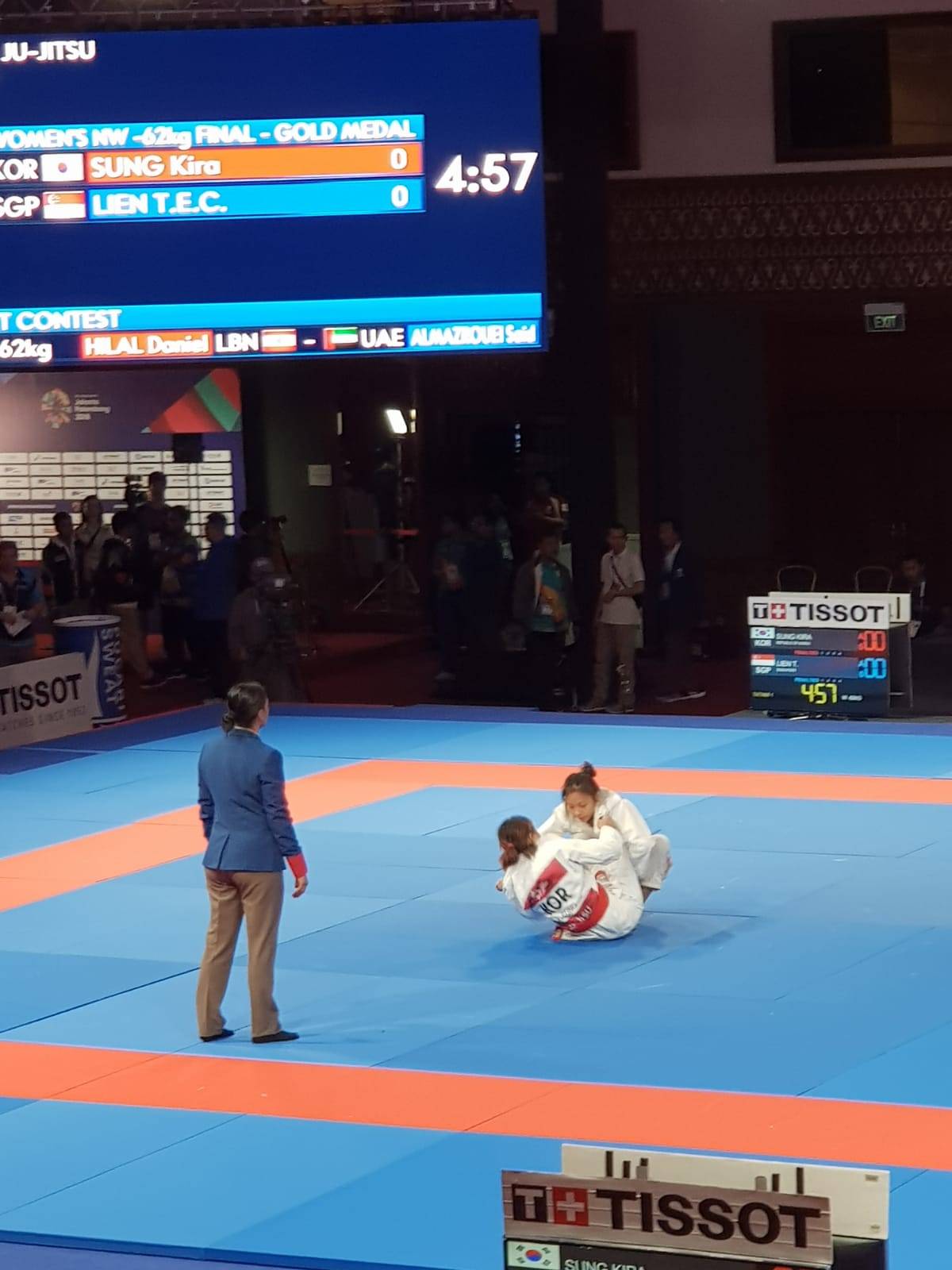
JAKARTA: Singapore jujitsu exponent Constance Lien has made history by winning Singapore’s first-ever medal for the sport at the Asian Games.

Lien lost to South Korea’s Sung Jira by 2-4 in the women’s under 62kg final on Saturday afternoon (Aug 25) at the Jakarta Convention Centre to clinch silver.

En route to the final, the 19-year-old beat Turkmenistan’s Krovyakova Violetta 6-0 in the semis. 

She also beat Mongolia’s Battsogt Buyandelger, Thailand’s Sangsirichok Onanong and Indonesia’s Julia Simone all by submission in the round of 32, round of 16 and the quarter-finals respectively. 

Constance Silver Medal

Singapore’s Constance Lien and South Korea’s Sung Jira in action at the 2018 Asian Games. (Photo: David Liew)

This is the first time that jujitsu is being contested at the Asian Games.

Lien came to the fore when she won golds in the under-58.5kg category and the absolute division at the Manila Open IBJJF Competition this year.

Constance LIEN semis 1

Singapore’s Constance Lien competes against Indonesia’s Julia Simone in the women’s under 62kg semi-finals at the 2018 Asian Games. (Photo: David Liew)

Constance LIEN semis 2

Singapore’s Constance Lien competes against Indonesia’s Julia Simone in the women’s under 62kg semi-finals at the 2018 Asian Games. (Photo: David Liew)

Get the widest coverage of the 18th Asian Games (Aug 18 – Sep 2) from Jakarta and Palembang, Indonesia on Mediacorp. Go to toggle.sg/AsianGames2018 for details.

Source link

‘The future of Singapore swimming is very bright’: Joseph Schooling

0

SINGAPORE: Olympic champ Joseph Schooling may have set pulses racing with his exploits at the 2018 Asian Games, but what got the Olympic champion pumped at the meet were two standout swims from young Singaporeans – 18-year-old Darren Chua and 16-year-old Jonathan Tan.

Speaking to reporters after the arrival of Singapore’s swimming, gymnastics and fencing teams at Changi Airport on Saturday (Aug 25), Schooling paid tribute to the performances of his younger teammates.

“We have a lot of young talent coming up – relays were great, I was very excited about that,” said Schooling. “The future of Singapore swimming is very bright and we have time before (the) Tokyo (Olympics). I think we’re going to get better and better every year.”

Joseph Schooling hugs father Aug 25, 2018

Joseph Schooling embraces his father Colin, after returning from an Asian Games outing which saw him finish with two gold and two bronze medals. (Photo: Matthew Mohan)

Singapore national swimmers ended their Asian Games campaign on Friday with six medals – two golds, a silver and three bronzes.

Schooling won gold in both the 50m and 100m butterfly, and helped the men’s 4x100m and 4x200m freestyle relay teams to bronze.

Roanne Ho, 25, won a silver in the women’s 50m breaststroke after Japan’s Miho Teramura was disqualified, while the women’s 4x100m medley relay won a bronze, also after disqualifications.

READ: Singapore swimmers ‘surpassed expectations’ at Asian Games, say coaches

Schooling, 23, was quick to single out two youngsters, Chua and Tan for their standout showings.

“Those two swims among a lot of other swims really stood out for me – I actually feel very excited talking about it right now,” Schooling added.

Asian Games 4x100m freestyle relay Team Singapore

Team Singapore’s 4x100m freestyle relay team, Quah Zheng Wen, Joseph Schooling, Darren Lim and Darren Chua, celebrates after clinching bronze. (Photo: SNOC)

The quartet of Schooling, Quah Zheng Wen, Chua and Darren Lim set a new national record in the men’s 4x100m freestyle relay while Tan, Schooling, Quah and Danny Yeo combined to clock a new national record in the men’s 4x200m freestyle relay.

Seven national records fell during the Games – with youngsters such as Glen Lim, 16 setting a national record in the 800m freestyle and 15-year-old Gan Ching Hwee clocking a new national record in the 1500m freestyle.

According to national head coach Stephan Widmer, these represent some of these fruits of Schooling’s gold medal at the 2016 Rio Olympics.

“Joseph had started to give Singaporeans the belief that Singaporeans can compete with the best in the world,” said Widmer. “Now you can see coaches believe, swimmers believe and it’s a great momentum.

“These kids have prepared, they not just have physical abilities but they have mental abilities and they did really well and (did) the nation proud.”

READ: Schooling mania strikes Jakarta as Indonesians cheer Singapore’s golden boy

For Tan, a Games debutant and the anchor of his relay team – the achievements of his seniors, including Schooling, has given him new confidence.

“Before I knew them or trained with them, I always thought that SEA Games was maximum you can go. After Jo won … it just gives you the belief that it is possible. Singapore has the capability of producing such athletes.”

Team SG Jonathan Tan

Singapore’s Jonathan Tan poses with coach Ang Peng Wee. (Photo: Facebook/Ang Peng Wee)

But with powerhouse China and Japan finishing the swimming competition with 19 gold medals apiece, part of the challenge will now be for the next generation of Singapore swimmers to bridge the gap. 

“They have a great sporting history – those two countries are sports powerhouses,” said Schooling. “I think Stefan brought up a good point – he said that we got the third highest, medal count behind China and Japan. So, we’re getting there, right?”

For the young swimmers, Schooling’s exploits remind them that they can challenge swimmers from regional powerhouses.

“It pushes us a lot. Seeing him being able to win a gold medal, its like – any Singaporean can do it,” said Chua “It helps to motivate us to want to win a medal, to train even hard and get into the Olympic level.”

Added fellow youngster Cherlyn Yeoh: “He has excellent work ethic, the way he trains is really hard and he is not complacent about his Olympic gold medal. 

“You always see him training hard – pushing himself in training and it motivates you. If he’s pushing himself so hard, then why can’t I?”

Get the widest coverage of the 18th Asian Games (Aug 18 – Sep 2) from Jakarta and Palembang, Indonesia on Mediacorp. Go to toggle.sg/AsianGames2018 for details.

Source link

He took out his life savings in Singapore to rescue children in India

0

GORAKHPUR, INDIA: Fascinated by a boy turning cartwheels and performing somersaults outside a railway station, Mr Ravi Rai Manas leaned forward for a closer look, and was horrified by the sight of maggots wriggling beside a wound on the boy’s head.

With a smile, the boy, oblivious to his condition, stretched out his hands and asked for money. The startled Singaporean promptly led the eight-year-old to a doctor, who removed eight maggots from his head.

“It was the first time I had seen maggots,” said Mr Rai, 56. “The boy had hurt himself performing for money. He had no money to see a doctor, and he scratched his wound till it became bigger.”

The boy, who left home when he was six, was living alone on the streets of Gorakhpur city, surviving on very little money from begging and performing.

That encounter in 2000, two years after Mr Rai started the organisation Children of Mother Earth (Come) in his ancestral village of Pharsar, cemented the former civil engineer’s conviction to help poor children, including runaways, orphans and victims of trafficking.

OTRD chef mission India 7

Mr Ravi Rai with children rescued by his organization.

The organisation rescues and rehabilitates them by providing clothing, education, food and shelter.

And in the case of the beggar-boy, named Soneo, who took refuge in Come for eight months, he was also reunited with his family in another village, Mr Rai said proudly.

His mission in India is featured in a four-part On The Red Dot special, as celebrity chef Robin Ho tracks down Singaporeans who have gone off the beaten track to work for a social good. (Watch the episode here.)

FIRST GLIMPSE OF POVERTY

In 1998, Mr Rai left Singapore with his life savings of S$300,000 to return to the northern tip of Uttar Pradesh state. It is among India’s most backward regions, with poor roads and minimal power supply in many villages.

And it had been calling to him since he glimpsed its poverty on his first trip to India as a 10-year-old accompanying his parents to visit relatives in their ancestral home.

OTRD chef mission India 8

“There were children walking around with no slippers and torn clothes during winter (temperatures dropping to 7 to 8°C). And they had little food,” he recalled. “I’d never witnessed anything like this. It opened my eyes to poverty.”

His parents encouraged him to share his belongings with them – his extra pair of slippers, books and food. “(The children) appreciated me sharing things with them, and I started reading and thinking about life,” he said.

After completing primary school in Singapore, he left for India to study, and graduated in civil engineering from a university in Allahabad, Uttar Pradesh.

He returned to Singapore to work as a civil engineer, with another purpose in mind: To save money to help the poor in India, especially the children.

OTRD chef mission India 10

When he was 35, thinking he had saved enough, he told his parents he was leaving Singapore.

“I was very clear about what I was going to do,” said Mr Rai, who would also have a rental income of S$2,000 from his three-room flat in Dover Road.

His mother was concerned about his safety, while his father, who has since died, encouraged him. A young Ravi had accompanied his dad to distribute necessities to the poor in Pharsar, and that generosity “rubbed off on me”, he said.

My father said he was very proud of me having chosen this path. He told me, ‘This is the way life should be, to give back to society.’

“He was my guru,” added Mr Rai.

‘OUR HOME’

So he quit his comfortable life in Singapore, relocated to India and converted the second floor of his ancestral home to house destitute children.

OTRD chef mission India

“This is our boarding facility. They live here until the age of 10. After that, depending on their needs, we transfer them to other centres,” he said.

Inscribed on the building is the phrase “humanity is our religion, earth is our motherland”.

“Religion is a very sensitive issue in this area. Children from any religion, if they come here for help, will be given help. Humanity means helping each other, and that should be the real way of living,” he explained.

The not-for-profit organisation started with 20 children but has since expanded to four centres across India, with over 200 children.

OTRD chef mission India 9

The boarding facility in Mr Rai’s home.

Its Gorakhpur centre is situated in an old railway shed, where the older boys study and live. It is called Apna Ghar (“our home” in Hindi), a name given by the children.

“They tell me that whenever the police or people ask where they’re going, they’d say, ‘We’re going to our home. We’re going to Apna Ghar,’” Mr Rai said.

It took him some time to feel at home, however, living as he did with no salary, no internet access and just eight hours of electricity a day. He said:

Can you imagine how a Singaporean would feel? But some of the children were learning, and that gave me strength. The material needs became secondary.

VICTIMS OF TRAFFICKING

Many of the children he has rescued had been beggars at Gorakhpur’s railway station. Most of them came from villages.

OTRD chef mission India 3

“The people in the villages are relatively poorer, so whenever the family faces some problem, (the children) would go to the cities, and they end up at the railway station,” he said.

Up to 100,000 lost and runaway children arrive at India’s railway stations every year. They beg, sell drinks and cigarettes or work illegally during the day, and sleep in the streets at night, huddled together for warmth in winter.

Some of them end up in the hands of syndicates, becoming victims of the organ or sex trades. And Gorakhpur is reported to be emerging as one of India’s biggest child trafficking hubs.

In April, non-governmental organisation Safe Society claimed to have found over 500 victims there in the last three years. “A lot of traffickers are here for the children,” confirmed Mr Rai.

“They make them work in tea stalls and don’t pay them. Some later end up in gangs … There are older boys connected to criminals, and they get involved in pickpocketing, stealing and snatching.”

OTRD chef mission 4

Mr Robin Ho with Mr Ravi Rai as he talks to children at the railway tracks.

Given that he approaches children at the stations to offer help, he has been questioned many times by the police, who suspected he was a trafficker.

He was even detained at a police station once, but was released after a senior officer vouched for him.

LETTING GO OF THE EGO

One of Mr Rai’s greatest challenges came when he started to run out of funds after three years.

He had a “big ego”, never would he take donations to fund his operations “because of what people would think about me”, he admitted. “I was too concerned about it.”

OTRD chef mission India 11

Mr Rai had enough money to run the centre in his ancestral home, but when his organisation expanded into Gorakhpur, Lucknow and Delhi, his savings were gone.

The turning point was the 2001 Gujarat earthquake. He went there with S$15,000 to help a village, having refused help from his friends and relatives who wanted to donate money.

His S$15,000, for building shelters for those who lost their homes, lasted barely a week.

“I started thinking about my principle of not taking donations. I was going to leave, but I saw that the people were still suffering. It wasn’t right,” he said. “I had a big conflict between my heart and my mind.”

Today, his organisation receives contributions from donors in Singapore, the United States and from the Indian government.

Mr Rai, who said he is still not on a salary, employs some 25 staff in total, plus volunteers from the US, Singapore and China.

REUNITING FAMILIES

One of their priorities is to reunite children with their family before they fall prey to syndicates, and because their parents “must be worried and would be looking for them”, said Mr Rai.

Sometimes the parents have abandoned them. I want to know where they come from so that, in future, if the child ever wants to go back, we know the address.

On one occasion, the On The Red Dot team followed him to find the family of a young runaway who had turned up at the Gorakhpur station.

The boy, Mohan, claimed that his father had beaten him, which was why he ran away – one of the many reasons that children leave home, noted Mr Rai.

OTRD chef mission India 5

Mr Rai trying to find out why Mohan was at the station.

Sometimes they are bullied by their elder siblings, or they simply did not want to study.

In Mohan’s case, the team eventually tracked down his home after a few hours of searching.

“As we approached the family … (there) was anger and then surprise. ‘What’s going on? Who are these people coming to our village?’ And then it became sadness. But eventually, I think, love took over – there was some forgiveness,” described Mr Ho.

Mohan was lucky, as some children who run away to the city are often sold, sometimes maimed, and forced into begging, Mr Rai told the boy’s father.

OTRD chef mission India 6

Mohan reunited with his family.

A MORE MEANINGFUL LIFE

On another occasion, Mr Rai accompanied one of his charges, Gopal, to visit his family in Gorakhpur. The family beg for a living, which gives them less than US$2 (S$2.70) a day, barely enough to stay alive.

Their home is basically a shelter with some plastic sheets, propped up by bamboo.

Gopal has two siblings who are still begging at railway stations, and Mr Ho observed that they looked dirty and “completely different” from their brother, with their long, unkempt hair.

OTRD chef mission India 1

The makeshift shelter where Gopal’s family lives. Sometimes the authorities would chase them away.

“Ravi tried to convince the other boys to come to the home so that he could provide them with education and shelter,” said Mr Ho. “I also saw their brother trying to ask.

“But I think the brothers were stopped by their parents because they needed them to continue to beg.”

To date, Come has rescued, sheltered and provided education for over 2,000 children, and transformed their lives.

Asked if he missed Singapore after all this time, Mr Rai said he returns home once or twice a year to visit his family and friends and to recharge.

“This place encourages me a lot – everything works here. In India, there’s no system,” he said with a laugh.

But I’m happy to have chosen this life. It’s more meaningful. I can make a difference.

His plan for the future is to start an academy in India that would be similar to the Institute of Technical Education (ITE) colleges in Singapore.

OTRD chef mission India 12

Children rehearsing for their performance at India’s Independence Day celebrations.

“I want to focus more on vocational training for some of these kids. They don’t have enough colleges like the ITE,” he said.

“I want to open some so that these children don’t loiter in the streets and hang out at railway stations.”

Ravi Rai Manas is one of four Singaporeans on a social mission abroad who feature in On The Red Dot. Watch this episode here. New episodes air on Mediacorp Channel 5 every Friday at 9.30pm.

Source link

CNB arrests 7, seizes drugs worth more than S$250,000

0

SINGAPORE: A variety of drugs with a street value of more than S$250,000 were seized in an operation by the Central Narcotics Bureau (CNB) on Friday morning (Aug 24).

Seven suspected drug offenders, all of whom are Singaporean, were arrested.

In a statement, CNB said its officers were deployed to observe the hideout of a suspected drug trafficker near Woodlands Crescent. The suspect, a 35-year-old male, was believed to be dealing in a sizeable quantity of drugs.

During the observation, CNB officers spotted another suspected drug trafficker, a 43-year-old male, entering the hideout.

Using specialised forcible entry tools, officers from CNB’s Special Task Force burst into the unit and arrested both men before they were able to dispose of the drugs.

CNB op Aug 24

Packets of heroin found at Woodlands Crescent in a drug bust on Aug 24, 2018. (Photo: Central Narcotics Bureau)

A total of 2.9kg of heroin, 2kg of cannabis, 100g of Ice, 45 ecstasy tablets and a bottle of methadone were found. Cash amounting to S$21,170 was also seized.

Two female suspects in the unit, a 30-year-old and a 32-year-old, were also arrested.

The 35-year-old man fainted during the search of the hideout, and was taken to hospital by ambulance.

CNB also arrested three other known associates of the 35-year-old male suspect on the same day.

CNB op Aug 24 - 3

Heroin and Ice recovered from a unit at Yishun Avenue 11 in a drug bust on Aug 24, 2018. (Photo: Central Narcotics Bureau)

Two of the suspects, a 42-year-old male and a 48-year-old male, were arrested in a unit at around Jurong East Street 24.

Police also seized about 12g of Ice and a small amount of cannabis from the premises.

The other known associate, a 48-year-old male, was arrested at Yishun Avenue 11. About 630g of heroin and 50g of Ice were also recovered.

Investigations into the drug activities of all the suspects are ongoing.

According to CNB, 2kg of cannabis is enough to feed the addiction of about 286 abusers for a week, while 3.53kg of heroin is enough to feed the addiction of about 1,681 abusers for a week.

Source link

Commentary: Strong political commitment to housing is precisely what younger Singaporeans need

0

SINGAPORE: Where does an award-winning conductor who directs world-renowned orchestras call home?

That question would likely summon images of a grand Beverly Hills mansion or a luxurious skyscraper penthouse in London.

But Wong Kah Chun, chief conductor of the Nuremberg Symphony Orchestra, calls his Jurong West HDB flat “the best because it is home”.

His story, told by Prime Minister Lee Hsien Loong at the National Day Rally (NDR) this week, will have likely resonated with many Singaporeans who value the simple, sturdy comforts of home.

BOLD MOVES ON HOUSING RECEIVED STRONG SUPPORT

It wasn’t just Wong’s story that threw housing in the spotlight at NDR 2018. Many bold plans were announced.

A new programme to redevelop more HDB flats before the end of their lease known as the Voluntary Early Redevelopment Scheme (VERS) received praise, as did the announced expansion of the Home Improvement Programme.

For months, some people have been watching for the Government’s response as discussions have developed about HDB flats being returned to the state when their lease runs out and the implications for the value of people’s homes.

Wong Kah Chun NDR 2018

Wong Kah Chun, a conductor and composer, at the 2018 National Day Rally. 

Interest in the issue was sparked by the announcement last June that land occupied by residences at Lorong 3 Geylang would be taken back by SLA when their lease expires in 2020. Prior to that, Minister for National Development Lawrence Wong had posted on Facebook to remind people of this fact.

That prompted some people to ask if they would be “stuck” with a flat they couldn’t sell because the Government will take it back after 99 years.

Several housing experts weighed in to discuss the implications and suggest ideas to tackle this conundrum.

Consider the gradual privatisation of all HDB flats or shift the housing model towards renting, said one. But study the impact of any policy review on retirement adequacy and on CPF savings, said another.

READ: Can shifting the emphasis to renting help solve Singapore’s public housing puzzle? A commentary

READ: 99-year HDB flats a chance to review homeownership and retirement policies

In this context, PM Lee’s announcement that the Government will take back eligible precincts after they reach 70 years or more and help residents get another flat under VERS fired a salvo in the face of concerns.

There are uncertainties and conditions, like needing most residents to say yes to VERS after selection and compensation will be less generous than under SERS, the selective en bloc redevelopment scheme.

But while the details are still to be worked out, the broad policy is a reassuring signal that the importance of people’s relationship with their homes is understood and potential policy problems will be addressed.

This move was strengthened to give owners of larger flats more options in unlocking the value of their apartments, when Minister for National Development Lawrence Wong announced the following day that the Lease Buyback Scheme would be expanded to cover all HDB flats.

File Photo HDB flats

HDB flats in Toa Payoh. (File photo: Calvin Oh)

A PROBLEM NOT FOR MANY YEARS YET KEENLY FELT BY THE YOUNG

Some ask why worry over expiring leases now, when the issue would only rear its ugly head many decades from now? After all, the vast majority of flats have more than 60 years of leases remaining.

But for someone whose grandparents live in Queenstown, where some HDB flats have leases that will expire in about 50 years, I share the anxieties about the fate of these first mass use cases.

The image of elderly residents having to vacate their homes after their lease expires troubles me when I meet families there, even though this scenario will not apply to my grandparents, as they are in their 90s.

Each time I walk along Stirling Road from the MRT station to their home, and pass by blocks of flats as old as theirs, I shudder at the possibility that Singapore might end up with run-down “ghost towns” of neighbourhoods of apartments no one wants to buy because their leases have passed the half-way mark and shuttered shops which no one wants to rent because of low foot-fall.

So it’s not just a worry about expiring leases but of estates emptying out and decaying as neighbourhoods age.

YOUNG SINGAPOREANS WANT THE SAME SOCIAL COMPACT OUR PIONEER GENERATION HAD

Yet, this bleak outlook is not congruent with my grandparents’ views about housing.

In fact, my grandparents’ experience suggest many of the pioneer generation of Singaporeans have come to regard their flat not just as a reliable roof above their heads but an almost unshakeable assurance of social security across the years.

They say their flat was a refuge against the daily toil and life’s uncertainties in Singapore’s first decades as a young nation.

Old HDB flats in Singapore

A block of flats in Singapore. (Photo: Marcus Mark Ramos)

They are also beneficiaries of the heavily subsidised Home Improvement Programme, and have seen a new utility room added coupled with the replacement of ageing bits like the toilets, pipes and windows a few years back.

They enjoy having breakfast at nearby Mei Ling Street Market, which was recently renovated and made more vibrant, attracting more friendly faces to the area.

While they appreciate the physical works, what these upgrading exercises represent to them is an affirmation that the value of their homes can be preserved. And they don’t just mean dollars and cents.

Many observers focus on this generation benefiting from higher housing prices. Indeed, my grandparents’ flat is now worth 40 times what they paid in 1971.

But when I talk to them about Queenstown, what gets first mention is how proud they are of their spruced-up home and how upbeat about the future they feel when they see that neighbourhood amenities are modern and buzzing with activity.

HOUSING AS SOCIAL IMPACT RESOUNDINGLY INTACT

Access to affordable, quality housing in vibrant neighbourhoods is not some abstract concept, but a lived reality most Singaporeans have a stake in. More than 90 per cent of residents are homeowners, and 80 per cent live in HDB flats.

In this context, these bold moves on housing have provided stronger reassurances and strengthened it as a key pillar of Singapore’s social compact.

We may be 20 years away from the first case of VERS, but its announcement has given many neighbours where my grandparents live some confidence of an option when the flat reaches 70 years or so, if their precinct gets selected.

Many also tell me they now see a longer-term future in Queenstown, and look forward to the possibility of another upgrading under the Home Improvement Programme II announced by PM Lee, and more broadly to their estate being revitalised over time with redevelopment.

NEVER DONE BUILDING SINGAPORE

There was one more thing at NDR that moved me – the CGI showing a visualisation of the Punggol waterway area played at the rally almost 10 years ago superimposed with recent footage of the neighbourhood shot by a drone from the same angle.

Punggol

A model of the Punggol Town Square along the waterway. (Photo: HDB)

It was an exciting sight to see what was planned for a decade ago has now materialised. 

For my younger sister, who has just moved into a brand new apartment on Anchorvale Crescent with her husband and newborn son, this bright reality underscores this social compact.

She speaks often to my grandparents and hears the same positive tales about what makes Queenstown their home.

And like many new homeowners of our generation, she hopes to enjoy the same assurances about housing my grandparents were privileged to.

“We will never be done building Singapore”, PM Lee said at the end of his rally speech.

But it’s assuring to see this strong political commitment to long-term planning, which has underpinned public housing for the pioneer generation of Singaporeans, undergird this social compact for a new generation of Singaporeans who call Singapore home.

Lin Suling is executive editor at Channel NewsAsia Digital News where she oversees the Commentary section.

Source link

The painless, potent ‘shock’ treatment for men who struggle to perform in bed

0

SINGAPORE: “Shockwave therapy for the penis” can be an intimidating proposition, admitted Travis (not his real name), a Singaporean male in his late 30s. Yet five months ago he tried the treatment in a bid to fix his erectile dysfunction (ED) – and it worked.

“People might be put off by the word ‘shockwave’, but there’s nothing to be afraid of. It was painless, there was no discomfort,” he described. “And it is effective. My performance has improved … it’s much better now.”

Despite the name, shockwave therapy actually uses external, low intensity acoustics to trigger a process that forms new blood vessels, improving blood flow to the nether regions to help enhance the firmness of an erection.

“Part of the reason for ED could be inflammation of the blood vessels or damaged tissue – and what shockwave therapy does is create better-quality tissue,” said Dr Lim Kok Bin, a urologist who has been offering the treatment at his Raffles Hospital clinic since 2016.

He added that the technology is not new, having long been used to address joint pains as well as break down kidney stones – albeit at energy levels of 100 times more.

Along the spectrum of ED remedies, shockwave therapy sits between oral medication like the instantly-recognisable Viagra and invasive procedures such as injections and prosthetic implants.

For Travis, the latter was a big no-no. He has also tried “non-conventional” supplements including traditional Chinese medicine and Viagra, but one proved ineffectual and the other produced side effects like blurred vision and headaches – so he turned to this other approach.

shockwave therapy 3

A simplified look at the shockwave therapy process (Illustration: Kenneth Choy)

“SCARY-SOUNDING”

Shockwave therapy is a more recent development than the 20-year-old blue pill of Viagra, having been first published in European research papers at the turn of the 2010s and only arriving in Singapore in 2014.

Today it is readily available here at private clinics, Raffles Hospital, Singapore General Hospital, National University Hospital and Khoo Teck Puat Hospital. But the treatment remains little-known: Travis believes this is due to ED being a topic “not openly discussed” to begin with, and Dr Lim put it down to a lack of advertising.

A further barrier could be what Dr Tan Kok Kuan, who runs a group of sexual health clinics, acknowledged as the “scary-sounding” name and notion – however ill-conceived – of shockwave therapy.

“The only scary thing about the treatment is that it is rather loud,” said Tan, who is Travis’ doctor. “It is completely non-invasive and completely painless.

“It feels very much like an ultrasound scan. Gel is placed on the probe and the probe is placed against the skin at the groin and the penis. If you touch the probe with your finger, you barely feel a tapping sensation,” he added.

“Patients feel nothing at all. In fact, many of my patients fall asleep during the treatment.”

Dr Lim reiterated: “I’m not sticking anything into your body, I’m not cutting you up. Nobody complains about pain – only one patient was a bit sensitive and jumped a bit. Nothing could go wrong.”

It was with those words as a guarantee that this reporter – who does not have ED – agreed to experience a standard 15-minute session involving 1,000 “shocks” on each of five different spots.

Yes, that adds up to 5,000 in total which sounded absolutely terrifying as I lay down on Dr Lim’s examination table, shivering in part from the cold of being exposed from the waist down and in part out of naked fear. But it was too late to turn back, and I clenched down hard on my teeth as he fired up the machine and went to work … 

As the doctors described, there was a bit of a din, which caused initial panic and the imagination of being repeatedly smacked down there. But I quickly realised that aside from a little warmth and a slight pattering sensation with each supposed “shock”, there was no pain at all.

It ended as quickly as it started, and with no need to worry about future repercussions, both doctors reassured.

Said Dr Lim: “Only two things will happen: It either helps you or doesn’t. The worst that could happen is it has no effect.”

He has administered shockwave therapy to around 20 patients, with only two not responding “very well” to the treatment due to psychological factors. Dr Tan, meanwhile, said: “I have treated more than 500 cases and I can safely say they have all seen some level of improvement, some more than others.”

shockwave therapy 1

The shockwave therapy machine displaying the number of shocks (5,000) and intensity (5, on a scale of 1 to 20) for the session just conducted on the reporter (Photo: Justin Ong)

FIXING MEN’S PROBLEMS FOREVER?

Dr Tan also quipped: “The joke I have with my patients is the only ‘side effect’ is injuring the wallet.”

Patients generally require six sessions divided over two to three weeks, costing in total between S$2,000 and S$5,000, depending on the clinic.

For Dr Lim, each round – of six sessions – lasts for a couple of years, while Dr Tan recommends returning for one session a year “to maintain the beneficial effects”.

Dr Lim pointed out that a two-year stretch of taking Viagra – with each pill costing around S$20 – would work out to some S$2,000 as well.

Shockwave therapy has also been touted in certain circles as a potential permanent cure for ED, compared to the temporary relief provided by Viagra. And in March this year a study recommended, for the first time, guidelines for optimal therapy at six to 18 sessions depending on the severity of the ED.

Nonetheless Dr Lim said it was still a work-in-progress with further protocols to be established, such as when to administer the treatment again.

“I would still prefer giving oral medication,” he noted. “If the patient is already doing so and it’s not helping, then I’ll suggest trying shockwave therapy while continuing to take medicine.”

Added Dr Tan: “I am very hesitant to use the word ‘permanent’. That would imply if a patient undergoes this treatment when he is 45 years old, he still will not have ED when he is 80 years old. This obviously cannot be the case.”

“Not all patients with ED will benefit from this treatment,” he explained, pointing to additional psychological and other medical factors as possible issues. “This treatment is only for men with mild to moderate ED caused by blood vessel disease.

“Therefore, patient selection is very important. Also, managing the patient’s expectations is important.”

For Travis, though, the clear advantage of shockwave therapy lies in its facilitation of spontaneous, naturally-occurring erections – unlike with pills, which have to be planned for and taken at set times before sex.

The result has been a happy spouse and a couple now eager to try for kids. “I think I’ll keep doing this for the rest of my life, if I have to,” he said, adding he was already looking forward to his next session with Dr Tan. “Need to recharge!”

Source link

Keeping employees safe and sound: On patrol with workplace safety inspectors

0

SINGAPORE: In two cars, four safety inspectors pulled up outside a warehouse, about the size of three basketball courts, in Joo Koon Circle.

“Where is the front gate? Why are there no directional signs?” asked 24-year-old Siti Hajar Salim in a perplexed tone. She was taking the lead in the operation and was acting as navigator to her buddy-mentor Aidil Mohamed Riduan, 39.

The group is from the Ministry of Manpower’s Occupational Safety and Health Division, and they were inspecting a supply company. The division has already carried out more than 2,600 inspections this year.

The inspection, carried out earlier this month, was part of Operation Junco which targets workplaces where there are greater risks from accidents involving vehicles, such as warehouses, shipyards, construction worksites and delivery businesses.

The focus on such businesses comes against a backdrop of incidents involving vehicles being the leading cause of fatal injuries at work for the past three years. There were 14 such deaths in 2017 and they included being struck by moving vehicles, work-related traffic incidents on public roads and being caught in between vehicles.

READ: Jurong Shipyard fined S$230,000 over fatal accident

The supply company occupying the warehouse space was last visited in August 2016, and was due for a new inspection, said the MOM officers. Two years ago, the company flouted several safety regulations and was let off with a warning.

Unattended forklift keys

NO-NO: Among the most common safety violations are leaving keys to vehicles like forklifts unattended. (Photo: Fann Sim)

Findings from the previous inspection include leaving forklift keys in the ignition unattended, and obstructing the emergency exit door.

BEING FAST, FIRM AND BLUNT

Once inside the warehouse, Ms Hajar whipped out her iPad and started taking photos of everything she saw that could potentially contravene safety rules even before speaking to warehouse managers and workers.

Catching her attention was a battered forklift haphazardly operated by a worker between storage racks.

She then introduced herself to the warehouse manager Mr Lim, and conducted a briefing about the day’s inspection with him – such as asking for documents like the factory’s blueprint, products they carry and clarifying the number of workers and industrial vehicles.

“Mr Lim, just now I noticed one worker. Who is that? Can you call him over please,” Ms Hajar said. She explained to Channel NewsAsia that she saw the worker operating the forklift and so his operator’s licence needed to be examined.

“Sometimes they see us, they just disappear. We ask for the worker and the worker disappears but I have photo evidence. That’s why I took the photo first,” said Ms Hajar.

Hajar taking photos of forklift

THRASHED FORKLIFT: The team found a few forklifts in very shabby condition with broken signal lights, missing rear-view mirrors and very worn out tires. (Photo: Fann Sim)

Mr Lim accompanied the team to comb through the warehouse methodically, which took an hour. “We get the warehouse manager to guide us because they know the space best,” said Anderson Ng, 30, the team leader. Their initial impressions were “so far so good” and that Mr Lim had been cooperative.

In Singapore, workplaces such as shipyards and factories that handle petroleum products or high-cost engineering works, or those with more than 100 workers are required to appoint a safety officer.

Firms like the company that Mr Lim works for are not required to have one, and so employees may be unfamiliar with safety procedures and documents vital to at-risk workplaces.

“When they make us wait, it means that there’s not a good system,” Ms Hajar said. For example, logs like the daily safety checklist for vehicles should be placed in the vehicle itself, she explained.

Broken wooden pallets

RISK: Pallets no longer in good working order might splinter further and disintegrate when it is being used to move items, making it risky for the workers. (Photo: Fann Sim)

During the inspection, the team found multiple issues – including using split wooden pallets to transport and store items, ladders used carelessly by workers, as well the very cluttered condition of the warehouse.

Ultimately, what crossed the threshold for the safety inspectors were the damaged racks still being used.

Damaged columns

IMMEDIATE STOP-WORK: After evaluating the damages on the chassis of the forklifts used in the warehouse and the bent racking columns, the inspectors concluded that there is a high likelihood of vehicles striking the racks and a high risk of the racks collapsing. (Photo: Fann Sim)

“Once you have damaged columns, the load is transferred from the beam to your columns to your foundation. It will reduce your safe working load. To how much? We don’t know. The assessor will only assess it when it is in working order but now it’s already damaged and twisted in some areas,” Mr Ng said.

The supply company was slapped with a partial stop-work order (SWO) which will be lifted only after the pallets and damaged racks have been replaced and evaluated again by a safety inspector.

MANAGING REACTIONS FROM HUMOUR TO HOSTILITY

After being served an SWO, a company representative immediately protested the decision made by Ms Hajar’s team.

“Huh! What do you mean? But we cannot not work. No sales how?,” he said tersely.

Mr Ng stepped in and said that they are not stopping the work of the company. It could continue with operations and sales but will have to stop any more work on the affected racks and pallets.

“What you can do now, you remove all the items on the damaged racks first because there is imminent danger that the racks may not be able to take the three tonnes. We are not stopping the operations like deliveries,” Mr Ng said, as he attempted to clear the air.

READ: Company fined S$290,000 over ‘numerous, glaring oversights’ resulting in death of worker

The man’s frustrated response is common, the team said, but it is something they can work with. “It’s always a two-way conversation between the inspectors and the occupier. We have to understand from them what are their needs and special operations before we can make any assessment on whether there were any contraventions,” said Mr Ng.

At another site – a shipping container yard along Penjuru Road – the officers met with a safety officer Rashad to carry out an inspection of the yard.

At this site there were several safety issues, such as not having a designated walking path for pedestrians and allowing drivers to walk under containers that were being moved.

Mr Rashad, the appointed safety officer from the occupier for the container yard, was knowledgeable about the inspectors’ work and, at times, keen to make inject some humour into the process.

‘You will see people like this trying to making a joke out of a serious situation but you have to be firm with what you are saying, what are the findings and what they have to rectify,” said Ms Hajar. 

“You can ignore all the jokes and laugh it off but the more important things need to be addressed first,” she added. 

Ms Hajar has seen her fair share of occupiers who react to her presence at their workplace in a disdainful manner. She found it challenging to get occupiers, who tend to be much older than her, to take her seriously. 

“In the first few months … I didn’t have that level of confidence yet. Sometimes when you talk to occupiers, they might even undermine you,” Ms Hajar said. 

Some have even said that they have done things their way for a long time, and Ms Hajar is too young and lacks experience. She said she has learned to handle such occupiers by being firm and she will share stories of fatal injuries with such occupiers. 

“To me, the worst safety violation is not telling your workers about the violations,” she said. 

“Going to the workplace is a proactive way of preventing accidents from happening. So when I go down and talk to the workers, it feels good. It’s very fulfilling.” 

Source link

At Asian Games, the battle for Southeast Asia’s esports market begins

0

JAKARTA/BANGKOK: “Slay the dragon!” Thailand’s national coach yells, rallying his players as they rehearse an elaborate assault for the 2018 Asian Games.

Their sport, making its debut at a major global athletic event, requires only one piece of equipment: a mobile device for playing Chinese tech giant Tencent’s online game Arena of Valor.

Competitive video gaming, dubbed esports, will appear at the Asian Games in Jakarta as an exhibition event sponsored by Alibaba’s sports arm Alisports.

It is a trial run for inclusion as an exhibition event in the Paris 2024 Olympics. But companies and telecoms are betting that the spotlight will grow the region’s esports market to match its East Asian peers, where tournaments can sell out entire stadiums in minutes.

“Everybody wants in. I’m getting so many calls that I have to charge my phone four times a day,” Thailand Esports Federation President Santhi Lothong told Reuters.

The region’s youthful population is already the world’s fastest-growing esports market, with PC and mobile games revenues hitting US$2.2 billion in 2017, a number projected to double by 2021, according to research by Niko Partners.

Members of Thailand's E-sports national team practice during a training session at a studio in

Members of Thailand’s E-sports national team practice during a training session at a studio in Bangkok, Thailand, August 10, 2018. REUTERS/Athit Perawongmetha

“The Asian Games will help esports become more mainstream in Southeast Asia and Asia,” said Johnson Yeh, who manages the region for the Tencent-owned studio Riot Games, whose blockbuster game League of Legends will be in the event.

Analysts also expect a significant boost in sales for the six games featured, half of which are owned by Tencent. Two more titles – Hearthstone and Starcraft II – are made by US gaming powerhouse Activision Blizzard, while Pro Evolution Soccer is from Japanese firm Konami Holdings.

Esports’ regional governing body, the Asian Electronic Sports Federation (AESF), chose the games for the competition, but has not made its criteria public. The federation said in May that each title must promote “integrity, ethics and fair play.”

The AESF did not respond to requests for comment. The International Olympics Committee has said games involving violence or shooting would not be considered for exhibition events.

“Being in the Asian Games legitimises our sport further among mass audiences and governments, while providing a legitimate sports dream for the players,” Yeh said.

Members of Thailand's E-sports national team practice during a training session at a studio in

Members of Thailand’s E-sports national team practice during a training session at a studio in Bangkok, Thailand, August 10, 2018. REUTERS/Athit Perawongmetha

INTO THE LIGHT

Thai Arena of Valor competitor Krit Suphattaraphong, 23, said taking part in the Asian games felt like validation of his nascent career.

“I feel like I made the right decision to pursue gaming professionally. This gives me strength to go on,” he told Reuters.

Krit – one of Thailand’s 2,000 professional gamers – said that for most of his life he played on his laptop or mobile phone late at night while hiding under a blanket from his parents.

They blamed his low grades on gaming and threatened to kick him out of the house if he didn’t quit.

Instead, he secretly registered to compete on a Thai reality TV show named King of Gamers, which pits would-be esports athletes against each other.

He was put on a makeshift team called Diamond Cobra that won the show and now represents Thailand in the Asian Games. He and his teammates are sponsored by Toyota and Thai entertainment company Kantana, which ran the TV show.

“Now my parents see it as me doing my job,” said Krit, who practices 10 hours a day. “Since I’m on the national team, they keep telling me to practice hard.”

Before they represent their country on Sunday in front of 5,000 spectators and a television audience, the team is competing in a professional Arena of Valor tournament sponsored by Singapore-based gaming and e-commerce firm Sea Ltd and Thai telecom True.

At stake? A prize pool of 6 million baht (US$181,000).

Audience members are silhouetted against a screen as League of Legends players compete at Hyperplay

Audience members are silhouetted against a screen as League of Legends players compete at Hyperplay, an e-sports tournament held in Singapore, August 4, 2018. REUTERS/Feline Lim

EXPANDING ECOSYSTEM

“Thailand was one of the first to embrace esports,” Sea chief strategy officer Alan Hellawell told Reuters. “Vietnam is one of the fastest-growing markets, while Indonesia is the one that’s coming of age in the mobile era.”

The startup, which describes itself as the region’s largest gaming platform, is partly owned by Tencent and sponsors tournaments, leagues, and training.

“With the explosion of smartphones, everyone can be an esports player. The infrastructure that took 15 to 20 years to cultivate in China is taking less than a decade in Southeast Asia,” Hellawell said.

Activision Blizzard told Reuters it has translated one of its games into Thai and was considering further language localisation for the region.

“The majority of Southeast Asia countries have recognised esports as an official sport. We really see it as a growing market,” said Southeast Asia head Paul Chen.

But for esports to graduate to being a medal event at the Asian games, it must be represented by just one organization.

Although AESF says it is the “sole competent authority for electronic sports” in Asia, South Korea’s International e-sports Federation organises separate world championships. There is no single international body.

Audience members watch as League of Legends players compete at Hyperplay, an e-sports tournament he

Audience members watch as League of Legends players compete at Hyperplay, an e-sports tournament held in Singapore, August 4, 2018. REUTERS/Feline Lim

BOOM FOR TELCOS

With two mobile titles selected for the Asian Games, regional telecoms are also set to benefit from esports. Some, like Thailand’s Advanced Info Service (AIS) and True, already sell esports data packages.

Singapore’s Singtel, the region’s biggest operator, is making esports a focus, launching a multi-game esports league and partnering with gaming hardware firm Razer on related tech. Singtel has stakes in AIS, Indonesia’s Telekomunikasi, and the Philippines’ Globe Telecom.

Singtel Group international chief executive Arthur Lang said esports’ presence at the Games shows how they are becoming mainstream, creating demand for data services.

“Southeast Asia is a mobile-first region and gaming is only just taking off,” he said.

Source link

Schooling mania strikes Jakarta as Indonesians cheer Singapore’s golden boy

0

JAKARTA: Ten-year-old Tiger has sat at the stands nearest to the athletes’ mixed zone at the Gelaro Bung Karno Aquatic Centre for the past three days.

The grade school student has been hoping to catch the attention of his hero and idol, Singapore’s Olympic champion Joseph Schooling.

“I wanted to wave at him or take a picture,” said Tiger who, like many Indonesians, goes by only one name.

But on Thursday night (Aug 23) after cheering Schooling on to his second gold medal at the 2018 Asian Games in the 50m butterfly, Tiger received a pleasant surprise.

Schooling mania GBK

Tiger, 10, was left speechless after Joseph Schooling tossed him his swim cap following the Singapore national swimmer’s victory in the 50m butterfly final. (Photo: Amir Yusof) 

Upon spotting Tiger calling his name from the front railing of the stands above him, Schooling, who was still panting from the intense swim race, tossed Tiger his black swim cap, drawing applause from nearby journalists and spectators.

Tiger promptly caught it and looked temporarily stunned.

“I was speechless, it felt like a dream,” said Tiger. “After I realised what happened, I ran back to my seat and passed the cap to my mother. I didn’t want anyone to take it.”

Tiger was among the hundreds of Indonesians who were cheering Schooling on during his two individual race wins – the 100m butterfly and 50m butterfly.

Schooling fans in Jakarta

Indonesian fans alongside Singapore fans at the GBK Aquatic Centre in Jakarta for the 2018 Asian Games. (Photo: Amir Yusof) 

Screams of “Schooling, Schooling” were unmistakable as the Singaporean touched the wall first both times.

Mr Nuryaman, a 44-year-old Grab driver who brought his two children to watch Schooling win his 50m fly on Wednesday, told Channel NewsAsia that the Singaporean champion gave many Indonesians reason to cheer.

“The swim races have so far been dominated by China and Japan. Its refreshing to see someone from this region – Southeast Asia – disrupting the supremacy,” he said.

“We want our children to be inspired. He proves that nothing is impossible, even us Indonesians can one day achieve something at the global stage.”

Following his victory ceremony for the 50m butterfly – a race in which he won by 0.04s – Schooling paid tribute to the Indonesian fans for egging him on.

“It was amazing. It’s unreal, the crowd support since I got here. It’s always a pleasure and honour to hear a crowd cheer your name like that and cheer for you that intensely.

“So it almost feels like my home over here. It’s a very, very nice feeling,” he said.

Aspiring national swimmer 15-year-old Albertus Bangun was delighted when Schooling signed his swim jersey from the stands.

“I didn’t even have to ask. We made eye contact and he immediately gestured to throw down the jersey and marker. What a star,” said Albertus.

Schooling mania

A close up of Joseph Schooling’s autograph on Albertus Andika Bangun’s jersey. (Photo: Amir Yusof) 

“I’m not going to ever wash this shirt. It’s going to hang on my wall prominently so I can see it every day,” he said.

Albertus, who like his idol is a butterfly specialist, recalled that Schooling had met Michael Phelps when he was a young boy, and he said that he wants to be similarly inspired and become an Olympic champion.

“I want to swim alongside Schooling, and race him one day. Like him, I want to make my country proud and win Indonesia’s first Olympic swimming gold,” he said.

Get the widest coverage of the 18th Asian Games (Aug 18 – Sep 2) from Jakarta and Palembang, Indonesia on Mediacorp. Go to toggle.sg/AsianGames2018 for details.

Source link
