SINGAPORE: Nanyang Technological University (NTU) will soon boast Asia’s largest wooden building, the university revealed on Monday (Aug 27).
This was announced by Professor Subra Suresh, President of NTU, as part of the university’s five-year plan to advance as a leading global university through a number of what Prof Suresh called “moonshot” projects.
The new 40,000 gross sq m academic building will cost S$180 million and is expected to be completed in 2021.
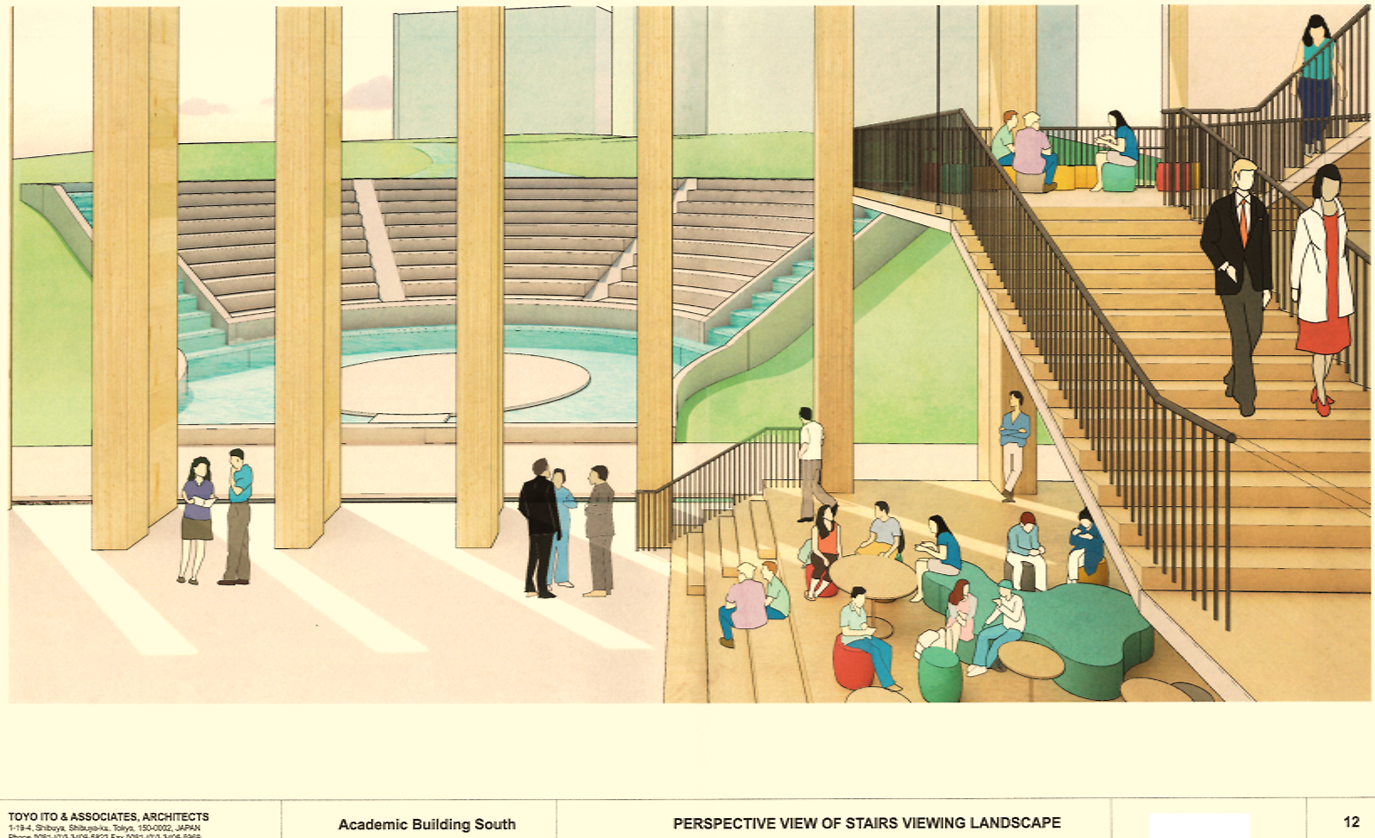
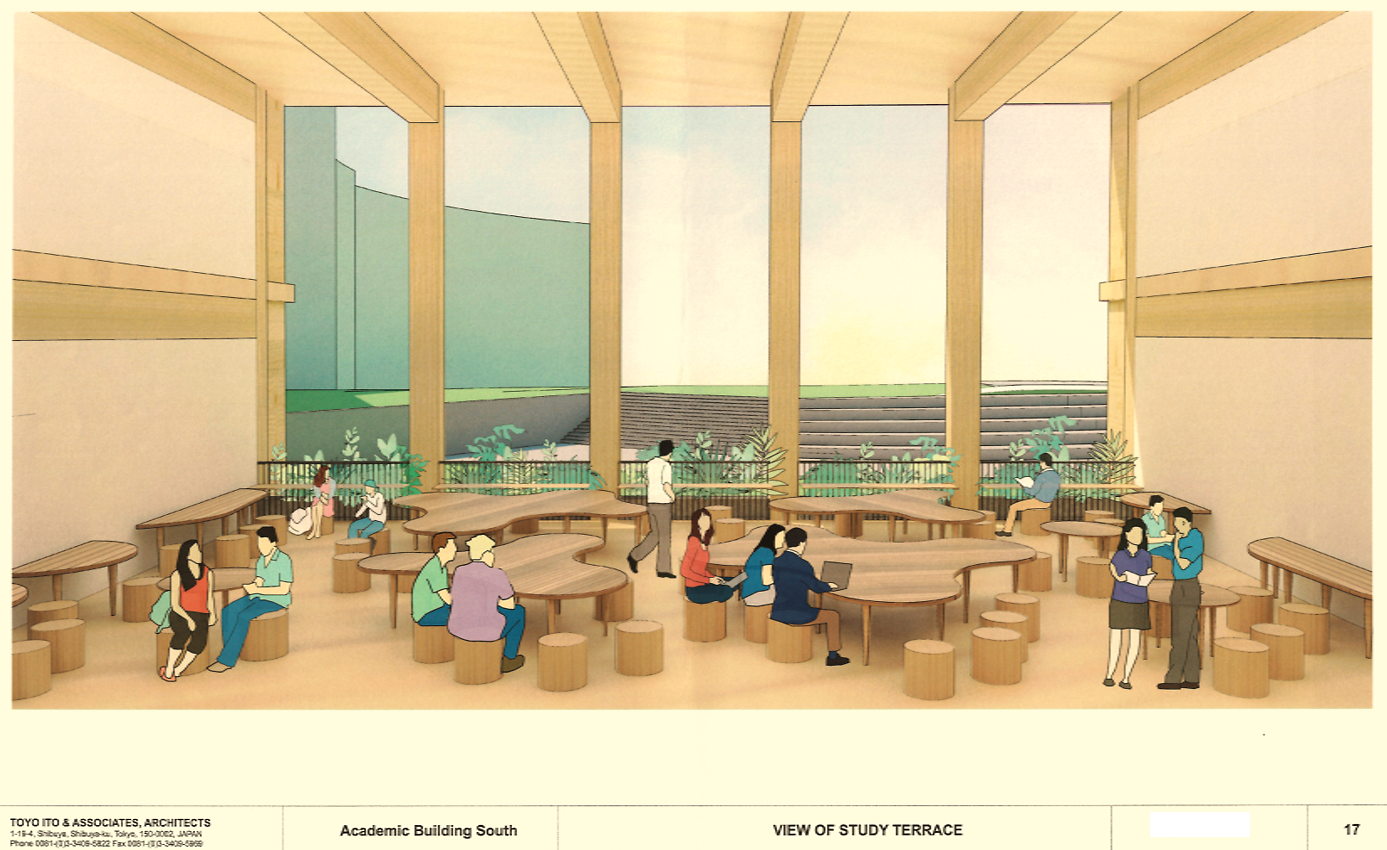
Designed by RSP Architects Planners & Engineers, who are behind Changi Airport Terminal 4, the six-storey building will house the Nanyang Business School as well as activities of several other colleges and schools, the university said in a press release.
The building will be constructed using mass-engineered timber, with material procured from renewable forests and pre-fabricated before being installed on site.
The new S$180 million academic building will span over 40,000 gross sq m. (Image: RSP Architects Planners & Engineers)
This will be more environmentally friendly and require less manpower than traditional construction methods, according to NTU.
“Bringing together our approaches to innovation and sustainability, the new academic building will be the largest wooden building in Asia, and it will exemplify our distinctive NTU Smart Campus and show that we ‘walk the talk’ of our commitment to sustainability,” said Prof Suresh.
NTU also has a sports hall, The Wave, which was built using mass-engineered timber and completed last year.
(Image: RSP Architects Planners & Engineers)
(Image: RSP Architects Planners & Engineers)
The university will also double the solar energy harnessed to power it to 9.9 megawatts by 2019, said Prof Suresh. This will supply between 7 and 10 per cent of the university’s electricity needs.
Speaking at a university town hall meeting, Prof Suresh announced specific targets focusing on attracting top faculty and students, developing new academic and research programmes and enhancing campus-wide community engagement.
NTU will aim to recruit about 300 faculty members over the next five years, and will support 350 new two-year “post-doc” positions to attract researchers starting this year.
The university will also renew its commitment to support the recruitment of top undergraduates through scholarships and bursaries.
“No deserving Singaporean student will be denied a world-class education at NTU because of financial or other impediments,” Prof Suresh said.
He announced another plan to create up to 100 new named professorships over the next five years, which will increase the number at NTU by about 10-fold.
“NTU’s next phase of major growth as one of the leading global research universities will critically depend on people: The recruitment and retention of top talent among faculty, staff, post-docs and students,” said Prof Suresh. “We are therefore very pleased to present a vision, and a means to achieving this vision, through a number of ‘moonshot’ projects over the next five years.”
PALEMBANG, Indonesia: Singapore clinched a joint-bronze medal in the sepak takraw men’s regu event on Monday (Aug 27) after losing 2-0 to Malaysia in the semi-final.
The team of Muhammad Farhan Aman, Muhammad Afif Safiee, Muhammad Asri Aron, Jaal Asfandi and Mohamad Farhan Amran lost to Malaysia in straight sets at the Jakabaring Sports Centre.
Singapore started the semi-final poorly, with captain Mohamad Farhan’s serves going astray on at least five occasions.
The team lost the opening set 21-8, and Mohamad Farhan was subsequently removed from the team.
Singapore’s sepak takraw team did not have a good start to the semi-final against Malaysia. (Photo: Amir Yusof)
Singapore rallied in the second set, with Muhammad Asri and Muhammad Farhan executing strong blocks, but Malaysia, who are perennial powerhouses in the sport, proved too strong and won the set 21-8.
The bronze medal in Sepak Takwraw was Team Singapore’s seventh in the sport at the Asian Games. (Photo: Amir Yusof)
The bronze is Singapore’s seventh in sepak takraw at the Asian Games. Singapore has never managed a gold or silver medal in the sport at the Games.
En route to the semis, Singapore lost to hosts Indonesia 0-2 but beat Philippines 2-1 and Pakistan 2-0 in the preliminary round.
Get the widest coverage of the 18th Asian Games (Aug 18 – Sep 2) from Jakarta and Palembang, Indonesia on Mediacorp. Go to toggle.sg/AsianGames2018 for details.
PALEMBANG, Indonesia: Singapore bowler Joey Yeo was one strike away from qualifying for the stepladder finals on Monday morning (Aug 27).
Knowing full well she needed to make the chance count, the 20-year-old took a breath, stepped up and threw her ball unto the lane.
Alas, it was not meant to be.
Due to what she called an “adjustment error”, Yeo struck down only six pins. She held her composure to knock down the remaining four pins and, as soon as she did, the tears fell.
Singapore national bowler Joey Yeo at the 2018 Asian Games. (Photo: Amir Yusof)
She had missed out on qualifying for the women master’s stepladder final – and a confirmed medal – by just 10 pinfalls. Her score of 3,837 ranked her fourth behind South Korea’s Lee Yeonji’s 3,847.
Daphne Tan reacts after scoring a strike at the 2018 Asian Games. (Photo: Amir Yusof)
Her national team-mate Daphne Tan finished fifth with 3,808 pinfalls.
“I tried to make it the best shot of my life. I knew it was make or break; I did my very best,” said Yeo, her voice shaking as she spoke to reporters minutes after her game ended.
“I executed the shot properly but unfortunately I needed to make an adjustment which I didn’t see beforehand; because bowling is like that. The movement is so quick; if you’re not on top of your game you don’t have that much leeway for mistakes, and I didn’t capitalise on that (chance).”
Yeo was understandably disappointed. She had started the day third overall after scoring 1,941 pinfalls in the first block on Sunday afternoon. Tan was fourth with 1,939.
Japan’s Mirai Ishimoto was unstoppable as she scored 3,948 pinfalls to qualify first for the women masters stepladder finals. (Photo: Amir Yusof)
But a slow start on Monday morning proved costly for the Singapore pair. After some sub-200 scores from both Yeo and Tan, the gap between them and their South Korean and Japanese opponents gradually grew bigger.
They attempted to mount a comeback, but by then it was too late.
“They were a little bit tense at the start,” said national coach Jason Yeong-Nathan.
“I’m sure they wanted to do well but … I’m very proud of these two (Yeo and Tan). They are among the youngest, and are usually (our) third or fourth bowler. (But) now when it’s time to step up, they did. They really made everything count,” he said.
Although they fell short, it was a spirited comeback for the pair after the disappointment of failing to defend their team title last Friday (Aug 24), when they finished a lowly seventh.
Singapore’s Daphne Tan in action at the 2018 Asian Games. (Photo: Amir Yusof)
“The (effort today) was for the team because our team event was a huge disappointment,” Yeo said. “Honestly it was not a great feeling, we just wanted to show everybody that we can come back stronger.
“We wanted to push even harder, and did not want to let one disappointing performance hold us back anymore.”
JAKARTA: Singapore claimed its second silver medal in pencak silat at the Asian Games on Monday (Aug 27) after Sheik Ferdous Sheik Alauddin finished second in the the men’s Class I (85-90kg) finals.
Ferdous, the older brother of world champion Sheik Farhan Sheik Alauddin, held his own against homeground favourite Aji Bangkit Pamungkas, before eventually losing 5-0.
Before this, Ferdous triumphed over Malaysia’s Robial Sobri 5-0 in the semi-final on Sunday.
This is the first time that silat has been included at the Asian Games as a medal sport, and Singapore have won a total of five medals in the sport so far in Jakarta – two silvers and three bronzes.
Earlier on Monday, Nurzuhairah Yazid also finished second in the Artistic Women’s Tunggal (Singles) Finals.
The 20-year-old ended the finals with 445 points. Indonesia’s Puspa Arumsari won gold, scoring 467 points, while the Philippines’ Cherry May Regalado took home the bronze with 444 points.
Singapore’s Nurzuhairah Yazid won the silver medal in the pencak silat artistic women’s tunggal (singles) finals. (Photo: SportSG)
“I feel really great, I know that I put in my best and already did my all,” she said. “I’m really satisfied with my performance. I was a little nervous but I didn’t let that overcome me. I kept my cool, just thought positive, I’ve trained hard and I really trust my process.”
Singapore’s three silat bronzes came from Nurul Shafiqah Mohd Saiful, Siti Khadijah Mohd Shahrem and Farhan. They clinched joint third-place finishes in the women’s Class B (50-55kg), women’s Class C (55-60kg) and the men’s Class J (90-95kg) respectively.
Get the widest coverage of the 18th Asian Games (Aug 18 – Sep 2) from Jakarta and Palembang, Indonesia on Mediacorp. Go to toggle.sg/AsianGames2018 for details.
SINGAPORE: After 13 years in the business, Singaporean chef-owner Wilin Low will close the doors of his popular “Mod-Sin” restaurant Wild Rocket.
The restaurant will serve its last dinner on Oct 31.
“Mod-Sin” – short for “Modern Singaporean” – was a style first coined by Low when he opened Wild Rocket back in 2005, with the aim of showcasing Singaporean dishes delivered with a twist.
Over the years, dishes like Low’s laksa pesto pasta, duck liver-filled ravioli in duck and salted vegetable soup, and scallop sashimi with chye poh (preserved radish) – a dish inspired by our local chwee kueh – have become popular Wild Rocket menu stalwarts.
Wild Rocket will serve its last dinner on Oct 31, 2018. (Photo: Facebook/Wild Rocket)
The 46-year-old lawyer-turned-chef cited various reasons for the closure. First, Hangout Hotel – where Wild Rocket is located – will undergo major refurbishments over an extended period of time next year. There is also some uncertainty regarding the lease of arts commune Emily Hill, where the open-air parking space also serves as the restaurant’s car park.
Low told CNA Lifestyle that he decided to take this opportunity to close so he could take a break.
“Thirteen years is a long time and a break is due,” he shared. “I’ve been thinking about it for a while as I wanted to do something different and bring Mod-Sin overseas.
“Though now with three new projects, it’s maybe not too much of a break!” he continued with a laugh.
His overseas ventures will see him opening Roketto, which he called “the baby sister of Wild Rocket”, this December in Hokkaido.
The casual dining restaurant, located at ski resort The Maples Niseko, will serve up Southeast Asian flavours with Japanese ingredients. Bah kut teh ramen, laksa somen with snow crab, braised pork rice bowls and bite-sized roti prata topped with chopped tuna are some of the items that will feature on the menu.
In the evenings, the restaurant will transform into a cocktail bar – a collaboration between Low, High Five Tokyo, Bar Mood Taipei and Nutmeg & Clove Singapore.
Also opening at the end of the year is Low’s Southeast Asian noodle concept bar in Hualien, Taiwan. The restaurant will feature local favourite Roxy laksa as one of its dishes.
Back in Singapore, Low will open his second branch of Relish – his all-day burger and pasta restaurant – at Frasers Tower on Cecil Street come November. He first opened Relish at Cluny Court back in 2006.
“I’m still thinking of giving it a little twist, perhaps a bit of Wild Rocket somewhere,” he teased.
Low also told CNA Lifestyle that there’s a possibility of reopening Wild Rocket here in Singapore.
“But not in the foreseeable future,” he admitted.
“There’s also a possibility of opening Wild Rocket overseas,” he said. “If we find the right partners.”
From now until Oct 31, Wild Rocket will serve three dinner menus – five-course, seven-course and nine-course – with a mixture of old and current items to celebrate its 13 years.
SINGAPORE: More than 2,000 flats located at a waterfront housing precinct in Punggol will be launched this month, the Housing and Development Board (HDB) announced on Sunday (Aug 26).
The flats are within the first two housing projects for Punggol Point District and are expected to be completed in 2023.
Punggol Point Cove will comprise five blocks with 1,172 units while Punggol Point Woods will have six blocks with 940 units.
An artist’s impression of Punggol Point Woods. (Image: HDB)
Punggol Point Cove is located along the eastern shoreline of Punggol Point District, HDB said, and its blocks are designed to “step down towards the promenade, so as to maximise the views towards the sea”.
Meanwhile, Punggol Point Woods is located next to the Heritage Trail, a 1.5km pathway – including a section of Old Punggol Road – that connects the My Waterway@Punggol pedestrian bridge to Punggol Jetty.
“Punggol Point is set to offer a tranquil living environment with a touch of nostalgia for its residents,” HDB said.
An artist’s impression of the Heritage Trail in Punggol. (Image: HDB)
It is one of seven waterfront districts planned for Punggol, and is envisioned to be a “Green Heritage” district that embraces nature and pays tribute to Punggol’s history, HDB added.
Plans for Punggol Point District will be exhibited at the HDB Hub sales atrium from Aug 28 and members of the public are invited to share their thoughts on what they would like to see along the Heritage Trail.
A map showing the location of the Heritage Trail. (Image: HDB)
The Heritage Trail is a nod to the history of Punggol, which was known in the early 1900s for its poultry, pig-rearing, fishing, fresh produce farms and rubber plantations.
The Old Punggol Road was the main route for many farmers, fishermen and traders who lived along the coastal district from Punggol to Serangoon to transport their harvest.
The route will be preserved through a 10m green buffer zone on both sides of the carriageway and an old bus stop will be retained to serve as a rest stop.
An old bus-stop, where bus services 82 and 83 once plied, has been retained to serve as a rest stop. (Photo: HDB)
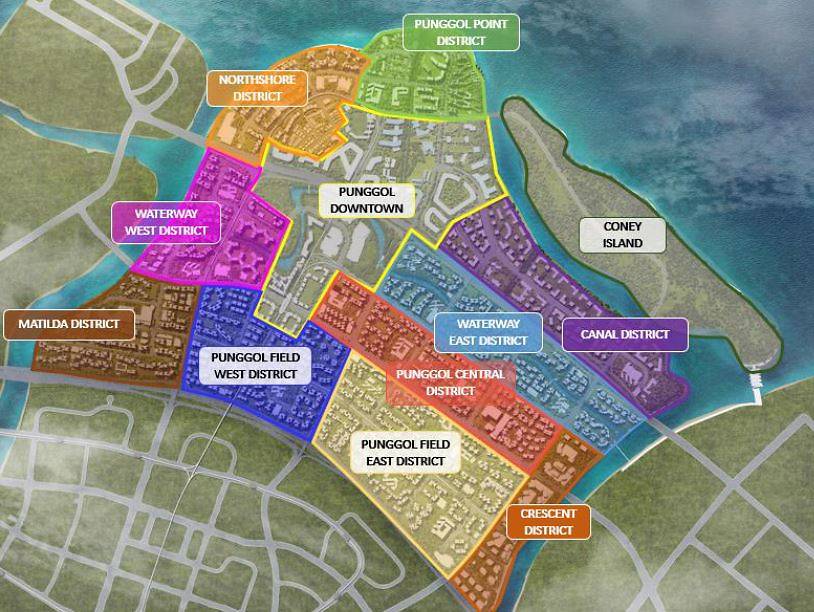
The other waterfront districts in Punggol are Waterway East, Waterway West, Northshore, Matilda, Canal, and Crescent.
To date, HDB has launched some 25,700 flats in 31 Build-To-Order projects in Punggol, across Waterway East and West, Northshore and Matilda.
“The projects have been well received, with close to 100 per cent take-up rate for most of the projects,” HDB said.
A graphic showing Punggol’s 11 districts. (Image: HDB)
SINGAPORE: Every four years, an event named BMW World treats fans to an extravaganza of all things, well, BMW.
This year, the overarching theme of the event, held at Suntec International Convention and Exhibition Centre from Aug 25 to 26, was “passion and joy”, it debuted a good number of high-octane performance models to the public.
The big surprise of the show was the appearance of the brand-new Z4 roadster, a car that had just enjoyed its global unveil several hours before the opening of BMW World Singapore at the Pebble Beach Concours d’Elegance in Monterey, California.
Joining the Z4 was the Singapore reveal of the carmaker’s flagship two-door sports car, the 8 Series, plus the white-knuckle M2 Competition and frugal-yet-rapid hybrid i8 Roadster.
Also in attendance was the BMW Group’s other brand Mini (the Bavarian automaker has owned it since 2000). Virtually its entire range was there, including the Clubman station wagon and Countryman compact SUV, along with a classic Mini decorated with fashion icon Sir Paul Smith’s signature stripes.
The All-new BMW 8 Series showcased at BMW World Of Passion And Joy. (Photo: nonlinear)
If you didn’t have the chance to partake in the festivities, never fear: We’ve put together the five most significant cars exhibited at BMW World that caught our eyes.
BMW i8 ROADSTER
The first BMW i8 Roadster. (Photo: BMW Asia)
To say that the i8 Coupe caused a bit of a stir back in 2014 would be a bit of an understatement.
Here was a car that looked a good decade ahead of its time, riding on a carbon fibre and aluminium chassis, and was usually the sole purview of million-dollar supercars and with a petrol-electric plug-in hybrid drivetrain delivering pace without the associated environmental guilt. Oh, and those dramatic beetle-wing doors, too.
Interior of the first BMW i8 Roadster. (Photo: BMW Asia)
But now that we’re all (somewhat) used to seeing a sports car from 2028 zipping around the roads, BMW has seen fit to release a companion to the i8 Coupe, the i8 Roadster. As its name implies, the main differentiators are a fabric soft top, “double-bubble” rear deck, and a matte grey plaque on the B-pillars bearing the “Roadster” designation. You’ll be pleased to know the i8 Coupe’s beetle-wing doors are carried over onto the Roadster.
As with the i8 Coupe, the i8 Roadster retains the electric motor/1.5-litre three-cylinder petrol engine of its hard-top counterpart, but with a slightly greater capacity for its lithium-ion battery pack. This allows the i8 Roadster to run purely on electron power for a claimed 53km at speeds of up to 120km/h.
In addition to that, the i8 Roadster also brings to the table some new colours, with the car exhibited at BMW World Singapore 2018 clad in E-Copper metallic. Orange to you and us, but to BMW, it’s high-tech orange. Or, well, E-Copper.
BMW CONCEPT X7 iPERFORMANCE
The BMW Concept X7 iPerformance. (Photo: BMW Asia)
Let’s leave aside for a moment what a massive coup getting a concept car flown over for BMW World Singapore is. Such cars are usually one-offs, made specially for motor shows (this one was first exhibited at last year’s Frankfurt Motor Show), so we can only imagine how much it’s insured for.
Anyway. The X7 may still be a concept for now, but it’s only a matter of time before it reaches production. The X7 is a clear signal of intent from BMW it wants to compete in the upper-upper echelons of the luxury SUV segment, taking the fight to the Range Rover Vogue and Porsche Cayenne Turbo.
Interiorior of the BMW Concept X7 iPerformance. (Photo: BMW Asia)
Hitherto the X7, the largest and most luxurious SUV BMW had in the range is the X5, which technically occupies the same space in the model hierarchy as the 5 Series. It’s difficult to extrapolate what the production X7 will be like, but given it’s meant to be the 7 Series in BMW’s X lineup of SUVs, expect luxury – and lots of it. That is to say, plenty of leather, premium wood trim and metal surfaces.
The X7 also represents a break from BMW tradition in that it has an exceptionally upright profile with a huge glasshouse area (the glazed surface area above the car’s shoulderline), making it more “utility” than it is “sport”. A brave new BMW for a brave new world, indeed.
BMW M5 (E39)
The BMW M5 (E39). (Photo: BMW Asia)
To simply judge the third-generation BMW M5 (with the internal codename of E39) on its looks alone would be doing it a grave disservice. It does, after all, look no more threatening than a regular 5 Series, though the more eagle-eyed will note the more butch styling, such as a small animal-swallowing front air dam, racy deep-dish wheels and quad tailpipes.
Truth be told, you wouldn’t know what you were looking at – unless you knew what you were looking at. And that’s the crux of the M5’s appeal, because lurking underneath that seemingly innocuous skin is a 5-litre V8 that develops a thumping 400hp.
Interior of the BMW M5 (E39). (Photo: BMW Asia)
Admittedly, 400hp is middling today, given that the recently launched M5 (the sixth-generation car) develops 600hp, but bear in mind this particular M5 turns 20 this year. It’s also helpful to note the E39-generation M5 had had comparable performance to a Ferrari of its day, which gives you some idea how insane it must have been in 1998.
Even more than its performance figures, though, is how the third-generation M5 is viewed today – as one of the greatest driver-focused sports saloons of the modern era. Owing to the vagaries of the COE system and a hefty annual road tax bill, fewer than a handful of E39 M5s remain in Singapore.
BMW M3 CSL (E46)
The BMW M3 CSL (E46). (Photo: BMW Asia)
If there were three letters that could send BMW fans into a tizzy, it would be “CSL”. First used on limited-run “Batmobile” 3.0 CSL in the early 1970s, BMW revived the hallowed CSL badge again some three decades later and slapped it on the M3.
An acronym that stands for Coupe Sport Leichtbau, German for Coupe Sport Lightweight, CSLs are what happens when automakers take the concept of “less is more” very seriously. And then charge for the privilege.
Interior of the BMW M3 CSL (E46). (Photo: BMW Asia)
The original 3.0 CSL deleted the interior trim, soundproofing and replaced the glass windows with plastic. The M3 CSL aped its legendary ancestor by axing most of the soundproofing, along with the electrically adjustable seats (replaced by fixed-back carbon fibre bucket seats) and the satellite navigation.
If you were feeling particularly masochistic, you could also tell BMW to leave out the air-conditioning and stereo, saving you the maximum 110kg over regular M3s. Happily enough, BMW gave the M3 CSL a smidge more power (17hp to be precise) over standard M3s, for a grand total of 360hp.
As with the E39 M5, the M3 CSL is an incredibly rare sight on Singapore roads, again with fewer than a handful around. That’s not so much down to our vehicle ownership system, but more because BMW only made 1,383 of them back in 2004.
THE NEW BMW 8 SERIES
The all-new BMW 8 Series. (Photo: BMW Asia)
If looks could kill, the BMW 8 Series would do it. All long of nose and low-slung of silhouette, with an aggressive overbite known in automotive design circles as a “shark nose”, it’s clear the all-new 8 Series means business.
If its badge sounds familiar, it should. It revives a nameplate last seen in 1999, and while it may be marginally smaller than its predecessor, it stays true in spirit, at least. Pitched as BMW’s top-of-the-line, two-door sports car, the 8 Series was, and is, a grand tourer of the highest order.
Interior of the all-new BMW 8 Series. (Photo: BMW Asia)
Made to have equal amounts of speed, comfort and mile-gobbling ability, the 8 Series exhibited at BMW World Singapore was a pre-production example, with it set to go on sale in the months to come.
However, what we know about it so far, we really like. A chassis comprised of exotic materials like carbon fibre, aluminium and magnesium help keep the weight down while maintaining rigidity.
The new 8 Series also plays host to other small, but clever ergonomics touches. BMW says the low seating position in the rear seats negate the need for headrests, which is handy because cars of its ilk tend to have fairly small rear windows, and headrests can eat into what is already spare rearward visibility.
Test drives can be booked at the Performance Motors or Performance Munich Autos showrooms.
SINGAPORE: My conversation with Education Minister Ong Ye Kung begins with him describing the lowest point of his political career.
Mr Ong has risen swiftly through the ranks since he, as part of a People’s Action Party’s (PAP) team, won in the Sembawang Group Representation Constituency (GRC) in the 2015 general election.
As we sit down to discuss issues recently brought up in the Prime Minister’s National Day Rally speech and the ups and downs of his own political journey, my first question to him is to describe the highest and lowest points of his career so far.
He chooses to start at the bottom, as if wanting to get it out of the way quickly.
“Let’s start with lows since I lost my first election. I don’t brood over it. But it was tough.”
He is referring to being part of the team that lost in 2011 to the opposition Workers’ Party (WP) team in Aljunied GRC. That was the first time an opposition party defeated the PAP in a GRC.
“It opened my eyes to how tough it can be. The national mood wasn’t so good and we faced a very strong WP team led by Low Thia Khiang. His jumping over (to join the GRC team), I think, made a big difference. But we fought the best fight we could.”
He refers to it as a “baptism by fire” and says that going into the election, he didn’t expect it to be so tough.
I wonder why he failed to sense the national mood.
“I was a rookie and just wasn’t mature enough as a politician. With many things in life, you have to go through it, experience it, and then you grow up. The important thing is with a setback like that, you have to bounce back, learn from it.”
Indeed, he learnt a “tremendous lesson”.
“The reality of politics, how important it is to sense the mood, move the masses, be able to put yourself forward as a credible person who would help residents change their lives. Another key lesson is an internal one – when you face a setback like that, how do you pick yourself up and soldier on?”
After the defeat, he stayed in his job as Deputy Secretary-General of the National Trades Union Congress for about a year before leaving to go to the private sector to take on the role of director of group strategy at Keppel Corporation.
Prior to this, he had been a high-flying civil servant who started off at the Ministry of Communications in 1993, before moving over to the Ministry of Trade and Industry in 2000 where he was the deputy chief negotiator for the Singapore-US Free Trade Agreement. He was also principal private secretary to Prime Minister Lee Hsien Loong from 2003 to 2005 and has also served as Mr Lee’s press secretary.
He has also held the role of chief executive of the Singapore Workforce Development Agency.
“Personally, I feel going through all this does make me a better person. You learn not to take yourself so seriously. You take your work seriously, but don’t take yourself too seriously.
“Setbacks do happen, and you just have to deal with it and bounce back … Other people have much more severe setbacks and yet they bounce back. Those are inspirations.”
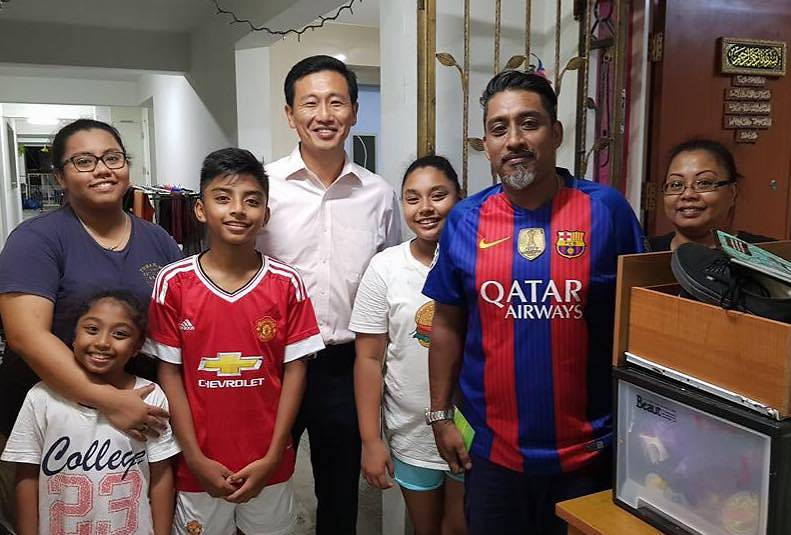
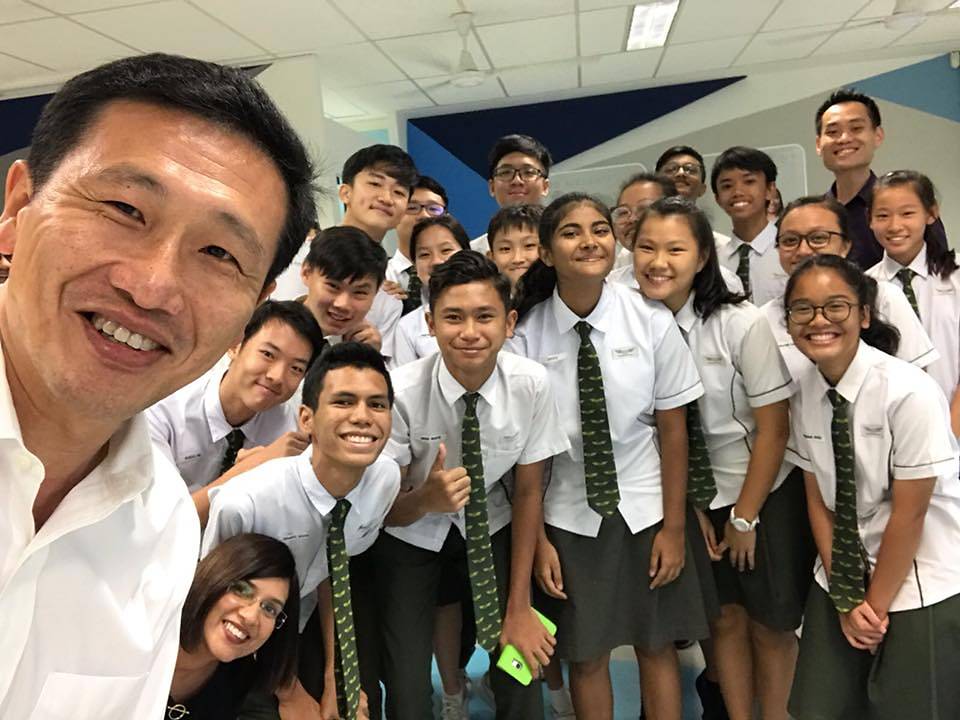
Minister Ong Ye Kung with residents. (Photo: Facebook / Ong Ye Kung)
THE POSSIBILITY OF ANOTHER POLITICAL SETBACK
As our conversation continues to more recent developments, it becomes apparent that being ready for more political challenges is not far from his mind.
Mr Lee described the schemes as ambitious endeavours that will stretch over 50 years and more, several generations, and many General Elections.
I ask Mr Ong if this is a way of securing the PAP’s position ahead of the next election.
“It’s really not about who is in government, but to have the conviction that in this little red dot, you must have longer-term polices. If you’re caught by short-termism and popularism, it’s not going to work for Singapore. Already, we are disadvantaged by size, disadvantaged by the lack of natural resources. What we have as an advantage is that as a small place, we can be more united and we can have plans that are long-term in nature, and that way, we are more coherent, our policies are more sound, more sustainable.”
He says he doesn’t think in terms of political power.
“Who wins the election and who is the government is for people to decide, but this Government believes in long-term policy. So long as we are in government, this is how we will implement the policies and people know what they will get with us as (the) Government.
“Ultimately, this is about what policies can best serve Singaporeans for the long term.”
When I put it to him that in spite of this, it’s possible that the PAP may not be in power for the long term, he acknowledges that could happen.
“It may happen. Never think any ward is safe. We are a small place … When the mood swings, the entire island will swing. I believe the day the PAP loses an election and cannot govern is when things are very bad and probably policies go awry. People don’t feel that we’re serving them anymore.
“When that happens, we will probably deserve to lose. And hopefully then, another party can come in and can carry on the long-term policies, and take the long-term perspective for the benefit of Singapore.”
“PARACHUTED” INTO POLITICAL OFFICE
After the 2015 election, Mr Ong was thrust straight into office when he was appointed Acting Minister for Education (Higher Education and Skills).
A year later, he was promoted to full education minister (Higher Education and Skills), as well as Second Minister for Defence.
Earlier this year, as the Ministry of Education (MOE) reverted to having only one minister, he was appointed to that role.
The highest point of his career so far, he says, is very much tied to this ministry.
“In my earlier years, in 2015, after I came in, I explained the need for SkillsFuture, multiple pathways and the fact that students have different passions, and we should let them pursue their passions.
“Then I introduced the early admission exercise for polytechnics, which is based not just on academic grades, but on aptitudes. That was very well-received and that was a very high point for me. It made me believe that whatever you do, you have to explain where you’re coming from, what are the principles, what are your basic foundational beliefs, and then I think you have a higher chance of people accepting it.”
His rapid rise through the political ranks has not gone unnoticed. In the initial years, some members of the public described him as having been parachuted in and questioned his credibility. This still happens from time-to-time.
“I would say judge me by what I’m delivering and what I’m doing. The path, to me, is not that easy, having to go through 2011 and the Aljunied GRC, then changing jobs and experiencing different sectors. If other people think it’s easy, and if I’m not doing a good job, I deserve the criticism. But I hope I do a good job.”
He points out that, in fact, his journey in politics began even before 2011, but he postponed his entry because of considerations for his father, who was one of 13 Barisan Sosialis legislative representatives elected in the 1963 General Election. He later had disagreements with the PAP.
“He had no misgivings with the current generation of PAP leaders, not even the 3G, 2G leaders.
“His misgivings and disagreements were with the first generation PAP leaders and over very deep-seated cultural, language issues … over the merger with Malaysia. Those were the issues. There were still a few first generation leaders around in 2006, so, I could see he was not comfortable. He said, ‘Why not later? Why not later?’
“Although he blessed it, in the end, I counted myself out. It would not have been respectful to him. He had passed away by 2011, but even before he passed away, he was a lot more at ease with the idea. So, I decided I would enter politics in 2011.
“Maybe it was a parachute, but it took me a long time to jump out of the plane,” he adds laughingly.
He counts his father as his most powerful political influence.
“It’s really a subconscious imbibing of values. I watched him when I was young, what he believes in. In politics, I believe you must have conviction, and a view in a certain direction, because if you don’t, then you’re just managing the bureaucracy. I might have gotten that from my father. He has a certain conviction. He stood on principles. If you look at it in terms of the political parties we joined, it’s different, but in terms of wanting to make a difference, I think we were on the same side.”
He admits considering other options after his 2011 defeat.
“I didn’t know whether I’ll be welcomed back, having lost once, whether I would be happier in the private sector. But having experienced the private sector, the union and public service, by 2015, I felt public service is probably what I enjoy doing the most, what I find most fulfilling. My test is this: When you are on your deathbed and you think back what you have done, I think I would have regretted if I had not come in, so when the PM invited me again, I felt I should give it another try.
“If you are not in government, then you have no policy levers. I think this is where you have a platform and an opportunity to make a big difference to many people’s lives.”
Minister Ong Ye Kung with residents. (Photo: Facebook / Ong Ye Kung)
PSLE AND THE CULTURE OF LABELLING
We move on to discussing hot-button issues in education.
In Parliament earlier this year, he addressed suggestions by some MPs to abolish the Primary School Leaving Examination (PSLE), or removing the practice of segregating students into different classes based on their academic results.
He said then that this may not reflect the preferences of a majority of students and their parents. Bold moves cannot be made recklessly, he cautioned, lest they “undo what had worked and served students well in the past”.
I put it to him that this might have served academically inclined students well, but the negative aspects of the exam cannot be denied.
Considering the stress it causes, how it judges students at a very young age, and labels them for so many more years of their lives, are the perceived plus points worth it?
“I accept that,” he said. “Sometimes the stakes are seen as very high. It really should not be.
“The key purpose is for the students to feel they have an exam that they can work towards, that allows them to consolidate everything that they’ve learnt for the last six years in primary school and know what is their level, so that they can go to a school that is more suited to their standard of learning, their pace of learning. That will be a good school to that student and that way he or she has the best chance to go as far he or she can.”
He later admits that changing perceptions about the objectives of the PSLE is something that his ministry needs to continue working on.
“You can’t have education without tests and exams, because you have to reflect how much I have learnt. So there’s nothing wrong with tests and exams. But I accept your point of view, that it can be stressful, it can be very high stakes. So, I think these are issues worth looking at.
“But don’t throw the baby out with the bathwater. We need PSLE as an important feature of the education system.”
The MOE is attempting to mitigate the perceived stakes. As part of a wider shift to move away from an over-emphasis on academic results, the T-score system in the PSLE will be replaced with eight broader “achievement levels” in 2021.
IS EVERY SCHOOL A GOOD SCHOOL?
He reiterates an example he raised in Parliament to make his case for keeping the PSLE intact.
“Switzerland doesn’t have any equivalent of PSLE, so you just send students to the school nearest their home, but as a result, there’s no choice for students. Students can’t say that I worked towards a certain PSLE result. I can look forward to a school that I want to go to. In Switzerland, there’s no such choice.”
I put it to him that if as the MOE says, every school is a good school, choice shouldn’t really matter.
“Every school being a good school does not mean every school is the same. If every school is the same, every school can’t be a good school. So when we talk about this aspiration or this vision, of every school is a good school, it is really to say, it is possible at some point, every kid can go to a school that suits him or her best and help him or her achieve the best that he or she can be … And that requires every school to be slightly different, to be strong in different areas that play to the strength of the kid. And for that to happen, choice is important.”
Education Minister Ong Ye Kung speaking in Parliament on May 15, 2018.
NARROWING THE GAP BETWEEN THE RICH AND THE POOR
He also cites other issues that proximity-based school admission raises.
“Just look at other countries where you have rich neighbourhoods with just that one rich school and all rich students go there. Then it will be a cocoon.”
I remark that under the current system, we are seeing this to a certain extent in Singapore too.
“But we can work against it, because we have the levers in place. We have the Direct School Admission (DSA) scheme that we can now make use of once we tweak the mechanisms,” he said.
“We can now recognise talent for admission into schools. And if there’s a singular talent, we can come up with a programme to develop those singular talents for students from poorer backgrounds as in the case of the Junior Sports Academy. So we take in students, including those from poor backgrounds, and train them professionally in sports.”
The subject of tuition inevitably comes up as the affluent can afford not just academic tuition, but sports tuition which gives them a leg-up even when it comes to DSA.
“The rich will always be able to take advantage of any system. Tuition is not a Government policy,” he says and maintains that the education system is being designed to narrow the differences between the affluent and the masses.
“With the right programmes and mechanisms in place, we can do this.”
He expects the expansion of MOE kindergartens to make a difference as well.
“One-third of the places are set aside for students from poorer backgrounds.”
However, I put it to him that if he is concerned that doing away with PSLE and implementing proximity-based admissions would result in greater social stratification, why not ensure a healthier socio-economic mix in neighbourhoods or situate schools better?
“You can mix the neighbourhood. Because 80 per cent of Singaporeans live in HDB, we can do some of it, but even so, not all neighbourhoods will be that mixed. But fundamentally, why take away the choice for a primary school student to work towards a secondary school that suits him best, that is strong in different areas that play to the strength of the kid?
“Different people have different strengths, and the system must be variegated enough to allow them the choice. First, to guide them to discover their own strength, and where their passion lies, their interest lies, and then have a multi-path system for everyone to pursue what is best for them.”
I wonder how he decided which school was best for him when he was growing up.
In an interview with another publication, he was quoted as saying he wanted to go to Raffles Institution (RI) “because I wanted to do well”.
I ask him what made him think that he had to go to RI to do well.
“I wanted to follow my brother. He went there, so as a younger brother, you tend to follow your elder brother. For a 12-year-old it was really just based on the fact that kor-kor went there. It was really just as simple as that.“
As it turns out, he went to a Special Assistance Plan institution, Maris Stella High School, as his Chinese-educated father wanted him to.
Mr Ong says he is happy with that choice and he “wouldn’t change a thing”.
“I think from there, I learnt how to overcome setbacks, I learn how to deal with people, talk to people, get things done. It’s very hard to articulate.”
To illustrate that today, every school has its strengths, he points out the “wonderful things” different schools are doing in the form of applied learning programmes, enrichment classes, and varied pedagogies.
He claims that attitudes on the ground are changing.
“As an MP, I visit a lot of homes. I do feel on the ground PSLE is still a stressful exam, but I think on the ground, more and more parents and students are taking a lighter attitude towards it, that this is not the be-all and end-all. If you want to apply to polytechnic or university, increasingly, they don’t just look at your academic results anyway. They look at your aptitude.
“But more importantly, is the job market. I think employers are also shifting and not just purely looking at academics. They are looking at your competencies and what you can do. The environment of moving towards advanced technology, high-tech innovative sectors is also making people feel that academics are not everything. In fact, getting your first qualification is a start of a lifelong journey and the deeper the sense of lifelong learning sinks in, the more we feel that PSLE is just really one small milestone.”
Minister Ong Ye Kung with students of Changkat Changi Secondary School. (Photo: Facebook / Ong Ye Kung)
IS THE GOVERNMENT WALKING THE TALK?
While private-sector employers might be progressively hiring based on skills and competence rather than paper qualifications, I ask him about his views on whether the Government’s hiring practices are changing accordingly.
Last year, it was reported that the Public Service Division (PSD) would stop distinguishing between graduates and non-graduates and grouping employees into divisions according to their paper qualifications.
Similar steps have been taken in the teaching profession to close the gap between graduates and non-graduates when it comes to salaries and promotions.
But is there still an unspoken partiality towards hiring graduates? Can the civil service do more?
“I would think yes, they can do more. It is doing more.
“Academic qualification does matter, but don’t put everything on an academic university education. There are different kinds of qualifications out there now, all of which can signal whether the person has the competency to do the job. So be more open, don’t just insist on one type of academic qualifications.”
He cites the Civil Aviation Authority of Singapore as a “model employer”.
“CAAS now takes diploma as well as degree graduates to become air traffic controllers. Whatever your qualification is, you come in as an air traffic controller, you go through their very rigorous training, after that you’re on probation. And once your probation is over, you can be a very good proficient air traffic controller. Everyone is paid based on performance.
“I hope the civil service, or statutory boards, because they do have quite a bit of autonomy fixing their own hiring policy, take a hard look. When a job is skills-based in nature, really, there’s no need to insist on different tiers of degrees, second-upper, first-class and so on. Really, hire based on skills and competencies.”
He emphasises that certain professions do still require a degree though and there is value in it.
“For example, don’t go to a doctor if he doesn’t have a degree, a medical degree. Certain professions you still need that degree, and therefore degree continues to be very useful.”
I point out that we don’t have a single non-graduate minister today. Can’t the Government more boldly set the tone?
“We are products of an education system of the past. But today, you look at the education system, we have students who opt for a more applied pathway through the diploma route. So you look at the students now, they’re making their choices very differently from the past. I think when they grow up, if they have interest in politics, what will be the state of ministers in future. It’s hard to say. I think you’ll get a much more diverse group coming from different pathways. I certainly hope so.”
SAGA OVER PARKING FOR TEACHERS WAS “UNNECESSARY”
As we continue talking about education, Mr Ong acknowledges that teachers play a vital role.
“My sympathies are totally with teachers. They have to face a lot of stress, a lot of demands from students, from parents, from MOE. But they are a very professional lot. I have great respect for teachers in MOE. It’s the backbone of our system. The entire quality of (the) education system really depends on the quality of teachers. They have displayed a tremendous level of professionalism.”
The Audit-General’s Office (AGO) 2014/2015 Financial Year report noted that some educational institutions did not charge or undercharged for parking on their premises. It had called this a “hidden subsidy” which went against Government guidelines for public servants.
MOE had said that since then, it had been working with the PSD and Ministry of Finance “to determine an appropriate treatment for staff parking in schools”.
Many members of the public took to social media to make a case for free parking for teachers in return for the numerous sacrifices teachers make in their jobs every day.
But the policy was implemented anyway.
“It is really unnecessary in my view – the whole saga,” says Mr Ong.
I ask him to clarify what he means since he had said in a Facebook post in May this year that charging parking fees at schools is about “upholding the value of self-discipline”. He had also said that “we have to respect our internal system of checks and balances. We cannot pick and choose which finding to address or comply with – we take them all seriously”.
So is he not on the authorities’ side on this?
“It’s hard to argue against it,” he says to me.
“We argued against it for a couple of years because between it being raised and being implemented was a good few years gap. That was the time we tried to talk to the authorities that feel there has to be parity in terms of every civil servant paying for parking at their workplace. But in the end, I think it’s a principle that’s hard to argue. So we explained to the teachers. Nobody likes to pay. But I do think the majority accepted it. We have implemented it. Let’s just focus on the work from henceforth.”
Minister for Education Ong Ye Kung at the SkillsFuture Fellowships and Employer Awards ceremony in 2017. (Photo: Deborah Wong)
FOCUSSING ON THE WORK
And the work is indeed what he seems to want to focus on.
“I really don’t want to think about that. If you’re an MP, be a good MP and if you’re entrusted with a ministry, be a good minister. And that is where I am now. That should be my focus. I just want to be a good education minister, and there are so many things we need to do. So let’s just focus on that.
“Every ministry is a good ministry,” he adds with a grin.
However, he recognises that more still needs to be done in his ministry and when I ask him what keeps him awake at night, he lists the tasks ahead of him.
“Some of the issues you raised – do exams need to be so stressful, can we customise education without the labelling and stigmatisation and making people feel that they’re being sorted? How do we make sure that as we progress in life, there are still many options, many paths, so that not everyone is focused on just that one academic path? How can we make sure that there’s more joy in learning in schools, while maintaining the rigour, and not having so much rigour that you kill the joy of learning? So these are key issues that we need to resolve.”
SINGAPORE: Apprehensions over ageing HDB leases might have eased to some extent after Prime Minister Lee Hsien Loong’s National Day Rally speech.
Mr Lee did well to explain why HDB leases are limited to 99 years and cannot be indefinitely renewed, for the sake of future generations and for social and practical reasons.
While understanding the reasons, Singaporeans can look forward to other options that could see older flats retain their value for a longer period.
The Home Improvement Programme (HIP) will be expanded to cover more flats, and the new HIP II scheme will give all HDB flats a second round of upgrading when they reach the 60 to 70-year mark.
However, while considering these and other options in the public housing ecosystem, Singaporeans would do well to manage their expectations and exercise prudence in their choices.
National Development Minister Lawrence Wong has already warned against playing up expectations that VERS will help prop up the resale market.
Clearly, there is a chance your precinct may not be selected for VERS and even if it is, the majority of residents could still very well vote against it.
National Development Minister Lawrence Wong speaks to the media at a REACH forum on Tuesday (Aug 21).
Last year, Mr Wong’s reminder that HDB flats would be returned to the state at the end of their 99-year lease was accompanied by advice that buyers should not fork out large sums for old resale flats on the chance that they may profit from the Selective En-bloc Redevelopment Scheme (SERS).
Only 4 per cent of Singapore’s public housing stock had been selected for SERS since the scheme began in 1995, but many HDB dwellers seemed to believe that the majority of them would benefit from the scheme at some point.
While the recent moderation of HDB resale prices may have disappointed sellers, some analysts argue that the moderating effect on resale prices has been positive. After all, runaway prices created anxiety among current and future flat buyers and are unsustainable in the long run.
The possibility of VERS might have a stabilising effect on the resale market on the whole, but again let’s not forget the various unknowns.
For instance, the terms for VERS have yet to be worked out, but we have already been warned that they will be less generous than those of SERS.
Whatever the case, buyers need to see this scheme as a bonus rather than a given when making their purchasing decisions. Taking this stance has its advantages.
For instance, it could continue moderating the market, ensuring reasonable affordability for generations of Singaporeans.
Home buyers would also more likely make our housing decisions more prudently, and take fewer risky decisions that could ultimately impact our savings, including those under CPF that should provide for our retirement.
BEING COGNISANT OF THE TERMS
Many young flat owners think they would probably sell their flats and move to something bigger and better long before their 99-year lease runs out. Over the years, such aspirations and a focus on profits might have also prevented many from fully coming to terms with the finiteness of HDB leases.
While the Prime Minister has assured Singaporeans that once the lease runs out, the Government “will help you to get another flat to live in”, he also said “whichever option you choose, you will have to pay for the lease”.
Mr Lee explained it is only fair “because you bought the original flat knowing when the lease would run out, and knowing that the flat would then have to be returned to HDB”.
However, in spite of this, there was clearly a belief in some quarters that the state would feel a duty to provide some form of compensation before, or at the end, of 99 years, whether through SERS or some other scheme.
Recent statements and discussions on this issue have hopefully driven home the message that we shouldn’t expect the Government to entirely bail us out of the housing decisions we made for ourselves.
We must understand the terms from the outset, manage our expectations and in the process, be cognisant of what our choices ultimately mean for us and our families.
If we choose to buy a resale flat with only a few decades left on the lease, do we have plans to move somewhere else after and are we able to set aside money to finance this?
Or do we want our flat to be an inheritance that can be passed down to our children, despite the fact that its lease will run down eventually?
How would this then determine how much we are willing to pay for it at the outset?
THE OBJECTIVES OF PUBLIC HOUSING FOR US AND FUTURE GENERATIONS
While most of our HDB flats have gone up in price compared to when we first bought them, public housing is clearly is not an asset that will invariably grow in value no matter the conditions.
A block of flats in Singapore. (Photo: Marcus Mark Ramos)
The public housing system as a whole is designed to provide housing security for not just the current generation, but future generations of Singaporeans.
But a HDB flat is designed to house one generation at a time; hence the need for finite 99-year leases so that the land can be redeveloped after for the next generation who have to pay their share for their house.
National Development Minister Lawrence Wong has stressed the need to ensure that fiscal arrangements for VERS are sustainable. This will undoubtedly determine the terms offered to residents.
We might be about 20 years away from Singapore’s first VERS project but clearly any indication of how it will be ultimately rolled out will be of great interest to home owners and future buyers.
In determining the merits of current and future schemes, individuals need to step back and look at their flat as not just an asset, but a home.
In this equation, windfalls and bailouts should not and cannot be seen as a given.
Bharati Jagdish is the host of Channel NewsAsia Digital News’ hard-hitting On The Record, a weekly interview with thought leaders across Singapore, and The Pulse, Channel NewsAsia’s weekly podcast that discusses the hottest issues of the week.