SINGAPORE: On Wednesday (Sep 12), the Competition and Consumer Commission of Singapore (CCCS) fined 13 fresh chicken distributors a total of S$26.9 million – the highest penalty yet.
The 13 distributors had been involved in unethical price fixing and market sharing practices for seven years.
The 13 companies in question import live chickens from farms in Malaysia, subsequently slaughtering them in Singapore. Then, the distributors sell the fresh chicken to supermarkets, restaurants, hotels, wet market stalls and hawker stalls.
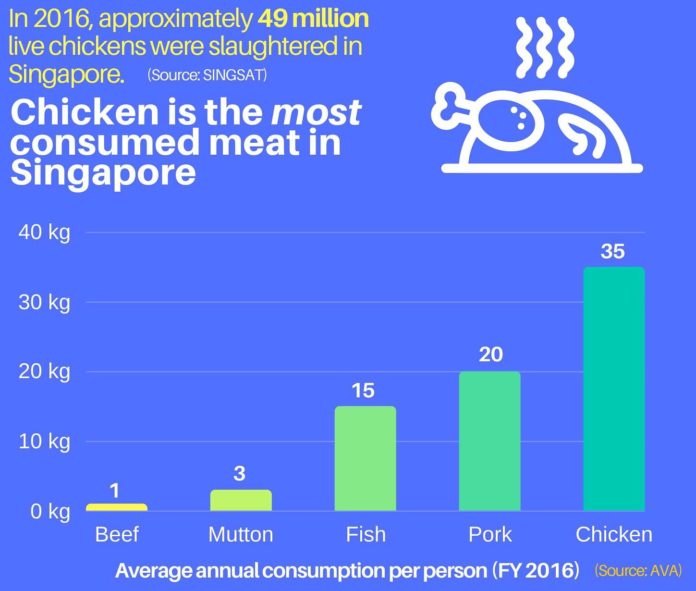
In 2016 alone, approximately 49 million chickens were slaughtered in Singapore.
2. CHICKEN IS THE MOST CONSUMED MEAT IN SINGAPORE
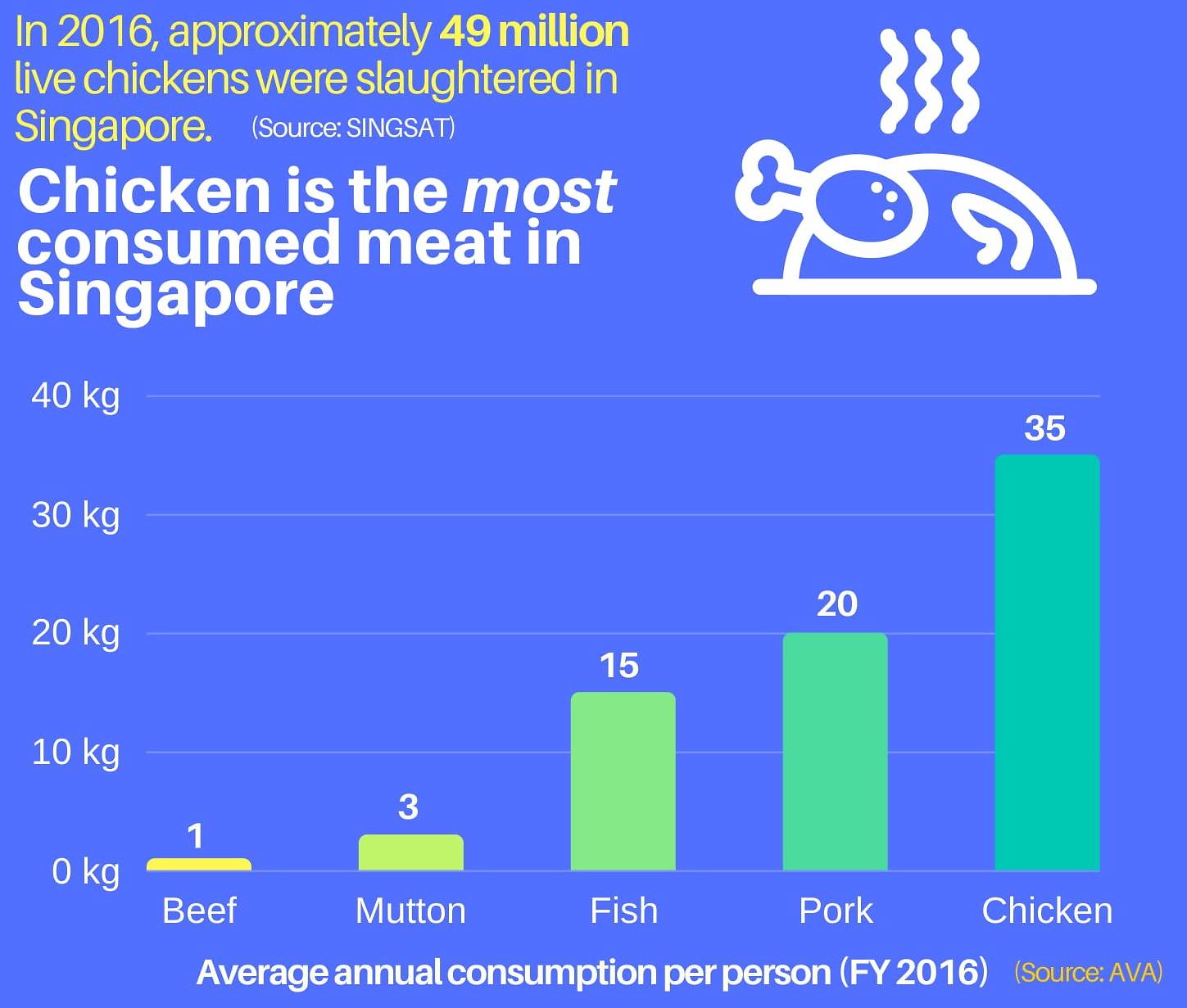
The average Singaporean consumes as much as 35kg of chicken a year. According to data from the Agri-Food and Veterinary Authority of Singapore, that’s as much as the average intake of fish and pork combined. Mutton ranks a distant fourth at 3kg consumed annually, with beef rounding out the top five at just 1kg.
The average Singaporean consumes 35kg of chicken a year. (Photo: CCCS)
3. IT IS A HALF-BILLION DOLLAR INDUSTRY
The 13 fresh chicken distributors that were punished were dubbed a cartel; the collective is responsible for supplying over 90 per cent of Singapore’s fresh chickens. The combined annual turnover of the 13 companies amounted to S$500 million.
4. HOW THE COMPANIES COLLABORATED
For at least seven years, the companies had:
Engaged in price discussions
Coordinated the amount and timing of price increases
Agreed not to compete for each other’s customers
So with each member having its own slice of the (chicken pot) pie, the anti-competitive measures culminated in …
5. COORDINATED PRICE HIKES
The coordinated price increases ranged from 10 cents to 30 cents per kg on at least seven occasions – July 2008, May 2009, August 2010, January 2011, March 2011, January 2013 and January 2014.
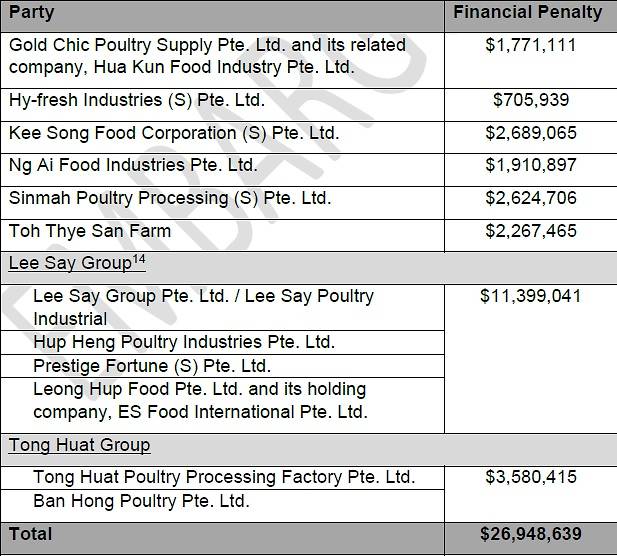
This left customers with limited options, if they had wanted to switch to more competitive distributors, ruled CCCS, which dished out fines to the 13 companies according to the following table:
SINGAPORE: When restaurant waiter Xavier Lor splashed out S$1,000 on an Inokim electric scooter last week, he thought he would be able to use it for the next five to seven years.
The 39-year-old was pleased to have found an efficient mode of transport that would allow him to avoid having to squeeze in crowded buses and trains to travel to and from his work.
But his plans to use the two-wheeler for that length of time were dashed on Monday (Sep 10), when the government announced that all motorised personal mobility devices (PMDs) must conform with UL2272 fire safety standards by 2021.
“So I’ve spent all this money on this scooter, only to be told I have to get rid of it in two years or risk breaking the law,” said Mr Loh, who uses the device to travel to and from his workplace in Clarke Quay.
Like the majority of e-scooters in the Singapore market, Mr Loh’s Inokim is not compliant with UL2272 – a technical standard developed by an independent US certification company – which the Singapore government said minimises the risk of motorised PMDs catching fire.
There have been 80 fire incidents involving motorised PMDs since 2016. Data released by the Singapore Civil Defence Force (SCDF) earlier this year also showed that e-scooters were involved in 40 fires last year, an increase of nearly 350 per cent from nine such cases in 2016.
But Mr Lor maintains that customers like him should not be punished for purchasing e-scooters that are not compliant with UL2272, having not been informed of this new law beforehand.
“When I bought it last week, I decided to invest a bit more money because I thought it was something that I can use for the next five to seven years. But now they’re telling me I have to get rid of it soon,” said Mr Lor.
“I can’t even sell it off in Singapore, since it won’t be legal,” he said, adding that he will make a report with the Consumer Association of Singapore (CASE).
Sample of a sticker to indicate that the device is UL2272 compliant, (Photo: UL.com)
Mr Chew Boon Hur, general manager for major PMD retailer Mobot, told Channel NewsAsia that “almost all” the models in Singapore are currently not compliant with UL2272.
He stressed that the time frame given by the government for customers to comply with the new standards is too short, especially for those who purchased their devices this year.
“We want to feedback to LTA to delay the implementation of the law by one more year, to 2022. This is for customers who just bought their scooters recently,” said Mr Chew.
“The average lifespan of an e-scooter is three to four years, so that’s enough time for the customer to use it, discard it and buy a new one by end-2021,” he added.
However, e-scooter user Mr Timothy Gan argued that the new requirement will deem almost all the models currently in the market in Singapore illegal, and is akin to “imposing a ban on PMDs without actually banning them outright”.
“Insisting that all PMDs comply with UL2272 is effectively banning them from Singapore. Almost everyone will have to throw away their e-scooters and spend even more money to buy new ones,” said the undergraduate.
Mr Victor Lee, general manager for Falcon PEV, one of the leading distributors for PMDs in Singapore, argued that having a blanket rule and insisting that all e-scooters conform to UL2272 is flawed.
“We question whether this certification really makes sense at all. It’s a US certification, meant for US brands and models. If they wanted to (impose an international safety standard), they should have introduced one approved by the International Electrotechnical Commission. UL2272 was introduced in 2016 because of hoverboards; PMDs are not hoverboards,” said Mr Lee.
The UL2272 standard was first published for hoverboards in the US in November 2016, but its scope has since been extended to cover all types of motorised PMDs.
PRICES COULD INCREASE BY 20 PER CENT
Additionally, Mr Lee warned that getting Falcon PEV e-scooter models to be UL2272-compliant could result in higher prices for customers.
“The cost will be levied onto customers. It’s substantial – bound to be between 10 and 20 per cent.” he said. “It’s too premature to specify how much exactly, but the prices of all PMDs will definitely go up.”
Mr Chew said that the cost of getting its e-scooters UL2272-certified will be between S$50,000 and S$100,000 per model, and will translate to higher prices for buyers.
“Consumers will expect costs to increase, possibly by up to S$100 … But we don’t know exactly how much yet,” he said.
Mr Chew added that Mobot, which previously sold 3,000 e-scooters annually, has seen a 40 per cent decline in sales since the beginning of the year due to the various regulations the government has imposed on users of PMDs, including mandatory registration, speed limits and illegal modifications.
But he maintained that business will likely pick up over the next few years and that the PMD scene in Singapore is “moving in the right direction”.
“By setting rules and regulations, you are making this industry to be the norm. In other words, people already know this is going to be the way forward for Singapore to use e-scooter as the mode of transport,” he added.
However, Falcon PEV’s Mr Lee does not share the same view. He stressed that the regulations have already triggered a steady decline in sales, and there will be a further decline in the coming years as there is a “cloud of uncertainty” over whether PMDs are considered a part of Singapore’s future transport scene.
“No one is willing to guarantee anything. Last week, the government announced that all PMDs cannot travel more than 10km per hour on footpaths. This week they announced fire safety standards. What’s coming next week?”
He added that the UL2272 fire safety standard could result in PMD firms “packing up” from the Singapore market, as many may not be able to find the right supplier.
“There are too many regulations and restrictions and boundaries. To turn something so viable for a car-lite society to something that is so complicated is a huge waste,” he said.
SINGAPORE: Singapore students have excelled in a number of international competitions in the past couple of months, winning top accolades in subjects like physics, chemistry, mathematics and geography.
The competitions, held from July to September, took place in various cities around the world, said the Ministry of Education (MOE) on Wednesday (Jul 12). Participants were from schools which include Raffles Institution, Hwa Chong Institution, NUS High School of Mathematics and Science and Eunoia Junior College.
At the International Young Physicists’ Tournament held in Beijing, the Singapore team emerged overall champion out of 31 other competing countries and territories.
The tournament is organised around “physics fights” that mimic discussions at research conferences, where participants present their research and provide constructive feedback on the work of other teams, MOE said in a media release.
At the International Mathematical Olympiad held in Romania, the Singapore team was placed eighth out of 107 countries and territories.
The team won two gold medals, three silver medals and one bronze at the event, which challenged students to “apply high-level problem solving skills and present rigorous proofs to support their solutions”, according to MOE.
The team that represented Singapore at the 59th International Mathematical Olympiad. (Photo: MOE)
Another team representing Singapore garnered three gold medals and one silver at the International Biology Olympiad in Tehran, Iran.
“The students went through a diverse range of biological tasks, including the dissection and identification of the internal structure of the Persian leech, purification of a bacterial protein and investigation of the behaviour of fruit fly larvae,” MOE said.
Singapore was placed a joint third out of 68 countries and territories.
The team that represented Singapore at the 29th International Biology Olympiad. (Photo: MOE)
For the 50th International Chemistry Olympiad held in Bratislava, Slovakia and the Czech Republic city of Prague, Singapore secured two gold and two silver medals.
Singapore was placed sixth out of 76 countries and territories.
The team representing Singapore at the 50th International Chemistry Olympiad. (Photo: MOE)
At the 49th International Physics Olympiad in Lisbon, Portugal, the Singapore team won four gold medals and one silver, placing third out of 87 countries and territories.
At the competition, students conducted experiments relating to paper transistors for future use in smart packaging, and modelled the destruction of a tumour based on the collapse of blood vessels, due to pressure increases, MOE said.
Singapore’s team at the 49th International Physics Olympiad. (Photo: MOE)
Meanwhile, the team that represented Singapore at the 15th International Geography Olympiad in Quebec City, Canada, bagged one gold, two silver and one bronze medal.
The competition tested students’ ability to apply their knowledge across a wide range of topics, spanning both physical and human geography. Students also honed their skills of observation, mapping and spatial analysis through fieldwork exercises, MOE said.
Singapore was placed second out of 43 countries and territories.
The team representing Singapore at the 15th International Geography Olympiad. (Photo: MOE)
Finally, the Singapore team secured one gold medal, two silver medals and one bronze at the 30th International Olympiad in Informatics in Tsukuba, Japan.
Students were faced with computational problems which tested their ability to design and implement efficient algorithms and data structures.
Singapore was placed joint ninth out of 87 countries or territories.
Singapore’s team at the 30th International Olympiad in Informatics. (Photo: MOE)
This eliminates the need for multiple terminals or QR codes for stall holders, while customers can use 20 different e-payment options by August 2019.
A NETS FlashPay terminal at Tanjong Pagar Hawker Centre. (Photo: NETS)
(Updated: )
Bookmark
SINGAPORE: NETS has been appointed to unify the e-payment landscape at hawker centres, coffee shops and industrial canteens, announced Enterprise Singapore on Wednesday (Sep 12).
This means NETS will be the only touchpoint to reconcile accounts and earnings by participating stall holders who accept payment via the various cashless systems, eliminating the need for multiple terminals or quick response (QR) codes.
For customers, they can choose to pay using 20 different e-payment options, including EZ-Link, NETS FlashPay, WeChat Pay, Singtel Dash and GrabPay.
The appointment of NETS as “master acquirer” follows a call for collaboration in April by several government agencies for a commercially viable, interoperable and open access e-payment solution.
Food businesses eligible for the unified system are those which operate under the Housing and Development Board, National Environment Agency and JTC Corporation.
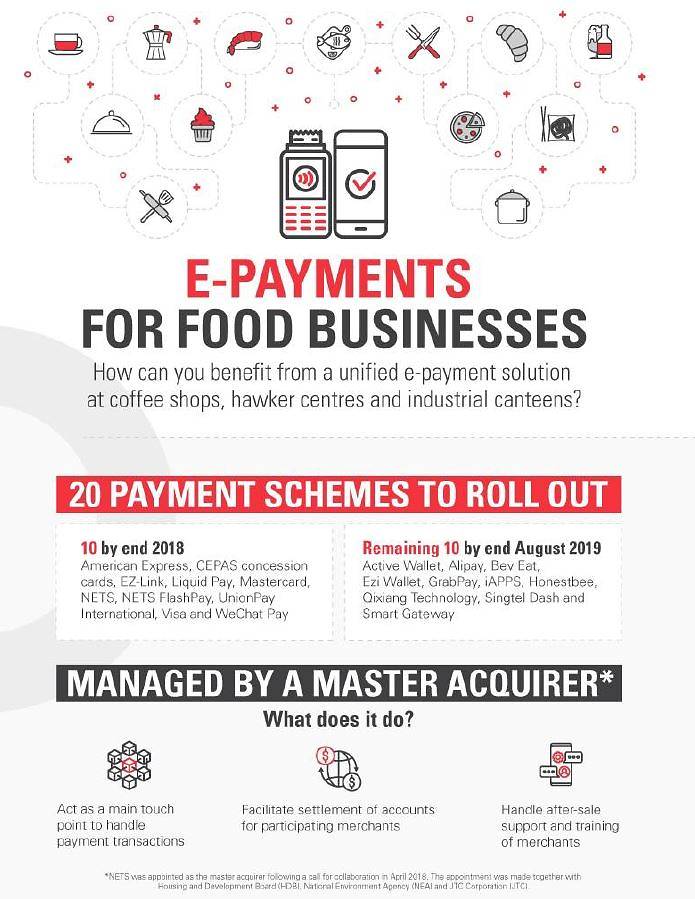
The initiative will be rolled out in two phases. By the end of this year, 10 payment schemes – including Mastercard, Visa and NETS – will go live, with the remaining 10 to be implemented by August 2019.
By August 2019, consumers will be able to choose from 20 e-payment options at selected coffee shops, hawker centres and industrial canteens. (Graphic: Enterprise Singapore)
FUNDING SUPPORT FOR BUSINESSES
Under the initiative, NETS will provide businesses with a terminal for card payments, as well as a QR code to accept and process transactions from the 20 payment schemes.
“The appointment of a master acquirer will also eliminate the need for multiple terminals or WR codes, a common bugbear in the e-payment ecosystem,” said Enterprise Singapore in a media release.
“In addition, merchants now need not liaise with different individual payment schemes and acquirers.”
Over the next three years, stall holders will not need to pay any monthly transaction fees for accepting e-payments, as the Government will provide funding support during this period.
After that, the monthly fee, or what’s known as merchant discount rate, will be 0.5 per cent. This is below the average industry rate of between 2 per cent and 5 per cent, said Enterprise Singapore.
Payment transactions will be credited directly into the merchant’s bank account within one day after close of business, for transactions made before 11pm, said the agency.
It added that transactions made via American Express, Mastercard and Visa will be credited within two days after close of business.
GrabPay will be one of the options consumers can choose from when the new e-payment methods are rolled out by August 2019. (Photo: Grab)
“In Singapore, about 40 per cent of dining occasions take place at coffee shops, hawker centres and canteens.
“With technology becoming such an integral part of our urban lifestyles, the Government is enhancing the dining experience by providing customers with a unified e-payment solution where transactions can be made easily, quickly and securely,” said deputy chief executive officer of Enterprise Singapore Ted Tan.
The agency hopes that 200 coffee shops, 25 hawker centres and 20 industrial canteens would adopt the unified e-payment system in the next two years.
SINGAPORE: Thirteen fresh chicken distributors that engaged in price fixing and market sharing have been fined a total of S$26.9 million – the highest financial penalty meted out by the Competition and Consumer Commission of Singapore (CCCS) for a single case.
For nearly seven years, the suppliers had discussed and coordinated the amount and timing of price increases ranging from 10 cents to 30 cents per kg on at least seven occasions. They also agreed not to compete for each other’s customers, said the CCCS on Wednesday (Sep 12).
Supplying more than 90 per cent of fresh chicken products in Singapore, the 13 companies have a total turnover of about S$500 million annually.
CCCS said the “seriousness and long duration” of the cartel conduct, alongside other factors such as the distributors’ high market share and the large size of the industry, contributed to the heavy fines.
The distributors have also been asked to provide a written undertaking that they will refrain from using The Poultry Merchants’ Association or any other industry association as a platform for anti-competitive activities.
The 13 distributors are Gold Chic Poultry Supply and its related firm Hua Kun Food Industry; Hy-fresh Industries; Kee Song Food Corporation; Ng Ai Food Industries; Sinmah Poultry Processing; Toh Thye San Farm; as well as the affiliated companies of Lee Say Group and Tong Huat Group.
Among them, four submitted leniency applications after investigations begun, and were eventually given reductions in their financial penalties for coming forward with information and evidence about the cartel activities. These include Tong Huat Group, Sinmah, Kee Song and Hy-fresh.
CCCS declined to reveal the reduction that was given to each distributor under its leniency programme.
Investigations into the fresh chicken distribution industry, which refers to chickens slaughtered here as opposed to frozen ones imported into Singapore, began in March 2014 after the CCCS received information from a secret complainant.
The complainant was a former employee at one of the 13 suppliers, said CCCS’ deputy director of business and economics Kong Weng Loong during a media briefing.
The companies were found to have held meetings – some at The Poultry Merchants’ Association that the suppliers are members of – from at least Sep 19, 2007 to Aug 13, 2014. They had “expressly coordinated” the amount and timing of price increases of certain fresh chicken products, such as whole fresh chickens, sold in Singapore, said CCCS.
Prices were increased by 10 cents to 30 cents per kg on at least seven instances, including July 2008, May 2009, August 2010, January 2011, March 2011, January 2013 and January 2014.
Meanwhile, the 13 suppliers also agreed not to compete for each other’s customers – a move that CCCS described as restricting choices made available to customers.
Together with the coordinated price increases, customers had “limited option” to switch to more competitive distributors, added CCCS.
“In view of the high combined market shares of the parties and as chicken is the most commonly consumed meat in Singapore, the parties’ anti-competitive conduct impacted a large number of customers including supermarkets, restaurants, hotels, wet market stalls and hawker stalls, and ultimately, end-consumers of these fresh chicken products,” said the commission.
The CCCS issued a Proposed Infringement Decision (PID) to all 13 suppliers on Mar 8, 2016, but decided to conduct further investigations in September when new information emerged.
CCCS said it carefully considered all the representations in reaching its findings.
Its chief executive Toh Han Li said: “Price fixing and market sharing are considered some of the most harmful types of anti-competitive conduct. Such conduct is particularly harmful when the products affected are widely consumed in Singapore, such as in this case.”
He added: “CCCS will continue to take strong enforcement action to ensure that cartels do not negatively impact Singapore markets and harm businesses and consumers.”
SINGAPORE: Without help, Ms Rashidah Ghazali was certain she would not have been able to cope. She was 27, four months pregnant and diagnosed with a life-threatening auto-immune disease back in 2016.
Then newly remarried and with five young children from her previous marriage, she could not turn to family for help in caring for them during her frequent and long hospital stays. Her husband, a first-time father, felt overwhelmed.
It was Madam Zarina Omar, 48, who came to her rescue. The childminder had been taking care of Ms Rashidah’s youngest son, Rayhan, since 2015, and took in his siblings as well. She put them up at her home for as long as was needed, sometimes overnight.
“She told me not to worry, that she will take care of my kids. She told me to focus on myself and recovering,” Ms Rashidah told Channel NewsAsia at Madam Zarina’s flat in Bukit Batok.
She gave birth to a girl and recovered a few months later.
Even when she was healthy, Ms Rashidah said that it was hard to focus on work without a childminder. Her limited number of childcare leave days was quickly used up whenever the childcare centre closed or when a child was too ill to go to school.
“Of course, we don’t want to be termed a ‘problem employee’ because we keep taking leave for our children,” said Ms Rashidah, who was working in a shipping firm.
Being employed is important as it would qualify her for infant and childcare subsidies which require the applicant to work a minimum of 56 hours per month, she added.
CHILDMINDING “NOT ABOUT THE MONEY”: MADAM ZARINA
Ms Rashidah would pay Madam Zarinah S$200 to S$300 a month. She had tried engaging a babysitter for her older child but found that she could not afford the S$500 monthly fee on her S$1,400 salary.
“The arrangement is not about money. It’s about help. Somebody wants my help, so I tell them ‘whatever you can give me, you just give me’,” Madam Zarina said.
“I like children, and when I help people, I feel happy,” she added.
The relationship between the two women has grown over the three years, and now, Madam Zarina takes care of Ms Rashidah’s younger children when their childcare centre is closed, or when the children are not well.
Seeing them interact, it is not difficult to mistake the two women as mother and daughter. Ms Rashidah calls the older woman “Ibu” (mother) after all.
“She is like a mother to me,” she said.
Ms Rashidah Ghazali with Madam Zarina Omar, a childminder. In the centre is Rayhan, who Madam Zarina started taking care of in 2015. On his left is Sofia and on his right is Nafisah. (Photo: Jalelah Abu Baker)
COMMUNITY CHILDMINDERS OFFERS PEACE OF MIND
A programme piloted in Bukit Batok aims to help more mothers in Ms Rashidah’s position. Called the Community Childminding programme, the effort by charity group Daughters of Tomorrow (DoT) was launched in February this year.
Executive director of DoT, Carrie Tan, said the idea was sparked following three years of experience from placing women from low-income families into gainful employment. She found that many of these women were not able to hold down their jobs due to childcare needs and contingencies.
“We needed a way for the women to get support near their homes to pick up or help care for their kids so they don’t have to keep taking urgent leave from work. In many cases, women were also prevented from taking on jobs that required shift work, as they had no options for childcare in the evenings or on weekends,” she said.
Madam Zarina is now part of the programme, and has taken care of 10 children. She makes herself available even in the evenings, while parents work overtime.
There are now 15 childminders under the initiative, said Ms Tan.
Since the programme started, the service has been used by 13 women from low-income families, clocking more than 2,000 childminding hours.
Ms Tan said that beneficiaries have shared that they are able to perform at their jobs better because they found someone they could entrust their kids to when they are at work.
GROWING THE PROGRAMME
She said that an app is also being developed to help the mothers register themselves as users and childminders so they can find one another easily through technology-enabled matching.
“We are looking into viable childminding or nanny training that would be affordable and easily accessible to help the childminders with skills development and professionalisation,” she said.
The success of the pilot has Ms Tan eyeing an expansion.
“We hope that it can grow into a nationalised programme for the low-income community that’s supported by private and public resources to enable underprivileged women to get back into the workforce, and also for childminder moms to also be able to make an income from providing this care support,” she said.
Already, the pool of childminders is expanding. Mothers from different neighbourhoods are being trained and coached in community outreach and organising
Chairman of the Government Parliamentary Committee for Social and Family Development Seah Kian Peng said: “We should allow social enterprises like these to grow. Many schemes can co-exist, and this is a good initiative, to give these women from low-income families to go to work, and to allow the childminders to earn some income.
SINGAPORE: When his first business, a construction and interior design firm, failed in 1997, entrepreneur Leonard Lim found himself struggling, financially and mentally.
He had lost a chunk of money in the business and ended up in debt, to the tune of a few hundred thousand dollars.
“We owed the suppliers money, projects were half done and debt collectors turned up at my door. It was quite upsetting; my mother and everyone was quite stressed,” he recalled.
“I couldn’t see a way out of it. I even had to ask for an allowance from my mum. It was sad and embarrassing.”
The then 27-year-old went fishing to de-stress, but that turned out to be more depressing.
“I went to the Kallang River on a daily basis, and I just sat there,” he recounted. “I spent five, six months just fishing every day. And believe it or not, I didn’t catch a single fish.”
This local inventor went on to start several business over the next few years – and failed each time. But he persevered, driven by his childhood dream to run his own company, and finally succeeded.
Today, he is the founder and chief executive officer of Omnisense Systems, a company that has revolutionised the way fever screening is done, with its made-in-Singapore thermal sensors.
Singapore is not lacking in inventors and inventions, from square milk bottles to a drink-mixing machine, yet many of these creators, like Mr Lim, have kept low profiles, as the four-part series Made in Singapore finds out.
Omnisense Systems’ fever scanner.
FALLING BACK ON RATIONS
In Mr Lim’s case, his entrepreneurial journey is peppered with failures, some lucky breaks and life lessons.
Not academically inclined, he did not do well in his A Levels. He embarked on a part-time economics degree but gave it up and started working as a salesperson for an exhibition company, which folded a few months after he joined.
With some of his ex-colleagues, they started a company installing door frames and kitchen cabinets for condominium projects. It was his first business, at the age of 24, and he was excited at the prospects. The firm lasted three years.
“The company ran into cash-flow issues, and in my opinion, they were caused by some dishonest practices by my partners. (It was) my fault as well, since I missed many signs until it was too late,” he said.
I didn’t handle the situation very well.
That episode left him broke, in a funk and back to picking up fishing (unsuccessfully) to deal with the situation.
Fishing was Mr Lim’s way of withdrawing from the world, said his friend Khoo Yong (left).
After a few months “in limbo”, he set up a small internet business, but that failed to take off. Once again, he found himself broke, but he was more prepared this time.
“I had stocked up on some canned food and rice at home so that when I was really broke, at least I could fall back on my ‘rations’,” said Mr Lim, who had already moved to his own HDB flat.
He also joined a church group, whose members gave him moral support. And he started doing volunteer work with underprivileged children, which, in turn, helped him. “Through those children, I started to understand myself much better,” he said.
I was able to identify some counter-productive emotional feelings I had and learnt to deal with them. I also found a more stable job.
TAKING A CHANCE DURING SARS
After a few years, Mr Lim felt the itch to start a business again. This time, he saw an opportunity during the outbreak of the severe acute respiratory syndrome (Sars) in 2003.
The Defence Science and Technology Agency was then exploring the option of using an infrared system to identify those with a fever, he recalled.
An infrared image on screen.
“While everybody in those days was trying not to go out, I actually went around looking for these systems,” he said. “It was a national crisis, so a quick solution was really required to manage the situation.”
He had always been fascinated with infrared technology, having watched a video on a British tank that used the technology during his secondary school days in the 1980s.
From his market research during the Sars period, he found that there were few systems in the market, while the existing ones, he felt, were too “crude” and “clumsy” to do the job.
He quit his job and joined a friend’s IT start-up to do development work on that project, to his mother’s disappointment.
“When everybody was afraid of losing their job because of the economy … and people were being retrenched, I still had my job and I quit,” he said. “As far as she was concerned, it was an extremely illogical decision.”
His new company faced a challenge getting its hands on an infrared camera, which was a controlled item, and the licence application took a few months.
The firm worked “non-stop” on the project in order to push its system into the market “fast enough”.
Apart from dipping into his savings, Mr Lim borrowed some S$40,000 from his mother for the project. But when it was finally market-ready, the firm suffered a setback.
“We had made an appointment with the testing agency … to validate the system,” he recalled. “(But) the government announced that all these screening measures would be terminated.
“We lost three to four months and maybe over S$40,000 … which (mostly) didn’t belong to me.”
He learned a few things, however. “First of all, I think speed to market was quite important. Second, we realised that the system itself still had a lot of gaps, which I think needed to be bridged,” he said.
Owing to that experience with infrared technology, he found another job dealing in such systems but then left the firm after two years because of a disagreement.
STAFF OFFERED TO WORK FOR FREE
In 2006, Mr Lim started Omnisense Systems to develop night-vision products for commercial applications. It exposed him to financial hardship again.
Back then, such products were essentially for the military market, so his company spent a couple of years learning to redevelop the products.
Things got desperate, however, when the 2008 financial crisis hit hard – and a corporate funder pulled out. “I was quite devastated when the news was broken to me,” he recalled.
We were left with nothing. We had no money for salaries.
But several of his staff offered to work for free. “I was very touched by such a gesture at that point in time. And I thought that people did believe in the things we were doing.”
Mr Lim with his staff.
While looking for other opportunities for the company, he got a lucky break when the Influenza A (H1N1) virus hit home in 2009. He decided to revisit the fever screening system.
“There were quite a lot of requirements, and people looking for fever screening systems, so we took the opportunity and went into this market,” he said.
Based on his earlier experience, he developed a new system, one that was more accurate, affordable and easier to use.
The big break came when the company tendered for and won a contract with the Education Ministry, beating out several major players in the market. After that, it started to showcase its products more aggressively.
“The sales started rolling in. We got our first hospital deal, which was quite significant during those days (2010). In fact, that system is still operating today,” he said proudly.
He reckoned that a few hundred of its systems are now deployed across Singapore, from hospitals to museums to Changi Airport.
“It was a very satisfying experience, not only because we made some money, but also because we felt that we had done something that not many people could have,” he added.
Over the years, however, his struggles with his business and finances took a toll on his family life.
In the initial years of Omnisense Systems, he was constantly under financial pressure, he admitted, even though his then wife was working and able to manage most of the household expenses.
“But my personal financial hardship soon affected the relationship, and we divorced around 2012. My son was around six then,” said Mr Lim, who has since remarried and also has a two-year-old daughter now.
IN A BETTER PLACE NOW
Omnisense Systems, which started with three staff, has now expanded to more than 40 people, in Singapore and now Taiwan.
In 2016, Singapore Exchange-listed BH Global Corporation bought a 51-per-cent stake in the company, giving it – and Mr Lim – a major boost.
“The nature of our business revolves very heavily around development work. So the cost of development and trying to push products into the market is quite significant,” he said.
“As a private company with very limited finances, we came to a point where it was very difficult for us to continue without external financial support.”
Now that the firm has a development centre in Taiwan, it can “develop products and manufacture them in a way that we couldn’t have done (before)”.
It is also looking to fine-tune its fever screening systems and explore the maritime market, hoping to make a mark overseas.
A hand that touches a surface could make a 0.1°C difference, which can be detected by the third version of Omnisense’s fever screening system.
Financially, Mr Lim is also in a better place but has “not yet made (his) fortune”, as he has reinvested most of his income into his thermography and night vision business.
His failures and personal crises over the years, including his utilities being disconnected and his car being repossessed, have moulded him into the person he is today, he said – more humble, with a sense of perspective and better self-awareness.
“I’m glad there was quite a fair bit of failure quite early in my life. That built me up,” he said. “Through all those failures, I realised that, very often in a crisis, there are a lot of opportunities.”
He advised entrepreneurs struggling today to be patient and to develop emotional stamina. “For every great journey, obstacles and trials should be expected. We need to find the correct motivation to push on,” he said.
“There’s also a time to give up. Knowing when to give up or alter course is a difficult but important decision to make. There’s no shame in failure; recognise when we make a mistake … learn from it and move on.”
The series Made in Singapore tells the stories of eight inventors and their inventions. Watch it here. Or catch episodes on Channel NewsAsia on Tuesdays at 9.30pm.
SINGAPORE: Fandi Ahmad got the first win of his tenure as the Singapore national team’s coach on Tuesday (Sep 11) after a 2-0 win over Fiji, with goals coming from his son Ikhsan Fandi and captain Hariss Harun.
It was their second international friendly at Bishan Stadium, in the lead-up to preparations for the 2018 ASEAN Football Federation (AFF) Suzuki Cup in November.
Fandi stayed true to his words from pre-match and made seven changes to the side that drew 1-1 with Mauritius last Friday, with 18-year-old Jacob Mahler making his debut on Tuesday.
The game also saw Gabriel Quak make his first appearance in national colours in more than a year, while Warriors midfielder Ho Wai Loon came on in the second half for his first Singapore cap as well.
Singapore were hardly troubled by a Fiji side which stands 165th in the FIFA ranking – four spots above the Lions – apart from an early scare that came in the second minute.
Roy Krishna – one of the only two professional footballers in the Fiji team – was left unmarked inside the danger area for a shot, but goalkeeper Hassan Sunny pulled off a decent save.
The Lions had their first chance in the 11th minute, with Ikhsan’s effort taking a heavy deflection before it was hacked off the line.
It was from the resulting corner that they broke the deadlock though, as Hariss met Zulfahmi Arifin’s delivery with a thumping header.
The lead was doubled just over a minute later, with Ikhsan producing a composed finish his dad would have been proud of, after breaking the offside trap to latch onto a glorious pass from Gabriel Quak.
Gabriel Quak made his first Singapore appearance in over a year against Fiji on Sep 11 and provided the assist for the second goal. (Photo: Matthew Mohan)
The Fijians slowly grew into the game after that, pinging the ball around. But they were unable to carve out any clear opportunities against the backline marshalled by Baihakki Khazan and Irfan Fandi.
Instead, it was Singapore who came closest to scoring again in the 71st minute. A well-worked move saw Khairul Amri set his fellow substitute Shahril Ishak up for a volley, which Fiji goalkeeper Misiwani Nairube did well to stop.
Neither side were able to find the net after that and Singapore were able to see off 10-man Fiji, who had Kolinio Sivoki sent off after he jutted his knee into Mahler’s back late on.
Tuesday’s victory was also the Lions’ second this year, having gone through the whole of 2017 without any wins.
SINGAPORE: Scams involving spoofed email addresses are on the rise, the Singapore Police Force (SPF) warned on Tuesday (Sep 11).
In a news release, the police said they had received more than 200 reports about business email impersonation scams between January and July this year, an increase of 9.7 per cent from the same period last year.
The cases usually involve businesses that have overseas dealings and use email as their main mode of communication, police said.
In many of the cases, the scammers are believed to have hacked into either the email accounts of the victims or their suppliers to monitor their email correspondence. They would look out, in particular, for correspondence relating to ongoing negotiations or discussions on sales and purchase transactions.
They would then use the supplier’s email account or a spoof account, closely resembling that of the suppliers’, to ask victims to transfer payments to a bank account controlled by the scammers.
The police cited examples of spoofed email addresses, which they said often included slight misspellings or the replacement of letters, which may not be obvious at first glance:
In order to deceive victims into thinking that the emails were genuine, the scammers may closely mimic the emails of the real suppliers. For example, they may use the same business logos, links to the company’s website, or messaging format, police said.
The victims would believe they had received genuine emails from their suppliers and transfer money to the new bank accounts, only find out they had fallen prey to scammers when their suppliers informed them that they did not receive the money.
Businesses affected by such scams should contact their bank immediately to recall the funds, police said.
PREVENTIVE MEASURES
In the news release, SPF advised businesses to take the following preventive measures:
Be mindful of any new or sudden changes in payment instructions and bank accounts. Always verify these instructions by calling your business partners on trusted numbers. Previously known phone numbers should be used instead of the numbers provided in the fraudulent email.
Educate your employees on this scam, especially those that are responsible for making fund transfers.
Prevent your email account from being hacked by using strong passwords, changing them regularly, and enabling two-factor authentication where possible. Consider installing email protection software that can detect fraudulent emails.
Install anti-virus, anti-spyware/malware, and firewall on your computer, and keep them updated. Also use the latest computer operating system and keep them updated when new patches are available.
The police added that anyone who wants to provide any information related to such crimes can call the police hotline at 1800-255-0000, or submit it online at www.police.gov.sg/iwitness. Those who need urgent police assistance can call 999.
Members of the public can also call the anti-scam helpline at 1800-722-6688 or visit www.scamalert.sg.
SINGAPORE: Despite our best-laid plans, sometimes things just don’t turn out the way they should – which is why it is conventional wisdom to have a back-up plan to “luck-proof” our goals.
In Singapore, where we are known for world-class efficiency and preparedness, it is not uncommon to even have a back-up plan for the back-up plan. This is not quite “kiasuism” at work; many simply see it as a sign of readiness, responsibility, even foresight.
We could almost sum up our obsession with back-up plans like this: If Plan A is for attaining dreams, Plan B is for avoiding nightmares.
Research suggests otherwise. Your back-up plan may well be the culprit that is making you fail on your goals.
Psychologists at the University of Zurich have found that back-up plans change the way we pursue a goal, and affect our probability of achieving it, even if we never use the back-up plan. They believe that a back-up plan can constitute as an additional cost in terms of time and resources, which can undermine our motivation to persist with our first-choice plan.
In another study, scientists at Wisconsin and Pennsylvania gave 160 university students a sentence-unscrambling challenge, with the promise of a energy bar if they performed well. Half of the students were told to think of ways to get free food in the campus should they fail to earn the energy bar.
At the end of the challenge, the students who were prompted to think of back-up plans fared significantly worse than those who did not think of a back-up plan.
In my work as an executive coach, I found that executives who prepared back-up plans fell short on their goals more frequently, compared to those who went all-in. There are three reasons why your back-up plan can hurt your chances of success.
IT WEAKENS YOUR CONFIDENCE
The very nature of a back-up plan is to anticipate and prepare for failure. That is a pessimistic way to get started on any goal.
Having a back-up plan can be a signal that you are planning for failure, which affects your confidence and the confidence others have in you.
In a survey reported by The Harvard Gazette, 62 percent of respondents thought that requesting a prenuptial agreement sends a negative signal about the future of the marriage. “It’s like you’re planning for divorce. It signals that you think there’s a positive probability for divorce,” said researcher Heather Mahar of Harvard Law School.
Many studies have proven the power of visualisation to help individuals perform better. World-class athletes such as gold-medalist swimmer Missy Franklin mentally picture their success to draw themselves closer to their desired outcome. The converse also applies – if you’re picturing and preparing for failure, you’re more likely to fail.
Missy Franklin won four-gold medals at the 2012 London Games. (Photo: AFP/Tom Pennington)
The path to success is almost never smooth. If you’re pursuing something worthwhile, it is unlikely to be easy.
You may know the saying: “When the going gets tough, the tough gets going.” But when the going gets tough – and you have a Plan B – you’re more likely to give up than to tough it out.
This is probably why many in history have gone to great lengths to avoid a back-up plan. Ancient military commanders like Julius Caesar and Hernan Cortes would burn their ships the moment they reach the battlegrounds to banish any thought of a retreat.
The Japanese samurai warriors took this concept to a whole new level – failing a mission meant performing seppuku or honour suicide, first performed by the ancient samurai Minamoto no Yorimasa in 1180.
Your back-up plan can make it too convenient to give up when you hit a temporary setback , one that is entirely possible to overcome. If you have a Plan B, your motivation may never be where it needs to be.
Young entrepreneurs would know. The founders of HungryGoWhere, one of Singapore’s most successful startups, had no back-up plan when they started out – it was all-or-nothing. Co-founder Wong Hoong An has said in an interview:
When we first started … we did not have startup grants, or MDA, there was nothing. So you had to have a business that works, and if it didn’t, there was no back-up plan.
After you have a back-up plan, you might think you can stop thinking about it so it does not distract you. But it is still there, humming away quietly in the background of your mind. Its mere presence can affect your focus when you’re trying to make Plan A work.
There is a real possibility that the back-up plan takes on a life of its own. It may spawn new ideas in your mind, evolving to become a viable, even more attractive alternative.
When I was a C-level executive of a large multinational company, I led teams of extremely talented individuals on time-sensitive, high-pressure projects. I noticed that the teams that were single-minded in their plans from the outset tend to deliver their best work in time, while others got mired in a number of red-herring alternatives that diluted their focus.
A team of people working in an office over a table with open laptops. (Photo: Pixabay)
A senior executive that I coach loves back-up plans. He takes a lot of pride in coming up with solid Plan Bs. The problem is, they are so good, they compete with his original plan. Because of that, he would regularly fall short of achieving his targets.
It was only when he let go of all his back-up plans, other than a basic safety net, did he finally succeed in following through on his Plan A.
If the singular objective is to succeed on your goal, you might want to start thinking about Plan C instead of Plan B.
Plan C is the option that protects you from the worst-case scenario, yet is in no way desirable enough to make failure acceptable.
Plan C does not distract you from Plan A, because it is simply not good enough to be considered as an alternative. Yet it also disaster-proofs the outcome.
That is what a safety net is for anyway – saving your life if you fall; it’s not meant to be a hammock.
For this strategy to work, be sure that your Plan A is indeed the right one. Consider all alternatives objectively, some of our Plan Bs could have been Plan As had we evaluated them with more care.
Here’s one way to approach the decision: Think about your Plan A almost as if you’re getting married to it. Move beyond the passion and excitement. Settle down and consider carefully. Do you really want to go through with this? How are you going to handle the rough patches? What do you need to do to make this work?
Nothing less than a resounding “yes”’ would do.
Because Plan B is like the college sweetheart who is still carrying a torch for you. And will be “here for you” when you run into problems with Plan A.
Plan C is being single and having lonely nights watching reruns on TV
If you want Plan A to work out, you have to forget Plan B. Occasionally remind yourself of Plan C, shudder, and make Plan A work.
Victor Ng is a certified executive coach at Sherpa Leadership. He helps executives and entrepreneurs become more resilient leaders in today’s increasingly challenging workplace.