SINGAPORE: The Ministry of Manpower (MOM) said on Thursday (Sept 13) that a recently published LinkedIn report on emerging jobs in Singapore cited a statistic that had been “misunderstood” by some.
The report, which came out last Thursday, used the LinkedIn data of over two million people with an account in Singapore to determine the top five fastest-growing jobs locally, such as data analysts and scientists.
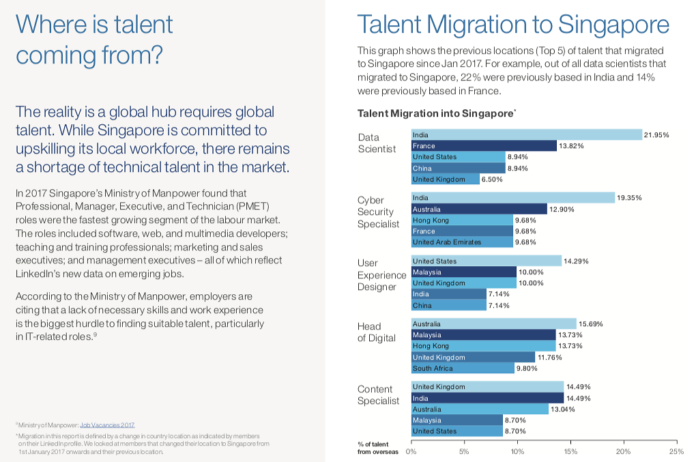
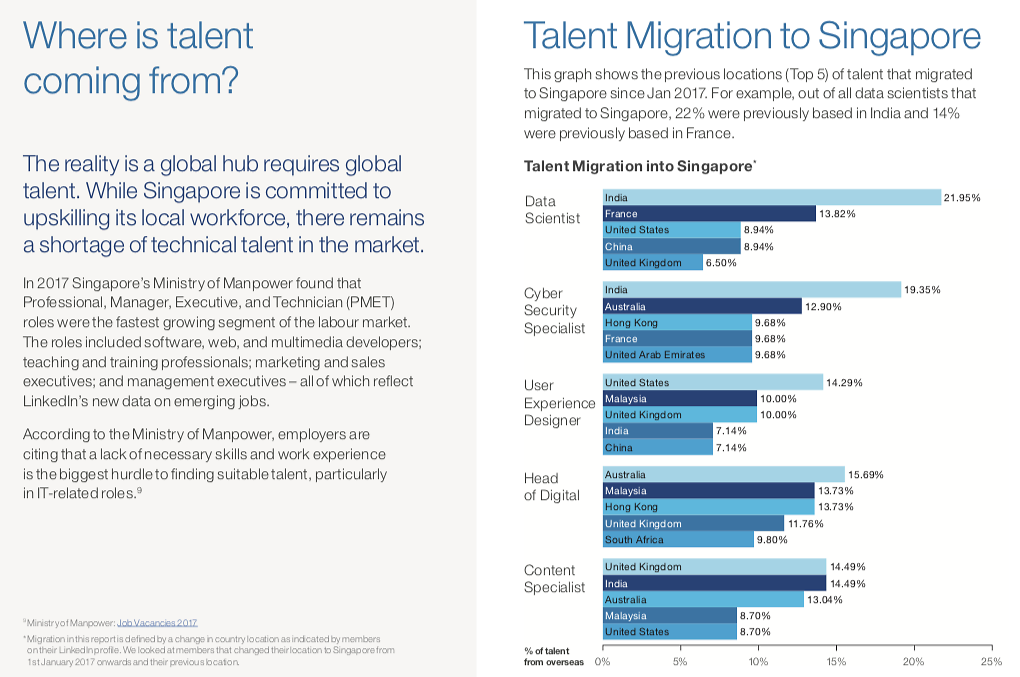
The 26-page report had a section on talent migration which showed a breakdown of LinkedIn users, who were previously based overseas, holding emerging jobs in Singapore.
According to the LinkedIn report, it looked at members who, on their profile page, changed their location to Singapore after Jan 1 last year. LinkedIn also tracked the members’ previous location.
“The report thus shows which countries this ‘talent migration’ is from. Some people have misunderstood the LinkedIn report as saying that many or even most of the jobs are being held by foreigners,” said MOM in a media fact sheet.
The report was updated to provide greater clarity on the Talent Migration graph. (Screenshot)
LinkedIn clarified that the data cited the members’ previous locations, not the nationalities of people that migrated to Singapore from January last year.
MOM added that based on the 2016 Infocomm Media Manpower Survey by the Info-communications Media Development Authority (IMDA), locals take up more than 70 per cent of the jobs comparable to the five fastest-growing jobs identified by LinkedIn.
The latest MOM labour report highlighted InfoComm and Media as a fast growing sector. Total employment grew by about 3,700 in the first half of the year, of which local employment increased by about 2,500.
SINGAPORE: The Singapore Civil Defence Force (SCDF) will decommission all 19 pump wells located at fire stations, on the recommendation of a Board of Inquiry (BOI) convened to investigate the death of full-time national serviceman (NSF) Kok Yuen Chin.
The BOI’s key findings and recommendations on CPL Kok’s death were released on Thursday (Sep 13) by the Ministry of Home Affairs (MHA).
The inquiry found that May 13, the night CPL Kok died, started off as a celebratory activity for his impending operationally ready date (ORD) but subsequently “went tragically wrong”.
The celebration, to mark the end of CPL Kok’s two-year training, was an initiative by members of his rota and paid for by the servicemen themselves. In a fire station context, a rota is a team comprising fire and rescue specialists and paramedics who are on standby duty to provide emergency services.
The inquiry found that CPL Kok was pushed into the well after the celebrations as part of a ragging ritual and did not resurface. Despite his colleagues’ attempts to save him, he could not be resuscitated after being pulled out of the well 36 minutes later.
During its discussions with SCDF, the BOI found that pump-well testing and training can be centralised at the Civil Defence Academy without compromising SCDF’s operational effectiveness and it is therefore not necessary for each fire station to have its own pump well, MHA said.
“The board therefore recommended that the fire station pump wells be decommissioned, to remove the risk of unauthorised access. For the pump wells at Civil Defence Academy, the board has suggested that SCDF take additional measures to restrict access and ensure their safe usage,” according to the press release.
In a news release the same day, SCDF agreed to the board’s recommendation to decommission all 19 pump wells at fire stations given that the testing of fire engine water pumps and related training can be conducted at the Civil Defence Academy without affecting its operations.
The decommissioning works, which involve filling up the wells with granite chips and covering them with concrete slabs, are expected to be completed by December this year, SCDF said, adding that future pump testing and training will be scheduled to coincide with officers’ regular training at the Civil Defence Academy.
Corporal Kok Yuen Chin’s photo displayed at his wake in Malacca. (Photo: Aqil Haziq Mahmud)
INCIDENT TOOK PLACE DESPITE “CLEAR ANTI-RAGGING POLICIES AND FRAMEWORKS”
MHA said the board found that the SCDF had clear anti-ragging policies and frameworks.
There were anti-ragging briefing sessions for all servicemen at the point of enlistment and during training. These messages were further reinforced through regular interviews and informal sessions with NSFs by commanders. Posters were also displayed at fire stations to remind servicemen of SCDF’s anti-ragging policy.
The incident took place “in spite of these measures”, the board said.
Nonetheless, it recommended that SCDF further review its anti-ragging measures. In particular, it suggested that SCDF help servicemen better internalise its anti-ragging policy.
The board also recommended that SCDF look into having more hands-on instructional methods to teach servicemen how to identify and stop ragging, and equip servicemen with a standard set of response lines to help them say “no” to ragging.
The BOI also found that SCDF had clear disciplinary and whistle-blowing policies.
It recommended that these policies be further enhanced to give greater assurance to victims and observers that their interests will be protected, and that SCDF expands the number of channels through which servicemen can report ragging incidents.
In addition, the board noted SCDF’s “zero tolerance policy” towards all forms of unauthorised activities, including ragging, and recommended that SCDF ensures that its commanders are trained to help them pre-empt ragging amongst officers under their charge.
“Officers who do not hold command positions but are senior in terms of rank or length of service should also be further trained to reinforce an anti-ragging culture within their own circles of influence,” MHA said.
It recommended that SCDF review how it recognises positive behaviour demonstrated by officers who show care for fellow colleagues. This could help to strengthen SCDF’s anti-ragging ethos, according to the press release.
Other recommendations include enhancing CCTV coverage in vulnerable areas within SCDF areas and strengthening training on risk management and workplace safety, MHA said.
The board interviewed more than 50 SCDF officers, including senior management, in the course of its inquiry. It also visited Tuas View Fire Station, where the incident took place, and reviewed evidence relevant to the incident.
The inquiry is separate from the investigations undertaken by the Singapore Police Force, which led to five SCDF officers being charged in court. It is also separate from any subsequent disciplinary proceedings that may be undertaken by SCDF, MHA added.
The recommendations were submitted to Home Affairs Minister K Shanmugam on Aug 28 and he accepted them in full, according to the ministry.
“We will do whatever we can to ensure that no more officers come to harm because of such activities. CPL Kok’s death was a most tragic loss, both for his family and SCDF. Our thoughts continue to be with his family, and we will support and assist them in any way we can,” said Mr Shanmugam.
SINGAPORE: Only religious groups that actively contribute to the community can bid for land reserved for places of worship, the Ministry of National Development (MND) said on Thursday (Sep 13) in a press release outlining changes to the tender framework for place of worship land.
MND will be tightening the prerequisites for such tenders, which used to be evaluated solely on price, it said in the press release.
Bidders now have to demonstrate that they are religious entities that have organised regular activities that involve and benefit the wider community in Singapore, and that they have a need for the new space.
They must also show that they have adequate and sustainable local funding to finance the purchase and development of the place of worship site, and will not use foreign donations.
This will help avoid situations where bidders secure foreign donations to bid aggressively for the land, said the ministry.
Only those who pass these criteria will be considered, and the land will be awarded to the qualified tenderer with the highest bid price.
MND said it worked closely with apex religious groups to review the land tender process for places of worship land.
Eternal Pure Land, a company that was not a religious organisation, had been awarded land in Sengkang that was meant for a place of worship back in 2014. MND terminated its agreement with the company after residents objected to its plans to build a commercial columbarium at the site.
The land was later awarded to Thye Hua Kwan Moral Society which was to build a Chinese temple at the Fernvale Link site.
LAUNCH OF LAND FOR RELIGIOUS HUBS
For the first time, MND will also be releasing land for the development of hubs that will be able to house multiple religious organisations belonging to the same religion.
MND will release sites for one church hub and one Chinese temple hub via concept-and-price tenders, and religious organisations can jointly apply to develop and manage these hubs.
As with tenders for standalone sites, tenderers for a place of worship hub will have to meet the requirements for developing such sites.
MND also said it will release at least two church and Chinese temple sites for tender each year.
“This provides greater certainty to aid planning by religious organisations, and will result in more places of worship land supply than in the past, when sites were put out intermittently,” it said.
SINGAPORE: The Singapore Civil Defence Force (SCDF) will decommission all 19 pump wells located at fire stations, on the recommendation of a Board of Inquiry (BOI) convened to investigate the death of full-time national serviceman (NSF) Kok Yuen Chin.
The BOI’s key findings and recommendations on CPL Kok’s death were released on Thursday (Sep 13) by the Ministry of Home Affairs (MHA).
The inquiry found that May 13, the night CPL Kok died, started off as a celebratory activity for his impending operationally ready date (ORD) but subsequently “went tragically wrong”.
The celebration, to mark the end of CPL Kok’s two-year training, was an initiative by members of his rota and paid for by the servicemen themselves. In a fire station context, a rota is a team comprising fire and rescue specialists and paramedics who are on standby duty to provide emergency services.
During its discussions with SCDF, the BOI found that pump-well testing and training can be centralised at the Civil Defence Academy without compromising SCDF’s operational effectiveness and it is therefore not necessary for each fire station to have its own pump well, MHA said.
“The board therefore recommended that the fire station pump wells be decommissioned, to remove the risk of unauthorised access. For the pump wells at Civil Defence Academy, the board has suggested that SCDF take additional measures to restrict access and ensure their safe usage,” according to the press release.
In a news release the same day, SCDF agreed to the board’s recommendation to decommission all 19 pump wells at fire stations given that the testing of fire engine water pumps and related training can be conducted at the Civil Defence Academy without affecting its operations.
The decommissioning works, which involve filling up the wells with granite chips and covering them with concrete slabs, are expected to be completed by December this year, SCDF said, adding that future pump testing and training will be scheduled to coincide with officers’ regular training at the Civil Defence Academy.
Corporal Kok Yuen Chin’s photo displayed at his wake in Malacca. (Photo: Aqil Haziq Mahmud)
INCIDENT TOOK PLACE DESPITE “CLEAR ANTI-RAGGING POLICIES AND FRAMEWORKS”
MHA said the board found that the SCDF had clear anti-ragging policies and frameworks.
There were anti-ragging briefing sessions for all servicemen at the point of enlistment and during training. These messages were further reinforced through regular interviews and informal sessions with NSFs by commanders. Posters were also displayed at fire stations to remind servicemen of SCDF’s anti-ragging policy.
The incident took place “in spite of these measures”, the board said.
Nonetheless, it recommended that SCDF further review its anti-ragging measures, In particular, it suggested that SCDF help servicemen better internalise its anti-ragging policy.
The board also recommended that SCDF look into having more hands-on instructional methods to teach servicemen how to identify and stop ragging, and equip servicemen with a standard set of response lines to help them say “no” to ragging.
The BOI also found that SCDF had clear disciplinary and whistle-blowing policies.
It recommended that these policies be further enhanced to give greater assurance to victims and observers that their interests will be protected, and that SCDF expands the number of channels through which servicemen can report ragging incidents.
In addition, the board noted SCDF’s “zero tolerance policy” towards all forms of unauthorised activities, including ragging, and recommended that SCDF ensures that its commanders are trained to help them pre-empt ragging amongst officers under their charge.
“Officers who do not hold command positions but are senior in terms of rank or length of service should also be further trained to reinforce an anti-ragging culture within their own circles of influence,” MHA said.
It recommended that SCDF review how it recognises positive behaviour demonstrated by officers who show care for fellow colleagues. This could help to strengthen SCDF’s anti-ragging ethos, according to the press release.
Other recommendations include enhancing CCTV coverage in vulnerable areas within SCDF areas and strengthening training on risk management and workplace safety, MHA said.
The board interviewed more than 50 SCDF officers, including senior management, in the course of its inquiry. It also visited Tuas View Fire Station, where the incident took place, and reviewed evidence relevant to the incident.
The inquiry is separate from the investigations undertaken by the Singapore Police Force, which led to five SCDF officers being charged in court. It is also separate from any subsequent disciplinary proceedings that may be undertaken by SCDF, MHA added.
The recommendations were submitted to Home Affairs Minister K Shanmugam on Aug 28 and he accepted them in full, according to the ministry.
“We will do whatever we can to ensure that no more officers come to harm because of such activities. CPL Kok’s death was a most tragic loss, both for his family and SCDF. Our thoughts continue to be with his family, and we will support and assist them in any way we can,” said Mr Shanmugam.
The ministry says the move is part of its plans to meet the growing demand for school places in Punggol.
A Google Street View screengrab of Yusof Ishak Secondary School in Bukit Batok.
(Updated: )
Bookmark
SINGAPORE: From 2021, the Ministry of Education (MOE) will relocate Yusof Ishak Secondary School to Punggol as part of its plans to meet the growing demand for school places in the estate, it announced on Thursday (Sep 13).
The school is currently located in a part of Bukit Batok where demand for school places is falling, said MOE in a media release.
The ministry said that in deciding on the relocation or opening of schools, its key consideration is to be “responsive to changing demographics and community needs, while providing an optimal student experience at all times”.
None of Yusof Ishak Secondary’s current students will need to move to the new Punggol campus, and no new Secondary 1 students will be admitted to the school in the next two years.
The first Secondary 1 cohort at the school’s new campus in Punggol will be admitted in 2021. At this time, the school will also continue its operations for a year at its current Bukit Batok location to accommodate its Secondary 4 cohort.
This will minimise any disruption to students’ learning, MOE said, adding that it will work with the school to ensure the transition to its new campus goes smoothly.
The ministry added that the school will have “a small number” of Secondary 5 students in the Normal (Academic) stream in 2022. These students will be transferred to other secondary schools within the Bukit Batok area.
The school was established in 1965 as Jubilee Integrated Secondary School and was renamed Yusof Ishak Secondary School in 1966, after Singapore’s first President Yusof Ishak, and was opened by Singapore’s first Prime Minister Lee Kuan Yew.
The school also hosts the Centre for Teaching and Learning Excellence. The centre, which was set up in 2015, was set up to help boost the professional development of teachers in Singapore.
The school’s new site in Punggol will continue to host the centre, but with improved facilities such as an interactive learning centre with video streaming capabilities, a learning lab with an attached observation room, an enlarged classroom with additional space for observers and a covered area for outdoor learning activities.
Two new primary schools – Valour Primary and Northshore Primary – will also begin operations and admit its first Primary 1 cohort in 2020. This will meet the high demand for primary school places in Punggol, MOE said.
SINGAPORE: Singapore’s labour market saw higher unemployment and more retrenchments in the second quarter, although there was also employment growth and more job vacancies available, according to Ministry of Manpower (MOM) figures released on Thursday (Sep 13).
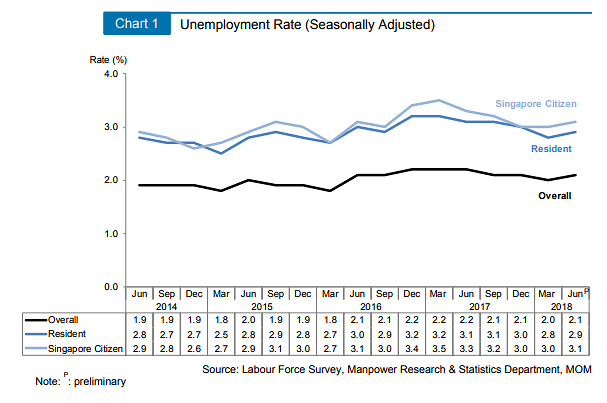
In its quarterly labour market report, the ministry reported that the overall seasonally adjusted unemployment rate rose slightly from 2 per cent in the first quarter of 2018 to 2.1 per cent in the second quarter.
The seasonally adjusted unemployment rate among residents rose from 2.8 per cent in the first quarter to 2.9 per cent in the second quarter, while the rate among citizens rose from 3 per cent to 3.1 per cent from the first to second quarter.
As of June, there were 67,300 residents and 59,800 citizens unemployed, MOM said.
The higher unemployment comes “as more people entered the labour force to look for work on the back of continued expansion in economic activities” and remains lower than a year ago, the ministry added.
The seasonally adjusted resident long-term unemployment rate also edged up from 0.7 per cent in March to 0.8 per cent in June, staying within the range observed in the last two years.
The number of retrenchments rose to 3,030 in the second quarter compared to 2,320 in the first quarter.
This was, however, lower than the same period a year ago, when 3,640 workers were retrenched. The six-month re-entry rate for retrenched residents also improved to 64.3 per cent in the second quarter of 2018 compared to 61 per cent in the previous quarter.
Business restructuring and reorganisation remained the top reason for retrenchment, MOM said.
EMPLOYMENT GROWTH, MORE JOB VACANCIES
While there was a slightly higher unemployment rate, total employment in the second quarter grew by 6,500, higher than the 3,700 in the preceding quarter, MOM said.
Excluding foreign domestic workers, there were 3,429,600 workers employed in Singapore as of June 2018.
Employment in service jobs grew the most, with 7,200 more jobs mainly in transportation and storage, information and communications, community, social and personal services and financial and insurance services.
This outweighed slowing declines in the manufacturing (-100) and construction (-700) industries, MOM said.
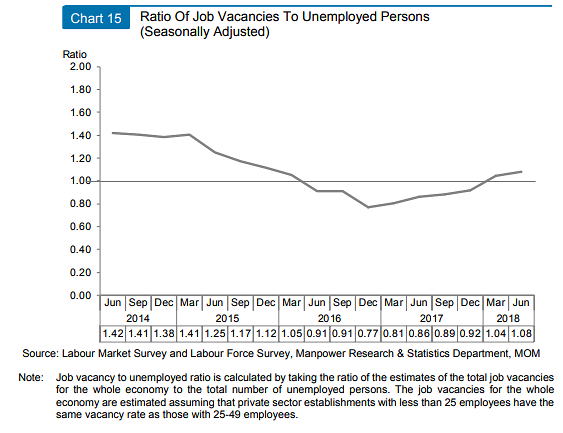
The number of seasonally adjusted job vacancies continued its uptrend since June 2017 to a three-year high of 56,700 in June 2018.
As this was more than the increase in unemployed persons, the seasonally adjusted ratio of job vacancies to unemployed persons was slightly higher at 108 job vacancies per 100 job seekers in June 2018, up from 104 in March 2018, MOM said.
SINGAPORE: In Singapore, it is not treated as rape if a man forces his wife to have sex – but this is set to change.
The journey towards this important piece of progress raises interesting questions about the approach of our laws towards questions of values and rights.
This week, the Government announced its intention to abolish marital immunity for rape in a review of the Penal Code, bringing Singapore in line with international legal norms including those of Hong Kong, Thailand and the Philippines.
Said Minister for Home Affairs K Shanmugam this week in response to one of the many recommendations put up by a committee involved in the Penal Code review:
I’ve thought it odd that we still have immunity for husbands who rape their wives. A woman’s body is her own. And even if she’s your wife, she’s entitled to say no – and no means no.
This long-awaited reform has been presaged by more than a decade of efforts by many Singaporeans who raised the issue in the 2007 Penal Code review, which resulted in limited recognition of marital rape where the couple is separated or the wife has a personal protection order.
The issue has since gained traction as public awareness increased. In 2009, we launched the No To Rape campaign with a group of non-affiliated volunteers, calling for total abolition of the immunity.
Women’s groups – including a coalition of 13 local non-government organisations who issued a report on gender equality in Singapore last year – have likewise been vocal on this issue.
Home Affairs and Law Minister K Shanmugam. (File photo: TODAY)
DEFENDING MARITAL RAPE IMMUNITY ILLOGICAL
The defences of marital immunity raised in 2007 and since have fallen along broadly two lines. First, it has been asserted that societal values pertaining to marriage and “conjugal rights” necessitate such immunity. Second, there were concerns about abuse by vindictive wives.
The concern about vindictive complaints is a plainly illogical and inadequate basis for even partial immunity, as the Penal Code Review Committee’s report now accepts. Other sexual offences have no marital immunity, including “sexual assault by penetration” of other kinds than those covered by the rape offence, and which carries the same maximum penalty as rape.
If wives wished to make vexatious complaints, that route has long been open to them under that offence, but in reality there is no evidence that they have done so.
More troubling and persistent has been the argument about values – that doing away with marital immunity would change the complexion of marriage to the detriment of marital relationships and the expression of intimacy.
But marital immunity for rape is utterly and surely unarguably repugnant to our values as a society, which sees every person as equally deserving of protection from violence. In this context, are we to accept the claim that the law as it stood actually reflected what most people around us believed?
We did not think that most people believed that women were obliged to provide sex on demand within a marriage in 2009 when we started our campaign. Nor did we think they believed that men who forced themselves on their wives should be immune from accountability under the law.
The idea that most people supported such views was an empirical question for which we saw little evidence, whether in the form of surveys or even the ordinary experience of discussing sex and marriage with those around us.
Men who forced themselves on their wives should not be immune from accountability under the law. (Photo: Pixabay)
It was our belief that a petition would enable ordinary people to make their beliefs clear, and dispel the myth that people had a deep attachment to marital immunity for rape.
Although 3,600 signatories may seem unimpressive today, in 2009, online petitions and other internet-enabled citizen activism – by a group of unknown individuals, no less – were relatively new, and it was no mean feat getting heard.
More significantly, most people we encountered in the course of our campaign had never even heard of marital immunity for rape, and were shocked and appalled when we explained it to them. To be sure, we also faced some opposition and resistance, but overall there was certainly no clear pattern of commitment to marital immunity.
ROOTED IN INERTIA, IGNORING EARLY SIGNS
It seems likely that this law, far from being rooted in deep societal consensus, persisted mostly out of inertia. We inherited marital immunity from the colonial British codification of common law – yet in England, it was abolished in 1991.
The archaic idea that marriage itself was deemed to be a state of irrevocable sexual consent between spouses is not in keeping with how most Singaporeans view marriage and intimate partnerships as being built on mutually respectful and loving bonds.
As early as 1993, NTU researchers Jeffrey Edleson and Alfred Choi published findings of detailed interviews with a nationally representative sample of over 500 Singapore residents and found that huge majorities strongly disapproved of a husband using force if a wife refused sex (95 per cent) and saw having sex with a wife against her will to be assault (74 per cent) involving the major use of force (69 per cent).
Only a tiny number (11.7 per cent) believed that judges should treat wife assault cases less seriously than other personal assault cases.
A woman covers her ears. (Photo: Pixabay)
No doubt there is a commonly held belief that sexual relations in marriage are sacred or distinct from other forms of sexual relations, and this belief can be given expression in many ways, some better than others.
But this belief is not universal, and to express it by codifying marital immunity for rape is to trample upon another, more fundamental and inviolable value of society, which is the right of every person to live free from violence and to enjoy bodily autonomy – including the absolute right to say “no” to sexual activity with anyone at any time.
There is an important lesson here surrounding the discussion of values. Societal perceptions and values often contain elements that are in tension. But a key part of principled and intelligent leadership is the ability to bring these into a coherent whole which better reflects and promotes the most unifying, inclusive and fundamental values.
Moreover, in Singapore people often look to figures of authorities for guidance – including what the law prescribes.
In this context, the very persistence of marital immunity for rape itself legitimised the notion of women’s subservience in marriage and the downplaying of sexual violence.
And on this issue of sexual violence, the law sustained the values it rested upon, rather than merely neutrally reflecting societal values. But there is a two-way exchange between law and societal values – each shapes the other.
A couple holding hands. (File photo: Reuters)
Because of the importance of leaders and leadership, institutions, from government agencies to employers and educational institutions, must play their part in proactively protecting the rights of vulnerable groups, ensuring that our people’s access to equality, as well as their own well-being and personal safety, is preserved.
If you are a leader or person of influence within your organisation, take a strong and unequivocal public position against the concept of gender-based violence.
Put in place safeguards against abuses, and remove barriers to the reporting and investigating of offences. Deal firmly with perpetrators, and actively foster norms and practices that protect your constituents. There should not be a need to wait for public opinion to tell you to do the right thing.
Formal recognition of marital rape as an offence will be a key step in enabling victims and survivors to initiate the due process of seeking legal accountability from perpetrators.
Beyond this change in the law, victims and survivors must be able to access resources across a range of options, financial or otherwise, to mitigate potential disruption to their home life and receive emotional support for trauma.
We hope that it will also enable authorities and support organisations to build a clearer understanding of spousal rape and other intimate partner violence, to respond more effectively to survivors’ needs. These issues have far too long been shrouded in secrecy and stigma.
Wong Pei Chi, Jolene Tan and Mark Wong are involved in the No To Rape Campaign.
SINGAPORE: It will be challenging to prove a lack of consent in cases of marital rape, criminal lawyers said, pointing to the intimacy associated with marriage and the fluid nature of consent.
As part of sweeping changes to the penal code, a review committee had on Sunday (Sep 9) proposed abolishing marital immunity for rape, garnering praise from women’s rights groups and members of the legal community.
But Mr Ramesh Tiwary, a criminal lawyer who runs a solo practice, told Channel NewsAsia that proving rape in a marriage adds “certain complications to what exactly is consensual, and how clear must that consent be”.
“If you had a continuing and lengthy relationship like a marriage, I think you’ll have greater complications (than in other types of relationships),” he said. “Are you supposed to get consent from your wife every time?”
Hilborne Law managing director Rajan Supramaniam said lack of consent in a marriage is difficult to prove because of the “sexual intimacy” within the relationship.
“Whatever transpired is very private between them and that makes it difficult to find the truth,” he added.
Another concern, the lawyers said, is the retracting of consent following a “trigger factor” like a heated argument.
“The wife might put up with a certain behaviour, but when something else happens, she might raise it as an offence,” Mr Tiwary said.
Mr Sunil Sudheesan, who heads the criminal department at Quahe Woo and Palmer, said it “has always been tricky” to determine if sex between parties in a relationship was consensual.
“Because it’s anybody’s say as to whether there was consent or not if there are no injuries,” he added, stating that lawyers would usually look for “objective identifiers” like the use of force.
PROVING MARITAL RAPE
Ms Corinna Lim, executive director of the Association of Women for Action and Research (AWARE), acknowledged the difficulty of proving rape in cases involving partners who share an intimate relationship due to a “much heavier focus on consent”.
However, she said that marital rape cases could present a different set of corroborating evidence, which includes a history of domestic violence.
“Timely medical examination, witness testimony, eyewitnesses before or after the assault, secondary witnesses and possible admission by perpetrator on texts can all help to secure conviction like any other sexual assault case,” she added.
“Just because it is difficult to prove, we cannot ignore a crime.”
Still, Ms Lim said cases of marital rape might go unreported because of the “deep misconceptions and stigma” that continue to surround any kind of sexual violence.
“Many also still harbour outdated gender roles and expectations, believing that a husband is ‘owed’ sex from his wife,” she added.
Furthermore, marital rape victims might choose not to speak up “for the sake of their children and to keep their family intact”, said Singapore Council of Women’s Organisations 1st vice-president Junie Foo.
“Shifting mindsets will take time and education,” she said. “The better way is to seek help early and protect themselves.”
CURRENT LAW
And then there’s the issue of legislation.
Family therapist Evonne Lek said some of her patients are reluctant to report marital rape as “they do not believe that the law will be on their side”.
“If I suspect domestic violence, I often have to ask specific questions like whether they were forced to have sex,” she said. “Then I will have to educate them that when they are forced to have sex, even though they are married, it is considered rape.”
Currently, a man can still be convicted of raping his wife in certain circumstances, including when the couple had been living apart, or if the wife had applied for a divorce, separation or personal protection order (PPO) before the alleged offence.
Family lawyer Rajan Chettiar said one in 10 cases he’s handled involved women saying they’ve had their husbands force sexual intercourse on them.
“This is usually raised by the female client when she wishes to file for divorce,” he said. “We will use this fact as an example of the husband’s unreasonable behaviour towards the wife, which is a reason to file for divorce under the Women’s Charter.”
Straits Law Practice director Ahmad Nizam Abbas, who handles matrimonial and divorce cases, said he has heard similar accounts, adding that he would bring up the option of a PPO “as their safety is critical”.
File photo of Singapore’s Supreme Court.
But if marital immunity for rape is fully abolished, things might change.
Mr Chettiar said he would then advise clients to make a police report and “ask the police to press charges against their husbands”.
“At the same time, I wonder how many wives will come forward to make such charges against their husbands,” he added.
“They will be worried about how this will affect their marriage, how their husband will behave towards them in the future and how this will affect their relationship with their children and their extended families.”
Mr Ahmad said there would also be other consequences, including the loss of a source of income. “The impact on the children will be a very important consideration in their decision to speak up or not,” he added.
MOVING FORWARD
Nevertheless, AWARE’s Ms Lim said the repeal of marital immunity for rape should come with “nationwide public education on sexual violence to dispel traditional gender roles and victim-blaming myths”.
“For example, this can be done by implementing age-appropriate consent and gender equality education in schools in order to promote healthier, more equal relationships and sexual relations,” she added.
As for the law, the criminal lawyer Mr Tiwary said things “can get pretty complicated”.
“I have no doubts that the judges will be well-placed to consider these facts, but their job will become more difficult,” he added. “This whole area of consent will have to be re-looked at.”
Where to get help: The Sexual Assault Care Centre operates a hotline at 6779 0282 from Monday to Friday, 10am to midnight.
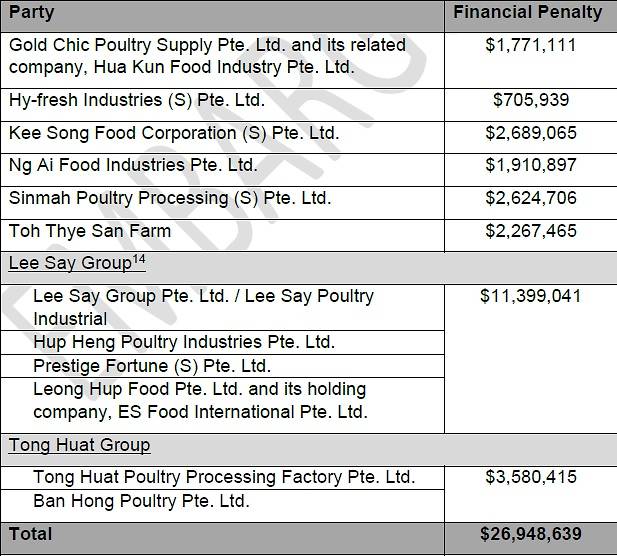
SINGAPORE: On Wednesday (Sep 12), the Competition and Consumer Commission of Singapore (CCCS) fined 13 fresh chicken distributors a total of S$26.9 million – the highest penalty yet.
The 13 distributors had been involved in unethical price fixing and market sharing practices for seven years.
The 13 companies in question import live chickens from farms in Malaysia, subsequently slaughtering them in Singapore. Then, the distributors sell the fresh chicken to supermarkets, restaurants, hotels, wet market stalls and hawker stalls.
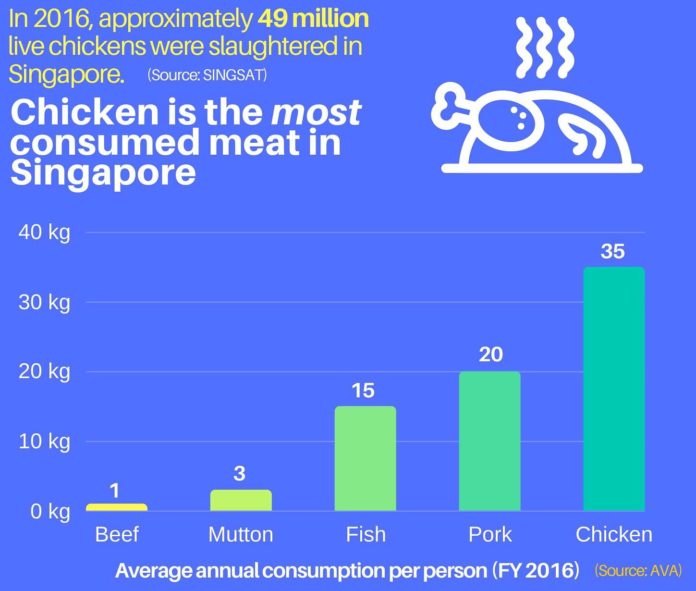
In 2016 alone, approximately 49 million chickens were slaughtered in Singapore.
2. CHICKEN IS THE MOST CONSUMED MEAT IN SINGAPORE
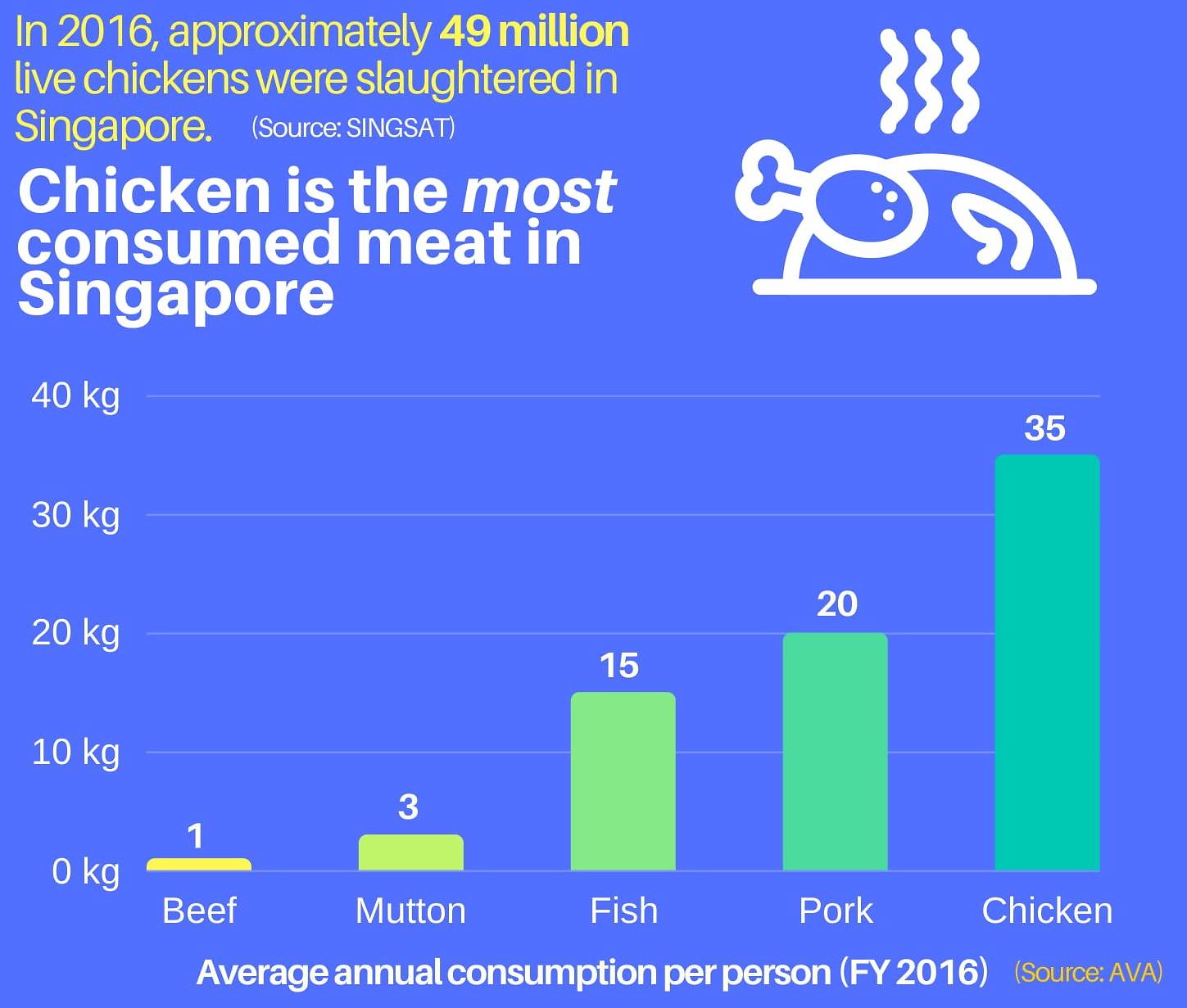
The average Singaporean consumes as much as 35kg of chicken a year. According to data from the Agri-Food and Veterinary Authority of Singapore, that’s as much as the average intake of fish and pork combined. Mutton ranks a distant fourth at 3kg consumed annually, with beef rounding out the top five at just 1kg.
The average Singaporean consumes 35kg of chicken a year. (Photo: CCCS)
3. IT IS A HALF-BILLION DOLLAR INDUSTRY
The 13 fresh chicken distributors that were punished were dubbed a cartel; the collective is responsible for supplying over 90 per cent of Singapore’s fresh chickens. The combined annual turnover of the 13 companies amounted to S$500 million.
4. HOW THE COMPANIES COLLABORATED
For at least seven years, the companies had:
Engaged in price discussions
Coordinated the amount and timing of price increases
Agreed not to compete for each other’s customers
So with each member having its own slice of the (chicken pot) pie, the anti-competitive measures culminated in …
5. COORDINATED PRICE HIKES
The coordinated price increases ranged from 10 cents to 30 cents per kg on at least seven occasions – July 2008, May 2009, August 2010, January 2011, March 2011, January 2013 and January 2014.
This left customers with limited options, if they had wanted to switch to more competitive distributors, ruled CCCS, which dished out fines to the 13 companies according to the following table: