Home Blog Page 952

MPs, citing dangers of secondhand smoke, want to curb smoking in homes

0

SINGAPORE: Members of Parliament (MP) have urged authorities to curb smoking in homes, citing residents’ complaints about secondhand smoke wafting into their flats and the health risks associated with it.

This comes as Parliament on Monday (Sep 10) passed amendments to the Smoking (Prohibition in Certain Places) Act, which allow the Government to designate more no-smoking zones and give officers more enforcement powers.

But the MPs said the Bill failed to address secondhand smoke from neighbours’ homes.

“We are now doing a lot to protect people from secondhand smoke in public areas,” Nee Soon GRC MP Louis Ng said. “But the concern which has been raised in this House before is: What are we doing to protect people from secondhand smoke in their own homes?”

READ: Government has no plans to make smoking rooms compulsory in public buildings: Amy Khor

Tanjong Pagar GRC MP and surgeon Chia Shi-Lu said secondhand smoke contains hundreds of toxic chemicals, of which about 70 can cause cancer.

“It can lead to coronary heart disease, stroke and lung cancer. It can cause asthma attacks, respiratory infections and sudden infant death syndrome,” he added. “There is no risk-free level of exposure to secondhand smoke.”

Over the years, Dr Chia said he has received numerous complaints from residents about the “nuisance and unhealthy effects of neighbours’ secondhand smoke drifting into their flats”.

RESIDENTS COMPLAIN

Likewise, Mr Ng said many of his residents complain about being affected by secondhand smoke when neighbours smoke at their windows or balconies, especially as housing units are close to each other.

“Imagine being exposed to and having to tolerate secondhand smoke from your neighbours every day for years with the only reprieve being moving out altogether,” he said.

Jurong GRC MP Rahayu Mahzam recalled how one of her residents, a lung cancer survivor living in a condominium, had to constantly close his windows and stuff cloth into the gap below his main door because his neighbour had a habit of smoking at the window.

Although the resident approached the condo managing agent and National Environment Agency for help, Mdm Rahayu said “there was little that could be done” except for advising and encouraging the neighbour to stop smoking from the window.

“The situation improved after some time but would recur once in a while,” she added. “This is clearly not the most ideal resolution of the matter.”

READ: Smoking ban expanded to include outdoor areas of universities, private-hire cars

Nee Soon GRC MP Lee Bee Wah said conflicts between HDB neighbours involving cigarette smoke entering other houses are “increasingly on the rise”.

“For years, non-smokers have been complaining about neighbours smoking at their window ledges, along common corridors and at landings between staircases,” Ang Mo Kio GRC MP Gan Thiam Poh said.

“Families with vulnerable young children and elderly members are particularly concerned.”

WHAT CAN AUTHORITIES DO?

To protect these individuals, Mr Ng asked if the law could be extended to prohibit smoking in a private home at a window or door that is within five metres of a neighbour’s windows and doors.

“These restrictions are based on the logic that cigarette smoke can be expelled up to five metres away,” he said.

Tanjong Pagar GRC MP Joan Pereira proposed that those who want to smoke in their homes must ensure that cigarette smoke does not escape their flats.

“In other words, windows and doors should be closed when smoking. Smokers may consider installing an air filter in their rooms. They should not be standing near the windows, doors or corridors to smoke,” she said.

“If smoke is detected outside of the flat, the resident should then be considered to have violated the law.”

READ: Orchard Road to go smoke-free by 2018; no new smoking areas at F&B outlets islandwide

READ: Smoke-free zone in Orchard Road delayed 6 months to end-2018

Mdm Rahayu suggested penalties for expelling secondhand smoke out of a residential home.

“If someone repeatedly commits the offence, it would be possible to track the unit from which the smoke comes from and issue a notice,” she said, adding that enforcement should be done in phases, with a warning issued first. 

“In any case, the legislation would send a strong message about the seriousness of the matter and deter residents from smoking at the windows or balconies.”

Dr Chia wants a tougher approach, calling for smoking in HDB flats to be banned. He said smoking areas can be set up near each HDB block. “This approach also protects the health of smokers’ families,” he said.

SHOULD AUTHORITIES STEP IN?

However, Mdm Rahayu acknowledged that there are residents who feel strongly about regulation that “impinges on what they can or cannot do at home”.

Mr Gan said “very unhappy” smokers have told him that they want a limit to the measures against smoking, including the 10 per cent increase to the tobacco excise duty.

“They ask for understanding from non-smokers and protest the deprivation of their spaces of freedom and enjoyment.,” he said.

Still, other MPs had a different opinion.

While “everyone deserves the freedom to do what he or she likes in their own homes as long as we do not break the law or harm anyone”, Dr Lee said smoking at home can harm family members and neighbours.

READ: Smoking ban in public housing might make quitting easier

Mr Ng pointed to a US ban on smoking in public housing to improve indoor air quality and reduce residents’ exposure to secondhand smoke.

“According to a nationwide study they conducted, people who lived in homes where smoking was prohibited were 60 per cent more likely to quit smoking for at least 30 days than people without this prohibition,” he added.

GOVERNMENT WARY OF SUCH MEASURES

Responding to the MPs’ suggestions, Senior Minister of State for the Environment and Water Resources Amy Khor said “regulation must be balanced against privacy concerns”.

In February, Dr Khor had said in Parliament that smoking within a residence is beyond the jurisdiction of the Government.

“Homes are private spaces; we need to be mindful that not everyone would support the view that the Government should intrude into one’s private space on the issue of smoking,” she said on Monday.

“Moreover, if we were to prohibit smoking in one’s own home, it would inevitably entail bringing to bear the necessary investigation and enforcement powers in our homes. We must not take this lightly.

“Such an intrusive regulatory approach to tackling neighbourly issues could ultimately be even more detrimental to community harmony and ownership.”

On the US ban on smoking within public housing estates, Dr Khor said it applies only to public housing estates for low-income residents through conditions in the tenancy agreements.

Oesophageal cancer smoking tobacco

File photo of cigarettes. (Photo: AFP/Joel Saget)

“The context of the US smoking ban is very different and we do need to consider our local circumstances before adapting practices from abroad,” she said.

As for the suggestion of setting up a designated smoking area (DSA) in residential estates, Dr Khor said the heartlands are “where our young children and youth spend their time daily”.

Furthermore, the fact that housing estates are designed so that HDB blocks are well-connected and dense means it is challenging to find suitable and less visible locations for the DSAs, she said.

“DSAs typically serve as congregation points for smokers,” she added. “The daily sight of people gathering to smoke at DSAs at residential areas may give our young the impression that it is normal to smoke. As much as possible, we want to avoid this.”

Instead, Dr Khor said the Government has been addressing secondhand smoke in housing estates by prohibiting smoking in common areas, including at the lift lobbies, corridors and staircase landings.

“Ultimately, living in the community is about give and take,” she added. “I urge all smokers to be considerate, and to refrain from smoking in a way that would negatively affect others.”

Source link

Average performance bonus of political office-holders dipped slightly in 2017

0

SINGAPORE: The average performance bonus of Singapore’s political office-holders was 4.1 months in 2017 – a five-year low – according to figures shared in a written parliamentary reply from Prime Minister Lee Hsien Loong on Monday (Sep 10). 

Mr Lee was responding to a question filed by the Workers’ Party’s Non-Constituency Member of Parliament Leon Perera.

The average performance bonus was 4.3 months in 2016, 4.4 in 2015, 4.2 in 2014 and 4.3 in 2013. 

The range of three to six months’ average performance bonus received by political office-holders of all grades remained constant from 2013 to 2017.

Performance bonus for ministers

The performance bonus is among several components of a political office-holder’s salary, apart from the monthly pay. The other components include a 13th month non-pensionable annual allowance, a National Bonus linked to Singapore’s socio-economic outcomes and an annual variable component as paid to civil servants.

Said Mr Lee: “I formed a committee in 2017 to review whether the salary framework established in 2012 remains appropriate and valid against its intended goals, and what adjustments may be useful; and whether there is a need to adjust the salaries should there be a change in overall salary levels based on the proposed framework.”

He pointed to Deputy Prime Minister Teo Chee Hean’s announcement in Parliament in March that ministerial salaries and their guiding framework would be unchanged, due to the committee’s affirmation that the current pay structure “remained sound”.

“Therefore, we should maintain this structure,” said Mr Lee. “While the MR4 (or entry-level minister) benchmark had increased by 9 per cent since 2011, the Government noted that the 2017 MR4 benchmark was lower than the 2016 MR4 benchmark, and hence had decided to maintain salaries at the current level and watch salary trends further. That remains the position.”

Source link

11 complaints to National Library Board on homosexual content since 2014

0

The National Library Board also acted on feedback received over 23 books due to race, religion and “other topics”.

National Library

The Library@Orchard. (Photo: Marcus Mark Ramos)

SINGAPORE: The National Library Board (NLB) has received 11 complaints from the public in the last four years over titles with homosexual content, said Minister for Communications and Information S Iswaran Parliament on Monday (Sep 10).

In response to a question from Nominated Member of Parliament Kok Heng Leun, Mr Iswaran revealed that eight were eventually moved to sections for older readers and three were assessed as suitable to stay put in the section for children and young adults.

NLB also received feedback on 23 titles due to race, religion and “other topics”, he added.

For these, seven were moved to sections for older readers and eight remained in their original locations. The other eight were Malay children’s titles – Agama, Tamadun Dan Arkeologi (or Religion, Civilisation and Archeology) – which were withdrawn in June last year due to “controversial religious content”.

The latter series was alleged to have contained material insulting religions such as Judaism, Christianity and Buddhism.

Three of the books with homosexual content were initially set to be destroyed in 2014 in a move that attracted global reportage. But after national backlash in the form of petitions and protests, two were moved to the adult section instead: And Tango Makes Three, about two male penguins raising a baby and The White Swan Express, which features children adopted by gay parents.

Who’s In My Family?, which mentions gay couples, was pulped.

The illegality of sex between men in Singapore has re-emerged as a hot-button topic after India repealed a similar British colonial-era legislation last week. Law Minister K Shanmugam and veteran diplomat Tommy Koh have spoken on the matter and thousands have signed petitions to either scrap or keep the penal code provision known as “377A”.

Mr Iswaran said the NLB selects titles “based on a collection policy which aims to provide age-appropriate and diverse reading material”.

“The NLB seeks to balance the need for a wide-ranging library collection with sensitivity towards our community norms,” he added. “Beyond its team of book selectors, the NLB also relies on pre-publication information from publishers and vendors, and reviews from library journals. In some instances, review copies are requested so that the NLB can assess these books in greater detail.

“In addition, the Library Consultative Panel, comprising citizens from a wide cross-section of our society, was established in 2015 to provide diverse community perspectives and recommendations to NLB on books which are being reviewed due to content concerns raised by members of the public.”

Source link

14 women arrested for prostitution-related offences

0

SINGAPORE: Fourteen women and a man were arrested on Friday and Saturday (Sep 7-8) during a series of police raids targeting vice activities.

The women, aged between 20 and 52, were arrested for prostitution-related offences under the Women’s Charter, the Singapore Police Force (SPF) said in a news release on Monday.

They were operating from hotels and rented apartments along Jalan Besar, Eu Tong Sen Street, Temple Street, Albert Street, Jalan Sultan and Smith Street. 

The women had advertised their services on various social media platforms, the police said.

(nh) 14 women, 1 man arrested for anti-vice operation

Enforcement checks were carried out on hotels and rented apartments along Jalan Besar, Eu Tong Sen Street, Temple Street, Albert Street, Jalan Sultan and Smith Street. (Photo: Singapore Police Force)

A 33-year-old man was also arrested for offences under the Employment of Foreign Manpower Act.

Investigations are ongoing, the police said.

The police advised landlords and hotel owners to ensure tenants do not carry out vice activities on their premises. 

(nh) 14 women, 1 man arrested for in anti-vice operation

The women had advertised their services through various social platforms. (Photo: Singapore Police Force)

Unlicensed brothel operators face up to five years in jail and a fine of up to S$10,000. Anyone convicted of living off the earnings of the prostitution of another person can be jailed up to five years and fined up to $10,000.

“The police will spare no effort in clamping down and take tough enforcement action on vice activities. Those found engaging in illicit activities will be dealt with sternly in accordance to the law,” SPF said.

Source link

Commentary: Helping Grab drivers find jobs and have enough money an uphill battle

0

SINGAPORE: The world of consumer demand has been upended this decade and it all started with the smartphone.

New technology, big data and artificial intelligence have transformed the world of goods and services into an on-demand economy where new products come online non-stop, rapidly shortening the product cycle.

Now you can buy anything, anytime, anywhere – so long as you have an account with an online retailer like Alibaba or Zalora. You can also get food delivered with Deliveroo or Foodpanda and call up a ride with a Grab app.

READ: Five secret boosts a growing gig economy offers Singapore, a commentary

CHOICE, LIKE A BUFFET

Welcome to the age of disruption. In this new economic reality, the most successful enterprises are highly agile and responsive.

Firms adopting these business models may require fewer but more skilful workers.

In this new environment, the workers who succeed are adept in many areas and obtain new, appropriate skills every few years.

These individuals work and live in a digitalised workplace. Those at the frontlines have more choice to work on projects they like and choose where and when they work.

When we go for a buffet dinner, we select what we like to eat. For workers in this new economy, they choose work from which they derive satisfaction and earn labour income.

Many of them might not have employers. They are gig workers, Grab drivers included.

A view of Uber and Grab offices in Singapore

A view of Uber and Grab offices in Singapore March 26, 2018. (Photo: REUTERS/Edgar Su)

The employment relationship between companies and workers is vastly different from the classic full-time job that provides an agreed compensation package. Companies need a diverse portfolio of teams of workers who can work flexibly, but this has massive drawbacks that are not immediately foreseen or felt.

The Government must provide the necessary institutional framework to ensure that firms can compete and workers are gainfully employed in this on-demand economy, and mitigate its snags. 

The gig economy never aimed to provide individuals with full-time employment and retirement benefits, and didn’t pretend to. It certainly helped those between jobs to earn some income.

In this sense, Grab came in on time to fuel the gig economy. It grew rapidly in Singapore since 2013 and brought disruptions to the traditional taxi industry.

But if one takes on tasks from these companies, it must be with a cautionary “employees beware” mindset. Not new, this challenge has plagued freelancers for a long time.

Inevitably, there will be times where one is without a task that provides income – or in the case of Grab, a ride, drivers’ incentives or other benefits. If income is not an issue, one can enjoy leisure.

And if workers take on gig jobs as a supplement to a steady stream of income, or such platforms help those out of a job to earn some money, companies like Grab are to be welcomed.

But if it’s full-time employment workers seek, they must know that they are at the whims and fancies of the companies they work with. Since Grab’s acquisition of Uber’s regional operations in March, Grab drivers’ earning have been hit hard. For instance, one grab driver claim that his earnings had fallen by 30 per cent. 

People wait for the start of Grab's fifth anniversary news conference in Singapore

People wait for the start of Grab’s fifth anniversary news conference in Singapore June 6, 2017. REUTERS/Edgar Su/Files

READ: Private-hire drivers face roadblocks as they seek way out of once-lucrative industry

READ: As reality dawns on consumers, time to question if private-hire cars advance our car-lite drive, a commentary

HARD TO FIND A JOB

Many Grab drivers have tried leaving gig driving but they have difficulties finding another job, because many mistook it for long-term employment and have seen their other skills eroded, which makes finding another job with a decent wage very difficult.

Being a Grab driver also does not give you much time to learn new skills. After driving for 10 hours a day for six days a week, you will be too exhausted to attend classes, let alone absorb what is taught.

Amidst this bleak outlook, at least one firm has risen to break the mold. A new taxi company, HDT Singapore Taxi, has offered fixed salaries and employment benefits such as annual leave and CPF contribution to its drivers. With a basic salary of S$1,900 monthly, if HDT drivers hit S$8,500 a month in revenue, their gross salary can rise to S$4,300 a month.

Some taxi drivers said that it is not easy to hit $7,500 a month, yet they feel that they are better off as taxi drivers as they have better control of their times.

But HDT Singapore’s model is nascent and small compared to the more than 40,000 private car drivers.

HDT

HDT electric taxis. (File photo: TODAY)

Meanwhile, more help with retraining and job matching might oil the wheels for Grab drivers. NTUC is launching a wide-ranging study to find out how workers can be matched to future jobs, as digitalisation and disruption has changed the way businesses operate, labour chief Ng Chee Meng announced this week.

To encourage drivers to invest in their retraining and give them skin in the game, perhaps we should encourage Singaporeans to put money in their SkillsFuture account by matching the amount on a one-to-one basis subject to a ceiling.

READ: People ready to retire later but preparing older workers will require more than reskilling, a commentary

WHITHER RETIREMENT?

Even still, the growth of gig jobs is not likely to abate, where the number of gig workers including those who are self-employed numbers more than 220,000 now and is expected to increase.

We can discuss how to help Grab drivers find full-time jobs, but it is also pertinent to focus on their retirement adequacy. Where CPF provides a huge part of retirement income in Singapore, these workers have no CPF contributions for the company they work for. How do you nudge them to save adequately for their old age if they fall outside the CPF scheme?

One idea to improve the retirement adequacy of gig workers is to encourage them to contribute to the Special Account under the CPF scheme, which receives a higher interest rate compared to ordinary account and improve incentives that encourage this group to do so.

This difference in rate and added incentives should be high enough to lure them to contribute to the CPF scheme but not high to induce full-time employees to switch to gig employment.

CPF building generic

File photo of the CPF building. (Photo: TODAY)

READ: Saving too little, starting too late, do we have enough for retirement? A commentary

TIME TO ASK OURSELVES HARD QUESTIONS

The media spotlight on Grab drivers struggling to find a job has raised many questions about what can be done to aid them.

This is an inevitable challenge of disruption and a digital economy where companies that must scale up rapidly will use short-term incentives to attract labour and the workforce must make its own informed decisions.

But public policy on retraining and retirement adequacy must also reflect this new reality where a sizable proportion of workers will undertake gig work.

Chew Soon Beng is professor of economics and industrial relations at Nanyang Technological University.

Source link

Singapore’s 1st female CID chief: ‘There is no glass ceiling in the police’

0

SINGAPORE: One and only one case in Florence Chua’s near-three decade police career fills her with regret – and it happened in her second year on the job. “It was a rape of a five-year-old girl by two perpetrators whom the mother had handed the girl over to, to help look after,” Ms Chua, now 52, recalled. “Before we could complete the prosecution, the mother – who was not local – decided to bring the girl back home and in the end, the two chaps weren’t convicted.

“I still think, could I have done it better?”

Today, as Singapore’s first-ever female chief of the premier Criminal Investigation Department (CID), it is episodes like these which continue to remind her why she does what she does.

“It keeps me going every day … the satisfaction of bringing closure to families; victims and keeping perpetrators off the street,” said Ms Chua, who is also the first female deputy commissioner – second in rank only to the police commissioner himself. “It’s like when you read about cases and think, this ‘fellow needs to be taken out’. Those are the moments.”

Yet she very nearly did not become a policewoman at all: In her early 20s, while still captain of Singapore’s national hockey team, she thought of working as a physical education teacher. Her dream job was “something not desk-bound, something to challenge me on a daily basis and something I could make a difference in”; she eventually applied to join the police in 1989.

Ms Chua’s journey has since traversed the investigation and intelligence departments to anti-vice and secret society branches to a stint with the home affairs ministry where she helped set up the Casino Regulatory Authority.

She also kept her place in the national hockey squad for 10 more years, lining up alongside luminaries like Melanie Martens to famously strike gold at the 1993 Southeast Asian Games held on home soil.

The sport, she said, imbued in her a long-lasting foundation of discipline, teamwork, resilience (think committing to training sessions after 24 hour work-days) as well as a mind constantly plotting different strategies and tactics to outwit opponents.

An example of the latter? “I was in a back lane full of transvestites when somebody shouted ‘police’ and the fellow next to me wanted to run,” said Ms Chua. “He fell right in front of me – because I was stepping on his sari.”

“GENDER SHOULD NOT MATTER”

When the dreaded yet inevitable gender questions were directed at her, Ms Chua – the eldest of four sisters – acquitted herself comfortably.

“You know people keep saying ‘first female’ this, ‘first female’ that … but I’m not the first in a lot of areas. For example, I was not the first female commander. And I wasn’t the first female in the SSB (secret society branch).

“Before me, we already had females who’d been breaking the glass ceiling.”

Cancel that – when it comes to Singapore’s police force, “there’s really no glass ceiling”, Ms Chua declared.

“Yes, when I first joined, there weren’t many female officers in investigation. But now you see female officers in almost every job and post, even leading our Emergency Response Teams to respond to terrorist incidents. In the early days, you won’t imagine this being done but today this is quite common.”

Pressed to share her everyday experiences, she said: “I don’t think there are a lot of obstacles to being a female officer. It’s easier for us to be a bit more empathetic … certain situations and crimes, we will be able to handle more sensitively.

“But in terms of expectations, requirements … it’s all the same. All of us do IPPT (Individual Physical Proficiency Test); shooting; when we go through courses we are expected to do the same thing; if a ladder is in front all of us are expected to climb it.”

The only plausible difference lies in IPPT scoring standards, Ms Chua added.

“Gender should not matter … It’s not whether you are male or female, but whether you have the capability; ability to do the job,” she summed up.

florence chua 1

When will Singapore have its first female commissioner? “When we have somebody capable and suitable – but it won’t be me,” said Ms Chua. (Photo: Justin Ong)

To reach her current post as CID director is to reach what Ms Chua herself described as the “apex” of a career in investigation; if not all the force. It is a testament to her ability – already borne out in a sprawling résumé of cases she either led or participated in.

Highlights include the businessman kidnapped – and rescued – on the eve of his wedding in 2001; tracking down both dead and surviving Singaporeans after the 2004 tsunami; the 2013 cyber attacks initiated by the “Messiah” hacker; the Little India riots the same year; and the 2014 “Sheng Siong kidnapping”.

“I’M NOT JUST SITTING BEHIND A DESK”

Her track record of high-profile cases has been amplified in just the last three months, starting with a baptism of fire in the Trump-Kim summit announced on June 1 – the same day she assumed the CID leadership. 

In July alone she dealt with the Serangoon slashing, SingHealth cyber attacks and illegal World Cup gambling; the next month the Boon Lay pawnshop robbery happened.

Little wonder she described her biggest challenge so far as “trying to find enough time”. Not that Ms Chua is complaining: In a way, the job still ticks the criteria boxes she once had as an action-seeking young woman.

“Director of CID doesn’t mean I don’t go on the ground, I still do. I’m able to still run operations, so I’m not just sitting behind a desk and looking at policies,” she laughed.

She has even retained the structured rigour of a competitive athlete, by waking up at 6am five times a week to hit the gym before heading to work – something she hasn’t stopped looking forward to daily.

Reflecting on her journey, Ms Chua said: “I’ve to sit down and count before I realise it’s been 29 years. Things moved pretty fast; time just passed … When I joined, I didn’t even think where I’d be when I retire.

“There were times when things didn’t really go very well and I thought about leaving. But do you just pack up and leave, or stay on and deal with it and make it a better place for others?” she mused.

“At the end of the day .. this is a job that I really like to do and it’s also a job that gives meaning. Every day I come in and I see officers willing to put in long hours, not complaining, and the only reason they do it? They want to see justice done.”

Source link

POPULAR Readers’ Choice Awards 2018

0

POPULAR Readers’ Choice Awards 2018
from Tuesday, October 9, 2018 at 7:00 AM to Tuesday, October 9, 2018 at 4:00 PM

POPULAR @ COMPASS ONE MALL

Singapore, Singapore

Source link

Online NRIC generators a ’cause for concern’, cybersecurity experts say

0

SINGAPORE: While the Government has issued new guidelines against indiscriminate collection of NRIC details, cybersecurity experts have highlighted a different kind of personal data threat: random NRIC generators.  

From September 2019, the Personal Data Protection Commission (PDPC) said organisations can only collect, use or disclose NRIC numbers or NRIC copies “under certain specific circumstances”.

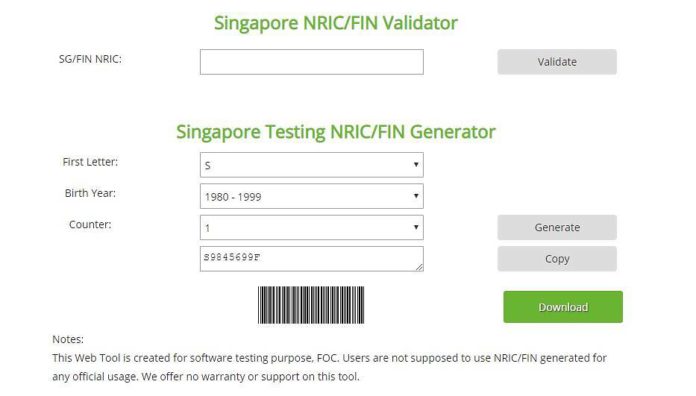
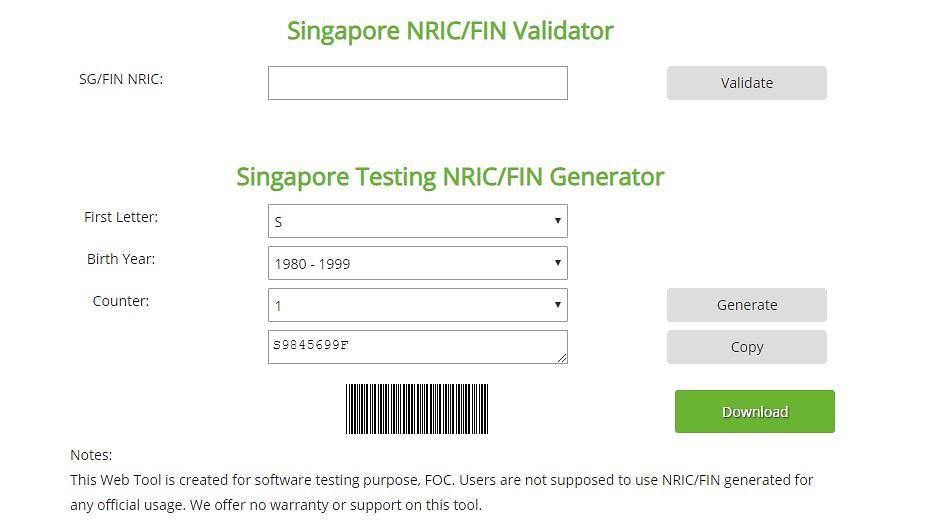
But a quick online search by Channel NewsAsia turned up at least two random NRIC generators that can produce “valid” NRIC numbers that are “verified against published checking logic”.

Both only required a user to input the desired NRIC number’s first letter and corresponding range of birth years before churning out the digits.

When announcing the new NRIC guidelines in August, the PDPC had said that the NRIC number is a “permanent and irreplaceable identifier which can be used to unlock large amounts of information relating to an individual”.

READ: Collection of NRIC details: Security, building management providers grapple with costs, time needed to change

“In today’s digital economy, indiscriminate collection or negligent handling of NRIC numbers can increase the risk of unintended disclosure and may result in NRIC numbers being used for illegal activities such as identity theft or fraud,” it added.

Mr Jonathan Phua, who co-founded cybersecurity firm InsiderSecurity, said the online NRIC generators pose “big cyber risks” as many online services use NRIC numbers as usernames.

“We know that many people like to use simple-to-remember passwords,” he told Channel NewsAsia.

“So if I generated a list of random, valid-looking NRIC numbers, I can try my luck to access such services with these NRIC numbers and commonly used passwords.

“Hopefully, the online services have measures in place to make this kind of attack more difficult, but the attacker may get lucky with an online service that is not so well-protected.”

Ms Joanne Wong, senior regional director for Asia-Pacific and Japan at LogRhythm, a security intelligence firm, said the generators can be a “cause for concern”.

“A system using artificial intelligence can be fed a list of existing NRIC numbers, possibly stolen in a data breach or bought on the dark web, and taught how to better identify and predict valid NRIC numbers,” she said.

“Further cross referencing between different sets of stolen data may reveal information such as favourite passwords and mobile numbers tagged to an individual NRIC number.

“In the worst-case scenario, this might even lead to accounts using NRIC numbers as part of login details to be compromised.”

online nric generator 2

Screengrab of another online NRIC generator.

Mr Clement Lee, principal consulting security architect for Asia, Middle East and Africa at Check Point Software Technologies, said hackers can build “context” around the generated NRIC numbers to launch an effective social engineering campaign.

For example, a hacker who is able to match the NRIC number to a person’s full name and mobile number can call the victim while posing as a person in authority.

“Step by step, the victim will be guided to install further mobile malware for further personal data phishing,” Mr Lee said, adding that advanced hackers can substitute their personal numbers with official-looking ones.

SHOULD YOU BE WORRIED?

While it is clear that online NRIC generators can be used for nefarious activities, the experts said there are measures in place to ensure criminals have a tough time.

READ: FAQ: When should you show your NRIC – and when not?

For example, organisations would usually need additional information like proof of address for verification, said Mr Dexter Ng, chief technology officer at AntiHack.me, a bug bounty platform.

“As there are ways of validating these numbers, it would be difficult to use these generated numbers for illegal activities,” Ms Wong said.

Likewise, Mr Lee said it is “extremely tedious to build the context around the NRIC numbers for them to be really useful”, while Mr Phua said the NRIC generators “don’t pose a new risk” as they have been around for a long time.

Mr Ng said the public “should not worry too much” about the generators, but instead “be more aware and concerned about data breaches from companies that store their data or companies that sell their data for money”.

PURPOSE OF NRIC GENERATORS

So, what then is an online NRIC generator used for?

Ms Wong said they can be used for contests, giveaways and registrations, pointing out that the generated NRICs might not necessarily belong to a real person.

“The most common usage or abuse for generators are registration of multiple accounts to gain referral points or discounts,” Mr Ng said.

NRIC 01_mod

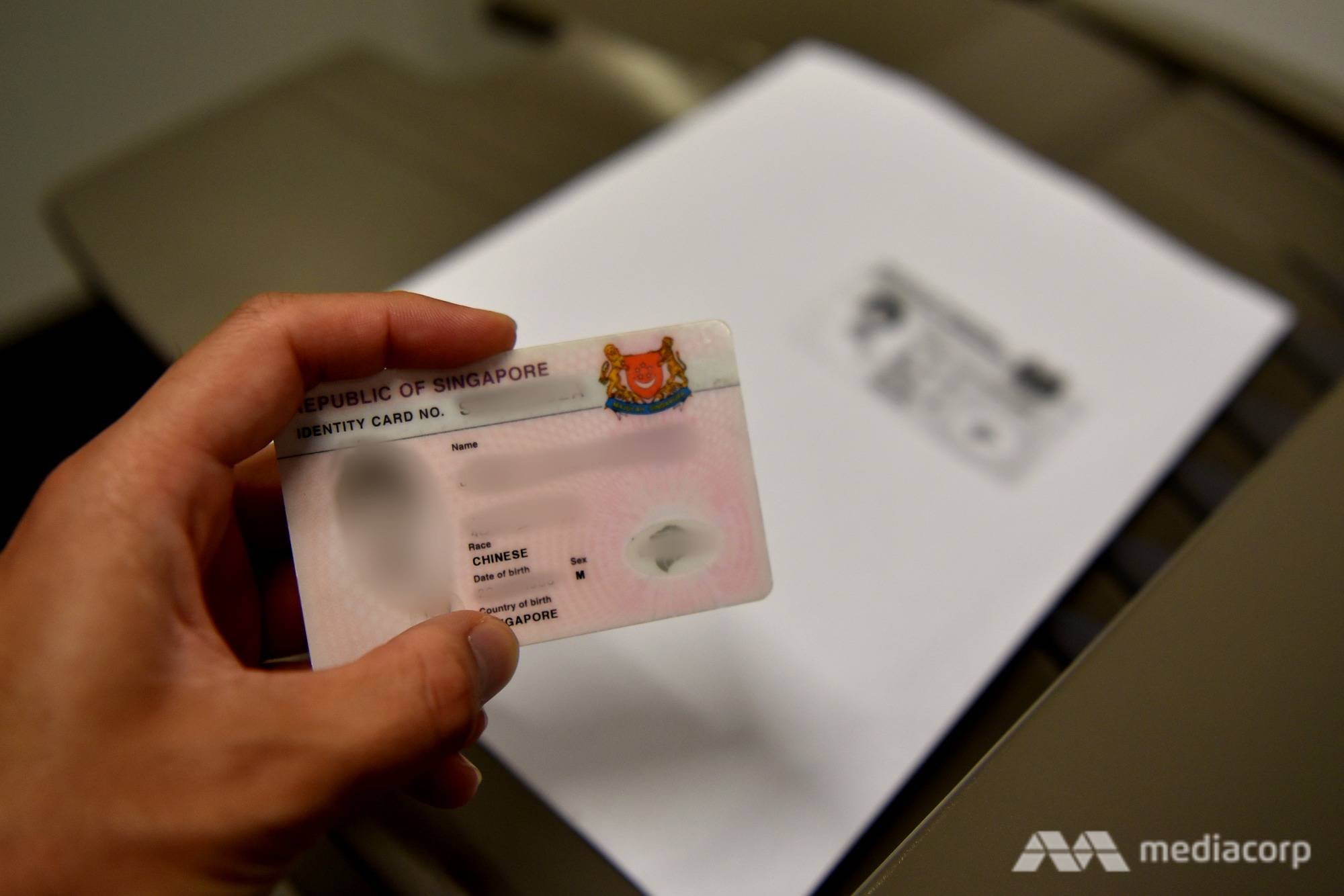
Photo illustration of photocopying an NRIC. (Photo: Jeremy Long)

As for the creators themselves, one stated on the generator’s website that it is used for software testing purposes, while another said it “serves to demonstrate that it is possible to do so”.

Mr Phua said the NRIC algorithm is simple enough that coders can take as quickly as 20 minutes to write their own random generator.

“The NRIC algorithm was never meant to be an impenetrable cipher, but a check for input errors,” Mr Lee said. “With a large enough data set, any budding cryptanalyst would be able to solve this algorithm.”

SHOULD AUTHORITIES STEP IN?

Despite the generator’s simplicity, its creators are quick to acknowledge the harm it can potentially cause.

“You should not use the NRIC numbers to impersonate anyone as it is an offence,” one said on the generator’s website. Another added: “Users are not allowed to use NRIC/FIN generated for work usage, or submit into Government systems.”

It remains unclear if it is legal to generate random yet valid NRIC numbers. Queries to the Info-communications Media Development Authority were referred to the Immigration and Checkpoints Authority (ICA), which issues identity cards to Singapore citizens.

Channel NewsAsia has reached out to ICA for comment.

READ: Singapore Taekwondo Federation fined S$30,000 after minors’ NRIC numbers disclosed

Nevertheless, the experts are clear about the importance of protecting the unique and widely-used NRIC numbers.

“If an organisation’s system is compromised, the perpetrator might make use of the NRIC number to search for more privileged information about the person,” said Mr Wayne Lee, a junior security researcher at Kaspersky Lab APAC’s global research and analysis team.

Furthermore, Mr Phua said attackers can use NRICs to tie together different kinds of leaked data from various sources and build a profile for different individuals.

“This will be useful to the attacker for identify theft, fraud or even state-sponsored espionage,” he added.

Source link

Commentary: What a ‘Housing Redevelopment Board’ will do for mature estates

0

SINGAPORE: “We will continue to transform our city … and in 30 to 40 years’ time, we will rebuild our existing towns,” said Prime Minister Lee Hsien Loong at this year’s National Day Rally (NDR).

“HDB will be very busy. They may have to change their name to HRB – the Housing Redevelopment Board,” he quipped.

PM Lee also announced the expansion of the Home Improvement Programme (HIP II) and a new Voluntary Early Redevelopment Scheme (VERS) at the same event, measures that may provide some respite to confused HDB home dwellers concerned with the growing uncertainty of the value of their 99-year leases.

READ: Strong political commitment to housing is precisely what younger Singaporeans need, a commentary

VERS A KEY LEVER

VERS will be a key lever for an imagined, future Housing Redevelopment Board, but it has been carefully designed to factor in a community’s collective choice on housing as flats age.

VERS takes on a very similar approach as the en bloc scheme for private properties, except public housing flats in selected precincts will only be returned back to the Government if residents vote “yes” to the scheme. 

The compensation from the VERS will allow residents to pay for another flat or keep the money for their retirement needs.

However, residents who wish to continue to live in their flats until their leases expire could vote “no”. As this scheme is still a work-in-progress, details of the selection criteria of precincts, majority voting rules, compensation, and many more have yet to be ironed out.

Will VERS stick to the minimum of 80 per cent consent needed to proceed, just like in the private en-bloc scheme, or will the bar be higher? How high is high enough?

Should flats be taken back by the Government in VERS, will home dwellers be given replacement flats in nearby estates as is the case in the current selective en bloc redevelopment scheme (SERS)?

HDB Old Flat Blue Sky

File photo of HDB Flat in Singapore.

VERS is part of the Government’s long-term plan to redevelop some of the oldest HDB housing estates, including Marine Parade, Ang Mo Kio and Toa Payoh that were built in a “rush” during the peak of the housing construction programme from the 1960s to the 1980s. 

When clusters of flats in these HDB estates reach 70 years simultaneously, some of the flats will be taken back through VERS, while other flats, where VERS was rejected, could be upgraded through HIP II.

Regardless of the decision made by each precinct, we may expect many to say yes. What this means on a national level is that VERS will enable the Government to phase and pace out estate redevelopment in a more systematic and planned manner, avoiding the same costly construction rush in Singapore’s early years.

SERS AN EXPENSIVE AND RARELY APPLIED LEVER

But there’s also the Selective En Bloc Redevelopment Scheme (SERS). While, unlike VERS, it remains highly selective and applicable to only a small percentage of HDB flats in Singapore, SERS is a harder urban redevelopment tool that allows the Government to acquire the land on which aged flats sit on without requiring residents to vote.

SERS MacPherson Lane

Three blocks of flats at MacPherson Lane have been selected for the Selective En bloc Redevelopment Scheme. (Screengrab: Google Maps)

But the high costs, which includes ensuring residents have a replacement flat in the vicinity to move to, suggest this tool will remain limited to high-potential precincts in mature HDB estates.

Indeed, the compensation for SERS is very generous and assistance to move to another house is extensive. When the Government identifies a precinct to carry out SERS, home owners will be notified early and compensated based on the market value of their flats at the time of the SERS announcement.

Home owners can use the proceeds to take up a new 99-year lease flat at a designated replacement site, apply for a flat from a HDB sale launch, or sell or transfer their flat with rehousing benefits. If they choose not to take up SERS rehousing benefits, they would receive up to S$30,000 as an ex-gratia payments on top of their SERS compensation.

READ: A tale of one HDB flat across two generations, a commentary

Still, home owners should not assume all HDB flats entering the final stages of their leases are eligible for this SERS scheme. While there are still opportunities for SERS to take place in the coming years, projects with the highest redevelopment potential have already carried out SERS and selected flats make up only 4 per cent of the HDB stock.

LESSONS FROM THE PRIVATE MARKET EN BLOC SALES

Perhaps an imagined Housing Redevelopment Board can design details of the newly-announced VERS scheme by drawing some lessons from the en bloc sales in the private housing market.

In the same vein as what VERS intends to do in the public housing market, en bloc sales ensure that Singapore’s private housing scene remains dynamic and keeps abreast with Singapore’s urban renewal plans – by allowing owners of either strata units in private non-landed residential developments or houses on contiguous land plots to come together to jointly sell redevelopment rights of their land to private developers.

private public housing

A view of private landed property and public housing. (File photo: TODAY)

En bloc deals can be a lucrative affair for home owners in land-scarce Singapore, if their existing land have not reaped theirhighest and best use” potential.

But what tempers profit-driven property developers, who may fork out large sums of money to entice home owners into agreeing to an en bloc sale scheme, is the profit motive. They will do their sums to ensure they can still profit from future redevelopment of the en bloc site.

On the flipside, VERS is a Government-initiated project that utilises public funds to carry out a buyback scheme. Therefore, the compensation the Government forks out for home owners has to be prudent.

Policymakers are also mindful that overly generous compensations could risk sparking a demand frenzy in the public housing market, which may raise prices for the new flats built on sites that have undergone VERS, and go against their goal of providing affordable housing for Singaporeans.

REJUVENATION OF A NATION’S HOUSING

VERS, SERS and en bloc all involve efforts that rejuvenate neighbourhoods in Singapore. The sum of their effects is to renew Singapore’s housing stock and upgrade residential properties to match home owners’ changing needs.

All three schemes aim at preserving home owners’ housing wealth, by unlocking and partially distributing value from a better use of land back to home owners.

It is inevitable that the newly-announced VERS may attract some over-zealous buyers to speculate on HDB flats they think may potentially fall under VERS  in the coming years. But such unhealthy, rent-seeking behaviour could crowd out other home buyers who want to live out their lives in those neighbourhoods.

READ: Windfalls and bailouts should not be an expected part of the public housing equation, a commentary

HDB flats

HDB flats in Singapore.

Buyers may reap some monetary benefits, if they together with the majority of other residents vote for the VERS when selected. But because the compensation is unlikely to be as much as those under SERS, buyers should heed caution and avoid relying on VERS to be bailed out.

Much work lies ahead for the authorities in ensuring that Singapore’s housing markets remains affordable and sustainable in the long run, not just in regulating unhealthy speculation in the property market but in the less eyeball-grabbing role of renewing the housing stock for future home owners.

What the Government has done at the National Day Rally is to chart out a path and give themselves leeway to plan for and redevelop new housing estates in Singapore, in anticipation that some public housing leases will run out at the same time and home owners will need time to think about whether to say yes to VERS.

An imagined Housing Redevelopment Board may have more schemes to provide more options for home owners to monetise their old flats but this is a heartening start.

Meanwhile, any new, suitable policy that preserves the housing wealth for HDB owners, who make up more than 80 per cent of the general public, will certainly attract the media spotlight and be closely scrutinised.

Sing Tien Foo is Director of the Institute of Real Estate Studies, National University of Singapore. Amanda Tang is currently pursuing a postgraduate degree in Human-Environment Relations at Cornell University.

Source link

7 things to know about the more virulent strain of HFMD that’s killed 2

0

SINGAPORE & MALAYSIA: When her 17-month-old boy was afflicted with fever, she gave him some medication for the night.

His fever persisted into the next evening, so mother Mazlin Khairudin took him to a doctor, who told her it was “a normal fever with a little rash on his throat”, recalled the Penang resident. “That’s all.”

Two days later, her boy’s condition deteriorated, and she rushed him to hospital, where he died from hand, foot and mouth disease (HFMD), a common viral illness.

Toddler Yusuf Danial had become the first Malaysian victim of the Enterovirus 71 (EV-71) HFMD strain – a more virulent strain that is also on the increase in Singapore.

TP HFMD 3

Yusuf Danial.

“His lungs were filled with virus,” Mdm Mazlin told the programme Talking Point. “The doctor said he’d try his best to treat Danial. He gave antibiotics, but Danial’s body rejected them. Around 8.48pm, his heart stopped beating.” (Watch the episode here.)

In Malaysia, HFMD has soared to near epidemic levels this year – over 55,000 cases as of Aug 27 – with the outbreak in Penang rising to more than 3,700 cases.

Of these, the EV-71 strain has claimed the lives of two: Danial, in June, and a 27-month-old child in Sarawak, in July.

In Singapore, over 31,000 HFMD cases have been reported to date. This is what you need to know about the EV-71 strain in particular.

TP HFMD 4

A three-dimensional reconstruction of EV-71.

1. HOW CAN YOU TELL IT’S EV-71?

Some of the symptoms of this strain are vomiting, irritability, seizures and breathing difficulties, said KK Women’s and Children’s Hospital senior consultant (Infectious Diseases) Chong Chia Yin.

“The other thing you can look out for is lethargy. (If) the child refuses to eat and drink, then you also have to come in (to hospital). If the urine output is already reduced, you’d have to come in (too) because the child is showing signs of dehydration,” she explained.

“If your child has a lot of bubbles and blisters on the hands and feet, it’s less likely to be EV-71.”

In Danial’s case, he experienced flu symptoms, breathing difficulties and mouth ulcers. He died three days after receiving treatment in hospital, and Mdm Mazlin regrets not getting him admitted earlier.

TP HFMD 5

Mdm Mazlin Khairudin.

“Parents, please pay attention to your child. If there’s something different about your child, and the fever doesn’t seem to go down in one or two days, better send your child for a blood test or X-ray straightaway because this virus is everywhere,” she beseeched.

READ: Toddler dies from HFMD in Penang; first fatality in Malaysia

2. HOW IS EV-71 MORE VIRULENT?

HFMD is usually mild, with few complications, but the EV-71 strain can be fatal because of its severe complications, which include neurological, respiratory and cardiovascular problems.

It is also more infectious than the Coxsackie virus, the most common cause of HFMD.

Associate Professor Chong said a child with a Group A Coxsackie virus, for example, would usually spread it to 2.4 other children. But a child with EV-71 would usually spread it to 3.5 other children.

TP HFMD 6

Coxsackie is a type of enterovirus.

3. IS IT SAFE TO VISIT PENANG?

By mid-July, the number of HFMD cases this year was twice the number in the same period last year – an outbreak Penang Health Committee chairman Afif Bahardin described then as “beyond the danger level”.

But there is “a tremendous decline now”. The state’s Health Department had, in July, directed shopping malls to sanitise their trolleys, child rides and public benches. At one hawker centre popular with tourists, nightly cleaning sessions are still going on.

“(For) those who are visiting Penang, what’s important is to keep a self-awareness of cleanliness,” said Dr Afif.

He acknowledged, however, the emergence of the more virulent EV-71 “at a bigger number compared to the usual pattern we’ve seen for the past few years”, when the Coxsackie virus was more widespread.

READ: Penang supermarkets, shopping malls ordered to carry out disinfection as HFMD cases rise

TP HFMD 7

Checks in Penang found that trolleys were among the causes of the spread of HFMD.

4. WHAT ABOUT EV-71 IN SINGAPORE?

While the Ministry of Health has reported a “slight increase” in the proportion of EV-71 cases here, the Coxsackie virus type A remains the predominant strain, like in past years.

The total number of HFMD cases – at 31,015 so far – is a 28 per cent increase from the same period last year. The last peak was in 2016, when reported cases hit 42,000 for the whole year.

WATCH: HFMD cases in Singapore on the rise

5. HOW TO KEEP HFMD AT BAY?

Wash your hands frequently, before and after meals and also after using the toilet. When you cough or sneeze, cover your mouth or nose, advised Assoc Prof Chong.

“Try not to share food and drinks. Don’t share personal items as well, for example your toothbrushes and towels. And if the child is infected, avoid kissing and hugging the child,” she said.

TP HFMD 8

Associate Professor Chong Chia Yin.

While wet wipes may be suitable for cleaning the surfaces of doorknob or tables, a hand sanitiser is still needed, she added.

READ: Commentary: Afraid your kids will catch HFMD? Don’t let modern day parenting be ruled by fear

6. IS THERE ANY VACCINE AVAILABLE?

There is no approved antiviral drug or vaccine in Singapore, but Associate Professor Justin Chu from the National University of Singapore’s Yong Loo Lin School of Medicine is working on a vaccine that may be viable in five years’ time.

He is also leading a team of researchers who have developed an HFMD test kit that could soon allow children to be tested at home or their childcare centre – with just their saliva.

This kit takes as quickly as about two hours to turn around the results, and can be used before symptoms of the virus appear.

TP HFMD 1

Associate Professor Justin Chu’s team is now testing the kit on a larger group – the earlier study involved 82 children – to increase the sensitivity and specificity of the test.

It is estimated that each kit will cost about S$2, but there is two or three years to go before it hits the market.

READ: New saliva kit can detect HFMD cases before symptoms appear

7. CAN PARENTS CATCH HFMD TOO?

Yes. Ms Glynisia Yeo’s four-year-old son has caught HFMD thrice over a span of two years, and she was badly hit in 2016 when she contracted the disease from him.

She could not eat for a few days because of the mouth ulcers; she could not walk properly because of the sores on her feet; she had painful rashes on her hands, and her skin started to peel.

After she was discharged from hospital, she thought the worst was over. A few weeks later, the base of one of her fingernails “started peeling off”.

TP HFMD 2

Ms Glynisia Yeo.

Over the next few weeks, her fingernails and toenails fell off, and she suffered from hair loss too.

“I did a check with my doctor, and he said (those) could be some of the after-effects because the virus that I was hit with was pretty severe,” said the 42-year-old, who has since recovered.

“To me, (HFMD) is quite scary now. So I’m very worried, and sincerely hope that my son won’t catch it again.”

Watch this episode of Talking Point here. New episodes every Thursday at 9.30pm on Mediacorp Channel 5.

TP HFMD 9

About one in 10 HFMD cases in Singapore involve adults and youth above the age of 15.

Source link