SINGAPORE: A single QR code that is compatible with multiple e-payment solutions has been rolled out on Monday (Sep 17), marking the latest step in Singapore’s push towards cashless payments.
Dubbed the first of its kind globally, the Singapore Quick Response Code (SGQR) is an “infrastructure-light technology” that will help to simplify QR e-payments in Singapore for both consumers and merchants, said the Monetary Authority of Singapore (MAS) and Infocomm Media Development Authority (IMDA) in a joint media release.
The SGQR will be used in 27 payment schemes, including PayNow, NETS, GrabPay, DBS PayLah and Singtel DASH.
Currently, multiple QR code stickers may be displayed at one store to support various e-payment schemes, which can be confusing for consumers. With the roll-out of the SGQR, there will only be one QR code sticker that shows all QR payment options that the merchant accepts.
“Consumers will be able to quickly and easily see if their preferred QR payment option appears on the merchant’s SGQR label,” said MAS and IMDA in their press release.
To make payment, customers will have to log in to the apps of their preferred payment schemes, scan the SGQR code and key in the payment amount.
A symbolic SGQR label with various QR payment options. (Photo: MAS/IMDA)
Describing SGQR payments as “simple, swift and safe”, MAS and IMDA said: “Simplicity and speed of e-payments were identified by MAS as one of the critical challenges impeding adoption of e-payment options in Singapore. As QR payments could be an e-wallet or funded by a credit or debit cards, consumers retain the flexibility in choosing how to fund their QR payments.”
For merchants, the display of one QR code sticker will mean “less clutter” and “quicker payments by consumers”, the joint statement said.
The SGQR will be deployed over the next six months, with the first phase set to include more than 1,000 merchants in the Central Business District.
About 19,000 QR codes will be replaced with the SGQR labels from end-September. The replacement exercise is expected to complete by the end of this year.
The SGQR comes after the set-up of an industry task force last August to look at developing a common QR code for the fragmented e-payment landscape in Singapore. Co-led by the MAS and the IMDA, the task force consists of members from payment schemes, issuers, acquirers, banks and relevant government agencies.
NOT DONE BUILDING THE E-PAYMENT INFRASTRUCTURE
Speaking at the launch, Education Minister Ong Ye Kung, who is also a MAS board member, also touched on other initiatives that he described “as the last few jigsaw pieces” to complete the national e-payment infrastructure.
For one thing, regulations for payments have to be “transparent, easily understood and give sufficient peace of mind to all parties”, he said.
“We have taken some time to build up an open, accessible and inter-operable e-payments infrastructure which fosters competition, innovation and enhances consumer experience,” said the minister.
“SGQR is our latest feature, and we are developing the next piece in the national e-payments infrastructure through broader access to e-wallet players.
“But consumers will only use e-payments when they feel safe,” Mr Ong added.
One of the initiatives is a set of user protection guidelines, to be released at the end of this month. The guidelines, among other things, will aim to apportion liability for unauthorised transactions between financial institutions and users.
For instance, where the unauthorised transaction is caused by the financial institution, it will bear the entire loss.
For unauthorised transactions caused by a third party and below S$1,000, financial institutions will similarly bear the loss.
Where the transaction is above S$1,000, the financial institution will have to investigate the case further and decide on a case-by-case basis.
“This is because transactions above S$1,000 require additional authentication and it is very unlikely that the user will be unaware of it, unless he did not take due care of his account,” said Mr Ong.
Mr Ong also announced plans to form a DIRECT FAST industry working group to help develop business and technical requirements for non-banks to connect directly to FAST, a transfer service launched in 2014 which enables customers of several banks here to transfer funds almost instantly.
Apart from the operator of FAST, banks and MAS, other players like Grab, Liquid Group, MatchMove and Razer and TransferWise have also signed up for the working group.
“If we want the e-payment system in Singapore to be truly open, accessible and competitive, we will have to open up FAST to other non-bank e-wallet payment solutions so that they can interoperate with bank accounts,” said Mr Ong, while adding that this is already underway in the UK and India where non-banks have been allowed access to central payment infrastructure to encourage competition.
Similar initiatives are also in the pipeline in Hong Kong and Malaysia, he added
The Government will also seek expressions of interest to build and operate a FAST aggregator. This will help lower costs by aggregating the technical requirements across a number of players, said Mr Ong.
SINGAPORE: The Government has moved to debunk what it described as “falsehoods” about ministerial salaries that have been circulating recently.
The Factually website, which is managed by the Public Communications Division of the Ministry of Communications and Information, said several websites and social media pages have “jumped on the issue” of ministerial salaries in recent weeks.
The website said one falsehood that has appeared online is that the Government is not upfront about how ministerial salaries are calculated.
Debunking this, the website said the pay components are set out in a White Paper, which was tabled in Parliament in 2012. The website also included a link to the White Paper.
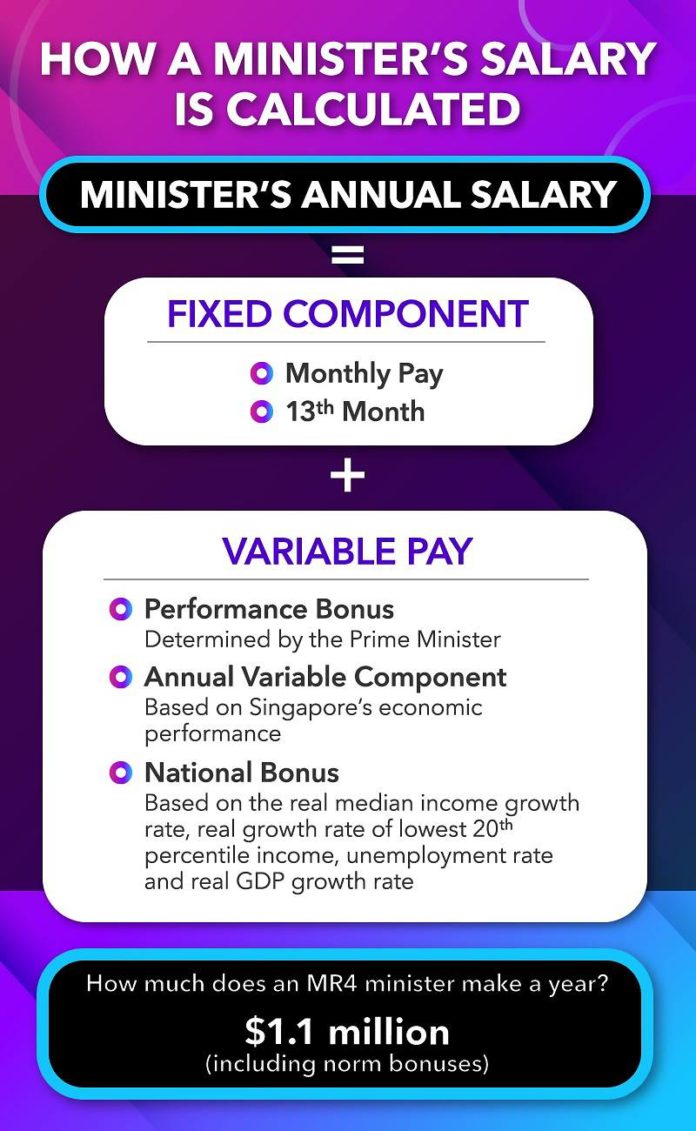
The Factually website said an MR4 (entry-level) minister’s annual salary is S$1.1 million, including bonuses. It added: “If the minister doesn’t do well – and if the economy doesn’t do well – he may get well below S$1.1 million.”
Another falsehood, the website said, is that the Prime Minister is being paid S$2.2 million a year as a base salary, excluding bonuses, and that his total salary is S$4.5 million.
The Factually website said this, again, is false. It said: “The Prime Minister’s norm salary is set at two times that of an MR4 Minister. His S$2.2 million annual salary includes bonuses. The Prime Minister does not receive a Performance Bonus as there is no one to assess his performance annually. He does receive the National Bonus.”
(Graphic: Factually)
Prime Minister Lee Hsien Loong, in a written parliamentary reply, had shared on Sep 10 the performance bonus of Singapore’s political office-holders from 2013 to 2017.
Mr Lee was responding to the Workers’ Party’s Non-Constituency Member of Parliament Leon Perera who had asked what has been the average, highest and lowest total number of bonus months paid to an individual minister in each of the past five years.
Mr Lee said that the actual performance bonus range from 2013 to 2017 was three to six months, while the actual average performance bonus was between 4.1 and 4.4 months for the same period.
According to the Factually website, a minister’s annual salary comprises five components: Monthly pay, 13th-month bonus, performance bonus, annual variable component and National Bonus.
SINGAPORE: Singapore’s journey from third world to first is a remarkable story of rapid development, and remains an inspiration for many nations around the world.
While the outward signs of its success, whether glistening skyscrapers or booming shopping malls, are familiar, Singapore’s success was built on a far less visible foundation – effective public administration.
Singapore’s story is often credited to Founding Prime Minister Lee Kuan Yew, with good reason; but there remains much to be said for the public administration he helped build.
The public administration, responsible for developing and executing policies aimed at delivering constant progress on improving the wider welfare of society, played and continues to play a crucial role in Singapore’s development.
If we look back at the early days of Singapore’s independence in the 1960s, the difficulties that this nation faced were manifold. Economic, environmental, educational, security, and social problems – taken in aggregate – seemed almost insurmountable at the time. Leaders in many of today’s developing countries may feel the same.
Yet, by prioritising efforts to build an effective, efficient, and innovative public service, Singapore beat a path toward successful, sustainable development.
Government bodies such as the Economic Development Board, Housing Development Board, and Public Utilities Board addressed the urgent need for jobs, housing, and water, while a heavy focus on public education drove the development of Singapore’s key resource – its people.
CAPABLE PUBLIC ADMINISTRATION KEY TO HUMAN PROGRESS
Each country faces its own unique context and development needs, but Singapore’s experience demonstrates that investing in a capable public administration committed to its citizens’ needs is critical to powering economic growth and human progress.
File picture of Singapore’s Parliament in session (Photo: TODAY)
This is an important lesson that developing countries still need to learn. In an increasingly complex and interdependent world, governments everywhere face fast-evolving, multifaceted challenges.
Understanding and addressing these challenges require a civil service that can develop long-term solutions leveraging new platforms and tools.
Without capable public administrations and effective public services, developing countries will struggle to deliver better life outcomes for their citizens.
Governments in developing countries rarely lack passionate public servants, but they may lack the capacity, capability, and know-how needed to capitalise on the latest global trends in public sector innovation, government reform, and technology in addressing development challenges.
This is perhaps most evident in the African agricultural sector, where the positive effects of new technologies have varied significantly depending on individual governments’ abilities to apply tech-based solutions.
While countries such as Ghana, Kenya, and Nigeria have leveraged technology effectively to address weather-driven food security risks, the lack of critical infrastructure in much of Africa limits scalability and prevents farming yields from reaching full productivity.
BUILDING UP PUBLIC SERVICE EXCELLENCE
Good governance cannot be replaced by new technologies, and we cannot expect developing countries to transform their public sectors overnight.
Developed countries like Singapore and multilateral institutions such as the United Nations Development Programme (UNDP) can help close this knowledge gap.
In pursuit of this aim, the UNDP established the Global Centre for Public Service Excellence (GCPSE) in Singapore to develop new thinking, strategy, and action in public administration. This does not simply mean producing new research on best practice, but helping developing countries adopt the latest public service reforms from around the world.
Importantly, the UNDP has helped to ensure that these efforts correspond to realities on the ground.
As Singapore’s government is globally recognised for its high-performing public sector, it has been the perfect location to bring together top thinkers and practitioners in public sector excellence to share learning and help developing countries deliver practical improvements to their governments.
Workers at the Raffles Place financial district in Singapore. (File photo: AFP/Roslan Rahman)
Public service excellence is not an unattainable ideal – it can transform lives around the world and address longstanding global challenges.
The UN’s Sustainable Development Goals (SDGs) were established with the ultimate aim of ending poverty, protecting the planet, and providing a prosperous future for all. The SDGs provide a way to structure the complexity of achieving progress for developing countries.
At the GCPSE – in partnership with the Singaporean Government, we have worked to help developing countries invest in their administrative capacity, making them more likely to deliver on the 2030 Agenda and translate development gains to societal benefit.
We have seen this in many of our partner countries, including Kazakhstan, where UNDP supported the implementation of new information systems for public service delivery in 2013, and developed a Civil Service Hub to share its success with neighbouring countries.
In the 2018 UN e-government survey, Kazakhstan broke into the Very-High E-Government Development Index group, topping the list of Landlocked Developing Countries.
This new information system has contributed to improved public service delivery, and increased transparency and accountability within local government.
Indeed, significant progress in achieving the 2030 Agenda has been made, and not just in Kazakhstan. Countries as diverse as Bolivia, Ethiopia, and India are seeing efforts in civil service reform pay off.
BREAKING DOWN SILOES
However, much remains to be done. Many of the obstacles to achieving the SDGs in areas as essential as promoting better sanitation and providing clean water, often cut across narrow ministerial boundaries and require holistic approaches that break down departmental silos.
By pooling knowledge and resources, the international community can work with developing countries to marry improved solutions with longstanding problems.
The role of the public official evolves continuously, but it remains a critical factor in driving development. Singapore has demonstrated that excellence in public service helps to power economic growth and human development.
As the international community continues to work towards achieving the SDGs by 2030, countries with a positive development story to share – like Singapore – should do more to share their lessons and help others achieve a better future and improve the lives of citizens everywhere.
Max Everest-Phillips is director of the UNDP’s Global Centre for Public Service Excellence based in Singapore which has just released a report Public Service 2030: Making the SDGs happen.
SINGAPORE: The Government has moved to debunk what it described as “falsehoods” about ministerial salaries that have been circulating recently.
The Factually website, which is managed by the Public Communications Division of the Ministry of Communications and Information, said several websites and social media pages have “jumped on the issue” of ministerial salaries in recent weeks.
The website said one falsehood that has appeared online is that the Government is not upfront about how ministerial salaries are calculated.
Debunking this, the website said the pay components are set out in a White Paper, which was tabled in Parliament in 2012. The website also included a link to the White Paper.
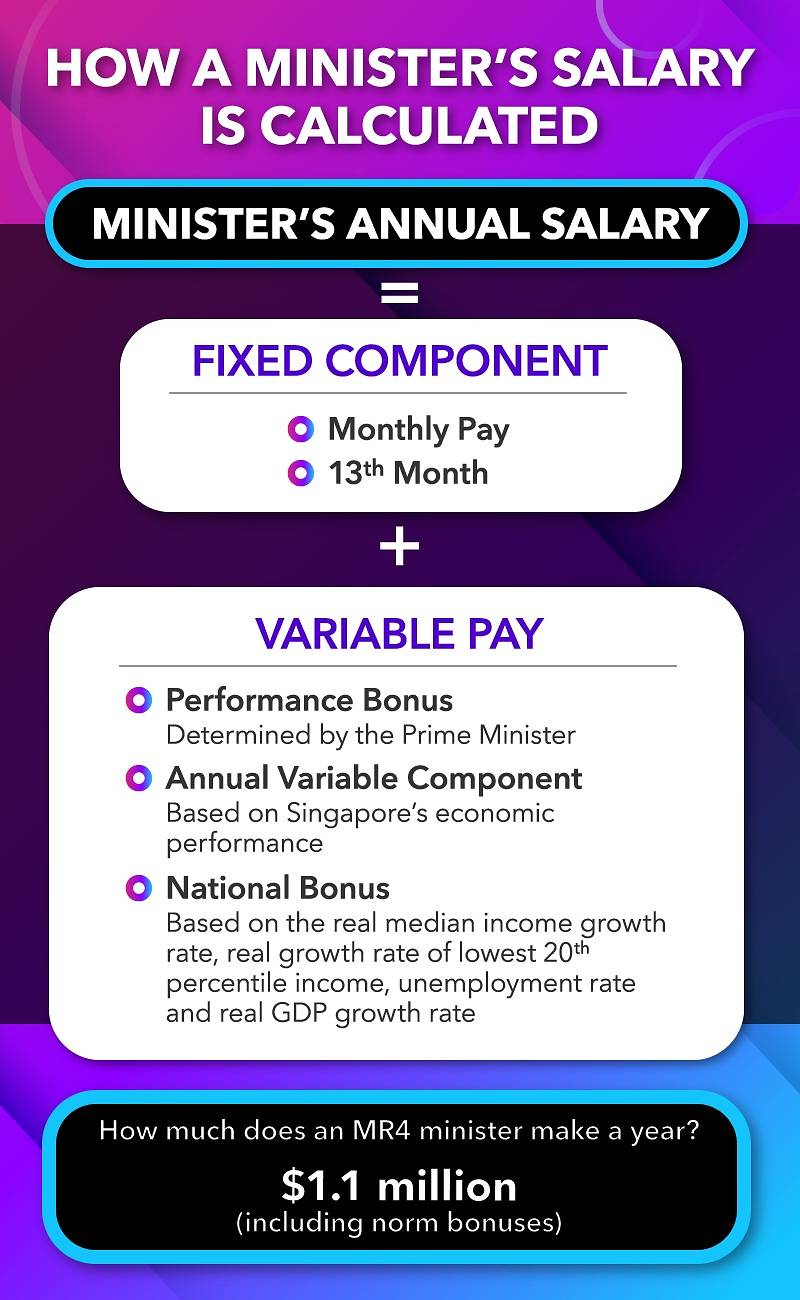
The Factually website said an MR4 (entry-level) minister’s annual salary is S$1.1 million, including bonuses. It added: “If the minister doesn’t do well – and if the economy doesn’t do well – he may get well below S$1.1 million.”
Another falsehood, the website said, is that the Prime Minister is being paid S$2.2 million a year as a base salary, excluding bonuses, and that his total salary is S$4.5 million.
The Factually website said this, again, is false. It said: “The Prime Minister’s norm salary is set at two times that of an MR4 Minister. His S$2.2 million annual salary includes bonuses. The Prime Minister does not receive a Performance Bonus as there is no one to assess his performance annually. He does receive the National Bonus.”
(Graphic: Factually)
Prime Minister Lee Hsien Loong, in a written parliamentary reply, had shared on Sep 10 the performance bonus of Singapore’s political office-holders from 2013 to 2017.
Mr Lee was responding to the Workers’ Party’s Non-Constituency Member of Parliament Leon Perera who had asked what has been the average, highest and lowest total number of bonus months paid to an individual minister in each of the past five years.
Mr Lee said that the actual performance bonus range from 2013 to 2017 was three to six months, while the actual average performance bonus was between 4.1 and 4.4 months for the same period.
According to the Factually website, a minister’s annual salary comprises five components: Monthly pay, 13th month bonus, performance bonus, annual variable component and National Bonus.
SINGAPORE: Look around us. From retail stores to mobile apps, from products to services, what we see is largely the result of intense competition and the market expansion of businesses.
One dominant player can be quickly replaced by another – and one single big player can become one of many in an industry just as quickly.
Most businesses, small and big, are at some point or another ought to think about market expansion – whether driven by the intention of the founders, or because of pressure from stakeholders looking for higher returns on their investments.
The scalability prospect of a start-up determines what kind of investors they attract.
Scaling will see a company meet with friction – as competition with existing competitors or new ones buoyed by the same prospect of market grab intensifies. But customers rejoice because competition lowers prices for products and services.
Striking the right balance when it comes to scaling a business is challenging. If founders expand too quickly, they may burn all of their cash away, making them less able to react to market demands. Competitors may come in and scoop up most if not all of their business.
If founders expand too slowly, they might be able to keep their cash, but risk being relegated to playing catch up with market trend and competitors. At the end, they might fold anyways because they won’t have enough revenues to pay for operating expenses.
TWO STORIES
Case in point, Uber versus Grab.
Uber was the definition of a wealthy start-up, armed with what seemed like an inexhaustible cash war chest. It muscled its way into every market it entered. It hired the best lawyer money could buy to fight off lawsuits after lawsuits.
It heavily subsidised drivers and passengers just to increase market share and drive out smaller competitors.
Then, as if someone came to the party, switched on the lights and turned off the sound system, Uber began to retreat market after market, selling away operations to its largest competitors.
Grab, on the other hand, started off as an app to help taxi drivers earn extra money by providing the same kind of digital service Uber had provided to its private car drivers.
Grab touted itself as the startup that wanted to empower taxi drivers, and give them the ability to earn more money by becoming more efficient and responsive to demand.
Quickly though, Grab realised that it couldn’t scale unless it expanded into private cars.
Supported by billions of cash investments, Grab competed head to head with Uber in this space within Southeast Asia. It wasn’t an easy task as Uber clearly had more money.
Grab’s advantage was its ability to adapt to the needs of local Southeast Asian customers. Grab offered cash payment in developing countries, whereas Uber initially only allowed credit card payment.
Grab and Uber bled so much cash that it was just a matter of time before one of them folded. It’s almost like an international game of chicken as fierce competition between these two rivals heated up – the attitude was “let’s see who blinks first”.
But SoftBank – a key investor for both companies – didn’t want to see the bloodbath continue.
Perhaps Grab was lucky as Uber was facing other legal and PR problems back home in the US – a series of events that ended with the resignation of Uber founder CEO Travis Kalanick. Perhaps Grab is just better executing strategy in a Southeast Asian market.
It could be all of the above. But make no mistake – as of today, in Southeast Asia, Grab is the new ruler in town.
GRAND AMBITIONS
Grab’s problem with scaling doesn’t stop with the exit of Uber, because Grab as a company needs to grow even more. It is now offering anything from food delivery to bike-sharing and it has grand ambitions of becoming Southeast Asia’s one-stop shop “super app”.
File photo of a GrabFood delivery. (Photo: Grab)
But you see, with each new product line, Grab or companies like Grab (Go-Jek in Indonesia offers massage service, mobile phone credit top-up, groceries shopping for instance) would face more competition.
The companies that dare challenge giants like Grab will have some comparative advantage – whether huge financial resources, or know-how in a specific product line.
Just look at GrabFood, FoodPanda and Deliveroo and the slew of promotions and discounts in food delivery apps in Singapore.
All these lead consumers to develop expectations that prices will remain artificially depressed but that’s a fallacy because as soon as competition disappears, prices will go up. It might bring in new players into the market, starting a new cycle of competition no doubt.
But the question is – what kind of competition and market scaling strategy in retail works best?
There isn’t an easy answer but competing in an all-out war and burning through investment cash is a dangerous risk-all game to play that doesn’t guarantee success.
The upside is that healthy competition can bring consumers benefit and keep large enterprises on their toes. Not long time ago, few dare imagine competing with Walmart – it was a retail behemoth.
Now, Walmart is worth US$500 billion, while Amazon is worth over US$1 trillion, making Jeff Bezos, Amazon’s CEO and founder, the wealthiest person in modern history.
Amazon CEO Jeff Bezos discusses his company’s new Fire smartphone at a news conference in Seattle, Washington June 18, 2014. REUTERS/Jason Redmond
In explaining Amazon’s success, we might point to the fact that running a retail business is extremely challenging. We might also point to the disruptions to retail, the massive changes in the way people shop, and the proliferation of mobile phones which have revolutionised shopping and made shops rethink their e-commerce strategy.
Being the first to market is not a competitive advantage either. As the executive director of the SMU Lien Centre for Social Innovation, I have heard countless pitches by young founders who say their idea is “the first in the market, and that’s why we will succeed”.
Really? Look up Friendster and MySpace, and see what happened to them. These were the original social networking sites before Facebook became the dominant player.
What’s needed in ensuring scaling is sustainable and healthy is to infuse expansion with innovation and an entrepreneurial spirit that value adds to the industry a company enters, to weather the storm of competition for the long term.
Overspending on promotions and discounts to gain market share seems like a cheap easy option to acquire consumers, but without careful and thoughtful strategies, companies run the risk of bank accounts drying up, and consumers leaving, forcing entrepreneurs to cut back and rethink their business models.
Jonathan Chang is executive director of the Singapore Management University’s Lien Centre for Social Innovation.
SINGAPORE: About 45 residents self-evacuated after a fire broke out at a Housing and Development Board (HDB) flat in Tampines on Sunday (Sep 16) morning, the Singapore Civil Defence Force (SCDF) said.
The SCDF said it responded to the fire at Block 307, Tampines Street 32 at 9.10am.
There were no reported injuries.
The aftermath of a fire at an HDB unit at Block 307, Tampines Street 32.
The fire, which involved the contents of a bedroom, was extinguished by firefighters using a water jet.
SINGAPORE: Every day, some 4,000 meals are churned out from a central kitchen in Tan Tock Seng Hospital (TTSH) for its patients, prepared by a team of more than 100 staff.
Located in the basement, this kitchen rustles up a variety of Chinese, Malay/Indian and Western cuisines. But it does not end there – the staff have to offer 40 different types of diet, including low-fat, low-purine and gluten-free.
The kitchen, about the size of three basketball courts, was bustling with activity when CNA Insider was there one morning. Machinery hummed in the background, and robots parked in one area bleeped, waiting to be activated to deliver the food.
The cooks were chopping vegetables, sautéing chicken and barking instructions to one another while plating the dishes, all as the smell of freshly baked banana bread wafted from the pastry corner.
The plating section.
Senior production chef Tay Kok Beng is in charge of this crew and oversees the patients’ meals and those for the staff, including doctors.
Often, he is the subject of the most brickbats, not only from patients complaining that the food is bland and unappetising, but also from colleagues in other departments – from dietitians to nurses – who have a big say in the menu.
“We have to work with dietitians and speech therapists because there’s a restricted diet we need to follow,” he explained, admitting that it is a challenge to balance taste and nutrition.
Here is what you would want to know about hospital food.
1. IT TAKES UP TO TWO YEARS TO CREATE A MENU
Mr Tay works in consultation with his colleagues to plan the menu, and it typically takes up to two years to come up with one.
Not only must they cater for many patients, with a multitude of different conditions and dietary requirements, they are also limited by the number of choices they can provide – it is impossible to personalise every meal.
But to offer enough variety, dishes on the menu are not repeated within a 14-day period. So only patients staying longer would eat the same dish again.
Mr Tay’s colleagues also have different concerns, as the menu must meet the nutritional needs of every group of patients – vegetarians, those requiring a higher caloric intake, and kidney patients to name a few – explained speech therapist Karen Chien.
So, for instance, a protein dish like chicken must be able to cater for medical conditions ranging from high cholesterol to diabetes. “There’s no one meal that can accommodate all our patients because (they) are so varied,” said Ms Chien.
2. THE FOOD IS DIVIDED INTO TEXTURES
Typically, hospital food is categorised into four textures: Regular (for the majority of patients), easy chew, soft-moist and blended.
The four textures (clockwise from top left): Regular, easy chew, blended and soft-moist.
For example, the blended diet caters for those with a swallowing problem or whose throat or tongue muscles are weak. Dietetic technician Jocelyn Huang described it as having the consistency of “very smooth puree, like baby food”.
For the easy-chew diet, the test is that one must be able to crush the food with a fork easily, and the item cannot be more than 1.5 cm2 in size.
3. THE TEXTURE MUST BE JUST RIGHT
The speech therapists and dietitians pay attention to the food textures, particularly the blended diet, because of the risk of choking.
An example of four vegetarian textures.
The blended food must be lump-free. It cannot be too watery nor too sticky, as the food could get into a patient’s airway and end up in the lungs, which can cause a chest infection.
“That can be life-threatening for our patients, so what we’re trying to achieve is that the patients are safe with the food that we serve,” said Ms Huang.
Ensuring that the consistency and textures of the food comply with international standards, and that it is appropriate and safe to consume, is one of the roles of her colleague Ms Chien.
4. THE FOOD IS AUDITED DAILY AND MONTHLY
The meals are audited daily, to ensure the suitability of not only the textures but also the taste.
Dietetic technician Jocelyn Huang testing every dish before it can be plated and served to patients.
“Sometimes (the kitchen) might add too much salt. That isn’t suitable for patients on therapeutic diets,” said Ms Huang. “So I’d ask them to … rectify the issue before they start serving the patients.”
In checking all three meals, she makes sure that the food presentation is appealing too.
There is also a monthly audit of the textures, taste and presentation, among other things, done by a team comprising Ms Huang, Ms Chien, principal dietitian Wong Siew Li, senior nurse manager Hasfizah Mohd Hanef and sous chef Goh Kim Hock.
“We have … to make sure that everything is consistent,” said Ms Wong.
There’s space for calibration between the speech therapist and diet technician. And also as a team we (have to) agree whether the taste is getting stronger and stronger or blander and blander throughout the year.
The monthly audit team.
5. THE CHEF’S NOT ALWAYS THE BOSS
Mr Tay used to work in a hotel, where he called the shots in the kitchen. Not so now. And his chefs are often restricted in the ways they may enhance the flavour of the food.
For example, the use of spices such as pepper must be approved by the food team first. “Sometimes, you never know, (a herb) might not work with the medicines, so we work very closely with the dietitians,” he said.
“As a chef, I have to be more creative. I need to always brainstorm with (my) staff – not only salt and pepper can (bring out) the flavour.”
Mr Tay Kok Beng, known as Chef Tay to all his TTSH colleagues.
Hospital chefs like him often find themselves at loggerheads with the audit team. “The speech therapists ‘fight’ with the chef quite a bit because we need our food to be very specific,” admitted Ms Chien.
“Sometimes we see some texture inside (the food) that isn’t what we require … But sometimes the chefs are also faced with challenges that are beyond their control.”
Ultimately, it boils down to the patients’ needs. “Safety is the most important thing,” said Mr Tay. “And we want the patients to feel that they’re eating healthily.”
6. PATIENTS CAN HAVE A SAY
If there are patients who dislike the food, Mr Tay or one of his assistants would go to the ward to get their feedback.
No complaints from this patient.
“I can’t say, ‘No, not my problem.’ With the feedback we get, at least we’d know exactly what the patients want,” he said.
To address any complaints going forward about bland food, TTSH will be using a salt meter to test the salt content of meals objectively, highlighted Ms Wong. But she acknowledged:
When they’re unwell, usually their taste buds are a bit affected. And even if we agree that (a meal) tastes flavourful … we might still get feedback from them that it’s bland.
An initiative the kitchen has already taken, especially for malnourished patients who find the food bland and struggle to finish meals, was to replace the vegetables with a high-calorie dessert, like Bubur Pulut Hitam.
“It’s tasty, it meets the safety requirements and, at the same time, it helps to boost our patients’ nourishment,” Ms Chien said of the glutinous rice dessert.
The hospital kitchen does birthday cakes too.
7. MACHINES ARE EASING THE LOAD
The kitchen has a number of elderly staff – the oldest is a 75-year-old cook – who assist in duties such as preparing the ingredients.
In the past, some of them had to wash the rice – up to 270 kilogrammes a day – and vegetables by hand, which was bad for their backs, tiring and wasted a lot of water.
Mr Tay found a rice cooker from Japan that would wash the rice and could be programmed to even cook chicken rice. He also bought a vegetable washer, which his staff admit cleans better than them.
The machine measures the water and rice by itself. When Mr Tay first bought it, his staff said they didn’t need it.
“In those days, you had to wash vegetables like clothes because some of the vegetables had worms and snails. So these are quite powerful (machines with) the pressure to get rid of (even) stones,” said Mr Tay. “All are happy.”
8. ROBOTS DO THE DELIVERIES
Some of the kitchen’s newest recruits are a team of 15 robots, known as automatic guided vehicles, which deliver the food to the wards for the nurses to serve to the patients.
The automated guided vehicle.
Each robot can lift about 15 trays of food. They have designated areas and paths to follow. They even have their own lifts. And if you are in its way, it would ask you, nicely, to move aside.
Apart from freeing up manpower in the kitchen, the robots take on other roles such as delivering linen, once they are done with their food rounds, which include bringing back the dirty dishes.
SINGAPORE: Murali Pillai has an avuncular manner about him. Throughout our interview he is amiable and exudes an approachability that might make most people want to invite him for coffee.
But when required, he can be a fiery politician as seen during some of his speeches during his PAP team’s campaign in the 2015 election in Aljunied Group Representation Constituency (GRC) and again when he contested and won the 2016 by-election in the Bukit Batok Single-Member Constituency (SMC).
It was only then that he became a Member of Parliament, making him the newest MP in Parliament today.
As we sit down to discuss his political career so far, he describes his election experiences as “phenomenal”. Both times, he had to go up against highly experienced opposition politicians.
But he says the most important lesson he learnt goes back to the basics of public service.
“The relationship of trust is key. Trust takes an eternity to build but can be lost very, very quickly and that must be the focus in grassroots politics – building that trust,” he says.
His debut election experience in Aljunied GRC certainly proved that.
Mr Murali Pillai has been MP for Bukit Batok SMC since 2016. (Photo: Lam Shushan)
BEING PART OF THE ‘SUICIDE SQUAD’
In 2011 the PAP lost the GRC to the Workers’ Party (WP) led by Mr Low Thia Khiang.
In 2015, the PAP team that went up against the WP in Aljunied was dubbed a “suicide squad”.
Mr Murali was selected to be part of this squad.
His team lost narrowly, garnering 49 per cent of the vote.
But Mr Murali managed to beat WP heavyweight Chen Show Mao by about 300 votes in his Paya Lebar ward.
When I point this out, he decisively interjects.
“No comments on that. We fought as a team and we lost as a team. I think it’s not fair to Mr Chen to talk about this. Let’s be clear on this. There were five of us and we lost to the five-member WP team.”
He acknowledges it was at the very least, a “tough fight”.
“We were going up against real WP heavyweights – Mr Low, Sylvia Lim, Pritam Singh, Chen Show Mao, Faisal Manap. It’s a recognition of their popularity, and the work that they do in Aljunied.”
While some would describe Mr Murali as a political novice, he was not a stranger to the area.
He was a long-time party activist, who joined the PAP in 2001 and was noticed largely because of the pro bono legal work he did for residents in Bukit Batok.
He was the branch secretary at PAP’s Bukit Batok Branch from 2007 to 2011 and in 2012, he was appointed the chairman of the party’s Paya Lebar Branch.
“The precursor to me being fielded is that I was involved in restarting a number of community programmes in Aljunied GRC, specifically the Paya Lebar division from around 2012. Through that process I got to know the community leaders there, the residents there and eventually that led to the party leadership asking me to stand for election there.”
His experience on the ground was clearly insufficient.
“We must, in every election, present an agenda that must chime with our people. And if it doesn’t chime, we take responsibility for it and work harder. That’s really the hallmark of democracy. I think ultimately it’s the residents’ decision. We presented our agenda to them. We focused on community programmes, on how we would run the town council and quite clearly, they were not attractive enough.”
He admits however that his team’s political inexperience played a part.
“Mr Yeo Guat Kwang is a fantastic comrade. He had been an MP for almost 20 years. But aside from that, we were newly-minted, and we didn’t have the depth of experience that for example, Mr Low had. So, we were learning on the job.”
I ask him if he thought it was unfair of the PAP to field a less experienced team. He chooses to look at it positively.
“This is not something that I decided. The party decided. But they had confidence in us. And I think the results showed that. We fought to win. We tried our best. We were supposed to be the suicide squad, but thankfully we turned in a respectable performance. We must always fight the good fight. How we fight is also important. And we made sure that our focus is our residents. We presented our plans, we treated our opponents with respect, and when the result came, we accepted it and we wished them well. That’s how it should be fought and that’s how I remember it.”
While I sense a tinge of disappointment as he speaks, he claims his own disappointment was irrelevant to him at the time.
“I felt more for my people – branch members and volunteers – who really worked hard. They were disappointed. I was focused on encouraging them. I wasn’t really thinking about disappointment for myself.”
When I ask him what strategy he thinks might help the PAP regain Aljunied in the future, he takes objection to the word “strategy” saying that it sounds “calculative”.
“I’m not very comfortable with that. Ultimately, I think it’s important to examine why we are doing this. And if you’re doing it for our people, our community, our country, and you put your programmes out there, people will make their own decisions as to whether we are trustworthy. That has to be the way. Otherwise, it’s about trying to win them over for the purpose of staying in power. That doesn’t sound correct at all.
“It has to be focused on improving the lives of our people. That’s extremely important. Ultimately it has to be a contest of ideas, irrespective of where they come from and the best idea must prevail for Singaporeans.”
GOING UP AGAINST DR CHEE SOON JUAN
Mr Murali’s next opportunity presented itself in Bukit Batok the following year, with the calling of the by-election in the SMC after the resignation of PAP MP David Ong.
“I had an opportunity to serve in Bukit Batok under the late Dr. Ong Chit Chung, who was the MP then. I did a pro bono matter for him. I represented a resident who was wrongly accused of molest. Thankfully, he was acquitted. Mr Ong then invited me to help out at the legal clinic there. That was the start of my service in Bukit Batok.”
Soon, he got involved in organising other types of community events and helping less fortunate families in the area.
“When the opportunity came for me to step into politics, I really saw it as an extension of the social work that I did. I had a much more established track record of serving in Bukit Batok.
“But just coming out from a loss in 2015, I knew that the line between success and failure is very, very thin. Also, as it turned out, I was fielded against a very experienced politician.”
Going up against the Singapore Democratic Party’s Dr Chee Soon Juan must have been daunting, I remark.
“I knew that I was in for a tough battle. I was absolutely correct. It was a tough battle. He’s a seasoned politician who had been fielded in a number of general elections and of course, he’s the secretary-general of a major political party too.”
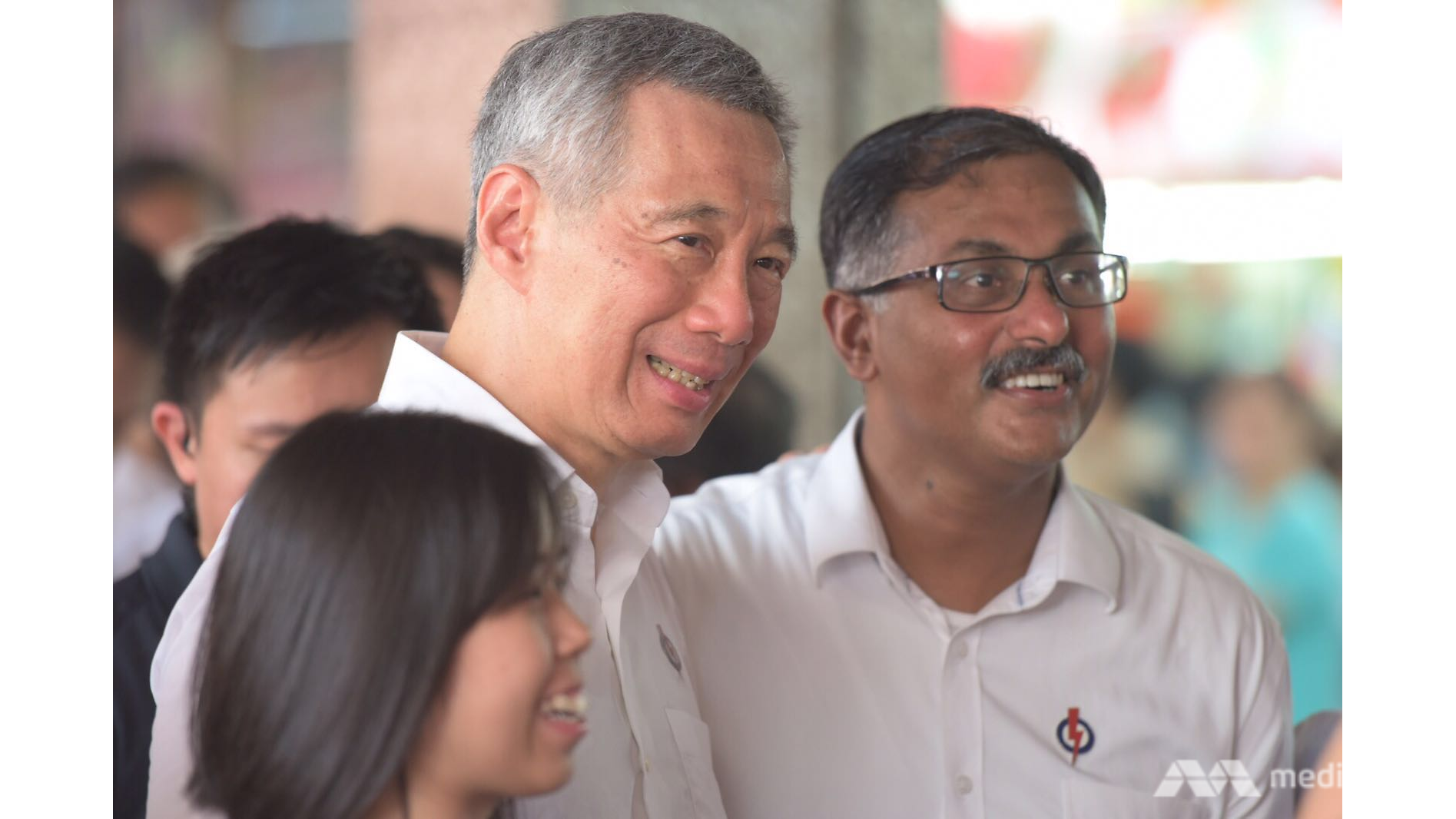
Mr Murali Pillai with Prime Minister Lee Hsien Loong during the Bukit Batok by-election campaign in 2016. (Photo: Justin Ong)
RIDING ON THE COATTAILS OF MORE PROMINENT PAP CADRES
Party bigwigs such as Mr Tharman Shanmugaratnam, Mr Chan Chun Sing and even Prime Minister Lee Hsien Loong showed up in Bukit Batok and at by-election rallies.
In fact, some members of the public remarked that he had come into Parliament on the coattails of these more powerful political personalities.
“I think people are entitled to their views. What people must realise is what mattered then were the opinions of the Bukit Batok residents and those were the people I was focused on. I met them at small gatherings, at the coffee shops and I had to explain my agenda to them and they made up their minds.
“I think Bukit Batok residents decided between myself, with whatever inexperience that I may have, and Dr. Chee. Whoever may be behind me is immaterial. I think residents would be rather offended if it were to be suggested to them that they decided on the basis of my backers.”
A campaign banner for the 2016 Bukit Batok by-election. (Photo: Facebook / Murali Pillai)
POLITICS AND RACE
During the election campaign, he took on the Chinese nickname “Ah Mu”.
When I ask him why he felt compelled to take on the nickname and if he felt his race was working against him, he explains that, on his part, it wasn’t calculated at all.
“My close friends and colleagues already call me ‘Mu’ for short. In or around 2000, when I joined Bukit Batok as a community leader, the late Dr Ong introduced me to Mr Ng Soo Phio, then the Bukit Batok Citizens’ Consultative Committee chairman, as ‘Murali’. Almost immediately thereafter, the Chinese-speaking Mr Ng came up with a tongue-in-cheek Chinese name for me; “Mou Nah Lee”. Translated directly from Mandarin, it sounds like ‘touch where?’. Needless to say, I was alarmed. So I was grateful and relieved that he and the other Chinese-speaking community leaders whom I worked with later settled on a more palatable term of endearment, Ah Mu.”
He claims his race did not pose an obstacle in connecting with majority Chinese residents.
“I was quite fortunate that I had a history of service there so I was able to connect. I learnt a little bit of Mandarin over the years from just interacting with residents. I can speak Malay quite fluently because I learnt Malay in school and I can speak a bit of Tamil. So through this, I can help communicate and it’s important for me to be able to communicate with the more senior residents in Bukit Batok. On balance, I think I didn’t have a difficult task being a minority candidate because I’m already familiar with the residents and the ground.”
When asked whether he believes in general, the race of a political candidate plays a part in voters’ decisions, he is more circumspect.
“I think this is something that’s sometimes primordial and people have views, maybe consciously or unconsciously, expressed in terms of the decisions they make. I do hope that at some point in time, race would not be a concern.”
“The progression only kicks in in a situation where for a long time, a member of a particular race is not elected. So it’s like a safety valve. I think that it’s a recognition that ultimately, we want to build a multiracial society. If that’s our goal, we must make sure from time-to-time that the highest office of the land can be occupied by members of all the races,” he replied.
“I think that’s a good ideal. The President is seen as a unifying force for the nation. Plus it’s still based on merit as the candidates have to fulfill the eligibility criteria. So it is to make sure that minority race candidates with merit are not ignored.
“The aspiration is that we won’t need to use this safety valve, but the question is when one race is excluded for such a long time, then what do we do to ensure there’s no disenfranchisement within society.”
I raise the next question, on whether Singapore is ready for a minority race Prime Minister.
“Because a presidential election is a direct election, we have to consider that race might be a factor for certain parts of the electorate, so we need a safety valve in that case. But in the case of the post of Prime Minister, the electorate votes for the MPs and political parties and ultimately, Members of Parliament and the political party with the most number of seats decide who should be the prime minister.
“I certainly don’t take the view that a prime minister must be from the majority race. He or she must have the capability, the leadership skills and also put Singapore in a strong position going forward. It has to be the most capable person who can lead Singapore into the future, irrespective of his race.”
Since we are on the subject of race, I wonder if he thinks the GRC system is still necessary to ensure minority race representation in Parliament, considering that he himself managed to win a seat in an SMC.
He believes what secured his win was his long grassroots engagement with residents, something that not all political candidates might be able to bank on.
“You need to have a diversity of candidates, not just community leaders like myself. So my sense is that the GRC system is still necessary. Again, for the same reason that we spoke about in relation to the reserved presidential election, to make sure that we have representations from all races in Parliament. Race, as I mentioned, I believe is a primordial issue. We don’t want to take the chance that we end up with no minority representation even though there are minority race candidates with merit.
“I do hope race will become less of an issue. As a society, we are quite fortunate that our founding fathers have always espoused the aspiration of being a multiracial country and through institutions like National Service and schools where we mix people from different races, different backgrounds together, all these things would percolate into a better outcome as far as this issue of race is concerned.”
Member of Parliament Murali Pillai at the opening of the second session of the 13th Parliament. (Photo: Jeremy Long)
THE LAW AND SECTION 377A
In the last two years, Mr Murali has also taken a special interest in policy matters pertaining to his personal area of expertise – law.
He was the head of commercial litigation at law firm, Rajah and Tann. After being elected in 2016, he stepped down from his post to better balance his work with his political responsibilities. Today, he is an equity partner, but no longer a head of department.
“I was inspired by the late David Marshall. That’s why I switched from wanting to study engineering to studying law. I was a police investigator first, then I wanted to be an effective lawyer like David Marshall. He had a very strong sense of justice. He wanted to make sure that his clients, whatever their backgrounds may be, have access to justice. He was not motivated by money. He was motivated in making sure that he gave his clients the best defence, whatever their backgrounds may be.”
One of the more notable cases he has handled includes that of former PAP MP Choo Wee Khiang who was acquitted of corruption charges in 2014.
“He was charged with the offence of criminal breach of trust as an agent when he was the president of the Singapore Table Tennis Association. But it was clear from the prosecution’s case that it was not that he personally benefited from the amount that was alleged to be taken,” he explained.
“He was alleged to have given the amount to a coach without authority, without the sanction of the association. I was glad that eventually he was acquitted without him entering into the witness box to give his defence.”
Since entering Parliament Mr Murali has called for more community-based options for offenders with mental disorders.
He noted that while offenders with disorders such as depression or schizophrenia are provided treatment, others with “more challenging psychiatric illnesses”, such as antisocial personality disorder, or mental retardation, may not receive such help.
“We are fortunate now that the criminal procedure code has been amended. So now the court has a wider suite of options. And I’m glad that these options, particularly the Mandatory Treatment Order is available even in the context of a criminal who may need inpatient treatment.”
I ask him about his stance on a hot-button legal issue that has re-emerged in Singapore.
“It is certainly a vexed issue. My overriding view and hope is that whatever decision that is eventually made in Parliament about Section 377A, it is done after we have made our best attempt in reaching a consensus within our society on this matter. This may seem like wishful thinking on my part since our society is currently polarised. But I’m hopeful, I’m optimistic because I believe there is a general recognition that a homosexual is deserving of equal treatment, deserving of dignity and respect and should not be treated as a social outcast.”
But does he personally agree with this standpoint?
“Yes, certainly,” he says.
When I put it to him that perhaps the Government should take a firm stand on the issue and set the tone as it has with many other tough issues, he says the matter has to be looked into holistically.
“At the same time, there is a belief that a decision on Section 377A may have an impact on important institutions such as marriage and family. This must be addressed too,” he adds.
“Hence, I strongly feel that we should take a holistic approach. This involves properly identifying all the issues associated with matter, a thorough engagement and discussion with civil society, religious groups, etc, and an effort at forging a consensus on the main issues involved. The hallmark of democracy at the end of the day is that we must be able to justify the moves we make even if not every single person agrees. We are not alone in this journey. This is happening in the rest of the world too. It is important that we study and gain insights from the global developments too. The efforts, the studies on these fronts should start now but will take time to complete. So be it. To be an effective interlocutor for this process, I feel that I should be open to suasion at this stage.”
He points out that while Section 377A is still in the penal code, it is not enforced. Some have remarked that considering this, it might make more sense to simply repeal it.
“The penal code is an old code and there were a number of other provisions which were removed over time. They were removed in a point in time when society kind of accepted it. For example, the provision outlawing adultery. That was in the books. There was a provision dealing with enticing a woman out of wedlock. That was in the books even after it became irrelevant. But over time, they were taken out. So let’s work on looking at the issue holistically and let’s see where that goes in relation to 377A.”
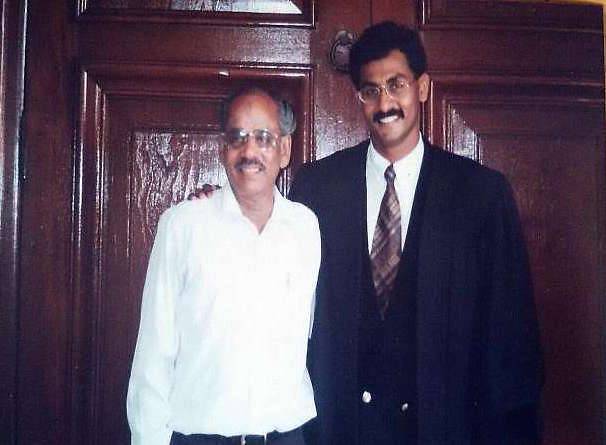
Murali Pillai with his father in 1996. (Photo: Murali Pillai)
HIS FATHER – THE MOST POWERFUL INFLUENCE IN HIS LIFE
As we approach the end of our conversation, I ask him who, besides David Marshall, has influenced him.
Inevitably, his father comes up.
“My late father who passed away in 2007 was the most powerful influence in my life. He impressed upon me that civil service could be the way I should go and that’s how I started serving in the police force in the first place, which led to all of this.”
It’s widely known that his father, PK Pillai, was a unionist detained during Operation Coldstore in 1963. He was released two years later.
This occurred even before Mr Murali was born but he says his father talked about it with him.
“My understanding is from what he told me, and I think we probably have copies of the detention papers in the house somewhere. As I understood, the circumstances were in relation to him joining Barisan Sosialis. He was a PAP member but he switched allegiance to Barisan Sosialis and he took over as the chairman of the PAP Sembawang branch after the late Mr Ahmad Ibrahim passed away, and tried to fight against merger with Malaysia. That was reason, or at least part of the reason why he was detained and was part of the struggle that he was involved in.
“You must also understand he was an anti-colonialist and that really drove him. So when he came from India, just before India’s independence, he promptly joined the Malayan Communist Party and fought against the British during the emergency.”
He says his father gave him “permission” to join the PAP and he would not have done it if his father hadn’t done so.
“He just wanted me to do it for the right reasons. When I told him I wanted to do it because I felt I was able to contribute, he actually said something very interesting. He said actually, if Barisan Sosialis had been in charge, Singapore wouldn’t have made such progress. He said it was Lee Kuan Yew that had that creativity to bring about economic growth. My father said that Barisan only knew ‘Robin Hood economics’, but it was the Lee Kuan Yew government that generated wealth for Singapore. He acknowledged that.”
Mr Murali’s father also influenced him in other powerful ways.
He whips out an old school “555” notebook from his pocket.
“My father had one of these on him all the time. He would write down every cent he spent. He was a very frugal man. After being released, he became a security guard and at some point in time, he had to take up another job. He was a labourer, breaking rocks in the road to take care of his family and he never thought about himself, always about the children. He’d wear torn shirts but he didn’t really think too much about it. So he was a really selfless person.”
He himself carries the notebook as a reminder of his father’s philosophy and while he doesn’t use it to keep track of his expenses, he uses it to take down notes during meetings with residents.
When I ask what mark he would ultimately like to make in politics, he brings up his father again.
“He influenced me in terms of focusing on doing service and not thinking about the outcome. If you’re too interested in the outcome, you could lose focus on achieving the desired result. So I’m not interested in making a mark to be frank. My focus has been and will continue to be taking care of my residents, expressing my mind in relation to issues concerning policy and contributing without being too concerned about how the outcome benefits me.”
SINGAPORE: I am pretty sure jargon is everywhere. Public servants are not the only guilty ones. But let me share my experience within the Singapore public service, where I have worked all my life.
The Complete Plain Words by Sir Ernest Gowers was published in 1957 at the request of the British government to improve writing within the British civil service. After half a century, it seems that nothing much has changed.
The much-publicised “only pizzas are delivered” style guide was issued in 2013, and then there was Lord Chancellor Michael Gove posting his “Ministerial Correspondence Preferences” online, warning his officials among other things to avoid being repetitive and not to use “anything too pompous”.
Did we inherit bad writing from the British? Our founding Prime Minister Lee Kuan Yew had “noted this steady deterioration over the last 20 years” and in 1979 called a meeting of ministers and senior civil servants to discuss how government papers and minutes could be written in clear, clean prose. He said:
If we start with those at the top, we can achieve a dramatic improvement in two years, provided the effort is made.
FIGHTING JARGON
38 years have passed, and I still spend most of my time fighting jargon, gibberish, pompous writing, and bad grammar. New words and phrases have appeared. From where, I don’t know. Once caught on, they are used at every opportunity.
My first encounter was with “paradigm shift”. Then it was “silver bullet”.
Nowadays, I am bombarded with “mindshare” and worse still “to mindshare”, “will back brief you after the meeting”, “will give you a read back”, “we must be future-ready”, and “need to future-proof our economy”.
(Outdoing all this was “futuring our economy”, part of a headline in an opinion piece in a local news outlet I read a year ago.)
“Opine” and “enthuse” make me cringe, and if that’s not bad enough, I am hit with “emote with”!
(Photo: Unsplash/Joe Green)
“Announceables” has become the “in thing” especially among media and corporate communications people. I managed to contain myself with “to dimensionalise”, until I read another media outlet’s post about Schooling having “a better record of medalling at international competitions”.
I suspect people think these words make them sound clever. And I painfully tolerate them in conversations or even internal emails among colleagues.
What I do not tolerate is jargon and gobbledygook in written work, whether it is a policy paper, a proposal, a news release or a reply in the forum page of our local media. I battle with them every day.
A recent example had to do with learning from others to “help us future-proof into the gallery’s concept and design” such that it continues to be a place that is relevant for visitors.
“What do you mean by this jargon?” I asked in the comment box. “Can you rewrite without using this horrible word?”
Of course it could be done, and it came back as “help us design the gallery in such a way that it continues to …” Plain words, as Gowers taught.
WHY USE BIG WORDS?
In 2014, during a 938LIVE panel discussion on clear communication in the civil service, I was asked why gobbledygook was used. I gave three reasons.
First, we try to impress with big words and phrases. “Apprise” certainly sounds more learned than “inform”, and a three-syllable word “utilise” is surely more convincing than “use”.
But try being succinct – use the smallest word that does the job. It doesn’t mean you cannot use big words. Just use them correctly and only when necessary.
Second, we try to avoid answering the question by being evasive and non-committal. You can recognise this when you see such phrases as “broad and comprehensive”, “holistic”, “facilitate coordination” and “put in place relevant frameworks and capabilities”.
The same vague and abstract expressions are used when our minds are not clear, and that is the third reason. As Albert Einstein said, if you can’t explain it simply, you don’t understand it well enough. The result is convoluted sentences, mangled expressions, and sloppy writing.
A graffiti of Albert Einstein (Photo: Unsplash/Sidney Perry)
MAKE THE EFFORT
I don’t believe that a complex idea or policy cannot be explained simply or in plain language. It can be done.
The thing is this – we need to apply ourselves and exercise our minds. Think through exactly what we want to get across, be clear in getting it across, and be short and sharp about it.
Being concise and succinct doesn’t mean using vague, nebulous words to “summarise” your concrete thoughts and actions. That is like packing all your colourful trinkets, ribbons and confetti into a cardboard box. You see the box and have no idea what lovely things it contains.
Mastering clear communication means unpacking that box – writing and speaking in clean, clear prose so that you are understood. Say what you mean and mean what you say because no one can read your mind.
Be precise – choose the correct words and give them their ordinary meaning. All this takes effort and time.
Unfortunately, we often think we cannot spare the time. So we end up overusing or misusing words, and here is where “optimal”, “optimise” and “facilitate” top the list of meaningless words. Someone wrote:
The outdated website design needs to be refreshed with a new look and feel for an optimal showcase of our articles.
This did little to enlighten me. I asked – what do you mean by “optimal”, when does it become optimal or ideal, not too much and not too little?
Back came the edited sentence – “We also want to refresh the design of the website to make it easy to read and navigate.” Could be improved some more, but much better, I thought.
Now I knew what the refreshed design was meant to do – help readers read and navigate the website more easily. It was as if a curtain or fog was lifted, and I could now appreciate the beauty of the landscape before me in all its finest and most glorious details.
Judith d’ Silva is active member in the Speak Good English Movement, she has given talks on writing clearly to be understood at the Civil Service College and to HDB station managers.