International and local white hat hackers will be invited to test selected Internet-facing Government systems to identify vulnerabilities, says Deputy Prime Minister Teo Chee Hean.
File photo of a man looking at computer code. (Photo: AFP/Thomas Samson)
(Updated: )
Bookmark
SINGAPORE: The Singapore Government will be inviting white hat, or ethical, hackers to test the cyber defences of selected Internet-facing systems to identify vulnerabilities by the end of the year, said Deputy Prime Minister Teo Chee Hean on Tuesday (Sep 18).
Speaking at the opening of the third Singapore International Cyber Week (SICW), Mr Teo said the Government Bug Bounty Programme will help build an innovative cyber ecosystem, draw in a wide range of expertise to help identify blind spots in its systems and benchmark its defences against skilled hackers from around the world.
He added that through this process, the Government can “bring together a community of cyber defenders, who share the common goal of making cyberspace safer and more resilient” by securing its systems against malicious attacks.
“This builds a shared sense of collective ownership over the cybersecurity of our systems, which is vital to achieve our Smart Nation goals,” Mr Teo said.
The minister pointed out that such initiatives are part of the Government’s investment in cyber innovation, given that cyber attackers are “extremely innovative”.
This move comes on the heels of a smaller scale bug bounty exercise organised by the Ministry of Defence last December. Then, 264 selected white hat hackers from around the world were given the greenlight to hack and find vulnerabilities in eight Web-facing systems, and the ministry paid out US$14,750 in bounties to the 17 successful hackers.
DPM Teo also said the Government is looking to enhance its cyber partnerships and, as part of that, is expanding its ASEAN Cyber Capacity Programme (ACCP) by setting up the ASEAN-Singapore Cybersecurity Centre of Excellence (ASCCE).
The new centre has three broad objectives: Strengthen ASEAN members’ cyber strategy development, legislation and research capabilities, train national computer emergency response teams (CERTs) in the region and promote CERT-to-CERT open-source information sharing, he added.
“Through the ASCCE, ASEAN members can engage more closely with our international partners, in particular our ASEAN Dialogue Partners,” Mr Teo said, adding that the centre will be open and inclusive.
He also gave an update on the ACCP, which the Government contributed S$10 million to, saying more than 140 officials from ASEAN member states have benefitted from it.
“The fight to secure our cyberspace is particularly challenging as it is asymmetric. It is easy for malicious actors to hide their identity, carry out their attacks across borders, and cause severe disruptions in essential services that disproportionately impact millions of people,” Mr Teo said.
“This is why it is important for us to work together – countries, governments, businesses and citizens – to pool our resources and strengthen our collective defences against this common threat.”
The phrase translates to “Although it is small, it is a treasure” in New Zealand’s indigenous Maori language and perfectly captures the essence of both New Zealand and Singapore.
With populations of approximately five million people each, both countries are well-known for punching above their weight. While New Zealand and Singapore are recognised global leaders in their respective fields, both nations face similar challenges.
Singapore and New Zealand need to build fearless and future-ready human resources, highly skilled and ready to cope with the rapid change brought on by technology as well as competition from larger economies.
Our two nations’ competitive edge depends on the skillsets and capabilities of our workers.
While there is no secret sauce to building the workforce of the future, both nations are working hard to build the foundation for upskilling their people.
As we chase similar aspirations, there is much that we can learn from each other.
WORKFORCE UPSKILLING
The youth education pathways in both countries are well-established, and the focus now needs to expand to include mature workers.
Preparing people to compete in the knowledge economy requires a new model of education and training, a model of lifelong learning.
This is particularly important as we are faced with a fast-changing knowledge economy, which means that skills are depreciating much more rapidly than they once did.
Self-checkouts are replacing cashiers, automated chat messaging software is replacing call centre staff, and user experience designers are being hired to develop seamless digital-banking products, replacing bank tellers.
By 2020, the OCBC bank will install such machines at 35 of its branches, reducing the need for customers to perform transactions over the counter. (Photo: OCBC)
To compete effectively in this rapid transformation across industries, workers need to upgrade their skills on a continuing basis.
The SkillsFuture programme has helped thousands of Singaporeans of all ages to enhance their employability and continue contributing to the economy.
As local universities follow the Government’s lead by rolling out alumni schemes that give them access to skill-based courses, Singapore is starting to reap the benefits of an upskilled workforce and prepare for the future demands of various industries.
Likewise, as New Zealand grapples with its own ageing population, it can take a leaf out of Singapore’s book and focus on cultivating a culture of continuous learning to ensure that its people can keep participating in the workforce.
The recent roll-out of the Digital Economy Work Programme in New Zealand is a step in the right direction, as we invest in a fuller education and enablement programme for the nation to acquire the digital skills it needs for growth.
DEMOLISHING TYPICAL BOUNDARIES TO LEARNING
While the classroom format is still what comes to mind when it comes to education, changes in today’s lifestyle are driving a sea-change in the format of learning.
Workers, who are increasingly mobile, expect that learning will fit into their busy schedules of work, family and travel – which means that learning also has to be available anywhere and anytime.
File photo of a man using his laptop at a coffee shop. (File photo: REUTERS/Carlos Barria)
Tertiary institutions have been driving the change, with more learning taking place online. Massey University call this “borderless education”.
The university started distance learning in 1960, with their first batch of students from around New Zealand receiving their weekly course readings in the mail.
As demand for the programme grew, the university leveraged technological advancement to develop an online learning programme that now caters to students all over the world.
For academic institutions charged with equipping graduates to compete in today’s knowledge economy, the possibilities are great.
Distance education, sophisticated learning-management systems and the opportunity to collaborate with research partners from around the world are just some of the transformational benefits that universities can and should continue to embrace.
However, we must ensure that the quality of education in distance learning remains on par with an in-class experience. Educators must understand what students need to be successful, be it pastoral care, social exchange or academic preparedness, and provide that in a digital environment.
Understanding the difference between information, knowledge and wisdom is key to constructing a student-supportive online learning environment.
Being able to fit work and caring responsibilities around study is especially helpful for those who cannot afford to come to campus every day.
Given that working-age graduates and postgraduates have higher employment rates and earn higher on average than non-graduates (seen for instance in the UK), distance learning programmes ensure that students all over the world and from all walks of life can upskill and leverage the benefits of higher learning.
EMBRACING THE SPEED OF CHANGE
As industries continue to relentlessly automate, people are concerned about job security and may tend to be technology-resistant. The aversion to anything digital or technology-based can lead to a widening gulf between the jobs of tomorrow and the workforce today.
Attendees at a job fair line up for an interview carrying their resumes in leather bags. (Photo: REUTERS/Jason Reed)
We need to re-frame the narrative for the workforce – the technology-driven fourth Industrial Revolution has brought on the advent of new jobs and industries that did not exist previously. These new jobs and industries will have a role for everyone who embraces technology and relentlessly upskills to keep up with the speed of change.
The task then becomes helping the workforce to embrace these technologies instead of rejecting them as threats to their jobs. This goes beyond hard skills education and requires an overall mindset shift.
The Digital Economy Work Programme in New Zealand is again a great example of how all segments and agencies of a country can pull together to ensure a collective focus on the right initiatives – in the right areas – to support the growth of the digital economy.
Recognising these future demands, Singapore universities are also developing tailored programmes around analytics to create value from research and data analysis.
Education providers will play a crucial role in building the talent pool for the future by cultivating a system that teaches students to embrace technology and leverage it.
The world of work is in a state of flux, which is causing considerable anxiety — and with good reason. As the world become increasingly connected and globalised, it has increased the pressure on individuals to compete and stay relevant.
With similar goals, challenges, skillsets and levels of economic maturity, Singapore and New Zealand can leverage each other’s experience with sophisticated education systems to build successful partnerships that will play an indispensable role in helping both nations nurture talent for the future.
Professor Jan Thomas is vice-chancellor of Massey University in New Zealand.
SINGAPORE: More than a decade after a bruising and fractious debate that ended in a stalemate, the powder keg that is Section 377A of the Penal Code has been reignited, following a decision by India’s Supreme Court to strike down a law criminalising sex between men.
That the reverberations of a judicial ruling thousands of miles away could be keenly felt here could be attributed to the fact that the criminal laws of Singapore and India — both former British colonies — share the same historical roots, or to India’s reputation as a conservative society.
Either way, the lid on a simmering issue, which has occasionally gone off the boil, has now been taken off: In the space of a few days, prominent Singaporean figures waded into the debate, and petitions from opposing sides garnered tens of thousands of signatures.
Activists also sprang into action, making rallying calls on social media, as slick videos, heartfelt pleas and essays — some bordering on hysteria and exaggeration — went viral.
For example, a video entitled “Is this the Singapore you want” which has been circulating on WhatsApp warns that repealing Section 377A could lead to the “normalisation” of homosexuality which would eventually result in gay marriage becoming acceptable in Singapore.
The video, which lasts 3 minutes and 20 seconds, goes further to warn that pastors who refuse to solemnise same-sex marriages — or even bakers and florists who decline to be involved in gay weddings — may be thrown into jail.
The video also warn: “Imagine if teachers must teach that it is normal to be intimate with people of the same sex”, and “teachers who refuse to do so might lose their jobs”.
Support for the other camp has been vociferous as well, with LGBTQ (lesbian, gay, bisexual, transgender, questioning, queer and gender-diverse) advocacy group Pink Dot understood to be campaigning for the repeal of Section 377A in gay clubs here.
The group said it has “organised multiple outreach sessions where our volunteers would go down to LGBTQ friendly businesses and events to raise awareness about the petition as well as to encourage the community to add their names to the petition (for repeal)”.
Earlier, Pink Dot had taken issue with the “conspicuous omission” of Section 377A from the recent Penal Code review. This is “all the more glaring”, given that the review committee’s objective was to better protect vulnerable people and minorities here.
Although not enforced, Section 377A of the Penal Code criminalises sex between men, with offenders facing up to two years’ jail. (Photo: Lianne Chia)
“Section 377A would have been the perfect candidate for such a review and and repeal. It is a colonial relic of Victorian values that was left behind by the British from before Singapore’s independence,” said Pink Dot.
The law treats an already unprotected segment of citizens as unequal by characterising them as unconvicted criminals.
Four years after the last legal challenge was squashed, and 11 years after Parliament decided to retain it, Singapore once again finds itself divided over an 80-year-old law.
Since the last major debate in 2007, the gay community here and elsewhere in the world have made great strides in the last decade.
In 2009, the Pink Dot rally was started to champion the cause of the LGBTQ community in Singapore. Its attendance has grown each year, and the annual event had attracted sponsorships from multinational firms such as Facebook and Goldman Sachs before the Government moved to bar involvement of foreign entities last year.
Meanwhile, in the Western hemisphere, the United States legalised same-sex marriage in 2015, while in Asia, Taiwan’s constitutional court ruled that the constitutional right of equality mandated legal recognition of same-sex marriages.
Same-sex activists in Taipei celebrating a court ruling in May that paves the way for Taiwan to become the first place in Asia to legalise gay marriage (Photo: AFP/SAM YEH)
Dr Gillian Koh, deputy director of research at local think-tank Institute of Policy Studies (IPS), said that given that laws banning gay sex and same-sex marriages have been overturned in many other countries since Singapore last reviewed its Penal Code, those advocating change will feel emboldened to push for the same here.
“And those committed to the status quo position will look to the Government for assurance that Singapore will not follow the crowd,” she added.
A RULING THAT RESONATED
It all started on Sep 6, when India’s Supreme Court struck down Section 377, the country’s law banning gay sex. Saying that the Indian Constitution should evolve with time and is not a “collection of mere dead” letters, Chief Justice Dipak Misra had described the law as “irrational, indefensible and manifestly arbitrary”.
In Singapore, the news was akin to stirring up a hornet’s nest, as both sides of the big divide reacted differently — the LGBTQ community was inspired, while conservatives poured scorn over the ruling.
Mr Leow Yangfa, executive director of non-profit organisation Oogachaga that works with the LGBTQ community, acknowledged that the Indian court ruling played a “big part in re-igniting and re-inspiring the latest round of petitions, debates and discussions about repealing Section 377A”.
Disc jockey Johnson Ong previously said that he was “energised” by the court ruling, prompting the 43-year-old to file a fresh constitutional challenge earlier this week.
While worded differently, both India’s Section 377 and Singapore’s Section 377A – which was introduced here in 1938 – share the same historical roots, legal academics said.
After all, Singapore’s Penal Code was adapted from the Indian Penal Code back in the 19th century when Singapore was part of the Straits Settlements and was governed by the British.
University of Hong Kong’s dean of law Michael Hor also noted another significance of the ruling: It undercuts the argument or assumption that conservative Asian societies will not support repealing such a law.
“And they can do so without exposing society to any serious harm,” he added.
File photo of an Indian supporter of the lesbian, gay, bisexual, transgender (LGBT) community. (Photo: CHANDAN KHANNA / AFP)
A key argument made by lawyers in India was that Section 377 was legally inconsistent with the constitutional right to privacy, which was guaranteed through a Supreme Court ruling in 2017.
In Singapore, there have been three past challenges against Section 377A – in 2010, 2012 and 2014. The last case was built on the argument that Article 12 of the Singapore Constitution guarantees equal protection under the law.
However, the Court of Appeal upheld the law criminalising gay sex. It noted that Article 12 touched only on the issues of religion, race, place of birth and descent, and not gender, sex and sexual orientation.
Singapore Management University (SMU) law academic Eugene Tan noted that privacy as a fundamental right played a huge role in the Indian court ruling. Singapore currently does not recognise privacy as a fundamental right. He added:
One way of challenging the constitutionality of Section 377A is to persuade the court that privacy should be recognised in Singapore as a fundamental liberty.
A day after the Indian court ruling, establishment-linked figures weighed in on the judgement, with veteran diplomat and international lawyer Professor Tommy Koh urging the gay community to file a class-action suit in a post on Facebook.
When reminded that there had been failed attempts, he called on them to “try again”.
Chief of government communications Janadas Devan, speaking in his personal capacity, also voiced support for a repeal, describing Section 377A as a “bad law”.
“Sooner or later, it will go. Pray sooner rather than later,” he wrote on Facebook.
In a subsequent Facebook post, he reiterated the Government’s position that the law remains because the majority of Singaporeans oppose a repeal.
Veteran Singapore diplomat Tommy Koh called for gay community to challenge sex ban in a facebook post. (Photo: Facebook screengrab)
Commenting on the Indian court ruling, Law and Home Affairs Minister K Shanmugam told reporters that Singapore is “deeply split” on the issue. While the majority oppose a repeal, a “growing minority” want it to be abolished, with the Government stuck in the middle.
And for the first time, he gave his personal views on the law, saying that when it comes to “people’s lifestyles … (and) sexual attitudes … (we) really should be careful in treating them as criminal or criminalising that”.
“But again, it would be wrong for me to impose my personal views on society or as a policymaker,” he said.
So I think, really, society has got to decide which direction it wants to go, and the laws will have to keep pace with changes in society and how society sees these issues.
Mr Shanmugam also reiterated that while the law is there, there have generally been no prosecutions for private conduct.
“People openly express themselves as gay, I mean you have got the gay parade. Police even approved the licensing for it, no one gets prosecuted for declaring themselves as gay. So, really, when was the last time someone was prosecuted?” he said.
Education Minister Ong Ye Kung has also weighed in on the issue, stressing that there is no discrimination against the LGBTQ community “at work, housing (and) education” in Singapore.
Echoing Mr Shanmugam’s view that society has to decide on the direction, he added during a dialogue at the Singapore Summit on Friday:
We might be the largest animal in the jungle, but we are not the jungle. Some things we leave it to society to decide over time.
Separately, Mr Ho Kwon Ping, chairman of SMU, also backed Prof Koh’s stance. It is “fundamentally untenable” for the Government to keep Section 377A without enforcing it, said Mr Ho as he questioned what the authorities are doing to the notion of “rule of law”.
Participants at a Pink Dot rally.
Mr Ho added: “One day, this pernicious relic of colonial taboos will be dropped. I only wish it were sooner rather than later.” He and his wife, former Nominated Member of Parliament Claire Chiang, are among those who signed the repeal petition.
The Christian and Muslim communities here had previously been among the most vocal in the public discussion surrounding Section 377A.
As the latest round of debate intensified, the National Council of Churches of Singapore (NCCS) issued a statement on Thursday (Sep 11) stressing it does not support the repeal of Section 377A, as the homosexual lifestyle “is not only harmful for individuals, but also for families and society as a whole”.
Repealing the law would lead to a “normalisation and promotion” of such a lifestyle, said the NCCS, which represents about 200 churches. It added that this would lead to “undesirable moral and social consequences, a slippery slope as seen in some countries taking this step”.
Meanwhile, some members of the Muslim community including Pasir Ris-Punggol Member of Parliament Zainal Sapari, have been circulating a statement from the Islamic Religious Council of Singapore (MUIS) in June 2014, which stated its position on the issue.
Written by Mr Mohd Murat Aris, who is MUIS’ director of religious development, the statement said that council does not “agree nor approve the pervasiveness of the LGBT lifestyle, and we cannot agree to the efforts in promoting such a lifestyle”.
HAVE SINGAPOREANS’ ATTITUDES SHIFTED?
In a BBC interview last year, Prime Minister Lee Hsien Loong gave his take on Section 377A: “My personal view is that if I don’t have a problem, this is an uneasy compromise, I’m prepared to live with it until social attitudes change.”
Singapore Prime Minister Lee Hsien Loong in an interview on BBC’s HARDtalk programme.
Over the last decade, there have been surveys assessing social attitudes here towards sexuality. Results from the Our Singapore Conversation in 2013, which aimed to get a pulse on the country’s future direction, showed that liberal attitudes on gay lifestyles and same-sex marriage were largely not prevalent here.
Based on age groups, for instance, more than half of those aged 50 and above frowned on gay lifestyles. Meanwhile, about one in three Singaporeans aged between 15 and 49 rejected gay lifestyles.
Then, there was the IPS survey on Social Morality released in 2014. It found that 78.2 per cent of respondents were against sexual relations between adults of the same sex, while 72.9 per cent disagreed with the notion of gay marriage.
So far, only one study had tracked the changes in social attitudes towards homosexuality between 2005 and 2010.
Published in 2013, the study conducted by academics at the Nanyang Technological University (NTU) found that Singaporeans’ attitudes towards homosexuality had changed, but slightly.
Led by Associate Professor Benjamin Detenber from the Wee Kim Wee School of Communication and Information in NTU, the study found that negative attitudes towards homosexuality had decreased by 4.1 percentage points, while positive attitudes had gone up by 2.4 percentage points.
In 2005, 68.6 per cent of respondents expressed negative attitudes compared to 64.5 per cent in 2010. Those who viewed homosexuality positively went up from 22.9 per cent to 25.3 per cent in the same period.
Meanwhile, the number of respondents staying neutral increased by 8.5 per cent to 14.7 per cent.
Although there might be more people accepting same-sex relationships, Assoc Prof Tan noted that it is not the same as wanting Section 377A repealed. “That law is seen by conservatives as a high-water mark or ‘safe harbour’ for societal values they regard as desirable and wholesome,” he added.
They are in favour of 377A but also do not want it actively enforced and for LGBTQ community to be discriminated.
Political analyst Felix Tan, an associate lecturer with SIM Global Education, noted that the shift in attitudes, however, is not as great as some might hope because there are still segments of people holding on to their conservative views – be it religious or cultural.
“For every attempt by the LGBTQ community to push their agenda onto a society that is still not ready to accept such liberal values, there will also be a stronger pushback from the conservative elements within society,” said Dr Tan.
“Last, but not least, the shift is not that great because there are those who simply are not interested in taking either side and prefer a ‘live and let live’ mentality,” he added.
While support for gay rights has been growing in Singapore, sex between men remains technically illegal under a law dating back to British colonial rule (Photo: AFP/Roslan RAHMAN)
IPS senior research fellow Dr Mathew Mathews, who conducted the IPS survey in 2014, noted that there will be “little shift among Christians and Muslims, who hold stronger positions” on homosexuality.
“However, I expect that among religious groups who do not have any clear prohibitions about homosexuality, there will be a gradual change in attitudes, where more become accepting of homosexuality,” he added.
The influx of information through various social media platforms and people’s movements — such as the #MeToo movement that galvanised women to counter sexual harassment and abuse — has also guided Singaporeans here, especially the young and educated, to view issues from different perspectives, said political analysts.
Such influences are “coming closer and closer to Singapore”, said Dr Tan, prompting Singaporeans to question “what kind of society they want to see in the future”.
“What the Government has been doing so far has only strengthened the narratives of the conservative, whilst allowing for alternative viewpoints to thrive independently. They are trying their best not to resist, but manage change,” he added.
But how much they can do for the minority LGBTQ community and to recognise equal rights and whether it’s enough will be an uphill task.
GOVT KEEPING THE STATUS QUO FOR NOW
Since Mr Lee Kuan Yew’s tenure as founding prime minister, the Government has made its position on the subject clear: Section 377A remains in the books because Singapore society is still largely conservative. But the Government does not, and will not proactively enforce the law.
As Parliament debated changes to the Penal Code in 2007, the issue cropped up again, leading to a two-day debate. A total of 14 MPs rose to speak on Section 377A, with a majority of them calling for the law to be retained to prevent homosexuality from becoming mainstream and weakening key institutions such as marriage.
Pink Dot 2018’s light-up formation this year says “We Are Ready”. (Photo: Fann Sim)
The House saw then Nominated MP and lawyer Siew Kum Hong – one of the vociferous voices – submit a petition calling for a repeal as the law, he said, contravened the constitutional guarantee of equality and equal protection of the law under Article 12(1) of the Constitution.
National University of Singapore (NUS) law professor Thio Li-Ann, who supported retaining the law, was equally vocal. She said that removing the law was the “first step of a radical, political agenda which will subvert social morality, the common good and undermine our liberties”.
Among the ruling People’s Action Party (PAP) MPs, Mr Charles Chong took a different stance from his party colleagues, describing the retention of Section 377A as a “blemish”.
Mr Chong said that he was “not convinced that there would be drastic consequences in our society” nor was he persuaded that Singapore would go down the slippery road if the law was removed.
“The slippery road argument has less of an impact on me these days, as I have heard that sort of arguments used many times before,” he said.
Speaking on the second day of the debate, PM Lee told the House that the Government “has not taken this matter lightly”.
Following a long discussion with his Cabinet ministers, and taking into account extensive public consultation on changes to the Penal Code, PM Lee said the Government had made a decision – “to leave things be”.
The Government had made the right move to uphold social and family values, he added, and at the same time accommodate homosexuals in the society. This should continue to be the approach, he noted.
“So, we will let others take the lead, we will stay one step behind the frontline of change; watch how things work out elsewhere before we make any irrevocable moves,” PM Lee said.
The 2007 parliamentary debate, which was remembered for its fiery and heart-felt exchanges, also spilled over into the public arena, getting ugly at times.
For example, MP Baey Yam Keng had his sexuality questioned when he spoke up for homosexuals. An individual had also sent an email to him, vowing not to vote for Mr Baey — who is married with three children — in the next election.
PAP MP Baey Yam Keng. (Photo: Kane Benjamin Cunico)
NUS law academic Yvonne Lee was flamed in blogs and had her phone number circulated, after she wrote a commentary arguing that it was wrong to decriminalise homosexual acts.
The contentious debate saw the country’s biggest opposition party, the Workers’ Party (WP), taking a similar stand on the issue with the ruling PAP — one of the rare occasions when the two parties saw eye to eye.
WP chairman Sylvia Lim, who was a Non-Constituency MP (NCMP) then, said that “after much deliberation, we were unable to arrive at a consensus that it should be repealed and, as such, we would not be calling for its abolition”.
Asked to comment on its position now, WP spokesperson Daniel Goh, who is currently an NCMP, said the party’s position “has not changed since 2007”.
Among the political parties contacted, Reform Party was the only one calling outright for Section 377A to be abolished, with its secretary-general Kenneth Jeyaretnam pointing out that this was part of his party’s 2011 General Election manifesto.
He labelled the law “archaic”, adding that Singapore is “increasingly out of step with modern democracies and even the rest of developed Asia”.
The Singapore Democratic Party had previously supported a repeal of the law. Other parties, however, were ambiguous in their positions.
Singapore People’s Party’s chairperson Lina Chiam acknowledged that the issue is “highly divisive”, adding:
To move forward, it will be important for us to seek views from as many people as possible across a wide spectrum to understand national sentiment over this matter.
The People’s Power Party’s secretary-general Goh Meng Seng called for a referendum on the issue to get a better consensus. But he noted that for countries, including Singapore, to emulate the Indian court ruling is “just too simplistic” and that social norms and cultural differences “must be taken into careful consideration.”
NUS political scientist Bilveer Singh said that the Government has chosen a safe approach by allowing the courts to decide on the fate of the law, cognisant of the fact that taking sides could have political ramifications.
The Government can rise above the issue by “doing nothing”, said Assoc Prof Singh, adding:
But if it changes its tact and supports a class-action suit and follows the Indian court ruling, there will be serious political costs, especially for all the hype about Asian values.
However, SMU law lecturer Benjamin Joshua Ong felt the issue will not be a political hot potato, especially during elections.
Still, he noted that perceptions of the Government could be affected not because of the ultimate conclusion it has reached on the issue, but rather its “thought process and the extent to which it engages seriously with all aspects of the debate”.
People celebrate after the Supreme Court’s verdict of decriminalizing gay sex and revocation of the Section 377 law, inside the Supreme Court premises in New Delhi, India, September 6, 2018. (Photo: REUTERS/Stringer)
Political observers were also divided on whether comments from establishment-linked figures that leaned towards a repeal are an attempt to “test the waters”.
Assoc Prof Singh said: “It (the Government) can tell the electorate, ‘See, I have revisited the issue and the majority still say no. Hence, the laws stay’.”
On the other hand, Assoc Prof Tan dismissed such a notion, analysing the comments as “perhaps nudging people to reconsider their own positions, particularly if it is ardently for Section 377A’s retention”.
GETTING OUT OF THE STALEMATE
Former PAP MP Hri Kumar Nair once argued that laws must meet the “three Cs” — clear, consistent and concrete. During the 2007 debate, he pointed out that Section 377A “in some respects, falls short of what a good law is or should be”.
The law lacks both clarity and substance, he added. Saying that the Penal Code is an important piece of legislation, Mr Nair noted that making some conduct criminal while stating that the law will not be enforced “simply invites attacks on the integrity of the Code”.
He had also questioned the consistency of the Government’s approach. While Section 377A is “often justified as being consistent with the importance society places on family values”, society has “done away criminalising a whole host of other conduct which is far more damaging to family values”.
Mr Nair, who is currently the Deputy Attorney-General, cited adultery as an example.
In 2014, former Attorney-General Walter Woon had also called for a repeal because of a “constitutional problem”. Though the Government has repeatedly said that it will not proactively enforce the law, the power to prosecute lies with the Attorney-General under Section 35(8) of the Constitution.
This, he pointed out, sets a “very dangerous precedent”. The public prosecutor is supposed to be independent, yet is being told by the Government not to enforce certain laws, Prof Woon noted.
SMU’s Mr Ong explained that a key purpose of criminal law is to regulate conduct by informing people what they are and are not allowed to do.
“In other words, people should be able to look at the law, and the law alone to tell whether something is prohibited,” he noted. “They should not have to look at the law plus a policy.”
A policy of non-enforcement “does not have the force of law”, said Mr Ong.
So, if there is no intention to criminalise certain conduct, it would give more legal clarity if the law is removed. That is better than having such a law but offering an assurance that it will not be enforced, he added.
A woman wrapped in the rainbow flag is seen at the Pink Dot rally, Singapore’s annual LGBT rally, at a park in Singapore July 1, 2017. (Photo: REUTERS/Darren Whiteside)
Prof Thio, however, countered that argument by saying that Section 377A — though not pro-actively enforced – serves an educative function. It identifies what society should consider a norm in terms of sexual relations, which affects policies.
The law, which has a substantive effect and not just symbolic, also prevents “fuller implementation of the homosexualism agenda”, she added.
If you change the criminal law, you open the doors to change the civil law which has huge repercussions. For example, who may enter into civil marriage, what is the age of consent, for instance, for male-male sexual relations.
She noted that the Apex Court has considered whether Section 377A has violated the test of equality and found it to be constitutional because the law is a “legitimate differentiation, not an illegitimate discrimination”.
Matters involving moral controversy should not be addressed by the courts, but by a democratically elected and accountable Parliament. Wanting the courts to do a subjective “moral” reading of the constitution would compromise the objectivity of the courts, said Prof Thio.
“If they read in views you like, they are the hero. If they read in views you do not like, they are the villain. Any appearance of objectivity, being above politics, of deciding legal questions rather than political questions, disappears,” she said. “The impartiality of the courts may be compromised, and that undermines the rule of law.”
Echoing a similar sentiment, Assoc Prof Tan noted that the Court of Appeal’s previous judgement showed no “constitutional deficiencies” with regard to Section 377A, and the “only recourse is to convince Parliament that the provision has no place in our statute books on policy grounds.”
The conservative majority hold sway over the law, said most political observers. Assoc Prof Tan noted that it will only be repealed if the conservatives are comfortable that there will not be much harm caused to society. Thus, the LGBTQ community needs to establish a rapprochement with the other side, he added.
Some observers cited the need for opposing camps to find common ground, in order to break the stalemate.
Dr Koh said there is “still a lot of work that each side needs to do” to share the pertinent concerns of each group.
“What hardships do members of the gay community face that they would want the broader society to understand? What are the deepest moral and social concerns of the conservatives and what public policy impact will they have?” she said.
“This sort of gentler approach to engagement, which may take time, can help us avert the most extreme culture war scenario.”
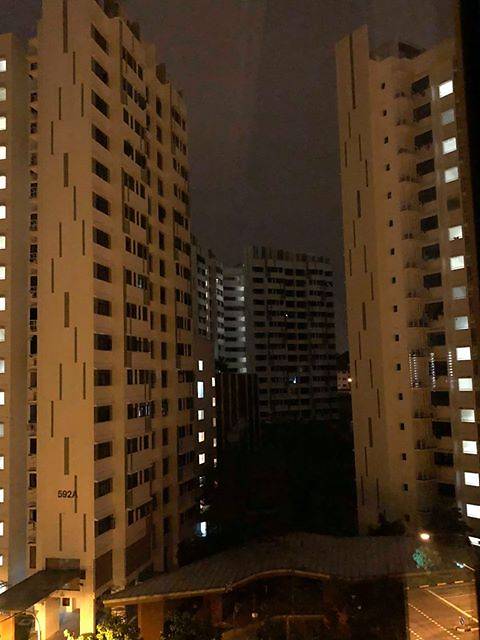
The blackout affected residents of Boon Lay, Clementi, Jurong, Aljunied, Geylang, Mountbatten, Kembangan, Bedok, East Coast, Ang Mo Kio, Bishan, Thomson, Admiralty, Sembawang and Woodlands, among other estates.
The view of the blackout at Ang Mo Kio Avenue 4. (Photo: James JQ Wong)
(Updated: )
Bookmark
SINGAPORE: The Energy Market Authority of Singapore (EMA) is investigating the blackout that hit multiple estates across Singapore early on Tuesday (Sep 18).
“Electricity supply to several areas was disrupted at 0118 hours and has been fully restored on 18 September and 0156 hours,” it said in a statement soon after the blackout.
“The cause of the supply disruption is being investigated. The Energy Market Authority takes a serious view of disruptions to Singapore’s electricity supply.”
Separately, power utilities company SP Group said it was also investigating the incident, with preliminary findings putting the cause on a “partial loss of supply from two power generation units”.
Update 2: (2/4)
About 146,797 residential and commercial customers were affected.
Our officers were immediately deployed to the affected areas and our priority was to restore supply as safely and quickly as possible.
About 146,797 customers in Boon Lay, Choa Chu Kang, Clementi, Jurong, Pandan Loop, Aljunied, Geylang, Tanjong Rhu, Mountbatten, Kembangan, Bedok, East Coast, Ang Mo Kio, Bishan, Thomson, Mandai, Admiralty, Sembawang and Woodlands were affected, the power company said.
“Our officers were immediately deployed to the affected areas and our priority was to restore supply as safely and quickly as possible,” it said.
“We apologise for the inconvenience caused and thank the public for their patience.”
The power outages hit estates as far apart as Jurong, Woodlands, Ang Mo Kio and Bedok.
Flats in Woodlands before (left) and after (right) the blackout. (Photo: Fann Sim)
(Updated: )
Bookmark
SINGAPORE: Multiple parts of Singapore were hit by blackouts early on Tuesday (Sep 18), with several areas across the island losing power for at least 30 minutes.
The power outages, which started at around 1.20am, affected areas ranging from Jurong and Woodlands to Ang Mo Kio and Bedok, according to residents that took to social media to report the blackouts.
The blackout in Jurong West Street 81. (Photo: Mr Kong)
A Twitter user known as Amanda tweeted a video of her estate in darkness, adding that she lived in Bedok Reservoir.
Other netizens in estates like Jurong West and Sembawang likewise reported blackouts in their area.
The blackout in Sembawang. (Photo: Mohamed Rezdwan)
Among those who took to social media was Speaker of Parliament Tan Chuan-Jin
Flats in Ubi were affected by the blackout. (Photo: Channel NewsAsia reader)
Energy utility company SP Group apologised in a tweet for the incident, adding that it was looking into the incident.
Electricity supply to the parts of Singapore was disrupted at 1.29 am.
Our officers were immediately deployed to the affected areas and our priority is to restore supply as safely and quickly as possible.
Its 24-hour emergency hotline was engaged when contacted by Channel NewsAsia.
It later tweeted an update at about 2.20am that power was restored to all the affected areas.
Update: Supply to all areas has been fully restored. We are sorry for the inconvenience caused and thank the public for your patience. We are investigating the cause of the incident.
SINGAPORE: A new batch of candidates for the Nominated Member of Parliament (NMP) post was revealed on Monday (Sep 17), made up of individuals described by Leader of the House Grace Fu as having “good credentials in their respective fields and have keen interest in a broad range of issues”.
They will also add to the diversity of expertise and experience in the House, added Ms Fu, who is a member of the Special Select Committee tasked with selecting possible NMP candidates.
Channel NewsAsia got in touch with some of the possible new entrants to Singapore’s Parliament to find out why they chose to stand and what they hoped to contribute to the country’s political discussions and decision-making:
Social entrepreneur Anthea Ong
Ms Ong said that there are three issues she hopes to raise in Parliament: Social inclusion, mental health and volunteerism.
On social inclusion, she said: “The increasing polarisation of views on so many social issues is deeply concerning and can split our society at its core. How can we ensure more and safe spaces to engage in difficult and divisive conversations? How can we stand in the common ground between the polarities and not be pressured to take either end of the two extremes?”
Ms Ong described stress and depression as one of the biggest threats for Singapore. To address this, she said that Singapore must start by reframing the stigma against mental health, and that mental health education should be made compulsory in schools and institutes of higher learning.
She sees volunteerism as a way to address both the issues of social inclusion and mental health. “Volunteering can help dispel prejudices, challenge stereotypes and create acceptance of diversity. Volunteering helps people who donate their time feel more socially connected, thus warding off loneliness and depression,” she said.
Roses of Peace founder and president Abbas Ali Mohamed Irshad and social entrepreneur Anthea Ong. (Photos: Facebook/Mohamed Irshad, Anthea Ong)
SUTD professor Lim Sun Sun
Prof Lim aims to raise issues relating to the impact of digitalisation on society, “especially with regard to transformations in the workplace and digital readiness of our citizens”, and increasing gender diversity in the technology sector.
“I’m also hoping to focus on fostering media literacy in an increasingly diverse media landscape,“ she added. “I will also speak on issues pertaining to new challenges in education.”
She hopes to draw on her academic expertise and be a “balanced and rational voice”.
Singapore Chinese Orchestra MD Ho Wee San
An active participant in marathons and triathlons, Mr Ho said he “strongly believes in the importance of a healthy and happy lifestyle”.
“However, I believe that this is not just about the body, but also the heart and soul. That is why the arts are so important, especially the traditional arts, which connect us to who we are,” he said.
As an NMP, he hopes to be a voice for the traditional arts, as well as a resource and advocate. He believes that more support is needed for the traditional art forms because they are under-appreciated and under-developed in Singapore.
“More can be done to make the traditional arts an integral part of our society, bringing together people of different races, religions, and backgrounds and creating a shared understanding across our various communities,” he said.
“Looking to the future, I really hope to see the traditional arts become a part of everyone’s everyday life, actively transforming the well-being of individuals, but also bringing people together as a nation and uplifting our spirits.”
Sakae Holdings executive chairman Douglas Foo
Mr Foo said he is passionate about how Singapore enterprises, particularly those in manufacturing, can learn to stay relevant in today’s “interesting”, fast-changing economy.
Through his leadership roles at the Singapore Manufacturing Federation, Singapore Business Federation and Singapore National Employers Federation, Mr Foo hopes he can help raise issues on facilitating greater exchanges between local companies with their ASEAN counterparts and, through that, create new and better jobs.
SUSS Associate Professor Walter Edgar Theseira
Assoc Prof Theseira said that he applied for the NMP post as he wants to help Singapore avoid the type of “political polarisation” that has engulfed other developed countries.
Singapore University of Social Sciences associate professor Walter Edgar Theseira. (Photo: ETH Zurich)
“I think the NMP position is one of the ways we have in the system to bring a non-partisan view on the policies and challenges we face – a view that is neither restricted by the need to promote a united Government front, nor the need to stand in opposition. The NMP position shouldn’t replace either Government or Opposition MP views, but can serve to complement them,” he said.
He added that he plans to speak on policy issues where social sciences and economics can “help us understand the trade-offs and challenges we face as a society better”.
The academic hopes his personal experience as “someone who benefited from a lot of luck and help from others to get to where I am today” will add something to the parliamentary mix.
KKH assistant director Irene Quay
Ms Quay said that she has been actively involved in volunteer work for the past 20 years, particularly in her area of expertise of pharmacy work, to contribute to a better healthcare system for Singaporeans.
“It has always been my passion to serve those in need and work with my fellow colleagues towards better healthcare for Singaporeans. We all benefited greatly from our forefathers’ sacrifices and it is time for us to use our knowledge and experience to do our part for the next generation,” she said.
Besides advocating for the advancement of allied health workers and making sure they are treated fairly in the workplace, the mother-of-four also said she is “in a good position to represent this critical workforce, share their concerns and suggest ways to further enhance the existing support framework for working mothers”.
Union leader Arasu Duraisamy
The long-term union leader said in an article on NTUC’s website on Monday that he was “apprehensive” when first approached for the post.
PSA Corporation technician Arasu Duraisamy and Singapore Chinese Orchestra managing director Ho Wee San. (Photos: NTUC, SCMF)
“But they worked their magic on me. My main aim as a unionist is to better the lives of our workers and members and so if there is another platform for me to air the members’ views, why not. So, I said I will take up the challenge,” Mr Arasu said.
One of the areas he hoped to bring up in Parliament is how workers need to know what they are training for even as 23 Industry Transformation Maps are being rolled out.
“Seventy per cent of our workers are in the small- and medium-sized companies and for them, they don’t see the impetus to upskill or upgrade their systems and processes because for them it is a day-to-day survival,” the 50-year-old said in the NTUC article.
“This is the group of workers who are not well-versed in the importance of the ITMs and we need to do more to reach out to them and engage them.”
SINGAPORE: Four members of a foreign crime syndicate have been arrested for allegedly stealing more than 800 items from multiple shops across the island, the police said on Monday (Sep 17).
The two men and two women, aged between 26 and 31, were arrested on Sunday along Chin Swee Road, the police said at a press conference.
The items allegedly stolen and later recovered – including lingerie and clothing from Uniqlo – are worth about S$26,000, the police said.
Police were alerted to a case of shop theft at a retail outlet along Pasir Ris Close on Saturday. (Photo: Fann Sim)
The arrest was made one day after the police were alerted by a store manager on Saturday that items had been stolen from a retail outlet along Pasir Ris Close.
The four will be charged in court on Tuesday with theft in dwelling with common intention under Section 380 read with Section 34 of the Penal Code Chapter 224.
If convicted, they can be jailed up to seven years, and may also be fined.
The items recovered are worth about S$26,000. (Photo: Fann Sim)
The police said that they do not tolerate foreign crime syndicates looking to operate in Singapore. Those found doing so will be prosecuted to the fullest extent of the law, they added.
Over half of Singaporeans – 54 per cent – attended at least one arts event in 2017.
Visitors interacting with an installation, titled Ember Rain, at the Singapore Night Festival 2018. (Photo: Jeremy Long)
(Updated: )
Bookmark
SINGAPORE: Attendance and participation in the arts continued their upward trend in 2017, with 54 per cent of Singaporeans attending arts events and 22 per cent participating in arts activities, according to survey findings released by the National Arts Council (NAC) on Monday (Sep 17).
Both indicators represent the highest since 2005, excluding the peak in 2015 where there was a surge in arts events to celebrate Singapore’s Jubilee year (SG50).
Across the various arts and culture forms, heritage-related events and activities continue to enjoy the highest attendance rate (32%), as well as the strongest increase from 2013.
NAC said attendance for visual arts events saw a comparable growth, which could be attributed to the increased accessibility of the art form, with the inception of arts events and festivals such as the Singapore Art Week and the National Gallery Singapore’s Children’s Biennale.
Music was the most popular art form for participation. Having an arts and culture-related hobby or personal leisure activity was the most common form of participation.
The two-yearly national population survey on the arts found that they are becoming a more integral part of Singaporeans’ lives, with perceptions of the role of arts and culture in improving quality of life exhibiting steady growth, NAC said.
Of the 2,023 Singaporeans and permanent residents polled, 89 per cent said that the arts and culture gave them a better understanding of people of different backgrounds and cultures, up from 76 per cent in 2013.
A majority of Singaporeans agreed that the arts strengthen inter-generational dialogue and understanding (79 per cent in 2017, up from 62 per cent in 2013).
There was also an increase in interest levels, with 37 per cent of respondents expressing an interest in the arts. Students aged 15 to 24 displayed the highest level of interest (46 per cent) in the arts.
However, the gap between sustained interest in the arts and attendance of arts events continued to widen. This highlights the need to heighten and deepen Singaporeans’ interest in the arts and encourage more works which are relevant and accessible to our audiences, NAC said.
Time continues to be the key barrier to attending arts and cultural events, among those who did not attend any arts events in 2017. Among them, 28 per cent stated that having arts and cultural events close to where they live and/or work would increase their likelihood of attendance.
“It is encouraging to note that the majority of Singaporeans continues to appreciate the value of the arts, especially in terms of enhancing their understanding of the richness and diversity of our society.,” said NAC’s Chief Executive Officer, Rosa Daniel. “We hope the findings in the survey will provide insights for our artists and arts groups to create and present more works which are accessible and relatable for Singaporeans.”
The survey was conducted between January and March 2018.
SINGAPORE: Imagine a hotel keycard that can predict your preferences and provide targeted e-Concierge services, or a holographic classroom lesson in schools.
These are no longer just visions but some of the breakthrough products brought to life by start-ups from Mediapreneur, Mediacorp’s incubator programme and on show at the Singapore Week of Innovation & TeCHnology (SWITCH) 2018.
Mediapreneur’s current Batch four startups – Serl.io, Sticheo and TellMe – are applying disruptive technologies like holography, artificial intelligence (AI) and Internet of Things (IoT) to convert their ideas into commercially viable solutions.
Innovators, technopreneurs and investors converging at SWITCH 2018 are invited to Mediapreneur’s booth to see the solutions at work. SWITCH 2018 is a platform concept bringing together partners in the innovation ecosystem in a series of complementary events.
Students trying out Serl.io’s hololens for a holographic classroom experience. (Photo: Mediacorp)
Serl.io, a mixed reality (MR) start-up, will exhibit their real-time and real-space holographic technology that allows schools to create engaging and immersive content and provide an MR experience for students.
Sticheo taps on computer vision and AI to identify spaces in video content for product placements, allowing seamless integration of ads in a non-disruptive and highly scalable fashion.
TellMe’s smart hotel keycard utilises interactive IoT to allow guests to use it as both an access card and e-Concierge, while allowing targeted ads to be served to them, based on their user patterns.
TellMe’s smart hotel keycard that allows guests to use it as both an access card and e-Concierge. (Photo: Mediacorp)
All three start-ups joined Mediacorp’s incubation programme in July as Mediapreneur’s fourth batch of budding entrepreneurs. Successful applicants embark on a year-long incubation programme, benefitting from a structured programme that offers both infrastructural support and guidance from experienced mentors.
In addition, Mediacorp provides start-ups with a head-start to doing business in the real world through prospective partnerships with Mediacorp’s stable of products and business units.
On the start-ups, Guillaume Sachet, Mediacorp’s Head of Social commented: “Converting great ideas into workable solutions that stand the test of commercial viability is the bedrock of Mediapreneur. We are extremely excited by this batch, many of whom have a strong advertising focus, which is core for Mediacorp.
“We look forward to partnering them on their innovation journeys to transform advertising formats and deliver more value to both our audiences and advertisers.”
On being part the Mediapreneur programme, Mr Ian Wu, founder of TellMe said: “We hope to leverage Mediacorp’s vast advertising expertise to become the number one advertising platform for brands to connect with tourists and travellers.”
Applications for Batch 4 are open till the end of the year. Interested applicants can apply via themediapreneur.sg.