SINGAPORE: Parti Keadilan Rakyat (PKR) president-elect Anwar Ibrahim stressed that there are “no problems” between Singapore and Malaysia and pledged to visit the city-state first when he becomes prime minister.
Mr Anwar was responding to a question on Singapore-Malaysia relations by former Singapore Member of Parliament Zainul Abidin Mohamed Rasheed at a forum during the Singapore Summit on Saturday (Sep 15).
“Are there any problems? I don’t see any problems. It’s just perception and also style,” said Mr Anwar.
“Singaporeans are too serious and business-like. We (Malaysians) are a bit cultured … a bit relaxed … a bit give and take. Singaporeans (are) dollars and cents,” he added.
Mr Anwar said that the relations are strong economically and historically.
“We cannot fail. I wouldn’t think it is sensible to create problems between the two countries.”
Mr Anwar acknowledged that Malaysian Prime Minister Mahathir Mohamad “was firm on some of the earlier contracts” he dealt with Singapore, but said that the matter should be “confined to those particular problems” and resolved there.
Some tension between the two countries were revived when Dr Mahathir, after becoming prime minister in May, raised a thorny bilateral issue – the water accord between Singapore and Malaysia – and proposed scrapping the KL-Singapore High-Speed Rail project that was agreed upon under the previous Najib administration.
“Its not all dollars and cents,” Mr Anwar reiterated. “We have to take into consideration the concerns, sensitivities and the need to look forward and forge that strong bonds between the two nations.”
He added that the current generation of leaders must make “additional effort” in improving bilateral relations.
“The younger generation of leaders do not have the same exposure, experience and relationship as the first or second generations,” said Mr Anwar.
“You have to understand that and therefore, you need to take additional effort.”
He also paid tribute to Prime Minister Lee Hsien Loong, who met Dr Mahathir, as well as Mr Anwar and his wife, Malaysia’s Deputy Prime Minister Wan Azizah Wan Ismail on May 19, 10 days after the Pakatan Harapan coalition won in Malaysia’s historic 14th general election.
“He was very very cordial, and it was a good gesture for him to be among the first to visit us after the election. These signals are important because it goes beyond diplomatic encounters and business deals,” Mr Anwar said.
ANWAR TO VISIT SINGAPORE FIRST AFTER BECOMING PM
Mr Anwar, who is in Singapore for the first time since he was released from prison in May, added that he will visit the city-state first when he becomes prime minister. He stressed, however, that he must first win the by-election for the parliamentary seat of Port Dickson.
It was announced on Wednesday that Anwar will be contesting in the by-election after PKR candidate Danyal Balagopal Abdullah stepped down, paving the way for Mr Anwar to return to the Malaysian parliament.
Parti Keadilan Rakyat leader Anwar Ibrahim speaks at the Singapore Summit 2018. (Photo: Amir Yusof)
Responding to a question on the upcoming by-election, Mr Anwar said: “I don’t take things for granted. I have been in politics for a long time.
“I will go down (there) to appeal to the voters, and (the demographics) is very mixed … it’s about 50 per cent Malays, 30 per cent Chinese and almost 20 per cent Indians.
“So it’s really a microcosm of Malaysian society, and I want to make sure, God willing, that I get a majority of the Malay votes, the majority of Indian votes and the majority of Chinese.”
Recognising that the task is arduous and that campaigning will be gruelling, Mr Anwar added that he is hopeful that he will win and enter parliament.
“When I assume the premiership, I will make sure that the first country I visit will be Singapore,” he added, to applause from the hall.
SINGAPORE: When it poured, some Fajar Secondary School students were late for school while waiting out the rain at void decks or at bus stops.
Others turned up at school soaking wet, having run the distance that’s not covered by sheltered walkways.
But since sheltered walkways leading to the school gate were built this year, the school in Bukit Panjang has seen more students turning up on time on rainy days, said its vice principal.
The walkways are part of 200km worth of sheltered walkways that have been built in the past five years under the Land Transport Authority’s (LTA) Walk2Ride programme.
LTA announced on Saturday (Sep 15) that the programme has been completed, at a cost of S$300 million.
“Where feasible, walkways have been built to schools, healthcare facilities and other public amenities within a 400-metre radius of MRT stations, and within a 200-metre radius of bus interchanges, LRT stations and selected bus stops with high commuter volumes,” said LTA.
To minimise inconvenience to residents during construction, LTA said materials were prefabricated off-site to speed up the installation process. A “single post design” was also used where necessary to maximise the width of the walkways.
A sheltered walkway near South View LRT station. (Photo: LTA)
Before the walkways were built, LTA said it sought information from the community to understand their needs and concerns.
“In the construction of the sheltered walkway to South View LRT station, LTA converted an unused space outside the LRT station into a three metre-wide path for commuters, which required modifications to the existing landscape as well as the construction of retaining walls,” LTA cited as an example.
It also worked with Fajar Secondary School to close a six-metre gap between an exiting sheltered walkway and the sheltered school gate.
These pictures show the same area before (left) and after (right) LTA worked with Fajar Secondary School to close a six-metre gap between an existing sheltered walkway and the sheltered school gate. (Photos: LTA)
As Singapore expands its public transport network, authorities hope the sheltered walkways will make is easier for commuters to reach train stations and bus stops.
“We know that safe, comfortable walkways are necessary to get Singaporeans to #WalkCycleRide and make Singapore car-lite. And in our tropical weather, they have to be sheltered too,” said Transport Minister Khaw Boon Wan in a Facebook post on Saturday.
“Five years and S$300 million later, I am happy to announce the completion of this #Walk2Ride Programme.”
SINGAPORE: The sun is setting, and a pot rages to a boil on the stove, the scent of aromatic spices wafting through the air.
On the table, fresh chicken is prepped for the oven, while fragrant coconut rice steams steadily in the cooker.
A little girl sits on a high stool, looking on curiously as vegetables sizzle in a wok while sugar and chilli caramelise in a pan.
This is the home many of us grew up in, where food is literally the centre of the universe.
We would gather at dusk, sitting in our dining rooms, chatting about our days over a warm bowl of rice and delectable dishes, at times ending dinner with a bowl of sweet treats – red bean soup, kueh – the list is endless.
It is only when we grow older that we start to think more deeply about the origins of our food. As far as we know, Singapore generates precious little of our locally consumed produce. So where does all this food come from?
Singapore sits in the cradle of Southeast Asia, and our palates have long been accustomed to the diverse and colourful tastes of our region. Yet many of us may not be aware of how much of our food comes from our neighbours.
Southeast Asia, a region of robust agricultural development and diversity, has availed the presence of a rich variety of produce making their way to our city-state.
In every well-stocked kitchen in Singapore, one is likely to find at least a few essential products from ASEAN countries. A groceries shopping trip to NTUC Fairprice will reveal several interesting facts about the many origins of our food.
While Malaysia is often perceived to be the main exporter of produce to Singapore, including meat, seafood, spices, fruit and vegetables, much of our kitchen stock also comes from other ASEAN countries.
This includes jasmine rice from Thailand, sweet potato and coffee from Vietnam, mangos from Myanmar and the Philippines, and even Kolo Mee from Brunei.
Even in a simple dish of noodle soup that one might whip up in their kitchen, there might be chicken from Malaysia, organic chye sim from Thailand, and spices from Indonesia.
In another local favourite, fried rice, most ingredients are sourced from our neighbours too – rice from Thailand, eggs from Malaysia, garden peas from Vietnam, carrots from the Philippines, garlic and spring onions from Indonesia and shrimp from Brunei.
The region has, literally, come to our kitchen, being present in almost every local Singaporean delicacy, from nasi lemak to char kway teow.
The presence of ASEAN in Singapore kitchen is emblematic of the multi-fold and far-reaching benefits of enhanced regional trade in agricultural products.
Malaysia, Indonesia, Thailand and Vietnam are among the top 10 exporters of food products to Singapore.
Thailand and Vietnam especially are among the top three rice exporters to Singapore, accounting for 62 per cent of its total rice imports.
FOOD SECURITY
A number of ASEAN initiatives have been put in place to enhance the sustainability of Singapore’s food imports, including the ASEAN Integrated Food Security (AIFS) Framework which provides an enabling environment for ASEAN member states to operate and cooperate in various aspects related to food production, processing and trade.
With the ever-present threat of climate change, episodic droughts, floods and other natural disasters, it is of utmost importance that Singapore join hands with other ASEAN countries to enhance food security in the region, including promoting conducive food market trade, agri-innovation and food security emergency arrangements.
One notable achievement in this respect is the ASEAN Plus Three Emergency Rice Reserve established in 2013.
With earmarked stocks and voluntary donations from 10 ASEAN member states plus China, Japan and the Republic of Korea, this reserve offers rice supplies for affected countries especially in times of acute emergency.
Now when I recall my childhood, I think not only of the bursts of flavour in every bite, but the lustrous fields across the region from which my rice and noodles hail.
When it comes to food, ASEAN is ever present in our home as much as we have always been right at home in the ASEAN region. These culinary connections highlight the intimate ties that bind Singapore to and with ASEAN.
Cheryl Teh is Research Associate at the ASEAN Studies Centre, ISEAS-Yusof Ishak Institute. This commentary was first published in ASEAN Focus Issue.
“I told him I’m flying home from Phnom Penh for this, and that he was going to be my plus-one!” said the Temasek Polytechnic student, who is currently based in Cambodia for an internship.
“I cannot believe that I got a chance to meet, chat and take a photo with my F1 hero. I’ve been a fan of Sebastian ever since my father introduced me to F1!”
Sebastian Vettel in the hot seat at the Shell Mini Grand Prix. (Photo: Ealbert Ho)
CNA Lifestyle Experiences winner Muhammad Salihin Bin Masnor (left) flew back from Cambodia where he’s currently based, to meet his F1 hero. And he brought his father along. (Photo: Ealbert Ho)
As part of CNA Lifestyle Experiences, a series of exclusive events for CNA Lifestyle Facebook fans, Salihin – along with fellow contest winners Fan Peiyi, Khairunnishah Hambali, Nadia Goh and Jeyakanthan Vijay – had a once-in-a-lifetime opportunity to get up close and personal with the 31-year-old Scuderia Ferrari German motorsports star ahead of the big Singapore GP race on Sunday (Sep 16).
(Photo: Ealbert Ho)
Sebastian Vettel (centre) with his game face on. (Photo: Ealbert Ho)
The five winners and their invited guests spent their Thursday afternoon (Sep 13) mingling and chatting with Vettel, taking photos, getting hugs and even passing him gifts.
It was the perfect opportunity to ask Vettel some burning questions, like Peiyi’s query about the story behind his lucky coin.
(Photo: Ealbert Ho)
“I have two coins, actually. I got them from my grandmother from a long time ago,” he said.
“Since I can remember, I’ve always had them with me, normally in my pocket, but then race suits got rid of pockets because of weight reasons. So I had to store them somewhere else and the only other place was the shoe.”
(Photo: Ealbert Ho)
On your mark… (Photo: Ealbert Ho)
Peiyi and Khairunnishah were selected, along with three other fans hosted by Shell, brand partner of Scuderia Ferrari,to go head to head with Vettel in a special remote control car race titled Shell Mini Grand Prix.
Fan Peiyi (left) and friend with the man himself. (Photo: Ealbert Ho)
Khairunnishah Hambali (right) and her guest flanking Sebastian Vettel. (Photo: Ealbert Ho)
Vettel is the main challenger for the world title to Britain’s Lewis Hamilton, and winning here in at the 2018 Singapore Grand Prix could prove to be the game-changer for this season.
Nadia Goh (left) and her sister Hidayah with Vettel. (Photo: Ealbert Ho)
“Singapore’s been a very, very good place for me,” he told CNA Lifestyle with a smile. “I’ve won a couple of times, so yeah, we’re back!”
Jeyakanthan Vijay (right) and his event guest with Vettel. (Photo: Ealbert Ho)
Indeed, Singapore and its night race hold a special place in Vettel’s heart. After all, he has quite an impressive record here. Since it began in 2008, Vettel has won at the circuit four times – in 2011, 2012, 2013 and 2015 – the most among his rivals.
(Photo: Ealbert Ho)
“Singapore, in particular the toughest race in the calendar, because it’s very humid… the track is very bumpy, very twisty and there’s a lot of corners,” Vettel admitted to CNA Lifestyle.
“Even though it’s tough, I like coming here. It’s one of my favourite races!”
It’s not quite a street race but it’s good enough for Ferrari’s Vettel. (Photo: Ealbert Ho)
This edition of CNA Lifestyle Experiences was made possible by Shell V-Power Nitro+.
SINGAPORE & THAILAND: It is in demand every Chinese New Year and is believed to bring good luck. But the red grouper is also overexploited or from unsustainable sources, according to the World Wide Fund for Nature (WWF).
In a country where people love to eat seafood – on average, 21kg per person in a year, compared to the global average of 20kg – one solution to the depletion of fish stocks is to eat responsibly.
To this end, a growing number of businesses, like Marina Bay Sands, are starting to use more certified sustainable products in their kitchens. But are such measures really benefiting the environment?
In January, nearly 70 organisations and individuals criticised the Marine Stewardship Council (MSC), the dominant seafood sustainability certifier, for failing to uphold standards to reduce overfishing.
In a joint letter, they said “an increasing number of controversial fisheries” had been certified despite destroying the environment and having unsustainable practices.
At a time when efforts like eco-dining – eating food harvested in a responsible way – ditching plastic straws and switching to electric cars are growing trends, a new Channel NewsAsia series is questioning things that green advocates might take for granted.
Coming Clean About Green looks at how impactful some of these green solutions, from cycling to clean coal, really are. And in the case of eating sustainably, it will take much more than that to make a world of difference. (Watch the episode here.)
FISHING FOR SOME ANSWERS
When it comes to sustainable seafood labels, there are few options. The Aquaculture Stewardship Council is one, and the Global Aquaculture Alliance’s Best Aquaculture Practice is another.
As for the MSC, its Asia-Pacific director Patrick Caleo disputed that his organisation is not doing enough. “If it’s MSC-certified, it’s sustainable,” he said.
Conservation groups would rather the bar be raised much higher, and the industry would rather see it lower.
“MSC’s bar is set at a very high level: 50 per cent of fisheries that initially go for a pre-assessment don’t go on to achieve MSC certification. We’ve got to be careful that we don’t set the bar too high,” he added.
There are annual surveillance audits of fisheries, he said, and “every point in the supply chain has taken ownership” of products with the MSC label. “The wholesale processes, right back to the fishery, have a chain of custody in place.”
Still, seafood is a fast-moving industry. Things can go wrong, and one of the risks is mislabelling. In 2016, advocacy group Oceana reported that one in five seafood samples it tested worldwide was mislabelled.
In Singapore, this would constitute food fraud under the Wholesome Meat and Fish Act, punishable by a fine of up to S$50,000 and/or a maximum jail term of two years for a first conviction, said the Agri-Food and Veterinary Authority.
But it still happens. When the CNA team sent eight samples of certified sustainable fish to a laboratory, the results showed that one product did not match its packaging label, which had stated Pacific cod.
The product labelled Pacific cod (above) was found to be Alaskan pollock, which is not on WWF’s Singapore Seafood Guide’s green list, although it is a fish of the cod family and its wild stock s certified sustainable by the MSC.
When the supplier and the MSC were alerted to this finding, they said they would investigate the matter.
BUYING ORGANICS
Sustainable fish is not the only food that might not be what it seems. People may take a leap of faith when it comes to organic farm products too.
At eco-grocery chain Little Farms, its most popular products are organic. Head of operations Fred Moujalli noted, however, that “being organic doesn’t necessarily mean it’s pesticide-free”.
There are, for example, natural pesticides. But that is the shady side of the organic food industry because producers “may not be honest”, according to Thai-Pesticide Alert Network (Thai-Pan) adviser Kingkorn Narintarakul Na Ayutdhaya.
Ms Kingkorn Narintarakul Na Ayutdhaya.
“We can’t guarantee that they’d use only light pesticides. They might use dangerous ones,” said the activist.
Forty per cent of the world’s organic producers are in Asia. And in Thailand, the amount of organic farmland nearly doubled between 2009 and 2016, backed by government support and growing demand.
Thai-Pan’s tests in 2016, however, found that two in 10 samples of fruits and vegetables certified as organic by the Thai government contained chemical residues.
“We’d like to advise consumers not to believe or trust it (certification) 100 per cent,” said Ms Kingkorn.
One vegetable farm that uses organic fertilisers, and more workers than in conventional farms to get rid of pests and weeds, is Monkey Organic Farm in Chiang Mai. And owner Nives Pirarak bemoans the “fake” organic products of some farmers.
Mr Nives Pirarak.
“As you know, organic products are more expensive than general ones. They’d mix them up and label them all as organic,” he said. His farm took two years to be certified as organic, and he feels “cheated” by such mislabelling.
I’ve tried very hard, made a lot of effort and spent a lot of time and money.
So how does a grocer like Little Farms back its claim that its sells produce which is good for the environment?
“It’s trust and relationship … If you trust your supplier, and we know where it comes from, that’s enough for me to serve to my customers,” said Mr Moujalli, 43.
“If I can ring up the supplier and say, ‘you’re stating a 100 per cent organic ingredients – can you please send over your certs, and that’ll be fine’, the minute they start to hesitate, we know there’s something going on.”
Mr Fred Moujalli.
FARM-TO-TABLE EATING
It is not just the organic movement that is gaining traction in Singapore. So too are farm-to-table restaurants, which are classified as those using fresh locally grown food.
One of them is Open Farm Community, in Dempsey. And head chef Oliver Truesdale-Jutras affirmed that the restaurant “tries to source locally as much as we can”. “We’re trying to shave food miles off our food,” he said.
“If you’re using organic produce in Singapore from the Netherlands, the miles you’re adding on, in terms of … how much energy gets used, pretty much equate to a standard product from nearby or even a very badly farmed product from nearby.
“We’re saving a lot of fuel for the world, I guess.”
The question of where your ingredients are from is a reminder of the environmental cost of transporting produce. But how much difference would a reduction in food miles make?
According to the study “Food-miles and the relative climate impacts of food choices in the United States”, transport represents only 11 per cent of the greenhouse gas emissions associated with food, based on an average supply chain of 6,760 kilometres.
The production phase contributed 83 per cent of the average household’s carbon footprint for food consumption, with red meat being around 150 per cent more carbon-intensive than chicken or fish.
Hence the study’s authors, from Carnegie Mellon University, suggested that dietary shifts could be a more effective means of lowering one’s food-related climate footprint than “buying local”.
In Singapore, to help consumers when it comes to eating fish, WWF has a sustainable seafood guide, notwithstanding the arguments about certification. There is, however, another question here – about feasibility.
Fish on the WWF’s red list of threatened ocean species
For example, cod from Japan and Hokkaido scallops are sustainable but expensive, as with a good number of the other recommended foods, like rock lobster and sea cucumber.
Food vendors may also have no idea whether their fish are sustainable and where it comes from, or even what is in a product such as fish balls.
Ultimately, consumers can still play a part in eco-dining, but it also takes healthy scepticism and a lot more work to make a real environmental impact.
The series Coming Clean About Green looks at the complex realities of green solutions being pursued across Asia. Watch this episode here.
SINGAPORE: Recent news about the French issuing a nationwide ban on mobile phone use in schools created a slight uproar, with ripples reaching here in Singapore where it is not uncommon to see children as young as those in Primary 1 brandishing their own mobile phones.
We all know the pros and cons of having a phone – the convenience of being able to contact your children versus the danger of falling into different forms of cyber addiction. So how do we balance these out?
How should we be making our decisions as to whether or not to give our kids a phone, when to give it, and how to control it?
IS THERE EVER A GOOD AGE?
Is age a good gauge for when to give a child a phone?
Children develop and mature at their own individual pace. While my daughter may be emotionally and mentally ready to bear the responsibility for an expensive item like a phone by a certain age, I may not be able to say the same for her younger brothers, who may need a couple more years to catch up to a similar level of maturity.
Some people would say it’s not wise for a child in lower primary to carry a phone as they may misplace it. My own son who started Primary 1 this year has already lost an umbrella, a water bottle and a wallet (although this was later retrieved), so I cannot yet fathom placing a mobile phone in his care at this stage.
There is also no need for him to have one as I pick him from school every day. However, some kids start to travel home alone at an early age, so it’s understandable that their parents would prefer for them to hold on to a phone so they can contact them if there is an emergency.
A child plays a game on his phone (Photo: Reuters/Brendan McDermid)
So individual needs have to be considered too – or the whys of having a phone.
However, we have to bear in mind that the younger the child’s age, the more controls need to be set in place.
SETTING THE STAGE FOR RESPONSIBLE USE
Maybe the question shouldn’t be when or why to give your child a phone, but how?
If you haven’t set clear boundaries about technology use or had conversations about it with your child, then passing junior a phone is likely to be premature.
Giving a child a phone without prior training is like putting him on a table with 10 marshmallows, telling him not to eat them, and then leaving the room. It doesn’t take much to know what’ll happen next.
I’m referring to the Stanford marshmallow experiment of course, which is a series of studies on delayed gratification. Its findings suggest that children who are able to delay their gratification in order to receive an even better reward – two marshmallows instead of one – go on to do better in life.
Seeing that the phone is about as tempting for little fingers as a fluffy white marshmallow, what we want to do with children is this: Before letting them loose with the phone, educate them on the benefits of having one, and provide some handles on how to manage potential pitfalls such as addictive behaviour and frequent notifications.
It is this process of equipping them with the necessary skills to master technology that will enable them not to be enslaved to it in the future.
We often underestimate the temptation that come in this 5″ by 3″ gadget. Even adults get hooked on phones and our time and energy often get sucked away as we scroll mindlessly through apps and websites. So what more for children?
A person using a smartphone. (File photo: Xabryna Kek)
A friend gave her daughter her own phone when she began using public transport at Primary 6.
About a year before that, she had started to actively introduce her to various apps, while taking care to mention the ways she manages phone distractions whenever she’s working. She also allowed her daughter to use her phone’s Whatsapp for school-related group chats.
In other words, she has been setting the stage for responsible use, using her own media habits as a model for her daughter.
There are also other controls we can put in place – such as setting a phone curfew so that the gadgets can be “retired” for the day and recharged, limiting time spent on games, and restricting social media use until the child is of a certain age and maturity.
EXAMINING OUR OWN VALUES
What do we value as a family? What are our own digital habits?
Asking such questions can help us set the tone for how technology is used in our homes.
If we value relationships, we will take pains to lay gadgets aside before any social gathering.
If we value family time, we will establish some tech-free zones and times in the house, so that we can catch up properly at least once or twice a week.
If respect for elders is a big thing in our households, then we would encourage our young to interact with their seniors rather than stare at their screens the moment they step into grandma’s house.
Our values determine to some extent the way we (and our offspring) interact with technology.
Once set, these habits can be hard to change, so it makes sense to think about them early when our children are still open to instruction. It is a conversation that we need to keep going, not just at the point of handing our children a phone.
A child playing a mobile game. (Photo: Reuters)
And as our kids grow, the rules and routines may evolve with time, but the values behind them usually don’t change.
JUST ANOTHER SKILL ON THE LIST?
As parents, we are responsible for teaching our children multiple skills, from life skills such as learning how to button a shirt, to literacy and social skills.
Today, we also need to teach technology skills, not so much the technicalities of how to work a phone, but rather wise and responsible usage.
Just like how we teach a child to ride a bicycle, we start with the basics and set some ground rules to ensure safety.
Perhaps we should give provisional licences to our kids when they start having their own phones, or do up a family tech-time contract together. It will remind us to maintain strict controls and close supervision, while also watching our own behaviour.
The more our children can prove that they are able to handle the distractions and temptations that come with phone ownership, the more trust we can offer in return.
Technology, minus the skills and maturity to handle it, can be dangerous. But if we give our kids the skills to manage technology, we can be more confident in handing over a phone too – with a P-plate on it.
June Yong is a mother of three, an educational therapist and owner of Mama Wear Papa Shirt, a blog that discusses parenting and education in Singapore.
SINGAPORE: Deep in the heart of Changi, Jeremy Ong is kitted out like a Japanese swordsman; his eyes locked on a target – a green circular mat strung up on a white tarp.
The 31-year-old civil servant locks his arms in archer’s stance, bow lifted, arrow quivering. His eyes narrow. Beads of sweat run down his face.
Thoop.
His arrow lands neatly in the bullseye of the target like a pro. But there is no celebration.
Slowly, he lowers the two-metre bow to his hip and turns his gaze. His face betrays no emotion.
Behind him, four others who have been waiting their turn perform precise ceremonial steps, each lasting several minutes. They shuffle along in white socks on glossy wooden floors, before they too, get in stance to shoot their arrows.
If this doesn’t sound like regular archery to you, it’s because it isn’t.
Jeremy and his peers practice kyudo, an ancient Japanese martial art that originated from the samurais in feudal Japan. Steeped in philosophical influences from Shinto and Zen Buddhism, kyudo translates literally to “the way of the bow”.
“I think for most people who are introduced to kyudo for the first time, they may find that there is a lot to take in. There is a lot that goes into refining the art to pursuing perfection,” Jeremy told Channel NewsAsia.
A archer at kai (full draw). (Photo: Gaya Chandramohan)
The distinctly ceremonial martial art involves five archers entering a dojo in lockstep while performing eight stages of deliberate and graceful movements. The shooting process emphasises not only dexterity, but emotional mastery and sense of being.
Practitioners of the martial art have to enter an almost meditative state as they go through the eight stages – ashibumi (footing), dozukuri (assuming the proper posture), yugamae (readying the bow), uchiokoshi (raising the bow), hikiwake (drawing the bow), kai (achieving full draw), hanare (the release), and zanshin (remaining spirit and form).
A kyudo practitioner having just prepared the bow for shooting, checking the target. (Photo: Gaya Chandramohan)
Along with a small group of kyudo aficionados, Jeremy turns up every other Saturday at a multi-purpose hall at the Japanese School in Changi to hone his art.
He admits kyudo is not as well-known as other sports such as judo and aikido because of its intense technical and mental focus. “People may not find this to be an art they want to pursue because some may just seek the experience of just shooting and not kyudo’s long, ritualistic process,” he said.
Indeed, there is no swagger of Marvel’s Hawkeye or Katniss from The Hunger Games in this martial art. This is meant to be a communal experience.
Archers have to learn to be considerate and harmonious when going through the motions on the floor together. During grading, archers of different nationalities and languages are expected to move together seamlessly in sequence.
The person in front is called the omaye and he or she sets the pace for the rest of the team behind. (Photo: Gaya Chandramohan)
For Goh Horng Bor, the non-confrontational nature of kyudo appeals to him.
“It’s a special martial art that is cooperative and peaceful. What one does in kyudo is not focused on one person’s journey – it’s more of a group journey.
“Having trained in budo, I really didn’t enjoy the aspect of sparring. Not everybody wants an opponent to fight. Some of us just want to reach out to our inner selves,” he said.
The 30-year-old, who began practicing kyudo three years ago and even met his fiancee through the sport, is convinced he has become a better person since. The martial art encourages practitioners to self-analyse and problem-solve constantly, he said, and it helps him at work as a software engineer who frequently deals with bugs.
Now the vice president of the interest group, Horng Bor added: “The problem-solving aspect of kyudo is essential and relevant everywhere in life. Many things in kyudo are counterintuitive. For example, you have to fight the instinct to release your arrow even when you feel like letting it go.”
“You’re taught to react gracefully while enforcing discipline within yourself. You learn how far your mind can stretch and how resilient you can become.”
Wong Lu Yee, 23, who joined the group two years ago, agrees.
“During the stage of kai (full draw), you have to focus and forget every problem or distraction. I use this technique I learned outside of the dojo as well. When I’m get nervous about something, I also remind myself of the breathing techniques we use in Kyudo to calm myself down,” she said.
SPEARHEADING A RARE HOBBY
“Kyudo boils down to being more than just an archer. When one is a good archer, there’s an emphasis on skills and techniques, but not much growth as a person. Practicing this introspective art forces a person to cultivate character development, to shoot with a depth of emotion or soul. It’s a more wholesome experience,” said Jeremy.
He chanced upon kyudo online in 2013. Having practiced taekwondo, budo and conventional archery, his interest was piqued.
Archers sitting in the unique kiza position which is a difficult half-sit and half-squat. (Photo: Gaya Chandramohan)
“In the beginning, it was just me practicing my form with a rubber bow I ordered online. There was no indication or interest whatsoever in Singapore at that time.”
Still, he was keen to bring it to Singapore. He eventually found a practicing club in Kuala Lumpur and two mentors who introduced him to Kodama Mariko and Iwasaki Eiko – two Japanese based in Singapore with extensive kyudo knowledge.
Together, the three of them set up the Singapore Kyudo Interest Group in 2014. After training alone for more than a year, Jeremy finally had guidance and fellow enthusiasts.
Four years on, with the help of Ms Mariko as technical advisor, Jeremy is president of the club and oversees 19 others.
Technical adviser Mariko-san referring to a Kyudo manual. (Photo: Gaya Chandramohan)
When they first started out, they didn’t even have access to a dojo to practice in, they said.
“The archery range at Pasir Ris kindly let us use their field, but it was tough to do the kneeling positions on the grass and mud. We couldn’t do a few of the steps of the taihai (process leading up to the shooting) because of this. Our kimonos got all muddy, so we all began wearing yellow Phua Chu Kang boots to shoot!” said Ms Mariko with a laugh.
Equipment was also hard to come by because no retailers carried bows and arrows that had to be customised for each archer. Right now, every piece of equipment – from the deerskin gloves the archers wear to the hakamas – has to be ordered from Japan itself.
The arrows have a nocking point for the string on the bow. (Photo: Gaya Chandramohan)
“On top of that, due to their levels of expertise and language barrier, Mariko-san and Eiko-san both struggled to teach me. But we eventually made it work,” said Jeremy.
Today, Jeremy and Horng Bor have achieved certification from the People’s Association to hold kyudo workshops and classes to teach the public.
Male arrows have fletches that are angled towards the left side and female arrow, on the right side. (Photo: Gaya Chandramohan)
THE BIGGER TARGET
But the team is currently in quest of another venue to practice at, as the existing venue only allows a shooting range of 15 metres.
Jeremy and Horng Bor are both at nidan (second dan or rank) and are looking to achieve sandan (third dan), where hitting the target is a required component of grading.
“The official distance for kyudo grading is 28 metres and our current range isn’t enough to get us ready for our examination next year in April,” Horng Bor said.
“The nature of kyudo also requires wooden flooring for us to slide on and at least a 32 metre by 18 metre space,” added Jeremy.
One of the requirements of a kyudo dojo is a polished wooden floor. (Photo: Gaya Chandramohan)
Despite the many hurdles, the enthusiasts still have their eyes on the prize. Even the strange looks that people shoot them and frequent questioning by security staff at MRT stations have not deterred them.
“The number of times I’ve had to reassure security personnel that I would only board the last or first train cabins and not during peak hours!” Jeremy said.
“We had a sensei tell us in a very light-hearted way that kyudo is not for normal people and that it’s for crazy people. I wouldn’t say he’s wrong. There’s this saying that there’s a very fine line between ingenuity and craziness and perhaps we’re tottering along that line.
“But we go through this process to remind ourselves that there is pain in life and when you have pain, you can appreciate things like happiness. And like they say: No pain, no gain.”
SINGAPORE: While the Singapore Armed Forces (SAF) has in place sufficient measures to detect and help pre-enlistees with mental health issues, experts said some might still slip through the cracks and face difficulties during National Service (NS).
Defence Minister Ng Eng Hen, in a written reply to Parliament in August, revealed that over the past five years, about 4 per cent of each NS cohort has been downgraded for mental health issues.
According to Ministry of Defence (MINDEF) figures, about 15,000 men enlist for NS each year.
“The majority were downgraded after the pre-enlistment check-ups before commencing their NS, and therefore the prevalence of mental disorders for national servicemen reflect that of the male population in Singapore,” Dr Ng wrote.
At the pre-enlistment stage, pre-enlistees undergo a “comprehensive” medical screening – including self-declaration and parent endorsement – for psychiatric, behavioural and adjustment problems. MINDEF also works with the Health Ministry to identify those with mental health history at public hospitals.
Pre-enlistees are exempted from NS if they are deemed to have “severe mental illnesses” that prevent them from performing their NS duties. From 2005 to 2015, about 400 pre-enlistees have been exempted from NS each year.
Dr Lim Boon Leng, a psychiatrist at Gleneagles Hospital who sees youths who face difficulties in coping with NS, said these measures are “sufficiently stringent”.
“However, it is pertinent to note that there are no screening processes that are foolproof or 100 per cent accurate,” he added. “These processes are also subjective and dependent on the cooperation of the pre-enlistees and their parents.”
Dr Marcus Tan, a psychiatrist at Nobel Psychological Wellness Clinic who is trained in military psychiatry, said the measures are “as comprehensive as the ministry can muster at this point in time”.
However, he acknowledged that there are servicemen, including those who do not declare their mental illnesses, who “slip through the gaps” and eventually “encounter difficulty post-enlistment”.
STRUGGLING WITH NS
One example is 21-year-old Derrek (not his real name), who was diagnosed with major depressive disorder in primary school.
Derrek told Channel NewsAsia that during his pre-enlistment check-up, he declared his condition to the medical officer, and was eventually assigned a PES E9L9 grade. This means he was still fit to serve NS.
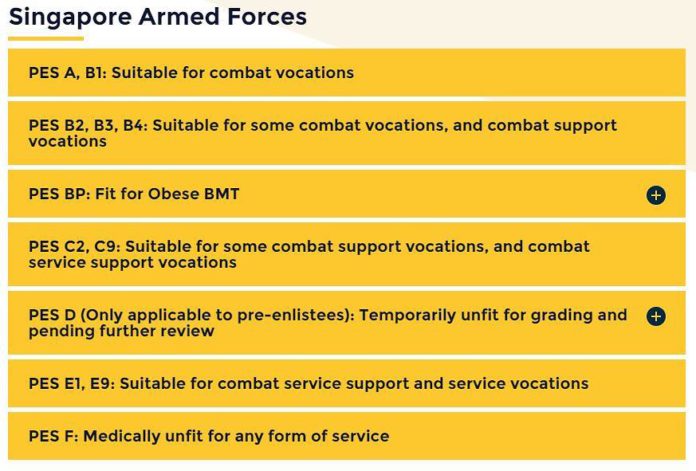
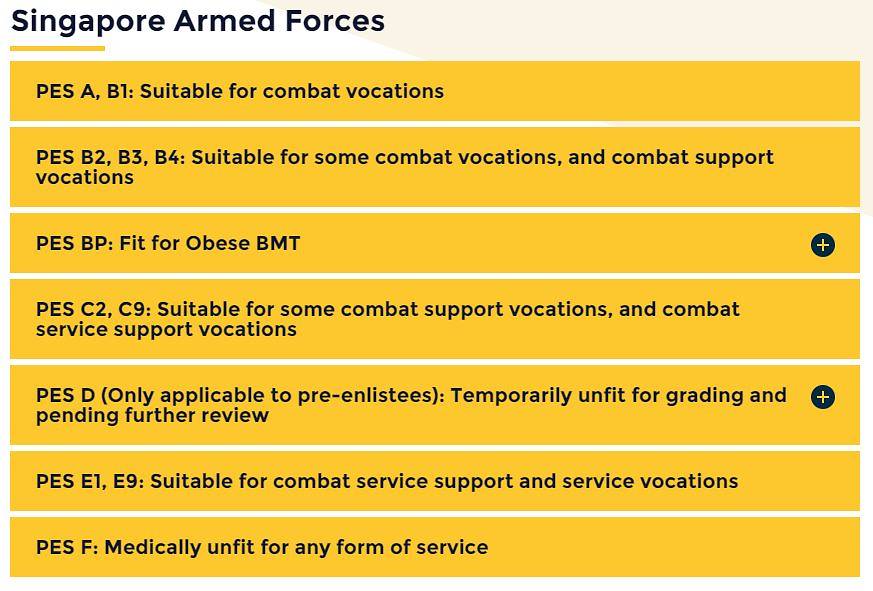
What the various PES grades mean. (Source: Central Manpower Base website)
PES refers to the Physical Employment Standards, which according to the Central Manpower Base is assigned based on a serviceman’s medical condition and is one factor used to determine his NS vocation.
While PES A and B1 indicate suitability for combat vocations, PES E denotes suitability only for combat service support and service vocations. PES F means exemption from NS.
Derrek enlisted last October and completed one month of Basic Military Training with fellow PES E servicemen before getting posted to the Navy as an administrative assistant.
His condition, however, worsened.
In January, about two months into his new posting, Derrek said his mental health spiralled “out of control”.
The next month, Derrek was further downgraded to a pending exemption, before being granted full exemption from NS in April.
MENTAL HEALTH AND NATIONAL SERVICE
As with Derrek, NS is a “big change for any enlistee”, said the psychiatrist Dr Lim.
“People who are suffering from mental health issues are more sensitive to changes in life, may have more difficulties coping with these changes and may take a longer time to adjust,” he added.
“Those who are unable to transit into military life may find themselves having adjustment disorders with emotional and behavioural disturbances. Some may develop anxiety disorders and depression, particularly if they are already vulnerable in some ways.”
Servicemen with mental health issues might struggle with the changes that come with NS. (Photo illustration: Jeremy Long)
These servicemen might also experience mood, sleep or appetite disruptions due to the change in circumstances, Dr Tan said.
“They may experience exacerbation of their conditions and will need to be monitored intently, with requisite adjustments made to their immediate operating environments as needs arise,” he added.
WHAT IS THE SAF DOING?
In another written reply to Parliament last year, Dr Ng said enlisted servicemen with mental health issues are “closely monitored while in service, and where necessary, are provided with regular medical treatment and counselling by psychiatrists, psychologists, counsellors and para-counsellors”.
The SAF has more than 1,200 of such psychiatrists, counsellors, para-counsellors and psychologists. It also draws on resources in the national healthcare system, including the Institute of Mental Health and psychiatric departments in restructured hospitals.
Besides that, unit commanders interview servicemen at “regular intervals” to check if they are under any form of stress, including emotional or psychological problems. At the formation level, dedicated psychologists help commanders manage such servicemen.
Commanders also undergo “basic training” to help them better understand mental health conditions and manage servicemen with such conditions. This includes referring them to trained professionals or restricting their access to weapons and ammunition.
For the servicemen themselves, there’s a 24-hour SAF counselling hotline.
ARE THE MEASURES ENOUGH?
But Derrek said he still found it difficult communicating his issues to his commanders during NS.
“As much as they wanted to help, they simply were not equipped as they did not understand the basics of mental health and the implications of mental illnesses,” he added.
Still, the psychiatrists Dr Tan and Dr Lim insisted that the SAF’s measures to manage servicemen with mental health issues during NS were adequate.
“The measures are adequate to address day-to-day (issues) as well as contingencies,” Dr Tan said. “To have this system work well, close and timely communication between the serviceman, unit superiors and each member of this team will be key.”
THE STIGMA OF MALINGERING AND EXEMPTION
However, Dr Tan urged commanders and servicemen to better understand common mental health conditions and how to manage them, while Dr Lim said the lack of mental health awareness is an issue that goes beyond the SAF.
“The problem is really a societal one and lies in a lack of understanding of mental illnesses, whereby leaders and commanders often assume those who declare their mental health issues to be malingering,” Dr Lim explained.
In 2014, an anonymous person posted online detailing how he allegedly escaped NS by faking mental illness, prompting a MINDEF investigation.
“Stigmatisation (surrounding malingering) often prevents those in need from seeking help,” Dr Lim added. “Improving the mental health literacy of commanders will no doubt help.”
There’s also the stigma associated with getting exempted from NS due to mental illness, something Derrek said he worried about even before enlisting.
“Admittedly, being exempted from NS on these grounds can cause self-stigmatisation and impact personal confidence,” Dr Tan said.
These men will also have to explain their exemption to future schools and employers, and therefore reveal their mental illnesses, Dr Lim added.
As for Derrek, he said he is doing much better now that he’s out of NS, adding that his exemption has not affected his prospects in any way.
MANY STILL COMPLETE NATIONAL SERVICE
Defence Minister Dr Ng told Parliament in 2014 that “under our present regime, there have been many national servicemen with mental health disorders who have completed their NS duties well”.
Dr Tan, the psychiatrist, agreed, noting that most of the servicemen in this category “come out stronger through the NS experience”.
Nevertheless, Dr Ng said MINDEF and the SAF will continue to “periodically review and strengthen” its mental health system in consultation with its Psychiatry Specialist Advisory Board, which comprises senior psychiatrists from private practice and public hospitals.
“(This is) to ensure that all our national servicemen with medical conditions receive good care during NS,” he added.
SINGAPORE: Among the dozens of e-scooter models being sold in the Singapore market, only one is currently compliant with the new fire safety standards set by the Land Transport Authority – and its stocks are fast dwindling, according to some local retailers.
Demand for the Segway Ninebot ES2 has increased after the Government announced on Monday that all motorised personal mobility devices (PMDs) that are not UL2272 certified will be illegal by 2022.
The UL2272 standard was first published by US-based company Underwriters Laboratories for hoverboards in the US in November 2016, but its scope has since been extended to cover all types of motorised PMDs.
The Segway Ninebot ES2 is being sold by at least two major PMD retailers in Singapore – Falcon PEV and online retailer scootersg.
Scootersg said on Friday (Sep 14) that its current stock for the model is “temporarily out” and the company will need to make further enquiries to expedite incoming shipments.
Many customers have placed orders as it is “the only model in Singapore” that meets the UL2272 requirement, a scootersg salesperson told Channel NewsAsia.
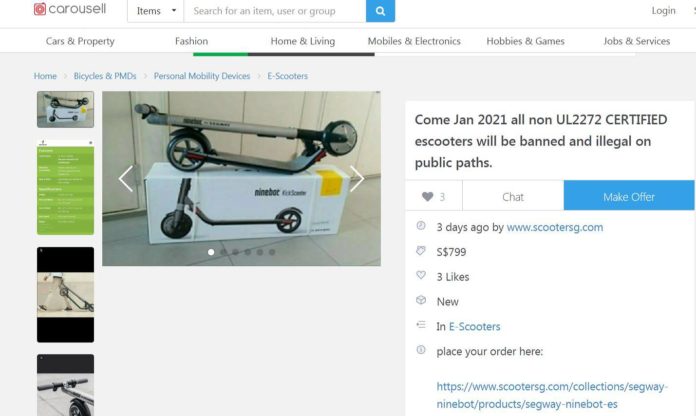
Since the new regulation was announced on Monday, scootersg has boosted its marketing for the product, posting multiple posts on its website as well as popular online marketplace Carousell, indicating prominently that the model is UL2272 certified.
Screenshot of a Carousell posting by scootersg for the Segway Ninebot ES2 model.
Scootersg is currently selling the model at S$799. Other independent sellers have posted about the same scooter as well.
Carousell user Reservevault is selling the model at S$670.
Carousell user Reservevault, who is selling the Segway Ninebot ES2 for S$670 in “brand new” condition, told Channel NewsAsia that its stock for the model has run out, and that a shipment will be delivered the following week.
OTHER MODELS HAVE BETTER SPECS: RETAILERS
One of Singapore’s largest PMD retailers, Falcon PEV, said more people have been asking about the Segway Ninebot ES2 this week. It has directed customers who have expressed concern over owning e-scooters that meet the new requirements in the long term to the Ninebot.
However, a spokesperson for Falcon PEV noted that there are many brands “with better specs which are better options for customers” – albeit not compliant with UL2272.
“Customers want a range of choices, they look at the specs – the speed of the scooter, the durability, etc. The Segway hasn’t been a popular brand for informed consumers,” said Mr Eugene Ng.
Despite the demand for the Segway Ninebot ES2, local retailer Mobot said it has no plans to stock it. The company does not sell the model currently, said its general manager Chew Boon Hur.
For customers looking to buy e-scooters, Mr Chew said he will explain to them the new LTA regulations and stress that the Mobot e-scooters they purchase now will only be usable for two years and three months.
“Consumers will make a decision based on price. They will divide the price of the e-scooter across two years and decide whether it’s worthwhile,” he said.
Mr Chew also predicted that the prices of UL2272 compliant e-scooters will surge in the coming months, and prospective buyers should be wary of buying them on impulse.
“We share with customers that there’s bound to be (an) increase in price for e-scooters (that are UL2272 compliant) because they have to pay for UL stickers and checks, and these are expensive.”
In the meantime, Mr Chew said Mobot will assess its options to get its current models, which are mostly manufactured in China, UL2272 compliant.
“The cost of getting our e-scooters UL2272-certified will be between S$50,000 and S$100,000 per model, and this will translate to higher prices for buyers,” he explained.
“Consumers will expect costs to increase, possibly by up to S$100 … But we don’t know exactly how much yet,” Mr Chew added.
SINGAPORE: Ferrari’s Kimi Raikkonen set the fastest practice time for the Singapore Grand Prix on Friday but the Finn’s team mate Sebastian Vettel suffered a frustrating start to the weekend in his bid to overhaul championship leader Lewis Hamilton.
Hamilton opened a 30-point cushion over Vettel with a surprise win in Monza two weeks ago and while Ferrari are regarded as having a superior car, the Briton set the second-fastest time of the day just 0.011 seconds back in his Mercedes.
Vettel has been criticised for dropping points due to some poor tactical driving this season but there was little he could do looking on from the Ferrari garage after his car suffered a radiator fluid leak midway through the second practice session.
Raikkonen lapped the 5.063 km Marina Bay Street Circuit in 1:38.699 seconds, with Hamilton just behind as the rejuvenated Red Bulls of Max Verstappen and Daniel Ricciardo finished third and fourth respectively half a second further back.
Red Bull’s Daniel Ricciardo during practice at the Marina Bay Street Circuit, Sep 14, 2018. (Photo: Reuters/Edgar Su)
Vettel’s troubles began during the frantic middle sector of the second session as drivers looked to set their fastest laps on the high-grip hypersoft tyres before switching to slower compounds for race simulations.
The German was on course to challenge Raikkonen and Hamilton’s best times before he clipped the wall on the final bend, causing him to abort his lap and dart into the pits with a fluid leak. He sat out the remainder of the session.
Valtteri Bottas was fifth fastest in the second Mercedes, ahead of Renault’s Carlos Sainz, Haas’ Romain Grosjean, McLaren’s Fernando Alonso and Vettel down in ninth place after completing just 12 laps.
RED BULL JOY
In the first session of the day, Red Bull enjoyed a welcome return to the top of the timesheets after a few quiet races with Ricciardo and Verstappen securing a one-two for the team in the baking afternoon heat.
Red Bull’s Max Verstappen during practice at the Marina Bay Street Circuit, Sep 14, 2018. (Photo: Reuters/Edgar Su)
The demanding 23-turn circuit has traditionally favoured the Red Bulls and Ferraris, so it was no surprise to see Vettel and Raikkonen clock the next quickest times as Mercedes opted to concentrate on long runs instead of qualifying simulations.
Ricciardo has failed to finish the last two grands prix since Formula One returned from its summer break but the Australian again showed his street circuit prowess by clocking one minute, 39.711 seconds in the scorching Singapore sun.
Dutchman Verstappen lapped in 1:39.912 to edge out Vettel by 0.085 seconds but the German will be looking for an improved third practice session and qualification on Saturday as he seeks to rein in Hamilton with seven rounds remaining.
“We can recover most of it tomorrow so we are not that worried,” Vettel told Sky Sports. “It looks like being close but we won’t really know until Sunday.”
Sauber’s Charles Leclerc continued to show the sort of form that encouraged Ferrari to sign him as Raikkonen’s replacement for next season by finishing ninth in an opening session that ended on a sour note when he crashed into a wall at Turn 13.
The 20-year-old apologised to his team on the radio as he left his car stranded in an escape road with two minutes left in the session, a sight that will disappoint his future employers, who will hope he does not make similar mistakes next season.