Maroon 5
Thursday, March 7, 2019 at 12:00 AM
Thursday, March 7, 2019 at 12:00 AM
Singapore National Stadium
1 Stadium Dr, Singapore, Singapore 397629, Singapore, Singapore
SINGAPORE: When he watched Dr Mahathir Mohamad being sworn in as prime minister of Malaysia last May, Parti Keadilan Rakyat (PKR) leader Anwar Ibrahim has admitted feeling that he should have been the one getting the appointment.
Mr Anwar, who was serving a prison sentence at the time, watched Dr Mahathir’s inauguration from a hospital ward after undergoing a surgery.
In a candid dialogue as part of the Ho Rih Hwa lecture series with hundreds of students from various Singapore schools at the Singapore Management University (SMU) on Thursday (Sep 20), Mr Anwar was asked by a student from Raffles Institution what was going through his mind when he was watching the ceremony.
Mr Anwar said: “You want me to be honest or politically correct? Politically correct, of course I rejoiced, everybody was so elated. Look, Mahathir swearing in, (signaling a) new era for Malaysia. He came up with a statement saying that once Pakatan Harapan wins, they will then submit an application to the king for immediate pardon (for Anwar).
“But I also felt that I should have been there, you know? I did, I did,” he said, waving his finger. “I do not want to lie to you, I did think about this – it should be me not you (Dr Mahathir),” he added, drawing laughter from the audience.

A student from Raffles Institution asks Anwar what was in his thoughts when he saw Dr Mahathir sworn in as Prime Minister.
Mr Anwar served as Dr Mahathir’s deputy from 1993 to 1998, but was sacked after a row with his mentor and eventually arrested and jailed on disputed charges of sodomy and corruption. He was released in 2004, but convicted and jailed again for a second time for sodomy in 2015.
Their relationship has since improved, with Dr Mahathir overseeing Mr Anwar’s release from prison, and agreeing to pass the premiership to his former protege in two years.
Mr Anwar, making his second public appearance in Singapore since his release from prison, was peppered with questions from the students, hard hitting as well as light hearted ones.
One Temasek Junior College student asked Mr Anwar what it would take for political reform to happen in Singapore and if he thought the country was ready for it.
Mr Anwar replied: “I think to be fair and more objective, the Singapore issue or problem certainly cannot be compared to the fiasco in Malaysia. Nobody talks about endemic corruption or discrimination as you see it here.
“But whether they should move on to a more vibrant, democratic reform, that’s for the Singaporeans to decide. But to compare with Malaysia, I think it is not right because we were at the stage where if … change was not affected at the last election, Malaysia would certainly go down the drain.”
Anwar Ibrahim posing for a wefie with the audience at SMU.
Mr Anwar was also asked about the recent decision by the Malaysian Cabinet to lower the voting age from 21 to 18, and the 71-year-old stressed that he was “very much for” the decision.
“I’ve gone to schools and talked to university students who are 18, they are sometimes smarter than those in their 50s. But more importantly they’re more idealistic, more principled and they hate corruption,” he said.
Mr Anwar was also asked if he would retain current Finance Minister Lim Guan Eng in his post when he is appointed prime minister – and he replied jokingly: “Make me prime minister first, we settle one at a time.”
A Malaysian student from Anglo Chinese Junior College asked about factions in his PKR party and how Mr Anwar planned to unite the two opposing camps led by Mr Azmin Ali and Mr Rafizi Ramli. The pair will also be contesting for the deputy president post in PKR’s internal elections on Saturday.
Mr Anwar, who is set to assume the PKR presidency in November, stressed that the contest for the deputy president post will not divide the party.
“The only solution is to have no contest, then I will follow the North Korean method,” he joked.
“If it’s a democracy, you must tolerate differences. You must accept the fact that there are people who are campaigning.”
“The vibrancy of the party and the democratic spirit is that they continue to enter the race, (contest to) win the elections. But it is my duty then as president to bring them together and give a suitable role for the person that has been defeated in the party elections. Because after all, this is an election among members of the family,” said Mr Anwar.
The dialogue lasted for almost two hours, with more than 20 students posing questions.
SINGAPORE: A 42-year-old Singaporean woman has been fined more than S$32,000 for failing to declare branded goods she bought overseas, the Singapore Customs said on Thursday (Sep 20).
In a media release, the Singapore Customs said Tammy Tien Mi was sentenced by the State Court to a fine of S$32,892.78 after she pleaded guilty to a charge of failing to declare taxable goods brought into Singapore.
On Jan 27, 2018, Tien arrived at Changi Airport from France. She was stopped for checks by Immigration and Checkpoints Authority (ICA) officers. When asked if she had anything to declare, Tien replied “no”.
The luxury goods discovered included handbags, shoes, coats, dresses, scarves and other accessories. (Photo: Singapore Customs)
Her four luggage bags were then put through an X-ray scanner, and images of several handbags were seen. The ICA officers referred Tien to Singapore Customs for further investigation.
After inspecting Tien’s bags, Singapore Customs officers found a total of 30 luxury goods. This included handbags, shoes, coats, dresses, scarves and other accessories worth more than S$469,890 that Tien had bought from various boutiques in France.
The total amount of Goods and Services Tax (GST) payable for the luxury goods amounted to S$32,892.78.
The luxury goods discovered included handbags, shoes, coats, dresses, scarves and other accessories. (Photo: Singapore Customs)
“It is the responsibility of all arriving travellers to make accurate and complete declaration of the dutiable and taxable items in their possession for duty and GST payment,” said Singapore Customs.
Under the Customs Act, those found guilty of failing to declare dutiable and taxable items can be fined up to S$10,000, or an amount equivalent to the tax payable, whichever is the greater amount. They may also be sentenced to jail for up to 12 months.
SINGAPORE: Apple mania is in town again. Hundreds were in line outside the Apple store along Orchard Road on Thursday afternoon (Sep 20), one day before the launch of the iPhone XS as well as XS Max.
But unlike the pushing and shoving seen last year when the iPhone X was launched, the queue this year was so far nothing short of orderly, civil and surprisingly quiet.
When Channel NewsAsia dropped by in the early afternoon, more than 400 people were patiently waiting behind a maze of barricades – some were chomping down packed lunches, while others were busy snapping selfies with friends.
Those in line were issued with numbered wristbands which indicated their place in the queue. Security personnel were also present to direct the crowd along the barricades, often instructing them to sit down.
Several men in the queue outside the Apple Store at Orchard Road. (Photo: Matthew Mohan)
According to security personnel, those in the queue are allowed to leave for one-hour meal breaks and 15-minute toilet breaks during their wait. Their wristbands are scanned when they leave and when they return to the line.
Among those in line was Le Tue Anh, a Vietnamese student studying in Singapore. Le, who had been in the queue since 2pm, said that he was part of a group paid by a store in Vietnam to purchase the new iPhones.
“I don’t have the money to buy these phones,” he explained with a laugh. “They are paying me $100 for each phone I buy.”
“The heat is no big deal here. I’ve been to outdoor camps before where it’s far worse than this. I’m more scared of the rain because I forgot to pack my umbrella.”
It started to drizzle at about 4pm for about an hour.
Those queuing outside the Apple Store at Orchard Road take shelter from the rain. (Photo: Matthew Mohan)
Sonny Khurma, a tourist from India, said he has his heart set on the iPhone XS Max.
“I’m very into Apple products and I wanted to be part of the first few in line to get my hands on it,” he said.
“If I were anywhere else, I would have queued to buy one too. It’s worth standing here to get it.”
First in line was 20-year-old Le Van Thang. “I have been queuing here since 7am this morning and I’m very happy to be the first in line,” said Le.
He is part of a group of 44 who flew in from Ho Chi Minh City and intends to purchase two iPhone XS Max phones, one for himself and another for a friend.
“My friends queue every year, but this is a first for me,” he added.
When Channel NewsAsia visited in the early afternoon, more than 400 were patiently waiting behind a maze of barricades. (Photo: Matthew Mohan)
Hundreds of people queue outside the Apple store at Orchard Road a day before the launch of new iPhones. (Photo: Matthew Mohan)
Further back in line was 22-year-old Mohamed Aseel Hussain, who had postponed his flight back to the Maldives so he could get a chance to purchase the new phones.
Armed with three powerbanks and a bottle of water, Mr Aseel, who is in Singapore for work training, intends to sell his purchases back home.
“I was already here so why not queue,” he said. “I’ll be able to cover the cost of extending my flight to tomorrow by selling the phones in the Maldives.”
The iPhone XS retails from S$1,649 and the iPhone XS Max from S$1,799.
Several men pose for a photo while they wait in line outside the Apple Store at Orchard Road on Sep 20, 2018. (Photo: Matthew Mohan)
SINGAPORE: The blackout across multiple estates in Singapore this week is a reminder that the country must continue strengthening energy resilience, Senior Parliamentary Secretary for Trade and Industry and Foreign Affairs Tan Wu Meng said while announcing initiatives to strengthen Singapore’s power systems on Thursday (Sep 20).
Speaking at the Energy Market Authority (EMA)’s Energy Innovation event, Dr Tan said that the incident brought home the importance of energy security.
“Very recently, we felt the importance of energy security and energy resilience in a very real way when electricity supply was disrupted to many Singaporean homes in the early hours of Tuesday morning,” said Dr Tan.
“I was up late that night, after meeting some of my residents. I saw the social media updates coming in around 1.30am – that was a few minutes after the blackout occurred,” he said.
“I also saw the many emails and WhatsApps from the EMA team, which were working very hard throughout the night, responding, looking into what happened.”
The authority is continuing its investigations into the incident, said Dr Tan, adding that “whatever the findings, we will learn, and we will improve”.
GRANTS TO STRENGTHEN POWER GRID
Dr Tan announced that a total of S$15 million in research grants has been awarded to seven projects with the aim to strengthen Singapore’s power grid and to improve the resilience of Singapore’s power systems and energy markets.
The projects, which were chosen by EMA after a grant call last May, are expected to be completed by 2021.
They will utilise technologies such as blockchain, data analytics and artificial intelligence.
The institutions involved in the projects include the National University of Singapore, Nanyang Technological University and Singapore University of Technology and Design.
Meanwhile, EMA and Enterprise Singapore also jointly launched a grant call for small- and medium-sized enterprises to develop solutions for optimising energy demand, as well as in solar energy deployment at home and abroad.
In a first, the Government is also extending the SkillsFuture Earn and Learn Programme to polytechnic and Institute of Technical Education graduates pursuing power engineering roles in the public sector, granting S$5,000 to each eligible individual, Dr Tan announced.
“The expansion of this programme to the public service sends a very strong signal that the Government is committed to preparing our power engineering professionals for the changes ahead,” he said.
EMA’s chief executive Ngiam Shih Chun said that although Singapore has one of the world’s most stable and reliable power systems, it cannot be taken for granted.
“Emerging trends such as distributed generation of energy and smart grids are transforming the energy sector,” he said. “The Government is therefore supporting these projects which have the potential to enhance the efficiency and reliability of our electricity and gas systems, building upon emerging trends.”
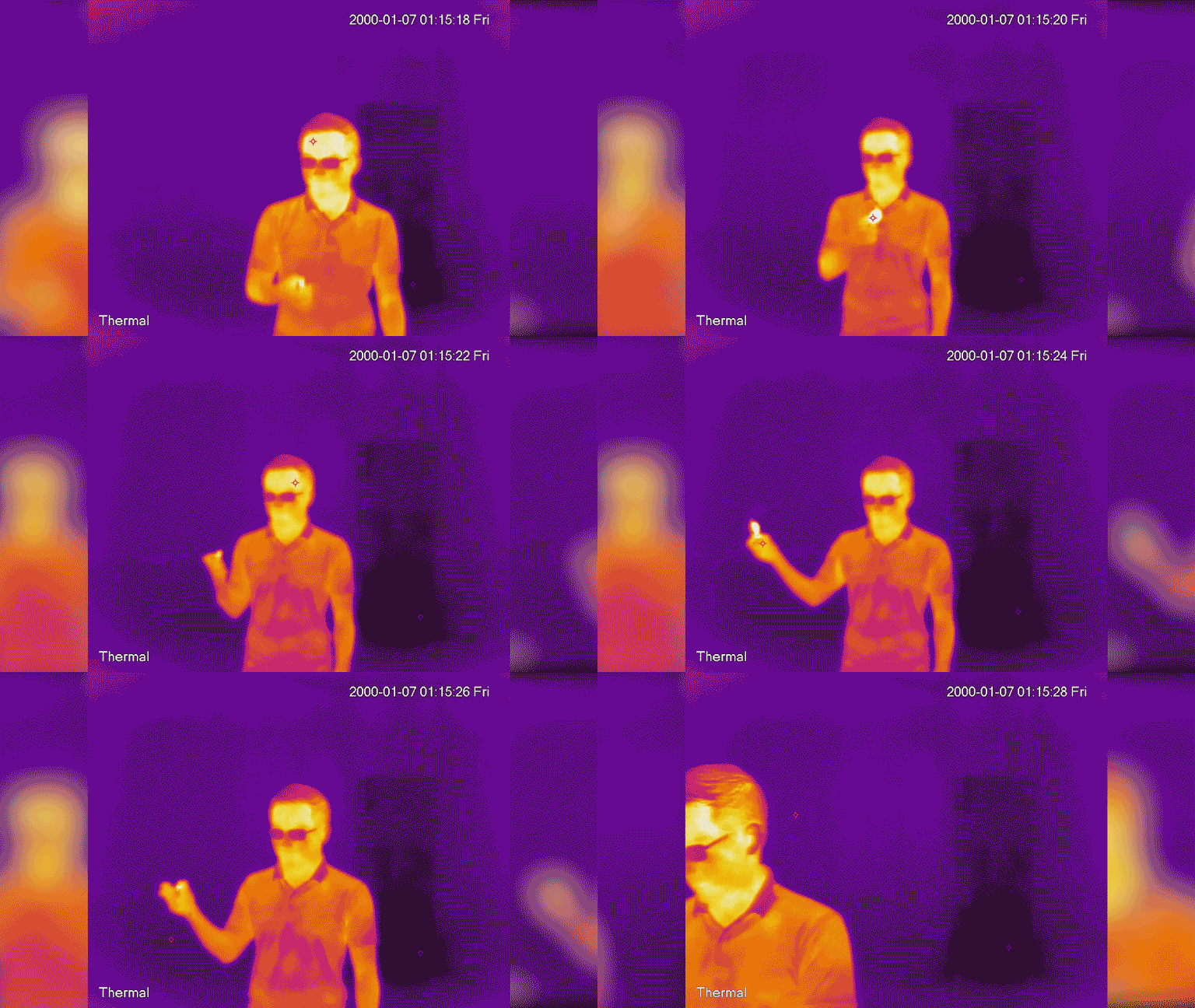
SINGAPORE: The thermal cameras that could be deployed to detect smoking in prohibited areas would likely be able to capture high definition images of your face from as far as 100m away, an industry expert said.
These pan-tilt-zoom cameras can also track offenders on the move and operate both day and night, said Mr Kenneth Tan, sales director at Transmex Systems International (TSI), a security solutions provider that deals in surveillance systems for law enforcement.
In her closing speech following a Parliamentary debate on the Smoking (Prohibition in Certain Places) (Amendment) Bill on Sep 10, Senior Minister of State for the Environment and Water Resources Amy Khor said the National Environment Agency (NEA) is exploring “the use of thermal cameras to deter indiscriminate smoking”.
“These cameras are equipped with heat-detection capabilities that can detect smoking activity and can be operated remotely,” she added. “When deployed, these cameras will be able to capture images of the smoking infringement and facilitate NEA’s investigations.”
It is unclear when the thermal cameras will be deployed. NEA has invited contractors that provide these services to submit tenders, and the agency is still evaluating the submissions, Dr Khor had said.
In response to queries, NEA said the cameras will be deployed in residential areas and other areas with “persistent feedback on smoking issues”. This includes corridors, lift lobbies and staircase landings, Dr Khor added.
“The principle is very simple,” Mr Tan said of the technology behind the thermal cameras. “The moment you have got some temperature difference, in this case the lit cigarette, the camera will highlight the area, zoom in and capture it.”
Using temperature difference as a “trigger” is also effective for detecting smoking, he said, as the heat from a cigarette “sticks out like a sore thumb” against the far cooler surroundings.
“Essentially, what they want to know is that there’s this incident and they want to capture the (offender’s) face,” he added. “It’s no use if your camera is too far away.”
In terms of range, NEA is likely to go for anything between 20m and 100m, Mr Tan said. In this range, the images captured are also clear enough for identification.
Anything farther will pose challenges in terms of the camera’s size and panning capabilities.
TSI’s surveillance system can capture anything that moves. (Photo: Aqil Haziq Mahmud)
At TSI’s showroom in Bukit Merah, Mr Tan demonstrated a similar system – triggered by movement instead of heat – that was deployed 30m above the building’s car park.
The cameras in this system managed to capture the faces of every pedestrian and motorcyclist who entered the car park, even as they were on the move.
At night, the cameras are smart enough to adjust their aperture settings to allow more ambient light to come in, Mr Tan said. “In Singapore, the street lighting is very bright,” he added.
ENFORCEMENT AND DEPLOYMENT
When it comes to enforcement, Mr Tan said it is possible to link facial recognition capabilities within the system to a national database, allowing authorities to automatically identify offenders and issue them summonses by mail.
However, Channel NewsAsia understands that images captured by the cameras will be used in tandem with other forms of evidence, like public feedback, to investigate and prosecute alleged offences.
Last year, NEA issued more than 22,000 summonses to people smoking in prohibited areas, compared with about 19,000 in 2016. Those caught smoking in a prohibited area may be fined S$200 or up to S$1,000 if convicted in court.
A smoking detection system can include facial recognition to quickly identify offenders. (Photo: Kenneth Tan)
Smoking is prohibited in an estimated 32,000 locations, including entertainment outlets, bus stops, covered walkways and building entrances.
It is also understood that the cameras will not be deployed at fixed locations, but in different areas about 140 times a year. “We can deploy (the camera) where it is needed,” Dr Khor had said in Parliament.
Mr Tan said a self-sufficient, mobile camera that comes with a mid-sized battery can last for about two days before it needs to be recharged.
“In that sense, you need to have a pool of people to do all these setting up, maintaining and dismantling,” he added.
CHALLENGES
But there are some limitations to the technology.
“Detection is very straightforward with thermal cameras,” Mr Tan said. “But if you want to recognise and capture the face, that imaging part will present challenges.”
For example, the clarity of the images will depend on weather conditions. If it was raining or foggy, the faces might not be easily recognisable, he said.
In addition, Mr Tan said the cameras might not be able to differentiate a legitimate smoking offence from, say, “some kids playing around with a lighter”.
“The system will capture these triggers, so it might still require officers to go through the footage,” he added. “But instead of having to go through 24 hours, maybe it can be condensed to half an hour.”
And then there’s the issue of privacy.
NEA said it will be mindful of this by ensuring that the cameras “focus only on the common corridors, lift lobbies or staircase landings as these are smoking prohibited areas”.
“Similar to the deployment of our high-rise littering cameras, there are strict protocols governing the viewing of the footage and only authorised NEA staff and the vendor may handle and view the video footage for official purposes,” it added.
“Footage that does not capture any smoking offences will be destroyed after three months.”
“KILL TWO BIRDS WITH ONE STONE”
Despite the concerns, Public Hygiene Council chairman Edward D’Silva welcomed the move, saying that it will reduce smoking offences and protect residents from secondhand smoke.
This method of enforcement will also “kill two birds with one stone” by reducing littering, he said, pointing out that some smokers are guilty of throwing their cigarette butts indiscriminately.
“Of course, they will find new spots to smoke, so there has to be enforcement as well as education,” he added.
SINGAPORE: Asia’s reputation as a region with one of the highest frequencies of severe weather events has again been proven right with the recent experience of Typhoon Mangkhut.
The strongest storm so far this year to hit Asia, Typhoon Mangkhut has left a devastating trail of destruction along its path. Buildings and infrastructure have been destroyed.
Lesser known but just as severe are the disastrous impact the storm may have on the livelihoods of farmers and the resulting huge losses in food production.
It made landfall in northern Luzon island, Philippines early Saturday morning but effects of its strong winds and heavy rain were felt over a wide swath of land which included the Philippines “ricebowl” area in Central Luzon, and major corn growing provinces such as Isabella and Cagayan (among top five corn growing provinces).
The typhoon’s path also included Guangdong province which is among the top ten rice-growing areas of China, and coastal waters off Southern China where there is much fish-farming.
However, the Philippines seems to have borne the brunt of this typhoon. There will be some immediate effects on food supplies in the affected areas, and some short to mid-term effects on the food security of other areas, including countries like Singapore.
SMALL FARM FAMILIES LOSE MAIN SOURCE OF INCOME, FOOD
While the local impact of typhoons may be severe on agriculture in the affected areas immediately, the livelihoods of the small farmers in these areas may experience longer term effects.
The bulk of rice farmers in Asia are smallholders who farm less than two hectares and often depend on their harvests as the main source of income and food.
Destruction of their main means of livelihood means that they are likely to go into even greater debt and have difficulty with procuring inputs to replant now or for the next season.
Torrential rains from the super typhoon flooded rice fields in the Philippines’ agricultural north (Photo: AFP/TED ALJIBE)
Rice for farming families are not just extra produce that feeds the cities and used to obtain cash for other necessities, it is also their staple food.
After the previous super typhoon Haiyan in 2013, farmers faced not just a lack of rice for food but also a lack of rice seed for planting and additionally, the lack of credit to purchase seed and other inputs.
LOW IN RICE, CORN AND FISH SUPPLIES
Apart from rice, corn and fish are food items that are most likely to have supplies affected in the short term because of Typhoon Mangkhut.
The Philippines has reportedly lost over 250,000 tonnes of paddy rice – that’s about 62,500 hectares, assuming an average yield per hectare is four tonnes.
Heavy rainfall and strong winds would also have meant that wild-caught fish may show a temporary shortage as fishermen have been unable to go into fishing waters. And even for those who were able to, fish landings and ports along the typhoon’s path were mostly closed.
Meanwhile, China, where most fish consumed are from fish farms rather than wild catches, has not reported the extent of loss. But it can be expected that floating sea cages along the coasts of Southern China would suffer dislodgement or fish escapes.
Heavy rain likewise could damage inland ponded farms.
SINGAPORE’S FOOD SUPPLY MAY BE TEMPORARILY REDUCED
Singapore is an overwhelmingly food importing country although with its over 5 million population, its demand for rice, corn or fish pales in comparison to its neighbours.
As a country that diversifies its imports from over 160 countries, it has inherent buffer capacity in the event of calamity in one geographic region.
Shoppers at a supermarket in Singapore (Photo: Ruyi Wong)
Countries in the typhoon belt and the monsoon belt in Asia can export only when they have surplus production. If severe weather events or changed weather patterns affect their production capacity, or the production in other importing countries, Singapore ends up competing with them for any stock left for trade.
For example, China, the world’s largest producer of rice, can take up all the available rice traded in the world, estimated at around 15 million tonnes, since it has lifted its import ceiling on staples.
Singapore may see a temporary reduction in the supply of food items like wild-caught fish or an increase in its food price index as a result of weather-induced effects elsewhere, but in a worst-case scenario, this is unlikely to last long.
The caveat, of course, is if global stocks are reduced due to simultaneous or consecutive events like a series of mega-typhoons closely following each other – let’s not forget the typhoon season this year is not yet over.
Singaporeans generally are fortunate that the average household expenditure on food is relatively low when compared to our neighbouring countries, partly because there are no tariffs on food in Singapore and average incomes are relatively high when compared to the cost of food.
This is not to say though that all Singaporeans are immune from food price hikes as there are members in the community who will feel the pinch.
A much bigger danger is presented when climate change simultaneously affects shipments of the same food items from our source countries. And this is not improbable.
CLIMATE-PROOFING FARMING NEEDS TO BE TAKEN SERIOUSLY
So what can net food exporters and net food importers do to deal with climate change-related extreme weather?
Waves slam the seawall as Typhoon Mangkhut continues to batter the Philippines. (Photo: AP)
Experts in the region have proposed many approaches, which include building infrastructure to minimise damage from extreme weather, developing and growing climate-adapted crop varieties and animal breeds, importing from geographically spread-out countries, and investing in countries to help them produce more.
It is ironic that while one solution may sound simple – which is to protect farming against climate-related risks and the technology is already available – countries in general have not taken up the challenge seriously.
Flood-tolerant and drought-tolerant crop traits are not new but currently limited only to a few crops.
Delayed ripening and delayed ageing technology has been available for years to keep vegetables and fruits fresh much longer without refrigeration. And close to home, technology for indoor, controlled-environment “plant factories” to grow fresh vegetables is only just starting to take off.
Major cities in the US like Boston and New York, and likewise cities in Japan and China have numerous such plant factories which supply vegetables year round and are located close to the majority of consumers.
While the investment community is beginning to catch up with the potential of climate-proof urban farming, government policies and regulations in general are still slow to respond.
Perhaps this is one area where courage can be demonstrated again by policymakers to take Singapore another step forward in becoming an exemplary city of the future.
Paul Teng is Adjunct Senior Fellow (Food Security) in the S Rajaratnam School of International Studies, Nanyang Technological University in Singapore and concurrently Adjunct Professor, Murdoch University Australia.
He previously held leadership positions at the Worldfish Centre and the International Rice Research Institute, two international organisations located in Southeast Asia under the auspices of the Consultative Group on International Agricultural Research.
SINGAPORE: Flash floods were reported in Ang Mo Kio on Wednesday evening (Sep 19) amid heavy rain over parts of Singapore.
National water agency PUB warned at 5.47pm of a flash flood at Ang Mo Kio Avenue 6 from Ang Mo Kio Avenue 8 to Avenue 9. Motorists were advised to drive carefully.
PUB subsequently said that the flash floods have subsided in an update at 5.55pm.
Senior business development manager Gary Haris told Channel NewsAsia that the flash floods also occurred at Ang Mo Kio Avenue 4 and Avenue 5.
A video taken by him shows pedestrians at a sheltered walkway in ankle-deep water.
The 44-year-old said that the flash floods began around 6pm, adding that the water “rushed down like a waterfall” at the staircase leading to a car park.
A Channel NewsAsia reader who did not want to be named said that the market and food centre at Block 628 Ang Mo Kio was affected by the flash floods as well, with waters ankle-deep.
Cars and motorcycles were also partially submerged in muddy waters at the car park next to the market.
Motorcycles parked at the car park beside Ang Mo Kio 628 Market and Food Centre were partially submerged in muddy waters. (Photo: Channel NewsAsia reader)
A video on Facebook page Singapore Road Accident shows vehicles with their wheels partially submerged at a traffic junction.
Another video that was circulated online shows a car that stalled in the middle of the road, part of its wheels also in water, at Ang Mo Kio Avenue 6.
Screengrab from a video circulating online which shows a car stalled in flood water in Ang Mo Kio.
Bus operator SBS Transit said in a tweet at 5.55pm that several bus services had to skip the bus stop opposite Yio Chu Kang station along Ang Mo Kio Avenue 6 due to the flash floods.
The services have since returned to normal.
Were you affected by the flash floods? Send us your photos and videos through Facebook Messenger or our WhatsApp hotline at +65 8218 8281.
SINGAPORE: It has become “very fashionable” for young adults in Singapore not to own or drive a car, said Mr Sitoh Yih Pin, a member of Singapore’s Land Transport Master Plan (LTMP) advisory panel, on Wednesday (Sep 19).
Speaking to reporters on the sidelines of the launch of a public engagement exercise for the next LTMP, Mr Sitoh also said that many Singaporeans have adopted the concept of a car-lite society and the Walk Cycle Ride way of travel into their lives.
Mr Sitoh – along with 14 other representatives in the panel – were appointed by the Land Transport Authority to consider the public’s views, deliberate on various issues, and make recommendations for LTMP 2040 in early 2019.
“Any transport system in any part of the world must be greater than the sum of its parts. If you look at what we announced today, it’s not just about creating or building a seamless transport system. It’s actually about creating a better life for our residents, for our citizens, for our people,” said Mr Sitoh, who is also the Member of Parliament for Potong Pasir SMC.
“When you talk to the young, it appears to me it is becoming very fashionable not to drive so much, maybe not to even own a car, and to take public transport more, to take the trains more and to take the buses more, even to walk and to cycle,” he added.
Mr Sitoh also reasoned that the land space freed up by fewer cars on the road could be used to improve alternative travel options for Singaporeans even further.
“If we drive less, we don’t have so many roads, so many cars, then maybe the limited land space in Singapore may be used for more walkways, more cycling paths and … we can have more greenery, more trees,” he said.
Senior Minister of State for Transport Janil Puthucheary, who chairs the panel, said that LTA has collected feedback from 1,000 commuters through electronic polls.
But Dr Puthucheary stressed that there are trade-offs to consider.
“There’s a balance between all the different interests and the views from the different stakeholders. How do we deal with those issues? What we are going to do is to start focus group discussions beginning in October 2018. The insights we get from this will go on to inform the advisory panel to what LTMP 2040 does, looking at all the information before coming up with some kind of recommendation,” he said.
To kick-start the process, Dr Puthucheary explained that LTA has put together a public consultation document, which frames the issues as the government sees them. But he maintained that authorities want to find out what the public thinks.
Fellow member of the LTMP advisory panel, Ms K Thanaletchimi also stressed the importance of feedback from commuters.
Member of Singapore’s land transport master plan (LTMP) advisory panel K Thanaletchimi speaks to reporters.
“We have received a lot feedback, (such as how) travelling becomes a one-hour journey in small Singapore, and it leads to less time spent with the family, and all these feedback are equally important,” she said.
“So firstly we have to engage the people there … understand their perspectives, understand their problems and find plausible solutions that are all rounded that can meet the expectations of our people,” she added.
Ms Thanaletchimi, who is a Nominated Member of Parliament, also stressed the importance of having a public transport that is inclusive.
“It has to be inclusive. Inclusive means regardless of gender, regardless of age and regardless of persons with disability. So even the visually impaired should be freely travelling on public transport – that is the ultimate (goal),” she said.


