SINGAPORE: Engineers started fixing the track point fault that caused delays along the East-West Line (EWL) on Wednesday morning (Sep 19) only after the peak travel period ended, said SMRT.
This was so that train services could continue running, albeit at a slower speed, the transport operator explained.
“The plan was to keep train services moving during the morning peak with the aim of fixing the fault after the peak period,” said SMRT in an update.
“This would allow EWL commuters to travel from Jurong East towards the city, and commuters to travel from the city to the interchange station at Jurong East.”
Commuters at Jurong East MRT station affected by delays due to a track fault at Clementi. (PHOTO: Arul)
Giving a timeline of events, SMRT said the fault was detected at 7am between Jurong East and Clementi MRT stations, which are consecutive stations on the EWL.
“After the fault was detected, train services between both stations were stopped for about 30 minutes to allow our staff to go onto the track to check a faulty point machine, which is used to control train movements at rail junctions when trains move from one track to another.
“Our staff inspected the point machine and assessed that train operations could continue but at a slower speed,” said SMRT.
Train services resumed at about 7.40am and as a precaution, trains travelled at a reduced speed while passing the track point.
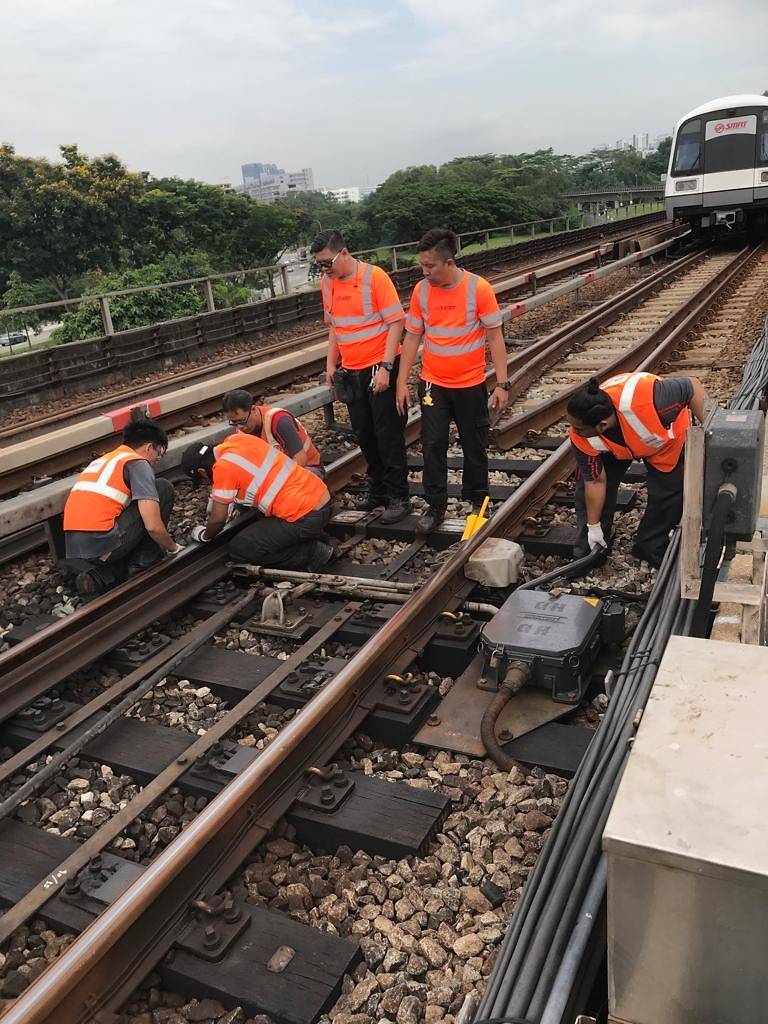
After the morning peak period, engineers went down to the track in between service and fixed the point machine at 1.20pm, said SMRT.
“This arrangement required EWL trains at Jurong East and Clementi to halt temporarily for up to five minutes every time the engineering staff went on track to carry out repair work. The team accessed the track six times,” it explained.
SMRT engineering staff working to rectify the faulty point machine near Clementi MRT station. (Photo: SMRT)
Large crowds were seen at the affected MRT stations during the morning rush hour, with commuters told to expect delays of 40 minutes at one point.
SMRT said that while the fault was being fixed, efforts were made to ease the congestion. Four trains were sent to pick up commuters travelling towards the city from Jurong East and another two trains to Clementi to serve those travelling towards the city.
It added that more of its employees were deployed to manage the peak hour crowds at EWL stations.
“We apologise to everyone affected by this morning’s disruptions,” said SMRT.
SINGAPORE: Channel NewsAsia has launched CNAlifestyle.com – a new lifestyle portal targeted at professionals, managers, executives and businessmen (PMEBs).
The portal and its Facebook page will focus on the latest in food, travel, fashion and what’s trending on the lifestyle landscape in Singapore and across Asia.
The multimedia content on the site will eventually appear on Mediacorp’s television and radio programmes.
Phin Wong, Supervising Editor of CNA Lifestyle, said: “Lifestyle categories such as entertainment, dining and wellness consistently rank among the Top 10 areas of interest of CNA’s audience.
“With the added introduction of fashion, beauty and luxury content, supported by offline engagement via specially curated experiences, it is our hope that CNA Lifestyle will be the first stop and go-to destination for these busy professionals.”
From left: Khoo Bee Khim, Deputy Editor; Mayo Martin (standing), Deputy Editor; Aaron De Silva (seated), Luxury Editor; Genevieve Loh, Senior Journalist; Karen Chng, Associate Art Director; Teng Chern Ling (standing), Senior Art Director; May Seah (seated), Senior Journalist; Shamala Rajendran(seated), Senior Editor; Serene Seow (standing), Style Editor; Phin Wong, Supervising Editor.
To deliver on these ambitions, CNA has assembled an experienced team of editors to steer CNA Lifestyle.
It is led by Supervising Editor Wong whose career spans over 20 years in media and lifestyle content creation, including stints at 8 Days and TODAY.
The Style Editor is Serene Seow who moves from ELLE Singapore, having previously been at L’Officiel Singapore and Female.
Aaron De Silva, previously from Robb Report Singapore and Men’s Folio, is the Luxury Editor overseeing content on the finer things in life.
The team also includes familiar names responsible for Mediacorp’s lifestyle content over the years, like Genevieve Loh, Mayo Martin, May Seah and Khim Khoo.
CNA Lifestyle promises to be a highly sought-after destination for advertisers looking to target consumers who want to live the good life.
Even before the dedicated portal was launched on Wednesday, lifestyle content on CNA’s digital platforms already attracted an average of 2.5 million page views and more than 1 million unique visitors per month.
Mediacorp Editor-in-Chief Walter Fernandez said: “Over the years, CNA has built a solid reputation for the breadth and depth of its political and business news coverage across Asia. Tapping on its unparalleled reach in Singapore and across the region, the newsroom is now turning its attention to delivering high quality and engaging lifestyle content with the same passion and professionalism.”
SINGAPORE: A fraudulent website is using fabricated comments attributed to Deputy Prime Minister Tharman Shanmugaratnam to solicit investments in bitcoins, the Monetary Authority of Singapore (MAS) warned on Tuesday (Sep 18).
A screenshot of the website, released by MAS late on Tuesday, shows an article with the headline “Tharman Shanmugaratnam Invests $1 Billion for All Singapore Resident. USE HIS Method To Become Rich in Just 7 Days!”.
The article, which was accompanied by a photo of Mr Tharman, describes the MAS chairman as a “venture capitalist” who announced Singapore’s entry into the bitcoin cryptocurrency market.
The site then asks readers to sign up for a bitcoin account and requests for credit card or bank account details.
A screenshot of another article on the fraudulent website. (Photo: Monetary Authority of Singapore)
“The website’s article on bitcoins is highly deceptive and misleading,” MAS said. “The statements attributed to DPM Tharman are completely false, apart from his observation that trading volumes in cryptocurrency are low in Singapore.”
MAS advised the public to “exercise extreme caution” and avoid providing any financial or personal information on the forms linked from the website.
“Putting money in cryptocurrencies such as bitcoins is highly risky,” warned MAS. “MAS had issued an advisory on 19 December 2017 to warn the public of the risks of cryptocurrency investments.
“DPM Tharman had in fact stated in a reply to a Parliamentary Question on 5 February 2018 that Singaporeans ‘could lose their shirts when they invest money in cryptocurrencies’.”
MAS added that members of the public who suspect that an investment could be fraudulent or misused for other unlawful activities should to report such cases to the Police.
SINGAPORE: A revamped SG Mobility Gallery that showcases Singapore’s land transport system was launched by Prime Minister Lee Hsien Loong on Wednesday (Sep 19).
The gallery, which is spread over an area of 1,000 sq m at the Land Transport Authority (LTA) office at Hampshire Road, features seven exhibition zones that showcase various facets of Singapore’s land transport system.
According to LTA, the gallery gives a behind-the-scenes look at how it plans, designs and builds our transport system “while balancing efficiency, liveability and inclusivity as it leverages technology for smarter urban mobility”.
Prime Minister Lee Hsien Loong at the opening of the Land Transport Authority’s SG Mobility Gallery. (Photo: Amir Yusof)
Visitors can take part in interactive activities, such as taking on the role of a transport planner and trying their hands at planning an efficient and sustainable transport network through multi-sensory exhibits.
Also part of the exhibition is a 270-degree theatre which provides a panoramic view into the work that goes on behind the scenes in running Singapore’s land transport system.
“Through augmented reality, visitors get a glimpse into how public transport workers such as rail engineers and bus technicians use technology in their work,” LTA said.
Another feature is a life-sized hands-free fare gate, currently being trialled at selected MRT stations, which enables commuters to enter and exit the train stations without the need to tap their fare cards.
The exhibition will also host LTA’s flagship knackstop shop, where visitors can purchase merchandise inspired by Singapore’s public transport system.
Net sales proceeds from the store go to the LTA Cares Fund, a fund dedicated to the transport needs of the disadvantaged.
The exhibition is open from Mondays to Fridays, from 9.30am until 5pm. Admission is free.
SINGAPORE:Members of the public can now share their views on the next Land Transport Master Plan (LTMP) after a public engagement exercise was launched on Wednesday (Sep 19) by Senior Minister of State for Transport Janil Puthucheary.
A public consultation document was also released.
Over the next few months, the public, along with transport industry players and other stakeholders, can provide feedback on the future of Singapore’s land transport system through the consultation document, electronic polls as well as focus group discussions.
“These serve as starting points for LTA’s conversation with Singaporeans about the future of our land transport system for 2040 and beyond,” said the Land Transport Authority (LTA).
LTA has also appointed an LTMP advisory panel, chaired by SMS Puthucheary, with 14 other representatives drawn from “diverse backgrounds”.
“The Panel will consider the views gathered through the public engagements, deliberate on the various issues, and surface their recommendations in early 2019. These recommendations will be incorporated into LTA’s vision, policies and targets for LTMP 2040,” LTA said.
According to LTA, the document outlines three broad themes which will serve as starting points for discussion – making Walk Cycle Ride (WCR) the preferred way to travel, an easier and more inclusive WCR experience as well as a land transport system that improves quality of life.
On the first theme, LTA said that members of the public will be invited to share how the Government should balance between the different WCR priorities such as comfort, choice and speed, as well as how WCR can be made more attractive for users.
On the second theme, LTA said it is looking for views on how Singapore’s land transport system can better help those who face difficulties under WCR.
On the third theme, LTA added that it wants suggestions on how to create “a safer land transport system that also enhances liveability through stronger communities, better health and a cleaner environment”.
These pictures show the same area before (left) and after (right) LTA worked with Fajar Secondary School to close a six-metre gap between an existing sheltered walkway and the sheltered school gate. (Photos: LTA)
The launch was witnessed by Prime Minister Lee Hsien Loong, who was also present for the opening of LTA’s SG Mobility Gallery as well as a ceremony to mark the completion of LTA’s Walk2Ride programme, a milestone from the previous LTMP.
PUBLIC TRANSPORT REMAINS KEY: LTA
At the launch, LTA added that it has made “significant investments” to improve Singapore’s public transport system, which it said continues to be a key piece in the blueprint to reinvent the city, affirming its vision for a people-centred land transport system.
“We promised more connections, better service and a transport system that supports a liveable and inclusive community,” it said.
LTA added that based on a recently released 2016 Household Interview Travel Survey (HITS), it is on track to achieve some of the 2030 targets set in the previous LTMP.
This includes, eight in 10 households living within 10 minutes’ walk of a train station; 85 per cent of public transport journeys under 20km being completed within 60 minutes; and 75 per cent of all journeys during peak hours being undertaken on public transport.
SINGAPORE: Lift technicians in Singapore can expect better pay as the Government accepts recommendations made by the Lift and Escalator Sectoral Tripartite Committee (STC) on Wednesday (Sept 19).
The recommendations include mandating the progressive wage model (PWM), a wage ladder which helps workers grow their salaries as they acquire skills and improve productivity.
The PWM has been implemented for workers in the cleaning, security and landscaping sectors, making lift technicians the fourth group of workers to come under the wage ladder.
Minister of State for National Development and Manpower Zaqy Mohamad said the recommendations provide a useful roadmap in attracting, developing and retaining locals in the lift industry.
“If we do this well, it will translate into safer and more reliable lifts for all of us,” Mr Zaqy said.
“For a start, the Government will take the lead in supporting the Progressive Wage Model for the lift industry,” he added.
Along with the PWM, the committee has proposed a higher basic wage range for all levels of lift maintenance personnel to attract and retain a core Singapore resident workforce. This can also keep the sector competitive with other sectors requiring comparable technical skills.
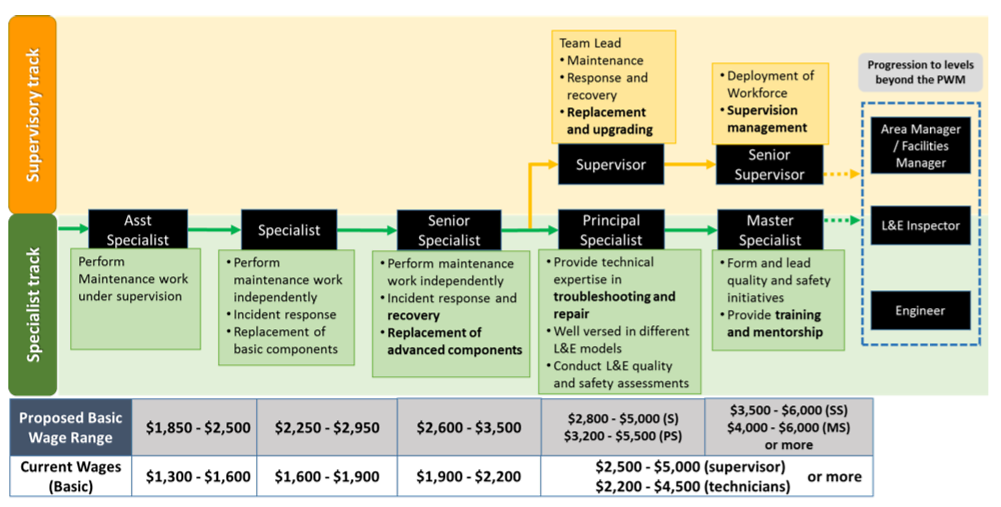
For example, the current monthly basic wage for an entry-level lift mechanic is between S$1,300 and S$1,600. The recommendations called for this to be adjusted to between S$1,850 and S$2,500.
“One of the concerns of the lift companies is whether or not the service buyers will pay more for their lift maintenance contracts. That is also why the STC is recommending that the PWM (be) a mandatory one … so that it will level the playing field for all the lift companies in Singapore,” said NTUC assistant secretary-general Melvin Yong, who is also co-chairman of the STC.
CLEARER CAREER PROGRESSION TRACKS
Currently, there are about 2,100 lift technicians servicing 67,000 lifts islandwide.
Of them, 42 per cent are Singapore residents. About half of them are above 50 years old and are expected to retire within the next 10 to 15 years, the committee said.
To tackle the aging and shrinking industry, the committee said it wants clearer career progression pathways pegged to the PWM to attract more Singapore residents to join the sector.
As the number of lifts continues to increase, we project that we will need about 3,000 lift technicians over the next three years,” Mr Yong said.
Now, mechanics can be promoted to technicians followed by senior technicians. After that, senior technicians can be promoted to a supervisory role with lesser involvement in site-based work.
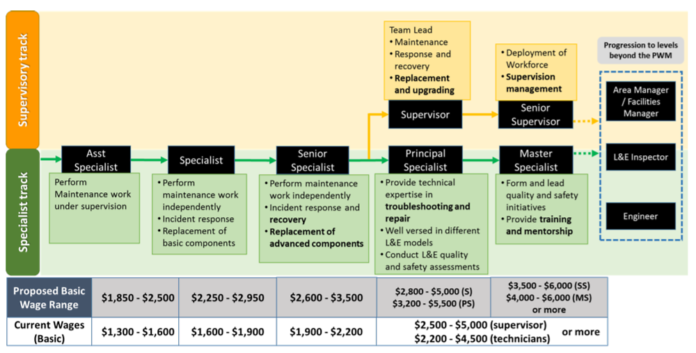
Under the recommendations put forth by the committee for lift technicians, more job roles will be created to build supervisory and technical capabilities of the lift industry. (Diagram: Lift and Escalator Sectoral Tripartite Committee)
However, those who want to stay in a technical role have little room for progression. Hence, the committee proposed an additional specialist track along with a supervisory track.
Those in the supervisory track will get to build up their management skills while those in the specialist track will get to deepen their technical skillsets.
UPSKILLING THE WORKFORCE
Currently, the Institute for Technical Education’s NITEC in Facility Technology (Vertical Transportation) is the only lift-specific qualification available in Singapore. There is also no standardised minimum requirement such as qualifications, training or certification for existing lift maintenance personnel at the rank-and-file level, the committee said.
While lift firms provide in-house training through on-the-job-training, there is also no standardised approach or curriculum across the industry.
To address this, the committee recommended a training and certification framework aligned with the proposed PWM to ensure that all maintenance personnel is equipped with the key skills required.
It also recommended the creation of training courses to cater to fresh graduates without related qualifications and mid-career switchers through bridging courses and certification.
BCA is also working closely with ITE to develop training courses, assessments, and certificates aligned with the career progression pathways of the PWM. (Photo: Cheryl Goh)
For existing personnel, the committee is pushing for lift firms to conduct their own appraisals to place maintenance personnel at the appropriate levels based on the PWM. All personnel have to attain at least Specialist level competency under the PWM.
ITE and the Building Construction Authority (BCA) have agreed to develop training courses, assessments, and certificates to catered to varying competencies of lift personnel.
USING TECHNOLOGY TO ENHANCE WORK
To cope with the manpower shortage and an expected increase in manpower cost, the committee said that the industry should look into technology that can help enhance efficiency and reduce manpower reliance.
One such example is the use of remote monitoring and diagnostics.
Currently, lift technicians must perform at least one routine check every month on a lift. It takes 45 minutes to 2 hours to shut down a lift and test its condition.
With remote monitoring, maintenance personnel can use sensors to check on lifts during off-peak periods without making the trip to the lifts. The data collected from sensors can also be used to pre-empt lift malfunctions or parts failure.
The committee also asked for an improvement in working conditions to make the industry a more attractive one.
“Today in the lift shafts, it’s dark and we need to also improve the ventilation. These are the conditions that the tripartite partners are also working very closely (on). A task force has also been set up and we hope that we hope that we will have some recommendations soon,” Mr Yong said.
Lift technicians will also see a renaming of their job titles to reflect the skills acquired as they progress up the ladder and to improve public perception. Entry-level mechanics will become assistant specialists, for example.
The implementation of the PWM will be phased over three years to give the industry sufficient time to adjust.
The ASEAN-Singapore Cybersecurity Centre of Excellence will deliver virtual cyber defence training and exercises for all ASEAN member states, among other things.
A computer keyboard lit by a displayed cyber code is seen in this illustration picture taken on March 1, 2017. REUTERS/Kacper Pempel/Illustration
(Updated: )
Bookmark
SINGAPORE: Singapore will be pumping in S$30 million over the next five years to fully fund the upcoming ASEAN-Singapore Cybersecurity Centre of Excellence (ASCCE), which is meant to help develop the cybersecurity capabilities of Southeast Asian member states.
A factsheet by the Ministry of Communications and Information (MCI) released on Wednesday (Sep 19), said the ASCCE will fulfill three principal functions:
Cyber think-tank and training centre To conduct research and provide training in areas spanning international law, cyber strategy, cyber conflict, legislation, cyber norms and other cybersecurity policy issues
Computer Emergency Response Team (CERT) centre To provide CERT-related training as well as facilitate the exchange of cyber threat and attack-related information and best practices
Cyber range training centre To deliver virtual cyber defence training and exercises for all ASEAN member states
The factsheet also said ASEAN member states and dialogue partners are welcome to contribute to the budget or to specific ASCCE programmes and workshops by either co-funding or sending trainers.
In his speech at the ASEAN Ministerial Conference on Cybersecurity on Wednesday, Minister-in-charge of Cyber Security S Iswaran said the centre will be launched next year as an extension of the ASEAN Cyber Capacity Programme.
He added that the centre was scoped to cover policy, strategy and legislation as well as operations to reflect the government’s conviction in the importance of aligning cyber diplomacy efforts with operational issues.
Mr Iswaran also said Australia, Canada, South Korea, New Zealand, the European Union, United Kingdom and the United States have “indicated keen interest” to work with Singapore to develop and deliver programmes under the ASCCE.
The factsheet said the targeted launch date is in the second quarter of next year, and an international advisory panel comprising senior representatives from key partner countries and international organisations will be convened to provide advice on the proposed programmes.
Additionally, an international programme committee will help develop the training curriculum and develop metrics to identify training needs and measure the programme’s effectiveness, it said.
SINGAPORE: A track fault at Clementi caused delays along the East-West Line on Wednesday (Sep 19) morning.
The track fault occurred at about 7am between Clementi and Jurong East MRT stations, rail operator SMRT said in a post at 8.39am on Facebook.
Train services between the two stations had to be stopped to allow staff to go onto the track to check on the fault, it added.
“Our engineers are on site doing their best to rectify the fault. Train services have progressively resumed,” SMRT said.
“Due to slow train movements, please cater for additional 40 minutes of train travel time. We are sorry your morning commute has been affected.”
At 8.15am, SMRT advised commuters to add 40 minutes travelling time between Boon Lay and Queenstown.
[EWL] UPDATE: Our staff is rectifying the fault, train service on the EWL is available. However, please add 40 mins travelling time between #BoonLay and #Queenstown. Free regular bus and bridging bus svc are available between #BoonLay and #Queenstown.
At 7.10am, SMRT tweeted to inform commuters that train service between Jurong East and Clementi would be delayed by 30 minutes.
Commuters at Jurong East MRT station affected by delays due to a track fault at Clementi. (PHOTO: Arul)
A few minutes later, it tweeted to add that free bus bridging services were available from Queenstown to Boon Lay.
Commuters at Jurong East MRT station affected by delays due to a track fault at Clementi. (PHOTO: Arul)
At 7.40am, the rail operator informed commuters to add 30 minutes travelling time between Queenstown and Boon Lay.
[EWL] UPDATE: Our staff is rectifying the fault, train service on the EWL is available. However, please add 30 mins travelling time btwn #BoonLay and #Queenstown. Free regular bus and bridging bus svc are available btwn #BoonLay and #Queenstown.
SINGAPORE: Imagine hopping in a helicopter for a short flight within Singapore, arriving at your destination in a fraction of the time it would take by road.
That is the vision that manufacturer Bell Helicopter has for its electric flying taxis, a concept it unveiled earlier this year at CES, formerly called the Consumer Electronics Show, in Las Vegas.
With its latest and most lightweight chopper, the highly manoeuvrable Bell 505, said to have been well-received in Asia since the aircraft’s entry into the region this year, the company sees the potential for urban air taxis, especially in Southeast Asia.
“Obviously, traffic here (in Singapore) isn’t as bad as in Jakarta or Bangkok, or Delhi for that matter, but I think there’s still a demand,” said Bell Helicopter Asia general manager Chris Schaefer.
“The market in Singapore would respond favourably to an air taxi service.”
The prototype of the cabin for Bell Helicopter’s air taxi.
A company called Whitesky Aviation has been doing just that in Indonesia since last December, with its Helicity flights in and out of Jakarta and around the capital, using Bell’s helicopters.
Describing it as “interesting business model”, Mr Schaefer told the programme Money Mind, in an episode on future business innovations, that Bell plans to launch its own urban air taxi by 2025.
The goal is for such helicopters to have an electric propulsion system, instead of conventional turbines. The company is now taking “incremental steps towards that”, starting with a hybrid gas-electric engine.
Bell also wants its air taxis to be pilotless. “That’ll be an evolution as well. So for now, we’re looking at autonomous technologies that aid conventional pilots, and we’ll work towards that full autonomy of flight,” said Mr Schaefer.
Money Mind’s Jonathan Peeris (left) took to the skies to see for himself Bell Helicopter’s vision for its urban flying taxis.
HELICOPTERS AT MRT STATIONS?
The way the on-demand air taxis work in Indonesia – using an app “a lot like Grab” – is an example of how “user-friendly” such a service can be, he highlighted.
“You’d enter the details of your account, and they’d send you an email on where you can be picked up and when,” he explained, adding that Bell
But could a system like that work in Singapore? Mr Schaefer admitted that the “biggest constraint is the regulatory environment” – how Singapore’s air space is managed. But Bell is undeterred.
“We want to work with the regulators as the technology develops, as it becomes more proven. And we’ve done some testing in some other areas,” he said.
“We look forward to working with the Singapore government on solutions that would make sense for this market.”
Some examples of possible route locations would include the airports, hotels and hospitals – “pretty conventional routes that would be easily established”. But he reckoned that MRT stations, too, could be “core” locations as such a service expands.
“We’d be able to pick you up not necessarily right at your door, but maybe at a station close by,” he said, promising that it would not be only for the rich, given the way the technology is developing.
Bell Helicopter Asia general manager Chris Schaefer speaks to Mr Peeris.
“If we get the economies of scale up, it needs to be at a price point where most public users will see it as accessible,” he shared.
“It’s still early days, but we’re looking at price points similar to what you’d see for a Grab limo service, or a Grab elite service – those premium services on the ride-sharing apps that you’d be familiar with today.”
Nonetheless, he noted that Singapore has many high net worth individuals who could “use the convenience of quick transportation around the island”. “So I think there’s a market for some corporate and private travel as well,” he added.
PLANS FOR THE REGION
For now, the Republic remains a technical hub for the American company’s maintenance, repair and overhaul work in the region, and “the central place” for its sales and marketing teams.
Mr Schaefer said technology has been taking leaps and bounds forward towards an autonomous air service,
“Singapore’s a fantastic place to get in and out of, so we can get a lot of penetration into the greater Asia area,” said Mr Schaefer, adding that Bell’s regional footprint is “quite extensive already”, with numerous customer service facilities.
As it continues to evaluate where those facilities are required, however, one place in particular where it is hoping to make deeper inroads is China – “definitely an emerging market that everybody’s watching carefully”.
“It’s set to develop very quickly,” he said. “Over the last couple of years, we’ve seen that bear out with a substantial number of orders coming from the Chinese market.
“As they develop their market, they’re going to go through those growing pains. A lot of emerging markets do. So the aftermarket support – the maiden side of their business – is going to require some additional due care.”
That is where Bell’s six-year-old facility in the Seletar Aerospace Park and its “mass capabilities” will help to support the Chinese market as it grows, he added.
In June, the first three Bell 505 helicopters were delivered to China, part of “exceptional uptake” of the aircraft in Asia so far. Mr Schaefer is not surprised. “The Asian market is generally an early adopter of new technologies,” he said.
In a few years, he will be hoping for the same response to the company’s electric flying taxis.
New episodes of Money Mind air every Saturday at 10.30pm.
The company’s latest and most lightweight chopper, the Bell 505 Jet Ranger X.