SINGAPORE: Companies are paying billions of dollars for fines and damages caused by cyberattacks. The number of breached records is skyrocketing and regulators around the world are tightening laws and penalising negligence, with minimal tolerance for laxity.
Cyberattacks and cybercrime are very real, and they happen every day.
We have observed that companies and organisations in Singapore whose operations rely heavily on digital forms of communications or payments are readily invested in cybersecurity capabilities with monitoring services and attack-detection capabilities.
However, other companies whose operations are less digitally reliant tend to take a reactive stance towards cybersecurity; remedial action is only taken after a breach, a significant close-call or if their competitor gets hacked and jailed.
This is where the danger lies.
Regardless of the nature of any business, the reality is that day-to-day communications today all take place online, making any organisation with any form of electronic communications susceptible to data breaches.
RETHINKING CYBERSECURITY
It is easy to assume that the management of cyber risks is the responsibility of the IT department, with the more sophisticated the system, the higher the level of security. But no technical solution will solve the current state of affairs.
It has been found that more than 80 per cent of cyberattacks against organisations actually occur through targeted employees, often through phishing email attacks and the reuse of leaked passwords.
While most of us know by now not to click on links and files sent through suspicious-looking emails, the reality is that with an average of more than 90 accounts per Internet user, there is a high likelihood that one of these services are likely to be breached.
As a result, all the user passwords of that breached service become the entry point for hackers to access other systems. This is how most hacks begin. Whether or not that access leads directly to the organisation’s core system doesn’t matter as hackers are increasingly targeting social media profiles.
A hacker may, for example, log in to an employee’s LinkedIn profile and send a message with a link or attachment to someone else he is chatting with. Disguised as a message from a trusted party, that person opens the link and access is granted.
PASSWORD PROBLEMS
Sadly, many organisations today still practise sharing key account passwords within the team. This practice is often a catalyst for immediate security failure when those passwords are leaked.
For example, several people within the finance, accounting and database management divisions may share a common password for access to key files or accounts such as the company’s Twitter profile or the finance department’s email address.
The danger is that the use of leaked passwords will not trigger any alarms, as it’s generally seen as normal and legitimately successful login attempts.
The word ‘password’ is pictured on a computer screen in this picture illustration taken in Berlin May 21, 2013. (Photo: REUTERS/Pawel Kopczynski/Files)
In reality, having security measures such as the requirement to change passwords every 90 days can actually undermine, rather than bolster, the organisation’s best-laid plans to fend off attackers. Making frequent password changes a mandatory practice, and enforcing password-complexity requirements such as capital letters, numbers and special characters, kills creativity.
This tedious process also leads people to use simple passwords that are easy to remember – and predictably easy to decipher. Think passwords like “January2018!” and “P@ssw0rd”. There really is no need to change a password as long as the system has not been compromised and the password is unique.
When it comes to password protection, the only game-changer from the hacker’s perspective is in its length and uniqueness. Passwords with more than 25 characters that are unique rarely get reused and they also demand that users be innovative when creating them. When they are encrypted inside the solution, software or service, they will be the last ones to be cracked.
Password manager applications are a good solution too. But if you are concerned about their level of security, given that nearly all of them have been hacked, a poem or a shopping list would serve well as a password. It would do a better job in minimising the chances of being hacked than the typically-advised uppercase and special character tweaks.
We have discovered from our research that more than 4.3 billion passwords to different online accounts worldwide have been breached over the past three years. That is one in every three accounts. So it is increasingly likely that your organisation’s information is also vulnerable. Re-assessing your organisation’s cyber resilience with password policies needs to be the first step to securing it.
AS SIMPLE AS 1, 2, 3
In my experience, successful companies put a lot of effort into understanding and simplifying things. It is not so much the outcome that matters, but the process.
Good cybersecurity starts with the identification of what comprises critical information for an organisation. The next step is to be able to identify where this information is located and how many people can access it.
While this may seem to be a very simple approach, it does require people within the organisation to have a shared understanding and agreement of what to protect and how to control access to the information. When everyone understands what they are protecting, user-awareness training can be designed to emphasise this and consequently, it becomes easier to motivate employees to follow practices and principles to safeguard it.
It’s impossible to secure everything, but you can certainly make critical information more secure.
There was this private wealth management firm seeking to boost its cyber resilience that I consulted for. It identified that its clients’ portfolios were the most critical information of value to them, but unfortunately, it was spread all around the organisation typically via email conversations.
For efficiency, these emails were accessible by employees on their smartphones, and, as you may have guessed, their phones are often used by spouses and kids, even friends.
File photo of people showing their smartphones. (AFP PHOTO / PHILIPPE HUGUEN)
In this case, simply disabling portfolio attachments in mobile devices to limit access to critical was sufficient as it didn’t affect productivity and these are typically handled at the office anyway.
If I boil it down, cybersecurity can and should be as easy as 1, 2, 3:
Identifying your most critical information. What is the most critical information on which the survival of the company depends? What information could be used against you if a rival acquired it?
Where is this information located? The answer is not a country, city or geographical area, nor is it a “secured server” or the cloud. What matters is where is it being copied. It is idealistic to think that all our critical information is safe in secure servers, but in fact it is probably most vulnerable in places where you can access it on the go. Is it on a desktop, laptop or mobile phone or outsourced to a third party? Is it in your emails that are downloadable on several devices? Or that USB stick that you left lying around in office.
How many people have access to this information? It may sound impersonal, but it is best at first to simply think in terms of numbers. Once you come up with a number, you will be able to make decisions about whether it is a good number or whether too many people have access to the crown jewels of data.
These answers are the fundamentals of ensuring cyber resilience. With these in hand, enlisting the help of experts to secure what is critical within your organisation makes a lot more sense.
Mikko Niemelä is the CEO of Cyber Intelligence House, which specialises in the detection and monitoring of cyber exposure from the dark Web, deep Web and data breaches. He is also a lecturer at NUS Business School and Insead.
These were some of the first things that came to mind when we asked young Singaporeans what they thought of Southeast Asia.
But contrary to their perceptions, the region is flourishing economically and socially, charting exponential growth over the past one to two decades.
In fact, a report by worldwide management consulting firm McKinsey released on Sep 14 found that eight out of 18 of the world’s best-performing emerging economies — including Cambodia, Laos, Indonesia and Vietnam — are in Southeast Asia. These economies averaged at least 3.5 per cent annual per capita gross domestic product (GDP) growth over 50 years, or 5 per cent annual growth over 20 years.
Last week, Prime Minister Lee Hsien Loong noted that the Association of Southeast Asian Nations (ASEAN) will become the world’s fourth-largest economy by 2030 after the United States, China and the European Union.
Mr Lee, who was speaking at the World Economic Forum on ASEAN in Hanoi, said: “ASEAN has its own competitive strengths, and by pooling our ideas and resources, and integrating our economies, we will be in a strong position to ride … this fourth wave (of industrial revolution) to bring tangible benefits to our economies and our people.”
Despite such promising outlook for the region, policymakers and businesses continue to face an uphill task in getting young Singaporeans to seek their fortune in Southeast Asian cities over their more glamorous counterparts such as London, New York or Shanghai.
Singapore Prime Minister Lee Hsien Loong speaking at the World Economic Forum in Hanoi on Wednesday (Sep 12).
Last month, panelists at a business forum said that among other things, young Singaporeans do not know much about their Southeast Asian neighbours, and would often choose to go to European countries for overseas internships or student exchange programmes.
“I think lots of young people in Singapore are global, but not necessarily regional,” said panelist Li Jianggan. Mr Li is the chief executive of Momentum Works, which builds and manages tech ventures and has a particular focus on Southeast Asia. While he understands the allure of Western countries, Singapore’s “big backyard” is ultimately Southeast Asia, he had noted.
With some companies struggling to find young Singaporeans willing to uproot themselves to work in neighbouring countries, former ASEAN secretary-general Ong Keng Yong said that youths here traditionally perceive going abroad as taking up opportunities in Western countries.
“Until the last few years, there has been very little effort in promoting similar opportunities in Southeast Asian countries. Naturally, young Singaporeans grew up aspiring to travel abroad to outside of Southeast Asia to pursue advancement in careers,” said Mr Ong, who is currently an Ambassador-at-large and the executive deputy chairman of Nanyang Technological University’s (NTU) S Rajaratnam School of International Studies.
For Mr Cheong Jin Hao, general manager of homegrown mobile-phone distributor Raduga, finding Singaporeans to work in its Myanmar office when the company expanded there in 2010 was a challenge. The country’s erratic weather and hygiene issues did not help to make its recruitment drive any easier.
“They find it very comfortable to work in Singapore rather than go to Myanmar, where you have to face power outages, poor Internet connectivity … especially in the early days when we just went in,” he said.
Xiao Ban Soya Singapore employs two Singaporean trainers, who travel to its Southeast Asian stores to train the locally hired workers there. Co-founder Max Yeow said that the trainers would initially complain about issues such as Internet connectivity, traffic, cleanliness and quality of life.
Eventually, however, they grew to like those experiences, he added. As the company has contacts or partners in the countries they expanded to, which include the Philippines and Vietnam, the Singaporean employees were able to get “the really local experience” and start appreciating their surroundings.
“There are more ‘whys’ in the beginning, but in the end there will be more ‘ahs’ once they understand the local culture and history,” Mr Yeow said.
Some students and employees, who had worked for extended periods of time in such countries, said that while there are more rural and undeveloped areas where they worked, compared to Singapore, the infrastructure in big cities such as Bangkok and Jakarta is not to be sniffed at.
Ms Lynette Lau, who completed a six-month-long internship with ride-hailing firm Grab Indonesia last year, said that the infrastructure in Jakarta “mirrors that of a developed city”, only that “it’s not that clean and the traffic is crazy”.
Traffic in central Jakarta. (Photo: AFP/ADEK BERRY)
“In the city centre and office districts, it’s quite developed,” the 20-year-old said. “The malls are great, really big. Offices are like that of those in the Central Business District. But if you travel more to the outskirts then there are fewer high-rise buildings.”
When it comes to safety, a key concern for some young Singaporeans, Ms Lau said that her own worries turned out to be unfounded. As part of her work in expansion analytics and operations, she travelled to 10 cities such as Bandung, Lombok and Medan – several times on her own.
A lot of my juniors (in Ngee Ann Polytechnic) were worried about going to Indonesia because of safety, cleanliness, this kind of things. But when I went there, I was surprised myself.
“It’s not that unsafe if you don’t go to shady areas. I went to very undeveloped cities where there is only one mall in the whole city and the airport is so small, and you think it’s really dangerous, but I travelled alone to these places … no harm came to me,” she added.
Safety issues aside, undergraduate Isaac Ng, 21, also cited the language barrier as one reason why he would prefer to work in a Western city rather than a Southeast Asian one.
“English is still the lingua franca (in Western countries), so it will be a bit more comfortable for me to live there and work there,” the Singapore Management University student said. “While I’m not ruling out the possibility of learning a new language, I think when it comes to emergencies and all that, it’s a bit easier for me to handle myself in a Western city.”
Mr Try Sutrisno Foo, who reads Southeast Asian Studies at the National University of Singapore (NUS), said he believes the preference for working in the West stems from Singaporeans not identifying themselves as Southeast Asians to begin with.
The perception that our neighbours are different means “young Singaporeans are more concerned with things that go on in the ‘developed’ world”, the 25-year-old added.
Over the past five years, about 25 to 30 undergraduates every year have chosen to major in Southeast Asian Studies at NUS, like Mr Foo. Another 25 took the course as a minor.
This makes up a fraction of the approximately 1,500 undergraduates who enter the Faculty of Arts and Social Sciences every year.
At the graduate level, about 15 to 20 graduate students took the Masters and PhD courses each year.
Yale-NUS College graduation ceremony. (Photo: Yale-NUS)
Associate Professor Itty Abraham, head of the department of Southeast Asian Studies at NUS, said that students “who come to Southeast Asia-focused classes are often amazed to find out how little they know about the region, compared to their knowledge of Europe and the US”.
Experts and businesses emphasised the importance of ASEAN, which has developed rapidly over the past two decades and now presents vast opportunities.
Professor Liu Hong, chair of NTU’s School of Social Sciences, said that it is necessary for young Singaporeans to come to grips with the rapid economic development, emergence of the middle class and improvement of living standards in Southeast Asia.
“Furthermore, ASEAN has developed very fast and is becoming one of the largest economies in the world, and this trend is likely to continue with the formation of the ASEAN Economic Community (in 2015). At a time of relative decline of the West’s economic influences, Singapore’s future is increasingly intertwined with the future of ASEAN,” added Prof Hong, who is also the Tan Kah Kee Endowed Chair Professor of Asian Studies.
At Republic Polytechnic (RP), for example, almost half of the 500 students who had interned overseas did so in Southeast Asian countries.
Such internships equip students with regional perspectives, which “challenge them to adapt professionally in an intercultural work environment”, said Dr Terence Chong, director of RP’s office of international relations.
“Additional emphasis is also placed into providing internships for students in Southeast Asia and China because it is widely acknowledged by the industry that vast opportunities are available in the region,” he added.
Republic Polytechnic was founded in 2002.
NUS’s Assoc Prof Itty noted that students in the Southeast Asian Studies course get to go on various field trips to the region. He added:
This exposure in the classroom and the field provides a very useful counterpoint to the everyday lives they live in Singapore — a world that is safe, comfortable, and clean — by making them newly aware of how hard it was to achieve what they have always taken for granted and bringing to them a new sense of responsibility and value in helping others in the region achieve similar outcomes.
SEIZE THE ADVANTAGE
Mr Ong noted that Singaporeans have a “comparative advantage” over others in the region when it comes to managerial positions in the tourism sector, as English is the common working language here.
“An increase in business opportunities also improves tourism and job opportunities in the tourism sector. Young Singaporeans can look forward to touring the region more widely with better established tourism facilities, and also starting up tour agencies or taking up good positions in the tourism sector in these Southeast Asian countries,” he said.
From a practical point of view, Raduga’s Mr Cheong said that the time differences in the region and Singapore’s proximity make it more convenient to work in Southeast Asia. It is easier to fly back and forth from Bangkok, for example, than from London, he noted.
On the business front, Mr Terence Yow, managing director of Enviably Me, said that smaller Singapore businesses like his own have a better competitive edge in developing economies, including those in Southeast Asia.
The sole distributor of Brazilian brand Melissa shoes in Singapore and Malaysia expanded its business to India just this year.
“Developed economies are always harder to start out in … in lesser developed countries, your ideas are more interesting and fresh to them, whether you are in retail, food and beverage or other industries,” Mr Yow said.
Some online food delivery services in India aim to compete with the country’s traditional lunchbox deliverymen while others incorporate them into their business. (Photo: AFP/PUNIT PARANJPE)
Mr Ong noted that as ASEAN countries develop and open up, the demand and need for infrastructure development will increase. Singapore companies could then seize these opportunities to establish offices there, he added.
For homegrown ride-hailing firm Grab, focusing its attention on Southeast Asia eventually allowed it to usurp giant rival Uber in the region.
Earlier this year, Uber bowed out of the regional market, in a deal that saw the American company receiving a 27.5 per cent stake in Grab — worth several billion of dollars — in exchange for its operations in eight Southeast Asian countries.
In an interview with Bloomberg earlier this month, Grab co-founder Tan Hooi Ling explained the company’s stance:
There’s more greenfield than in any other region in the world, because technology hasn’t been able to truly shape the lives of the Southeast Asian region yet.
Mr Yow also pointed to how technology has democratised information within the region.
“I see a much more tremendous energy in the ASEAN market compared to the rest of the world, and compared to 20 to 30 years ago. Businesses which tap into the region will be able to tap into youths’ passion and optimism,” he said.
Mr Yeow from Xiao Ban said that many of his acquaintances were “puzzled” when they heard about the company’s interest in expanding to Cambodia and Vietnam. Xiao Ban is the second-generation offshoot of local favourite Lao Ban Soya Beancurd, and was founded in 2013 by four young entrepreneurs — including Mr Ken Li, the eldest son of the Lao Ban founders.
The landscape of Ho Chi Minh City has changed vastly over the past five years, with old villas and historic municipal buildings replaced by sprawling construction zones. (Photo: AFP)
However, these developing economies, which have young and educated populations, were exactly what the co-founders wanted to target. By introducing their products there to younger consumers, rather than older ones in developed, ageing economies such as Japan, they could get more bang for their buck.
Mr Yeow gave the example of popular yoghurt drink Yakult. “Yakult came into Singapore when we were young, and now they don’t have to market (the drink) anymore because it’s so ingrained in our lifestyle … in more mature economies, your dollars are lost on one generation,” he said.
Ms Marcia Chia, 42, said the biggest challenge she faced after moving to Bangkok for her job seven years ago was adapting to the culture there, and understanding the way Thai people work.
Nevertheless, the employee at Swedish furniture giant Ikea said there were many similarities between Singapore and Thailand. The company had approached her in 2011 with the job opportunity, and since then, she has not looked back.
“Everyone is family-oriented … Asia is very diverse, but I had no reservations about working (in Bangkok),” said the procurement manager, who has held three positions in Ikea since leaving Singapore.
Ikea now operates seven stores in the Southeast Asian region — two each in Singapore and Thailand, and three in Malaysia, the latest being in Johor Baru. Another is in the works in Penang, and Ikea also plans to enter the Philippine market in the coming years.
With Bangkok in the midst of expanding its rail network, improving public transport, and developing many housing projects, Ms Chia said that Singaporeans should not be afraid of moving there — or to other developing Southeast Asian cities — to work.
An Indian girl checks furniture at the new IKEA store in Hyderabad on Aug 9, 2018. (Photo: AFP/NOAH SEELAM)
“It’s worth it. You may not speak Thai (at first), but you try to find your own ways to communicate with the people,” she said.
RP student Muhammad Shazwan Rusli, who interned at Outward Bound Vietnam in Quy Nhon city for five months this year, said his experience was a “humbling” one. He endured temperatures of up to 37°C during the fasting period of Ramadan, and had trouble finding halal food in the still-developing city.
Despite that, he wanted to challenge himself by interning at a start-up, rather than well-established companies like those in Australia.
“There may be some Singaporeans who look at other countries in Southeast Asia and think that these countries do not have much to offer. But they offer lots of potential for learning. They have beautiful natural landscapes, great food and even their own unique way of life,” the 22-year-old added.
When Ms Lau’s friends heard of her interest in interning in Indonesia under her polytechnic’s Global Entrepreneurial Internship Programme, they asked her why she did not aim for Silicon Valley in the US or Shanghai.
But she told them that Indonesia offered many opportunities for her to grow.
The work culture was great; people were hospitable and friendly. Even though I spoke minimal Bahasa Indonesia, they helped me out.
To help Singapore companies enter markets in the region, Mr Ivan Tan, Enterprise Singapore’s global market director in Southeast Asia, said that the agency works with companies in various ways and offers both financial and non-financial help.
He added that small- to medium-sized enterprises with more limited resources can tap the Plug and Play Network in the region, which includes Malaysia, Indonesia, the Philippines and Vietnam. Partners in the network provide advice on how to enter markets, and even co-working spaces.
A view of advertising billboards at a Solaire Casino building in Pasay City, Metro Manila May 20, 2015. REUTERS/Erik De Castro/Files
Before expanding to other Southeast Asian markets, Mr Tan noted that companies should have these steps in mind:
1. Have a differentiated product or service offering as competition is intense.
2. Be prepared to navigate an environment that can be very different from Singapore, and watch political developments that may impact business.
3. Take time to develop relations with stakeholders in the market, at both the national and city levels as decisions can be decentralised depending on the sectors.
He added: “Importantly, find and develop the right talent who understands the culture and market nuances. This goes beyond acquiring a knowledge of the business, regulatory landscape and government policies. Even within a country, there could be regional differences in the conduct of business.”
This was the case for Xiao Ban’s Mr Yeow and his co-founders. For example, their franchisee in Cambodia challenged them on simple things like signage — signs in the Khmer language invited less tax than those in English.
It pays to be “very sensitive to political situations”, be more open-minded and be willing to diversify your business in other areas, Mr Yeow said.
Ms Lau noted that being willing to work in less glamorous countries also opens new doors.
Following her return from Indonesia and equipped with her experience, she is now studying business administration at NUS, and already has her sights set on getting into the NUS Overseas Colleges programme.
“Throw away your preconceptions of working in Southeast Asia … it’s developing so fast and there are so many opportunities there. I don’t regret it at all,” she added.
SINGAPORE: A chemical company has been fined S$200,000 for a chlorine leak that exposed seven people to escaping chlorine gas, said the Ministry of Manpower (MOM) on Monday (Sep 24).
Following the leak, Chemical Industries (Far East) Limited pleaded guilty to a charge under the Workplace Safety and Health Act for “failing to take reasonably practicable measures” to ensure the safety and health of people involved in the company’s undertakings.
The incident took place on Sep 4, 2016 at Chemical Industries’ storage facility at Jalan Samulun where liquid chlorine leaked from a 1-tonne cylinder. The facility is on a small island off Tuas.
The leak triggered an alarm from a chlorine detector and a worker activated the chlorine gas emergency scrubber and exhaust system to regulate the ventilation.
Two workers then donned personal protective equipment and attempted to stop the leak, but were unsuccessful, said MOM. The Singapore Civil Defence Force (SCDF) was then called in and mitigated the leak.
Two SCDF responders and five members of the public outside the facility were momentarily exposed to the leaked chlorine gas, and were later admitted to Ng Teng Fong hospital for treatment for issues like breathing difficulties and eye irritation.
They were discharged on the same day.
“MULTIPLE SAFETY BREACHES”
Multiple safety breaches were found following MOM’s investigations.
Firstly, the company had failed to maintain the fitted fastening on the container that controlled the pressure.
The fastening – called a fusible plug – was found to be “severely corroded”, said MOM, adding that it had resulted in the leak.
The company did not conduct any inspection of the fusible plugs during the external inspection of the containers before each filling, which would have revealed damage to the fusible plug, said MOM.
Photo showing the corroded fusible plug. (Photo: Ministry of Manpower)
In addition to that, MOM also found that the company failed to implement a detailed emergency response plan. The response plan that the company had in place assumed the chlorine would leak slowly as a gas instead of liquid under pressure – which was not the case during the Sep 4, 2016 incident.
To help contain the leak, the container had to be rolled over to position the leaking fusible plug at its topmost position, which would convert the liquid leak to a gas leak.
This would have reduced the rate of chlorine leaking out of the corroded connection significantly, allowing emergency responders to seal the corroded connection, preventing further leaks, MOM said.
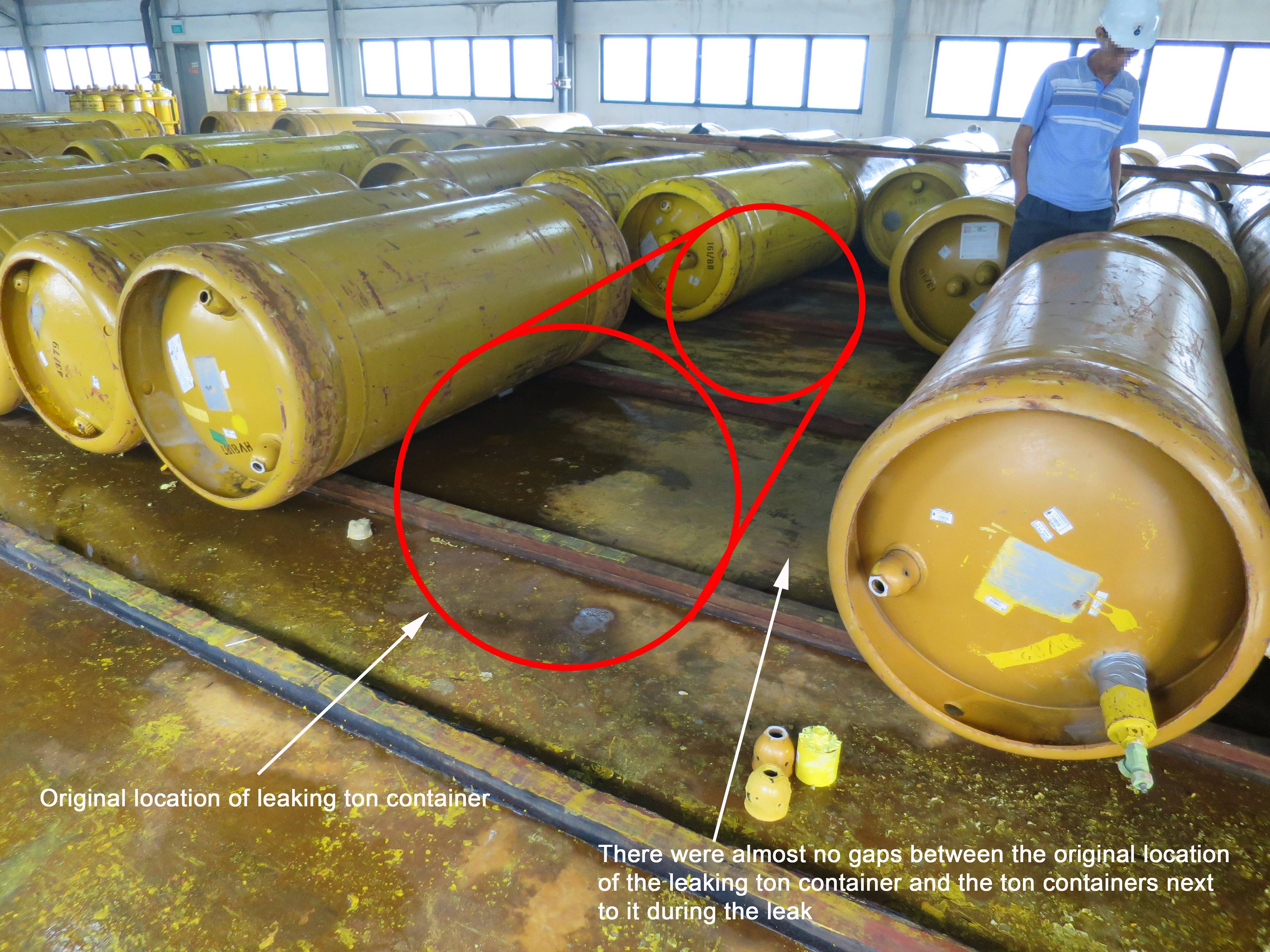
However, when the incident occurred, there was no space to execute this as the leaking container was stored between many other containers with no gaps.
Photo showing original location of leaking container. Container has been removed. (Photo: Ministry of Manpower)
The company had also failed to install its emergency scrubber and exhaust system according to design and maintain a safe ventilation in the workplace.
Some of the suction pipes within the warehouse used to extract air from the warehouse were found to be covered with mesh filters.
There were no calculations conducted to verify that these filters would not reduce the flow rate of air into the emergency scrubber and exhaust system, said MOM.
Photo showing mesh filter screen used on suction pipe intakes. (Photo: Ministry of Manpower)
“Investigations revealed that the rate at which the contaminated air was extracted did not meet general ventilation standards,” said MOM.
“The company had failed to properly maintain and store the ton containers, establish a proper emergency response plan to address chlorine leaks and implement an effective exhaust system for extracting and channelling contaminated air to the scrubber,” said MOM’s director of the major hazards department Go Heng Huat.
“The multiple safety breaches showed a clear disregard of the hazards at the workplace and had posed a safety risk to the public.”
SINGAPORE: Starting next year, students in Singapore could be developing new and healthier crop varieties in a first-of-its-kind urban agriculture research facility.
The facility – the only one to be located in a junior college – is set to break ground in National Junior College (NJC) this month.
This comes after the school inked a partnership with the Agri-Food and Veterinary Authority (AVA) and local biotechnology company Life3 to set up an R&D facility for agri-tech solutions in food production.
NJC, which already has an innovation and research programme, hopes to expose its students to opportunities in agri-tech, which it said is imperative in land-scarce Singapore.
The aim is for students to modernise farming practices to improve sustainability and cultivate high-nutrition plants.
“You need that expertise from a group that has been there and done that,” said vice-principal Harman Johll. “We need an industrial partner to come into play, to allow our students to see what it takes to get, to actualise, or to enable that.
“If they do come up with something, hopefully they can patent it.”
Life3 will provide resources including technical expertise.
“Working with students is a pivotal role because we want to encourage a new generation of talent in this space … We do not have a food-resilient system and security,” said founder Ricky Lin.
“We are going to use Internet of Things to wire up this whole farming environment. This will help to optimise space in a very efficient way. We are looking at growing some of the crops at 200 times their usual output, with very little water utilisation, as compared to usual farming methods.”
He added that having AVA as a partner allows for wider transfer of knowledge and expertise in the agri-tech field.
NJC has also set up an R&D facility for agri-tech solutions in food production. (Photo: Tan Si Hui)
Both NJC and Life3 hope to engage students from other schools in the five-year project.
Other schools are also working to give students a foothold in thriving industries.
All secondary schools run Applied Learning Programmes (ALPs) to let students apply their knowledge in real-world settings, and these will be rolled out to all primary schools by 2023.
Among mainstream secondary schools, more than half offer ALPs in Science, Technology, Engineering and Mathematics (STEM). These are supported by STEM Inc, a unit under Science Centre Singapore that works with teachers to develop programmes.
Changkat Changi Secondary runs an ALP called SOAR (student-centred opportunities for aerospace industry) that gives students a hands-on experience in the aviation sector, which contributes about 6 per cent of Singapore’s GDP.
Changkat Changi Secondary students on a learning journey to SIA Engineering as part of the school’s Applied Learning Programme. (Photo: Tan Si Hui)
Through a partnership with SIA Engineering, students get to learn about plane maintenance, repair and operations.
Students are also taught the principles of flight and coding, and the school says there are plans to weave topics like food science and tourism into lessons to give an insight into aspects of the industry like airport management.
Thirteen-year-old Ghiyas Ibrahim’s dream is to become a pilot, so he chose to apply to Changkat Changi Secondary after completing his Primary School Leaving Examination last year.
“I thought that if I chose this school, it will probably help me to become a pilot,” said Ghiyas.
Inspecting an aircraft engine at SIA Engineering. (Photo: Tan Si Hui)
Another school that offers a STEM ALP – focused on fragrances – is Bartley Secondary.
Lessons are carried out in a purpose-built perfumery lab, where students conduct experiments such as extracting essential oils.
The school has partnered global fragrance company Takasago so students can visit the facilities and interact with researchers.
Bartley Secondary students on a visit to fragrance company Takasago. (Photo: Tan Si Hui)
Junior perfumer Amber Lee said the company hopes to increase awareness of the perfumery industry in Singapore among students.
“This will open up more opportunities for them to join us in this industry in the future.”
Bartley Secondary student Aaliyah Elena said she hopes to join the industry after a recent job shadowing experience.
“One of the compounders told me that there is this course on fragrance in Singapore Polytechnic, so it has inspired me to pursue this as a job as well,” she said.
SINGAPORE: Starting next year, students in Singapore could be developing new and healthier crop varieties in a first-of-its-kind urban agriculture research facility.
The facility – the only one to be located in a junior college – is set to break ground in National Junior College (NJC) this month.
This comes after the school inked a partnership with the Agri-Food and Veterinary Authority (AVA) and local biotechnology company Life3 to set up an R&D facility for agri-tech solutions in food production.
NJC, which already has an innovation and research programme, hopes to expose its students to opportunities in agri-tech, which it said is imperative in land-scarce Singapore.
The aim is for students to modernise farming practices to improve sustainability and cultivate high-nutrition plants.
“You need that expertise from a group that has been there and done that,” said vice-principal Harman Johll. “We need an industrial partner to come into play, to allow our students to see what it takes to get, to actualise, or to enable that.
“If they do come up with something, hopefully they can patent it.”
Life3 will provide resources including technical expertise.
“Working with students is a pivotal role because we want to encourage a new generation of talent in this space … We do not have a food-resilient system and security,” said founder Ricky Lin.
“We are going to use Internet of Things to wire up this whole farming environment. This will help to optimise space in a very efficient way. We are looking at growing some of the crops at 200 times their usual output, with very little water utilisation, as compared to usual farming methods.”
He added that having AVA as a partner allows for wider transfer of knowledge and expertise in the agri-tech field.
NJC has also set up an R&D facility for agri-tech solutions in food production. (Photo: Tan Si Hui)
Both NJC and Life3 hope to engage students from other schools in the five-year project.
Other schools are also working to give students a foothold in thriving industries.
All secondary schools run Applied Learning Programmes (ALPs) to let students apply their knowledge in real-world settings, and these will be rolled out to all primary schools by 2023.
Among mainstream secondary schools, more than half offer ALPs in Science, Technology, Engineering and Mathematics (STEM). These are supported by STEM Inc, a unit under Science Centre Singapore that works with teachers to develop programmes.
Changkat Changi Secondary runs an ALP called SOAR (student-centred opportunities for aerospace industry) that gives students a hands-on experience in the aviation sector, which contributes about 6 per cent of Singapore’s GDP.
Changkat Changi Secondary students on a learning journey to SIA Engineering as part of the school’s Applied Learning Programme. (Photo: Tan Si Hui)
Through a partnership with SIA Engineering, students get to learn about plane maintenance, repair and operations.
Students are also taught the principles of flight and coding, and the school says there are plans to weave topics like food science and tourism into lessons to give an insight into aspects of the industry like airport management.
Thirteen-year-old Ghiyas Ibrahim’s dream is to become a pilot, so he chose to apply to Changkat Changi Secondary after completing his Primary School Leaving Examination last year.
“I thought that if I chose this school, it will probably help me to become a pilot,” said Ghiyas.
Inspecting an aircraft engine at SIA Engineering. (Photo: Tan Si Hui)
Another school that offers a STEM ALP – focused on fragrances – is Bartley Secondary.
Lessons are carried out in a purpose-built perfumery lab, where students conduct experiments such as extracting essential oils.
The school has partnered global fragrance company Takasago so students can visit the facilities and interact with researchers.
Bartley Secondary students on a visit to fragrance company Takasago. (Photo: Tan Si Hui)
Junior perfumer Amber Lee said the company hopes to increase awareness of the perfumery industry in Singapore among students.
“This will open up more opportunities for them to join us in this industry in the future.”
Bartley Secondary student Aaliyah Elena said she hopes to join the industry after a recent job shadowing experience.
“One of the compounders told me that there is this course on fragrance in Singapore Polytechnic, so it has inspired me to pursue this as a job as well,” she said.
SINGAPORE: A new study of 5,000 train passengers in London showed that more than half of commuters were checking and sending work e-mails while travelling to and from their jobs.
In response, there has been pressure on employers to consider commuting as work time, potentially reducing commuter pressure during peak hours, and allowing for more comfort and flexibility around office hours.
Should your employers treat your commute as just another part of your workday?
WORKING WHILE IN COMMUTE
There are certainly advantages to making the commute a part of work. According to the latest Moovit Public Transport Index, the average Singaporean spends 84 minutes on public transport, with over 85 per cent reporting that they spend more than two hours on public transportation every day.
For people who would be working during their commute anyway, a commute-as-work policy would ensure that they were getting paid for their work hours on public transportation.
After all, people should be fairly compensated for all the work they do, whether they are in or out of the office.
In Norway, public servants are able to count their commute as working hours.
Commute-as-work also creates an incentive for people to take public transport to work — as those who drive are not able to safely check and respond to their e-mails on the road —reducing vehicle emissions and traffic congestion.
A commuter using his phone in a bus in Singapore. (Photo: Alicia Tantriady)
It might even encourage people to live a little farther from their workplaces, potentially alleviating urban density issues in highly-populated areas.
However, commute-at-work comes at a potentially stiff cost.
Commute-as-work raises serious questions about work–life boundaries – where do we draw the line between work and non-work?
If commute-as-work were legitimised, working hours may extend well beyond normal office hours.
RISING EXPECTATIONS AND STRESS
Employers may reasonably expect workers to “be productive” while commuting, and may feel justified in monitoring workers’ activities over the ride back home, letting work creep further and further into people’s everyday lives.
Commute-as-work has the potential to become a “poisoned chalice” that not only extends organisations’ control over people’s lives, but can make work itself more toxic, stressful, and unsustainable.
First, commuting is already stressful in and of itself. The commuting experience is often marked by traffic congestion, crowds, bad weather, and vehicle breakdowns, leading to delays, stress and time pressure.
Research out of the University of Minnesota has shown that commuting stress already leaves people exhausted when they get to work – imagine compounding that exhaustion with the pressure to “be productive” on your commute. And it’s not like the train is an ideal work environment either.
Commuters at the fare gantry of an MRT station. (File photo: TODAY)
Whether you travel to and from work via car, train, bus, bicycle, or walking, it’s never quite as conducive as a proper workspace or your home office.
For those of us who use our mobile phones to check our work e-mails, which most of us do on trains and buses these days, constantly looking down on our mobile phones stresses our spines and may cause symptoms such as stiff necks, back pains and shoulder strains.
Commute-as-work piles stress upon stress on workers who are already strained and overloaded.
BLURRING WORK-LIFE BOUNDARIES
Second, commute-as-work opens the door to even greater surveillance of workers who are expected to work before and after office hours. In a time when most people are already struggling to “switch off” from work and their mobile devices, commute-as-work exacerbates the problem.
Further, some managers may feel entitled to making more work-related demands since organisations are compensating employees while they are commuting.
Work intensification is already a huge problem in organisations as it is. Some of us may prefer to surf social media, read the news or listen to classical music to relax and unwind during our commute.
This freedom to spend our commuting time helps us recover from the daily stresses of our work and non-work responsibilities. The more organisations blur the boundaries between work and non-work, the more people’s family responsibilities are compromised and their family lives suffer.
Commuters boarding a public bus in Singapore. (File photo: Land Transport Authority)
Third, although the prospect of being compensated for your commute might be enticing, commute-as-work can be prone to the same potential for unfairness that is endemic to other work-intensifying compensation schemes like pay-for-performance.
How do we compensate people for their commutes if their commute time varies? How do we allocate work if commute styles vary? Most importantly — how do we do these things in a manner that is fair to everyone?
It’s like the saying goes: The devil is in the details.
Even if commute-as-work were a good idea, poor execution could potentially create a climate of injustice that undermines its good intentions.
Technology-enabled working has blurred the boundaries between work and life, and implementing commute-as-work is likely to be a step backwards in the pursuit of a healthy and integrated work–life balance.
Carys Chan is lecturer and assistant professor of Management at RMIT University. Rajiv Amarnani is lecturer and assistant professor in Management and Organisational Behaviour at the Australian Catholic University.
SINGAPORE: Singapore company Creative Technology on Monday (Sep 24) announced the launch of its first Super X-Fi product – the SXFI Amp dongle – and CEO Sim Wong Hoo is optimistic the product will sell as there is “lots of pent-up demand”.
Explaining what Super X-Fi was in March, Mr Sim said it is a technology that can be used in headphones and dongles for mobile devices to recreate the listening experience of a multi-speaker surround sound system.
The SXFI Amp dongle connects to mobile phones, laptops and computers via USB-C, allowing users to enjoy 5.1 and 7.1 cinematic audio content from movies and games downloaded or streamed online.
It costs S$219 (US$149.99) and will only be available online at Creative’s website from 6.34pm on Monday.
Mr Sim explained during a pre-launch interview with Channel NewsAsia that this is because it wants to make sure the “word of mouth (reviews from early adopters) are as good as possible”.
It is only when there is mainstream awareness of its technology and how it works – “People will ask: ‘What’s head mapping’”, Mr Sim said – will Creative involve the bigger retailers. In previous product launches there were “negative, painful experiences” with channel partners, he explained.
The dongle and a standalone mobile app will initially be available only in Singapore and for Android mobile devices. Worldwide delivery begins in November, the company said in a separate press release on Monday.
A second product will come down the pipeline in November with Apple’s iOS users in mind as the dongle is not yet compatible with these devices, Creative said.
That product, the SXFI Air, is a Bluetooth headphone with the Super X-Fi technology built into it.
More details will be released later, the company said.
Scans of one’s ears and face are captured and fed into Creative’s artificial intelligence algorithm for a personalised profile to deliver sound optimally, the company says. (Photo: Creative)
There is also another reason why Creative is limiting sales to its website, the CEO said.
Some would find the set up to create their audio profile daunting (it requires scans of the ear and face). They have the option of heading down to Creative’s headquarters in Jurong where staff will “hand-hold them” through the process and answer any questions they may have.
“We have spent more than S$100 million on this and we’re still burning (cash),” Mr Sim said of the investment that had gone into developing the technology and product.
“I don’t want to run all the way, then fall down at the last 100m.”
SINGAPORE: About 80 shops at Plaza Singapura had to operate in darkness in the morning and early afternoon on Sunday (Sep 23) after a scheduled electrical shutdown went on longer than originally planned.
There was no air-conditioning until the evening, too.
According to a CapitaLand memo sent to tenants at The Atrium @ Orchard, the shopping mall management had scheduled an electrical shutdown for maintenance works from 11.30pm on Sep 22 to 8am on Sep 23.
There would be no electricity supply to the store premises and common areas during the specified period, the memo said.
Tenants were advised to arrange for alternative power sources or provide separate arrangements for their frozen food and perishable items.
Responding to a query from Channel NewsAsia, General Manager of Plaza Singapura June Ang said an “unforeseen delay” caused power supply to return gradually only from 2.15pm.
“The lights were fully restored by 2.40pm while the air-conditioning was progressively switched on from 6.40pm,” she said.
“We have been providing regular updates to the tenants since this morning and also deployed our team to advise shoppers. We apologise for any inconvenience caused to the affected tenants and shoppers, and will continue to provide assistance where required.”
In a subsequent update, Ms Ang said air-conditioning was fully restored at 8.30pm.
The business development manager of Arteastiq and Cajun on Wheels said both her outlets were affected, and that their ice creams had melted. (Photo: Teo Jia Min)
Channel NewsAsia reader Tiffany Lim said the air-conditioning at Sephora, located on the first floor, was not working when she visited the store at around 5pm.
“I walked in and it was like a heatwave … and one of the Sephora staff was fanning herself so I knew it wasn’t just me,” she said.
Business development manager of Arteastiq and Cajun on Wheels, Teo Jia Min, said both outlets were affected by the disruption.
For instance, the ice cream at her stores melted.
“Tenants can expect a massive loss in sales as it is Sunday, the busiest day of the week,” she said.
“Tenants also have to pay staff salaries, food spoilage from the non-functioning freezers and chillers. CapitaLand has not given any indication on whether compensation will be given for the day’s rental.”
Ms Teo also claimed that CapitaLand did not allow its tenants to close for the day and had instead required them to be on standby.
It was an explosion so loud, even waiting in anticipation for it to happen could not stop one from flinching.
Then there was a huge leak from a pipe, before a massive fire emerged.
Singapore Civil Defence Force (SCDF) personnel then jumped into action to stop the leak and extinguish the fire.
It was as realistic as it gets, but this was actually a demonstration of the Diamond Simulator, located at the Home Team Tactical Centre.
The facility, built in 2015, is a five-storey building that simulates a typical industrial site and prepares firefighters to handle 15 different scenarios.
These include advanced industrial firefighting, dealing with hazardous materials and carrying out search-and-rescue missions.
The Diamond Simulator is a five-storey building that simulates a typical industrial site. (Photo: Ahmad Khan)
The Diamond Simulator allows training for advanced industrial firefighting, dealing with hazardous materials and carrying out search-and-rescue missions. (Photo: Ahmad Khan)
“In the past, with fewer fire simulators and a smaller training ground, the training was perhaps less realistic and sometimes less challenging,” said Major Lionel Lee, Head, Hazmat Branch at the Civil Defence Academy. “We feel confident that our personnel will be much more prepared having gone (through) a few weeks’ training here (at the Diamond).”
INDUSTRIAL FIRES IN SINGAPORE
Every year, about 150 cases of industrial fires are dealt with by SCDF. Such fires can be more challenging to extinguish due to the nature of the location and the materials involved, so firefighters need ample training and preparation.
An example of one of the more challenging fires SCDF has had to deal with is the oil storage tank blaze on Pulau Busing that happened in March this year.
It was the scene of one of Singapore’s biggest industrial fires, that took more than 100 firefighters six hours to extinguish.
The Diamond Simulator allows for responses to real-life scenarios to be tested, such as dealing with toxic chemical leaks.
Said Major Rayner Oon, Commander of Tampines Fire Station: “We have many industries which deal with toxic industrial chemicals, and having these personnel who are trained to deal with such incidents, who know what to do when a leak occurs, knowing how to use the specialised equipment to mitigate the leaks, I think it’s very crucial for SCDF.”
HANDS-ON EXPERIENCE
In some situations, officers may need to communicate with hand signals as they try to seal off a chemical leak.
This looks easy, but is anything but.
Hazmat officers may need to communicate with hand signals as they try to seal off a chemical leak. (Photo: Ahmad Khan)
I was tasked to carry out a simple mission: To stop a container leak. All I had to do was tighten a strap on a sealing bag that would help cover the leak. But having to do that with a breathing apparatus and a chemical suit made it very challenging.
The suit weighed more than 20kg, and tightening a seal when wearing rubber gloves was tough. Plus, it was difficult to see clearly under the bulky mask.
Hazmat personnel have to put on a breathing apparatus before donning the chemical suit. Once in it, your voice cannot really be heard, no matter how loud you try to shout. (Photo: Ahmad Khan)
Wearing the breathing apparatus and chemical suit that weighs more than 20kg, and then being asked to tighten a strap to help seal a leak, is a tough challenge. (Photo: Ahmad Khan)
TESTING OUT NEW TECHNOLOGY
The Diamond Simulator is also a practice bed where the SCDF tries out new firefighting tools.
The Pumper Firefighting Machine, which is on trial, was tested at the facility to demonstrate its capabilities.
The robot can operate in areas of intense heat, which means there is less risk for firefighters when they are trying to put out a big blaze.
The Pumper Firefighting Machine was unveiled at SCDF’s workplan seminar earlier this year. (Photo: Ahmad Khan)
SINGAPORE: At the 2018 National Day Rally, Prime Minister Lee Hsien Loong highlighted efforts by the Government to rejuvenate and redevelop older HDB towns to avoid the situation where entire towns were built in a rush in the 1970s and 1980s from recurring.
PM Lee explained: “If we do not plan ahead, 99 years later, all the leases in such towns will expire around the same time, and all the flats will be returned to the state within a few years.
“We will have to find new homes for a lot of people at once. HDB will have to tear down and rebuild the old flats in a hurry … I do not think that is a good idea. The towns will become construction sites all over again, with cranes all over the place.”
The large-scale planned redevelopment of older HDB estates, whether through the Voluntary Early Redevelopment Scheme (VERS) or otherwise, is important to prevent a sudden shock to public housing prices, when the removal of a large number of old housing flats from the public housing market creates a huge supply shortage.
OUR EARLY HOUSING HISTORY
A chief reason why we should not revert to the old model of building in a rush is that we had little choice in the past, but we do in Singapore’s future.
Singapore faced acute housing shortage in the 1960s; and the housing problem was further aggravated by the Bukit Ho Swee fire in 1961 that destroyed thousands of houses and displaced many households.
Many might not remember but the fire was a huge test of resolve for the nascent Housing & Development Board (HDB), set up on 1 February 1960 as the national housing agency to take over the roles of its predecessor, the Singapore Improvement Trust formed under the British colonial government.
Already saddled with the challenge of meeting a housing crunch besetting a fledging polity that had just attained self-government from the British, the HDB pressed on with great gusto.
It undertook a massive construction programme to supply a large volume of affordable housing with sanitation and access to clean drinking water to Singaporean families in a short time span. HDB completed nearly 667,575 dwelling units in several housing projects between 1960 and 1990.
Public housing units built by HDB from 1960 to 2015. (Graphic: Authors. Source: HDB Annual Report 2016/2017)
By 1990, Singapore had already achieved a very high rate of homeownership of 87 per cent. However, the housing construction programmes did not slow down thereafter, because of strong demand for new flats by Singaporean households.
Since then, the housing market has seen ebbs and flows, almost in tandem with the economy.
The Asian Financial crisis hit the region in 1997 and did not spare Singapore’s economy; the housing market was badly hit by the crisis. Demand dwindled rapidly from the peak in 1997, and many Singaporeans withdrew their applications from the system leaving behind 17,000 unsold flats in HDB’s inventory in 2001.
To manage changes in demand, and maintain the stability of housing prices, HDB introduced the Built-to-Order (BTO) programme in 2002. It also scaled back its building programmes between 2005 and 2010.
THE OLDEST NEIGHBOURHOODS WORRY ABOUT PRICE STABILITY
Maintaining the stability of housing prices has been a key driving force behind VERS and over the years, a preoccupation of HDB’s. It is also a chief concern of most property owners in Singapore.
By 2017, there were nearly 960,000 flats sold, distributed over 26 HDB towns and estates across Singapore. The three largest HDB towns, by housing units sold, are Jurong West (71,119 units), Tampines (66,225 units) and Sengkang (64,905 units). These three towns were developed over different periods, in the 1970s, 1980s and 1990s respectively.
For the over 110,000 flats built in the 1960s, which are mostly found in the housing estates of Queenstown, Bukit Merah and Toa Payoh, most are between 48 to 58 years old. The balance leases for the oldest flats built by HDB are about 47 years
HDB flats in Toa Payoh. (File photo: Calvin Oh)
Owners of these older flats are understandably anxious about shorter leases and obsolescence caused by wear and tear; the two factors that could adversely affect the values of their flats. Where many see their homes as “retirement nests” and forms of wealth to supplement their financial needs in their older years, one can empathise with their anxieties.
THEY ALSO WORRY ABOUT GHOST TOWNS
A commentary on Channel NewsAsia highlighted the challenge of expiring leases posing an additional challenge of “estates emptying out and decaying as neighbourhoods age”.
Some readers have asked, how likely is this scenario?
Ang Mo Kio today town houses approximately 45,700 residents in over 50,000 HDB flats built mostly in the 1970s and 1980s. The oldest flats are 48 years old, and many more will cross the half-life in the lease cycle in 10 years.
Ang Mo Kio is mainly made up of HDB flats that were built in a short span of 7 years in the late 1970s; and most of them have balanced leases of about 55 to 65 years.
An HDB block in Ang Mo Kio Avenue 2. (File photo: Gaya Chandramohan)
What will Ang Mo Kio town be like in 20 years? If there were no VERS, and residents start to move out en mass when leases are closer to expiry, we might find Ang Mo Kio hollowing out. Essential services, such as schools, hospitals, shopping centres, supermarkets, closing; and those left behind will face see their quality of life severely diminished.
Indeed, we will see entire towns like Ang Mo Kio ending up as “ghost towns”.
In many huge Western countries, where the land supply is abundant, it is not uncommon to see “ghost towns” emerge – caused by the abandonment of a functional centre by residents, because a huge company closes.
From long abandoned but once vibrant mining towns like Kennecott in Alaska, to shuttered resort towns that saw falling visitor numbers like Salton City in California, many localities have fallen into despair and decay.
Such forms of urban blight, are unlikely to happen in land-scarce Singapore, if relocation is tempered by constraints on housing supply, so there will always be some people living in older flats.
However, as neighbourhoods age, many may choose to move out to newer towns or precincts. This is a very likely outcome, as younger Singaporeans get married and leave their homes to move to newer towns, leaving behind less vibrant, older towns with a heavily ageing population.
The deeper shade of red in the bar colour represents relatively high-density estates by the number of HDB units in the estate. (Graphic: Authors. Source: HDB Annual Report 2016/2017)
The same chart, represented geographically. (Graphic: Authors. Source: HDB Annual Report 2016/2017)
In this context, the government’s announced VERS not only gives older estates “a new lease of life” assuring at least some flat owners that their old HDB flats will not be left to depreciate to zero at the end of the lease term.
VERS, more importantly, plays a stabilising role in keeping the overall housing stock in equilibrium in the long term.
In the absence of VERS, redevelopment can only happen once these estates run their lease down and the blocks return to HDB.
But consider this. When the leases of almost 250,000 flats built between 1971 and 1980 expire between 2070 and 2079, approximately 25 per cent of the housing stock will be removed from the market.
In just nine years, this number is equivalent to about five Ang Mo Kio towns.
If construction cannot keep up to replace the houses removed or demolished at the end of the leases, the supply shortfall could cause dis-equilibrium in the housing market triggering an upward housing price cycle.
The large-scale depletion of the housing stock could put severe stress to the housing market. A flat today will cost a lot more. How will young couples afford them then?
A man looking at a model of new flats at the HDB Hub. (File photo: TODAY/Ooi Boon Keong)
Even if population growth remains constant, and construction keeps up, this will mean construction resources will be taken up by the Government, crowding out private developments and transforming entire neighbourhoods into loud, noisy construction sites.
In tackling this conundrum, VERS gives owners of flats aged 70 years and above the chance to vote collectively, as a precinct, to “sell” the tail-end of the leases of their flats back to HDB.
With VERS, HDB could redevelop those blocks retrieved back from the home owners and rejuvenate entire housing precincts with new amenities and new concepts of living that match future needs of residents earlier than the scheduled lease depletion time.
GOOD NEWS FOR NOW
Depending on how residents vote for VERS, redevelopment of different precincts in a housing estate could be carried out sequentially, in phases, and avoid turning one entire housing estate like Ang Mo Kio into a massive construction site.
Therefore, VERS is an important urban renewal tool that help smooth out inelastic housing supply cycle, and consequentially, prevent steep housing price shocks that could adversely affect the housing affordability of the future generation of Singaporean households.
It should be good news for most, even as we await more news on its details.
Sing Tien Foo is Dean’s Chair associate professor and director at the Institute of Real Estate and Urban Studies, National University of Singapore. Namita Dinesh is a research analyst at the same institute.