SINGAPORE: More than S$50 billion in tax revenue was collected in the last financial year as revenue from stamp duties jumped by nearly 50 per cent, data released by the Inland Revenue Authority of Singapore (IRAS) on Wednesday (Sep 26) showed.
A total of S$50.2 billion was collected by IRAS in the 2017/2018 financial year, an increase of 6.8 per cent from the previous year.
The tax collected represents 66.2 per cent of the Government’s operating revenue and 11.1 per cent of Singapore’s GDP, the tax authority said in a news release.
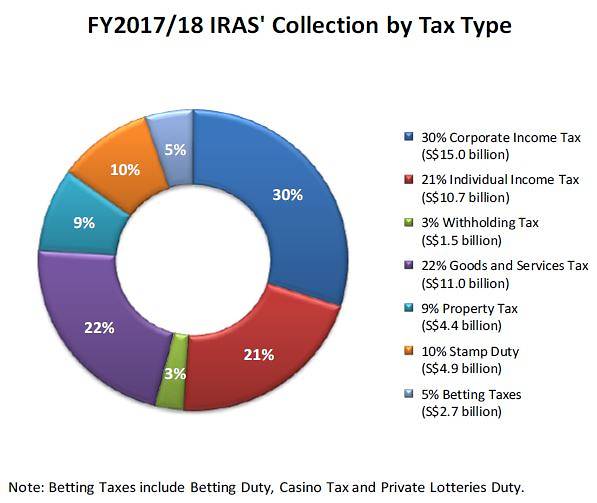
A breakdown of the tax revenue collected by the IRAS. (Infographic: IRAS)
Revenue from stamp duties surged by 49.6 per cent to S$4.9 billion due to an increase in property transactions. Property tax collection remained largely unchanged at S$4.4 billion, said IRAS.
Revenue from income tax, comprising corporate income tax, individual income tax and withholding tax, rose 6.3 per cent from the previous year to S$27.2 billion, and represented 54 per cent of total tax revenue, IRAS said.
Corporate income tax grew from S$13.6 billion to S$15 billion, while GST collection was S$11 billion, similar to the previous year.
Betting taxes collected in the last financial year was S$2.7 billion – similar to the previous year.
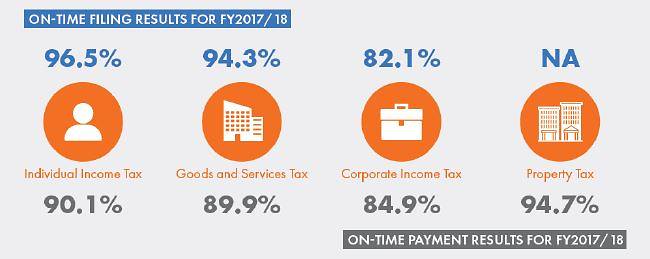
A total of 96.5 per cent of individual taxpayers filed their income tax on time and 90.1 per cent made their payments on time.
When it came to corporate income tax, 82.1 per cent filed it on time and 84.9 per cent paid their tax on time.
(Infographic: IRAS)
In total, 10,726 taxpayers were audited and investigated, and about S$384 million in taxes and penalties were recovered during the 2017/2018 financial year, IRAS added.
Starting Jan 1, 2020, GST will be imposed on imported digital services. About 850 businesses and associations have been consulted in the design of the GST measures, IRAS said.
SINGAPORE: Of all the acronyms I’ve heard thrown around in the first weeks of university life, “FOMO” probably tops the charts.
“FOMO”, or “fear of missing out” encapsulates a fear of missing out on exciting or important events which you know many of your peers are going for. It shows up over and over again in conversations millennials have, usually in the phrase “FOMO is real”.
In May this year, it was even heard in Parliament when Dr Maliki Osman mentioned it in his response to the President’s Address.
So what do millennials experience FOMO on? We experience FOMO on social gatherings, overseas experiences, events, forums, networking dinners, capturing “Insta-worthy moments” and the list goes on. Even a simple “Do you want to join us for lunch?” is enough to invoke FOMO.
To millennials and their friends and family, this is not news. In fact, it has been so widely discussed that it doesn’t really warrant a full commentary.
But consider FOMO in relation to the economic challenges millennials face: FOMO with regard to career opportunities in an age of disruption or what I call “the fear of missing out on a disrupted future”.
Almost two weeks ago, the World Economic Forum released the findings of a survey of 42,000 youths across six countries in ASEAN. The survey showed that youths in Singapore are among the most pessimistic in the region about the impact of technology on their employment prospects and earning potential, though this can be partially explained by higher education levels and age.
Separately, according to the National Youth Survey released last year, youths are tentative about having sufficient opportunities in Singapore to achieve their aspirations.
NUS Career Fest 2018 saw more than 260 employers offer about 4,000 job opportunities in 21 industries. (PHOTO: National University of Singapore)
While we should not jump to the conclusion that youths in general are pessimistic about the future, we can all agree that they face significant levels of uncertainty as they prepare to enter the workforce.
This should not be a surprise. Unlike their parents whose lives were affected by disruption, their lives will be defined by it.
Coming of age in an age of disruption, they are acutely aware that the jobs they are training for may no longer exist as they are in the future and that conventional signals of competence and potential (such as a degree, good grades or a strong internship track record) may no longer guarantee the stable employment it used to.
Faced with significant levels of uncertainty, millennials seek to reduce it. But because there are no clear strategies or formulaic steps for doing so, and because they know their peers may be doing even more, every event, project, initiative, gathering starts to look like a potential opportunity to gain that certainty they so badly want.
The perceived cost of not seizing these opportunities and missing out on increasing one’s chances of personal and professional success skyrockets as well. The fear of missing out rears its ugly head once again.
So why exactly is a fear of missing out a bad thing? Well, the first word says it all: fear. Yes, as with any dreaded emotion such as stress or anxiety, having a little of it is not necessarily bad – it spurs one to work hard and be clued in on potential opportunities.
But perhaps it’s no longer such a good thing when about 8 in 10 young professionals in Singapore suffer from a quarter life-crisis, according to survey by Linkedin released in May this year.
National University of Singapore graduates at a commencement ceremony. (Photo: Lionel Lin)
On a national level, this could translate into a second education arms race, which I discussed in an earlier commentary.
Such a race would be detrimental – university students would focus on securing internships, overseas experiences, leadership positions and the like for the sake of doing so, rather than focusing on value-adding and developing mastery, precisely the key ingredients needed for a resilient economy of deep capabilities.
Faced with such a situation, it is easy to look to the Government again for solutions.
However, we must remember that the Government can prepare for, but never guarantee, the future, even as it remains fully committed in preparing young people for a disruptive one.
What this future will be like will always be beyond the reach of the Government. This is especially so for small states like Singapore, which have limited control over global trends and situations.
Given that macro-level solutions are already being extensively implemented with more in the pipeline, we should, for now, turn our attention to individuals instead.
How do we millennials better cope with such uncertainty? How can we prepare ourselves to seize the uncertain future? I’m not an expert, but I have three pieces of advice to offer my peers and, well, myself.
First, we should recognise that the certainty that we so badly seek is right there – just in a different way than we thought. Uncertainty stems from not knowing what comes next, but if what comes next has yet to be defined, that means we have at least a chance to shape the future and determine what goes into the blanks, something our parents might not have been able to do.
And unlike our parents, the world truly is our oyster. Never before have so many opportunities abroad lay so closely within our reach, a global playing field so open and accessible.
Mr Christopher Quek, 40, wants to create a pay-it-forward culture here where entrepreneurs will readily lend support to their less-experienced peers. (Photo: Tang See Kit)
Second, with everyone seizing some form of opportunity to advance themselves, it may be tempting to do so too just for the sake of. But there’s really no need to.
Instead of fretting over what the formula for success is and constantly comparing ourselves to our peers, we should stake out our own career paths and educational trajectories, bearing in mind that an unconventional combination of conventional actions can lead to productive, even better-than-foreseen outcomes.
For each of us, that combination will be different because each of us are different, and even a difference might be useful in differentiating ourselves from our competitors, including those from abroad.
Third, even if our fears materialise and we have to settle for a job which we did not want, it might be more constructive to see this not as the end but just the beginning of our exciting professional journey.
Settle down, build on it, work hard – and seek out new opportunities, which might present themselves more frequently precisely because of continued disruptive changes.
Lim Chin Sing, Lim Jia Yi and Teresa Stephanie Tay are part of a team at the National University of Singapore who discovered an “alien” mussel which was recently introduced in Singapore and spreading rapidly. (Photo: Fann Sim)
So yes, disruption can be scary and uncertain. However, it has also gifted us with unprecedented opportunities to find new pathways and forge fresh outcomes for ourselves, one that isn’t limited by our own knowledge and expectations at this young age.
Thus, over the next few years of university, I hope I can begin to see a shift from a narrative of fighting uncertainty to one of hope, hope that we can seize disruptive opportunities, chart our own course and remain resilient in the face of setbacks.
Now that’s something I wouldn’t want to miss out on.
Ng Chia Wee is a first-year undergraduate at the National University of Singapore’s Faculty of Arts and Social Sciences and Tembusu College.
SINGAPORE: If you happened to look up from your phone this week, you would have been treated to a beautiful sight: the Harvest Moon rising big and bright over the Singapore sky.
The Harvest Moon is the first full moon after the autumnal equinox, which was on Sep 22 this year, and was predicted by the National Aeronautics and Space Administration (NASA) to appear in the sky on Tuesday (Sep 25).
The moon also marks the start of the mid-autumn festival, which is celebrated in parts of East Asia, including Singapore.
Channel NewsAsia reader A Kannan took these photographs of the ethereal phenomenon at about 8pm in Woodlands.
(Photo: A Kannan)
(Photo: A Kannan)
“The moon is beautiful. This September moon is special as it marks the beginning of autumn,” he said.
Mr Kannan, a 53-year-old civil servant, said the Harvest Moon is his favourite and that he has managed to capture it on camera “many times”, each time attempting different perspectives.
(Photo: A Kannan)
(Photo: A Kannan)
He also shared photos he took of the moon early Tuesday morning.
“The moon was … was red; (my photographs are) unedited and taken from my block at 6.30am,” he added.
(Photo: A Kannan)
During this period after the autumnal equinox, the moon rises closer to sunset, leaving a shorter period of darkness between sunset and the moon rising. Farmers can work late into the night by the light of this moon, according to NASA’s moon blog.
(Photo: A Kannan)
(Photo: A Kannan)
Many others across the world took to social media to share their photographs of the moon with its distinct orange glow. In the UK, social media users described the moon as “amazing” and “breathtaking”.
The photos of the Harvest Moon were submitted by a Channel NewsAsia reader. If you would like to send in photos or videos of something newsworthy, WhatsApp our Mediacorp news hotline at +65 8218 8281 or message us on Facebook.
SINGAPORE: Ride-hailing operator Grab said on Tuesday (Sep 25) that it will retain the existing redemption rates under its GrabRewards programme beyond the end of this month.
“We heard your feedback. That’s why we’re pleased to announce that even after 30 September 2018, all Silver, Gold and Platinum members will continue to enjoy preferential pricing on Grab rewards,” said Grab in an email notification to its customers.
The notification from Grab sent via email about its rewards system on Sep 25.
Under the original rewards system, Regular, Silver, Gold and Platinum members needed 2,200, 2,100, 2,000 and 1,900 points, respectively, to redeem a S$5 reward for Grab rides.
In a controversial move in July, Grab revised the redemption rate to 2,200 points for a S$5 Grab ride reward regardless of member tier, sparking an online furore.
Several days after announcing the revision, Grab said that it would revert to the previous ride reward rates and postpone implementing the new scheme until Sep 30 in order to give customers time to adjust to the changes.
Grab’s changes to its loyalty programme – including reducing the number of points earned by riders per dollar spent – were among some of the items highlighted by the Competition and Consumer Commission of Singapore (CCCS), who on Monday imposed a S$6.42 million fine and several restrictions on Grab to address competition concerns arising from its merger with Uber.
In response, Grab said it will abide by the remedies set out by the watchdog, although it maintained that it did not intentionally or negligently breach competition laws.
GRABHITCH SERVICE UNAVAILABLE FROM 1AM TO 5AM
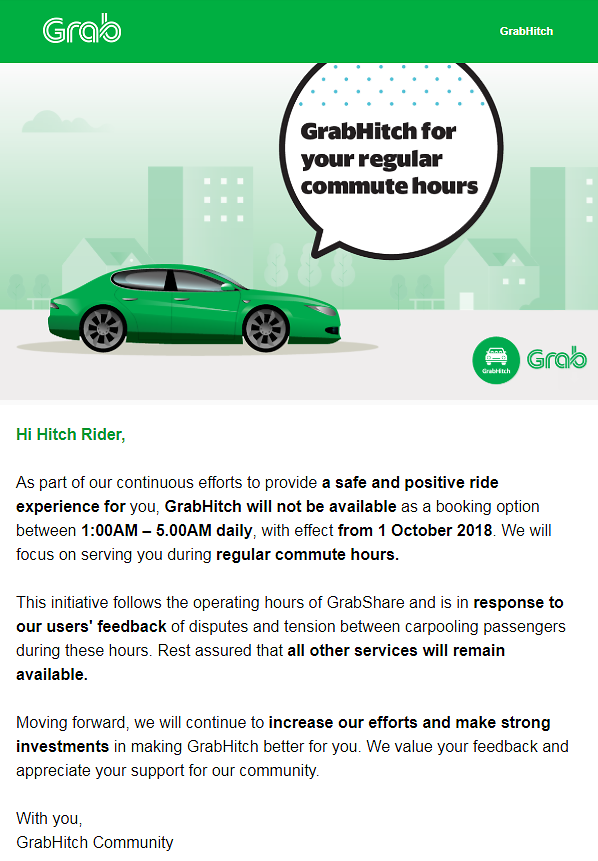
In a separate notification on Tuesday, Grab said that its GrabHitch service will no longer be available between 1am to 5am from Oct 1, as part of its “continuous efforts to provide a safe and positive ride experience” for customers.
“This initiative follows the operating hours of GrabShare and is in response to our users’ feedback of disputes and tension between carpooling passengers during these hours,” said Grab.
“Rest assured that all other services will remain available. Moving forward, we will continue to increase our efforts and make strong investments in making GrabHitch better for you,” it said.
Grab’s notification to its customers over its GrabHitch service on Sep 25.
The company told Channel NewsAsia that it received feedback from its driver partners and passengers that “it can be an unpleasant experience to be matched with unruly passengers on the same GrabShare ride”.
SINGAPORE: A childcare centre, nursing home and dialysis centre, as well as an urban farm will be built on the site of the former Henderson Secondary School, the Singapore Land Authority (SLA) said on Tuesday (Sep 25).
In its news release, SLA said that housing three facilities on a single site will cater to the needs of the community living in the area. The planned nursing home and dialysis centre are also expected to meet demand from within the region, the release said.
The integrated site is a collaborative effort between the Early Childhood Development Agency (ECDA), Ministry of Health (MOH) and the Agri-Food and Veterinary Authority (AVA), the release said.
Henderson Secondary vacated the premises after it merged with Bukit Merah Secondary School last year.
The childcare centre is set to occupy a 1,800 sq m two-storey block, and will be run by PAP Community Foundation. The pre-school, which will be able to take in 250 children, is expected to begin operations at the end of next year.
“At this retrofitted premises, the centre will have opportunities to develop spaces for outdoor learning and play, as well as engage in cross-programming with the nursing home and urban farm,” the release said.
As for the urban farm, the site can also be used to test-bed innovative technologies and raise awareness within the community on how food is grown and promote local produce.
A tender will be launched for urban farming use at the end of October.
“Tenders will be assessed on their proposals to see how best they can involve the community and how their operations can be more socially inclusive,” the release said.
“The successful tenderer will be required to curate activities and programmes for the childcare centre, nursing home and the community within the area,” it added.
(Photo: Singapore Land Authority)
SLA deputy director of business planning and development Yap Eai-Sy said: “SLA strives to optimise available sites including vacant schools in new ways that will benefit the community. We are working towards providing a wide range of use to optimise state properties and to provide for the changing environmental needs.”
SINGAPORE: Veteran diplomat Tommy Koh called again for the repeal of Section 377A of the Penal Code, which criminalises gay sex, in an opinion piece published by The Straits Times on Monday (Sep 24).
On the scientific evidence for repealing the law, Dr Koh wrote: “Scientific research has shown that homosexuality is a normal and natural variation in human sexuality and is not in itself a source of negative psychological effects.”
He cited a World Health Organisation decision in 1973 to delete homosexuality from the Diagnostic and Statistical Manual of Mental Disorders.
“This decision was endorsed by the general assembly of WHO in 1990 when it agreed to delete homosexuality from its list of mental disorders. In WHO’s view, being LGBT (lesbian, gay, bisexual and transgender) is not a disease,” he added.
He also pointed out that of the 196 states in the United Nations, the majority – 124 states – do not criminalise sodomy. Singapore is among the minority of 72 states which do.
While all the developed, Western countries do not criminalise sodomy, a notable number of Asian territories also fall into this category, including China, Japan, South Korea, Hong Kong, Taiwan, the Philippines and Thailand, he said.
Meanwhile, many of the countries who have a similar law in place were former British colonies.
“Singapore is part of the minority mainly because it inherited from the British a penal code which criminalises sodomy. For a country which embraces science and technology, it is surprising that, on this one aspect, the law has not been updated, in the light of the scientific evidence,” he wrote in The Straits Times.
SEPARATION BETWEEN RELIGION AND STATE
In making his argument, he also elaborated on the difference between a sin and a crime: While adultery and fornication are regarded as sinful, they are not “criminal behaviour”.
Former attorney-general Walter Woon was “unhappy” with the compromise of “retaining 377A and not enforcing it because it brings the law into disrepute”, Dr Koh said.
Addressing the calls of Christian and Muslim religious groups to retain Section 377A, he said: “It is not the business of the state to enforce the dogmas of those religions. In Singapore, there is a separation between religion and the state. Church leaders and Islamic leaders should respect that separation.”
He called on Christian and Muslim leaders to refrain from “pressuring the Government to criminalise conduct which they consider sinful”.
Laying out court decisions in the US and India which had ruled that laws criminalising sodomy were unconstitutional, he wrote: “In most cases, the antiquated sodomy laws were repealed by the legislatures of the respective states or countries. However, in a few cases, the laws were declared unconstitutional by the courts.”
Summarising his arguments, Dr Koh said: “Section 377A is an antiquated law, not supported by science, and should be repealed.”
He concluded that the Singapore Court of Appeal should overturn a 2014 decision and declare Section 377A to be unconstitutional.
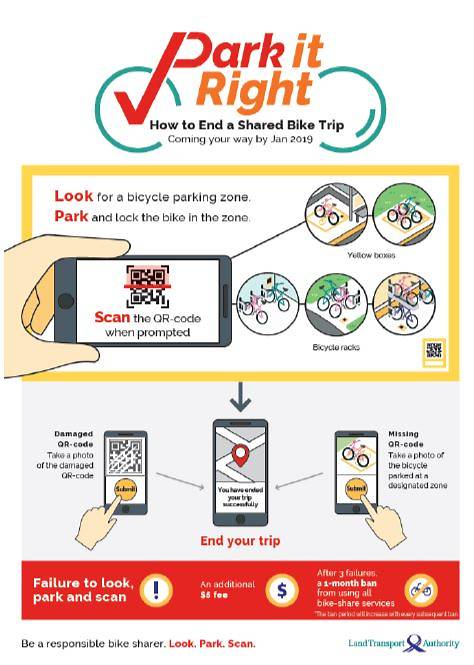
SINGAPORE: A Quick-Response (QR) code parking system for shared bicycles will be implemented next year to ensure users do not park indiscriminately, the Land Transport Authority (LTA) announced on Tuesday (Sep 25).
Those who fail to park properly and scan the QR code will be charged S$5 by licensed operators, LTA added in the news release.
Users who park indiscriminately three times in one year will be banned from using all bicycle-sharing services for up to a year.
Both the QR code parking system and the ban will begin in January next year, LTA said, adding that it will start to install the QR codes progressively at public bicycle parking spaces from the end of this month.
A public education campaign will also be launched in early October to educate users of shared bicycles on how to end their trips with QR codes.
Public education poster on QR code parking system. (Image: LTA)
The latest move is part of the new bicycle-sharing licensing regime. The Ministry of Transport had announced in March that LTA will “right-size” the shared bicycle fleet to manage indiscriminate bicycle parking and ensure the efficient use of shared bicycles and limited parking spaces.
By 2020, the number of bicycle parking lots in Singapore will be increased from 207,000 to 267,000, LTA said. About 7,000 lots have been added at locations such as public transport nodes, housing void decks and parks since the beginning of this year.
LTA said that 97 per cent of “key destinations” such as polyclinics, community centres, schools and town centres are now within a five-minute walk from bicycle parking spaces, up from 80 per cent at the start of this year. About 95 per cent of people living in private homes are now within a five-minute walk from bicycle parking lots, up from 90 per cent.
“LTA will continue to work with our partner agencies, private developers and building owners to expand the bicycle parking capacity islandwide, especially at locations with higher demand for bicycle parking,” it said.