SINGAPORE: A total of 3,500 cartons of duty-unpaid cigarettes were seized by Immigration and Checkpoints Authority (ICA) officers at Tuas Checkpoint on Wednesday (Sep 26).
A Malaysia-registered lorry, which was entering Singapore, was directed for checks at about 5.30am, said the authority in a news release on Thursday.
The ICA officer noticed anomalies in the scanned images of the refrigerated vehicle, which was carrying goods declared as frozen food.
After further checks, the cartons of cigarettes were found concealed in the consignment, said ICA.
Refrigerated lorry used in the smuggling of duty-unpaid cigarettes. (Photo: ICA)
The driver, a 37-year-old Malaysian man, was also accompanied by a 25-year-old Malaysian man.
The total duty and Goods and Services Tax evaded amounted to about S$298,900 and S$21,900 respectively, added the authority.
The case has been referred to Singapore Customs for further investigations.
A total of 3,500 cartons of duty-unpaid cigarettes were seized. (Photo: ICA)
The proportion of singles in most age groups has gone up, with the biggest increase among Singaporean women aged 25 to 29, according to the annual Population in Brief report.
File photo of a woman nursing her baby. (Photo: AFP/Raul Arboleda)
(Updated: )
Bookmark
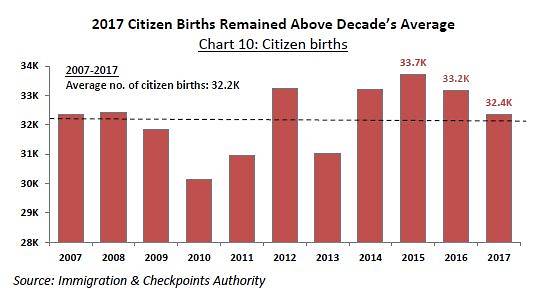
SINGAPORE: The number of babies born to Singaporean parents in 2017 is at a three-year low, according to the annual Population in Brief report released by the Prime Minister’s Office Strategy Group on Thursday (Sep 27).
There were 32,356 babies born to at least one citizen parent last year, compared to 33,167 in 2016. The average for the past decade is about 32,200.
(Graph: Prime Minister’s Office Strategy Group)
The resident total fertility rate fell from 1.2 in 2016 to 1.16 in 2017.
“This is due partly to a larger cohort of young Singaporeans (aged 19 to 29 in 2017) – many of whom are children of baby boomers – who are entering the peak childbearing ages, but have not yet had children,” said the report.
The median age of Singaporean mothers giving birth for the first time has remained at 30.3 for the past two years. It was 29.4 in 2007.
Meanwhile, the proportion of Singaporean women, aged between 30 and 39, who are or have been married but are without children also remained stable at 22.6 in 2017 and 2016.
For Singaporean women aged between 40 and 49, the figure dipped slightly from 11.2 in 2016 to 10.9 in 2017.
NUMBER OF MARRIAGES HIGHEST IN 10 YEARS
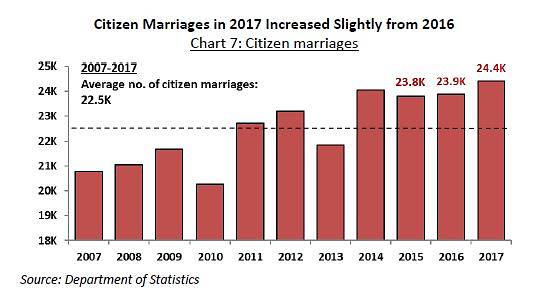
There were 24,417 citizen marriages in 2017 – the highest in 10 years and more than the 23,873 in 2016, according to the report.
Citizen marriages refers to those involving at least one Singaporean.
The median age at first marriage in 2017 was 29.8 years for citizen grooms and 28.1 years for citizen brides, similar to the previous five years, noted the report.
(Graph: Prime Minister’s Office Strategy Group)
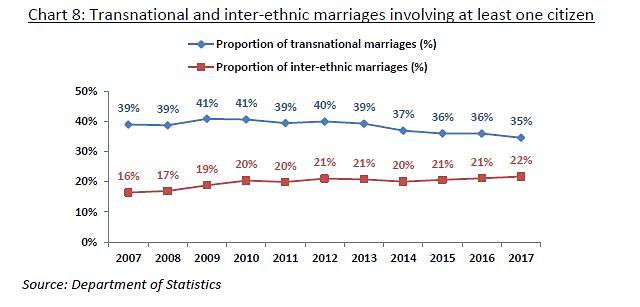
The report added that more than one in three citizen marriages last year were transnational, meaning it involved one Singaporean and one non-Singaporean.
There has been a steady increase in inter-ethnic marriages over the past decade, with about one in five citizen marriages being between people of different races.
(Graph: Prime Minister’s Office Strategy Group)
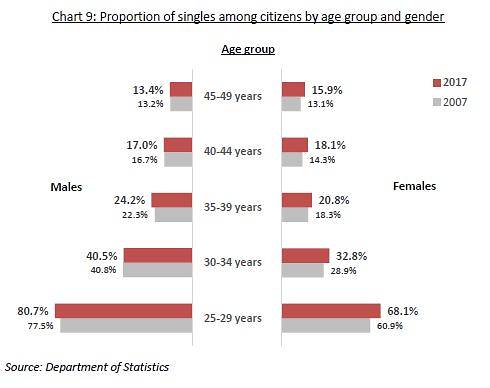
The proportion of singles among Singaporeans across most age groups has increased compared to 10 years ago, the report noted.
The biggest increase was among Singaporean women aged 25 to 29 – seven in 10 in this group were single in 2017 compared to six in 10 in 2007. For men in this age group, about eight in 10 were single last year.
(Chart: Prime Minister’s Office Strategy Group)
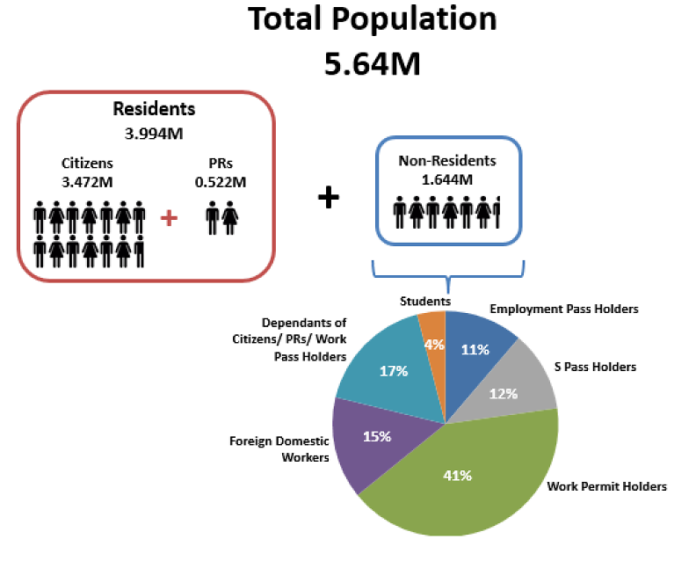
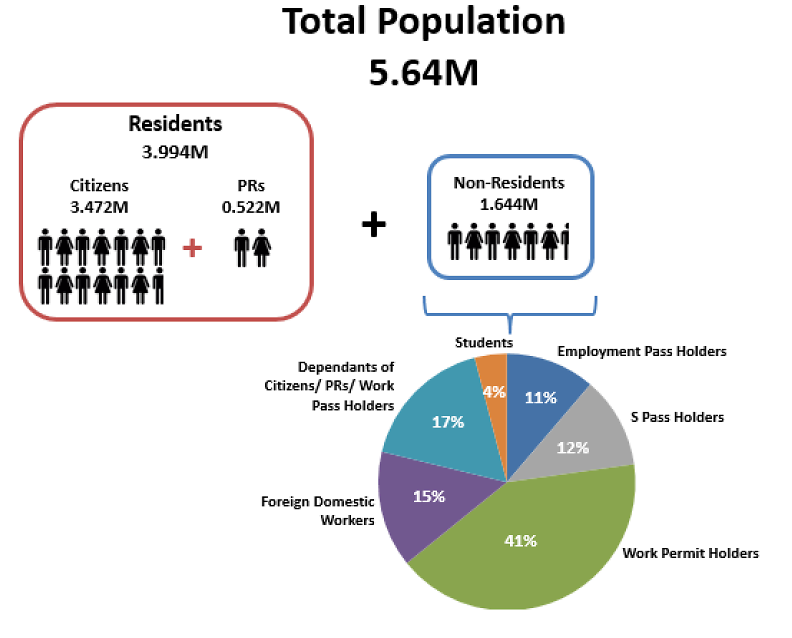
Singapore’s total population grew slightly by 0.5 per cent over the past year to 5.64 million as of June 2018. Non-resident population remained relatively stable at 1.64 million, said the report.
SINGAPORE: Singapore’s population rose 0.5 per cent to 5.64 million from 2017 to 2018, latest figures showed on Thursday (Sep 27).
The slight increase over the past year was mainly due to stable growth in citizen population, which rose 1 per cent to 3.47 million citizens as of June, according to statistics released by the Prime Minister’s Office (PMO) Strategy Group in its annual Population in Brief (PIB) report.
The 1 per cent growth in citizens was due to citizen births and immigration.
(Graph: Prime Minister’s Office Strategy Group)
There were 22,076 new citizens last year – the second-highest number in the last 11 years. The majority (65.7 per cent) were from Southeast Asian countries, with 28.6 per cent from other Asian countries and 5.7 per cent from countries outside Asia.
About 1,600, or 7 per cent, of new citizenships were granted to children born overseas to Singaporean parents, according to the report.
Singapore grants between 15,000 and 25,000 new citizenships annually “to individuals who are committed to making Singapore their home”, the PMO Strategy Group said in the report.
It added: “They either share family ties with Singaporeans, or have studied, worked or lived here for some time.”
The permanent resident (PR) figures, meanwhile, remained stable over the past year, at 522,000. In 2017, 31,849 were granted PR status.
Of the new PRs, 60.1 per cent were from Southeast Asian countries, 31.8 per cent from other Asian countries and 8.1 per cent from countries outside Asia.
Together, PRs and citizens made up 3.99 million residents in Singapore as of June 2018.
Number of Singapore citizenships and permanent residences granted. (Graph: Prime Minister’s Office Strategy Group)
The non-resident population also remained stable last year at 1.64 million, with a dip of about 10,000 from the previous year, according to the PIB report. The non-resident population includes work permit holders, foreign domestic workers and international students.
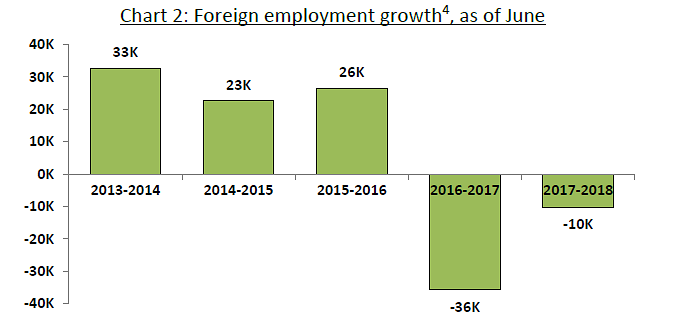
The decline, though not as steep as 2017’s, is mainly attributed to a decrease in work permit holders in the construction and marine shipyard sectors.
Foreign employment growth, as of June 2018. (Photo: Prime Minister’s Office Strategy Group)
The report also found that owing to increasing life expectancy and low fertility rates, the proportion of Singapore’s ageing population – aged 65 years and above – is rising, and at a faster pace compared to the last decade.
Between 2017 and 2018, the proportion of citizens aged 65 and above increased from 14.4 per cent to 15.2 per cent.
The median age of the citizen population rose from 41.3 years to 41.7 years in the same period.
SINGAPORE: The Life Beyond Grades campaign serves as a timely reminder to many parents not to pursue grades relentlessly to the detriment of our children’s health.
It is a worthy effort, as the education system moves towards imbuing creativity thinking and a lifelong culture of learning, and away from the focus on grades.
At the same time, it has been criticised as a tad frivolous, particularly to families who are banking on their children’s academic success to lift them out of dire straits.
While we don’t want to chase grades at all costs, the reality is that grades do matter, as long as employers look at educational qualifications as a signal and shorthand for hiring, and grades provide the only standardised way of sorting people.
Idealism needs to make room for the pragmatic. For many of us, our PSLE scores actually paved the way for our growth in both the academic world and the real one.
This three-digit score opens some doors and shuts others.
Thus, I worry that the campaign may inadvertently send the wrong message to children that they don’t have to work hard for good grades as they can still chase their dreams and fulfill them.
Times have changed as compared with 25 to 30 years ago.
There are more choices and pathways, from IB and IP to Normal and NT. These are positive changes, as the system works to ensure that no child is left behind. However, in reality, the wide range of options can be mind-boggling for a 12-year-old and his parents.
The practical thing to do then is to understand our children’s strengths and inclinations, look at their results, and choose the path that may suit them best.
But without good results, the options shrink.
While coming home with a red report card or going into the NT stream may not be the end of the world, we need to be honest with ourselves and our offspring.
When you start at the lower rung, the odds are stacked up against you, and it takes a greater amount of effort, self-discipline, and resilience to rise above this mountain.
Students attending a mathematics class at a primary school. (File photo: TODAY)
It makes for an inspiring news story at the end of the day, but can you imagine the process of getting there? Most would give up and resign themselves to a life of hardship.
I enjoyed reading the social media stories of ordinary people who carved their own version of success. The common thread behind each story is resilience, tenacity and hard work.
It is also likely that someone along the way gave these individuals a helping hand, be it in the form of giving them their first job, or introducing them to people who would, in other words – access.
For people in the lower-income group, it can be tough to gain access, to know the right doors to knock on, and to ask for help.
Indeed, grades, like the income bracket your family comes from, are not a be-all-end-all. There are other ways to level up, and one way is to nurture the unique personalities and talents within our children.
Instead of holding on to our ideals of what our children should be, we should investigate and find out how they’re naturally wired – an endeavour that requires parents to have a sense of perspective.
If they’re not academically inclined, their strengths may lie in another domain. For some, it could be in innovating and solving problems; for others, hands-on work.
I once spoke with head chef Koh Han Jie, who graduated with a National ITE Certificate (Nitec) in Western Culinary Arts. He entered the course by chance, but discovered his passion during the course when he did a six-month stint at Pierside restaurant. He eventually went on to win the highly-coveted Young Talents Escoffier 2018.
Koh Han Jie also won a competition for an internship at Gordon Ramsey’s Bread Street Kitchen in 2014. (Photo: Facebook/Koh Han Jie)
While others applaud his cool-headedness amidst such nerve-wrecking competitions, he credits his mother for his success, saying that she did not give up on him, and would show up at his competitions to support him.
Koh’s story shows if parents take time to nurture and affirm our children’s strengths and passions, it can be a powerful catalyst for success – regardless of grades.
The Life Beyond Grades movement is right in that grades may be a great enabler but head knowledge can only take us so far. Employers today are saying that soft skills such as innovation, communication, and resilience are essential. These innately human qualities will be increasingly in demand in the age of automation.
The movement also helps shine a spotlight on the fact that in a society that is less accepting of failure, children and adults alike learn to fear and shun it. It also means we shy away from challenges, instead of seeing them as crucial in one’s journey of growth.
As Koh’s story reveals, our children need our support, particularly in times of failure. Admittedly, it is hard to embrace our children’s failures wholeheartedly, but we can all show our young some compassion whenever they falter.
Herein lies the real story behind the success tales of those who did well in life despite getting bad grades – hard work, a positive attitude, and someone who did not give up on them.
A family walking in Singapore. (Photo: Gaya Chandramohan)
Not every individual will find it easy to accept a setback and pick themselves up. But each time they conquer a seemingly unconquerable mountain, their resilience muscle grows stronger.
As parents, we can empower our children to have a growth mindset, and to not fear failure. After all, is this not the great paradox in education – that we need both success and failure to be a lifelong learner?
So what do we tell our children about PSLE? That grades are not everything, like what the Life Beyond Grades movement is saying?
There is definitely more to life than grades, but we should not underestimate the difficulty of scaling that mountain after a fall. Grades are definitely important, and we should do our best with our talents and abilities.
While success cannot be boiled down to any one factor – whether grades, family resources, or personality traits – luck does favour the one who tries and perseveres.
But for every single success story, there are probably dozens of others with unfortunate endings.
Let’s help our kids put grades in perspective. Our children can still succeed in spite of poor grades but it is going to take a lot more effort.
They need to understand that the process of clawing back from setbacks and failures is not an easy one, and the tears and sweat cannot be neatly encapsulated into one insta-worthy shot.
June Yong is a mother of three, an educational therapist and owner of Mama Wear Papa Shirt, a blog that discusses parenting and education in Singapore.
SINGAPORE: Office workers and shoppers were evacuated from Ngee Ann City along Orchard Road on Wednesday afternoon (Sep 26) after a fire broke out at Tower B.
The Singapore Civil Defence Force (SCDF) said it was alerted to the incident at about 5.10pm.
“Upon arrival, SCDF located the source of smoke to a pile of smouldering trash accumulated at the bottom of a ventilation shaft within a stairwell,” it said in a Facebook post, adding that the fire was extinguished using a hose reel.
The smoke came from “a pile of smouldering trash” that had accumulated at the bottom of a ventilation shaft in a stairwell, SCDF said. (Photo: Facebook/Singapore Civil Defence Force)
There are no reported injuries, said SCDF.
According to witnesses, the fire alarm went off at around 5.20pm.
“We thought it was (a) false alarm or fire drill,” said a Channel NewsAsia reader who did not want to be named. He works on the ninth floor of the office and shopping complex.
“(We) started to evacuate when the receptionist told us it’s real as (there was a) strong burning smell,” he said, adding that people had to use the staircase to evacuate.
Smoke was also seen on the third floor of the building, according to Ms Belle Ong, an assistant manager who works in the building.
Firefighters responding to a fire at Ngee Ann City on Sep 26. (Photo: Belle Ong)
At least four fire engines were seen outside Ngee Ann City.
SCDF said Tower B was evacuated as a precautionary measure before its officers arrived at the scene.
At least four fire engines were seen outside Ngee Ann City. (Photo: Instagram/der_designer_)
People waiting outside the Ngee Ann City building after being evacuated. (Photo: Twitter/@weeteck)
People walking out of Ngee Ann City after the fire alarm went off. (Photo: Twitter/@weeteck)
People were allowed back into the building after about one-and-a-half hours, at about 7pm. A Ngee Ann City employee was heard making the announcement using a loudhailer.
“Sorry for the delay. You may now proceed back to your office,” he said.
The cause of the fire is under investigation, said SCDF.
This story came from tip-offs by several readers. If you would like to send in photos or videos of something newsworthy, WhatsApp our Mediacorp news hotline at +65 8218 8281 or message us on Facebook.
SINGAPORE: A new training facility opened on Wednesday (Sept 26) at Tuas Naval Base, to better prepare sailors for operations on Singapore’s warships.
The simulation centre, or SIMCEN, was opened alongside the commissioning of RSS Justice and RSS Indomitable – the navy’s fourth and fifth littoral mission vessels (LMV) to turn operational.
The centre is named RSS Daring to pay homage to those who stood guard over Singapore’s waters, and to also remind the Navy personnel of the vital need to defend Singapore.
The facility will use technology such as virtual reality and artificial intelligence. This will shorten the training time for each ship by up to 60 per cent, making it more efficient.
Minister in the Prime Minister’s Office Indranee Rajah, who was the guest-of-honour at Wednesday’s opening, said the LMV centre will facilitate more effective training.
“It will also support a full range of training from operator component training to mission-based training, giving the LMV crew valuable experience to ensure operational readiness,” she said.
“Training will be made more effective by using analytics to monitor the crew members’ performances. This will allow for prompt correction to enhance learning retention and speed.”
Ms Indranee Rajah trying out the throttle in LMV SIMCEN. (Photo: Facebook/Republic of Singapore Navy)
The feedback from Navy personnel have also been positive. Ye Yiming, commanding officer of RSS Justice said they are now better prepared to go to sea.
“My crew and I have gone through the entire training at the LMV simulation centre. From getting our skills to operating the LMV. Learning to work together at the cluster level and across the various clusters in the integrated command centre,” he said.
“This prepared us greatly for the sea, even before our ship Justice was ready to sail.”
The RSS Justice crew with Ms Indranee Rajah. (Photo: Facebook/Republic of Singapore Navy)
Sachael Teo, Marine Systems Operator at RSS Justice said the training facility allowed her team to build team synergy and gain more confidence.
“SIMCEN provides a safe environment for us to trial and error various procedures. Through the training at SIMCEN it has allowed me and my ship crew to build team synergy while responding to different kinds of scenarios. Thus we gain more confidence while sailing out at sea,” she said.
Sachael Teo, Marine Systems Operator at RSS Justice, said the simulator centre RSS Daring allows her team to build synergy and gain more confidence. (Photo: Facebook/Republic of Singapore Navy)
SIMCEN was jointly developed by the Republic of Singapore’s Navy and the Defence Science and Technology Agency. Two simulation halls will replicate the LMV’s integrated Command Centre, giving a 360-degree view around the ship.
SINGAPORE: More than 58,000 oBikes have been removed from public spaces around Singapore after the company went into liquidation earlier this year, the Land Transport Authority (LTA) said on Wednesday (Sep 26).
In response to queries from Channel NewsAsia, LTA said that it has been working with FTI Consulting, the liquidators of oBike Asia, to remove the bicycles from the streets. Some of those which were removed by LTA officers are now temporarily stored at holding sites and are being progressively removed to be scrapped, LTA added.
Thousands of oBikes parked at an LTA building near the Kallang-Paya Lebar Expressway (KPE).
One of the sites where the bikes are being stored is an LTA building situated between Pelton Canal and the Pan-Island Expressway (PIE), near the Kallang-Paya Lebar Expressway (KPE).
When Channel NewsAsia visited the area last weekend, thousands of bikes were seen stacked up in the grounds of the building.
Thousands of oBikes parked at an LTA building near the Kallang-Paya Lebar Expressway (KPE).
Thousands of oBikes parked at an LTA building near the Kallang-Paya Lebar Expressway (KPE).
When FTI Consulting was appointed as oBike’s liquidators, it said it would work with LTA and other vendors to ensure that oBike’s bicycles “continue to be collected and thereafter, realised in an orderly manner”.
In July, Channel NewsAsia observed oBikes being scrapped at a Tuas compound.
The bike-sharing company announced in June that it is shutting operations in Singapore, citing difficulties in meeting the new requirements put in place by LTA to tackle indiscriminate parking.
It owes users S$8.9 million in total, according to FTI Consulting’s senior managing director Joshua Taylor.
SINGAPORE: The newest batch of Nominated Members of Parliament (NMPs) were officially appointed on Wednesday (Sep 26) by President Halimah Yacob.
During the ceremony at the Istana, Mdm Halimah presented instruments of appointment to the nine NMPs, who are all new to the role.
Among the nine are Paralympian Yip Pin Xiu, general-secretary of the Singapore Port Workers Union Arasu Duraisamy, as well as executive chairman of Sakae Holdings Douglas Foo.
Ms Yip Pin Xiu receiving her instrument of appointment. (Photo: Jeremy Long)
Executive chairman of Sakae Holdings Douglas Foo receiving his instrument of appointment. (Photo: Jeremy Long)
The new NMPs will take their oath at the next Parliament sitting.
The Office of the Clerk of Parliament said it had received 48 proposals by the close of NMP submissions on Jul 6.
The names of those who qualified for appointment were then submitted to the eight-member Special Select Committee of Parliament for consideration.
The committee then submitted its list of nine nominees to the President.
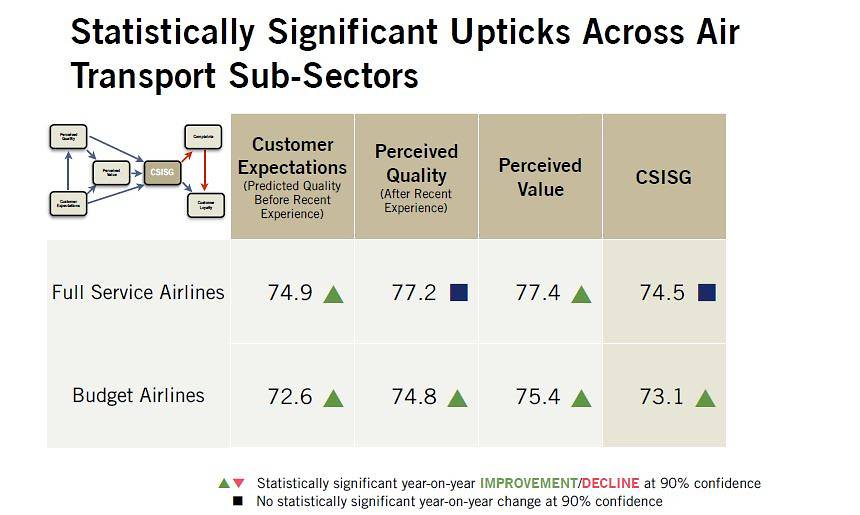
SINGAPORE: Customer satisfaction with budget airlines is catching up with full-service airlines, a survey released on Wednesday (Sep 26) by Singapore Management University (SMU) showed.
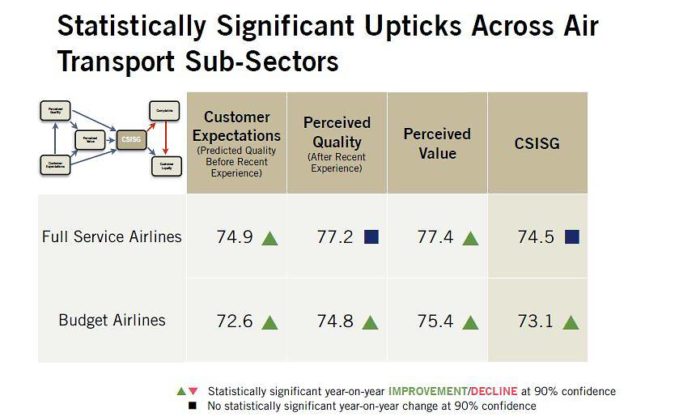
On the whole, the air transport sector scored 75.4 points on a 0 to 100 scale, a 1.4 per cent improvement over last year, according to the Customer Satisfaction Index of Singapore for the second quarter of 2018, a survey conducted by SMU’s Institute of Service Excellence (ISE).
The study also assessed customer satisfaction for the land transport sector, which scored 67.8 points, unchanged from the previous year.
In the last quarter, scores for budget airlines improved to 73.1 points, a 2.7 per cent increase year-on-year.
This is the subsector’s third consecutive annual increase in customer satisfaction, SMU said.
Meanwhile, full-service airlines have seen more modest improvements in scores, leading to a narrowing in the difference in satisfaction levels. This year, full-service airlines scored 74.5 points, similar to last year.
In 2014, the difference was 7.2 per cent. This year, the difference has shrunk to 1.9 per cent, SMU said.
Source: Institute of Service Excellence, Singapore Management University
“The performance metrics of budget airlines have been converging on full-service airlines for a few years now,” said Ms Neeta Lachmandas, executive director of ISE.
“This suggests (that) budget airlines, beyond using price as a lever, have been successful in shaping what travellers deem to be a high-quality mode for air travel.”
The survey also measured satisfaction with Changi Airport which went up slightly to 78 points.
LAND TRANSPORT
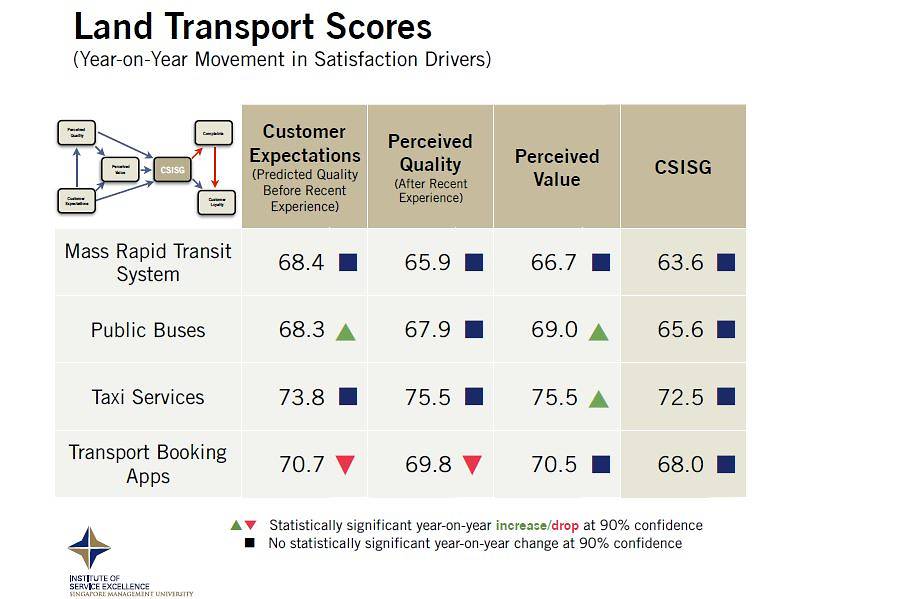
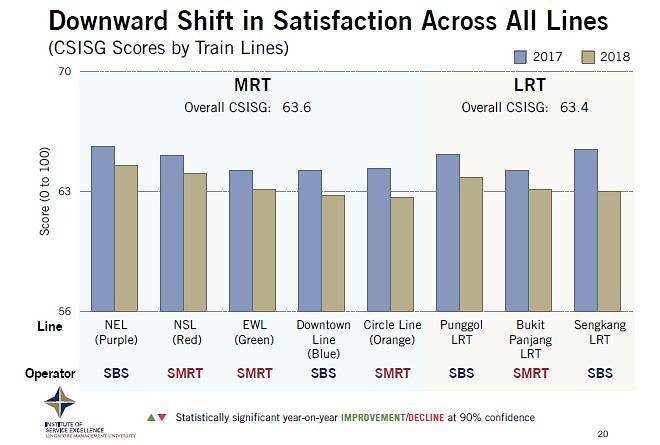
Customer satisfaction with public buses (65.6) and taxi services (72.5) saw a mild increase from last year, while satisfaction with MRT train services dipped to 63.6 points.
Customers were also less satisfied with transport booking apps which recorded a lower score year-on-year, at 68 points.
“However, these changes were not statistically significant,” ISE said.
For transport booking apps, customers registered significantly less satisfaction with the fares charged and the app promotions and discounts, which fell 7.7 per cent and 17.1 per cent, respectively.
This is the first time since CSISG tracking began in 2007 that customer satisfaction with public buses outperformed the MRT system with statistical significance, it added.
“The significant investments into the public bus system, such as the Bus Service Enhancement Programme, have seen the sub-sector record four consecutive years of improvement,” said Ms Lachmandas.
ISE said in its analysis that satisfaction, user trust, and confidence with the public transport operators were closely linked to commuters’ satisfaction with government intervention in these public transport systems.
Mr Chen said: “Improvement in several customer satisfaction metrics for our public bus and MRT systems seem to be tied to public perceptions of government intervention.
“Therefore, to most efficiently move the needle, our public transport operators should consider working closely with government regulators.”
A total of 6,249 respondents, comprising of 3,539 locals and 2,710 tourists, were surveyed between April and July for the study.