The reporting of each student’s progress iI various domains will be better balanced to reduce an excessive focus on marks, says the Ministry of Education.
File photo of students receiving their O-Level results.
(Updated: )
Bookmark
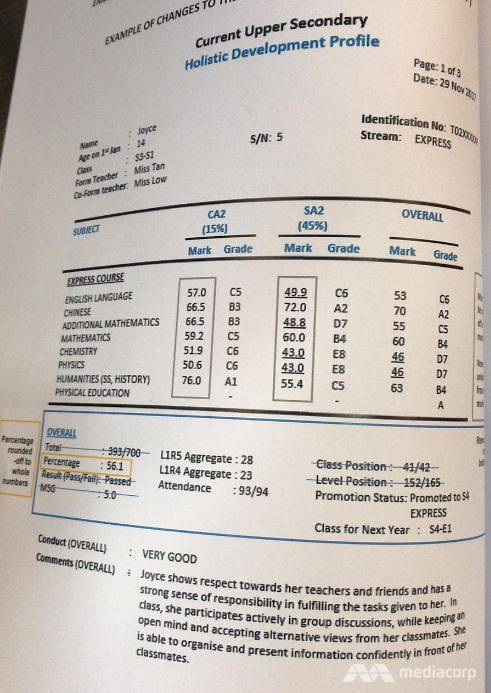
SINGAPORE: Starting next year, report books in schools will no longer show certain academic indicators such as the level and class positions of the students, the Ministry of Education (MOE) announced on Friday (Sep 27).
This is one of the changes MOE is making to move away from an overemphasis on academic results. It also announced that primary and secondary schools will reduce the number of examinations and assessments from next year.
The changes to the report book – also known as the Holistic Development Profile – aim to help students to focus on their learning progress and discourage excessive peer comparisons, the ministry said in a media release.
Apart from the class and level positions of students, the information that all schools will remove by 2019 include the minimum and maximum marks, mean subject grades and the overall total marks scored.
Marks for subjects failed will no longer be underlined or reflected with a different colour in the report book.
An example of changes that will be made to report books from next year.
With the removal of weighted assessments such as class tests at Primary 1 and 2 from next year, MOE said it will guide schools to use “qualitative descriptors” to report students’ learning at these levels.
For the other levels where marks are used to report students’ learning, these will be rounded off and presented as whole numbers, without decimal points.
However, non-academic indicators such as physical fitness, conduct and a student’s involvement in co-curricular activities will be retained at all levels. Form teachers’ comments as well as personal qualities with ratings will also be retained.
“With these changes, the reporting of each student’s progress in various domains will be better balanced, reducing excessive focus on marks,” said MOE.
In response to questions from reporters about whether parents and students would be concerned about the removal of the L1R5 aggregate score – which highlights a student’s results in English and five other subjects – in the report book for lower secondary students, Director-General of Education Wong Siew Hoong said that the score is meant for posting and admission purposes in the O-Level exams.
“It’s more applicable for Secondary 3 and 4 students,” he said. “We don’t want the lower secondary students to be so preoccupied with O-Levels three or four years in advance.”
SINGAPORE: Eligible Singaporeans will receive an SG Bonus of up to S$300 by December, the Ministry of Finance (MOF) said on Friday (Sep 28).
A total of 2.8 million Singaporeans will receive letters from Oct 2 onwards, informing them of their SG Bonus benefit, MOF said. The bonus will be paid out to citizens by December, it added.
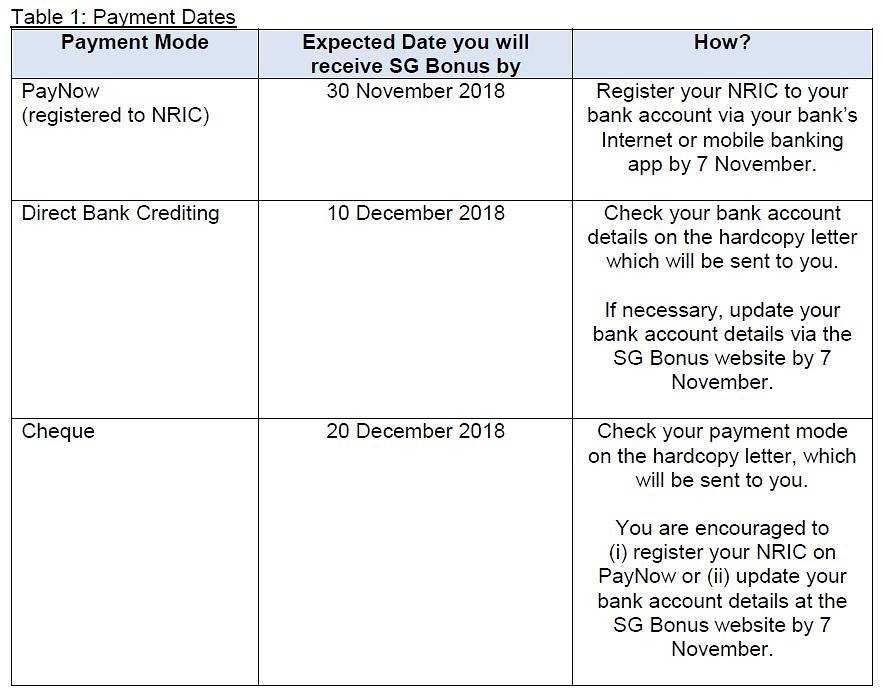
It added that this year, citizens can get the bonus through PayNow. Those who register for this mode of payment will get their payouts by the end of November.
“As announced at Budget 2018, the Government will be giving a one-off SG Bonus to all adult Singaporeans this year. This reflects the Government’s long-standing commitment to share the fruits of the country’s development with Singaporeans,” said MOF.
Eligible citizens will receive up to $300, depending on last year’s Assessable Income.
GET SG BONUS THROUGH PAYNOW
MOF said that it will be using PayNow to disburse the bonus to citizens who have registered their NRIC on PayNow as at Nov 7.
“Citizens are encouraged to register their NRIC on PayNow by Nov 7 to receive their SG Bonus earlier,” the ministry said.
They may do so via their bank’s mobile banking application or Internet banking platform.
Citizens who want to donate their SG Bonus may do so via the SG Bonus website (www.singaporebudget.gov.sg/sgbonus) or the SG Cares mobile application, MOF added.
They may use their SingPass to view their SG Bonus benefit online at the SG Bonus website www.singaporebudget.gov.sg/sgbonus from Oct 2.
Those who have registered their mobile numbers with SingPass will also receive SMS notifications.
Singaporeans who have signed up for any other government payout scheme in the past, such as Growth Dividends and GST Vouchers, will automatically receive their SG Bonus.
For those who have not signed up, their letter will inform them to do so.
They will have until Mar 31, 2019 to sign up online, or through a hardcopy form available at Community Clubs and CPFB Service Centres.
Those who require more information can contact MOF at 1800-2222-888 or email contactus@govtopup.gov.sg.
SINGAPORE: Calling for type O blood donors – Singapore’s stockpile of the blood type has fallen to a low level, the Singapore Red Cross and Health Sciences Authority (HSA) said on Friday (Sep 28).
The amount of type O blood in Singapore is currently about half of the required stockpile. About 500 donors are needed over the next two weeks to bring the national stockpile back to a healthy level, the agencies said in a joint press release.
Nearly half of patients in Singapore are from the type O blood group and can only receive blood of the same type, they added. Type O blood is also required for all patients during emergency situations when their blood groups are not known.
The Singapore Red Cross and HSA said they aim to have at least six days’ supply to meet the daily transfusion needs and bleeding emergencies in Singapore.
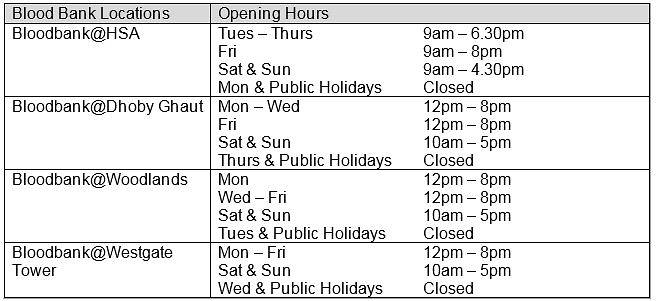
They urged donors to visit Bloodbank@HSA, Bloodbank@Dhoby Ghaut, Bloodbank@Woodlands and Bloodbank@Westgate Tower as soon as they can.
Graph shows locations and opening hours of blood bank locations. (Image: HSA/Singapore Red Cross)
Donors have to be healthy, aged between 16 and 60, and weigh at least 45kg. Those who have not made a donation in the past 12 weeks are also encouraged to donate.
Donors are advised to eat a light meal and drink plenty of fluids before a donation. They should also make sure that they have adequate rest the night before and on the day of donation.
Those aged 16 or 17 who would like to donate are required to bring a signed parental consent form. The form can be found on www.hsa.gov.sg/parent_consent.
Those who have not donated blood before in Singapore can visit www.hsa.gov.sg/donor_criteria or call 6220 0183 for more information or to make an appointment for blood donation.
SINGAPORE: Earlier this week, Singapore’s competition watchdog fined Grab and Uber a total of S$13 million over their merger, saying that the deal has led to a substantial erosion of competition in the ride-hailing market.
It is understandable for businesses to want to achieve growth and dominance, but the latest development has shown that they also need to consider their responsibility to consumers and in ensuring fair play.
As part of its investigation findings, the Competition and Consumer Commission of Singapore (CCCS) found that Grab trip fares, net of rider promotions, increased by between 10 and 15 per cent after the acquisition deal.
It highlighted changes Grab made to its loyalty programme as well as a decrease in the number and frequency of driver promotions and incentives.
The CCCS also found that Grab currently holds about 80 per cent of the market share, and that the “strong network effect” makes it difficult for potential competitors to scale and expand in the market.
As such, among other things, it has ordered Grab to remove exclusivity obligations on drivers and taxi fleets, and to maintain its pre-merger pricing algorithm and driver commission rates.
While maintaining that the ride-hailing firm completed the merger within its legal rights and “did not intentionally or negligently breach competition laws”, head of Grab Singapore Lim Kell Jay has said that for drivers to have full maximum choice, “all transport players, including taxi operators, should be subjected to non-exclusivity conditions.”
However, according to the CCCS, under competition law, dominant players can have certain measures imposed on them in order to ensure the contestability of the market.
Perhaps, in time, measures such as non-exclusivity conditions should be applied equally to all players in the spirit of fair play and to prevent a repeat of this situation.
A view of Uber and Grab offices in Singapore on Mar 26, 2018. (File photo: REUTERS/Edgar Su)
SIMPLY A MATTER OF STRATEGY?
The fact remains that the merger has had a substantial impact on commuters.
Some experts argue that what Grab has done in the Singapore market is a very natural thing for businesses to do.
The incentives it offered consumers initially were merely a strategy many industry disruptors use to acquire a larger market share.
It is to be expected that once this goal has been achieved, prices would rise as companies strive towards building a more sustainable business model.
While prices don’t have to go completely out of hand as industry players, including Grab, can build a suite of services other than ride-hailing to ensure sustainability, price increases certainly wouldn’t be inconceivable.
The problem perhaps is not so much that Grab managed to achieve market dominance and tweaked fares accordingly, but that it put in place practices such as exclusivity agreements.
When it comes to fares, one could argue that Grab is well within its right to tweak as it wishes.
If the terms of service change too unfavourably, consumers can choose not to reward Grab for its behaviour if it fails to provide value for money, hopefully leading to a correction.
Insisting that prices and driver commissions remain unchanged may be unrealistic. These should be governed by market forces.
However, can consumers realistically move away from using Grab today?
According to data released by the CCCS in June, Grab now has a market share of 80 to 90 per cent. ComfortDelGro has a share of 10 to 20 per cent, and all other players share 0 to 5 per cent.
After the CCCS decision, Grab Singapore said that commuters are “free to choose between street-hail taxis and private-hire cars, and it is a fact that private-hire car drivers’ incomes are directly impacted by intense competition with street-hail taxis”.
But if one considers this market alone and CCCS data, it seems consumers’ choices could also be curtailed because of some of Grab’s anti-competitive practices.
In a market devoid of these practices, perhaps taxi services and existing and new ride-hailing apps could give Grab a run for its money more easily.
But the fact remains that even today, consumers can consider using the services of smaller players or choose other options in the transport ecosystem such as taxis, buses and trains.
In the meantime, some of the measures taken by the CCCS should not be seen as concessions to smaller players or potential new entrants, but rather as levelling the playing field for fair competition.
The CCCS has said that it will suspend the measures it has imposed on Grab if an “open-platform competitor attains 30 per cent or more of total rides matched in the ride-hailing platform services for one calendar month”. The measures will also be lifted if such a market share is maintained for six months in a row.
Ride-hailing firm Grab insists its takeover of Uber’s business in Southeast Asia has not substantially eroded competition in Singapore. (Photo: AFP/Roslan Rahman)
Some may argue that 30 per cent is too high a threshold especially under the current conditions, and that CCCS intervening in this manner is detrimental to disruption in the long term.
However, allowing anti-competitive practices that discourage new players from entering the market could also clearly be detrimental to disruption.
The CCCS decision should be seen as being largely in the public interest and even friendly to disruptors.
But still, as consumers, let’s not come to expect low fares and fancy deals that last indefinitely.
It remains to be seen if more or large players will enter the market to indeed give Grab a run for its money.
The Grab-Uber saga has shown us that disruption is not smooth-sailing and ultimately, businesses will recalibrate their promises to consumers in order to ensure sustainability.
The CCCS would also do well to communicate what constitutes anti-competitive behaviour and apply rules, such as restrictions on exclusivity obligations, more consistently.
However, businesses too must come to terms with the fact that while exponential growth and dominance are tempting and only logical for them to want to achieve, they have a responsibility in maintaining fair play in a competitive market.
Bharati Jagdish is the host of Channel NewsAsia Digital News’ hard-hitting On The Record, a weekly interview with thought leaders across Singapore, and The Pulse, Channel NewsAsia’s weekly podcast that discusses the hottest issues of the week.
SINGAPORE: It was once an area struggling with a reputation as a tourist trap, with aggressive touting and overcharging complaints not uncommon. Aside from “unsavoury business practices”, the Singapore River precinct wasn’t exactly a pretty sight, said Michelle Koh, executive director of Singapore River One (SRO).
“We had overhanging cables running from shophouses to the outdoor refreshment area (at Boat Quay), and it was unsightly and not safe,” she said.
That was why seven landlords in the area came together to form an association in 2012, to help tackle these challenges in a more coordinated manner. Since then, Singapore River One has expanded to include over 110 property and business owners, managing Boat Quay, Clarke Quay and Robertson Quay.
Having a coordinated platform where all the stakeholders could have their say helped, said Ms Koh.
“One key thing we learnt from the onset was to listen to the stakeholders so we could bring their concerns and feedback to the various agencies, and see how we can overcome bad practices (by) educating business operators,” she said.
Since then, the association has cleaned up the area and pulled off more coordinated marketing and management efforts, such as the signature annual Singapore River Festival and St Patrick’s Day Street Festival, as well as a permanent car-free zone at Circular Road.
The St Patrick’s Day celebrations in Singapore at Boat Quay. (Photo: Facebook/St Patrick’s Day Street Festival Singapore)
Its efforts were also given a leg up when it took on the mantle of piloting Singapore’s first pilot Business Improvement District (BID) last April. Under the private sector-led model, asset owners develop detailed business plans, which must garner at least 51 per cent support from all property owners within the precinct’s boundaries. The government will then co-fund the collected membership fees, capped at S$500,000 annually for a four-year period.
Currently, SRO’s annual membership fees vary depending on the size of asset owners, from S$100 onwards for small business operators to a few thousand for landlords.
“In the past nobody knew what a BID was. Everybody was very reliant on the government sector to provide those resources,” said Ms Koh. “Our job was to get them to understand there will be a certain cap to what the government can do.
“The key thing was for us to band together, to be a collective voice in terms of marketing as well as asking ourselves what we want to elevate the Singapore River in terms of place-making initiatives.”
She added that these include organising new events such as a Halloween street party and installing mural art along the precinct, with plans to showcase more signage and benches in the area as well.
With more vibrant activities and a cleaner reputation, footfall has increased, with weekly visitorship increasing by 11 per cent, from 1.3 million in the first half of 2017 to 1.4 million in the first half of this year.
“Previously under the loose informal association set-up, the rules were not as clear,” said Ku Swee Yong, adjunct faculty member at Singapore Management University’s Lee Kong Chian School of Business.
“So every landlord and tenant involved would probably be considering their own interests first,” Mr Ku said. “Under the BID with a more formalised structure, there would be a lot of better coordination and ability to push through these programmes.”
Kampong Glam. (Photo: Wendy Wong)
BUSINESS IMPROVEMENT DISTRICTS A “GOOD IN-BETWEEN SOLUTION”
For these reasons, the Government is studying the feasibility of legislating BIDs in the future, by piloting another nine across a mix of precinct profiles, National Development Minister Lawrence Wong announced on Sep 17. These include the historic Kampong Glam, Central Business District (CBD) precincts of Tanjong Pagar and Raffles Place, as well as suburban precincts at Jurong Gateway and Paya Lebar.
“We have limited resources in terms of having Government policy planners look into every nook and cranny of Singapore. The Government’s master planning and policymaking would be for new precincts like Bidadari or Tengah, or rejuvenation of very old estates,” said Mr Ku.
“So for the Government to want to upgrade Raffles Place, taxpayers might protest – what’s wrong with Raffles Place that we have to spend to add sidewalks,” he said. “There would be certain parts of Singapore in their middle age or teen years that require a new lease of life to be injected. So this private sector-led with Government grants is a good in-between solution.”
A general view of the Raffles Place financial district in Singapore. (File photo: AFP/Roslan Rahman)
If legislated in the future, more precincts that might have missed out otherwise could also see a facelift under the BID model, said Mr Ku, citing the example of Changi Point.
“It’s is where water, sea and leisure sports people travel out to Pulau Ubin for its nature reserve. The community of retailers, service providers and F&B operators in Changi Point could start up a BID to provide better accessibility and connectivity by traffic and sheltered walkways that offer all-weather access,” Mr Ku said.
One of the selected precincts to pilot a BID is China Place, located a stone’s throw away from the more well-known Chinatown district. It’s an area bustling with the office crowd on weekdays thanks to the office crowd, but a ghost town on weekends.
In 2012, three landlords – Great Eastern, Frasers Property and Far East Organization – came together in an attempt to make the precinct more attractive, such as by building an overhead canopy to provide shelter for businesses and pedestrians to encourage more people to dine in outdoor areas.
The precinct also rebranded itself as China Place with design motifs found on the pillars and pathways across Nankin Row, China Square Central and Far East Square, linking the three malls and its connecting walkways.
While these efforts helped to improve traffic somewhat, they remained “limited”, said Low Chee Wah, chairman of the China Place pilot BID task force. “It was probably more of a limited effort because on our own, I think there’s much more limited resources.”
“A lot more can be done, particularly on weekends and weekday evenings. We hope that this pilot BID will give a formalised structure to do much more as there’s a lot of potential work to be done,” said Mr Low, who is also the retail and commercial head at Frasers Property.
The precinct’s plans include activating common spaces, improving wayfinding with signage as well as creating a more distinctive identity through signature events and festivals, to draw “not just occupants but visitors and potentially tourists to this area”, Mr Low said.
The shop interior of Sifr Aromatics at Kampong Glam. (Photo: Wendy Wong)
MANY VOICES, ONE TABLE
But getting support from a majority of stakeholders to approve the business plans for a precinct may not be easy, especially for areas like Kampong Glam, which houses over a hundred property owners with diverse needs and interests. So far, 11 stakeholders are on board the initial pilot BID task force, including shophouse owners, two hotel operators, as well as community partners such as the Sultan Mosque and Malay Heritage Centre.
One of them is third-generation shop owner Johari Kazura, whose family started a perfume trade there the 1930s.
“There’s a lot of voices at the table, different communities, types of owners, that are going to be represented. And that means that whatever happens to Kampong Glam, part of it is decided by this diverse group of people,” said Mr Kazura, who is the owner of Sifr Aromatics.
“Before this it was just growth, gentrification happening by itself while different groups, government groups or arts groups had different things they were doing to promote their work – there was no ‘everyone let’s sit down and see what we can do for this area’.”
To garner support, the task force will organise a series of meetings with stakeholders to share its plans and their benefits. It will also set up a new entity called Kampong Gelam Association to front the precinct’s BID, and will absorb One Kampong Gelam, the existing business association spearheading promotional efforts, said its chairman Olivier Lenoir.
“Now it’s an official system in place with a structure, and we’re recognised by the Government,” said Mr Lenoir, who is also general manager of Andaz Singapore.
“If this becomes legislated, we’d then be recognised and it’d become mandatory to be part of the Kampong Gelam Alliance if you’re in Kampong Glam.
“It’s the formality that’s very helpful. Being official means we’ll be bigger, bigger means more funds and more impact on the community. We’d have the funds and structure in place, and the team behind to support and assist us in the process.”
Having a single platform where all stakeholders can engage the government with was also a key reason why developers in the up-and-coming Paya Lebar precinct banded together to pilot a BID.
“We foresaw that when we wanted to put forth initiatives that having a unified voice was a very efficient way of liaising with the government to get some things implemented and to save the government some time, than soliciting individual input,” said Richard Paine, co-chair of the Paya Lebar pilot BID task force and managing director of Paya Lebar Quarter.
“Quite often individuals may have a very interesting idea, but when put forward to government agencies naturally they solicit other stakeholder views.”
“But from a pure efficiency point of view, if we can put forward an idea to Government agencies that has the overall support from all stakeholders, that in itself is a unified way to moving forward and getting things done.”
Such sentiment among private stakeholders is not uncommon, said Chou Mei, group director of conservation and urban design at the Urban Redevelopment Authority (URA).
“One of the things we have heard from BID stakeholders is that oftentimes they find it challenging to get different agencies at the same table,” she said. “As a collective, (the BID) is a good platform for them to play an advocacy role for them to have common platform to have dialogues with agencies to discuss plans for their precinct.
“If they have a good plan to manage precincts in a coordinated manner, I think agencies are prepared to let them have more autonomy in the way they want to use certain spaces or run certain events.”
REJUVENATING THE HEARTLANDS
Channel NewsAsia understands that efforts are also underway to explore whether pilot BIDs can be implemented in the heartlands, to inject new life in the public housing retail scene such as in Ang Mo Kio and Bedok.
But challenges remain, such as raising enough support from merchants and retailers, who must pay membership fees under the BID model, arranging for the use of public spaces under the purview of different town councils, and being mindful not to create disturbances to residents living nearby when planning events and activities.
“Merchant associations have already been implementing place management initiatives such as promotional activities and festive events in HDB towns and neighbourhood centres,” said a URA spokesperson.
He added that URA is working together with the Federation of Merchants’ Associations Singapore (FMAS), along with Enterprise Singapore and the Housing and Development Board to help heartland retailers participate in the pilot BID programme through the new Heartland Enterprise Centre, which aims to rejuvenate neighbourhood precincts.
The centre, which was announced on Sep 19, is a partnership between FMAS and the Singapore Institute of Retail Studies.
“When we plan a city, it is just the hardware,” said Ms Chou. “But for places to be liveable and lovable, it’s really the people and and activities that make it come alive. When we work closely with the community and private sector stakeholders, the impact is much better.
“Because the people on the ground know the places much better, they have an interest to promote their precinct, know the ground, and are better able to decide what they should do to set their precincts apart from other precincts.”
SINGAPORE: The environment ministers of Singapore and Malaysia on Thursday (Sep 27) agreed to enhance collaboration in new areas such as climate change, managing plastic and packaging waste as well as industrial pollution and radiation safety.
Those issues were discussed during an annual meeting between the environment ministries of the two neighbours, which was held in Putrajaya this year.
The Singapore delegation, led by Minister for the Environment and Water Resources Masagos Zulkifli, included senior officials from the ministry, the National Environment Agency and other government bodies.
Mr Masagos was in Malaysia for a two-day visit at the invitation of Ms Yeo Bee Yin, Malaysia’s Minister of Energy, Science, Technology, Environment and Climate Change.
Singapore’s Environment and Water Resources Minister Masagos Zulkifli meeting with Malaysia’s Minister of Energy, Science, Technology, Environment and Climate Change Yeo Bee Yin. (Photo: MEWR)
A host of environment-related matters were discussed, including the joint monitoring of water quality in the Straits of Johor.
“The two ministers agreed on the importance of good water quality in the Straits of Johor, and encouraged both sides to continue efforts to improve water quality by implementing measures to control sources of pollution,” said a joint press release by the two environment ministries.
On land reclamation works in the Straits of Johor, the ministers noted the potential transboundary impact of such activities, and agreed that it is important for both sides to fulfil their obligations under the United Nations Convention on the Law of the Sea.
Singapore Minister Masagos Zulkifli co-chairing the AEV Meeting with Malaysian Minister Yeo Bee Yin. (Photo: MEWR)
“In this regard, the ministers urged the Danga Bay Joint Task Force to work closely and resolve the issues pertaining to the findings of the bathymetry surveys at Danga Bay expeditiously,” said the joint press release.
Danga Bay, at the southern tip of Johor Bahru not far from the Causeway, is home to residential and commercial developments. Land in the area has been reclaimed for several projects.
Singapore and Malaysia also agreed to continue to update each other on policies to reduce harmful vehicular emissions and identify areas of cooperation.
In addition, the ministers acknowledged the progress made by ASEAN member states in addressing transboundary pollution, and reaffirmed their commitment to work together and with other countries on such issues.
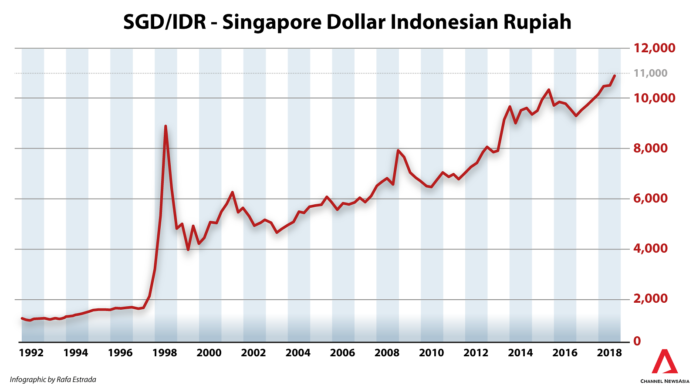
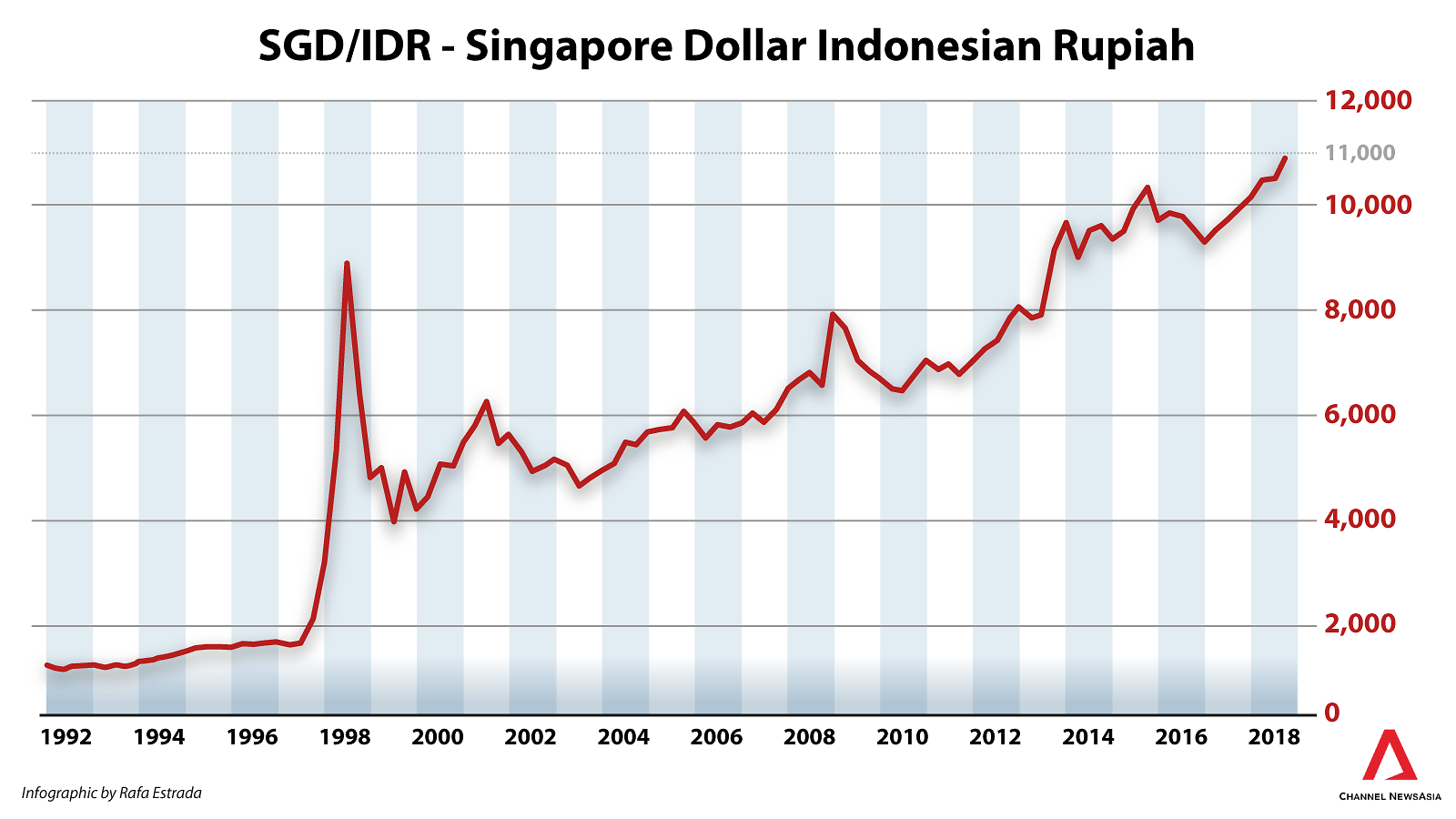
SINGAPORE: Indonesia’s rupiah dropped on Thursday (Sep 27) to its lowest level against the Singapore dollar since at least 1992, even as the government in Jakarta took measures to protect the embattled currency.
The rupiah slumped to as low as 10,968.35 against the Singdollar, amid a sell-off of Indonesian assets due to rising US interest rates, contagion fear from other emerging market crises and the China-US trade war.
Indonesia’s currency has not been this weak since at least 1992, according to Bloomberg data.
“At this point, it looks like emerging market pressures may persist for a while. This pressure has been going on amid the US interest rate normalisation and the Sino-US trade tensions,” said OCBC Bank economist Alan Lau.
The persistent weakening of the rupiah is, however, beneficial for visitors to Indonesia like Singaporean Herman Armando, who is able to use the rate to his advantage.
“Being half-Indonesian, it means so much more for me as I am able to go back more often to visit my relatives,” he told Channel NewsAsia.
A cheaper rupiah also benefits visitors from Singapore, like Ms Veronica Song, who frequent Batam for weekend trips.
“I’m very pleased because I go to Indonesia often with my friends. This will make it even more affordable for me to go there,” she told Channel NewsAsia.
On the flip side, the ongoing depreciation places pressure on the financials of Indonesian businesses.
“The ongoing depreciation on the rupiah has definitely taken a toll on our business in Batam,” Mr JT, the director of solar panel company Batam Surya Pertama, told Channel NewsAsia.
“Most of the quotations we have sent out have a two-week to one-month validity period. We have to honour those quotations even though the costs of shipping and materials have increased,” he added.
Indonesia hiked interest rates again on Thursday by 25 basis points to 5.75 per cent – its fifth rise since May – after the government said it was taking other measures to protect the weak currency.
“This (rate) decision is to control the current account deficit and to maintain the attractiveness of the domestic market in the midst of global uncertainty,” central bank governor Perry Warjiyo told reporters.
There have been growing concerns about Indonesia’s current account deficit, which expanded to its highest level in about four years.
The current account is a broad measure of a country’s trading relationship with the rest of the world.
A weak rupiah means it is more expensive to repay debts in dollars and other currencies.
“The authorities are worried about currency weakness because of the relatively high level of foreign currency debt in the country,” Mr Gareth Leather at research house Capital Economics said in a report after the rate hike.