SINGAPORE: Electricity tariffs will increase by an average of 2.1 per cent or 0.48 cent per kWh from Oct 1 to Dec 31 this year, compared to the previous quarter, SP Group announced on Saturday (Sep 29).
This is mainly due to the higher cost of natural gas for generating electricity, it said in the media release.
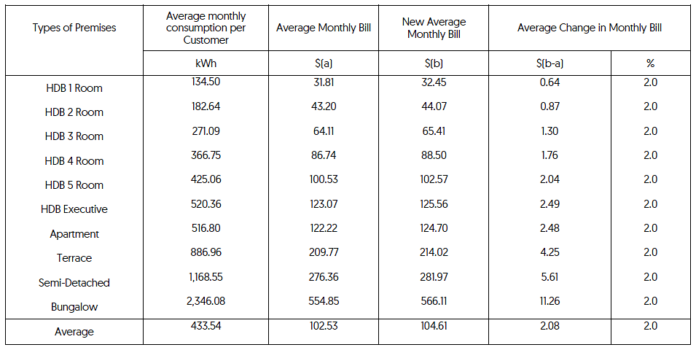
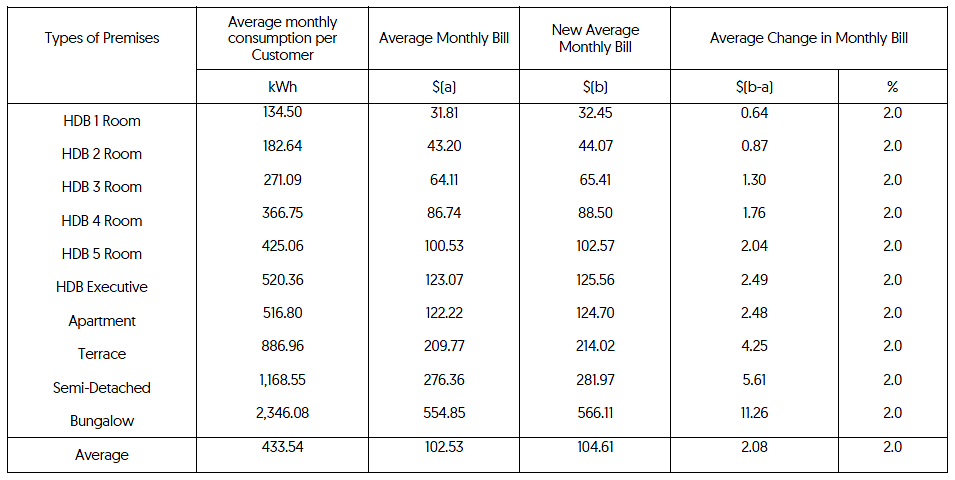
For households, the electricity tariff will increase from 23.65 to 24.13 cents per kWh. The average monthly electricity bill for families living in four-room HDB flats will increase by S$1.76.
Table showing the average monthly electricity bills of domestic customers; tariff with effect from Oct 1. (Table: SP Power)
SP Group reviews the electricity tariffs quarterly based on guidelines set by the Energy Market Authority (EMA), the electricity industry regulator.
SINGAPORE: His paper bus model may not look anything out of the ordinary, but Mr Cho Wen Wei is quite proud of it. By his reckoning, it is one of SBS Transit’s first paper bus models, “so it’s very valuable”.
His hobbies are collecting bus guides and memorabilia as well as exploring old interchanges, so one thing is for sure – he is crazy about all things buses.
“My family members call me a bus encyclopedia. It’s faster than checking the app,” he says with a smile. It is little wonder that he loves his job, as he gets to live his passion.
Mr Cho is in charge of cleaning and maintaining hundreds of buses – one of the unsung heroes working day and night to keep Singapore’s public buses running on the roads.
He may not be one of SBS Transit’s 6,500 bus captains whom commuters see every day, but he feels that he is “serving the public” no less.
“The bus industry is 24/7 from Monday to Sunday, even public holidays, so we need to work to support them at the back end, to ensure that the bus can go out and return every day,” he says.
Running Singapore’s biggest fleet – some 3,000 buses – is an immense task, as On The Red Dot found out after gaining unprecedented access behind the scenes of SBS Transit’s operations, from managing its network of routes to unexpected road conditions. (Watch the three-part special here.)
Here is how the bus operator’s teams do it, even if not everything always goes like clockwork:
1. BY MITIGATING TRAFFIC CONGESTION AND UNFORESEEN SCENARIOS
The nerve centres of the bus network are the operations control centres. Every bus on the road is linked to a centre, of which there are seven, each monitoring traffic conditions and the movements of over 500 buses on average.
The centre in Seletar Depot, for example, tracks 27 bus services to ensure that they run on schedule, covering a route network in Yishun, Ang Mo Kio and the Central Business District.
There are seven controllers on each shift, so each of them tracks about four bus services. They can relay instructions to bus captains, who can also report back on any accidents, traffic jams or incidents on board via a microphone.
The operations control centre in Seletar.
In this way, the controllers can adjust arrival times remotely, by telling the drivers to increase speed or slow down.
When one of the buses was ahead of schedule, for example, assistant service controller Francis Nah told the bus captain: “Slow down for two minutes. You’re too close to the front bus, causing bunching.”
Bunching occurs when two or more buses of the same service arrive at a stop together. This makes the service unreliable, creating longer waiting times.
Slowing down the second bus, however, is not the only solution. “If the front bus is too slow (and) the rear bus has already caught up … we’d ask the captain to safely overtake,” said Mr Nah.
Mr Francis Nah.
The most challenging service he must supervise is number 70, which goes to the central business district. “We do experience delays, especially during peak hour,” he said, indicating at one point that its buses were nine to 10 minutes late.
During the peak period, the controllers’ workload “gets doubled or tripled”, in step with the increase in the number of buses on the road.
Overseeing all of them is Service Controller Deng Ziliang, who is in charge of the centre’s operations –the “kingpin” as Mr Nah described him. And he usually has his hands full.
During one “tense” moment, after two buses broke down, another bus captain found a fault with a bus at the depot. “So now we’re trying to mitigate all these by swopping some buses,” he said.
Mr Deng Ziliang (right).
Sometimes his team is put in situations “beyond (their) imagination”, like the instance when the system they use to monitor the buses – the common fleet management system (CFMS), which uses a GPS locator technology – was hit by a connection problem.
Without the CFMS, they cannot communicate with bus captains on the road and cannot determine the actual location of buses.
To keep the situation under control, with peak hour looming, they used their phones to call the bus interchange personnel to continue their co-ordination work.
Once the server was rectified and the system was brought back online, it was business as usual and straight into peak hour traffic. “We need to react very fast because time doesn’t wait for us,” noted Mr Deng.
The common fleet management system, used by all four of Singapore’s public bus operators.
2. BY ENSURING STRINGENT MAINTENANCE 24/7
Public buses can operate up to 18 hours a day and thus require regular maintenance. Each bus goes through a three-hour check every two months.
At the workshop in Hougang Bus Depot – one of Singapore’s oldest bus depots, having opened in 1983 – teams of technicians and foremen are constantly checking and repairing their fleet of 600 buses.
Repair times depend on the bus models and faults. Some buses take 30 minutes to fix; others with major defects can take days.
“For us, a good day means there’s no bus breakdown,” said senior technician Amin Tugiman. “If a bus comes back, then we’ve got a big, big problem.”
The 59-year-old was one of the few technicians at the depot with the expertise to deal with one such bus that returned with an oil leak and in “quite a big mess”.
Despite his nearly four decades of experience, it was a challenge. His investigation found coolant leaks – an issue that, if untreated, can cause the engine to overheat and be damaged – as well as other faults.
He had to remove the water pump assembly, among other parts, clean the gasket area and fit in a new one.
Once the technicians have completed repair works on each bus, they must take it for a road test. The bus must meet certain criteria, such as travelling uphill and negotiating sharp bends.
They have a little help from technology, a computer, to see whether all the signs are good. Some faults, however, cannot be detected by computers, “so you still need the human touch”, said the workshop’s deputy manager Aw Boon Huan.
It takes six years, reckoned Mr Amin, to be a good technician who “understands these engine systems”.
“It’s a good place to work actually, but then maybe the environment (looks) greasy, and the younger ones try to avoid doing all these jobs,” he said.
The workshop has over 100 staff, and its technicians are between 20 and 60 years old. At his age, it can get tiring, Mr Amin admitted. “When we finish work, all our energy is drained out,” he said.
It is a reflection of the fact that the workshop never sleeps. “We operate for 24 hours, seven days a week,” said Mr Aw. “Even when we go to sleep, our phone is still beside us.”
3. BY WASHING THE BUSES METICULOUSLY
Another big operation is the washing of buses. At Bedok Depot, with a fleet of more than 600, this task is split into two sections.
Operation Wipe is the daily cleaning of the floors and windows, and Operation Wash covers everything from tyre rims and mirrors to handles and seats.
With a team of 30, Mr Cho is in charge of this process. To keep to a tight schedule, everything here must run like clockwork. “The constraint is basically the race against time,” said the operations officer (Garaging).
“We make use of the split-shift period to wash the buses. And when the buses come back, we must be fast enough to complete the scheduled fleet for the day.”
On average over a seven-hour period, around four buses are worked on per hour.
“So it’s non-stop for them. They need to continue washing one bus after another without a break,” said Mr Cho, who has five contract cleaners and two parking attendants to assist him.
He will inspect the buses once the washing is done – and he is meticulous. One of the buses was “quite clean”, for example, but he spotted some dirt in the bus captain’s area, and the dashboard was “a bit dusty”.
So he made sure that those areas were cleaned again.
4. BY PUTTING TRAINEES THROUGH THEIR PACES
Every week, there are 20 trainees learning the ropes to become an SBS Transit bus captain. The candidates would have to go through more than 30 days of theory lessons and practice, as well as sit two exams.
They must pass the basic test to proceed to the next level. In the advanced course, the training includes learning service routes and navigating busy bus interchanges.
Trainers like Mr Desmond Au, who joined the company four years ago and has trained over 200 recruits, are seeing more candidates in their 40s and 50s.
Many are making a mid-career switch, and with a failure rate of five per cent, most are expected to make the grade.
Some of them may be experienced drivers who have worked with heavy vehicles, such as tipper trucks or tourist coaches. That does not necessarily make the job of a trainer easier.
“They may look at you (and go), ‘Wah, I’ve got much more experience than you. How are you going to teach me?’” said 42-year-old Mr Au. Driving a bus, however, is another matter altogether, as he explained it.
“Driving a car, our front tyre is in front. You drive a truck – our tyre is below our backside. And now we’re driving a bus. Where’s our front tyre? Behind,” he said. “So that’s where they (make) a lot of mistakes.”
He is usually assigned six trainees in each new batch. And there are four cameras in the training buses recording every moment of the driving sessions, which he uses to review their performances.
Safety is the number one priority. As the trainees also find out, however, being a bus captain is not just about driving from point A to point B.
By his own admission, Mr Marshall Wong has a bad temper. But after his basic course at the Hougang Training Centre, he realised that a bus captain “should be very patient”.
“Previously, maybe I wasn’t at that stage, but now I’m trying to learn. I’m trying my best,” said the 40-year-old.
SINGAPORE: In a country where new culinary trends can take off very quickly, it is rare for a restaurant to thrive exclusively on a single cuisine, much less a single signature dish.
But two of Singapore’s oldest restaurant chains, established for almost as long as the nation has been independent, have done it.
As fusion dishes here get ever more quirky (laksa sushi?), No Signboard Seafood continues to churn out plate after plate of its signature chilli crab and white pepper crab, while Seoul Garden is still remembered by generations of Singaporeans as the first Korean food they’ve tasted.
Both brands, homegrown and established in as far back as 1979, have somehow avoided being thrown into the manic wave of rainbow bagels and rendang burgers, instead offering tried and trusted dishes.
But something has shifted over the past six months.
No Signboard Seafood CEO and chairman Sam Lim took over the family business started by his grandmother, in 1998. (Photos: No Signboard)
In June, No Signboard marked its official expansion into the beer market by completing its acquisition of Danish Breweries. Its Draft beer was distributed in local pubs and restaurants, and by the end of 2018, there will be canned versions available in local mini-marts and supermarkets such as NTUC FairPrice and Sheng Siong.
“The Singapore more than 30 years ago and the Singapore now are totally different,” said Mr Sam Lim, who in 1998 first joined the No Signboard family business founded by his grandmother.
“There was not that much F&B around here. Every F&B player did well because there was only a handful of us,” said the 41-year-old chairman and CEO.
“Everyone in Singapore is competing, like in Hong Kong. Brands want to come to Singapore because we have all these attractions – the F1, casino, Resorts World Sentosa, Universal Studios. It’s very attractive for tourists to come once, even twice a year. The competition became quite stressful for us. Then of course there’s also the rental and food cost – everything went up.
“We decided we needed to diversify,” he added.
Draft Denmark beer at Beerfest Asia. (Photo: No Signboard)
No Signboard has also signed a 10-year franchise agreement to bring the Little Sheep (Xiao Fei Yang) hotpot brand from China to Singapore, with one outlet expected to open annually within the first five years.
Singapore already counts local brands like Seoul Garden hotpot, plus foreign ones like Beauty in a Pot and Hai Di Lao, as crowd favourites.
“The question that most people, including our landlords, ask me is: ‘There are so many hotpot brands already; why bring in Little Sheep?’ Yes, it’s true almost all the good brands from China want to come to Singapore, but they’re all about the same. Little Sheep is different because it specialises in lamb from Mongolia,” said Mr Lim.
No Signboard also chose Little Sheep for its track record in China and the United States, the company revealed, adding that unlike hotpot chains that were started from scratch – such as Jumbo Group’s JPOT – they would not have to wait years to gain brand recognition.
No Signboard favoured the Little Sheep hotpot chain for its track record in China and the United States. (Photo: Facebook/Little Sheep Mongolian Hotpot, Edison)
And more initiatives are in the pipeline.
As soon as next month, No Signboard will launch a halal fast food chain called Hawker, which will sell burgers inspired by Singapore’s street food culture.
The first outlet will be at the Esplanade, with a menu boasting items like chilli crab burger, black pepper crab burger, Hainanese chicken rice burger, nasi lemak burger and roti prata wrap.
Plans are already underway to offer a 24-hour restaurant service to target the supper crowd, as well as expand the brand into Muslim nations.
This could be seen as a somewhat unusual venture for a company that has specialised in premium seafood, such as the Alaskan King crab, for decades.
“I like fast food very much,” Mr Lim explained. “I have to eat fast food almost every week.”
His goal is to put Singapore on the fast food map: “I’ve been studying the fast food scene and it’s a billion-dollar industry with companies like KFC and McDonald’s at the top, and their market cap is crazy amazing. There aren’t any Chinese or Asian fast food companies that are on the top 10 list. I’m thinking I want to put Singapore on it.
“The quick-service concept is the easiest way to introduce Singapore food to the world.”
“KOREAN PLUS”
Seoul Garden is another time-honoured local brand going through a shake-up. The Korean barbecue chain has been around for more than 30 years – long before the Korean Wave came crashing into the region.
Two Hana cafe and Seoul in a Sandwich are two new brands by the Seoul Garden Group that at Century Square mall in June. (Photo: Hidayah Salamat)
But as Korean electronics, makeup, music, food and even cleaning supplies garnered more interest, Seoul Garden was comparatively quiet.
It was only this year, on its 35th anniversary, that the company started inching back into the spotlight.
In June, a Korean fusion cafe called Two Hana by Seoul Garden Group opened at the newly revamped Century Square mall in Tampines. In the basement of the same mall, it launched takeaway toastie kiosk Seoul in a Sandwich.
Seoul Garden Group CEO Andrew Lee said that for a while, it felt like a good idea to just keep things as they were.
CEO Andrew Lee poses near the premium seafood offerings at the Seoul Garden outlet in Tampines Mall. (Photo: Hidayah Salamat)
“The business journey is like that,” he told Channel NewsAsia in an interview at the Seoul Garden in Tampines Mall – one of seven in Singapore. “Sometimes you feel like at that time, it’s better to be Korean.
“But your strategy evolves. You try this idea and then that, and whichever is better, you grow on it.”
The current strategy is something Mr Lee calls “Korean Plus”.
“The name Seoul Garden tells you about our ‘Koreanness’. But we’re from Singapore. When we’re here, people recognise us as being Korean. But when we go overseas, they see us as Singaporean. Globally, we’re not recognised as Korean and that places us at a disadvantage among other Korean brands,” he said.
“While trying to find a way to fit in the market, we discovered there was opportunity for us to grow not just in the Korean area, but in the ‘Korean Plus’ area. We can be Korean-international, while these other brands can only say they’re Korean.
Seoul Garden has been halal-certified since 2012. (Photo: Hidayah Salamat)
“Being Singaporean, we have a unique ability to adopt each other’s ideas and cultures. For example, it’s very difficult for traditional Korean brands to be halal. They don’t understand it, but we do and we can blend the cultures together,” Mr Lee added.
Both Two Hana and Seoul in a Sandwich were certified halal this month by the Islamic Religious Council of Singapore (MUIS) – a natural move for a restaurant chain that has been catering to Muslims since 2002.
“We’ve been halal-certified for so many years that it’s become part of our culture. We’re very strict – we have an internal auditor and an external consultant, and all the members of our staff are aware that the products we use must be according to what we submit to MUIS.
Chef Choi In-sun’s salmon soon dubu. (Photo: Seoul Garden Group)
The group’s core brands have also evolved.
Since May, diners have been able to top up S$5 to enjoy more “premium” buffet options such as sliced ribeye and salmon fillet at Seoul Garden.
The company has also partnered with Korean celebrity chef Choi In-sun to spice up the Seoul Garden Hotpot chain, which currently comprises six outlets here. Chef Choi’s soon dubu, a Korean soft tofu stew that comes in several spice levels and protein options, was introduced to the hotpot menu last month.
“THERE’S NO LOYALTY NOWADAYS”
After experimenting with flavoured beers for last year’s Beerfest, No Signboard’s Mr Lim said he is considering introducing them to the menu.
“That’s a concept for the future – having your chilli crab as you drink your chilli beer. When you look at the global beer situation right now, craft beer takes up about 5 per cent – that’s a lot,” he said.
“Thirty years ago, if you went to a coffee shop, everyone would be drinking Tiger beer. But now, if you go to a popular coffee shop, there’ll be 10 different brands, most of which you’re not familiar with.
One of the Draft beer ice-cream floats served at last year’s Beerfest. (Photo: Facebook/Draft Denmark)
“Youngsters like something new. There’s no loyalty nowadays,” he added.
The company has been targeting students since their earlier days, when they would book advertising space in cinemas.
“The young ones are important because they will eventually come out to work and earn money, and we want them to remember our brand when they do,” said Mr Lim. “Today, many youngsters visit No Signboard only with their parents, on someone’s birthday, because they have no spending power. But when they join the working class, we want them to bring their corporate clients to our restaurant.
The striploin bap at Two Hana. (Photo: Seoul Garden Group)
Seoul Garden is looking to court millennials as well.
Since its opening, Two Hana’s cafe concept has attracted hordes of young adults who come to try its menu, which features adventurous twists to traditional Korean dishes.
The bulgogi chicken linguine, striploin bap and truffle sidewinders with kimchi mayo are some of the eye-catching offerings, as are the Melona soda floats that feature the popular Korean ice-cream pop.
Customers trying Two Hana’s Melona soda float (left) and apple caramel waffles with doenjang caramel ice-cream. (Photo: Seoul Garden Group)
Seoul in a Sandwich offers a similarly quirky menu, with savouries like Army Stew-ich (inspired by the famous Korean budae jjigae) and gochujang egg mayo, as well as sweet treats like citron cream cheese and Asian pear.
At Seoul in a Sandwich, diners can submit their orders through iPad stations such as these. (Photo: Hidayah Salamat)
Unlike many cafes in Singapore with strict rules about working or studying in their space, Two Hana is happy to have diners linger over a cup of coffee or a snack, and provides a number of power outlets for those who want to catch up on work.
The company is also hoping to set up high tables at Seoul in a Sandwich in the mall basement for those who decide at the last minute to pause for a meal.
Both outlets have also adopted new technologies, with a digital rewards system at Two Hana and eye-catching self-order kiosks at the takeaway spot.
Both No Signboard and Seoul Garden are also on the verge of further overseas expansion.
Two Hana offers free Wi-fi and use of power outlets. (Photo: Hidayah Salamat)
The seafood restaurant chain, which has three outlets in Singapore, expects to open a Shanghai branch in Q2 next year.
Hawker outlets in other parts of Asia will soon follow, probably at the end of 2019, said Mr Lim.
There are also plans to stock their Draft beer with Yum China, which operates Little Sheep and thousands of fast food outlets including KFC and Pizza Hut across the country.
Meanwhile, Seoul Garden continues to grow “very quickly” in Malaysia, on top of outlets spread across Indonesia, the Philippines and Vietnam. Soon, Seoul Garden will land in Myanmar and in the next “two to three years”, in other markets as well, said Mr Lee.
“We’ll continue to grow Seoul Garden. We find that the brand has the potential to be a global brand. Soon, our Nex outlet will be the most modern Seoul Garden yet, featuring ninth-generation grills. We cannot keep up with Samsung, but we’re trying,” he said.
SINGAPORE: Xiao Jia*, 12, came to us as she could no longer cope with an intense fear of the upcoming Primary School Leaving Examination (PSLE).
She had set out to score more than an aggregate of 250 and didn’t want to disappoint her parents.
A plan of getting into her choice school, excelling later at the O and A-Levels, getting into her choice university course, and eventually securing a good job all hinged on doing well in this first national exam.
Her fears are not uncommon among her peers, albeit of varying degrees.
PRESSURE TO PERFORM AT EXAMS
Children and adolescents in Singapore face pressures at school and at home. Other than relationship and family problems, a commonly cited issue that afflicts many of the students we see at the Institute of Mental Health is academic-based stress.
A study conducted by the Organisation for Economic Cooperation and Development (OECD) found that Singaporean students were significantly more anxious about tests and grades compared to their international peers.
This intensified dread over academic performance may be due to a more competitive culture in Singapore.
The astounding story of Singapore’s success has been largely attributed to its system of meritocracy, one where the best and brightest rise to the top by their own merit and hard work, and tales of leaders emerging from humble backgrounds are largely celebrated as testimonies that the system works.
Singapore’s system of meritocracy in our education system is still based on academic success, and Singapore has done well in that aspect. It is ranked first in the 2015 Programme for International Student Assessment conducted by the OECD, based on assessments of 15-year-olds on reading, mathematics and science.
Students attending a mathematics class at a primary school. (File photo: TODAY)
However, despite the brilliant performance on global academic rankings, Singapore has produced proportionally fewer top-ranked scientists, inventors, entrepreneurs and business leaders.
When Deputy Prime Minister Tharman Shanmugaratnam was asked about this by CNN many years ago by Fareed Zakaria, he replied that Singapore was an “exam meritocracy”, compared to America which was a “talent meritocracy”.
Understandably, there is no perfect measure to gauge a multifarious concept of merit. But studies have shown academic achievement is positively correlated to later occupational performance, and remains a valid measure of merit in Singapore’s context.
Over the years, meritocracy has worked well to sieve out scholastically-inclined students, and develop them into prominent leaders and captains of industry.
This, in turn, reinforces the belief that doing well in school equates doing well in life and that conversely, doing badly comes with huge, adverse consequences.
Many students and their parents, driven by this belief, place utmost emphasis on academic achievement.
A competitive education system has put our students scholastically ahead of others globally, with benefits to individuals.
Studies have shown moderate amounts of stress and anxiety can motivate and encourage people to work harder and attain better performance.
Stress is an inevitable part of life, and exposing students to a reasonable amount in school builds resilience that will serve them well in their adult lives.
But an overly competitive culture can be detrimental for students’ mental health. High expectations can lead to excessive stress and anxiety, especially during major examinations that have perceived consequence for one’s future, such as the PSLE, and the O-, N- and A-Level national examinations.
File photo of a student taking the 2017 A-Level Chemistry paper. (Photo: Ruyi Wong)
In psychology, stress is the body’s reaction to difficult situations, real or perceived. This “fight or flight” stress response, evolutionarily developed to enable humans to escape from physical danger, manifests as physiological symptoms such as a quicker heart rate, hyper-ventilation and muscle tension.
While there are far less opportunities to meet physical or predatory threats in the modern society of Singapore, the stress response still remains in us.
For some students who place utmost importance on academic success, performing “poorly” in examinations could represent a form of failure or threat. This could potentially trigger a stress response in some students as they try to meet their expectations.
In extreme cases, prolonged stressful situations associated with tests and examinations leads to the development of performance anxiety in some students.
Some suffer intense emotional symptoms like fear, anger, depression or helplessness, while others exhibit behavioural symptoms like avoidance or irritability or cognitive impairment that include racing thoughts, minds going blank, difficulty concentrating and negative thinking.
People also experience rapid heartbeat, shortness of breath, nausea, diarrhoea or excessive sweating. In severe cases, test anxiety can lead to a full-blown panic attack, crippling the person with a sudden onset of intense fear and uncontrollable physical symptoms.
There are no exact causes of test anxiety, but studies have found that contributory factors include low academic self-concept, fear of failure, feelings of helplessness, and parental as well as teachers’ pressure on students – that may be intensified by a hyper-competitive culture.
Worse, test anxiety as a disorder inevitably leads to poor performance, as the distressing symptoms inhibit a student’s ability to absorb, retain and recall facts and information, and can lead to other mental health disorders such as panic disorder or depression.
We tend to underestimate the effects but anxiety and mood disorders are highly prevalent in Singapore, and carry a high disease burden due to the associated decreased work productivity and significant loss of function.
In cases when test anxiety becomes so severe that it develops into a psychiatric disorder and affects the student’s ability to function significantly, professional help might be needed.
HELP NEEDED
Parents can help their children by moderating their own expectations, and focus on their children’s efforts rather than their results. Regular and open dialogues about school and academic stress, and being empathetic towards their difficulties without making critical judgements can aid.
Ensuring that the basic health needs of our children, such as getting enough sleep, maintaining a balanced diet and exercising regularly, are met can go a long way. If necessary, a school counsellor can provide extra support.
However, it may be more useful to attenuate the development of test anxiety and other mental health disorders at a macro level.
A balanced approach where academically brilliant students are recognised and groomed, while the less academically inclined ones are supported and encouraged to pursue their interests based on their strengths, will be optimal.
We have already seen positive moves in this direction. There has been a shift in Singapore’s education system away from the narrow focus of grades and academic achievements. There were no final examinations for Primary 1 students since 2013, and the PSLE will do away with aggregate scoring from year 2021.
School rankings are no longer released to the public; and media reports have shifted from highlighting top scorers in national examinations to celebrating the achievements of students who overcame the odds and performed well.
FOCUS ON WELL-BEING
The idea that academic achievement is a necessary ingredient to obtain lifelong success has become a long-held but unhealthy belief ingrained into our culture. It is a momentous task to shift this national mindset to one that is more encompassing, more accepting and less competitive.
Yet, as Albert Einstein once wrote:
If you judge a fish by its ability to climb a tree, it will live its whole life believing that it is stupid.
There are many students who excel in other varied areas, such as arts, sports or music, and deserve to be recognised for these non-academic abilities.
At the same time, expectations should be set according to individual abilities, with appropriate cajolements to push our children to reach their maximum potential, but not to the point where it becomes corrosive to their mental well-being.
Meritocracy has driven Singapore well, scholastically, and economically. It has played a large part in contributing to our nation’s success, and will continue to do so.
However, it is also important to place emphasis on well-being and prioritise the mental health of students who are the future pillars of Singapore society.
Xiao Jia’s case has a happy ending for now. She was able to communicate her feelings of performance anxiety and high self-expectations to her parents and the treatment team during therapy sessions.
Her parents responded well and constantly assured her that what mattered more were her efforts and not the final aggregate or whether she eventually got into her choice school.
To help her cope with her anxiety, she was taught calming techniques as well as encouraged to embrace a positive mindset that could help relieve anxiety during examinations.
That year, Xiao Jia sat for her PSLE and successfully enrolled into a secondary school of her choice.
Brian Poh is senior clinical psychologist at the Institute of Mental Heath’s Department of Developmental Psychiatry.
SINGAPORE: Experts have described the Land Transport Authority’s (LTA) decision to reduce bicycle-sharing operators’ fleet sizes as a sensible move, but not all firms are pleased.
The authority said on Friday (Sep 28) that it will grant full licences to ofo, Mobike and SG Bike, and sandbox licences to Anywheel, Grabcycle and Qiqi Zhixiang. These licences will be awarded at the end of October, after the payment of licence fees by the operators.
The application of a seventh operator, GBikes, was rejected because it did not satisfy certain assessment criteria, LTA said.
Under the new licensing scheme, ofo and Mobike will be allowed to operate a maximum fleet of 25,000 bicycles each, while SGBike’s is capped at 3,000. Operating under a sandbox licence, Anywheel as well as Grabcycle will be allowed to operate up to 1,000 bicycles each, while Qiqi Zhixiang’s maximum is 500.
Bicycle-sharing operator ofo had submitted an application to operate 80,000 bicycles and said it was disappointed at the LTA’s decision to only allocate a maximum number which was less than half its current fleet.
In a press release, the company said it had facilitated about 100 trips every minute in Singapore this year, with each trip recording an average distance of 1.26 km.
“While we are pleased to be awarded the full licence by the LTA, we are disappointed that the awarded fleet size will not be sufficient to facilitate the high demand for bike sharing in Singapore,” said ofo Singapore general manager Isabelle Neo.
“Since our launch in Singapore, ofo has enabled about 35 million rides to our 1.2 million users, as their short distance mobility partner. With a smaller fleet size, access to a shared bike will be significantly harder for our users.”
Ofo bike-sharing bicycles are pictured in Singapore, Aug 29, 2017. (Photo: Reuters/Edgar Su)
Based on the new regulations, licensed operators can submit applications to expand their fleet sizes twice a year – in January and July. “Responsible licensees” that are able to manage their fleets effectively will be given the opportunity to grow their fleets, said LTA.
Local firm Anywheel also told Channel NewsAsia that it has recalled a number of bicycles back for upgrading to comply with the new regulations.
“We are delighted to be able to continue our operations in Singapore,” said Anywheel strategy manager RJ Seet. “Anywheel will be recalling the excess bicycles and preparing them for the next round of licensing in January.”
Ofo, which has a fleet of 80,000, has also begun to downsize its numbers.
Experts say that bicycle-sharing continues to play a key role in Singapore’s transport ecosystem despite the overall fleet size being reduced.
“There is an integral role for bicycles to play in Singapore but it’s just a question of how to make sure that bicycles are not indiscriminately parked and are in sufficient spaces where they are needed,” said Singapore Management University transport researcher Terence Fan.
“Hopefully, players can learn to efficiently manage resources and not just dump bikes in Singapore in a way that would have happened had the regulations not come into play.
“It’s a smart move (by the LTA), it does take some guts to impose it. It’s a painful trade-off that they (the LTA) is trying to make, but they would rather see it limited now first and see how these players get smarter with their operations.”
According to data provided by the LTA, the average utilisation rate for the entire shared bicycle population in Singapore was slightly more than one trip per day.
“This is much lower than the utilisation rates in other cities such as New York City and Chicago, where each shared bicycle is used about three to six times a day,” it had said in a media release.
Pointing to this data, Singapore University of Social Sciences (SUSS) transport researcher Walter Theseira noted that the number of shared bicycles currently in public spaces is “an unsustainably large number”.
“It makes sense that the LTA wants to cut the fleet size,” added Dr Theseira.
“I don’t think it was a case of people not being able to find a bike – rather it was a case of too many bikes. We were spoilt for choice, it was good for people looking for a bike but not so good for people trying to walk down a path.”
But not all firms will need to reduce their fleet sizes; local firm SG Bike plans to increase its fleet by 800 to hit the maximum allocated quota of 3,000.
“We always carefully consider our fleet size alongside the available resources and infrastructure before introducing more bicycles to ensure that we can manage our bicycles and that they are always in a good riding condition,” said SG Bike marketing director Benjamin Oh.
MoBike, which will be permitted to have a fleet of 25,000, said that it remains committed to its users in Singapore.
“Singapore was the first international city to welcome Mobike, and we look forward to continuing to be part of the city for many years to come,” said Mobike Singapore country manager Sharon Meng.
But, Dr Theseira warned that the regulations could hit some operators hard.
“This entire industry has been focused on market share and growth, that’s because their investors could be expecting them to turn in double-digit or triple-digit growth figures,” explained Dr Theseira.
“But now that we have made a decision to orient them towards profitability and sustainability instead, it remains to be seen that investors are interested in that.
“We will have to see what happens in the market, but I personally wouldn’t be surprised if the market consolidates.”
SINGAPORE: The move to shift away from academic results by having fewer exams in primary and secondary schools has been commended by parents Channel NewsAsia spoke to as a “good first step”.
However, they pointed out that it is still too early to tell if the move will truly make a difference in reducing the over-emphasis on grades. They added that even though the changes will be implemented progressively from next year, they hoped that at the school level, more details would be given about how the changes would be carried out.
On Friday (Sep 28), the Education Ministry (MOE) announced that all weighted assessments – which could take the form of class tests, presentations or group projects – would be removed for all Primary 1 and 2 students from next year.
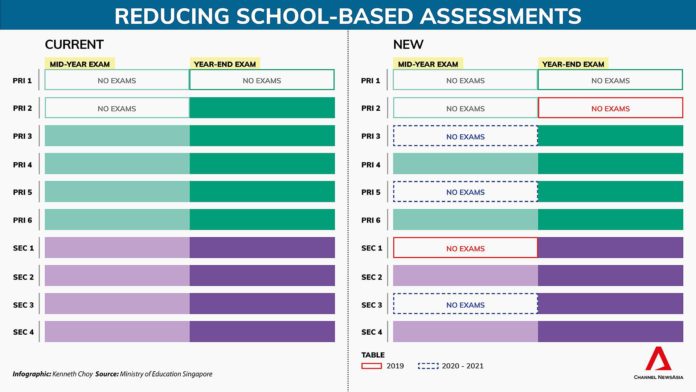
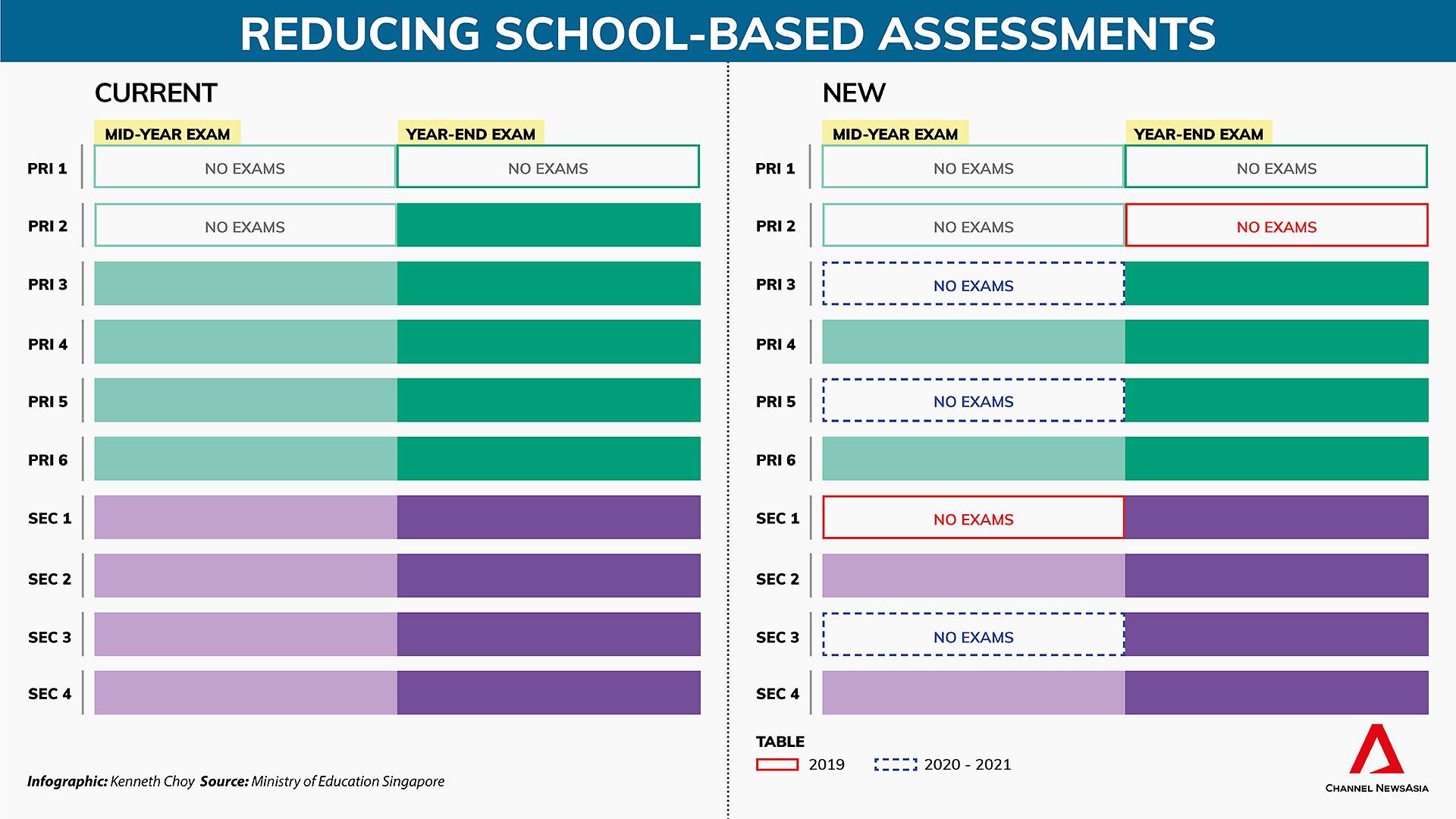
Mid-year examinations would also be removed for Secondary 1 students from next year. By 2021, the same will be done for Primary 3, Primary 5 and Secondary 3 students.
The levels were chosen, according to MOE, because they are “transition years” where students will be exposed to new subjects and higher content rigour.
TARGETING ‘TRANSITIONAL YEARS’ WELCOMED BY PARENTS
Mother-of-one Teo Kei Hoong said the move to have exams only from Primary 3 onwards is a good one because some children experience adjustment issues going from kindergarten to a primary school environment.
Madam Teo, who volunteers at a parent reading programme at a primary school, said she observed that students do not enter primary school with the same levels of literacy.
“The programme is run by parents for those who are weaker in reading. They went through kindergarten but perhaps did not get the right education. So when they come to us, some of them cannot even spell simple words like three-letter words,” said Mdm Teo, who is a part-time fitness instructor and homemaker.
“Going to Primary 1 is a very steep learning curve for them and to actually have to go through exams, especially the final-year exam, I don’t see it as necessary,” she added.
Another parent Evelyn Liu, who works as an associate lecturer, said that the scrapping of mid-year exams from the so-called “transition years” would have been especially helpful for her daughter a year ago when she was in Primary 5.
Currently, some schools carry out subject-based banding to match a child’s competency in a subject to the appropriate class combination.
“The challenge we had from the system that she is in right now is that from Primary 4 to Primary 5, there is that streaming and then Primary 5 was a very big jump in terms of the curriculum and in her performance,” Ms Liu said.
Teachers even told her to taper her expectations of her daughter’s results and that it is “very normal” for the child to experience a drop in her results.
“Why should parents be told to ‘expect a jump or drop in performance’ come the beginning of Primary 5? The curriculum should be delivered across gradually across all six years rather than the sudden jump in Primary 5,” Ms Liu added.
Ultimately, whether the shift is a beneficial one or not will depend on how schools implement the changes and how they spread the curriculum wider with the extra time, said Ms Liu. She agreed that more time, even just three weeks, will be helpful for students.
PARENTS PREFER TESTS OVER EXAMS
In a bid to move away from over-emphasising academic results, MOE has reduced the number of school-based exams but added that teachers can continue to assess students through tools such as worksheets, classwork and homework.
Removed exams can be substituted with class tests as well, but the ministry will set guidelines so that there will only be one class test per subject per term that will count towards the final score, said Minister Ong.
Lawyer and mother-of-two Anna Quah welcomes the shift from exams to tests, but said that it must be made clear to all that class tests should only act as “checkpoints”.
Class tests, she observed, are on a smaller scale and are usually interspersed throughout the year.
“When it’s a bite-sized chunk that way, it becomes a true assessment of what they have learned … as opposed to an exam where you cram and go for tuition or enrichment,” Ms Quah said.
“It just becomes an artificial representation of your ability to perform in an exam setting as opposed to an accurate depiction of whether the child has learned and absorbed, and his ability to apply,” she added.
Ms Quah also said that the latest changes will help in a certain way, but more attention should be put on shifting the objective of exams from one of scoring to one of learning.
Another parent Samantha Anderson said that her daughter found it less stressful when her school, Ngee Ann Secondary, removed mid-year exams last year.
“Actually having no exams in primary schools wouldn’t hurt our kids. The teachers would have much longer to teach the students more, with more opportunities to make learning fun,” Ms Anderson said.
“Let’s give teachers the much-needed space to breathe,” she added.
SINGAPORE: Fourteen residents of the Singapore Boys’ Home have been arrested for rioting, the police said on Friday (Sep 28).
Authorities said they received a call for assistance at about 5.50pm on Friday, adding that two male employees of the home were taken to Ng Teng Fong General Hospital with minor injuries.
An auxiliary police officer was also taken to hospital, said the Ministry of Social and Family Development (MSF).
Police arrested 14 residents of the Singapore Boys’ Home for rioting on Friday (Sep 28). (Photo: Ahmad Khan)
It added that the police were called in after a group of residents “behaved in an unruly manner”.
“Police investigations into the conduct of the group of boys are ongoing,” said MSF in a statement.
The Singapore Boys’ Home, located in Jurong West, is a juvenile detention centre run by MSF.
In 2016, 26 youths from the home sparked a six-hour standoff with the police when they barricaded themselves in their rooms, destroyed and vandalised property after their plan to escape failed.
SINGAPORE: The redeveloped Funan mall will open two months ahead of schedule in the second half of 2019, instead of the projected third quarter, thanks to smart technologies used in its construction.
This was announced on Friday (Sep 28) during its topping out ceremony, which marked the integrated development’s structural completion.
Its developer CapitaLand adopted new construction methods, such as virtual design and construction at the onset, as well as a top-down construction method for the building’s basement and main structure to be built simultaneously.
Precast concrete structural building components were also used to help cut down the construction time.
According to CapitaLand, this has resulted in manpower savings of around 15 per cent.
An artist’s impression of the redeveloped Funan mall. (Photo: CapitaLand)
MALL TO FEATURE TECHNOLOGY LIKE FACIAL RECOGNITION
Aside from its construction, the S$560 million project was also designed around technological innovation.
The six-storey retail mall will be the first in Singapore to showcase a smart interactive directory which will use facial recognition technology to sort shoppers into demographic groups using factors like their gender and age, and recommend suitable stores to them.
Sensors will also be placed throughout the mall, providing data on shopper traffic and demographics through video analytics, allowing retailers to tailor more attractive offerings, said CapitaLand Retail CEO Wilson Tan.
“This facial recognition is anonymous in nature, whereby looking at people coming into the mall, all our social media digital walls can then showcase products more relevant to people visiting the mall,” said Mr Tan.
“Examples would be if we’re sensing more males coming in, and they’re middle-aged males, we can then profile products relevant to them,” he said. “During the weekends, we may see more families coming in, and that’s where we are able to showcase a different set of products.”
The mall’s retailers will also be able to analyse consumer data and insights – such as their age, gender and their purchases – via a merchant dashboard, with the data generated through CapitaLand’s membership app.
Finance Minister Heng Swee Keat at Funan’s topping out ceremony on Friday (Sep 27). (Photo: CapitaLand)
PREPARING FOR THE DIGITAL ECONOMY
Adopting such technology is crucial in order to thrive in the digital economy, Finance Minister Heng Swee Keat said during his speech at the event, citing Funan as a positive example of keeping pace with the times.
“The original Funan Centre, when it opened in 1985, was a general shopping centre,” said Mr Heng. “However, following the late 1990s’ tech boom, it was the sixth floor, the Computer Mart, that expanded and eventually occupied a large part of the mall.”
“Just as how Funan adapted to the previous tech boom and re-branded into the IT mall we knew and loved, Funan is now undergoing the next stage of transformation, to prepare itself for the digital economy,” Mr Heng said.
“With technology so deeply interwoven into our daily activities, even shaping our preferences as a consumer, retailers have to transform and adapt to this new normal.”
The former Funan DigitaLife Mall, which closed its doors in 2016 for redevelopment, will be replaced with a six-storey retail mall, two six-storey office blocks, as well as a co-living serviced residence called lyf Funan.
The retail and office components will be completed in the second half of 2019, while lyf Funan will be completed in the fourth quarter of 2019.
SINGAPORE: Primary and secondary schools will reduce the number of examinations and assessments students are required to sit from next year, as part of efforts to reduce the emphasis on academic results.
The move, announced by the Ministry of Education (MOE) on Friday (Sep 28), will provide students with more time to adjust during “key transition stages”. Older students will also get more time to adjust to new subjects and higher content rigour, the ministry said.
The changes will be implemented in stages, beginning with the removal of all weighted assessments and exams for Primary 1 and 2 students from next year. Weighted assessments, said MOE, can take various modes such as class tests, presentations or group projects.
Currently, Primary 1 students do not have exams, but weighted assessments are conducted throughout the year. Primary 2 students now have weighted assessments throughout the year, as well as a year-end exam.
Secondary 1 students will also no longer have a mid-year examination from next year. From 2020 and 2021, this will also be removed for Primary 3, Primary 5 and Secondary 3 students.
Explaining the change, MOE said these are “transition years”, during which students will be exposed to new subjects and higher content rigour. “We want to provide them with adequate time and space to adjust to the increased curriculum demands,” said MOE.
The removal of the mid-year exams will free up about three weeks of curriculum time for each two-year block, such as Primary 3 and 4, Primary 5 and 6, Secondary 1 and 2, and Secondary 3 and 4. “Schools will use this time to pace out teaching and learning, and leverage engaging pedagogies to deepen understanding, and develop 21st century competencies in students,” said MOE.
Besides this, schools will conduct no more than one weighted assessment per subject, per school term, for all levels from Primary 3.
SCHOOLS HAVE DONE THIS WITHOUT AFFECTING RESULTS: ONG YE KUNG
Education Minister Ong Ye Kung described the changes as a step forward in improving the balance between the joy of learning and the rigour of education.
“It will send a strong signal that we are at a strong position of rigour, and can afford to unwind a bit without undermining the performance outcomes,” he said at a press conference on Friday.
This will also encourage teachers to explore more optimal ways of teaching, he said. For example, with an additional three weeks of curriculum time every two years, there could be more hands-on learning or investigative lessons.
“On the ground, teachers are on a high-speed train. Rushing, getting curriculum taught, and then do assessments, drills, and preparing the students for exams which is deemed as high-stakes,” he said. “I think it’s time to take a pause.”
He added that even before Friday’s announcement, some schools have already removed some examinations of their own accord.
“Judging from the schools that have already tried this, it hasn’t affected their PSLE, O-Level results or posting,” he said. “So I am confident that when implemented across the system, it should have a similar outcome.”
He also reiterated his stand on whether the Primary School Leaving Examination (PSLE) would be removed. In a wide-ranging speech in Parliament in June, Mr Ong said that the “sacred cow” of PSLE has survived for some “very valid reasons”.
“I’ve stated our position in Parliament,” he said, in response to questions from reporters. He added that the PSLE is an important system to take stock of a child in their first six years of education.
“Doing away with it will not help.”
EDUSAVE ACADEMIC AWARDS CRITERIA TO BE REVISED
With the removal of all weighted assessments at Primary 1 and 2 next year, MOE will also adjust the academic criteria for awarding the Edusave Merit Bursary to these students, as well as the Edusave Good Progress Award to Primary 2 and 3 students.
The selection of both awards at these levels will no longer be based on academic scores, said MOE. Instead, the eligibility criteria will be adjusted to recognise “positive learning orientations” such as diligence, curiosity, collaboration and enthusiasm in daily lessons and learning activities.
Currently, the Edusave Merit Bursary is awarded to Singaporean students who are in the top 25 per cent of academic performance of their level and course, and whose household income does not exceed the prescribed income criteria. The value of the bursary ranges from S$200 to S$500, depending on the students’ level.
The Edusave Good Progress Award is meant for Singaporean students who are not recipients of any Edusave Scholarship or the Edusave Merit Bursary, if they are within the top 10 per cent of their level and course in terms of improvement in academic performance.
SINGAPORE: Six Singaporeans were arrested and 11kg of cannabis was seized in a Central Narcotics Bureau (CNB) operation on Thursday, police said in a press release on Friday (Sep 28).
CNB officers were deployed in the Tuas Industrial Estate to look out for a group of suspected drug traffickers and at about 7.20pm, they spotted three suspects arriving in a blue Suzuki. A while later, a white Volkswagen also arrived at the scene.
Officers observed the rear passenger of the blue Suzuki – a 21-year-old man – approaching the white Volkswagen. The latter car then drove away and the man returned to the Suzuki.
Officers then arrested the three suspects in the blue Suzuki, the rear passenger and two other men aged 20 and 21. Authorities also seized 11kg of cannabis and 31 LSD stamps from the vehicle.
A small packet of Ice recovered from a bag belonging to the 26-year-old suspect. (Photo: CNB)
Meanwhile, authorities followed the white Volkswagen to a car park around Tampines Street 21. The car was parked and two men – aged 26 and 29 – emerged from it, and were arrested.
Officers recovered 524g of Ice from the car, as well as another small packet of the drug from a bag belonging to the 26-year-old. Raiding the suspect’s home in the area, they found a further 16g of cannabis and a small amount of Ice.
A 26-year-old woman suspected of drug abuse was also arrested in the unit.
Investigations into the drug activities of all suspects are ongoing, said CNB.
It also said that 11kg of cannabis is enough to feed the addiction of 1,570 abusers for a week.