SINGAPORE: A Singaporean on a paragliding trip to Indonesia found himself caught in the middle of the devastating quake-tsunami that hit the island of Sulawesi on Friday (Sep 28).
Mr Ng Kok Choong, a 53-year-old retiree who was in Palu to take part in a paragliding competition, had just left the Mercure Hotel where he was staying at when “the earth suddenly started shaking very violently”.
“I fell to the ground immediately and I couldn’t even sit down to stabilise myself. I was rolling around and I could see a horse cart had also fallen to the ground,” said Mr Ng as he described the initial moments of the earthquake that has since left at least 832 dead.
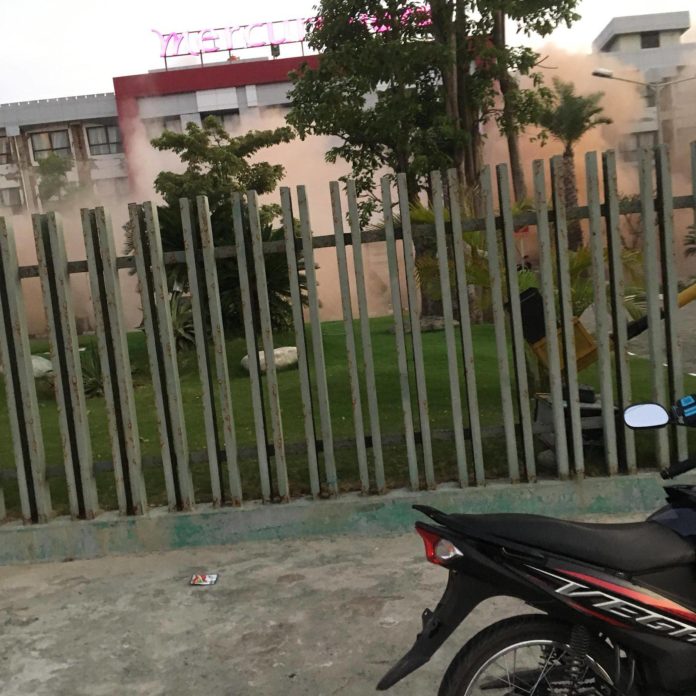
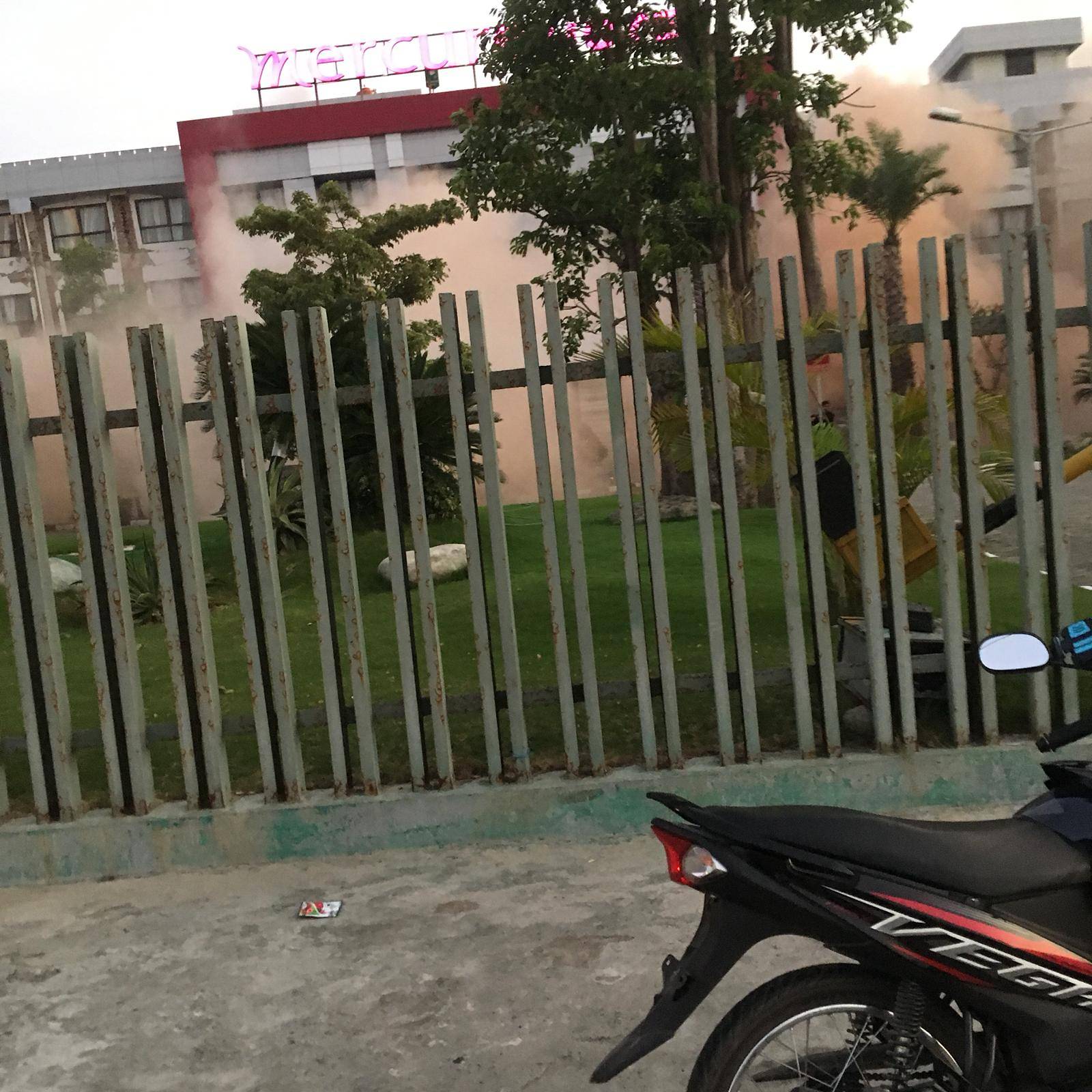
“I saw the hotel shaking like jelly, there was dust all around and the moment that happened, the hotel collapsed,” continued Mr Ng who with his friend Francois were just 50m away from the Mercure Hotel building when it collapsed.
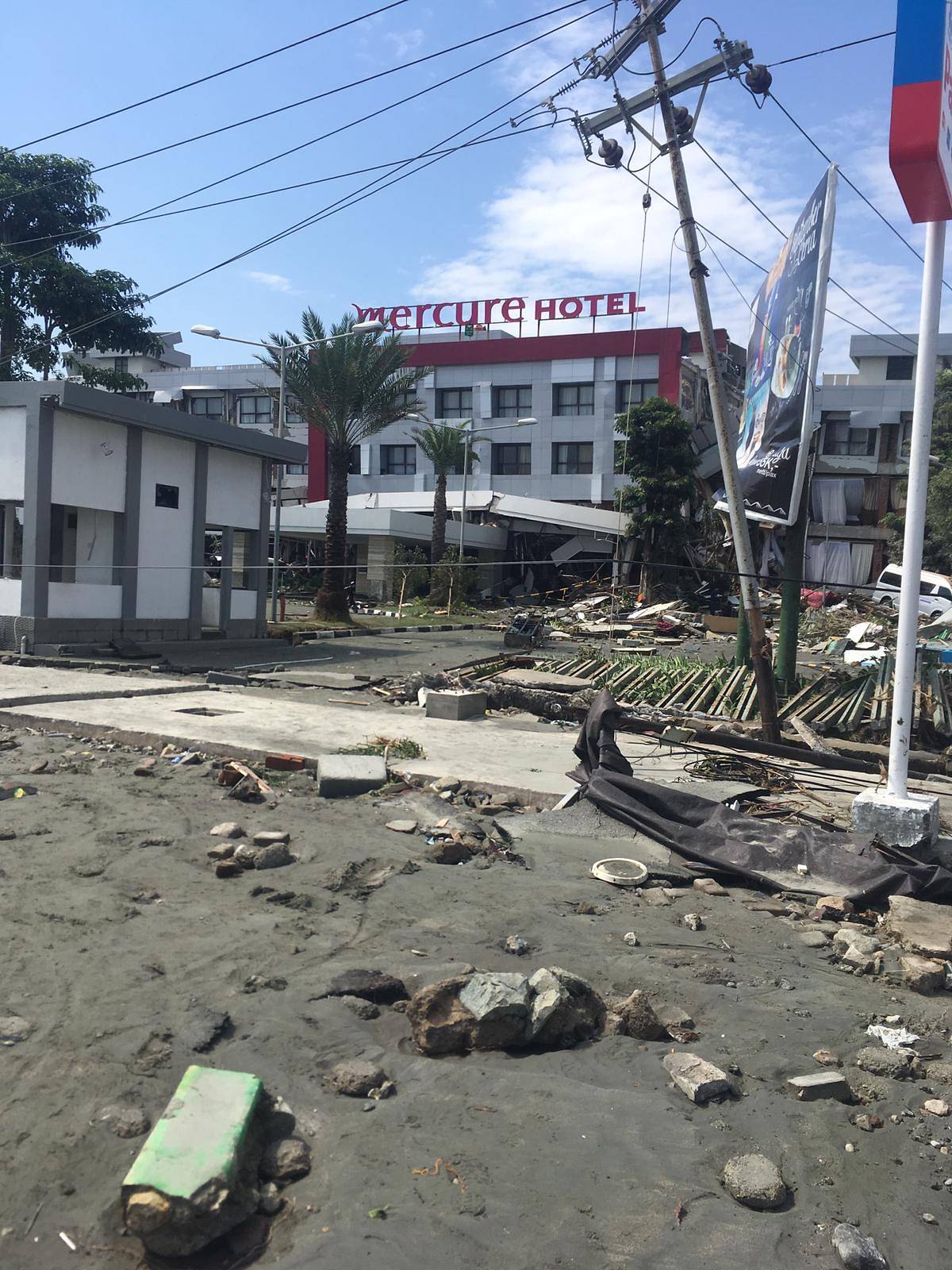
This was the moment Mercure Hotel, where Mr Ng was staying at, collapsed. (Photo: Ng Kok Choong)
Just as it dawned on Mr Ng that an earthquake had struck, he noticed the sea close to his hotel becoming rough and the waves building up – signalling a tsunami.
“I THOUGHT SHE WAS DYING”
To escape the impending tsunami, both men looked for higher ground and ended up back at what remained of Mercure Hotel. That was when they encountered a little girl and her mother stuck under the debris of the hotel.
“They were crying and we ran to them and tried to pull them out. We managed to pull out the little girl, but her mother was stuck,” said Mr Ng, adding that he could see the tsunami fast approaching.
“My friend carried the girl away and ran in the opposite direction of the tsunami. He ran up a tree with the girl and the girl’s father,” he said. “The mother could not be helped.”
At the time, he described the entire situation as “frightening and noisy”, with the wind howling, the waves crashing in and buildings shaking.
Mr Ng managed to find higher ground and he stayed there while waiting for the tsunami to subside – which took around 30 minutes.
After he had ascertained it was safe, he came back down to where the little girl’s mother was. He heard her calling for help and screaming in pain as a piece of concrete was crushing her thigh.
“I went back and stayed with her because I couldn’t do anything for her and I thought she was dying. I just tried to assure her and pacify her,” said Mr Ng.
“I tried to move the concrete, but it wouldn’t move much. She was stuck there for about one to two hours until a few locals came to help. Somehow we were able to lift the concrete and pull her out.”
Mr Ng’s friend Francois and the little girl both men had rescued. (Photo: Ng Kok Choong)
Later, he was directed to an emergency centre set up by some locals, where he was reunited with Francois and the little girl.
The centre provided him and about 40 other survivors with water and mattresses to rest on.
“Some people were crying, but it was generally calm,” he said.
The paragliding event organisers then managed to find Mr Ng and Francois, and took them to an open field where they were instructed to stay until daylight.
“The tremors could be felt throughout the night,” Mr Ng said.
He added that he could not initially contact his family because the phone lines and connections were affected following the earthquake-tsunami, but as soon as he got through to his wife, he instructed her to inform the Ministry of Foreign Affairs (MFA) of his situation.
MILITARY EVACUATION
The next day, Mr Ng attempted to look for his passport from the Mercure Hotel site.
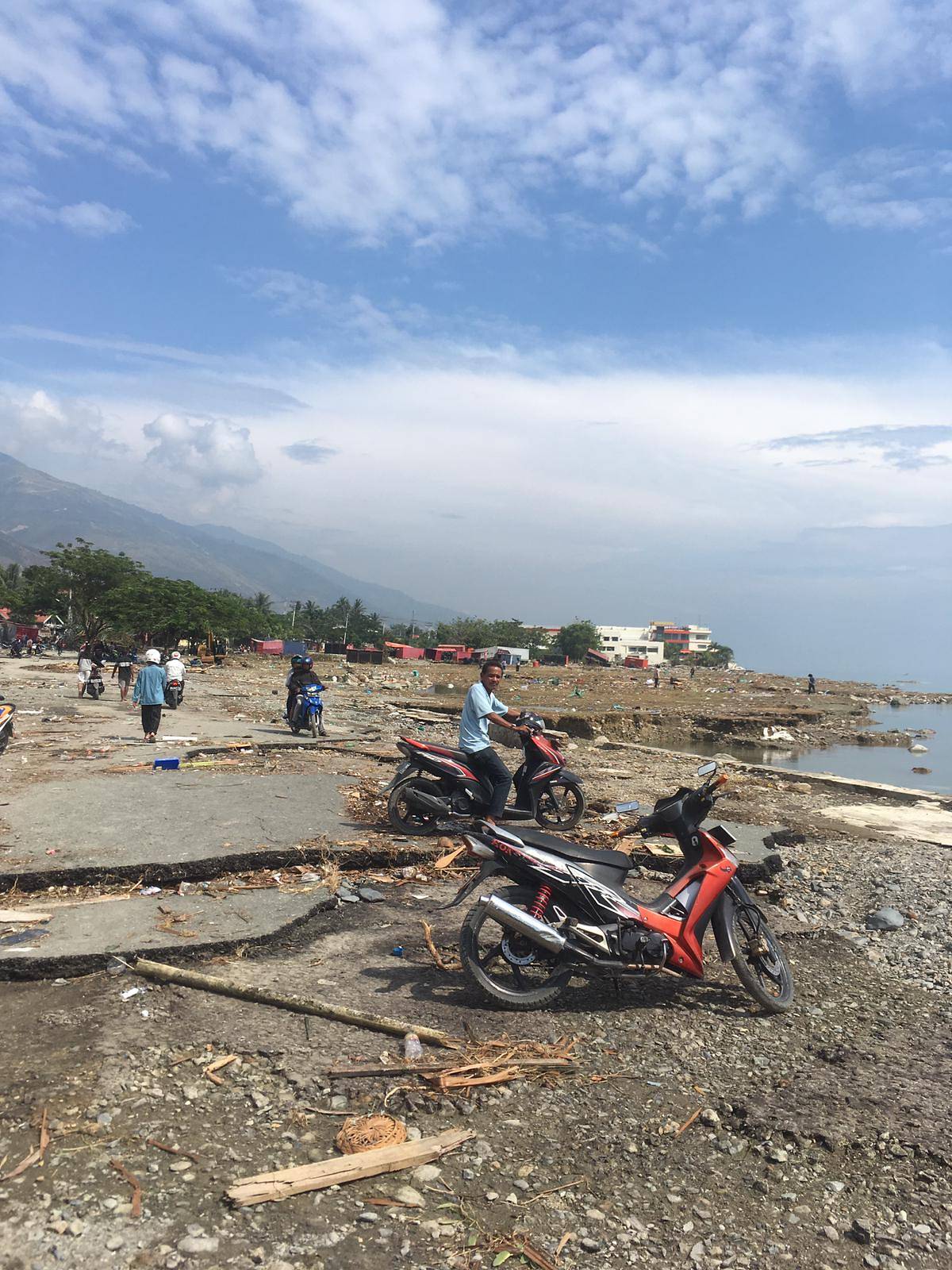
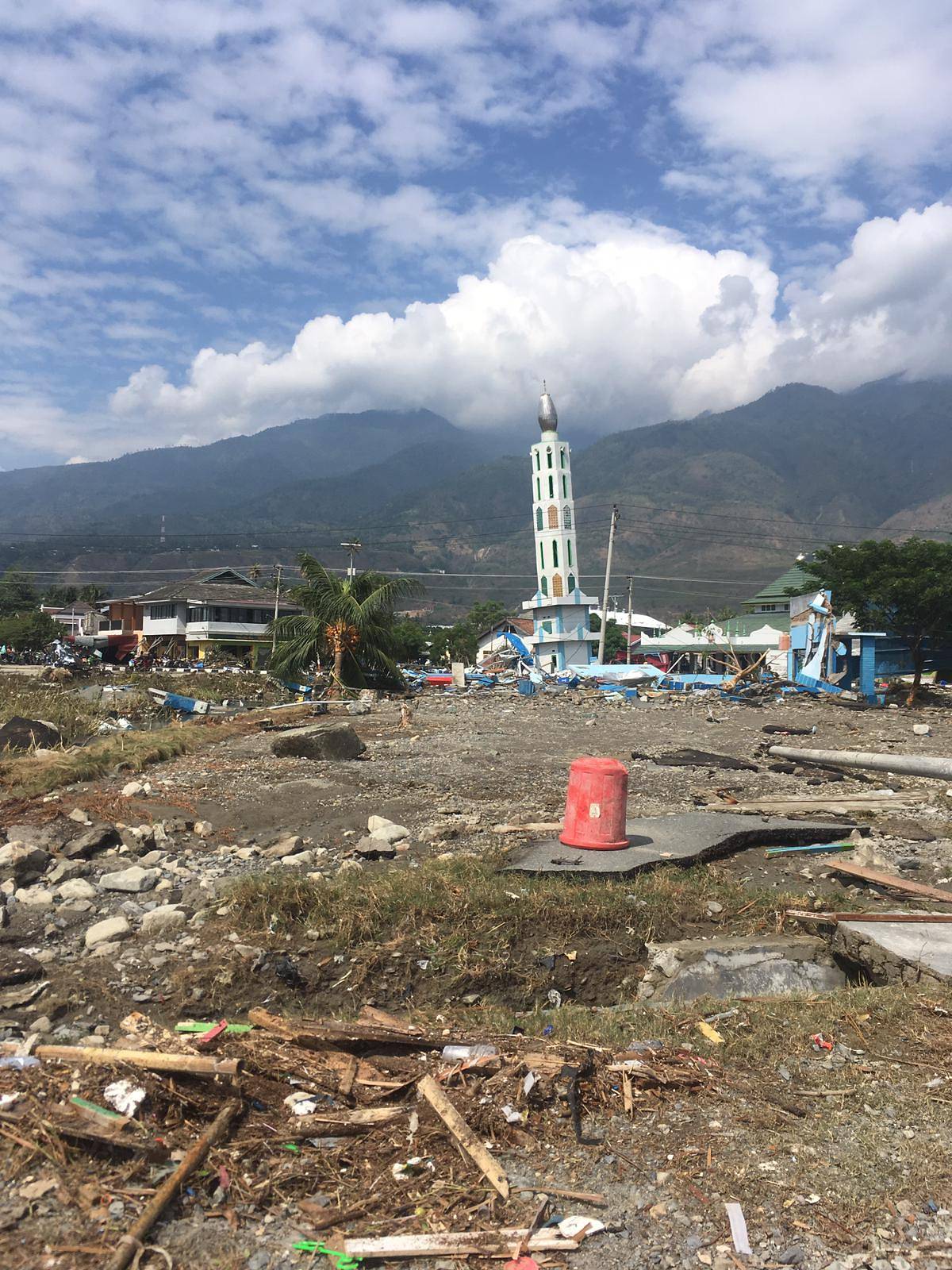
“Along the way, I saw that the main roads all along the beach were damaged, the makeshift huts were all washed away, buildings were collapsed and there was debris all over,” he said.
The aftermath of the tsunami-earthquake in Palu. (Photo: Ng Kok Choong)
The scene in Palu after the tsunami-earthquake on Friday (Sep 28). (Photo: Ng Kok Choong)
He climbed up to the fourth floor of the damaged hotel on a ladder, smashed a window with a hammer and successfully managed to salvage his belongings, including his passport.
Mercure Hotel in the aftermath of the disaster. (Photo: Ng Kok Choong)
With the help of the paragliding event organiser, a military evacuation by the Indonesian air force was arranged at Palu’s domestic airport.
Those awaiting evacuation, including Mr Ng, were ushered into a military plane at about 2pm that was headed to Makassar, and then Jakarta.
“The airport was not open to commercial planes because the control tower had collapsed,” he said.
A photo of Mr Ng, Francois and a member of the paragliding group, Gleen, who is believed to be missing. (Photo: Ng Kok Choong)
When Mr Ng reached Jakarta, he booked a flight back to Singapore. He arrived in Singapore at 12.30pm on Sunday.
“I was just happy to meet my wife and go back home,” he said.
After he touched down, he learned that five people from his paragliding team were still missing.
“It was a really shocking experience. I realised nothing can prepare oneself for an earthquake like this,” he said as he collected his thoughts after returning to Singapore.
“I think you can learn everything about an earthquake, but the moment it hits suddenly, the force is so great and you can’t even run when it happens.
NEW YORK: Of the world’s 7.6 billion people, a record-breaking 1.4 billion are grandparents.
Today’s grandparents play vital and increasingly indispensable roles in modern family life, contributing to the well-being of generations succeeding them.
Grandparents have always been an integral part of family life. During the past half-century, however, their roles have evolved as result of demographic, economic, social and technological changes taking place worldwide.
The proportion of grandparents in a population varies across countries, depending on fertility rates and life expectancy, ranging from lows of around 15 per cent in countries such as in Kenya and Pakistan to highs in excess of 25 per cent in Japan and Russia.
YOUNG AND OLD GRANDPARENTS
The proportion of women and men in a given population remaining childless reduces the potential future pool of grandmothers and grandfathers.
In many developing countries, such as India and Indonesia, the proportion of childless women in their late forties is relatively low. By contrast, in most developed countries, the number is more than double at 10 per cent.
The first childbirth of one’s offspring largely determines the age when people become grandparents. In some developed countries, the average age of women at first childbirth is close to 30 years, implying that the average age of grandmothers would be approximately double that age or about 60 years.
Elderly in Singapore (File photo: TODAY)
The level of fertility also produces age structures that help determine the relative proportion of grandparents within a given population.
High fertility countries, such as Uganda, Kenya and Nigeria, have less than 10 per cent of the population above the age of 50 years. In low fertility countries, such as Germany, Italy and Japan, more than 40 per cent of the population is aged 50 years and older.
GRANDPARENTS ARE LIVING LONGER
Notable gains achieved in health and lifespans today provide women and men with more years to enjoy sustained relationships with grandchildren as they grow into adulthood.
Living to advanced ages also permits increasing numbers of grandparents, especially women who generally live longer than men, to become great-grandparents, a relatively recent phenomenon.
The global number of centenarians, 80 per cent being women, has tripled since the start of the 21st century. By the century’s close, the current number, about a half a million, is expected to increase 40-fold.
One study estimated that by the year 2030, more than 70 per cent of 8-year olds in the US are likely to have a living great-grandparent.
An elderly lady in Japan. (File photo: AFP/Behrouz Mehri)
GRANDPARENTS HELP REDUCE CHILDCARE COST
A key familial role of grandparents in today’s modern world is providing childcare assistance to working couples and single-parent families.
Although many relatives do not want to look after young grandchildren for health, financial or personal reasons, grandparents are the most common providers of informal childcare.
Largely due to the costs, unavailability and quality of formal childcare, absences and separations of parents, and normative attitudes and traditions concerning childcare, parents frequently rely on grandparents to care for grandchildren.
Such assistance often provides an indispensable lifeline to families squeezed by limited incomes, rising childcare costs, time constraints and employment demands.
The financial savings can be considerable. In the UK, for example, grandparents save parents more than US$70 billion annually in childcare costs. In Australia, they save more than US$2 billion annually.
Such care is particularly critical for mothers with young children, especially single mothers, enabling them to enter and remain in the formal labour market. Without such support, many mothers could not participate in the labour market or pursue career goals.
An elderly woman pushes two babies in a stroller in Beijing, China October 30, 2015. (Photo: REUTERS/Kim Kyung-Hoon/File Photo)
Available studies show that grandmothers are more likely than grandfathers to provide childcare assistance and more time.
For many developed countries, no less than 40 per cent of grandmothers provide some childcare to their grandchildren. In the US, the UK and Romania, the large majority of grandmothers provide some childcare.
GRANDPARENTING A GLOBAL PHENOMENON
Increasing numbers of grandparents are responsible for raising grandchildren on a full-time basis. For many reasons, including parents’ substance abuse and addiction, mental illness, incarceration, family breakdown, migration and death, custodial grandparenting is a global phenomenon.
About 2 per cent of children in the US are raised by grandparents with no parent living in the home.
The Great Recession and housing crises brought many generations together. In the US, the number of grandparents living with their grandchildren increased by about a third over the past generation.
The proportion of multi-generational households in wealthy nations is once again increasing in recent years. This increase has been attributed to the economic conditions and growing numbers of foreign-born groups accustomed to living with extended families.
CARE FOR GRANDPARENTS
Many grandparents need care too as they age. Most elderly prefer to live independently in their own homes as long as possible and not to become a burden for family members.
However, growing numbers of aging grandparents, especially those with special needs, move near or in with children or to a facility providing assistance. Nearly 30 per cent of those 85 years and older have dementia, with Alzheimer’s disease the most common form.
Providing care to the elderly can be difficult and costly, taking a toll on the caregiver’s time and quality of life. Grandparents, adult children and grandchildren can anticipate and prepare for caregiving and end-of-life challenges.
Countries widely recognise grandparents’ essential roles in modern family life by officially celebrating Grandparents Day such as in Australia, Singapore, the UK, US and elsewhere.
In addition to their unconditional love, grandparents offer guidance, emotional support and financial assistance to families, helping relieve economic, social and personal stress.
Beyond their noteworthy contributions, grandparents receive considerable satisfaction from their roles, enjoying and benefiting being with family members.
Joseph Chamie is an independent consulting demographer and a former director of the United Nations Population Division. This commentary first appeared in Yale Global Online. Read it here.
SINGAPORE: In the latest iteration of the Times Higher Education World Rankings, the National University of Singapore (NUS) lost its top spot as Asia’s number 1 university and falls one spot.
It was ranked 23rd and Nanyang Technological University (NTU) was placed at 51st.
While much has been said about the impressive rise of NUS and NTU on these global university rankings, there is also a need to take a step back and ask: What does this mean for teaching and learning in these universities?
According to the Ministry of Education, the core focus of Singapore’s university education is to “prepare students not only for today’s world but also for a world where there will be jobs that have yet to be invented and challenges not yet foreseen”.
In other words, the role of a university is to educate citizens and prepare them for their future careers.
This role has become increasingly critical, as Singapore faces deep transformation and disruptions to its economy that will require graduates to be equipped with industry-relevant skills such as data analytics or coding.
This is a point that was picked up by Education Minister Ong Ye Kung, who said at a recent education conference that university ranking systems need to “evolve” beyond focusing merely on the quality of academic papers published, to evaluate the effectiveness of universities’ collaboration with industries, society and the government.
Rankings “must go way beyond publications and citations, which are the easiest to measure today and we may have relied on quite a lot”, said Minister for Education Ong Ye Kung on Sep 26.
As it stands, university rankings place a disproportionate emphasis on evaluating universities’ research output. For instance, research and citations contribute to 60 per cent of a university’s performance in the Times Higher Education World Rankings, with teaching measures accounting for only 30 per cent.
This overwhelming emphasis on research has meant that universities seeking to rise up the ranks of such global university rankings have tended to devote an extensive amount of resources towards boosting research outcomes. Certainly, this is how NUS and NTU have both leapfrogged many of their competitors in global university rankings.
However, an overemphasis on research can come at a cost to teaching quality. One of the problems with an overemphasis on research is a concomitant lack of resources that can be directed towards adult-learning.
As Education Minister Ong Ye Kung has mentioned on multiple occasions, there is a need for our universities to play a bigger role in lifelong learning.
Given the importance of continuous education and reskilling for Singapore’s future economy, this may require directing universities’ best and brightest faculty members towards adult learning and continuous education, rather than employing adjunct lecturers for this important mission.
Yet, in many universities across the world, adjunct lecturers are typically picking up the teaching slack, while professors are asked to focus on research.
Indeed, in Singapore, we are well familiar with the refrain that our people are our only resource. Shouldn’t this warrant greater emphasis among universities on education and lifelong learning, activities that can give rise to real substantive benefits for our citizens and our economy?
Nanyang Technological University engineering students engaged in team-based learning. (Photo: NTU)
SINGAPOREAN UNIVERSITIES OR UNIVERSITIES FOR SINGAPOREANS?
More worryingly, this focus on research output and university rankings can serve to dilute the Singaporean identity of our universities.
Such concerns are not new. In a 2015 speech, Prime Minister Lee Hsien Loong emphasised that universities’ KPI should not be about ranking positions, but how well they serve Singapore.
Indeed, this lack of a Singaporean identity is a common grouse that I have encountered among many of our Singaporean undergraduate students, many of whom have expressed a strong desire for local academics who can present knowledge in a manner that makes sense in the Singaporean context.
To give an example: It is one thing to teach the fundamentals of financial regulation from a theoretical perspective. But without a sound understanding of how the Monetary Authority of Singapore operates or the vulnerabilities and constraints that our policymakers face, public policy education runs the risk of becoming overly-abstract and irrelevant to budding public servants and those seeking a career in the financial sector.
In order to develop a better understanding of the Singaporean context, there is a need to encourage more Singapore-centric research. While such research may not generate high levels of citations globally, they can bring forth strong benefits for Singapore society.
This means a need for more Singaporean academics. Paradoxically, the over-emphasis on research and rankings may prove counter-productive for developing a strong core of Singaporean academics.
Professors Pang Eng Fong and Linda Lim have found that local universities’ focus on rankings and citations have sidelined local academics, with universities seeking to hire foreign academics with high citations counts rather than local academics whose work on Singapore may not generate as much global interest.
Similarly, Member of Parliament Seah Kian Peng has previously argued that Singapore’s academia lacks a “Singaporean core”, with Singaporeans forming the minority in political science, public policy and communications departments of several of Singapore’s public universities.
During the Budget debate in2014, Member of Parliament Seah Kian Peng highlighted the low percentage of Singaporeans in several departments at the National University of Singapore and Nanyang Technological University. (Photo: Facebook / Seah Kian Peng)
SIDELINING OF LOCAL ACADEMICS
Perhaps most worryingly, the “sidelining” of local academics that Profs Pang and Lim have identified can give rise to a gradual brain drain of Singaporean intellectuals.
More than simply being teachers or research output automatons, local academics play an important role in contributing to the socio-cultural milieu of Singapore. It will only be to Singapore’s loss, if our Singaporean academics decide to leave for greener pastures.
In the longer run, this strategy of focusing on research citations and hiring foreign academic talent can give rise to deep institutional drift.
While both teaching and research are no doubt important for Singapore’s universities, an over-emphasis on one over the other may give rise to skewed educational outcomes.
There is therefore a need to rebalance this portfolio of research and teaching activities, in order for universities to contribute towards both the education and training of a credible Singaporean labour force as well as research-driven and industry-centric innovation.
Aside from improving teaching quality, Singaporean universities will also need to reorient both their teaching and research capabilities towards contributing to Singapore’s broader national goals and needs, whether these be training up a skilled and effective workforce or providing local industries and enterprises with access to cutting-edge research and innovations.
In all instances, there is a need to groom a stronger core of Singaporean academics and encourage our foreign colleagues to apply their research and expertise to the better good of the society within which they reside.
Woo Jun Jie is an Assistant Professor in the Public Policy and Global Affairs Programme of Nanyang Technological University.
SINGAPORE: Ho Kwon Ping has an almost sage-like quality about him and while his pronouncements on businesspeople’s role in solving problems such as income inequality often make the headlines and seem to resonate with the public, I wonder how far he actually walks the talk.
But first, knowing what shapes his thinking is vital.
The 66-year-old is the founder and executive chairman of Banyan Tree Holdings, an international hospitality brand that manages and develops premium resorts, hotels and spas. He is also the founding chairman of the Singapore Management University.
But when he makes news today, it is more often because of his comments on, among other things, diversity within Singapore’s political establishment, democracy, social inequalities and whether Section 377A should be repealed.
His views on such issues, which have been expressed in his public speeches over the years, have now been compiled and published in a new book, Asking Why.
Why, indeed, has a businessman become so involved in intellectual discourse about such a wide range of topics?
“I was actually interested in these areas not for personal reasons, not because I wanted to be a politician. In terms of my interest in world affairs, in politics and economics and so on, it predated my being a businessman. Because that is to me, what drives the world, what drives political tension, what creates wars or creates disparities. At the heart of it all is economics and my interest was therefore in political economy and development economy.”
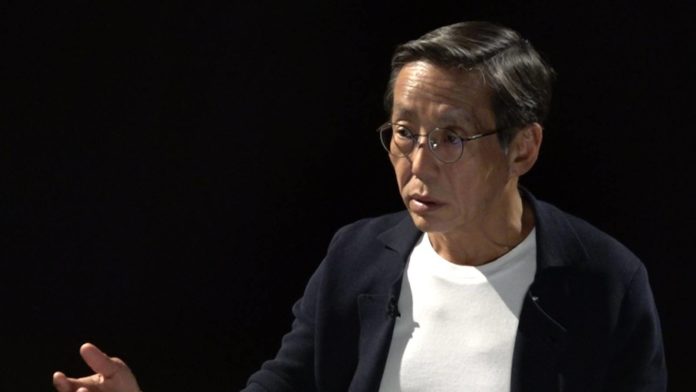
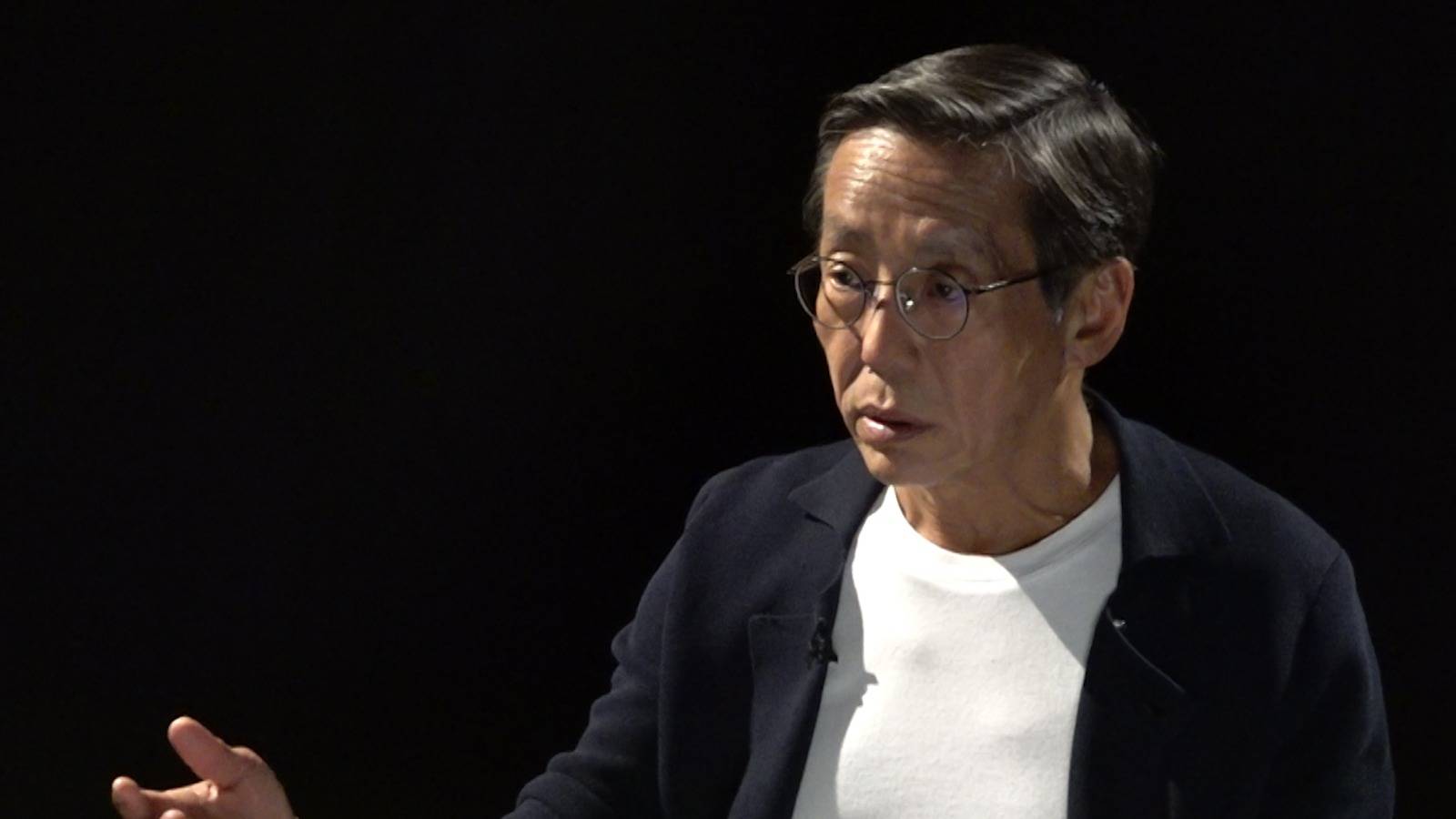
Ho Kwon Ping goes On the Record with Channel NewsAsia.
It’s no surprise then that his views on business also go beyond dollars and cents.
He has said before that he believes business is the most dynamic driver of economic development in the world but it must be tempered and inspired by a determination to improve the world through business.
“You have to recognise that in a non-communist world, it is business that is the main driver of prosperity and change,” he says.
“I have made the further point that business leaders must be social leaders at the same time, because if we are, as business leaders, the main drivers of change, then we must have views on many things other than our own self-interest in business. We must have views on inequalities and climate change, for instance.”
He has walked the talk to some extent. For instance he built desalination plants to turn sea water into fresh water to avoid damaging the fragile ecosystems near Banyan Tree projects.
He also once suggested that investment bankers’ bonuses above six month’s salary be taxed at 70 per cent and the money be redistributed to primary and secondary school teachers.
“It’s about how society values its people. I truly believe that one of the most important groups of people in the world are school teachers. How many of us remember our best primary school teacher and secondary school teacher. I do. You probably realised a lot of things about yourself because maybe a teacher encouraged you and spotted a talent in you or became your mentor while you were young. Teachers really have a far greater job than just teaching knowledge. How they inculcate a generation of people in terms of their values is so important.”
He also speaks up against excessive salaries at the top in general.
“Nobody in the elite world – directors or CEOs – is willing to make practical suggestions to solve the problem. I actually have gone back to that recently at a Singapore Institute of Director’s Conference and people talked about governance. I basically said that it’s so ridiculous for all of us sitting here. We talk about inequality, we talk about how pay scales are skewed and we won’t even do something very simple like in our own companies, adopt a scale, which in fact in the UK they’re beginning to do now, that forces companies to show what the multiple of the CEO’s salary is to the median salary within the company.
“Then it depends on the rest of the civil society to stand up and hold them accountable. I think naming and shaming is ultimately better than regulatory control.”
Banyan Tree Holdings’ own annual reports are online for all to see.
“I’m willing to do it but there’s no point for just me to do it. My multiple is very, very low compared to some other people.”
At one point during our interview, he includes Singapore ministers in this group.
“My salary is decided by the board and my salary is lower than the ministers so I probably belong to the group of people who might be considered mediocre, unfortunately.”
I point out his salary, including benefits and a bonus, according to Banyan Tree Holdings’ 2017 Annual Report was over S$2.5 million, so it’s certainly not lower than ministers’ salaries.
“I don’t know about everything. All I can say is that we are still every year winning corporate awards for our transparency and disclosure. So whatever those guidelines are, we are definitely one of the best. I try. That doesn’t mean you may find me in every way, walking the talk.”
Some might agree that Mr Ho tries more than most. His wife labels him a socialist at heart but a capitalist in his wallet.
One could argue that some of his company’s business practices reflect this.
“When it comes to the hospitality sector, everyone matters. We pay market competitive rates. We’re not a charity so we’re not going to pay more. We pay market competitive rates. We have bonuses. In countries where we charge a service charge, we don’t keep it. We pay it all out to staff.”
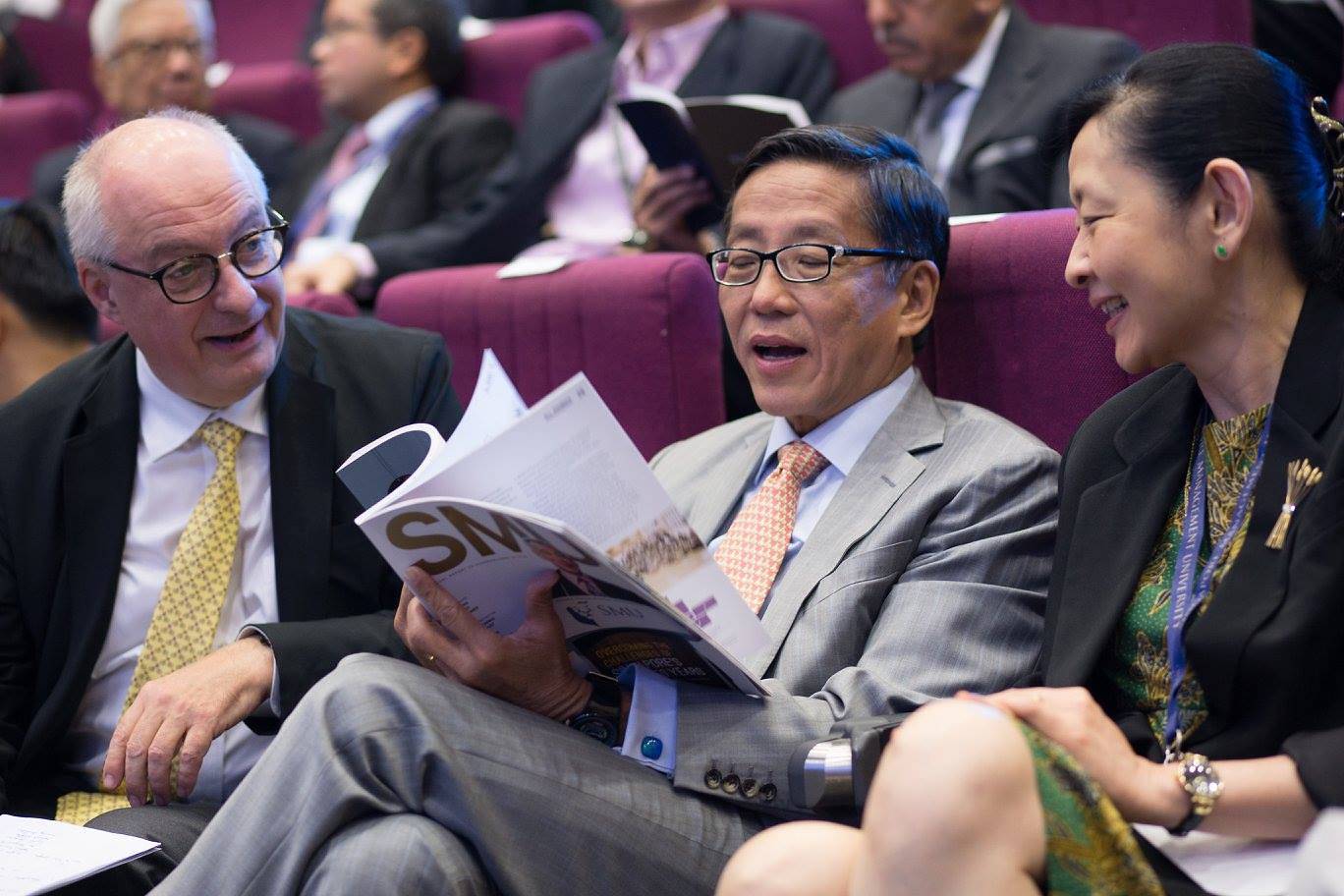
Ho Kwon Ping at the inaugural Institute for Societal Leadership Summit in 2015. (Photo: Singapore Management University)
MINISTERIAL SALARIES SHOULD NOT BE PEGGED TO TOP EARNERS’
We then turn to discussing ministerial salaries since he briefly brought up the issue.
“I think we should peg it to something that is more logical than pegging it to top salaries. When you peg ministerial salaries to the top people in the country, subconsciously – I’m not saying any ministers are doing this – but subconsciously to the extent that in the corporate world, salaries and incentives are supposed to drive behaviour, it motivates ministers to have a more and more unequal society because the more the top get, the more they get.”
He suggests pegging ministerial salaries to the median salary of Singaporeans instead.
“I’m not really concerned about the quantum of the salary, but rather what it is pegged to. It immediately drives the behaviour to the extent that ministers are subconsciously driven – again, I’m not saying they are ever, but to the extent that we all are subconsciously driven – that only when the average salaries go up, then their pay goes up too.”
He suggests “an independent commission of people, very trustworthy, conservative, very pro-Government” decide the actual quantum.
When I ask why they need to be “pro-Government”, he explains he means an objective group that would not bring emotions into the decision and decide based on what’s best for Singapore, not for any one political party.
Some argue that if salaries were lower, attracting the best people to politics would be challenging. He disagrees.
“I don’t think people join politics or become ministers because of the salaries,” he says.
However, he recognises that healthy salaries do play a part in “reducing the incentive for corruption”.
TAXES AND THE RICH
Considering the views he has expressed on the role of wealthy, I wonder how he feels about recent discussions on whether the rich should be contributing more to social spending to meet Singapore’s needs.
“I don’t have an inherent objection to a wealth tax or higher income taxes. I’m not so safeguarding of my own benefits. But any form of tax has to be very carefully studied because sometimes they have perverse effects.
“I separate myself and what I have from what I think is good for the country but I wouldn’t want to pay 99 per cent wealth tax because I think that’s actually not good for the country as a whole. It’s penalising business people. Businessmen are not all just avaricious people who only want to protect what we have. We are also, at the same time, citizens and I would hope that we can separate the two. If something can be proven good for the sake of the country and it involves higher taxes, why not? But at the same time, the other effects need to be considered.”
He also points out that taxing is not the only way to get things done.
“I fully understand that for strategic reasons in the past, we have never wanted to say what our total reserves are and we probably should not but I think they could, at least with some greater discussion internally in the GIC, disclose what they think can be disclosed and maybe have a discussion as to how wealthy we need to be before some of the reserves and the amount that we are earning is channeled back into recurrent spending. Are we building up so much wealth that frankly, Singaporeans aren’t really getting the benefits?”
Ho Kwon Ping at a Singapore International Chamber of Commerce event. (Photo: Singapore International Chamber of Commerce)
HIS LIFE SO FAR
We discuss other aspects of his life that he chose to expand upon in his latest book.
Mr Ho was born into a wealthy family. His father, Ho Rih Hwa, was the former ambassador to Thailand, but also ran the family business for a period. Wah Chang Group was a “hotchpoth of companies” spanning areas such as construction and manufacturing that his grandfather created, he says.
He spent a considerable amount of his growing-up years in Thailand because of his father’s diplomatic appointments.
When it came to choosing a profession, he went into journalism.
His articles in the Far Eastern Economic Review criticising Singapore led to him being detained under the Internal Security Act (ISA) in 1977 at the age of 24.
He first explains that it was certainly not the reason he quit journalism. In fact, after his two-month detention, he returned to the industry.
His second stint as a journalist saw him living humbly in Lamma Island in Hong Kong. A journalist’s salary was “extremely modest”, he says.
“That didn’t bother me. But I was getting tired of journalism because it’s non-productive. It’s non-constructive. You haven’t built anything, you haven’t built a factory, you haven’t built something lasting. You’re just writing to deadlines. In my field, one also actually got more credit for criticising things and attacking things than for building up things. If I wrote an article saying the finance minister is doing great stuff in Pakistan, everybody would just fall asleep. If I wrote an article castigating his plan and had the guts to do it, I will be lionised as the guy who is willing to take on the finance minister of Pakistan.”
Having decided to move out of journalism, he accepted a position as an academic, but when his father suffered the first of many strokes, he joined the family business.
After 10 years in the family business, he and his wife began building Banyan Tree. He was a “reluctant businessman” when he joined his father’s business, but the idea of building something of his own inspired him.
While building his own enterprise, he closed many disparate businesses that his father had started “somewhat impulsively”. He explains the twists and turns of this more extensively in his book.
MOMENTS OF DESPAIR
But Mr Ho’s story is no ordinary success story.
It’s also a story “punctuated by moments of despair” as he puts it.
This becomes clear as we discuss his ISA detention.
He was accused of engaging in pro-communist activities.
“I was writing articles that were critical about Singapore. But I didn’t even know all the characters. I didn’t even know any of the people who were supposed to be guilty of this conspiracy. I think I was collateral damage.”
He has said several times that while he thinks “the Government and Lee Kuan Yew were wrong” to detain him because he was not a communist, he does not bear a grudge and it’s clear that the Government didn’t hold it against him either.
“I have worked with Lee Kuan Yew, for him and the Government subsequently.”
Indeed, he has chaired organisations such as Singapore Power and has also served on the boards of GIC, the Civil Service College and the Singapore Tourism Board.
Some have accused him of selling out.
“The concept of selling out is that you have something, a belief perhaps that is so immovable and so fixed, but you’ve abandoned your fundamental principles. But if you are able to differentiate between fundamental principles and those beliefs that you had that were either wrong or which have developed differently over time, I don’t believe it’s selling out.
“I’m still independent in my views. I have been in many ways extremely supportive of certain Government positions, but I’ve also spoken up against certain positions. What got me into trouble in the first place was asking ‘why’ and I continue to ask ‘why’. Having a generally enquiring mind does not mean you have to oppose everything. It also could mean that you recognise that the beliefs that you had in the past are no longer valid.”
In his book, he reveals he was approached by the People’s Action Party (PAP) to consider running as a political candidate in the 1984 general election.
However, after several psychometric tests and interviews, Mr Ho was told that a few members of the party had expressed doubt his political ambitions and his ability to be a team player.
I wonder if he wishes he had got further.
“I think both sides were not very clear. I also had baggage. I came from a family business. What would then happen to the family business? So I too was not at all sure what I wanted to do.”
We return to discussing Mr Lee Kuan Yew.
“I don’t think he ever took the actions he did against communists for his own personal gain. I think he did it rightly or wrongly – in this case wrongly – because of what he felt was correct for Singapore. How can you carry an anger towards somebody who does something for what he thinks is for the good of the country? I believe Lee Kuan Yew just made an error in judgment.”
Mr Ho spent two months in detention. A televised confession was his ticket out.
“They could see I wasn’t a threat.”
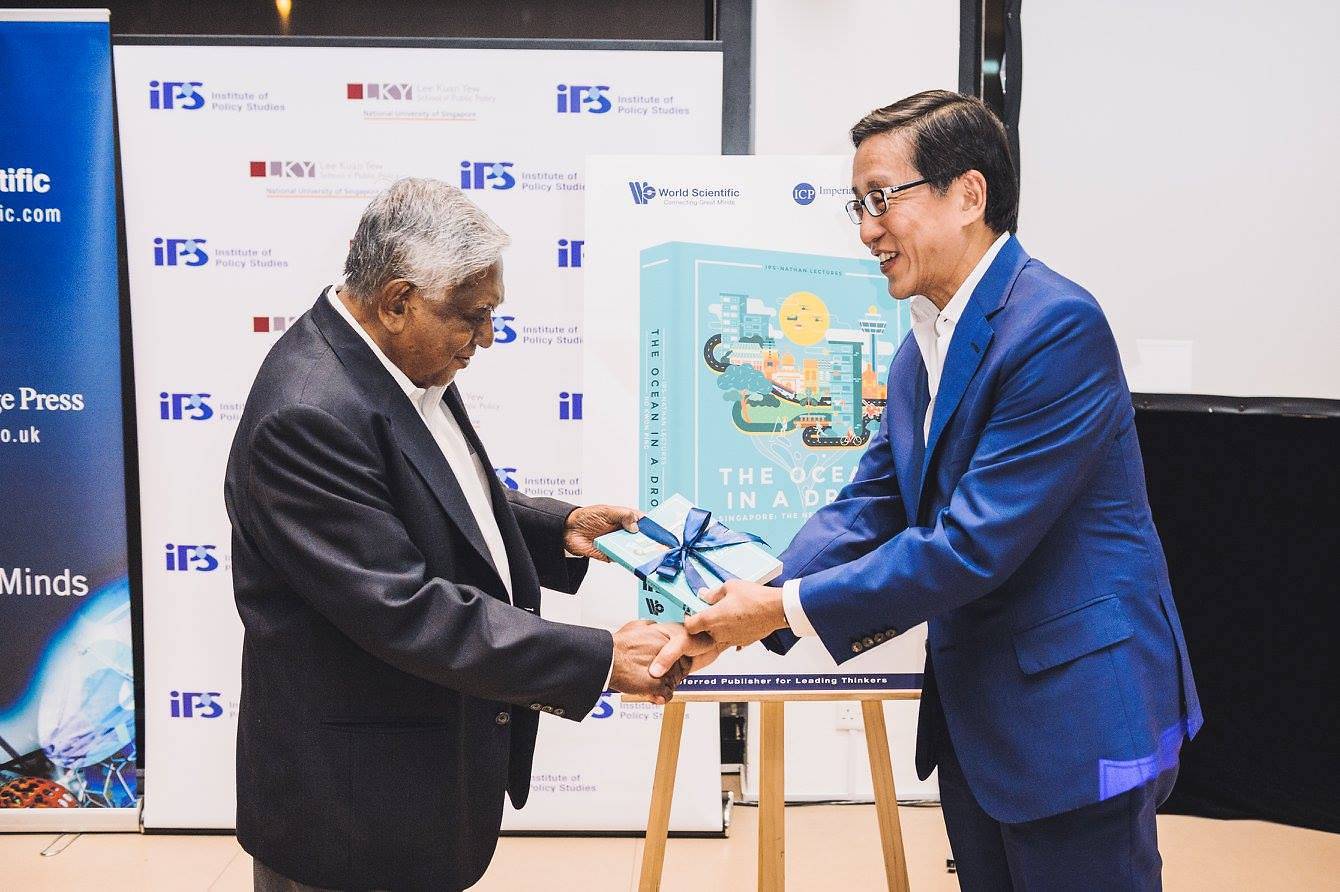
Ho Kwon Ping at the launch of his book, The Ocean in a Drop. He is with the late SR Nathan, former President of Singapore. (Photo: World Scientific)
HE IS NO MANDELA
I ask him why he confessed to something he says he didn’t do.
“I was warned that if you don’t confess you could be in here for 20 years and I don’t think I had the courage nor the conviction of real hardcore activists whether they be Mandela or some of our Coldstore political dissidents. I didn’t have the conviction.”
He harks back to his years at Stanford University where he protested against US involvement in the Vietnam War. He ended up spending a night in jail.
“I think that was probably my first sense of self. I realised one can go through life pretending to be a lot of things that you are not. I came to realise that kind of role playing was partly what I indulged in while in Stanford. It’s a heady life. You’re only in your 20s. You’re a student activist. You’re lionised because you’re one of the only few Asians who’s quite articulate, could speak good English and was speaking out against the war in Vietnam.”
I wonder if he believed in the cause at all.
“I still believe the Vietnam war was a mistake,” he says decisively.
But looking back, he also realised that he did not do so to the extent that he was willing to risk his future.
“I realised this especially during my ISA detention as well. It was a realisation of the need to be really honest with yourself, to know who you are or who you’re not. I was a middle-class kid who had ideals. I was naïve. But I wasn’t a threat to the Government and I wasn’t going to spend 25 years of my life in detention simply because I wasn’t willing to confess.”
He actually watched his televised confession about 30 years later when he served as chairman of Mediacorp. I wonder what was going through his mind as he watched it.
“Duh, this guy at 24?” he says with a laugh.
“I’ve moved on. It’s one of the episodes of my life like many others.”
OPPOSITION POLITICS, CIVIL SOCIETY AND INFORMED DEBATE
While he did not join politics himself, he frequently comments on it.
His past published views include the need for fresh blood and diversity within the political leadership and whether the dominance of a single political party is good for Singapore in the long-term.
“I think Singapore is going into new phases of development where a more creative and liberal approach to what the next generation of Singaporeans want might actually work better,” he says to me.
“A pendulum democracy which changes from one ruling party to another but within the context of two large parties so there is more stability compared with a group of coalition parties, I think is probably the best and most sustainable long-term solution.”
Considering the current circumstances however, can a credible opposition emerge in Singapore?
He addresses the opposition’s concerns over an un-level playing field.
“Every government, to its greatest extent possible, tries to make the playing field un-level. Who wouldn’t? No government is going to give its right to rule on a silver platter to somebody else.”
But he admits that more can be done to level the political playing field here.
“It’s not just about the control over the media. Now you already have social media that is not so easy to regulate. There’s lots of gerrymandering. We could think of the Government doing less of that.
“In the past, one big factor was fear. In the beginning, it was fear of imprisonment if you spoke against the Government. Today, it isn’t that. It’s the traditional fear of even just being chastised publicly. Asians are very thin-skinned and we will always think about face and the minute somebody scolds you, it’s already bad enough. The Government can afford to be less personal.”
But he feels that the fear of speaking up is dissipating anyway.
“People are quite happy to disagree with a minister now. It would be unthinkable in my day. When I was covering Singapore, the only people who would run in opposition politics would be like character actors out of a bizarre play. You would not see people of substance, people with good professional backgrounds, good incomes, articulate and idealistic people running. Now, you are seeing many of them coming up.”
Ho Kwon Ping at the Singapore Management University. (Photo: Singapore Management University)
However, he explains that to him, what’s more important in a vibrant democracy is a robust civil society.
“Civil society is not a very pleasant symphony of harmonic music. It’s a cacophony of people who make up a marketplace of ideas. I think Singapore can afford to have more cacophonic sound because I think if you want to have resilience in society, want people to ask ‘why’ more often so that they can examine issues and come up with solutions to problems, you need that. They have to feel empowered to solve issues and not just rely on the Government. You need people to have a sense of ownership of Singapore.
“For this, one of the first things we need is more access to information. Many people in our universities who want to have access to data find that a lot of Government agencies simply say we cannot give you that data even if it’s not a classified secret. We should have every civil service ministry adopt a pledge, saying that it would only withhold information by exception, meaning everything can be given to the public, except for certain things. Now, it’s the other way around. But we need more information even if some of that data may not point to very flattering things about Singapore society, so that we can have more informed debates.”
One particular debate that seems to be concerning him these days is the one over Section 377A which he mentions several times during our interview.
“This is one area where I think we can speak about with a better understanding of the issues. I agree fundamentally with what diplomat Tommy Koh and some others have said – that you have to differentiate between a sin and a crime. My personal view is that I don’t think homosexuality is a sin at all. Others may say it is a sin, but I would say that does not even relate to this debate at all. Adultery is a sin but it’s not a crime. Divorce may be a sin, but it’s not a crime.
“It’s also an untenable law. We’ve got something which is on the statute books as a crime and the Government is saying it won’t act on it. Former attorney-general Walter Woon has said that makes a mockery of the law. I hope the Government would just take that to heart and simply say, we are not taking sides on whether homosexuality is a sin or not. That’s to do with taboos and moral values. Section 377A is about the legal system in Singapore.
“Should it be a crime? We have to divorce the law from morality.”
At 66, Mr Ho clearly hasn’t mellowed when it comes to expressing his views.
As we end our conversation, I ask him what he would like to be remembered for.
“I’ve never even thought about why I should be remembered for anything. I think it’s much more important to think about what you are going to do with the remaining years of your life. For me, that is to continue to have a purpose. It’s continuing to do what I’m doing and whatever comes along the way.
“I joke that I’ve only lived two-thirds of my life. I’ve got 33 more years because I’m only going to die at 99. No earlier than that. So I’ve got 33 more years to find myself,” he says with a laugh.
SINGAPORE: It was a scene that you would associate with any preschool in Singapore – sounds of exuberant children echoing through the playground as they enjoyed the swings and slides during their outdoor play session.
Dressed in their identical khaki uniforms, it was almost impossible to tell the children apart.
But there are little differences when you look closely at the playground and how the preschool is laid out.
A life-size model of a toy car is specially designed to allow a child in a wheelchair to enter and pretend to be a driver. Tactile lines laid out on the floor of the open-concept schoolhouse give a child with visual impairment extra help to find the classroom or bathroom. And the treehouse in the playground provides the space and accessibility for a child in a wheelchair to move around freely.
This is Kindle Garden, one of a growing number of preschools in Singapore that offer a space where all children – with or without special needs – can learn and play together.
HOW DOES THE MODEL WORK?
Broadly speaking, inclusion in a school setting simply means that the school is willing to support children with disabilities and additional needs, Associate Professor Sirene Lim, the academic lead from the Singapore University of Social Sciences’ (SUSS) Early Childhood Education Programme said.
She noted that in some models, children with disabilities may be placed physically on the same campus as regular, typically developing children.
“They may have little contact in terms of classes, but they may have the same playtime,” she explained. “So that’s the most basic form of integrating different children in the same school.”
The treehouse at Kindle Garden’s playground is built so a child with a wheelchair can move around freely. (Photo: Lianne Chia)
But preschools in Singapore that follow an inclusive model go beyond this.
In the case of Kindle Garden, the first inclusive preschool to be set up here, empowering all children and giving them the support they need to take part in the various activities is key. The preschool, which is run by non-profit AWWA, caters to children of all abilities, and about 30 per cent of the 80 or so children currently enrolled have special needs such as autism, Down Syndrome or cerebral palsy.
“We want them to have equal opportunities, to be a part of the activities, the environment and everything that we do,” said Honey Ng, Kindle Garden’s assistant director of preschool support.
“The equipment and design of this place will give them the sense that therapy can happen anywhere, and they don’t need to be pulled out,” she added. For example, a child with additional oral-motor needs can get additional help during mealtimes, with support staff like a speech and language therapist working with all the children in a group.
“They may all be eating, and the teacher might tell them to chew in a particular way,” she said. “And all the children will get into this game, but it’s actually therapy for those children who need it.”
New entrant SAIL Playhouse focuses on differentiating the lesson for each child, depending on their needs. The preschool, which opened in August, has seven children, three of whom have additional needs.
“They actually all go through the same lesson, but we adapt our instructions, so that when I give instructions to different children, it’s different, and I expect different outcomes,” said SAIL Playhouse’s centre director Chua Pei Lin.
In a pizza-making activity, for example, some children who might have difficulty with their fine motor skills might receive materials which have already been cut up for them, while their peers would be instructed to cut their own materials and count the number that they need.
“I have different expectations for different children, but they’re all participating at a level they are able to,” she said.
Ms Chua admitted that with children of different abilities and needs all integrated into one class, lessons can get disrupted at times. But apart from giving teachers mentoring and support, SAIL Playhouse also has an in-house early interventionist who provides the teachers with extra support in the classroom.
“Sometimes if we get a child who might need more support, we get the interventionist to work with the child to establish a routine, then slowly integrate him or her back into class,” she said.
FILLING A GAP
Such inclusive preschools hope to fill a gap in Singapore’s early childhood landscape, particularly for children with special needs.
Currently, children with mild developmental or learning needs can receive intervention that is based in their preschools through the Development Support or Learning Support programme, where therapists and Learning Support Educators provide targeted short-term intervention in selected preschools for these children.
Children with moderate to severe developmental needs can be enrolled in Early Intervention Programme for Infants and Children (EIPIC) centres where they receive more intensive intervention. There has been an increase in the number of children referred to EIPIC centres, from an average of 1,200 referrals annually from 2012-2014, to an average of 1,600 annually from 2015-2017, the Ministry of Social and Family Development (MSF) told Channel NewsAsia.
Children at SAIL Playhouse go through the same lesson, but instructions and expected outcomes are differentiated according to their needs. (Photo: Lianne Chia)
While MSF noted that the “majority of children” who are enrolled in an EIPIC centre are also enrolled in preschools, Kindle Garden’s Dr Ng said it can be a challenge for parents who need to ferry their children around to the different centres.
“We saw them rushing to bring them to one school, and later to another, and if they have siblings, it’s multiple trips for them,” she said. “So we saw this gap that needed to be filled.”
Parents such as Eliza Chan also struggled to find a preschool for her daughter, Khloe, who has Down Syndrome. She had hoped that Khloe, who was already enrolled in early intervention, could gain exposure to a bigger social setting, and meet other typically developing children.
“I emailed three to four preschools to ask if they accept children of her kind, but they turned me down quite flatly,” she said.
“Maybe they felt they couldn’t care for the child, but it was very frustrating.”
Khloe has been attending Kindle Garden for about two years, and Ms Chan could not be happier with her progress.
“She has learnt quite a lot, and the teachers don’t stereotype her,” she said. “They treat her just like any other child.”
EVERYONE BENEFITS – NOT JUST CHILDREN WITH SPECIAL NEEDS
But the benefits of the inclusive preschool model are not merely limited to children with special needs.
“Being able to understand another person’s point of view and another person’s feelings is very crucial to early education,” said SUSS’s Prof Lim. “And we can’t do that unless children are put in diverse groups, where they face differences and play together with their friends.”
SAIL Playhouse’s Ms Chua noted that the typically-developing children in her preschool are showing “a lot more social sensitivity”, even in the short span of time that the preschool has been open.
“They notice that everyone is learning at a different pace, so they learn that there is nothing wrong to need a bit more help in certain areas,” she said.
“Even in our toddler age group, where we have a child who is still learning to walk, I can see our toddler children cheering the child on, going to the child and patting the child on the back,” she added. “So you see all this compassion and kindness even at this age group…what more when they get older?”
This is something that parents like Tessa Lam, who enrolled her 20-month-old twin daughters at Kindle Garden in August, can also see.
“I’ve noticed that sometimes when they see each other crying or feeling unhappy, they will run and comfort each other,” she said. “I read that at 20 months, the children are usually very self-centred. But it’s so different … there’s this caring attitude, and I attribute that to the environment here.”
Parents of children enrolled at inclusive preschools such as Kindle Garden say they see their children becoming more compassionate and caring. (Photo: Lianne Chia)
WHAT NEXT?
More than two years have passed since Kindle Garden opened. And while Kindle Garden’s Dr Ng admitted that there was some “initial worry” about whether parents of typically-developing children would enroll their children in the preschool, its popularity has now been established.
Today, the preschool is running at full capacity. Parents of another 80 children have expressed interest in enrolling their child in the school.
The model is also gaining traction, with the opening of other similar inclusive preschools run by private operators – such as SAIL Playhouse – in recent months. Bright Path, an inclusive preschool by the Busy Bees Group, officially opened in July and as of Aug, had an enrollment of four children.
And at a national level, MSF had announced in its 2017 Committee of Supply Debate that it was studying the feasibility of rolling out an inclusive preschool model that enables children with special needs to study alongside their typically developing peers.
In response to Channel NewsAsia’s queries, MSF said they welcome the “several ongoing efforts” in the sector to develop preschools that cater to children with special needs.
“We will also study the experience of these centres as we consider what is the most sustainable and suitable model of inclusive preschool for our context.”
In parallel, MSF added that they plan to increase support for children with special needs within the mainstream setting. “One programme that is being explored is an enhanced Development Support programme, which will allow children who have made sufficient progress in an EIPIC centre to continue to receive support within their preschool.”
SUSS’s Prof Lim noted that the increasing trend of such inclusive preschools is a positive step for Singapore. But moving forward, she reiterated the importance of training special education teachers, as well as the need to support them in the classroom with early interventionists or therapists.
“The philosophy towards educating young children should always be inclusive, but teachers must know where to get support, giving them a bigger toolkit to draw from in terms of teaching strategies, and how to observe children better to cater to their needs,” she said.
“Teachers also need to work with therapists in order to understand what the children’s needs are, and to be supported by specialists in order to provide extra help for these children, whether it’s speech therapy or sensory integration.”
In the meantime, inclusive preschools like Kindle Garden and SAIL Playhouse hope to blaze a trail for others to follow.
Kindle Garden, said Dr Ng, is beginning to run expert series and workshops to encourage others in the sector to work with children with special needs.
And as for SAIL Playhouse’s Ms Chua, she hopes that the model she uses will inspire others to also venture into the sector.
“In general, I think there’s a lot of hesitation when it comes to inclusion, so we wanted to show that you don’t have to be really big, or have access to a lot of resources, to be able to do it well,” she said.
“When the parents and children come into our school, they realise that it doesn’t actually look very much different from a typical preschool. So that’s the message we want to send,” she added.
“Little, small efforts can really help make the programme a lot more inclusive, and make a big difference.”
SINGAPORE: As kids, Ritz Ang and his friends used to freely roam the long, open corridors of Golden Mile Complex, playing police-and-thief or hide-and-seek in the many nooks and crannies.
But there’s one particular corner on the fifth floor – purportedly haunted – that is deemed off-limits even now. The fourth to the ninth floors are where the offices are, occupied by the likes of small accounting, law, shipping, architecture and secretarial firms.
“It’s eerie. Whoever dares hide there would win the game immediately. To this day I try to avoid that area,” he said, shuddering. “It’s quite dark there. It’s scary. For some reason, daylight somehow just doesn’t reach that area.”
The long corridors of the complex used to be their playground.
And it’s not just the young musician who has lived in the building all his 27 years. Other occupants too warned the CNA Insider team of this quiet and largely deserted corner.
But few others from the outside world know about this part of Golden Mile Complex, familiar as they are only with the tour bus companies, the Thai supermarket, the restaurants and clubs on the four retail floors downstairs.
The building – which has become the subject of a conservation debate ever since the news in August that it would go on en bloc sale – holds plenty of little-known nuggets. Here are some of them, as shared by residents and tenants
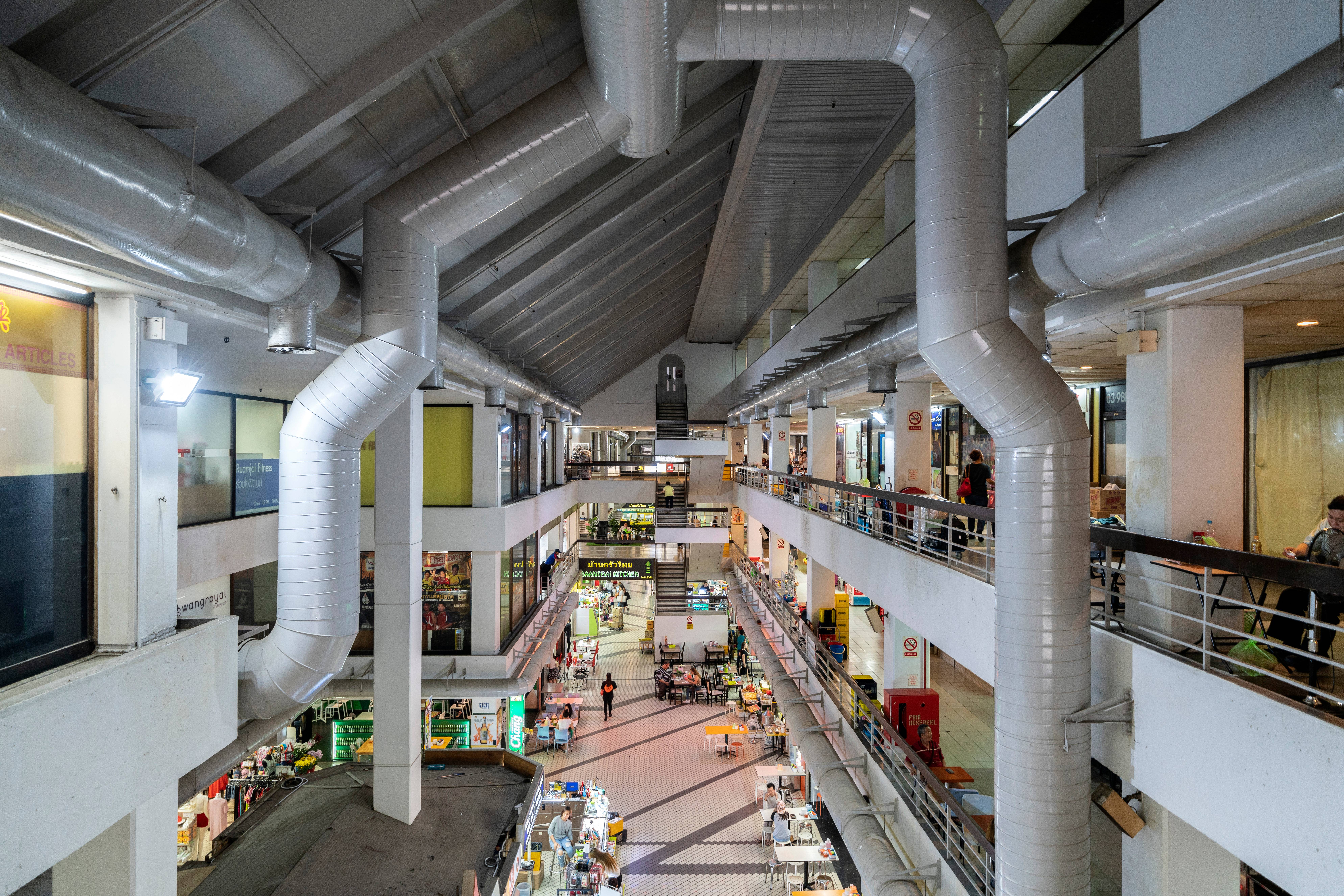
Golden Mile’s unique architecture is apparent even on the inside.
1. IT HAS AN ABANDONED SWIMMING POOL
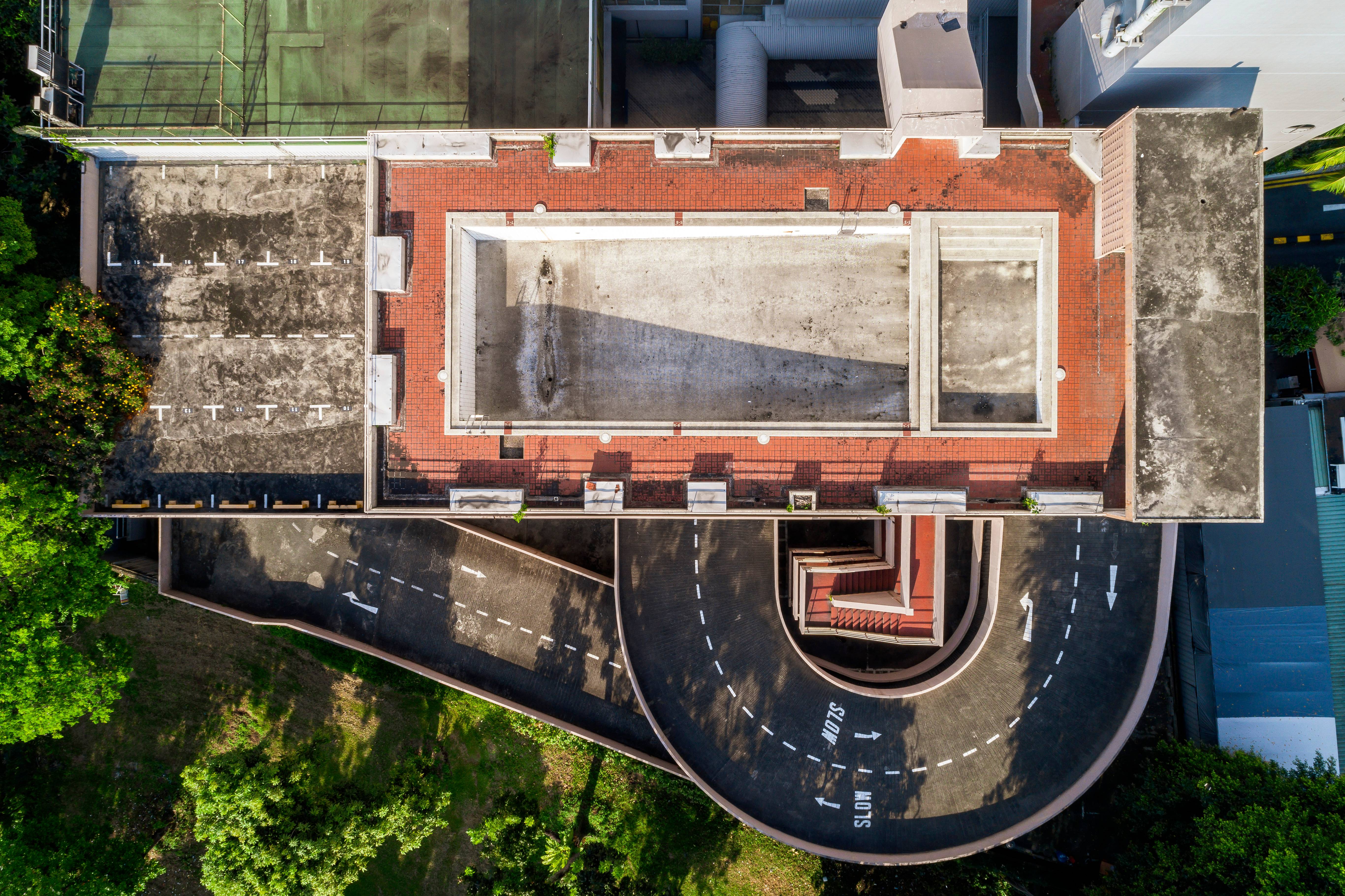
On the fifth floor is a swimming pool, about a third the size of an Olympic pool, that holds some of Mr Ang’s fondest memories.
He recalls spending many weekends down by the pool with his family and friends. Unknown to most outsiders, it was open only to residents.
“When the swimming pool was up and running, it was quite fun. We’d have barbeques there,” he said. “I felt like that’s how the neighbours got to know each other. We grew up being friends like that, and I still keep in touch with them today.”
The swimming pool was emptied about 15 years ago.
The pool overlooks the Kallang River, and there was even a mama shop (a small provision shop) next to it where he occasionally bought sweets, biscuits and toys. It was closed when the pool was drained about 15 years ago.
According to another resident Mr Ponno Kalastree, the pool was under-utilised and expensive to maintain. After it was emptied, the residents’ monthly maintenance fees were cut, he said.
“I was sad (when the pool was closed), and I couldn’t do anything about it,” said Mr Ang. “It’s all locked up now. I wish it could still be accessed.”
Overhead view of the pool. (Photo: Darren Soh)
2. RESIDENTS HAD FRONT-ROW SEATS TO HISTORY
Completed in 1973, the complex boasted an “uninterrupted panoramic view of the seafront and surrounding Southern Islands” and “luxury apartments”.
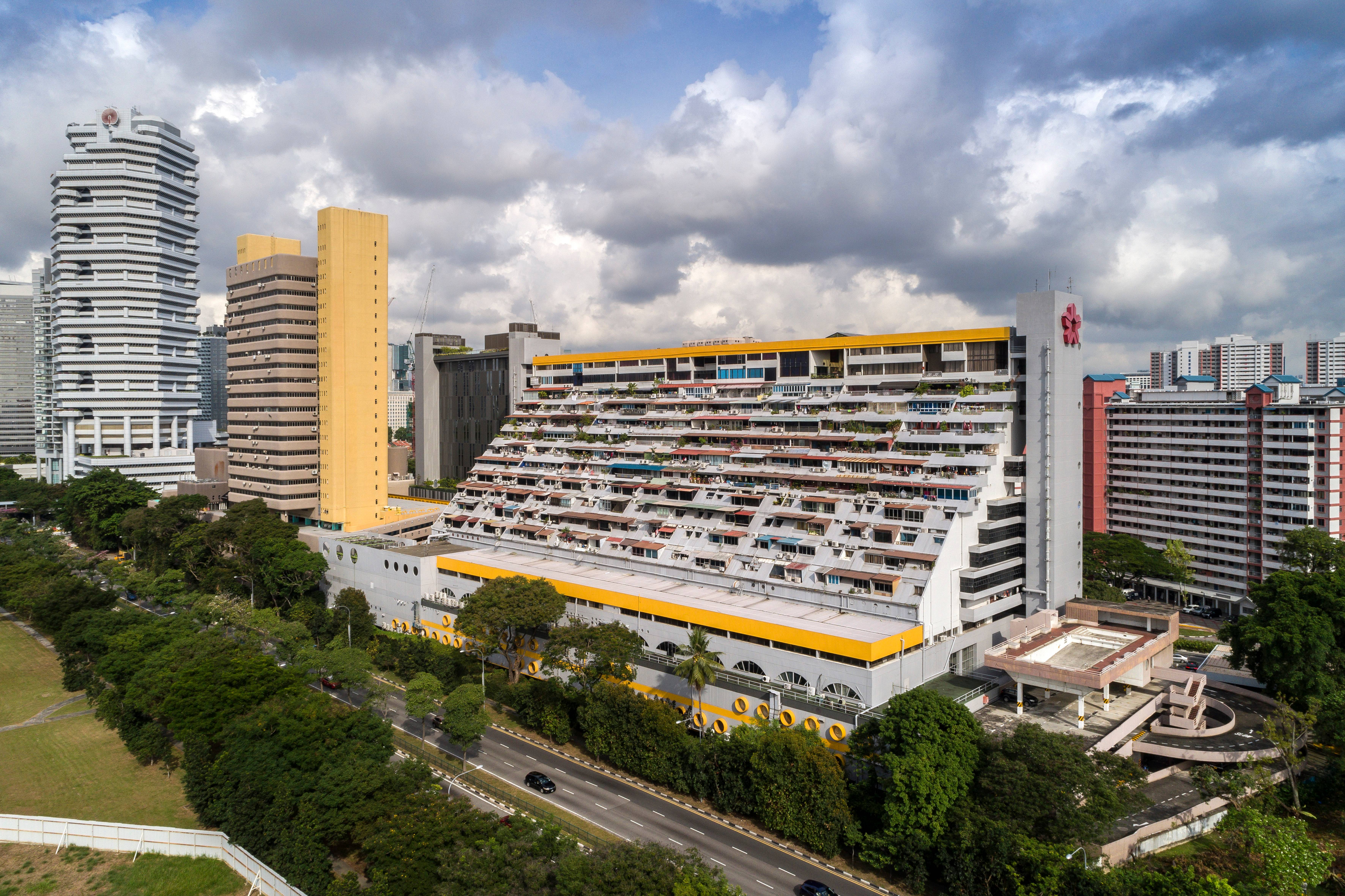
The unique stepped-terrace design that holds 68 apartments, from the tenth to the sixteenth floors, is a familiar sight from Nicoll Highway. And from the balcony of his home on the thirteenth floor, Mr Ang can see from Kallang Basin and the sea off East Coast Park all the way to the Marina bayfront and beyond.
This means he has had a ringside view to many key national events and transformations – from the fireworks every National Day, to a skyline altered by Gardens by The Bay, the Marina Bay Sands and the F1 Pit building.
The view from Mr Ang’s balcony.
The high-end residential Tanjong Rhu enclave also used to be barren land, he pointed out. “It’s nice to see how this area went from a river to something so metropolitan, with condos, a shopping mall and a stadium. We see changes here constantly,” he said.
The building was also witness to a national tragedy.
When a stretch of Nicoll Highway which was part of the Circle Line worksite collapsed on April 20, 2004, Mr Ang – who was 13 at the time – was at home alone watching cartoons. “It was very, very vivid… All of a sudden, I heard this noise, and it was getting louder and louder to the point where the whole building was shaking.
“I looked out the balcony to see what had happened, and there was this huge bang,” he recounted. “And then I was like, ‘oh my god’. And I saw people just running around. It was horrible.”
The balconies of the residences overlook Nicoll Highway. (Photo: Darren Soh)
The first thing the panicked boy did was to call his mother, who was working downstairs. Her nonchalant reaction, he recalled, was: “Oh, but the house is fine right?”
“I don’t think she grasped what had happened. People were screaming, it was quite traumatic,” he said. The complex’s occupants were evacuated for a few hours until it was deemed structurally safe. Four people died at the worksite.
3. MANY LIVE, WORK AND PLAY ALL IN THE SAME BUILDING
The building was one of Singapore’s first mixed-use developments, integrating shops, offices and residences under one roof.
“Theoretically, it was designed for people who need never leave the place,” said local architecture photographer Darren Soh. “I mean, they could live here and do everything without ever leaving.”
The spacious residence, around 2,000 sq ft.
Mr Kalastree, for instance, runs a security and investigation firm from two rented office units. As for Mr Ang, who grew up making the building his playground, his parents own three stores on the retail floors.
Some of the residential units have been rented out to business owners who use them as staff quarters. Mr Leon Loh, manager of Diva Disco on basement one, lives in one of these apartments.
Indeed for the Thai community, the complex has been their home away from Thailand for years, said Mr Soh: “Many of them rent units here and work downstairs. Their children grew up here with their parents working downstairs.”
The office floors, with natural sunlight.
4. THEY CELEBRATE SONGKRAN (THE WATER FESTIVAL) EVERY YEAR THERE
What this means is that there is a strong sense of community among the occupants of the complex, as many residents and tenants are familiar with each other, said Mr Ang whose mother is Thai.
“I bet you if I go down right now, and if I fell down or something, in one hour my mother would know what happened even if she was not here,” he said.
During the annual Songkran festival in April, residents, shop-owners and customers splash water and engage in water-gun fights with each other on the retail floors.
The retail floors. (Photo: Darren Soh)
“You get to experience the Thai culture,” said Mr Ang. “I always invite my friends over. Actually that’s the best time to go to the Thai discos because it’s so fun. It stops being the sleazy thing that people say that it is.”
He also remembers that for a couple of years, there used to be a concert too, with Thai traditional dances and bands playing on the first floor.
5. FEWER LOCALS LIVE THERE TODAY
When Mr Kalastree first moved in about 30 years ago, attracted by the building’s location and the seaview, about 90 per cent of the residents were locals, he said.
But over the years, the building has deteriorated due to poor maintenance. It was even famously called a “vertical slum” and a “national disgrace” by a Nominated Member of Parliament in 2006.
The stepped terraces. (Photo: Darren Soh)
Today, many of the original home owners have passed away, their homes sold or handed down to their children, said Mr Kalastree. Some are leased to Thai businesses like the restaurants or discos, which use them as living quarters for their Thai-national employees.
Others are used by bus drivers employed by the coach companies on the ground floor. Said Mr Ang: “The drivers would stay overnight, shower and then go down and do another round to Kuala Lumpur, and back and forth. So, it’s more like a halfway building for them.”
WATCH: Paying nostalgic homage to a landmark (11:55)
6. INSTAGRAMMERS TRESPASS TO GET TO THE COURTYARD
The sheltered courtyard on the ninth floor is meant to be a playground for kids who live there to cycle and play badminton.
However, with its bright yellow columns, blue-tiled floor and view of the Beach Road area opposite, it has become a popular Instagrammable spot in recent years, despite the lack of signs leading to the place.
The popular courtyard.
“They only started painting the void deck blue three years ago. Before that it was just concrete white and super dusty,” said Mr Ang. “Then I started seeing people going to the ninth floor, dressed nicely. Apparently, a lot of bloggers started taking pictures there.”
Do proceed at your own risk, though: There’s a private-property sign warning trespassers that the area is strictly for residents and tenants only, and that “any trespasser will be handed over to police”.
7. EVENINGS ARE THE BEST TIME FOR PICTURES
But if you’re aiming to get photos of the complex itself, evening is the best time said Mr Soh. And not just because of beautiful shadows cast by the rays of the setting sun.
One side of the complex, with the intricate reverse of the terrace, faces the setting sun, and pictures are best taken from the HDB blocks along Beach Road across from the complex.
8. ITS AMULET AND OCCULT SHOPS DRAW LOCAL STUDENTS
Singaporean Chris Tan, who owns one of the numerous Thai amulet shops on the third floor, said some of his clients include students, policemen and even a school principal. About 90 per cent of his customers are Singaporeans.
He sells Thai amulets to those who believe it would help them through difficult times; one costs from as little as S$10 to the tens of thousands. But Mr Tan cautions that they are meant only as a helping “boost”. “If there’s an amulet that can guarantee you wealth in life, there wouldn’t be so many poor people in Thailand,” he said wryly.
Chris Tan and his amulet shop on the third floor.
Some of the amulet shops also advertise occult services. Perhaps it is that fact, plus the tattoo shops and massage parlours that also populate the third floor, that explains why most visitors don’t venture up there.
“Most people are here to makan or to go to the supermarket,” said Mr Tan.
9. YOU CAN BUY CRISPY CRICKETS AT THE SUPERMARKET
Aside from never-ending rows of Thai sauces and instant noodles, the Thai supermarket on the second level also offers snacks one would be hard-pressed to find elsewhere in Singapore – such as crispy crickets and silkworms at S$2.30 a packet.
But the supermarket’s main draw, especially to Thai nationals, is its wide array of fresh Thai produce – certain varieties of vegetables and types of basil leaves that are found only here, said Thai national Lili Wong, who is married to a Singaporean.
Thai Supermarket’s operations manager Ronald Teo with Thai produce.
She visits Golden Mile Complex about three times a month to stock up on cooking ingredients, including a particular fish sauce that’s only available here. The 10,000 sq ft supermarket carries over 8,000 types of products.
In bygone years, the supermarket and the complex – which earned the moniker “Little Thailand” – was crowded with Thai construction workers on Sundays, said Thai Supermarket’s operations manager Ronald Teo. “It was just like Chinatown during Chinese New Year, that kind of atmosphere.”
The supermarket started out as an Econ Minimart. Thai construction workers were a-plenty.
But their numbers have declined, with fewer coming to Singapore to work.
10. THE COMPLEX ALMOST NEVER SLEEPS
It gets busy from about 11am when the retail stores open, and stays abuzz with activity well until the next morning.
(Photo: Darren Soh)
After the retail shops close at night, the Thai discos and clubs come alive – and a different, more shadowy side of Golden Mile Complex emerges with girls in tight shorts and short dresses lingering outside these establishments.
And when the clubs close, patrons may end up at the Mookata restaurants which are open 24/7. The whole complex only becomes quiet in the early morning, and only briefly before the office crowd starts streaming in.
11. YOU CAN BUY FLOWERS FOR THE PRETTY HOSTESSES
At Diva Disco, there is a culture of patrons buying flower garlands and sashes to show appreciation for the attractive girls performing on stage.
The price of these garlands start from S$10, said club manager Mr Loh. The girls typically get a commission from such sales.
And while they may reward the appreciative patron with a visit to their table, they are not obliged to do so. Mr Loh adds that the girls are strongly discouraged from engaging in any hanky-panky.
The bulk of Diva Disco’s patrons are regulars, mostly Singaporeans.
12. NOT EVERYONE WANTS GOLDEN MILE CONSERVED
The 16-storey complex, designed in the Brutalist style that was in fashion worldwide from the 1950s to the 1970s, was hailed as an “architectural and cultural marvel” by international critics.
Now facing possible demolition if an en bloc sale goes through, the building’s uncertain fate has rallied concerned architects and academics to petition for it to be conserved.
But residents like Mr Ang are not so sure it should be, citing maintenance issues and the age of the building. One of the lifts stopped working months ago (the parts that need replacing are obsolete), and leaking pipes have damaged the walls of Mr Ang’s home.
Mr Kalastree said: “The problem is that it’s an old building, and when it rains, the water seeps through some of the walls. The building has water-proofing issues.”
One of the biggest issues is the main sewage pipe which leaks occasionally and stinks up the place, he added. “It’s a big headache. They call the contractors all the time to fix it. But they couldn’t.”
Mr Ang said that if the building were to be conserved, then it should be properly fixed up and maintained. “The moment people find out that it’s going to be gone, all of a sudden it’s a heritage thing.
“But 10 years ago, nobody gave a shit about this place. People would tell you, ‘oh, be wary of this place’,” he said, referring to the building’s reputation as a sleazy haunt.
SINGAPORE: Local boxer Muhamad Ridhwan put up a strong showing but came up short against Nambia’s Paulus Ambunda, as his opponent clinched the super bantamweight category (up to 55kg) International Boxing Organisation (IBO) world title on Saturday (Sep 29) by split decision.
Both Ridhwan and the 38-year-old Ambunda lasted the full twelve rounds but it was the Namibian that edged the contest by the judges’ score of 115-113, 112-115, 116-111.
Headlining the Roar of Singapore: The Kings of Lion City at Resorts World Sentosa, Ridhwan was aiming to extend his undefeated record of 11-0 and emulate the likes of Manny Pacquiao, Anthony Joshua, Lennox Lewis and Floyd Mayweather Jr, all of whom were former IBO world champions.
The IBO is considered the biggest organisation outside the sport’s four major bodies: the World Boxing Association, International Boxing Federation, World Boxing Council and World Boxing Organisation (WBO).
Singapore’s Muhamad Ridhwan lands a punch against Paulus Ambunda during their International Boxing Organisation (IBO) bantamweight world title fight. (Photo: Matthew Mohan)
But up against a formidable opponent in Ambunda, who clinched the same world title in August 2015 before losing it almost a year later, Ridhwan found it tough to get going in the early rounds.
Ambunda, who boasted a record of 26 wins and two losses before this fight, seemed to be the more aggressive of the two and often had the Singaporean pinned against the ropes. But as the fight wore on, the 30-year-old local pugilist found his way back into the fight and gave as good as it got.
“He was not scared, I wasn’t too – but some things in life you’ve just got to go through,” said Ridhwan. “Respect to him, I’ve got no excuses. I should have done better.”
Ridhwan, nicknamed “The Chosen Wan”, had earned his title shot after beating Filipino Jeson Umbal for the IBO intercontinental featherweight title in April.
Singapore’s Muhamad Ridhwan up against Paulus Ambunda during their International Boxing Organisation (IBO) bantamweight world title fight. (Photo: Matthew Mohan)
Despite the defeat, Ridhwan, a three-time Southeast Asian Games bronze medallist, is not going to dwell on the first loss of his professional career.
“Winning and losing is part of the game,” said the Singaporean.
“Losing always happens to the best … When I’m down, I will come back, I always come back.”
SINGAPORE: A 44-year-old man was killed in an accident along the Pan-Island Expressway (PIE) that involved his motorcycle, a lorry and two vans on Saturday (Sep 29) afternoon.
Police and the Singapore Civil Defence Force said they were alerted of the accident, which took place near the Eng Neo exit on the PIE towards Tuas, at about 1.10pm.
The man, as well as a 44-year-old female pillion rider, were taken to the National University Hospital (NUH). He died of his injuries at the hospital.
Police said investigations are ongoing.
In an online video purportedly showing the scene of the crash, a man can be seen performing CPR on a person laying on the road shoulder. A white van with a dented front, as well as a white lorry, can also be seen in the video.
A video circulating online showed a man performing CPR on another person at the road shoulder.
Photos and videos also showed shards of broken glass strewn across the three lanes, believed to have come from the crates of bottles that fell off the lorry when the crash occurred.
Photos posted on social media showed shards of glass strewn across the lanes of the expressway. (Photo: Facebook / Salim Mohd Saini)
In his post, Facebook user Salim Mohd Saini wrote: “Lorry with glass bottles smashed on lane three, four and five … Broken glass all over.”
He added that traffic was almost at a standstill.
Mr Salim also posted photos from traffic surveillance camera footage that showed a massive jam on PIE on Saturday afternoon.
SINGAPORE: A 38-year-old man has been arrested after he was suspected of selling counterfeit luxury watches and accessories online, police said on Saturday (Sep 29).
The man was arrested in Bukit Timah on Thursday in a raid conducted by officers from the Criminal Investigation Department, authorities said in a news release.
A total of 255 pieces of trademark-infringing goods including watches and watch accessories were seized. The items had an estimated street value of more than S$140,000.
Watch accessories were among the items seized in the raid on Thursday (Sep 27). (Photo: Singapore Police Force)
Preliminary investigations showed the man obtained the goods from local and foreign sources before reselling them via various online platforms.
Police said investigations are ongoing.
Those convicted of selling or distributing goods with falsely applied trademarks may be fined up to S$100,000, given a maximum jail term of five years or both, police added.
SINGAPORE: Deliberate online falsehoods (DOFs), also known as disinformation and fake news, is a problem that has again drawn the attention of the Singapore public.
Last Thursday (Sep 20), the Select Committee on DOFs published a report that explains the committee’s findings on the causes and impact of the problem. The report also recommends countermeasures such as critical thinking to address the problem.
The report paves the way for a multitude of efforts that could be taken at the institutional, societal and individual levels to protect the Singapore public from the harmful impact of DOFs.
As with any complex problem, the public would have a wide range of views on DOFs. These views dissect both the explanations for the causes of the problem and the recommended countermeasures to address the problem.
DOFs is not a straightforward problem as it could either gestate internally or be engineered by external actors. Different intentions drive its spread, and different end outcomes determine its methods.
Members of the Select Committee on deliberate online falsehoods. (Photo: Hanidah Amin)
It is inherent in falsehoods to be both persuasive and deniable. What is not deniable is the predominant intention to cause harm. There could be no single solution and hence a raft of countermeasures is necessary.
Critical thinking is perhaps the most important countermeasure as it could serve as the most fundamental defence against DOFs. Laws and cyber tools could deter the purveyors of DOFs and disrupt their methods but may have limited effect in making people – the targeted audience – more resilient.
There are also concerns over whether certain laws would undermine critical thinking. People must want and be able to think critically before they would even acknowledge the necessity of fact-checking and support quality journalism.
Critical thinking could help people to realise that no one is immune to ideological and cognitive biases when forming their thoughts and making their decisions.
It is the first step to determine what needs to be done – for example, teaching critical thinking skills – to counter DOFs. The next step, more importantly, is how to better teach critical thinking skills.
People now live in a confusing environment where many complex problems exist and are intertwined. For example, the Singapore public is expected to defend themselves against the dangers of DOFs, intolerance of cultural differences, extremism, foreign influence and cyber threats.
In fact, asymmetric warfare entails the use of disinformation and cyber threats to undermine a nation-state by targeting the people’s minds and emotions, and infrastructure.
While it is necessary to expect people to do more to defend themselves, is too much being expected out of them? Is it therefore possible to teach fundamental concepts of critical thinking that are versatile and could be applied to a broad range of dangers?
Secondary school students in a classroom in Singapore. (File photo: MOE)
Could these concepts be adapted for people of various ages, education levels, professional and cultural backgrounds? Could these concepts be enduring and hence applicable for contemporary and future dangers?
Could these concepts be politically-neutral and undergirded by universal human values so that there is more buy-in from people regardless of where they lie on the political spectrum?
There are two concepts that may form part of a framework for critical thinking or enhance current methods of teaching critical thinking. The appreciation of these concepts could help people defend effectively against DOFs and other dangers that may undermine social cohesion by targeting minds and emotions.
These concepts may be adapted from counter-extremism literature in which radical propaganda is seen as a form of disinformation.
The first concept is moral disengagement which entails the cognitive process of dehumanising other people – the “others” – who are different racially, religiously, economically, culturally or politically.
This process enables people to overlook that the “others” are also humans and hence behave unfairly and cruelly towards them. This behaviour may manifest in the act of accepting and circulating narratives that could cause harm to the “others”. Harm may manifest in physical and non-physical ways.
Rumours could also be spread through instant messaging apps like Whatsapp. (File photo: REUTERS/Dado Ruvic)
A historical example is the Singapore communal riots of 1964 in which one of the possible causes is toxic narratives inducing one group to perceive another group as deceitful, harmful and deserving of harm.
A contemporary example is the spread of falsehoods over social media that justifies violence against the Rohingyas who are perceived by their attackers as malicious outsiders.
People who consume online information must guard against this cognitive process which could render them susceptible to narratives that influence them into distrusting and hating the “others”.
The second concept is advantageous comparison – a cognitive process applied to make an act seem less negative and hence acceptable when it is a response to negative actions committed by “others”.
An extremism example is individuals sharing radical propaganda online. They perceive this act as the right thing to do and harmless compared to the injustice – perceived or actual – that those who share the same religion suffered at the hands of “others”.
“Others” may include public institutions that these individuals perceived as having treated them or those who share the same religion unfairly.
Students attend a lesson on “Fake News: access, security and veracity of information” in Sao Paulo, Brazil. (Photo: AFP/Miguel SCHINCARIOL)
A socio-political example is respectable political supporters who resort to spreading rumours to help gain an advantage over “others”. They perceive this act as acceptable because the “others” have used falsehoods in the hustings. A study on The Spread of True and False News Online by MIT researchers highlights this example.
Such acts would not uphold justice but perpetuate misconceptions and distrust among people and between people and public institutions. People who share online information must guard against this cognitive process which could render them complicit – intentionally or inadvertently – in the spread of falsehoods.
Critical thinking is not a countermeasure that could be implemented straightforwardly but it is fundamental. It is not only about having more educational programmes but more importantly, honing the concepts that constitute effective critical thinking.
It is the cognitive nutrition and exercise that progressively builds up resistance against the viruses of falsehoods.
Muhammad Faizal Abdul Rahman is a Research Fellow with the Homeland Defence Programme at the Centre of Excellence for National Security, a unit of the S Rajaratnam School of International Studies at the Nanyang Technological University, Singapore.