Home Blog Page 935

Class – not race nor religion – is potentially Singapore’s most divisive fault line

0

SINGAPORE: The fault lines that have been the most worrisome in Singapore since the nation’s independence are, after 53 years, no longer so in the eyes of its people.

Instead of race and religion, what worries Singaporeans more is the class divide.

That is the finding of the latest, and one of the largest, surveys on this topic, which Dr Janil Puthucheary, the chairman of OnePeople.sg – the national body promoting harmony – worked with Channel NewsAsia to commission.

Almost half of the 1,036 citizen respondents felt that income inequality is the likeliest to cause a social divide here.

Regardless of class 5

As sociology professor Tan Ern Ser said after examining the data: “What we’re seeing here is that if you compare between race, religion, sexual orientation, nationality (country of birth) and class, class matters.”

It matters so much that only about 20 per cent of the respondents felt that race was likeliest to cause a social divide, and an almost similar proportion felt that way about religion.

That is a “huge gap” between the worries over income inequality and those traditional fault lines, noted Dr Puthucheary, who found some of the survey results quite “unsettling”.

“Today, it’s the divide between the haves and the have-nots that’s creating the most tension,” he said. “This is going to be an explosive issue because it challenges some of the values that we hold so firmly and dearly”.

Regardless of class 6

Dr Janil Puthucheary going through the data with the researchers.

Values like fairness, meritocracy and the “founding ideal that there’ll be no such thing as a second-class citizen”. But has the nation been living up to that standard for every Singaporean?

Do people believe that Singapore is a city of opportunity where they can make it so long as they work hard? Is education effective as a social leveller today?

Those are some of the questions explored on the documentary, Regardless of Class. And the answers reflect some “uncomfortable realities”, said host Dr Puthucheary. (Watch it on CNA tonight, Oct 1, at 8pm.)

CLASS-BASED DISCRIMINATION

The treatment that security guard Mohammed Syukri receives is instructive. It may vary from resident to resident at the condominium where he works, but they can get “harsh”.

Regardless of class 2

Mr Mohammed Syukri.

“Sometimes, even when the barrier isn’t open properly, they’d start shouting at us. They’d say ‘useless security’ and ‘stupid security’ and things like that,” he related.

He was “a bit shocked” by this when he started out in this low-paid profession. “But after a while, I go site to site, and everything and everywhere is also the same, so I get used to it,” he added.

When that kind of thing happens to me, I can’t vent my anger on anyone, so I just keep it to myself.

When asked to voice his thoughts, however, he said nervously: “They’re treating us like not humans but … like slaves.”

Stories like his are not new. Dr Puthucheary said: “I hear them all the time in my work as a Member of Parliament, from waiters, security guards, cleaners (and) salespeople. They tell me about a deepening class divide.”

He asked some of them to write down their stories, to find out if people are guilty of creating an ‘us’ versus ‘them’ situation.

Regardless of class 4

One McDonald’s cleaner wrote: “I know I’m invisible. I have to get used to this, and learn to stop caring.”

Similarly, a public estate cleaner wrote: “I just sweep the floor, and then you throw rubbish from the top of the block. Then after that residents complain … The blame is always on me.

“We live our lives as if we’re apart. They go about doing their own work, I go about living mine.”

It is the “little things”, such as a look or a throwaway comment, that cause a sense of separation, said Dr Puthucheary. “And it’s these social cues that slowly widen the divide.”

Regardless of class 16

Dr Janil Puthucheary is also Senior Minister of State for Transport and Communications and Information.

Another security guard, Mr Pugalenthi, can attest to that. “People think … a security guard is a low-class job. They say, “Ah, you’re only a security guard,’” he said.

“Sometimes I feel, like, alamak … This job, why do people look down on it? Work is work.”

COMMON STEREOTYPES

The class divide has been a buzz phrase since an Institute of Policy Studies survey last year found the gap to be more pronounced than it seemed.

READ: More can be done to facilitate mixing among people of different social classes, IPS survey finds

Most researchers define class by income, housing type and education. But people can make class markers out of anything, from the way others speak to the way they dress, even if it may be off the mark.

That has been the experience of freelance actress Nadiyah Ramlan, who has received comments about her “low-class” dress style and has also been asked about her education level. “That’s not the way it’s supposed to be,” she said.

Regardless of class 7

Ms Nadiyah Ramlan.

In the documentary, to determine a person’s social class, participants asked questions about the stranger’s hobbies, travel destinations, favourite brands and where he or she shopped, among others.

On the website Quora, some people have suggested that one’s occupation as well as state of mind, such as confidence level and social etiquette, can also contribute to the perception of socio-economic class in Singapore.

Recently, a social science guidebook (not on the approved textbook list) even codified stereotypes of the classes into text, causing an uproar.

READ: Controversial Social Studies guidebook not on approved textbook list: MOE

So in July, the CNA survey asked the respondents, aged 18 to 74, what they thought of others from different classes.

Given a choice of over 20 characteristics, the top three perceptions Singaporeans had of the upper class were: Able to speak good English (chosen by 98 per cent); tended to plan ahead; and domineering (both 94 per cent).

As for perceptions of the lower class, most people thought they were friendly (92 per cent), caring and tended to speak Singlish.

Regardless of class 8

The top perceptions of the lower class.

What Dr Puthucheary found more interesting were the differences between the ways people saw the upper classes versus the lower classes. Some 91 per cent thought the former were arrogant, versus 35 per cent who thought that of the latter.

People also thought someone from the upper class was likelier to be luckier than someone from the lower class (90 vs 48 per cent).

These are more than just perceptions, however; they also affect interactions between the different ends of the divide.

The middle and lower classes have to “be somebody else” to blend in with the upper class, which is “very uncomfortable”, said Malay language instructor Rohati Januri. But the alternative – being one’s own self – leads to feeling excluded, she admitted.

Regardless of class 9

Ms Rohati Januri.

WHAT THE CHILDREN SAY                                                                            

Is Singapore’s class consciousness starting in school, however? To find out, CNA interviewed several groups of nine- to 11-year-olds. And as Shievon Cheah put it, “If you have the most expensive things, you’re the most popular also.”

Asked what she thought of those who get a lot of pocket money, she said: “They’re rich or their parents just don’t care how much they give their kids.”

Grayden Tan, who classified himself as “a little above average”, said hesitantly: “I think rich people treat poor people badly … because they think they’re rich, so they don’t really know what it’s like to be poor.”

Asked how the poor treated the rich, he replied: “They don’t treat them badly. They don’t say anything. It’s just that they’re a bit hurt and sad that these rich people say these things like ‘go get a job’.”

Regardless of class 10

Shievon Cheah (centre).

Both Marcus Lee and Renee Phua have fathers who told them to study hard to earn more in future, or risk ending up with a low-paid job.

Asked what he thought of poor people, Marcus said: “They may be good socially, but maybe they don’t have the (job) skills.”

When another group of students, aged 15 to 17, from the Integrated Programme (IP) and the Normal streams came together, the differences were clear.

The parents of the IP students and the students themselves expected at least ‘A’s and to go to university, locally or abroad.

The parents of the Normal stream students and the students themselves expected a pass in all their subjects and a little bit of improvement, and also to get into the Institute of Technical Education.

Regardless of class 11

Coming face to face from different educational tracks.

How much did they interact with students from a different stream? “Most of the people in the Express stream look down on us,” said Normal (Academic) student Joey Heng.

They think we’re quite stupid, so they seldom talk to us.

Normal (Technical) student Muhd Nadiy Razin has friends from the Express stream but does not usually hang out with them. “They’re very quiet and neat in school, not like us. We usually create chaos,” he said.

N(T) student Muhammad Sufa Aniq has tried talking to some Express students, and they have reciprocated. But the gap is hard to bridge. “The way they speak and the way I speak are very different,” he said.

Such friendships require a lot of effort, agreed IP student Maniyar Kareena Tushar. “The kind of activities my school may expose me to outside of school generally tend to be quite populated by the higher express streams,” she said.

She doubts that mixed-ability classes are a viable solution. “It might even increase the gap if the students feel as if they can’t cope, so they just give up completely,” she explained.

Nadiy and Aniq, on the other hand, think it could work, but only if the teachers are willing to help them.

Regardless of class 12

If IP student Alexander Loh finds himself having the opportunity to go overseas for university, he said he would “definitely take that”.

EDUCATION – LABELLER OR LEVELLER?

The discussion the students had was awkward, acknowledged Dr Puthucheary. “But I think the reality is that’s what they face every day – we want to remove ourselves from situations where we feel embarrassed,” he said..

“Maybe that’s one of the reasons why it’s so difficult for kids of different backgrounds to interact regularly all the time and develop deep friendships.”

The class divide can have an impact beyond just friendships, however. Playwright Faith Ng, who was from the Normal stream, said worries at home about her family’s finances did affect her studies. She was not motivated and had poor self-esteem.

“The teachers would say things like ‘even though you’re from Normal’. And that ‘even though’ already would imply a lot. So you kind of deduce that it means you’re not as good as everybody else,” she said.

Regardless of class 13

Ms Faith Ng’s play, Normal, about two N(A) students battling stereotypes, caused a buzz when it made its debut in 2015.

It took her a decade to get over the stigma, but she went on to get a master’s degree and is now a part-time university lecturer.

Dr Puthucheary saw her story as a “silver lining”, as not just one of class bias but “also one of social mobility”.

“That’s what we’ve always been proud of: People are given the opportunity to rise above their circumstances. And I’ve always believed in this too. It’s your ability, not your connections – your worth, not your birth,” he said.

But CNA’s survey showed that not everyone felt the same way. Asked what it would take to get them out of poverty, those respondents suggested, in ascending order: Knowing the right people; education; and, most importantly, hard work.

Regardless of class 1

In contrast, when people from the upper class were asked how to get rich, they suggested: Hard work; ability; and, most importantly, knowing the right people. Education did not factor into their top three reasons.

When it came to social mobility, only half of the people from the lower class were confident that their next generation’s financial situation will improve.

Anglican High School literature teacher Samuel Chan said family “has a big part to play”, where some parents have the familial, cultural and financial resources to give their children a head start.

“We’re seeing a gap in achievement for different students,” said Mr Chan, who also teaches low-income students at non-profit organisation Readable.

Regardless of class 14

Mr Samuel Chan.

Then there is the perception among parents that “unless you’re going to certain schools, your avenues for success are closed off to you”.

But he thinks that education is a symptom, rather than a cause, of the “felt sense that society is more unequal” and that it can still function “very much” as a social leveller.

WHY IT MATTERS

Ultimately, however, why should the average Singaporean care about income inequality?

The Straits Times opinion editor Chua Mui Hoong thinks it should be because “so much of the Singaporean identity has been built on the idea that we can all have a fair go, that you can do well in life regardless of your family connections (and) wealth”.

Regardless of class 3

Ms Chua Mui Hoong has compiled her articles on income inequality and class divide into the book, Singapore Disrupted.

And she wants to see this not only preserved but entrenched and enhanced.

“It becomes a problem if we’re increasingly having a society where people who are already privileged and with access to resources are able to pass on those advantages to their children,” she said.

A divided society, she believes, would be “a very unhappy one, full of resentment, full of envy, full of talk about the divide between the best and the rest, full of criticisms of the elite … (and) totally fractured politics”.

That society could become quite ungovernable.

Currently, people from the higher classes are likelier than those from the lower classes to participate in society by, for example, volunteering in labour unions, sports clubs, professional associations and non-governmental organisations, or engaging in arts and cultural activities.

Dr Puthucheary believes that probably explains why the survey found that class affects people’s feelings about the country: 70 per cent of the higher classes felt a strong sense of belonging, compared with 46 per cent of the lower classes.

Regardless of class 15

And 76 per cent of the higher classes felt proud to be Singaporean, compared with 50 per cent of the lower classes.

“This is the gap that really matters to me, that the rich feel connected to Singapore, and the poor don’t,” said the senior minister of state.

“This class gap is really an inclusion gap. So solving this problem, to me, can’t just be one more thing on our to-do list. It can’t only be a line item on a ministry’s budget.

“Tackling this divide is central to what makes us Singaporean – that no one should consider themselves a second-class citizen,” he concluded.

Watch the episode here, or catch it tonight, Oct 1, at 8pm.
Source link

900,000 HDB households to get utilities rebate in October

0

SINGAPORE: About 900,000 Singaporean HDB households will receive a rebate of up to S$95 off their utilities bill this month, the Ministry of Finance announced on Monday (Oct 1).

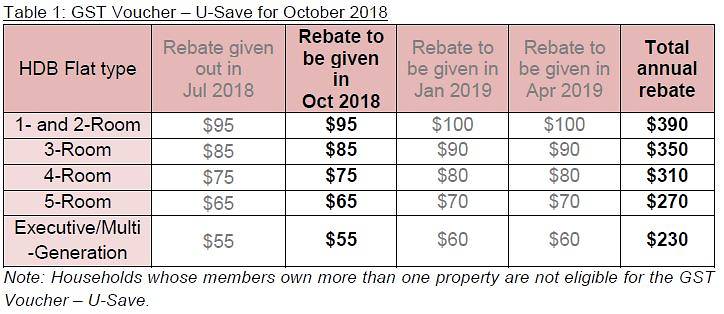
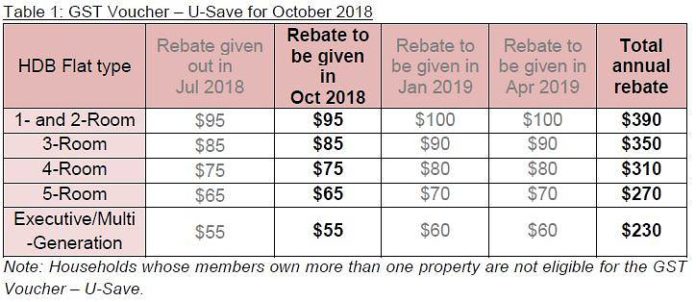
Eligible households will each get a rebate of between S$55 and S$95, depending on their HDB flat type, in the latest instalment of the GST Voucher – Utilities-Save (U-Save) rebate.

GST Voucher Table

As announced in Budget 2018, eligible households will receive an additional S$20 per year (S$5 per quarter) for three years from 2019 to 2021. This will help households adjust to the carbon tax when it is implemented from 2019, said the ministry. 

READ: From GST to hongbao giveaway: Budget 2018’s impact on economy, environment and society

The rebate, which is part of the permanent GST Voucher scheme, is distributed every three months. It helps HDB households offset part of their utilities bills and serves to lower overall household expenses. 

The total expenditure on U-Save rebates is expected to amount to S$280 million a year, the ministry said. 

Source link

HDB resale prices down slightly in Q3, continuing declining trend

0

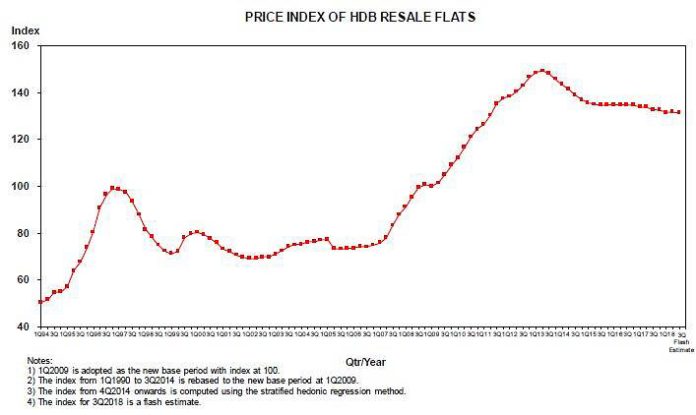
SINGAPORE: Prices of resale flats for the third quarter fell 0.2 per cent, continuing a declining trend, according to flash estimates released by the Housing and Development Board (HDB) on Monday (Oct 1). 

The resale price index – which provides information on the general price movements in the resale public housing market – is estimated to have slid to 131.5 from 131.7.

READ: Private home prices rise further in Q3 but pace of increase slows

Resale prices for HDB flats have been on the decline over the last year. Prices fell 0.7 per cent in the third quarter of 2017, 0.2 per cent in the fourth quarter of 2017 and 0.8 per cent in the first quarter of this year, although they inched up 0.1 per cent in the second quarter.

hdb q3 2018 flash estimates graph

Graph: HDB

The resale price index for the full quarter will be released on Oct 26.

READ: HDB resale market to see ‘little’ benefit from cooling measures, experts say

HDB also announced that it will launch about 3,800 Build-to-Order (BTO) flats for sale in Sembawang, Sengkang, Tampines, Tengah and Yishun in the November sales exercise. There will also be a concurrent Sale of Balance Flats exercise.

Those who buy the Sengkang and Yishun BTO flats will have a shorter waiting time of two-and-a-half years, instead of the usual three to four years, HDB said. 

The housing board said in July last year that some BTO projects will be sold with a shorter waiting time to help young couples get their first home earlier.

READ: HDB to offer BTO flats in Sembawang, Sengkang, Yishun with shorter waiting time

First-timer families applying for these flats will get higher priority, with at least 95 per cent of the four-room and larger flats set aside for them – up from the current quota of at least 85 per cent in non-mature estates.

The flats will come with floor finishes, internal doors and sanitary fittings, reducing renovation works required and enabling home buyers to move in sooner. All units will also come with an open kitchen concept where the layout permits, HDB said.

Source link

Private home prices rise further in Q3 but pace of increase slows

0

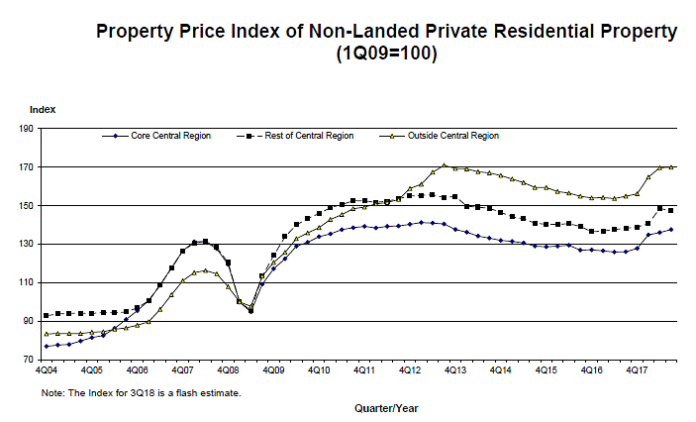
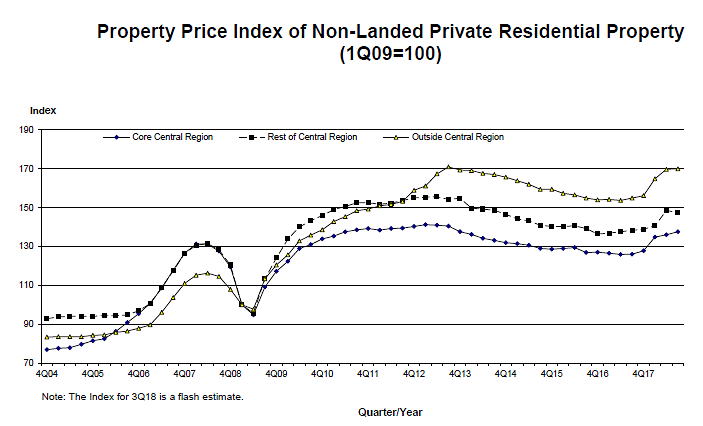
SINGAPORE: Private home prices rose 0.5 per cent in the third quarter of this year, according to the latest figures from the Urban Redevelopment Authority (URA) on Monday (Oct 1). 

This continues a rising trend from the previous quarters, although the pace of increase slowed in comparison with the 3.4 per cent rise in the second quarter and 3.9 per cent rise in the first quarter

READ: Private home prices up 3.4% in second quarter

Prices of non-landed properties rose by 1.2 per cent in the Core Central Region (CCR), compared to the 0.9 per cent increase in the previous quarter.

Meanwhile, prices in the Rest of Central Region (RCR) decreased by 0.8 per cent, after registering an increase of 5.6 per cent in the previous quarter, said URA. 

Prices in Outside Central Region (OCR) increased by 0.1 per cent, after rising 3 per cent increase in the previous quarter. 

READ: HDB resale prices down slightly in Q3: Flash estimates

URA private property graph Oct 1

The flash estimates are compiled based on transaction prices given in contracts submitted for stamp duty payment and survey data on new units sold by developers up until mid-September.

READ: Private home prices up 3.9% in first quarter

The statistics will be updated on Oct 26 when URA releases the full real estate statistics for the quarter.

Source link

Singapore to open up retail electricity market from November: What it means for consumers

0

SINGAPORE: For the past week, Ms Janet Wong and her neighbours have been discussing the merits of switching electricity providers. 

This after the Energy Market Authority (EMA) on Sep 21 announced the nationwide roll-out of the Open Electricity Market, an initiative to fully liberalise the retail power market here.

Simply put, buying electricity will soon be like choosing mobile phone plans. Instead of getting power solely from SP Group at the quarterly-reviewed regulated tariff, consumers will be able to sieve through price plans offered by as many as 12 approved retailers. 

“We are all very keen,” Ms Wong told Channel NewsAsia. “If it means savings for us, why not?” 

The roll-out to include 1.4 million consumers across the rest of Singapore is set for Nov 1 and will be done in batches according to postal codes. 

Households and business accounts with postal codes that begin from 58 to 78 will be the first, followed by the adjacent zone that has postal codes starting from 53 to 57, 79 to 80, 82 to 83 on Jan 1. 

The third zone, marked by postal codes from 34 to 52, and 81, will be included in the initiative from Mar 1 2019, while the final area that comprises of codes from 01 and 33 will get their turn on May 1. 

Ms Wong’s residence in Choa Chu Kang falls under the first zone. 

“My company switched to a different retailer a few years ago and the electricity bill went down by nearly half,” said the 56-year-old. “Now, I want to do the same for my own bill.”

Zonal rollout map of Open Electricity Market

The Open Electricity Market will be rolled out across Singapore in batches. (Graphic: Energy Market Authority)


TO SWITCH OR NOT

The liberalisation of Singapore’s retail electricity market has been a gradual one that started in 2001 with larger businesses. 

Since then, more commercial consumers have been given the freedom to go shopping for electricity as the contestability threshold – the amount of electricity one uses per month – was lowered progressively. 

For now, this refers to businesses with monthly electricity consumption averaging at least 2,000 kilowatt hour (kWh), equivalent to a bill of about S$400. According to EMA, more than half of the 95,000 eligible business accounts have made the switch as of July. 

Homeowners were given an option for the first time when the pilot test of the Open Electricity Market began in Jurong on Apr 1. Over the past five months, more than 30 per cent of consumers there have chosen to buy electricity from a different provider, with savings of about 20 per cent, the EMA said. 

The agency also surveyed 400 people that have switched retailers; about 80 per cent agreed that the initiative has its benefits such as competitive pricing and innovative offers, while a similar percentage of respondents described the switching process as an easy one. 

Mr Jason Low is among those who welcome the market liberalisation. Though he was “sitting on the fence” initially, the 35-year-old said he was convinced by “attractive discounts” during an EMA-organised roadshow in April.

Since signing up for a two-year fixed rate plan with Geneco, a brand under YTL PowerSeraya, Mr Low said the monthly bill for his family of four has gone down by more than S$40. “Going for something that helps to cut down household expenses seems like a practical thing to do.” 

To be sure, there are many others in Jurong who remain undecided or prefer to stay on with SP Group. 

EMA explained that this can be due to consumers having a “wait-and-see” approach for better deals or simply not having the urge to switch. Small households, in particular, may feel that “the savings are not worth the extra effort of figuring out the options”, said the agency’s chief executive Ngiam Shih Chun. 

Mr Nazri told Channel NewsAsia that his parents, who live in Jurong, are among those that are not in a hurry to make a decision. 

The 37-year-old, who stays in a four-room flat in Choa Chu Kang with his wife, will also be taking his time come November even as he is keen on a plan that can help trim his monthly bill to below S$100. 

“There are quite a lot of players so I think we will want to compare carefully,” said Mr Nazri, while adding that he is unsure of what switching retailers may mean for electricity supply to his home, especially in the event of company closures.

READ: Singapore consumers can choose electricity provider from November

READ: Sizzling competition, ‘encouraging’ sign-ups as electricity market opens up in Jurong

PROTECTING CONSUMERS

On that, EMA has said that opting for a different provider will not affect supply reliability because SP Group will continue to operate the national power grid.

Even as retailers leave the Open Electricity Market, there will be no power disruptions as households will be automatically transferred back to SP Group, which is the case for consumers in Jurong who have signed up with Diamond Electric, Red Dot Power, Sun Electric and Sunseap.

These four retailers, which took part in the pilot test, have decided to sit out of the nationwide roll-out due to reasons, such as re-assessing business plans and system upgrades. 

EMA also stressed that the initiative is not compulsory but to help those interested, a notification package and information booklet will be issued before each roll-out. A comparison website will also be updated with the latest price plans by Nov 1. 

To further protect consumers, guidelines from the EMA require all retailers to present their customers with an advisory form and fact sheet, and obtain acknowledgement for both before proceeding with the switch. 

Retailers are also required to safeguard each household’s security deposits, and are banned from making unsolicited calls, messages or door-to-door visits. 

For each sign-up, electricity providers will work with SP Group to “ensure seamless transition”. 

When contacted, SP Group said that it “supports” the Open Electricity Market and will help its customers to “switch seamlessly to a retailer should they choose to do so”. 

DECIPHERING PRICES 

SP Group’s spokesperson added that the “increase in competition for retail services does not materially affect” its operations. It continues to operate and maintain the power grid, while providing market support services such as billing and meter reading, the emailed response said. 

SP Group is paid for these network costs and market support services at fees that are reviewed annually and regulated by the EMA. These fees form part of the regulated tariff, alongside energy costs, market administration fee and power system operator costs which go to the generation companies, Energy Market Company (EMC) and the EMA, respectively.

“Other than the SP component, SP Group does not benefit from the remaining tariff components,” said the spokesperson.

Based on the recently announced electricity tariff for the fourth quarter, SP Group will receive 5.71 cents per kWh – an amount that has held steady for the past six months. For the first quarter of 2018, SP Group was paid 5.67 cents per kWh.

These fees will also be included in the electricity prices offered by retailers, as SP Group remains the power grid operator and supplier of meter readings, added the spokesperson. 

“Regardless of whether consumers buy electricity under tariff, or through a retailer, the SP component collected from consumers will be the same.”

SP Group's electricity tariffs for Q4 2018

For the fourth quarter of 2018, SP Group will be paid 5.71 cents per kWh for network costs and market support services that it provides. Electricity tariffs are reviewed quarterly based on guidelines set by the Energy Market Authority. (Graphic: SP Group)

As to how retailers are able to offer lower prices, EMA said the regulated tariff reflects the long-term costs of producing electricity in the market, including fuel costs. 

Retailers, on the other hand, are allowed to set their own rates, which mirror short-term costs that are dependent on market conditions, such as supply and demand of electricity, and competition levels. 

EMA said these factors may vary over time and there is no guarantee that rates offered by retailers will remain at the same levels. 

For instance, discounts aimed at grabbing market share and the wholesale prices at which retailers buy their electricity from will play a part, industry experts and players told Channel NewsAsia. 

Currently, all power generation companies compete to sell their electricity in a wholesale market operated by the EMC. Retailers, in turn, buy electricity in bulk from the wholesale market, where prices change every 30 minutes depending on demand and supply. 

“If a retailer has the skills to determine the correct prices to buy and sell, then it will have a good business case,” said Professor Subodh Mhaisalkar, executive director of the Energy Research Institute at Singapore’s Nanyang Technological University. 

The electricity futures market, introduced by the EMA in 2015, also helps retailers without generation assets to compete in the retail electricity market. 

For independent players like Ohm Energy, the futures market is “equally important” in helping it to hedge against the rise and fall in global crude oil prices, said its managing director Jomar Eldoy. 

READ: Electricity tariffs to rise by 2.1% for October-December period

READ: Commentary: Assessing the benefits of an Open Electricity Market for households and small businesses

When asked if the Open Electricity Market will translate into long-term cost savings for consumers, Professor Mhaisalkar said yes though “how much that will be will depend on individual retailer’s price efficiency and business plans”. 

“But the good news is, if consumers are unhappy with their retailer, they can always switch back to SP Power or go for another retailer and authorities will make sure that there is no deterioration in supply,” he added. 

“So in that sense, consumers have a safety net.” 

And as the market matures, Professor Mhaisalkar said consumers here can look forward to innovative offerings that involve, for instance, technological solutions as retailers aim to differentiate themselves beyond price.

But during the initial phase, consumers may need to contend with some uncertainties, such as the sudden exits of retailers, noted Mr Allan Loi, a research associate at the National University of Singapore’s Energy Studies Institute.

“This trend could be prevalent in the first one to two years after deregulation, especially when consumer tariff and environmental preferences are still unclear,” he said. 

Consumers also need to do their research and compare beyond price before making the switch.

For instance, going for a two-year fixed price plan may cushion consumers from volatile movements in global oil prices but if the price of crude falls, they will not be able to reap the benefits. 

Professor Mhaisalkar said: “Consumers will need to do their homework, be careful and make sure they pick a plan that they can stick to. Bear in mind that changing your mind halfway through the contract may incur penalties, which will not make monetary sense.”

Source link

Full opening of electricity market in Singapore to fire up competition: What will retailers do?

0

SINGAPORE: When the nationwide roll-out of the Open Electricity Market begins next month, consumers here will stand to enjoy the benefits of a liberalised retail power market with industry experts expecting sizzling competition to fire up price cuts and other promotions. 

This after a pilot test in Jurong saw retailers trying to outdo each other in similar fashion over the past five months. 

Simply put, the expansion of the Open Electricity Market, to be done in batches from Nov 1 to May 1, means that households and small businesses will no longer have to buy power solely from SP Group at the quarterly-reviewed regulated tariff. Much like getting mobile phone plans, they will be able to sieve through price plans offered by as many as 12 approved retailers. 

As part of a pilot programme that started in April, 120,000 consumers in Jurong were the first to enjoy this flexibility. 

To entice those shopping for electricity for the first time, 13 retailers doled out a buffet of plans that were priced on average 20 per cent below the regulated tariff. Freebies such as iPads, shopping vouchers and air tickets were also up for grabs at a roadshow organised by the Energy Market Authority (EMA) in April.

Experts and industry players told Channel NewsAsia that it would not be a surprise if that repeats during the nationwide roll-out. 

“There will definitely be a push to maximise market share so consumers can expect incentives to be offered,” said Professor Subodh Mhaisalkar, executive director of Nanyang Technological University’s (NTU) Energy Research Institute. 

Echoing that, Ohm Energy’s managing director Jomar Eldoy said: “We have seen, what I would call, subsidised prices in Jurong and that may very well be what our competitors will put out when the next section of the market opens later this year.” 

Given that they are only allowed to start marketing from Nov 1, retailers that Channel NewsAsia approached were tight-lipped about their upcoming plans. For those that are already retailing, they declined to reveal if further price changes are in the pipeline. 

Nevertheless, almost all said that they will be closely monitoring market conditions. 

“I suppose things like discounts will be something that every retailer has under wraps for now… so it’s inevitable that a price war will happen,” said Union Power’s executive director Ellen Teo. “We will wait and see what happens.”

“ENCOURAGING” SIGN-UP RATE IN JURONG

For now, electricity retailers are feeling upbeat following an “encouraging” response in Jurong where more than 30 per cent of consumers have opted for a different provider.

EMA roadshow on Open Electricity Market 2

Electricity retailers and consumers at a Open Electricity Market roadshow held at Westgate mall on Apr 21, 2018. (Photo: Energy Market Authority)

Among those willing to reveal sign-up rates, Ohm Energy said it now serves about 1,500 households while PacificLight Energy is fast approaching 6,000 sign-ups. 

“Considering that it’s been only five months, I think this is a very good response compared to other markets,” said the latter’s general manager Geraldine Tan. 

“The pick-up rate has been very fast though it has slowed down a little over the last two months. This is because there are consumers that are probably adopting a wait-and-see approach… This is always the case when there’s something new so we are exploring ways in which we can reach out to this group of consumers,” she added. 

READ: Singapore consumers can choose electricity provider from November

READ: Sizzling competition, ‘encouraging’ sign-ups as electricity market opens up in Jurong

This includes clarifying questions about switching retailers, such as whether it affects the reliability of electricity supply, and simplifying consumer choices. 

In announcing the nationwide roll-out, the EMA said it will limit standard price plans to those that offer fixed prices and discounts off the regulated tariff. A peak and off-peak plan will be removed due to a low take-up rate. 

It also standardised price plan durations to six months, one year and two years after retailers started offering “confusing” trial plans as short as three months. 

Retailers agreed that having simple and transparent price plans, alongside a fuss-free transition process, will be crucial. This is especially the case when the idea of shopping for electricity remains a new concept for consumers, said Mr Stefano Boscaglia, senior vice president of SME and consumer sales at Senoko Energy. 

Still, some maintain that there is merit in offering non-standard price plans. For instance, Geneco, a brand under YTL PowerSeraya, said it will continue to offer six plans, including a peak and off-peak option targeted at consumers who wish to monitor their own consumption. 

“With varying lifestyles, there are customers who want different types of plans so even though they may not be as popular, we will make them available,” said the company’s executive vice president of retail Low Boon Tong. 

READ: Singapore to open up retail electricity market from November: What it means for consumers

ELECTRIFYING COMPETITION

Also feeling confident, the new players entering the Open Electricity Market are looking to develop their own competitive advantage. 

Union Power, a subsidiary of home-grown bottled-gas supplier Union Energy, told Channel NewsAsia that it will focus on customers who are already using its liquefied petroleum gas (LPG). 

Said Ms Teo: “We have a natural base of customers after being in the LPG business for 40 years now. The objective is to offer them value-added services. 

“For instance, if you use LPG in your kitchen, we can come in to supply electricity for your entire home. We see this as having a lot of synergy with our core business.” 

ES Power, on the other hand, is hoping to differentiate itself with its carbon-neutral electricity. With the exit of Sunseap and Sun Electric, the energy brand of local firm Environmental Solutions is the only green energy player in the Open Electricity Market for now. 

Citing results from the company’s recent survey, co-founder and executive director Sivakumar Avadiar said there is demand for green energy in Singapore. 

Among the 600 people it surveyed from April to June, nearly 10 per cent will be willing to pay more for green energy plans, while close to 20 per cent will opt for a green product if the pricing is competitive. 

“If we can offer cleaner energy together with savings in excess of 20 per cent, we think consumers will appreciate it,” said Mr Avadiar, though he acknowledged that the process of convincing consumers to switch electricity retailers will likely be a multi-year “marathon, instead of a sprint”. 

Meanwhile, other electricity providers that have left the Open Electricity Market told Channel NewsAsia that they will be back. 

Sun Electric, Sunseap and Red Dot Power cited system upgrades and development of new products for their pull-out but stressed that they will re-join the competition when they are ready. Diamond Electric did not respond to queries. 

Hyflux Energy, which had a short-lived participation in the pilot test from April to June, also said via email that it plans to participate in the Open Electricity Market “at a later stage” and is “preparing for it accordingly”. 

Citing “competitive reasons”, the spokesperson declined to reveal the number of customers Hyflux Energy has in Jurong, as well as the reason for its exit though she stressed that “Hyflux Energy is not involved in the restructuring exercise that is currently being undertaken by some entities within the Hyflux Group”. 

“As there were no disruptions to any service, Hyflux Energy continues to actively retail electricity to commercial and industrial customers, and has been serving the residential customers in Jurong who have already signed up with Hyflux Energy,” said the emailed response.

READ: Electricity tariffs to rise by 2.1% for October-December period

READ: Commentary: Assessing the benefits of an Open Electricity Market for households and small businesses

HOW WILL IT PAN OUT

On whether the Singapore market is big enough for so many players, Professor Mhaisalkar from NTU reckons that consolidation might happen in three to five years hence retailers need to differentiate themselves beyond price. 

This will involve offering unique bundled services and innovative solutions involving technology.

“Just like how the introduction of Uber and Grab disrupted the taxi market, the opportunity would be innovation. Similarly in the telco space, we’ve seen how telco players now allow their customers to monitor data usage via an app,” said Professor Mhaisalkar. 

“Something similar could happen in the electricity market.” 

On the other hand, Mr Allan Loi, a research associate at the National University of Singapore’s Energy Studies Institute, is less sure. 

He cited New Zealand, which is a much smaller market that continues to have more than 30 retailers after being deregulated for more than a decade. 

“A consumer will likely not complain if having many retailers can bring down electricity costs. So I would say we are probably not at saturation point right now.” 

However, independent retailers, especially clean energy brands, may need time to find their footing. 

“(New Zealand’s) smaller retailers started to gain ground around 5 years after operation. Hence, we may require this amount of time for consumers to fully trust smaller retailers with their electricity supply,” explained Mr Loi. 

“Having said that, many smaller retailers may eventually merge with the vertically-integrated market players. It is too early to tell when market consolidation will occur.”

Source link

Commentary: Expats, foreign talent and immigration make Singapore economically better off

0

SINGAPORE: For many years, and probably more commonly expressed since the Population White Paper with its projected population of up to 6.9 million by 2030 was released in 2013, many Singaporeans have been vocal, especially online, in voicing their objection to the inflow of foreign talent and immigration.

Many Singaporeans for instance, expressed concern over the number of new citizens accepted into Singapore in 2017 announced on Thursday (Sep 27) – of slightly more than 22,000, the second highest in the last 11 years.

Yet, most are not against the inflow of foreign workers who hold lower-paid jobs that local people do not want.

Foreign talent is commonly perceived to be the key culprit taking away good jobs that could be filled by local Singaporeans, and hence deemed undesirable. Immigration creates concerns that Singapore will be more crowded and less livable.

Is this really the case?

MISPERCEPTIONS ABOUT FOREIGN TALENT

The inflow of foreign talent and immigration involve also the consideration of non-economic aspects like social harmony that I will not discuss in this commentary due to limitations of space and expertise.

Nevertheless, the economic effects considered here is a, if not the, major factor accounting for the misperception of the undesirability of foreign talent.

One reason for the misperception is because the replacement effect of local talent by foreign talent is direct, immediate, and visible – while the benefits of getting the best, even if foreign, talent are indirect, long-run, and less visible.

People Orchard Road walking

Pedestrians cross a street at the Orchard Road shopping district in Singapore. (Photo: AFP/Roslan Rahman)  

If an opening of a professorship is filled up by a foreigner, then obviously, where relevant, a local applicant misses out on this position.

At NTU, we have a policy of preferring a local applicant if their qualifications are comparable. We appoint a foreign applicant only with clear superiority – a general inclination I imagine many other universities and countries share.

I also support this policy of a slight preference for local talent on the grounds of the added costs of settling in and adapting to a new country for a foreign professor. However, this preference should not be large, else we would miss out on high-quality talent and lag behind internationally.

READ: Why do companies still hire expat staff even though they seem to cost more? A commentary

READ: Expats have an edge over locals. Here’s why, a commentary

ADVERSE EFFECTS IF WE SHY AWAY FROM FOREIGN TALENT

Imagine that, back in 1965, if we were to adopt a policy of not appointing foreign applicants, then by now in 2018, we would have virtually all of our top jobs occupied by Singaporeans only.

However, we would almost certainly be a much more backward country with all, including top jobs, paying much less than half those of the current levels.

This would be the case if, for instance, we lose 1.5 per cent of GDP growth each year over 53 years – a back-of-the-envelope estimate which is not unreasonable when you consider that the real GDP per capital of Singapore since independence grew at an average annual compounded rate of about 5 per cent.

Almost certainly, if a no-foreign-talent policy were pursued instead, Singapore’s average growth rate would be less than half of this.

Perhaps only about half of the current occupants of these top jobs are Singaporeans. Yet almost all Singaporeans still have jobs – and many earn more than twice as much compared to a under a no-foreign-talent scenario.

Singapore skyline

Skyline of Singapore’s Central Business District. (File photo: Reuters)

Indeed, the already low 2 to 3 per cent unemployment rate now is unlikely to be lower in a no-foreign-talent policy scenario.

In fact, without our ability to attract foreign investment and talent, including the multinational corporations that bring their people to set up shop here and rely on this foreign talent, the economy would be less efficient and vibrant, and hence likely to have a higher unemployment rate.

In other words, at least in the long run, most if not all Singaporeans will be much better off if the open and outward-looking manpower policy that views foreign talent favourably which the Singapore Government has pursued over the last 50 years or so remains.

And we would be wise not to tighten foreign manpower inflow and immigration excessively, just because some people fail to see the long-run benefits of an economic model that is open and efficient. Yet, as reported on Sep 27, the number of foreigners employed in Singapore continued to decline over 2017, after a big drop over 2016.

Many people also believe that immigration reduces the salaries of locals and increases unemployment, and hence make them worse off economically. In fact, serious economic studies show overwhelmingly that the reverse is true.

Immigrants bring in factors complementary to the local ones and make the economy more vibrant. Recently published studies of 20 OECD economies over 20 years by human capital and economic growth expert Michal Burzynski  and labour economist Frederic Docquier have shown that the long-run employment, wage and income effects on locals are all positive, contrary to popular misperceptions.

Rain in Singapore, skyline

(File photo: AFP/Roslan Rahman)

READ: A leading chipmaker’s expansion here and what it means for Singapore, a commentary

THE FALLACY OF ANTI-FOREIGN TALENT SENTIMENTS

Several fallacies are behind such misperceptions.

First, that foreign talent pushes up property prices. Although foreign talent might increase demand for property, goods and services, their consumption drives a vibrant, stable market and is tempered by government restrictions on foreign ownership of residential properties.

A second fallacy is that immigration increases congestion and pollution over time. When driving in a congested road or in a crowded bus or train, one is tempted to think, if the number of cars or commuters can be halved, I can move around more freely.

This is a mistake because the logic is based on the invalid assumption that the width of the road and the number of buses or trains is given. However, given the amount of taxes each person has to pay, if the number of taxpayers were fewer, we would have narrower roads and fewer buses and trains. Congestion would likely be worse.

In 1965 when Singapore had less than a third of its population now, I was studying at the old Nanyang University. When we missed the only bus from the campus to the city then, we had to wait the full half-an-hour.

Now, at the NTU campus at the same location, even if one misses two buses in a row, typically the third one arrives within 5 minutes. Development, a better endowed university, along with a higher density of people have led to better services.

Downtown Line Botanic Gardens MRT

Botanic Gardens MRT station along the Downtown Line and Circle Line. (Photo: LTA/Facebook)

A LARGER POPULATION ISN’T A BAD THING

The advantages of a larger population typically more than offset the costs. People in larger cities earn more, have better amenities, and travel more conveniently than people in the country side or even smaller towns. They also contribute to a larger built-up area in the city centre.

Given two similar jobs, most people prefer the one in a larger city. As often reported, medical practices in small towns have difficulties attracting medical doctors to work there despite offering double the amount of salary.

Yet, when it comes to immigration, people complain that the population size is already too big. Isn’t this rather paradoxical?

It is true that if we do not have efficient policies and not keep up investment in infrastructure, a larger population may lead to excessive congestion and pollution.

However, if we correctly impose taxes on these external costs (including through taxes on petrol consumption), foreign talent and immigration make Singapore better off. Taxes collected, including income taxes levied on tax residents, could be used to provide better amenities.

Berlayer Creek 1

The look-out point at Berlayer Creek offers a glimpse of the wildlife that live in the mangroves. (Photo: NParks)

A larger population also makes Singaporeans better off by spreading out the large costs of providing public goods like defence, broadcasting, and research. This factor is particularly important for a small country like Singapore.

If we look at the source countries of the foreign talent we received in recent years, we also see that there is a healthy mixture of talent from Australia, China, India, the UK and the US. If social harmony cannot be maintained, the economic benefits of immigration may be more than offset by the social costs.

Over the decades, Singapore has been very open to foreign talent and immigration to augment itself, and even with a diverse mix of talent from many different countries, has been able to maintain a very high level of harmony.

This would be made even more so, if Singaporeans understand that much of the anti-foreign talent sentiment is based on fallacies discussed above.

Ng Yew Kwang is Professor of Economics at the Nanyang Technological University.

Source link

Commentary: The golden age of the small state is almost over

0

LONDON: In his motorised dash through Singapore this month, the triumphant Lewis Hamilton made short work of land that did not exist when he was born.

The island state won it from the sea as part of its restless bid for space.

The Grand Prix circuit embodies a technical miracle — and a small nation’s quest to be less small.

SMALLNESS AN EDGE, NOT CURSE

The paradox is that smallness has been an edge, not a curse, in the liberal age. For all the grandiloquence about a Washington Consensus and a Pax Americana, the US was never the principal profiteer from globalisation. It was a rich and diverse place to begin with. Its gross domestic product was (and is) not all that dependent on external trade.

The real stories were the rapid enrichment of Ireland, the ethnic diversification of Sweden, the technological fecundity of Israel and the rise of Dubai from the sands as a shimmering entrepot.

We should record the decade or so either side of the millennium as the belle epoque of the small nation. Rules-based globalism was a precious equaliser for these places.

In an alchemic miracle, it also made advantages of their liabilities. Their shortage of domestic consumers was the ultimate incentive to cast around for other markets. Their lack of capital made them wave in foreign investors.

Even the nicheness of their native languages (in some cases) obliged them to master English. There is, without leaning too much on “national character”, a small-country hardiness that I recognise in relatives from Singapore and Sri Lanka.

Part of the illuminated circuit is seen during the third practice session of the Singapore F1 Grand

Part of the illuminated circuit is seen during the third practice session of the Singapore F1 Grand Prix at the Marina Bay circuit September 25, 2010. (Photo: REUTERS/Edgar Su)

​​​​​​​

It is an acceptance of the outside world as a non-negotiable fact: A blend of fatalism and resourcefulness that makes for formidable migrants. And, in some places, for uncomplaining citizens.

SIZE FOSTERS A SENSE OF ENTITLEMENT TO CONTROL

Nativist grievances are often loudest in countries that are big enough, you would think, to feel secure in themselves. America is the obvious example, but Britain, France and Italy are topical too.

Perhaps size fosters a sense of entitlement to control. Globalism is the opposite of control. For small countries, which are much more used to being done to and acted upon, there is nothing more banal than powerlessness in the face of the external.

Globalism is just another visitation from history. The reaction against it is accordingly muted. If small countries have mastered the global age, it is a feat that goes beyond the economic. 

They also have a cultural reach that was hard to picture not long ago, when nations needed the brawn of a BBC or a Canal Plus to foist their creative wares on distant audiences.

Scandinavian noir, The Luminaries, Karl Ove Knausgaard’s mesmeric hold on the anglophone reader, even the setting of a film as big as Crazy Rich Asians on an island that has to eke out land from the straits: All attest to what we are now obliged to call the “soft power” of small countries.

"Crazy Rich Asians," the Warner Bros. adaptation of Kevin Kwan's best-selling novel

“Crazy Rich Asians,” the Warner Bros. adaptation of Kevin Kwan’s best-selling novel of the same name, took $25 million AFP/Alberto E. Rodriguez

PRECARIOUS CONDITIONS

The mistake is to see this moment as eternal. For those who live in or care about these places, the dread is that the coming decades will be as harsh as the last few have been kind.

Almost all the conditions that allowed small nations to bloom look precarious. There is a protectionist fad that should haunt these trade-dependent economies like nothing else.

Nation-blind rules are giving way to the newly assertive colossi of America, China, Russia and India. The most successful minnows have always counted on the patronage of larger forces: an EU financial backstop, say, or the US security umbrella.

An unrolling of this noblesse oblige would leave them exposed in a world where nimbleness begins to matter less than raw heft.

READ: Are Trump’s foreign policy moves setting the stage for global chaos? An analysis

In his bid for citizenship there, Peter Thiel said he found “no other country that aligns more with my view of the future than New Zealand”. It was telling that such a prolific maker of sound bets backed a small, open, adaptable nation.

It will be even more telling if he changes his mind over time. He coined his fortune in a world that starred such places. But they will find the next few decades much tougher going, and without doing a single thing worse.

© 2018 The Financial Times Ltd. All rights reserved. Please do not copy and paste FT articles and redistribute by email or post to the web.

Source link

UK Commercial Property Expo

0

UK Commercial Property Expo
from Sunday, October 7, 2018 at 10:00 AM to Sunday, October 7, 2018 at 6:00 PM

Hilton Singapore

581 Orchard Road, Singapore, 238883 Singapore

Source link

Not if but when 377A will be repealed, says Singapore movement against anti-gay law

0

SINGAPORE: The question is not if but when Singapore’s anti-gay law will be repealed, said members of the “Ready4Repeal” movement on Sunday (Sep 30) at a private town hall discussion attended by over 800 people.

The group is calling for the removal of Section 377A of the penal code, a remnant from British colonial rule which criminalises sex between men.

A similar law was scrapped by India in early September, sparking a nationwide debate in Singapore. An online petition by Ready4Repeal closed on Thursday with 44,650 signatures by Singaporeans and PRs.

The petition is authored by theatre director and filmmaker Glen Goei and legal trainee Johannes Hadi. Lead signatories include prominent figures such as diplomat Tommy Koh, academic Kishore Mahbubani and Ho Kwon Ping, founding chairman of the Singapore Management University (SMU).

Johannes Hadi and Glen Goei

The Ready4Repeal petition is authored by legal trainee Johannes Hadi (left) and theatre director and filmmaker Glen Goei. (Photo: Justin Ong)

The university became the venue for the town hall after Suntec Convention Centre reportedly cancelled due to what organisers called “unforeseen circumstances”.

SMU, however, has stressed that it is only leasing out space to the organisers. It said it is not connected to the Ready4Repeal movement and remains “neutral on the matter”.

Speaking to the media after the event, Mr Johannes said: “It’s a matter of when 377A will change, not if. But when it does, we hope Singaporeans will be ready for it. We don’t want them to be unprepared or alienated by it.”

He said the key to achieving this is for both LGBT (Lesbian, Gay, Bisexual, Transgender) and heterosexual communities to start public engagement now, by way of sharing personal stories with one’s environment – including political representatives, in view of changes to the penal code set to be tabled in Parliament in November.

“Talk to your friends, family, colleagues,” Mr Johannes urged the crowd earlier. “Talk to your MPs (Members of Parliament) – educate them, encourage them to listen.”

Other speakers at the event also stressed the need to voice out. “Share your stories on what it’s like to be LGBT in Singapore, and how 377A affects you,” said Mr Clement Tan of Pink Dot SG.

Lawyer Remy Choo at the Ready4Repeal town hall

Lawyer Remy Choo gives a speech on the legal challenges behind 377A. (Photo: Justin Ong)

“BAD LEGISLATION”

Human rights lawyer Remy Choo was one of those who took the stage to address the legal challenges behind repealing 377A. He pointed out that the government, too, had acknowledged the law’s origins as cryptic. 

“It is bad legislation that even our former colonial masters couldn’t justify it in the 1960s,” he said, referring to when Britain decriminalised gay sex.

“Section 377A belongs in the dustbin of legal history,” Mr Choo went on. “The defence of marriage; the slippery slope; religious freedom – these are red herrings. What we are trying to repeal is bad colonial legislation.”

Former AWARE president Constance Singam

Former AWARE president Constance Singam. (Photo: Justin Ong)

Former Association of Women for Action and Research (AWARE) president and petition signatory Constance Singam also spoke at the event. 

It’s not just about signing petitions every few years – “you have to be an activist every day of your life,” she said. “It’s about changing the value system of our society to be more welcoming, more respectful of all differences.

“Every time a community is discriminated against, we dehumanise them and dehumanise ourselves. Nobody is free, unless everybody is free.”

Venture capitalist Dr Finian Tan and wife Fiona

Venture capitalist Dr Finian Tan and wife Fiona, signatories of the Ready4Repeal petition. (Photo: Justin Ong)

Venture capitalist Dr Finian Tan and his wife Fiona then echoed her points, as they talked about wanting to bring up children “in a society that embraces differences and appreciates diversity”.

This past month since the Indian court ruling, news about 377A has occupied headlines in Singapore – from disc jockey Johnson Ong filing the latest constitutional challenge to religious bodies issuing missives urging for the law to remain in place.

Thus far only the non-sectarian Buddhist Fellowship has taken an opposite stance – it is a lead signatory in the Ready4Repeal petition, along with advocacy groups like Action for Aids (AFA) and MARUAH.

At the government level, Education Minister Ong Ye Kung also waded into the issue when he declared there was “no discrimination” against the LGBT community in the areas of work, housing and education.

Law and Home Affairs Minister K Shanmugam described Singapore as “deeply split” on the issue, but noted that laws will have to keep pace with changes in societal views – and ultimately, it is up to Singapore society to decide which direction it wants to take.

Source link