ACKNOWLEDGING that Indian tourists are its “third largest visitor arrival contributor” last year, the island city-state of Singapore is ramping up efforts to keep them coming.
The Singapore Tourism Board (STB) launched a music video titled Unstoppable featuring both Indian and Singaporean talents, a cross-border collaborative English music video, to connect with Indian millennials.
Currently, there is an estimated 65 percent of India’s population who are 35 years old and below with a strong disposable income and are frequent travellers. This brand of tourist is more adventurous, seeking immersive, unique and local experiences on their travels.
Having identified this opportunity, STB is venturing into a different space and reaching out to the young Indians via a world of pop culture.
Produced in collaboration with VH1 India, the music video is a first of its promotional activities in India.
Featuring Grammy award-winning Indian-American rapper, singer, and songwriter Raja Kumari, Midival Punditz, and Singaporean B-Boys Radikal Forze, Unstoppable urges viewers to pursue and live their passions.
Source: Shutterstock.
Prior to the filming of the video, Raja Kumari and Midival Punditz explored the city and visited popular landmarks like Gardens By The Bay, the Esplanade, Haji Lane, Orchard Road and Buddha Tooth Relic temple in China Town.
For Rajakumari, it was her first trip to Singapore, and she was impressed with what the city had to offer. Her experiences inspired her to pen the lyrics urging people to pursue and achieve their dreams.
In speaking about her involvement the Unstoppable songwriter, Raja Kumari said, “It’s so rewarding when music travels across countries and cultures. Experiencing Singapore and collaborating with the Midival Punditz and Radikal Forze was an eye-opening and grand experience.”
“We tried to capture the colours and sounds of the city with this track. I hope you enjoy Unstoppable as much as we enjoyed making it.”
Source: YouTube screenshot.
Musical arrangements, incorporating sounds of daily life, like trains and tea-lady, recorded in Singapore were done by Midival Punditz. Rounding off the collaboration was Radikal Forze who danced to the beat and vibes of the song.
Apart from the main music video, audiences will be treated to four behind-the-scenes videos that include conversations with the artists about their experiences in making this unique project possible.
The video also features Tan Wei Tian who is the youngest opera singer in Singapore and Mark Ong, a leading Singaporean sneaker designer who has added a personalised touch to the video by showcasing his quirky artwork on sneakers.
Random blood testing is not conducted in Singapore but the aviation authority has conducted more than 900 ramp inspections since 2013 and not detected any signs of pilot intoxication.
File photo of a Singapore Airlines plane at Changi Airport (Photo: AFP/Roslan Rahman)
(Updated: )
Bookmark
SINGAPORE: There has not been any case of pilots consuming alcohol or drugs before boarding aeroplanes in Singapore, based on records from the Civil Aviation Authority of Singapore (CAAS), said Senior Minister of State for Transport Lam Pin Min on Tuesday (Oct 2) in Parliament.
In response to a follow-up question from Member of Parliament Ang Wei Neng, Dr Lam said random blood testing is currently not carried out in Singapore. However, there are spot checks specifically performed by CAAS during ramp inspections – and in more than 900 of such inspections conducted since 2013, the authority has not detected any pilot showing signs of alcohol intoxication.
Last month, a Singapore Airlines (SIA) flight out of Melbourne was cancelled after the pilot failed a random alcohol test conducted by Australia’s Civil Aviation Safety Authority. SIA has suspended the pilot and CAAS is investigating the case, which is the first to be reported to the authority in a decade.
“Most civil aviation regulators, including CAAS, hold their airlines responsible for ensuring that their pilots do not operate aircraft whilst intoxicated,” said Dr Lam. “Specifically, CAAS requires Singapore carriers to ensure that their pilots do not consume any alcohol at least 8 hours before flight, wherever they operate in the world.”
Flying out of Singapore’s airports under the influence of drugs or alcohol – regardless of whether the pilot is operating a Singapore or foreign registered aircraft – is an offence under the Air Navigation Order. The penalty is up to S$100,000 and/or five years’ imprisonment upon conviction.
Dr Lam also revealed that Singapore carriers have set up peer support groups to identify and manage individuals who may have alcohol-related issues.
“These support groups provide a non-punitive approach for pilots to seek support and treatment,” he said. “Such peer support groups are recognised internationally as an effective measure to identify such pilots at an early stage to rehabilitate them, or to remove them from flying duties where necessary.
“Operating an aircraft while intoxicated is a serious matter. CAAS is reviewing the regulations and procedures to more strongly deter such behaviour,” Dr Lam concluded.
SINGAPORE: Food delivery service Deliveroo on Tuesday (Oct 2) launched a new monthly subscription service in Singapore offering unlimited deliveries.
The new service, called Deliveroo Plus, is priced at S$10.90 a month.
Customers who subscribe will not have to pay the usual S$3 delivery fee on their orders, Deliveroo said in a media release, adding that the new service will help the company expand its customer base.
Customers who sign up by November will have their subscription fee waived for the first month.
Deliveroo customers who sign up for unlimited deliveries will have to pay a monthly fee of S$10.90.
“With more than half of Singapore’s food delivery app users ordering in more than three times a month, those who sign up to Deliveroo Plus and dine in five times will save over S$4 a month,” said the British-based company.
Subscribers will also have access to exclusive promotions, which will be rolled out over the next few weeks, it added.
The launch of Deliveroo Plus in Singapore follows the service’s rollout in UK, Ireland, Spain and France. The company said 10 per cent of customers in these countries now subscribe to the service.
Deliveroo is headquartered in London and operates in 13 markets, including Singapore, Australia, Hong Kong and United Arab Emirates.
SINGAPORE: A man who allegedly tried to extort S$500,000 from Standard Chartered Bank was charged on Tuesday (Oct 2) with attempting to place a man in fear of harm in order to commit extortion.
Indian national Nagarajan Balajee, 35, is accused of threatening to publish defamatory libel about StanChart’s global head of digital banking and retail Aalishaan Zaidi, 47, unless Mr Zaidi gave him S$500,000 in cash.
Nagarajan allegedly committed this offence on the morning of Sep 27 at Standard Chartered@Changi 2 in Changi Business Park Crescent.
The bank made a police report on the day of the incident, and Nagarajan was arrested at Kovan Road three days later. Mr Zaidi was one of several employees who received e-mails from the accused.
StanChart said in its police report that it had received anonymous e-mails demanding S$500,000 in exchange for not leaking confidential information belonging to the bank.
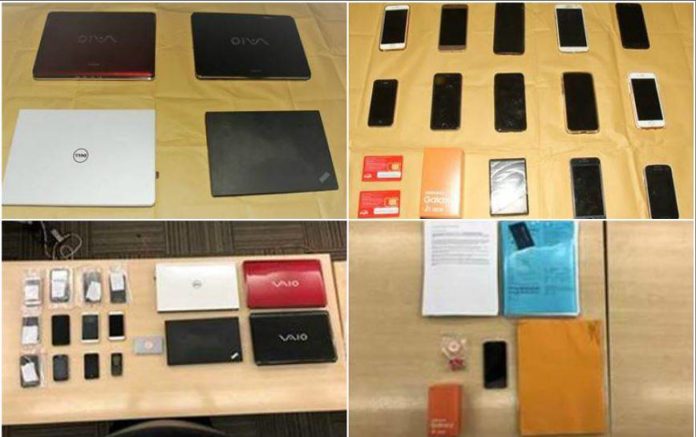
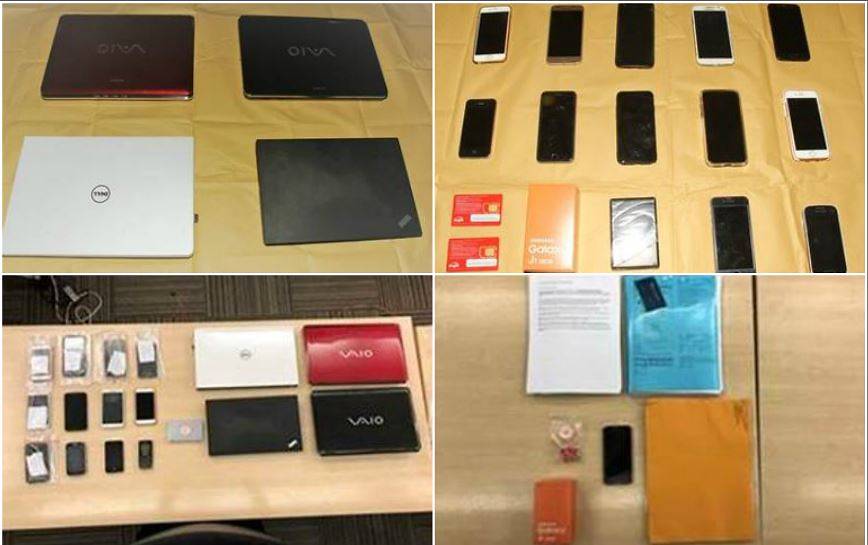
Several laptops and mobile phones were seized from a man suspected of trying to extort Standard Chartered Bank. (Photos: Singapore Police Force)
The bank issued a statement later saying that the incident was “not related to our customer data or systems which remain secure”.
“This was an isolated incident and was not a result of an external cybersecurity-related threat,” said a StanChart spokesman.
Nagarajan was offered bail of S$20,000 and will be back in court on Oct 30.
If found guilty, he can be jailed for between two and five years and caned.
SINGAPORE: When it comes to cybersecurity, humans are the weakest link. Attackers often leverage on this weakness to gain access to sensitive data, carry out scams and perform fraud.
Living in Singapore, with our low crime, effective security and strong legal system, people are often fooled into thinking the same of the internet world. Or they adopt the “who would target me?” syndrome. But, the connected digital world means anonymous attackers can target anyone in the world.
While the recent Singhealth breach made people aware of cybersecurity attacks, most still view cybersecurity as an organisational or state issue – not an individual one.
However, cybersecurity is a personal issue. The cyber safety of organisations and a nation depends on individuals staying safe.
Attackers will continue to create new forms of attack, which exploit new vulnerabilities. In the past, we feared the IloveYou virus, Conficker worm and Wannacry ransomware.
Crypto-jacking malware (which is the unauthorised use of someone else’s computer to mine cryptocurrency) have made headlines today. There will surely be new ones next year.
So what is the best way to stay safe? In today’s digital era, just about every aspect of our lives – from paying for food, to taking transport or connecting with friends – are somehow connected to the digital world.
A personal cyberattack is no longer a minor inconvenience, but something that could compromise your daily lifestyle. Fortunately, there are habits that you can cultivate to protect your digital lifestyle.
The first set of habits is to get your house in order. Your “house” refers to your computers and mobile devices.
HABIT #1: UPDATE YOUR SYSTEMS IMMEDIATELY
Turn on automatic updates and whenever you see a pop up, telling you to update, save what you are doing, run the update immediately and go for a break.
There are no perfect systems and software, as security researchers and attackers find vulnerabilities on a daily basis. But too many people put off system updates for another time, which exposes themselves to potential attackers.
Whenever you get a new computer or devices, download and install anti-virus as your first software if they are not pre-installed. This applies to Microsoft PCs, Macs and Android devices.
Anti-virus prices are much cheaper these days with lots of good choices and bundle options. It’s a small investment compared to the price of your devices and the value of your personal information in these devices.
Once your house is in order, the next two habits safeguard the “keys” to your house – the passwords.
HABIT #3: USE LONG PASSWORDS
Passwords are meant to be secret, something only you know and are hard for others to find out. So avoid using easy-to-guess passwords like “123456”, common words from the dictionary or your personal information, like your date of birth. Good passwords are long and something only you can remember.
One recommendation is to use three words related to a special memory. For example, “bedokrainingdurian” would be easy for you to remember, if you tasted the best durian at Bedok on a rainy day.
The word ‘password’ is pictured on a computer screen in this picture illustration taken in Berlin May 21, 2013. (Photo: REUTERS/Pawel Kopczynski/Files)
Just as we don’t share a secret with everyone, don’t reuse your password for different applications. This protects you against the scenario where attackers steal your login password from one website in a data breach, and subsequently use the collected data to login to other websites.
Famous data breaches where user login credentials are stolen include Yahoo!, Adobe and LinkedIn. You can check online if your email address has been compromised in a data breach.
And finally, you need to watch who is going in and out of your house. The remaining habits focus on cultivating safe web habits to keep away from unsavoury characters.
HABIT #5: WHEN NOT EXPECTED, DON’T CLICK
The most common way attackers target their victim is through sending phishing emails or messages. These are fraudulent attempts by attackers pretending to be someone else in an attempt to bait you to click links and download malicious software on your devices.
If you have not ordered a TV and a delivery man turns up with one, most people will be suspicious. Likewise, if you get an unexpected email address to a generic “dear sir/mdm”, the sender’s email address does not look right and he is asking you to click on links, don’t click. Don’t let them into your house.
An email reportedly sent as part of a phishing scam. (Photo: Joseph/Facebook)
HABIT #6: WATCH WHERE YOU SURF
When you visit a foreign country, good safety habits include staying on the main street, avoiding the alleys and dodgy establishments, and sticking with safe food choices. The same applies when surfing the web.
Only download software from official app stores by Microsoft, Google and Apple or legitimate sites. If you are unsure if it’s a legitimate site, Google the topic and legitimate sites will appear top.
Most legitimate sites will have HTTPS enabled (green padlock on browser bar) and the site will look professionally-built. If the site looks like a dodgy establishment, avoid it.
Be suspicious of sites with lots of pop-ups asking you to download and “Buy Now”. If a website tells you that you are infected with virus, don’t believe them.
Turn on safe browsing features on your web browser, which will warn you of fraudulent or unsafe sites.
HABIT #7: KEEP YOUR DIGITAL FOOTPRINT SMALL
Visiting social media platforms leaves behind your digital footprints. Whenever you share on social media, these digital footprints tell others who you are, where you are, how you can be contacted, whom you know and what you are doing.
A smart phone with icons for the social networking apps Facebook, Instagram and Twitter on the screen. (Photo: AFP/ Kirill Kudryavtsev)
Attackers collect your digital footprint to be more effective in their attack against you or the people you know. For example, a fraudster may use your children’s names, and their known whereabouts to conduct a scam against you.
Nowadays, people often share information on relationships, location data and contact numbers freely on social media sites.
Understand the settings on social media sites and make a conscious decision on who can see your posts – whether it’s your friends, your friends’ friends or the public. Keep your digital footprint as small as possible.
For those that want to stay safe online, get your house in order, safeguard the keys, and be careful of who you invite in.
Ng Pan Yong is founder of The Cyber Assembly, a cybersecurity startup that provides active learning platforms to help organisations and individuals connect to cyber skills.
SINGAPORE: Poor families should get longer financial aid from the government. That is what the director of a family service centre has suggested as a way of bridging the class divide.
It sparked an intense debate in the Channel NewsAsia documentary Regardless of Class, with host and OnePeople.sg chairman Janil Puthucheary remaining unconvinced that long-term government handouts are the solution.
Yet the question of what it would take to uplift poor families is one he “often grapples with” as a politician, he admitted. So the search for answers to the class divide continues. (Watch the documentary here.)
Methodist Welfare Services Covenant Family Service Centre (Hougang) director Cindy Ng-Tay, a social worker for decades, based her suggestion on her centre’s experience with families struggling to break out of intergenerational poverty.
It takes a long time – at least five to seven years of “consistent work” with a family – before there is a breakthrough, she said. But the short-to-medium-term assistance provided by help agencies may last only three to six months.
Mrs Cindy Ng-Tay’s team works with around 350 families at any one time.
A review by social service officers determines whether the assistance is extended or stopped. And she thinks it may be better to “channel the resources that we put into the review into a longer assistance” instead.
In this way, the poor would not have to “worry that their assistance would be cut off at a certain point”, which creates “unnecessary stress”. But Dr Puthucheary felt that the proposal could be costly.
“Wouldn’t three to six months be appropriate for some people?” he asked.
“How many? Because the experience we have is (it) isn’t enough,” replied Mrs Ng-Tay, saying that it causes the poor to “focus on the here and now” rather than thinking about long-term plans such as saving up for their children.
We want them to be able to have foresight and to start planning, the way you and I plan about our future, about our retirement.
When Dr Puthucheary suggested that the financial cost of her idea would be significant, she said: “We also have to take into account the social cost of not having this … What’s the cost of letting the divide continue?”
The cost of getting it wrong, however, includes making it worse, he countered as he asked her: “You’re prepared to take that risk?” She replied: “I’d be prepared to take that risk to make things better.”
When he said it could “trap people in poverty” and cost “a lot of money we don’t have”, she replied in turn that it could “release people” and “really help us with the next generation”.
While the Gini coefficient, which measures income inequality, has remained stable in Singapore over the years, a segment of the population is still trapped in poverty, acknowledged Dr Puthucheary, who is also a senior minister of state.
Dr Janil Puthucheary is also Senior Minister of State for Transport and Communications and Information.
There are nearly 60,000 public rental flats, where the poorest people live, he noted. Part-time caterer Siti Sufiyah, for example, has been receiving financial assistance for years but is still living in her rental unit of 15 years.
Said Dr Puthucheary: “That’s not how it’s meant to work.”
Mdm Siti ended up in her financial situation after her first husband beat her up and their second child was diagnosed as a high-risk asthma patient. At that point, she was unable to work.
“Which employer would want to employ somebody who always takes leave? Because my son would be admitted (to hospital). In a week, three days he’d be in hospital,” she recalled.
Mdm Siti Sufiyah.
Her second marriage gave her two more children, but her then husband cheated on her and did not provide financial support for the children.
Asked how difficult it has been to renew her financial assistance – which can be tied to the recipient finding work – the divorcee said: “If I want to go out to work, I need somebody to tend to my children.”
Her two elder boys are now in the Normal (Technical) stream, which saddens her “a bit”, as she expected her children to make it the Normal (Academic) stream like she did.
Access to resources and the ability to use resources – constrained by years of chronic stress caused by poverty – are two of the reasons families are stuck despite intervention, said Mrs Ng-Tay.
Besides her idea of longer financial aid, she identified early education and support for children from low-income families as crucial.
“Don’t tie the access of resources for children to their parents’ marital status, or socio-economic status, or even work status,” she suggested.
She agreed with Dr Puthucheary on the importance of balancing parental and social responsibility, but added: “We need to look at the vulnerability of the children.
If we want them to get a good start in life, then it would be quite unfair for the children’s life outcomes to be dependent on whether their parents would be motivated or not.
The right balance, she felt, was to “recognise structural factors that maintain poverty” and to also understand that the poor “have the potential to be inspired” to live better lives.
CAN BUSINESSES MAKE A DIFFERENCE?
One person turning her life around is barista Evalene Foo. People once thought she was good for nothing because she had dropped out of school in Secondary Three, ran away from home and got into trouble with the law.
Ms Evalene Foo.
“I mixed with bad friends, so I lost interest in my studies. That’s why I dropped out,” explained the 21-year-old.
But then she went for emotional training, which taught her to overcome her anger, be happier and not let other people affect her. She now dreams of managing her own cafe, maybe in 10 years’ time.
Her newfound ambition, after a month on the job, “shocked” her mother, she admitted. “Because in the past, I wasn’t that good. I had no confidence in myself.”
Ms Foo works at Bettr Barista, founded in 2011 by Ms Pamela Chng to provide marginalised women with an employable skill.
“A lot of them come from broken families or just families who don’t have the resources and time to invest in their livelihood and their education. You see them falling back further and further in school,” said Ms Chng.
“By the time they hit 15 or 16, they’re just too far behind. And a lot of them, through a fear of failure, give up.”
She sees this happening “a lot, especially through our conversations with the schools”. While there is little she can do about the home environment, she thinks businesses “can do a lot to, say, rethink how we’re working”.
But are efforts like hers too thin on the ground to make a difference? “The approach that we’re taking here is really looking at the depth of the impact and the longevity of the impact,” said Ms Chng.
“If we can change one person’s life, and they go around and change their children’s lives, their family’s lives and then their community’s lives, then you can start to amplify the impact.”
Ms Pamela Chng’s vision for her business’ future is based on creating a culture and mindset of helping people to ‘move up the value chain’ in empathetic way, yet not compromising standards and quality.
She agreed with Dr Puthucheary that it would not be easy to incentivise businesses to get on board, but she added: “The incentive is the future. What future do you want to create for yourself?”
INTEGRATED PUBLIC HOUSING
One plan of action for encouraging social mixing that will soon come to fruition is the construction of the first three integrated Build-To-Order blocks, comprising rental and sold flats, in Woodlands, Bukit Batok and Sengkang.
But even this may not be a good idea, according to Institute of Policy Studies senior research fellow Leong Chan Hoong, who questioned how some of the potential frictions on the ground could be mitigated or addressed.
Dr Leong Chan Hoong.
“There’ll be tensions because the needs, priorities and values are different,” he said. “That’ll be the challenge … Contact alone may not necessarily produce the desired outcome. It’s important to ensure that the conditions of the contact are acceptable to everybody.
“In other words, you have to ensure that interaction is genuine, intimate and, most importantly, there’s no status difference in the interaction. Nobody feels intimidated (or) that they’re being slighted because they’re engaging with someone of a different level.”
It is only human, acknowledged Dr Puthucheary, “to seek out people who are like us, to find our tribe”. But if classism – prejudice against people from a different social class – prevails, then shared spaces would not work, he noted.
And if that is case, class divisions in Singapore can only be a mounting worry.
Another suggested amendment will also allow the Government to prosecute money mules who transport criminal proceeds for organised syndicates.
File picture of a conflict zone in Iraq (Photo: AFP/Delil Souleimna)
(Updated: )
Bookmark
SINGAPORE: The financing, and the provision or collection of funds to finance the travel, of an individual to engage in terrorist training would become illegal in amendments proposed by the Ministry of Home Affairs (MHA) on Monday (Oct 1).
This will expand the scope of activities prohibited under the Terrorism (Suppression of Financing) Act (TSOFA) and align Singapore’s laws with obligations under the United Nations Security Council Resolution 2178 – introduced in 2014 to address the threat posed by foreign terrorist fighters.
Another proposal by MHA seeks to create a new money laundering offence under the Corruption, Drug Trafficking and Other Serious Crimes (Confiscation of Benefits) Act (CDSA): To possess or use property reasonably suspected of being criminal proceeds and not being able to satisfactorily account for it.
This will enable the prosecution of money mules who transport criminal proceeds for organised syndicates.
MHA is also aiming to prosecute instances of money laundering involving a foreign offence – so an act that is committed abroad, which amounts to a drug dealing or serious offence if committed in Singapore, will be presumed to be an offence in that foreign country.
In the same amendments bill tabled to Parliament, MHA is proposing enhancements to current penalties – for instance, to increase the maximum fine for failing to file a Suspicious Transaction Report (STR) from S$20,000 to S$250,000 and three years’ jail for individuals, and S$500,000 for entities.
The STR needs to be filed whenever there is a suspicion that a property is linked to a drug dealing or serious offence.
For tipping off another person of a CDSA-related investigation or an STR, the fine could also be increased, from S$30,000 to S$250,000 and three years’ jail.
Additionally, failing to report bringing more than S$20,000 cash into Singapore could result in composition fines of up to S$20,000 plus a Court order confiscating the undeclared amount above S$20,000.
MHA is also suggesting to increase the S$1 million penalty for corporations convicted of terrorism financing, to the higher of either S$1 million or twice the value of the property involved or services rendered for terrorism financing.
The final proposed amendment pertains to improving the tackling of transnational crimes – by allowing the Suspicious Transaction Reporting Office (STRO) to share information with other jurisdictions which have endorsed the Egmont Charter and Principles for Information Exchange.
This is an international arrangement to enhance cooperation between Financial Intelligence Units.
SINGAPORE: Global airport operators, faced with rising sea levels and more powerful storms as the climate changes, are starting to invest in measures including higher runways, seawalls and better drainage systems to future-proof immovable assets.
In early September, a seawall at Japan’s Kansai International Airport built on a reclaimed island near Osaka, was breached during Typhoon Jebi.
The runway was flooded and it took 17 days to fully restore airport operations, at a high cost to the region’s economy as well as the dozens of airlines that cancelled flights.
Major airports in Hong Kong, mainland China and North Carolina were also closed due to tropical storms last month.
Such incidents highlight the disaster risks to investors and insurers exposed to a sector with an estimated US$262 billion of projects under construction globally, according to Fitch Solutions.
An MH-65T Dolphin helicopter aircrew from Coast Guard Air Station Atlantic City looks over LaGuardia Airport while it conducts an over flight assessment of New York Boroughs impacted by Hurricane Sandy, Oct 30, 2012. (Photo: Reuters/US Coast Guard)
“There is a kind of one-way direction with regards to the frequency and severity of climate change-related events,” said Fitch Solutions Head of Infrastructure Richard Marshall. “If people aren’t taking that seriously, that is a risk.”
Fifteen of the 50 most heavily trafficked airports globally are at an elevation of less than 30 feet above sea level, making them particularly vulnerable to a changing climate, including rising sea levels and associated higher storm surges.
“You see it at individual airports that are already seeing sea rise and are already dealing with water on their runway,” Airports Council International (ACI) Director General Angela Gittens said, citing examples in island nations including Vanuatu and the Maldives.
“But even in some of these mature economies they are having more storms, they are having to do more pumping. My old airport in Miami is in that scenario.”
A draft copy of an ACI policy paper reviewed by Reuters and due to be released this week warns of the rising risks to facilities from climate change. It encourages member airports to conduct risk assessments, develop mitigation measures and take it into account in future master plans.
The paper cites examples of forward-thinking airports that have taken climate change into account in planning, such as the US$12 billion Istanbul Grand Airport on the Black Sea, set to become one of the world’s largest airports when it opens next month.
INVESTOR INTEREST
Debt investors in particular have high exposure to airports, most of which are owned by governments or pension funds. Ratings agency Moody’s alone has US$174 billion of airport bonds under coverage.
Earl Heffintrayer, the lead analyst covering US airports at Moody’s, said the risk of climate change became apparent to investors after Superstorm Sandy closed major New York airports for days in 2012.
Planes are surrounded by flood waters caused by Tropical Storm Harvey at the West Houston Airport in Texas, US, Aug 30, 2017. (Photo: Reuters/Adrees Latif)
Sandy led to the cancellation of nearly 17,000 flights, costing airlines US$500 million in revenues and disrupting operations around the world, according to a 2017 presentation by Eurocontrol on climate change risk.
Investors are increasingly asking about mitigation plans at low-lying airports like San Francisco and Boston as they look to invest in bonds with terms of up to 30 years, Heffintrayer said.
San Francisco International Airport, built on reclaimed land that is slowly sinking, has completed a feasibility study on a US$383 million project to make the airport more resilient to sea level rises on its 12.9km of bay front shoreline by 2025.
“We are seeing a lot more thought going into protection against flood damage, catastrophe, making sure that the storm drains around the airport are fit for purpose,” said Gary Moran, head of Asia aviation at insurance broker Aon. “There definitely is a lot more thought going into potential further worsening in weather conditions further down the line.”
TAKING ACTION
Singapore’s Changi Airport, which has analysed scenarios out to 2100, has resurfaced its runways to provide for better drainage and is building a new terminal at a higher 5.5 metres above sea level to protect against rising seas.
Moran said such steps were prudent and would provide comfort to insurers.
“If you were to look at Singapore, if something was to happen at Changi in terms of weather-related risk, Singapore would have a problem,” he said. “There isn’t really too much of an alternative.”
Singapore expects sea levels to rise by 0.76 metres by 2100. Changi Airport declined to comment on the cost of the extra protection.
ACI, Fitch, Moody’s and Standard & Poor’s were unable to provide Reuters with an estimate of the global cost of climate change protection at airports. The protective action is often folded into larger refurbishment and expansion projects, ratings agency analysts said.
In Australia, Brisbane Airport and located on reclaimed land on the coast at just 4 metres above sea level, is constructing a new runway 1 metre higher than it otherwise would have done, with a higher seawall and better drainage systems as sea levels rise.
Paul Coughlan, the director of Brisbane Airport’s new runway project, said the incremental cost of such moves was relatively low – for example the seawall cost around A$5 million (US$3.6 million) more than without taking into account sea level rises – but the potential benefits were big.
“At the end of the day, whether you are a believer in climate change or a disbeliever, doing a design that accounts for elevated sea levels, more intense rainfall, flooding considerations, that is just prudent,” Coughlan said.
“If you build it into your design philosophy from day one, you don’t pay that much of a premium and you have bought a lot of safeguards.”
SINGAPORE: The salary structure for Singapore’s ministers is “totally transparent” and “there are no hidden components or perks”, said Deputy Prime Minister Teo Chee Hean in Parliament on Monday (Oct 1).
In mid-September, the Government moved to debunk what it called “falsehoods” about ministerial salaries – such as, among others, Prime Minister Lee Hsien Loong being paid a total of S$4.5 million.
A week earlier, Mr Lee had also revealed in a written parliamentary reply that the average performance bonus of Singapore’s political office-holders was 4.1 months in 2017, with the range of three to six months’ performance bonus remaining constant from over the last five years.
The issue was first cast into the spotlight in August, when Emeritus Senior Minister Goh Chok Tong was quoted saying that Singapore’s ministers are “not paid enough”, though he later clarified that salaries are not a “starting point in looking for ministers”.
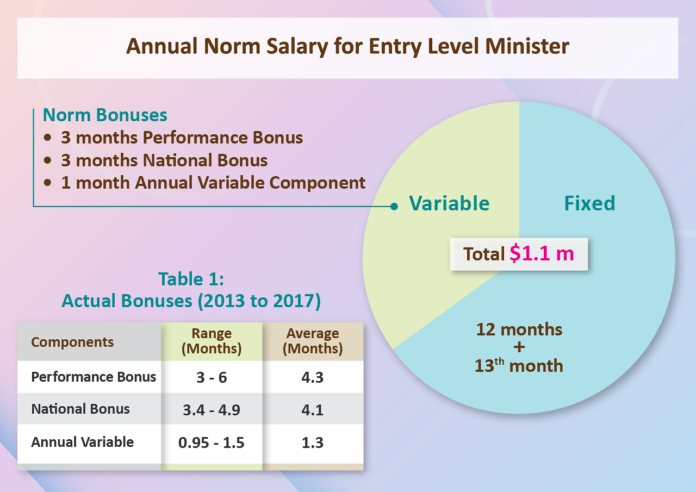
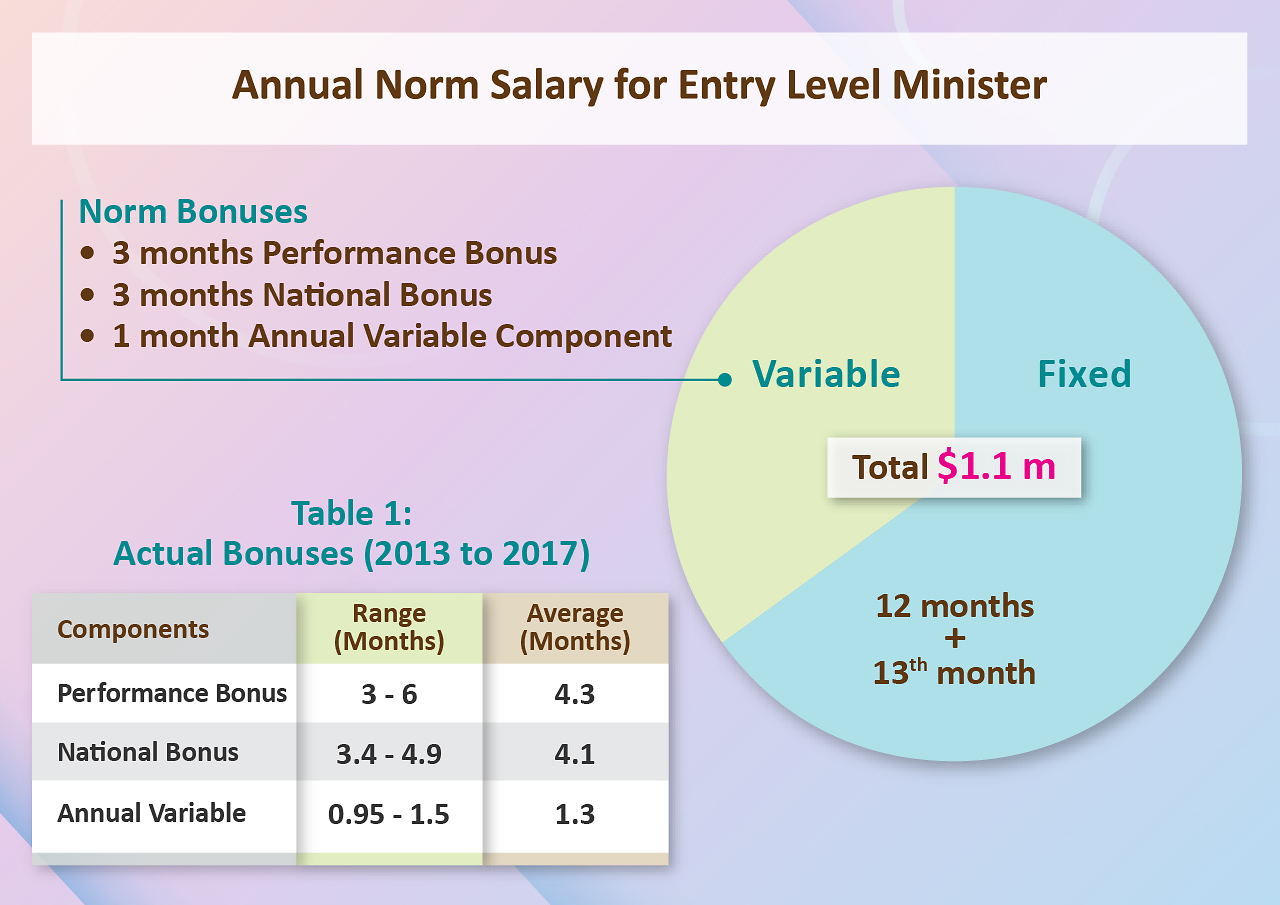
In his response on Monday to a question tabled by Member of Parliament Alex Yam, Mr Teo reminded the House of the 2012 White Paper on government salaries, which recommended a norm level of S$1.1 million as the total annual salary for an entry-level (MR4) minister – based on a 40 per cent discount to the market reference, to reflect the ethos of public service.
“All the bonus components form part of, and are not in addition to, the S$1.1 million salary norm,” he stressed.
Mr Yam had asked for a list of all the components of the salaries of the ministers and the Prime Minister, the amounts paid for each component, and whether the components are fully included in – and are not over and above – the ministerial salary benchmark established in the 2012 White Paper.
Mr Teo reiterated that the Prime Minister’s salary – twice that of an MR4 minister, at S$2.2 million – did not include a performance bonus.
“But to keep to the principle of making a significant part of the PM’s total pay subject to performance – that is, 35 per cent, the PM’s variable pay has twice the national bonus compared to other ministers, to reflect national outcomes, in place of the individual performance bonus,” he added, noting that there are no other components or perks otherwise.
ON THE WORKERS’ PARTY FORMULA
Moving on the variable pay components received by political office-holders, DPM Teo emphasised that these were in accordance with the White Paper framework, and not on top of it.
Annual norm salary for entry-level ministers. (Graphic: Public Service Division)
He said bonuses depended on the actual performance of individuals as well as Singapore’s national outcomes each year, namely the real median income growth rate; the real growth rate of the lowest 20th percentile income of Singaporeans; the unemployment rate; and the real GDP growth rate.
While the annual variable component is the same amount received by all civil servants, the performance bonus is determined by the Prime Minister in consultation with senior Cabinet ministers.
“But I should emphasise that each office-holder receives only one salary regardless of whether he holds one or multiple portfolios,” said Mr Teo.
Later, in response to a supplementary question by Mr Yam, Mr Teo also confirmed that ministerial pensions had been discontinued in 2012, with “no hidden benefits”.
Mr Teo pointed out that the opposition Workers’ Party (WP) had, in 2012, endorsed the White Paper’s principles of salary determination – and added that the formula proposed by WP then would have resulted in the same total annual salary for entry-level ministers.
Comparing ministerial salaries on the 2012 White Paper and The Workers’ Party’s formula. (Table: Public Service Division)
“But the Workers’ Party formula would have had a higher fixed component (of 81 per cent) compared to the White Paper’s proposal, and a smaller variable component (of 19 per cent),” said DPM Teo.
“This means the WP would have paid out a higher portion of the salary – about S$880,000 out of S$1.1 million – regardless of individual performance or national outcomes, and even if the outcomes were not achieved.
“This would have made the link between salary and performance weaker.”
WP chief Pritam Singh later reaffirmed his party’s position was the same as in 2012 – and agreed that the total amounts as presented in the table were accurate and correct.
The WP and government proposals are “very close” to each other in principle and quantum, said Mr Teo. “Indeed if, if there were a WP government in power today, by their own formula, a WP minister would be paid essentially the same as what a minister today is paid.”
The glitch in the GPConnect computer system saw more than 830 patients receive medicine labelled with the wrong dosage instructions.
People waiting for their prescriptions. (File photo: TODAY)
(Updated: )
Bookmark
SINGAPORE: The cause of the IT glitch resulting in more than 830 patients receiving medicine labelled with wrong dosage instructions has been traced to an IT vendor for the GPConnect computer system, Senior Minister of State for Health Lam Pin Min revealed on Monday (Oct 1).
Speaking in Parliament, he said investigations revealed that the IT vendor had made some changes to the application code for the system, which is run by public healthcare IT agency Integrated Health Information System (IHiS).
The glitch followed a system upgrade by the vendor implemented on Sep 1, which saw some GP clinics having problems where medication labels were printed incorrectly. Dr Lam said, while the correct medication and total quantity of medication were correctly dispensed, the system printed the wrong unit of measurement on the label.
Several clinics were aware of the error and manually corrected the dosage instruction on the label. Once notified, IHiS investigated the incident and informed all infected clinics from Sep 2, said Dr Lam.
IHiS has been monitoring the situation, and no further errors have been reported since Sep 3, he added. “Affected patients were monitored by the clinics, and to date, there have not been any reports of adverse effects,” he said.
Dr Lam explained that the changes made by the IT vendor to the application code resulted in the incorrect medication labels being printed. These changes were unrelated to the system upgrade.
“Hence, the user acceptance tests designed to evaluate the upgrade did not pick up the error,” he said. “The vendor also did not report any errors from any other tests done.
He said that since the incident, additional rounds of testing have been conducted to ensure that existing functions within GPConnect are working as designed. The unit of measurement function is also being enhanced to prevent future errors.
In response to a supplementary question from MP Intan Azura Mokhtar, who suggested that new technologies or new security measures could be applied to ensure the security of such data, Dr Lam said that this particular incident was a result of human error, and there will be measures to ensure such errors can be picked up.
However, he noted that MOH would “seriously look” into her suggestion on new technologies.