SINGAPORE: A 63-year-old woman has been fined S$7,000 for importing embryonated duck eggs into Singapore.
Le Thi Ung had bought the eggs from a wet market in Vietnam, said the Agri-Food and Veterinary Authority of Singapore (AVA) and Immigration and Checkpoints Authority (ICA) in a joint news release on Wednesday (Oct 3).
She was caught in September when authorities checked her baggage after she arrived at Changi Airport.
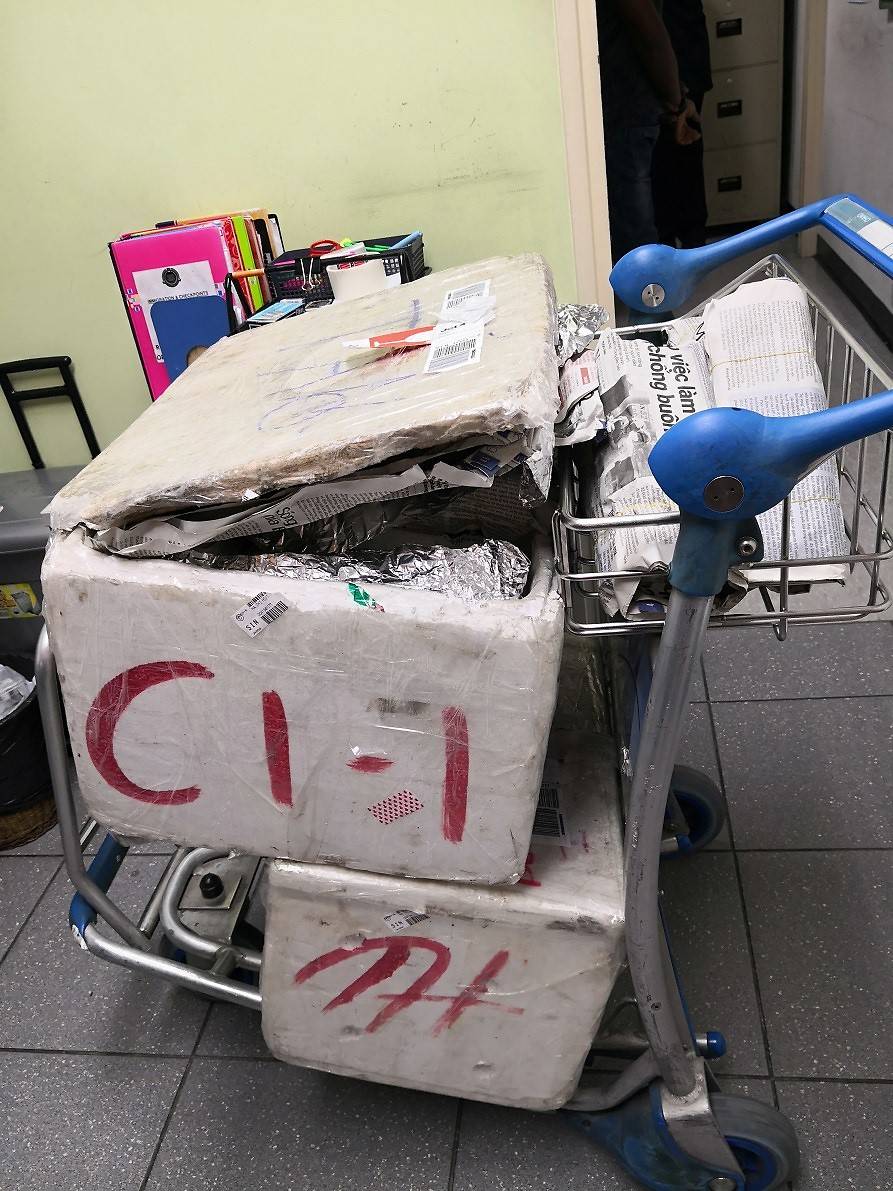
They found 490 eggs, commonly known as “balut”, in two styrofoam boxes.
The 490 illegally imported duck eggs concealed in styrofoam boxes. (Photo: AVA)
Singapore does not allow the import of balut eggs.
Le had contravened the Wholesome Meat and Fish Act, said the authorities in the news release.
“The import of food, including meat and eggs, and their products, are regulated for animal health and food safety reasons,” it said. “Meat and eggs, and their products, can only be imported from accredited sources in approved countries that comply with Singapore’s food safety standards and requirements.”
Anyone found guilty of illegally importing meat products from unapproved sources could face a fine of up to S$50,000 and a jail term of up to two years for the first conviction.
Repeat offenders face a maximum fine of S$100,000 and up to three years’ jail.
SINGAPORE: Singapore’s Minister for Defence Ng Eng Hen and visiting Malaysian Deputy Minister for Defence Liew Chin Tong have reaffirmed the bilateral defence relationship between both countries.
Mr Liew called on Dr Ng on Wednesday morning (Oct 3). Both ministers exchanged views on the bilateral and multilateral defence cooperation between Singapore and Malaysia.
They also discussed the regions’s ongoing geopolitical and security developments, said Singapore’s Ministry of Defence (MINDEF) said in a media release.
Mr Liew was later hosted to lunch by Senior Minister of State for Defence Heng Chee How.
Senior Minister of State for Defence Heng Chee How (right) and Permanent Secretary for Defence Chan Yeng Kit (left) hosting Malaysian Deputy Defence Minister Liew Chin Tong (centre) for lunch. (Photo: MINDEF)
Mr Liew, who is here on a two-day visit, also stopped by SAFRA Punggol on Wednesday morning. On Thursday, he will deliver the keynote speech at the 2018 Southeast Asia Counter-Terrorism Symposium, organised by the S Rajaratnam School of International Studies.
Mr Liew’s visit underscores the “warm and long-standing” bilateral defence relations between Singapore and Malaysia, said MINDEF.
It noted that the armed forces of both countries interact regularly across a wide range of bilateral activities, including military exercises, visits and exchanges.
“They also cooperate extensively on multilateral platforms, including the Five Powers Defence Arrangements (FPDA), ASEAN Defence Ministers’ Meeting (ADMM) and ADMM-Plus, as well as the Malacca Straits Patrol,” said MINDEF.
“These interactions have strengthened mutual understanding and professional ties between personnel of both armed forces.”
DESPITE its principle of non-intervention on domestic issues, Burma’s (Myanmar) Asean neighbours have called on the country to ensure full accountability on those responsible for the atrocities against the Rohingya minority.
During an informal meeting in New York on Sept 29, Singapore’s Foreign Minister Vivian Balakrishnan said the ministers from the group called on the Independent Commission of Enquiry appointed by the Burmese government to be “given a full mandate to investigate, and to all those responsible, fully accountable.
According to Kyodo news, Balakrishnan said Asean is awaiting a report from the commission and is particularly interested to hear feedback from its two independent members from Philippines and Japan, as “both of them have reputations for being fiercely independent.”
“We expressed our grave concern with these alleged acts of violence,” he was quoted as saying.
“To be brutally honest, this is a man-made humanitarian disaster and something which should not be happening in this day and age.”
The Asean ministers also called on Burma and neighbouring Bangladesh, where some 700,000 Rohingyans to help fled to since violence erupted in August last year, to help facilitate the return of refugees to their native Rakhine state.
Rohingya refugees arriving by boat at Shah Parir Dwip on the Bangladesh side of the Naf River after fleeing violence in Myanmar. September 12, 2017. Source: Adib Chowdhury/AFP
“The responsibility for resolving this must lie with the government of Myanmar, and this is a responsibility that we will hold them to account,” Balakrishnan said.
“They do need to do the right thing for all the vulnerable, defenceless and innocent victims.”
A fact-finding mission by the UN found evidence of ethnic cleansing and accused Burma’s military of genocide. The final report, released last month, documented patterns of gross human rights violations and abuses that included killing indiscriminately, gang-raping women, assaulting children, and burning entire villages.
The UN investigators called for Burma’s army general Min Aung Hlaing and five generals to be prosecuted for genocide and crimes against humanity, among others.
The military has repeatedly denied any wrongdoing and de facto leader Aung San Suu Kyi has remained largely silent on the atrocities.
The Nobel laureate has received widespread criticism for being complicit in the military’s brutal crackdown.
Balakrishnan said a long-term political solution was needed to resolve the crisis.
“Specifically, what we said last week to Myanmar was that we expect the voluntary repatriation to begin soon, and Asean stands ready to help facilitate that in any way possible.
Giving an update of the numbers on Wednesday (Oct 3), Mr Ong said this is an encouraging development in efforts to match interest, talent and course of study.
Youths walking after a class has finished. (Photo: TODAY)
(Updated: )
Bookmark
SINGAPORE: A record 13,900 applicants have applied to study at polytechnics next year under the Early Admissions Exercise (EAE), with the more popular courses being early childhood, nursing and hospitality, Education Minister Ong Ye Kung revealed on Wednesday (Oct 3).
Speaking at the Singapore International Technical and Vocational Education and Training Conference, Mr Ong said that the number of EAE applicants for admission year 2019 represents a 13 per cent increase over the previous year.
The EAE is an aptitude-based admissions exercise that allows students to apply for and receive conditional offers for admission to polytechnics before they get their final grades.
Mr Ong added that under the EAE, the polytechnics also made 6,250 offers to students for next year’s admission – which at 14 per cent higher year-on-year is also another record.
The expected final enrolment through EAE is about 4,600, which is close to 20 per cent of the total admissions for polytechnics.
“This is an encouraging development in our efforts to match interest, talent and course of study,” he said.
Currently, polytechnics can take in up to 15 per cent of its students through the EAE, but there is some room for manoeuvring.
“Polytechnics have the discretion to use the guideline by looking at the quality of applicants and how well they match with the courses, and exercise their discretion while observing the guideline,” Mr Ong said.
“As it turns out, I think we will exceed the guideline, and certainly we will review to see whether this guideline ought to gradually float up,” he added.
“I think it’s a dynamic situation … We have to see what the demand is, how we administer (it) and over time look at it year by year,” he said.
SINGAPORE: A hornbill at the Jurong Bird Park, diagnosed with an aggressive form of cancer, has been given a fighting chance to survive – in the form of a 3D-printed prosthesis.
Jurong Bird Park keepers first noticed an 8cm-wide gash on the Great Pied Hornbill’s casque (a helmet-like structure on the top of its beak), which exposed the underlying tissue, on Jul 13.
Upon examination of the casque’s tissue sample, the 22-year-old male bird was diagnosed with cancer, said Wildlife Reserves Singapore, which manages the park, on Wednesday (Oct 3).
In order for the bird to survive, it required specialist veterinary intervention for the casque to be replaced with a 3D-printed prosthetic casque.
(Left) A close-up of Jary’s affected casque pre-surgery, which shows exposed tissue destroyed by the cancer. (Right) Jary undergoing a CT-guided biopsy; a Tru-cut biopsy needle was inserted into part of the casque to extract a sample of the affected tissue. (Photo: Wildlife Reserves Singapore)
A team at the Veterinary Emergency and Specialty Hospital enlisted the help of Keio-NUS CUTE (Connective Ubiquitous Technology for Embodiments) Centre, NUS Smart Systems Institute and NUS Centre for Additive Manufacturing to produce the prosthesis.
It took almost two months of designing and discussion before a perfect fit for the hornbill was produced.
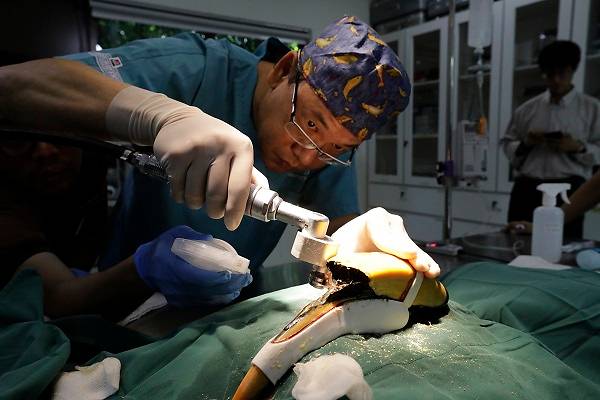
Dr Hsu Li Chieh from The Animal Clinic removing the casque with an oscillating saw. (Photo: Wildlife Reserves Singapore)
“This case is a great example of how veterinarians and engineers can work together to utilise science and technology for the treatment of diseases such as cancer in all species, including birds,” said Dr Xie Shangzhe, Jurong Bird Park’s assistant director of the veterinary department.
The hornbill, christened Jary (pronounced ya-ri), which means “a warrior with a helmet” in ancient Norse, is currently resting under close observation at the Jurong Bird Park’s Avian Hospital.
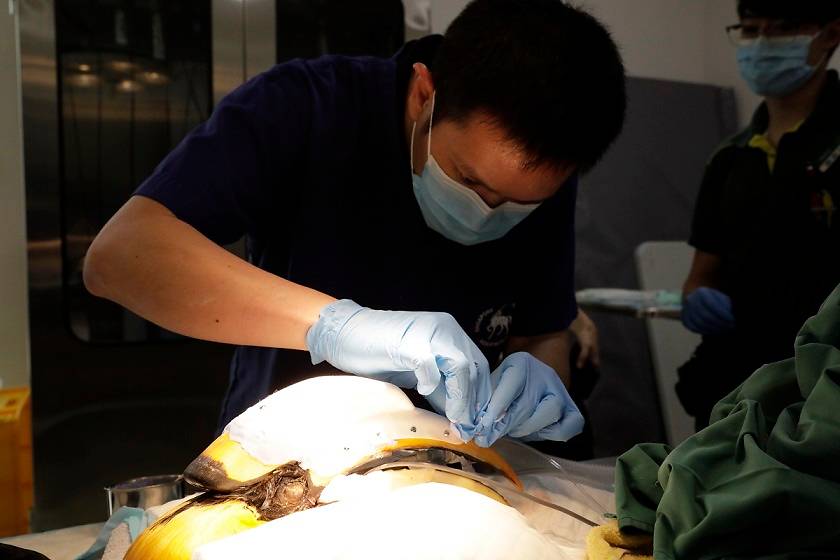
Dr Xie Shangzhe applying dental resin on Jary’s new casque to seal any gaps. (Photo: Wildlife Reserves Singapore)
According to Dr Xie, the hornbill was eating normally the day after the surgery, and has also started exhibiting natural behaviour – meaning that the bird has accepted the prosthesis as part of it.
There have been two similar cases of hornbills with cancer at Jurong Bird Park, Wildlife Reserves Singapore said. One underwent chemotherapy but died, while the other hornbill’s cancer had progressed too rapidly for treatment.
Great Pied Hornbills, which live up to 40 years on average, are classified as near-threatened in the International Union for Conservation of Nature’s Red List of Threatened Species. Jurong Bird Park is home to Southeast Asia’s largest collection of hornbills, and it currently houses four male and six female Great Pied Hornbills.
SINGAPORE: A passenger on a Scoot flight who said his luggage had a bomb in it was fined S$4,500 on Tuesday (Oct 2).
Hsu Chun Meng, a 41-year-old Singaporean, pleaded guilty to one charge of using threatening words by stating there was a bomb in his luggage.
The court heard that he was travelling from Singapore to Hat Yai in Thailand with two friends on Apr 5 this year. At about 12.55pm, the three of them boarded the plane for Scoot flight TR634 at Changi Airport Terminal 2.
Hsu had one hand-carry luggage and placed the luggage in the overhead compartment above his seat.
However, the bag was too big and the compartment could not be closed. Scoot stewardess Boo Joe We, 23, who saw what was happening, then told him that the luggage was oversized and had to be checked in.
Hsu continued to try and squeeze the bag into the compartment. When Ms Boo asked him if the luggage contained any items that he needed, such as his passport or wallet, or any prohibited items such as lithium batteries, Hsu replied: “Nothing, only bomb.”
He did so because he was “not happy” with Ms Boo’s “attitude and the way she spoke to him”, Deputy Public Prosecutor Nicholas Khoo said.
Ms Boo stared at Hsu, who then said: “No bomb lah. Joking. How can it be.”
She felt alarmed by what he said, but accepted that he was joking and went about the rest of her duties. Even so, she reported this to the cabin crew member in charge, Ms Ginny Chiong Wen Chin, 26.
Ms Chiong told Ms Boo that “an incident such as this cannot be treated as a joke”. She wanted to inform the captain immediately, but the plane was about to take off and she could not enter the cockpit.
She told the pilot what happened after the plane had taken off and she was allowed to enter the cockpit.
The pilot put out a Mayday call and headed back to Singapore, where RSAF fighter jets escorted the plane.
The plane landed at about 3.20pm at a remote bay away from the main terminal of Changi Airport. After the police arrived, all 179 passengers on the plane had to disembark for security checks.
Hsu and his friends’ luggage bags were located and removed for specific security checks.
As a result, the flight was delayed for four hours and 48 minutes, and the entire cabin crew, along with the pilots, were replaced with a fresh crew.
Vouchers were disbursed to the affected passengers, and Scoot incurred a loss of S$13,757, according to court documents.
Hsu admitted to the charge and was fined S$4,500, just S$500 shy of the maximum S$5,000.
SINGAPORE: Foreign visitors to Singapore will not have to fill up paper arrival cards soon, according to the Immigration and Checkpoints Authority (ICA).
The disembarkation/embarkation cards, which foreigners entering Singapore are required to submit on arrival, will be replaced with an electronic version, said ICA in a news release on Wednesday (Oct 3).
With the electronic arrival card, travellers can submit their personal information and trip details through the ICA website or via a mobile application before arriving in Singapore.
Passports will only need to be produced for immigration clearance upon arrival. The electronic arrival card which they had filled up in advance will then be called up by ICA’s immigration system.
To ensure the smooth implementation of the new electronic arrival card, a trial will be conducted for three months starting on Thursday, said ICA.
The trial will be conducted at most of the air, land and sea checkpoints, namely Woodlands and Tuas Checkpoints, Changi Airport and the four cruise/ferry terminals.
Foreign visitors who arrive at these checkpoints but have not yet completed the paper arrival cards may be approached by ICA officers to participate in the trial, and to provide feedback.
SINGAPORE: My wife and I were in the middle of our healthy little debate on whether we should subscribe to Netflix. We had heard about the endless options of films, documentaries and TV shows that we could choose from.
For her, the decisive factor was the ability to access a repository of Korean dramas. I was more concerned with whether we would end up glued to our devices and forget the existence of our three children.
However, a more valid concern was whether this newfound subscription would eat into our already precious sleeping hours.
MOST HARDWORKING PEOPLE IN THE WORLD
Studies show that Singaporeans are some of the hardest working people in the world, averaging between 45 to 50 hours a week at work. Thus, it is not surprising that we would also spend less time sleeping.
A maker of sleep trackers, Jawbone, found in a worldwide study in 2014 that Singapore is the third most sleep deprived city in the world after Tokyo and Seoul, averaging about 6 hours and 32 minutes of sleep daily.
Market research firm Wakefield Research placed us as the second most sleep deprived country, coming in only after the British. This same study also found that Singapore millennials (defined in Singapore’s context as those born between 1980 and 2000) make up the biggest proportion of a generational cohort who sleep in on the weekends to overcome their sleep debt.
The National Sleep Foundation recommends that adults aged between 18 and 64 get between seven to nine hours of sleep.
WHO TO BLAME FOR OUR SLEEP EPIDEMIC?
So why are we sleeping less? Some put the blame on technological innovation. Technological advancement seeks to enable humans to do more with less.
(Photo: Unsplash/Vladislav Muslakov)
However, it almost seems that with improved technologies, we have less time for anything else. We are able to do more, but we also extend our working hours to do even more work, leaving us less time for sleep.
Others attribute blame to our easy access to a myriad late night eating options. The introduction of app based food delivery services means that food can be readily available at one’s fingertips in a matter of minutes, satisfying our late night cravings.
MILLENNIALS GET THE LEAST SLEEP
When we think about the topic of sleep, the narrative is that older people need less sleep. However, it seems that millennials, who are in need of between seven to nine hours of sleep, are getting much less than what experts recommend. Why is this so?
Firstly, many millennials belong to the age group where career foundations are still being established. It is never easy to build up something from scratch. The learning curve might be a little steep and the work intense.
As such, young people need to learn a large amount of content and job related competencies. This can be time consuming.
Secondly, millennials may venerate a culture of sleeping less, where sleep is not viewed as a necessity but a means to an end. As a result of embracing such a philosophy, those who choose to sleep early may be perceived as not hardworking enough; or that one is complacent with life.
Coming to work or school with little or no sleep may give others the perception that you are a driven and hardworking team player.
Thirdly, millennials place high value on meaningful experiences. While the motivation of financial gain cannot be underestimated, it is the opportunity to learn and undergo meaningful experiences that excite many millennials.
The fear of missing out (FOMO) motivates the millennial to see more, do more and experience more. In order that learning opportunities or unique experiences be maximised, it is not surprising that one’s waking hours are extended in order to pursue these opportunities.
After all, you only live once (YOLO).
WHY WE NEED MORE SLEEP
As humans, we need sleep to allow the body to repair itself in order to be ready for the next day’s challenges. Dr Maiken Nedergaard, Professor of Neurosurgery at the University of Rochester likens the brain cleansing process during sleep to a dishwasher.
Cerebrospinal fluid in the brain flushes a harmful protein waste called beta-amyloid that accumulates during one’s waking moments. This flushing process may also help lower the risk of Alzheimer’s disease. Insufficient sleep may lead to poorer decision-making and reduced alertness.
A person deprived of sleep may be likened to someone under the influence of alcohol. The impact on verbal learning and short-term memory recognition are also adversely affected.
Militaries around the world have been studying the effects of sleep deprivation due to the unpredictable tempo and nature of warfighting. Unfortunately, it is still difficult to practice what is being preached.
An example in point is when the United States Navy attributed some of the blame for the 2017 separate deadly collisions by the guided-missile destroyers USS John S McCain and USS Fitzgerald on unhealthy sleeping patterns, resulting in crew fatigue. This attribution suggests that the ships’ command leadership downplayed the importance of sufficient sleep for the crew.
REVERSING THE SLEEP DEBT
What then can we do to reverse this sleep debt in so many of us?
For starters, avoid watching the television, using the laptop, tablet or mobile phone one hour before bed time. Such devices emit blue light that suppress sleep enhancing melatonin and delta brainwaves that promote deep sleep.
(Photo: Unsplash/Jay Wennington)
Secondly, try to ensure that your sleep environment is dark, cool and quiet. If the environment does not promote such ideals, earplugs and sleeping eye masks may help improve your situation.
However, the most important way to deal with your sleep debt is to change your mindset. Naturally, those whose work require shift duty will find this much more difficult as working during odd hours is part of the job.
But for the rest of us, it takes some discipline and a mindset change in order to lead a lifestyle that encourages sufficient sleep. One simple method to set an alarm to remind you of the need to turn off your devices one hour before bedtime.
If you are working from home, let your colleagues know that you would like them to respect a cut-off time, after which you will go offline. These must be non-negotiable rules that only you can enforce.
Finally, to my millennial friends, I can only advise that sufficient sleep is strongly associated with increased productivity in your job. If you really like your career to take off, perhaps it is time to re-consider how you feel towards sleep.
Dr Paul Lim is a lecturer of organisational behaviour and human resources with the Lee Kong Chian School of Business at the Singapore Management University. His research focuses on the areas of millennials, mentoring and resilience.
SINGAPORE: Mandatory bonuses for cleaners regardless of performance, as well as the expanded use of an automated waste collection system, were among the changes to the Environmental Public Health Act passed in Parliament on Tuesday (Oct 2).
Moving the Bill for a second reading, Senior Minister of State for Environment and Water Resources Amy Khor said that the new amendments would ensure that Singapore remains a “clean, green and livable city for generations to come”.
Explaining that waste generation in Singapore grew by 40 per cent in the last decade, Dr Khor said: “If we do not adopt technology but continue to manage waste the way we do today, we will need a proportionate increase in manpower which we cannot meet without turning to foreign labour.”
COMPULSORY BONUS FOR CLEANERS
The mandatory Progressive Wage Model (PWM) bonuses for cleaners will be one way in which Singapore can realise the vision of a skilled and productive workforce, said Dr Khor.
Building on the compulsory wage ladder – which was launched in 2012 to help cleaners grow their salaries – the new changes will pay cleaners a bonus regardless of their performance.
Under the amended Bill, the PWM bonus, which will take effect in January 2020, will be a licensing requirement for cleaning businesses. Those who do not comply will face financial penalties or risk losing their licence.
However, the eligibility, amount and frequency of the bonus will be stipulated by the Commissioner for Labour. Currently, the minimum quantum recommended by the Tripartite Cluster for Cleaners (TCC) is two weeks of the basic monthly wage.
“These amendments signal our continual commitment to improve the wages of our cleaners, even as the push for productivity continues,” said Dr Khor.
“But our efforts alone will not be enough; employers and service buyers must also act responsibly and reward staff fairly.”
The decision to implement bonuses was widely welcomed by Members of Parliament, with MP and TCC chairman Zainal Sapari describing the move as a “historic and landmark change”.
Workers’ Party MP Chen Show Mao also welcomed the provision in the Bill.
“Cleaners, like many other low-wage workers, often live from paycheck to paycheck and find it difficult to save for the future,” said Mr Chen. “Today’s Bill takes a step in the direction towards minimum wage protection for low-wage workers in the cleaning sector.”
MP Louis Ng lauded the move as a “very positive step forward” to help cleaners feel appreciated but added not all cleaners will get to receive the bonus, such as those hired directly by food and beverage establishments rather than a cleaning company.
In response, Dr Khor said while the PWM bonus does not apply to cleaners who are directly employed, MEWR urges employers who are doing well to “share their gains and reward their workers fairly”.
As part of the changes, some 40,000 resident cleaners may stand to receive up to 4 per cent more in wages each year, said Dr Khor in her opening speech.
With the scheduled annual wage increments under the PWM, cleaners could see their salaries go up by 7 per cent from now till 2020, when the PWM bonus is mandated.
Dr Khor said more details on the bonus will be given in due course.
Cleaners no longer need to manually collect waste from individual apartment blocks and bring it to a bin centre with the PWCS, a technology that uses air pressure to convey waste through sealed pipes from throw-points to a collection centre.
While it has been mandatory for new development applications for condominiums with 500 residences or more to implement PWCS since Apr 1, the changes to the Bill will now allow PWCS to be deployed at a district level, said Dr Khor.
“This will transform waste collection, and allow us to improve the standards of cleanliness and public health, even with a shrinking workforce,” she added.
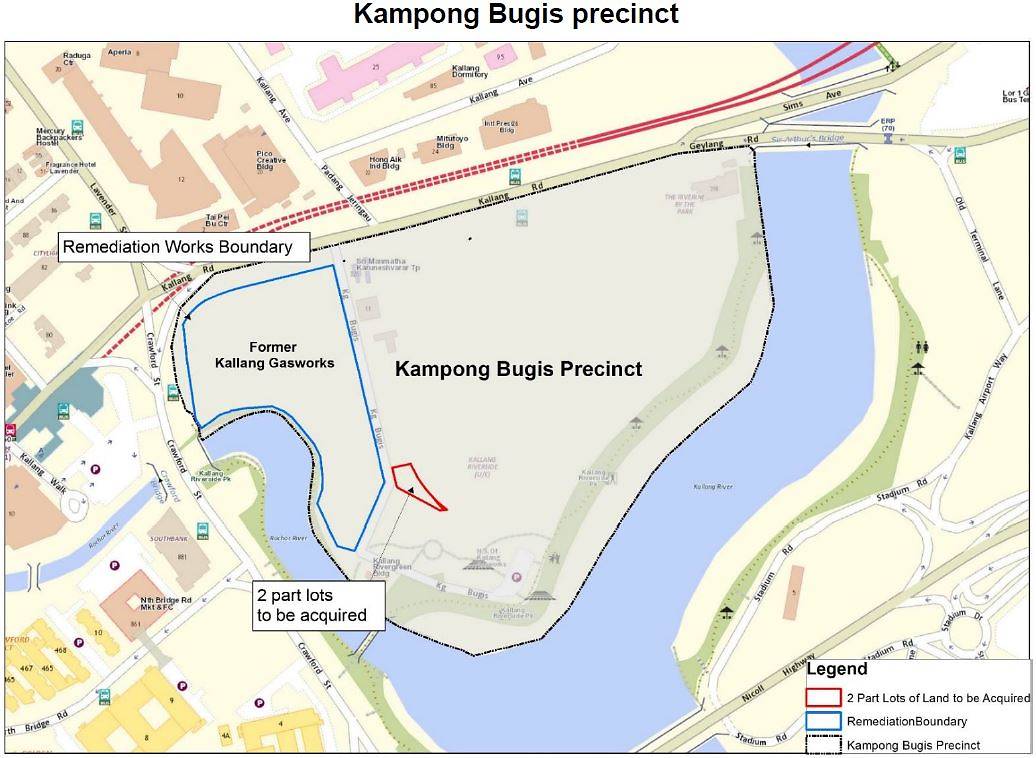
The first District Pneumatic Waste Conveyance System (DPWCS) under the amendments will be implemented at the upcoming private residential estate of Kampong Bugis.
HDB flats in Yuhua estate. (Photo: HDB)
Changes to the Bill will allow the authorities to declare DPWCS areas, where all private developments within such a district will be required to connect and use the DPWCS.
“By implementing PWCS at the district level, we can reap more economies of scale,” explained Dr Khor.
“NEA (National Environment Agency) estimates that a condominium with 1,000 dwelling units that would no longer need a bin centre would save on space equivalent to one five-room flat.”
New sections added to the Bill will give NEA the powers to require owners and occupiers of premises to pay connection charges and/or tariffs where necessary.
COST OF INSTALLING, MAINTAINING THE SYSTEM
Citing a 2015 news report which said that the PWCS cost more than S$11 million for 38 blocks in Yuhua estate as part of the Housing and Development Board’s Greenprint project, MP Lee Bee Wah asked if the cost of implementing the system will be transferred to residents.
MP Sylvia Lim also raised similar concerns. “It is quite clear that owners of premises will have to incur significant costs to make their properties PWCS-ready,” Ms Lim said. “Can the government give any indication as to the expected cost of the mandatory PWCS to existing homes?”
Several MPs also asked about the hefty capital cost and maintenance fees, and whether residents would have to foot the bill.
Dr Khor clarified and illustrated with the example of upcoming development Kampong Bugis, a private residential precinct. The master developer will cover the capital costs, while the development’s management will cover operational and maintenance expenses through a monthly tariff.
She added that when implemented on a district level, premises will get to enjoy cost savings due to economies of scale through shared bin centres, air and ventilation equipment and pipe networks.
Compared to Yuhua, the cost borne by premises in Kampong Bugis is expected to be lower because the construction is done from the start without retrofitting, she said.
Location map of the Kampong Bugis Precinct. (Source: URA)
In response to a question from MP Murali Pillai who had asked if the Government would consider subsidising existing private developments to implement PWCS within their estates, Ms Khor said that it has “no plans to do so”.
Workers’ Party’s Ms Lim also asked if the DPWCS would be extended to landed estates in the future.
“Currently, we do not think there are sufficient economies of scale to implement DPWCS in landed estates for the system to be financially viable. We will focus our efforts on non-landed developments, such as Kampong Bugis,” Dr Khor said.
But employees are given significant customer service training, including how to handle victims who have been molested, adds Senior Minister of State for Transport Janil Puthucheary.
An entrance of Serangoon MRT station. (File photo: Wikimedia Commons)
(Updated: )
Bookmark
SINGAPORE: MRT station employees are not trained to chase after nor apprehend people, and the protocol is for them to call for help in the event of incidents such as molestation, said Senior Minister of State for Transport Janil Puthucheary on Tuesday (Oct 2).
Dr Puthucheary’s comments were made in response to a parliamentary question from NCMP Daniel Goh, who had enquired about the molest case at Serangoon MRT station last month, and if incidences of molestation on MRT premises are treated as high priority for staff intervention.
A 23-year-old man was arrested last month for allegedly molesting a woman at Serangoon MRT station twice – once while on the train and the other after she had alighted at the station.
In a widely-shared Facebook post, the woman who alleged she had been molested said she had alerted the control station “hoping someone would stop him … but people just stared and did nothing”.
As a result, the alleged perpetrator got away, she wrote.
Dr Puthucheary said on Tuesday that after they were informed of the incident, train station staff notified the SBS Transit Operations Control Centre (OCC) and the Public Transport Security Command of the Singapore Police Force (TransCom) was alerted immediately.
“Their swift actions enabled the police to subsequently arrest a male suspect. Investigations are ongoing,” Dr Puthucheary said.
Assoc Prof Goh then asked if the staff protocol in such instances would involve giving chase or stopping the molester from escaping the scene of the crime.
“The protocol does not specifically instruct staff to give chase,” Dr Puthucheary replied.
“The first thing the staff have to do is inform the network of support structures we have such as OCC and TransCom in case more resources and assets are required to be deployed to the station … The staff have a duty to the station and a responsibility to the post as well,” he said.
Dr Puthucheary added that train station employees are also not trained to “handle violent criminals and chase down and apprehend people”.
“There is the issue of course as to whether the perpetrator could become violent … So they have to exercise some judgment on what intervention is appropriate for them,” he said.
In Parliament, Assoc Prof Goh also noted that sensitivity is required in dealing with victims, who could be emotionally distressed during such circumstances.
To this, Dr Puthucheary said that employees are given a significant amount of customer service training, including on how to handle victims of molest.