Home Blog Page 932

From clerk to MMA world title contender: Singapore’s Amir Khan fights to reach the top of his sport

0

SINGAPORE: When he was in national service (NS), Amir Khan harboured dreams of becoming a mixed martial arts (MMA) world champion. He did not see NS as a hurdle to his ambition.

“It was me serving my country. I knew I had to do it, no excuses. I just made the best out of it,” said Khan, who spoke to Channel NewsAsia in an interview last month.

For close to two years from May 2015, he served as a clerk with the Singapore Civil Defence Force (SCDF). Khan was assigned the post after his basic rescue training because he has Tourette syndrome. The regular office hours he kept gave him the opportunity and time to train, but only in the evenings.

“I trained only once a day at the gym but it taught me to get my priorities right. Put what’s important first – do my NS in the day, and train in the evenings,” he added.

With a ripped physique and bulging muscles, Khan was by his own admission fitter than some of his NS commanders. But what the two years of service taught him was respect and humility.

“Even though I was tougher than my own commander, I had to respect him,” said Khan. “I built a relationship with my commanders so that they allowed me to train and stuff. The whole experience made me grow as a person, and apply these same skills I learnt,” he added.

Now, more than a year since completing his national service, Khan has been given the chance for the ONE championship MMA world lightweight title.

Khan is now the fighter with the largest number of finishes in ONE, but the accolade does not mean much to him. 

“The record is an added bonus. But it’s not something to be proud of. I want to be world (lightweight) champion, and until then, I have not achieved my goal,” he added. Khan will not have to wait much longer to have a shot at that.

ONE’s chief executive officer Chatri Sityodtong announced on Monday (Oct 1) that the 23-year-old will face Philippines’ Eduard Folayang for the belt at its Conquest of Champions event at the Mall of Asia Arena in Manila on Nov 23.

Khan’s stint with ONE and Evolve gym has allowed the Muay Thai specialist to blossom into one of the top MMA prospects in the world. He has 11 wins to his name and three losses – two of which were very early in his career. 

Most recently, he beat the Philippines’ Honorio Banario in Shanghai. Before the fight, Khan predicted he would win within two rounds – but Banario conceded within the first.

Amir Khan rear naked choke

Honorio Banario tapped out in the first round after Khan locked him down with a rear naked choke. (Photo: ONE Championship) 

“It was done effortlessly,” said Khan with a straight face, almost as if he was talking about brushing his teeth.

He grappled Banario to the ground in the first round of the bout, held him in a rear naked choke, leaving his more experienced opponent tapping out in submission.

“I timed the move, and took the opportunity, without wanting to waste energy,” he said. “Yes, (I expected to beat him. If not, what’s the point of fighting,” Khan added matter of factly.

Khan was an active child growing up and knew from young that he wanted to be a professional sportsman. Khan, who has been competing with ONE for four years, picked MMA because it allowed him to be different. 

Beyond MMA, Khan has also set his sights on one day representing Singapore at international major competitions such as the Asian Games or the Olympics.

Khan, who is a well-rounded fighter with skills across Olympic sports such as wrestling and jiu-jitsu, told Channel NewsAsia that representing Singapore is something he is considering “down the road”, following in the footsteps of ONE’s May Ooi, who represented Singapore in jiu-jitsu at the recent 2018 Asian Games. 

Ooi competed in the under-62kg category but she lost to the United Arab Emirates’ Alshamsi Hessa in the round of 32. 

“I saw May (Ooi) compete and transition (easily) – if I get the same opportunity, I’ll grab it. I’m still young, and that’s something to think about a few years down,” he said. 

Khan also named Singapore’s swimming Olympic champion Joseph Schooling as an athlete he looks up to and aspires to reach similar heights. 

“The endorsement deals that he has, the opportunities that he gets – he’s done it and because of him, we believe we can do it too,” said Khan. 

In terms of career progression, Khan said that he has no plans to compete under different MMA companies such as the US-based Ultimate Fighting Championship or China’s kickboxing promotion league Kunlun Fight. 

“I don’t look at other organisations, I want to stick with ONE. It’s a well-run gym, we have the top coaches, I have everything I need under one roof, so I don’t have to go anywhere else,” he said.  

Within ONE itself, however, Khan wants to correct the “wrong perceptions” some of the other fighters have of Singapore and its people. 

“They view Singapore as a rich city, where people don’t know what it’s like to struggle. They think excelling in MMA is all about channelling that aggression into the ring. But I want to prove that it’s not like that at all,” said Khan, who was raised in a middle-income family.  

“It’s not all about street fighting. We Singaporeans also struggle, albeit in a different way. I have an apartment that I have to pay rent for and I’m living all on my own,” said Khan. 

He stressed that one of his biggest motivations to win the lightweight title is to prove these doubters wrong. 

“Singaporeans are tough, in our own way. I am passionate about the sport and it’s not all about being angry when I fight,” he said. 

And how does he plan on becoming the first Singaporean to win a world MMA title? 

“I am all about effort and commitment,” said Khan. 
Source link

Passengers on May SIA flight asked to go for Tuberculosis screening

0

SINGAPORE: The Ministry of Health (MOH) has asked a number of passengers who took Singapore Airlines flight SQ25 to New York via Frankfurt on May 13 and 14, as well as the return flight SQ26 on May 27, to go for Tuberculosis (TB) screening as they might have got into contact with a person with an infectious form of the disease.

The passengers were asked to go to the Tuberculosis Control Unit (TBCU), located at Tan Tock Seng Hospital, for screening.

MOH said on Friday (Oct 5) that it was notified of a suspected TB case on Jul 27, but contact investigation was not initiated as the case was classified as “nontuberculous mycobacteria”, which the ministry said is typically non-infectious.

MOH said: “In line with standard medical practice, the case was started on TB treatment from 27 July 2018 until TB could be definitively determined or ruled out with the results of a sputum culture, which takes up to six to eight weeks. 

“The case’s culture returned positive in August for mycobacterium tuberculosis (ie TB diagnosis) and contact investigation was immediately initiated.” 

Passengers sitting in the vicinity of the case who were potentially at risk were asked to go to TBCU for screening. Besides the passengers, the case’s close contacts were also contacted.

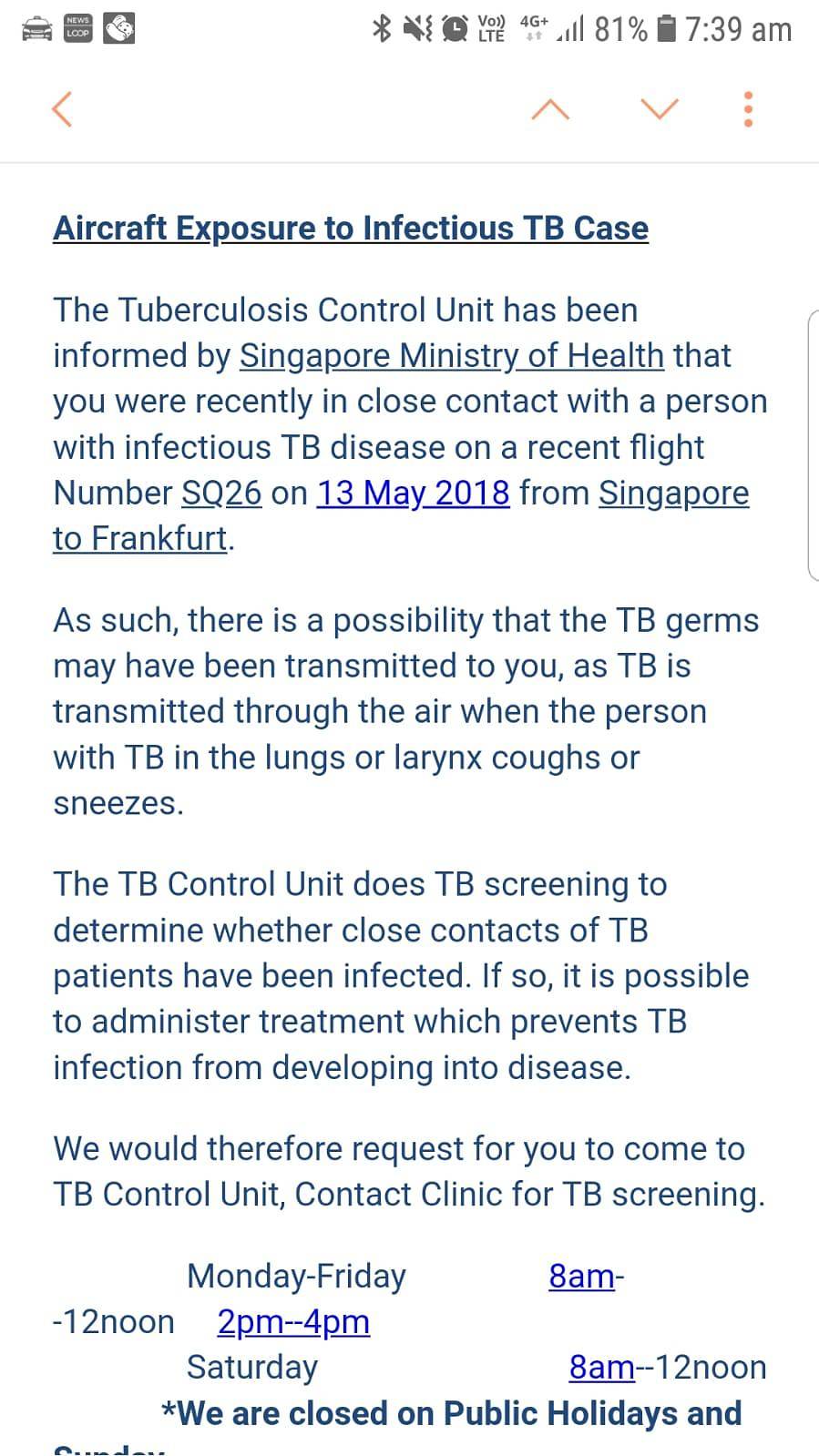
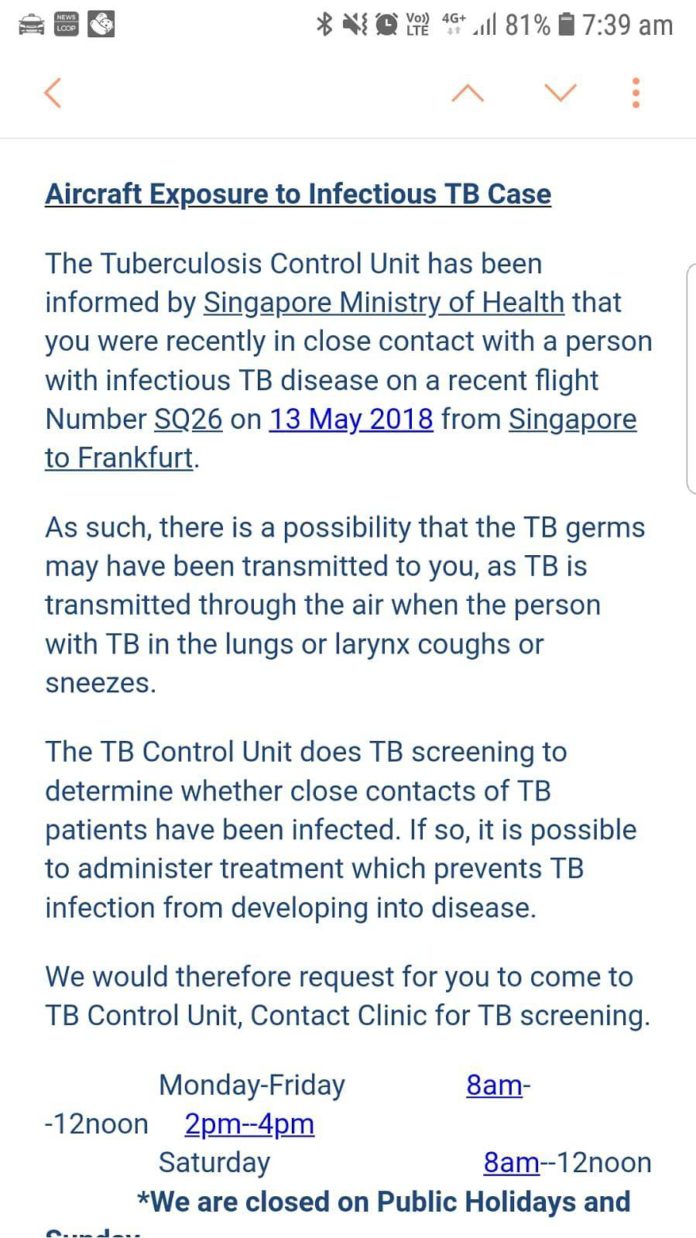
They were contacted by phone, text message or email, a screengrab of which was shown to Channel NewsAsia by a reader. 

Tuberculosis screening at Tan Tock Seng Hospital

A screengrab of the email sent to passengers who had been in close contact of an active TB case.

WATCH: Lam Pin Min on tuberculosis in Singapore

READ: Fewer new tuberculosis cases in Singapore in 2017

“NO ACTIVE TB CASES”

“Only those who have been contacted by TBCU have been assessed to be at risk of TB transmission. To date, all those identified by TBCU have been contacted,” the ministry said. 

“In line with the International Health Regulations, MOH has also alerted the authorities of other countries whose nationals were identified as close contacts, so that they can take the necessary public health actions.

“Passengers who were on board the flights but were not identified and contacted for screening are not at risk as they did not have close and prolonged contact with the individual.”

The ministry added that there are no active TB cases among the close contacts identified for screening to date.

Source link

National Skin Centre unveils patch treatment for keloid scars

0

SINGAPORE: Patients at the National Skin Centre (NSC) can look forward to a painless treatment to reduce the size of their keloid scars by the end of this year.

Developed by NSC, the new treatment comes in the form of a patch and can be performed by the patient at home, as compared with the current treatment, which involves monthly injections at a clinic.

Keloids, which are firm protruding lesions on the skin, can sometimes cause itchiness and pain when rubbed against fabric, and can affect movement when they form on the joints. 

They can also increase in size over time and affect quality of life, said Dr Tey Hong Liang, senior consultant and head of research at the NSC, who revealed the new treatment on Friday (Oct 5).

The NSC takes care of more than 5,000 patients with keloids per year.

The current treatment treatment keloid scars involves having patients undergo monthly injections of the steroid triamcinolone. Regular doses are needed for the treatment to be effective. However, the treatments have certain limitations.

“In many patients, the keloid scars are very sensitive and they feel a lot of pain (from the injection). It prohibits them and deters them from coming for treatment,” said Dr Tey.

“And in children, it’s impossible to inject them because it is just too painful. We have patients who have keloids occurring on the mid-face … These patients are not amenable for injection therapy,” added Dr Tey.

Keloid Scars 1

Patches for keloid scars of different sizes. (Photo: Elizabeth Neo)

The alternative treatment NSC has developed uses a microneedle patch that contains triamcinolone. 

The microneedle patch, which is about a hundred times smaller than the conventional needles used for keloid injections, is to be applied on the affected area for two to three minutes once a day. 

A pack of 30 – which is enough for a month’s use – costs about S$40, similar to the conventional monthly injection.

It is expected to be available on a prescription basis at the end of the year. 

One patient, who has been receiving treatment for more than 10 years, told Channel NewsAsia that the discomfort and inconvenience of travelling to the doctor for the injections deters him from getting regular injections.

“For myself because I’ve done the steroid injections, I’ve only got a few (keloids) left that are really stubborn, and they’re quite small. So I will be more than happy to just use the microneedles at home, when I’m watching TV. I can definitely afford a couple of minutes a day,” said the patient, who declined to be identified.

Both the monthly injection and daily patch treatments require patients to receive treatment for about two to five years in order to flatten the scar and relieve discomfort.

A study was conducted on 27 patients who had used the patch from 2016 to 2017. All respondents said that the patch was not painful, while 88 per cent indicated they preferred it over the conventional injection.

Source link

‘Customised, uniquely tailored’ malware not seen elsewhere used in SingHealth cyberattack

0

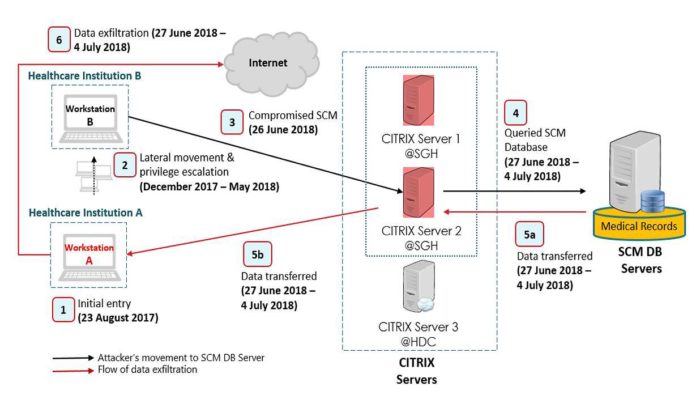
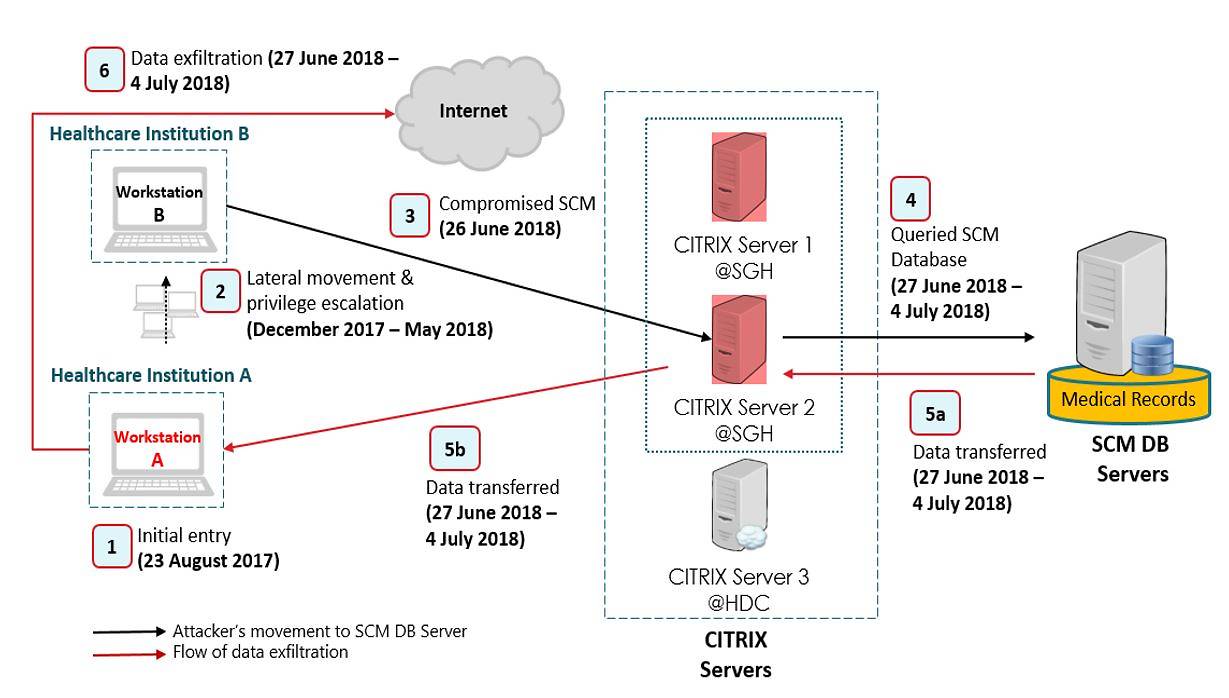
SINGAPORE: Phishing was likely used as a tool to gain access to a front-end computer at Singapore General Hospital, the Committee of Inquiry (COI) into the SingHealth cyberattack heard on Friday (Oct 5). The attacker then installed customised malware before laying dormant to execute their plan months later.

Forensic investigations found signs of call-backs to an overseas command and control server, said Solicitor-General Kwek Mean Luck as he presented a report by the Cyber Security Agency of Singapore (CSA) on the “modus operandi” of the cyber attackers. Such servers are used by attackers to talk to compromised computers within a target network.

The malware was “customised, uniquely tailored to the targeted systems, and had not been observed elsewhere”, the report said. The “skilful and technically advanced” attacker also used modified open-source tools that evaded anti-virus software, it added.

CSA said that the tools, techniques and procedures, as well as some of the malware that the attacker used fit the profile of an Advanced Persistent Threat (APT) group that it has previously encountered in other investigations.

READ: Singapore health system hit by ‘most serious breach of personal data’ in cyberattack; PM Lee’s data targeted

The cyberattack, which was Singapore’s most serious breach of public data to date, saw a total of 1.5 million patient records accessed and 160,000 records of outpatient dispensed medicine taken. Database administrators from the Integrated Health Information Systems (IHiS) – the central IT agency for the healthcare sector – discovered the breach on Jul 4 and acted immediately to stop it.

It also saw the personal particulars of Prime Minister Lee Hsien Loong, as well as information on his outpatient dispensed medicines, being “specifically and repeatedly” targeted.

KEY FACTORS THAT LED TO BREACH

According to the CSA report, there were three key factors which contributed to the cyberattack.

The first was the profile of the attacker, who was described as a “skilled and sophisticated threat actor” who used an “advanced modus operandi”, first gaining access on Aug 27 last year.

SingHealth COI Fig2

Utility tools such as Microsoft Powershell were likely to have been used alongside customised malware between steps two and three. (Photo: CSA)

The “stealthy and disciplined” attacker then laid low and only began exploiting the access after four months and moved in a “targeted manner” planning his route in the network between December 2017 and July 2018.

After compromising the initial computer, he proceeded to distribute malware and steal credentials, including user accounts and passwords including those that ultimately gave him access to the Electronic Medical Record (EMR) database.

“The attacker took care to avoid detection by moving quietly and slowly,” the report said.

“He avoided secondary targets that might have drawn attention to his presence. He was also careful and deliberate in erasing traces of his activities,” it added.

The attacker had also planted multiple footholds in the network, which was later used to attempt re-entry into the SingHealth system.

Secondly, weakness in SingHealth’s IT network allowed the attacker to gain access, said the report.

READ: Exploited server had not been updated for more than a year

The final reason identified by the report was a vulnerability in an application on the EMR database, which led to the breach.

READ: SingHealth COI hearing: Former IHiS CEO dismissed staff for ethical breach, didn’t probe alleged vulnerability

“From the evidence, it would appear to the COI, even at this stage, that the attacker had one and only one malicious intent, and that of exfiltrating data from the crown jewels of the network, which is EMR,” said COI chairman Richard Magnus in his closing remarks.

“I think at this stage the COI is inclined to accept the CSA’s assessment of the three factors that led to the cyber attack.”

CONTAINMENT MEASURES SUGGESTED BY CSA

After the breach was uncovered on Jul 4 and subsequently reported to CSA on Jul 10, IHiS and CSA implemented several immediate measures to contain the threat, eliminate the attacker’s foothold, and prevent the attack from recurring.

They include mandatory password changes for end-user computers which were completed on Jul 19 and Internet Surfing Separation policies, implemented on Jul 20, in view of call-backs to the overseas servers.

A master pass account, known as the Kerberos Golden Ticket, was also reset on Jul 12 twice to ensure that the attacker’s potential administrative privileges were invalidated.

The IHiS team also created firewall rules on Jul 13 to begin blocking malicious call-backs to identified overseas servers used by the attacker. Later on Jul 17, IHiS incorporated indicators that would help anti-virus systems recognise intrusions for system-wide scanning.

Citrix servers, which communicate between workstations and database servers were reloaded on Jul 14. Benign utility tools such as Microsoft PowerShell, which was used during the attack, was also disabled on Jul 13 on all end-user machines.

Over the past two weeks, the COI had heard from at least 14 witnesses at its public hearings ranging from former IHiS CEO Dr Chong Yoke Sin to assistant lead analyst Chai Sze Chun who went out of his way to investigate the hackings.

Part of the hearings was held behind closed doors, where evidence which involved national security matters were heard. For instance, the evidence may be exploited to carry out further cyber attacks or patients’ personal data may be revealed.

READ: COI for SingHealth cyberattacks: Officer took initiative to investigate even though it was not his job

Describing the Solicitor-General’s statement and the CSA’s investigation report as “essential” to the inquiry, Mr Magnus also added that both reports provided “clear insights into the modus operandi and the characteristics of the attacker”.

“As we all know, the COI is still ongoing, and I think we will consider all the evidence judiciously,” he added.

The inquiry will continue into its third tranche at end October. Witnesses are due to give evidence on areas such as the cybersecurity measures in place when the attack happened, the immediate responses to the cyberattack, IT governance frameworks as well as existing cybersecurity policies and their adequacy, Solicitor-General Kwek said.

The COI will hear from senior executives from IHiS and SingHealth, including IHiS’ director for cybersecurity governance Chua Kim Chuan, IHiS CEO Bruce Liang, and SingHealth Group CEO Ivy Ng, he added.

A report looking into the events and contributing factors leading to the cyber attack is due by end-2018.

Source link

Hyflux still in discussions with potential investors for Tuaspring plant, other strategic investments

0

But the SGX filing on Friday did not reveal details about these discussions, citing confidentiality considerations and the need to protect the company’s interests in ongoing negotiations.

Hyflux Singapore

(Photo: Jeremy Long)

SINGAPORE: Embattled water treatment firm Hyflux said on Friday (Oct 5) that it is still in active discussions with potential investors for the divestment of its Tuaspring Integrated Water and Power Plant, as well as strategic investments for the rest of the group. 

However, the SGX filing, which the company said is aimed at clarifying recent media reports, did not reveal any details about these discussions, except that Hyflux has not made any commitments and remains open to considering various opportunities. 

The home-grown firm, which first made its mark in water treatment and later ventured into power generation, is currently going through a court-supervised restructuring process after first making the unexpected announcement in end-May and later obtaining an additional six-month moratorium in June. 

Hyflux has cited “prolonged weakness” in the local power market for the turnabout in fortunes. 

With liabilities of S$2.95 billion, the divestment of its Tuaspring plant, which cost more than S$1 billion to build and marked Hyflux’s move into the electricity market, has been seen as key to resolving the company’s cash crunch. 

Hyflux has until Oct 15 to ink a binding deal with a successful bidder for Tuaspring, as part of an agreement with Maybank – Tuaspring’s only secured creditor. 

With the clock ticking, a Bloomberg article on Oct 2 reported that Hyflux only received one bid for the integrated plant by the Oct 1 deadline.

Citing unnamed sources, the report said that the bid from Sembcorp Industries was below Tuaspring’s book value of S$1.4 billion and will not be enough to fully pay back loans.

The Bloomberg report added that Keppel Corp, which had earlier shown interest, did not submit a binding bid in the end. 

With only one bid on the table, Hyflux may negotiate with Maybank to explore other options. There are also overseas investors who remain keen on Hyflux’s entire business, though regulatory approval could be a challenge, the article citing sources said.

Referring to this article, Hyflux said in Friday’s SGX filing that the company is still pursuing the divestment of the Tuaspring plant concurrently with strategic investments in the overall business of the Hyflux Group. 

“These processes run in parallel and are at the stage where the company is actively engaged in discussions with potential investors in Tuaspring and/or the rest of the Hyflux Group,” it said. 

“The company has not committed itself to any particular option or any of the proposals received at this point in time and remains open to considering various opportunities,” Hyflux wrote, while adding that any proposals received will be subjected to approval by the relevant authorities where required. 

It also said that it would not be able to comment on specific details about the Tuaspring divestment process at the moment, given confidentiality considerations and the need to protect its interests in ongoing negotiations. 

Trading in Hyflux’s SGX-listed shares and related securities remain suspended, leaving tens of thousands of investors reeling. In July, the company held townhall meetings that were attended by about 800 investors of its notes, perpetual securities and preference shares.

An update of the company’s reorganisation plans is expected at a court hearing scheduled on Oct 8 at 2.30pm.

Source link

First day of trial for lawsuits against Workers’ Party MPs

0

The suits were brought against three Workers’ Party MPs Low Thia Khiang, Sylvia Lim and Pritam Singh as well as others, over alleged improper payments amounting to millions of dollars.

WP trial day 1 Pritam Singh Sylvia Lim

Workers’ Party secretary-general Pritam Singh (centre) and chairman Sylvia Lim (right) arrive at the High Court on Friday (Oct 5). (Photo: Hani Amin)

SINGAPORE: The civil lawsuits brought by the Aljunied-Hougang Town Council (AHTC) and Pasir Ris-Punggol Town Council (PRPTC) against three Workers’ Party Members of Parliament over an alleged breach of fiduciary duties went to trial on Friday (Oct 5).

Among the defendants named in the suits are MPs Low Thia Khiang, Sylvia Lim and Pritam Singh. 

READ: AHTC-appointed independent panel files lawsuit against Workers’ Party MPs over ‘improper’ payments

The others are AHTC councillors Chua Zhi Hon, Kenneth Foo Seck Guan and How Weng Fan. The town council’s former managing agent FM Solutions and Services (FMSS), and its owner Danny Loh, who died in 2015, are also named as defendants.

WP trial day 1 Pritam Singh Sylvia Lim

Workers’ Party secretary-general Pritam Singh (left) and chairman Sylvia Lim (right) arrive at the High Court on Friday (Oct 5). (Photo: Hani Amin)

Some members of the public arrived as early as 7am, with a short queue forming outside the courtroom by around 8.30am. Non-Constituency MP Daniel Goh was also spotted entering the courts at around 9am.

The three MPs arrived at the High Court at around 9.45am, accompanied by fellow WP MPs Png Eng Huat, Faisal Manap and Leon Perera, as well as party member Yee Jenn Jong. Mr Png, Mr Faisal, Mr Perera, Mr Yee and Mr Goh sat at the public gallery of the courtroom.

Most of the WP members were dressed in blue, the party’s official colour.

WP trial day 1 Leon Perera Png Eng Huat

Workers’ Party’s Png Eng Huat (centre), Faisal Abdul Manap and Leon Perera arrive at the High Court on Friday (Oct 5). (Photo: Hani Amin)

In July last year, a three-member independent panel filed a suit against the defendants on behalf of AHTC, alleging that the three WP MPs breached their fiduciary duties by appointing FMSS as the town council’s managing agent. 

It also alleges that Mr Low and Ms Lim misled the town council into waiving a tender and appointing FMSS as the town council’s managing agent.

WP trial day 1 Sylvia Lim Low Thia Kiang

Ms Sylvia Lim, Mr Pritam Singh, Mr Low Thia Khiang and other members of Workers’ Party seen outside the Supreme Court on Friday (Oct 5). (Photo: Hani Amin)

It also accuses them of making “improper payments” of more than S$33 million to FMSS and its service provider, FM Solutions and Integrated Services. They are also accused of deciding that Ms How, who was then the deputy secretary and general manager of the town council, would set up and incorporate FMSS with her husband Mr Loh, the secretary of AHTC at the time.

The independent panel was set up in February 2017 to review the findings of a KPMG report. The report said that the town council had “serious flaws” in governance and made improper payments amounting to millions of dollars to third parties.

In September 2017, PRPTC filed a similar suit against the councillors, seeking claims and reliefs pertaining to Punggol East. Punggol East was previously managed by the WP after it won a by-election in 2013. 

The WP lost the single-member constituency in the 2015 General Election, and PRPTC took over management of the ward.

READ: Pasir Ris-Punggol Town Council initiates legal action against AHTC councillors 

AHTC is represented by Shook Lin & Bok, while PRPTC is represented by Drew and Napier. The WP members are represented by Tan Rajah & Cheah, while Netto & Magin is representing FMSS and Ms How, who is the personal representative of her late husband Mr Loh.

The trial, which is expected to run until Nov 2, continues.

Source link

Sagra Italiana! – An Italian Festival

0

Sagra Italiana! – An Italian Festival
Tuesday, October 23, 2018 at 10:00 AM

United Square Shopping Mall

101 Thomson Road, Singapore, 307591 Singapore

Source link

Iceberg lettuce containing high levels of pesticide recalled from NTUC FairPrice, Sheng Siong

0

SINGAPORE: The Agri-Food & Veterinary Authority (AVA) has issued a recall for iceberg lettuce sold at NTUC FairPrice and Sheng Siong supermarkets.

The recall comes after the iceberg lettuce from a Malaysian farm were found to contain high levels of fipronil, a “wide-spectrum pesticide”, AVA said in an alert on Thursday (Oct 4).

The implicated product is imported by Go Fresh Impex for sale at the two supermarkets. AVA has directed the importer to conduct a recall, which is ongoing, the agency said.

Iceberg lettuce sold at NTUC FairPrice that are affected by the recall come with the supplier code 40.

Iceberg lettuce recall NTUC

“Consumers who have purchased the affected products may contact the respective supermarket retail outlets for enquiries,” AVA said.

The agency advised the public to practise good food safety by washing and soaking vegetables to remove any pesticide residue before cooking or consumption. 

Source link

Work pass holders who borrow from unlicensed moneylenders to face repatriation

0

SINGAPORE: Work pass holders who borrow from unlicensed moneylenders will be repatriated and barred from further employment in Singapore under planned new penalties.

This was announced in a joint press release from the Ministry of Law and the Ministry of Manpower (MOM) on Thursday (Oct 4).

“When a work pass holder has been found to have borrowed from unlicensed moneylenders, MOM will inform the employer and revoke the work pass,” said the ministries. “The foreign worker will then be repatriated and debarred from further employment in Singapore.”

Appeals by employers to retain their foreign worker will be considered on a case-by-case basis, it added.

The penalties will be implemented in 2019.

In addition, foreigners residing in Singapore will also have the amount they can borrow from licensed moneylenders restricted.

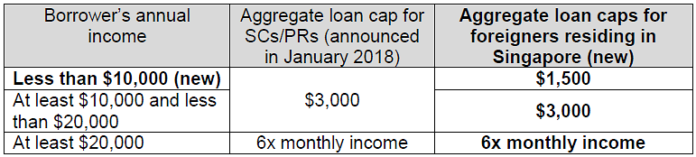
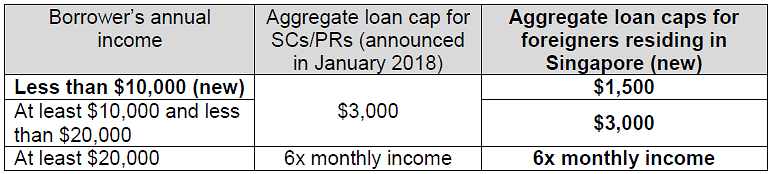
Aggregate loan caps for borrowing from licensed moneylenders – previously announced earlier this year – will be extended from Singapore citizens and permanent residents (PRs) to all foreigners residing in Singapore.

The caps, which will be implemented in the fourth quarter of 2018, restrict the amount individuals can borrow.

The following loan caps will apply:

moneylending caps table

The two ministries said they had observed an increase in the number of foreigners borrowing from licensed moneylenders, from 7,500 in 2016 to 35,000 in the first half of 2018.

The police have also observed more foreigners residing in Singapore borrowing from unlicensed moneylenders, they said.

In addition, a previously announced self-exclusion framework will also be extended to foreign residents in Singapore.

The framework will prohibit licensed moneylenders from lending to those who have applied for self-exclusion, and will be implemented in 2019.

“This framework will help borrowers regulate their borrowing behaviour, and participate in debt assistance schemes which typically require self-exclusion,” said the press release.

MOM and the police will also step up education efforts for foreign work pass holders on the risks of borrowing.

The borrower protections will apply to foreigners who are holders of Work Passes, Long Term Visit Passes, Short Term Visit Passes, Dependant’s Passes, and Student Passes. 

They will not apply to foreigners with a temporary presence in Singapore, such as tourists.

Source link

Commentary: Parents, don’t shy away from a competitive education system

0

SINGAPORE: Christmas came early this year for many parents.

A move towards fewer tests in schools announced by the Ministry of Education (MOE) last Friday (Sep 28) was applauded by relieved mums and dads.

THE EDUCATION SYSTEM HAS BEEN CHANGING

Radical as it seems, MOE’s announcement is not all that groundbreaking considering the concerted shift away from an emphasis on academic grades in recent years.

A roll-out of applied learning programmes across all primary schools by 2023 was announced earlier this year – heralding a greater shift towards nurturing creativity and developing a love for learning.

Although the Primary School Leaving Examination will be retained, since 2013, MOE has removed the highest and lowest aggregate scores in results slips. Scoring bands will also be widened from 2021 onwards.

At the secondary school-level, the Direct Admission Scheme, which admits students based on their other talents, was strengthened when authorities did away with the use of general academic ability tests as a criterion this year.

So changes in the system have been underway for some time. But the reactions from most parents reveal a certain psyche.

READ: Scrap PSLE? The Singapore education system is not a free lunch, a commentary

READ: With less focus on grades, is PSLE still a necessary checkpoint? A commentary

ESPECIALLY KIASU PARENTS

Wanting children to do well in school is a goal of every Singaporean parent down the generations, but it seems having gone through a system of streaming and frequent scholastic testing have turned many of my vintage into especially kiasu parents.

There seems to be an unhealthy arms race in parenting. When my parents raised me, being a supportive parent meant gently reminding your children to study hard or sitting with them while they do their homework.

Generic preschool image. Photo: TODAY

A child doing homework. (File photo: TODAY)

These days, being a supportive parent comes packed with pretty high expectations – including early enrollment into the best pre-school and suite of enrichment classes money can buy.

Numbers is something every practical Singaporean understand. Every exam grade your child gets must feel like a test of your parenting abilities.

Fewer tests means having to deal with fewer periods of busied preparations and that must be such a relief for parents.

STRESS COMES FROM OTHER SOURCES TOO

But will students finally be free from stress?

“The devil’s in the details of how people respond”, a friend who has three kids said. I think she’s onto something.

The Education Ministry might have reduced testing but stamping out the corrosive sources of exam stress will require a bigger mindset shift from teachers, parents and students.

If we think back, how much anxiety did not arise from the underlined marks on a failing grade in a report card, but from the memory of the burning shame we felt when teachers gave out exam scripts in class – in order of merit?

Or the look our parents gave us when we told them our grades?

So it is useful that instead of stress reduction, Education Minister Ong Ye Kung has framed the announcement as a focus on what he calls “the true spirit of learning” where students can take time to enjoy school, speaking at an event on Wednesday (Oct 3).

READ: Is academic competition really necessary to be the best than we can be? A commentary

Viewed this way, fewer tests could mean parents can spend more time with their children reading, tinkering and discovering together a love for learning, instead of cramming for exams.

LET’S REMEMBER COMPETITION IS A GOOD THING

But in the debate on education and tests, let’s be careful not to shy away from competition altogether. Studies have shown that healthy competition can be good for a child’s development.

primary school students

File photo of students at a primary school.

No doubt competition can be harmful if exams become a zero-sum race and winning takes primacy over gaining knowledge, writes education expert Dr John Shindler, but if tests are viewed as a collective challenge, they can foster constructive skills of collaboration – like when students study together.

Competition also teaches children how to cope with negative emotions, confront insecurities, and develop self-esteem, according to UC Berkeley Education Director of the Greater Good Science Centre’s Vicki Zakrzewski.

Schools are putting these lessons to practice, where many recognise the caustic effects hyper-competition can have.

Many, like Serangoon Garden Secondary School and Concord Primary School have also taken action to support their students through difficult times – through gratitude programmes, sharing sessions and outdoor education aimed at building confidence and mental health – without necessarily dialing back on the importance of assessment.

Preparing for a test, and dealing with the stress and results, can also be a learning experience.

COMPETITION WILL BE INTENSE IN AN AGE OF DISRUPTION

I worry parents see the announced move towards fewer tests as an easy way out – as a justified tweaking of the rules of the game instead of bravely confronting a situation when children react badly to stress.

The reality is that kids will grow up in a more volatile and uncertain world. To deal with the unpredictable challenges of disruption, they will need agility and resilience to navigate varied scenarios.

Being exposed to competition – whether in the form of regular testing or otherwise – can help them grow these needed skills.

And it is incumbent on parents and family members to build in them a robust response to pressure, instead of wishing to protect them from the stresses of life.

Let’s not forget they take their cues from us all.

READ: Protecting your kids from failure isn’t helpful parenting, a commentary

child parent holding hands

(File photo: Pixabay)

Parents have dramatic influence on how their children learn, writes Amanda Ripley, author of The Smartest Kids in The World. She writes:

“Parents who view themselves as education coaches … let their children make mistakes and then get right back to work. They teach them good habits. They want their children to fail while they are still children. They know that those lessons – about hard work, persistence, integrity and consequences – will serve a child for decades to come.”

How are parents helping their kids build self-reliance? Do mums and dads actively discuss with their kids their fears and uncertainties about the future?

Do parents themselves have a positive attitude about adapting to change and disruption? Or do they run away from problems – in this case from helping their kids navigate stress?

A NATURAL PART OF GROWING UP

All this is not to say that we should wish for more tests to be reinstated – far from it.

But it would be worrying if as a nation, we start to favour an education system that mollycoddles Singapore’s children. That would be doing them a disservice.

So in MOE’s latest move, it’s the parents, not the students, I worry about.

But I have faith that parents understand that having to face important challenges and feeling uncomfortable, even anxious, while doing so is a healthy, natural part of growing up that should not be robbed from our children.

And as a society, we must not let the removal of exams diminish the desire to be actively involved in our children’s learning journey.

Lin Suling is executive editor at Channel NewsAsia Digital News where she oversees the Commentary section.

Source link