Home Blog Page 931

Some teens, wary of being dismissed, seek mental health help without parents knowing

0

SINGAPORE: Some teenagers with mental health issues are seeking help without their parents’ knowledge due to fears of being dismissed or a reluctance to make them worry, psychiatrists and counsellors said.

An increase in mental health public awareness could also be driving them to seek assistance, the experts said, adding that the teenagers know of the kinds of help available to them.

This comes as the Samaritans of Singapore (SOS) said in September that more teens aged 10 to 19 were writing in for emotional support. In the 2017/18 fiscal year, 530 teens emailed the suicide prevention centre, a 53 per cent jump from the 347 the year before.

“Teens usually expressed their fear of being judged as well as of the reactions they may receive from family members,” an SOS spokesperson said. “Many teens feel a lack of effective communication and understanding between family members.”

Dr Ong Say How, senior consultant and chief of the department of developmental psychiatry at the Institute of Mental Health (IMH), said he has observed teens who come by themselves for issues like relationship problems, academic stress and parent-child conflicts.

“Once in a while, there might be those aged 16, 17 or even 18 coming to the clinic on their own,” he told Channel NewsAsia. “Upon asking, they request not to involve their parents.”

This could be because such teens are wary of being dismissed at home, Dr Ong said. “Imagine how you would feel if your parents were upset and made comments that were not sensitive,” he added.

On the other hand, Dr Ong said they could be very protective of their parent’s feelings. “They want their parents to feel happy, so they may also exclude parents from the discussion totally,” he added.

Dr Ken Ung, a senior consultant psychiatrist at Adam Road Medical Centre who specialises in adolescent psychiatry, has also seen teens aged 13 upwards visiting his clinic alone.

One reason, he said, is that parent and child are not getting along. If that’s not the case, then it could be culture.

“Even though they have a reasonable relationship with their parents, they come from families with parents who are more traditional, so they are not the types that may want to talk about feelings, emotions and problems,” he explained.

READ: Under pressure at home and in school, youths battle depression

Besides these factors, Dr Ong said mental health help has also become more accessible. “Due to an increase in public mental health awareness, they are savvier right now in trying to self-help,” he added. “They know where to go.”

This is also seen at school, where students have shown a “growing awareness and willingness to seek help”, said Mdm Choy Wai Yin, guidance branch director at the Ministry of Education’s student development curriculum division.

HOW DOES TREATMENT GO?

When students reach out regarding parent-related problems, Mdm Choy said school counsellors will try to understand the student’s perspective, then help him or her understand the parents’ point of view.

“The counsellors will then work with the student to explore what he or she could do to resolve the problem and cope with the situation, before guiding him or her to develop a plan of action,” she added.

“If the safety or well-being of the student is compromised, the counsellor will contact the relevant external agencies, for example Child Protective Services, to provide further support.”

READ: More kids in Singapore seeking help for mental health issues

IMH’s Dr Ong said because the teens are minors, the clinic “would encourage them to inform and bring their parents along subsequently”. “Parents can help the child at home as well by applying some of the therapeutic principles that we use as clinicians,” he said.

Dr Ong pointed out that teens can also benefit from bringing their parents along by seeing their relationship improve.

“It’s also a discovery journey for some (parents),” he added. “By helping them understand their teenager, they can then take a step back, calm themselves and be able to accommodate what their teen is going through.

“With that understanding, the whole attitude changes to become more positive and nurturing.”

Adam Road Medical Centre’s Dr Ung said he would be happy to see the teens alone, as long they do not pose a danger to themselves or others, or need prescribed medicine. He would also try gaining their trust before involving parents in the equation.

“I would then say: ‘Look, maybe it’s a good idea for your parents to be involved. Why don’t I speak to them? Or we could meet together in case you’re worried they will overreact or blow up,’” he added.

READ: Teenage suicides at highest in recent years despite overall decline: SOS

TOUCH Youth Intervention (TYI), which does youth counselling and support groups for issues ranging from cyber wellness to transitional stresses, also gets hotline calls from youths who chose not to tell their parents.

But because most of them are minors, TYI senior counsellor Andrea Chan said the centre would need parental consent before starting therapy. However, counsellors would see them separately at the beginning.

“Based on the comfort level of the client, we would then decide if we would bring in the parents,” she added. “This is especially so in emotionally charged sessions where some youths might vent their frustrations on their parents.”

Nevertheless, Dr Ong said treatment would not be complete without “support from the home front”. “Usually, the teenagers would subsequently agree (to bring their parents) after a careful explanation,” he added.

WHAT CAN PARENTS DO?

At home, Dr Ong said parents can maintain healthy communication with their teens by making time for their child from a “really early” age, starting from pre-school.

“Things that are done in a very cursory or superficial manner don’t constitute quality time,” he said. “Asking about homework, have you eaten your meals, go to sleep now, shut down your computer – that kind of communication doesn’t constitute quality communication.”

Parents can also engage their teens by sharing about their own feelings or childhood experiences first. “After all, childhood, though it differs quite a lot through different generations, still share some commonalities,” he added.

“Importantly, parents should portray themselves as being open and non-judgmental. If the parents start criticising (their child’s) friends or show facial expressions that convey annoyance and irritability, the teenager will just clam up.”

child parent holding hands

(File photo: Pixabay)

Dr Ung said parents should understand that their teenagers have grown up and might not like excessive attention.

“It’s to do with trying to balance giving them a certain degree of independence and yet trying to continue to show concern,” he said, adding that parents can ask questions like “how’s your day” or “how are things” as an open invitation to share.

“But if the child is hesitant or reticent, then they should accept it and not push the matter. They should give some space so they can be there, ever present in the background.

“And if the teen knows that, then it will be very helpful.”

Where to get help: Samaritans of Singapore operates a 24-hour hotline at 1800 221 4444, or you can email pat@sos.org.sg. You can also find a list of international helplines here. If someone you know is at immediate risk, call 24-hour emergency medical services.
Source link

In pictures: MRT trains and buses dressed up for Deepavali

0

SINGAPORE: It’s still a month to go before Deepavali but some trains and buses are already dressed up for the Hindu festival of lights. 

Two Deepavali-themed trains – one on the North East Line and another on the Downtown Line – will run from now until Nov 9, said the Land Transport Authority (LTA) on Saturday (Oct 6). 

MRT trains and buses dressed up for Deepavali (5)

A rangoli motif on a Deepavali-themed train. 

MRT trains and buses dressed up for Deepavali

Commuters can catch these festive themed trains until Nov 6, 2018. 

MRT trains and buses dressed up for Deepavali (1)

A festive motif of an Indian celestial swan, or Annapatchi. (Photo: Land Transport Authority)

Deepavali falls on Nov 6 this year. 

Little India MRT station, too, got a festive pop of colour. 

MRT trains and buses dressed up for Deepavali (2)

The Deepavali decoration at Little India MRT station. (Photo: Land Transport Authority)

Deepavali Little India station

Little India station. (Photo: Land Transport Authority)

In addition, Boon Lay Integrated Transport Hub as well as five buses – service numbers 23, 64, 65, 147 and 166 – have also been decorated in a similar theme.

MRT trains and buses dressed up for Deepavali (3)

Five bus services also feature the Deepavali decorations.  (Photo: Land Transport Authority)

deepavali bus interchange

(Photo: Land Transport Authority)

LTA said the themed trains and buses were launched in collaboration with the Little India Shopkeepers & Heritage Association.

Source link

New S$6 million jetty for Lim Chu Kang fish farmers by 2020

0

SINGAPORE: The rustic jetty located at the end of Lim Chu Kang Road is one of the last remaining wooden jetties in Singapore, but its days may be numbered.

A new S$6 million jetty for fish farmers is set to be built just a few hundred metres west by September 2020.

The Agri-Food and Veterinary Authority of Singapore (AVA) told Channel NewsAsia that the proposed 4,000 sqm project is meant to ease operations for fish farmers, who have raised concerns about the limited space for loading and unloading.

Currently, more than 50 coastal fish farmers dock at the jetty to load and unload live seafood and other cargo every day.

According to fish farmers Channels NewsAsia spoke to, finding a spot to dock could take up to two hours during peak periods in the early mornings and evenings, compared to about 15 minutes during non-peak hours. The wait sometimes leads to quarrels among the farmers.

Mr Yeo King Kwee, a fish farmer of over 20 years, said: “When we are moving live fishes, time is really short. We have to get the fishes to the restaurants before they’re all dead … We have to queue and waste our time. That’s not good, wasting time at the hot jetty.”

New $6 million jetty for Lim Chu Kang fish farmers by 2020

Boats tied together in a bundle as there is no space to dock them properly. When the waves come crashing, the boats end up knocking against each other, causing damage. (Photo: Junn Loh)

The lack of facilities like a shelter as well as taps and toilets also makes working conditions tougher. It is an issue fish farmers hope can be addressed at the new jetty. 

“We need water to wash, clean, cook, bathe … the current situation is that we’re all using rainwater,” Mr Yeo said.

The jetty, which is about 30 years old, hasn’t weathered the elements well either – and this poses safety concerns.

Some of the jetty’s wooden planks are broken, and although the farmers have mended them using material cut out from plastic barrels, they say this hasn’t stopped accidents from happening, especially when the workers are carrying heavy loads.

New $6 million jetty for Lim Chu Kang fish farmers by 2020_1

Broken wooden planks, mended using material cut out from plastic barrels. (Photo: Junn Loh)

Fish farmer Edwin Tan said: “When it’s very low tide, the land on the right is higher than on the left, so the jetty will tilt to one side.”

“When we unload our fish, it weighs over 50kg per bucket and we have two buckets per trip. Because of the slope, the workers plus the fish have fallen into the sea many times, and the workers also get injured. During the rainy season, it gets worse.”

And it’s even harder at night, when the fish farmers have to tread a fine line between safety and getting their stock out on time.

Agreeing, Mr Yeo said: “At the current moment, there are no lighting facilities. And when it’s dark, it’s very dangerous. We try to avoid night loading, but during wee hours at around 3am, we have to start loading our goods for the market.” 

Other features the fish farmers hope to see include an access point for petrol, which is necessary to keep their boats and trucks running, as well as a designated space to park them when they are not in use.

AVA has called for an Expression of Interest for consultants to look into the design and construction of the new jetty.

New $6 million jetty for Lim Chu Kang fish farmers by 2020_1 (1)

Proposed location of new jetty. (Photo: AVA)

In response to queries, AVA said details have not been finalised and that it will continue to engage fish farmers on the matter. This includes setting up a working group with the farmers to discuss potential solutions and develop its design proposal.

It added that the fish farmers will continue to use the existing jetty until the new site is ready.

Construction is targeted to begin by September next year.

Source link

CNB seizes assortment of drugs worth S$63,000, 8 suspects arrested

0

SINGAPORE An assortment of drugs worth S$63,000, including cannabis, Ice, ecstasy and heroin, was seized by the Central Narcotics Bureau (CNB) on Friday (Oct 5). 

Eight suspected drug offenders – all Singaporeans – were also arrested. 

In a media release on Saturday, CNB said its officers raided a private apartment unit located around Lorong 29 Geylang in the wee hours of Friday.

About 1,517g of cannabis, 257g of Ice, 246 ecstasy tablets and 58g of heroin were seized from the unit, which is suspected to have been used as a drug store. 

Four suspects were arrested – two of them women aged 18 and 30, and two men aged 27 and 33.

Another suspect, a 24-year-old man, was later arrested nearby. He had earlier made contact through the unit’s intercom and tried to escaped when officers approached him. 

CNB said officers recovered a packet containing about 10g of Ice, which the suspect threw away while fleeing.

Cocktail of drugs seized in CNB operation (1)

Heroin recovered from a unit in a private apartment in Geylang. (Photo: Central Narcotics Bureau)

Separately, officers raided a unit in the vicinity of Potong Pasir Avenue 1. 

CNB said officers had to force their way in as the suspects refused to open the door. 

Three people in the unit were arrested – a 49-year-old suspected drug trafficker and two drug abusers aged 42 and 52. The suspected drug trafficker is allegedly known to the two male suspects arrested in Geylang. 

Officers also recovered about 74g of heroin, 58g of Ice, 2g of cannabis and two ecstasy tablets, said CNB.

Investigations into the drug activities of all the suspects are ongoing. 

According to CNB, 1,519g of cannabis is enough to feed the addiction of more than 210 abusers for a week, while 325g of Ice can feed the addiction of about 180 abusers for a week.

Source link

Kwong Wai Shiu Hospital reopens after S$96 million revamp

0

SINGAPORE: The Kwong Wai Shiu Hospital reopened on Saturday (Oct 6) after a major S$96 million revamp. 

The redeveloped compound on Serangoon Road now houses more than 600 beds in better-ventilated and more comfortable wards, making it the largest single-site nursing home in Singapore. 

Channel NewsAsia understands that more than 500 of the beds are already occupied.

Among the new additions is a 12-storey nursing home building with themed day activity spaces. The building also features a two-storey senior care centre, as well as a Terrace Garden specifically designed with dementia patients in mind. 

Patients and visitors can also drop by a refurbished Traditional Chinese Medicine (TCM) Centre or the new Heritage Gallery. 

Training facilities have also been set up, including the recently inaugurated Community Training Institute.

Besides centre-based nursing services, the hospital also offers inpatient and outpatient services, rehabilitation and day care.

Kwong Wai SHiu Hospital reopening

By 2021, the Kwong Wai Shiu Hospital will have presence at six locations including Kallang, MacPherson and Potong Pasir. (Photo: Cheryl Goh)

At the reopening, which coincided with the hospital’s 108th anniversary, Prime Minister Lee Hsien Loong noted the hospital’s long history of helping the needy.

“Kwong Wai Shiu Hospital is one of our oldest charitable healthcare institutions. 

“As Singapore developed and prospered, the lives of our people improved. However, there remained people who could not afford medical care when they became ill or suffered from chronic illness. 

“Not only did Kwong Wai Shiu continue to look after its patients, you have become a sanctuary for this group, so that they can recuperate in peace,” he said.

Mr Lee added that community partners like Kwong Wai Shiu Hospital complement the medical and social service provided by the Government. 

PM Lee also planted a Pink Mempat tree, symbolising a Chinese proverb that future generations will reap what the previous generation sows. The late founding prime minister Lee Kuan Yew planted a Flame of the Forest tree when he first visited the hospital 55 years ago.

Kwong Wai Shiu Hospital reopening

Prime Minister Lee Hsien Loong planting a Pink Mempat tree at the Kwong Wai Shiu Hospital. (Photo: Cheryl Goh)

Plans for further developments are underway. 

By 2020, the hospital will have a 128-bed long-term care facility. The National Healthcare Group Polyclinics will concurrently open the new Kallang Polyclinic, which will be connected to the hospital.

The hospital is set to establish its presence at a total of six locations by 2021, specifically areas within the central region of Singapore such as Kallang, Jalan Besar, MacPherson, Whampoa and Potong Pasir.

Seniors living in the neighbouring estates can look forward to a holistic and comprehensive suite of care services for the elderly as Kwong Wai Shiu Hospital strives to be an integrated healthcare and community hub.

The hospital’s chairman Patrick Lee said: “We wish to thank the community, our donors and volunteers for their utmost support throughout the redevelopment project. 

“We will continue to offer more quality services while continuing to keep our fees affordable for all and work with our partners to meet essential healthcare needs of our elderly.”

Source link

Beware of fraudulent emails impersonating MAS, authority warns

0

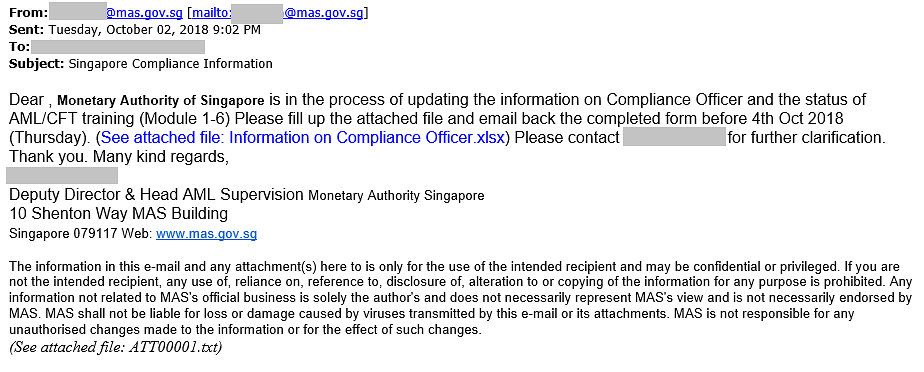
SINGAPORE: The Monetary Authority of Singapore (MAS) warned on Saturday (Oct 6) against responding to fraudulent emails purportedly sent from @mas.gov.sg accounts, which request recipients to click on links or open attachments that contain malware. 

Members of the public should not respond to these emails, which have subject titles like “Fund Transmittal” and “Singapore Compliance Information”. They should also not open the attachments or divulge any personal information including login IDs and passwords, MAS said in a media release. 

The authority also said that some of these emails claim it has received funds from foreign central banks remitted to the recipients, who are then asked to pay a transaction fee and provide details of their bank accounts to a specified email address. 

READ: Seven habits of highly secure digital natives – a commentary

Another group of emails, which claim that MAS is updating information on the training status of compliance officers for programmes related to anti-money laundering and countering the financing of terrorism, was also flagged. 

Recipients of these emails are asked to provide the information by filling out documents attached.

MAS fraudulent email

Members of the public are warned against responding to such fraudulent emails, as well as opening the attachments that come with them. (Photo: Monetary Authority of Singapore)

“Under no circumstances will MAS ask members of the public to provide their personal or bank account information,” the authority said. “If members of the public receive any unsolicited or suspicious emails purportedly from MAS requesting personal or bank account information, they should report this to MAS at webmaster@mas.gov.sg.”

“Financial institutions receiving emails purportedly from MAS are advised to be alert to any anomaly in the details of the sender or nature of request, and contact the relevant MAS review officer if in doubt,” it added. 

Source link

Kwong Wai Shiu Hospital reopens after $96 million revamp

0

SINGAPORE: The Kwong Wai Shiu Hospital reopened on Saturday (Oct 6) after a major S$96 million revamp. 

The redeveloped compound on Serangoon Road now houses more than 600 beds in better-ventilated and more comfortable wards, making it the largest single-site nursing home in Singapore. 

Channel NewsAsia understands that more than 500 of the beds are already occupied.

Among the new additions is a 12-storey nursing home building with themed day activity spaces. The building also features a two-storey senior care centre, as well as a Terrace Garden specifically designed with dementia patients in mind. 

Patients and visitors can also drop by a refurbished Traditional Chinese Medicine (TCM) Centre or the new Heritage Gallery. 

Training facilities have also been set up, including the recently inaugurated Community Training Institute.

Besides centre-based nursing services, the hospital also offers inpatient and outpatient services, rehabilitation and day care.

Kwong Wai SHiu Hospital reopening

By 2021, the Kwong Wai Shiu Hospital will have presence at six locations including Kallang, MacPherson and Potong Pasir. (Photo: Cheryl Goh)

At the reopening, which coincided with the hospital’s 108th anniversary, Prime Minister Lee Hsien Loong noted the hospital’s long history of helping the needy.

“Kwong Wai Shiu Hospital is one of our oldest charitable healthcare institutions. 

“As Singapore developed and prospered, the lives of our people improved. However, there remained people who could not afford medical care when they became ill or suffered from chronic illness. 

“Not only did Kwong Wai Shiu continue to look after its patients, you have become a sanctuary for this group, so that they can recuperate in peace,” he said.

Mr Lee added that community partners like Kwong Wai Shiu Hospital complement the medical and social service provided by the Government. 

PM Lee also planted a Pink Mempat tree, symbolising a Chinese proverb that future generations will reap what the previous generation sows. The late founding prime minister Lee Kuan Yew planted a Flame of the Forest tree when he first visited the hospital 55 years ago.

Kwong Wai Shiu Hospital reopening

Prime Minister Lee Hsien Loong planting a Pink Mempat tree at the Kwong Wai Shiu Hospital. (Photo: Cheryl Goh)

Plans for further developments are underway. 

By 2020, the hospital will have a 128-bed long-term care facility. The National Healthcare Group Polyclinics will concurrently open the new Kallang Polyclinic, which will be connected to the hospital.

The hospital is set to establish its presence at a total of six locations by 2021, specifically areas within the central region of Singapore such as Kallang, Jalan Besar, MacPherson, Whampoa and Potong Pasir.

Seniors living in the neighbouring estates can look forward to a holistic and comprehensive suite of care services for the elderly as Kwong Wai Shiu Hospital strives to be an integrated healthcare and community hub.

The hospital’s chairman Patrick Lee said: “We wish to thank the community, our donors and volunteers for their utmost support throughout the redevelopment project. 

“We will continue to offer more quality services while continuing to keep our fees affordable for all and work with our partners to meet essential healthcare needs of our elderly.”

Source link

Spying on maids with CCTV – where do we draw the line?

0

SINGAPORE: When his second child was born three years ago, Mr Christopher Sun hired a foreign domestic worker to help look after his kids.

To be safe, he set up closed-circuit television (CCTV) cameras at home, to ensure that his new hire was “not doing funny things” and to keep an eye on his children.

While monitoring the cameras from his office one day, he was shocked by what he saw. “The maid gave a kick to my daughter, (and she) fell to the ground,” he recounted.

“I was lucky that I had CCTV cameras installed, or I don’t know how many times my kids would have been abused.”

TP Maids CCTV 2

Mr Christopher Sun showing one of the CCTV cameras he installed.

Mr Sun handed the footage to the police and uploaded the clip on Facebook as a warning to other parents.

He is just one of many employers here who install cameras at home to monitor their maids’ activities: A study in 2015 showed that at least one in five domestic workers in Singapore is living with CCTV cameras at their workplace.

But when does this monitoring cross the line, and it is legal to record or to upload the camera footage online? The programme Talking Point explored these questions. (Watch the episode here.)

WATCHED CONSTANTLY

In the last two years, there have been a number of reported cases about maids committing crimes at home, such as theft and abuse of young children and the elderly.

Many of these cases were exposed thanks to CCTV cameras – which is why employers like Mr Sun resort to the technology as a precaution.

READ: Maid jailed 4 months for ill-treating bedridden young boy

While some domestic workers have accepted the presence of these cameras at their workplace, others, however, complained about a loss of privacy, and how they are being watched constantly.

One pointed out that she would feel uncomfortable with these cameras and that “if you (the employers) don’t trust anyone else, then don’t hire maids”.

For Indonesian ‘Rita’ (not her real name), the excessive monitoring by her former employer was simply too much – the cameras were everywhere, in the living room, the master bedroom, and even her own room.

TP Maids CCTV 4

‘Rita’ employer would call and question why she spent “so long” in the toilet.

There was one time when her employer’s son climbed on top of the coffee table. She got a call from her irate employer, who told her to not “let the boy sit on the table”.

“In my heart, I was like ‘Oh my god, they saw me on the CCTV’,” she recounted.

According to ‘Rita’, when she sat down for a while, the phone would ring and she’d be asked: “Why do you keep sitting down?” And even when she went to the toilet, she’d get a call asking why she “took so long”.

She asked the agency for a change of employer when her contract ended.

WATCH: Two sides of the issue (3:36)

MORE SAYING NO TO CAMERAS

Maid agency United Channel said it had seen more cases where domestic workers reject job offers from employers with CCTV cameras at home. This makes up about three out of every 10 cases that they handle.

Branch manager Ms Flora Sha noted that these are typically the more experienced transfer maids.

When domestic workers complain about CCTV cameras in the home, the agency said it would usually attempt to resolve the situation with the employers. If that fails, they would find a replacement maid.

While employers might install CCTV cameras for peace of mind, few have given thought to what one can and cannot do with these cameras.

TP Maids CCTV 5

Ministry of Manpower (MOM) guidelines state that the employer must inform the domestic worker of the cameras’ locations, and these must not be areas that would compromise her privacy or modesty, such as where she sleeps or changes clothes, or in the toilets.

Nonetheless, lawyer Steve Tan from Rajah & Tann explained that it is perfectly legal to install CCTV cameras at home to record the activities of a household, including that of the maid.

“This is called the personal or domestic exemption. That means that anything the home-owner does, in terms of the collection of personal data such as CCTV images in a personal or domestic context, would not need to comply with the general data protection law,” he said.

But one should not place a camera in the maid’s room or toilet, where at some point, “you would know that sooner or later she would be in a state of undress”, he said.

“If you do something with the intention to insult the modesty of a woman, by intruding into that private space of that woman, it announces criminal offence,” said Mr Tan.

TP Maids CCTV 3

Lawyer Steve Tan.

CAN “CHOOSE NOT TO WORK THERE”

But what happens if the living room doubles up as the maid’s sleeping quarters, and there is a camera there?

“No one in the right frame of mind would go to a state of undress in your living room, especially as you know that in this household there are multiple home-owners,” said Mr Tan. And since nobody would want to change clothes in such a space, he reasoned, “it is still arguably reasonable for you to install a CCTV there”.

Meanwhile, the jury is still out on whether it is an offence to upload footage of one’s activities at home, including that of the maid, on social media, he said.

All in all, employers seem to have the upper hand when it comes to the monitoring, recording and sharing of footage captured from their CCTV cameras at homes. The domestic worker’s recourse? 

To “choose not to work for the homeowner there”, said Mr Tan.

Watch this episode of Talking Point here. New episodes every Thursday night.

Source link

Commentary: Reasonable to expect S$3,000 a month for retirement

0

SINGAPORE: Is wanting S$3,000 a month to spend in retirement excessive? After my commentary on retirement, some readers pointed out that this amount seemed high.

But how much we need for a comfortable retirement depends on the kind of old age lifestyle we aspire towards. It also depends on how much we and our family are prepared to adjust to a more frugal lifestyle in our senior years, after inflation and higher costs of living erode the strength of each present day dollar.

In a survey of 200 people my team and I conducted in August, interviewees of various occupations, and whose incomes ranges from S$1,500 to S$8,000, were asked about their expected monthly retirement expenses, based on their expected retirement lifestyle, and what their anticipated largest expenses would be during retirement years.

These interviewees came from all walks of life – and include taxi drivers, technicians, executives, entrepreneurs among other professionals.

The mean range of expected retirement sum voiced by groups of respondents, worked out to be between S$2,900 to S$3,500.

Almost 60 per cent believed that healthcare expenses, is going to be their single largest expense. These concerns seem warranted. 

Aon reported that medical inflation in Singapore has reached 9.6 per cent in 2017, based on claims received by insurers it surveyed.

LIVING LONGER AND NEEDING HEALTHCARE

Singaporeans are living longer and spending more time in retirement. But we are living more years in poorer health, hampered by disease and disability.

The Global Burden of Disease Study in 2015 showed that while the average Singaporean lives until 82, he spends the final eight years in ill health.

File photo elderly

File photo of a group of senior citizens. (Photo: Calvin Oh)

Making plans for retirement cannot be dependent on some rosy notion of good health and good wealth. Adopting a healthy lifestyle can only, at best, reduce the risk of being hit by dreadful diseases whether diabetes, stroke, cancer or even dementia.

READ: Hard to grapple with dementia when early signs are often neglected, a commentary

As the population ages and the demand for healthcare grows, retirees must expect that their medical expenses will increase many folds, involving larger medical and hospitalisation bills. 

Some bills, such as follow-up visits to the GP, however may not be fully claimable from healthcare insurance policies – including Medishield Life. Many Integrated Shield Plans also have restrictive conditions for claims.

Without proper planning and management of your financial resources, sustaining treatment can be a huge challenge, especially when the patient is a retiree. But there is good news.

Recent initiatives announced by the Government, such as the introduction of a new Merdeka Generation healthcare subsidy package, will relieve the worries of Singaporeans now in their 60s.

The Community Healthcare Assistance Scheme, has also been extended to all Singaporeans, regardless of income, to help Singaporeans cope with higher medical expenses, especially those suffering from chronic conditions.

The introduction of a 5 per cent co-payment for new Integrated Shield Plans, can help change the “buffet syndrome”, and keep persistent premium increases in check, thus reducing the financial burden of those who subscribe to these private plans. 

While these initiatives can help to defray some of our healthcare and medical expenses, these expenses are not the only thing one needs to save for in retirement.

A BURDEN TO FAMILY

What if we exhaust our retirement savings and become a burden to our family and loved ones?

A recent Nielsen study found 67 per cent of parents indicated that they expect to outlive their savings and that 70 per cent of youths are expecting to downgrade their lifestyle to care for their parents in the future. Many parents are rightfully concerned about “becoming a burden” to their children.

Father daughter family Singapore

A man and a child on a beach in Singapore. (Photo: Gaya Chandramohan)

Additionally, inflation has a big impact on our expenses and quality of life.

A cup of coffee which used to cost just S$0.80 a few years ago costs S$1.10 today. The S$100 you have today will only be worth S$54 in 20 years – assuming an annual of 3 per cent inflation rate.

It might be a higher rate than today’s 0.6 per cent but it’s better to be cautious and save more than to be put in a precarious situation if you don’t save enough.  

Inflation erodes savings and reduces purchasing power. Our retirement fund must be inflation adjusted, if we want to maintain our current lifestyle.

SAVE MORE OR DOWNGRADE LIFESTYLE

So, we either have to set aside more for our retirement fund, settle with less than we enjoy now by downgrading our living standards – or depend on our children for money.

None of us want to strain our kids’ finances so the key question is: Are you ready to adjust to a more frugal lifestyle? It may be tougher than we thought.

Are you assuming that the costs of a Certificate of Entitlement will stay the same? And if it doesn’t, are you prepared to give up your car?

Do you eat out every day at fancy restaurants now? A decadent meal here and there can add up. And do you expect to travel a few times each year for leisure and stay at 5-star hotels?

Ultimately, whether having S$1,000 or S$15,000 monthly is sufficient for retirement living is not the issue. What is the issue is what your chosen retirement lifestyle looks like.

We can enjoy our retirement, without major disruption, if we plan it early and holistically. It is better to be over-prepared financially than to suffer the effects in old age.

Patrick Chang is senior consultant at Financial Alliance, an independent financial advisory firm, and author of  the book The A To Z Guide to Retirement Planning.

Source link

Commentary: Time for Singapore universities to switch gears

0

SINGAPORE: Fifteen years after we started writing about global rankings and Singapore universities, it is gratifying to see Minister of Education Ong Ye Kung argue that rankings should not be based only on academic research publications, and NTU Assistant Professor Woo Jun Jie echo our argument that local and locally-oriented faculty, research and teaching are necessary.

We mostly agree with Minister Ong and Dr Woo, but would like to add some other important considerations.

Research universities in any country are “peak institutions” with complex multifaceted missions: “Pure” or “basic” research to advance human knowledge; “applied” research with practical policy and business implications; education to help individuals realise their human potential; professional training for job placement; and public service. 

These missions are intertwined, not opposed to each other. Excellent universities perform well on all dimensions, which have local as well as global correlates. 

READ: Singapore and Singaporeans lose when universities chase after world rankings, Woo Jun Jie’s commentary

THE ISSUE WITH PURSUING GLOBAL RANKINGS

Our quarrel with the global rankings produced by Western commercial media outfits is that they overweight one of these missions judged by a singular metric — academic research published in “highly-ranked” peer-reviewed disciplinary journals and easily-measured “citation counts” and “impact factors”.

Such metrics privilege research of universal interest and relevance, undervaluing locally-specific research particularly in the humanities and social sciences. 

Hiring and promotion of faculty, and faculty research choices based on these metrics, ends up restraining local faculty and local research.

“Chasing rankings” is also expensive, typically involving a global salary premium for scarce faculty talent in specialised fields. 

READ: The age-old question about university rankings, a commentary

NUS students

Students sitting around campus. (File photo)

READ: The relentless pursuit of university rankings is creating a two-track system, a commentary

For instance, the package for a young finance professor with a few highly-ranked research publications and a light teaching load can exceed half-a-million dollars a year, including perks like housing allowance and CPF top-up for foreign faculty. 

But universities are not just local vocational training institutes. Ranking them by (difficult-to-measure) contributions to industry and society, and graduates’ success in the current job market, risks undermining all aspects of their multi-faceted mission. 

Given limited resources, including academic talent and faculty time, how can countries and institutions manage this balancing act?

OPTION 1: HAVING DIVERSE HIGHER EDUCATION INSTITUTIONS

One way is by differentiating among institutions, which happens in large countries with diverse, “tiered” higher education ecosystems, like the US and China, but also small Hong Kong, and other mainly public higher education systems. 

Here, academic research is weighted more heavily in “research universities” with large postgraduate programmes, teaching commands more faculty time in “teaching universities” and undergraduate liberal arts colleges, and more vocationally-oriented institutions focus on job training and service to business and industry.

University offerings and faculty expectations differ accordingly.

Standardised rankings are meaningless in such systems, since an institution may rank highly on one mission or metric (say, academic research or undergraduate teaching) but low on another (say, student job placement or starting salary).

OPTION 2: HAVE DIFFERENT FACULTY TRACKS

Another way to cope with a multi-faceted mission is by having different faculty tracks in the same institution.

Tenure-track faculty for whom academic research publication is prioritised teach less than clinical or practice faculty with more practitioner-oriented research and industry consulting, and less than lecturers or adjuncts appointed full- or part-time purely for teaching. 

NUS signage

File photo of the National University of Singapore.

Traditional ranking metrics which focus on academic research publication will thus mischaracterise an institution’s overall teaching or practice performance.

OPTION 3: HAVE A DIVISION OF LABOUR IN EACH FACULTY

A third option is to have faculty on the same track specialise in different functions depending on their individual capabilities and interests— a “portfolio” approach.

Within a particular academic department, all faculty teach, do research and some service (administration, committee work, student counselling), but some are more prominent in one function or another. 

A division of labour based on individual comparative advantage then enables the department to perform well in every dimension of its mission.

OPTION 4: FACULTY SHIFT RESPONSIBILITIES OVER FACULTY MEMBERS’ CAREER LIFECYCLE

A fourth option is to have faculty on the same track change the weight of their responsibilities (time spent in a particular function) over the “life-cycle” course of their careers. 

Junior tenure-track faculty focus on academic research publication, adding service obligations as they become more senior, and turning to administration and practitioner-oriented activities like government and industry consulting later in their careers. 

Teaching and service may become more important in a senior faculty member’s “portfolio”.

This is practically what happens in US research universities, enabling them to excel in all functions, with a flexible corps of faculty, but without requiring rigid, standardised performance of every individual faculty member throughout her career — which following global research-based rankings would enforce.

RANKINGS CONSTRAIN UNIVERSITIES’ MISSION

In Singapore, it is not global rankings themselves which constrain universities’ ability to fulfil their mission, but making a fetish of them in faculty hiring, promotion, rewards and resource allocation. 

Adding more metrics to rankings — especially without adding the resources to achieve them — will simply require more trade-offs from other functions, and risk reducing rather than improving overall institutional performance. 

File photo of students taking their seats for the diploma ceremony at Harvard University in Cambrid

A university student graduation. (Photo: Reuters/Brian Snyder)

Foreign rankings companies will have difficulty properly evaluating contributions to national industry, public policy and social impact in diverse countries. Their attempts might even reinforce current ranking inequities favouring well-endowed and long-established institutions in Western countries, entrenching their standards of broader impact measurement.

Moving away from rankings entirely will mitigate the current rankings bias against local research, making it easier to attract scholars interested in such research to local universities. 

A wider range of research topics, methodologies, academic and popular publication outlets would be considered in faculty hiring and promotion.

HOW MUCH LOCAL CONTENT DO WE NEED?

But “local content” cannot and should not be divorced from global disciplinary research questions, which can shed useful light on the local situation, and vice versa. 

Faculty also need not have local empirical expertise to apply global disciplinary concepts locally, especially with the spread of interactive pedagogies that require and enable students to do so themselves – for instance through “action learning” and independent research. 

For this, academic freedom is necessary, since critique is the rationale and lifeblood of all academic inquiry, and trains students in the original and critical thinking which citizens need and employers increasingly demand.  

Both local and foreign faculty are more likely to engage students in applying and evaluating global theories in the Singapore context, including on locally sensitive subjects, if they are assured that their jobs, promotion prospects and visa status will not be compromised.

In preparation for the job market, the “local” in Singapore cannot be disentangled from our role as a global and regional hub: Understanding and navigating the social and cultural distinctiveness of the markets we serve is both necessary and a competitive advantage.

HIGHER EDUCATION IN A TECH-DRIVEN WORLD

With artificial intelligence (AI) soon able to handle routinised tasks, even in highly-skilled professional and technical areas, there is increased need for attention to “hyperlocal” specificities in tech-enabled markets, where AI will be slower to penetrate and niche customisation increasingly the norm.

Economic, social and business problems are inherently multidisciplinary. Leading universities are innovating in such areas as humanities education for medical and engineering students.

SMU students walking by

Students walk by the Singapore Management University. (Photo: Singapore Management University)

Tech companies increasingly look to hire graduates with an understanding of human behavior gleaned from studying history, literature, anthropology, psychology, drama and art, to help design products, perfect marketing algorithms, develop communications strategies, and handle customer relations.

This gives a practical edge to local and foreign Singapore university students’ frequently expressed wish for more local faculty and local and regional application of global curricular content. 

SLOWING THE RETIREMENT OF PROFESSORS

Fortunately, there are “low-hanging fruit” that can be plucked to meet these wishes. 

For example, most lecturers and adjuncts are locals, who could be given more opportunity to do research that can enhance their classroom teaching. 

There are more locals among older than younger faculty cohorts, who could be encouraged and enabled to serve longer, particularly in teaching, service and practice functions, by raising the retirement age beyond 65, and providing post-retirement part-time teaching opportunities. 

Retainingh the services of faculty as long as possible is a sensible strategy, given the scarcity of local faculty, pressures on younger faculty to prioritise research, Singapore’s rapidly ageing population, the national move to encourage later retirement for fiscal and retirement adequacy reasons and the new emphasis on lifelong learning.

This will slow the decline in the ratio of local to foreign faculty, and reduce the faculty recruitment disadvantage of the shorter tenure of academic positions in Singapore than the US.

Decoupling from rankings can improve all (not just local) faculty recruitment, retention, research productivity, teaching excellence, civic participation and social contribution to Singapore and Singaporeans, simply by broadening faculty evaluation criteria, incentives and rewards.

Singapore’s universities can restructure themselves to reduce bureaucracy, increase flexibility, encourage academic freedom and reallocate resources to excel in their multi-faceted missions, without hewing to (even revised) global commercial rankings or rigid quotas favouring the hiring of local faculty. 

Eschewing rankings is only a first step toward this transformation.

Linda Lim is Professor Emerita of Corporate Strategy and International Business at the Stephen M Ross School of Business at the University of Michigan. Pang Eng Fong is a former Professor of Strategic Management (Practice) at Singapore Management University.

Source link