BEIJING: Singapore and China on Wednesday (Oct 24) reaffirmed their commitment to strengthen defence cooperation between ASEAN and China, and this includes working towards the next edition of a joint maritime exercise.
The first such exercise kicked off on Monday in Zhanjiang city in China’s Guangdong province.
The commitment was made as Singapore Defence Minister Ng Eng Hen met his Chinese counterpart Wei Fenghe in Beijing where a welcome ceremony was held at the military’s Bayi Building.
Having visited the site of the inaugural drills the day before, Dr Ng said ASEAN defence ministers are “very happy” that the joint maritime exercise could be held this year.
“Not all of them were in full support when we pushed for the exercise to be held this year,” noted Dr Ng.
“But now that it is held, all of them – all of them agree that this is very good and important for ASEAN-China relations.”
Singapore Minister for Defence Ng Eng Hen reviewing the Guard of Honour at the Bayi Building in Beijing on Oct 24, 2018. (Photo: MINDEF)
On his part, Mr Wei, who is also state councillor, said he felt “great closeness” being able to meet Dr Ng twice in a week, following meetings with ASEAN defence ministers in Singapore.
He added that both sides reached consensus on regional and international affairs, and Dr Ng’s visit would help promote military-to-military exchanges between Singapore and China.
On the bilateral front, both sides also agreed to continue the exchange of high-level visits and discussed proposals to expand cooperation.
“China has always treated Singapore with respect and I thank the Chinese leaders for the good relations,” said Dr Ng.
Singapore Defence Minister Ng Eng Hen at a bilateral call with Chinese State Councilor Wei Fenghe at the Bayi Building in Beijing on Oct 24, 2018. (Photo: MINDEF)
In a media release on Wednesday, Singapore’s Ministry of Defence (MINDEF) said that the leaders also look forward to holding a bilateral army exercise known as Exercise Cooperation next year.
“Dr Ng’s visit to China is testament to the strong defence ties between both countries,” said MINDEF, noting that both armed forces interact regularly through bilateral and multilateral exercises, high-level visits, professional exchanges, port calls, as well as the cross attendance of courses and seminars.
“These mutually beneficial interactions have enhanced the mutual understanding and camaraderie between the officers and men of the two militaries,” MINDEF added.
Dr Ng is on a five-day visit to China and will speak at a military forum – the 8th Beijing Xiangshan Forum – on Thursday.
SINGAPORE: One of Singapore’s most established jazz musicians and a pioneer dance choreographer bagged the Cultural Medallion on Tuesday (Oct 23).
Ms Low Mei Yoke, 63, received the award – widely recognised as the nation’s highest accolade for people involved in the arts – for creating a unique brand of contemporary dance which incorporates a “distinctive Singapore style”, according to the National Arts Council.
Her dance sequences fuse Eastern dance aesthetics with Western dance movements.
Ms Low Mei Yoke, 63, received an award during the Cultural Medallion Awards for creating a unique brand of contemporary dance. (Photo: NAC)
Ms Low is the co-founder of Frontier Danceland, where she is both the artistic director and choreographer.
Her works have been performed in countries such as the US, Portugal, Germany and France.
Speaking at the award ceremony in Mandarin, Ms Loke thanked the National Arts Council for recognising and affirming her contributions to the arts scene.
JAZZ DRUMMER DURING THE VIETNAM WAR
The other recipient was award-winning Mr Louis Soliano, 76, a long-time jazz drummer who performed in Vietnam during the Vietnam War.
He was introduced to music by his father and uncles – all of whom are professional, touring musicians.
Award-winning Mr Louis Soliano, 76, is a long-time jazz drummer. (Photo: NAC)
Since then, Mr Soliano has performed alongside artists such as Rosemary Clooney, Sarah Vaughan and Billie Daniels.
He has several awards under his belt, with the most recent being the Lifetime Achievement Award, which he clinched in 2014 at the inaugural Singapore International Jazz Festival.
A triumphant Mr Soliana expressed his gratitude to the National Arts Council and his family for having helped him in his journey as a jazz musician.
“I would like to encourage the young generation who are new to (the) music scene to expose themselves to as many artists as possible, practice your craft, know it very well and pursue your passion wholeheartedly,” said Mr Soliano.
“Be brave and be confident.”
YOUNG ARTIST AWARDS
Five Young Artist Awards (YAA) were also given out at the event by Culture, Community and Youth Minister Grace Fu.
The recipients, aged below 35, practised various genres in the visual and performing arts.
They include: Sound designer, Ms Lim Ting Li, 33, artist Mr Hilmi Johandi, 31, dancer-choreographer, Mr Mohamad Sufri Juwahir, 35, playwright Ms Faith Ng, 31 and musician Mr Zulkifli Mohamad Amid, 35.
“Through the Cultural Medallion and Young Artist Award, we want to inspire our arts practitioners to greater heights,” said Ms Fu.
“I congratulate this year’s recipients, not only for creating excellent arts experiences Singaporeans can be proud of, but also for their role in giving back to the community through education and mentorship.
“We will continue to support our artists and make the arts an integral part of all our lives.”
SINGAPORE: Singapore is the second most affordable city for public transport, according to a study comparing trends in public transport fares across 12 major cities.
The Nanyang Technological University (NTU) study – which was commissioned by the Public Transport Council (PTC) – compared trends in public transport fares across the cities in terms of concessionary fares, fare affordability and fare revenue per passenger kilometre.
The cities include London, Beijing, Sydney, Seoul, Paris, Hong Kong, Taipei, Toronto, New York, Tokyo and San Francisco.
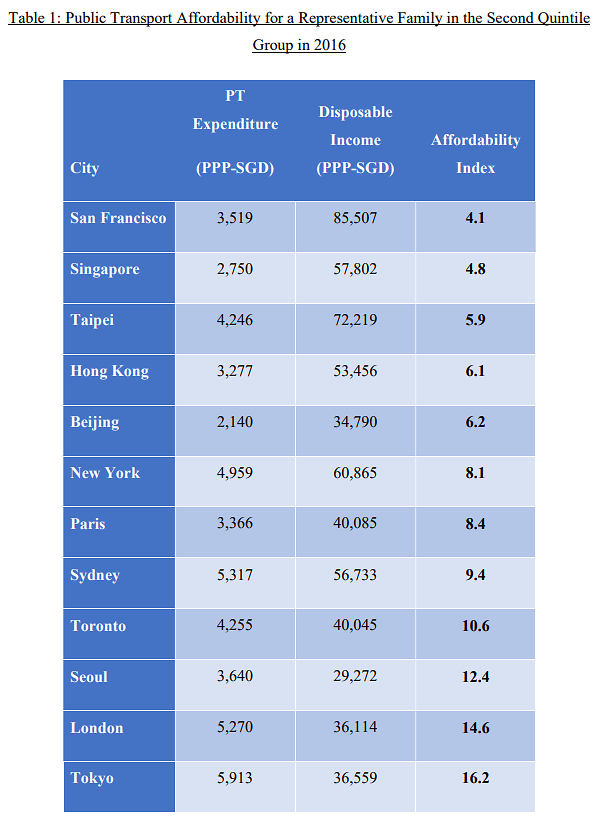
The study measured fare affordability as the proportion of disposable income spent on public transport by a household in the second quintile household income group.
This quintile was chosen because it is the group “most likely to depend on public transport regularly”, said the study.
“To allow comparability of public transport affordability across the cities, an index illustrating the costs incurred by a typical family with two working adults and two schoolgoing/school age children as a percentage of household disposable income was developed,” it said.
Based on this, Singapore came in second after San Francisco in terms of fare affordability with an index score of 4.8, compared with San Francisco’s score of 4.1.
This means that on average, a typical family that uses public transport on a daily basis in Singapore spends about 4.8 per cent of its disposable income on public transport, said the study.
It noted that in San Francisco, which topped the ranking, public transport expenditure was 28 per cent higher than Singapore and disposable income was 48 per cent higher.
(Image: Nanyang Technological University)
Singapore’s senior citizen and student concessionary fares were also among the lowest across the 12 cities compared, according to the study.
Seniors in Singapore, London and Sydney pay concessionary fares at age 60 while other cities have lower fares for seniors only at age 65 or 70.
The study also found that Singapore collected the lowest fare revenue per passenger kilometre, when compared with Hong Kong, Sydney, Toronto, New York, San Francisco and London.
In 2016, fare revenue per passenger kilometre in Singapore was S$0.11, while in Hong Kong, which ranked second, it was S$0.14.
Due to data limitations, only these seven cities with publicly available data were used for this comparison category.
ZHANJIANG: It is important for China is to engage more with external parties, and to continue to assure others that the rise of the country is peaceful, said Singapore Defence Minister Ng Eng Hen on Tuesday (23 Oct).
Noting that defence diplomacy is important, Dr Ng added: “I think China also recognises that its military has modernised so rapidly.
“China can understand why other countries may feel uncomfortable, even threatened … and we have urged them to engage more with other countries, and even partners in ASEAN and beyond.”
While at the Zhanjiang Naval Base, Dr Ng visited the Chinese destroyer Changsha and the Singapore frigate RSS Stalwart.
Minister for Defence Ng Eng Hen with crew from the Republic of Singapore Navy’s Formidable-class Frigate RSS Stalwart. (Photo: MINDEF)
He was briefed on the training exercise, and he interacted with navy personnel from China, Singapore and the participating ASEAN countries.
Referring to the inaugural drills between ASEAN and China, Dr Ng added that the way forward would be “to do more and to do larger” exercises.
Such multilateral exercises, he added, are important because it builds relationships and mutual confidence.
Minister for Defence Dr Ng Eng Hen with personnel from the People’s Liberation Army Navy on board the Type 052D Destroyer Changsha.
“It’s not a given that militaries will always cooperate, or that you can agree on everything,” he said.
“During peacetime, you should be spending a lot of your time building linkages, understanding each other … not so that you can get an advantage, but if there’s any mishap, hopefully you can call up the other person and through your personal ties and relationships that you’ve built up before, reduce miscalculations.”
The six-day ASEAN-China maritime exercise is into its second day.
Dr Ng left Zhanjiang for Beijing on Tuesday evening, where he is due to have bilateral engagements with Chinese leaders. He will also speak at the 8th Beijing Xiangshan Forum.
SINGAPORE: The Health Sciences Authority (HSA) seized about 4,500 units of illegal health products in an enforcement operation last week, it said on Tuesday (Oct 23).
The estimated street value of the products was about S$9,000. The majority of the seized medication were weight loss products, as were more than 90 per cent of the illegal sales postings detected during the enforcement week from Oct 9 to Oct 16.
Two people are assisting in investigations, HSA said in its press release.
The seized weight loss products were found to contain potent medicinal ingredients and sibutramine, a banned substance in Singapore.
Sibutramine was available in Singapore as a prescription-only weight-loss drug until 2010. It was withdrawn as users reported hallucinations, hearing of voices, palpitations and breathlessness. It also results in an increased risk of heart attacks and strokes.
“SMART DRUG” SEIZED
HSA also seized 500 modafinil tablets which were sent to Singapore from overseas sellers. Modafinil, sometimes called a “smart drug”, is a prescription medicine to treat narcolepsy or excessive sleepiness.
It has also been used as a “cognitive enhancer” by healthy people to improve their focus, reports say.
But HSA warned against self-medicating with the drug: “Modafinil carries a potential risk of dependency due to its stimulant effect on the brain.”
Modafinil. (Photo: HSA)
The agency added: “It can also cause serious adverse effects such as heart problems, hypertension and psychiatric conditions such as anxiety, hallucinations or mania.”
She developed Stevens-Johnson syndrome, a life-threatening skin condition with blistering and severe peeling of the skin. She also had multiple mouth ulcers and conjunctivitis, also known as red eyes.
Anyone convicted of supplying illegal health products can be imprisoned for up to three years and/or fined up to S$100,000.
HSA’s operation was carried out in coordination with INTERPOL as part of Operation Pangea, an international Internet week of action targeting the illegal online sale of counterfeit and unlicensed medicines.
SINGAPORE: One of five Singapore Civil Defence Force (SCDF) officers charged over a ragging incident that led to the death of a full-time national serviceman (NSF) was sentenced to 12 months and four weeks in jail on Tuesday (Oct 23).
Staff Sergeant Muhammad Nur Fatwa Mahmood, 33, pleaded guilty to causing death by a rash act and abetting the obstruction of justice.
He is the first among the five men, who were charged in July, to plead guilty and to be sentenced.
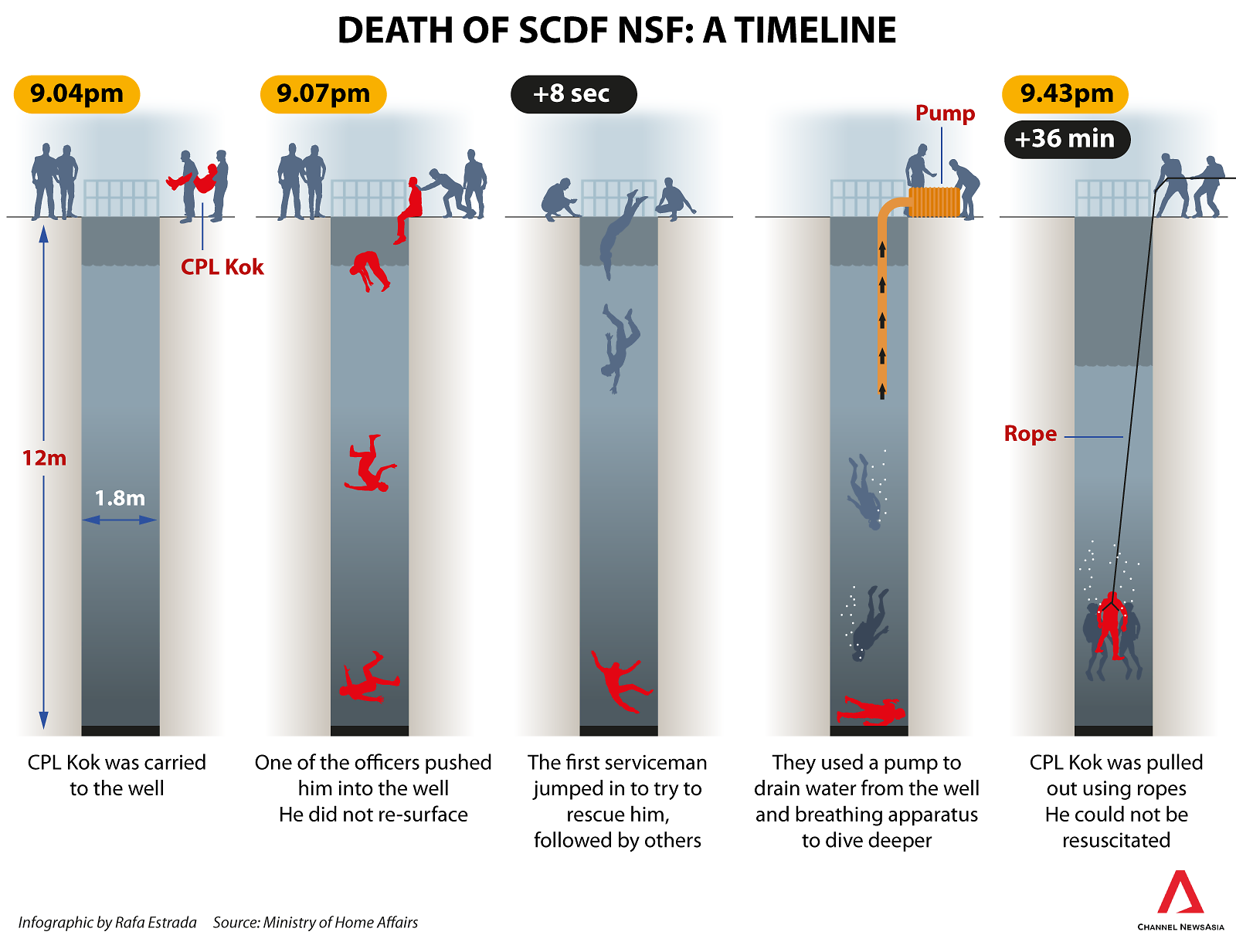
Corporal Kok Yuen Chin died in May after being found unconscious at the bottom of a 12m-deep fire station pump well which was filled with water at Tuas View Fire Station.
Left: The pump well that Corporal (CPL) Kok Yuen Chin drowned in. Right: Tuas View Fire Station. (Photos: SCDF, Mediacorp)
An inquiry found that May 13, the night CPL Kok died, started off as a celebration for his impending operationally ready date (ORD) but subsequently “went tragically wrong”.
The celebration, to mark the end of CPL Kok’s two-year training, was an initiative by his colleagues and paid for by the servicemen themselves.
CPL Kok was pushed into the well after the celebrations as part of a ragging ritual. He did not resurface and was only pulled out of the well 36 minutes later. Despite his colleagues’ attempts to save him, he could not be resuscitated.
First Warrant Officer Mohamed Farid Mohd Saleh, 34, was charged with abetting a rash act causing death.
Lieutenant Chong Chee Boon Kenneth, 37, and First Senior Warrant Officer Nazhan Mohamed Nazi, 40, were both charged with abetting a rash act causing grievous hurt by illegal omission. Nazhan is expected to claim trial.
Staff Sergeant Adighazali Suhaimi, 32, was charged with intentionally obstructing the course of justice.
SCDF has said it will decommission all 19 pump wells located at fire stations, on the recommendation of the Board of Inquiry.
The decommissioning works, which involve filling up the wells with granite chips and covering them with concrete slabs, are expected to be completed by December this year, SCDF said.
The penalties for causing death by a rash act are a maximum jail term of five years and a fine, while the punishments for causing grievous hurt by a rash act are a maximum jail term of four years and a fine of up to S$10,000.
For obstructing justice, an offender can be jailed for up to seven years and fined.
SINGAPORE: In December 2017, Singaporean Ms Shreya Bhat forked out S$55 for a wallet that separates coins from notes for her boyfriend as a Christmas present.
But 10 months later, the order for the grey KIN wallet she placed still had not arrived.
“The order was never fulfilled. I’ve yet to receive a refund as well. My boyfriend and I have both complained through various channels … but it was all in vain,” said Ms Bhat.
The wallet, which sorts out the coins into a separate compartment with a shake of the hand, was designed by three students from the National University of Singapore in 2016.
The industrial design students – Ms Lim Li Xue, Ms Cheryl Ho, and Ms Ng Ai Ling – were in their final, third and second years respectively in the industrial design course when they created the product two years ago.
One of the modules required them to launch a product on Kickstarter.
Their company, KINstudio, was responsible for producing and shipping the wallets. The innovative design was a resounding success on global crowdfunding platform Kickstarter, when the trio garnered S$280,468 – more than 70 times their S$4,000 target.
The project attracted positive news coverage both locally and internationally, but the company have struggled to deliver their orders on time.
From December 2017, KIN Studio posted updates on its Facebook page, apologising to customers for the delays due to quality and delivery issues of the shipments.
In the first update, KIN Studio urged their backers to “continue to be patient” as the team was “very small and inexperienced”, but added that it had delivered 992 wallets to its backers and 146 to its online customers.
However in March 2018, KINStudio said it received feedback on the quality of the wallets, and they had to spend a month in the factory to “re-fix the production line”.
In the company’s last update in May 2018, it said it was working to get more clarity from its manufacturer, but they have been not able to provide any concrete information, and hence, KINStudio was unable to inform backers when exactly the wallets will be delivered.
Some of the project’s backers affected are from overseas, including Thai national Sutthisak Wimolrat, who purchased the KIN wallet in March 2017 and has been waiting almost 20 months for his delivery.
Mr Wimolrat, who purchased the kepler black model for S$55 through Kickstarter, said: “I do not know how to move on from this.The KIN wallet developers have deceived us and are not responsible for what happened. We do not know what to do.”
NUS REACHES OUT TO KIN STUDIO
In response to queries from Channel NewsAsia, NUS confirmed that the product was developed by three of its undergraduates but said that two of them have since graduated.
NUS added that following the end of the module, the intellectual property in the product was licensed from NUS to KIN Studio, a private entity, to commercialise the wallet.
It added that the Division of Industrial Design at the NUS School of Design and Environment is aware of the current issues encountered by KIN Studio.
“We have been informed that there has been a delay in the delivery of the orders as KIN Studio is resolving some technical and quality issues with the manufacturer. The Division has reached out to KIN Studio to offer help on the issues,” NUS said.
Another backer from Thailand, Ms Tawan Anantachin, told Channel NewsAsia she paid for the ultramarine KIN wallet in May 2017 and have yet to receive her shipment.
Ms Anantachin added that she made several refund requests through Facebook messenger and emails, but instead received auto-reply messages on what caused the delay of the shipments.
“I wanted my S$55 back but instead the replies were about manufacturing issues, about them going abroad (to fix the problem) and the high volume of messages,” she said.
Mr Anantachin last heard from KIN Studio in July 2018 when the company eventually asked for her bank account details but has yet to receive a refund.
According to Mr Tejas Ewing, Ms Bhat’s boyfriend who was supposed to receive the KIN Wallet as a Christmas present last year, the pair are not expecting the delivery or the refund to arrive anytime soon.
“CASE (Consumers Association of Singapore) can’t really force the company to do anything, and when we made a police report, we were told to file a claim at the Small Claims Tribunal. But we weren’t going to do that, not for 50 dollars,” said Mr Ewing.
“Our best bet is to file a complain with our credit card company to cancel the order,” he added.
KICKSTARTER BACKERS MAY NOT GET THEIR MONEY BACK: CASE
CASE told Channel NewsAsia that as of Friday, Oct 19, it had not received any complaints against KIN Studio.
The consumer watchdog added that crowdfunding platforms, such as Kickstarter, are usually not involved in the development of the project and transactions occur between the backers and creators directly.
“If the project is not accomplished, the backers can try requesting for a refund from the creator. However, a refund is not guaranteed,” CASE said.
“Backers with unresolved disputes against the company may wish to contact CASE for further assistance. Alternatively, they may wish to seek legal advice against the company,” it added.
CASE also wished to remind backers of such projects to do background research on the developer’s know-how to deliver the project, and the viability of the estimated delivery timeline, before making any purchases.
“They should enquire if there is a way to contact the creator in the event of any problems. Backers should also be mindful that there is always a risk that the Kickstarter project will fail and they may not be able to get their money or product in the end,” CASE said.
Channel NewsAsia reached out to KIN Studio and the three creators of the wallet – Ms Lim, Ms Ho, and Ms Ng – last week to find out how many orders remained undelivered and what they intend to do to make good on their promises to their backers and customers.
They were also asked why there has been no update on the KIN Studio Facebook page for five months. The three creators and KIN Studio, have not responded to the queries.
SINGAPORE: The natives are restless in Singapore’s much-cherished hawker landscape, with a litany of issues plaguing what is one of the country’s most important community spaces and social institutions.
Allegations of poor management practices as well as high rentals and auxiliary costs at social enterprise-run hawker centres have hogged the headlines in recent weeks, not long after it was announced by Prime Minister Lee Hsien Loong during the National Day Rally that the Republic is eyeing a spot for its hawker culture on the UNESCO’s Representative List of the Intangible Cultural Heritage of Humanity.
In announcing the bid, Mr Lee emphasised the hawker centres’ special place in the Singaporean heart, on top of the important role which they play in keeping the cost of living low.
It was less than a decade ago, in 2011, when the authorities announced they would start building more hawker centres again, amid concerns over the rising cost of living and the lack of affordable eating-out options in some housing estates. The move came nearly 30 years after the last hawker centre was built.
A Hawker Centres Public Consultation Panel was set up in November 2011 to provide ideas on the new hawker centres.
About five months later, it submitted its final report to the Government, containing a key recommendation — among other proposals — to allow social enterprises to manage hawker centres. The proposals were by and large accepted by the Government soon after.
Defining a social enterprise as “a regular business that maximises profits to deliver social impact”, the panel suggested that the management models of the new hawker centres should ensure the community “derives maximum benefit”, give employment opportunities to lower-income and less privileged individuals, and help those who aspire to be in the food industry.
Apart from trying a new management model, the Government also rolled out training courses to encourage young people to become hawkers. Last year, the Government accepted the recommendations of a Hawker Centre 3.0 committee, which was formed to propose ways to improve hawker centres and promote the trade.
Jurong West Hawker Centre (Photo: Fann Sim)
These included starting an incubation stall programme for aspiring hawkers, and boosting hawkers’ productivity through centralised dishwashing services and cashless payment options.
The endeavour to preserve the hawker culture here and keep the trade alive, while ensuring Singaporeans have access to cheap food, is recognised by many. Yet, the growing dissatisfaction over the social enterprise hawker management model could threaten to derail these efforts.
So much so that the National Environment Agency (NEA) has been tasked to conduct a stock-take of the model, as Senior Minister of State for the Environment and Water Resources Amy Khor warned on Friday (Oct 19) that errant operators will be taken to task.
Just three years after the social enterprise model was rolled out to new hawker centres in Singapore, it has failed to live up to its promise. The questions on everyone’s minds are: Where has it all gone wrong? Are there underlying issues that need to be addressed? What is the best way forward?
In the last few years, concerns over the social enterprise model being applied to hawker centres have been aired from time to time by some Members of Parliament.
Before the Government announced that it had accepted the recommendations by the Hawker Centres Public Consultation Panel, then-Non-Constituency Member of Parliament Yee Jenn Jong expressed concerns that letting “market forces take over the provision of social goods” could lead to rising prices for consumers.
In his reply, then-Minister for Environment and Water Resources Vivian Balakrishnan cited the example of NTUC Fairprice, which is the “most successful cooperative” in the Singapore context.
To date, there are currently 13 hawker centres and markets which are managed by NEA-appointed social enterprises including NTUC Foodfare’s Kampung. (Photo: Fann Sim)
Noting that Fairprice has “fulfilled a social mission of ensuring commodities and essential food are priced reasonably and provides competition”, Dr Balakrishnan said:
What I am hoping to do by changing this hawker centre policy is, number one, increase the supply of places. That should have some effect on prices, both in terms of rental as well as the prices charged by hawkers. But having said that, I do not believe that simply lowering rentals by itself will necessarily lead to lower prices charged by hawkers.
He assured that the Government would “certainly be watching it very, very closely”. It would also keep an eye on “the evolution of these new generation hawker centres”, to ensure it does not deviate from the “original objective”.
In 2015, the authorities announced that another 10 hawker centres would be built over the next 12 years to moderate food prices. They will be located in new estates or existing ones that are relatively underserved, such as Bidadari, Sengkang and Bukit Batok.
Later that year, concerns over the social enterprise model received another airing, when then-Nominated Member of Parliament (NMP) Kuik Shiao-Yin asked how NEA would ensure that social enterprise hawker centre operators “do not take advantage of their position to profiteer unfairly”.
In response, Dr Balakrishnan said that operators are “required to submit audited accounts and detailed management reports”. NEA “will ensure that the interests of hawkers, cleaners, hawker assistants and patrons are well taken care of”, he said.
Some, including Mr Jack Sim, founder of global non-profit World Toilet Organisation, believe that the issues bogging down the industry can be traced all the way to the start.
Mr Sim pointed out that the Hawker Centres Public Consultation Panel did not include many experts on hawker centres or food, nor were there enough hawkers involved. He said:
In human-centred design, we need to involve all stakeholders, and what was done was a very top-down approach. It was not democratically done.
In its report released in February 2012, the Hawker Centres Public Consultation Panel said it held seven formal meetings among its 18 members to deliberate on their recommendations on topics such as design and infrastructure, vibrancy, and management models. It also “met hawkers from different generations and members of the public and visited a number of hawker centres”.
A busy hawker centre in Bukit Panjang. (Photo: Ernest Chua/TODAY)
The panel was chaired by 77th Street founder Elim Chew, and its members included architects and top representatives from NTUC Foodfare and Koufu (which were food court operators at that time). There was one representative from the Hawkers’ Association.
The panel proposed having social enterprises manage hawker centres on a not-for-profit basis, to ensure that the management model would be sustainable in providing affordable food. Before then, all hawker centres were managed by NEA.
Under the not-for-profit model, any operating surplus generated by a hawker centre must be shared among its stakeholders, such as the stallholders, the manager and NEA. It must also be used to create “social benefits”, and it cannot go to the manager’s shareholders.
Like the panel, the 14-member Hawker Centre 3.0 Committee also comprised mainly people who do not have direct experience with hawker centres. Chaired by Dr Khor, the committee included members such as then-National Heritage Board CEO Rosa Daniel, food blogger and general practitioner Leslie Tay, and Ms Kee Ai Nah, who was then SPRING Singapore’s group director of industry and enterprise.
Several academics and educators from the National University of Singapore, Republic Polytechnic and Singapore Polytechnic were also involved. Dr William Wan, general secretary of the Singapore Kindness Movement, was on both the committee and the Hawker Centres Public Consultation Panel.
Going forward, Mr Sim suggested a public forum involving all stakeholders in order to resolve the issues.
“We need to work with the intention to find better answers for the hawkers, and not to be stuck to rules and prescriptive models,” said Mr Sim, who believes that the management of all hawker centres should be returned to NEA.
The first hawker centre to be privately owned by a social enterprise, Kampung@Simpang Bedok, closed in 2013 after a year due to poor business and lack of financial support.
Currently, 13 out of 114 hawker centres across the island are managed by five social enterprises: Fei Siong Food Management, NTUC Foodfare, Timbre Group, Hawker Management and OTHM.
Timbre+ at one-north. (Photo: Facebook/Timbre+)
Hawker Management and OTHM are subsidiaries of Koufu and Kopitiam, respectively.
Of the 13 centres, NTUC Foodfare took over the management of five existing ones — including Old Airport Road Food Centre — from the NEA in 2016.
SQUARE PEGS FOR ROUND HOLES
Given that some of the social enterprises or their parent companies were previously involved in running food courts or other types of eateries, it is no wonder that some of the practices have been imported — and it has not gone unnoticed that what may have worked at these places, are failing at hawker centres which are not only larger in scale but also have a greater variety of stalls manned by people from all walks of life.
In other words, the standardisation and centralisation put in place by each operator to enable them to run food courts or other eateries more efficiently may not necessarily work at hawker centres.
“Some new hawker centres are being run like food courts. That’s why hawkers are unhappy… the rental costs are rising … hawkers can’t take back their deposits if they want to leave earlier,” said hawker Douglas Ng, 27.
Mr Ng runs Fishball Story, which made it into the Singapore Michelin Bib Gourmand Guide in 2016. He first began selling handmade fishball and fishcake dishes at Golden Mile Food Centre, and now has stalls at Timbre+ in one-north — managed by Timbre Group — and the Hungry Bee coffee shop in Geylang.
Since taking up stalls in hawker centres run by social enterprises, many hawkers complain that they have had to grapple with several issues that they did not face in NEA-run hawker centres.
These include having to apply for leave in advance if they choose not to open their stalls, not having the freedom to adjust food prices, and having to pay “penalty” fees for terminating their tenancy.
Other common complaints include high rentals and auxiliary costs that the hawkers have to bear despite low footfall at these centres.
Hawkers at Jurong West Hawker Centre, run by Hawker Management, had petitioned the NEA for the operator to remove the 20-cent fee that they have to pay for every tray that a customer uses.
The tray return system at Jurong West Hawker Centre.
A day earlier, prominent food critic K F Seetoh, who had previously written about the tray-return scheme at Jurong West on his Makansutra website, posted a copy of a contract from a hawker at the Hawker Centre@Our Tampines Hub on his Facebook page.
The contract contains clauses dictating how much vegetables and calories a particular dish should have, and a S$250 fine for every day a stallholder closes if he or she does not give a week’s notice which is approved by the managing agent.
Over at Pasir Ris Central Hawker Centre, run by NTUC Foodfare, hawkers interviewed said teething problems continued to plague them some 10 months after its opening in January, resulting in more than 10 tenants moving out.
For example, Mr Khaharudin Juraimi, 36, who runs halal burger stall Burgernomics with his business partner, said that some stalls, including his, have leaking exhaust hoods. The problem has yet to be fixed even though they have raised the issue with the management several times, he added.
At Old Airport Road Food Centre, several hawkers who did not wish to be named said that while everything has remained largely the same after the centre was taken over by NTUC Foodfare, their crockery collection fees have risen 40 per cent to S$580 a month.
Mr Daniel Goh, 42, who runs craft beer stall Smith Street Taps at Chinatown Complex Food Centre, said that some aspiring F&B entrepreneurs who he had spoken to were keen to cut their teeth at a hawker centre — until they discovered that they would earn more as a line cook at a hotel, a job that typically brings in about S$2,000 a month.
Pasir Ris Central Hawker Centre (Photo: NTUC Foodfare)
Long-time hawker Kelvin Ang, 52, said he would not want to work in a social enterprise hawker centre.
“There are rumours among hawkers that sooner or later, all of us will be under this type of social enterprise management. We are all worried,” added Mr Ang, who has sold braised duck dishes at Block 724 Ang Mo Kio Food Centre for more than three decades.
He pointed out that his hawkers’ association engages contractors to wash dishes for them, and hawkers themselves negotiate prices with the contractors.
Mr Ang pays about S$1,000 for table-cleaning and dishwashing fees — on top of rental fees — at his NEA-managed hawker centre. However, for hawkers at centres run by social enterprises, such as Mr Khaharudin, they can pay twice as much in additional fees, on top of higher rental fees.
“The NEA, they believe in a free market … they won’t control prices. Everyone follows the same set of rules. But every social enterprise runs their centres differently; it causes confusion,” Mr Ang said.
While social enterprises and the NEA had previously said that all costs and requirements are made known to stallholders before they sign their tenancy agreements, CIMB Private Banking economist Song Seng Wun reiterated that some hawkers may not fully understand their contracts before signing them.
MAKING MONEY VS SOCIAL OBJECTIVES
Much of the recent debate has revolved around the perception that the social enterprises are making profits by charging their tenants high fees.
Some have also questioned the logic of introducing an additional layer of costs to the running of hawker centres by bringing social enterprises into the picture.
The social enterprise model has “turned a public good into a private good” and “added another layer of management to the already price-sensitive market”, said Mr Sim.
Jurong West Hawker Centre is run by social enterprise Hawker Management.
As a result, the hawkers are squeezed in the middle, given that they must keep their prices low.
While the social enterprises running the hawker centres are meant to be not-for-profit, economists interviewed said that they are not legally bound to operate on such a basis.
This is unlike charities, which are regulated under the Charities Act and will lose their registration if they are run for private gains.
Mr Donald Low, former associate dean of the Lee Kuan Yew School of Public Policy, noted that it “is just a label as far as the law is concerned”.
“They are registered as companies limited by guarantee, according to the taxman,” he said.
NMP Walter Theseira felt that it does not make sense “to think of social enterprises as different from privatised for-profit coffee shops, unless the social enterprise can prove otherwise”.
“Some may be run at arm’s length from their profit-making enterprises, and they may have strong controls to prevent self-enrichment. Others may not,” added Dr Theseira, a labour economist from the Singapore University of Social Sciences.
“The problem is there may be private and marketing benefits from claiming to be a social enterprise, and as such, you really have to look deeper to see what is the actual case.”
Mr Song questioned the need to “proclaim that you are a social enterprise”. He said:
We don’t need to call it anything. Consumers are just there to ‘makan’.
Smith Street Taps’ Mr Goh pointed out that some of the social enterprises currently running hawker centres were set up by for-profit corporations.
“So to expect them to run a ‘social enterprise’ business is conflicting, to say the least. Exactly which aspect of social enterprise hawker centre is social, aside from forcing hawkers to offer a cheap option for diners?” he said.
The five social enterprise operators were contacted for comments on the differences between operating a hawker centre and running other forms of F&B outlets, such as restaurants, coffee shops, food courts, as well as the lessons they have learnt from operating a hawker centre. Only Timbre Group, which runs Timbre+ and Yishun Park Hawker Centre, responded to the queries.
Yishun Park Hawker Centre opened on Wednesday, Sep 20, 2017. (Photo: Lennard Lim)
Its managing director Edward Chia reiterated that it holds frequent dialogues with tenants to get feedback on operational matters and ideas, and has launched several promotions to increase footfall during lunchtime and off-peak hours.
Mr Chia noted that running a hawker centre is different from running Timbre restaurants and bars, as the former involves managing tenants.
“Our team running Yishun Park Hawker Centre and Timbre+ will have to look for suitable tenants, work with tenants on operational matters and also provide marketing and communication support,” he added.
‘STOP CAPPING FOOD PRICES, HELP NEEDY CUSTOMERS DIRECTLY’
While experts and industry observers said there is no silver bullet that will solve the hawkers’ problems, they felt that the Government needs to intervene in a different way to keep food prices affordable.
Mr Song said that help must be specifically targeted at lower-income groups, rather than suppressing the cost of food in hawker centres. This could come in the form of food stamps, vouchers or rebates. He added:
It requires taxpayers’ intervention … assistance to (lower-income groups) can also be calibrated to reflect the underlying cost of living. Singapore is small enough for this scheme to work.
Mr Song also questioned the need for social enterprise hawker centres to serve some regular-portion meals priced at a maximum of S$2.80. If there is to be a cap on prices, he suggested having a mechanism in place to adjust it regularly while keeping it affordable.
Dr Theseira agreed that the issue of food affordability should be addressed through more financial assistance.
It is “very difficult” for hawker centres — and social enterprises — to both provide meaningful employment or enterprise opportunities, while also providing cheap food to lower-income Singaporeans, he added.
“This has to be done at least on a break-even basis. But this simply is very hard to achieve in a landscape where you have competition both from government-run hawker centres where there are implicit discounts (generally from older hawkers who pay subsidised rentals), and privatised food courts which really don’t have to worry about the social objectives, and so can pick and choose where and how they operate,” Dr Theseira said.
Char siew – also known as barbequed pork – being sold at a hawker stall in Singapore.
Hawker centres run by NEA could fulfil both goals, he explained, given that the Government is “not under the same pressure to generate financial returns, and be self-sustainable, as private enterprises are”.
Mr Low noted that the hawker industry generally sees less productivity growth compared to other industries. This means innovative processes, such as automation and machinery, will not do much to reduce the cost of hawker food.
“We shouldn’t be asking hawkers to keep costs down. We should ensure that incomes rise for everyone at a rate as fast as costs increase, so that everyone can afford the rising prices of food,” he added.
Dr Theseira said that there is no need to keep hawker food prices low for Singaporeans who can afford it, if it results in placing undue pressure on low-income hawkers.
“Nobody says we should keep espresso prices low, after all. So why should someone who wants to become a hawker face this societal pressure to keep prices low, when the alternative is being a café owner and selling expensive espresso?” he said.
This means consumers should be willing to fork out more for hawker food, said the experts.
“Wages do grow, so we must get around the fact that costs to us are wages to hawkers,” said Mr Song.
“A cup of kopi costs S$1.20, versus S$5 for an Americano from a café, yet you’ve got people who have both choices. Why is it not okay for the hawker to raise his kopi price to reflect a rise in water prices?”
Fishball Story’s Mr Ng said that Singaporeans should not continue to think that hawker food must be kept at traditionally low prices. When prices increase, hawkers can enjoy better margins and be more motivated to sustain their career “if they see good returns for their hard work”.
We can start by paying a little more. If you want cheap food, I’ll give you budget-quality food. If you want good, proper food, expect to pay more.
With the Government putting the pressure on hawkers to keep their food prices down, “there is no way hawkers can survive in the long run”, he added.
SINGAPORE: My personal journey towards early retirement started in my mid-twenties when I studied for my Masters in Applied Finance at the National University of Singapore.
At that time, I was working in the IT sector.
And I have never held a job that gave me a salary that exceeded S$10,000 a month.
But at 39, the dividends from my investment portfolio began to exceed my take home pay and I was able to not just retire from the corporate workforce altogether, but was also able to pay my way through a three-year Doctor of Jurisprudence program in Singapore Management University using my dividend payouts.
I have since completed my legal practice training and have been called to the Bar in August 2018.
And it’s has been four years since I have held a job that paid a regular income.
LIVING LONGER LIVES
According to the Institute of Health Metrics and Evaluation (IHME), in the year 2040, Singaporeans would have an average life expectancy of 85.4 years.
Some are concerned about needing to work longer to ensure they can have a comfortable retirement in old age.
While longevity may require you to have more money to support yourself in old age, it doesn’t mean your means must come from an ever-shrinking pot of savings.
With careful planning, a retiree in Singapore can sustain himself through investment income that come from investing in securities on the Singapore Stock Exchange.
According to the Department of Statistics’ Household Expenditure Survey data last released in 2013, the average retiree household spends S$1,700 per month. Let’s say this amounts to S$2,000 in 2018.
A man carrying an infant in Singapore. (Photo: Gaya Chandramohan)
If we adopt a withdrawal rate of 4 per cent, the proportion of your investments you can withdraw each year without running out of money before reaching the end of your life used by the financial planning industry, a portfolio in Singapore equities worth S$600,000 would be sufficient to sustain this this level of expenditure until the end of one’s life.
Furthermore, CPF Life can provide additional income that act as a cushion to deal with shortfalls that may arise during your retirement.
Constructing such a retirement portfolio that can sustain your lifestyle after you requires the application of three skills in tandem with each other.
The most important skill is to figure out how to earn more money. This means ensuring that you can earn the most money in the given time that you have in the corporate world.
Corporate loyalty is a thing of the past. Staying in a job role for too long can lead to stagnant salaries.
According to local news reports, job hopping strategically once every three to four years can provide the occasional 10 to 20 per cent income boost. This is superior to the 3 to 6 per cent increment that employers were reported to have said they intend to give workers in 2018 earlier in February.
There is also the option to participate in the gig economy on weekends, providing tuition to students, or freelancing on a project, to boost your income further, if permitted by your current employment contract.
A person using the Grab mobile app. (Photo: Grab’s website)
2. SAVING MORE MONEY
But it is pointless earning more money if you have no means of saving it.
When I began my journey towards early retirement, I stopped eating at restaurants and even became vegetarian for at least one meal a day to squeeze out more savings every month.
At the broadest level, you should maintain a budget and track your regular expenses. However, the most effective means of saving money is to make big life decisions that avoid major expenses in the first place.
One such life decision involves buying a more affordable HDB flat to keep mortgage expenses low. The other decision is to forego the use of a car or taking a cab everywhere, and stick with taking public transport. These decisions can easily save thousands of dollars that can be invested later.
In my Early Retirement masterclass, I would get my students to track their expenses. During the last run, we realised that most of them spent too much on insurance premiums when I benchmarked them against the rest of the Singapore population.
Can it be that our financially responsible citizens are locking up too much money too soon in such schemes?
It is worth noting that these same people tend to spend too much money on their home mortgages and it might be worth reviewing your home loan to see if refinancing might shave off more unnecessary costs.
HDB flats in Singapore.
3. INVESTING MORE EFFECTIVELY
But saving can also only take you so far. Singaporeans have suffered low returns for far too long.
Local news reports in September revealed that the CPF Investment Scheme unit trusts and investment-linked policies returned 15.8 per cent during the three-year period ending June 2018. During this same period, stocks on the MSCI All-Country Asia Ex-Japan, an index that tracks the investment returns on Asian equities except for Japan, rose 25.2 per cent.
You can have a healthier retirement if you are willing to be more proactive and hands-on when investing your personal funds. This means taking some pain to educate yourself until you are comfortable investing directly in the stock market.
Before I started on my formal training in finance, I spent most of my money investing in unit trusts which can impose expenses of up to 3 per cent each year. International equities returned 9 per cent since 1982, which means I could only expect returns of around 6 per cent after paying off the active fund manager and various miscellaneous expenses incurred by the fund.
Relying on exchange-traded funds (ETFs) such as the Straits Times Index (STI) ETF does not get any better for retail investors. If you have invested in this ETF for the past 10 years, you would have achieved an annualised return of 6.4 per cent. S$100,000 invested in the STI ETF 10 years ago would now be worth S$185,430.
By simply switching to the strategy of buying each STI component in equal weights, you can increase your annualised returns to 7.6 per cent per annum. S$100,000 invested in an equal weighted portfolio 10 years ago would now be worth S$207,440.
People work in an office at the Singapore Exchange (SGX) on July 27, 2016. (File photo: AFP/Roslan Rahman)
The annualised returns are different because the STI is a capitalisation-weighted index and you are in essence putting a larger proportion of your money into the larger companies in the STI such as our local banks.
But buying more of a stock as market capitalisation increases goes against the idea that one should buy more of stock at lower rather than higher prices.
Performance can be improved if you select stocks based on simple value investing measures. If you choose to buy 15 of the highest yielding dividend stocks of the STI based on its last annual report, you would have achieved a return of 12.9 per cent if you had done so in the past 10 years. S$100,000 invested using this strategy 10 years ago would become S$367,600 today.
You can find a table that lists the dividend yield corresponding to each STI stock component in local business publications. Simply choose 15 of the stocks that give out the highest dividend yields, buy them in equal proportions, hold them for a year and repeat this exercise after one year.
EXAMINE REITS
Perhaps there will never be a better instrument for retirees than investing in Singapore Real Estate Investment Trusts or S-REITs. An equal weighted portfolio of REITs can provide dividends of 6 to 7 per cent in current market conditions.
In other words, a retiree with a S$100,000 portfolio of REITs can expect a passive income of S$6,000 to S$7,000 every year. Combine this with some income from CPF Life, this is may be just enough to sustain a retiree household at S$2,000 per month.
For now, the income from REITs do not attract corporate or personal income taxes. If you had invested in every REIT in SGX for the past 10 years, you would have achieved a return of 11.3 per cent. This return even comes with a lower volatility compared to the STI index, allowing many retirees to sleep well at night.
LONGEVITY MATTERS LESS WITH CAREFUL RETIREMENT PLANNING
Enjoying an effective early retirement is not a pipe dream.
A Singaporean has to apply three skills simultaneously – to find creative ways to increase his earned income so that it can set aside for investment purposes and deftly managing one’s career and personal expenses while being on the constant lookout for superior investment ideas.
The successful application of these skills would make longevity a non-issue when it comes to retirement planning.
Christopher Ng Wai Chung runs a financial blog at and conducts an Early Retirement Masterclass.
SINGAPORE: Social mobility is more important than inequality, and Singapore must not allow social stratification to harden, Prime Minister Lee Hsien Loong has said at a community dialogue session.
Mr Lee made these remarks at a post-National Day Rally dialogue at Ci Yuan Community Club on Oct 14, which were later made available to the media.
In his opening remarks, Mr Lee stressed the importance of not leaving behind lower-income Singaporeans.
“The way you dress, the way you talk, what you eat, and where you go on holiday. You compare notes then you feel, I show you a little bit (that) I am better than you. I think we have to combat that,” he added.
He was speaking to about 530 grassroots leaders on their concerns with issues raised in the National Day Rally speech, including the Merdeka Generation Package and housing.
PM Lee Hsien Loong and moderator Darryl David, MP for Ang Mo Kio GRC, during a post-National Day Rally dialogue. (Photo: MCI)
Mr Lee added that Singapore must ensure that when it progresses, those of lower income are not disadvantaged and do not get left behind.
“We have a meritocratic system, but we have to strive to bring everyone to a good starting point, to give everyone a fair chance to do well and to compete, whether you come from rich or poor families, whether your parents have connections or not,” he said.
Mr Lee then highlighted that this was the reason the Government ensures that all children are afforded a good preschool education to level the playing field “as much as possible” and that different types of Housing and Development Board (HDB) flats are mixed within the same town so that Singaporeans of different household incomes live and interact with one another.
“These are government policies which are important to safeguard social mobility and cohesion. But just as important as government policies are social attitudes,” said Mr Lee.
“In other words, the attitudes of each one of us individually, as Singaporeans, towards one another. We want to, and I think we generally do, live in a society where the ethos is open and informal. We want people to interact freely and comfortably as equals and we must have regard and respect for one another, regardless of income or status,” he added.
Mr Lee said people from lower-income families should not feel that they are being discriminated against, while those who are successful and happen to have been born wealthy should not flaunt their wealth either.
“No need to show off, and people are not impressed. If you succeed, remember, it is not purely the result of your own hard work or even of your own talent. Because many others have helped you along the way,” he said.
PM Lee Hsien Loong meets grassroots leaders after a post-National Day Rally dialogue on Oct 14, 2018. (Photo: MCI)
Mr Lee also highlighted inequality and the lack of social mobility as threats to the Government’s goal of improving the lives of everybody in Singapore.
He lauded Channel NewsAsia’s documentary Regardless of Class, which was presented by Dr Janil Puthucheary, Senior Minister of State of Communications and Information as well as Transport, as a programme that “gives a vivid sense of the different levels of Singapore society today, and how people view one another across the different social groups”.
“Inequality exists everywhere. In every society, there is a certain amount of inequality and there is no society where the top and the bottom are the same,” he said.
But Mr Lee said the Singapore Government has worked hard to lessen this inequality and “raise the base level up” to make sure that Singapore becomes a fair and just society.
He elaborated that this was done through “high quality and affordable housing, education and healthcare for everybody” as well as a progressive tax system.
PM Lee Hsien Loong meets grassroots leaders after a post-National Day Rally dialogue on Oct 14, 2018. (Photo: MCI)
In his opening remarks, Mr Lee also highlighted the Government’s efforts in tackling issues that have concerned Singaporeans such as public transport reliability, affordability of public housing, availability of healthcare as well as preschool education.
He added that the Government was tackling other cost-of-living issues such as by handing out U-Save vouchers to keep utility tariffs affordable.
“Then, we are looking at how to pay for these things … and how to keep our programmes financially sustainable. We are planning ahead to make sure we have enough revenues, especially with the GST increase sometime beyond 2021,” said Mr Lee.