Home Blog Page 918

‘A rebirth’: Uber-owned Lion City Rentals out to attract casual hirers, says new GM

0

SINGAPORE: Uber-owned vehicle leasing operator Lion City Rentals (LCR) is known for providing car rentals to full-time drivers who work for ride-hailing platforms in Singapore.

But the company now is looking to expand its scope of business to attract casual hirers, said its general manager Pascal Ly on Thursday (Oct 25).

Speaking at a media briefing, Mr Ly explained that the company is looking to attract friends or couples who wish to rent vehicles for getaways, or people seeking transport to move bulky items.

To achieve this, Ly said, LCR is set to offer incentives such as a new loyalty scheme, shorter rental periods of as short as one week and competitive charges such as renting out a Mazda 3 car for S$390 a week.

“We are not just for professional drivers, we are also for casual drivers now,” said Mr Ly, who joined LCR two months ago. 

“Our vision is to be the preferred rental car company in Singapore.”

The company said that casual hirers can use their services within two to three months.

LCR, which was founded in 2015, previously provided rental services for Uber drivers in Singapore. But after Grab took over Uber’s regional business in March, LCR now supplies cars to Grab drivers.

But in September, the Competition and Consumer Commission of Singapore (CCCS) fined Uber and Grab for contravening competition laws for their merger deal and also imposed a number of measures, including the need for Uber to sell vehicles from Lion City Rentals to any potential competitor with a “reasonable offer”.  

According to reports, Indonesian company Go-Jek is widely expected to enter the Singapore ride-hailing market imminently.  

In response to a question on how LCR would welcome this move, Mr Ly said Go-Jek’s arrival would mean “a market uplift” for car rental companies, especially LCR.

Lion City Rental

Lion City Rental’s office in Paya Lebar. (Photo: Facebook/Lion City Rentals) 

“People will be looking for cars and we want to be sure that people will be thinking about Lion City Rentals to rent their cars,” he said. 

“They (may choose to) drive with whichever ride-hailing platforms; that’s not up to us to influence. But, get a car from us and you can drive with Go-Jek or whoever else that will be coming into the market.”

Mr Ly added that LCR is an attractive proposition for drivers who wish to drive with Go-Jek because it has experience in serving ride-hailing app drivers, and understands the “hurdles and pain” professional drivers go through.

“We used to do it for Uber, and then for Grab and now we’re doing it for anybody who’s interested. So you can trust us that we know what we’re doing as a business,” he said.  

He also stressed that LCR has no plans to sign deals with ride-hailing platforms currently and that any potential buyout will be subjected to approval from Uber.

The Straits Times reported in September that LCR was about to close down and that it was selling off its fleet to companies like ComfortDelGro and Grab.

While Mr Ly acknowledged that LCR’s fleet of vehicles has decreased recently, he maintains that this recent move by the company to refresh its business was not a “last resort or desperate measure”.

He said: “We are not in a desperate situation, we are not sad or anything … This is a refresh, a rebirth saying here we are, we are LCR (and) we know where we are going.”
Source link

SP Group to double electric vehicle charging points to 1,000 by 2020

0

SINGAPORE: SP Group announced on Thursday (Oct 25) that it will build 1,000 electric vehicle charging points by 2020, double the initial target it made in June.

In addition, one-quarter of the 1,000 charging points will be extra high-powered, to support upcoming electric vehicle models with bigger battery capacities and longer driving ranges. These chargers will have power ratings of as high as 50kW, said SP in a news release.

The company previously said that it will build 50kW DC chargers which can fully charge a car in 30 minutes.

The charging points will be located at shopping malls, residential areas, business parks and industrial sites, as well as close to coffee shops and food outlets, said SP. 

It added that it plans to extend such charging services to a wider range of vehicles in future, including larger commercial vehicles such as buses and other heavy-duty vehicles.

READ: Electric buses to serve Singapore commuters from 2020

For now, major users of SP’s electric vehicle charging network include drivers from Grab and HDT Singapore Taxi. 

The energy and utilities company on Thursday also announced a partnership in which it will support HDT with all its vehicle charging needs for the next 10 years. 

HDT, Singapore’s largest electric taxi operator, plans to grow its fleet to 800 electric taxis by 2022, and it may be including newer electric vehicle models in their fleet.

Singapore Power signs agreement with HDT Singapore Taxi

Mr James Ng, managing director of HDT Singapore Taxi, with Mr Goh Chee Kiong, SP Group’s head for strategic development. (Photo: SP Group)

​​​​​​​

READ: HDT to become Singapore’s 7th taxi operator

“By developing Singapore’s largest and fastest electric vehicle charging network, it will enable greater adoption of electric vehicles, helping our customers to go green, while saving energy and cost,” said Mr Wong Kim Yin, group chief executive officer of SP Group.

“The significant reduction in carbon emissions will also support Singapore’s Climate Action Plan,” he added.

Source link

66 arrested in crackdown against organised criminal group

0

SINGAPORE: The police arrested 61 men and five women in a crackdown against a suspected organised criminal group on Wednesday (Oct 24).

The suspects – aged between 17 and 63 – were nabbed for their suspected involvement in gang-related activities, operating of illegal gambling dens, and other criminal activities, the police said in a press release.

Officers raided 10 locations across the island during their operation, during which S$428,720 in cash, jewellery, watches, mobile phones and gambling paraphernalia were seized.

The bank accounts of those arrested have also been frozen to prevent the dissipation of suspected criminal proceeds, the police said.

66 arrested for organised crime (2)

Cash amounting to S$428,720, jewellery , watches, mobile phones and gambling paraphernalia were also seized during the operation. (Photo: Singapore Police Force)

“OCGs (organised crime groups) are involved in serious criminal activities and can pose a threat to Singapore’s safety and security,” said Criminal Investigation Department director Florence Chua.

She also said that the operation was part of the police’s ongoing efforts to disrupt and dismantle organised crime groups.

“The police will remain resolute in our enforcement efforts against such groups, so as to keep Singapore safe and secure,” she said.

66 arrested for organised crime (3)

Cash amounting to S$428,720, jewellery , watches, mobile phones and gambling paraphernalia were also seized during the operation. (Photo: Singapore Police Force)

​​​​​​​

The operation included officers from the Criminal Investigation Department, Police Intelligence Department, Special Operations Command, Bedok Police Division, Clementi Police Division and Tanglin Police Division.

The raid locations included Geylang, Sengkang, Bedok and Ang Mo Kio.

The suspects are being investigated for offences under the Organised Crime Act 2015, Common Gaming Houses Act and Societies Act.

Under the Organised Crime Act 2015, any person who is convicted of being or acting as a member of a locally linked organised crime group may be fined up to S$100,000, jailed a maximum of five years, or both.

Source link

Singapore economy faces challenges, but significant opportunities also present: Chan Chun Sing

0

SINGAPORE: Even as Singapore faces challenges that are both external and internal, Trade and Industry Minister Chan Chun Sing said there are also significant opportunities and strategies that have been mapped out to ensure the country’s future success.

Mr Chan was speaking at the annual Singapore Economic Policy Forum organised by the Economic Society of Singapore and Nanyang Technological University on Thursday (Oct 25).

In his keynote speech, he started out by outlining five challenges that Singapore has to deal with “squarely”.

These include simmering nativist politics and protectionist economics that are threatening to fragment the global trading system.

READ: Commentary: Trump tariffs have barely perceptible impact on the world

Citing the tit-for-tat tariffs between the United States and China, Mr Chan said trade disruptions between the world’s two biggest economies will likely impact Singapore given how US-China bilateral trade contributes indirectly to 1.1 per cent of the country’s gross domestic product (GDP).

Singapore’s open economy could be further affected if an escalation in the trade conflict triggers a sharp and sustained plunge in business and consumer confidence.

READ:With the world ‘moving a little closer’ to a trade war, what’s the impact on Singapore?

Chan Chun Sing at Singapore Economic Policy Forum

Trade and Industry Minister Chan Chun Sing speaking at the annual Singapore Economic Policy Forum on Thursday (Oct 25). 

Shifts in global production and value chains, as well as the rise of the new digital economy, also count as the external challenges that Singapore faces, according to Mr Chan.

The latter, which bolstered the rise of sharing economy and catapulted the likes of Uber to key players in their respective industries, will mean that new rules will be needed to keep up with the pace of change, while also ensuring growth support for the sectors and consumer protection.

On the domestic front, the economy continues to contend with differing growth trajectories across sectors, as well as constraints in labour and land.

For the limitations in labour and land, Mr Chan said there is a need for these “factors of production to be recycled more efficiently”.

READ: Higher unemployment rate, more retrenchments in Q2: MOM

These will involve ensuring that labour is channelled to more productive activities by being equipped with the right skills. Similarly, Singapore needs to be more innovative in its usage of land – a finite and scarce resource – by going high-rise, underground or having shared facilities.

But even as challenges abound, Mr Chan said there remain five significant opportunities for Singapore.

They are the potential of a rising Asia amid increasing urbanisation and fast growth, as well as the emergence of new technologies, such as robotics and artificial intelligence, which means that geography and size are becoming less important in determining Singapore’s economic potential.

On top of existing physical connectivity through airport and port infrastructure, the country also needs to continue investing in its connectivity to the world, particularly in non-physical domains including finance and data, he added.

Singapore’s “hard-earned” competitive advantages in trust and standards on goods and service quality, as well as having a stable and pro-business economic environment will also stand Singapore in good stead.,

CRITICAL STRATEGIES FOR SUCCESS

To that end, Mr Chan said there are eight strategies underway to ensure Singapore’s future success.

They include the building of physical and relational connectivity with the world; supporting international trade rules; embracing Industry 4.0 solutions to transform manufacturing; growing a global talent network; fostering innovation by investing in research and development (R&D); capability building in both big and small local enterprises; having agile regulations and lastly, helping the local workforce to learn continuously.

READ: Why did Dyson pick Singapore to build its electric car?

On connectivity, Mr Chan cited British technology company Dyson’s decision to build its electric cars here as a reflection of Singapore’s strong connectivity.

“Dyson will require a global supply chain. While our land costs may not be the cheapest, while our labour costs may not be the cheapest, our superior connectivity will allow them opportunities to create a new industry in Singapore.”

For rules, Mr Chan said Singapore, together with like-minded partners, is helping to update World Trade Organisation’s (WTO) rules to keep up with the new economy – echoing a point made by Prime Minister Lee Hsien Loong in a speech last week during the Asia-Europe Meeting Summit in Brussels. 

The country also continues to pursue regional and bilateral free trade agreements, he added. The newly signed trade pact between Singapore and European Union, for one, will help local companies to access European markets more easily. 

The minister said Singapore’s economy has done reasonably well thus far despite the challenges, given how GDP growth expanded by 3.8 per cent year-on-year in the first three quarters of the year. 

Official forecast is for full-year growth to fall within the range of 2.5 to 3.5 per cent.

“This is not easy because we are facing quite many challenges on the horizon and there are downside risks in the global economy due to ongoing trade conflicts and the slowing pace of expansion of regional economies, such as China,” he said.

“We need to understand the challenges, the opportunities and go forward together.”

Source link

Eight win President’s Volunteerism and Philanthropy Awards

0

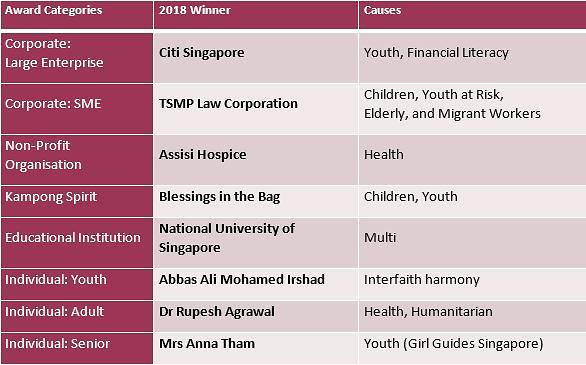
SINGAPORE: Eight recipients on Wednesday (Oct 24) were given the 2018 President’s Volunteerism and Philanthropy Awards, which honour individuals, companies, ground-up movements, non-profit organisations and educational institutions who give back to the community. 

Among the recipients were Citi Singapore, which won in the Corporate: Large Enterprise category for championing causes in youth and financial literacy, and Assisi Hospice, which took the award category for non-profit organisations for providing end-of-life care. 

The winners were picked from nearly 100 nominations. 

NVPC

Recipients of the 2018 President’s Volunteerism and Philanthropy Awards. (Image: NVPC)

The awards were presented by President Halimah Yacob at a ceremony.

Madam Halimah said: “I’m heartened that this year’s winners include firms that made giving an integral part of their corporate culture, as well as individuals who are passionate in helping those around them.

“Through their selfless acts, they have shown that volunteerism can be a part of all our lives. When all of us pitch in to help those around us, we can make a greater and longer lasting impact on society.”

Ms Melissa Kwee, the CEO of the National Volunteer and Philanthropy Centre, said: “The winners remind us that each of us can chose to use our power and influence in private and public arenas to uplift, comfort, create and expand our imagination of what it means to do good and do well.”

Source link

Model of social enterprise hawker centres needs to be tweaked to benefit all involved: Elim Chew

0

SINGAPORE: The model of having social enterprises manage hawker centres on a not-for-profit basis was mooted with good intentions, but it will now have to be tweaked so that it benefits all parties involved, said local entrepreneur Elim Chew.

In particular, the issue of higher rents and additional fees faced by hawkers at some of these social enterprise-run hawker centres will have to be looked into, she told reporters on Wednesday (Oct 24).

“It (was recommended with) a good intention,” said Ms Chew. “I don’t think it’s a wrong model but it needs to be tweaked to a model that benefits all.” 

Ms Chew, best known as the founder of iconic streetwear brand 77th Street, chaired the 18-member Hawker Centres Public Consultation Panel which in 2012 recommended the not-for-profit hawker centre model.

The panel was formed in November 2011 after the Government announced in the same year that it would start building more hawker centres amid concerns over rising living costs.

Since the National Environment Agency (NEA) began appointing socially-conscious operators in 2015, there are now seven of such centres managed by five social enterprise entities – Hawker Management by Koufu, Fei Siong Social Enterprise, NTUC Foodfare, Timbre+Hawkers and OTMH by Kopitiam. 

However, this operating model has come under the spotlight following complaints about higher rents and additional fees for services such as tray returns and cleaning. 

READ: Some social enterprise hawkers unconvinced by business model of packaged charges

READ: Extra fees of S$650 levied on some Ci Yuan hawkers a ‘miscommunication’: Fei Siong management

Last week, Senior Minister of State for Environment and Water Resources Amy Khor said that NEA will do a “stocktake” of the model and bring errant operators to task.

ISSUE OF WHO BEARS LOSSES

Ms Chew said that while some of the complaints raised by hawkers have come as a surprise to her, they are also “part and parcel of who bears the loss” of running these hawker centres.

She added that there may have been some misunderstanding about the social enterprise model.

“They are not-for-profit but that doesn’t mean that they don’t make profit,” she said, while stressing that profits will help to ensure the sustainability of these social enterprises.

“At the end of the day, it’s where the money goes to. In our recommendation, it’s a plough-back model … which means the money needs to go back to helping hawkers upgrade their skills or better programmes for the centres.”

Ms Chew added that the question of who bears the losses of running these hawker centres will be one that authorities and operators have to look into. In addition, it may help to get operators to declare how much profits will be put back into helping the hawkers. 

Entrepreneur Elim Chew on social enterprise hawker centres

Ms Elim Chew, who started the iconic streetwear brand 77th Street and is now a champion of social enterprise, speaking to the media on Oct 24, 2018. (Photo: Tang See Kit)

Under the panel’s proposed not-for-profit model, the hawker centres would be run by social enterprises – defined as a regular business that maximises profits to deliver social impact – with funding and other support from the Government. 

The priorities include ensuring that the community “derive maximum benefit from the centre”, provide employment opportunities for individuals from the lower income groups and the less privileged, as well as help people who aspire to be part of the food industry.

When asked by Channel NewsAsia if this model is too idealistic given that these operators are businesses after all, Ms Chew replied: “They are making money from the rest (of their operations) … so we’d think that maybe they would want to have a section that gives back. But even as much as they want to give back, they are coming with the angle that they cannot lose money – it’s a very business mindset in terms of I cannot lose money.

“(Only when) we can help them to solve that then they will have the ease to say ‘Ok, all these other things will be waived or absorbed’.”

It is an issue that needs to be clarified so that these do not get translated into additional costs for the hawkers, she added.

On how that clarification can be done, Ms Chew suggested doing it through the tender contract between NEA and the operators, though she stressed that all parties involved will have to come together to discuss how to make things work.

READ: Jurong West Hawker Centre customers to pay deposit when using trays: Hawker Management

READ: Hawkers can flag concerns with NEA place managers: Amy Khor

Moving forward, Ms Chew thinks the model of having social enterprises manage hawker centres is still a viable one given that it was recommended as an alternative to NEA-run hawker centres with the aim of solving some problems, such as subletting of stalls and having a more active landlord that can provide hawkers with help in areas like marketing. 

But current complaints that have raised eyebrows about how social enterprises manage hawker centres will have to be solved – and be done soon. 

“The life of hawkers is tough – it is what we care for in the first place, so we must do it as fast as we can.” 

Noting that the model remains one that will need to evolve with the ongoing feedback, Ms Chew added: “We can make plans for the next few hawker centres so that we don’t make some of these past mistakes.”

For one, the entrepreneur, who has been championing the idea of social enterprises here in Singapore, suggested implementing an all-inclusive rental package at a flat fee.

“Everything can be a package – you rent this stall for S$3,000 and the hawker wouldn’t have to worry about tray returns for example … Take away the load of all these thoughts of additional costs so that all hawkers have to think is how to cook the dish at its best or how they can improve them.”

Source link

Mixed rice stall penalised after centipede found in food: Kopitiam

0

SINGAPORE: Food court operator Kopitiam has issued a written warning and imposed a penalty on a mixed rice stall at its Plaza Singapura outlet after a customer found a dead centipede in his food on Tuesday (Oct 23).

The incident occurred at about 2.30pm, according to Mr Faz Yusof, who said that he saw the store continue operations later that evening. 

He and his colleagues showed the food to the staff members at the stall who threw it away and offered them a refund of S$3.50, he wrote in an email to Channel NewsAsia.

He added that he has reported the incident to the National Environment Agency.

Kopitiam told Channel NewsAsia that the food court took action quickly.

The affected dish, a plate of kangkong, as well as other food on display, were discarded, said Kopitiam corporate communications manager Vincent Cheong on Wednesday.

“Kopitiam’s hygiene department was activated to conduct a comprehensive inspection of the food stall,” said Mr Cheong.

“No evidence” was found to suggest that the incident was down to poor housekeeping, he said.

“(There was a) high probability that it was hidden among the vegetable supplied and was missed out during the washing and sorting process,” Mr Cheong said.

The investigation included reviewing the stall’s housekeeping, food storage methods, food preparation and food handling procedures. 

Centipede found in food at Kopitiam Plaza Singapura on Oct 23, 2018

A centipede was found in a plate of kangkong at Kopitiam Plaza Singapura on Oct 23, 2018. (Photo: Faz Yusof)

Kopitiam said that the stall will continue to be closely monitored, and that a thorough spring cleaning of the food stall was conducted as a precautionary measure. 

“Good food hygiene and food safety standards are of utmost importance to Kopitiam. We do not condone any lapses and will not hesitate to take drastic action against any errant stall holders,” said Mr Cheong.

Source link

Temasek allocates bonds to all applicants, ups public offer to S$300 million

0

SINGAPORE: All retail investors who subscribed to Temasek Holdings’ first public bond offer will get all or a proportion of the bonds they applied for, the Singapore state investment firm announced on Wednesday (Oct 24).

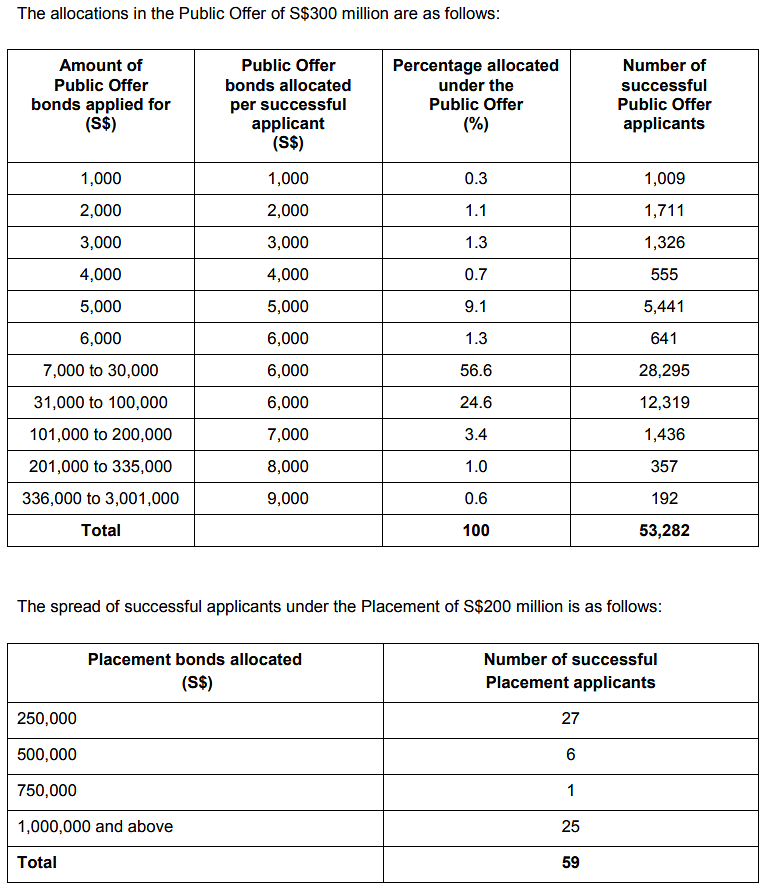
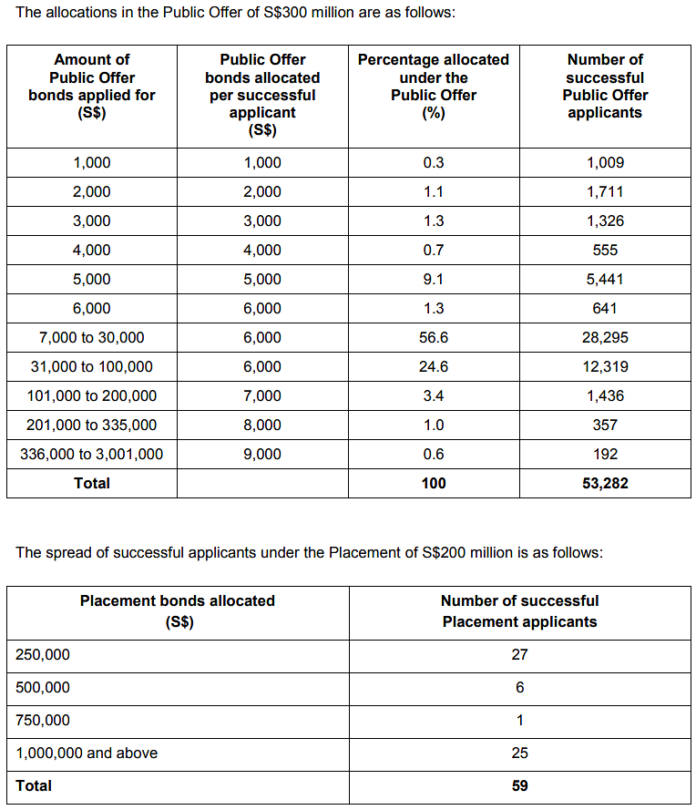
Those who applied for up to S$6,000 of bonds stand to receive their full application, while those who applied for amounts above S$6,000 will get between S$6,000 and S$9,000.

More than 80 per cent of the issued bonds will go to investors who applied for between S$7,000 to S$100,000 of bonds. They will each be allocated S$6,000.

temasek bond results

(Source: Temasek Holdings)

Due to strong demand that saw retail investors submitting valid applications of around S$1.68 billion for S$200 million worth of bonds, Temasek exercised the option to upsize the issue size to S$300 million, an increase of S$100 million.

Interest among institutional investors was similarly robust, with more than seven times the offered amount or about S$1.4 billion in bids received.

READ: Temasek’s first public bond offer more than 8 times subscribed

The five-year notes, which will mature on Oct 25, 2023, offer a guaranteed fixed interest rate of 2.7 per cent. The interest will be paid at the end of every six months.

Chief financial officer Leong Wai Leng thanked all applicants for their support for the bond issue, saying: “We appreciate the confidence they have all shown in us. The demand for both the public offer and the placement was robust, amounting in aggregate to about S$3 billion.”

READ: Temasek launches first retail bonds with 2.7% interest rate

Temasek welcomed, in particular, members of the public who applied for its inaugural public offer, Ms Leong said.

“We very much welcome our first retail investors as a new set of stakeholders for Temasek.”

READ: What are some of the least risky investments? Here’s a guide

Issued under the firm’s wholly owned subsidiary Temasek Financial (IV), the T2023-S$ Temasek Bond is expected to trade on the Singapore Exchange on Friday.

Invalid applications and those who did not receive the full allocation for their applied amount will have their application amounts or the balance refunded without interest, credited to their bank account, Temasek said in its statement.

Source link

Singapore, Thailand to push Burma on ‘safe return’ of Rohingya

0

THE foreign ministers of Singapore and Thailand are expected to head to Burma (Myanmar) soon to expedite the safe repatriation of the over 700,000 minority Rohingya refugees in Bangladesh.

The move comes as Burma faces international pressure on alleged atrocities committed against the stateless Muslim minorities during an anti-insurgency campaign last year, with its Asean neighbours calling for full accountability of the commanders who led the violent crackdown.

Malaysia’s Minister Saifuddin Abdullah said the Asean-approved mission to Burma would likely set the tone for the Asean leaders’ meeting in mid-November, according to Kyodo News.

SEE ALSO: Australia strikes Burmese generals with sanctions over Rohingya crisis  

At the meeting in November,  Asean leaders are expected to put the Rohingya crisis at the top of the agenda, Saifuddin said.

Saifuddin said the Asean countries hoped the efforts would help the return of the Rohingya community to the western Burmese state by early next year.

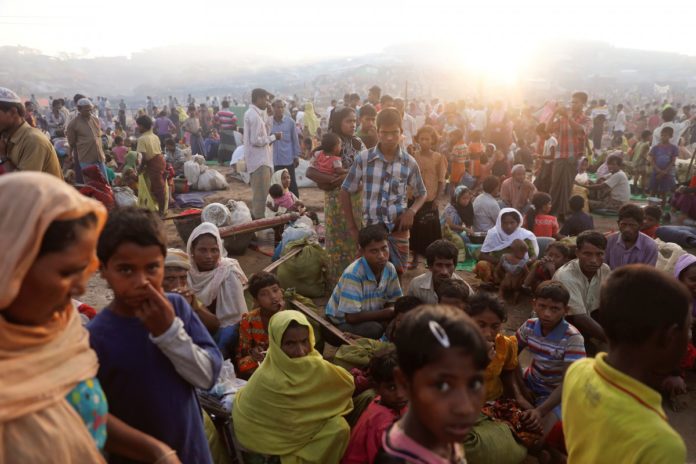
2018-08-15T144908Z_1305704773_RC1C0B10BBB0_RTRMADP_3_MYANMAR-FACEBOOK-HATE

(File) The sun rises as thousands of Rohingya refugees who fled from Burma a day before wait by the road where they spent the night between refugee camps, near Cox’s Bazar, Bangladesh Oct 10, 2017. Source: Reuters

“We are hopeful that (at) the beginning of next year, when the rainy season ends, the process can start,” Saifuddin was quoted as saying.

Since its formation in 1967, the Asean grouping, also known as the Association of Southeast Asian Nations, has applied the principle of non-intervention on domestic affairs among its 10-member countries.

SEE ALSO: Burma president intervenes in case of three jailed journalists

However, ministers from countries like Malaysia have insisted that the Rohingya issue had caused the arrival of Rohingya refugees to its shores.

In Malaysia, the UN High Commissioner for refugees recorded 75,000 Rohingya refugees in the country. Thousands more remain unaccounted for as they were not registered.

Singapore and Thailand will head the repatriation bid due to their status as Asean chair – Singapore at present and Thailand will assume the role in January.

Source link

New insurance plan to cover surge pricing for Grab rides on rainy days

0

SINGAPORE: A new insurance plan has been introduced to cover surge pricing for trips booked on ride-hailing app Grab on rainy days.

Launched by NTUC Income on Wednesday (Oct 24), the insurance plan – named Droplet – offers a payout of up to 60 per cent of the trip fare or the cancellation fee, or both, if it was raining at the point of pick-up. 

For a premium of up to S$9.60 a day – purchased at least a day in advance – riders can submit receipts for up to S$50 worth of rides.

Coverage is for a minimum of two days. The exact premium depends on the weather forecast and when the insurance plan is purchased, NTUC Income said. 

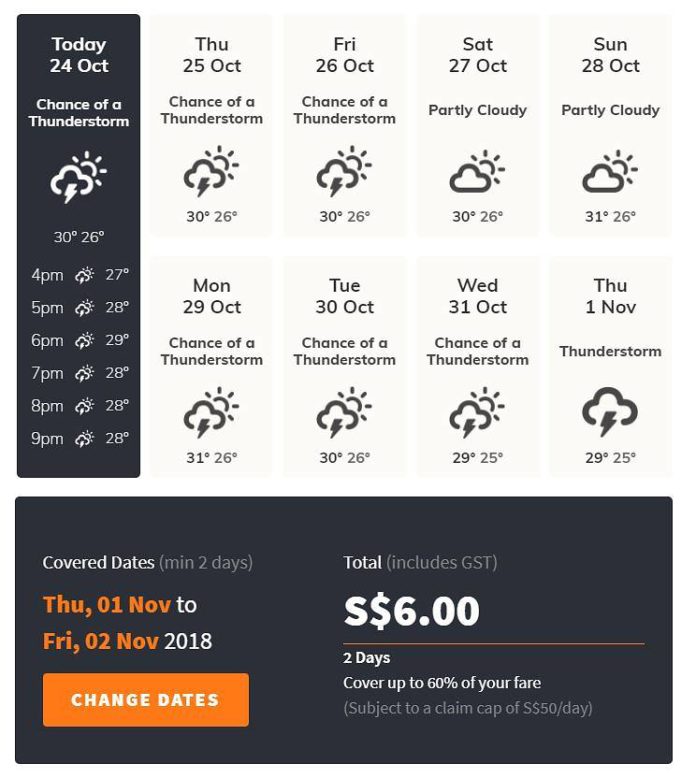
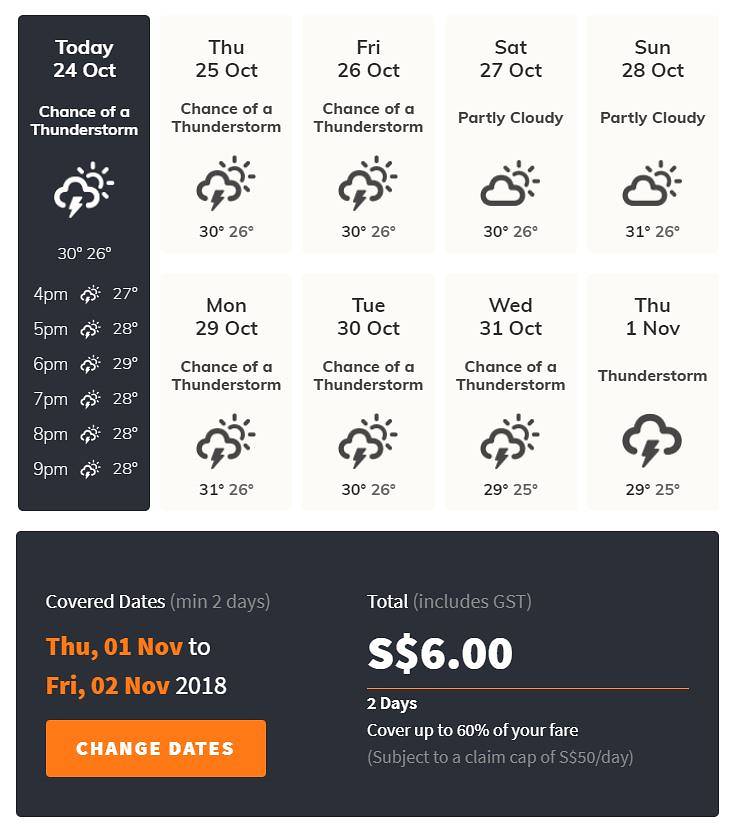
“To help consumers make informed decisions about purchasing Droplet, real-time weather forecast is made available at the point of purchase on www.droplet.sg with premium pricing dynamically pegged to rain forecast,” it said. 

Droplet screenshot

A screenshot from www.droplet.com.sg.

Riders who purchase the insurance plan closer to the days that forecast rain will likely pay a higher premium, NTUC Income said, adding that its weather forecast data is sourced from the National Environment Agency.

The plan currently only covers rides booked via Grab. More ride-hailing apps will be included by the end of the year, the insurer said.

Riders have up to seven days from the day of the ride to submit their claims. Reimbursements will be made through the PayNow app within three days from the day of claim submission. 

Each receipt will be verified for rain at the time and location of the ride using Leveraging Robotic Process Automation technology, NTUC Income said. 

“In Singapore, where an average of 167 days of rainfall can be expected a year, consumers can now meaningfully address this pain point with insurance cover,” it added.

Source link