They allegedly targeted victims in Singapore, Malaysia and Hong Kong, cheating them of more than S$19 million.
Laptops, mobile phones and other items seized during a joint operation to nab scammers. (Photo: Royal Malaysia Police)
(Updated: )
Bookmark
SINGAPORE: Nineteen people believed to have cheated people in Singapore, Malaysia and Hong Kong of more than S$19 million through Internet love scams have been arrested.
Law enforcement units from the three countries embarked on a joint operation in Malaysia from Oct 19 to 21 and nabbed 15 Malaysian women and a Malaysian man, two Nigerian men and a woman from China, police said on Monday (Oct 22).
The suspects, aged between 29 and 60, are believed to be involved in at least 146 cases of Internet love scams.
In Singapore, two Malaysian women aged 40 and 48 are assisting with investigations as they are believed to have helped transfer criminal proceeds linked to the scams.
Several mobile phones, laptops and ATM cards were also seized in the operation.
Eight Internet love scam cases reported in Singapore, involving at least S$450,000, have been solved as a result of the joint operation.
Police said that officers from the Singapore Police Force, the Royal Malaysia Police and the Hong Kong Police Force have been sharing information on Internet love scams since early 2018.
Director of the Commercial Affairs Department of Singapore’s police force, David Chew, thanked his counterparts from Malaysia and Hong Kong for their “strong support” in fighting transboundary online crime.
He added: “The fact that victims in Malaysia, Hong Kong and Singapore fell prey to the same scammers shows that the criminal networks behind the scams are sophisticated and transnational. To tackle these syndicates, international cooperation among law enforcement agencies is extremely critical.”
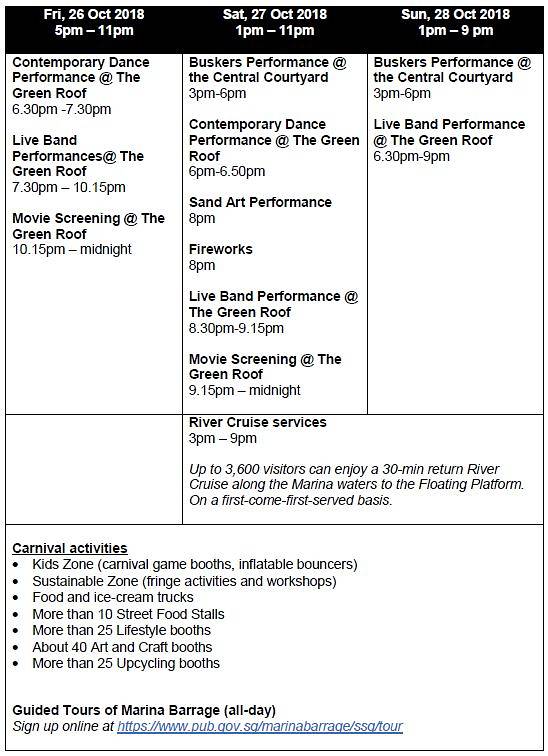
SINGAPORE: The Marina Barrage will host its biggest-ever carnival from Friday to Sunday (Oct 26 to 28), an event that marks the end of its 10th-anniversary celebrations, national water agency PUB said in a media release on Monday.
The carnival will feature more than 100 food and craft vendors, with live performances and a fireworks show on Saturday.
Visitors can also take a free half-hour boat cruise that takes them along Marina Reservoir to the Floating Platform during the weekend. Passengers can learn about the history of Marina Barrage and other interesting facts.
The River Cruise operates from 3pm to 9pm and rides are on a first-come-first-served basis.
Visitors can enjoy a free River Cruise along the Marina waters at Marina Barrage’s 10th anniversary carnival. (Photo: PUB)
There will be more than 10 street food stalls, including food and ice-cream trucks.
KAYNA, a six-piece band from Ecuador, will be performing in Asia for the first time.
There will also be movie screenings on Friday and Saturday nights.
KAYNA, a six-piece band from Ecuador, will be performing in Asia for the first time at Marina Barrage’s 10th anniversary carnival. (Photo: Anthony Keung Fatt)
On Saturday, professional sand artist and performer Stacey Lee will put on a live sand art performance that will tell the story of the Marina Barrage.
Stacey Lee will use sand as a medium to tell the story of Marina Barrage at its 10th anniversary carnival. (Photo: PUB)
A key highlight of the weekend’s festivities will be a fireworks display at 8pm on Saturday.
More than 15,000 people are expected to attend the three-day celebration.
Marina Reservoir is Singapore’s 15th reservoir and the first reservoir in the city, serving as a collection point for five rivers – Geylang River, Rochor River, Stamford Canal, Kallang River and the Singapore River.
The Green Roof at the Marina Barrage has become a popular space for recreational activities like kite-flying and picnics. Since its official opening in October 2008, the barrage has welcomed more than 16 million visitors, PUB said.
“We celebrate a proud decade as the Marina Barrage plays an important role in flood control and water supply for Singapore. At the same time, it has evolved into an iconic lifestyle attraction and recreation space for both locals and visitors,” said Mr Ng Joo Hee, chief executive of PUB.
The naval drills involve more than 1,000 personnel and eight ships.
Participants from ASEAN and Chinese navies at the opening ceremony of the inaugural ASEAN-China Maritime Exercise in Zhanjiang, China. (Photo: MINDEF)
(Updated: )
Bookmark
ZHANJIANG: The first-ever maritime exercise held by the Association of Southeast Asian Nations (ASEAN) and China started on Monday (Oct 22) in the southern Chinese city of Zhanjiang.
Over the next six days, the navies of ASEAN and China will plan and conduct field training off the coast of Guangdong province, marking efforts by the regional bloc and Beijing to avoid military confrontations in Asia amid tensions in the region between the US and China.
The maritime exercise – first mooted in 2015 – is unprecedented. While this is not the first time ASEAN navies are taking part in multilateral naval drills, it is the first time ASEAN is engaging another country in such an exercise.
A second such exercise will take place soon. It was announced at the ASEAN Defence Ministers’ Meeting (ADMM) in Singapore last week that ASEAN and the United States will hold a joint maritime exercise next year.
At Monday’s opening ceremony of the ASEAN-China exercise, Singapore’s Chief of Navy, Rear-Admiral Lew Chuen Hong, said that the region’s prosperity is underpinned by a stable and secure sea.
“We also need to promote practical norms that support international laws, and enhance practical cooperation. The Code for Unplanned Encounters at Sea, or CUES, is one such example – it enhances operational-level communication and reduces risk of miscalculations. Overall, it aims to improve trust,” he said.
There was a recent near-miss between US and Chinese warships in the South China Sea, as both countries continue to be engaged in an escalating trade war.
Against such a backdrop, these drills are seen as increasingly important in building mutual trust.
“I believe this exercise will achieve the expected results. It will be an important platform for the various navies to exchange knowledge, increase mutual understanding, and become an important platform to deepen defence cooperation between China and ASEAN.
“It is key to China and ASEAN’s shared destiny and to preserving peace in the region,” said Vice-Admiral Yuan Yubai, commander of the Southern Theatre Command in the People’s Liberation Army Navy.
Singapore, as ASEAN and ADMM chair this year and as the coordinator for ASEAN-China relations from August 2015 to August 2018, is the co-directing the exercise with China.
The field exercise is the implementation phase of a table-top exercise that took place in Singapore in August.
It includes search-and-rescue drills, and also provides an opportunity for naval codes, like the Code for Unplanned Encounters at Sea, to be tested out.
There are more than 1,000 military personnel and eight ships – three from China, and one each from Singapore, Brunei, Thailand, Vietnam and the Philippines – taking part in the exercise in Zhanjiang.
SINGAPORE: A 14-member committee has been appointed to oversee and lend guidance to Singapore’s nomination of hawker culture for a spot on the UNESCO Representative List of the Intangible Cultural Heritage of Humanity.
It will be co-chaired by National Heritage Board CEO Chang Hwee Nee, National Environment Agency CEO Tan Meng Dui and Federation of Merchants’ Associations president Yeo Hiang Meng, the three organisations said in a press release on Monday (Oct 22).
The other committee members come from across the public, private and people sectors, with knowledge and expertise in fields such as community engagement, education and food heritage.
The committee will provide recommendations, feedback and advice on the nomination documents to be submitted to UNESCO in March 2019, as well as encourage community participation and support for Singapore’s nomination, which is an important component of UNESCO’s assessments.
The results are expected by end 2020.
The decision to nominate hawker culture was announced by Prime Minister Lee Hsien Loong at the National Day Rally in August, where he spoke about hawker centres being a unique part of Singapore’s society, heritage and identity.
“Hawker centres are our community dining rooms,” Mr Lee had said in his Chinese speech, noting how Singaporeans of all races, faiths and income groups are able to eat together in hawker centres.
File photo of Tiong Bahru Market. (Photo: Sherlyn Goh)
SINGAPORE: Following a half-hour impasse that saw Senior Council Davinder Singh ask for “respect” to be shown to the court, Workers’ Party chairman Sylvia Lim on Monday (Oct 22) acknowledged that she and fellow elected Members of Parliament (MPs) for Aljunied-Hougang Town Council (AHTC) had breached their duties by not disclosing the cost of a new managing agent to other town councillors.
Ms Lim, Low Thia Khiang, Pritam Singh and other town councillors are embroiled in a civil lawsuit over millions of dollars of “improper” payments that were allegedly made to new managing agent FM Services and Solutions (FMSS).
They are being sued by AHTC as well as Pasir Ris-Punggol Town Council (PRPTC) for alleged breaches of fiduciary duty in the appointment of FMSS.
Mr Singh, the lawyer for PRPTC, had earlier on Monday already subjected Ms Lim to a bruising interrogation.
He resumed his cross-examination in the afternoon by noting that the former AHTC chair had not reproduced for the rest of the town council the rates charged by FMSS, despite it being the same as those of the outgoing managing agent, CPG Facilities Management.
“This is the most important contract of the town council,” said Mr Singh. “When you waive a tender, you don’t have the advantage of competitive rates – so all the more reason to know what the rates are going to be. So why didn’t you tell the rest of the town council what the rates were going to be?”
Ms Lim said there was “nothing sinister” in play and that the “key thing” was FMSS committing to taking over at CPG’s prevailing rates. She acknowledged she should have reproduced the rates, but also said it was an inadvertent omission not done with any deliberate intent.
“Do you agree it’s the duty of the chairman and others who knew the rates to disclose them to other town councillors, so they would know the rates before deciding?” Mr Singh asked.
Ms Lim agreed.
“Do you agree that duty was breached by you and other elected members?” Mr Singh added.
“In the sense that I should have included rates in my report, I agree,” Ms Lim replied. But she refused – initially – to agree the same of the other elected members, reiterating that “they had delegated the responsibility of the presentation” to her.
“Well, that’s very big of you, but you agree with me that they too were under a duty,” Mr Singh fired back.
“Answer my question … Ms Lim, we are waiting for an answer,” he pressed, in a refrain that would be repeated over the next 30 minutes.
“I don’t think it’s fair for me to answer the question,” said Ms Lim.
To which Mr Singh said: “If it wasn’t fair, there would be an objection and His Honour would have stopped me. It’s not for you to decide whether it’s fair.”
But Ms Lim would only say: “They didn’t disclose the rates.”
Said Mr Singh: “You agree they had a duty to disclose rates. You agree they did not disclose the rates. If someone has a duty to do something and he doesn’t do it, it follows the duty has not been complied with.”
The Workers’ Party’s Sylvia Lim walking to the Supreme Court on Oct 22, 2018.
After a long pause, Justice Kannan Ramesh stepped in to ask Ms Lim to respond. “The question has been asked several times over several minutes. Answer it please,” he said.
Ms Lim repeated her stance that the rates had not been disclosed, adding that the rest of the town councillors should have been informed.
Mr Singh said: “I can understand if you are fencing with me. But it’s not just me asking the question, it’s the court. Please show some respect.
“When you say they should have disclosed the rates, in other words – they should have complied with their duties but they didn’t,” he re-emphasised.
SYLVIA LIM AND OTHER MPS “VERY SELECTIVE” ABOUT INFORMING OTHER TOWN COUNCILLORS: DAVINDER SINGH
During the cross-examination, Mr Singh also accused Ms Lim of breaching her duties in another area – by withholding information from her fellow town councillors with regard to a payment made to FMSS prior to the start of FMSS’ managing agent contract on Jul 15, 2011.
He said Ms Lim had an arrangement with the other WP MPs to be “very selective” about what they told the other town councillors – an allegation which Ms Lim denied.
Referring to a report circulated to other town councillors, Mr Singh noted that the report does not show that FMSS would begin charging the town council on Jun 15, a month before its contract officially began. He added that one particular invoice had in fact already been paid by AHTC at the end of June.
Ms Lim maintained that the report shows that FMSS would take over the existing employees of Hougang Town Council from Jun 15, and that it would also engage new employees as necessary in preparation for the takeover. “The implication is clear,” she said, adding that “it is understood” from a paragraph in the report that FMSS would have taken over as the managing agent from Jun 15.
She agreed, however, that specific approval for FMSS to begin charging for the period of Jun 15 to Jul 15 had not been given by the town council. She also added that information about the cost of hiring new employees for the month of June should also have been given to the town councillors.
After a further back-and-forth between the two, Mr Singh charged that Ms Lim, as well as the other elected WP MPs, had decided to give “as little information” as possible to the town council about “relevant events”. Ms Lim disagreed, saying Mr Singh’s allegation was not true.
Mr Singh then put it to Ms Lim that she “could not afford” to have the town council not approve the appointment of FMSS, pointing out that there would be “severe disruption” to residents had the town council rejected it.
While Ms Lim agreed on the point, she said she “did not know” about Mr Singh’s characterisation that she could not afford to have FMSS rejected.
“But you wanted the FMSS arrangement approved,” countered Mr Singh. “Which is why where it was necessary to withhold information … you breached your duties, you all prepared to do that to get the approval.”
Ms Lim disagreed.
The trial continues on Tuesday, with Mr Singh expected to resume his cross-examination of Ms Lim.
SINGAPORE: Several users were not able to log in to the newly launched SingPass Mobile app on Monday (Oct 22), saying they received a “121” error code.
The Government Technology Agency (GovTech) acknowledged the issues faced, and said it is trying to resolve the problem.
“Some users have given feedback that they are facing issues registering the app.
“We are in the midst of resolving the situation and seek your patience. We will share updates soon,” said GovTech in a Facebook post at about 3pm.
The agency urged users who encounter problems with the app to email their name, phone model, operating system version and mobile number to the SingPass helpdesk at support@singpass.gov.sg.
Screengrab of GovTech’s response to a review on the Google Play Store of the new SingPass Mobile app.
The SingPass Mobile app, which was launched on Monday, allows Singaporeans to log into government e-services on their phones with just their fingerprints, faces or a six-digit passcode, removing the need for passwords.
GovTech said the app will also make it easier for Singaporeans living and working overseas to access government services without a digital token.
The app will not replace existing methods of two-factor authentication for SingPass users. SMS One-Time Passwords and OneKey tokens will continue to be offered as options for users,
SINGAPORE: While many tend to paint millennials as spoilt and self-entitled, this might actually be a one-sided view of the generation.
A recent HSBC Private Banking report, Essence of Enterprise, found that in fact, Singapore millennial business owners are independent, care deeply about social issues and have an eye on spotting the next great opportunity.
But what stood out most prominently in our research?
The entrepreneurial spirit is strongest in Singapore leading globally when comes to being a self-made millionaire. The values they hold dear to them also tells us they have equal measure of courage and heart.
This bodes well for Singapore’s entrepreneurial scene. As they grow and expand, they may look ashore to other parts of Asia and beyond. Today’s keen entrepreneurs could just be on their way to being tomorrow’s tycoons.
1. THEY ARE SELF-STARTERS
It is a common misconception that younger business owners are the beneficiaries of family backing, when in truth many of them are independent self-starters.
About half of Singaporean millennial business owners (49 per cent) do not come from a family businesses, with a majority of them starting their business in their 20s, while only 8 per cent stated that their wealth came from an inheritance or family wealth.
This number is especially impressive when you compare it with global (24 per cent self-starters), Asia Pacific (26 per cent self-starters) and America (21 per cent) figures – which seem to highlight that Singaporean entrepreneurs are more self-reliant than international peers in their age group.
2.THEY ARE MULTI-TASKERS
Singaporean millennial business owners have a wandering commercial eye and prefer to diversify their investments instead of putting all their eggs in the same basket. Notably 63 per cent of them have already been active shareholders in multiple entrepreneurial ventures.
Grab co-founder Tan Hooi Ling (right).
This percentage is behind the rest of Asia Pacific (66 per cent), America (86 per cent) and globally (78 per cent).
However, Singapore ranks second among all Asian countries surveyed, but lower than Western countries like the US, UK and France, which might signify that Singaporeans have adopted a slightly more Western approach to investment.
3. DOING GOOD IS IMPORTANT TO THEM
Social issues and values are important to Singaporean millennial business owners. Overall 71 per cent considered social or environmental concerns as important in their planning when they first set up their current business.
Often this is referenced as Environmental, Social, Governance or ESG for short. They are slightly behind their global (85 per cent), Asia Pacific (81 per cent) and America (94 per cent) peers.
This percentage for Singapore increases to 76 per cent with regards to planning their business today, however, the number still lags behind global, Asia Pacific and American figures as an increase is seen throughout.
This might point to the fact that the importance of social and environmental concerns is growing.
4. GIVING BACK IS IMPORTANT TO THEM
A majority of Singaporean millennial business owners (74 per cent) have given time, money or expertise to support good causes personally or through their business activities over the last year. This percentage is lower than the global (80 per cent), Asia Pacific (76 per cent) and America (91 per cent) average.
File photo of Singapore currency. (Photo: TODAY)
Of this, the most popular personal activities Singaporean business owners undertook were making single gifts to charitable causes, fundraising or volunteering for charitable organisations and making strategic business decisions with a clearly defined objective to create positive social impact, which is fairly similar to their American peers.
Globally and throughout Asia Pacific, the most common activity is actually giving on an ongoing basis to charitable organisations.
The common thread for millennial business owners is that although they want to leave their mark and build successful companies, doing good goes hand-in-hand with this, not separate from it.
5. FAMILY IS STILL AT THE HEART OF EVERYTHING
Despite all the hype about the “me” generation and entrepreneurial self-interest, Singaporean millennial business owners show a commitment to community and family as a strong motivating force.
According to the report, 33 per cent of them say their main priority when running a business is financial security for themselves and loved ones – more than any other consideration.
This attitude is more common in Singapore than globally (22 per cent), Asia Pacific (22 per cent) and America (21 per cent).
For Singapore millennials, the second most important focus is spending time with family and friends (20 per cent), followed by creating employment and economic prosperity (13 per cent) come in.
Youths walking after a class has finished. (Photo: TODAY)
In Asia Pacific, good governance and business practice ranked as the second most important consideration as a business owner. In the United States, creating employment and economic prosperity, as well as maximising shareholder value tied as the second most important to business owners.
The research signals Singaporean entrepreneurs are keeping options open. They continue leading companies invested in with their own capital and sweat, yet look to invest in the next big opportunity.
This bodes well for a thriving ecosystem in Singapore with the funnelling of capital and expertise back to the entrepreneurial community.
Certainly for me, I have a lot of optimism when it comes to the future of businesses in Singapore and the attitudes of business owners that underpin it.
Philip Kunz is Head of Southeast Asia, HSBC Private Banking.
FORT WORTH, Texas: F-35 Lightning II maker Lockheed Martin has allayed safety concerns over the fighter jet following its first crash in late September, pointing to a long record of crash-free flights prior to the incident.
“While you don’t want to brag about it, it’s remarkable that it’s taken that long for that to happen,” F-35 international business development director Steve Over told Channel NewsAsia on Oct 2.
On Sep 28, a US Marine Corps F-35B crashed in South Carolina with the pilot ejecting safely and no injuries reported on the ground. The F-35B is also the short take-off/vertical landing variant that Singapore is reportedly interested in buying.
Initial investigations pointed to problems with a fuel tube, leading to a grounding of F-35 fleets worldwide as safety inspections were conducted and suspect parts replaced. Since then the US, UK and other countries have cleared majority of their F-35s to resume operations.
This total-loss crash was the first in nearly 160,000 hours of flying the F-35 since it first took off in 2006, prompting Mr Over to describe it as an “excellent safety record”.
In contrast, he said more than 50 pilots had been killed at this point in the F-16 programme, attributing the crashes to pilots losing consciousness during extreme manoeuvres. F-16s are now equipped with software that automatically flies the plane when it is going down.
Still, even as Mr Over said he doesn’t expect the crash to affect production timelines, he refused to downplay the incident, calling it a “tragic day” for the programme.
“If the airplane had contributed in some factor to this, then just like with everything else on the programme, we’ll dive in along with our customers to get to the root cause of this, and what we need to do to the airplane going forward,” he said before the cause of the crash was identified.
Two F-35Bs refuel from a KC-130J Super Hercules tanker near MCAS Beaufort, South Carolina. (Photo: Lockheed Martin)
But the crash is hardly the F-35’s first setback. In its 17-year history, the multi-billion-dollar programme has suffered from significant delays, cost overruns and technical problems that ranged from faulty ejection seats to an under-performing helmet display.
TECHNICAL ISSUES
In a June 2018 report, the US Government Accountability Office noted more than 900 unresolved technical deficiencies on the F-35, over 100 of which could “jeopardise safety, security or another critical requirement”.
However, Mr Over said the majority of the critical deficiencies have been resolved with the release of a major software update last December, stating that the F-35 can now deliver every operational capability that was promised when the programme started in 2001.
“Does that mean the software today is perfect? No, it does not,” he added. “There are still lower category deficiencies that exist in it. As we’re moving forward, we’re now adding new capabilities in addition to resolving those outstanding deficiency reports.”
An F-35B test aircraft reveals the bombs it is carrying internally. (Photo: Lockheed Martin)
These fix-and-add software updates, which started this year and will be released twice a year, also help future-proof the F-35s as threat weapon systems evolve.
For example, the most recent update allowed the F-35 to use a type of bomb capable of hitting moving targets on the ground. Future editions include new weapons and improvements to the jet’s radar, electronic warfare and targeting systems.
“Certainly, this airplane is going through a modernisation programme that will allow it to stay well ahead of the threat for the lifetime of the airplane,” Mr Over said.
MONEY TALKS
The cost of this modernisation programme, expected to be well over US$10 billion (S$13.7 billion) till 2024, will be borne by the US and its partner customers.
Foreign military customers who want to buy the plane have to pay a one-time “recoupment cost” that is a “tiny fraction” of the cost of these updates.
When these customers first buy the jet, they will also get a logistics support package, comprising training equipment, spare parts and maintenance systems, that will cost roughly 20 per cent of the jet’s unit price.
Both of these costs are on top of the jet’s unit price, which for the B variant currently stands at US$115.5 million.
The F-35 production facility in Fort Worth can churn out at least 165 airplanes a year. (Photo: Lockheed Martin)
But Lockheed Martin has been trying to reduce this by ramping up production and building economies of scale. To date, it has produced more than 320 F-35s, a figure that will increase three-fold by 2022 to meet demand.
This means that for the latest production run of the aircraft, the F-35A costs US$89.2 million, a 5.4 per cent decrease from the previous one. Lockheed Martin expects the price to drop to US$80 million by 2020, which Mr Over said is less or equal to the cost of most fourth-generation fighters like the F-16.
The defence contractor is also trying to reduce maintenance and operating costs by issuing standard spare parts and equipment that can be shared among global partners, and showing military technicians how to maintain the planes more efficiently.
In addition, engine manufacturer Pratt & Whitney is working on making the jet more fuel-efficient, which Mr Over said will reduce costs by more than a third over the next five to 10 years.
Citing a Pentagon report, Reuters reported in September that it costs about US$30,000 per hour (in 2012 dollars) to fly the F-35, compared to around US$25,500 per hour for the F-16.
Pratt & Whitney’s F135 engine, which powers the F-35, undergoes testing. (Photo: Facebook/Pratt & Whitney)
Mr Over said Lockheed Martin’s objective in the next five to six years is for the F-35 to be as affordable to maintain as the F-16. And he is even more confident of hitting the US$80 million-per-jet target by 2020.
“If I can show you the discriminating capability and you’re not being asked to pay a price premium for that airplane, it becomes a really, really easy choice,” he said.
SINGAPORE’S OPTIONS
The choice has been easy for the UK, Italy, Turkey, Australia, Norway, Denmark, Canada and the Netherlands, the programme partners that are expected to field some 600 F-35s in the coming years.
Israel, Japan and South Korea, the three foreign military customers, have also placed orders for more than 100 of the jets.
The flags on the side of this F-35B represent the programme’s partners. (Photo: Lockheed Martin)
The list goes on, with Mr Over revealing that Belgium, Finland, Germany and Switzerland are considering the F-35 as they look to refresh their fighter capabilities.
Like Israel, Singapore joined the programme as a security co-operation participant, which means that it paid for detailed information on the airplane’s capabilities, its test reports and how it was developing.
Singapore had also conducted localised studies on how the F-35 would support its needs, Mr Over said.
“Basically, (this is) enough information to decide if the F-35 makes sense to the RSAF (Republic of Singapore Air Force),” he added. “They’re still sifting information and trying to decide if or when it makes sense to move forward with the F-35.”
In June, Defence Minister Ng Eng Hen said the country was also considering fifth-generation fighters from Russia and China.
China unveils its J-20 stealth fighter during an air show in Zhuhai, Guangdong Province, China, in 2016. (Photo: China Daily/via REUTERS)
Russia and China’s respective Sukhoi Su-57 and Chengdu J-20 stealth fighters have both been plagued by engine problems, with reports indicating that Moscow will not mass produce the Su-57 and Beijing only nearing mass production of the J-20.
“(The F-35) is going to stay well ahead of those airplanes,” Mr Over said. “We do our own intelligence assessments of where we think our adversaries are located. And I can tell you in my opinion we’re at least 15 years ahead. Not only in stealth but also in the mission systems on the airplane.”
“DARKEST POINT”
While Mr Over is bullish about the F-35’s prospects, including its potential to feed data to other ground-based and maritime assets and change the way battles are fought, he acknowledged the programme’s checkered past.
“Our development process wasn’t perfect getting here,” he said. “We certainly underestimated some things and had our own challenges trying to get through them.”
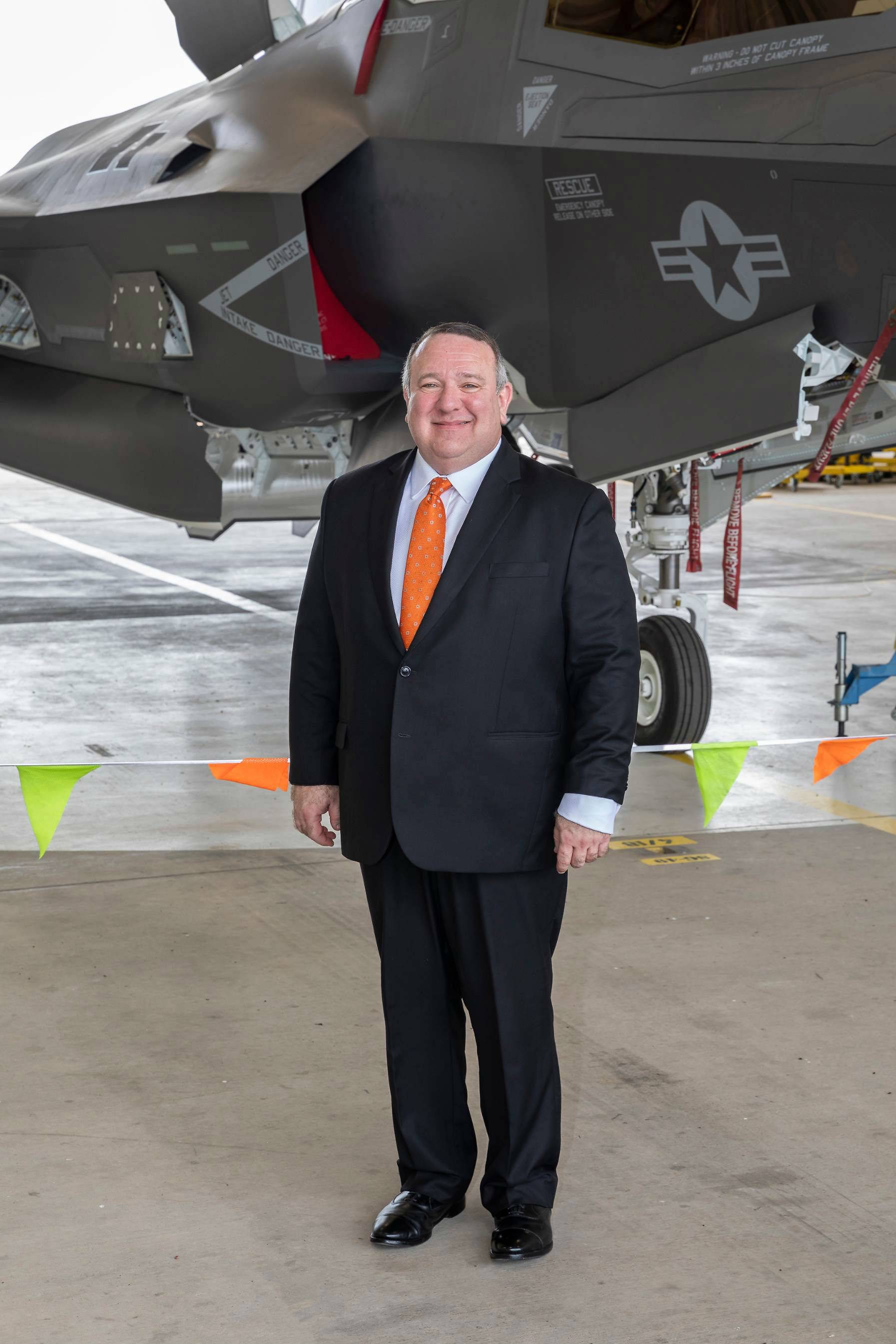
Mr Steve Over, director of F-35 international business development, in front of an F-35B. (Photo: Lockheed Martin)
After leading some of the most recent sales of the F-16, Mr Over joined the F-35 programme in early 2013, during its “darkest point” as customers were thinking of walking away and looking at other alternatives.
“Fortunately, they stuck with us,” he said. “One of our customers once said: ‘If you hadn’t had the challenges you faced, then I wouldn’t have believed that you were doing something that was worthwhile.’
“While it took us more time and money to get there, the airplane that we’re fielding right now is really remarkable.”
Click here to read the first part in this series about the F-35 on how it might be a battlefield game changer, and here for the second part on what it feels like to fly the F-35.
Channel NewsAsia’s visit to the F-35 assembly line was facilitated by Lockheed Martin.
SINGAPORE: Karolina Pliskova issued a warning to her opponents at the WTA Finals with a convincing straight-sets victory against defending champion Caroline Wozniacki.
The dynamic 26-year-old’s easy 6-2, 6-4 triumph in Singapore was sweet revenge for Pliskova, who lost to Wozniacki in the semis at last year’s WTA Finals.
Pliskova had strapping on her lower right leg but moved well against the sluggish second seed.
The hard-hitting Czech was not broken on serve for the entire match and fittingly closed it out with an ace.
“I felt good from the baseline and it was not all about my serve,” Pliskova said after the match.
“She started a bit nervous in the beginning, it’s always tough to defend a title.”
Pliskova played down injury concerns.
“I don’t know what is wrong with me, but, you know, it’s the end of the season,” she said.
“I have now two days, so I’m sure it’s going to be fine.”
The world number eight stunned Wozniacki with a brilliant first set highlighted by trademark booming ground strokes.
Caroline Wozniacki squandered break points in the eighth and 10th games in a disappointing start to her title defence. (AFP/Roslan RAHMAN)
She saved two break points in her opening service game before overwhelming the Australian Open champion en route to winning five straight games.
Wozniacki, who had only played two top-10 players this year before Sunday, struggled with rhythm in the first set and made several uncharacteristic errors.
“I think I was struggling a little bit with the timing in some of the points and just trying to find my rhythm,” she said.
“I think there were times where I played really well, and I was trying to move her around, but there were also times when I just didn’t time the ball perfectly.”
The one-way traffic continued in the second set with Pliskova breaking immediately, saving three break points in the next game to the frustration of her opponent.
The Dane started to find her groove but squandered break points in the eighth and 10th games in a disappointing start to her title defence.
SVITOLINA BEATS CURSE
Earlier, a determined Elina Svitolina ended her long-time jinx against former Wimbledon champ Petra Kvitova, cruising to a straight sets win.
The world number six triumphed 6-3, 6-3 in just 89 minutes in the tournament opener, easily overcoming a lacklustre Kvitova, who had 29 unforced errors and seven double faults.
World number six Elina Svitolina triumphed 6-3, 6-3 in just 89 minutes over her nervy opponent. (AFP/Roslan RAHMAN)
Svitolina had won just one set in seven straight harrowing defeats to the Czech but impressively turned the tables.
“Winning this match definitely gives me lots of confidence,” Svitolina told reporters after the match.
“I played good, quite solid from the baseline and putting pressure on Petra. I was really, really solid, and I think this was really the key.”
Kvitova rued her subpar opening performance.
“Wasn’t the best start, but the good thing is there is still a chance to play better and to improve and maybe go somewhere forward,” she said.
Kvitova’s trademark firepower moved Svitolina around the hard court but the Ukrainian’s defence was up to the task.
A composed Svitolina made just four unforced errors in the opening set in a notable contrast to her error-riddled opponent, who struggled badly on serve and conceded the first set after her fifth double-fault.
Svitolina broke in the sixth game and held her nerve to claim just her second victory against Kvitova from nine meetings.
The Red Group action starts on Monday with number one seed Angelique Kerber playing Kiki Bertens and Naomi Osaka squaring off against Sloane Stephens in a battle of the past two US Open champions.
SINGAPORE: In the home of this Hindu family, there is a Catholic altar as well as a Buddhist altar. Here, there is a place for different gods and religions because that is the philosophy this family has known for generations.
Mr Rishnaiswaren Pillay recalled how his paternal grandmother used to bring him and his brother to Malay shrines, called a keramat, to pray and give offerings.
“My grandma always told us that all religions are one and that we’re all humans after all. When we cut our hands, we have the same (coloured) blood,” said the 30-year-old business analyst.
“We don’t let go of the Hindu practices. It’s just that … we have add-ons.”
Mr Rishnaiswaren Pillay praying at the Catholic altar.
Acceptance is a word he uses, as does 71-year-old Ponnosamy Kalastree, who is from the same community and also goes to different places of worship because “all religions preach good things”.
The ability to accept not only different religions but also cultures is “in our DNA”, said Mr Ponnosamy. And that is the DNA of the Chetti (or Chitty) Melaka community – the Peranakan Indians.
“I always used to say, ‘Chetti is three in one,’” he said. “Basically we’re Indians, but we’ve embraced the Malay and Chinese culture.”
The community stretches back centuries. But its age-old culture has been eroded and is at risk of vanishing.
Photo courtesy of Indian Heritage Centre.
There are now around 200 Chetties recorded in Singapore, and it was only in the last decade or so that concerted attempts have been made to preserve their practices, from their language, food and dressing to their way of thinking.
They may be little known, but the likes of Mr Pillay and Mr Ponnosamy see reasons to hope.
CHETTI-STYLE QING MING
The Chetti Melaka are the oldest Peranakans in this region, descendants of South Indians who first settled in Melaka during the reign of the Melaka Sultanate (15th to 16th centuries) and married women of Malay and Chinese descent.
The word ‘Chetti’ means merchant, and these pioneering traders adopted many of the local Malay and Chinese cultural influences over the years.
Photo courtesy of Indian Heritage Centre.
As Mr Ponnosamy often tells his wife Dora, a Chinese Singaporean, she is “quite lucky to marry an Indian like me because I’m well-versed in the Chinese culture”.
One of the most important Chetti customs, for example, comes from the Qing Ming Festival, a Chinese tradition also known as the tomb-sweeping festival.
Unlike the usual Indian practice of cremation, the Chetti followed the Chinese custom of burial in the past.
And when the time came to pay respects to their ancestors, they too would visit the graves, clear the weeds and make offerings.
“You’d put the various types of food, cakes and all that … put the flowers round the whole grave, then you’d light the joss stick,” described Mr Ponnosamy, who is the president of the Peranakan Indian (Chitty Melaka) Association Singapore.
A photo of Mr Ponnosamy with his wife’s relatives.
This is followed by a mixed ritual called Bhogi Parachu, ancestral prayers incorporating Indian and Chinese elements.
At home, the Chetti would fill banana leaves with their ancestors’ favourite foods – as Indians would do – while lighting red candles according to Chinese prayer customs. It is a reunion day of sorts for Chetti families, “when everyone comes together”.
“Parachu was a big part of my life when I was young,” said Mr Pillay. “Because it was a day, apart from Chinese New Year and Deepavali, when we had crowds coming into our houses.”
But these days, especially since his grandmother is dead, it is too great an effort for his family to cook all their ancestors’ favourite dishes, so Parachu is now a small affair for him.
An offering for Bhogi Parachu. Photo courtesy of Indian Heritage Centre.
Mr Ponnosamy has also seen a gradual loss of this tradition as more Chetties convert to other religions. He has relatives, for example, who do not want to eat the food offered because they are Christian, he said.
“They’re confused between culture and religion,” he added. “They don’t realise that this isn’t Hinduism.”
DISTANCE MAKES A DIFFERENCE
One person who is able to reconcile his religious beliefs and his culture is Bible teacher Devastry Parasurama Bok, known simply as David Bok. He was born a Hindu, but becoming a Christian did not detract from his Chetti identity.
Mr David Bok. Photo courtesy of Indian Heritage Centre.
The 70-year-old permanent resident thinks, however, that the Chetti in Singapore have it tough because of that distance from Melaka, the heart of the Straits Indian culture.
One of the festivals – the most important one in the Chetti culture there – that is still going strong is the Datuk Chachar festival every May, a 12-day event dedicated to the Hindu goddess Mariamman.
She was given the name Datuk Chachar because she is known to cure ailments like chicken pox (chachar in Malay). Families used to return for the festival, but hardly so nowadays, as polytechnic student Sathyavani Balan Krishnan discovered.
When the 23-year-old recently visited her maternal grandmother’s birthplace to understand her roots, she learnt that the community in the Chetti village get to see their relatives only for a day now, if at all.
A picture of the Datuk Chachar procession being screened.
And since her grandmother died when she was eight years old, “it just felt very weird that there was this whole other tradition and culture going on that we had no idea about”, she admitted.
The thing is, a lot of them looked like my relatives. The features were all so similar, so it was a bit eerie.
Indian Heritage Centre curator Nalina Gopal agreed that youngsters like Ms Sathyavani have become distanced from their roots. “Where family history hasn’t been preserved, there might be a loss also in terms of their own Chetti Melaka antecedents,” she added.
One of the differences between Singapore and Malaysia is language, and that is another reason for the loss of the culture, as the Chetti traditionally speak a Malay patois infused with Tamil and Mandarin. It is called Chetti creole.
“So if one generation passes, that disappears too,” said Mr Bok.
Mr Pillay used to speak it a bit with his grandmother. He called her nenek, as the Malays would. Mr Ponnosamy’s daughter Sheila did likewise, growing up not realising “there were other terms that the Indians call their grandparents”.
In creole, grandfather would be topeh, according to Mr Sithambaram Muragason Pillay. “The ‘to’ is from Malay, the ‘peh’ is from Chinese … so they mixed it,” he said.
Mr Sithambaram Muragason Pillay.
His son, who grew up speaking Malay, is now hoping to relearn Chetti creole.
OF DRESS AND FOOD
The westernisation of Singapore has not helped, including in terms of dress, said Mr Ponnosamy.
Traditional Chetti outfits reflected the styles of the Javanese, Bugis, Acehnese, Batak and Tamil. But generally, the men would wear the Malay sarong and batik shirts.
Meanwhile, the women would wear the sarong kebaya just as the Peranakan Chinese would, but incorporating Indian elements such as a thali, the gold chain worn by married women, and the pottu (dot on the forehead).
Traditional outfits in the days of Mr Ponnosamy’s grandparents.
These days, dressing up the traditional way would be possible only on “grand occasions”, said the younger Mr Pillay, which he sees as one of the reasons it is difficult to “prove to (others) that we’re proud to be Chetti”.
“If you happen to (enter a temple in a kebaya), there’d be societal pressure from other Indians in the temple who’d say, ‘Why don’t you use a sari?’”
When it comes to food, Chetti cuisine is a blend of Indian, Malay and Peranakan Chinese styles. But as both Mr Pillay and Mr Ponnosamy attest, their daily choices veer towards the Malay and Chinese options.
Mr Ponnosamy said: “If you ask me to go to Banana Leaf (restaurants) every now and then, I can’t eat. Because it’s too Indian. We have to have our mixed type of food.”
Sambal goreng rather than typical Indian curry, added his 47-year-old daughter. And definitely the kueh-kueh. She said:
When I grew older … I realised the Indians in India had a different palate for desserts. They have the laddu and other types of sweets, so it’s very different.
There is no Chetti restaurant in Singapore nor even one in Melaka, according to Ms Gopal.
But the real conundrum for the community is how interracial marriages, which go to the core of their identity and are becoming more common in Singapore too, is contributing to the loss of lived culture.
“Some of them don’t consider themselves to be Chetti any more,” noted Mr Pillay.
The Chetti are “so accepting of differences” that ethnic intermarriages may cause them to be “absorbed by majority cultures”, agreed Ms Gopal, 34.
But that may not be the case for all. “The degrees are varying for each family, depending of course on their own personal journey,” she said.
Ms Nalina Gopal.
And she believes that cultural aspects such as food – “which is devoid of any religious overtones” –language or even dress are what people can “reconnect with their Chetti Melaka-ness”.
HOPING FOR THE NEXT GENERATION
In terms of a physical place, there is a Chitty Road in Little India, indicating the community’s historical presence here. But that is now a “very small street” that few people associate with the Chetti, said Ms Gopal.
What has been a real marker for the community’s revival, however, was historian Samuel Dhoraisingam’s book Peranakan Indians of Singapore and Melaka, published in 2006 by the Institute of Southeast Asian Studies.
It was launched by the late President S R Nathan, who encouraged members of the community to “take advantage of the momentum and start an association”, recalled Mr Bok.
An album picture of Mr Ponnosamy with the late President S R Nathan, who was a supporter of the Chetti Melaka.
By 2008, the association was registered, with Mr Ponnosamy also as one of the founding members. It started off by doing mainly research, talks and workshops, culminating in a 2014 symposium titled The Lost Tribe of Chetti Melaka.
“That raised awareness, and you got some Chetti Melaka coming out of the woodwork. Because you don’t know who they are, you see,” said Mr Bok, himself a prime example of that point, with his Chinese looks.
Now, on an even bigger scale, the exhibition Chetti Melaka of the Straits: Rediscovering Peranakan Indian Communities is being held at the Indian Heritage Centre, which may spark memories for anyone who might have overlooked their Chetti roots.
Mr Ponnosamy hopes so. “The hope is to encourage the younger generation to come forward,” he said. “You have to do your own research, your own family tree … but obviously, you’ll definitely know that somehow or other you’re (Chetti).”
That was the case for Ms Sathyavani. Her father is a Malayalee Indian, but because her grandmother was from Melaka, she assumed that she was also Peranakan, though “not specifically Chetti”.
Ms Sathyavani Balan Krishnan.
Despite not practising the rituals, save for enjoying the Chetti dishes her mother would cook occasionally, she would “hate to see” the culture gone because of her generation.
“I want to be part of the community and the youth who document this (culture), and that’s something I’m looking into,” she said.
However, it cannot be just a matter of obligation, said Mr Pillay, whose mother is a Tamil Indian.
“I’ve a lot of friends who say that ‘actually my grandma is Chetti, actually my granddad is Chetti’. But they don’t practice, or they don’t visit our village,” he said.
“It’s just a choice of whether you want to proudly say that you’re a Chetti or your roots are from Chetti.”
The early signs are positive. Since the exhibition opened last month, the Peranakan Indian association’s membership has doubled to around 200. And Mr Ponnosamy estimates that there could be as many as 5,000 Chetties here.
But that is not the key thing. “(The exhibition) is meant for members of the public who are Chinese, Indian and Malay,” he said, stressing that the different communities must make an effort to mix to develop the Singaporean identity.
“We can’t say that ‘we’re Indian, okay you’re Chinese’. No, we want everybody to be together … They should be one. We’re one.”
The exhibition at the Indian Heritage Centre is on until May 5.