SINGAPORE: Gaming peripherals company Razer is not content playing a bit part in the overall mobile phone market, even though it is a relative newbie to the scene.
Fresh off announcing the introduction of its next-generation Razer Phone to four more Asia-Pacific markets, Razer vice-president Irene Ng told Channel NewsAsia in a recent interview that it is already looking at bringing its gaming-focused smartphone to more destinations next year.
Thailand, South Korea, Taiwan and Australia are joining Singapore and Hong Kong to have access to this year’s flagship device.
Going forward, one of the potential new markets is Malaysia, with interested parties there the ones making the initial overtures to bring Razer’s product in, she said.
“We’ve already have had several rounds of discussions,” Ms Ng revealed, without naming any specific partners.
Razer is also preparing the ground to enter the vast and lucrative Chinese market, a bold move considering the dominance of local handset makers like Huawei, Oppo and Xiaomi, as well as the popularity of Samsung and Apple.
Ms Ng shared that the company is in talks with potential partners there and is currently studying various plans for entry, which she said is “most likely” in 2019.
“It all depends on how complex the market is and the regulatory landscape, but we hope to get this done as soon as possible.”
The executive was keen to stress that Razer’s products, such as its Blade laptops and other gaming peripherals, are already available in China, and it had previously partnered companies like JD.com to bring these into the market.
The gaming company, backed by Intel and Hong Kong billionaire Li Ka-shing, listed in Hong Kong last year, raising HK$4.12 billion (US$528 million) from the exercise.
Expanding to more markets aside, the vice president has been busy building up the infrastructure and processes needed to sell phones in this part of the world.
Ms Ng, who joined the company in April this year from South Korean electronics giant Samsung to head up Razer’s mobile business in Asia-Pacific, said that basic steps like involving its marketing and sales teams in the wider mobile business are ongoing.
Also key is finding the right telco to partner in bringing Razer’s devices to more consumers or, as she put it, “getting people excited” about the company’s focus on gamers and gaming.
There is a symbiotic relationship between Razer, whose customers are predominantly gamers, and telcos, which are looking to increase the average spend per subscriber through mobile data,Ms Ng explained.
“Telcos like us as gamers use more data when playing games on their mobile phones,” she said. “It’s a win-win relationship.”
She cited Singtel as one such telco that is a “right fit” for the Singapore-headquartered company. Its “passion” about the mobile gaming and wider electronic sports (e-sports) arena is why Razer picked it over other telcos like StarHub or M1, she explained.
The glass-backed Razer Phone 2 will enable wireless charging, but it will also be a magnet for pesky fingerprints. (Photo: Razer)
The Mirror Black variant of the Razer Phone 2 will be launched on Nov 3 and will cost S$1,249.
There is no word currently if the matte version of the phone, known also as Satin Black, will be brought here and how much it would cost, a spokesperson clarified. Razer had previously said the model will be introduced in the US, Europe and Asia-Pacific in the fourth quarter of this year.
The two companies further developed the relationship with a memorandum of understanding (MOU) this May, promising to collaborate in the areas of e-sports and e-payments, among other digital initiatives.
The Singtel partnership also opened doors for Razer to markets like Thailand and Australia by working with the telco’s regional affiliates like AIS and Optus, respectively, Ms Ng revealed.
ATTRACTED BY “TREMENDOUSLY EXCITING” SPACE
Asked why she decided to leave Samsung, where she headed marketing in this region for the past 13 years, for a relative upstart in the market, the vice president explained that the “tremendously exciting” mobile gaming space enticed her.
She cited a June 2018 study by Newzoo that stated there are more than 2.3 billion active gamers in the world and 1.1 billion of these spend money on games. The total games market will reach US$137.9 billion this year, and for the first time, mobile gaming will contribute more than half of all revenues, it found.
“It is a mobile-first culture here in Asia,” Ms Ng said. “And in the mobile e-sports and mobile gaming space, (you just need to see) the explosive growth in China to understand the potential.
“Razer is well placed to capitalise on this growth.”
She, however, declined to reveal the sales figures for Razer Phone other than to say it “did very well”, and added the target for the next iteration is to double that number.
The vice president was also reticent in stating an intent to overtake the more established players in the global smartphones sales ranking list.
She did point out that since the Razer Phone was launched, rivals like Apple and Huawei are emulating them by adding more gaming-friendly features in their devices.
With that in mind, Ms Ng declared: “We want to be the No 1 gaming phone maker in the world.”
SINGAPORE: Bicycle-sharing companies in Singapore with bigger fleets than they are allowed are moving the excess bikes to warehouses, scrapping them for spare parts and even shipping them overseas ahead of the Land Transport Authority’s (LTA) deadline on Thursday (Nov 1).
Mobike, ofo and SG Bike were granted full licences, while Anywheel, GrabCycle and Qiqi Zhixiang were awarded regulatory sandbox licences, which are intended for those that had been operating for less than six months in Singapore at the point of application.
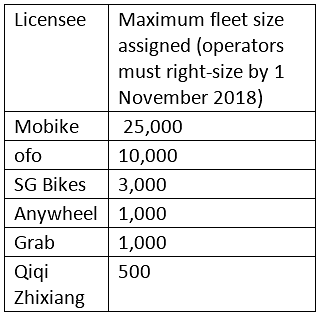
While ofo was granted a maximum fleet size of 25,000, LTA said on Monday that the bike-sharing company had requested to further reduce its fleet to 10,000 bicycles, which is a fraction of the 80,000 it had initially applied for.
Ofo told Channel NewsAsia that it has been removing the surplus bikes, as well as pulling broken bikes off the streets, to comply with the licensing regime.
General manager Isabelle Neo said: “We will liquidate the bikes for spare parts to be used to upkeep our fleet. Parts that won’t be used, will be repurposed or processed for other means.”
Anywheel founder Htay Aung told Channel NewsAsia that the company had hoped to apply for 30,000 bicycles, but was informed that the maximum fleet size for sandbox licence holders was 1,000 bicycles.
It was subsequently awarded a fleet of 1,000 bicycles.
While he declined to share how many bicycles it used to have on the streets, Mr Htay Aung said the company has acquired two new warehouses to store its excess bicycles.
A thousand spare bicycles will be kept in Singapore to replace any that are damaged, while the rest will be moved to other markets in Southeast Asia that it is planning to enter by the end of the year, said Mr Htay Aung.
As of Sunday, Mr Htay Aung said Anywheel had right-sized its fleet.
Anywheel also intends to apply for a full licence in January.
However, the rest of the existing operators have faced fewer logistical challenges.
Mobike told Channel NewsAsia the company did not need to do much adjustment to get its fleet size to the 25,000 it was allocated.
File photo of a Mobike parked at a bicycle rack at a HDB void deck in Singapore. (Photo: Elizabeth Khor)
Of the existing operators, SG Bike is the only player that is building up its fleet – from 2,200 to the 3,000 it is allowed.
The remaining two other operators have not hit the streets yet.
GrabCycle launched as a bicycle-sharing marketplace app in March, but it remains unclear what its new model will be now that it has been allocated a fleet size of 1,000 bicycles.
“With the sandbox licence, we now have an opportunity to expand our suite of affordable transport offerings, bringing us closer to our multi-modal vision,” said a Grab spokesperson.
Channel NewsAsia has reached out to new entrant Qiqi Zhixiang from China, but has not received a response.
IMPACT ON BOTTOM LINE
Existing operators we spoke with had mixed reactions to the impact of the new regime on their bottom line.
Ofo raised prices this month, less than two weeks after it was granted its licence – in a move that Ms Neo said was prompted by licensing costs.
Bicycle-sharing operators that are awarded a full licence have to pay S$60 for each bicycle in their fleet.
“The increase in ofo’s pricing as a result of the licensing cost is a reflection of our commitment to be sustainable in Singapore and to continue providing efficient and convenient short-distance mode of transportation to our users,” said Ms Neo.
But Mobike said the new regulations could lead to savings in the long run.
Besides adjusting fleet sizes, bicycle-sharing operators will have to manage how users park their bicycles, such as by implementing a QR code geo-fencing solution and banning users who repeatedly park indiscriminately.
Mobike said these parking regulations mean it can spend less manpower and resources to return its bicycles to proper parking places.
“We are a last-mile transportation solution, but at the end of the day, we’re also part of the entire transportation network. So we need to make sure that we remain relevant in this market,” said Mobike general manager Sharon Meng.
“Raising prices is not something that will solve all the problems. Eventually it’s about increasing (fleet) efficiency, better fleet management using technology, and to generate revenue through other sources of income streams.”
Mobike said it plans to begin corporate sales and launch advertising on its bicycles by the end of the year.
SINGAPORE: What can Singaporeans do to help bridge the gap between social classes? For Minister in the Prime Minister’s Office Indranee Rajah, the answer is very simple: Think of people as people.
She was responding to a question from a participant at a dialogue and closed-door screening of the Channel NewsAsia documentary “Regardless of Class” on Monday (Oct 29). The documentary explores the class divide in Singapore and how it affects society.
In its race from the third world to first, is Singapore still a society based upon justice and equality, regardless of class?
The screening held by Channel NewsAsia was attended by about 100 participants which included students, teachers and those who work in social enterprises and voluntary welfare organisations.
“The intrinsic worth of a human being is not measured by how much money you have or the kind of house you live in … it’s the fact that you’re a fellow human being,” said Ms Indranee, who is also Second Minister for Education and Finance.
“At the end of the day, it’s seeing people as people.”
Both Ms Indranee and Senior Minister of State for Transport and Communications and Information Janil Puthucheary, who hosted the documentary, stressed the importance of not thinking of people in terms of social class, income or status at the dialogue.
Dr Puthucheary pointed out that one thing that was reflected in the documentary were the biases that people have towards each other.
“The starting position is in recognising that bias and recognising the ease by which we can put someone down, even by using small words,” he said.
He elaborated on the point in response to questions from an audience member on whether the show was implying that academic streams were correlated to social class.
To that, Dr Puthucheary said “no”, pointing out that the show’s message is that “all of this is made up”.
“As we get more prosperous, we keep finding reasons to pigeonhole people,” he said. “Some people look at how other people dress, or what car you drive … or whether you take public transport. All of these are a result of stereotyping, bias and unconscious assumptions … and it’s all wrong.”
“But it’s very human,” he added. “If we want to be the kind of society we imagine ourselves to be, we’re going to have to have some work put into this to undo these biases.”
Dr Janil Puthucheary, senior minister of state, Ministry of Transport and Ministry of Communication and Information, speaking at a doorstop following a post-screening dialogue of the “Regardless of Class” Channel NewAsia documentary.
HELPING DISADVANTAGED CHILDREN UNLOCK THEIR POTENTIAL
Ms Indranee also gave more details on the new task force she is leading to strengthen support for students from disadvantaged families, pointing out that the task force will be looking at “real, practical issues”.
“It’s very difficult for a child to have a good foundation in English and reading if, at home, both parents don’t speak, read or write English,” she said. “Then the child is at a disadvantage.”
Pointing out the various issues such children could be facing, Ms Indranee also noted that there are existing assistance programmes, and the task force can help with coordinating and “stringing everything together”.
“It’s still a work in progress, but there will be things which the Government can do, and which volunteers can do, and we will work on this together,” she said.
The task force is also looking at how a child’s worldview can be expanded, and Ms Indranee cited an example of how a volunteer programme in her Tiong Bahru ward. She had asked, she said, a bakery to run a cookery programme for children living in the rental blocks in her area.
The value of that programme, she said, lay in giving the children different social exposure.
“This is an example of how you can try to create a different environment where you can allow them to learn,” she said. “You can intervene, and give them the opportunity to unlock that potential.”
A member of the audience asking a question at a post-screening dialogue of Channel NewsAsia documentary “Regardless of Class”.
BACKLASH TO DOCUMENTARY “UNFORTUNATE”
During the dialogue, Dr Puthucheary also stressed that he stands by the editorial integrity of the documentary, when asked about the online backlash related to how some teenage students were presented in the show.
The backlash centred largely around a segment of the show where students from various academic streams spoke about their differences and how they rarely interacted with those from other academic streams.
Hitting out at various “blog sites” that he said “decided to editorialise” the trailer of the documentary, Dr Puthucheary noted that the full programme was available online for more than a week, and no one criticised it.
“There was a short trailer that was made, and the point of the trailer is to provoke you into watching the main show, right? So the trailer for that segment was cut in a slightly provocative way,” he explained. “But the blog sites then spoke about the trailer as if the trailer was the product.”
“So you have the film, and then you have the trailer, and then you have commentary about the trailer,” he said, while responding to a question on whether the backlash could have been avoided or anticipated. “What was being shared and went viral was the latter.”
Most people who came up to him about the backlash had not watched the full documentary, he said, adding: “They were getting angry because someone told them to get angry … It was very unfortunate there were some kids caught up in it, and I wish it hadn’t happened.”
SINGAPORE: Ms Sylvia Lim was a “hopeless chairman” of Aljunied-Hougang Town Council (AHTC) and Mr Low Thia Khiang should replace her, according to the director of the town council’s former managing agent FM Solutions and Services (FMSS).
Ms How Weng Fan, one of eight defendants in the ongoing AHTC trial, was revealed to have said that in a recorded phone call to an employee of audit firm KPMG.
Portions of the 2016 phone call were read out in the High Court on Monday (Oct 29) by Senior Counsel Davinder Singh on day 16 of the trial.
“I even told Low Thia Khiang to remove her as chairman,” read Mr Singh, who acts for Pasir Ris-Punggol Town Council (PRPTC).
“You told Mr Low to remove Sylvia as chairman of the town council?” he asked.
“To replace her with himself,” answered Ms How.
“That would be a removal,” Mr Singh said.
“No, rotate and replace,” she answered.
“Why?” Mr Singh asked.
“Because we were put into this political situation whereby a new MP like Sylvia or any other elected MP would not be able to handle this kind of situation where all the government bodies were coming at us so you need someone experienced enough who can handle,” Ms How replied.
Ms Lim was chairman of AHTC from June 2011 to August 2015. She assumed the position soon after Hougang Town Council (HTC) merged with Aljunied Town Council when the Workers’ Party (WP) won Aljunied GRC in the 2011 General Election.
Mr Singh went on to read other portions of the transcript, where Ms How said: “You know Mr Low very well … and he also played me out.”
“Yes,” Ms How responded. “That’s what I felt when he informed me that Sylvia would be the chairman. I felt to put an inexperienced MP to be chairman it would (put me in a difficult position as) we need someone strong to be able to handle the matters politically.”
Ms Lim sat in the courtroom listening to Ms How’s testimony.
Ms How took the stand for the first time on Monday. She represents herself and her late husband Danny Loh in the lawsuits brought by AHTC and PRPTC for alleged breaches of fiduciary duty in the appointment of her company FMSS as managing agent of AHTC.
It is alleged that the appointment led to AHTC making millions of dollars of “improper payments” to FMSS. This was in circumstances where there were conflicts of interest, as both Ms How and her husband held dual roles in both AHTC and FMSS.
After the WP won Aljunied GRC, Mr Low had approached Ms How to set up a company to provide managing agent services to AHTC if needed. Ms How had previously worked with Mr Low for more than 20 years, having joined HTC in 1991.
She told the court that she was reluctant at first, as she and her husband were contemplating semi-retirement, but eventually agreed as she wanted to set up a company with her husband anyway.
SYLVIA LIM “SO SCARED OF EVERYTHING”: HOW WENG FAN
Mr Singh continued reading what Ms How said during the phone call: “(Sighs) She was the councillor before at Hougang Town Council. She is so scared of everything. She just cannot be the chairman. She will just do things to protect herself only. Then I told Low Thia Khiang she cannot be the chairman, you have to replace her … you have to come back and be the chairman.”
Looking at Ms How, Mr Singh said: “That’s nothing to do with inexperience, Ms How, it’s because of the character.”
Ms How disagreed.
“You said she is so scared, she will just do things to protect herself only,” Mr Singh went on.
“That’s because she was inexperienced,” Ms How said.
“You meant she’s a person of no integrity, because she will look after her own interests only,” Mr Singh persisted.
He said Ms How blamed Ms Lim for the troubles in the town council, but Ms How disagreed.
He continued reading what Ms How had said in the conversation: “They do not even know, that by not defending me, they are just digging their grave.”
“So you were saying that if they turn on you, you are going to spill the beans, correct?” Mr Singh asked.
“This is very natural because … I’m going to arbitration to disagree with each other on the claims,” answered Ms How.
“And the grave they are digging for themselves meant that there is something that will put an end to them right?” Mr Singh asked.
“No, I think it will be coming to this court,” Ms How said.
“Many people go to court and are victorious,” Mr Singh answered. “They don’t dig their grave when they go to court.”
“This is just a figure of speech,” Ms How said.
“It is a very powerful figure of speech,” Mr Singh replied. “So you were telling (them) that if they don’t change course, you will come clean …”
“Well, when you come to court everything will be exposed,” Ms How said.
Mr Png Eng Huat and Ms Sylvia Lim leaving court on Monday (Oct 29).
MS HOW HAD INFO WHICH COULD DESTROY ELECTED MPS POLITICALLY: DAVINDER SINGH
Mr Singh continued reading aloud from the phone conversation, where Ms How said: “All PAP need to do is come and ask me for my views for MPs la. I think they will die straightaway la.”
“Yes,” Ms How said.
“The same grave, the same death analogy. In other words, you had information that would finish them off, correct?” Mr Singh asked. “This was not inefficiency. This was not inexperience. (You) had information which would destroy them politically, correct?”
“I did not have information,” Ms How replied. “But we would be dragged through the mud because of how the press would report. It’s a grave. I can’t get any jobs. I can’t get any contracts for my company. (The MPs) will lose their seats and all that. If for one reason or another, the truth has been turned into lies … they will lose their seats. With all this political bullshit this is what is going to happen, look at what is happening!”
At this, the judge stepped in and Mr Singh asked Ms How to mind her language, to which she apologised, saying she got carried away.
Mr Singh continued reading from the phone call, where Ms How said: “You know, I had to lose my husband in the process. I think you read in the papers you should know. And because of her.”
“Who is the ‘her’?” Mr Singh asked.
“Sylvia,” Ms How answered. “My husband was under a lot of pressure. We went through a lot of hell having to set up the town council properly, amidst all the problems that we had and at the end of the day we deal with audit, then AGO, then we have to deal with audit again, PwC, and nobody wants to listen to the problems we were facing and going through and at the end of the day, the town council accepts the AGO’s report just like that. Which cannot.
“The report doesn’t tell everything … Events are not recorded properly. I spent five hours talking to AGO, I don’t think the minutes … (reflect that). At the end of the day, because of this AGO report, the chairman felt compelled, because of the lapses, she imposed liquidated damages on us. In Japan, (my husband Danny Loh) was still doing the bonus calculation. He just died of a heart attack there and then. What did the press report? He died in an accident. Totally untruth. How can that be?”
“Ms How,” Justice Kannan Ramesh began.
“And they are suing me, for S$33 million, times two!” Ms How burst out.
Another segment of the phone call revealed that Ms How had told KPMG that she had advised the town council, but they “did not want” to listen to her.
According to the transcript, she said: “I know you all (KPMG) want to rush out the report but … you can’t finalise this report like that … Frankly speaking they get themselves into hot soup because they do not want to use advice from FMSS and now they are using such things to stab off, I will have to … defend myself. And kill them off, and help PAP kill them off.”
“What is that advice they did not want to listen to?” Mr Singh asked, referring to the town council.
Ms How explained that FMSS had told the town council that they were not in a position to do an audit, and that their advice was to honestly tell the Ministry of National Development and the Housing Development Board that they were unable to do an audit as they did not have the computer system for it, and could not balance the figures.
SINGAPORE: Three otters were spotted in the heart of Singapore’s Central Business District on Sunday (Oct 28), swimming in a water feature outside office building One George Street.
There have been more sightings of otters in recent years, as the animals venture beyond parks and canals.
According to Facebook user Nel Jason Sanson, who shared a video of the CBD otters, two of the animals were seen in a water feature at about 6pm before another jumped in from the bushes.
They appeared to tussle in the water before one jumped out, ran onto the streets and rejoined the pair shortly after. The three otters were later seen running into the bushes to hide from a crowd which had gathered.
Otter enthusiast and admin of interest group Ottercity, Marjorie Chong, said that the three otters live along a nearby stretch of the Singapore River. They have been spotted in different locations such as Robertson Quay.
Earlier on Sunday at about 5pm, they were seen upriver and likely swam towards Boat Quay before heading up on land towards Pickering Street and One George Street, she added.
On Saturday, the same three were seen lazing along the Singapore River, according to Ms Chong.
The Singapore River otters seen lazing along the Singapore river on Saturday (Oct 26). (Photo: Ottercity)
After watching the video by Mr Sanson, she said they were probably trying to find fish in the water feature.
“When one is lagging behind, the other two will wait for it,” Ms Chong told Channel NewsAsia. “Otters are very sociable animals and will often groom each other and hug one another and play-fight.”
Otters play-fight in the water feature outside One George Street. (Photo: Nel Jason Sanson)
When asked why they were seen so far into the city, she said: “My guess is, they managed to wander around because it was a quiet Sunday evening with less traffic and less people.
“Otters are equally comfortable in water and on land. They are curious and like to explore, and usually have a good sense of direction – if they are not distracted.”
Ms Chong has the following advise for people who come across otters in the city:
Stay a safe distance away
Avoid running or chasing after them, as this could cause them to become disoriented and end up further inland or cross roads to get away
Call the Animal Concerns Research and Education Society (ACRES) rescue hotline at +65 97837782
Ottercity, a Facebook group set up by otter enthusiasts, documents wild otters in Singapore. Families of otters have been spotted at Bishan Park, Pasir Ris Park and Marina Reservoir.
SINGAPORE: The Land Transport Authority (LTA) said on Monday (Oct 29) that it would award licences to six bicycle-sharing operators after their full payment of licence fees.
Full licences have been granted to ofo, Mobike and SG Bike, and sandbox licences to Anywheel, Grabcycle and Qiqi Zhixiang, LTA said last month.
Under the new licensing scheme, Mobike will be allowed to operate a maximum fleet of 25,000 bicycles, becoming the largest bicycle operator in Singapore by fleet size.
ofo was granted a maximum fleet size of 25,000 bicycles, much lower than their original application of 80,000, but have now asked to cut this to 10,000 bikes.
“ofo subsequently requested to operate a reduced maximum fleet size of 10,000 bicycles instead, and LTA has agreed to this request,” LTA said in a press release.
SGBike will be allowed to operate a fleet of up to 3,000 bicycles, with Anywheel and Grabcycle allowed to operate a maximum of 1,000 bikes each, while Qiqi Zhixiang will be permitted to operate a fleet of 500.
(Image: Land Transport Authority)
Operators will have until Nov 1 to reduce their fleet size, said LTA, adding that they would consider imposing regulatory sanctions on licensees that fail to meet the deadline.
LTA pledged to regularly review the fleet sizes of the six operators, taking into account factors such as the operators’ performance and user demand.
The next window for operators to apply for new licences or increases in fleet size will open in January next year.
SINGAPORE has joined South Korea and Japan in warning its citizens against smoking marijuana in countries where it is legal, amid reports that its Southeast Asian neighbours were considering the drug for medical use.
The city-state’s Central Narcotics Bureau (CNB) on Friday reiterated its tough stance on the matter, saying any citizen or permanent resident found to have used the drugs overseas would be treated as though he or she abused drugs in Singapore, according to Today Online.
The bureau said it conducts enforcement checks at the Singapore’s checkpoints and will take action on those who tested positive for marijuana use.
Without referring to any country, the bureau said it was aware of “ongoing discussions” over the safety and legality of medical marijuana, or products containing tetrahydrocannabinol (THC), the ingredient vital for its recreational and medical use.
In September, neighbouring Malaysia’s government said it was looking into amending its laws to allow the use of marijuana for medical purposes.
Malaysia’s announcement came after similar ones by Thailand and the Philippines in recent years.
Thailand’s researchers are persuading the military government to allow studies to be conducted on the drug for medical use by May next year. The medical marijuana sector is thriving as a multibillion-dollar industry in Canada, which has recently legalised the drug for recreational purposes.
Canada legalisation of marijuana, also commonly known as cannabis or weed, prompted South Korean and Japanese authorities to warn its citizens living or visiting in Canada against smoking marijuana or risk criminal charges when they return to their home country.
A man smokes a joint on the day Canada became the first industrialized nation to legalize recreational marijuana at Trinity Bellwoods Park, in Toronto, Ontario, Canada, Oct 17, 2018. Source: Reuters
South Korea’s Narcotics Crime Investigation Division said South Korean smokers could face up to five years in prison, even if they consumed the drug abroad.
Cannabis was extremely effective in treating chronic pain, especially for those suffering from multiple-sclerosis, according to a major report by the National Academies of Science, Engineering, and Medicine entitled “The Health Effects of Cannabis and Cannabinoids”. It is also effective for treating chemotherapy-related nausea and vomiting in cancer patients.
Singapore’s (CNB) however, pointed out a literature review done by the Institute of Mental Health affirmed the “addictive” and “harmful” nature of cannabis, and that that it “damages” the brain.
“These findings corroborate our position that cannabis should remain an illicit drug,” it said, adding possession or consumption of cannabis can lead to jail terms of up to 10 years and a fine of up to SGD$20,0000 (US$14,400).
Singapore also imposes the death penalty for the trafficking of drugs.
The bureau said its tough stance on the issue has placed the abuse of drugs at an all-time low, as the number of drug users arrested comprised less than 0.1 percent of the total population.
SINGAPORE: For six months, Ms Hanna Sim was trying in vain to rent out her 1-bedroom apartment at private condominium Kingsford Hillview Peak. Her tenant search ended after her property agent lowered the monthly asking rent from an initial S$2,000 to S$1,750.
With a lower rental income, the 30-year-old is making a loss out of her 52 sq m shoebox apartment in Hillview. To break even, she would need a tenant who would be willing to pay a monthly rent of about S$2,200.
Ms Grace Seow, who had owned a shoebox unit at Parc Rosewood in Woodlands, sold her apartment at the same price she paid for it, albeit without factoring added costs such as renovation or maintenance.
“It took me quite a while to sell it, and I managed to break even at the price that I bought,” the 29-year-old insurance agent said.
Ms Seow and Ms Sim are among a growing number of people here who are finding out the hard way that warnings by experts and the Government about buying shoebox units in the heartlands are true: There is low resale demand for such units given their location, and they are too small to raise a family in.
Even so, shoebox units in new projects in the heartlands continue to sell like hot cakes — often thanks to good marketing and persuasive property agents. These units at some of the recent launches were the most popular among buyers, developers said.
Shoebox apartments are generally defined by the industry as being 50 sq m or smaller, which is slightly four times the size of a car parking lot (11.52 sq m). The smallest shoebox unit ever sold in Singapore was 24 sq m — the size of two and a half carpark lots — at Suites @ Guillemard, according to Squarefoot Research.
While shoebox units used to be concentrated in the central region and city fringes of the island, such apartments have mushroomed in the heartlands, known as the Outside Central Region (OCR).
(Photo: 99.co)
Responding to queries, the Urban Redevelopment Authority (URA) said that as of the first quarter of this year, there were about 28,000 completed shoebox units in Singapore in total, an 11-fold increase in just six years.
The figure makes up 8.7 per cent of the 323,000 non-landed private housing units completed on the island. Out of the total number of completed shoebox units, 85 per cent are located outside the central area — a complete reversal of the distribution of such units in 2012, when 80 per cent of shoebox units were located in the central area.
Concerns over an oversupply of shoebox units, particularly in the suburban areas, were first raised in Parliament in 2012. Then National Development Minister Khaw Boon Wan told the House that there were 2,500 such apartments, comprising about 1 per cent of the total private housing stock then.
Back then, the URA also observed shrinking dwelling unit sizes in new private housing projects, and the strain posed on the local infrastructure by the large concentration of such developments, which were much higher than what was originally planned for.
Mr Khaw also noted that property data at the time suggested most of the people who invested in shoebox units were mostly Singaporeans with Housing and Development Board (HDB) addresses.
He told Parliament: “Obviously, they do not plan to stay (in these shoebox units) because they would not be able to fit into these 50 sq m for a family of several members.”
“It looks like they are investors, parking their funds there and expecting to be able to rent out because they must have seen shoebox units in the Central Region being able to be tenanted out relatively easily with reasonable yield.”
Six years after Mr Khaw raised the red flag over shoebox units, they continue to proliferate.
In recent years, Singapore Government introduced cooling measures to tame the demand for property (File photo: TODAY)
On Oct 17, the URA announced new guidelines — taking effect three months later — to reduce the maximum number of units allowed in new private housing projects in the heartlands. This effectively deters developers from building an excessive number of shoebox units.
Several new areas — including Marine Parade, Balestier and Loyang — will also be subject to more stringent requirements due to the severe strain which the “cumulative effect of new developments” could pose on local infrastructure.
The new guidelines are a tightening of the ones first unveiled by the URA in 2012 to “moderate the excessive development of shoebox units”.
Data from two other property brokerage firms — Cushman and Wakefield and ZACD Group — showed that across the island, the average size of shoebox units had increased slightly from around 41.5 sq m in 2014 to 43.1 sq m in the first half of the year.
However, research from property consultancy CBRE showed that the median size of private homes in new projects in the heartlands especially has been shrinking since the second quarter of 2017.
In fact, as of the third quarter of this year, the median size of homes in OCR is the lowest among the three regions at just 57 sq m — compared to 82 sq m and 65 sq m in the city area and the city fringes, respectively.
Analysts attribute this to the fact that in the heartlands, developers need to keep the prices of condominium units relatively low in order to target the mass market. As a result, smaller units are built to maintain profit margins.
Potential buyers at the showroom of UOL development The Tre Ver in Potong Pasir on Jul 21, 2018. (Photo: UOL Group)
While shoebox units are usually targeted at investors and singles, other common profiles of their buyers include expatriates, the elderly and couples without children.
Mr Goh Boon Hong is one of them. The 48-year-old engineer currently lives in a 49 sq m shoebox apartment at Urban Vista condominium with his wife. He bought the unit in Tanah Merah in 2013, and moved in when the development was ready in 2016.
“This unit (size) is sufficient for couples, although it may be cramped for (owners) with kids,” he said.
Likewise, Mr Goh Zong Wei, 32, used to call a 49 sq m shoebox apartment in Mountbatten home for two years, until his wife got pregnant.
The apartment is definitely not suitable for a family since it has only one bedroom and one study, the banker said.
Another owner of a 44 sq m condo unit at Parc Centros — who only wanted to be known as Nicholas — also changed his mind about living in a shoebox unit after plans to settle down came to the fore.
The 28-year-old, who had been living with his parents in a HDB flat, bought his property in late 2017 with the intention of living there alone.
However, he now intends to sell his Punggol shoebox unit in two years.
While Nicholas is happy with his purchase, he recognises that living in a tiny apartment “would be difficult for two people”, and intends to buy an HDB flat in the future with his partner.
Prospective buyers at a condominium showroom. (File Photo: TODAY)
Because of its relatively lower quantum, or overall price, in the private market, shoebox apartments also cater to the needs of an unlikely group of buyers: Those who are not able to purchase HDB flats through its Build-To-Order exercise or the resale market.
Despite being Singapore citizens, public housing regulations and loan restrictions meant that Ms Sim and her husband could only get a lower-priced property in the private housing market. While initially intending to live in the apartment, an overseas relocation for her husband meant that she had to rent out her unit. She said:
If circumstances had been different, we would have gone for a bigger place.
For Mr Nandhakumar Palani, a Singapore permanent resident (PR) who is from India, he was unable to buy an HDB resale flat as his wife had not attained her PR status when they were house-hunting four years ago.
Confined to the private housing market, the 38-year old executive in the oil and gas industry said that a shoebox unit was within his budget as “bigger units (are) expensive”.
“If we had gotten PR before buying this house, we would never come here. We would be buying HDB,” said his wife, Ms Bharathi Govindasamy.
When they bought their 40sqm shoebox unit at Parc Rosewood, the couple had only one son. But the three-person household has become a four-person family with the arrival of another son, in addition to Ms Bharati’s mother, who is currently in town for a visit.
File photo of private housing in Singapore. (Photo: TODAY)
While Mr Nandhakumar said they are managing the use of the tiny space comfortably, the growth in family size has definitely made a difference. The family of four is now cramped in the only bedroom while Ms Bharati’s mother sleeps in the living room.
“(In) future, better go for HDB, big space,” Mr Nandhakumar said.
For Malaysian businesswoman Cheah Bee Choo, buying a shoebox unit was born out of necessity as her children were studying in Singapore.
“My husband and I are not PRs and we cannot buy HDBs, so we don’t have a choice, and we have to pay stamp duties too for this unit,” the 43-year-old said.
Ms Cheah added: “There are four kids staying on their own here, and I will visit them occasionally, so there are currently five in this unit now. To accommodate them, we have to use double-decker beds.”
While there is no data on the category of foreign buyers, analysts believe that they tend to be the exception rather than the norm.
Property consultancy ZACD Group executive director Nicholas Mak said he does not think this segment of buyers form a huge percentage.
“To say that a lot of PRs have to wait for three years before they can buy an HDB flat and therefore have to buy shoebox units, I don’t think that is the primary source of demand,” he added.
Despite the earlier warnings that shoebox apartments in heartland areas may not yield attractive rentals, the appetite for these units remains strong, with analysts noting that tiny apartments at new launches tend to be snapped up the fastest compared with bigger-sized units.
Data from OrangeTee showed that while sales of heartland shoebox units made up only 6 per cent of non-landed private housing sales in the first three-quarters of 2008, they now comprised 49 per cent for the same period this year.
File photo of a condominium in Singapore.
At one of property developer Oxley Holdings’ recently launched developments in Hougang, Riverfront Residences, nearly 200 of the 281 one-bedroom units measuring 43sqm had been sold. “It is one of the hot-selling types,” an Oxley spokesperson said.
Over at Potong Pasir, one- and two-bedroom apartments at The Tre Ver, another recently launched project, were the most popular units, said a spokesperson for property developer UOL.
At Oxley’s Kent Ridge Hill Residences — which has not been launched — the smaller units, measuring between 44 sq m and 54 sq m, account for 125 out of 548 units.
“Now, 474 sq ft+ (44 sq m+) units are more comfortable and just nice,” the Oxley spokesperson added.
Analysts attributed the high demand to factors such as the low-interest rate environment, relatively affordable price quantum for shoebox apartments, and the lack of data for shoebox units to allow buyers to make an informed decision.
Mr Ku Swee Yong, chief executive of International Property Advisor, said: “Demand is still high because that’s all (this group of buyers) can afford.”
He added: “And that’s the segment that (property agents) are going after. In any new (property) launches, (shoebox units) are the low-hanging fruits. You sell those first in order to achieve a high dollar per square foot benchmark.”
“(Such a benchmark) sets a valuation for your other larger size units, which is actually very topsy-turvy because that’s how market crashes are created. He said:
You overvalue yourself by having 10 per cent of all your units as microsize units in order to set a high dollar per square foot transaction price, and the rest (of the bigger units) can be supported by valuers.
Agreeing that the lower quantum is one of the factors driving demand, Mr Desmond Sim, CBRE head of research for Singapore and Southeast Asia, said that for some people, the “yearn for social escalation” drives them to forego a bigger-sized HDB apartment for a private shoebox unit.
General view of private and HDB properties in Singapore. (File photo: TODAY)
This is further aided by the ability to utilise Central Provident Fund monies to pay for property for Singaporean buyers, added Mr Sim, as the lower amount of cash needed for downpayment helps to increase the affordability of homes for Singaporeans.
Another factor is the “artificially compressed interest rate environment” since the 2008 Global Financial Crisis, which has made capital so cheap and led to a boom in residential markets around the world, said Mr Sim.
“A low interest rate environment is not a norm. Interest rates are going up,” he added.
The lack of available data for shoebox apartments, such as rental yield and vacancy rates, also means that buyers are unable to make informed decisions, Mr Ku said.
“There’s nobody actually trying to do a matching of what was the expected rental at the point of launch versus what is actually realised. Secondly, nobody tracks what is the vacancy period from the day (a buyer) collect the keys to the first tenant moving in,” he added.
The URA and several other property brokerage firms approached could not provide data on rental yield for shoebox units in suburban districts.
“It’s not easy to find available data, so people thought everything is rosy. Especially if their main sources are property agents,” Mr Mak said.
Mr Sim added: “All you need to do is go down to a showflat … They (agents) will tell you here got international schools and all that. Some people are driven thinking that ‘maybe I still have a chance because got international school, chance to have rental.”
Investor psyche is also another reason, said Mr Sim, noting that Asians will always prefer to place their money in real estate, as it is deemed to be not as volatile as other investment options such as equities or even bonds, which are more sentiment-driven.
A view of residential developments in Singapore. (Photo: Jeremy Long)
COMPETING WITH HDB FLATS
The demand for shoebox apartments in the heartlands has remained unabated, even as analysts continue to assert that the investment or resale potential of such units is not guaranteed.
Hence, the URA latest guidelines to curb the excessive development of shoebox units are seen by some as a step in the right direction, by curbing the supply side of the equation.
Mr Ang Wei Neng, an MP for Jurong GRC, said the URA latest guidelines could have been implemented earlier. But he added: “Late is better than never”.
The MP, who looks after the Jurong Central Ward, said that in the past few years, during his Meet-the-People Sessions, he had seen quite a few cases of residents — mainly young couples — who were having difficulty selling their shoebox apartments.
“I had a young married couple who came to see me. They have a newborn and the shoebox apartment they bought before having children is too small for them,” Mr Ang added.
Mr Ku of International Property Advisor said that shoebox units in the heartlands tend to fare poorly in the market due to the higher proportion of HDB units, which are also competing for tenants.
“In the central parts of Singapore such as Newton or Tanjong Pagar, the competition from HDB flats is very thin. And so it makes sense to (rent out your shoebox units there),” Mr Ku said.
Agreeing, Mr Sim of CBRE warned that it would be a “dire mistake” for buyers to think they are able to rent out their shoebox apartments, especially in the heartlands.
In addition, with a greater number of foreigners not on “expat packages” anymore, they would rather opt for a bigger-sized HDB apartment in the heartlands to host a visitor, said Mr Sim.
Potential buyers look at models of a new public housing estate to be constructed in Singapore. (File photo: Reuters/Edgar Su)
The low interest rate environment also attracted many “fringe players” to invest in shoebox apartments, said Mr Ku. Some of these investors had even pooled their monies to invest in a shoebox unit.
“These are investors who got together on a very tight budget basis, bought it (the unit) and they later couldn’t keep up with their mortgage payments because the rental wasn’t there,” said Mr Ku.
If interest rates go up, it will hit even more people who are in that category.
Mr Mak also said that rising interest rates will impact investors more than those who bought the apartments to live in them. While rising interest rates will affect all unit types, the fact that shoebox units tend to depend more on investment demand than bigger units, Mr Mak said demand for these smaller units may be hit more with rates going up.
Mr Sim said if people continue to buy shoebox units in heartland areas only to find out that the rental demand is not there, the number of vacant units will start to go up. And with rising interest rates compounding the problem, people might choose not to service their mortgage and put their apartments up for sale, leading to an influx of tiny units in the resale market.
In 2014 and 2015, real estate consultancy Colliers International saw a surge in mortgagee listings after their previous owners defaulted on their housing loans.
Ms Tricia Song, head of research for Singapore, Colliers International, said: “(The surge) coincided with the peak sales in 2011 to 2012, assuming a three- to four-year construction cycle, and as the overall property market started to (feel the impact of) the cooling measures.”
To date, 35 per cent of the total shoebox apartment auction listings in Singapore from 2008 to Sep 30 this year are mortgagee listings.
However, several owners remained upbeat about selling their shoebox apartments in the future.
Some analysts noted that due to demographic shifts, shoebox units cater to an emerging segment — a growing number of people who are staying single, couples who do not want to have children, and an increasing number of elderly folks.
Mr Henry Kwek, MP for Nee Soon GRC, said that while shoebox apartments can be part of Singapore’s diverse housing solutions, he urged the Government to reserve more of such small apartments for the elderly. He said:
There is one major area of need for small apartments — for retirement housing with assisted living options — but with more areas dedicated for general community use.
In 2014, all 281 units at The Hillford, which were then marketed as a retirement resort, were snapped up on its first day of sales due to overwhelming demand not only from senior citizens, but also investors shopping for shoebox apartments.
OrangeTee’s head of research and consultancy Christine Sun said shoebox units in the heartlands serve the needs of singles and young couples who may not be able to afford those in the Central Region due to their higher purchase price.
Beyond these demographic shifts, Ms Sim also believes that the location of her condominium is another plus point, even though she recognises that the pool of interested buyers in tiny units would be smaller.
Noting that Hillview is known for its peaceful environment, the homemaker added: “There is a close neighbourhood feel, more privacy. It’s an upmarket kind of feel with condos around.”
For Nicholas, Parc Centros’ location just beside Punggol MRT station is another reason why he is not too concerned about the possibility of having problems selling facing his unit in the future.
Mr Nandhakumar, however, does not share such optimism. He said he had been worried about the resale value of his one-bedroom unit for the last few months as prices had gone down.
He bought his unit in Woodlands four years ago for S$550,000 in the resale market, but the market value for his flat is now about S$520,000.
Information on the resale potential of shoebox units in the heartlands is, however, not clear.
According to data from the National University of Singapore’s Real Estate Department, sales volume of new shoebox units has for several years eclipsed resales, until this year when the number of resales so far has outstripped the number of new sales.
However, property broker ERA’s key executive officer Eugene Lim said that there are limited buyers in the resale market looking for shoebox units as these buyers tend to be families “buying for their own stay” and the need for a bigger space is “more important”.
FEWER SHOEBOXES, HIGHER PRICES?
Despite the less than rosy scenario, several owners remained pretty upbeat about selling their shoebox properties in the future — thanks in part to the URA’s revised guidelines.
Some owners said with property sizes in future private developments getting bigger, small units less than 50 sqm would become rarer, which may drive up demand for such units.
And while its current developments are no bigger, Oxley Holdings said that it had ceased building 36 sq m units for recent projects, with its spokesperson citing the negative connotations associated with “shoebox units”.
Mr Goh Boon Hong, who owns the 49 sq m shoebox apartment at Urban Vista, said that the latest guidelines by URA are a blessing in disguise.
“In fact, there may be more demand (for shoebox apartments) in the future. I foresee that it will be easier to sell (my unit) because there will be less of such shoebox units in the market,” he added.
Nicholas, the shoebox unit owner in Punggol, added: “If something is much rarer than normal, I may have control over the price.”
Ms Sun from OrangeTee said that the new guidelines may even “revive” demand for shoebox units.
Besides the fact that these tiny units will be short in supply in the future, the new units to be launched then would be higher priced as they are being redeveloped from land acquired at high prices through the recent collective sales boom, she added.
Others, like Mr Mak, felt that it may not significantly increase the demand for shoebox units in the near-term at least, as there will still be a constant supply of tiny apartments from a few large-scale developments that are currently in the midst of the planning process. These developments are sitting on large sites and could still be bound by the previous guidelines, where the average size of an apartment had to be 70 sq m.
While there may be differing views on how the revised guidelines may impact the future demand and supply of shoebox units, analysts and homeowners agreed on one thing: The new rules are positive in ensuring that the built environment people live in remains healthy.
“People put heart and soul and a lot of money into buying property. (The Government) just want to make sure that affordability is kept in check, and the quality of the built environment also needs to be kept in check,” said Mr Sim.
“At the end of the day, we won’t face something that is, in the words of Liew Mun Leong (former chief executive officer of CapitaLand), ‘inhumane’ to live in,” he added.
SINGAPORE: In about a month, 50 Indian star tortoises that were rescued from the illegal wildlife trade in Singapore will embark on their journey back home to India.
It is Singapore’s biggest mass repatriation of rescued animals to date.
The tortoises are being cared for at a wildlife rescue centre run by animal welfare group Animal Concerns Research and Education Society (ACRES), which is closely monitoring them for any health abnormalities ahead of the long trip.
The tortoises will take a four-and-a-half-hour flight to Bangalore in India, where they will be transported to a protected area in Karnataka state for a month-long quarantine before they are released into the wild. They have been microchipped to allow wildlife experts there to continue monitoring them.
The project took two years to hatch and the ACRES team is determined to make it a success.
“They have been poached from the wild and smuggled in to meet the demands of the pet trade; many of them actually die. These are more or less the lucky ones who survived this ordeal and I think they truly deserve a second chance to be back in the wild,” said deputy chief executive Anbarasi Boopal.
She added that repatriation was in the best interests of the wild animals, as it is “often impossible” to meet all their complex needs in captivity.
For example, the temperature and humidity in Singapore are not suitable for the tortoises, so caregivers would need to provide heat lamps or a dry spot for them to hide.
“The humidity in Singapore is actually very high for their needs and it does not suit their requirement. They definitely don’t belong in this space, so they need to go back home,” said Ms Boopal.
The Indian star tortoise is protected under the Convention on International Trade in Endangered Species of Wild Fauna and Flora (CITES). Yet, it remains one of the most widely trafficked tortoise species in the world due to its striking yellow and black shell, which features a unique star-like radiating pattern.
The star tortoise is prized for its striking yellow and black shell, which features a unique star-like radiating pattern. (Photo: Junn Loh)
In Singapore, the star tortoises are among the five most common types of illegal wildlife seized by the Agri-Food and Veterinary Authority of Singapore (AVA), along with hedgehogs, ball pythons, sugar gliders and leopard geckos.
AVA investigated an average of 21 cases of illegal CITES and non-CITES live wildlife each year over the past five years. It has dealt with 13 cases up until mid-April this year.
REPATRIATION NOT AN EASY PROCESS
The upcoming repatriation of the Indian star tortoises is the country’s most ambitious project to date, to bring home some of the animals that were caught up in the illegal wildlife trade.
ACRES last sent six reptiles – four giant Asian turtles and two elongated tortoises – back to Malaysia in April. Its first successful reptile repatriation was for a Malaysian giant turtle named Rahayu early last year.
But according to ACRES, the repatriation process is not an easy one.
Ms Boopal told Channel NewsAsia that it has to first determine if the animals are fit for release into the wild.
It then has to source for a suitable release site, work with partners from the receiving country and apply for permits to transport the animals across borders.
The entire process could take months or years and has often fallen through.
“It requires a lot of communication between different countries and different governments. So quite often, rescue centres, zoos, agencies and NGOs that are involved in repatriation need to sit down and discuss how the programme is going to transpire, and the successes around it,” said Dr Jessica Lee, who is senior manager for conservation, research and veterinary services at Wildlife Reserves Singapore (WRS).
She added that countries may also hesitate to take the animal back if the species is not considered a conservation priority.
There is also the risk of disease transmission for all animals – whether they were smuggled in or not.
Citing the example of the Javan mynah, which is commonly found in Singapore, Dr Lee said: “If we don’t know the disease status of animals in the country where they are introduced, and the original country, we cannot move birds easily and simply.
“The last thing we want to do is to move birds that are carrying a disease into Indonesia, or any country, that will introduce the disease into native populations in the country of origin. That may have (a) negative impact on those populations.”
This ploughshare tortoise, which was smuggled into Singapore, is now part of the zoo’s collection and educational campaign efforts. (Photo: Junn Loh)
But the biggest hurdle to overcome is financing.
“Funding is pretty much one of the reasons repatriation is not the first option,” Dr Lee said. “Quite often, many countries may not have the expertise, the time or the financial resources to carry out the programme.”
ACRES’ upcoming project, for example, will set it back by S$60,000 – an amount it is still trying to raise.
So what happens if repatriation is not an option?
Many of these animals could end up living out their lives at ACRES or WRS, which is the designated centre for rescued wildlife in Singapore.
“We will try our best to absorb the animal in question into our collection and give them the best standard of care possible, with the hopes that we can put them back in the wild in the future,” said Dr Lee.
The animal could also form part of the Singapore Zoo’s breeding programme, or become the face of its educational campaign to raise awareness of the illegal wildlife trade.
The rescue facilities are concerned that illegal online trade could feed a growing appetite for exotic animals. Already, ACRES is seeing an increase in the number of online advertisements selling illegal wildlife.
This could put the animals under threat, more than ever.
SINGAPORE: Love was in the air at the WTA Finals on Saturday (Oct 27) when a Singaporean proposed to his girlfriend in front of spectators at the Indoor Stadium.
Ms Zaljska said she had no inkling Mr Chia planned to propose until she saw him get down on one knee.
“When we saw ourselves on the big screen, I thought it was a kissing cam like at those football games … then I saw him stand up,” she said.
Mr Chia, who had written to the event organiser about his plan, said he was nervous about the proposal.
Mr Adrian Chia, a 37-year-old Singaporean, proposed to girlfriend, Ms Hana Zaljska, 26, during the WTA Finals match between Sloane Stephens and Karolina Pliskova at the Singapore Indoor Stadium. (Photo: Lagardère Sports)
“I was nervous and I was so afraid I couldn’t ask her the question or do the right thing,” he said. “I was checking my pockets for the ring to make sure it was still there.”
The couple have been together for three years and spent most of their relationship in two separate countries – Singapore and the Czech Republic, where Ms Zaljska is from. They first met in Taipei, Taiwan, where Ms Zaljska is studying Mandarin.
The two tennis fans plan to hold two weddings in their respective countries.
Stephens, a former US Open champion, triumphed on Saturday against Pliskova 0-6, 6-4, 6-1. She faces Ukraine’s Elina Svitolina in the final.
This is the final year for the tournament in Singapore. It will take place in Shenzhen, China next year.