Home Blog Page 916

Why it’s still so hard to have more early childhood educators in Singapore

0

SINGAPORE: She was working at a pre-school while studying for her diploma in early childhood education. But with a year to go, she called it quits. The stress from parents and their expectations got to Ms Syairah Zahira Azhari.

“Some of them are very particular about what exactly has happened to their children,” said the 34-year-old. “Even like a small scratch – sometimes we didn’t how that had happened. But they’d question (us) – What happened? Why weren’t you … attentive?”

She even had nightmares, not to mention back problems worsened by bending a lot while taking care of the children, like when she had to shower them.

“It took a toll on my back … It was (so) painful that I couldn’t even get out of bed,” she said.

“So I decided to leave. I do love kids, but taking care of them is another thing. Taking care of 13 or more is a totally different thing.”

Ms Syairah Zahira Azhari left the pre-school industry after the stress from parents got to her.

Ms Syairah Zahira Azhari.

The reasons for not staying in the job may vary, but the effect is the same: A pre-school teacher crunch. And now, the clock is ticking.

By 2020, owing to the demand from parents for places in pre-schools, 3,000 more teachers are needed to be in place. That is an 18 per cent increase in the current number of 17,000 teachers.

Despite recruitment drives for the sector, and steps to make the profession more attractive, it is still hard to recruit and retain pre-school teachers. The programme Talking Point finds out why and what it might take to change that. (Watch the episode here.)

THE CHALLENGES

A one-week stint as a teacher’s assistant in two pre-schools gave Talking Point host Diana Ser insights into the trials – and joys – of being an early childhood educator, provided by the practitioners themselves.

Talking Point host Diana Ser serving food to preschoolers.

Teachers must not only serve the food, but also remember each child’s food preferences, as Ms Diana Ser discovered.

And one of the main takeaways is that the job is not as easy as it may look. Some people may have had a “wrong perspective” before they joined the sector, said EtonHouse International Education Group senior teacher Shirlee Lim.

They may have thought “it’s really fun”, but there are stresses, and it can get “mentally tiring” to “keep thinking about what you want to say (and) making decisions every single moment”.

“Like weighing what’s important, what (to) attend to first and being comfortable with myself,” she added.

“The most challenging part is knowing that I can always do more, but I only have these hours in a day, and then respecting that and being contented with it in a way, but knowing that I’m always trying to be the best I can be.”

EtonHouse senior teacher Shirlee Lim says the job isn't as easy as it may look.

Ms Shirlee Lim with her students.

While early childhood education is her passion, she only made the switch mid-career “because of family expectations” at first. “My family would rather that I be an accountant,” she admitted.

“Mum would say a preschool teacher isn’t a job that people would see as something that you’d want to do.”

It is a sign of how people’s notions of the job can also be a challenge in terms of attracting talent.

My First Skool deputy centre lead Eunice Tay said: “People would just think that ‘oh, you’re just a nanny’ and you have to … take care of the children. Some people would like to work in the office and dress nicely.

“As pre-school teachers, we do get to dress nicely, but at times, we dirty ourselves.”

That may not seem “glamorous”, but Ms Tay hopes that people realise pre-school teachers are far from being nannies.

“We’re professional teachers who know how to deal with children and … plan lessons based on the different needs of the children and their learning styles,” she said.

“We’re preparing them for future learning when they go to Primary One and also preparing them for learning for life.”

That means spending time not only planning the lessons, but also setting up the classroom environment. And that, to Ms Tay, is the hard part of the job because it may eat into family time.

Family, including the desire to start one, is one of the key reasons teachers leave, agreed Ms Evelyn Tay, the group human resource director of EtonHouse International Education Group.

Another reason is the desire for new experiences or career advancement, which she said the company tries to offer. For a big player like EtonHouse, the problem is not about finding teachers but retaining them, she told Ms Ser.

Asked what the turnover rate was, she said: “Our attrition is healthy. We have about 25 per cent of our teachers (and) staff who’ve been with us for more than five years.”

WHAT CAN BE DONE

The last time the industry’s attrition rate was reported was in 2013, when it was 15 to 20 per cent. Since then, the early childhood sector has evolved quickly.

The manpower crunch remains, however, given that the number of full-day places in pre-schools has risen by almost 60,000 over the past seven years.

Nonetheless, that expansion has come with enhancements in professional development, as Mr Eugene Leong, the chief executive of the Early Childhood Development Agency, noted.

“We’ve improved the entry pathways for people to join the sector. So for example, for new students, whether from the polytechnics or the Institute of Technical Education, we have training awards, much better internships and mentors,” he said.

“Then for (those in) mid-career, we have place-and-train programmes and professional conversion programs that allow the prospective teacher to enter the sector, earn a salary and receive training at the same time.”

The National Institute of Early Childhood Development has also been set up to consolidate the fragmented early childhood training ecosystem and to enhance the quality of pre-school teachers. It will welcome its first trainees next year.

But can more be done, for example, by thinking outside the box to attract talent? “Most certainly,” said early childhood education specialist Peggy Zee, who has been a consultant in the industry for nearly four decades.

She believes the sector can provide a mid-career change for those who “may lose their jobs because of artificial intelligence in the next five years”.

“The other group might be the foreigners. Maybe allow for more foreigners to come in, at least to stamp out difficulties in the next four, five years as we’re building the industry,” she suggested.

She also wants more to be done to recruit men “to come in and be role models for our children”.

Currently, male pre-school teachers make up barely one per cent of pre-school educators.

And it may not be easy to attract more, as they might think “entering this industry is like a legal minefield” because of restrictions they may face, said MindChamps PreSchool reading and enrichment teacher Jonathan Kum.

The idea that men must be the main breadwinner for their family may also hold them back, he added, agreeing with Ms Ser that paying male teachers more could be a starting point for enticing more of them.

“But, ultimately, it’s passion that holds everyone,” he said.

Watch this episode of Talking Point here. New episodes on Channel 5 every Thursday night.
Source link

Commentary: With Grab’s super app ambitions, who will it eat for lunch?

0

SINGAPORE: In just over six years since its founding, Grab has grown tremendously.

Despite being a late entrant, it beat Uber, its multinational rival.

GROWING AMBITIONS

Like many start-ups such as Tencent in China and Go-Jek in Indonesia, Grab’s ambitions didn’t stop at being a leading player in the shared transport space.

Its burgeoning ambitions has now led it to expand into food delivery and payments, among other services.

This expansion has shown early promise, at least in terms of growth in partners, for instance the number of restaurants on GrabFood, and customers, for GrabPay.

Grab’s initial success on these counts raises uncomfortable questions of what comes next for Grab and what its expansion means for consumers.

READ: Grab, the new ruler in town, and the paradox of scaling a business, a commentary

There was considerable alarm over Grab’s potential monopoly power when news of its acquisition of Uber’s Southeast Asian businesses sent shockwaves across the region, and the acquisition incurred fines from the Competition and Consumer Commission of Singapore (CCCS).

No doubt Grab’s plan for a rapid proliferation of services under the Grab umbrella may have huge implications for consumers and consumers may be suitably worried.

Grab Singapore

Grab’s R&D Centre at Marina One. (File photo: TODAY/Koh Mui Fong)

SHARED TRANSPORT CONTINUES TO BE A FLASHPOINT WITH CONSUMERS AND DRIVERS

In the shared transport space, the more popular an app, the more attractive it is for its drivers and consumers, given network effects. Hence there tends to be consolidation of market share, which is what caused concern for CCCS and consumers.

Grab has since taken some mitigating steps, at least in terms of offering better terms to drivers, including guaranteed income for meeting specific targets, announced just last week.

READ: Grab’s Singapore head admits need to up transport game, rebuild ties

Yet prices apparently have risen by 10 to 15 per cent and stayed that way because of fewer promo codes and less attractive rewards, which is what alarmed the CCCS and led it to require that Grab remove the clause of exclusivity for Grab drivers.

So, shared transport will remain a flashpoint for Grab given its unbeatable market share even as it tries to make amends to regain trust with commuters and drivers.

DIGITAL PAYMENTS A CROWDED SPACE

Yet, concerns about monopoly power are likely to be less salient for mobile payments, where there are many players vying in the area of small payments consumers use to pay for everyday purchases, such as in hawker centres, through the use of digital wallets.

Grabpay

GrabPay will be one of the options consumers can choose from when the new e-payment methods are rolled out by August 2019. (Photo: Grab)

Grab also faces stiff competition from the like of FavePay, Paylah, and NetsPay, among others.

While Grab has a captive base of Grabpay users, the fact remains that the big boys NETS and DBS (Paylah) have existing infrastructure and deep pockets, coupled with strong commitment from their top management, to be key players in this space.

The space of payments for business transactions looks even more crowded and likely affords advantages to larger, incumbent multinational players such as banks, Visa, Mastercard and AliPay.

So concerns about potential dominance by Grab are limited. GrabPay offers good convenience for its users but how dominant Grab will become is anybody’s guess. The most likely scenario is that multiple payment platforms will coexist, without one party dominating.

RISK OF PRICE INCREASES IN FOOD DELIVERY UNLIKELY

GrabFood has made impressive strides in signing up a good number of restaurant partners but concerns about higher prices charged to consumers may be tempered because of two factors.

First, existing competition in the form of Deliveroo, FoodPanda and Honestbee, among others. Given the popularity of food delivery in Singapore, the sector is likely to continue to attract new entrants even if we see market consolidation in the future.

Grabfood

Grabfood delivery rider (left) travels on the road in Singapore on Sep 24, 2018.  (Photo: AFP/Roslan Rahman)

Second, the business model of food delivery companies is also funded by commissions from restaurants, not just fees from users. 

Given high rents in Singapore, restaurants will generally be open to charging a lower price and giving incentives to food delivery companies because they provide additional business without using restaurants’ most expensive and constrained resource – space.

SO FAR SO GOOD

So it seems despite grand plans of expansion in a variety of services, concerns about Grab’s market power will be most salient in the shared transport space.

The CCCS ruling may have alleviated some concerns. There is also emerging competition in the form of TADA and Go-Jek, a well-funded rival with a good track record of successful growth in Indonesia, which might be good news for consumers and drivers.

READ: When Go-Jek enters Singapore, what consumers, drivers and delivery services can expect, a commentary

On the whole, Grab management has made good moves. Expanding into payments and food delivery are smart, synergistic moves.

GrabPay which already handles a huge number of transactions for riders and drivers, saves Grab charges it would otherwise pay to payment processors.

Food delivery is an attractive market in Singapore. The culture of eating out in Singapore is strong because dual income families face time constraints and food delivery makes it even more convenient not to cook while enjoying a meal in the comforts of one’s own home. 

A conservative estimate of the market for food delivery is S$500 million – and capturing even a small proportion can be a game changer for Grab.

Regardless, from a business strategy perspective, Grab’s management has shown a high degree of agility in terms of seizing on opportunities quickly and generally executing these strategies well.

CHALLENGES ON THE HORIZON, LIKE BEING PROFITABLE

Grab faces three challenges on the horizon. First, its shareholders might clamour for Grab to be profitable in the not-too-distant future. 

From a growth-oriented company trying to capitalise on wide-ranging opportunities, Grab must transition to a profitable, well-managed corporation; it is no longer and cannot behave like a start-up.

Already the company has made US$1 billion in revenues in 2018, according to Grab President Ming Maa, and yet he said in August that they are still not done raising money.

(dn) ITS Uber Grab 12

Second, Grab must resist the temptation of trying to be all things to all people. Following the likes of Chinese tech giant Tencent to become a snazzy super-app may be alluring but at what cost?

Grab will do well to remember the 80/20 rule according to which most of its revenues and profits will likely come from a small number services.

Having too many services may dilute Grab’s focus, especially in warding off challenges in each sector, possibly reducing overall profits.

Having paid the price of diversification, many companies are returning to simplicity. Google jettisoned a number of its moon shot ventures, including recently announcing it will discontinue Google+.

General Electric has also decided on a narrower focus, selling off its distributed power and rail business units, and Starbucks has brought its focus back to brewing good coffee.

So Grab’s current focus on essential services consumed everyday like transport, payments and food delivery seems appropriate to me.

But I am sceptical of Grab Cycle where the revenue potential will be limited. The current pricing at S$8 a month charged by a bike operator will generate less than a million for Grab, small change compared to its other lines of business and might soak up valuable management time and attention.

FILE PHOTO: A man walks past a Grab office in Singapore

FILE PHOTO: A man walks past a Grab office in Singapore March 26, 2018. REUTERS/Edgar Su/File Photo

Third, there is the issue of rewards. While enticing consumers to join its suite of services, Grab might be tempted to offer generous rewards that may be difficult to sustain in the long run and yet operate profitably.

They might have learnt their lesson from the brutal price war in the ride-hailing business, but there is also the temptation to react aggressively to competitive challenges in the short term and rewards are difficult to scale back at a later point, because of possible consumer backlash.

So all in all, Grab’s focus should not be simply on offering more services but offering a focused range of synergistic services to become profitable.

My guess is that in the short term, there will be a proliferation of services under the Grab umbrella brands, but in the long run, we will see a more focused approach where selected services that are synergistic and high potential will be offered under the app.

So perhaps there is room for optimism for consumers, as Grab’s business expands.

Nitin Pangarkar is an Associate Professor in the Department of Strategy and Policy at the National University of Singapore (NUS) Business School. The opinions expressed are those of the writer and do not represent the views and opinions of NUS.

Source link

URA guidelines change for new condos: All you need to know

0

SINGAPORE: On Oct 17, the Urban Redevelopment Authority (URA) – Singapore’s urban planning authority – announced several new guidelines for condominium developments that would take effect early next year.

Among other things, the rules included reducing the maximum number of units allowed in new condominiums outside the Core Central Region (CCR) of Singapore.

The reasons behind the URA guidelines change? To discourage developers from building shoebox units, counter shrinking condo unit sizes overall and hopefully “manage potential strains and stresses” on Singapore’s infrastructure.

For developers, this is bad news. Lowering the maximum number of units can mean eating into their potential profits down the road. But what can homebuyers expect? Read on to know all about the new rules and the implications:

READ: URA revises guidelines to reduce number of shoebox units, stem shrinking of private homes

WATCH: Impact of revised URA guidelines on property market

New URA guideline #1: Maximum dwelling units lowered

Before: The formula used to calculate the maximum number of housing units allowed in developments outside the CCR is gross floor area (GFA) in square metres divided by 70 sq m (GFA/70 sq m).

Now: The formula is now updated to be (GFA/85 sq m). Given the same GFA and assuming developers maximise their GFA quota, this translates into about 18per cent fewer units being built per development.

Why: According to URA’s group director for development control, Ms Goh Chin Chin, this allows developers to provide a more balanced mix of unit sizes. The goal is to cater to the diverse needs of home buyers, not just investors.

Implication for homebuyers: Average unit sizes of new launch condos will increase down the line. As cheaper shoebox-sized units may be a thing of the past, property investors with limited budgets might be priced out of an investment, unless they turn to resale.

Even those who can afford the larger single-bedder units might work out a diminished rental yield, because while the bigger square footage costs more, it might not justify a higher rent in the rental market. Meanwhile, those buying homes for their own stay might welcome the fact that new developments will be less cramped.

For buyers who are worried that developers might increase their prices to recoup lost profits, let’s just say that, after the July cooling measures, developers are aware that raising prices — by raising the per square foot (psf) price — would be akin to shooting themselves in the foot multiple times. Buyers might have to pay a higher absolute price for slightly bigger square footage of the larger units, but in psf terms they’re unlikely to get a worse deal.

Plus, if the market is indeed cool, developers might even be forced to sell at a lower psf price in order to keep the absolute price of units affordable.

shoebox pic from 99.cco

(Photo: 99.co)

New URA guideline #2: More precincts with special maximum unit controls

Before: Four areas are subject to special requirements when it comes to maximum unit controls. These areas are: Telok Kurau, Kovan, Joo Chiat and Jalan Eunos. In these estates, the GFA is divided by 100 sq m (GFA/100 sq m) to arrive at the maximum units allowable.

Now: Nine areas have to adhere to the special maximum unit controls. These areas are: Marine Parade, Joo Chiat-Mountbatten, Telok Kurau-Jalan Eunos, Balestier, Stevens-Chancery, Pasir Panjang, Kovan-How Sun, Shelford and Loyang.

Why: While URA hasn’t said so explicitly, it’s likely they want to maintain the low-density profile of these neighbourhoods. It happens that these neighbourhoods are characterised by networks of small streets/narrow roads, hence stricter maximum unit controls are needed to prevent new developments putting undue strain on infrastructure in the future. Think of this as a preemptive measure of sorts.

Implication for homebuyers: Those who are looking to live in a more laid-back neighbourhood for decades to come now know where to look. They can also be reassured that if they do want to sell or rent out their homes in these areas further down the road, they wouldn’t face much of an oversupply issue. But note that because of the maximum unit restrictions, properties in these precincts will be less attractive en bloc options for developers too, so it’s a double-edged sword.

New URA guideline #3: Allowance for indoor communal spaces (Bonus GFA scheme)

Before: No such guideline/scheme in place.

Now: Under the bonus GFA scheme, developers may build indoor recreations spaces such as gyms, libraries, function rooms and reading rooms, and apply for these to be counted as bonus GFA.

The maximum bonus GFA is capped at 1 per cent of total area for residential developments, or the GFA of the residential component for mixed-use developments. Take for example a project the size of Kent Ridge Residences, with a GFA of 41,490 sq m. The bonus 1 per cent GFA is equivalent to about 415 additional indoor sq m, about the size of a basketball court.

Why: Again, URA hasn’t said so explicitly, but we see this as a move to increase neighbourliness and kampung spirit within condo compounds with more common spaces.

Implication for homebuyers: They can expect more indoor facilities in future new launch condos. With fewer units and more facilities, we think condos will become better living environments. More indoor facilities will also mean greater utility, as these can be used regardless of the weather.

New URA guideline #4: New rules for balconies

Before: Back in 2001, URA stipulated that private developers could build additional space over the maximum development intensity to make allowance for balconies for residents. More specifically, the GFA of residential developments could be extended by 10 per cent, with the caveat that the additional space should be designated purely for a balcony.

There was also no minimum width requirement for balconies, so certain projects ended up with balcony spaces that look more like oversized planters.

Now: The bonus GFA cap for private outdoor spaces will be reduced to 7 per cent. On top of that, the total balcony area for each unit will be capped at 15 per cent of the net internal area. Balconies must also now have a minimum width of 1.5 metres so that the outdoor space can be used meaningfully by residents.

Why: URA has observed that some developments now feature excessively large balconies in relation to the size of the unit’s indoor spaces. (Moreover, the common sentiment is that home buyers find it difficult to look for units without waste-of-space balconies.)

Implication for homeowners: They can look forward to better-proportioned homes with balconies that have greater utility. Hopefully, we’ll see the end of shoebox units with balconies the size of a bedroom.

Terrasse condo

The Terrasse condominium at Yio Chu Kang Road. (Photo: Facebook/Pat Lim)

How will the latest URA guidelines impact buyers?

The new URA guidelines are likely to bring about larger unit sizes (and possibly lower psf selling prices), and they definitely favour homebuyers over investors.

Considering that we can expect an influx of new units fuelled by the recent en bloc fever, this is a timely move to curb oversupply and overcrowding. If you’re thinking of buying a condo in the next few years, it’s time to rejoice.

This article first appeared on 99.co.

Source link

Singapore tennis fan pops the question at WTA tournament

0

SINGAPORE: Love was in the air at the WTA Finals on Saturday (Oct 27) when a Singaporean proposed to his girlfriend in front of spectators at the Indoor Stadium. 

Mr Adrian Chia, 37, popped the question to his girlfriend, Ms Hana Zaljska, 26, during a break following the first set of a match between American Sloane Stephens and Czech player Karolina Pliskova.

Ms Zaljska said she had no inkling Mr Chia planned to propose until she saw him get down on one knee.

“When we saw ourselves on the big screen, I thought it was a kissing cam like at those football games … then I saw him stand up,” she said.

Mr Chia, who had written to the event organiser about his plan, said he was nervous about the proposal.

WTA proposal

Singaporean man proposed to girlfriend at the Singapore Indoor Stadium during WTA. (Photo: Lagardère Sports)

“I was nervous and I was so afraid I couldn’t ask her the question or do the right thing,” he said. “I was checking my pockets for the ring to make sure it was still there.”

The couple have been together for three years and spent most of their relationship in two separate countries – Singapore and the Czech Republic, where Ms Zaljska is from. They first met in Taipei, Taiwan, where Ms Zaljska is studying Mandarin.

The two tennis fans plan to hold two weddings in their respective countries. 

Stephens, a former US Open champion, triumphed on Saturday against Pliskova 0-6, 6-4, 6-1. She faces Ukraine’s Elina Svitolina in the final.

This is the final year for the tournament in Singapore. It will take place in Shenzhen, China next year. 

Source link

Singaporean businessman wanted by FBI denies laundering money for North Korea: Report

0

SINGAPORE: A Singaporean trader charged with money laundering to evade sanctions against North Korea and defrauding the United States has reportedly denied the accusations made against him.

The US Treasury Department on Thursday announced in a statement that they have sanctioned Mr Tan Wee Beng and two Singapore firms connected to him. 

Mr Tan is the director of Wee Tiong Holdings and the managing director of WT Marine. 

In a BBC report on Friday (Oct 26), the 41-year-old denied the accusations made against him, adding that he had only found out about the matter through news reports. 

“Nobody has contacted me. The FBI has not called me, the Singapore police have not called me,” he was quoted by the BBC as saying.

“I found out only today through the internet. It came as a shock to me,” Mr Tan added. 

“We are an international trading company, and not a front [for laundering].”

The report also said that Mr Tan has appointed a lawyer to defend him and disputed claims by the FBI that he was “at large”. 

READ: US imposes sanctions on 2 Singapore firms, director accused of money laundering to help North Korea

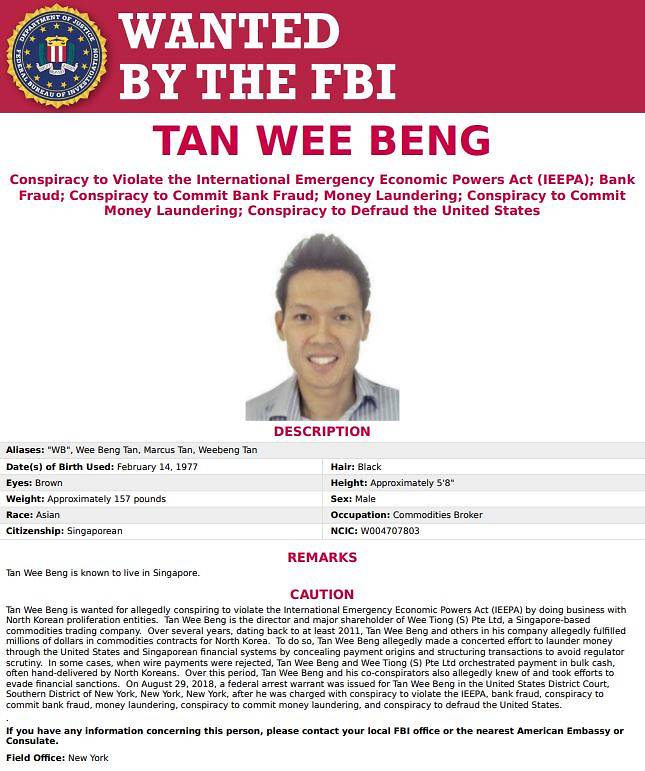
Tan Wee Beng FBI poster

A poster showing Singapore commodities broker Tan Wee Beng is wanted by the Federal Bureau of Investigation. (Image: Federal Bureau of Investigation)

The US Treasury Department had said that Mr Tan had hid the origins of payments and structured transactions to fulfil millions of dollars in North Korean contracts since at least 2011.

Further sanctions were imposed on two vessels tied to WT Marine, which the United States said engaged in illicit economic activity connected to North Korea.

Criminal charges unsealed against Mr Tan include those for bank fraud, money laundering and defrauding the US, according to an FBI notice. The arrest warrant was issued for Tan in August. 

In a statement by FBI assistant director William Sweeney Jr, he said:  “As alleged, (Tan) conducted illicit transactions totalling millions of dollars in support of North Korean entities in blatant violation of a host of economic sanctions the United States has established against North Korea and North Korean entities.”

Channel NewsAsia has contacted the Singapore Police Force and the Attorney-General’s Chambers for comments. 

Source link

125 arrested for offences including vice, scams in 5-day operation

0

SINGAPORE: A total of 125 people have been arrested for various offences in a five-day operation that was jointly conducted by five government agencies. 

According to a news release on Saturday (Oct 27), the operation took place from Oct 22 to 26 and covered Tuas, Jurong West, Choa Chu Kang, Bukit Panjang, Bukit Batok and Woodlands. 

The suspects were aged 18 to 62 years old, police said, adding that investigations against all of them are ongoing.

They included 47 women who were arrested for their alleged involvement in vice-related activities at residences as well as employment-related offences at public entertainment outlets.

Seventeen suspects – 14 men and three women – were arrested over e-commerce scams and offences related to commercial crime. Police said that preliminary investigations showed they were believed to be involved in 60 cases in which victims had lost more than S$356,000. 

The remaining 61 suspects were arrested for their alleged involvement in various crimes related to loansharking, immigration, outrage of modesty, robbery and other offences. 

Police said that a total of 4,332 packets of duty-unpaid cigarettes of assorted brands were seized. The total duty and goods and services tax evaded from the seized cigarettes were about S$43,980 and S$3,190 respectively. 

Cigarettes seized by authorities Oct 27

A total of 4,332 packets of cigarettes were seized in a five-day operation. (Photo: Singapore Police Force)

The operation was led by the Jurong Police Division and supported by the Central Narcotics Bureau, the Immigration and Checkpoints Authority, the Singapore Civil Defence Force and Singapore Customs. 

Commander of Jurong Police Division, Assistant Commissioner of Police Devrajan Bala, expressed his appreciation to all those involved in the operation.

“This joint operation is part of police’s continuous efforts to clamp down on criminal activities,” he said in the news release. “While the police work closely with other Home Team and law enforcement agencies to deal with those who take part in illicit activities, we also urge the public to be vigilant and not fall prey to crime.”

Source link

Excerpts from Tall Order: The Goh Chok Tong Story

0

SINGAPORE: Emeritus Senior Minister Goh Chok Tong’s authorised biography, titled Tall Order: The Goh Chok Tong Story, has reached bookshelves in Singapore.

Written by former Straits Times journalist Peh Shing Huei, the book is the first of what is expected to be a two-part series. 

It tells the story of Mr Goh’s life and career, from his childhood until he takes office as Singapore’s second Prime Minister in 1990, succeeding Mr Lee Kuan Yew.

Mr Goh’s own voice is heard directly in the book. First, book-ending the volume are a foreword and an afterword written by the Emeritus Senior Minister himself. Within each of the chapters – which take a chronological tour of his life – are also questions and answers from the interviews that the author undertook with Mr Goh.

The following are some excerpts from the Q&A between the author and Mr Goh:

ON HIS CHILDHOOD

What were your nicknames at home and in schools?

No nicknames at home. But Chinese like to use ‘Ah’ before your name, so I was ‘Ah Tong’ growing up at home. But among my friends in school, I had a few nicknames. I went by Panjang (a Malay word which means long). This was how friends teased me, but I never took any offence. One friend called me Shorty. Close friends called me Chok.

Were you tall since primary school?

Oh, I was. When I was in Primary 6, I was 68 inches (172cm) tall, I remember. I was very tall.

Goh Chok Tong

An image showing Emeritus Senior Minister Goh Chok Tong with former Hong Kong chief executive Tung Chee Hwa in the 1970s. (Photo: Facebook/MParader)

ON HIS ENTRY INTO POLITICS

Were you regarded as the top high-flyer in the 1976 general election and seen as one of the potential new Cabinet ministers?

I would not say so. At that time, nobody expected you to be anybody. Succession was still not quite yet flaunted or talked about. How did you know the others would not be high fliers? Nobody speculated that you would be an office holder and there was no point in speculating because the old ministers then were still quite young. It was too early to say. Your bigwigs in politics were there – Toh Chin Chye, Ong Pang Boon, Chua Sian Chin, Jek Yeun Thong, S Rajaratnam, E W Barker. They were in their late 40s, at most 50s. I was 35.

ON PAP’S FIRST ELECTORAL DEFEAT AT THE ANSON BY-ELECTION

What was the discussion with Lee Kuan Yew after the result?

There was a post-mortem. And that was how you learnt again. It was a quick post-mortem, but we all knew the reasons. But it was also looking forward. So, you learnt that what had gone, had gone. We called a meeting of all MPs and the question was: What do we do now in Anson? Do we continue to run the community centre (CC) in Anson or do we pass it on to JBJ (JB Jeyaretnam)? I felt that we should pass on the CC to JBJ. And many of the young ones felt so. I thought we should be fair – he had won, so pass on everything to him. The CC was part of Anson and we should pass it on. British parliamentary rules – accept it and shake his hand. Write him a congratulatory letter and so on. That was the thinking of the younger ones, the MPs.

LKY (Lee Kuan Yew) never scolded us but he asked the older ones. And they said, no, we do not pass it on. We keep it, this is our base. You pass it on to him, he would be entrenched and we would never win Anson back again. This cannot be done. So, you learn. Yet, what is the reason to justify keeping it? This is part of government facility. CC is part of the government – you do not pass on part of the government to the other side. We young naive ones thought the CC was part of the constituency’s institutions and we had to pass it on. The older ones said, no.

ON BRINGING LEE HSIEN LOONG INTO POLITICS

Leading up to the 1984 election, the major talking point was Lee Hsien Loong as a new candidate. Were you prepared for the public interest in him?

Of course. Surely. He is the son of Lee Kuan Yew. Surely people must speculate. The difficulty was for him to convince the public that he was not there because of Lee Kuan Yew. First, he must convince Lee Kuan Yew’s colleagues that he was not put in there by Lee Kuan Yew. Second, the ministers must be convinced that Lee Kuan Yew was not building a dynasty.

Lee Hsien Loong – and I have said it before on many occasions – came in because I spotted him. He was a colonel in the general staff office. He was a young man and I was the Defence Minister. At our Monday meetings, he had to make presentations. He was very articulate. I was very impressed by his articulateness, his logical thinking. So, I said, yes, he has the potential. I asked him if he was keen to be involved in politics some time in the future. He said he was.

Goh Chok Tong Tall Order cover

The cover of Tall Order: The Goh Chok Tong story. (Image: Google Books).

​​​​​​​

ON BEING A “SEAT WARMER”

How did you know you were not a seat warmer? 

It was interaction and confidence in him (Lee Kuan Yew). If I suspected that he was just putting me to be a seat warmer for his son, and just for two, three years, what is the point? Then I would have said ‘let us find a way for Lee Hsien Loong to take over from you.’ There was no need to have me. There was no point. But I never worried about the seat warmer joke. In my heart, I knew that Lee Kuan Yew never meant for me to be a seat warmer. Politicians must have some thick skin and be able to laugh it off because in my view, that is not what Lee Kuan Yew regarded me as. You must have self-respect. If Lee Kuan Yew used me for his own purpose, then what is the point for me? History would laugh at you, isn’t it? I have the self-confidence. I was prepared to do the job and I knew he was honest with me, with my strengths and weaknesses.

ON THE OPPOSITION

Would you be friendly with long-time opposition MPs like Chiam See Tong and Low Thia Khiang too?

I regard Chiam as a friend … I have seen him at dinners outside. He would come to me and I would go and talk to his wife and so on. If I see the wife, I would ask her how Chiam is. He was a gentleman politician. He had his own purpose in politics, which is to create a two-party Parliament. There is nothing wrong with that. We did not like it, but we said, you try, so he tried.

Would that be the same towards Low?

It is the same thing with Low. In fact, with most of the people, it is the same thing. We always watch. What is the purpose, their aspirations, their goals and would they bring Singapore down? Or would they be just difficult opponents for us? Then we got to be better than them. So, if they are honest and honourable and want to do good for Singapore even though it is in a different way, well, we can have a debate on that. But if your views are totally wrong in our view, like promising a welfare state and using the reserves, then we would fight you. We would fight you tooth and nail on your wrong-headed and populist approach.

So who would be someone whom you would not speak to?

Chee Soon Juan.

Source link

Commentary: Can young working parents survive without a maid?

0

SINGAPORE: Can young families do without maids? This is the million dollar question that every new parent struggles with.

The range of opinions on this is vast. Some feel strongly about having one as it allows both parents to work; others would rather do without help as they prefer to be the main care-giver imparting values and teaching to their children. 

I’ll be grappling with this reality come next year when we release our helper of three-plus years. She has served us well but her contract is ending and she has expressed her desire to return home and set up a small business of her own.

I’ve been mentally preparing myself for this day. Even though she’s a reliable help, I try to take care of our household groceries and do the cooking, and dishes when it’s her off day, in a bid to keep tabs on the level of dependence we have on her.

I also get the kids to clean up their own mess at the dining table and before bedtime so that they get a taste of what’s involved in keeping a household running.  

My emotions are mixed – on some days, I feel an odd rush of exhilaration (my planner persona kicks in, knowing that I’d be in full control of cooking and cleaning) tempered with anxiety (how am I going to handle three kids’ schedules, cook and clean, and put in an honest day’s work at the same time?).

READ: Instead of robots or commodities, why not treat foreign domestic workers like fellow human beings? A commentary

THE PROS AND CONS OF HIRED HELP

Hiring a helper can be a handy option for some, essential for others. I’m referring to those households where both parents work long or erratic hours and who do not have the luxury of having grandparent-carers.

In the absence of consistent help in the form of grandparents or affordable childcare, or in the case of having multiples or children with special needs, having an extra hand in the house can make a world of difference.

maid file photo

File photo of a foreign domestic worker.

But it also comes with a string of challenges, such as a lack of privacy in one’s home, lack of training in household responsibilities for kids, and the issue of trust when it comes to caring for the very young or the elderly.

Most acknowledge that it can be hard finding someone trustworthy and willing to serve the family wholeheartedly. 

In the beginning, having a total stranger into the home takes some getting used to. Language can be a major barrier, as with sharing control with an unfamiliar person.

When the child is very young, it is a common worry that she will grow too attached to “Aunty” and choose her over her parents. I’ve even heard of mothers instructing the helper not to hug or kiss their child, as a form of drawing the line.

EMBRACE THE GOOD WITH THE BAD, FOR A SEASON

Like many employers of helpers here, I had to accept both the good and the bad if I were to enjoy the mental space to focus on other priorities.

In some ways, it is like buying time for ourselves. By outsourcing less critical duties in the home, one may be able to rest better and be more intentional in building relationships with our kids or spouse.

For parents who work full time or hold multiple jobs, this time can be sanity-saving.

READ: Married couples want better work-life balance, a commentary

This is also what tipped the scales for us. On hindsight, I think her presence and support enabled our family to ride through a rough season – when the kids were younger and more difficult to handle. 

stock mother 02

A mother pushes her child in a pram. (File photo: Francine Lim)

With all of the conveniences of having a helper, however, the flipside is it is extra tough to train our children in household chores.

Research has shown that enlisting children’s help in household chores imbues in them a greater sense of ownership and responsibility.

Children who help out at home also tend to have higher self-esteem and are less self-absorbed. They learn to see themselves as contributors to the world, instead of only being responsible for (and taking pride in) their academic performance.

Now that our children are now older and more independent, we think it is time to end our season of hired help, and focus on building some of these life skills.

GET CREATIVE AS A FAMILY

In my role as a work-at-home mother, there is a level of flexibility as to how I fulfil my work responsibilities. In some ways, this allows me to face the upcoming transition with less unease.

For those working in a more typical office job and who are getting by with little help, it may require more supportive work-life policies to enable these parents to get off work earlier, tend to their children’s needs first, and pick up work later in the night as needed.

It may also call for some creative engineering on our part.

Friends who have survived without helpers cite thermal cookers, dishwashers, dryers, and robot cleaners as their best friends. Not to mention the various online grocers who (almost) magically show up at our doors with food to last a few days.

READ: A tale of two bankers and modern parenting, a commentary

what to do child vegetarian nutrition parents

(Photo: rawpixel / Unsplash)

Or maybe just a mindset shift. Like a friend quipped: “Just accept that the house will be at a new (and constant) level of mess.”

As author Charles Swindoll wrote: 

We are all faced with a series of great opportunities brilliantly disguised as impossible situations.

While I feel for the many young parents who are suffering from the chronic lack of sleep and time, we should also acknowledge that they are gaining new skills. They are masterful at planning, swift at problem-solving, and constantly thinking several steps ahead – surely every HR person’s dream qualities in a new hire.

Can modern dual-income families survive the daily grind without hired help?

I think it’s a situation where: “Whether you think you can or you can’t, you’re right.”

But whether you hire or you don’t, it’s best to be all in with your decision, and be ready to call it quits when the time is ripe.

June Yong is a mother of three, an educational therapist and owner of Mama Wear Papa Shirt, a blog that discusses parenting and education in Singapore.

Source link

Quick guide to becoming a successful landlord in Singapore

0

SINGAPORE: Renting out your property takes experience. After a few years, you’ll know which tenants will be great, and which ones will add therapy to your costs (judging from experience, the ones who go out of their way to impress you, such as by bragging about their high level job, tend to be the most problematic).

Until you’re a veteran who’s had at least six or seven tenants, here are some hacks to make things easier:

1. Keep note of the exact paints used

This is to make sure you can get the exact shade and colour for the inevitable touch-up. While most contractors can look at the paint and make a calculated guess, mistakes do happen – and there really can be a few hundred shades of white. Unless you want a patchwork effect on your walls, note down the brand, name, and product number of all paints used.

The other alternative is to just repaint everything in a new shade – but that can be expensive.

man paint wall interior design renovation

File photo. (Photo: Pixnio)

2. Use the 15 per cent rule for tax claims

In case you didn’t know, mortgage interest is tax deductible. But only the interest portion, and not the principal (this amount should be detailed in the regular letters from the bank).

In addition to claiming the mortgage interest, you can also make claims for maintenance costs. This can get a bit complicated – you need to list all the items and costs of replacements. So save some time: you can claim the mortgage interest, plus a flat 15 percent of gross rental income.

Note that you shouldn’t be too quick to do this if you’ve undertaken major repairs – the claimable amount could come up to more than 15 per cent.

3. Pre-arrange site inspections

In Singapore, landlords cannot disturb the peace and quiet of tenants with unannounced inspections. And quite frankly, no one is paying to live in a military barrack, so it’s best to lay off the stand-by bed. The problem is, you’ll want to know when something is broken or falling apart as soon as possible.

A good example of this are floorboards – especially if you get fungal issues (it really is possible for mushrooms to grow in your condo toilet, even on the 20th floor). Once floorboards start to warp and rot, you need to quickly fix the issue. Let the problem stew for half a year, and you’ll have to rip out the entire floor.

Arrange to investigate your property every six months (with the tenant’s permission, of course). It’s good for them too, since it lets them update you on what’s faulty and in need of replacement.

4. Place plastic or vinyl on the bottom of kitchen cabinets

Kitchen cabinets have a tendency to spoil fast, especially if food spills on the various drawers or floorboard. And keep an eye out for cabinets that conceal pipes: If they leak, the bottom of the cabinet can start to rot.

You can ask the contractor to lay plastic or extra vinyl (from flooring) along the base of drawers and cabinets. Do not use towels or newspaper – not unless you want to cultivate experimental lab bacteria. That only works if the tenant is willing to change them regularly; and most won’t.

File photo of home renovation

File photo of a home being renovated. 

5. Make the place as bright as possible when trying to find tenants

Strong, white light – along with white walls and ceilings – give the impression of newness and spaciousness. Avoid yellow lights, or similarly coloured walls when trying to draw tenants. In particular, avoid using wallpaper.

If the wallpaper gets damaged, and that particular print is not made anymore, you will end up changing the wallpaper for the entire room. So whenever possible, just use white paint.

6. Keep in touch with your tenant’s situation

Send the occasional birthday card, and drop by to talk to the tenant. It’s not just about being friendly; you want to keep yourself updated on your tenant’s situation. If they have just lost their job and are looking for a new one, or are homesick and want to fly back, you’ll get early warning.

This will give you fair time to prepare your finances, to cover a month or two when you may have to look for another tenant. You don’t want to find out at the last minute or when the lease expires, that they have no intention of renewing.

7. Use renovation loans before personal loans

Whenever you need to make major renovations and you need a loan to cover it, always use a renovation loan first. The interest on this can be as low as 3 to 4 per cent per year, whereas personal loans tend to be between 6 and 9 per cent.

If you have just bought the unit, the mortgage banker may be able to get you a good reno loan deal with the same bank. Sometimes you can get six month interest-free loans. Alternatively, use loan comparison websites to find the cheapest deal of the month.

Whatever the case, always use the renovation loan first. Only use the personal loan for the portion that would exceed the reno loan cap (most reno loans are capped at $50,000).

8. If you want to renovate while the tenant is there, position it as an upgrade

So you want to install a feature wall, or a bathtub, or an air-conditioner. Only problem is, you don’t want to annoy the tenant with the sound and dust. The solution is easy: Tell the tenant you’ve decided to upgrade the place for them, at no cost.

This makes it a little more acceptable to most tenants (and changes nothing for you, since you were going to do it anyway). The key is to always phrase it as a benefit to the tenants, which really it should be anyway.

9. Paint the furniture and appliances

So the furniture or an appliance is faded, rusting, peeling, etc. It happens. There’s only so many times you can yank a fridge handle, for example, before the silver coating peels to reveal plastic. The same thing often happens with shower faucets, because it’s such a moist environment.

If it works though, don’t be too quick to junk it. Get the right kind of paint from a DIY store (tell the shopkeeper what you are trying to repaint), and just paint over the ugly bits. Most of the time, you’ll find the results are quite passable.

Singapore Furniture Industries Council

File photo.

10. Started out as unfurnished, then buy over from the first tenant

Don’t want to furnish the apartment yourself? Here’s one alternative:

The first time you get a tenant, rent the apartment as unfurnished. Encourage your tenants to bring in their wardrobes, floating shelves, sofas, etc. When your tenant needs to move back home, offer to just buy over the furniture from them at a discount. Voila. Instant furnished apartment.

Of course, this runs the risk that they may not furnish it to your liking. But you can also pick and choose the bits that you want, and buy those over at second-hand prices. The tenant should be pretty happy to easily sell on their furniture rather than having to list and arrange hand over to multiple other people- as long as the price is right, of course.

This article first appeared on 99.co.

Source link