SINGAPORE: Singapore Zoo’s Lucy the giraffe is expecting the arrival of her first calf at the end of January next year, Wildlife Reserves Singapore (WRS) announced in a media release on Wednesday (Oct 31).
The 14-year-old giraffe was confirmed to be pregnant after keepers noticed a bump on her in April.
Her baby will be the first giraffe to be born at Singapore Zoo since male calf Jubilee was born in 2015.
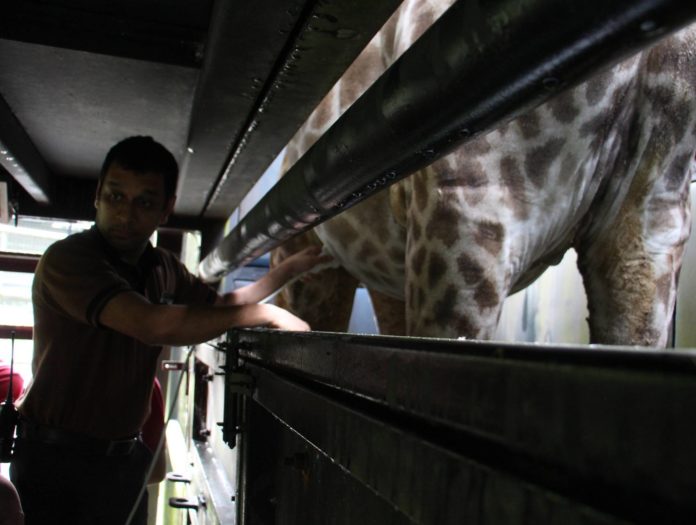
Lucy the giraffe towers over Dr Abraham Mathew, Assistant Director, Veterinary Services, Wildlife Reserves Singapore, as he conducts an ultrasound scan. (Photo: Wildlife Reserves Singapore)
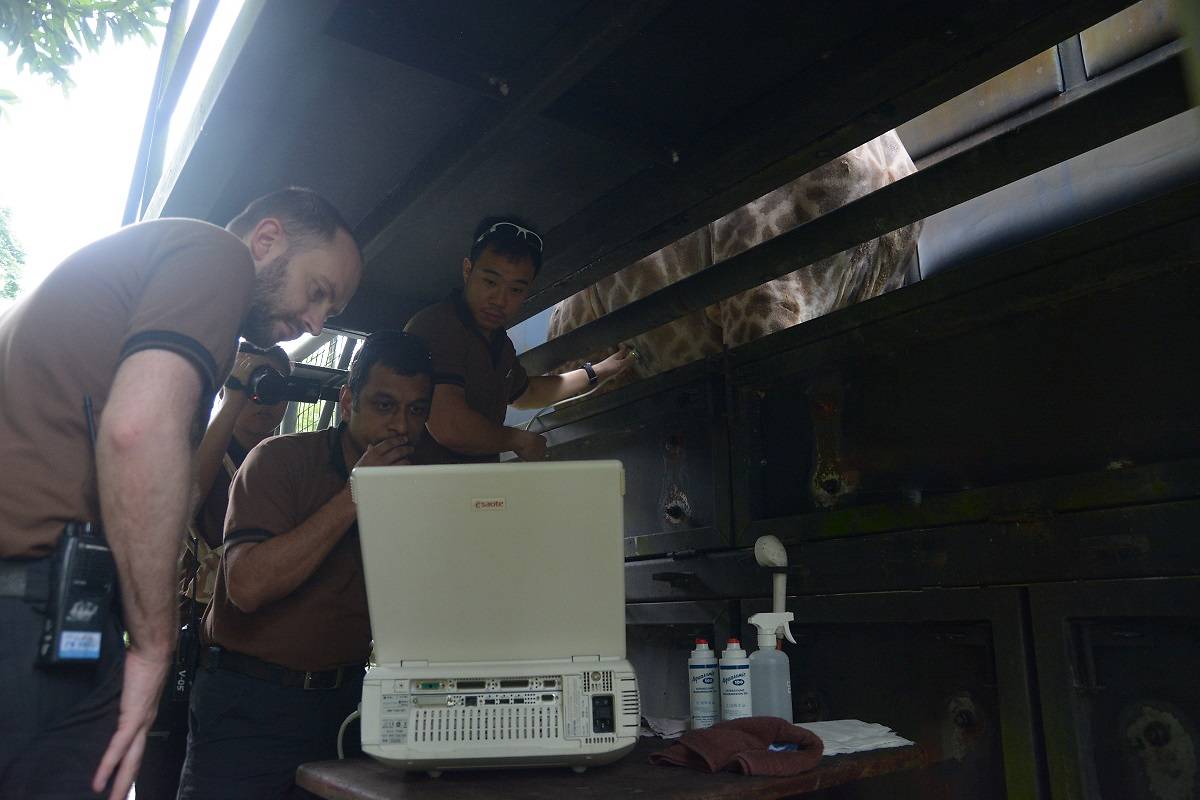
Keepers and vets have been conducting regular ultrasound scans.
“During these scans, the team has spotted baby’s heartbeat, ribcage and even little hooves!” said WRS.
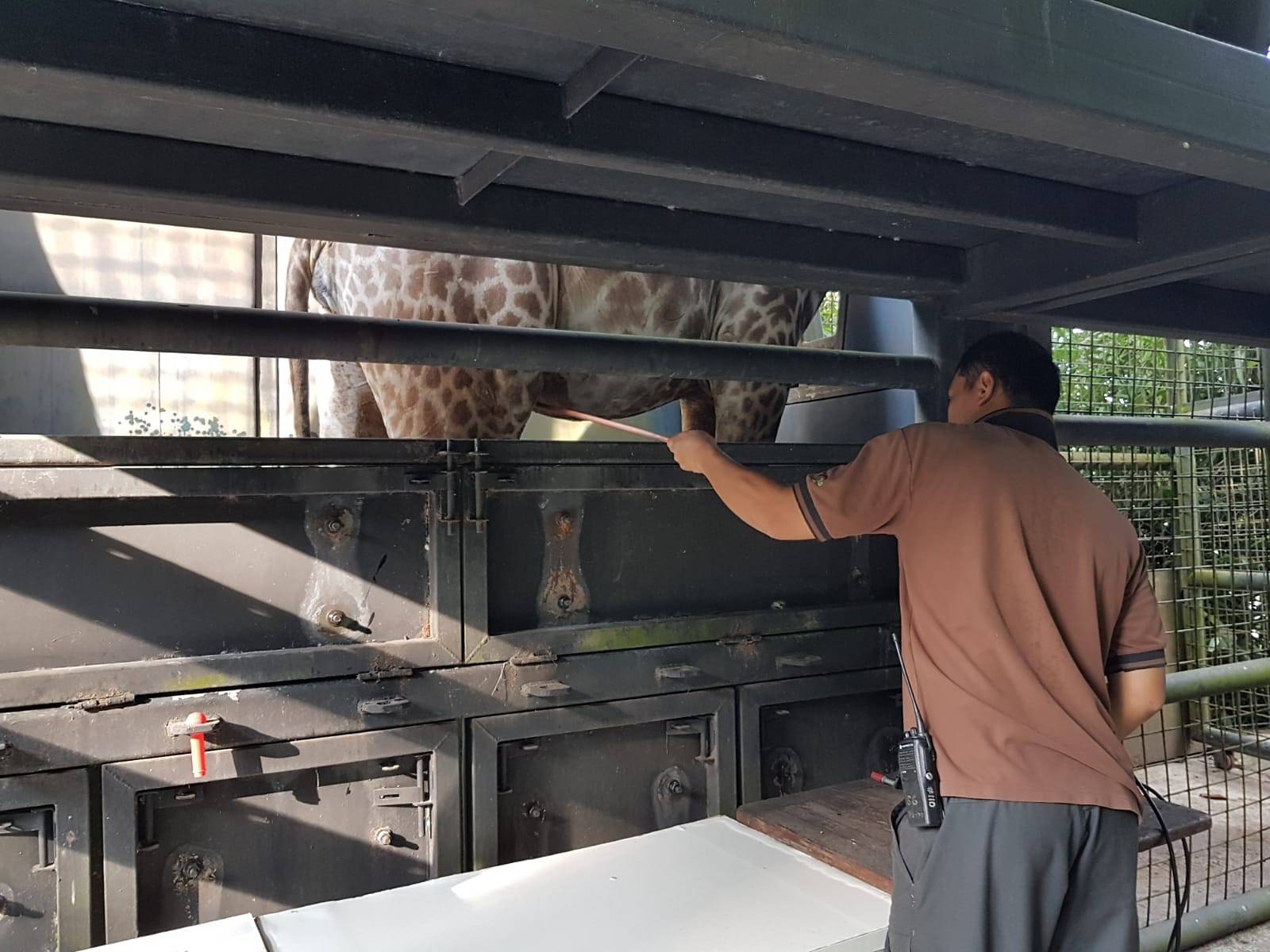
Zookeepers had in 2016 started conditioning Lucy to get her comfortable with ultrasound procedures, in anticipation of an eventual pregnancy.
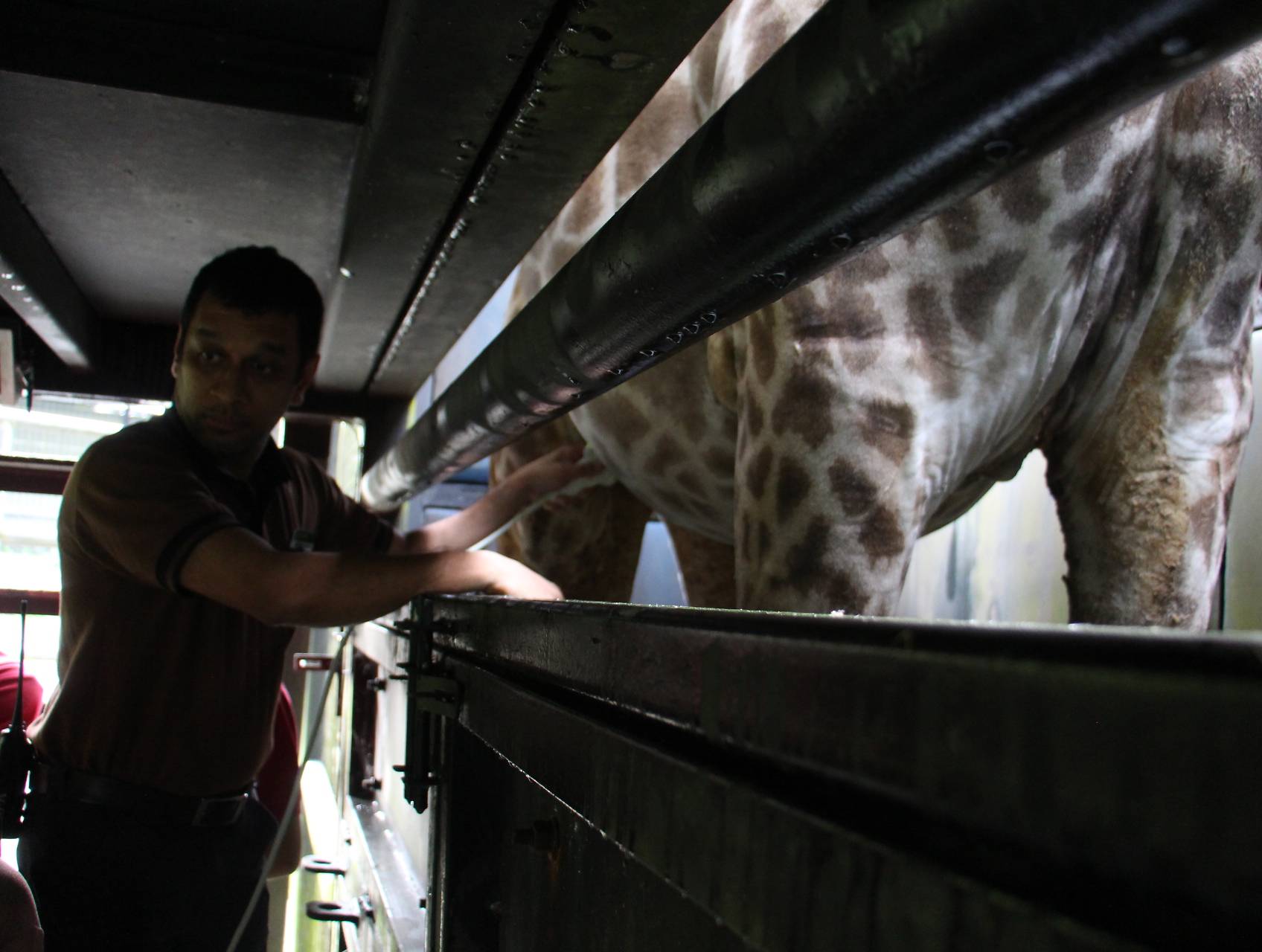
Veterinarians from Wildlife Reserves Singapore have been conducting regular ultrasound scans on Lucy to ensure her calf is developing well. (Photo: Wildlife Reserves Singapore)
“Giraffes are shy and skittish by nature and under human care it is often a challenge to conduct physical checks on them,” said WRS.
Lucy therefore had “months of having her tummy rubbed with a shower head smothered with lots of gel after she voluntarily enters a raceway” to get her used to ultrasound procedures, said WRS.
When Herbivore Keeper Hikmat Siliwangi and his team suspected that Lucy the giraffe might be pregnant, they devoted mornings to conditioning her for ultrasound scans. (Photo: Wildlife Reserves Singapore)
To make sure Lucy receives enough nutrition, keepers also give her “round-the-clock access” to alfalfa hay, assorted leaves and browser pellets (a type of food pellet).
She also gets a daily dose of green leafy vegetables, and is particularly fond of kang kong, added WRS.
Her food intake and weight are monitored daily.
Lucy lives with her mate 14-year-old male giraffe Marco, as well as three-year-old Jubilee.
SINGAPORE: A commission will be formed to develop guidelines and establish a reporting process for sexual misconduct in the local sporting fraternity, announced Minister for Culture, Community and Youth Grace Fu on Wednesday (Oct 31).
Speaking at a conference for coaches at Republic Polytechnic, Ms Fu said that there was a need for a “safe space” for individuals to voice concerns without “fear or discrimination”.
“All of us have to be vigilant and pay attention to what is happening around us in training and during competitions,” said Ms Fu.
“If we see or sense something amiss, we need to raise this with the appropriate authorities. Everyone in the fraternity has a responsibility in ensuring a safe environment in sports.”
Governing body Sport Singapore (SportSG) will partner the Ministry of Social and Family Development (MSF), the Singapore Police Force (SPF) and the Ministry of Education (MOE) to form the commission next year.
The announcement follows the Inaugural Safe Sport Forum held in May this year, which saw 59 National Sports Associations (NSAs) pledge a “zero tolerance” stance towards sexual misconduct in sport.
File picture of Singapore national hurdler Kerstin Ong (Photo: XYZ Photos)
Allegations of misconduct have been levelled against several coaches in recent times.
National hurdler Kerstin Ong lodging an official complaint with SportSG earlier this year, saying a former coach’s verbal and physical behaviour left her feeling “uncomfortable”. The coach was subsequently sacked by Singapore Athletics.
In March this year, a former rope-skipping coach was convicted of committing sexual offences against a student who was between 13 and 14 years old at the time. The coach was sentenced to 25 years in jail.
The problem of misconduct in the sporting arena is a “global crisis”, said Mr Troy Engle, the director of CoachSG, a coaching arm of SportSG.
“The single biggest problem facing sport in the world today is the issue of safety and protection of participants,” he said.
“You can’t pick up the newspaper or turn on the television in any nation in the world without attention to the challenges in securing the well-being of participants. First, we have to recognise that this is a global crisis.
“We know that we have problems here, just like there are problems everywhere in the world but I think the difference is that we are trying to take proactive steps to create a national system to get in front of it.”
As there is no standard system for reporting sexual misconduct across NSAs, Mr Engle said there is a need to have measures in place to address the issue.
“We’ve decided that it’s time for us to have an open and frank conversation about how we can guarantee participants and the families of participants that sport is a safe environment,” he said.
“Truthfully in sport, there wasn’t any universal SOP (standard operating procedure) that’s why we’ve recognised that we need to get in front of that. We have in conversations with National Sports Associations realised that they feel relatively under prepared.”
A collaborative effort with the SPF, MSF and MOE will be key in the effort to combat sexual misconduct, added Mr Engle.
“The NSAs have said they need some help in this. We’re really happy about involving some of the other inter-government agencies in this process,” he said.
“We are trying to work with experts in the field, we’ve talked to the global leaders in this movement about what they do and we’re trying to import a reasonable local system that will work within our Singapore context and it’s really been embraced by all our participants.”
SINGAPORE: Two residential sites and one White site with a combined yield of 2,000 homes and 540 hotel rooms were released for sale under the second half 2018 Government Land Sales (GLS) Programme on Wednesday (Oct 31).
The plot of land at Kampong Java Road belonging to the Urban Redevelopment Authority (URA) and the executive condominium site at Tampines Avenue 10 by Housing & Development Board (HDB) were launched for sale under the Confirmed List, URA and HDB said in a news release.
The URA White site, or mixed-use site, at Marina View is available for application under the Reserve List.
According to property services firm Colliers International, developers are expected to continue to be circumspect about land acquisition following the new cooling measures in July.
The tenders for the two land parcels at Kampong Java Road and Tampines Avenue 10 closes on Jan 15 next year.
With a site area of 11,643.3 sq m and a maximum permissible gross floor area (GFA) of 32,602 sq m, it can accommodate an estimated 435 housing units.
Colliers said that the it expects the 99-year-leasehold Kampong Java site to be a “litmus test”.
“Based on the map of Central Area, this site sits just outside of the Central Area and thus should be subject to a minimum average unit size of 85 sq m come Jan 17, 2019,” said Ms Tricia Song, head of research for Singapore at Colliers International.
“Response to the Kampong Java site could provide an indication of developers’ confidence in the high-end home market after a spate of collective sales in the area and the recent announcement on revised unit size guidelines,” she added.
She expects developers to place bids of about S$470 million or S$1,350 psf ppr, and target a S$2,100 psf average selling price.
Mr Ong Teck Hui, senior director of research & consultancy at JLL, said he expects bidders for the site to take into account the slower demand for private homes since the July cooling measures as well as the significant supply in the sales pipeline.
A location plan of the Tampines Avenue 10 land parcel. (Photo: HDB)
The executive condominium site in Tampines Avenue 10 has a site area of 24,938.7 sq m and a maximum permissible gross floor area (GFA) of 69,829 sq m. It can accommodate an estimated 695 units.
Colliers expects this plot to be popular, after recent bids for executive condominium sites at Anchorvale Crescent and Canberra Link saw seven and nine tight bids.
Mr Ong from JLL concurred, saying that he expects between six and 10 developers contesting for the site.
“Due to the shortage in supply of new ECs and keen demand from buyers, developers would have a more optimistic outlook on the EC market,” he said, adding that the top bid could com in between S$500 and S$600 psf ppr.
MARINA VIEW
An aerial view of the Marina View land parcel. (Photo: URA)
The White site at Marina View is projected to be a mixed-use development with about 540 hotel rooms, complemented by supporting retail and food and beverage uses. It is available for application under the Reserve List.
The land parcel has an area of 7,817.6 sq m, with an underground space of 18 sq m. The maximum permissible gross floor area (GFA) stands at 101,629 sq m.
As the Marina View site is situated within the Downtown Core, next to the future Shenton Way MRT station and flanking both Marina Bay and Shenton Way, Colliers expects developers with hotel interests or varying interests to form a joint venture, as the entire development will be held under a single strata lot.
The top bid is estimated to range from S$1,380 to S$1,600 psf ppr, or S$1.5 billion to S$1.75 billion.
The site is also expected to yield an estimated 905 housing units.
SINGAPORE: The iconic Golden Mile Complex is deemed to have heritage value and authorities are in the process of exploring options to facilitate conservation, said the Urban Redevelopment Authority (URA) on Wednesday (Oct 31).
This comes even as the development tries to find a buyer, with the collective sale tender launched on Wednesday at a reserve price of S$800 million.
The building may not be demolished, as an outline application has been submitted to retain the existing 16-storey building, with the addition of a new block next to it, said the property’s marketing agent Edmund Tie & Company’s (ET&Co). This is subject to authorities’ approval.
“Regarding the outline application, URA has advised that Golden Mile Complex is under conservation study and they are open for discussions to facilitate conservation,” said the marketing agent in its tender announcement.
An en bloc of a large-scale conserved building in Singapore is unprecedented, said ET&Co’s senior director of investment advisory Swee Shou Fern. She added that a longer tender process will be conducted to allow interested parties to carry out a detailed study.
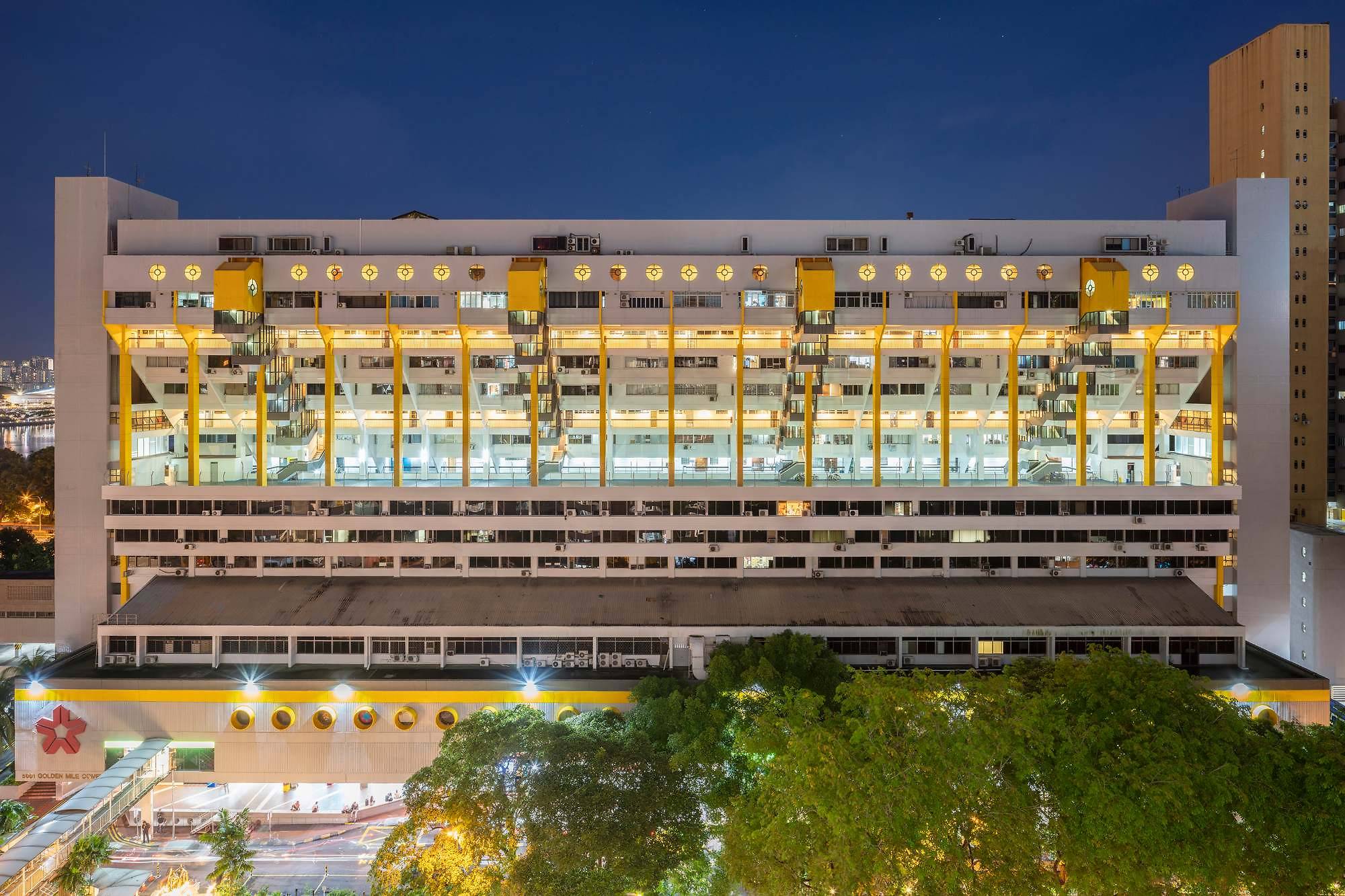
Completed in 1973, the signature step-terraced building along Beach Road and Nicoll Highway was designed by DP Architects, formerly known as Design Partnership.
The building, which was built in 1973, was designed by DP Architects. (Photo: ET&Co)
DP Architects will be the consultant architect for the development, as appointed by the Collective Sale Committee.
Located along Beach Road and Nicoll Highway, the property has a land area of about 1.3ha and is zoned for commercial use under Master Plan 2014.
Describing Golden Mile Complex as “an architectural icon”, director of DP Architects Chan Hui Min said that the building is important to the public memory of Singapore.
“Many successful developments that integrate older buildings not only manage to optimise the land use efficiency, but also leverage on the history of the site to bring value to the sense of place and identity of the development,” she said.
“We can create win-win situations with sensitive adaptive reuse.”
Formerly known as Woh Hup Complex, the Golden Mile Complex was built in 1973. It was designed by Singapore’s pioneering architects Gan Eng Oon, William Lim and Tay Kheng Soon. (Photo: Darren Soh)
In response to Channel NewsAsia’s queries, URA said: “Modern architecture, dating from our recent past, is a significant aspect of our built heritage, and we have selectively conserved a number of such buildings.
“Where there are strong support and merits for conservation, we will work with the relevant stakeholders to facilitate the process.”
The differential premium to intensify the land use as well as the premium to top up the lease to 99 years will depend on the developer’s proposed land use mix, said ET&Co.
The tender exercise will close on Jan 30 next year at 3pm.
SINGAPORE: A one-of-a-kind, 5,655-carat emerald crystal weighing a whopping 1.1kg has been discovered in Zambia, Gemfields announced on Monday (Oct 29).
The London-based supplier of sustainably sourced gemstones described the precious jewel as having “remarkable clarity and a perfectly balanced golden green hue”.
The crystal was unearthed in October in Kagem, the world’s largest mine, which is 75 per cent owned by Gemfields and 25 per cent owned by the Zambian government’s Industrial Development Corporation.
It has been named Inkalamu (which means lion in the local Bemba language) in honour of the work carried out by two of Gemfields’ conservation partners, the Zambian Carnivore Programme and the Niassa Carnivore Project in Mozambique.
Emerald supplier Gemfields describes the crystal as having “remarkable clarity and a perfectly balanced golden green hue”. (Photo: Gemfields’ Facebook page)
“The naming of uncut emeralds is a tradition reserved for the rarest and most remarkable gems,” said the company in its announcement. “While no official records exist, perhaps two dozen have merited their own name and with the majority weighing less than 1,000 carats.
“Gemfields last named an emerald in 2010 when it unveiled the Insofu or Elephant Emerald.”
The Lion Emerald will be auctioned in Singapore in November to about 45 partners selected for their “shared values in responsible practices”, said Gemfields. It added that in contrast to the diamond industry, the price for exceptionally large emeralds like Inkalamu is particularly difficult to predict.
“We expect a number of large, fine-quality cut emeralds to be borne of the Inkalamu crystal,” said Adrian Banks, Gemfields’ managing director for product and sales. “These important pieces are what return value to the buyer and there might be hundreds of offcuts that are fashioned into smaller gems, cabochons and beads, but the key lies in recovering the fine quality pieces.
“Given this emerald is such a rare find, it is also perfectly conceivable that the buyer will choose to purchase it as an investment.”
SINGAPORE and MALAYSIA: It has built its reputation on serving see-hum (blood cockles), and the star dish at the Two Chefs Eating House is still its garlic and chilli cockles. The restaurant in Commonwealth Crescent serves over 10 kilogrammes of these cockles daily.
In recent times, however, they have become even more precious to owner Lam Chan Wah. Five years ago, they cost him around S$1.50 to S$2 per kg, but that figure is now around S$4.50 because the supply has been dwindling.
In 2013, Singapore imported 2,720 tonnes of cockles from Malaysia, the source of more than 99 per cent of the Republic’s live cockles. That has now fallen to 1,700 tonnes a year. So what has happened?
Mr Lam Chan Wah says there have been more customers even as the cockle supply has decreased.
With food prices rising by 2.1 per cent a year, on average, over the past five years, the series For Food’s Sake finds out what is behind the hikes in the prices of various foods, from rice to bananas to sugarcane.
It is not only about climate change or inflation caused by labour cost. The reasons are scandalous in some cases, such as chicken (price-fixing) and cockles being ruined by the direct impact of human development on the environment. (Watch this first episode here.)
And for Singaporeans who have grown up eating cockles as a must-have ingredient in their laksa and char kway teow, it is not only a matter of price.
As presenter and foodie Lennard Yeong discovered when ordering laksa at a stall, the hawker could not provide more see-hum than the usual amount, not even for extra money, because of the low supply.
Mr Yeong wasn’t expecting the hawker to skimp on cockles.
HEADACHE FOR FISHERMEN
Blood cockles have always been a widely available source of protein in Singapore. They get their name from their red flesh, caused by high levels of haemoglobin. And their slightly metallic flavour makes them a delicacy – like oysters, but cheaper.
In Malaysia, cockles are a key income source for fishermen in the main breeding states of Selangor, Perak, Penang and Johor. But it is now a multimillion-ringgit industry teetering on the brink of a crisis.
In 2005, the country produced 100,000 tonnes of cockles for export and local consumption. But by 2015, only 16,000 tonnes were harvested. And the shortage is getting more serious.
Take, for example, Mr Halim Mat Sa’ad from Kuala Juru in Penang. He has been in the business for 20 years, and he went from catching 250 kg of cockles per day in 2014 to 50 kg at most now.
His earnings have shrunk by two to three times over those four years, and nothing has prepared him for this problem. He said:
It isn’t enough to survive. This income issue gives me a headache.
Cockles spend their lives burrowing in the muddy seabed not far from the shore, and Malaysia’s coastline was once a fertile breeding ground, thanks also to its relatively slow currents.
But its cockles are dying off because the natural balance of their habitat is being disturbed. “It’s because the water is contaminated by acid, or chemicals are released into the water, causing pollution and harming the cockles,” said Mr Halim.
In Penang, the island’s second bridge to the mainland, completed in 2014, has also affected the fishermen’s livelihood because it changed the water currents, according to him.
“When the water doesn’t flow fast enough, it causes the mud to build up, so it’s hard for us to fish for them,” he said. “The cockles can’t survive when the mud is too thick.”
HIGH NITRATE LEVEL
To test what is in the water, Mr Yeong enlisted the help of the Centre for Marine and Coastal Studies at the Universiti Sains Malaysia.
And the results of the samples indicated that the nitrate level in the seawater was “pretty high”, said research officer Nithiyaa Nilamani. It is one of two chemical compounds that are especially bad news for cockles. The other is phosphate.
“Those are the nutrients that come from river runoff,” she said. And high levels of both mean that the mudflats have been affected by chemicals leaking from farms or nearby factories.
“Nitrite would enter the system of the cockle, and it would bind with the blood system, and it would reduce the oxygen level in the cockles. So that’s how they would suffocate, and it would cause mortality.”
Ms Nithiyaa Nilamani.
Studies have traced the impurities to agricultural pesticides as well as waste from industrial and construction sites.
Penang, for example, has been transformed into a tourism paradise and manufacturing hub over the past 20 years. It has seven industrial parks, including on the mainland, and by 2016, about 3,000 manufacturing companies.
SMUGGLING AND OVERHARVESTING
To protect the cockle population, the Malaysian authorities have limited the amount of cockle spat (young cockles) that can be harvested. These are precious because they can help to culture new cockles.
Baby cockles caught by fishermen in Johor, for example, are in demand in states like Selangor, Perak and Penang “so they can grow them there”, said Mr Hairul Akbar Saat, the general manager of the Pontian District Fisherman Association.
Mr Hairul Akbar Saat.
The spat can be distributed only within Malaysia. But not everyone follows the rules. He said:
You need a permit to distribute the cockle spat to other (Malaysian) states, but some greedy fishermen who want more income sell them to people who smuggle (the spat) to Thailand.
The Thais love cockles as much as the Malaysians do, but their coastline does not produce enough to meet the demand. That is why the smuggled spat can go for as much as five times the price in Malaysia.
According to Mr Hairul, the baby cockles are thrown into cans or gunny sacks and stashed in lorries, usually under legitimate cargo. The spat can live one to days on land and must then go back into water or perish.
There were 33 cases of smuggling reported in 2015 and 35 cases in 2014. Those found guilty may face a two-year jail term or a fine of more than RM80,000 (S$26,450).
In general, the overharvesting of baby cockles, when the mature ones are in short supply, makes it even harder for the population to recover, said Dr Hadzley Harith from the Fisheries Research Institute in Penang.
Dr Hadzley Harith.
Cockles have a lifespan of about three years, and “if we cut the reproductive cycle … we’re promoting the shortage of cockles in the environment”, he added.
“Our biggest task is to persuade the local (fishermen) to do proper management and to harvest the cockle (according to the size) … (and) that cockles aren’t an open bank (which they) can harvest daily or every time.”
WHAT MORE CAN BE DONE
One person on a mission to help revive the cockle population is Centre for Marine and Coastal Studies director Aileen Tan. She wants to breed cockles in a fully controlled environment to reduce the dangers of contamination and overharvesting.
Dr Aileen Tan, like many Malaysians, can’t imagine her char kway teow without cockles.
“I’m trying to find other ways to culture cockles rather than in their natural site, which is now considered as polluted. So we’ve introduced cleaner or bigger-sized sediment for them to attach to,” she said.
“If you see the cockles opening up, that means they’re comfortable with the environment. Digging into the substrate … shows that they’ve already started feeding. That means they’re no longer under stress.”
At the centre’s laboratory, Malaysia’s oldest at 35 years old, she has experimented with different kinds of sand for cockles to live in, instead of mud, which gets contaminated easily. And the cockles seem to prefer the finer sediments.
If her method works, she thinks that a lot of unused prawn ponds along the coastline can be used to grow cockles, with their favourite type of sediment placed there.
Dr Tan’s breeding experiment.
Cages could also be utilised, following the aquaculture example of many other seafood farms across Asia. The cages would protect the cockles from touching the sea floor and river bed, where the heavy metals and other pollutants tend to collect.
Dr Tan believes that these methods will guarantee healthier cockles and reduce their mortality rate.
“Our waters aren’t going to get better. Capture fisheries aren’t making money any more. Aquaculture is the answer now. So this is the beginning of the aquaculture of cockles,” she said. “We need the cockles back desperately.”
Still, it would take a while for the population to recover through farming and even longer for the price to drop. Are the days of cheap and ubiquitous cockles over, at least for now?
Said Mr Yeong: “It feels as if it’s time we get used to eating laksa and char kway teow without cockles, unless you’re willing to pay top dollar.”
Watch this episode here. The next episode of For Food’s Sake airs on Monday, Nov 5, at 8pm.
Garlic and chilli cockles, the star dish at the Two Chefs Eating House.
SINGAPORE: Trade is very much in the news these days, mostly because of the ongoing trade war between the United States and China.
In the face of this and other challenges, many businesses must make risk assessments and operational adjustments to take in the new, volatile economic and political landscape.
Against this backdrop, the recently inked EU-Singapore Free Trade Agreement (EUSFTA) stands out and is significant for a few reasons.
First, it provides businesses of Singapore and the EU countries better access to each other’s markets.
For Singapore small- and medium-sized enterprises making goods ranging from samosas and belacan chilli to electrical equipment, the agreement will potentially open doors to the EU market by removing or reducing barriers which may otherwise hinder or delay trade. Similarly, EU suppliers of goods and services will enjoy greater access to the Singapore market.
Second, the EUSFTA joins a number of other recently concluded bilateral and regional agreements (including the Comprehensive and Progressive Agreement for Trans-Pacific Partnership, or the CPTPP Agreement) which continue to promote trade liberalisation, the streamlining of rules and the reduction of red tape.
Although broader trade negotiations at the World Trade Organisation have stalled, agreements such as the EUSFTA allow countries to continue to work with trade partners to open up their markets.
The EU-Singapore Free Trade Agreement being signed by Prime Minister Lee Hsien Loong with European Commission president Jean-Claude Juncker, European Council president Donald Tusk and Austrian Chancellor Sebastian Kurz. (Photo: Tang See Kit)
Such agreements provide concrete and legally binding commitments by countries to enhance market access for a wide range of goods and services, which is a welcome assurance and friendly signal to businesses.
PRE-CURSOR TO A WIDER FTA
Third, the EUSFTA will be a useful pathway to explore a wider trade arrangement between the EU and ASEAN as a whole.
Fourth, when the United Kingdom exits the EU in March 2019, the EUSFTA can serve as a convenient reference for negotiations between Singapore and the UK, should they wish to form a bilateral free trade agreement fairly quickly.
Fifth, for Singapore, the EUSFTA provides another reason for businesses to consider it as a base for business activities, as Singapore’s various trade agreements allow goods made in the nation-state to enjoy preferential access in a large number of markets.
This is bolstered by Singapore’s strong trade infrastructure and connectivity, which help goods move more efficiently from its factories to overseas markets.
This, in turn, can help such goods to better compete in global markets. Importantly, the concept of “ASEAN cumulation” found in the EUSFTA opens the possibility for various products to be considered as being made-in-Singapore (to qualify for the FTA’s benefits), even if some of their components are sourced from the ASEAN region.
MAKING SINGAPORE AN ATTRACTIVE BASE FOR BUSINESS
Finally, while goods made in other ASEAN countries, such as Malaysia and Vietnam, also enjoy preferences in their own FTA partner countries, Singapore is presently the only ASEAN country which simultaneously has preferential trade agreements with its ASEAN neighbours, China, India, Japan, Korea, Australia, New Zealand, the US, and possibly soon, the EU, and CPTPP countries such as Chile, Mexico and Peru as well.
A view of the Singapore skyline. (File photo: Reuters)
Singapore manufacturers would therefore be able export to such destinations while taking advantage of the various trade benefits offered by these agreements.
Taking the recent announcement by Dyson as an example, its electric cars to be made in Singapore will enjoy various preferences when those cars are exported to the countries with which Singapore has FTAs.
More significantly, this means that Dyson – a British company – may have preferential access for its Singapore-made products in many markets, including the EU’s, subject to the terms of the EUSFTA, despite Brexit.
Better access to the EU market also awaits those who provide financial, e-commerce and other services.
STRENGTHENING TRADE AND INVESTMENT TIES BETWEEN SINGAPORE AND THE EU
The EU-Singapore relationship is not only being strengthened in the area of trade but also in the area of cross-border investment.
The EUSFTA met a speed bump in May 2017 when the European Court of Justice ruled that its investment protection provisions (including those on investor-state dispute settlement) were matters which had to be approved by each EU member state.
The logo of the European Court of Justice is pictured outside the main courtroom in Luxembourg January 26, 2017. Picture taken January 26, 2017. (Photo: REUTERS/Francois Lenoir)
Undeterred, the EU and Singapore reworked the EUSFTA, removing and reworking its investment provisions. The new investment provisions are now housed in a separate agreement, the EU-Singapore Investment Protection Agreement (EUSIPA).
The EUSFTA can now proceed for approval by the European Parliament, while the EUSIPA awaits individual EU members’ approval. This way, the EUSFTA benefits can become available sooner for EU and Singapore businesses.
Should the EUSIPA receive the requisite EU members’ approval, Singapore and EU investors will then additionally also enjoy investment protection benefits – such as certain guarantees as to how Singapore investors – who, for example, acquire or set up businesses in the EU – will be treated in the EU, and vice versa.
Against a global backdrop of the US-China trade war and growing protectionism, the EUSFTA heralds a refreshing commitment between Singapore and the EU to continue building trade opportunities and to keep trade flowing and growing.
Locknie Hsu is Professor at the School of Law at the Singapore Management University.
SINGAPORE: Singaporean Analiza Mokhtar was crowned winner of the Mediacorp Subaru Car Challenge 2018 on Tuesday (Oct 30), after keeping her palm on a car for 75 hours, 17 minutes and 58 seconds.
Ms Analiza Mokhtar outlasted her competitors by placing her palm on the car for 75 hours, 17 minutes and 58 seconds. (Photo: Jeremy Long)
This is her 12th attempt, having taken part in the event almost every year since 2005.
Analiza Mokhtar wins the Mediacorp Subaru Car Challenge 2018. (Photo: Jeremy Long)
For being the last woman standing in the endurance competition, the 40-year-old bank employee won the grand prize of a brand new Subaru 2.0i-S worth more than S$70,000.
Ms Analiza Mokhtar won a brand new Subaru 2.0i-S worth more than S$70,000. (Photo: Jeremy Long)
She was named the winner shortly after Thai national Phraitoon Sanguannam, 33, dropped out.
Analiza Mokhtar from Singapore at Car 8 braving the rain on Tuesday (Oct 30) during the Mediacorp Subaru Car Challenge. (Photo: Jeremy Long)
The endurance competition, which is in its 17th year, kicked off at 1pm on Saturday at Ngee Ann Civic Plaza, with almost 400 participants.
More than 100 of them had dropped out by the end of the first day, due to the hot and humid weather.
On Tuesday, heavy rain with lightning and thunder put a temporary stop to the competition.
Analiza Mokhtar, winner of the Mediacorp Subaru Car Challenge 2018. (Photo: Jeremy Long)
“I’m someone who never ever gives up regardless of how many attempts I need to get it done, I’ll get it done,” she said after being crowned winner of the 2018 edition.
“You need to enjoy the process in order to get to your destination. I’m actually enjoying the process of the Subaru Challenge by singing because I love to sing. Just enjoy the process and never give up,” she added.
“You need to enjoy the process,” says Analiza Mokhtar, who won this year’s Mediacorp Subaru Challenge. (Photo: Jeremy Long)
Analiza would have won the car’s Certificate of Entitlement (COE) as well, had she broken the record of 82 hours and 16 minutes that was set in 2014.
Analiza Mokhtar, winner of the Mediacorp Subaru Car Challenge 2018. (Photo: Jeremy Long)
In addition to the grand prize, this year’s edition included a team challenge where groups of up to five with the highest cumulative time can win S$1,000.
Alongside the main event, there was also the Mediacorp Charity Challenge where Mediacorp celebrities attempted to surpass each other’s times to raise funds for beneficiaries of the President’s Star Challenge.
SINGAPORE: The first tranche of the Aljunied-Hougang Town Council (AHTC) trial ended on Tuesday (Oct 30) after 17 days, during which the court saw some strong allegations, heated exchange and spirited defence.
The trial, which began on Oct 5, is centred on the town council and those who led it. Workers’ Party (WP) Members of Parliament Sylvia Lim, Low Thia Khiang and Pritam Singh, along with AHTC town councillors Kenneth Foo and Chua Zhi Hon, have been accused of breaching their fiduciary duties in the appointment of FM Solutions and Services (FMSS) as managing agent.
This appointment led to AHTC making more than S$33 million in “improper” payments to FMSS, which was helmed by “conflicted” parties who had held roles in both the town council and the management agent, it was alleged.
The “conflicted” parties are Ms How Weng Fan, who has worked with Mr Low for more than two decades, and her late husband Danny Loh.
The eight defendants are being sued by AHTC and Pasir Ris-Punggol Town Council (PRPTC), on the back of audit reports by KPMG and PricewaterhouseCoopers.
On Tuesday, six defence witnesses took the stand, including ex-employees of AHTC and FMSS. Most of them gave evidence only briefly, with some of them not asked a single question.
Defence lawyer Leslie Netto, who represents Ms How, Mr Loh and FMSS, wrapped up his case on Tuesday after his witnesses were cross-examined in quick succession. This is the last of the hearing until March, when parties are expected to make their oral closing submissions.
FMSS’ How Weng Fan takes the witness stand on Tuesday (Oct 30), while former AHTC chairman Sylvia Lim looks on. (Sketch: Lydia Lam)
PHONE CALL WAS RECORDED BY MS HOW’S OFFICE SYSTEM
Mr David Chan, the lead lawyer for AHTC, addressed the first witness Ms How on a point made a day earlier by PRPTC lawyer Davinder Singh.
Mr Singh – who was unable to be in court on Tuesday – had on Monday read out portions of a phone call between Ms How and a partner at audit firm KPMG in 2016.
She also said: “All PAP need to do is come and ask me for my views for MPs la. I think they will die straightaway la.”
Mr Chan on Tuesday asked Ms How if she had facilitated the recording.
Ms How answered that the phone call was recorded automatically by a system in her office.
When asked if she had told the KPMG partner that the conversation was being recorded, Ms How said: “I don’t think so.”
She was re-examined briefly by Senior Counsel Chelva Retnam Rajah, lead lawyer for the WP MPs and AHTC councillors. She was then released from the stand, to be replaced by the next witness, FMSS shareholder and former deputy general manager of the town council, Mr Yeo Soon Fei.
ENTIRE PAYMENT PROCESS FACILITATED BY “THE VERY PEOPLE PAYMENT WAS BEING MADE TO”
In cross-examining Mr Yeo, Mr Chan stressed that the entire payment process was facilitated by “the very people the payment was being made to”.
Mr Yeo had been identified in the KPMG report as a “conflicted person” – which according to the report refers to people who had direct ownership interests in FMSS or its service provider FMSI and concurrently held management positions in the town council.
Mr Chan suggested to Mr Yeo that only those in FMSS – Mr Yeo, Ms How and Mr Danny Loh – were involved in the payment process, which includes works orders, tax invoices and payment vouchers.
AHTC lawyer David Chan cross-examines FMSS shareholder and former AHTC deputy general manager Yeo Soon Fei on Tuesday (Oct 30). (Sketch: Lydia Lam)
In response, Mr Yeo argued that at the end of the day, it was the town council that was the paymaster. “If they don’t approve, we don’t get the payment,” he said.
Mr Chan also pointed out that a stamp Mr Yeo had used on tax invoices – which stated that he certified works had been done – merely meant that Mr Yeo was confirming the accuracy of the figures. “So you’re not really certifying works received, you’re just tallying figures,” Mr Chan put to Mr Yeo. After some clarification, Mr Yeo acknowledged this point.
When asked if he had ensured that the works were satisfactorily completed before signing off, Mr Yeo said that the MPs were the ones who made the checks, noting that they were “the best people to oversee (them)”.
“If we don’t perform, the MPs will come after us,” he said.
“The MPs, they saw us working from day to night from 2011 to 2015 … and I got high blood because of that, it’s very stressful,” he said. “We scratch our head to ensure that we cannot let the town council down.”
Mr Chan also explored the issue of payment processes briefly in the cross-examination of the next two witnesses Mr Ronley Ng and Mr Tan Han Hoe, both of whom had roles in FMSS or AHTC.
Mr Ng confirmed that he was not involved in the payment process other than to compile the relevant documents and present them to the town council chairman. Mr Tan said that his role was to check through the documents submitted to the finance department for payment.
Two other witnesses who were previously with Hougang Town Council, Ms Serene Loi and Ms Chong Huey Jiuan, took the stand only to be told by the lawyers that they had no questions for them.
Fourteen witnesses took the stand throughout the trial, which spanned more than three weeks and ended three days ahead of schedule.
It began with the defence cross-examining the plaintiffs’ two witnesses KPMG and PwC. The auditors had pointed to poor controls in the town council, flawed governance and millions of allegedly improper payments made by the town council to FMSS.
After this, WP MPs Low Thia Khiang, Sylvia Lim and Pritam Singh were grilled on the stand, largely by Pasir Ris-Punggol Town Council (PRPTC) lead lawyer, Senior Counsel Davinder Singh.
At the heart of the MPs’ defence is their claim that they acted in good faith and in the best interests of their residents, as they had to work swiftly against deadlines to find a managing agent and ensure continuity of services to residents.
After the MPs, AHTC town councillors Mr Foo and Mr Chua took the stand, followed by several other defence witnesses ranging from finance managers at AHTC and former employees at FMSS.
Both the plaintiffs and defence will have to submit their written closing submissions around mid-January next year. The date for their oral closing submissions is scheduled for March.
Justice Kannan Ramesh will subsequently rule if the defendants are found liable. If they are, the question of damages will be addressed.